INTRODUCTION
Killer whales (Orcinus orca) are widely distributed throughout the world's oceans, where they forage on a large variety of different prey species ranging from fish to marine mammals and birds (Forney & Wade, Reference Forney, Wade and Estes2007). It has been shown that feeding ecology is of central importance to the killer whales' social network. Food availability has a direct influence on group structure, and it is under debate to what extent the sociality of killer whales is flexible enough to adapt to local ecological conditions (Beck et al., Reference Beck, Kuningas, Esteban and Foote2012; Foster et al., Reference Foster, Franks, Morrell, Balcomb, Parsons, van Ginneken and Croft2012).
In the north-east Pacific some highly specialized sympatric populations have evolved, with resident groups foraging on salmonids, transient groups feeding on marine mammals, and offshore groups feeding on fish such as sharks (Ford et al., Reference Ford, Ellis, Barrett-Lennard, Morton, Palm and Balcomb1998). Often these specialized populations show high site and time fidelity, such as the northern and southern resident lines in the north-east Pacific which feed primarily on Chinook salmon (Oncorhynchus tshawytscha) (Ford & Ellis, Reference Ford and Ellis2006). The survival of these killer whales seems to depend on the Chinook salmon's year-round abundance (Ford et al., Reference Ford, Ellis, Olesuik and Balcomb2010).
In the north-east Atlantic at least two different populations have been recently identified, including a herring feeding population in Norway and Iceland (Foote et al., Reference Foote, Vilstrup, de Stephanis, Verborgh, Abel Niellsen, Deaville, Kleinvane, Martín, Miller, Oien, Pérez-Gil, Rasmussen, Reid, Robertson, Rogan, Similä, Tejedor, Vester, Víkingsson, Willerslev, Gilbert and Piertney2011). In addition, two ecotypes of North Atlantic killer whales with morphological differences were determined: Type 1, with severe apical tooth wear, a generalist type with a length of up to 6.6 m, presumably feeding on fish and to some extent on seals; and Type 2, with no apical tooth wear, a highly specialized type with a length of up to 8.5 m, presumably feeding on other whales (Foote et al., Reference Foote, Newton, Piertney, Willerslev and Gilbert2009). Further, marine mammal–feeding killer whales were described from Scottish inshore waters (Bolt et al., Reference Bolt, Harvey, Mandelberg, Thompson and Foote2009). In Irish waters, killer whales mostly feed on fish; stomach contents revealed a diet of siphonostomatoid copepods (Cecrops latreilli), ocean sunfish (Mola mola), mullet (Chelon labrosus) and salmon (Salmo salar) (Ryan & Wilson, Reference Ryan and Wilson2003; McHugh et al., Reference McHugh, Law, Allchin, Rogan, Murphy, Foley, Glynn and McGovern2007, Ryan & Holmes, Reference Ryan and Holmes2012), and in the 1970s a killer whale was observed hunting salmon in the Lough Foyle Estuary (Wilson & Pitcher, Reference Wilson and Pitcher1979). In the waters around the British Isles, herring and salmon were identified as prey species (Evans, Reference Evans1988). Thus, we are only starting to understand the variety of the North Atlantic killer whales' feeding ecology, especially the degree of prey specializations.
Killer whales studied in Norway feed mostly on herring, with tagged animals showing high site and time fidelity to herring migrations, and are considered a herring-feeding population (Similä et al., Reference Similä, Holst and Christensen1996; Stenersen & Similä, Reference Stenersen and Similä2004; Foote et al., Reference Foote, Vilstrup, de Stephanis, Verborgh, Abel Niellsen, Deaville, Kleinvane, Martín, Miller, Oien, Pérez-Gil, Rasmussen, Reid, Robertson, Rogan, Similä, Tejedor, Vester, Víkingsson, Willerslev, Gilbert and Piertney2011, Reference Foote, Vester, Víkingsson and Newton2012). The winter migration of herring in Norway brings a large number of killer whales close to shore in November. For many years the location of the wintering grounds was inside the Tysfjord and Vestfjord area in northern Norway (Røttingen, Reference Røttingen1990). However, for the last two years herring spent the winter months close to Vesteralen, inside the Andfjord and the neighbouring island of Senja. In addition to killer whales, many humpback whales (Megaptera novaeangliae) and fin whales (Balaenoptera physalus) were seen feeding on herring next to killer whales (VesterFootnote 1). When the sun returns to these Arctic waters by the end of January, the herring starts its southward migration along the coast to spawn in southern Norway until the end of March, thereafter dispersing in the open north-east Atlantic (Røttingen, Reference Røttingen1990). During summer months, herring does occasionally occur close to the northern Norway coast, and killer whales have been seen feeding on it (Similä et al., Reference Similä, Holst and Christensen1996). These observations suggest that killer whales follow the year-round migration of the herring, because it represents their main food source (Similä et al., Reference Similä, Holst and Christensen1996).
However, occasional sightings of killer whales earlier identified feeding on herring making harbour seal, harbour porpoise, and minke whale hunts and kills, as well as unidentified killer whales attacking sperm whales have also been reported in Norwegian waters (Stenersen & Similä, Reference Stenersen and Similä2004; VesterFootnote 2). Therefore, it may be that the feeding ecology of killer whales in Norway is to some degree flexible and not as specialized as previously thought or found in other areas such as the north-east Pacific.
MATERIALS AND METHODS
Here we describe for the first time killer whales feeding on salmon during the summer months in northern Norway, and propose that at least some groups of the herring-feeding population have also specialized to feed on salmon when herring is offshore. We conducted daily field trips from Henningsvaer, northern Norway, to the adjacent Vestfjord from May until November 2011. During these trips the track and encounters of whales were recorded by their GPS locations, time and date. During encounters, we noted ad libitum and event sampling of the whales' surface behaviour, and took photo-identification (photo-ID) pictures. Left-side pictures of saddle patches were taken according to the protocol of Bigg (Reference Bigg1982). In addition, we made sound recordings whenever the weather conditions and behaviour of the whales allowed. From a total of 39 hours of underwater sound recordings, approximately 13 hours were taken during salmon feeding.
RESULTS
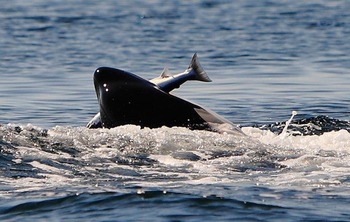
After the first sighting of killer whales on 23 April 2011, our fieldwork started on 5 May 2011 and lasted until 5 November 2011. We were able to observe regular encounters of two groups of killer whales for six months, named in our photo-ID catalogue (Vester3) as NKW (Norwegian killer whales) -AN (Group ID letter) with 5 individuals, and NKW-AP with 16 individuals. Only group NKW-AN remained continuously in the same fjord throughout the entire course of our study. Beginning in May 2011, we made a new discovery that these two groups of killer whales were feeding on salmon in a narrow northern Norwegian fjord (see Figure 1). Local residents reported that killer whales have regularly visited this fjord in summertime for at least 10 years, but were commonly thought to feed on local herring (Clupea harengus) and saithe (Pollachius virens) stocks.
Salmon caught by killer whale in Øksfjord, northern Norway, 2011. Photograph kindly provided by Geir Nøtnes.

We observed the killer whales inside Øksfjord (N68 19/E15 14), a side fjord off the main Vestfjord, that leads to the open Atlantic. The area used by the killer whales was approximately 30 km long, up to 200 m deep, and surrounded by islands without a deepwater opening to the Vestfjord (see Figure 2). Inside the Øksfjord are several salmon rivers, where salmon runs start in April and last until the end of September. In addition, four operational and one non-operational salmon farms are located inside the fjord.
Map of a killer whale foraging area inside Øksfjord in northern Norway during summer months: (A) shows the resting area of group AN; (B) shows the resting area of group AP. The line indicates the main foraging route of both groups.

Atlantic salmon (Salmo salar) in Scandinavia live 1–4 years at sea before migrating to their native rivers for spawning from the end of April until autumn. Spawning happens from October–November, and eggs hatch in April–May. Juvenile salmon remain in the rivers for 2–5 years until migrating to the sea, when the cycle repeats (Pethon, Reference Pethon1998). Northern Norway's best salmon fishing season is between 1 June and 31 August. The period of salmon runs and catches fits within the period of killer whales' occurrence, from April to November.
Both groups often hunted together but separated when resting; the small group (NKW-AN) used the fjord entrance as a resting place (Figure 2A), whereas the larger group (NKW-AP) used the other end of the fjord (Figure 2B). After 19 July only group NKW-AN was seen in the fjord (without males) and they remained until the beginning of November.
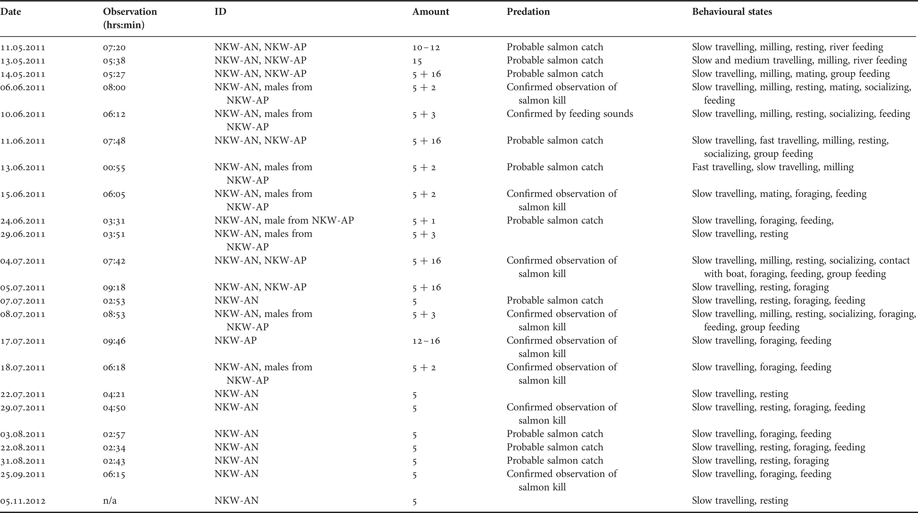
One of the main behaviours observed was foraging, including scanning the fjord with loud echolocation clicks. During resting and milling, all group members were slowly swimming at the surface, either swimming back and forth in the same area or slowly travelling along the fjord in silence. Socializing was only observed when two groups met, or during resting or milling. The actual salmon hunt and catch usually lasted only a few minutes during which whales engaged in active surface behaviour, such as breaching, jumping and fast swimming manoeuvres. During this time, live salmon could be seen chased at the surface; also, red salmon body parts from killer whale predation or seagull scavenging could be detected. In the beginning of the season in April to mid-June, when salmon runs scarcely feeding at river openings were observed by both groups, this behaviour included all animals waiting at the river opening and occasional catches of salmon swimming upriver were observed. When the two groups met for foraging, they often searched for fish together, with individuals spreading out across the fjord and swimming at the same speed (3–4 knots) in the same direction. Intense and continuously repeated echolocation clicks revealed that they were scanning the fjord for prey. The different observed behavioural states and predation activities for each encounter are listed in Table 1.
Data collection, predation and behavioural stages of two groups of killer whales (Orcinus orca) observed in Øksfjord in northern Norway in 2011. During confirmed observation of salmon kill, dead salmon in the whales' mouths or floating salmon body parts were observed. Probable salmon catch was indicated by typical fish-chasing movements by the whales at the surface and vocalizations.

During the five months of observation, two calves were born, and we observed courtship behaviour between the groups several times. On five occasions, two males joined a female and they separated from the rest of the group. The two males chased the female slowly, triggering tail-slaps by the female, which was then approached by one male and belly-to-belly rolling of the male and female could be seen at the surface.
In 2011 none of the individual killer whales feeding on salmon was known from earlier encounters, and they could not be matched to an existing photo-ID catalogue of around 550 individuals collected in the Vestfjord (VesterFootnote 3). However, given the fact that there may well be more than 1000 killer whales in the Norwegian herring-feeding population (Kuningas et al., Reference Kuningas, Similä and Hammond2007), these animals simply may have been missed before. However, this year (2012) we could identify one salmon-feeding individual which we registered before in 2003, 2004 and 2005 as individual X-163 (Vester3). This individual was first seen in 1996 as a one-year-old calf and, due to severe dorsal and spine injuries caused by boats, was called ‘Stumpy' (Stenersen & Similä, Reference Stenersen and Similä2004). At these earlier observations X-163 was seen associated with different groups, engaged in herring feeding (Stenersen & Similä, Reference Stenersen and Similä2004; Vester3).
CONCLUSIONS
This represents the first continuous six-month study of a killer whale group in northern Norway. Our study revealed a different foraging behaviour than previously described for killer whale groups in Norway. Salmon feeding is well known in resident groups in Canada (north-east Pacific), but was until now unknown in Norway.
However, whether this form of salmon foraging behaviour is specialized and exclusive for these groups of killer whales, or whether it is additional to herring foraging, is not conclusive at this stage. We have already started a larger study in Norway comparing vocal repertoires of salmon-feeding killer whales and herring-feeding killer whales. First results indicated some overlap of both vocal repertoires (Vester et al. Footnote 4). Such comparisons, in addition to future observations, may help us reveal whether killer whales in Norway are specialized in salmon feeding or have developed an opportunistic feeding behaviour.
ACKNOWLEDGEMENTS
We thank Geir Nøtnes and Marco von der Schulenburg for their cooperation in the field and for providing photographs of the killer whales. We thank Wen-Chuang Chou, Sarah Hallerberg, and Marc Timme for fruitful discussion. We also thank André Baumeister for providing a map of Øksfjorden, and Kristin Jacobsen and Madita Zetsche for help in photo-identification. Irene Barnard helped with manuscript editing. This study was funded by a small grant from the WWF Sweden and by Ocean Sounds, Norway, and supported by the Max Planck Society. This paper was greatly improved by constructive comments and suggestions from Andy Foote, an anonymous referee and the Editor.