




No CrossRef data available.
Article contents
- Abstract
- EXISTING DYNAMIC MODELS OF POLICY-BASED PARTY COMPETITION
- A NEW AGENT-BASED MODEL OF MULTI-PARTY POLITICAL COMPETITION
- BEHAVIOR OF SIMULATED PARTY SYSTEMS UNDER SINGLE DECISION RULES
- COMPETITION BETWEEN PARTIES USING DIFFERENT DECISION RULES
- THE DYNAMICS OF PARTY COMPETITION IN IRELAND
- CONCLUSION
- APPENDIX: SIMPLIFIED NETLOGO CODE FOR KEY FEATURES OF THE AGENT-BASED MODEL
- References
Policy and the Dynamics of Political Competition
Published online by Cambridge University Press: 08 June 2005
Article contents
- Abstract
- EXISTING DYNAMIC MODELS OF POLICY-BASED PARTY COMPETITION
- A NEW AGENT-BASED MODEL OF MULTI-PARTY POLITICAL COMPETITION
- BEHAVIOR OF SIMULATED PARTY SYSTEMS UNDER SINGLE DECISION RULES
- COMPETITION BETWEEN PARTIES USING DIFFERENT DECISION RULES
- THE DYNAMICS OF PARTY COMPETITION IN IRELAND
- CONCLUSION
- APPENDIX: SIMPLIFIED NETLOGO CODE FOR KEY FEATURES OF THE AGENT-BASED MODEL
- References
Abstract
This paper proposes a model that takes the dynamic agent-based analysis of policy-driven party competition into a multiparty environment. In this, voters continually review party support and switch parties to increase their expectations; parties continually readapt policy positions to the shifting affiliations of voters. Different algorithms for party adaptation are explored, including “Aggregator” (adapt party policy to the ideal policy positions of party supporters), Hunter (repeat policy moves that were rewarded; otherwise make random moves), Predator (move party policy toward the policy position of the largest party), and “Sticker” (never change party policy). Strong trends in the behavior of parties using different methods of adaptation are explored. The model is then applied in a series of experiments to the dynamics of a real party system, described in a published opinion poll time series. This paper reports first steps toward endogenizing key features of the process, including the birth and death of parties, internal party decision rules, and voter ideal points.
Information
- Type
- ARTICLES
- Information
- Copyright
- © 2005 by the American Political Science Association
Informed discussions of political competition—by journalists, pundits, novelists, country specialists, or indeed practicing politicians—usually describe a system in perpetual motion. Perpetual motion is seen as a normal state of affairs, not a manifestation of chaotic instability. And it is usually seen as having an endogenous dynamic; what the actors do at cycle c of the political process feeds back to affect the entire process at cycle c+1. These informed discussions thus see politics as a complex dynamic system evolving under its own steam, a system unlikely to reach steady state.
In stark contrast, mainstream models of political competition are usually static, with key model parameters and rules of interaction fixed exogenously. Although static models do not necessarily imply equilibrium, almost invariably the core intellectual approach is to specify a model and solve for equilibrium. Authors of such models are typically driven by what Cederman describes as a “metaphysical conviction that equilibria are always ‘out there’ waiting to be discovered,” a conviction that can “blind the analyst to the possibility of adjustments never settling” (Cederman, 1997, 34–35). But if common sense tells us party competition is a complex dynamic process, then it also tells us party competition may never achieve equilibrium.
This paper addresses the striking disjuncture between the static nature of most formal models of party competition and the dynamic way in which informed observers, who hardly ever talk about politics in terms of equilibrium, think about the political process. While many theorists would willingly concede in general terms that real political competition is a complex dynamic process, the hard question concerns how to model this in a way that is both theoretically tractable and substantively plausible. In what follows, I set out to answer this question by specifying a complex dynamic model of political competition, by interrogating the model using techniques of agent-based modeling, and by calibrating the model to a real world example of dynamic political competition. To the extent that this undertaking is successful, it paves the way for an approach to modeling the complexities of political competition in multiparty systems that more closely matches the intuitions of informed observers of real politics.
To get a substantive feel for the type of system I will be exploring, consider Figure 1, which plots quarterly opinion poll support for the main Irish parties between 1986 and 1997.1
This was after the formation of the Progressive Democrats (PDs) and before the merger of Labour (Lab) and Democratic Left (WP/DL), during which Ireland was effectively a five-party system. Figure 1 and results that follow report party shares of support for the five main parties.
From just over 40% to just under 60%.
Under Ireland's more or less proportional STV electoral system.

Opinion Poll Time Series of Party Support, Ireland, 1986–97
Most specialists in Irish politics would be delighted to talk us through the politics of the complex interactions that generated Figure 1. Specialists in the politics of other countries, likewise, make their livings analyzing their own country-specific versions of Figure 1. But most models of party competition, confronted with the type of moving system reported in Figure 1 and forming the bread and butter of any country specialist, could do no better than describe it in terms of random noise superimposed on a steady state. This large lacuna motivates what follows, in which I present a model that describes the complex dynamics of a multiparty system in continuous motion. My core intellectual mission is to characterize the movement of this system over time, not to solve for some equilibrium state there is no a priori reason to expect.
EXISTING DYNAMIC MODELS OF POLICY-BASED PARTY COMPETITION
The main departure from traditional static theories of party competition can be found in an emerging literature that models two-party competition between incumbent and challenger as an evolving complex system. This followed work by Kollman, Miller, and Page (1992, 1998)—hereafter KMP—and assumes that a realistic account of policy-driven party competition describes a complex and evolving decision-making environment where key actors have very incomplete and imperfect information. KMP use a paradigm that intrinsically reflects this low-information dynamic environment, rather than tinkering with a traditional static spatial model based on the assumption of hyperrational decision-making with high levels of information. This leads them to “artificial adaptive agent,” or agent-based, models. The key distinction between paradigms is that hyperrational agents make choices by looking forward strategically, continuously solving and resolving in real time the dense systems of equations in the high-end rational choice literature. Note that even these equations describe a spectacular reduction in the complexity of any real decision-making environment. In contrast, adaptive agents look backward and learn from the past, developing simple rules of thumb that condition future behavior on the recent history of the system.
We would all love to enjoy the best of both paradigms, but only agent-based models currently offer the practical possibility of modeling the endogenously evolving dynamic systems described by most informed observers of real politics. This is because agent-based models of party competition: work well with levels of information and rationality that are not “unrealistically” high; describe parallel recursive interactions between large numbers of agents, interactions that generate a complex system; allow different agents to deploy different behaviors that can tractably be pitted against each other within the model; treat agents as discrete decision-makers with discrete ideal points; allow the effects of model parameters to be explored systematically and rigorously. To be sure, agent-based models are simulations that do not allow us to prove theorems in the style of classical game theory. But, in a context where the types of theorem classical game theorists can currently prove are at odds with the common-sense view of politics as a moving system unlikely to reach steady state,4
Exponents of nonclassical “evolutionary” game theory may eventually prove important theorems about policy-driven party competition in a dynamic system. But a recent sophisticated presentation of the cutting edge of this field (Cressman 2003) implies that there is still a long way to go in this regard.
Agent-based models of politics have recently been used to explore, inter alia, evolution of cooperation among selfish actors (Axelrod 1997; Bendor, Diermeier, and Ting 2003; Skyrms 1996), evolution of the international state system (Cederman 1997), migration between policy jurisdictions (Kollman, Miller and Page, 2003), rotating presidency of the European Council (Kollman 2003), and emergence of civic traditions in modern Italy (Bhavnani 2003).
KMP (1992, 1998) presented an agent-based dynamic model of two-party competition in a multidimensional issue space, setting the baseline for subsequent work and citations in the field, almost all of which retain a U.S.-oriented focus on two-party incumbent-challenger systems (see, for example, de Marchi 1999, 2003). KMP's underlying spatial characterization of policy preferences is the same as that of the traditional spatial model, although their computational implementation assumes that agents adopt one of a small number of possible positions on a finite set of issue dimensions and, thus, uses a discrete policy lattice rather than a real policy space.6
The original KMP model has 15 dimensions, with seven possible positions on each.
KMP depart from the traditional model in assuming party leaders are not perfectly informed—either about the utility functions of every single voter or about the probability functions associated with these. Instead, they gather information from limited (and private) opinion poll or focus group feedback during election campaigns, using this to adapt policy positions incrementally from a given starting point.7
KMP do not explicitly claim that this feedback is private information, but this is implicit in the process they describe; parties test a battery of counterfactual policy modifications on a sample of voters and adopt only modifications that increase voter support. This is hard to envisage on the basis of public opinion polling.
A “random adaptive party” generates a finite set of counterfactual platforms in the neighborhood of its current platform and adopts the alternative attracting most support. A “climbing adaptive party” makes a sequence of small counterfactual modifications to its policy position, experimenting with individual small shifts, implementing any shift that increases support, and iterating this process. A “genetic adaptive party” uses a version of the genetic algorithm developed within evolutionary biology. Its policy package is described by a vector of seven possible policy positions on 15 different issue dimensions and treated as equivalent to its “policy DNA.” A finite set of counterfactual policy vectors is generated and subjected to the genetic operators of reproduction, crossover, and mutation, with the resulting evolved positions adopted if they increase party support. This process is iterated a set number of times during a campaign.
de Marchi (2003) subsequently refined assumptions about voters. “Highly sophisticated” voters have “constrained” issue positions—position on one dimension can be predicted from position on another—and report their preferences to pollsters relatively accurately. Other voters display “less interest or aptitude in politics” (148). Their positions on each issue are derived from independent uniform distributions and reported to pollsters with high variance around “true” positions. Results confirm expectations that the greater the uncertainty with which opinion polls pick up the ideal points of “unsophisticated” voters, the more ineffective party search strategies.
KMP (2003) extended their two-party incumbent–challenger model to multiparty competition, in work that raises questions about taking their search algorithms out of a two-party context. In an incumbent–challenger setting, testing counterfactual challenger positions against a fixed incumbent seems intuitively plausible. The multiparty KMP model, however, gives each party an exclusive “turn” of eight iterations of this process, holding the positions of all other parties fixed, before the turn passes to another party (196). The entire set of party “turns” is repeated five times during an election campaign. Setting aside the possible sequencing effects of these “turns,” the key question concerns the substantive interpretation of what is going on. KMP report results for systems with up to seven parties. In this context the generic counterfactual question posed by each party in private polling would take the form, “Assuming all six other parties retain their current policy packages, and assuming we move our own policy package from x to x±δ, which party would you support?” A battery of similar questions generating systematic sweeps of δ would need to be asked by each party at each cycle of adaptation in order to identify the best policy move from a given position. This seems to be a complicated and substantively unrealistic way for parties to gather information. Transplanting their search algorithms into a multiparty context, KMP may be assuming that party leaders are able to read far richer information off the system than would conceivable in any real-world context. Furthermore, it is not clear that multiparty competition is realistically modeled by giving each party a chance to adapt its policy in a well-sequenced series of “turns,” during each of which all other parties simply watch what is happening. Actual policy moves may well be made in some kind of de facto sequence, but it seems implausible to imagine parties sequencing their information-gathering activity in this way. Yet this sequencing is mandated by the counterfactual questions to voters the KMP search algorithms need to ask; these algorithms may thus not adapt plausibly to a multiparty context. They require parties to have much less information about voters than the traditional spatial model, but impose what may still be unrealistic requirements on information-gathering activities by parties, as well as unrealistic sequencing assumptions. For these reasons, an alternative set of adaptive algorithms is explored below.
A NEW AGENT-BASED MODEL OF MULTI-PARTY POLITICAL COMPETITION
Motivational Assumptions
Following both the traditional spatial model and KMP, I classify political agents into two types or “breeds,” party leaders and voters.10
Thus this is not a model of the purely endogenous evolution of political parties within a “single breed” population of voters—for an example of such a model see Schreiber 2002.
To aid visualization, this version of the model is implemented in two dimensions, but the model can be implemented in any number of dimensions.
Party System Dynamics
Initiation of the model, as with KMP, randomly scatters a discrete set of party positions and supporter ideal points across the policy space.12
The model currently uses a random draw from a normal distribution with a mean of zero and a standard deviation one third the radius of the space There is no reason why specific assumptions or data on party and supporter policy positions could not be read into the model as starting configurations; this is indeed done below when the model is applied to a real party system. In this context, note KMP's (1998) important finding that many key features of competition do not depend on the configuration of supporter ideal points.
Thus this model does not have the “election campaigns” within which the action in the KMP model is confined. Political dynamics is seen as a continuous process that runs all the time, between elections as well as in the run-up to these. For those who want to know something about election campaigns, in addition to the continuous evolution of political competition, snapshots or short movies can be taken of this process at scheduled intervals, for systems with fixed-term legislatures, or at intervals generated by some probabilistic model of endogenous election scheduling that suits the purposes and tastes of the investigator. It is important, however, if we seek a realistic dynamic model of political competition, that the baseline model describes a process that never stops rather than something set in motion only during election campaigns.
Adaptive Decision Rules for Party Leaders
Party leaders are assumed to use one of a number of adaptive decision rules to set party policy at any given cycle of the process. These rules are grounded in received wisdoms about types of intraparty decision-making regime. The essential distinction is between what we might think of as a “democratic” party, in which leaders adapt party policy to the preferences of current supporters, and some form of “cadre” party, in which leaders adapt policy according to their own interests—for example, maximizing votes by appealing to potential supporters. Kitschelt (1994) describes this distinction as one between “innovation from below,” in which a party seeks to “diversify its appeal and represent popular debates within the microcosm of the party,” and “‘innovation from above,’ whereby party leaders act autonomously from a party's internal process of interest aggregation” (212). The latter is “particularly important in situations where … small changes its strategic appeal my result in great differences in its success in vote seeking…” (213). Müller and Strøm (1999) make the same distinction. They contrast regimes, often within traditional social democratic parties, where “party members … constrain the party's leading representatives to follow a clearly defined policy course” with regimes, as in the post-1979 PSOE in Spain, where members have “no influence on the policies of the party leadership” (292–93).
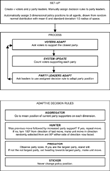
The first adaptive rule for party leaders thus reflects a party in which the leader's freedom to set policy is constrained by the policy preferences of current party supporters. This rule—which incidentally cannot be found in the traditional spatial model, in KMP, or indeed in any other formal model of party competition of which I am aware—is AGGREGATOR. Under AGGREGATOR, leaders set party policy at the mean position on each dimension of the ideal points of current party supporters. They continuously readapt this position as the party's support profile changes.13
An alternative interpretation of AGGREGATE is a party that is a leaderless endogenous coalition of supporters, as envisaged by Schreiber (2002).
The second adaptive rule models an “unconstrained” party leader who constantly modifies party policy in the search for more supporters. Unlike the KMP search strategies that impose heavy information requirements in a multiparty context on leaders trying to evaluate prospective counterfactual policy moves, the rule defined here is intrinsically adaptive, conditioning the direction of a policy move at cycle c on the success or failure of the previous move, made at cycle c−1. The rule is called HUNTER and searches for support using a simple Pavlovian “win–stay, lose–shift” algorithm, found very effective by Nowak and Sigmund (1993).14
A similar “win–stay, lose–shift” rule was implemented by Bendor, Diermeier, and Ting (2003).
HUNTER makes a unit move in a random direction on the first cycle of adaptation, since there is no previous move to evaluate.
An alternative adaptive rule for unconstrained party leaders is used here as an alternative to simple Pavlovian learning and exploits a different piece of freely available information party leaders might use to increase their support. This is the location of the largest party in the system and the rule is called PREDATOR. A PREDATOR observes the current sizes and policy positions of all parties at cycle c−1. If it was not the largest party, it makes a unit move at cycle c toward the position of the largest party. If it was already the largest party, a PREDATOR stands still.16
In a two-party incumbent–challenger context, a predating challenger would simply move directly toward the known policy position of the incumbent, with no need to do private polling.
Partly to provide a static baseline against which adaptive decision rules can be evaluated, but also to model an ideological party leader concerned exclusively with maintaining a particular policy position and not at all with increasing party support, the final decision rule used here is STICKER. A STICKER never changes policy position, regardless of the ideal points of voters and the positions of other parties. This rule is not itself interesting in dynamic terms but becomes significant when interacting with other decision rules.
Figure 2 summarizes the model and its adaptive strategies, which was programmed by the author in NetLogo 2.0.2.17
All programs are freely available upon request from the author. Key elements of the NetLogo code can be found in the Appendix.

Overview of Dynamic Model and Its Adaptive Rules
BEHAVIOR OF SIMULATED PARTY SYSTEMS UNDER SINGLE DECISION RULES
Hunter
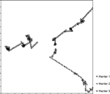
The most striking generic result in this paper is the success of the adaptive HUNTER algorithm in finding dense areas of party support. Hunters use no information whatsoever about the global geography of the policy space. They know only that voters support the closest party, how many supporters they had during the previous two cycles, and which direction they moved between these cycles. They have no knowledge of the ideal point of any voter, or of the position and size of any other party. Hunters use limited feedback from their local environment and apply it recursively, but this still allows them to pick up effective clues about the best policy direction in which to move. Figure 3 shows the trajectory of a typical simulated party system with three Hunters, each artificially started at the edges of a policy space with 1,000 randomly scattered voters. The plots show each party leader relentlessly homing in on higher support densities at the center of the policy space. It is important to remember when looking at Figure 3 that, unlike KMP's Climbing Adaptive Parties, Hunters do not use an “uphill” search algorithm (backed up by sophisticated private polling about local sets of counterfactual policy positions) to find higher support densities. They simply adapt to rewards and punishments reported in common-knowledge published opinion polls. Large numbers of simulations, run with up to 12 parties, always showed the same pattern.18
There is one crucial but obvious exception. In a one-party system with a lone Hunter, party support is unaffected by policy position, and HUNTER can take any position in the space.

Three Hunters Finding High Support Densities
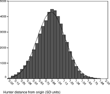
Figure 3 also hints at strong pattern observed in many simulations of party systems where all parties are Hunters. While Hunters systematically move toward the center of the policy space, they tend to avoid its dead center. After any given cycle in a mature party system, the party configuration is typically a scatter of Hunters around, but definitely not at, the center. This is illustrated in Figure 4, which summarizes the results of an experiment involving 100 independent 500-cycle runs of a system with seven Hunters and 500 voters. To concentrate on the configuration of the “mature” system, the effects of the random starting configuration were “burnt off” by discarding output from the first 150 cycles of each run, before output for a 500-cycle run was recorded. Figure 4 shows a histogram of distances between one of the Hunters and the origin, measured in standard deviation units of the voter distribution (SD units), during the full 50,000 cycles of the experiment.19
Entirely similar patterns obtain for all other Hunters in the simulation.

Distribution of Hunter Distances from the Origin
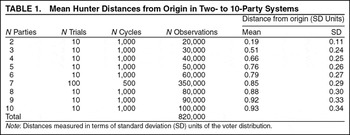
Table 1 shows results from a suite of experiments designed to characterize Hunter distances from the center of the policy space as a function of the number of parties in the system.20
The seven-Hunter case in Table 1 is described in the previous paragraph. Experiments for party systems of other sizes were based on 10 trials of 1,000 cycles, with parties and 500 voters rescattered at the start of each trial and the first 150 cycles discarded as a burn-off phase.

The behavior behind the patterns in Table 1 is easily understood if the system is watched in motion. If any party goes to the center of a system with several Hunters, it becomes a rewarding source of votes for other Hunters, who move toward it and feed off its support base. The party at the center is thus punished by losing support, despite being at the highest density point in the space, and responds to this punishment by moving away from the center. This emergent “coordinated” behavior by the other Hunters arises despite the fact that, in contrast to more traditional game theoretic models, no Hunter knows any other party exists, showing the complex way in which several Hunter algorithms interact. In effect, systematic information about the behavior of all other parties is encoded in the sequence of rewards and punishments experienced by a Hunter. One consequence of this is that a Hunter finding itself at the center of the party system tends to get out as fast as it can. In general substantive terms, of course, we note that it is empirically rare to find large parties at the dead center of multiparty systems—a theoretical problem for the traditional spatial model recently discussed by Schofield (2003).
Aggregator
While AGGREGATOR may not at first seem to be an intrinsically adaptive decision rule, it generates party adaptation in the context of a dynamic multiparty system. A set of voters supports an Aggregator at cycle c because it is the closest party to them. The intrinsically “democratic” Aggregator goes to the mean policy position of its supporters but all other parties adapt their positions at the same time. Following this, some voters may wish to switch parties, causing the set of voters supporting both losing and gaining parties to change. Each switch to or from an Aggregator, quite possibly arising from the actions of other parties, changes the set of voters whose views must be taken into account and thereby provokes a shift in its policy position.21
Since a voter located at the current party position would never switch.
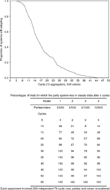
One strong result from many simulations is that a steady state always emerges in a party system where all parties are Aggregators, an unanticipated and striking pattern. We might conceivably devise pathological configurations of voter and party positions where the system is always in motion; but we can confidently conjecture that, for an arbitrary scatter of discrete voter ideal points and party positions, a steady state will be achieved after a finite number of cycles of an all-Aggregator party system. Figure 5 illustrates this systematically. The top panel shows the pattern of evolution to steady state in a 10-Aggregator party system with 500 voters, summarizing results of an experiment with 200 independent 75-cycle trials, each with a random draw of party and voter starting positions. For any given cycle, it shows the proportion of trials for which the party system was still adapting. In about half of the simulated party systems, party support levels flat-lined in steady state before 20 cycles of the model; in this experiment, the longest adaptation to steady state from a random start took 43 cycles.

Emergent steady states in all-Aggregator party systems
We can conjecture that steady states emerge in all-Aggregator party systems, instead of the unending adaptation and readaptation we might expect, because any discrete scatter of voter ideal points has nonuniform random clusters of voters that provide local attractors for Aggregating parties. Such a discrete scatter has a “granular” quality, providing a source of friction in the system quite distinct from the conventional spatial model's smooth density map of ideal points, which describes a friction-free world with an infinite number of agents. The bottom panel in Figure 5 throws systematic light on this, in a series of experiments (Models 1–3) on all-Aggregator systems, each with five parties but with from 250 to 1000 voters.22
Each experiment involved 200 independent 75-cycle runs.
Such steady states, while quickly reached, are easy to perturb. If each voter is sent on a one-unit random walk after a steady state has emerged, for example, Aggregating parties readapt to different positions and sizes. This adds to the intuition that it is local and easily perturbed granularities in the voter distribution that attract particular steady states of party positions. Thus, while we confidently predict a steady state in any given all-Aggregator party system, it is impossible to predict precise party locations in this. What we can confidently predict, however, is that Aggregating parties will spread themselves evenly over the surface of the policy space. Always located at the center of its supporters, a “democratic” Aggregating party never “attacks” the support base of any other party, but adapts passively to the changing composition of its support base by locating itself at the center of this. The result is an even distribution of parties across the surface of an all-Aggregator party system.
All-Sticker and all-Predator party systems are trivial or pathological. Party leaders in all-Sticker systems by definition never move. In all-Predator systems, all agents end up writhing around on top of each other in the center of the space—a result not unlike that of the unreconstructed traditional spatial model. Neither of these looks remotely like a real party system, in which parties typically do not converge on the center, a problem recently highlighted by Schofield (2003).23
In both models this situation arises because all party leaders are programmed to do nothing but attack each other, which necessarily results in all party leaders ultimately finding themselves at the same part of the space. In effect both all-predator systems and the unreconstructed spatial model are prone to ignore potential sources of lost party support arising from converging on the positions of other parties.
COMPETITION BETWEEN PARTIES USING DIFFERENT DECISION RULES
One benefit of using agent-based models of party competition is that it is easy to observe how different types of parties fare when competing against each other in the same policy space. There are far more configurations of four decision rules, assigned to parties in systems of varying sizes, than it is conceivably possible to investigate here. I focus below on how Predator parties fare facing two different types of opposition, and on whether a lone “ideological” Sticker can succeed in pulling the mean policy of all other parties toward its preferred position.
“Democratic” Aggregator versus Predator Parties
A Predator scans the system for the largest party and moves relentlessly toward this, standing still only when it becomes the largest party itself. Repeated simulations show that a lone Predator always does well in a system otherwise populated by democratic Aggregators. As might be expected analytically, a steady state quickly emerges in which Predator finds a (central) place where it is the largest party and Aggregators adapt to this, spacing themselves evenly around noncentral regions of the policy space. Pit two Predators in competition with a set of Aggregators, however, and the situation is quite different. Repeated simulations show that the Predators both move to the center, but if one ever becomes the largest party, the other attacks it. The Aggregators surround the Predators, boxing these into the center of the space. If the Predators move in one direction, some Aggregator in the other half of the space becomes the largest party; the Predators reverse direction and move toward this.24
This suggests an improved and biologically more realistic Predator algorithm, in which the direction moved by the Predator would be a trade-off between the sizes of the other (prey) parties and their distance from the Predator.
Hunters versus Predators
Simulations of party systems pitting Hunters against Predators generate thought-provoking results because a lone Predator, contrary to what we might superficially expect, proves ineffective against any number of Hunters greater than one.25
Competition between a lone Hunter and a lone Predator is pathological, but most amusing to watch in motion, having the structure of a Tom and Jerry cartoon.
The biological analogy may not be helpful here. Predators of the same animal species tend not to cannibalize each other; the same should probably not be assumed for political parties.
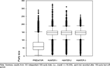
Figure 6 shows the results of an experiment with 100 independent 500-cycle runs of a party system with three Hunters and one Predator.27
Output from each run was recorded after a 150-cycle burn-off period.

Party Sizes in a Three-Hunter, One-Predator Party System
Sticker versus Hunters
The Sticker rule for setting party policy can be interpreted as modeling an “ideological” party leader, concerned to promote a particular policy position rather than to maximize party support. This leaves open the substantive question of whether the leader's unwillingness to compromise arises from an expressive desire to articulate a particular policy position or from a more instrumental desire to use party competition to pull the positions of other parties toward his or her ideal point. With one very important exception, however, simulation experiments using the model show that an ideological Sticker tends not to affect party competition by dragging other parties toward it. The exception, possibly underlying the gut feeling that being an intransigent Sticker may pull others toward you, arises in a two-party system when a Sticker competes with a Hunter. In this case, repeated simulations show that the Sticker's position exerts a strong pull on the Hunter—which tends to seek votes close to the position of the Sticker. This is because the Hunter is most rewarded at positions closer to the center of the space than the Sticker, yet as close as possible to the position of the Sticker.28
The logic here thus resembles that of the comparative statics in the traditional spatial model.
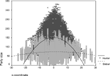
The grave dangers of generalizing from two- to multiparty competition, and the need for a dynamic model, can be seen clearly when we consider competition between Hunters and Stickers. When there is more than one Hunter in the party system, interaction between the Hunters has a far greater effect on party competition than the policy position of a single intransigent Sticker. This was explored systematically in an experiment involving 200 independent 250-cycle runs of a system with three Hunters and one Sticker.29
The first 150 cycles of each run were discarded as the burn-off phase, with output from 250 cycles recorded for each of the 200 runs—giving 50,000 cycles in all.
Figure 7 presents further results from this experiment that throw general light on the effectiveness of simple adaptive rules for setting party policy. It plots, for the Sticker and one of the Hunters, party support levels against the party x-coordinate throughout the full 50,000 cycles of the experiment.30
The curved lines are quadratic regressions summarizing the scatter of points for each party.

Hunter and Sticker Support levels for the Same x-Coordinate
THE DYNAMICS OF PARTY COMPETITION IN IRELAND
Scott Moss (2001), evaluating his agent-based model of the behavior of market intermediaries, argues model outputs should have the same statistical distributions as observed outputs in the social system being modeled, describing a theoretically relevant statistical distribution of outputs as a “statistical signature” of the system. This offers a way to calibrate simulations to observations of the real world and, thereby, evaluate the empirical relevance of different models. Observing actual party competition, there is no chance of gathering dense time series data on small shifts in party policy positions and, thereby, reading this statistical signature in the real world. There are dense time series of published opinion polls tracking changes in party support over time. Traditional spatial models have little to say about either cross-sectional or time series variations in support for different parties, but those with an interest in real party competition know that these two types of variation are substantively significant yet observable features of a real party system in motion. These features of opinion poll time series are thus attractive moving targets for a dynamic model to hit; they are more attractive in many ways than real election results, which are available only at infrequent intervals and omit a lot of intervening dynamics.
In what follows, the moving target is the quarterly opinion poll series plotted in Figure 1, describing the dynamics of five-party competition in Ireland between 1986 and 1997.31
Data made available by Michael Marsh. Coakley and Gallagher (2004) provide recent general discussions of Irish party competition. Irish elections held in this period are discussed, respectively, in Laver, Mair and Sinnott 1987; Gallagher and Sinnott 1990; Gallagher and Laver 1993; and Marsh and Mitchell 1999.
That is, the mean over the five parties of the difference between mean simulated party size and mean opinion poll size. The measure for standard deviations is analogous.
The ENP turns out to be a simple mathematical transformation of the population standard deviation of party sizes at a given cycle. It is not a suitable measure of fit; if the sizes of two parties are inverted, and the simulation completely “wrong” in this sense, the ENP is unchanged.
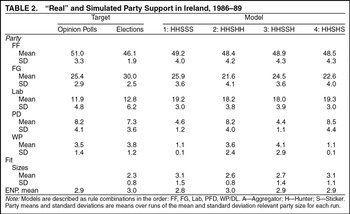
The first two columns of values in Table 2 give mean support levels for each party in both opinion polls and real elections, and standard deviations of these, over the period under investigation.34
The percentages reported are each party's share of the five-party vote, excluding votes for independent candidates and microparties.

To simulate the dynamics of Irish party competition, we need a spatial representation of the policy positions of parties and voters. This was derived from expert survey estimates by Laver and Hunt (1992) relating to 1988–89, the closest to the start of simulated “reality” for which data are available. The simulations reported below use two policy dimensions. The first is the left–right dimension of economic policy found by Laver and Hunt to pervade party competition in Western Europe.35
The Laver–Hunt dimension trades off lower taxation against higher public spending.
This was the mean position of each party's voters, weighted by the share of the five-party vote won by the relevant party in the 1989 election.
The resulting party positions were as follows:

It would be unrealistic to describe Irish party politics as competition among five parties all using the same rule to set policy. Laver and Hunt (1992) asked experts about the extent to which each party sacrifices policy objectives to get into office (or vice versa). The two large parties, FF and FG, were unequivocally judged office-oriented; WP/DL was unequivocally judged policy-oriented. The other two parties, Labour and PDs, were placed somewhere in between, though both parties publicly insist they are policy-driven. Thus, as a “best estimate” using independent data, the three smaller parties are characterized as policy Stickers, with the other two, FF and FG, characterized as vote-seeking Hunters. Below, I assess these assumptions using simulation experiments to conduct systematic a sweep of rule assignments.
Each experiment reported in one of the columns in Table 2 was based on 500 independent 43-cycle runs, using starting configurations of party and voter positions derived from the Laver–Hunt data. Simulation results are compared with the 43-cycle “real-world” run generated by the opinion poll series. Different simulation runs produce different results, even from the same starting configuration. One reason for this is that Hunting parties make random moves when punished with lower support; another is the random draw of voter ideal points. To assess the robustness of simulations to these random effects, two experiments were conducted using the “best estimate” rule assignment. The first involved repeated runs with the same random draw of voter ideals, confining the variation to random moves by Hunting parties. The second involved repeated runs with different random draws of voter ideal points. The results showed that it made little difference whether or not voters were rescattered each run; the precise scatter of voter positions had little impact on party sizes in the simulations. The simulations below thus rescattered voters each run, removing the possibility that results depend on some particular scatter of voters.
Model 1 in Table 2 uses the “best estimate” assignment of decision rules to parties. Mean support shares of the two largest parties, FF and FG, were simulated as 49.2% and 25.9% respectively, as opposed to 51.0% and 25.4% in the opinion polls. Standard deviations of the FF and FG support shares over the simulated time series are also similar to those of the opinion poll series. Labour support share was overestimated by 7.3% in the simulation and PD share underestimated by 3.6%; time series variations in PD support were lower in simulations than the opinion poll series. The mean absolute difference between party support in opinion polls and “best estimate” Model 1 was 3.1%, as compared to the 2.3% fit between real election results and opinion polls. An important baseline for assessing this is the MAD fit to the opinion poll series of a simulated static party system in which no party adapts its policy position; this was 4.9%.38
The fit to a static system was estimated using a 500-trial experiment directly comparable to those reported in Table 2, in which all parties were Stickers.
Obviously, the variation in party sizes in the static model is zero.
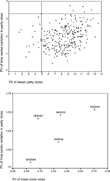
Model 1's assignment of party decision rules is both supported by independent expert survey data and substantively plausible, but it is important to know the sensitivity of simulation results to different parameter settings. Since starting policy positions derive from independent data, the main parameters in this model are decision rule assignments to parties. Confining the investigation to three decision rules—Aggregator, Hunter, and Sticker—there are 35(=243) permutations of rules among the five parties. A systematic sweep of all permutations was conducted, with a simulation experiment for each permutation that was identical to that described for Model 1.40
To reduce the 240 hours of continuous computing that would have been needed to conduct this sweep, JAVA code (available from the author) was written to control the NetLogo program. Each experiment first did 50 runs of 43 cycles. If the MAD from opinion poll party sizes was less than 5.0 after 50 runs—taking the 4.9 MAD for the static model as the benchmark—the experiment continued for the full 500 cycles; otherwise it was terminated after 50 cycles. Given the substantive plausibility, backed by expert survey evidence, of designating both FF and FG as Hunters, all such rule combinations were subjected to a 500-run experiment. Thus all data in Table 2 derive from 500-run experiments.

Results of the Systematic Sweep of All Rule Permutations
Table 2 reports substantive results for the four best-fitting models identified in Figure 8.41
An independent set of 500-run experiments for Models 1–4 was run on a different computer platform, with results identical to those in Table 2, which thus seem robust and stable.
Shortly after the end of the simulated period, WP/DL did in fact fuse with the Labour Party—unequivocal evidence of a shift toward the center.
Theoretically, the large set of simulation experiments reported above suggests that the model can use independent estimates of key parameter values and rule combinations to simulate “realistic-looking” dynamics in an actual party system—dynamics with statistical signatures very similar to those of published opinion poll series. Starting from expert survey estimates of party and voter positions, and party decision rules, the model generates time series of individual party sizes, variations in these, and the cross-sectional variation of sizes between parties that look similar to published opinion poll series forming the basis of substantive descriptions of the Irish party system. Systematic sweeping of decision rule permutations adds insights to our evaluation of the best-estimate model, in this case plausibly “fixing” the strategies of three of the five parties and suggesting that a decision rule allocation running counter to the public protestations of the parties may generate a more realistic time series of party support. All in all, this is an encouraging first start at calibrating the dynamic model to a real party system.
CONCLUSION
The Story So Far
The most striking generic finding reported above is the success of the simple Pavlovian HUNTER rule, which not only locates high voter densities in a very low-information environment but also outperforms other decision rules. The emergent “coordinated” behavior of a group of Hunters confronting a Predator is intriguing; while Hunters are not explicitly aware of each other, the rewards and punishments to which they respond do convey information about other agents. As a result an adaptive Hunter, responding to such rewards and punishments, is more than a match for a more “rational” Predator. Analysis of Hunter–Sticker competition shows that Hunters win more support than Stickers for the same policy positions, because Hunters set their positions as an adaptive response to the dynamics of party competition and Stickers do not. In simulation results not reported above, Hunters also do well in competition with Aggregators, tending to hunt for votes in higher-density areas of the space, while Aggregators adapt their positions into the areas some distance away from this. Not only does the adaptive HUNTER algorithm—“If it ain't broke don't fix it; if it bites you walk away”—work well in generic simulations, but also it does seem an intuitively plausible way to describe a potential rule of thumb for party leaders forced to make policy decisions when they have only crude summaries of information about the precise ideal points of voters. In simulations of a real party system, plausible assumptions about which parties are Hunters characterize all simulations that generate a statistical signature close to that of the real world. All of this draws attention to the HUNTER algorithm as a way to motivate future dynamic models of adaptive multiparty competition in an environment of low information.
The “democratic” AGGEGATOR algorithm sets out to reflect the views of a party's current supporters rather than to increase the number of those supporters; we should thus not be surprised that Aggregating parties tend to do less well at winning votes than Hunting parties. Nonetheless, while rarely kings of the jungle, Aggregating party leaders do tend to keep out of serious trouble, since continuously adapting party policy to the center of supporters' policy positions prevents the Aggregators from close contact, and hence potential damage, from other parties. Methodologically, the emergence of steady states in all-Aggregator party system draws our attention to the impact of treating supporters as a set of discrete adaptive agents rather than summarizing their ideal points as continuous smooth density maps.
The fact that the model can be deployed in a plausible way to retrieve a real opinion poll series in Ireland also gives considerable grounds for optimism. Using independent data on party positions and decision rules, the model can generate time series that capture mean party sizes, as well-as time series variations in these, that come as close to published opinion polls as real election results and closer than output from a static model assuming that parties do not adapt policy positions at all. Systematic sweeps of potential rule combinations add insight to our ability to understand the real party system under investigation. In the Irish case they confirm expert judgments of FF and FG as vote Hunters; imply that Labour must indeed have been a policy Sticker to garner so little support from its starting policy position; and suggest, despite public protestations to the contrary, that the two smaller parties may be vote Hunters rather than policy Stickers. This gives us some hope that we may be able to use the model to go beyond inherently unreliable public statements by parties about their political strategies and infer strategies that better fit their observed behavior.
The Way Forward
Significant extensions to the basic model have already been implemented and are briefly noted below; space constraints mean future papers will report results derived from these. In the model described above, voters always support the closest party, sometimes making “hair-trigger” switching decisions. This can be modified if voters change party subject to some “switching threshold,” shifting party support only if the difference in distances between their current closest party and their existing party exceeds this threshold. This captures voters' inability to perceive small differences in policy distances or the nonpolicy attractions of their current party, for example, party identification.43
Jackson (2003, 130) uses an analogous threshold, in a stochastic environment, in his computational model of party competition, to describe the minimum threshold above which voters perceive a policy move to convey information.
Future work will endogenize many model parameters now set exogenously. A second-generation model includes the endogenous birth of new parties.44
This model has already been programmed.
Perhaps the biggest lesson for the future is that it is feasible using the techniques of agent-based modeling not only to describe, but also to implement and explore, a model that sets policy-driven party competition in the endogenously evolving dynamic environment that most informed observers agree is a plausible way to describe real politics. We must make sacrifices to do this in a tractable way, of course. Using agent-based models means that we must set on one side any investigation of the sophisticated, forward-thinking strategic calculations at the heart of many game theoretic models. Instead we characterize party competition as adaptive learning by party leaders in a complex system with very limited information feedback. The results reported above are intended to demonstrate that it is feasible and realistic to model this complex system using currently available methods and that, in so doing, we can advance the analysis of political competition in interesting and important ways.
APPENDIX: SIMPLIFIED NETLOGO CODE FOR KEY FEATURES OF THE AGENT-BASED MODEL
SUPPORTER BEHAVIOR
to join-closest-party
set closest-party min-one-of parties [distance-nowrap myself]
end
;;supporter finds ID of the closest party
PARTY LEADER BEHAVIORS
to update
set old-mysize mysize
;; store party size from previous cycle
ask supporters [join-closest-party]
;; ask supporters to reconsider affiliation, possibly changing party
set mysize count supporters with [closest-party=myself]
;; calculate new party size
end
to reverse-browse
set heading heading+ 90+ random 180
fd 1
end
;;party turns about face, moves in random direction away from previous heading
to aggregate
set xcor (sum values-from supporters with [closest-party=myself] [xcor])/(count supporters with [closest-party=myself])
set ycor (sum values-from supporters with [closest-party=myself] [ycor])/(count supporters with [closest-party=myself])
update
end
;;aggregators set policy on each dimension at mean position of current party members
to hunt
ifelse (mysize>old-mysize) [fd 1] [reverse-browse]
update
end
;;hunters move in same direction as previous move if this increased party support,
else turn about face and make random move in opposite direction
to predate
set largest-party max-one-of parties [mysize]
if (mysize<value-from largest-party [mysize]) [set heading towards largest-party fd 1]
update
end
;;predator identifies largest party and moves towards it if predator is not largest
to adapt
if (my-strategy=“sticker”) [update]
if (my-strategy=“aggregator”) [aggregate]
if (my-strategy=“hunter”) [hunt]
if (my-strategy=“predator”) [predate]
end
SYSTEM
to go
ask parties [adapt]
set cycle cycle+ 1
end
This paper greatly benefited from comments by three anonymous reviewers, as well as by Ken Benoit, Bruce Bueno de Mesquita, Ken Kollman, and participants in departmental seminars at Trinity College Dublin and New York University and in the Harvard–MIT seminar on political economy. Thanks are due to Michel Schilperoord for invaluable research assistance.
References
Axelrod Robert.
1997.
The Complexity of Cooperation.
Princeton, NJ:
Princeton University Press.
Bendor Jonathan,
Daniel Diermeier, and
Michael Ting.
2003.
“Rediscovering Behavioralism: Adaptively Rational Strategic Agents with Endogenous Aspirations.”
In Computational Models in Political Economy,
ed. Ken Kollman,
John H.
Miller and Scott E. Page. Cambridge, MA:
MIT Press,
213–
74.
Bhavnani Ravi.
2003.
“Adaptive Agents, Political Institutions and Civic Traditions in Modern Italy.”
Journal of Artificial Societies and Social Simulation
6:
No. 4.
Available at: http://www.soc.surrey.ac.uk/JASSS/6/4/1.htm.Google Scholar
Cederman Lars-Erik.
1997.
Emergent Actors in World Politics.
Princeton, NJ:
Princeton University Press.
Coakley John, and
Michael Gallagher, eds.
2004.
Politics in the Republic of Ireland.
4th Ed.
London:
Routledge.
Cressman Ross.
2003.
Evolutionary Dynamics and Extensive Form Games.
Cambridge, MA:
MIT Press.
de Marchi Scott.
1999.
“Adaptive Models and Electoral Instability.”
Journal of Theoretical Politics
11
(July):
393–
419.Google Scholar
de Marchi. Scott.
2003.
“A Computational Model of Voter Sophistication, Ideology and Candidate Position-Taking.”
In Computational Models in Political Economy,
ed. Ken Kollman,
John H. Miller, and
Scott E. Page.
Cambridge, MA:
MIT Press.
Gallagher Michael, and
Michael Laver, eds.
1993.
How Ireland Voted 1992.
Dublin:
Folens.
Gallagher Michael, and
Richard Sinnott, eds.
1990.
How Ireland Voted 1989.
Galway:
Centre for the Study of Irish Elections.
Jackson John E.
2003.
“A Computational Theory of Electoral Competition.”
In Computational Models in Political Economy,
ed. Ken Kollman,
John H. Miller, and
Scott E. Page.
Cambridge, MA:
MIT Press,
109–
42.
Kitschelt Herbert.
1994.
The Transformation of European Social Democracy.
Cambridge:
Cambridge University Press.
Kollman Ken.
2003.
“The Rotating Presidency of the European Council as a Search for Good Policies.”
European Union Politics
4
(March):
51–
74.Google Scholar
Kollman Ken,
John Miller, and
Scott Page.
1992.
“Adaptive Parties in Spatial Elections.”
American Political Science Review
86
(December):
929–
37.Google Scholar
Kollman Ken,
John Miller, and
Scott Page.
1998.
“Political Parties and Electoral Landscapes.”
British Journal of Political Science
28
(January):
139–
58.Google Scholar
Kollman Ken,
John H. Miller, and
Scott E. Page.
2003.
“Political Institutions and Sorting in a Tiebout Model.”
In Computational Models in Political Economy,
ed. Ken Kollman,
John H. Miller, and
Scott E. Page.
Cambridge, MA:
MIT Press,
187–
212.
Laakso M., and
R. Taagepera.
1979.
“‘Effective Number’ of Parties: A Measure with Application to Western Europe,”
Comparative Political Studies
12
(February):
3–
27.Google Scholar
Laver Michael, and
W. Ben Hunt.
1989.
Policy and Party Competition.
London:
Routledg.
Laver Michael,
Peter Mair, and
Richard Sinnott, eds.
1987.
How Ireland Voted: The General Election of 1987.
Swords:
Poolbeg Press.
Marsh Michael, and
Paul Mitchell. Eds.
1999.
How Ireland Voted 1997.
Boulder, CO:
Westview Press.
Moss Scott.
2001.
“Game Theory: Limitations and an Alternative.”
Journal of Artificial Societies and Social Simulation
4;
No. 2.
Available at: http://www.soc.surrey.ac.uk/JASSS/4/2/2.htm.Google Scholar
Müller Wolfgang, and
Kaare Strøm.
1999.
“Conclusions: Party Behavior and Representative Democracy.”
In Policy, Office or Votes? How Political Parties in Western Europe Make Hard Decisions,
ed. Wolfgang Müller and
Kaare Strøm.
Cambridge:
Cambridge University Press,
279–
309.
Nowack M., and
K. Sigmund.
1993.
“A Strategy of Win-Stay, Lose-Shift That Outperforms Tit-for-Tat in the Prisoners' Dilemma Game.”
Nature
364:
56–
58.Google Scholar
Schofield Norman.
2003.
“Valence Competition in the Spatial Stochastic Model.”
Journal of Theoretical Politics
15
(October):
371–
83.Google Scholar
Schreiber Darren.
2002.
“The Emergence of Parties: An Agent Based Simulation.”
Thesis.
University of California,
Los Angeles.
Skyrms Brian,
1996.
Evolution of the Social Contract.
Cambridge:
Cambridge University Press.
Overview of Dynamic Model and Its Adaptive Rules
Three Hunters Finding High Support Densities
Distribution of Hunter Distances from the Origin
Mean Hunter Distances from Origin in Two- to 10-Party Systems
Emergent steady states in all-Aggregator party systems
Party Sizes in a Three-Hunter, One-Predator Party System
Hunter and Sticker Support levels for the Same x-Coordinate
“Real” and Simulated Party Support in Ireland, 1986–89
Results of the Systematic Sweep of All Rule Permutations
 You have Access
- 189
- Cited by
Comments
No Comments have been published for this article.