Introduction
The Qur'anic text presents itself as a revelation from God to humanity, comprising a tapestry of various divine disclosures or simply, verses, referred to as āyāt. The term āya (pl. āyāt) refers to ‘a sign, token, or mark, by which a person or thing is known’ (Lane & Poole (Reference Lane and Lane-Poole1955), 135). In the Qur'anic context, the term āya or āyāt takes on two meanings: (a) as the signs of God manifest in the divine speech and revelation itself, and (b) as the signs of God evident in the natural world (cf. Ibn Taymiyya (Reference Ibn Taymiyya1979), 7:302). Both categories of signs are thought to be truly indicative of that to which they point: the reality and unity of the divine. But it is to the latter set of signs that we turn our attention towards in this article.
In her Logic, Rhetoric and Legal Reasoning in the Qur'an: God's Arguments, Rosalind Ward Gwynne writes that ‘a sign [i.e. āya] itself is not an argument but a piece of evidence that supports various forms of argument, explicit or implicit’, and that ‘Muslims built an immense structure of theological and philosophical argument on the basis of such Qur'anic evidence’, citing well-known Muslim philosopher Ibn Rushd (d. 1198 ce) as a prime example (Gwynne (Reference Gwynne2004), 26). In his well-known philo-theological treatise devised for popular consumption, al-Kashf ‘an Manāhij al-Adilla fī ‘Aqā’id al-Milla, Ibn Rushd outlines two arguments for God's existence which he takes to be grounded in the āyāt of the Qur'an which refer to natural phenomena as indications of the Divine, and which he takes to be the primary means by which the common believer attains knowledge of God. These two arguments are referred to as dalīl al-’ināya or the argument from design/providence and dalīl al-ikhtirā’ or the argument from creation/invention (cf. Ibn Rushd (Reference Ibn Rushd1998)). Ibn Rushd cites a number of Qur'anic verses in support of both arguments,Footnote 1 and thus gives the impression that a proper Qur'anic epistemology of treating signs as theistic evidence should construe them as the basis from which one formulates arguments typical of natural theology.
In contrast to Ibn Rushd, who drew upon the signs inherent in Qur'anic verses to formulate arguments for God, the fourteenth century Damascene Islamic theologian Ibn Taymiyya (d. 1328 ce) offers an alternative approach to seeing how āyāt – by which I mean both Qur'anic verses and signs in the natural world – may function as theistic evidence. The remainder of this article attempts to explore this alternative, particularly focusing on how Ibn Taymiyya views the broader signs in the natural world as theistic evidence, although, as we shall see, this will have important implications for how we might view the Qur'anic āyāt as engaged in its own distinctive sign-based discourse. In doing so, the article attempts to situate Ibn Taymiyya's ‘inference through signs (istidlāl bi'l-āyāt)’ within the framework of his distinctive fiṭra-based epistemology, and draws upon insights from contemporary analytic philosophers of religion in articulating the force of this approach. We ought to begin, however, by laying down the epistemological grounds on which Ibn Taymiyya's inference through signs is grounded.
The Taymiyyan epistemological background
Ibn Taymiyya's epistemology has sometimes been described as empiricist (cf. Heer (Reference Heer, Kazemi and McChesney1988)). Indeed, for Ibn Taymiyya, of the three primary sources of knowledge, which are sense perception (ḥiss), reason (‘aql), and report (khabr; i.e. testimony), sense perception is most fundamental, by grasping the particulars which reason requires to do its work of abstraction and inference, and is said to be superior to testimony, in its grasping of these particulars directly (Reference Ibn Taymiyya1979, 7:324).Footnote 2 However, the centrepiece of Ibn Taymiyya's epistemology is the concept of fiṭra.
According to Ibn Taymiyya, ‘fiṭra is the original nature of man, uncorrupted by later beliefs and practices, ready to accept the true notions of Islam’ (Ibn Taymiyya (Reference Ibn Taymiyya1995), 4:245–246). Carl Sharif El-Tobgui, suggests that in Taymiyyan terms, fiṭra is ‘perhaps best rendered as by the term “original normative disposition”’ (El-Tobgui (Reference El-Tobgui2020), 260). This normativity of fiṭra perhaps refers to the idea that human nature, qua human nature, ought to, and indeed will, accept certain beliefs, provided that, as Mehmet Sait Özervarlı remarks, the ‘original and distinctive qualities’ of one's fiṭra, are ‘left unaffected by his or her family or social environment’ (Özervarlı (Reference Özervarli, Kokoschka, Krawietz and Tamer2013), 47). Fiṭra, then, is not a faculty for knowing in its own right, but instead, the operative focal point to which all other faculties turn for direction; a disposition which, in turn, steers our faculties towards truth. Ibn Taymiyya insists that God
made the fiṭra of His servants disposed to the apprehension and understanding of the realities [of things] and to know them. And if it were not for this readiness (i.e. fiṭra) within the hearts/minds (qalb) to know the truth, neither speculative reasoning would be possible, nor demonstration, discourse or language. (Ibn Taymiyya (Reference Ibn Taymiyya1979), 5:62)Footnote 3
For Ibn Taymiyya, it is in virtue of fiṭra that a human's ‘knowledge of truth … and the recognition of falsehood’ is grounded (Ibn Taymiyya (Reference Ibn Taymiyya2014), 49), and that ‘children are born with sound fiṭra, which if left sound and intact, will make them choose knowledge (ma'rifa) over its denial’ (Ibn Taymiyya (Reference Ibn Taymiyya1979), 8:385). Therefore, as El-Tobgui remarks, in Ibn Taymiyya's view, ‘the proper functioning of all our epistemic faculties … is predicated in all cases on the health and proper functioning of the fiṭra’ (as El-Tobgui (2020), 271). Of crucial significance here is the externalist epistemology that it implies: a faculty-based approach to knowledge acquisition. Elsewhere I have suggested that this Taymiyyan epistemology may be in some sense comparable or at least compatible with Plantingian proper functionalism (cf. Turner (Reference Turner2019)). Perhaps a more precise way of construing it, though, is that it is broadly compatible with a form of virtue epistemology; one which emphasises the knower's subjective capacities to understand and grasp the truth, more so than mere ‘evidence’ internal to the subject.Footnote 4 So, we may tentatively conclude that knowledge – or perhaps to put it in contemporary terms – warrant, in the Taymiyyan scheme, is achieved just so long as one's cognitive faculties, predicated on fiṭra, are functioning properly.
This epistemological background is crucial when considering the way in which knowledge of God can be attained. For one thing, it means that Ibn Taymiyya allows that certain beliefs be sufficient for knowledge independent of inference. This is roughly what he refers to as ‘ilm ḍarūrī (necessary knowledge; cf. Ibn Taymiyya (Reference Ibn Taymiyya1979), 3:309). Importantly, such beliefs are inclusive of theistic ones according to Ibn Taymiyya, for he states that, ‘the affirmation of the Creator and His perfection is innate (fiṭrīyya) and necessary (ḍarūrīyya) with respect to one whose fiṭra remains intact’ (Ibn Taymiyya (Reference Ibn Taymiyya1995), 6:73). In other words, the existence of God may be known, without recourse to argumentation. If so, then what role do theistic signs play, in one arriving at theistic knowledge according to Ibn Taymiyya?
The Taymiyyan alternative: inference through signs
In treating Ibn Taymiyya's inference through signs as in some sense an alternative, I mean to point out that, not only does it differ from the sort of approach we have alluded to in the work of Muslim philosopher Ibn Rushd, it also contrasts greatly with the general approach towards proving or pointing to the existence of God in the Islamic tradition. Typically, Muslim theologians (mutakallimūn) have insisted that because knowledge of God is not necessary (ḍarūrī), and is instead acquired (muktasab), it must be grounded in inference (cf. Frank (Reference Frank1989); Abrahamov (Reference Abrahamov1993); Heer (Reference Heer, Mir and Fossum1993); Uslu (Reference Uslu2007)). Therefore, they have usually devised sophisticated proofs for God's existence (cf. Shihadeh (Reference Shihadeh and Winter2008); Erlwein (Reference Erlwein2019)).
For Ibn Taymiyya, such long-winded philosophical methods are not necessary.Footnote 5 As Anke von Kügelgen puts it, in contrast to traditional inferences employed to prove God's existence, Ibn Taymiyya draws on an alternative which he coins, ‘God's method of proof through signs’ (istidlāluhu taʿālā bil-āyāt), the consequence of which he considers to be ‘an immediate – that is a fiṭrī knowledge – insofar as the signs indicate the existence of one Creator’ (von Kügelgen (Reference Von Kügelgen, Kokoschka, Krawietz and Tamer2013), 323). The concept of a sign (āyā) as ‘proof’ for God's existence on Ibn Taymiyya's view, then, is intrinsically linked to fiṭra. Indeed, this is what Ibn Taymiyya explains when he writes that ‘proving the existence of God by way of signs (āyāt) is obligatory. This is the way of the Qur'an, and inherent in the fiṭra of His servants’, adding that, ‘the sign (āya) indicates the object itself of which it is the sign. Every created being is a sign and a proof of the Creator Himself’ (Ibn Taymiyya (Reference Ibn Taymiyya1995), 1:48).
For Ibn Taymiyya this method is radically different from the methods of the falāsifa (philosophers) because according to him, ‘the difference between a sign (āya) and a syllogism (qiyās) is that the sign entails the entity of which it is the sign’ (Ibn Taymiyya (Reference Ibn Taymiyya2005), 194), whereas the (categorical) syllogism championed by the falāsifa only proves a universal concept in the mind, which shares something in common between a multiplicity of existents. For Ibn Taymiyya, istidlāl bi'l-āyāt is the prophetic way: ‘it was the method of the prophets – may God bless them – in proving the existence of God to [make] mention of His signs (āyāt) … [and] God's method of proof through signs are plentiful in the Quran’ (ibid., 193–194). Ibn Taymiyya also stresses the point that, through means of natural signs, God's existence is proven, that is, His particular nature rather than an abstract concept of a Necessary Being, say, stripped of distinct knowable qualities: His signs point to Him individually and prove His essential nature as the One Being upon whom all else depends:
His signs entail Him individually and whose conceptualization precludes plurality in Him. Everything else other than He is evidence of His Self and signs of His existence … no contingent existent can be actualized without His very self being actual. All contingent existents are entailed by Him; they are evidence and a sign of Him. (Reference Ibn Taymiyyaibid., 197)
But this ‘inference’ through signs is not to be conceived as an inference of any traditional kind. It does not appear to work on the basis of clear steps or premises. Indeed, this is what Ibn Taymiyya seems to suggest where he writes that,
affirming one's knowledge of the Creator and prophecy does not depend on any syllogistics (al-aqyisa). Rather, this knowledge is attained from the signs (āyāt) that prove a specific matter that is not shared by others. These matters are known by means of necessary knowledge (bi'l-’ilm al-ḍarūrī) which does not require discursive reasoning (naẓar). (Reference Ibn Taymiyyaibid., 401)
Perhaps, then, we might conceive of Ibn Taymiyya's inference through signs along the lines of what John Henry Newman (d. 1890) coined a ‘natural inference’. According to Newman, this
natural mode of reasoning is, not from propositions to propositions, but from things to things … [and the] antecedents commonly are not recognized by us as subjects for analysis; nay, often are only indirectly recognized as antecedents at all. Not only is the inference with its process ignored, but the antecedent also. (Newman (Reference Newman1909), 330–331)
For Newman, this inference is predicated upon a particular ‘instinct’ or ‘instinctive perception’ (Reference Ibn Taymiyyaibid., 260).
In Taymiyyan terms then, this might be to suggest that Ibn Taymiyya's istidlāl bi'l-āyāt could be seen as a sort of ‘natural’ inference or istidlāl, in which an apprehension of the antecedent – in this case the signs of God in the natural world – results in an immediate grasping of the consequent (i.e. theistic belief). For Ibn Taymiyya, istidlāl bi'l-āyāt clearly works from things to things, as is evident in his saying that ‘the very knowledge of the indicant entails the knowledge of the very thing indicated, just as the sun is the sign of daylight’ (Ibn Taymiyya (Reference Ibn Taymiyya2005), 194). Moreover, this knowledge is only actualised, on the grounds that one's ‘instinct’ or rather disposition (fiṭra), is intact and prepared for this recognition.
Knowledge of God by way of his signs
As we have seen then, for Ibn Taymiyya, the pristine way to reach knowledge of God is in reference to the many signs which indicate His existence and particular nature. Whether those signs be what he refers to as ‘āyāt al-anfus’ (signs within one selves) or ‘āyāt al-āfāq’, signs within the horizon and cosmos (Ibn Taymiyya (Reference Ibn Taymiyya1979), 3:108). Evidently, according to Ibn Taymiyya, such knowledge is fiṭrī: a natural product of sound cognition. Thus, this knowledge is thought to be rooted in the sound cognition of one's qalb (heart/mind): the head of all cognition (cf. Ibn Taymiyya (Reference Ibn Taymiyya1995), 9:308) and the locus of fiṭra, which guides all faculties to their true north. Hence, through the apprehension of God's signs, ‘when the fiṭra is left unspoiled, the heart/mind knows God, loves Him and worships Him alone’ (Ibn Taymiyya (Reference Ibn Taymiyya2018), 26).
Significantly, according to Ibn Taymiyya, ‘the signs of God are always known through sense perception’ (Reference Ibn Taymiyya1995, 2:48), which as Wael Hallaq (Reference Hallaq1991, 63) notes, includes both its ‘internal’ and ‘external’ dimensions (al-bāṭin wa'l-ẓāhir).Footnote 6 Above we spoke of interpreting Ibn Taymiyya's inference through signs in terms of a ‘natural inference’, and this may well be an accurate way of construing it, yet, the emphasis on sense perception here also allows us to view things in additional light. In his ‘Perceiving Design’, Del Ratzsch – drawing on the ideas of Thomas Reid (d. 1796) – argues that belief in a designer from the apparent design in nature, can be formed non-inferentially, akin to the way in which we form our ordinary perceptual beliefs. Crucially, he suggests that some disposition to form these beliefs is integral to this outlook, or as he puts it, ‘built into our cognitive nature’ (Ratzsch (Reference Ratzsch and Manson2003), 129). Concerning Reid's view, he concludes that, ‘Reid must be read as holding the view that … recognition of a mark as a mark of design is perceptual.’ (Reference Ratzsch and Mansonibid., 130). In following Ratzsch, we might think that Ibn Taymiyya holds a similar position concerning the connection between our disposition (fiṭra) to form theistic beliefs – upon an apprehension of the signs in nature – and our sense perceptual faculties. That is, given our fiṭrī disposition to form beliefs about God, our sense perceptual faculties may be geared up to form non-inferential beliefs about God from perceiving His signs in nature. This knowledge, in the Taymiyyan view, arises through the proper function of fiṭra (in conjunction with the relevant cognitive faculties), upon an apprehension of these signs, whereby one grasps the necessary concomitance between sign and signified, as ‘the created beings that indicate the Creator (al-dalāla ‘alā al-khāliq) … [are] concomitant with its Creator, [so] it's not possible that they exist without the existence of their Creator, just as He cannot exist without His knowledge, power, will, wisdom, and mercy’ (Ibn Taymiyya (Reference Ibn Taymiyya2005), 245).
However, although we have suggested that an apprehension of these signs occurs through sense perception, it may also include signs tied more intimately to ‘reason’, through a pondering or rational reflection. Perhaps then theistic belief may be elicited upon a ponderance of the natural world, through an apprehension of the sheer contingency of all that exists other than God, for ‘it is known that, apart from God, all contingent existents entail the essence of the Lord, may He Be exalted; they cannot exist without the existence of the essence of the Lord’ (Reference Ibn Taymiyyaibid., 195). Indeed, for Ibn Taymiyya pointing to God's signs to prove His existence constitutes ‘the rational fiṭrī methods (al-ṭuruq al-’aqliyya al-fiṭriyya) which the Quran adopts’ (Ibn Taymiyya (Reference Ibn Taymiyya1995), 1:49) and hence ‘the rational methods that people endowed with reason know by their fiṭra’ (Ibn Taymiyya (Reference Ibn Taymiyya1980), 76). Therefore, although it may always be the case that in some manner sense perception (external and/or internal) is involved in the apprehension of signs, that need not exclude reason (‘aql), which may be at the heart of reflection upon God's signs as well.
This also need not mean that the process includes discursive reasoning (naẓar) just because reason is involved in the reflecting. Rather, it may be as we have suggested above a form of ‘natural inference’, or perhaps something closer to what Robert Audi has described in an altogether different context as, a ‘conclusion of reflection’ (Audi (Reference Audi2009), 45). As Michael Bergmann explains, such reflections need not be based on ‘inferences from premises but instead emerge non-inferentially from an awareness of a variety of observations, experiences, and considerations over a (perhaps long) period of time’ (Bergmann (Reference Bergmann2017), 37). These conclusions of reflection may include a variety of experiences, memories, and considerations, but may also perhaps include what Ibn Taymiyya refers to as simply ‘preliminary intellectual reflection (bidāya al-’uqūl)’ (Ibn Taymiyya (Reference Ibn Taymiyya2005), 297), that is, what results from the most basic and initial impressions of reason (‘aql) itself. Hence, one may entertain in one's mind the collection of āyāt in one's self and the world ‘out-there’, sensing the utter contingency of all physical existents including the universe, and thus, upon such reflections over these different signs, when fiṭra is sound, the qalb as the seat of all cognition, comes to know that God exists in properly basic fashion. Finally, we may speculate that, the proper basicality of theistic belief attained from this process may be conceived along the lines of some version of a faculty-based virtue epistemology
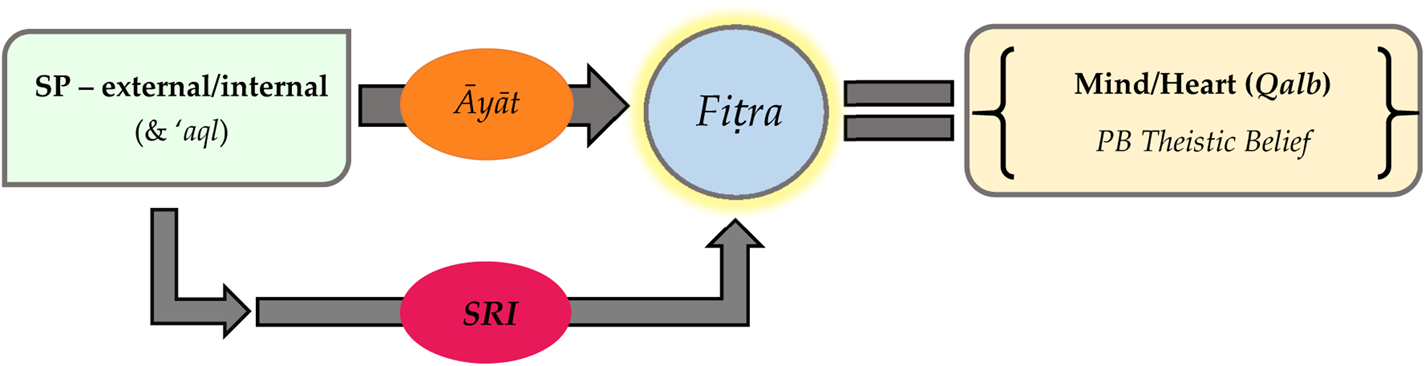
We may thus summarize the istidlāl bi'l-āyāt as follows (Figure 1):
Istidlāl bi'l-āyāt (inference through signs): [1] signs (āyāt) are apprehended through sense perception (SP) (and reason (‘aql) in at least some if not all circumstances). [2] Fiṭra – when sound – allows what has been received through the subjects’ cognitive faculties to be processed properly. [3] The cognitive process functions properly, and so one will immediately come to hold a corresponding theistic belief sparked by the apprehension of God's signs, settled in one's mind/heart (ḥaṣala fī qalbihi), and in turn, one will hold a properly basic (PB) theistic belief.
The general cognitive process of an istidlāl bi'l-āyāt to knowledge of God, when fiṭra is sound.

Wael Hallaq and the problem of circularity
However, it has been suggested that this notion of an inference through signs which Ibn Taymiyya proposes, as outlined above, is somewhat problematic: both contradictory within his own thought and epistemically circular. It is to this critique we now turn. Wael Hallaq (Reference Hallaq1991) devotes a significant amount of attention to Ibn Taymiyya's inference through signs, but suggests that there is a difficulty with Ibn Taymiyya's assertions regarding fiṭra and knowledge of God, namely that the idea appears somewhat circular. First, he argues that it is circular because Ibn Taymiyya apparently asserts that we come to knowledge of God by way of fiṭra, and yet it is God who implanted fiṭra within us: hence we need to assume God's existence in some premise before concluding that He exists. Second, Hallaq argues that Ibn Taymiyya impinges on the validity of his argument, by adding the theological assertion that fiṭra knows the existence of God even before apprehending theistic natural signs, and that in order to know that the signs signify God's existence, one must know God before being able to recognise that these are His signs. This, Hallaq suggests, appears to be circular and given what Ibn Taymiyya seems to have said in other places, also somewhat contradictory. So, he states that,
it turns out that while fiṭra apprehends God through the immediacy and necessity (ḍarūra) of the sense perception of Signs, such apprehension is said to be implanted in fiṭra by God Himself without the medium of Signs. This last assertion clearly injects in Ibn Taymiyya's argument a strong element of circularity. (Hallaq (Reference Hallaq1991), 65–66)
How might one respond to Hallaq's contentions? Let us begin with the first of two charges that Ibn Taymiyya's approach seems epistemically circular, which has it that he suggests that we know God via fiṭra, but that it is God who created us upon it, hence somehow assuming His existence in a premise antecedent to the conclusion. Now, this would of course be problematic if (1), it was supposed to be an argument aimed at demonstrating God's existence, and (2), if one was in what Bergmann coins a ‘question doubting’ context (Bergmann (Reference Bergmann2006), 199),Footnote 7 in this case concerning the truth of the conclusion that God exists. For if Ibn Taymiyya was attempting to demonstrate God's existence, he may be implicitly putting himself into a ‘question doubting’ context, where one cannot rely on the truth of that which is in question. But that is not what seems to be going on when Ibn Taymiyya says for instance that, the ‘recognition of the Creator is innate [and] necessary (fiṭrī ḍarūrī)’ (Ibn Taymiyya (Reference Ibn Taymiyya1995), 16:328). Ibn Taymiyya is merely starting from the supposition that God exists as a piece of knowledge that he already holds, and then from that knowledge explaining how it arises or has come to be known. Therefore, Ibn Taymiyya is not liable to the charge of epistemic circularity in any ‘malignant’ sense.
But what about the problem that Ibn Taymiyya appears to be contradictory by asserting, on the one hand, that we know God by fiṭra through the medium of signs, but then on the other hand, that we in fact know Him prior to the signs in order to recognize that they are His? It ought to be made clear that it is not as Hallaq suggests, that on occasion Ibn Taymiyya presents fiṭra as a faculty for knowing that created things must have a creator, and on other occasions, that fiṭra refers to inborn knowledge of the creator. As Ovamir Anjum explains, ‘this second view … is explicitly rejected by Ibn Taymiyya’ (Anjum (Reference Anjum2012), 221). Anjum notes – in referring to Ibn Taymiyya's main disciple, Ibn al-Qayyim (d. 1350 ce) – how Ibn Taymiyya's use of ma'rifa in the relevant passages as opposed to ‘ilm, demonstrates that such knowledge can only refer to knowledge which is acquired (muktasab), that is non-basic, and given other explicit passages from Ibn Taymiyya himself, it is clear that the knowledge within fiṭra does not refer to knowledge implanted within human beings since birth (ibid., 222).
However, this still does not explain what Ibn Taymiyya means when he suggests that fiṭra knows God prior to perceiving His signs. Indeed, Ibn Taymiyya does state that ‘fiṭra knows the Creator without these signs; that knowledge is inherent in it. Had it not known Him before these signs, it could not have known that they are His signs’ (Ibn Taymiyya (Reference Ibn Taymiyya1995), 1:47). So how ought we to understand this passage? First, note that, as we have seen, knowledge of God inherent in fiṭra is not something implanted. Second, Hoover – commenting on some of Hallaq's contentions – explains that, according to Ibn Taymiyya,
it is possible that inner voices (khawāṭir) in the soul alert it to the true religion without external teaching, and, apart from corrupting influences … [In addressing] the problem of circularity, the shaykh still has resort to external determinative causes. He says that these inner voices arise through the inspiration of an angel or other causes (asbāb) that God originates. (Hoover (Reference Hallaq2007), 41–42)
Now, it is not altogether clear how this would deal with the charge of circularity, because these ‘external determinative causes’ are still asbāb which ‘God originates’ and hence presuppose His existence. However, what Hoover does help us to understand here more clearly is how knowledge of God (at least in a partial sense) can arise within fiṭra in the absence of a connection to God's signs, which is not at the same time implanted knowledge, and can account for what Ibn Taymiyya means when he states that ‘fiṭra knows the Creator without these signs’. But perhaps one can simply dismiss this apparent problem of circularity, by recognizing the distinction between knowledge in potentia and in actuality. Indeed, Hoover explains that, ‘[f]or Ibn Taymiyya, the fiṭra is the religion of Islam, but in potentiality rather than in actuality’ (Hoover (Reference Hoover, Fleet, Kramer, Matringe, Nawas and Rowson2016a), 106). So, we may speculate, then, that the ‘prior knowledge’ of God before the apprehension of signs simply refers to a kind of potentiality to recognize God, where God not only provides the signs, but also a kind of natural ability to read the signs as coming from Him. In this case – where the prior knowledge is taken to be a kind of knowledge of God one has in potentia, in one's ability to recognize God when God prompts one to know Him – there is no circularity.Footnote 8
Thus, having addressed the main critique of Ibn Taymiyya's thesis in the literature, in the next section, we will attempt to draw on C. Stephen Evans's ideas on ‘theistic natural signs’, and consider how some of those ideas may help us further understand the utility and epistemic value of Ibn Taymiyya's thesis, and also where epistemic space may be left for more traditional theistic arguments.
Theistic natural signs and Pascalian constraints
In his Natural Signs and Knowledge of God: A New Look at Theistic Arguments, C. Stephen Evans argues that behind the traditional theistic arguments lie ‘theistic natural signs’, which point to God's reality, and that their fundamental epistemic value may be viewed in the context of these underlying natural signs. He conceives of these signs as bringing God into one's awareness and producing non-inferential beliefs about Him. A theistic natural sign is one that God has ‘set up’ so to speak, and put in place such that His creatures may apprehend them, and in turn, come to acquire true beliefs about Him. Importantly, Evans argues that for a theistic natural sign ‘to be a natural sign at all, there must be some in-built propensity, when the sign is encountered, to form some relevant judgement as a result of the encounter with the reality mediated by the sign’ (Evans (Reference Evans2010), 38). In other words, there must be a natural capacity or inclination within God's creatures so that they can recognize His signs.
The plausibility of this approach from one perspective, according to Evans, is its ability to satisfy what he coins ‘Pascalian constraints on knowledge of God’ (Reference Evansibid., 17); what we might expect from God by way of evidence, if He does indeed exist. The first of these constraints are what he refers to as a ‘Wide Accessibility Principle’. Roughly, the idea is that it is conceivable that God would make knowledge of His existence ‘widely available, not difficult to gain’ (Reference Evansibid., 13). For given that God created human beings such that they may enter into a ‘relationship’ with Him, know Him, and worship Him, He would want to make the possibility of this ‘relationship’ open to all humans. The second constraint Evans refers to is the ‘Easy Resistibility Principle’, meaning that, ‘though knowledge of God is widely available, it is not forced on humans’ (Reference Evansibid., 15), such that those who do not want to enter into a special relationship with God will find it easy to reject Him and His existence as a whole.
It seems to me that Evans's conception of theistic natural signs neatly ties into the Taymiyyan conception of istidlāl bi'l-āyāt. First, Evans's notion of a ‘theistic natural sign’, as the basis of an immediate belief in God, neatly overlaps with what Ibn Taymiyya refers to as an āyā which points to God's existence. Second, as Evans puts it, the ability to grasp the concomitance between theistic sign and God presupposes a ‘natural disposition to become aware of that reality’ (Reference Evansibid., 93), which sounds strikingly similar to what Ibn Taymiyya speaks of in terms of fiṭra as a disposition for theistic belief: ‘fiṭra has a potency to know and believe in the Creator’ (Ibn Taymiyya (Reference Ibn Taymiyya1979), 8:458).
Perhaps more interesting though, is the plausibility of an overlap in terms of the aforementioned ‘Pascalian constraints’. Perhaps a Taymiyyan ‘Wide Accessibility Principle’ may be found in his saying that, ‘the more people need to know a thing, the easier God has made it for the minds of people to know the [corresponding] evidences (adilla) of it’ (Ibn Taymiyya (Reference Ibn Taymiyya2005), 299). Clearly, knowledge of God is more of a necessity than any other sort of knowledge for Ibn Taymiyya. Further, we may infer that the ‘Easy Resistibility Principle’ can been teased out of a Taymiyyan epistemology as well. In earlier work, Evans refers to what may be taken as the above principle in terms of a person ‘resisting’ the evidence of God's signs, due to them lacking ‘the proper kind of ‘subjectivity’ (Evans (Reference Evans, Craig and McLeod1990), 72). He continues by adding that, such evidence ‘can point the sincere seeker in the right direction securely, but also allows the one who is rebelling against God to convince himself that religion contains no truth’ (ibid., 73). In simple terms, it is evidence which is only ‘powerful for him who has ears to hear and eyes to see’ (ibid., 75). As we have seen, for Ibn Taymiyya it is only when one's fiṭra is unimpaired that knowledge of God may be attained from an apprehension of His signs. Such impediments upon fiṭra may arise due to certain desires (hawā) or personal motives (gharaḍ), which obstructs them from the truth (cf. Ibn Taymiyya (Reference Ibn Taymiyya1979), 6:271). Hoover also notes that ‘ignorance and heedlessness play a detrimental role’ in the corruption of fiṭra according to Ibn Taymiyya, as well as ‘pride, ill purposes, and divided love for God’ (Ibn Taymiyya (Reference Hoover2007), 43). Therefore, the ability of non-theists to resist the signs of God before them, is due to their underlying nature (fiṭra) or will to believe, being in some sense impaired on the Taymiyyan perspective.Footnote 9
These interesting parallels and compatibility between Ibn Taymiyya's and Evans's theses further reinstate the plausibility of contemporary Muslim philosophers drawing on Ibn Taymiyya's theological epistemology. Moreover, they highlight the novelty of views grounded in medieval theological thought and open up space for further comparative work. But crucially, they also emphasize the cross-religious accounts of a ‘Reformed epistemology’ (by which I mean simply that God can be known apart from argumentation). But what room may be left for traditional theistic arguments in a Taymiyyan epistemology of theistic signs?
Corruption of fiṭra and signs as a basis for theistic arguments
Above we outlined Evans's thesis regarding ‘theistic natural signs’, but we left out a crucial component. Evans argues that one can convert the theistic natural signs into propositional evidence. That is, one could ‘reflect on a natural sign and make it the basis for an argument’ like the cosmological, teleological, and moral arguments, drawing on these various signs and using them as ‘data’ which postulates God as the best or only explanation (Evans (Reference Evans, Walls and Dougherty2018), 109). So, to what extent might a similar postulation be the case concerning Ibn Taymiyya's own thesis on signs and knowledge of God?
For Ibn Taymiyya, although knowledge of God is principally attainted through fiṭra (upon an apprehension of God's signs) in an immediate manner, it may be possible that one arrives at this knowledge by way of argument, and in fact, this may be necessary for those whose fiṭra has become impaired. Ibn Taymiyya writes that,
The establishment and recognition of the Creator is innate [and] necessary in the souls of all people (fiṭrī ḍarūrī fī nufūs al-nās), even though some people have done something to corrupt their nature (fiṭra) such that they need an inference (naẓar) to achieve knowledge [of God]. This is the opinion of the majority of people, as well as the skilled debaters (ḥadhāq al-nuẓẓār); that knowledge of God is sometimes achieved by necessity [i.e. in ‘basic’ fashion] and other times by inference. (Ibn Taymiyya (Reference Ibn Taymiyya1995), 16:328)
In reference to the above passage, Hallaq explains that according to Ibn Taymiyya, ‘individuals who are devoid of such [sound] fiṭra may still be able to come to the knowledge that God exists, though their knowledge is not considered of a first order. This is perfectly in agreement with Ibn Taymiyya's epistemological postulate that inferred knowledge (naẓari, muktasab) occupies a rank inferior to immediate necessary knowledge (ḍarūrī)’ (Hallaq (Reference Hallaq1991), 57). Thus, Hallaq recognizes that for Ibn Taymiyya, inference to the existence of God is possible, but he also notes how this takes a second rank position epistemically. Therefore, Ibn Taymiyya appears to uphold something like the following: ‘a noetic structure N1 in which theistic belief is properly basic is epistemically superior to a noetic structure N2 in which theistic belief is nonbasic’ (Sudduth (Reference Sudduth1995), 29). The issue for Ibn Taymiyya then, is evidently that the superior method is that which leads to immediate necessary knowledge, namely the inference through signs, but he also chastises the theologians/philosophers for narrowing the route to knowledge of God. Ibn Taymiyya on the contrary insists that there are many paths to this knowledge:
Many thinkers (nuẓẓār) adopt a certain method of inference and argue that no other method can lead to the knowledge required. This negative statement has no validity, though their own method may be valid. The more people need to know a thing, the easier God has made it for the minds of people to know the [corresponding] evidences (adilla) of it. The evidences of the Creator, His Unity, and the signs of prophecy and their evidences are very many and ways for people to know them are very many. Most people, however, do not need many of these ways. (Ibn Taymiyya (Reference Ibn Taymiyya2005), 299)
Thus, although rational speculation is not necessary in theory to prove God's existence, it is possible and in fact may be necessary for those whose fiṭra has been corrupted, and as such, some could acquire this knowledge without inference (naẓar), while others need it.Footnote 10 Therefore, it would appear that Evans's thesis concerning theistic natural signs and knowledge of God overall is strikingly similar to that of Ibn Taymiyya and vice versa: for indeed, knowledge by way of apprehending God's signs can be immediate and produce basic theistic beliefs, but it just may be that some people can (and may have to) infer God's existence through means of a more traditional philosophical argument, which draws on those signs and takes them as the basis for those arguments. On the Taymiyyan scheme, this is predicated on the habits and methods of individual people (cf. Reference Ibn Taymiyyaibid.), but more primarily on the health of one's fiṭra.
What is also significant in this context is the flexibility and relativity which Ibn Taymiyya recognizes in the distinctions between basic (ḍarūrī) and non-basic or acquired (muktasab) knowledge depending on the cognitive state of the subject in question. Ibn Taymiyya considers ‘knowledge, whether self-evident [i.e. basic] or inferential (naẓariyya) … a relative, relational matter. What may be self-evident (badihiyya) for some people may be inferential for others’ (Reference Ibn Taymiyyaibid., 55). Indeed, there are differences in the intellectual capacities of human beings, and the role of fiṭra here is also instrumental, as Ibn Taymiyya states, ‘the foundation of reason (‘aql) is based upon sound and healthy fiṭra’ (Reference Ibn Taymiyyaibid., 368).
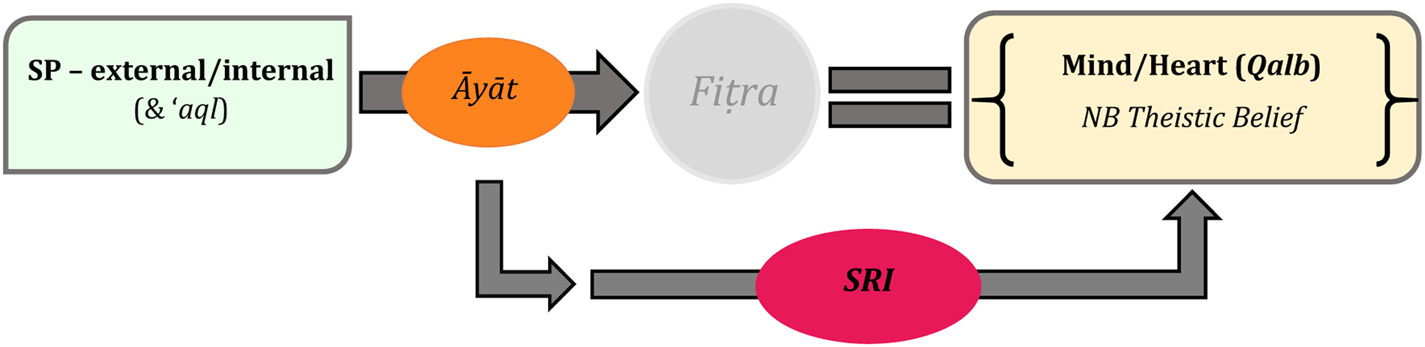
However, it is important to note that for Ibn Taymiyya, not just any old inference would be sufficient, and perhaps some of the arguments employed by the philosophers/theologians of the Islamic tradition would fail to meet the standards of a proper inference on his terms. Ibn Taymiyya speaks of ḥuṣn al-naẓar (sound rational inference) as the product of ‘aql ṣarīḥ (pure reason). A case in point would be from the very premise that the temporal origination (mujarrad al-ḥudūth) of things in our experience requires an originator, likewise so the temporal origination of the world itself needs an Originator (cf. Ibn Taymiyya (Reference Ibn Taymiyya1979), 8:319). This sort of sound rational inference is built on pure reason and undergirded by fiṭra, as Ibn Taymiyya points out elsewhere: ‘It is known by the fiṭra which God created His servants upon and by the purity of reason (ṣarīḥ al-’aql), that what is temporally originated cannot come into being without an originator’ (Ibn Taymiyya (Reference Ibn Taymiyya1999), 3:202). Consider then, how ḥuṣn al-naẓar may impact knowledge of God, given that one's fiṭra has become impaired (Figure 2):
[1] Signs (āyāt) are apprehended through sense perception (SP) (and reason (‘aql) in at least some if not all circumstances). [2] Fiṭra – in a state that is unsound – negatively impacts the cognitive process, such that the subject fails to arrive at properly basic theistic belief. Rather, one has perhaps at best a vague theistic seeming. [3] Consequently, one draws upon a sign (āya) they have apprehended and constructs a sound rational inference (SRI) from it, establishing the existence of God, and hence settled in the qalb, is a non-basic (NB) theistic belief.
The cognitive process of an istidlāl bi'l-āyāt to knowledge of God, when fiṭra has become impaired.

Yet, there is also another way to construe the scenario. Drawing upon the ‘combined warrant scenarios’ offered by Kevin S. Diller (Reference Diller2011), suppose one has some vague theistic seeming (due to an impaired fiṭra) that God exists, a seeming not strong enough for warrant. But then perhaps one learns of some inference for God, say a cosmological argument that goes something like this:
(a) whatever begins to exist has a cause,
(b) the universe began to exist,
(c) therefore, the universe has a cause (i.e. God).
Upon hearing the inference – suppose from your trustworthy philosopher friend – fiṭra, in conjunction with the relevant cognitive faculties, is able to see through the initial vague theistic seemings and arrive at theistic belief. In this case, it is not that your theistic belief was based on the inference, but rather that the inference (in this context being some grasp of the cosmological argument and that your friend is trustworthy in such matters) acted as the impetus for your vague theistic seemings to become firm and in the end be sufficient for warrant, such that you have a properly basic theistic belief.Footnote 11 Consequently, one is able to revive the fiṭrī disposition to believe in God in properly basic fashion, while drawing on inferences in some sense. Thus, the source of warrant is the proper function of one's faculties in producing firm theistic seemings, rather than the actual inferences themselves. In this case then, it might look something more like the following (Figure 3):
[1] Signs (āyāt) are apprehended through sense perception (SP) (and reason (‘aql) in at least some if not all circumstances) giving one a vague theistic seeming due to fiṭra being impaired. [2] Having had the seeming, you come to know about a cosmological proof for theism (SRI) from a trustworthy intellectual friend. [3] Fiṭra is revived such that you are now able to see the initially vague seeming in all its clarity, transferring the mode of acquisition back to the original non-inferential process, thereby arriving at a properly basic (PB) theistic belief.
The cognitive process of an istidlāl bi'l-āyāt to knowledge of God, when fiṭra has been revived.

Thus, we have seen in this section, how Ibn Taymiyya allows for more traditional inferences to knowledge of God and how one could draw on different āyāt to reach that knowledge by way of sound rational inference, and also how inferences can in some way help one to revive fiṭra and come to knowledge of God in a properly basic way. But what implication might a Taymiyyan epistemology of signs have for the Qur'anic discourse on theistic signs?
Qur'anic āyāt as divine-design discourse
According to Ibn Taymiyya, there are two broad categories of signs: ‘the signs which indicate [the existence of] the Lord may He be exalted are, [1] His spoken signs that He mentions in the Quran, and [2] signs of His creative acting which He created in the souls and the cosmos’ (Ibn Taymiyya (Reference Ibn Taymiyya1979), 7:302). So, given what his epistemology of theistic signs in the natural world implies about knowledge of God, we may wish to ask what a Taymiyyan approach might imply for the role of Qur'anic signs functioning as theistic evidence (perhaps somewhat differently from the way in which Ibn Rushd perceived things).
It seems to me that, given a Taymiyyan epistemology of theistic signs applied to the Qur'an, we might end up with a view of Qur'anic āyāt functioning as theistic evidence, which runs close to what Alvin Plantinga has coined ‘design discourse’ (Plantinga (Reference Plantinga2011), 240–248). Plantinga's idea is that, rather than viewing teleological discourse in natural theology as the explication of inferences, we might rather see them as simply, ‘directing our attention to the way we are inclined to form design beliefs in certain circumstances, and trying to get us in those circumstances’ (Reference Plantingaibid., 247). Or rather, we might view the discourse as a ‘wholly different style of argument: one where the arguer tries to help the arguee achieve the sort of situation in which the Sensus Divinitatis operates’ (Plantinga (Reference Plantinga, Walls and Dougherty2018), 470), or roughly what Evans coins, ‘an argument for ordinary people’ (cf. Evans (Reference Evans, Walls and Dougherty2018), 108–122).
In other words, we may view the Qur'an – when engaged in alerting its audience to natural phenomena which are indicative of the divineFootnote 12 – not as offering inferences from design (or from other features in the world), or even pieces of evidence which supports or inspires those inferences (at least not primarily). Rather, it is to be seen as engaged in a ‘divine-design-discourse’, one that works to awaken fiṭra and open its sincere interlocutor to the truth behind the signs. This idea would seem to neatly map onto a Taymiyyan understanding of a sign-based ‘inference’ in tandem with the Qur'an. Roughly, the idea might be that the Qur'an, in making reference to the natural signs in creation, acts as the external prompting, and grounds the circumstances in which the fiṭrī response to an apprehension of and reflection over these āyāt may be achieved. Indeed, it is Ibn Taymiyya's view of prophecy more generally that it came to perfect fiṭra: encouraging believers towards the recognition, worship, and love of God (cf. Hoover (Reference Hoover2007), 44).
Furthermore, the notion of divine-design discourse perhaps better resonates with an experiential approach that inspires not merely theistic affirmation or belief, but also urges the believer to stand in awe and wonder of these signs, and hence engage in praise of the very source of them (i.e. God). Thus, Ibn Taymiyya explains that,
The distinction between the Qur'anic and the kalām theological methods is indeed that God commands worship of Him … He did not limit it to mere affirmation, as is the objective of the methods of kalām … the Qur'an [in contrast] relates knowledge of Him and service to Him. So, it combines the human faculties of knowledge and practice … [kalām methods] secures merely the affirmation and acknowledgment of God's existence. (Ibn Taymiyya (Reference Ibn Taymiyya1995), 2:12)
Finally, conceiving of these sorts of immediate beliefs elicited from signs as an ‘argument for ordinary people’ is significant. For one, it allows us to conceive of Ibn Taymiyya's own thesis, that is, the Qur'anic method he interprets as the inference through signs, as being a wholly different sort of ‘inference’ in contrast to traditional theistic arguments, where, in alerting subjects to the signs of God, it can trigger immediate theistic beliefs when one's fiṭra is sound. From this perspective, the Taymiyyan position would seem to suggest that the Qur'anic method for eliciting theistic beliefs as divine-design discourse is equally applicable to the philosopher as it is the layman, which of course resonates with the Qur'anic view as being a revelation to humanity, and hence epistemically egalitarian, as opposed to esoteric. This view may be seen as an extension of what Yahya Michot describes as ‘the self-sufficiency of the religious rationality manifested in scriptural literality and common faith, and its validity for all, the elite as well as the crowd’ (Michot (Reference Michot2003), 171), in the Taymiyyan scheme. Thus, the philosophical methods of rational speculation are not necessary for most people. Rather, ‘authentic knowledge is available to anyone whose basic rational faculty and fiṭra are intact, not just an elite coterie of philosophers’ (El-Tobgui (2020), 293). And as we have seen, authentic knowledge of God is thought to be principally the consequence of perceiving the His signs manifest in the natural world.
Conclusion
At the beginning of this article, we mentioned Ibn Rushd, who drew on particular verses/signs (āyāt) from the Qur'an in articulating two arguments for God's existence. In contrast, to Muslim philosophers like Ibn Rushd and the classical Muslim theologians (mutakallimūn), Ibn Taymiyya presents a unique alternative to construing how knowledge of God may be attained in the absence of argumentation: through an apprehension of theistic natural signs (āyāt). Significantly, this unique Taymiyyan approach gives us a fresh way to understand the epistemic function of Qur'anic āyāt as theistic evidence. Indeed, Ibn Taymiyya views his approach as the Qur'anic method of natural theology par excellence and hence, in opening space from which an Islamic natural theology grounded in the Qur'an allows for its subjects to uphold knowledge of God, despite the lack of inference, it opens space to exploring a Reformed epistemology within Islam.
Acknowledgments
This research article came to fruition due to a research grant I obtained from the Theology, Science and Knowledge (JTF) Project, led by Jon McGinnis and William Dunaway, whom I would like to thank for facilitating my acceptance of the grant, and for their help more generally.