1. Introduction
Aglaspidids are a modestly diverse and relatively obscure group of lower Palaeozoic arthropods that are only known from a handful of localities worldwide. Most recognized species of aglaspidids sensu stricto (as defined by Van Roy, Reference Van Roy2006) are known from the upper Cambrian of Wisconsin, USA (Raasch, Reference Raasch1939; Hesselbo, Reference Hesselbo1992), with only three monospecific genera having been described from the upper Cambrian of Tasmania (Ortega-Hernández et al. Reference Ortega-Hernández, Braddy, Jago and Baillie2010), and the lower Ordovician of Wales (Fortey & Rushton, Reference Fortey and Rushton2003, Reference Fortey and Rushton2009) and Morocco (Van Roy, Reference Van Roy2006; Van Roy et al. Reference Van Roy, Orr, Botting, Muir, Vinther, Lefevbre, Hariri and Briggs2010). Interestingly, not a single aglaspidid genus is shared between these localities, except perhaps for a yet undescribed taxon from the lower Ordovician Fezouata biota that may be referable to Tremaglaspis (Van Roy et al. Reference Van Roy, Orr, Botting, Muir, Vinther, Lefevbre, Hariri and Briggs2010; Fortey & Rushton, Reference Fortey and Rushton2009).
Reports of taxa with putative aglaspidid affinities from China are almost non-existent, which is surprising considering the vast diversity of arthropods that has been described from the lower Palaeozoic of this region. The few reports available include Kwanyinaspis maotianshanensis Zhang & Shu, Reference Zhang and Shu2005 from the lower Cambrian Chengjiang Konservat-Lagerstätte, an unnamed taxon from the Ordovician of Shanxi (Fortey & Theron, Reference Fortey and Theron1995; not Silurian as mentioned by these authors, Derek Siveter pers. comm.) and Sinaglaspis xiashanensis Hong & Niu, Reference Hong and Niu1981 from the Carboniferous of Shanxi. However, K. maotianshanensis displays several features that are not compatible with its inclusion within the Aglaspidida sensu stricto (Van Roy, Reference Van Roy2006) and a recent cladistic analysis resolves its position outside this group (Ortega-Hernández, Legg & Braddy, Reference Ortega-Hernández, Legg and Braddy2012). The same analysis supported the inclusion of the Ordovician species from Shanxi within the Aglaspidida sensu stricto, but this taxon still awaits formal description. Lastly, S. xiashanensis only bears a vague resemblance to aglaspidids sensu stricto (Van Roy, Reference Van Roy2006) and was even considered by Zhang & Shu (Reference Zhang and Shu2005) to be an arachnid rather than an artiopodan.
Here we describe a new arthropod that constitutes the first convincing evidence of the presence of an aglaspidid sensu stricto in the Cambrian of China. Comparisons with previously known aglaspidids sensu stricto indicate that this arthropod represents a new species within an already established genus from Laurentia, suggesting that these arthropods had significant dispersal capabilities. This discovery also carries implications for the systematic classification within the Aglaspidida.
2. Geological setting
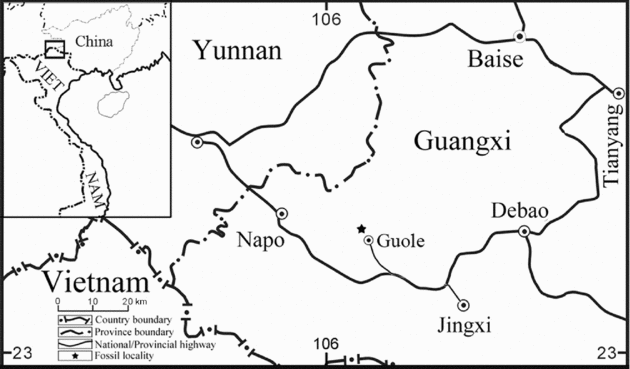
The material was collected in a small outcrop located about 1 km NW of Guole Township, Jingxi County, Guangxi Province, China (Fig. 1). It was found in a marl bed belonging to the upper Cambrian Sandu Formation, which crops out sparsely all around Guole. The Sandu Formation has yielded a diverse fauna of brachiopods (Zhan et al. Reference Zhan, Jin, Rong, Zhu and Han2010), trilobites (e.g. Han et al. Reference Han, Tang, Wei and Wang2000; Zhu, Hughes & Peng, Reference Zhu, Hughes and Peng2007, Reference Zhu, Hughes and Peng2010), echinoderms (Han & Chen, Reference Han and Chen2008; Zamora et al. unpub. data; Zhu et al unpub. data), hyoliths, graptolites (Zhan et al. Reference Zhan, Jin, Rong, Zhu and Han2010) and undescribed palaeoscolecids. However, only one aglaspidid specimen was discovered despite intensive collection efforts by one of the authors (XZ), and a team led by Bertrand Lefebvre and Jean Vannier (Université Lyon I, France). The abundant trilobite remains found in the same bed indicate that this level is equivalent to the Probinacunaspis nasalis–Peichiashania hunanensis Zone (Furongian, Stage 9) of northwestern Hunan. Brachiopods indicate that the Sandu Formation may represent a nearshore, shallow-water environment (Zhan et al. Reference Zhan, Jin, Rong, Zhu and Han2010).
Locality map of the Guole Section.

3. Material and methods
The single aglaspidid specimen is an almost entire cephalon associated with fragments of trunk tergites. Photographs of the specimen immersed under diluted ethanol were taken with a Leica DFC420 digital camera mounted on a Leica MZ12.5 microscope. Details of the exoskeletal sculptural features were investigated using a scanning electron microscope (SEM; JEOL 310 JSM-6490LV) equipped with an energy dispersive X-ray (EDX) module (EDAX-Ametek).
EDX analyses show that the fossil is composed of O, Si and Al, and to a lesser extent Mg, Fe and Al. This composition is suggestive of a clay mineral, the precise nature of which could not be determined. This clay mineral has likely replaced the original cuticle during diagenesis, but whether this was purely organic or partially mineralized is uncertain.
The specimen is housed at the Nanjing Institute of Geology and Palaeontology, Chinese Academy of Sciences (NIGPAS). Other institutional abbreviations used: MPM – Milwaukee Public Museum; USNM – National Museum of Natural History, Washington, DC; UCA – University of California; UW – University of Wisconsin Madison.
4. Systematic palaeontology
Order AGLASPIDIDA Raasch, Reference Raasch1939
Family Aglaspididae Miller, Reference Miller1877
Genus Aglaspella Raasch, Reference Raasch1939
Type species. Aglaspella granulifera Raasch, Reference Raasch1939 from the upper Cambrian of Wisconsin, USA.
Assigned species. A. granulifera Raasch, Reference Raasch1939; A. sanduensis sp. nov.
Diagnosis (emend.). Genus of Aglaspididae characterized by a wide, subtrapezoidal cephalon with low dorsal convexity, straight anterior margin, medially positioned eyes, acute genal angles and widespread tuberculation.
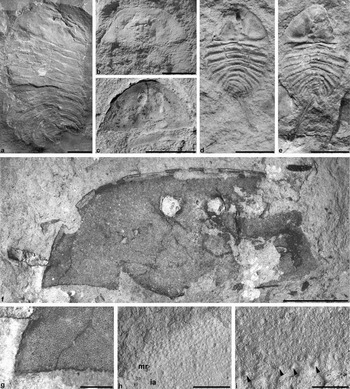
Discussion. As interpreted by Raasch (Reference Raasch1939) and Hesselbo (Reference Hesselbo1992), the genus Aglaspella comprises the species A. granulifera and A. eatoni, which are united by the presence of small eyes of high relief and of a single row of tubercles along the posterior margins of the cephalon and trunk tergites. Whilst the eyes of A. granulifera are in accordance with this diagnosis (Fig. 2a, b), those of A. eatoni have only a feeble convexity (Fig. 2c–e). Furthermore, the presence of a row of tubercles along the cephalic and tergite posterior margins is not unique to Aglaspella but can also be observed in representatives of the genera Aglaspis and Glypharthrus (Ortega-Hernández, Legg & Braddy, Reference Ortega-Hernández, Legg and Braddy2012); thus, we consider that the grouping of A. granulifera and A. eatoni within the same genus is weakly supported. Conversely, A. granulifera and the new species described below resemble one another in the distinctive overall shape of the cephalic outline, the morphology of genal angles and the position of the eyes. Accordingly, these features are used herein to propose a new concept of the genus Aglaspella that includes these two species. A. eatoni is assigned to a new genus based on its distinctive morphology.
(a–e) Aglaspidids from the upper Cambrian Trempealeau Formation, Wisconsin, USA, dorsal views. (a, b) Aglaspella granulifera Raasch, Reference Raasch1939, Lodi Member, Richland County. (a) lectotype exoskeleton MPM 11166 (only the counterpart is figured); (b) paralectotype MPM 11173, cephalon with parts of anteriormost trunk tergites, courtesy of Patricia Coorough Burke. (c) Hesselbonia eatoni?, hypotype cephalon USNM 101127, Saint Lawrence Member, Monroe County. (d, e) Hesselbonia eatoni (Whitfield, Reference Whitfield1880), holotype exoskeleton, Lodi Member, Lodi, Columbia County, courtesy of Dave Strauss; (d) counterpart UCA 34380; (e) part UCA 34379. (f–i) Aglaspella sanduensis sp. nov., holotype (NIGPAS 157028), cephalon with fragments of tergites, Probinacunaspis nasalis–Peichiashania hunanensis Zone, upper Cambrian (Furongian, Stage 9), Sandu Formation, Guole Section, Guangxi Province, China, dorsal views. (f, g) Specimen immersed under ethanol; (f) general view; (g) detail of the left genal area. (h, i) Scanning electron micrographs; (h) tuberculation patterns of the marginal rim (mr) and the inner area (ia) circumscribed by it; (i) row of large tubercles (arrow heads) along the posterior margin. Scale bars = 5 mm for (a–f), 1 mm for (g), 500 μm for (h) and 200 μm for (i).

Aglaspella granulifera Raasch, Reference Raasch1939
Figure 2a, b
1939 Aglaspella granulifera Raasch, pp. 17–19, pl. 9, figs 1–7.
1992 Aglaspella granulifera Raasch; Hesselbo, p. 903, figs 14.2, 15.1–15.5.
2010 Aglaspella granulifera Raasch; Ortega-Hernández, Braddy, Jago & Baillie, fig. 7 (schematic drawing).
Material, localities and horizons. See Hesselbo (Reference Hesselbo1992).
Diagnosis (emend.). Aglaspella with small eyes, short anterior cephalic margin (c. half of maximum cephalic width), subrectangular trunk, articulating ridge cuspate over the axis and tailspine bearing three rows of dorsal tubercles (modified from Hesselbo, Reference Hesselbo1992).
Description. See Hesselbo (Reference Hesselbo1992).
Discussion. The distinctive subtrapezoidal outline of the cephalon that characterizes the genus clearly distinguishes A. granulifera from other aglaspidids sensu stricto, especially from the species that co-occur within the upper Cambrian of Wisconsin (Raasch, Reference Raasch1939; Hesselbo, Reference Hesselbo1992). Features differentiating the two species of Aglaspella are discussed below.
Aglaspella sanduensis sp. nov.
Figures 2f–i, 3
Material, locality and horizon. Holotype, cephalon associated with fragments of trunk tergites (NIGPAS 157028; Fig. 2f–i); Marl with abundant trilobite sclerites; horizon equivalent to Probinacunaspis nasalis–Peichiashania hunanensis Zone of northwestern Hunan, upper Cambrian (Furongian, Stage 9), Sandu Formation, about 1 km NW of Guole Township, Jingxi County, Guangxi Province, China (Fig. 1).
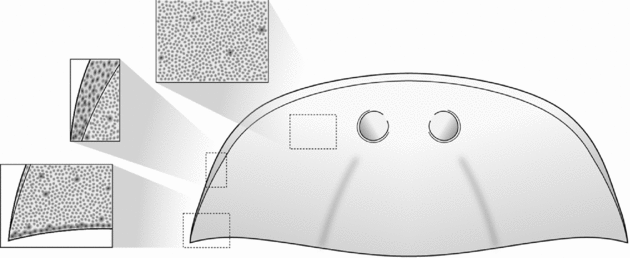
Schematic reconstruction of the cephalon of Aglaspella sanduensis sp. nov. and variability of the cuticular sculpture.

Etymology. After the Sandu Formation, the lithostratigraphic unit that yielded the specimen.
Diagnosis. Aglaspella with long anterior cephalic margin (almost two-thirds of maximum cephalic width) and large dorsal eyes.
Description. Cephalon subrectangular in outline (Fig. 2f); anterior margin particularly long (almost two-thirds of maximum width of the cephalon) and straight; posterior margin slightly opisthocurved abaxially and procurved medially; genal angles acute but devoid of well-developed spines (Fig. 2g); marginal rim weakly defined (Fig. 2f, h), narrow, flat and merging with lateral margin before reaching genal angle; insertion of eyes large and located in close proximity to the sagittal axis and anterior margin (distance between insertions of eyes and anterior margin less than a third of sagittal length of cephalon); medioposterior area, possibly representing an axial lobe (i.e. glabella), circumscribed by cuticle folds running anteromedially from posterior margin to adaxial edges of the eyes; doublure as wide as marginal rim (at least anteriorly); area between the marginal rim and the posterior margin covered by evenly spaced granules, with occasional large tubercles sparsely distributed between them (Figs 2g–i, 3); marginal rim covered with moderately large, densely packed tubercles that are slightly elongated in a direction subparallel to margin (Figs 2h, 3); posterior margin bordered by a row of large tubercles (Figs 2i, 3).
The preserved cephalon is associated with some fragments of trunk tergites on its left (Fig. 2f) and posterior to it (not illustrated). The shape of these tergites is not known, but their sculpture is similar to that observed on the inner part of the cephalon.
Discussion. The new aglaspidid species from the Cambrian of China is considered a member of the Aglaspidida sensu stricto, despite the fact that most of the characters regarded as diagnostic of the order by Van Roy (Reference Van Roy2006) cannot be directly observed on the single cephalon available.
Van Roy (Reference Van Roy2006) developed the concept of Aglaspidida sensu stricto in an attempt to group taxa that could reasonably be regarded as a monophyletic clade within the multiplicity of aglaspidid-like arthropods described. This concept is defined by a specific set of characters, or combination thereof, that were selected after critically reviewing the characters used in previous definitions of the Aglaspidida (Van Roy, Reference Van Roy2006). The taxa that could not fit the minimal criteria (e.g. the presence of postventral plates) were all included within an artificial group known as ‘aglaspidid-like arthropods’. However, no distinctions were made between the taxa for which the presence of the diagnostic characters could not be confirmed owing to the incompleteness of the material available and those that were actually known to differ from the Aglaspidida sensu stricto from a morphological perspective. For instance, Kwanyinaspis maotianshanensis was regarded as an aglaspidid-like arthropod because some aspects of its morphology (e.g. ventral eyes) clearly differ from those that characterize aglaspidids sensu stricto, and the fact that the putative presence of diagnostic aglaspidid features is at best dubious (see Section 5 below). Glypharthrus thomasi (Walter, Reference Walter1924), the type species of the genus, was not recognized as an aglaspidid sensu stricto on the grounds that its morphology is not sufficiently well known. Surprisingly, its two sister taxa, G. simplex (Raasch, Reference Raasch1939) and G. vulpes Raasch, Reference Raasch1939, are considered true aglaspidids (Van Roy, Reference Van Roy2006, table 1). If such drastic conditions were applied to a group like trilobites, in which the morphology of the entire exoskeleton is frequently unknown, this would result in the exclusion of a notable proportion of the 19600 or so species assigned to this clade (Adrain, Reference Adrain and Zhang2011). We fully agree with Van Roy that the definition of a more restricted concept Aglaspidida was necessary. However, we consider that if some species of a given genus are regarded as aglaspidids sensu stricto (e.g. Glypharthrus), this should logically be applied to the other, less well-known species assigned to the same genus, unless it can be shown that such assignment is not justified. Following this more flexible approach, we consider that the Aglaspidida sensu stricto comprises the species listed by Van Roy (Reference Van Roy2006), the recently described Australaglaspis stonyensis Ortega-Hernández et al. Reference Ortega-Hernández, Braddy, Jago and Baillie2010, and G. thomasi and Aglaspella sanduensis sp. nov.
In addition to the diagnostic characters proposed for the genus Aglaspella, A. sanduensis sp. nov. and A. granulifera share a narrow, weakly defined marginal rim and a similar sculpture, the variations of which over the different parts of the cephalon are virtually identical in the two taxa. A. sanduensis sp. nov. differs from the type species in its distinctively marked subrectangular cephalic outline, owing to the possession of a longer anterior cephalic margin. The eyes are broken in the holotype of the new species, but their insertions on the cephalon indicate that they are considerably larger than those of A. granulifera. However, their position and subcircular shape are similar in both species.
Order and Family uncertain
Genus Hesselbonia gen. nov
Remark. We follow Van Roy (Reference Van Roy2006), who considered that the type species of the new genus is not sufficiently well known for a confident assignment to the Aglaspidida sensu stricto. Moreover, the diagnosis of this monotypic genus and its comparison with other aglaspidids rely exclusively on the morphology of the holotype specimen of the type species (Fig. 2d, e), for we doubt that the assignment of the other specimens previously assigned to this species is correct (see discussion of the type species below).
Type species (monotypy). Aglaspis eatoni Whitfield, Reference Whitfield1880 from the upper Cambrian of Wisconsin, USA.
Etymology. In honour of Stephen P. Hesselbo, for his essential work on the aglaspidid fauna from the upper Cambrian of Wisconsin, USA.
Diagnosis. Aglaspidid-like arthropod with semi-circular cephalon subdivided by furrows into moderately inflated glabellar and lateral lobes and a flat peripheral border area, 11 trunk tergites, the anteriormost of them forming chevrons with strongly diverging branches (c. 150°), and a caudal spine.
Discussion. Although it cannot be confidently assigned to the Aglaspidida sensu stricto, Hesselbonia gen. nov. is best compared to representatives of this clade. However, the presence of glabellar and lateral lobes separated by furrows on the cephalon of Hesselbonia gen. nov. has no equivalents amongst aglaspidids sensu stricto. The morphology of its trunk tergites also differs from that typical of aglaspidid genera. In most aglaspidids sensu stricto, the anterior trunk tergites are straight transversely, and remain so (e.g. Aglaspis) or progressively bend backwards (e.g. Glypharthrus) abaxially. In Hesselbonia gen. nov. (Fig. 2d, e), the two halves of the anterior trunk tergites resemble parallelograms merging sagittally to form a chevron-shaped structure. This feature is not related to the fact that the convexity of the exoskeleton is still apparent in the holotype of H. eatoni. Indeed, some specimens of Tremaglaspis unite Fortey & Rushton, Reference Fortey and Rushton2003 also display a certain relief (e.g. Fortey & Rushton Reference Fortey and Rushton2009, figs 1A, 2B), but their anterior trunk tergites are clearly straight transversely.
A well-defined border area along the posterior cephalic margin occurs in G. thomasi; however, it does not continue into the lateral and anterior border areas, but is replaced by a rim, and the trilobation of the cephalon is barely perceptible. Chevron-shaped anterior trunk tergites are present in Aglaspoides sculptilis Raasch, Reference Raasch1939, but there is no clear delimitation of cephalic lobes or of a border area along the cephalic margin in this species, which also exhibits a narrow parabolic cephalic outline and a less pronounced divergence (c. 110°) of the two halves of the anteriormost trunk tergites.
Hesselbonia eatoni (Whitfield, Reference Whitfield1880)
Figure 2c–e
1880 Aglaspis eatoni Whitfield, p. 52.
1882 Aglaspis eatoni Whitfield; Whitfield, p. 192, pl. 10, fig. 11.
1901 Aglaspis eatoni Whitfield; Beecher, p. 366.
1925 Aglaspis eatoni Whitfield; Walter, p. 198.
1931 Aglaspis eatoni Whitfield; Resser, p. 1.
1931 Aglaspis eatoni Whitfield; Graham, p. 128.
1939 Aglaspella eatoni (Whitfield); Raasch, pp. 19–22, pl. 10, figs 1–7.
1979 Aglaspella eatoni (Whitfield); Briggs, Bruton & Whittington, p. 167.
1992 Aglaspella eatoni (Whitfield); Hesselbo, pp. 903–5, figs 14.3, 15.6–15.10.
2006 Aglaspella eatoni (Whitfield); Van Roy, p. 330, table 1.
Diagnosis (emend.). As for the genus.
Materials, localities and horizons. Holotype exoskeleton (part, UCA 34379, and counterpart, UCA 34380), Lodi Member, Trempealeau Formation, upper Cambrian, Lodi, Columbia County, Wisconsin (USA) (Fig. 2d, e). Additional specimens regarded as hypotypes of Aglaspella eatoni by Hesselbo (Reference Hesselbo1992; see his list for origin and repository details) are herein only tentatively assigned to the species (see below).
Description. See Hesselbo (Reference Hesselbo1992).
Discussion. The holotype significantly differs from the other specimens assigned to A. eatoni illustrated by Raasch (Reference Raasch1939) and Hesselbo (Reference Hesselbo1992). None of these specimens exhibit the diagnostic features of Hesselbonia gen. nov. USNM 101127 (Fig. 2c) or UW L74/1095 display slightly inflated glabellar areas, but no reliefs that could suggest the presence of lateral lobes (Hesselbo, Reference Hesselbo1992, figs 15.8, 15.10). A faint furrow separates the glabellar and occipital areas in these specimens and USNM 101128 (Fig. 2c), but there is no large border area clearly differentiated abaxially along the cephalic posterior margin (Hesselbo, Reference Hesselbo1992, figs 15.8–15.10). Moreover, UW L74/1095 and to a lesser extent USNM 101127 (Fig. 2c) show transverse instead of chevron-shaped anteriormost trunk tergites (Hesselbo, Reference Hesselbo1992, figs 15.8, 15.10). Finally, in these three specimens, the cephalon is narrow parabolic in outline, not semi-circular as in the holotype. Considering that none of these additional specimens come from the type locality and that even some of them were found in a different lithostratigraphic unit (e.g. Saint Lawrence Member), we doubt that they are conspecific with the holotype. However, we had no opportunity to directly examine the specimens and, therefore, it seems more cautious to keep them assigned to H. eatoni, although tentatively.
5. Discussion
In the past 25 years, the study of several soft-bodied faunas from the Cambrian of China (e.g. Chengjiang Fauna, Hou et al. Reference Hou, Aldridge, Bergström, Siveter, Siveter and Feng2004; Guanshan Fauna, Hu et al. Reference Hu, Zhu, Steiner, Luo, Zhao and Liu2010; Kaili Fauna, Zhao et al. Reference Zhao, Zhu, Babcock and Peng2011) has significantly contributed to a greater understanding of the diversification of marine life during and immediately after the Cambrian explosion. Despite the arthropod richness known from these Konservat-Lagerstätten, no aglaspidid sensu stricto has as-yet been described. Although Kwanyinaspis maotianshanensis from Chengjiang was tentatively assigned by Zhang & Shu (Reference Zhang and Shu2005) to the Aglaspidida, this species is best regarded as an aglaspidid-like arthropod (Van Roy, Reference Van Roy2006). Indeed, K. maotianshanensis lacks a mineralized exoskeleton, anterior tergal processes and probably also postventral plates, which are three of the six main characters proposed by Van Roy (Reference Van Roy2006) to define the clade. Moreover, it possesses ventral eyes and biramous appendages, which are features as-yet unobserved in aglaspidids sensu stricto. In the recent cladistic analysis of Ortega-Hernández, Legg & Braddy (Reference Ortega-Hernández, Legg and Braddy2012), the position of K. maotianshanensis was resolved close to, but definitely outside the Aglaspidida sensu stricto, while previous analyses had resolved it basal to Conciliterga (Paterson et al. Reference Paterson, Edgecombe, García-Bellido, Jago and Gehling2010; Paterson, García-Bellido & Edgecombe, Reference Paterson, García-Bellido and Edgecombe2012).
Accordingly, A. sanduensis sp. nov. represents the most convincing evidence of the presence of aglaspidids sensu stricto in the Cambrian of China. If our assignment of this species to Aglaspella is correct, this constitutes the first occurrence of a previously endemic Laurentian aglaspidid sensu stricto genus outside this palaeocontinent. Such distribution is not surprising considering that Cambrian faunas from Laurentia and China share many genera of non-trilobite arthropods, including Branchiocaris, Canadaspis, Isoxys, Leanchoilia, Marrella, Mollisonia, Naraoia, Perspicaris, Skania, Waptia and possibly also Odaraia and Sidneyia (see table 1 in Hendricks, Lieberman & Stigall, Reference Hendricks, Lieberman and Stigall2008; for Marrella, see Zhao et al. Reference Zhao, Yuan, Zhu, Yang and Peng2003). It is also noteworthy that strong affinities between the Sandu Formation fauna and contemporaneous faunas in Laurentia have been noticed for brachiopods (Zhan et al. Reference Zhan, Jin, Rong, Zhu and Han2010), whereas echinoderm and trilobite faunas have greater affinities with other Gondwanan faunas (e.g. Australia and Korea; Zhan et al. Reference Zhan, Jin, Rong, Zhu and Han2010, Zamora et al. unpub. data). The presence of A. sanduensis sp. nov. in Guangxi indicates that some genera of Cambrian aglaspidids sensu stricto had extensive geographic ranges, which suggests that the biogeographic pattern of these organisms during this period might have been more similar to that of non-trilobite arthropods than to that of trilobites (Hendricks, Lieberman & Stigall, Reference Hendricks, Lieberman and Stigall2008). Swimming capabilities have been proposed as an explanation for this wide geographical distribution of Cambrian non-trilobite arthropods. However, the morphology of the body (i.e. dorso-ventrally flattened) and, as far as it is known, of the appendages (i.e. short and leg-like) of aglaspidids are indicators of a benthic lifestyle rather than of significant swimming abilities, as are the trace fossils supposedly made by them (Hesselbo, Reference Hesselbo1988). Also, if confirmed by further findings, these important capabilities for dispersal of some late Cambrian aglaspidids would require the evocation of other biological traits (e.g. developmental strategies) to be explained, as with naraoiids (Hendricks, Lieberman & Stigall, Reference Hendricks, Lieberman and Stigall2008). In any case, the extensive geographic distribution of upper Cambrian aglaspidids sensu stricto, coupled with the recognition of two distinct sub-groups of aglaspidid morphotypes (Ortega-Hernández, Legg & Braddy, Reference Ortega-Hernández, Legg and Braddy2012), strongly suggests that most aspects of the early evolutionary history of this group are largely obscured by the scarcity of fossil material.
6. Conclusion
The discovery of an aglaspidid sensu stricto in the Sandu Formation confirms that these arthropods were already widely distributed around the world by the late Cambrian, as first suggested by the description of Austraglaspis stonyensis from Tasmania. It also represents the first evidence of the occurrence of a genus of an aglaspidid sensu stricto in two distinct palaeocontinents at that time, suggesting that some representatives of the group might have had great dispersal capabilities. Characterized by a high endemicity, the previously estimated palaeobiogeographic pattern of these arthropods might therefore be inaccurate and strongly influenced by the scarcity of aglaspidid findings outside Laurentia. A. sanduensis is exceedingly rare in the Sandu Formation but with the help of the present contribution, we hope that the growing interest for the upper Cambrian biota of the Guole area will permit the discovery of additional specimens in the future.
Acknowledgements
Derek J. Siveter (University of Oxford) shared with us details about the undescribed Ordovician aglaspidid from Shanxi. The pictures of the holotype of Hesselbonia eatoni were provided by Mark Goodwin and Dave Strauss (University of California Museum of Palaeontology) and that of the paralectotype of Aglaspella granulifera by Patricia Coorough Burke (Milwaukee Public Museum). We would like to express our gratitude to these persons for their help and to Peter Van Roy, an anonymous referee and Graham Budd for their comments. This work has been funded by the Agence National de la Recherche (R.L.-A., grant number RALI 197); the Consejo Nacional de Ciencia y Tecnología, (J.O.-H., grant number 209152); the University of Cambridge Trusts (J.O.-H., grant number 10135957); the Chinese Academy of Sciences (X.J.Z., grant numbers KZCX2-EW-111, KZCX2-YW-BR-23); and the National Natural Science Foundation of China (X.J.Z. grant numbers 40602002, 40872010, J0630967).