Implications
A proportion of pigs normal for ryanodine receptor 1 gene react to halothane gas challenge. If managed under commercial conditions, pigs that exhibit limb rigidity during halothane gas challenge may have poorer meat quality and more muscle fluid loss, which is detrimental to the fresh meat and further to processing industries. These results provide further insight into a possible cause for the variability observed in pork quality across the industry. Improved understanding of the underlying physiology and control of this condition can lead to interventions that can be used to enhance pork quality.
Introduction
The HAL-1843™ polymorphism, a mutation within the skeletal muscle ryanodine receptor gene (RYR1), has been directly associated with classical porcine stress syndrome (PSS; Fujii et al., Reference Fujii, Otsu, Zorzato, Del Leon, Khanna, Weiler, O'Brien and MacLennan1991). The PSS syndrome typically manifests itself during handling with the following symptoms: pigs become overly excitable, are difficult to move, exhibit open-mouth breathing and display discoloration of the skin and muscle rigidity. A proportion of these animals can die if intervention is not provided. Upon harvest, pigs that are homozygous or heterozygous for the HAL-1843 polymorphism will have poorer meat quality, and many are classified as pale, soft and exudative (Sellier, Reference Sellier1996).
Before availability of DNA testing for the HAL-1843 polymorphism, pigs were assessed for PSS using halothane gas challenge (Christian, Reference Christian1972; Webb and Jordon, Reference Webb and Jordon1978). Upon exposure to halothane gas, pigs that exhibited muscle rigidity, discoloration of the skin and limb tremors were classified as halothane reactors and susceptible to PSS. If halothane gas exposure continued, pigs exhibiting this manifestation would often die. However, reaction to halothane gas was determined to be associated with a recessive genotype (Christian, Reference Christian1972); therefore, pigs heterozygous for the HAL-1843 polymorphism could not be identified by halothane gas challenge.
Further research in this area has indicated that a proportion of pigs that are normal for RYR1 (Rempel et al., Reference Rempel, Lu, Kandelgy, Kennedy, Irvin, Mickelson and Louis1993; Allison et al., Reference Allison, Johnson and Doumit2005) would react abnormally when challenged with halothane gas. This abnormal reaction was similar to the phenotype exhibited among pigs that had the recessive PSS genotype, except that the condition was not fatal, even with prolonged exposure to halothane gas. Allison et al. (Reference Allison, Johnson and Doumit2005) further determined that halothane-sensitive pigs normal for RYR1 and handled aggressively had lower ultimate pH and greater longissimus muscle fluid loss compared with pigs less sensitive to halothane gas. However, halothane-sensitive pigs of different genetic backgrounds and handled using different movement methods did not consistently yield carcasses with poorer meat quality.
Pigs can learn to adapt their behavior to different environmental stressors (van Putten, Reference van Putten1982). Pigs sensitive to halothane gas and moved out of and into their pens regularly during their development required less handler intervention during aggressive handling at the time of marketing (Allison et al., Reference Allison, Mar, Berry, Anderson, Ivers, Richardson, Keffaber, Johnson and Doumit2006). Pigs sensitive to halothane gas and handled regularly during their development and marketed under normal handling conditions may be able to modify their metabolic state such that subsequent impacts on meat quality could be minimized. However, pigs raised under commercial conditions are typically not handled after they are moved into finishing pens. This may result in pigs not leaving their pen for 4 to 5 months after movement before they are marketed. Therefore, pigs normal for RYR1 and sensitive to halothane gas challenge may be less able to mitigate their metabolic state during handling and transport to the market. Our objective for this study was to assess the association of halothane sensitivity with growth and meat quality in RYR1-normal pigs managed under simulated commercial conditions.
Material and methods
All animal care and research procedures were approved by the Michigan State University's Institutional Animal Care and Use Committee. Pigs used in this study were from sires and dams that were normal for RYR1. Yorkshire–Landrace F1 females were single-sire mated to one of the seven Landrace boars at the MSU Swine Farm. There were 38 litters produced across four replications (farrowing groups). Pigs were weaned from sows at 19 ± 2 days of age and moved into nursery pens. Pigs consumed diets and water ad libitum. Diets met or exceeded NRC (1988) recommendations for each phase of growth. As pigs reached 56 ± 3 days of age, they were evaluated for halothane sensitivity. Pigs were chosen at random for halothane gas challenge, which consisted of pig exposure to 5% halothane gas in a closed system at a rate of 2 l/min for 3 min per pig in replication one and 2 min per pig in replications two to four. Halothane response was assessed using a 2-point scale with 0 indicating no response and 1 indicating sensitivity to halothane gas. This assessment was completed after 1 min of halothane gas exposure. Each of the four limbs was individually assessed for rigidity. The front two legs were individually assessed for limb tremors and the abdomen was assessed for discoloration. Two trained evaluators conducted all the classifications for halothane response. Halothane-sensitivity assessment was repeated 2 days after the initial assessment to estimate repeatability of halothane sensitivity.
Approximately 1 week after the halothane challenge, pigs were moved into finishing pens (0.74 m2/pig) and neither moved nor weighed again until they reached harvest age. Stockpersons observed pigs daily from outside the pen and did not enter the pen after moving unless a pig required human or medical intervention. Within each replication, pigs were marketed within one of the two harvest groups. At the initial marketing within replication, the heaviest pigs within each pen were visually identified, removed from the pen, walked a distance of 91 m to simulate the length of a typical U.S. finishing barn, weighed individually, tattooed and moved into holding pens. Pigs from a finishing pen were not mixed with other pigs until placement on the transport vehicle. Pigs were transported a distance of 550 km to a commercial slaughter facility in Ohio (USA). Pigs were rested in a single pen overnight with access to water and were the first pigs slaughtered the following morning. After harvest, carcasses remained in the coolers until further processing.
Data collection
Live animal data included halothane-sensitivity scores for limb rigidity, limb tremors and abdominal discoloration. Average daily gain (ADG) was determined from weaning to harvest. Longissimus muscle pH was measured adjacent to the last rib at 45 min and 18 h post mortem with a portable pH meter (Model 1140, Mettler-Toledo, Woburn, MA, USA) equipped with a puncture-type combination pH electrode (Lot 406-M6-DXK-57/25, Mettler-Toledo, Woburn, MA, USA). In addition, at 18 h post mortem, objective longissimus muscle color measurements of International Commission on Illumination (CIE, 1976) L*, a* and b* were collected using a Hunter Miniscan EZ Colorimeter (HunterLab Associates, Reston, VA, USA). This instrument is equipped with a 25-mm diameter measuring area and a 10° standard observer. Illuminant D65 was used. In addition, subjective longissimus color score on a 1 to 6 scale (National Pork Producers Council (NPPC), 2000), where 1 was pale, pinkish gray and 6 was dark, purplish red, and subjective marbling score on a 1 to 10 scale (NPPC, 2000), which approximated intramuscular fat percentage, were collected. Furthermore, longissimus muscle fluid loss was estimated using the filter paper method (Kauffman et al., Reference Kauffman, Eikelenboom, van der Wal, Engel and Zaar1986).
Statistical analysis
A generalized linear mixed model incorporating a logit link function was used to estimate the variance components to calculate repeatability for limb rigidity, front limb tremors and abdominal discoloration. The model included the fixed effects of sex (barrow or gilt) and assessment day (1 or 2). The random terms were replication, litter and animal. Repeatability was calculated using the following equation: σ 2 animal/(σ 2 animal + σ 2 replication + σ 2 litter + 1).
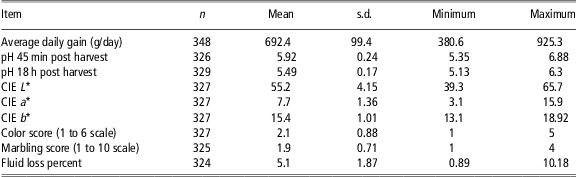
Pig growth and meat quality data (Table 1) were analyzed using a mixed model that included the fixed effects of sex, limb rigidity, limb tremors and abdominal discoloration, as well as all possible two-way interactions. Random effects included replication, litter and harvest group. To evaluate the association of halothane sensitivity with growth and meat quality, Day 1 halothane sensitivity classification for abdominal discoloration, tremors in either front limb and rigidity for any of the four limbs was used to indicate the pig's status for halothane sensitivity. Preliminary statistical analyses indicated that the results were similar using these halothane response variables v. using an overall sum for the front leg tremors and limb rigidity variables. For ADG, the covariates of weaning weight and days from weaning to harvest were included in the model.
Descriptive statistics for response variables for pigs challenged with halothane

CIE = International Commission on Illumination.
Results and discussion
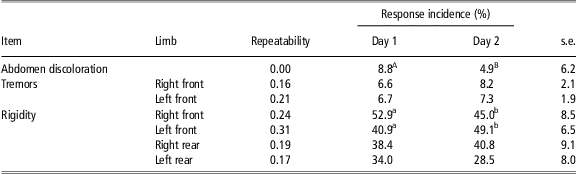
Halothane-challenge response is reported in Table 2. Abdominal discoloration and limb tremors were observed at a relatively low frequency with a significantly greater (P < 0.01) occurrence of abdominal discoloration on Day 1 than on Day 2. However, the opposite was true for limb tremors. There was a numerically greater occurrence of limb tremors on Day 2 than on Day 1; however, these differences were not significant. Limb rigidity displayed a greater response to halothane challenge. Limb rigidity has been the classical response variable evaluated for halothane gas challenge (Webb et al., Reference Webb, Carden, Smith and Imlah1982; Rempel et al., Reference Rempel, Lu, Kandelgy, Kennedy, Irvin, Mickelson and Louis1993). Occurrence of limb rigidity in the rear limbs was similar for each day. However, occurrence of limb rigidity did differ (P < 0.05) by day for each of the front limbs. This is consistent with previous findings that reported that response to halothane gas challenge did differ across challenge dates (Webb and Jordon, Reference Webb and Jordon1978; Allison et al., Reference Allison, Johnson and Doumit2005).
Repeatabilities and least squares estimates of incidence for halothane challenge response variables

A,BMeans with differing superscripts differ (P < 0.01).
a,bMeans with differing superscripts differ (P < 0.05).
Repeatability for halothane gas challenge was estimated for each halothane-challenge response variable evaluated (Table 2). Repeatability is considered to be an estimate of the upper bound of broad-sense heritability (Lynch and Walsh, Reference Lynch and Walsh1998) and includes the animal's genetic variance and individual permanent environmental variance. The estimate for repeatability of abdominal discoloration was 0.00 and it indicates that abdominal discoloration that occurred during halothane challenge did not occur among the same animals from day to day. Repeatabilities were generally larger for occurrences of limb rigidity than for limb tremors. Response to halothane challenge has long been reported to be a condition of incomplete penetrance (Smith and Bampton, Reference Smith and Bampton1977; Reik et al., Reference Reik, Rempel, McGrath and Addis1983) among pigs that were considered homozygous for the RYR1 mutation. The results reported here are consistent with historical findings and with more recent reports of halothane sensitivity among pigs normal for RYR1 (Allison et al., Reference Allison, Johnson and Doumit2005).
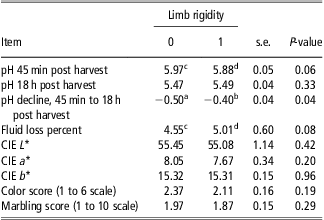
Pig performance and meat quality results are shown in Table 3. Pigs exhibiting abdominal discoloration or front leg tremors during halothane challenge did not differ (P > 0.10) for growth rate or meat quality compared with pigs that did not exhibit abdominal discoloration or front leg tremors (data not shown). The same was true for growth rate between pigs that exhibited limb rigidity during halothane challenge compared with those that did not. This is consistent with a review of literature that found no differences in growth rate among pigs thought to have differing RYR1 genotypes and differing in halothane-challenge response (Webb et al., Reference Webb, Carden, Smith and Imlah1982). However, in a report evaluating halothane sensitivity among RYR1-normal pigs, Allison et al. (Reference Allison, Johnson and Doumit2005) indicated that for one of the four groups of pigs that differed in genetic background, halothane-insensitive pigs had greater final live weight at the end of growth test compared with halothane-sensitive pigs.
Least squares means by limb rigidity classification for meat quality traits

CIE = International Commission on Illumination.
a,bMeans with differing superscripts differ (P < 0.05).
c,dMeans with differing superscripts differ (P < 0.10).
Several meat quality characteristics were somewhat different between carcasses from pigs that exhibited limb rigidity during halothane challenge compared with those that did not (Table 3). At 45 min post mortem, longissimus muscle pH was 0.09 units lower (P = 0.06) for carcasses from pigs that exhibited limb rigidity compared with carcasses from pigs that did not exhibit limb rigidity. However, longissimus muscle pH at 18 h post mortem was similar between the two halothane-challenged groups. This difference in 45 min pH caused pH decline from 45 min to 18 h to be less (P = 0.04) in longissimus muscle from pigs that exhibited limb rigidity during halothane challenge. This is somewhat conflicting with a previous report that evaluated meat quality in pigs that were RYR1 normal, but a proportion exhibited halothane sensitivity (Allison et al., Reference Allison, Johnson and Doumit2005). Allison et al. (Reference Allison, Johnson and Doumit2005) reported that pigs that differed in halothane sensitivity were similar for pH at 1 and 22 h post mortem, unless handled rigorously before slaughter. The results in the present study somewhat resemble those described in reviews of the literature that summarized comparisons of meat quality measures from pigs that were RYR1 normal v. those that were heterozygous for RYR1. Sellier (Reference Sellier1996) and Salmi et al. (Reference Salmi, Trefan, Bloom-Hansen, Bidenel, Boeschl-Wilson and Larzul2010) reported that carcasses from RYR1-heterozygous pigs were −0.24 and −0.16 pH units lower, respectively, for longissimus muscle pH taken within the first 45 to 60 min post mortem compared with carcasses from pigs that were homozygous RYR1 normal. However, in both literature reviews, ultimate longissimus muscle pH was also lower in carcasses from RYR1-heterozygous pigs compared with carcasses from RYR1-normal pigs, whereas the difference in the present study was not significantly different between the two groups. Consequently, although not reported, longissimus muscle pH decline would have been less for RYR1-carrier carcasses compared with RYR1-normal carcasses in the two previously mentioned literature summaries.
Longissimus muscle fluid loss tended to be greater (P = 0.08) in carcasses from pigs that exhibited limb rigidity during halothane challenge than carcasses from pigs that did not. Similar to the findings for pH, Allison et al. (Reference Allison, Johnson and Doumit2005) did not observe differences in longissimus muscle drip loss among carcasses from pigs that were RYR1 normal but differed in halothane sensitivity except when handled rigorously before slaughter. Among pigs handled rigorously, pigs classified as halothane sensitive had greater drip loss compared with those that were not sensitive to halothane exposure. The two aforementioned reviews of literature conflicted in their assessment of muscle drip loss. Sellier (Reference Sellier1996) reported that longissimus muscle drip loss was 1% greater for RYR1-carrier carcasses than for RYR1-normal carcasses. However, Salmi et al. (Reference Salmi, Trefan, Bloom-Hansen, Bidenel, Boeschl-Wilson and Larzul2010) reported that longissimus muscle drip was not significantly different between RYR1-carrier and RYR1-normal carcasses. In a study not included in either literature review (Shen et al., Reference Shen, Underwood, Means, McCormick and Du2007), an intensive study of longissimus muscle from RYR1-carrier and RYR1-normal carcasses was completed. In this study, muscle pH, ATP, ADP, adenosine monophosphate, inosine monophosphate and lactic acid concentrations were evaluated over a 24-h period post mortem. Although similar at exsanguination, longissimus muscle pH was lower at 0.5 and 1 h post mortem, and similar at 4 and 24 h in carcasses from RYR1-carrier pigs compared with carcasses from RYR1-normal pigs. This led to greater lactic acid concentration in longissimus muscle at 0.5 and 4 h post mortem and higher longissimus muscle drip loss in carcasses from RYR1-carrier pigs compared with RYR1-normal pigs.
The results in the present study suggest that pigs that exhibited limb rigidity during halothane challenge and those managed under simulated commercial conditions produced carcasses in which longissimus muscle quality was similar to that of carcasses heterozygous for the RYR1 mutation. Although the differences between carcasses from halothane-sensitive and halothane-insensitive pigs for longissimus muscle pH 45 min post harvest and muscle fluid loss were not as large as those between carcasses from RYR1-heterozygous and normal-homozygous pigs for longissimus muscle pH at 45 min and drip loss, the direction of these characteristics was similar. This suggests that RYR1-normal pigs sensitive to halothane gas may undergo a similar stress response during loading and transport to slaughter as RYR1-heterozygous pigs and potentially yield inferior meat quality post slaughter.
The underlying genetic control for limb rigidity, observed during halothane challenge, may differ for pigs normal for RYR1 compared with pigs that were homozygous for the RYR1 mutation. The repeatability for limb rigidity ranged from 0.17 to 0.31. This suggests that more than a single locus is involved in eliciting limb rigidity upon exposure to halothane gas challenge unlike pigs homozygous for the RYR1 mutation. Subsequent research is needed to better understand the genetic control of halothane sensitivity among pigs normal for RYR1. High-density genotyping using high-density molecular markers such as single nucleotide polymorphisms would allow for whole genome association studies to be conducted in order to determine how extensive the genomic control of this condition may be. If a few quantitative trait loci (QTL) appear to be controlling this condition, it may be possible to determine candidate genes that can be used in selection away from this condition. However, if there are many QTL associated with the expression of this condition, further studies may be needed to determine whether halothane challenge or possibly related biomarkers, not yet identified, may be needed in order to select against this condition.
Objective and subjective measures of longissimus muscle color and marbling were similar from carcasses of pigs that did and did not exhibit limb rigidity during halothane challenge (Table 3). This is somewhat similar to a previous study that compared RYR1-normal pigs that differed in halothane sensitivity (Allison et al., Reference Allison, Johnson and Doumit2005). In that study, there were no significant differences for CIE L* and b*, as well as subjective color and marbling scores between halothane-sensitive and halothane-insensitive pigs across the eight different breed groups evaluated. The results from the present study indicated that longissimus muscle from pigs that exhibited limb rigidity during halothane challenge yielded pork that was similar to that described as red, firm and exudative (RSE; Kauffman et al., Reference Kauffman, Cassens, Scherer and Meeker1992). Although firmness was not quantified in the present study, longissimus muscle from pigs that exhibited limb rigidity during halothane challenge was similar in CIE L* and subjective color score to longissimus muscle from pigs that did not exhibit limb rigidity during halothane challenge, but tended to have greater fluid loss. It has been suggested that pigs that have greater pre-slaughter stress will have a greater potential to yield RSE product (Ryu and Kim, Reference Ryu and Kim2006). Pigs normal for RYR1 and sensitive to halothane gas may be experiencing greater metabolic stress during handling and transport before slaughter, which could result in lower longissimus muscle pH at 45 min after slaughter and greater muscle fluid loss.
The limb rigidity and limb tremor interaction was significant (P < 0.05) for CIE a*. Within pigs that did not exhibit limb tremors, longissimus muscle CIE a* did not differ between pigs that did not and did exhibit limb rigidity (7.7 v. 7.9; P > 0.10). However, within pigs that did exhibit limb tremors, pigs that did not exhibit limb rigidity had greater longissimus muscle CIE a* after slaughter compared with pigs that did exhibit limb rigidity (8.4 v. 7.4; P < 0.05). This indicates that for pigs that exhibited limb tremors and did not exhibit limb rigidity, the longissimus muscle was redder in color than for pigs that did exhibit limb rigidity during halothane challenge. This was also seen in a study that evaluated meat quality in carcasses from pigs that differed in halothane sensitivity but were normal for RYR1 (Allison et al., Reference Allison, Johnson and Doumit2005). In that study, in one of the eight breed groups, longissimus muscle CIE a* was different between carcasses from pigs that differed in halothane sensitivity. Longissimus muscle CIE a* was greater, indicating greater red color intensity, from carcasses of pigs classified as halothane insensitive compared with halothane sensitive.
In conclusion, a proportion of pigs normal for RYR1 did exhibit limb rigidity when challenged with halothane gas. Subsequently, these pigs tended to have both lower longissimus muscle pH at 45 min post slaughter and greater muscle fluid loss. Pigs exhibiting limb rigidity during halothane challenge produced carcasses that had similar meat quality attributes to those of RYR1-heterozygous carcasses as compared with carcasses from RYR1-normal pigs. These results provide further insight into a possible cause for the variability observed in pork quality across the pork industry. Further investigation of the underlying physiology and genetic control of halothane sensitivity should lead to possible interventions or genetic selection strategies that would enhance pork quality.
Acknowledgments
The authors acknowledge and thank Dr George Bohart, Small Animal Clinical Sciences, College of Veterinary Medicine, Michigan State University, for his assistance and instruction to complete the halothane challenge portion of this experiment. The authors also thank I. Choi, S. Prasongsook, E. D'Alessandro and B. Varnes for their assistance with data collection. This work was funded in part by the Michigan State University Animal Industry Initiative Coalition grant program.