1 Introduction: synchronic variation in binominal size noun uses
In present-day English, binominal syntagms containing size nouns (henceforth SNs) such as bunch(es), heap(s), load(s) and pile(s) can express at least three main types of meaning which link up with distinct syntactic parsings of the SN within the construction (see Brems Reference Brems2003 and Reference Brems2007). SNs can function as head nouns referring to a particular constellation or shape of the noun following of (i.e. N2), as in (1). The of-phrase then is a postmodifier of the head SN and the binominal syntagm is parsed as follows: [[head: SN [postmodifier: of + N2]].
(1) ‘My first impression was not that it was an earthquake’, said Heinz Hermanns, standing by a heap of bricks that had fallen from his 100-year-old house. (CB-Today)Footnote 2
The set of N2-collocates in this use is typically restricted to specific subsets of count and uncount concrete nouns, depending on the lexical semantics of the individual SN, e.g. heaps of bricks/rubble/glass and a bunch of grapes/tulips/parsley.Footnote 3
In addition, SNs can express grammatical quantifying meaning (2) and (quantifying) evaluating meaning (3). In both cases the SN together with of has modifier status and N2 functions as the head noun, i.e. [(valuing) quantifier: SN + of] [head: N2].Footnote 4
(2) The graphics are very polished, with pitch detail, markings and the like adding heaps of atmosphere. (CB-Today)
(3) Warts-only copperdom, presenting the police as a bunch of hamfisted dimwits. (CB-Today)
Heaps of in (2) functions as a quantifier substitutable by a canonical quantifier such as much. Heaps of atmosphere (hyperbolically) measures the size of the abstract noun atmosphere and yields a functional structure that has to be parsed as [quantifier: heaps + of] [head: atmosphere]. Contrary to head noun uses, heaps of in (2) clearly does not serve to categorize N2 as an instance of the type ‘heaps’ (cf. Langacker Reference Langacker1991; Bache & Davidsen-Nielsen Reference Bache and Davidsen-Nielsen1997: 350ff.). In this quantifier use N2-collocates can be all kinds of abstract nouns and concrete nouns, including concrete animate nouns, which are not allowed in head uses.Footnote 5
In (3) a bunch of mainly serves to emphasize the negative value of hamfisted dimwits, rather than quantifying the referents, with presenting . . . as as an important contextual clue. In valuing uses N2-collocates are systematically restricted to abstract and concrete animate nouns which are negatively evaluated.
In addition to head and (valuing) quantifier examples such as (1)–(3) there are also ambivalent examples, i.e. examples in which more than one layer of meaning and structural organization is activated. I further subdivide these into ambiguous (4) and vague (5) examples as two distinct ways in which these multiple layers may interact:
(4) A spokesman for her London agents, Storm, confirmed yesterday: ‘At the moment she's looking at a heap of movie scripts. Another possibility Kate has toyed with recently is becoming a fashion photographer.’ (CB-Today)
Depending on the specific contextualization, a heap of movie scripts in (4) yields either a lexical head noun reading referring to a literal heap of scripts sitting on her desk, or a grammatical quantifier one that refers to ‘a great amount of’. Ambiguous examples include clues that support more than one reading, but the point is that either interpretation cancels the other one out in a more specific contextualization.
Example (5) illustrates a different kind of ambivalence that I have called vagueness in Brems (Reference Brems2007):
(5) The British have forged a fine tradition of gardening and cannot afford to sit on their well-clipped laurels. Striding past the compost heap of nostalgia, comes Christopher Lloyd. (CB-Times)
An example such as (5)
[i]nvolves two or more semantic features simultaneously playing a role in the interpretation of a structure: grasping the meaning of such a structure involves incorporating two or more different semantic features into one global interpretation. (Willemse Reference Willemse2007: 562; original italics)
Example (5) revolves around an extended gardening metaphor, in the semantic frame of which heap has literal reference, but at the same time the compost heap of nostalgia expressively measures the years of tradition in gardening and nostalgia and hence also activates the quantifier use. Contrary to ambiguous examples, vague SN-constructions resist disambiguation by means of more specific contextualizations and cannot be reduced to one of the meaning layers they incorporate. Vague uses precisely exploit the tension between lexical and grammatical meaning inherent in SNs without resolving it. Synchronically ambivalent uses will largely be left out of the present discussion. For a more detailed discussion see Brems (Reference Brems2007).
In the following sections I will argue in detail that the head, quantifier and valuing (quantifier) SN-uses discussed above constitute distinct constructions within the theoretical framework argued for in Brems (Reference Brems2007), i.e. a functional-cognitive one (Langacker Reference Langacker1991; Halliday Reference Halliday1994; Bache Reference Bache2000) that is complemented with a usage-based constructional component (cf. Goldberg Reference Goldberg2006). In section 2, I will first discuss the synchronic and diachronic datasets used for this study as well as the grammatical, semantico-pragmatic and collocational criteria on which the qualitative and quantified corpus analyses are based, and introduce the theoretical framework of this study.
In section 3.1, I will discuss the quantifier uses of bunch, heap(s), pile(s) and load(s) on the basis of extensive synchronic data analysis summarized from Brems (Reference Brems2007) as well as diachronic pilot studies of bunch, heap(s) and load(s) from Middle English onwards. In keeping with Traugott (forthcoming), I will argue that their present quantifier uses are the result of grammaticalization-cum-subjectification processes characterized by an extension of the collocational ranges of these SNs. Section 3.2 will discuss the valuing (quantifier) construction as it is instantiated by the singular SN-expressions bunch and load of. It will be hypothesized that the emergence of this constructional use involves new collocational restrictions and is fundamentally characterized by semantic prosody. For now, I will define the latter as a specific kind of evaluative meaning situated in extended lexical units, rather than individual lexical items, in which affective value is shared between collocates and nodes (Sinclair Reference Sinclair1991; Louw Reference Louw, Baker, Francis and Tognini-Bonelli1993, Reference Louw, Heffer and Saunston2000; Bublitz Reference Bublitz1996).
Section 4, then, will address some theoretical repercussions of the descriptive studies for a functional-cognitive model of the NP and grammaticalization research. Firstly, the three main SN-patterns will be argued to constitute collocationally constrained constructions (see Brems Reference Brems2007), a kind of lexico-syntactic structure that cannot be accounted for by most functional models of the NP, and that needs to be added to the present stock of construction types in construction grammar. As regards grammaticalization theory, this study argues that paths of grammaticalization do not only involve an ever-increasing broadening of the contexts in and collocations with which a grammaticalizing unit may appear, but may also involve reclusterings around constrained collocates and discourse schemata. The potentially motivating force of semantic prosody will be discussed, which entails a more precise definition of semantic prosody that distinguishes it from mere connotation and assesses its diachronic import.
2 Description of the data and methodology
The synchronic data for this study were extracted from the COBUILD corpus, which contains some 57 million words from 1990 onwards stratified in terms of register, medium and region. There is a predominance of British English data (42,099,593 words), but the corpus also contains American (9,980,368 words) and Australian English (5,337,528 words).Footnote 6
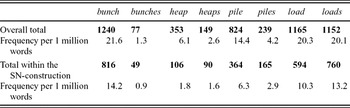
Extractions were made on the SNs bunch(es), heap(s), load(s) and pile(s) + of and are either exhaustive or constitute a random sample of 250 analysable tokens.Footnote 7Table 1 displays the token frequencies of the SNs irrespective of the construction in which they feature, obtained via the query ‘SN’/noun, which extracts all nominal uses of the SN. The frequencies of SNs within the SN-construction were obtained via ‘SN’/noun+of. Wrongly tagged or irrelevant uses were filtered out manually (e.g. frequent references to The Brady Bunch, The Wild Bunch or piles referring to haemorrhoids). Two figures are given in each case: absolute numbers (in bold) and frequencies per million words.
Token frequencies of eight SNs in COBUILD

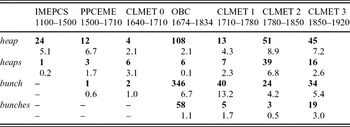
The diachronic studies reported on concern the SNs heap(s) and bunch(es) from the Middle English period onwards when the ‘NP + of + NP’ syntagms first appear (see Denison Reference Denison2002: 10 on sort/kind/type of). Using the queries hy?\+?[aei]\+?[aeiyo]?\+?a?\+?pp?[usnaer]?[maesnu]?[eam]? for heap(s) and bo?[uo]n[sc]h[usnaer]?[maesnu]?[eam]? for bunch(es) respectively, exhaustive extractions were made from the Innsbruck Middle English Prose Corpus Sampler (IMEPCS), Penn–Helsinki Parsed Corpus of Early Modern English (PPCEME), Corpus of Late Modern English Texts, extended version (CLMETEV 0–3)Footnote 8 and the Old Bailey Corpus (OBC).Footnote 9 These queries net all the spelling variants of the SNs listed in the Oxford English Dictionary (henceforth OED) and the Middle English Dictionary (henceforth MED) as well as possible case markings. For the analysis of the data, Abundantia Verborum was used, a computer program that combines tools for classifying data and performing statistical analyses on them.Footnote 10 Occurrences of SNs in of-constructions were filtered out and labelled manually in Abundantia Verborum. Table 2 first lists the overall token numbers of the SNs in the of-construction in each corpus (in bold). The figures underneath indicate the relative frequencies per million words. The PPCME (Penn–Helsinki Parsed Corpus of Middle English) did not yield any data for heap(s) or bunch(es).
Token frequencies of heap(s) and bunch(es) of from 1100 to 1920

Table 2 shows that there is an overall dearth of diachronic data for SNs especially for the periods in which, according to the OED and MED, the reanalysis as quantifier takes place, i.e. a.1661 for heap, a.1547 for heaps, c.1600 for bunch.Footnote 11 This is linked to an intrinsic lack of informal data for the older periods of English, the type of data that SNs today still typically occur in. Only the OBC, which consists of the proceedings from London's central criminal court, can be said to reflect colloquial, spoken language, but it too yielded relatively few data with little variation. Heap(s) threw up the most data, while bunch(es) is only attested from c.1700 onwards within the OBC and the literary CLMET. As a consequence, the discussion of the diachronic corpus analysis will be mainly qualitative in nature. As argued by Lehmann (Reference Lehmann2004), Traugott (Reference Traugott, Eckardt, Jäger and Veenstra2008) and others, synchronic data attesting synchronic variation can at best suggest an ongoing change but cannot be admitted as empirical evidence for change, nor for the directionality of change or the rate at which changes happened over time. Given the availability of synchronic and diachronic data at this stage, observations on the semasiological history and relative chronology of quantifier and valuing uses are necessarily formulated as hypotheses.
The classification of all corpus data was done by means of Abundantia Verborum, which allowed me to shunt between general functional classification and qualitative and quantitative features of the data. All data were classified in terms of the function that they fulfilled, and then more specific observations about collocational patterns and association with discourse schemes were added. Repeated cycles of (re-)classification and subclassification involving interlocking clusters of semantico-pragmatic, syntactic and collocational evidence led to the classification of SNs as head, quantifier, valuing quantifier and ambivalent uses, and their description as presented in section 3. Semantic criteria pertain to the degree of lexicality of the SN as well as to the degree of coextensiveness between the SN and N2 (see Langacker forthcoming a, b), reflected by the semantic generality of the N2-collocates. Syntactic criteria pertain to number concord between the SN or N2 and finite verbs, phoric pronouns and determiners. Subject–verb concord has limited applicability, however, since it can only be empirically tested when the binominal SN-construction has subject function and the SN and N2 differ in number. Francis & Yuasa (Reference Francis and Yuasa2008: 54) agree with Brems (Reference Brems2003) that these restrictions prevent systematic syntactic corroboration of the status of the SN within the SN-construction. Verbal and phoric concord can furthermore be motivated by factors other than grammatical number, and fluctuating verb agreement can be indicative of vacillating grammatical and semantic behaviour of the SNs as such.Footnote 12 In addition to concord patterns, substitution of the SN-expression by a (monomorphemic) canonical quantifier such as many/much is a test both for formal constituency and functional unity. Selectional restrictions on the choice of verb or other elements in the co(n)text are likewise taken into account, as well as constituency tests such as preposing of the of-phrase (see Aarts Reference Aarts1998; Traugott Reference Traugott2005; Langacker forthcoming a, b).
N2-collocates were categorized semantically as either concrete or abstract nouns, and generalizations were made over semantic subsets of collocates within those more general sets. I use the semantic terms concrete and abstract in the traditional sense of Quirk et al. (Reference Quirk, Greenbaum, Leech and Svartvik1985: 247), but also Langacker (Reference Langacker1991: 27–30). Referents of concrete nouns are typically instantial and can be registered by the senses in the here and now, whereas abstract nouns describe concepts and pertain to ‘type space’ instead of physical space (Langacker Reference Langacker1991: 64). Naturally, the categories of concrete and abstract noun have fuzzy boundaries, and assignment to either is context-dependent. For instance, crap can refer to concrete ‘faeces’, or to the abstract concept ‘nonsense’. Animate nouns (typically referring to human referents, and more rarely to animals) will be singled out as a special category, even though they are a subset of concrete nouns. They are allowed by some uses and disallowed by others. Like abstract nouns, animate nouns signal a clear move away from lexical head status of the SN. Syntactically, N2-collocates were characterized in terms of countability, as either (plural) count or uncount nouns.
3 Three constructional uses for SNs
In this section I will argue that the synchronic variation of SN-patterns introduced in section 1 reduces to three main constructional uses in which a specific function is linked up with a particular syntactic status and a particular collocational shape. I will therefore argue that SN-patterns are collocationally constrained constructions (CCCs), in the sense that the various SN-uses, as constructions, are characterized by distinct collocational patterns (see Brems Reference Brems2007). The theoretical value of CCCs for the study of the NP and grammaticalization research will be discussed in section 4.
I will also argue that non-head CCCs are the result of grammaticalization-cum-subjectification processes leading from head to quantifier and valuing (quantifier) uses which involve changes in collocational patterning. The path leading to quantifier uses seems to involve a gradual extension of the collocational range of the SNs involved on the ideationalFootnote 13 level: from a restricted set of N2-collocates in the head use, e.g. a bunch of grapes/flowers, in which ideational features are shared between the nodal SN and its collocates, the collocational range extends to include more types of concrete and abstract nouns, e.g. a bunch of suits/workshops/people. Valuing quantifiers involve interpersonal collocational reclustering, rather than extension, based on the sharing of affective or emotively coloured values between the nodal SN and its collocates. The latter will be explained in terms of semantic prosody patterns (Louw Reference Louw, Baker, Francis and Tognini-Bonelli1993; Bublitz Reference Bublitz1996, Reference Bublitz, Mengel, Schmid and Steppat2003). The main driving factors behind both developmental paths are assumed to be general expressivity needs, viz. the need for expressions of (hyperbolic) quantification, on the one hand, and for more attitudinally subjective forms of quantification and evaluation on the other hand (Hopper & Traugott Reference Hopper and Traugott2003; Haspelmath Reference Haspelmath1999).
Section 3.1 looks at the path leading from head noun to quantifier use by discussing the main lines within the collocational extension of the SNs bunch, heap(s) and load(s). Section 3.2, then, turns to the path leading to valuing meaning, which predominantly involves the singular SN-expressions bunch and load of. Detailed quantified collocational profiles of all SNs in their various uses are included in the Appendix. Interestingly, the various SN-expressions looked at did not grammaticalize to the same extent within each path. Some SNs still have a predominant head use, while others have developed a predominant (valuing) quantifier use.
3.1 Towards quantifier uses
3.1.1 Head uses of heap(s), load(s) and bunch
In their original head use, heap(s) and load(s) and bunch have lexical meanings that constrain the types of N2-collocates they can co-occur with. In the case of heap(s) the lexical semantics do not impose many restrictions on the nature of N2 other than that it needs to be concrete and can be made into a heap. Both synchronic and diachronic head uses of load(s) refer to ‘that which is laid upon a person, beast, or vehicle to be carried; a burden’ (OED). As such, ‘load’ depicts a rather indistinct constellation and imposes no restrictions on N2 in terms of countability. Like heap(s), synchronic and diachronic head uses of load(s) typically collocate with concrete N2s, e.g. (8), (9) and (11), but may also combine with abstract nouns in examples referring to a metaphorical burden, e.g. (7) and (12), or with animate referents (6), (10) and (13):
(6) [T]he carcass to an enormous size, until it at length bursts and becomes in a few hours afterwards one living heap of maggots. (CLMET, Samuel White Baker, 1853)
(7) [He] called hym a swellynge full of corruption that is to saye a man hauynge an hepe of vyces in hys breste. (PPCEME, George Colville, 1556)
‘He called him a swelling full of corruption, that is to say a man that has a heap of vices on his chest’
(8) Each home belonging to a Croat or Moslem was reduced to a heap of rubble. (CB-Today)
(9) They cast up two heaps of stones, the one at his head, the other at his feet. (CLMET, John Dryden, 1688)
(10) While we were attempting to disentangle ourselves from the heap of crumpled bodies, Alain coolly skied off into the distance, expecting us to follow. (CB-UKmags)
(11) Six plane loads of food are also being flown today to the city of Baidoa. (CB-NPR)
(12) The nurses and the women with child were to suffer a heavier load of sorrow because of the imminent persecutions (PPCEME, Jeremy Taylor, bishop of Down and Connor, 1673)
(13) . . . the last boat load of passengers was taken aboard at 8.30 A.M. (CLMET, The Loss of the S.S. Titanic, 1912)
As indicated by the OED, bunch refers to ‘a collection or cluster of things of the same kind, either growing together, or fastened closely together in any way’. In keeping with the more specific constellation it denotes, bunch(es) shows a more restricted range of N2-collocates than heap(s) and load(s). Frequent collocates include carrots, grapes, bananas, flowers, herbs (and their co-hyponyms), feathers, hair(s) and keys (see OED and Traugott forthcoming: 6). Feathers and hair(s) are frequent in the diachronic data only:
(14) A fox, unable to reach a bunch of grapes that hangs too high, decides that they were sour anyway (implied moral: it is easy to spurn what we cannot obtain). (CB-USbooks)
(15) [He] presented to the People two Handkerchiefs, a black silk Neckcloth, some beads, and two very small bunches of Feathers. (CLMET, Captain Cook, 1768−71)
(16)


In examples (6) to (16) the SN functions as the head noun of the construction and is coextensive with the referent of N2. Examples (11) and (13) show that verbal concord is with the SN. The of-phrase functions as a postmodifier specifying what the SN consists of, rather than introducing an additional referent into the discourse. Premodifiers of N2 further refine the type designated by N2 by indicating a specific subclass, e.g. white spray (16), ane hyeape of dyade coles ‘a heap of extinguished coals’ (IMEPCS), or attributing qualities to it, e.g. heaps of coarse hay (CLMET 3), untidy heaps of muddy or wet footwear (CB-UKephem).
Both in synchronic and diachronic head uses the SNs are fully categorial nouns. They appear in the singular and plural in this construction and allow definite, e.g. (10) and (13), as well as indefinite determiners, which are fully referential with regard to the binominal NP. Head SNs also allow all kinds of quantifiers or modifiers preceding the SN, which again apply to the entire binominal construction, e.g. one (6), two (9) and (15), six (11), three (16), heavier (12), small (15), a dreary heap of stone slabs (CB-Times).
3.1.2 Quantifier uses of heap(s) of, load(s) of and bunch of
In addition to their particular lexical semantics, all five SNs imply more abstract scalar meanings referring to what the typical size of a heap, load or bunch is. Repeated inferencing may semanticize or conventionalize such initially pragmatic implicatures, leading to semantic and structural reanalyses of these SNs as quantifiers (see Traugott forthcoming). In support of this hypothesized development relatively early diachronic examples such as (19)–(22) can be found that are bridging contexts between the ‘constellation’ meaning and the true quantifier meaning (Evans & Wilkins Reference Evans and Wilkins2000). Some synchronic examples with concrete nouns display a similar ambiguity (see a heap of movie scripts in example (4) in section 1):
(17) . . . it is no noble thing to a gouernour of a countree to haue a grete hepe or a quantite of golde all onely. (IMEPCS, William Caxton, 1481)
(18) Vast quantities of rich merchandise glittered in the shops as we passed along to the gates. Heaps of fruit and sweetmeats set half the grandams [older women] and infants in the place a-cackling with felicity. (CLMET, William Beckford, 1783)
(19) [T]he attempt to force improvements, which, however flattering the prospect at first, soon produced a load of debt, and inextricable embarrassments. (CLMET, Thomas Clarkson, 1808)
(20) . . . vegetables, on rafts and in barges, that I could scarcely distinguish a wave. Loads of grapes, peaches, and melons arrived, and disappeared in an instant. (CLMET, William Beckford, 1783)
In (17) the rephrasal of hepe as quantite highlights the scalar implicatures of ‘heap’. In (18) and (20) plural heaps and loads may refer to actual heaps or loads, or to large quantities as such, via the metonymy of ‘a quantity that could form’ heaps or loads. Example (19) shows that metaphorical load may also elicit scalar implicatures in its reference to a burden that weighs down heavily on someone.
Heap of, load of and especially heaps of, loads of and bunch of can in present-day English unambiguously denote mere quantity of a more or less unrestricted variety of concrete nouns. In addition, the collocational range is extended to abstract nouns, both count and uncount, which were not systematically allowed in the head noun use. Another major collocational extension is towards animate nouns. Examples of all five SNs with count and uncount concrete N2s (A), abstract count and uncount (B) and animate N2s (C) are given below. Diachronic examples are included when attested in the diachronic data or cited in the OED or MED:Footnote 14
A. Concrete N2-collocates
(21) Doors will open at 10.30pm for a great night out, featuring the somewhat bizarre antics of ‘The Vibemaster’, Evan Fletch mystery musicians, heaps of giveaways and prizes. (CB-OZnews)
(22) We have had loads of sunshine all the winter. (CLMET, Horace Walpole, 1735−48)
(23) Ned wanted to give me a bunch of suits. (CB-NPR)
B. Abstract N2-collocates
(24) I hope you won't go yet, for I expect my son home soon, and I've a heap of things to talk to you about besides. (CLMET, Frances Burney, 1782)
(25) I had amassed cart-loads of useless knowledge. (CLMET, Eliza Lynn Linton, 1885)
(26) The ‘surrogate mum’ to princes William and Harry shared heaps of fun with them at a fair yesterday while father Charles was otherwise engaged. (CB-Today)
(27) They employ lorry-loads of flattery. (CB-Today)
(28) We started in May and we did a bunch of practising. (CB-UKspoken)
(29) There's now a whole bunch of studies from different cities that show the same thing. (CB-NPR)
C. Animate N2-collocates
(30) ‘A whole heap of people step on the gas when them see me and run back to tell people me gone mad’, he recalls wryly. (CB-UKmags)
(31) There were heaps and heaps of mothers in the world, of course. (CLMET, Algernon Blackwood, 1915)
(32) I'm sure there are millions of people, millions of bikers, well not millions, but loads of bikers and people wearing exactly what Marlon Brando was wearing. (CB-UKspoken)
(33) A bunch of drunken, brain-dead louts seem determined to disgrace our team and our country. (CB-Sunnow)
These quantifier uses show several characteristics of grammaticalization and subjectification. The reanalysis from head to quantifier involves a rebracketing of [SN] + [of + N2] into [SN + of] + [N2]. Heap(s) of, load(s) of and bunch of can now fill the same functional and structural slot as monomorphemic quantifiers such as many/much.Footnote 15 Accordingly, the number concord is between N2 and the finite verb, e.g. (29)–(33). As noted by Traugott & Dasher (Reference Traugott and Dasher2002), grammaticalization is often accompanied by subjectification, or the development of speaker-related meaning from formerly ideational meaning. The emergence of quantifier meaning involves a backgrounding of propositional lexical semantics of the SNs leading to the semanticization of repeated pragmatic inferences of scalarity. Assessment of size is a speaker-related deictic notion and hence its semanticization is a case of subjectification (Breban Reference Breban2006).
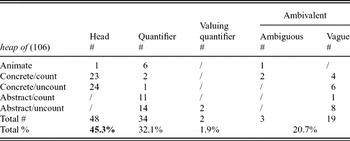
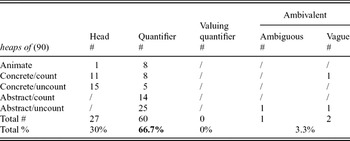
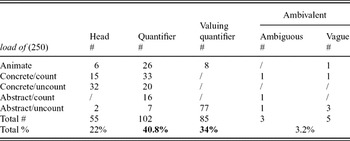
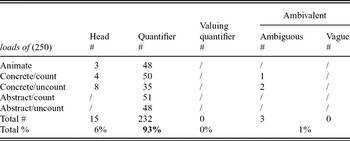
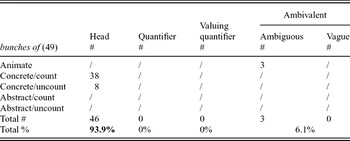
The examples above also show signs of partial decategorialization, i.e. the loss of features characteristic of the lexical noun category, compensated for by the gain in properties typical of the grammatical class of quantifiers (see Denison Reference Denison, van Kemenade and Los2006; Brems Reference Brems2007). Firstly, in the synchronic data the quantifier function is primarily associated with the plural variants of the SNs, except in the case of bunch of, where the plural variant shows no quantifier uses at all. Heap of has 32.1% quantifier uses versus 66.7% for heaps of; load of has 40.8% quantifier uses versus 93% for loads of (for the complete quantified synchronic analyses see the Appendix). Secondly, the article in the quantifier uses of singular SNs is largely restricted to the indefinite article, whereas, as we saw in section 3.1.1, the head use allows both definite and indefinite articles, e.g. the heap of crumpled bodies (10) and the last boat load of passengers (13). The definite article in quantifier uses is allowed in contexts where canonical quantifiers like many/much would also allow them, e.g. emphatic uses as in Harding was not approached to answer the many questions put in the article (CB-OZnews) and Tickets for the heaps of other events are selling faster than the lap time at today's Indy (CB-OZnews). Thirdly, premodifiers of the quantifier SNs are restricted to expressions that further reinforce the quantifier meaning of the SN, e.g. whole in a whole bunch of studies (29) and A whole heap of people (30), or more expressive prefixes such as cart in cart-loads (25) and lorry in lorry-loads of flattery (27), both harking back to the lexical origins of the SNs. By contrast, the premodification in head uses is more or less unrestricted in the kinds of property of the SN it describes, e.g. one living heap of maggots (6), a heavier load of sorrow (12), a fresh-gathered bunch of roses (CLMET, Mathilde Blind, 1885).Footnote 16
Grammaticalized SN-uses in the synchronic data furthermore appear in coalesced spellings such as buncha, loadsa and heapsa, though only in informal registers and primarily in internet data. Such coalescence is considered a common characteristic of advanced grammaticalization and reflects the functional and formal unity of the SN + of-string (Lehmann Reference Lehmann1985: 308; Heine Reference Heine, Joseph and Janda2003). However, as noted by Joseph (Reference Joseph2007) and De Smedt, Brems & Davidse (Reference De Smedt, Brems, Davidse and Facchinetti2007), coalesced spelling as such is no proof of grammaticalized status but typical of any routinization process.
Finally, synchronic quantifier uses comply with another characteristic of later stages of grammaticalization, viz. extension to other syntactic contexts than its source construction (Himmelmann Reference Himmelmann, Bisang, Himmelmann and Wiemer2004). Heaps, loads and bunch can be used adverbially with (comparative forms of) adjectives (34), verbs (35) and adverbs (36). In these uses of is lost:
(34) I miss the old Valley Pool. The new one is heaps better, of course, but I pity the children who have to attend school carnivals there. (CB-OZnews)
(35) The Sultans Of Ping are having an off night. This is probably the wrong place and wrong time, and the sound wobbles loads. (CB-UKmags)
(36) Here's a bunch more MOSS-based Internet facing websites that have recently gone live. (http://blogs.msdn.com/ecm/archive)
The quantifier uses of the various SNs each appear to have their own specific quantificational meaning and collocational profiles (see the Appendix). Heap and load of and especially the plural forms heaps Footnote 17 and loads of in examples (21), (22), (24)–(27), (31) and (32), for instance, mainly act as hyperbolic quantifiers, profiling the designated quantity more emphatically than more established quantifiers such as many/much do. The prolongable vowel in heap(s) and load(s) of iconically adds to this hyperbolic function. Bunch of, on the other hand, is not so much a hyperbolic quantifier, but has a casual and relativizing feel, as exemplified in examples (23), (28)–(29) and (33).
In grammaticalized quantifier uses not only has the lexical meaning of the various SNs bleached, but also more abstract implications of those lexical meanings may be backgrounded or lost, such as spatial and temporal contiguity and boundedness of the N2-referents. Loads of sunshine in (22) spans a season, for instance, and in a whole heap of people in (30) and loads of bikers and people in (32) the N2-referents are likewise not spatio-temporally contiguous. There appear to be regional differences in the extent to which bunch has delexicalized as a quantifier (p.c. Mark Davies).Footnote 18
The various SN-quantifiers synchronically also show differences in terms of semantic prosody patterns. In general terms, semantic prosody pertains to the fact that nodes predict collocates that are either negatively or positively coloured. A textbook example is the seemingly neutral verb cause, which, as extensive corpus analysis shows, typically patterns with negative collocates such as confusion, pain, death (Stubbs Reference Stubbs1995, Reference Stubbs2001). However, semantic prosody is used in various ways in the literature, and, as Whitsitt (Reference Whitsitt2005) points out, these differences remain largely undiscussed as semantic prosody is seldom explicitly defined. Very commonly, authors equate it with the notion of connotation (e.g. Partington Reference Partington1998: 66). Others have stressed its attitudinal nature and its function as a coherence-creating device and have therefore jettisoned the term in favour of ‘emotive prosody’ (Bublitz Reference Bublitz, Mengel, Schmid and Steppat2003), ‘pragmatic prosody’ or ‘discourse prosody’ (Stubbs Reference Stubbs2001: 65–6). Following Louw (Reference Louw, Baker, Francis and Tognini-Bonelli1993, Reference Louw, Heffer and Saunston2000), I use the term semantic prosody to refer to more than connotation. Semantic prosody receives its distinctive character from the transfer of meaning from a set of collocates with a consistent affective colouring to the node. It is this feature that makes it suprasegmental, as opposed to connotation, which is typically situated within a word. In addition, it is semantic in nature as well as dynamic in that the node over time acquires a new sense through frequent association with a specific set of collocates. The systematic emotive colouring of collocates ‘primes’ the node, so that ‘it prompts ahead and “sets the scene” (Sinclair 1992: 8) for a particular type of subsequent item’ (Bublitz Reference Bublitz1996: 11). Even with this explicit definition a number of vexed questions remain, but I will return to those in section 4.
In contrast with the predominantly negative collocates of their head uses, e.g. maggots (6), vyces (7), rubble (8), crumpled bodies (10), heaps of in particular has an overall neutral to positive prosody when quantifying concrete nouns, as in example (21) heaps of giveaways and prizes, (26) heaps of fun and heaps of good nosh and champagne (CB-OZnews). Heap(s) of may also appear with negatively evaluated (especially abstract) N2s, e.g. a heap of trouble (CB-USephem), heaps of noise (CB-OZnews). It seems that the hyperbolic value of especially plural heaps of counteracts preferences for negative semantic prosody. Hyperbolic load(s) of in loads of sunshine (22) behaves in a very similar way, with a predominantly neutral or positive semantic prosody when combined with concrete nouns. However, load(s) of combines with negatively evaluated N2-collocates as well, as in cart-loads of useless knowledge (25) and lorry-loads of flattery (27). In such examples reference is often made to frequently-occurring activities that require an effort on behalf of the speaker, as also shown by I've applied for loads of jobs (CB-Times) and She's had loads of asthma attacks (CB-UKspoken). Most probably this harks back to the original, negative meaning of load as a burden or something that is heavy to carry. This lexical persistence (cf. Hopper Reference Hopper, Traugott and Heine1991) in the quantifier use may thus account for the attraction of a set of negatively evaluated N2-collocates.
Bunch of, finally, typically has a negative semantic prosody and associates N2-collocates with an element of casualness, as in examples like a bunch of suits (23), a bunch of practising (28), a whole bunch of studies (29) and a bunch of drunken, brain-dead louts (33). As in the case of load, lexically persistent features of the original meaning of bunch may fuel this specific semantic prosody. Allan (Reference Allan1977), cited in Lehrer (Reference Lehrer1986: 118), states that ‘a bunch is more untidy and less focused than a cluster’ and it is this untidiness and unruliness that seems to persist in the quantifier use as nonchalance or negative semantic prosody (see section 4).
3.2 Towards valuing (quantifier) uses of bunch and load of
The first developmental path leading to quantifier uses can be characterized in terms of an extension of collocational range at the ideational or representational level. The more restricted sets of N2-collocates in the head noun use extend to more types of collocate in the quantifier use. In addition, it was observed that synchronic quantifier uses of SNs have assumed semantic prosodies that are partly different from those of their head noun uses. In this section I turn to a synchronic SN-use in which the global meaning is interpersonal in nature and pertains to evaluating the N2-referent by a foregrounding of the usually negative semantic prosody of the SNs involved. In the process, the quantifying function is backgrounded or in some cases lost altogether.
Of the SNs looked at in this article only load and bunch of have developed systematic quantifier uses as well as valuing (quantifier) uses. Their plural variants have either only followed the first path, viz. loads of, or in the case of bunches of have not developed quantifier uses. In the diachronic datasets the valuing quantifier use was only attested for load of and only once, which means that most of the examples in this section are from the synchronic data. Let us first look at some examples with load of:
(37) Do you honestly believe that if somebody kills people, you honestly believe that as a society and God-fearing person, we should look after him? What a load of crap. (CB-UKspoken)
(38) Do you believe in the paranormal? I think it is a load of mumbo-jumbo and if you spend your life thinking about it, you are sad. (CB-Sunnow)
(39) A: ‘Is there anything else they need to know?’ B: ‘No, I don't think so. Apart from the fact that we're a load of horrible old drunks.’ (CB-UKspoken)
(40) ‘Well, that's a boat-load of lunatics, sure,’ said the skipper. (CLMET, Captains Courageous, 1897)
In these examples load of typically combines with negatively evaluated human N2s, e.g. (39) and (40), or abstract uncount N2s denoting ‘nonsense’, e.g. (37) and (38). In 8 examples load of values animate nouns; the remaining 77 tokens feature abstract nouns. The valuing use often co-occurs with identifying copular clauses and intensifying premodifiers such as what (37). Load of is often purely valuing with next to no quantifying meaning left, as in (37) and (38), where (what) a load of intensifies and echoes the negative value of crap and mumbo-jumbo rather than quantifying it. In (39) and (40) the plural animate nouns foreground quantification in addition to evaluation and intensification.
Examples (41)–(44) illustrate valuing quantifier uses of bunch of:
(41) Your editorial calling for warnings in the brochures of non-ABTA travel agents makes holidaymakers look like a bunch of morons. (CB-Today)
(42) When I'm in England, I get a go at their snobbery, the Irish get it for their drunkenness and the Welsh are just a bunch of sheep. (CB-Sunnow)
(43) What we show is the truth, Luciano Benetton said. Traditional advertising pictures are a bunch of lies. (CB-Today)
(44) The old version is titled ‘Election to postpone determination as to whether presumption that an activity is engaged in for profit applies’. What a bunch of gobbledygook. (CB-OZnews)
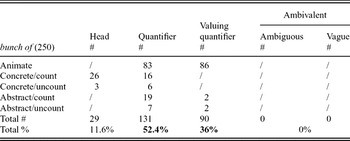
Just like load of, bunch of has a preference for negatively evaluated abstract nouns referring to ‘nonsense’, e.g. (43) and (44), with which it occurs 4 times out of the total 90 valuing uses. It predominantly combines with animate nouns, though, e.g. (41) and (42), which account for the remaining 86 collocates. In the valuing uses with animate nouns the semantic prosody is predominantly negative, except in some uses referring to children or a group of friends. Such cases of positive semantic prosody show persistence of another feature than unruliness, namely the feature of constituting a close-knit group:
(45) We have another three games and that will be a real test but they are a smashing bunch of lads to work with and they keep on going. (CB-Sunnow)
Whereas the quantifier uses of load of and bunch of were characterized by an extension of collocational range to the inclusion of increasingly more types of concrete as well as abstract nouns, valuing uses of load and bunch of synchronically display constraints, viz. a reclustering to negatively evaluated abstract and animate nouns. This goes against traditional observations about grammaticalization as involving generalization and extension to increasingly more contexts (e.g. Himmelmann's 2004 host-class and context expansion). Valuing quantifier uses thrive on the sharing of affective or emotively coloured values between the nodal SN and its collocates. As quantifiers, load and bunch of display semantic prosody in that certain sets of collocates they quantify are negative. In valuing quantifier uses, this semantic prosody is intensified to the extent that the SN very strongly predicts not just a negative collocate, but an animate or abstract negative collocate. Hence the name valuing (quantifier) use.
Such collocational reclustering seems to fit Himmelmann's interpretation of lexicalization,Footnote 19 which he typifies in terms of abrupt host-class reduction, i.e. one frequent collocation from the total set of collocations a node can have acquires special status and is interpreted as constituting one single processing unit together with the node, rather than a compositional expression. Some idiomatization is certainly at work in valuing SN-uses. This can be measured by means of the MI-score (i.e. mutual information score), which calculates the strength of association between a node and its collocates by expressing the extent to which the observed frequency of co-occurrence differs from the expected frequency (see e.g. Church & Hanks Reference Church and Hanks1990; Church et al. Reference Church, Gale, Hanks, Hindle and Zernik1991; Clear Reference Clear, Baker, Francis and Tognini-Bonelli1993; and Stubbs Reference Stubbs1995).Footnote 20 It is generally agreed in the literature that values equal to or higher than 3 single out highly cohesive collocations and identify idiom-like or fixed phrases in which the node and collocate predict each other very strongly (see Stubbs Reference Stubbs1995: 35). Bunch of idiots for instance has an MI-score of 7.70, bunch of losers has an MI-score of 6.42 and bunch of lies has an MI-score of 3.80 in the COBUILD corpus.Footnote 21 However, I do not interpret this collocational reclustering as lexicalization rather than grammaticalization. At the core of the valuing (quantifier) use is the reanalysis from a lexical head use to a more grammatical modifier use, and this is a case of grammaticalization.Footnote 22 The valuing (quantifier) use crucially lacks an increase in or even constancy of lexical meaning (see Wischer Reference Wischer, Fischer, Rosenbach and Stein2000): the valuing quantifying use clearly has a more abstract intensifying and evaluating meaning than the original lexical meaning of bunch. Lexicalization is relevant to valuing SN-uses only in the sense of idiomatization and fixation of frequently occurring collocations within grammaticalized functions. This may involve phonetic erosion as in Jeez, what a buncha idiots we must've looked like (COCA), which, as mentioned earlier, is typical of later stages of grammaticalization but also of other routinization processes.
What is the relation between the quantifier construction and the valuing (quantifier) construction? Once one accepts that each grammaticalization process is a potential process that may stop halfway or revert to earlier stages (see Fischer Reference Fischer, Fischer, Rosenbach and Stein2000), it is not unlikely that a phase of extension of collocational range may be followed by a phase in which new restrictions arise. It can be hypothesized that in their grammaticalization as a quantifier, pragmatic inferences draw on one or a selected set of semantic features of the various SNs to the detriment of others, viz. scalar implicatures of the constellation meanings. The inferred meaning components can then develop their own further inferences, which can motivate additional developments, such as the more subjectively coloured valuing (quantifier) uses (see Sweetser Reference Sweetser, Axmaker, Jaiser and Singmaster1988).
As explained in section 2, the more familiar diachronic corpora yield few data, which makes it difficult to trace the quantifier and valuing quantifier use diachronically. For bunch, for instance, no unambiguous quantifier uses were attested even though the OED cites examples of quantifier uses for load, bunch and heap from 1550 onwards. The valuing quantifier use of bunch of remains diachronically unattested, while load of is only attested once (40). The available data may suggest that the valuing quantifier is a relatively recent, further development of the quantifier use. The general lack of suitable diachronic data, however, prevents one from simply assuming that non-attestation means a non-occurrence of the valuing quantifier use before 1897. The relation between both quantifier and valuing quantifier uses hence at this stage remains unclear.
4 Theoretical implications for grammaticalization theory, the description of the NP and collocational studies
The development of quantifier and especially valuing quantifier uses presented in section 3 has important theoretical implications for grammaticalization research, specifically with regard to the semantic processes generally considered to be involved in processes of grammaticalization. As noted by authors critical of grammaticalization studies, semantic processes involved in grammaticalization are often too vaguely defined, or the only ‘proof’ for a grammaticalization claim.Footnote 23 In the absence of an explicit definition and without bringing in formal reflexes, the concept of reanalysis is at times restricted to semantic reinterpretation (cf. Heine Reference Heine, Joseph and Janda2003, who sees grammaticalization as essentially a semantic process). Grammaticalization claims then risk being equated with simple semantic reanalysis or semantic change as such. Instead, I want to argue for an interpretation of reanalysis that fundamentally correlates form and meaning, taking into account semasiology and such formal reflexes as verb and phoric concord, preposing of the of-phrase, fusion between SN and of, etc. The availability of attestable formal reflexes of a reanalysis depends on the kind of construction looked at. As SN-expressions grammaticalize into (valuing) quantifiers, the specific outlook of the binominal syntagm remains largely unaltered and is eroded only by coalescence, which, as mentioned earlier, is not exclusive to grammaticalization processes. The other formal reflexes are not systematically observable, as noted earlier.
The case of SN-expressions leads one, in my view, to operationalize the semantic processes involved in grammaticalization mainly in terms of changes in the collocational range. This approach can be seen as a variant of Hopper & Traugott's (Reference Hopper and Traugott2003) loss-and-gain model rather than a model of attrition, which traditional terminology such as delexicalization and bleaching tends to reflect (cf. Lehmann Reference Lehmann1985). In the development of quantifier SN-uses, the more abstract size implications of SN-expressions invite pragmatic inferences in the very early stages, paralleled by a backgrounding of the lexical semantics, which denote, for instance, a type of configuration or container. This process of subjectification results in an overall redistribution of meaning, rather than overall loss. This redistribution of meaning involves semantic generalization of the SN, which allows for the collocational extension of the N2-slot. Defined in such a way, ‘delexicalization’, as the sum of all the semantic processes involved in grammaticalization, subsumes two interlocking steps: semantic generalization of the SN and extension of collocational range, which makes it empirically testable. Crucially, prior semantico-syntactic analyses of constructions may continue to exist alongside new ones, and older layers of meaning may persist in grammaticalized uses in various ways.
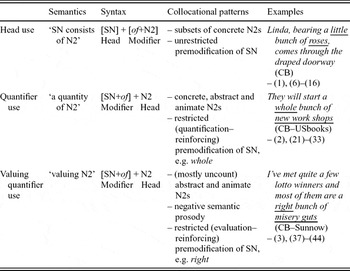
Collocations, as a specific lexical–syntactic relation, have generally been under-researched in grammaticalization processes (but see e.g. Lorenz Reference Lorenz, Wischer and Diewald2002 and Hilpert Reference Hilpert2007) and cognitive–functional models of the NP. The systematic pre- and postnominal collocations for each SN-use cannot be predicted from the ‘(determination) (modification) SN + of + (determination) (modification) N2’-syntagm, nor can they be accounted for by regular functional models (e.g. Langacker Reference Langacker1991; Halliday Reference Halliday1994; McGregor Reference McGregor1997). A functional dependency model allows one to describe and account for the fact that there are both head and modifier uses of SN-expressions, as opposed to class-based grammars such as Quirk et al. (Reference Quirk, Greenbaum, Leech and Svartvik1985), discussed in footnote 4, which do not allow head status to shift from the SN to N2. However, functional–cognitive models typically consider the positions within the NP as free, whereas in SN-patterns some slots are predetermined collocationally. I have therefore proposed to analyse them as collocationally constrained constructions (see Brems Reference Brems2007). From a construction grammar perspective, SN-uses qualify as constructions in the strict sense. Head, modifier and ambivalent uses are unpredictable from the schematic surface structure ‘(determination) (modification) SN + of + (determination) (modification) N2’. SN-patterns more specifically resemble what Goldberg (Reference Goldberg2006: 5) calls partially filled constructions, i.e. constructions in which some positions are variable, while other configurational slots are lexically fixed in order to arrive at a grammatical construct. Goldberg (Reference Goldberg2006: 5) exemplifies these by means of partially filled idioms, such as to jog someone's memory and to send someone to the cleaners, in which someone(’s) is the variable slot in both cases, whereas the remainder is fixed. In SN-constructions specific SNs act as fixed lexical items in the sense of collocational nodes that take different sets of collocates depending on whether they are used as a head, quantifier or valuing quantifier. Hence, in SN-patterns the predetermination takes the shape of strong node-collocate co-selection related to the various constructional uses of SNs. Prenominally, these co-selection patterns hold between sets of adjectives and determiners, and the SN. Postnominally, systematic co-selection subsumes semantic prosody and the sets of N2s that SNs combine with. Table 3 sums up the most important of these systematic co-selection patterns for head, quantifier and valuing (quantifier) uses as they were described in section 3 in addition to the key semantic and syntactic features that characterize the various SN-patterns.
SN-uses as collocationally constrained constructions

The incorporation of a collocational-constructional component in a functional dependency model of the NP allows one to describe the various SN-uses. More generally, such an enriched model is capable of accounting for more types of structures than traditional models can (e.g. type noun expressions such as two kinds of women, a sort of supergroupie; see Denison Reference Denison2002, Brems Reference Brems2007 and Davidse, Brems & De Smedt Reference Davidse, Brems and De Smedt2008). I want to argue that the attested collocational constraints function as very significant semantico-syntactic markers of synchronic variation and as markers of the diachronic shift from head to modifier.
5 Conclusions
The case of the SNs shows that in grammaticalization processes generalization and restrictions interact, just as grammaticalization and lexicalization may interact (see Wischer Reference Wischer, Fischer, Rosenbach and Stein2000, Himmelmann Reference Himmelmann, Bisang, Himmelmann and Wiemer2004). This ties in with Hopper's (Reference Hopper, Traugott and Heine1991: 22) notion of specialization in grammaticalization. The restriction to or specialization in animate nouns and abstract nouns referring to ‘nonsense’ or ‘junk’ relates to the overall function of valuing uses, which serve to emphasize the (negative) value a speaker wants to attach to a specific referent. The use typically meshes with emphatic contexts and constructions, e.g. predicative constructions of the form ‘X is/behaves like Y’, e.g. (38)–(43), or ‘What a Y of N2’, where the ‘Y’ slot can be filled by valuing SN-expressions, e.g. (37) and (44).
This specialization takes the shape of semantic prosody. In section 3 we defined the latter as the exchange over time of affective polarity between collocates and node. However, a number of vexed questions remain, both in the context of SNs and beyond. Firstly, how does one determine the affective colouring of a collocate? Is it independent of the particular co(n)text or genre, or not? In assessing affective colouring, I have always taken the specific context into account and not just the polarity of the N2-collocates in isolation. Another question is why nodes come to be associated with particular sets of collocates or prosodies. It is often stressed that frequent collocations between words have little or ‘no referential basis’ (Crystal Reference Crystal1991: 83). In addition, they are considered to be hidden to language users’ intuitions and observable only via extensive concordances (Sinclair 1992). For some SNs, such as heap, there indeed seem to be few (negative) implicatures in the concept itself that could motivate further attraction of negatively coloured N2s. The only negative association comes from contexts in which the horizontal potential of a heap is referred to and N2-collocates describe what is left, typically of a building, e.g. reduce to a heap of ruins/rubble (e.g. (10)). As mentioned earlier, bunch in its reference to a constellation has a deeper-lying feature of untidiness (see Allan Reference Allan1977 cited in section 3.1) which may enhance the attraction of negatively coloured N2s. A literal ‘load’ has the implication of being a heavy weight, which explains metaphorical uses referring to a burden. In addition, it may also explain its negative prosody in head and grammaticalized uses.
Specific to semantic prosody is the idea that seemingly neutral nodes come to carry negative (or more rarely positive) associations due to transfer of the affective colouring of the set of collocates they are frequently attested with. Nevertheless, it seems that very cohesive semantic prosody patterns that can lead to systematic and productive valuing uses and semi-lexicalized strings, such as bunch of morons/crap, benefit from nodal SNs which themselves already imply emotive colouring which may be context-dependent. It remains to be seen whether other instances of negative semantic prosody recognized in the literature can also be linked to latent negative features in the lexical concepts of the nodes involved.
At the very least semantic prosody has to be considered part of the quirky developments that the grammaticalization processes of SN-expressions display, and most probably of other cases of grammaticalization as well (e.g. the grammaticalization of the adjective lauter meaning ‘pure, unmixed’ into a negative quantifier meaning ‘(too) many, only’; Gehweiler Reference Gehweiler2008). The case of SN-constructions makes clear that the idea of strict unidirectionality in grammaticalization processes needs to be toned down. Instead, development seems to take place along multiple and often interlocking pathways, with collocational extension possibly being followed by new restrictions. Rather than arguing that semantic prosody is restrictive, I would like to argue that it can be a facilitating factor, promoting emergent grammaticalizing readings, viz. the valuing quantifier use. It is the singular forms of the SNs that are especially apt to express evaluation of the discourse referent, because they allow it to be equated in its entirety with some negative quality. In It makes holidaymakers look like a bunch of morons (41) the effect of singular bunch and its interaction with negatively coloured morons is that holidaymakers are generalized over as all of one kind and equally moronic. Singular load of, as in That's a load of crap, acts similarly. Interestingly, plural bunches and loads of did not develop this valuing quantifier use, and neither did heaps or piles of. As mentioned earlier, bunches of did not grammaticalize at all along either of the two paths. In grammaticalized uses of loads of, the plural morpheme always seems to trigger a hyperbolic quantifier reading, e.g. loads of sunshine (22), loads of bikers and people (32); also when the N2-collocate is negatively coloured, as in You get loads of aches and pains (CB-UKephem). Semantic prosody thus interlocks with and facilitates the functionality of singular bunch and load of for expressing evaluative quantification or emphatic evaluation as such.
Finally, the influence of lexical persistence or conceptual image persistence of the semantic features in the various SN-constructions likewise shows that present delexicalization models in grammaticalization studies are too narrow. On the one hand persistence of the lexical semantics of SNs may impose restrictions on the felicitous use of quantifier SNs, for instance with regard to boundedness and spatial proximity of the N2-referents (see footnote 18). On the other hand, the persistence of such features as ‘unruliness’ in bunch and ‘burden’ in load have led to a negative semantic prosody and yielded an additional pathway of change towards the valuing (quantifier) construction.
In sum, the semantic processes involved in grammaticalization include backgrounding and foregrounding, generalization and the emergence of new restrictions, lexical persistence and semantic prosody. Delexicalization should therefore be envisaged within a redistribution model, rather than simplified into a negatively defined and unidirectional model of attrition. Such an approach only seems possible within a model of the NP that can accommodate collocationally constrained constructions.
Appendix: Quantified collocational profiles of heap(s), pile(s), load(s), bunch(es) (the predominant use is indicated in bold)
Quantified collocational profile of heap of

Quantified collocational profile of heaps of

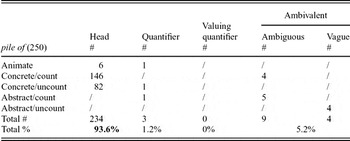
Quantified collocational profile of pile of

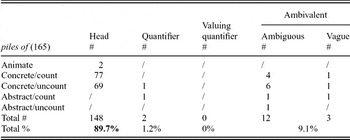
Quantified collocational profile of piles of

Quantified collocational profile of load of

Quantified collocational profile of loads of

Quantified collocational profile of bunch of

Quantified collocational profile of bunches of