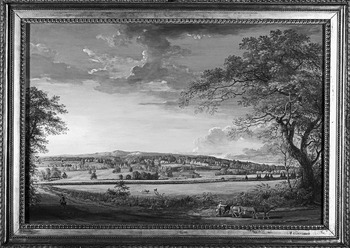
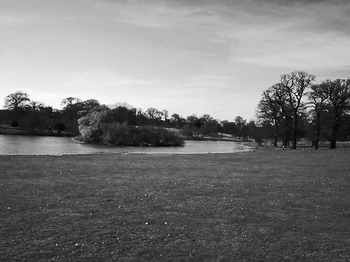
Painting, poetry and gardening in eighteenth-century Britain were often collectively termed the ‘sister arts’, united in their preoccupation with nature and landscape – central concerns of the contemporary aesthetic of the picturesque.Footnote 1 Yet English music, indeed music of any nationality, was seldom spoken of as a member of this sisterhood, despite the large amount of critical commentary on music and music aesthetics at the time.Footnote 2 In eighteenth-century England, a painting could be thought to convey a picturesque landscape (see Figure 1), a landscape garden could embody the picturesque through its artful arrangement of natural elements (see Figure 2) and a poem could articulate picturesque sentiments. So how might music have contributed to this picturesque chorus? Answers to this question are hard to come by in either primary or secondary literature, despite recent musicological interest in the idea of the picturesque. Thus far, musicology has tended to concentrate on the reception of German instrumental music according to the English concept of the picturesque, examining contemporary testimonies as to how the music was heard and showing how analysis might account for those testimonies. English vocal music with unmistakably picturesque texts has been little discussed, however. This is a missed opportunity, since the English vocal music of the period (this article will ultimately focus on the genre of the English glee) amply demonstrates that English music belonged as much to the picturesque movement as did the sister arts. Indeed, native music played a major role in nurturing and reinforcing picturesque tastes.Footnote 3
Paul Sandby, A View of Vinters, Boxley, Kent, with Mr. Whatman's Turkey Paper Mills (1794). Yale Center for British Art, Paul Mellon Fund (B2002.29). Used by permission

Holkham Park, Norfolk

Though the aesthetic of the picturesque concerned the natural environment and implicitly set up the countryside as a preferred opposite to the city, it did not partake of traditional pastoral tropes, such as an idealized Arcadia, mythical character archetypes or the artist in retreat from the city.Footnote 4 Instead, one might regard the picturesque as a late eighteenth-century aesthetic offshoot of the pastoral tradition – one that concerned itself with the details and structure of nature scenes and emphasized discovery and the seeking of new experiences.Footnote 5
Two late eighteenth-century theorists who associated music with the picturesque (as opposed to the merely pastoral) were the landowner, theorist and amateur musician Sir Uvedale Price and the composer, pedagogue and amateur painter William Crotch. In his 1794 Essays on the Picturesque Price expanded Edmund Burke's account of the sublime and the beautiful by introducing the picturesque as a third term. For Price, the picturesque was a species of beauty sometimes capable of encompassing the sublime, as when, for example, one surveyed scenes of rocky outcrops, perilously steep cliffs or raging torrents.Footnote 6 Price used an analogy with music to explain how principles of design and organization, and a mix of styles and affects, could best be employed in garden design, invoking the keyboard sonatas of Domenico Scarlatti.Footnote 7 Crotch observed similar parallels between the effects of unpredictability and humour in music and the irregular lines and eye-catching surprises of landscape gardens. However, adopting Sir Joshua Reynolds's tripartite model of styles in the visual arts (the ‘grand’, the ‘splendid’ and the ‘composite’) and aligning them with Price's three aesthetic categories,Footnote 8 Crotch ultimately reached more negative conclusions about the musical picturesque, which, in his view, ranked far below the beautiful and sublime in aesthetic worth, denoting music that was merely humorous, skittish and crowd-pleasing.Footnote 9
For these writers, Italian and German music provided the model for the musical picturesque. The situation has changed very little nowadays. Those few musicologists who have discussed the picturesque have tended to propose new readings of instrumental works, mostly from the Austro-Germanic canon.Footnote 10 Annette Richards, in her important book on the free fantasia and the musical picturesque, focuses predominantly on the instrumental music of C. P. E. Bach, Haydn and Beethoven.Footnote 11 Less interested in overtly picturesque themes or narratives in this music, Richards develops non-mimetic analogies between musical form and certain tropes of the landscape-garden aesthetic.Footnote 12 She thus discusses the picturesque from the point of view of reception: there is not necessarily any landscape represented or thematized in the music she surveys. In this vision, music – as many eighteenth-century theorists would have agreed – is apt to behave and ‘move’ in the same way as a natural landscape; like landscape, it has a topography.Footnote 13 The pleasure of picturesque musical designs is that they prompt the listener to imagine and contemplate, to create new landscapes of thought. For Richards (as for Price and Crotch in the eighteenth century), the content of these thoughts is of little consequence.
Yet, as Richards also acknowledges, there is ample evidence that eighteenth-century audiences, particularly in England, often did imagine picturesque scenes upon hearing picturesque music. When Charles Burney called instrumental music ‘picturesque’, for example, he usually meant that the music encouraged him to listen ‘visually’.Footnote 14 Indeed, the musical picturesque on occasion described a species of ‘characteristic’ music – a genre that, in the eighteenth century, frequently sought, with the aid of descriptive titles or programmes, to arouse thoughts of scenes from nature.Footnote 15
In any case, given the amount of English vocal music that interacted explicitly with cultures of the picturesque in other artistic media, it seems remarkable that musicologists have by and large sought elusive manifestations of the picturesque that are encoded in technical details and formal schemes, mostly because of the continuing desire to focus on German instrumental music. Musicologists' aversion to understanding the picturesque more concretely – in terms of nature imagery or evocations of the English landscape – combined with the troubled historiography of English music, has prevented a debate about the relationship of post-Handelian music in England to the aesthetic of the picturesque.Footnote 16 Yet the picturesque was so ubiquitous an expression of English national identity (to the point that it was subject to ridicule in the subsequent century) that it is hardly likely that English musicians would have remained oblivious to it.Footnote 17
MUSIC AND POETRY IN THE BRITISH CRITICAL CONTEXT
Although a search for the picturesque in English instrumental music is not necessarily fruitless, it is not the best place to start. England had a strong tradition of song and musical theatre, and both were thriving in the late eighteenth century in London locations such as the Little Theatre in the Haymarket, Drury Lane, the Pleasure Gardens, series such as the ‘Vocal Concerts’, and in glee and catch clubs. Moreover, British critics and theorists, like most of their continental counterparts at this time, tended to regard vocal music as superior to instrumental music. Although there were many disagreements about what music alone could and should represent, there were, as John Neubauer points out, ‘few defenders’ of music that directly represented natural sounds.Footnote 18
Yet the most important British critics of the mid- to late eighteenth century took the Platonic line that music was only truly meaningful when it was allied with words. As James Beattie wrote in 1776:
Nor do I mean any disrespect to music, when I would strike it off the list of imitative arts. I allow it to be a fine art, and to have great influence on the human soul: I grant, that, by its power of raising a variety of agreeable emotions in the hearer, it proves its relation to poetry, and that it never appears to the best advantage but with poetry for its interpreter: and I am satisfied, that though musical genius may subsist without poetical taste, and poetical genius without musical taste; yet these two talents united might accomplish nobler effects, than either could do singly.Footnote 19
Music, in this way of thinking, was the servant of the words – an ancillary feature that aided verbal expression. Writing some thirty years earlier, James Harris had argued that when music and words were merged skilfully, a kind of alchemy took place; the result was a ‘force irresistible’. (Harris had also stressed that text-setting was an elevation of speech, a ‘noble Heightening of Affections’ quite different from mere ‘arbitrary’ differences in pronunciation or delivery.)Footnote 20 Later in the century the cleric and critic Thomas Twining – who otherwise advocated for music's independent powers of expression in more modern vein – argued that
Those who talk of instrumental Music i.e. of Music by its self, as unmeaning … and expressing nothing, forget that if that was the case, it could not possibly add expression to verse. If it cannot move the passions separately, it cannot conjointly. If it assists [the poetry], it must be by some strength of its own which it brings with it.Footnote 21
Such ideas reflected a widespread view in late eighteenth-century criticism that fine expression was the goal of music. Though composers might attempt to paint pictures, tell stories or mimic sounds in their compositions, for most British critics, this was futile. Good music was imitative only to the extent that it imitated affects rather than natural sounds. Accordingly, critics tended to apply the term ‘imitation’ only to ill-fated attempts at tone painting.Footnote 22
PICTURESQUE MUSIC'S VEHICLES AND ALLIES
The picturesque is a broad and in some ways unwieldy concept, with many contradictions between its theory and its practice – not to mention ambiguities wrought by its status in the eighteenth century as a theoretical category, a term for a fashionable pursuit and a description of natural or pseudo-natural artefacts.Footnote 23 Even though there has recently been renewed academic interest in the theory of the picturesque, therefore, key aspects of its practice have often been overlooked. Moreover, the most prominent eighteenth-century theorists of the picturesque – Price, Richard Payne Knight and William Repton – were concerned mainly with landscape gardens (William Gilpin, also an important figure, wrote primarily about natural landscapes);Footnote 24 the remaining sister arts of poetry and painting have tended to be discussed far less outside of their own disciplines. Both eighteenth-century and present-day writing on the musical picturesque thus reflect a bias towards theory over practice and gardening over other arts.
English picturesque music, especially given the aesthetic contexts sketched above, was most likely to have been conceived of as music about a natural landscape, not music like a natural landscape (which is largely the way in which musicologists such as Richards understand the musical picturesque – partly as a consequence of Price's and Crotch's aesthetic predilections). Eighteenth-century topographical poetry and landscape painting amply show that the picturesque was predominantly a matter of theme and ambience rather than abstract design. For this reason alone English music might be included in the sisterhood of picturesque art. First, as in contemporary poetry and painting, English music frequently served to celebrate the beauty of the countryside. Second, it was almost invariably in partnership with these other media, whether heightening the expressive power of picturesque poetry or adopting an almost painterly method of presenting landscape scenes.
Crucial to any exploration of the picturesque in English music is nationalism. Though the theory of the picturesque tended to emphasize universality rather than parochialism, the eighteenth century none the less saw an increase in artworks that took as their subject distinctively English nature scenes, as opposed to idealized biblical, classical or otherwise continental European vistas – a focus that betokened a new national confidence and pride in the ‘natural art’ to be found within England's ‘wooden walls’.Footnote 25 English poetry, painting and music that glorified nature invariably used real English locations as their subject. And even when the location was not specified, these detailed depictions of nature tended to proceed as though they had been experienced, perhaps in one's own surroundings, rather than imagined, employing a topographical language distinct from the usual pastoral tropes that conjured a mythical Arcadia.
The shift from a universalizing pastoral – which either invoked Arcadia as a symbol of all of nature's works or depicted generic classical scenes – to an art that treated real domestic locations as worthy subjects was the English picturesque's coming of age. This was galvanized by a new breed of native artists that included James Thomson (whose The Seasons was the basis for Gottfried van Swieten's libretto for Haydn's oratorio of the same name) and George Cowper, as well as landscape painters such as Thomas Gainsborough and Richard Wilson.Footnote 26 As Malcolm Andrews has argued, there was ‘growing impatience’ with the veneration of classical civilization and the belief in Italian artistic pre-eminence – predilections that had found expression in the eighteenth-century culture of the Grand Tour. One distinctively national response was to promote purportedly vernacular styles and, towards the end of the century in particular, to reclaim the idea of the ‘gothic’, with its supposedly Anglo-Saxon roots.Footnote 27 By late century newer gardens eschewed the antiquarian symbolism of classical structures, such as those dotted around the landscapes at Stowe and Stourhead, and sought a greener, more ‘natural’ (which is to say, less regular) appearance, held to be characteristically English. Gothic structures became more prevalent in these gardens.Footnote 28 By the century's end, ruins – whether artfully constructed or discovered in their sublime state of disrepair – were virtually a picturesque requirement. Gothic ruins became popular visitor attractions, the subject of many paintings and the backdrop for numerous novels, songs and theatre pieces.Footnote 29
Literary scholars have long recognized that English poets from Alexander Pope to Thomas Gray played an active role in shaping and propagating the culture of the picturesque: Robert Aubin has suggested that Thomson's The Seasons might have been partly responsible for arousing the public's interest in landscape gardens,Footnote 30 while J. R. Watson has shown that William Gilpin's illustrated tour guides borrowed substantially from the tone and method of Thomson's topographical poetry.Footnote 31 Horace's dictum ut pictura poesis (as in a picture, so in a poem) was one that guided the English pastoral poets of the eighteenth century, who sought to ‘paint’ nature scenes in words and record the sentimental reflections prompted by them.Footnote 32 Jean Hagstrum, for example, argues that the ‘series of pictorially static moments with attached reflection’ in Gray's Elegy Written in a Country Churchyard are hallmarks of the poetic picturesque.Footnote 33
A great deal of picturesque poetry was set by English composers, texts by William Cowper, Gray, William Shenstone and Thomson in particular. English secular vocal music in the late eighteenth century is thus replete with lyrical descriptions of the rural English landscape. These picturesque songs were among the most fashionable of the period: in the early nineteenth century William Horsley reported that the ‘descriptive compositions’ of the glee composer John Wall Callcott were his most popular.Footnote 34 Precisely how glee composers chose their material is unclear, though it seems that suitable or fashionable verse was sometimes proposed by educated patrons.Footnote 35 In any case, leading figures in the picturesque movement, such as Uvedale Price, Sir Henry Hoare and Lancelot ‘Capability’ Brown, were members of catch and glee clubs, where questions of taste and fashion were frequently discussed.Footnote 36 And musicians regularly mixed with poets and painters in London's concert rooms and parlours.Footnote 37 The glee composer R. J. S. Stevens recalled an evening in the autumn of 1793 thus:
I went one Evening to meet Mrs. Hughes (wife of the Rev. Thomas Hughes, Prebend of Westminster) at Mrs. Blencowe's in Little King Street, St. James's Square, near Market Lane. Mr. Blencowe was an intolerable miser, tho' a well-educated man; and of considerable Landed Property … His Concert Room, was on the first floor, over a large Baker's Shop … I squeezed into the Concert Room, which was intolerably full of a mixture of Company: all devotees at this miserable miser's shrine. Poets, Painters, Musicians; all were crowded together … Blencowe introduced me to Cumberland the Poet; and afterwards to Lawrance the Painter.Footnote 38
The English musical picturesque, then, should be seen as part of a complex, broad-based cultural movement, not merely as a musical illustration of an abstract theoretical model. Music occupied the same social spaces as the picturesque and came into contact with picturesque subjects via the poetry that it set, making it not merely a sister art but a willing companion.
A TYPOLOGY OF PICTURESQUE SONG TEXTS
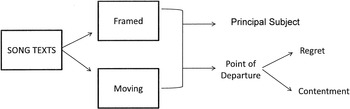
As we have seen, picturesque poetry in this period can be distinguished from traditional pastoral verse in its emphasis on a sense of (English) place and the personal, psychological impact of rural topographies. In the picturesque songs of the Georgian period one might distinguish between two types of text: a ‘framed’ scene that portrays a landscape as if the observer is sedentary (as in poems such as John Dyer's ‘Grongar Hill’ or Gray's ‘Ode on a Distant Prospect of Eton College’) and another, ‘moving’ scenario in which the rural terrain is ranged over, as if during a walk (as in passages of Cowper's ‘The Task’ and Gilbert White's ‘Invitation to Selborne’). These two subject positions have distinct topographical and temporal implications. When the scenery is described by a walking subject, the ever-changing character of the topography is a given; but in a fixed scene topographical modulations can still be recorded – as, for example, when the eye shifts between the three planes of foreground, middleground and background. Should a poem take the perspective of a wandering subject, time clearly elapses as the text progresses; meanwhile, in an unmoving scene the progress of time can also be charted, and in ways that a landscape painting cannot easily replicate – for example, the lighting of a scene might change as twilight or dawn approaches.
The landscape of picturesque song can be thought of as either the principal subject or the point of departure. In the former, a scene is relished in painterly fashion for its pleasing arrangement and its variance of colour. These types of poems sometimes encompass analysis too: explorations of the reasons behind the scene's particular interest. Where the landscape is a point of departure, however, descriptions ultimately recede in order to develop associated ideas and feelings. These generally divide into tropes of well-being or tranquillity and those of regret, fear or horror – though the latter can also be a kind of pleasure or thrill (as Uvedale Price averred, the sublime, far from being a distinct aesthetic, is actually an important element of the picturesque).
Tropes of well-being include the pastoral motif of ‘rural ease’ associated with the eclogues of Theocritus and Virgil. This is closely related to the notion of ‘retirement’ (also a pastoral theme from antiquity, and a state of being explored by Pope, among others): the countryside as a symbol of rest and retreat, either temporary or as a reward for a life of dutiful industry. One also frequently encounters expressions of belonging or attachment, which might also prompt pride – especially patriotic pride – in the English landscape. By contrast, the more negative tropes of the picturesque include feelings of regret or loneliness brought on by the rural surroundings: thoughts of a lost loved one, memories of happiness long past and stories of poverty or drudgery. Some landscapes may cause a frisson of excitement tinged with fear, especially if one feels lost, intimidated or haunted by intimations of the spirit world. This is the sublime landscape – all the more affecting when experienced at night, illuminated only by the moon.Footnote 39 (This typology is summarized in Figure 3.)
A typology of picturesque song texts in the eighteenth century

THE ENGLISH GLEE: CONVIVIALITY AND PATRIOTISM
The eighteenth-century English glee is a genre scarcely touched by today's musicologists. Its marginal status stems principally from its limited distribution and audience, its association with the catch (a generally more light-hearted and lightweight genre encompassing ribald and occasionally extremely coarse texts) and of course the somewhat thin secondary literature on English music of the Georgian period altogether. In the late eighteenth century, however, the glee made a rich contribution to English musical and cultural life.
Unlike the catch, the glee was a fully formed part-song set to substantial poetry. Although glees occasionally hymned the glory of Priapus, the vine and the hop, they tended to explore refined subjects too, adopting a fashionably sentimental outlook or celebrating gentlemanly patriotism.Footnote 40 Borrowing from J. Merrill Knapp's typography of the glees of Samuel Webbe the elder, one might parse the English glees of this period into Anacreontic drinking songs, serious songs that set the verse of exalted poets (such as Milton and Pope) and pastorals.Footnote 41 Among the last group were myriad examples of the English musical picturesque (indeed, in Emanuel Rubin's table of glee composers' chosen poets, the most popular were those associated with picturesque poetry: Gray, Shenstone and Thomson).Footnote 42 These glees brought a painterly approach to detail and a topographical exactness to the mythic pastoral register, while expressing the kind of patriotic pride that suited the ethos of the English glee club.Footnote 43
No single, recognizable formal design predominates in the English glee. Strophic forms were rare and were by and large employed only when glees were composed for the commercial market (indeed, itinerant glee composers such as Webbe the elder and Callcott preferred to remove the appellation ‘glee’ in such examples). Rather, in the glee one tends to see each stanza, line or even phrase given contrasting textural, metrical and temporal treatment – as John Hullah's entry on the glee in the first Grove dictionary described:
The short phrases, incessant cadences, frequent changes of rhythm, and pace of the average glee contrast unfavourably with the ‘long resounding’ phrases of the madrigal, never brought to an end in one part till they are begun in another, overlapping one another, bearing one another up, and never allowing the hearer to anticipate a close till everything that can be done with every subject has been done, and the movement comes to a natural end.Footnote 44
This analysis highlights the importance glee composers attached to the conveyance of discrete sentiments, moods and topics. Such an approach was particularly suitable to the picturesque glee, which sought to represent a varied landscape, suggesting an analogy between the affects reaching the ear and the visual information reaching the roving eye (this analogy is particularly prominent in the glees of Benjamin Cooke, discussed below). To be sure, this approach to text-setting did not always find favour among English critics: William Jackson expressed concern that the overall expressive effect (in his words, the ‘general expression’) would be impaired by local expressive details (what he called ‘particular expression’).Footnote 45
THE PICTURESQUE GLEE: FOUR CASE STUDIES
1. Webbe's Dreaming Spires
Samuel Webbe the elder's four-part glee of 1788, ‘Swiftly from the Mountain's Brow’, is one of several of Webbe's settings of pastoral poetry by the Irish poet and dramatist John Cunningham.Footnote 46 Cunningham's poetry was described by his near-contemporary Joseph Ritson as
possess[ing] a pleasing simplicity which cannot fail to recommend him to a reader of unadulterated taste. This simplicity may, perhaps, in some of his compositions, be thought too great; but when it is known that they were necessarily adapted to the intellects of a country-theatre, little censure can be justly incurred by the poet.Footnote 47
Indeed, despite Cunningham's painstaking attention to topographical detail, his poetry lacks the surrounding philosophical discourse characteristic of the pastoral poetry of Thomson or Cowper.
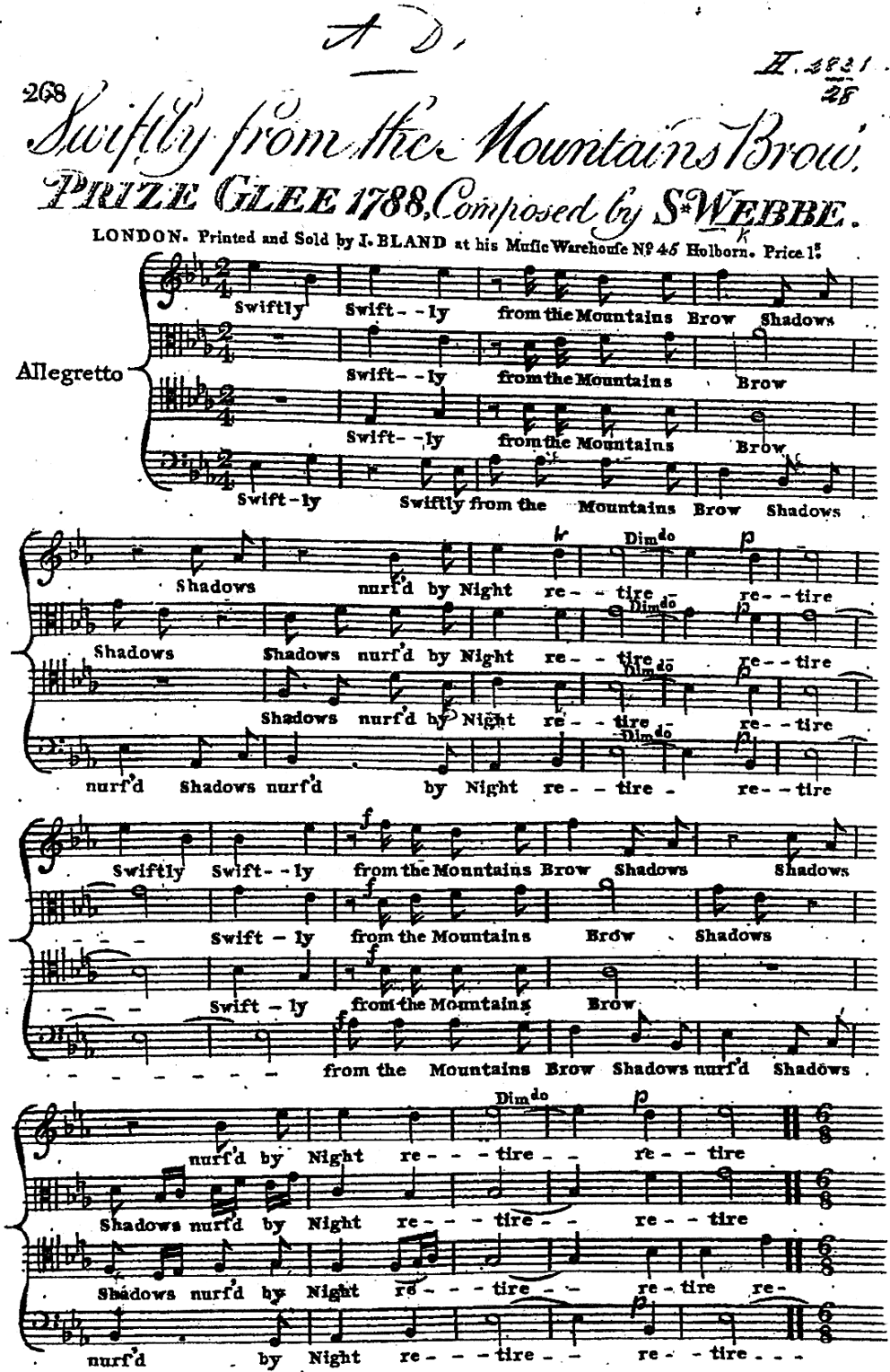
Webbe's glee deals exclusively with a picturesque scene, lingering in painterly fashion on such details as the retreating shadows, which, ‘nurs'd by night retire’.Footnote 48 He is moved to see these shadows as visual echoes that dart before the eye before settling into shade, and the treatment of the word ‘shadows’ is accordingly imitative, before stasis is engineered with two consecutive perfect cadences on ‘retire’ (see Figure 4a). In the next section (see Figure 4b), the peeping sunbeams that ‘paint with Gold the village spire’ constitute a painterly detail that none the less has an implicitly temporal dimension: the sun ‘peeps’ where once it hid, and only now paints the spire with gold (‘The church, as the centre of the village, should be the object of the landowner's particular attention’, wrote Uvedale Price, describing the ideal picturesque harmony between trees and village buildings).Footnote 49 As in another Cunningham poem simply entitled ‘A Landscape’, in which the poet's eye roves over a series of busy, modern eighteenth-century vistas, changes are recorded in physical geography and in time: ‘Hamlets, villages and spires/ Scatter'd on the landscape lie,/ Till the distant view retires/ Closing in an azure sky.’
Samuel Webbe the elder, ‘Swiftly from the Mountain's Brow’, bars 1–20. © The British Library Board. H.2831.h.(28.)
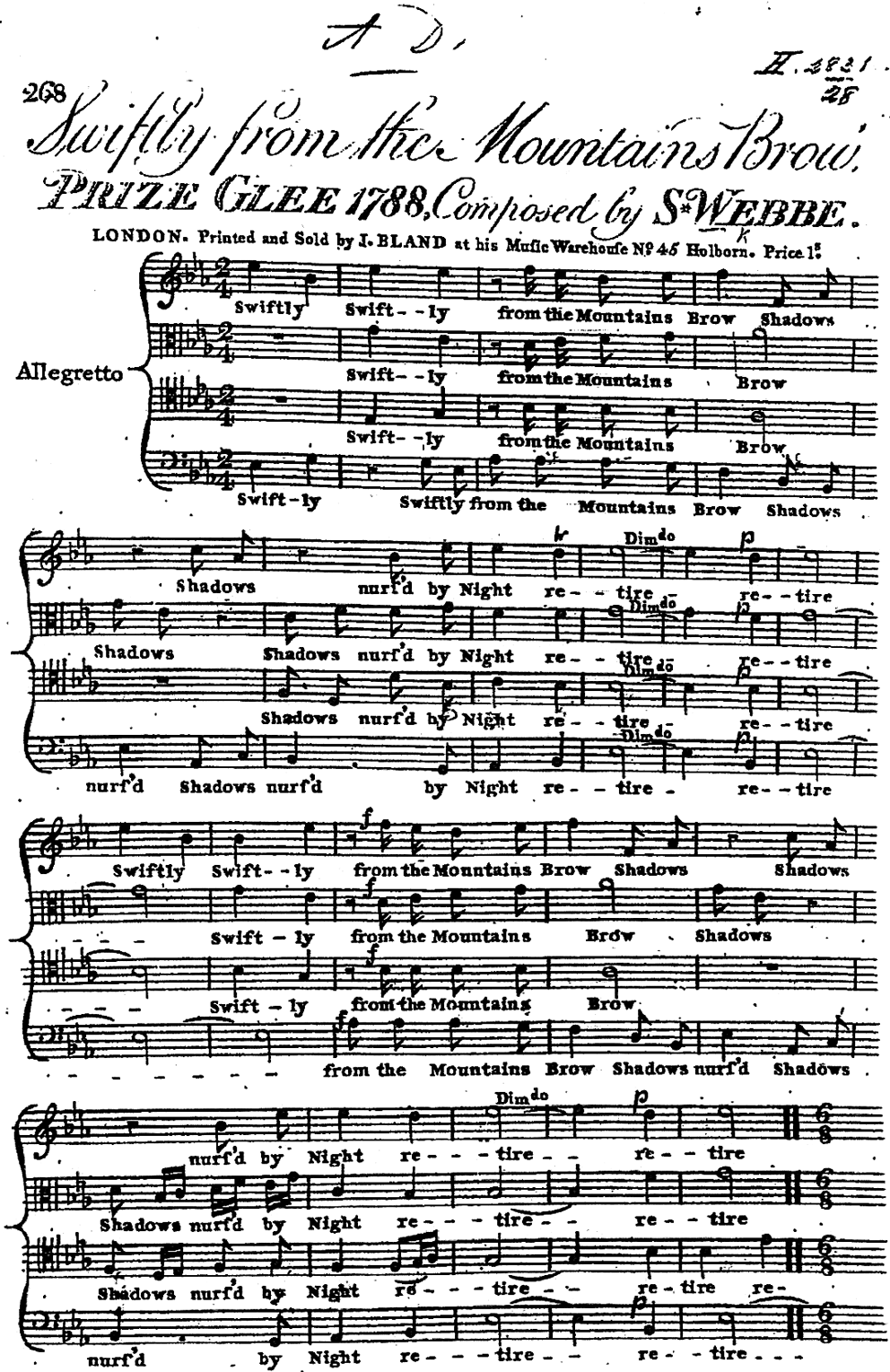
‘Swiftly from the Mountain's Brow’ contains a similar description, during which Webbe's glee changes the metre (to compound duple time) and presents broad dotted crotchets descending in the soprano. Although the tenor and bass lines anticipate this motion in bars 24–25, it is the soprano, supported in compound thirds by the tenor, which springs from the texture with particular registral and rhythmic emphasis (see Figure 4b).
‘Swiftly from the Mountain's Brow’, bars 21–36

‘Swiftly from the Mountain's Brow’ is thus concerned with the changing impressions of a fixed scene, an example of the ‘framed picture’ in which the eye roves from background to middleground and foreground. We can think of this not only as a written eye-witness account but also as a little collection of paintings that record the contrasts imparted to the scene by the day's breaking. Webbe's episodic treatment of the verse enhances the impression of a viewer's eye shifting across a distant scene, much as it would when contemplating a picturesque painting, and uses musical contrast to delineate visual data.
2. Cooke's Perambulations
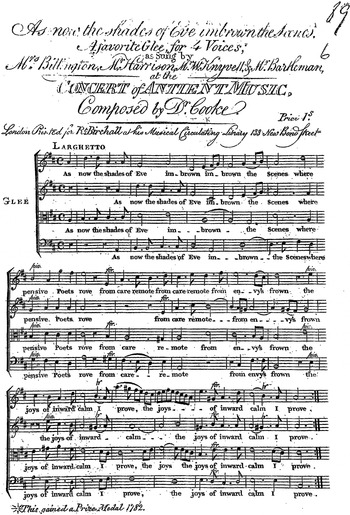
The words of Benjamin Cooke's four-part glee ‘As Now the Shades of Eve’ also record changing impressions of a landscape under the setting sun, but here the verse encompasses a moving perspective as the speaker embarks on a walk.Footnote 50 Cooke responds to a text of considerable emotional range and painterly character with a musical setting of suitably wide stylistic compass. The scene is benign and calm – ‘from care remote’ – and is seen in a soft light (‘the shades of eve imbrown’). This kind of landscape is where ‘poets pensive rove’ – a topos of such poetry, and perhaps also a gesture towards the habit of some eighteenth-century poets, such as Thomson and Cowper, of roaming whilst writing (see Figure 5a).
Benjamin Cooke, ‘As Now the Shades of Eve’, bars 1–18. © The British Library Board. H.2832.l.(6.)

In ‘As Now the Shades of Eve’, the speaker travels until a particularly special location – ‘favour'd ground’ – has been reached; there, as with ‘Swiftly from the Mountain's Brow’, the scene is framed as a picture. But in this case, once the visual splendour has been registered, it gives rise to an emotional response – a sensation of spiritual ‘presence’: ‘What holy strains around me swell’.
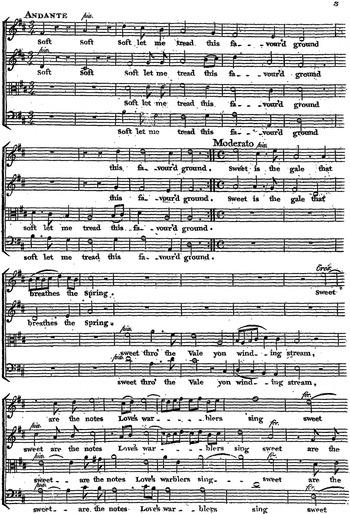
The shift from tranquil, quasi-visual scene-setting in the first stanza to the following stanza's focus on sound and bodily sensation is one that Cooke responds to musically, the increased tension and spiritual dimension announced with striking textural, dynamic and tonal contrast (see Figure 5b). The terraced dynamics of the first stanza are now replaced with crescendo (notably in the approach to the word ‘swell’) and diminuendo, sudden contrasts and layered differentiations of dynamic between parts. The sense of transfiguration suggested by the verse is denoted by the move to a distant C major, which also perhaps responds to the allusion to ‘holiness’. Cooke replaces the dotted rhythms and legato quaver runs with broader, long-limbed phrases of minims, semibreves and breves, within which crotchets move constantly through the parts. This creates a harmonious noise, a sustained ringing wall of sound to illustrate the swelling ‘holy strains’, not ‘wildly rude’ or ‘tumultuous’. The experience transfixes the wanderer and serves to ‘fix the soul in magic spell’. Cooke's tone changes once again here: the crotchet movement dissipates, the dynamics are reduced to a hush with rapid rising and falling swells, and the sense of tonality is restless. The section closes with the words ‘in magic spell’ sung to a whisper in rhythmic unison.
‘As Now the Shades of Eve’, bars 19–48

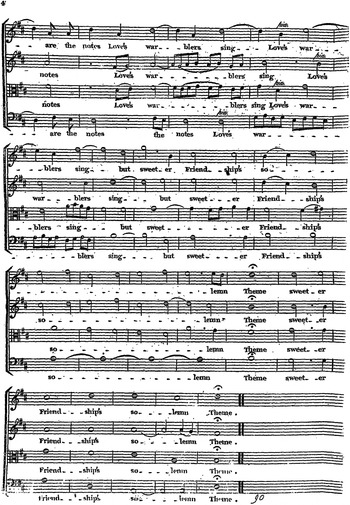
The perspective comes now from the ‘favour'd ground’, selected as a painter might choose a scene. The speaker tells us that one must ‘tread soft’, a moment of recognition that Cooke isolates in the form of a brief, slow, triple-time introduction to the final Allegro.Footnote 51 This disjunction is destabilizing – an episodic gesture that threatens the unity of the song – but Cooke clearly saw this moment as a peripeteia, requiring a separate voice to enunciate it (see Figure 5c). The closing section constitutes the wanderer's comparison of the delights of the scene – the warm spring wind and the attractive stream ‘winding’ through the vale – with those of love and friendship (see Figure 5d). But the ‘sweet notes of love's warblers’ (the prevalent melisma gruppetti) seem to be trumped in the end by ‘friendship's solemn theme’ (the closing broad, chorale-like texture).
‘As Now the Shades of Eve’, bars 49–71

‘As Now the Shades of Eve’, bars 72–90

3. Callcott's Architecture
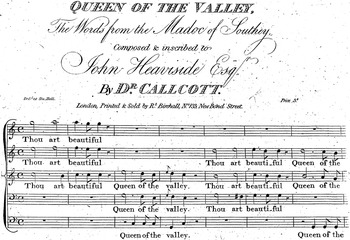
The title-page of John Wall Callcott's ‘Queen of the Valley’ announces that the words have been taken from ‘The Madoc of Southey’, Robert Southey's 1798 poem Madoc. This epic rescue tale concerns the rescue of the Hoamans from barbaric Aztecs by enlightened travellers from Wales.Footnote 52 Callcott's excerpt contains no reference to the setting or the story, however. Removed from its context, the extract, to the uninitiated, might seem to be a description of, and an elegy to, a building (a country house, perhaps? A Grecian temple?) in an otherwise natural environment (the principal object of praise is located in a green space).
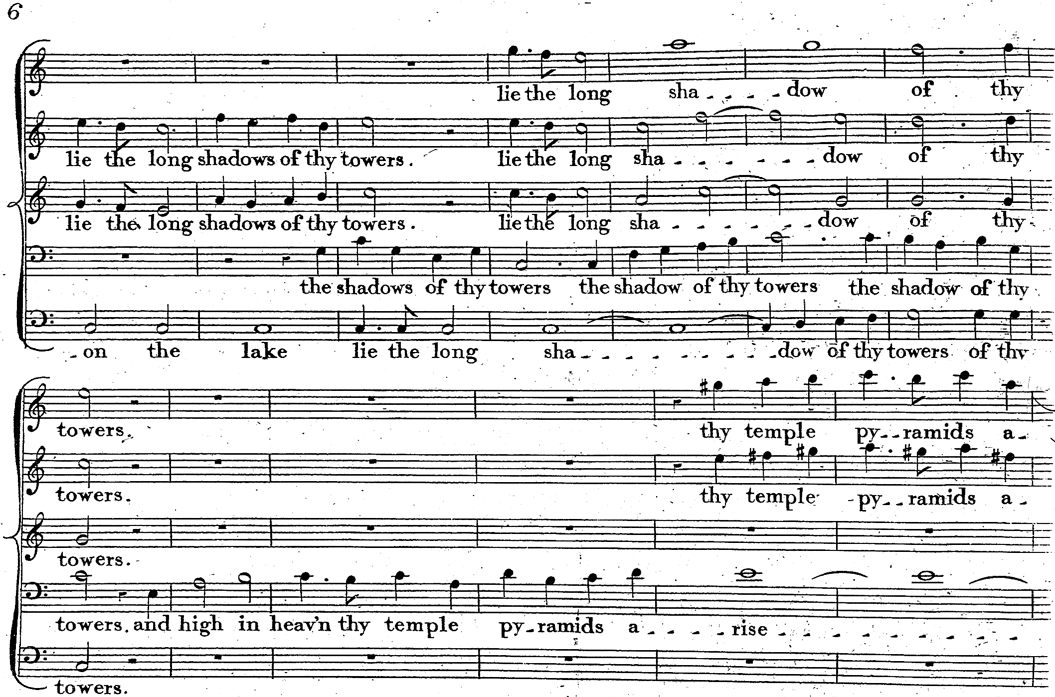
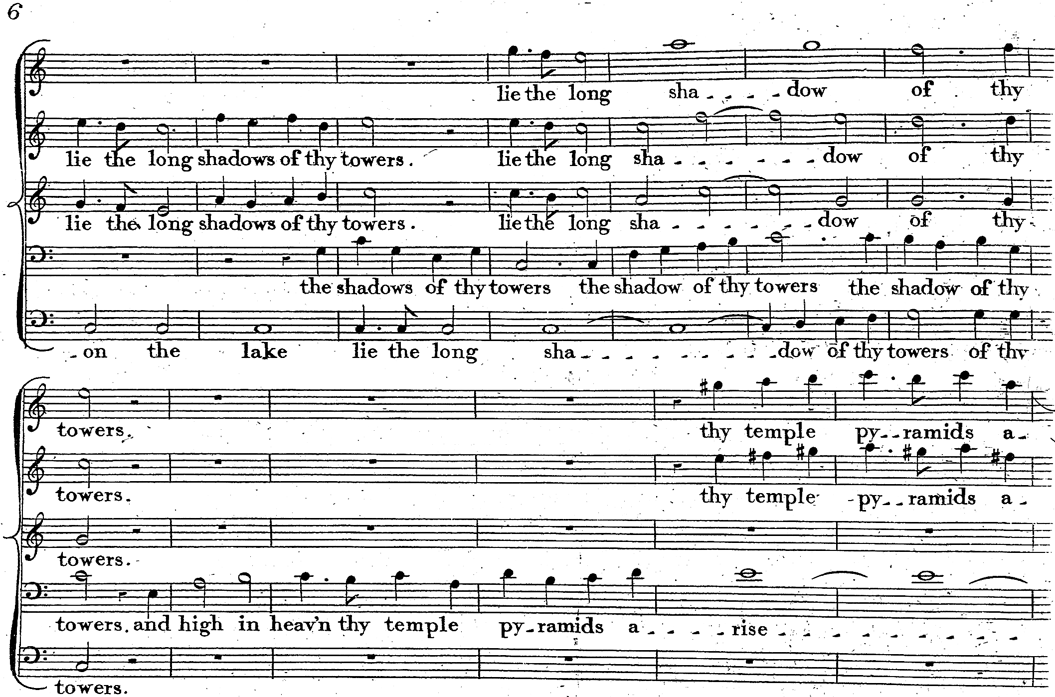
The title of the glee is mischievous, therefore. For one might expect the ‘Queen of the Valley’ to be the quintessentially pastoral figure of the fair maid from the hillside village. But the queen turns out to be a building. Indeed, the composer seems willing to exploit this potential confusion to the full; the opening line, ‘Thou art beautiful, Queen of the Valley’, is treated to a number of antiphonal repetitions until, at last, a lone bass line starts to describe the object of this panegyric: ‘Thy walls like silver, sparkle to the sun’ (see Figure 6a).
John Wall Callcott, ‘Queen of the Valley’, bars 1–22. © The British Library Board. E.359.(6.)


But the glorification of a building was not Southey's intention in Madoc. The lines preceding the excerpt in Callcott's glee run: ‘Hark! From the towers of Aztlan how the shouts/ Of the clamorous joy re-ring! The rocks and hills/ Take up the joyful sound, and o'er the lake/ Roll their slow echoes …’. The Hoamans are rejoicing, literally shouting from the rooftops of the city, at their liberation. The Queen of the Valley is thus the city of Aztlan, freed from the despotic Aztecs, and now – for the speaker, the Hoamans and their Welsh rescuers – it takes on a new lustre in the sun. The city walls ‘sparkle’, as do its groves, gardens and lake.
Callcott's five-line extract stops with the words ‘thy temple pyramids arise’. In Madoc, however, the temple pyramids ‘high/ In heaven … arise,/ Upon whose summit now, Far visible/ Against the clear blue sky, the Cross of Christ/ Proclaims unto the nations round, the news/ Of thy redemption’. For the rescue is an act by Christian missionaries who have educated the saved Hoamans in the teachings of the scriptures. Callcott has no use for this theological reference, so for his coda he borrows from later in the stanza: ‘Long, may'st thou flourish in thy beauty, long/ Prosper beneath the righteous conqueror/ Who conquers to redeem!’ In the poem it is the city and its peoples who are urged to prosper. In the glee, without reference to any citizens, it can only be the building (and its grounds and estate?) that should flourish. Yet who is Callcott's ‘righteous conqueror’? What is the relationship of the conqueror to the built structure? Is this perhaps the landowner, lord of all he surveys?
Callcott has stripped Southey's text down to the picturesque essentials, then, and his compositional response revels in its painterly character. For many English writers on the picturesque, man-made structures were not inimical to the style, even though the aesthetic was founded on a feeling for the beauty of nature. Indeed, as with the developing English vogue for ruins in verdant surroundings, the picturesque frequently described the harmony of a building and its natural context. William Gilpin's character Callophillus, in the Dialogue upon the Garden at Stowe, says of the Temple of Bacchus, ‘Don't you think this Building too is a very genteel one and is extremely well situated? These Trees give it an agreeable, cool Air, and make it, I think, as elegant a Retreat for the Enjoyment of a Summer's Evening, as can well be imagined.’Footnote 53 Joseph Heely, in his Letters on the Beauties of Hagley, Envil, and the Leasowes, argued that architecture should be considered one of the sister arts:
Architecture and gardening may be called sister arts, tho' diametrically opposite in their principles; the excellencies of the first are founded in a mathematical exactness, and regularity; in the latter, on an assemblage of scenery without either: yet when both unite, each graces the other so powerfully, and affords so striking a contrast, that, it is much to be lamented, they are ever seen but in inseparable connection.Footnote 54
But it was the architect Robert Adam who most eloquently explained how much was shared between the form of landscape and of architecture:
Movement is meant to express the rise and fall, the advance and recess with other diversity of form, in the different parts of a building, so as to add greatly to the picturesque of the composition. For the rising and falling, advancing and receding, with the convexity and other forms of the greater parts, have the same effects in architecture that hill and dale, foreground and distance, swelling and sinking have in landscape. That is, they serve to produce an agreeable and diversified contour, that groups and contrasts like a picture, and creates a variety of light and shade, which gives great spirit, beauty and effect to the composition.Footnote 55
William Horsley, in his memoir of Callcott, seems in no doubt that ‘Queen of the Valley’ is a piece of landscape painting, divorced from its poetic and theological origins and about the beauties of a house in ‘inseparable connection’ with its rural placement, to adopt Joseph Heely's words. Horsley makes no mention of Madoc, suggesting that Callcott's intentions were to erase all trace of Southey's America in favour of a subject more in keeping with the English picturesque:
Thou art beautiful, Queen of the Valley … may be called a musical landscape throughout the whole of which a delicious tranquillity prevails … It is related of Mozart, that coming suddenly to a place, whence he had a very fine prospect, he exclaimed, ‘Oh, that some one would set all this to music’. Such an exclamation may be quite unintelligible to those, who are unacquainted with the secret workings of a composer's mind, and of the delightful faculty which he possesses.Footnote 56
Callcott aurally paints the sparkling walls beneath the sun with two sonic metaphors, the scalar melisma and the two-note chordal declamation (see Figure 6b). The composer assigns a markedly different affect to three further aspects of the house: its ‘melodious groves’, ‘gardens sweet’ and ‘high temple pyramids’ whose shadows ‘upon the lake lie’. The house's splendour is celebrated in rich five-part counterpoint and sharply delineated rhythms until the opening line returns, this time as a fanfare (see Figure 6c).
‘Queen of the Valley’, bars 23–35

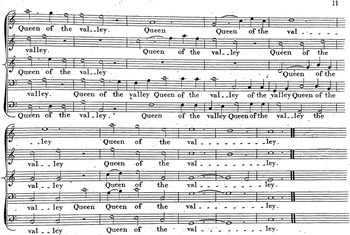
‘Queen of the Valley’, bars 58–83

The closing section, set in a more solemn, sedate 3/2, serves as a prayer for the preservation of the house's beauty, a hope enfolded in the belief that the building symbolizes the prosperity and honour of its owner. The wish is for ‘long years of peace’, peace to thwart threats to the house and its grounds' present glory, and peace for the owner, whose own contentment is guaranteed by this (see Figure 6d).
‘Queen of the Valley’, bars 84–103


A country house is an unusual object for such a hymn of praise, perhaps, and the words thus apostrophize it directly, treating it as an object of almost erotic desire: it has a beauty that the speaker wants to ‘possess’, as one might a lover. It is in this respect that the glee is most clearly picturesque as opposed to pastoral: the house has as much potential for beauty as a natural landscape; indeed, in this text it is the most important element in the rural scene, entirely transcending its functionality. Bricks and mortar are given a hymnic treatment reserved customarily for the ‘pride of the valley’ (the village nymph) or – as was becoming more common at this picturesque moment – the valley itself. This recognition of the beauty of the house itself – its contribution to the ‘composition’ of the landscape and the symbolic importance of a grand dwelling within rural surroundings – signals a picturesque sensibility more tellingly than perhaps any other Georgian glee.
By the same token, if Callcott's audience, and the glee's dedicatee John Heaviside, knew Southey's poem (and there has to be some doubt about this, as it had only just been written when the glee was composed), then this glee might have constituted a hidden allusion for an inner circle. But why did Callcott leave out any mention of Aztlan? One answer is that the exoticism of the Americas is inimical to the style of the glee and to Callcott's purposes; Callcott wished to emphasize Southey's picturesque language, the loving and elegiac description of vales, lakes and groves that sparkle in the sunlight.Footnote 57 But the architectural ‘Queen of the Valley’ is the glee's main focus, which is what marks the piece as picturesque rather than merely pastoral. It is unclear whether the composer had a particular house or scene in mind. But since the glee's text, in isolation, appears to be a kind of a prayer for a house's preservation, it seems to be an example of the subgenre of the ‘request’.
Callcott's only well-known contemporary by the name of John Heaviside was a surgeon – indeed, ‘surgeon-extraordinaire’ to George III. Horsley tells us that Callcott had ambitions to be a surgeon (before fainting on observing an operation, summarily scuppering his plans), so it is likely that this Heaviside was the dedicatee.Footnote 58 Could Heaviside have been the owner of the ‘Queen of the Valley’?
4. Callcott's Cliff
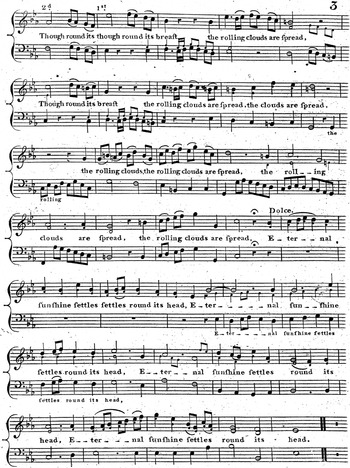
In Callcott's miniature glee ‘The Cliff’ we encounter vividly painted pictures of a dramatically precipitous coastline under assault by storm. Yet the storm in the picture has not completely obscured some residual sunshine. After the first phrase Callcott introduces a rising sequence with a crescendo on the words ‘Swells from the vale, and midway leaves the storm’, an image that suggests that the cliff's peak is untouched (see Figure 7a). This is confirmed by the following pair of lines: ‘Though round its breast the rolling clouds are spread’, an image painted by Callcott's sequential broken thirds and rumbling bass scales, and then ‘Eternal sunshine settles round its head’. The peak, illuminated by the sun's glow, is painted with a fermata and a new, march-like affect (see Figure 7b).
John Wall Callcott, ‘The Cliff’, bars 1–26. © The British Library Board. G.806.a.(4.)

‘The Cliff’, bars 27–61

The text is by Oliver Goldsmith, often portrayed as an anti-pastoralist. But even in his ‘The Deserted Village’ – an elegy for the downtrodden rural poor later echoed in George Crabbe's ‘The Village’ – this apparent anti-pastoralism does not rule out a picturesque register. Read against the background of poems such as ‘The Deserted Village’, the text of ‘The Cliff’ is not merely a picturesque scene but also a social and theological metaphor. The torso of the cliff, enshrouded by cloud, and the shining dome of the cliff's top represent the piety of the village rector, a character introduced near the beginning of the poem: ‘His ready smile a parent's warmth exprest,/ Their welfare pleased him, and their cares distrest;/ To them his heart, his love, his griefs were given,/ But all his serious thoughts had rest in Heaven’. Only at this point does Goldsmith pursue the analogy with the cliff; earthly cares and concerns are the reverend's preoccupations (the ‘rolling clouds spread’ around the ‘midway’), yet he has unbending faith: the eternal light shines in heaven (‘Eternal sunshine settles round its head’).Footnote 59 As with ‘The Queen of the Valley’, Callcott has latched onto picturesque poetic imagery – in this case, imagery that strongly implies the sublime – and has loosened it from its moorings. The musical setting completely transforms the language so that it functions as a picturesque vignette, a vivid illustration of the sounding English landscape.
Conclusion
The English glee has no clear position in conventional historiographies of eighteenth-century music. Its minor status owes much to the long-standing indifference to English music of this period, as well as the tendency of glee composers to set pastoral and pictorial verse – supposedly lower artistic registers. The picturesque provides a fresh context for this genre, however, restoring English music's links with topographical poetry and landscape painting in the eighteenth century.
As noted earlier, music's participation in the culture of the picturesque has hitherto been discussed by musicologists largely in connection with the Austro-German instrumental repertoire. While the picturesque as it has been understood in these studies is undoubtedly useful in explaining the ways in which these works were heard and experienced in England, it is nevertheless a blunt instrument when it comes to assessing the music from the country considered to be the cradle of the picturesque. The genre of the glee is not about playing Haydnesque games with musical form; spinning formal patterns that might remind listeners of the pleasing irregularity of landscapes was not for the glee composer. Instead, the glee provided a medium for a heightened form of speech that spoke elegiacally of the idyllic natural beauty of England's green pastures. Through words, through music, the vision of the landscape sounded.