Surgical site infections (SSIs) are among the most common healthcare-associated infections (HAIs) and are a major cause of morbidity, hospital readmission, and mortality in the United States. Nationally, SSIs account for approximately 22% of HAIs in the acute care hospital patient population.Reference Magill, Edwards, Bamberg, Beldavs, Dumyati and Kainer 1 Mortality from SSIs is approximately 3%, and 75% of those deaths are attributable to SSIs.Reference Awad 2 , Reference Mangram, Horan, Pearson, Silver and Jarvis 3 SSIs are also responsible for a significant healthcare cost burden. The mean excess hospital stay attributable to SSI is approximately 12 days, and estimated costs of an SSI range from $11,000 to $35,000 per SSI. A meta-analysis of healthcare costs in 2013 determined the cost to be $20,785 per SSI.Reference Kirkland, Briggs, Trivette, Wilkinson and Sexton 4 – Reference Zimlichman, Henderson and Tamir 6
Systematic studies provide evidence that 26%–55% of SSIs are preventable.Reference Umscheid 7 However, effective prevention requires an understanding of the modifiable and non-modifiable risk factors that contribute to high SSI rates. SSI rates are also widely used in comparative studies of surgical care quality. These uses of SSI data for prevention and quality measurement purposes place a premium on methodologically sound risk adjustment that takes into account variations in patient case mix and other SSI risk factors that are not amenable to changes in patient care practices.Reference Mu, Edwards and Horan 8
Although SSIs among inpatients have received considerable attention, infections and other adverse outcomes in the outpatient setting have been studied less frequently despite the high volume and increasing use of outpatient surgeries.Reference Magill, Edwards, Bamberg, Beldavs, Dumyati and Kainer 1 , Reference Mangram, Horan, Pearson, Silver and Jarvis 3 , Reference Kirkland, Briggs, Trivette, Wilkinson and Sexton 4 , Reference Mu, Edwards and Horan 8 This scarcity may be due in part to the challenges of systematic patient follow up after outpatient procedures; almost all follow-up requires contact and communication with patients after leaving the facility. Still, the increasing number of surgical quality incentives and reporting mandates highlight the importance of both data with which to assess SSI risk factors in the outpatient setting and the development of risk-adjustment systems specific to outpatient facilities.
Breast procedures are among the most commonly performed surgeries in an outpatient setting, especially ambulatory surgery centers, and they contribute to a significant proportion of outpatient SSIs.Reference Cullen, Hall and Golosinskiy 9 The reported risk of SSI following breast procedures ranges from ~1% to >30%, and risks vary widely by the type of breast procedure.Reference Mannien, Wille, Snoeren and van den Hof 10 – Reference Olsen, Lefta and Dietz 14 However, previous studies have not compared SSI risks following breast surgeries performed in different types of outpatient facilities. Anecdotal reports of differences in SSI outcomes between these 2 types of facilities may reflect differences in patient case mix rather than differences attributable to procedure locations or care team performance. More systematic studies can help identify and quantify risk differentials for adverse outcomes across different types of outpatient facilities that are amenable to changes in patient care practices. In this study, we compared SSI risk following surgical breast procedures among 2 patient groups: those whose procedures were performed in ambulatory surgery centers (ASCs) and those whose procedures were performed in hospital-based outpatient facilities, after adjusting for factors associated with patient case mix.
METHODS
Data Source
Data analyzed for this study included operative procedure, risk factor, and outcome data reported on SSI numerator and denominator records that ASCs and hospitals (specifically hospital outpatient departments) submitted to the Centers for Disease Control and Prevention’s (CDC’s) National Healthcare Safety Network (NHSN) for breast surgeries performed from 2010 through 2014. During the study period, breast surgery SSI numerator and denominator records were submitted to the NHSN from 139 ASCs and 242 hospitals.
Data collection involved patient-based, prospective surveillance conducted by infection prevention personnel such as infection preventionists (IPs) or other designated personnel at each participating facility. Specific methods for identification of SSIs are not required; various approaches are taken by facilities and may include direct examination of patient wounds, review of medical records, and/or surgeon and patient surveys conducted by mail or telephone. 15 Other covariates collected on NHSN SSI denominator forms and included in the study were patient age at procedure, anesthesia use during procedure, American Society of Anesthesiologists (ASA) Classification of Physical Status, 16 duration of procedure in minutes, gender of patient, and wound classification. These variables were selected because they represent patient-level characteristics that have been shown to be biologically plausible confounders of the relationship between location of procedure and risk of SSI.
The NHSN defines breast surgeries as any procedure involving excision of a breast lesion or breast tissue, including radical, modified, or quadrant resection, lumpectomy, incisional biopsy, or mammoplasty. For a full list of procedures, see the International Classification of Disease, Ninth Revision, Clinical Modification (ICD-9-CM) and Current Procedural Terminology (CPT) codes that comprise the NHSN classification of breast surgery (Online Supplementary Table A1). The outcome variable, breast SSI, was defined as any superficial, deep, or organ-space SSI occurring in a breast surgery detected in a 90-day postoperative surveillance window (30-day window for superficial incisional SSI), in accordance with the definitions above. The exposure variable (outpatient facility type) was a binary variable, coded as “Ambulatory Surgery Center” versus “hospital-based outpatient facility.” The majority of facilities classified as “hospital-based outpatient” were general hospital outpatient departments; however, other hospital types were also included (Appendix Table A2).
The total population of outpatient surgical breast procedures included in this study was comprised of 124,012 procedures performed during the 5-year study period. The period 2010–2014 was selected for this study because it included the first state-mandated reporting of outpatient breast surgery SSI (2010) and the most recent full year for which NHSN data were available (2014). States with ambulatory SSI reporting mandates within this time period included Colorado (35% of procedures), New Jersey (18%), and Pennsylvania (8%). The rest of the data (39%) were reported from 36 other states. Patients were excluded if their age was <15 years or >109 years. Procedures were deemed outliers and excluded if duration was ≤10 minutes or ≥291 minutes. Exclusion criteria for the lower bound for age and duration were determined based on medical relevance. Breast procedures were not included for pediatric patients under the age of 15, and procedures shorter than 10 minutes were classified as likely data entry errors and were excluded. Procedures that were not primarily closed were excluded from the 2014 data, reflecting a change in the NHSN definition. The analysis population was a subset of the total population for which procedures with ≥1 missing covariates were excluded and consisted of 110,987 procedures, 89.4% of the total.
Statistical Analyses
All statistical analyses were conducted using SAS software, version 9.3 (SAS Institute, Cary, NC). Descriptive exploratory analysis was first conducted to examine distributions of exposure and covariates in the population. Univariate associations between covariates and the outcome were then examined using likelihood ratio χ2 tests. All statistical tests were performed at the α=0.05 level.
Unconditional multivariate logistic regression was used to examine the association between facility type and breast SSI. Observations with missing values in any of the covariates were excluded from the model. The modeling strategy included an interaction assessment followed by a confounding assessment. All exposure–covariate interactions were considered, but covariate–covariate interactions were omitted because only the effect of exposure was of interest. An overall (chunk) likelihood ratio test was performed to assess the significance of all interaction terms, followed by a backward elimination strategy to assess the significance of individual interactions.
Confounding was assessed using several criteria: biological plausibility (assessed at the variable inclusion stage), association of the variable with exposure and outcome, and whether the risk ratios of the exposure variable changed (by >10%) when a covariate was removed from the logistic regression model. The change-in-estimate confounding analysis utilized a best-subsets approach. Variables were dropped from the model if the change in risk ratio was <10%.
Collinearity was assessed through examination of condition indices and variance decomposition proportions. Any variable with a condition index >30 was considered a possible source of collinearity. For those variables, collinearity with other covariates was considered present if the variance decomposition proportions were >0.5. A goodness-of-fit test was conducted using the deviance-based χ2 test. Validation of the model was conducted using a bootstrap resampling method.Reference Mu, Edwards and Horan 8 Parameters of interest for validation included the C index (area under the receiver operating characteristic [ROC] curve, or AUC), and logistic regression coefficients.
The results were expressed as risk ratios with corresponding 95% confidence intervals. Odds ratio estimates obtained from logistic regression were assumed to closely approximate risk ratios because the outcome of interest is a rare outcome.
RESULTS
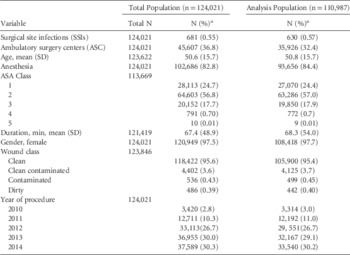
Descriptive characteristics of all variables included in the study are shown in Table 1 for the total population and the analysis population. Among 124,021 total breast surgery procedures and 681 total SSIs (0.55%), 45,607 (36.8%) procedures and 123 SSIs (0.27%) were reported from ASCs and 78,414 procedures (63.2%) and 558 SSIs (0.71%) were reported from hospital-based outpatient facilities. The analysis population was comprised of 110,987 procedures (89.4% of the total) and 630 SSIs (0.60%), with 35,926 procedures (32.4%) and 91 SSIs (risk, 0.25%) reported from ASCs and 75,061 procedures (67.6%) and 539 SSIs (risk, 0.72%) reported from hospital-based outpatient facilities. Distributions of covariates did not differ substantially between the total and the analysis population. ASA class had the highest number of missing values (10,352, 8.3%), whereas all other variables had few missing values (<2.0%). The majority (87.0%) of the observations were collected from 2012 to 2014, with the least (3.0%) collected in 2010.
Characteristics of Outpatient Surgical Breast Procedures Reported to NHSN, 2010–2014

NOTE. NHSN, National Healthcare Safety Network; ASA, American Society of Anesthesiologists.
a Unless otherwise indicated.
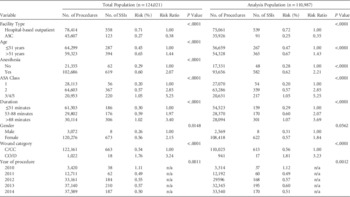
Univariate analyses between each covariate and the outcome variable are shown in Table 2, with corresponding P values. All variables were found to be significantly associated with SSI at the 0.05 level. The crude risk of SSI in ambulatory surgery centers was 0.25%, compared with a hospital-based outpatient risk of 0.72% (crude risk ratio, 0.35; P<.0001). Risk ratios also did not vary substantially between the total and analysis populations.
Univariate Analysis of Predictors of SSI among Outpatient Surgical Breast Procedures Reported to the NHSN, 2010–2014

NOTE. SSI, surgical site infection; NHSN, National Healthcare Safety Network; ASC, ambulatory surgery center; ASA, American Society of Anesthesiologists; C, clean; CC, clean contaminated; CO, contaminated; D, dirty.
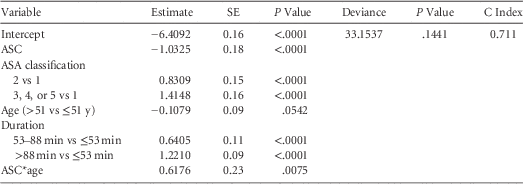
Unconditional logistic regression was performed using all covariates and by applying the modeling strategy outlined above. Table 3a shows model performance statistics, regression coefficients, and corresponding P values of the final model, and Table 3b shows risk ratios and 95% confidence intervals. Effect modification was assessed between exposure and all other covariates, but age of patient was the only significant effect modifier (P=.0075). Patient gender, anesthesia use, and wound classification were determined to contribute minimal or no confounding of the estimate, likely due to the uniformity of their distribution in this population; thus, they were excluded from the final model. Although age did not contribute substantially to the model, it was included in the model because it was a significant effect modifier, and inclusion was necessary to keep the model hierarchically well formulated.
Multivariate-Adjusted Model Examining the Association Between Facility Type and Risk of Outpatient Breast Surgical Site Infections (SSIs) in 110,987 Procedures Reported to the NHSN, 2010–2014

NOTE. SSI, surgical site infection; NHSN, National Healthcare Safety Network; ASC, ambulatory surgery center; ASA, American Society of Anesthesiologists.
Age-Stratified Risk Ratios and 95% CI for the Association Between Facility Type and Risk of Outpatient Breast SSI, Adjusted for Model Covariates

NOTE. SSI, surgical site infection; RR, risk ratio; CI, confidence interval.
For patients age 51 years or younger, the risk of SSI among patients whose procedures were performed in ambulatory surgery centers was 0.36 (95% CI, 0.25–0.50) times the risk of SSI among patients whose procedures were performed in hospital-based outpatient settings, adjusted for age, ASA class, and duration of procedure. For patients >51 years old, the SSI risk associated with breast surgery in an ambulatory surgery center was 0.32 (95% CI, 0.21–0.49) times the SSI risk associated with breast surgery in a hospital-based outpatient setting, adjusted for model covariates (Table 3A).
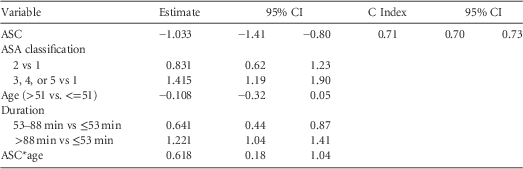
The final model did not significantly deviate from the fully parameterized model, indicating good model fit (P=.14). The final model provided acceptable discrimination between cases and non-cases, with a C index of 0.711. Table 4 shows the results of the bootstrap validation for 100 replicates. The model consistently performed acceptably, with a C index ranging from 0.70 (lower 2.5%) to 0.73 (upper 97.5%). All estimates of regression coefficients remained significant.
Bootstrap Model Validation Estimates and Corresponding 95% Confidence Intervals, Obtained from 100 Replicates of the Dataset

NOTE. SSI, surgical site infection; NHSN, National Healthcare Safety Network; ASC, ambulatory surgery center; ASA, American Society of Anesthesiologists.
DISCUSSION
The risks of breast procedure SSI differed significantly between the ASC and hospital-based outpatient patient populations, among both older and younger patients, adjusted for patient case mix. Model performance, as measured by the C index, was higher or comparable to similar models created for inpatient procedures.Reference Mu, Edwards and Horan 8 Our findings suggest that the ASC breast surgery patient population has a substantially lower risk of SSI than the hospital-based outpatient patient population, even after adjusting for patient case mix with the available variables. These results raise the possibility that older patients have a higher benefit (decrease in SSI risk) from undergoing breast procedures at an ASC than younger patients. Another interpretation is that older patients may be more likely to have specific breast procedures with lower SSI risk than younger patients. NHSN does not retain the specific ICD-9-CM or CPT codes to further stratify SSI risk; therefore, this is considered an important limitation of this study.
Our findings should be placed in the context of several other limitations. The risk of outpatient breast SSI reported in this study for both patient populations may be lower than the actual risk, due to the possibility that current nonstandardized and variable practices of postoperative SSI surveillance following procedures in outpatient settings leads to under-ascertainment of infections.Reference Petherick, Dalton, Moore and Cullum 17 SSI rates measured by the American College of Surgeons National Surgical Quality Improvement Program (NSQIP) are consistently higher than rates measured by NHSN; however, temporal trends have been shown to be similar.Reference Gase, Kelly, Hohrein, Siebels and Babcock 18 Assuming detection rates of SSI events are nondifferential with respect to facility type, the magnitude and direction of bias in the risk ratios are estimated to be null. This assumption may be challenged by the notion that hospital-based outpatient facilities may have more resources dedicated to surveillance than ASCs, although evidence on this subject is limited.
Another potential limitation is inadequate control for confounding factors. Control for confounding of the association between outpatient facility type and breast SSI was accomplished through instrumental variables to account for the differences in patient case mix between facility types that are typically associated with differences in SSI rates. These instrumental variables are not theoretical confounders in themselves, but they are highly associated with unmeasured and immeasurable confounders. Therefore, controlling for these may result in incomplete control of confounding, or residual confounding. Similarly, duration of procedure is a controversial point of control, as some may argue that it reflects procedural elements of the facility or the skill of the provider rather than patient complexity. In other words, it is not entirely clear whether duration is a confounder or an intermediate in the causal relationship between facility type and SSI. This controversy applies in risk-adjustment models, where skill of the provider is sometimes unwanted as a point of adjustment.
Several patient variables that are known to be associated with increased SSI risk were not included in our analysis. Body mass index and diabetes status were not required by NHSN until the last year of the study period and were excluded from the risk models. Hypertension and previous breast surgery, also known contributors to SSI risk, are not NHSN factors and were therefore not able to be collected during the study period. Other variables not captured by NHSN but included in other studies of SSI risk following breast procedures are preoperative chemoradiation, surgical approaches, intraoperative bleeding, and drainage time.Reference Xue 19 – Reference Kaye, Schmit and Pieper 23 Some of these variables represent modifiable risk factors that may be causal intermediates of the relationship between facility type and risk of SSI. In other words, they may reflect differences in practice between facility types that may be the cause of differences in SSI risk. Because the objective of this study was to determine whether any differences between facility type, other than patient case mix (which cannot be a target for prevention), result in differences in SSI risk, it would not be appropriate to adjust for the aforementioned variables. Therefore, it did not matter that those variables were not captured by the NHSN.
The designation of “hospital-based outpatient” may be a source of ambiguity when interpreting these findings. The “hospital-based outpatient” designation was assigned when any non-ASC healthcare facility reported outpatient breast surgeries to NHSN. However, all of the facilities related to this designation are acute care hospitals, with 89.4% being general hospitals (Online Supplementary Table A2). It is reasonable to assume that the hospital-based outpatient procedures were performed at the same geographic location as a corresponding inpatient facility, whereas ASC procedures were performed at a dedicated outpatient facility.
Most of the data in this study (54%) were reported to NHSN from 2 states, Colorado and New Jersey. Reporting mandates for breast procedure-associated SSI in these states may cause rates of SSI in these states to be lower than that in the general US population because surveillance and feedback of HAI rates have been shown to improve HAI rates.Reference Gaynes, Richards and Edwards 24 However, it seems reasonable to assume that the comparative ratio measures assessed in this study would not be affected; there is no evidence to assume that the reporting mandates for outpatient SSI would influence SSI rates in hospital-based outpatient settings and ASCs differentially.
Models based on NHSN data are used nationwide in risk-adjustment methods that healthcare facilities use to calculate risk-adjusted SSI rates for quality improvement. Using the same risk-adjustment variables in this analysis lends some additional credibility to the model built in this study, most notably its ability to control for patient case mix using proven instrumental variables.Reference Gaynes, Culver, Horan, Edwards, Richards and Tolson 25 This is one of the first studies using outpatient data collected by NHSN, and our findings indicate that ambulatory surgery centers have significantly lower rates of SSI, adjusted for differences in patient case mix using data available through NHSN during the study period. Given the limitations of the study, these results can lead to several possible conclusions and future hypotheses. If patient case mix was adequately controlled for, the difference in risk between ASC patients and hospital-based outpatients was likely due to differences in practice between the 2 facilities or to modifiable differences that can be targets for preventative interventions. A more conservative interpretation of these results is also useful: If patient case mix was not adequately controlled for, it is possible that facility type may be another useful proxy to delineate different risk populations and measure patient case mix. In this case, future risk-adjustment efforts for outpatient SSI should either analyze these 2 populations separately or include adjustment factors related to the facility type. Additional studies are therefore needed to examine the effects of intermediate, modifiable variables related to differences in practice that may result in the association observed, as well as the possibility for systematic differences in case ascertainment between the 2 facility types. These findings can then be used by hospitals and policymakers as targets for intervention and quality improvement and will contribute to risk-adjustment systems for outpatient surgeries.
ACKNOWLEDGMENTS
The findings and conclusions in this report are those of the authors and do not necessarily represent the official position of the Centers for Disease Control and Prevention.
Financial support: No financial support was provided relevant to this article.
Potential conflicts of interest: All authors report no conflicts of interest relevant to this article.
SUPPLEMENTARY MATERIAL
To view supplementary material for this article, please visit http://dx.doi.org/10.1017/ice.2016.146