Introduction
Parasites are incredibly diverse microorganisms and play an essential role in ecological and evolutionary processes (Gómez & Nichols, Reference Gómez and Nichols2013). For instance, they are some of the main regulators of some vertebrate species populations (Watson, Reference Watson2013), therefore, they should be considered important elements for conservation (Gómez & Nichols, Reference Gómez and Nichols2013). The term ‘parasite’ encompasses a diverse range of life forms that are usually smaller in size than their hosts, can inhabit them externally or internally and have a population distribution that varies from homogeneous to aggregate, making distribution difficult. The lack of knowledge about diversity can also be linked to limited sampling efforts (Okamura et al., Reference Okamura, Hartigan and Naldoni2018).
Reptiles comprise an essential group of terrestrial vertebrates with more than 11,500 species known worldwide (Uetz & Hosek, Reference Uetz and Hosek2022), and about 848 species in Brazil (Costa et al., Reference Costa, Guedes and Bérbils2021). They are crucial in developing conservation strategies, especially in discontinuous or isolated environments (Rodrigues, Reference Rodrigues2003), as they are ecosystem agents capable of influencing important environmental changes (Miranda, Reference Miranda2017), and they also have significant economic and social importance (Boas et al., Reference Boas, De Vasconcelos Camargo, Junqueira, Venturelli and Albo2014). Despite all this, among the vertebrates, the reptiles have some of the fewest descriptions of their parasitic fauna (Carlson et al., Reference Carlson, Dallas, Alexander, Phelan and Phillips2020).
More than 400 species of reptiles can be found in Northeast Brazil, making it the second richest region in the country in terms of reptile biodiversity (Costa et al., Reference Costa, Guedes and Bérbils2021). Important surveys on the parasitic fauna of reptiles have been carried out in Brazil and South America (Vicente et al., Reference Vicente, Rodrigues, Gomes and Pinto1993; Ávila & Silva, Reference Ávila and Silva2010); however, the discovery of new parasitic species, points of occurrence and parasite–host associations make reviewing this information an ongoing and necessary process. Surveys and reviews of the parasitic fauna contribute to global estimates of the diversity and distribution of these organisms, revealing the evolutionary history of related species (González et al., Reference González, Hamann and Duré2021), and serving as an essential source of information for future research.
This study presents a compilation of data on parasitism in reptiles from Northeast Brazil, indicating the host and parasite species, the location of the association's record, parasitized organs and authors of the original records. It also lists the number of parasitic species, diversity, distribution and host range.
Material and methods
Study area
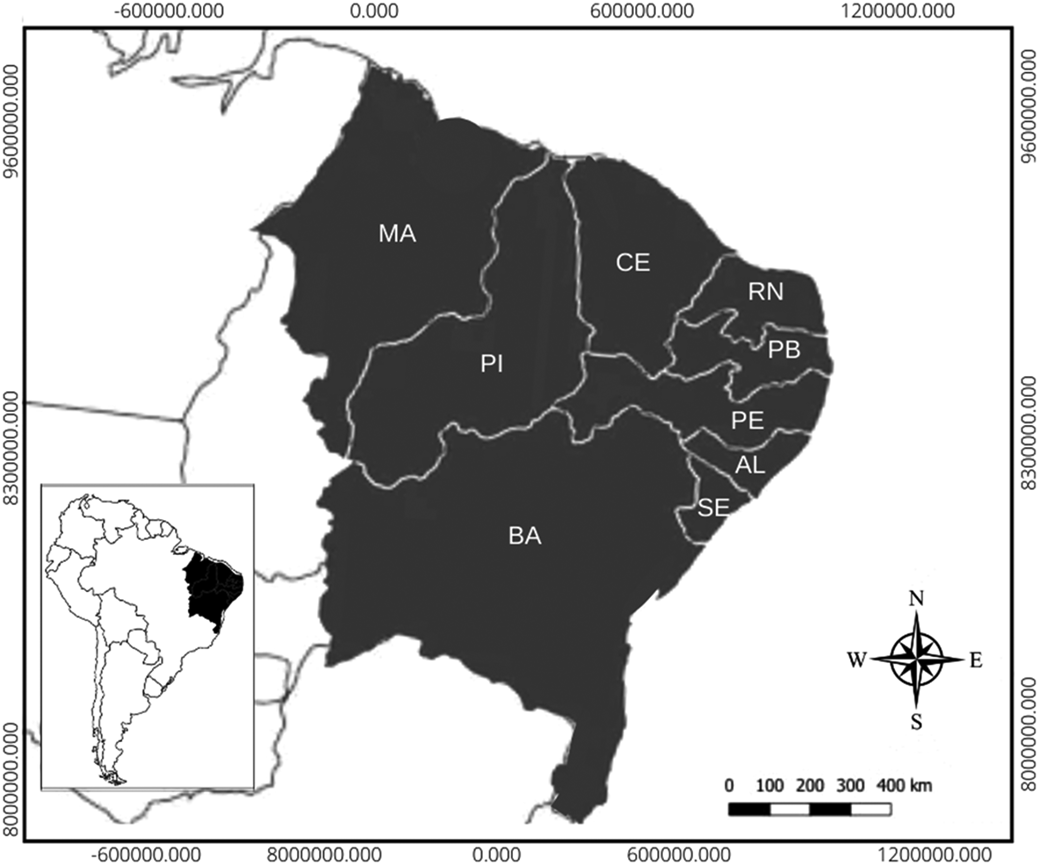
The Northeast Brazil region is located in the eastern end of tropical South America (Molion & Bernardo, Reference Molion and Bernardo2002), it is about 1,558,196 km2, equivalent to 18% of the national territory (Silva et al., Reference Silva, Pereira, Azevedo, de Sousa and Sousa2011), and comprises nine states: Maranhão; Piauí; Ceará; Rio Grande do Norte; Paraíba; Pernambuco; Alagoas; Sergipe; and Bahia (fig. 1). The region is divided into four major regions: Mata, Agreste, Sertão and Meio-Norte (Garcia, Reference Garcia2017), where portions of biomes such as the Atlantic Forest and the Cerrado, are found (BRASIL, 2017); however, the Caatinga is the predominant biome (Araújo, Reference Araújo, Villagra, Melo, Romaniuc-Neto and Barbosa2014). Four types of climates are present in Northeast Brazil: equatorial humid; coastal humid; tropical; and tropical semi-arid (Silva et al., Reference Silva, Pereira, Azevedo, de Sousa and Sousa2011). In terms of herpetofauna, it is the second richest region in Brazil, housing about 180 species of amphibians (Freitas, Reference Freitas2011), and 389 species (406 species + subspecies) of reptiles (Costa et al., Reference Costa, Guedes and Bérbils2021).
Northeast Brazil and its nine states: MA, Maranhão; PI, Piauí; CE, Ceará; RN, Rio Grande do Norte; PB, Paraíba; PE, Pernambuco; AL, Alagoas; SE, Sergipe; and BA, Bahia.

Literature research and review
The literature on parasitism in reptiles from Northeast Brazil is based on information obtained from online databases (such as PubMed, BioOne, Jstor, Scielo, Google Scholar, Web de Science and ScienceDirect). Scientific notes, articles, books, book chapters, dissertations, theses and published manuscripts were analysed. Works published between the years 1924 and 2021 were considered. In each study the host species, associated parasites, infected organs and the location of the record were analysed. The groups of reptiles included in this study were amphisbaenians, testudines, snakes, crocodiles and lizards. For parasites were considered: helminths; pentastomids; ticks; and mites.
For host taxonomy we followed Costa et al. (Reference Costa, Guedes and Bérbils2021) and the taxonomy of parasites we followed Anderson et al. (Reference Anderson, Chabaud and Willmott2009) for nematodes, Christoffersen & De Assis (Reference Christoffersen and De Assis2013) for pentastomids, Amin (Reference Amin2013) for acanthocephalans, Lunaschi & Drago (Reference Lunaschi and Drago2007) and Fernandes & Kohn (Reference Fernandes and Kohn2014) for trematodes, Paredes-León et al. (Reference Paredes-León, Garcia-Prieto, Guzman-Cornejo, Leon-Regagnon and Perez2008) and Cuellar et al. (Reference Cuellar, Sáez, Cantú, Sánchez, Mendoza, Conga, Cruces, Luque and Chero2022) for cestodes, Barros-Battesti et al. (Reference Barros-Battesti, Arzua and Bechara2006), Martins et al. (Reference Martins, Onofrio, Barros-Battesti and Labruna2010), Andreotti et al. (Reference Andreotti, Koller and Garcia2016), Nava et al. (Reference Nava, Venzal, González-Acuña, Martins and Guglielmone2017) for ticks and varied literature for mites (Paredes-León et al., Reference Paredes-León, Garcia-Prieto, Guzman-Cornejo, Leon-Regagnon and Perez2008; Mendoza-Roldan et al., Reference Mendoza-Roldan, Ribeiro and Castilho-Onofrio2020). For all groups of parasites, the SiBBr (Information System on Brazilian Biodiversity, n.d.) database was also consulted.
The hosts’ names are listed in alphabetical order and parasites are presented in alphabetical order under their Phylum, Class, Order, Family and Genus. Hosts and localities bear a number in parentheses that identifies the locality and reference of each original record. The site of infection in some cases was described as ‘Not specified’ because it was not reported in the original record. The remarks sections contain information and mention taxonomy data on hosts and parasites. Abbreviations for localities cited are: Maranhão (MA); Piauí (PI); Ceará (CE); Rio Grande do Norte (RN); Paraíba (PB); Pernambuco (PE); Alagoas (AL); Sergipe (SE); and Bahia (BA). Other relevant abbreviations include: ESEC (Ecological Station); RPPN (Private Natural Heritage Reserve); and REBIO (Biological Reserve).
Results
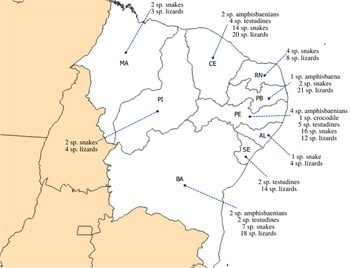
We report 183 parasite taxa belonging to four phyla for Northeast Brazilian reptiles: Nematoda (20 families and 38 genera); Arthropoda (12 families and 9 genera); Platyhelminthes (14 families and 21 genera); and Acanthocephala (three families and three genera). These were registered for 101 host species: seven amphisbaenas; one crocodile species; seven testudines (two species of Chelidae, two Cheloniidae, one Kinosternidae and two Testudinidae); 30 snakes; and 56 lizards. All states presented records of parasitism for at least one group of reptile included in this study. Ceará was the state with the highest number of investigations (about 44% of all studies), followed by Pernambuco (26%), Bahia and Paraiba (both with 13%), Rio Grande do Norte (7%), Piauí and Sergipe (6% each), Maranhão (3%) and Alagoas (2%). Ceará was also the state with the highest quantity and diversity of investigated reptile species (42) (fig. 2), followed by Pernambuco (38), Bahia (29), Paraíba (24), Sergipe (16), Rio Grande do Norte (12), Piauí (6), and Maranhão and Alagoas (five species in each state). The Caatinga and Atlantic Forest were the most investigated environments. In both, lizards were the most studied group regarding parasite fauna, followed by snakes, amphisbaenas and testudines. The Cerrado presented a low number of records, both of host and parasite species.
Number of reptiles’ species with recorded parasite–host association in each state of Northeast Brazil

ACANTHOCEPHALA
Phylum: Acanthocephala Kohlreuther, 1771
Class: Archiacanthocephala Meyer, 1931
Order: Oligacanthorhynchida Petrochenko, 1956
Family: Oligacanthorhynchidae Southwell & Macfie, 1925
Oligacanthorhynchus Travassos, 1915
Oligacanthorhynchus sp.
Hosts: Ameiva ameiva (1), Ameivula ocellifera (2), Gymnodactylus geckoides (2), Philodryas nattereri (4), Phyllopezus pollicaris (2), Pseudoboa nigra (5), Tropidurus hispidus (6), Tropidurus semitaeniatus (2, 7)
Localities: (1) Mata do Pau Ferro – PB; (2) Alto Sertão – SE; (3) Mata de Goiamunduba, Mata Sítio Socorro – PB; (4) Exu – PE; (5) Piauí – PI, Ceará – CE, Pernambuco – PE; (6) ESEC Aiuaba, Santa Quitéria, Várzea Alegre – CE, João Câmara – RN; (7) Santa Quitéria, Várzea Alegre – CE, João Câmara – RN
Infection sites: Coelomic cavity, cavity, stomach, small intestine and large intestine.
References: (1) Teixeira et al. (Reference Teixeira, Riul, Brito, Araujo-Filho, Teles, de Oliveira Almeida and Mesquita2020); (2) Araújo Filho et al. (Reference Araújo Filho, Teixeira, Teles, Rocha, Almeida, Mesquita and Lacerda2020); (3) Teixeira et al. (Reference Teixeira, Riul, Brito, Araujo-Filho, Teles, de Oliveira Almeida and Mesquita2020, Reference Teixeira, Sampaio, Araujo-Filho, Teles, Almeida, Mesquita and Brito2021); (4) Araújo Filho et al. (Reference Araújo Filho, Teles, Teixeira, Sakamoto, Pinto, Silva and Almeida2018); (5) Matias et al. (Reference Matias, Silva, Sousa and Ávila2018); (6) Brito et al. (Reference Brito, Ferreira, Ribeiro, Anjos, Almeida, Mesquita and Vasconcellos2014a, Reference Brito, Corso, Almeida, Ferreira, Almeida, Anjos, Mesquita and Vasconcellosb); (7) Brito et al. (Reference Brito, Corso, Almeida, Ferreira, Almeida, Anjos, Mesquita and Vasconcellos2014b)
Class: Palaeacanthocephala Meyer, 1931
Order: Polymorphida Petrochenko, 1956
Family: Centrorhynchidae Van Cleave, 1916
Centrorhynchidae undetermined
Hosts: Hemidactylus agrius (1), Hemidactylus mabouia (2)
Localities: (1) Fazenda Experimental Vale do Curu – CE; (2) Paulino Neves – MA, Parnaíba – PI
Infection site: Body cavity.
References: (1) Anjos et al. (Reference Anjos, Holanda Bezerra, Cunha Passos, Zanchi and Barbosa Galdino2011); (2) Bezerra et al. (Reference Bezerra, Pinheiro, Melo, Braga, Anjos and Borges-Nojosa2020)
Centrorhynchus Lutz, 1913
Centrorhynchus sp.
Host: Erythrolamprus viridis
Locality: Várzea Alegre, Aiuaba – CE.
Infection site: Body cavity.
Reference: Quirino et al. (Reference Quirino, Ferreira, Silva, Silva, Morais and Ávila2018)
Cistacant of Centrorhynchus sp.
Host: Anolis fuscoauratus
Locality: Serra de Maranguape, Serra de Baturité, Parque Nacional Ubajara – CE
Infection site: Coelomic cavity.
Reference: Mesquita et al. (Reference Mesquita, Oliveira, Perez and Ávila2020)
Remarks: Called Norops fuscoauratus in this paper.
Order: Echinorhynchida Southwell & Macfie, 1925
Family: Echinorhynchidae Cobbold, 1876
Echinorhynchidae undetermined
Host: Psychosaura macrorhyncha
Locality: Trancoso – BA
Infection site: Stomach tract.
Reference: Vrcibradic et al. (Reference Vrcibradic, Rocha and Van Sluys2001)
Remarks: Called M. macrorhyncha in this paper.
Acanthocephalus Kohlreuther, 1771
Acanthocephalus sp.
Host: Pseudoboa nigra
Localities: Ceará – CE, Pernambuco – PE
Infection site: Stomach.
Reference: Matias et al. (Reference Matias, Silva, Sousa and Ávila2018)
Cistacant undetermined
Hosts: Ameivula ocellifera (1), Ameivula pyrrhogularis (3), Gymnodactylus darwinii (7), Gymnodactylus geckoides (1, 2), Leptodeira annulata (4), Philodryas olfersii (5), Phyllopezus pollicaris (1), Tropidurus hispidus (1), Tropidurus semitaeniatus (1), Trachylepis atlântica (6)
Localities: (1) Alto Sertão – SE; (2) ESEC Aiuaba, Cuncas – CE; (3) ESEC Aiuaba, Cuncas, Dom Quintino, Quitaiús – CE; (4) Aiuaba, Barro, Farias Brito, Jati, Mauriti – CE; (5) Ilha Grande – PI; (6) Fernando de Noronha – PE; (7) Mata do Camucim, Mata do Tapacurá, São Lourenço da Mata – PE
Infection sites: Stomach, body cavity and wall of the gastrointestinal tract.
References: (1) Araújo Filho et al. (Reference Araújo Filho, Teixeira, Teles, Rocha, Almeida, Mesquita and Lacerda2020); (2) Alcantara et al., Reference Alcantara, Ferreira-Silva, Gonçalves-Sousa, Morais and Ávila2019); (3) Silva et al. (Reference Silva, Manoel, Uieda, Avila and Silva2019b); (4) Carvalho et al. (Reference Carvalho, Silva-Neta, Silva, Oliveira, Nunes, Souza and Ávila2018); (5) Castro Araújo et al. (Reference Castro Araújo, Silva, Machado, Oliveira and Ávila2020); (6) Bursey et al. (Reference Bursey, Rocha, Menezes, Ariani and Vrcibradic2010); (7) Oitaven et al. (Reference Oitaven, da Silva Ribeiro, de Moura and de Oliveira2019)
Encysted larva
Host: Ameivula pyrrhogularis
Localities: ESEC Aiuaba, Cuncas, Dom Quintino, Quitaiús, – CE
Infection site: Not specified.
Reference: Silva et al. (Reference Silva, Manoel, Uieda, Avila and Silva2019b)
ARTHROPODA
Phylum: Arthropoda von Siebold, 1848
Class: Arachnida Lamarck, 1801
Family: Cheyletidae Leach, 1815
Cheyletidae
Host: Ameivula ocellifera
Localities: Santo Inácio – BA, Pirambu – SE
Infection site: Not specified.
Reference: Xavier et al. (Reference Xavier, Anjos, Gazêta, Machado, Storti-Melo and Dias2019)
Family: Glycyphagidae
Host: Ameivula ocellifera
Localities: Santo Inácio – BA, Pirambu – SE
Infection site: Not specified.
Reference: Xavier et al. (Reference Xavier, Anjos, Gazêta, Machado, Storti-Melo and Dias2019)
Order: Ixodida Leach, 1815
Family: Argasidae Murray, 1877
Ornithodoros Koch, 1844
Ornithodoros mimon Kohls, Clifford & Jones, 1969
Host: Corallus hortulana
Locality: Chapada do Araripe – CE
Infection site: Not specified.
Reference: Alcantara et al. (Reference Alcantara, Ferreira-Silva, Ávila, Pacheco, Martins, Muñoz-Leal and Morais2018b)
Ornithodoros rietcorreai Labruna, Nava & Venzal, 2016
Host: Leptodeira annulata
Locality: Farias Brito – CE
Infection site: Not specified.
Reference: Alcantara et al. (Reference Alcantara, Ferreira-Silva, Ávila, Pacheco, Martins, Muñoz-Leal and Morais2018b)
Ornithodoros sp.
Hosts: Leptodeira annulata (1), Oxyrhopus trigeminus (2), Philodryas olfersii (2)
Localities: (1) Jati – CE; (2) Barro – CE
Infection site: Not specified.
Reference: Alcantara et al. (Reference Alcantara, Ferreira-Silva, Ávila, Pacheco, Martins, Muñoz-Leal and Morais2018b)
Family: Ixodidae Murray, 1877
Amblyomma Koch, 1844
Amblyomma dissimile Koch, 1844
Hosts: Ameiva ameiva (1), Iguana iguana (2), Tropidurus hispidus (3)
Localities: (1) Chapadinha – MA; (2) Ribeiro Gonçalves – PI; (3) São Lourenço da Mata – PE
Infection site: Near the mouth.
References: (1) Lopes et al. (Reference Lopes, Andrade and Costa-Júnior2010); (2) Alcantara et al. (Reference Alcantara, Ferreira-Silva, Ávila, Pacheco, Martins, Muñoz-Leal and Morais2018b); (3) Dantas-Torres et al. (Reference Dantas-Torres, Oliveira-Filho, Soares, Souza, Valença and Sá2008)
Amblyomma fuscum Neumann, 1907
Hosts: Boa constrictor (1, 2, 3), Caiman latirostris (4)
Localities: (1) Parque dois Irmãos – PE; (2) Igarassu, São Lourenço da Mata – PE; (3) João Pessoa – PB, Recife – PE; (4) Estação Ecológica do Tapacurá, São Lourenço da Mata – PE
Infection site: Between the scales of the dorsal region of the body, ventral region.
References: (1) Cunha et al. (Reference Cunha, Farias, Brito and Serra-Freire1999); (2) Dantas-Torres et al. (Reference Dantas-Torres, Oliveira-Filho, Soares, Souza, Valença and Sá2008); (3) Dantas-Torres et al. (Reference Dantas-Torres, Ferreira, de Melo, Lima, Siqueira, Rameh-de-Albuquerque, Melo and Ramos2010); (4) Dantas-Torres et al. (Reference Dantas-Torres, Mascarenhas-Junior, Dos Anjos, Dos Santos and Correia2019)
Amblyomma rotundatum Koch, 1844
Hosts: Atractus guentheri (12), Boa constrictor (18, 19, 20, 21, 22, 23), Bothrops leucurus (gr. atrox) (4, 5), Bothrops erythromelas (6), Caiman latirostris (1), Chelonoidis carbonarius (2), Chelonoidis denticulatus (2), Chironius flavolineatus (14), Corallus hortulana (18), Crotalus durissus cascavella (7), Drymarchon corais (13), Epicrates assissi (24), Epicrates cenchria (18); Eunectes murinus (25), Helicops carinicaudus (18), Iguana iguana (8, 9, 10), Lygophis dilepis (15), Mesoclemmys tuberculata (3), Micrurus ibiboboca (26), Micrurus lemniscatus (5), Oxyrhopus trigeminus (16), Philodryas olfersii (5) Philodryas nattereri (5), Tropidurus hispidus (11), Xenodon merremii (18), Xenopholis scalaris (17)
Localities: (1) Parque Dois Irmãos, Recife, Estação Ecológica do Tapacurá, São Lourenço da Mata – PE; (2, 18) Parque Dois Irmãos – PE; (3) Camaçari – BA; (4) Crato, Barbalha – CE; (5) Salvador – BA; (6) Farias Brito – CE; (7, 8) Igarassu – PE; (9, 24) Parque Arruda Câmara – PB; (10) Mata de São João – BA; (11) Aiuaba – CE; (12) Ilhéus – BA; (13) Guaramiranga – CE; (14) Caririaçu, Barbalha – CE; (15) Crato – CE; (16) ESEC Aiuaba, Barro – CE; (17) RPPN Pedra D'antas, Lagoa dos Gatos; (19) Mossoró – RN; (20) São Lourenço da Mata – PE; (21) João Pessoa – PB, Recife – PE; (22) Custódia – PE; (23) Salvador, Candeias, Feira de Santana, Mata de São João – BA; (25) Salvador, Lauro de Freitas, Feira de Santana – BA; (26) ESEC Aiuaba, Barbalha – CE
Infection site: Near the mouth, tail, near of the head, ventral region near the neck, head.
References: (1) Dantas-Torres et al. (Reference Dantas-Torres, Mascarenhas-Junior, Dos Anjos, Dos Santos and Correia2019); (2, 9, 21) Dantas-Torres et al. (Reference Dantas-Torres, Ferreira, de Melo, Lima, Siqueira, Rameh-de-Albuquerque, Melo and Ramos2010); (3, 5, 10, 23, 25) Fonseca et al. (Reference Fonseca, Bahiense and Silva2020); (4, 6, 13, 14, 15, 16, 17) Alcantara et al. (Reference Alcantara, Ferreira-Silva, Ávila, Pacheco, Martins, Muñoz-Leal and Morais2018b); (7) Dantas-Torres et al. (Reference Dantas-Torres, Oliveira-Filho, Souza and Sá2005); (8, 20) Dantas-Torres et al. (Reference Dantas-Torres, Oliveira-Filho, Soares, Souza, Valença and Sá2008); (11) Quirino et al. (Reference Quirino, Alcantara, Silva, Ávila, Morais and Silva2016); (12) Mendoza-Roldan et al. (Reference Mendoza-Roldan, Ribeiro and Castilho-Onofrio2020); (18) Cunha et al. (Reference Cunha, Farias, Brito and Serra-Freire2003); (19) Labruna et al. (Reference Labruna, Ahid, Soares and Suassuna2007); (24) Batista et al. (Reference Batista, de Lucena, de Oliveira Filho, Nery, Martins and Pereira2021); (22) Horta et al. (Reference Horta, Do Nascimento, Martins, Labruna, Machado and Nicola2011); (26) Alcantara et al. (Reference Alcantara, Ferreira-Silva, Ávila, Pacheco, Martins, Muñoz-Leal and Morais2018b)
Amblyomma sp.
Hosts: Ameiva ameiva (1), Anolis brasiliensis (7), Boa constrictor (2, 3), Bothrops leucurus (gr. atrox) (4), Chironius exoletus (10), Chironius flavolineatus (11), Copeoglossum arajara (5), Epicrates cenchria (2), Erythrolamprus viridis (12), Leptodeira annulata (13), Lygophis dilepis (14), Micrurus ibiboboca (6), Oxyrhopus trigeminus (15), Philodryas nattereri (16), Philodryas olfersii (17), Philodryas sp. (20), Pseudoboa nigra (18), Spilotes pullatus (20), Tantilla melanocephala (8), Tropidurus hispidus (8, 9), Tropidurus sp. (3), Xenopholis scalaris (19)
Localities: (1) Chapadinha – MA; (2) Parque Arruda Camara – PB, (3) Parque Estadual Dois Irmãos – PE; (4) Araripe – CE; (5) Ipú – CE;(6, 7) Crato – CE; (8) São Lourenço da Mata – PE; (9) Parque Nacional Serra de Itabaiana – SE; (10) Timon – MA; (11) Barbalha – CE; (12) Farias Brito – CE; (13) Várzea Alegre – CE; (14) Exu – PE; (15) Barbalha, Farias Brito – CE, Exu – PE, Quebrangulo – AL; (16) Barro – CE, Exu – PE; (17) Barro – CE; (18) Lavras da Mangabeira – CE, Ouricuri – PE; (19) RPPN Pedra D'antas, Lagoa dos Gatos – PE; (20) Recife – PE
Infection site: Right side of the entire neck ‘mite pocket’.
References: (1) Lopes et al. (Reference Lopes, Andrade and Costa-Júnior2010), (2, 3, 20) Dantas-Torres et al. (Reference Dantas-Torres, Ferreira, de Melo, Lima, Siqueira, Rameh-de-Albuquerque, Melo and Ramos2010); (4, 5, 6, 7, 10, 11, 12, 13, 14, 15, 16, 17, 18, 19) Alcantara et al. (Reference Alcantara, Ferreira-Silva, Ávila, Pacheco, Martins, Muñoz-Leal and Morais2018b); (8) Dantas-Torres et al. (Reference Dantas-Torres, Oliveira-Filho, Soares, Souza, Valença and Sá2008), (9) Santana et al. (Reference Santana, Caldas, de Queiroga Cavalcanti, Gomes, da Silva, dos Santos and Faria2017)
Remarks: Host A. brasiliensis reported in Alcantara et al. (Reference Alcantara, Ferreira-Silva, Ávila, Pacheco, Martins, Muñoz-Leal and Morais2018b) as N. brasiliensis.
Order: Mesostigmata Canestrini, 1891
Mesostigmata
Hosts: Ameivula ocellifera, Ameivula nigrigula
Localities: Santo Inácio – BA, Pirambu – SE
Infection site: Not specified.
Reference: Xavier et al. (Reference Xavier, Anjos, Gazêta, Machado, Storti-Melo and Dias2019)
Family: Ascidae Oudemnas, 1905
Host: Ameivula nigrigula
Localities: Santo Inácio – BA, Pirambu – SE
Infection site: Not specified.
Reference: Xavier et al. (Reference Xavier, Anjos, Gazêta, Machado, Storti-Melo and Dias2019)
Family: Phytoseiidae Berlese, 1916
Hosts: Ameivula ocellifera, Ameivula nigrigula
Localities: Santo Inácio – BA, Pirambu – SE
Infection site: Not specified.
Reference: Xavier et al. (Reference Xavier, Anjos, Gazêta, Machado, Storti-Melo and Dias2019)
Order: Trombidiformes Reuter, 1909
Family: Pterygosomatidae Oudemans, 1910
Bertrandiella Paredes-Léon, Klompen and Pérez, 2012
Bertrandiella jimenezi Paredes-Léon & Morales-Malacara, 2012
Hosts: Gymnodactylus geckoides (1), Phyllopezus pollicaris (2)
Localities: (1) Piranhas – AL, Canindé de São Francisco – SE, Angicos – RN; (2) Piranhas – AL, Canindé de São Francisco – SE
Infection site: Not specified.
Reference: (1, 2) Mendoza-Roldan et al. (Reference Mendoza-Roldan, Ribeiro and Castilho-Onofrio2020)
Geckobia Mégnin, 1878
Geckobia hemidactyli Lawrence, 1936
Host: Hemidactylus mabouia
Locality: Mata de Tejipó - PE
Infection site: Axillary, dorsal, ventral and pelvic regions.
Reference: Oliveira et al. (Reference Oliveira, Campos, de Oliveira and de Moura2019c)
Geckobiella Hirst, 1917
Geckobiella harrisi Davidson, 1985
Host: Tropidurus hispidus
Locality: Mata de Tejipó – PE
Infection site: Mite pocket.
Reference: Oliveira et al. (Reference Oliveira, Campos, de Oliveira and de Moura2019c)
Geckobiella sp.
Host: Tropidurus hispidus
Locality: Chapada do Araripe – CE
Infection site: Evenly distributed by the scales all over the body.
Reference: Delfino et al. (Reference Delfino, Ribeiro, Furtado, Anjos and Almeida2011)
Prostigmata Kramer, 1877
Host: Ameivula ocellifera
Localities: Santo Inácio – BA, Pirambu – SE
Infection site: Not specified.
Reference: Xavier et al. (Reference Xavier, Anjos, Gazêta, Machado, Storti-Melo and Dias2019)
Tarsonemidae Kramer, 1877
Host: Ameivula ocellifera
Localities: Santo Inácio – BA, Pirambu – SE
Infection site: Not specified.
Reference: Xavier et al. (Reference Xavier, Anjos, Gazêta, Machado, Storti-Melo and Dias2019)
Family: Trombiculidae Ewing, 1929
Eutrombicula Ewing, 1938
Eutrombicula alfreddugesi Oudemnas, 1910
Hosts: Ameivula ocellifera (1), Ameivula nigrigula (1), Lygodactylus klugei (2), Strobilurus torquatus (3), Trachylepis atlântica (4), Tropidurus cocorobensis (5), Tropidurus erythrocephalus (5), Tropidurus hispidus (5) Tropidurus semitaeniatus (5), Tropidurus hispidus (6), Tropidurus torquatus (7)
Localities: (1) Santo Inácio – BA, Pirambu – SE; (2) Jati – CE; (3) Parque Nacional Serra de Iatabaiana – SE; (4) Fernando de Noronha – PE; (5) Morro do Chapéu – BA; (6) Chapada do Araripe – CE; (7) Trancoso, Prado – BA
Infection sites: All over the body, attached to the centre of the back, on the thigh, between the fingers, near the knee and mite pocket.
References: (1) Xavier et al. (Reference Xavier, Anjos, Gazêta, Machado, Storti-Melo and Dias2019), (2) Sousa et al. (Reference Sousa, Oliveira, Ferreira, Roberto and Ribeiro2021); (3) Silva et al. (Reference Silva, Xavier, dos Santos Carvalho, dos Anjos, Machado and dos Reis Dias2021); (4) Mendoza-Roldan et al. (Reference Mendoza-Roldan, Ribeiro and Castilho-Onofrio2020); (5) Menezes et al. (Reference Menezes, Fontes, Gettinger, Van Sluys and Rocha2011); (6) Delfino et al. (Reference Delfino, Ribeiro, Furtado, Anjos and Almeida2011); (7) Rocha et al. (Reference Rocha, Cunha-Barros, Menezes, Vrcibradic, Kiefer, Fontes, Van Sluys, Galdino and Maia-Carneiro2020)
Eutrombicula aff. alfreddugesi
Hosts: Tropidurus cocorobensis, Tropidurus erythrocephalus, Tropidurus hispidus, Tropidurus semitaeniatus
Locality: Morro do Chapéu – BA
Infection sites: Gular region and groin.
Reference: Rocha et al. (Reference Rocha, Cunha-Barros, Menezes, Fontes, Vrcibradic and Van Sluys2008)
Eutrombicula sp.
Host: Kentropyx calcarata
Locality: Mata de Tejipó, Recife – PE
Infection sites: Throat skin folds and post femoral regions.
Reference: Oliveira et al. (Reference Oliveira, Campos, de Oliveira and de Moura2019c)
NEMATODA
Phylum: Nematoda
Class: Secernentea
Order: Ascaridida Sprehn, 1927
Family: Anisakidae Skrjabin & Karokhin, 1945
Anisakis Dujardin, 1844
Anisakis sp. larvae
Host: Eretmochelys imbricata
Localities: Ceará – CE, Bahia – BA
Infection site: Liver.
Reference: Werneck et al. (Reference Werneck, Lima, Pires and Silva2015)
Family: Ascarididae Baird, 1853
Hexametra Travassos, 1919
Hexametra boddaertii Baird, 1860
Hosts: Ameivula ocellifera (1), Glaucomastix abaetensis (1), Leptodeira annulata (2), Pseudoboa nigra (3), Psychosaura macrorhyncha (4), Tropidurus hispidus (5)
Localities: (1) Dunas do Abaeté – BA; (2) Aiuaba, Barro, Farias Brito, Jati, Mauriti – CE; (3) Piauí – PI, Ceará – CE, Pernambuco – PE; (4) Trancoso – BA; (5) Fazenda Experimental do Vale do Curu – CE
Infection sites: Lung, body cavity, coelomic cavity, stomach and small intestine.
References: (1) Dias et al. (Reference Dias, Vrcibradic and Rocha2005); (2) Carvalho et al. (Reference Carvalho, Silva-Neta, Silva, Oliveira, Nunes, Souza and Ávila2018); (3) Matias et al. (Reference Matias, Silva, Sousa and Ávila2018); (4) Rocha & Vrcibradic (Reference Rocha and Vrcibradic2003); (4) Vrcibradic et al. (Reference Vrcibradic, Rocha and Van Sluys2001); (5) Galdino et al. (Reference Galdino, Ávila, Bezerra, Passos, Melo and Zanchi-Silva2014)
Remarks: Hosts A. ocellifera and G. abaetensis are reported in Dias et al. (Reference Dias, Vrcibradic and Rocha2005) as C. ocellifer and C. abaetensis, respectively. Host P. macrorhyncha reported in Vrcibradic et al. (Reference Vrcibradic, Rocha and Van Sluys2001) as M. macrorhyncha.
Ophidascaris Baylis, 1920
Ophidascaris cretinorum Freitas, 1968
Host: Ophidia undetermined
Locality: Maranhão – MA
Infection site: Stomach.
Reference: Vicente et al. (Reference Vicente, Rodrigues, Gomes and Pinto1993)
Remarks: Host indicated by the original authors as probably being a cobra-coral.
Ophidascaris sp.
Host: Anolis brasiliensis
Locality: Crato – CE
Infection site: Stomach.
Reference: Amorim & Ávila (Reference Amorim and Ávila2019)
Remarks: Called Norops brasiliensis in this paper.
Family: Atractidae Railliet, 1917
Atractis Dujardin, 1845
Atractis sp.
Host: Iguana iguana
Localities: Aiuaba, Barro, Crato, Juazeiro do Norte, Santana do Cariri – CE, Exu, Moreilândia – PE
Infection sites: Small intestine and large intestine.
Reference: Teles et al. (Reference Teles, Brito, Teixeira, Ribeiro, Araujo-Filho, Lima, Pereira and Almeida2016)
Cyrtosomum Gedoelst, 1919
Cyrtosomum sp.
Host: Anolis fuscoauratus
Localities: Serra de Maranguape, Serra de Baturité, Parque Nacional Ubajara – CE
Infection site: Large intestine.
Reference: Mesquita et al. (Reference Mesquita, Oliveira, Perez and Ávila2020)
Remarks: Called Norops fuscoauratus in this paper.
Maracaya Díaz-Hungria, 1964
Maracaya graciai Díaz-Ungria, 1969
Host: Amphisbaena vermicularis
Localities: Abreu e Lima, Palmares, São Lourenço da Mata – PE
Infection sites: Small intestine and large intestine.
Reference: Oitaven et al. (Reference Oitaven, Barbosa de Moura, Ribeiro, Lisboa and Oliveira2021)
Family: Cosmocercidae Travassos, 1925
Cosmocercidae
Hosts: Anolis brasiliensis (1), Gymnodactylus geckoides (2), Tropidurus semitaeniatus (2), Vanzosaura multiscutata (2)
Localities: (1) Crato – CE; (2) Alto Sertão – SE
Infection sites: Cavity, coelom, stomach and large intestine.
References: (1) Amorim & Ávila (Reference Amorim and Ávila2019); (2) Araújo Filho et al. (Reference Araújo Filho, Teixeira, Teles, Rocha, Almeida, Mesquita and Lacerda2020)
Remarks: Host A. brasiliensis reported in Amorim & Ávila (Reference Amorim and Ávila2019) as Norops brasiliensis.
Aplectana Railliet & Henry, 1916
Aplectana albae Adamson & Baccam, 1988
Hosts: Amphisbaena alba, Amphisbaena ridleyi
Locality: Fernando de Noronha – PE
Infection site: Intestine.
References: Ramalho et al. (Reference Ramalho, da Silva, Schwartz and Péres2009); Ávila & Silva (Reference Ávila and Silva2010)
Aplectana nordestina De Amorim, Da Silva, Morais, Da Silva, Ávila, 2017
Host: Leposternon polystegum
Localities: São Gonçalo do Amarante, Trairi, Paracuru, Paraipaba – CE
Infection sites: Small intestine and large intestine.
References: Amorim et al. (Reference Amorim, Silva, Morais, Silva and Avila2017, Reference Amorim, Perez, Ávila and De Moura2019)
Aplectana pusilla Miranda, Reference Miranda1924
Hosts: Amphisbaena alba, Amphisbaena sp.
Locality: Bahia – BA
Infection site: Intestine.
References: Miranda (Reference Miranda1924); Travassos (Reference Travassos1931); Vicente et al. (Reference Vicente, Rodrigues, Gomes and Pinto1993)
Aplectana unguiculata Rudolphi, 1919
Hosts: Amphisbaena alba, Amphisbaena sp.
Locality: Bahia – BA
Infection site: Intestine.
References: Miranda (Reference Miranda1924); Travassos (Reference Travassos1931); Vicente et al. (Reference Vicente, Rodrigues, Gomes and Pinto1993)
Aplectana sp.
Hosts: Amphisbaena vermicularis (1), Diploglossus lessonae (2), Dryadosaura nordestina (3), Enyalius catenatus (4), Erythrolamprus viridis (5), Gymnodactylus darwinii (6), Anolis fuscoauratus (7)
Localities: (1) Palmares, São Lourenço da Mata – PE; (2, 4) Mata de Goiamunduba – PB; (3) Mata de Goiamunduba, RPPN Engenho Gargaú, REBIO Guaribas, Mata do Pau Ferro, Mata Sítio Socorro, Jardim Botânico Benjamim Maranhão – PB; (5) Várzea Alegre, Aiuaba – CE; (6) Jardim Botânico Benjamim Maranhão – PB; (7) RPPN Engenho Gargaú – PB
Infection sites: Lung, stomach, small intestine and large intestine.
References: (1) Oitaven et al. (Reference Oitaven, Barbosa de Moura, Ribeiro, Lisboa and Oliveira2021); (3) Teixeira et al. (Reference Teixeira, Silva, Brito, Teles, Araujo-Filho, Franzini, Santana, Almeida and Mesquita2018a); (5) Quirino et al. (Reference Quirino, Ferreira, Silva, Silva, Morais and Ávila2018); (6) Silva et al. (Reference Silva, Teixeira, Teles, Araújo Filho, Mesquita and Almeida2018); (7, 2, 5, 4, 6) Teixeira et al. (Reference Teixeira, Riul, Brito, Araujo-Filho, Teles, de Oliveira Almeida and Mesquita2020)
Remarks: Host A. fuscoauratus called Norops fuscauratus in Teixeira et al. (Reference Teixeira, Riul, Brito, Araujo-Filho, Teles, de Oliveira Almeida and Mesquita2020).
Larvae of Cosmocercidae
Hosts: Philodryas olfersii (1), Iguana iguana (2)
Localities: (1) Ilha Grande – PI; (2) Aiuaba, Barro, Crato, Juazeiro do Norte, Santana do Cariri – CE, Exu, Moreilândia – PE
Infection sites: Stomach, small intestine and large intestine.
References: (1) Castro Araújo et al. (Reference Castro Araújo, Silva, Machado, Oliveira and Ávila2020); (2) Teles et al. (Reference Teles, Brito, Teixeira, Ribeiro, Araujo-Filho, Lima, Pereira and Almeida2016)
Cosmocerca Diesing, 1816
Cosmocerca sp.
Host: Dryadosaura nordestina
Localities: Mata de Goiamunduba, RPPN Engenho Gargaú, REBIO Guaribas, Mata Sítio Socorro, Jardim Botânico Benjamim Maranhão – PB
Infection sites: Small intestine and large intestine.
References: Teixeira et al. (Reference Teixeira, Silva, Brito, Teles, Araujo-Filho, Franzini, Santana, Almeida and Mesquita2018a, Reference Teixeira, Riul, Brito, Araujo-Filho, Teles, de Oliveira Almeida and Mesquita2020)
Oxyascaris Travassos, 1920
Oxyascaris sp.
Host: Leptodeira annulata
Locality: Aiuaba, Barro, Farias Brito, Jati, Mauriti – CE
Infection site: Large intestine.
Reference: Carvalho et al. (Reference Carvalho, Silva-Neta, Silva, Oliveira, Nunes, Souza and Ávila2018)
Paradollfusnema Baker, 1981
Paradollfusnema amphisbaenia Baker, 1981
Hosts: Leposternon microcephalum (1), Leposternon polystegum (2)
Localities: (1) Recife – PE; (2) Pinheiros – CE
Infection site: Large intestine.
References: (1) Ávila & Silva (Reference Ávila and Silva2010); (2) Amorim et al. (Reference Amorim, Oliveira, Silva and Ávila2014)
Raillietnema Travassos, 1927
Raillietnema spectans Gomes, 1964
Host: Leptodeira annulata
Localities: Aiuaba, Barro, Farias Brito, Jati, Mauriti – CE
Infection site: Large intestine.
Reference: Carvalho et al. (Reference Carvalho, Silva-Neta, Silva, Oliveira, Nunes, Souza and Ávila2018)
Family: Heterakidae Railliet & Henry, 1912
Moaciria Freitas, 1956
Moaciria alvarengai Freitas, 1956
Host: Trachylepis atlântica (1, 2)
Locality: (1, 2) Fernando de Noronha – PE
Infection site: Large intestine.
References: (1) Bursey et al. (Reference Bursey, Rocha, Menezes, Ariani and Vrcibradic2010); (2) Ramalho et al. (Reference Ramalho, da Silva, Schwartz and Péres2009)
Spinicauda Travassos, 1920
Spinicauda spinicauda Olfers, 1819; (= Heterakis turgida, Schneider 1866; = Heterakis campanula, Linstow 1899; = Spinicauda amarali, Pereira, Reference Pereira1935).
Hosts: Trachylepis atlântica (1, 2), Tupinambis teguixin (3), Salvator merianae (1, 2, 4)
Localities: (1, 2) Fernando de Noronha – PE; (3) Fortaleza – CE; (4) Aiuaba, Antonina do Norte, Barro, Farias Brito, Juazeiro do Norte, Várzea Alegre – CE, Serrita, Exu – PE
Infection sites: Oesophagus, stomach, small intestine, large intestine and caecum.
References: (1) Bursey et al. (Reference Bursey, Rocha, Menezes, Ariani and Vrcibradic2010); (2) Ramalho et al. (Reference Ramalho, da Silva, Schwartz and Péres2009); (3) Vicente et al. (Reference Vicente, Rodrigues, Gomes and Pinto1993); (4) Teixeira et al. (Reference Teixeira, Brito, Teles, Ribeiro, Araujo-Filho, Lima, Pereira and Almeida2016)
Strongyluris Müller, 1894
Strongyluris oscari Travassos, 1923
Hosts: Ameivula ocellifera (1, 2), Copeoglossum arajara (3), Dactyloa punctata (4), Gymnodactylus geckoides (2, 5), Lygodactylus klugei (2), Anolis fuscoauratus (4), Tropidurus hispidus (1, 2, 6, 7, 9, 10, 11, 13), Tropidurus jaguaribanus (8), Tropidurus semitaeniatus (2, 7, 10, 14), Tropidurus torquatus (15, 16, 17), Strobilurus torquatus (4, 18)
Localities: (1) ESEC Aiuaba, Santa Quitéria, Várzea Alegre – CE, João Câmara – RN; (2) Alto Sertão – SE; (3) Chapada do Araripe, Barbalha, Crato – CE; (4) RPPN Engenho Gargaú – PB; (5) ESEC Aiuaba, Várzea Alegre – CE; (6) Chapada do Araripe – CE; (7) Piauí – PI, Ceará – CE; (8) ESEC Aiuaba – CE; (9) Fazenda Experimental Vale do Curu – CE; (10) Parque Nacional Chapada Diamantina – BA; (11) Cabaceiras – PB, Barra do Cunhaú – RN; (13) REBIO Guaribas – PB; (14) Santa Quitéria, Várzea Alegre – CE, João Câmara – RN; (15) Umbuzeiro – PB; (16) Fortaleza – CE; (17) Salvador – BA, Fortaleza – CE; (18) Parque Nacional Serra de Itabaiana – SE
Infection sites: Lung, oesophagus, stomach, small intestine and large intestine.
References: (1, 14) Brito et al. (Reference Brito, Ferreira, Ribeiro, Anjos, Almeida, Mesquita and Vasconcellos2014a, Reference Brito, Corso, Almeida, Ferreira, Almeida, Anjos, Mesquita and Vasconcellosb); (2) Araújo Filho et al. (Reference Araújo Filho, Teixeira, Teles, Rocha, Almeida, Mesquita and Lacerda2020); (3) Cabral et al. (Reference Cabral, Teles, Brito, Almeida, Dos Anjos, Guarnieri and Ribeiro2018); (4, 13) Teixeira et al. (Reference Teixeira, Riul, Brito, Araujo-Filho, Teles, de Oliveira Almeida and Mesquita2020); (5) Brito et al. (Reference Brito, Corso, Almeida, Ferreira, Almeida, Anjos, Mesquita and Vasconcellos2014b); (6) Anjos et al. (Reference Anjos, Ávila, Ribeiro, Almeida and da Silva2012); (7) Ávila et al. (Reference Ávila, Anjos, Ribeiro, Morais, da Silva and Almeida2012); (8) Alcantara et al. (Reference Alcantara, Ferreira-Silva, Sousa, Ávila and Morais2018a), (9) Galdino et al. (Reference Galdino, Ávila, Bezerra, Passos, Melo and Zanchi-Silva2014); (10) Maia-Carneiro et al. (Reference Maia-Carneiro, Motta-Tavares, Ávila and Rocha2018); (11) Araujo Filho et al. (Reference Araujo Filho, Brito, Lima, Pereira, Mesquita, Albuquerque and Almeida2017); (15) Pereira (Reference Pereira1935); (16) Konh et al. (Reference Kohn, Pinto and Fernandes1973); (17) Vicente (Reference Vicente1978), Vicente et al. (Reference Vicente, Rodrigues, Gomes and Pinto1993); (18) Silva et al. (Reference Silva, Xavier, dos Santos Carvalho, dos Anjos, Machado and dos Reis Dias2021)
Remarks: Host C. arajara reported in Cabral et al. (Reference Cabral, Teles, Brito, Almeida, Dos Anjos, Guarnieri and Ribeiro2018) as Mabuya arajara. Host A. fuscoauratus called Norops fuscoauratus in Araújo Filho et al. (Reference Araújo Filho, Teixeira, Teles, Rocha, Almeida, Mesquita and Lacerda2020).
Family: Kathlaniidae Travassos, 1918
Cruzia Travassos, 1917
Cruzia sp.
Hosts: Ameiva ameiva (1), Ameivula ocellifera (2); Ameivula pyrrhogularis (3), Salvator merianae (4)
Localities: (1) ESEC Aiuaba, Várzea Alegre – CE, João Câmara – RN; (2) ESEC Aiuaba, Santa Quitéria, Várzea Alegre – CE, João Câmara – RN; (3) ESEC Aiuaba, Cuncas, Dom Quintino, Quitaiús – CE; (4) Santa Quitéria, Várzea Alegre - CE
Infection site: Not specified.
References: (1, 2, 4) Brito et al. (Reference Brito, Corso, Almeida, Ferreira, Almeida, Anjos, Mesquita and Vasconcellos2014b); (3) Silva et al. (Reference Silva, Manoel, Uieda, Avila and Silva2019b)
Cruzia travassosi Khalili & Vogelsang, 1932
Host: Salvator merianae
Localities: Aiuaba, Antonina do Norte, Barro, Farias Brito, Juazeiro do Norte, Várzea Alegre – CE, Serrita, Exu – PE
Infection site: Intestine.
Reference: Teixeira et al. (Reference Teixeira, Brito, Teles, Ribeiro, Araujo-Filho, Lima, Pereira and Almeida2016)
Tonaudia Travassos, 1918
Tonaudia freitasi Vicente & Santos, 1968
Host: Chelonia mydas
Locality: Aracati – CE
Infection sites: Stomach and intestine.
References: Vicente et al. (Reference Vicente, Rodrigues, Gomes and Pinto1993); Muniz-Pereira et al. (Reference Muniz-Pereira, Vieira and Luque2009)
Family: Seuratidae Hall, 1910
Skrjabinellazia Sypliaxov, 1930
Skrjabinellazia intermedia Freitas, 1940
Hosts: Ameivula nativo (1); Dactyloa punctata (2), Hemidactylus agrius (3), Hemidactylus brasilianus (3), Anolis fuscoauratus (4), Phyllopezus pollicaris (3), Tropidurus torquatus (5)
Localities: (1) Guaratiba – BA; (2) REBIO Guaribas – PB; (3) ESEC Aiuaba – CE; (4) RPPN Engenho Gargaú – PB; (5) Salvador – BA
Infection sites: Stomach, small intestine and large intestine.
References: (1) Menezes et al. (Reference Menezes, Vrcibradic, Vicente, Dutra and Rocha2004): (2, 4) Teixeira et al.(Reference Teixeira, Riul, Brito, Araujo-Filho, Teles, de Oliveira Almeida and Mesquita2020); (3) Lima et al. (Reference Lima, Brito, Araújo, Teles, Ribeiro, Teixeira, Pereira and Almeida2017); (5) Vicente (Reference Vicente1978), Vicente et al. (Reference Vicente, Rodrigues, Gomes and Pinto1993)
Remarks: Host A. fuscoauratus called Norops fuscoauratus in Teixeira et al. (Reference Teixeira, Riul, Brito, Araujo-Filho, Teles, de Oliveira Almeida and Mesquita2020).
Skrjabinellazia sp.
Hosts: Hemidactylus agrius (1), Anolis brasiliensis (2), Anolis fuscoauratus (3)
Localities: (1) Fazenda Experimental Vale do Curu – CE; (2) Crato – CE; (3) Serra de Maranguape, Serra de Baturité, Parque Nacional Ubajara – CE
Infection site: Small intestine and large intestine.
References: (1) Anjos et al. (Reference Anjos, Holanda Bezerra, Cunha Passos, Zanchi and Barbosa Galdino2011); (2) Amorim & Ávila (Reference Amorim and Ávila2019); (3) Mesquita et al. (Reference Mesquita, Oliveira, Perez and Ávila2020)
Remarks: Hosts A. brasiliensis and A. fuscoauratus called Norops brasiliensis and N. fuscoauratus in Amorim & Ávila (Reference Amorim and Ávila2019) and Mesquita et al. (Reference Mesquita, Oliveira, Perez and Ávila2020), respectively.
Family: Subuluridae Travassos, 1914
Subulura Molin, 1860
Subulura lacertilia Vicente, Van Sluys, Fontes & Kiefer, 2000
Host: Ameivula nativo
Locality: Guaratiba – BA
Site of infection: Small intestine.
Reference: Menezes et al. (Reference Menezes, Vrcibradic, Vicente, Dutra and Rocha2004)
Subulura sp.
Host: Iguana iguana
Localities: Aiuaba, Barro, Crato, Juazeiro do Norte, Santana do Cariri – CE, Exu, Moreilândia – PE
Infection site: Small intestine and large intestine.
Reference: Teles et al. (Reference Teles, Brito, Teixeira, Ribeiro, Araujo-Filho, Lima, Pereira and Almeida2016)
Order: Spirurida Chitwood, 1933
Family: Camallanidae Railliet & Henry, 1915
Serpinema Yeh, 1960
Serpinema monospiculatus Freitas & Dobbin Junior, 1962
Hosts: Mesoclemmys tuberculata (1, 2), Phrynops geoffroanus (3, 4)
Localities: (1) Jaboatão – PE; (2) Carius – CE; (3) Cortês – PE; (4) Capibaribe – PE
Infection sites: Lung, body cavity, stomach, small intestine and large intestine.
References: (1, 3) Vicente et al. (Reference Vicente, Rodrigues, Gomes and Pinto1993); (2) Pereira et al. (Reference Pereira, Brito, De Araújo, Teixeira, Teles, Santana, Lima and Almeida2018); (4) Fonseca et al. (Reference Fonseca, Rojas, Vieira, dos Santos Ferreira, Da Silva Rodrigues, De Barros, Júnior, Moura and de Oliveira2021)
Serpinema magathi Sprehn, 1932
Host: Kinosternon scorpioides (1, 2)
Localities: (1) Barra do Cordeiro, Açude São João da Várzea, Recife, São Lourenço da Mata – PE; (2) São Bento – MA
Infection sites: Stomach, small intestine and large intestine.
References: (1) Vicente et al. (Reference Vicente, Rodrigues, Gomes and Pinto1993); (2) Viana et al. (Reference Viana, Rodrigues, Madelaire, Clara, Santos and Sousa2016)
Family: Diplotriaenidae Anderson, 1958
Hastospiculum Skrjabin, 1923
Hastospiculum onchocercum Chitwood, 1932
Host: Lachesis muta
Locality: RPPN Pedra Dantas – PE
Infection site: Coelomic cavity.
Reference: Araujo-Filho et al. (Reference Araujo-Filho, Oliveira, Ávila, Roberto and Almeida2013)
Hastospiculum nordestinum Ferreira-Silva, Alcantara, Ávila & Silva, 2020
Host: Xenodon merremii
Locality: Barbalha – CE
Infection site: Body cavity.
Reference: Ferreira et al. (Reference Ferreira, Alcantara, Avila and Silva2020b)
Family: Gnathostomatidae Railliet, 1895
Spiroxys Schneider, 1866
Spiroxys figueiredoi Freitas & Dobbin Junior, 1962
Hosts: Kinosternon scorpioides (1, 2), Mesoclemmys tuberculata (3), Phrynops geoffroanus (3, 4),
Localities: (1) Açude São João da Várzea, Recife – PE; (2) São Bento – MA; (3) Carius – CE; (4) Capibaribe – PE
Infection sites: Stomach, small intestine and large intestine.
References: (1) Vicente et al. (Reference Vicente, Rodrigues, Gomes and Pinto1993); (2) Viana et al. (Reference Viana, Rodrigues, Madelaire, Clara, Santos and Sousa2016); (3) Pereira et al. (Reference Pereira, Brito, De Araújo, Teixeira, Teles, Santana, Lima and Almeida2018); (4) Fonseca et al. (Reference Fonseca, Rojas, Vieira, dos Santos Ferreira, Da Silva Rodrigues, De Barros, Júnior, Moura and de Oliveira2021)
Family: Onchocercidae Leiper, 1911
Onchocercidae undetermined
Host: Anolis brasiliensis
Locality: Crato – CE
Infection site: Stomach.
Reference: Amorim & Ávila (Reference Amorim and Ávila2019)
Remarks: Called Norops brasiliensis in this paper.
Oswaldofilaria Travassos, 1933
Oswaldofilaria brevicaudata Rhodain & Vuylsteke, 1937
Host: Iguana iguana
Locality: Exu – PE
Infection sites: Dorsal region of the peritoneum and hind legs, and general cavity.
References: Bain (Reference Bain1974); Vicente et al. (Reference Vicente, Rodrigues, Gomes and Pinto1993)
Oswaldofilaria petersi Bain & Sulahian, 1974
Hosts: Salvator merianae (1), Tropidurus hispidus (2)
Localities: (1) Aiuaba, Antonina do Norte, Barro, Farias Brito, Juazeiro do Norte, Várzea Alegre – CE, Serrita; (2) Ibiraba – BA
Infection sites: Right ileo-fibular muscle and intestine.
References: (1) Teixeira et al. (Reference Teles, Brito, Teixeira, Ribeiro, Araujo-Filho, Lima, Pereira and Almeida2016); (2) Silva & Kohlsdorf (Reference Silva and Kohlsdorf2003)
Oswaldofilaria sp.
Hosts: Ameivula pyrhogularis (1), Tropidurus hispidus (2, 3)
Localities: (1) ESEC Aiuaba, Cuncas, Dom Quintino, Quitaiús – CE; (2) Fazenda Experimental Vale do Curu – CE; (3) ESEC Aiuaba, Santa Quitéria, Várzea Alegre – CE, João Câmara – RN
Infection site: Body cavity.
References: (1) Silva et al. (Reference Silva, Manoel, Uieda, Avila and Silva2019b); (2) Galdino et al. (Reference Galdino, Ávila, Bezerra, Passos, Melo and Zanchi-Silva2014); (3) Brito et al. (Reference Brito, Ferreira, Ribeiro, Anjos, Almeida, Mesquita and Vasconcellos2014a, Reference Brito, Corso, Almeida, Ferreira, Almeida, Anjos, Mesquita and Vasconcellosb)
Piratuba Freitas & Lent, 1947
Piratuba digiticauda Lent & Freitas, 1941
Hosts: Tropidurus hispidus (1), Tropidurus torquatus (2)
Localities: (1) Parque Nacional Chapada Diamantina – BA; (2) Salvador – BA
Infection sites: Coelom, large intestine and abdominal cavity.
References: (1) Maia-Carneiro et al. (Reference Maia-Carneiro, Motta-Tavares, Ávila and Rocha2018); (2) Vicente et al. (Reference Vicente, Rodrigues, Gomes and Pinto1993)
Piratuba sp.
Hosts: Acratosaura mentalis (1), Ameivula ocellifera (1), Gymnodactylus geckoides (1, 2), Iguana iguana (3), Kentropyx calcarata (4), Lygodactylus klugei (1), Tropidurus hispidus (5), Tropidurus semitaeniatus (1)
Localities: (1) Alto Sertão – SE; (2) ESEC Aiuaba – CE; (3) Aiuaba, Barro, Crato, Juazeiro do Norte, Santana do Cariri – CE, Exu, Moreilândia – PE; (4) Mata Sítio Socorro – PB; (5) Cabaceiras, João Pessoa – PB, Barra do Cunhaú – RN
Infection sites: Body cavity, small intestine, large intestine and ovary.
References: (1) Araújo Filho et al. (Reference Araújo Filho, Teixeira, Teles, Rocha, Almeida, Mesquita and Lacerda2020); (2) Lima et al. (Reference Lima, Brito, Araújo, Teles, Ribeiro, Teixeira, Pereira and Almeida2017); (3) Teles et al. (Reference Teles, Brito, Teixeira, Ribeiro, Araujo-Filho, Lima, Pereira and Almeida2016); (4) Teixeira et al. (Reference Teixeira, Riul, Brito, Araujo-Filho, Teles, de Oliveira Almeida and Mesquita2020); (5) Araujo Filho et al. (Reference Araujo Filho, Brito, Lima, Pereira, Mesquita, Albuquerque and Almeida2017)
Family: Physalopteridae Railliet, 1893
Larva of Physalopteridae
Hosts: Ameivula ocellifera (1), Hemidactylus agrius (2), Lygodactylus klugei (2)
Localities: (1) Ceará – CE; (2) Fazenda Experimental Vale do Curu – CE
Infection site: Stomach.
References: (1) Ávila et al. (Reference Ávila, Anjos, Ribeiro, Morais, da Silva and Almeida2012); (2) Anjos et al. (Reference Anjos, Holanda Bezerra, Cunha Passos, Zanchi and Barbosa Galdino2011)
Remarks: Host Ameivulla ocellifera reported in Ávila et al. (Reference Ávila, Anjos, Ribeiro, Morais, da Silva and Almeida2012) as Cnemidophorus ocellifer.
Physaloptera Rudolphi, 1819
Larva of Physaloptera sp.
Hosts: Gymnodactylus darwinii (1), Gymnodactylus geckoides (2), Anolis fuscoauratus (3), Tropidurus hispidus (4), Tropidurus semitaeniatus (4)
Localities: (1) Mata do Camucim, Mata do Tapacurá, São Lourenço da Mata – PE; (2) ESEC Aiuaba, Cuncas – CE; (3) Serra de Maranguape, Serra de Baturité, Parque Nacional Ubajara – CE; (4) Ceará – CE, Piauí – PE
Infection sites: Stomach and large intestine.
References: (1) Oitaven et al. (Reference Oitaven, da Silva Ribeiro, de Moura and de Oliveira2019); (2) Alcantara et al. (Reference Alcantara, Ferreira-Silva, Gonçalves-Sousa, Morais and Ávila2019); (3) Mesquita et al. (Reference Mesquita, Oliveira, Perez and Ávila2020); (4) Ávila et al. (Reference Ávila, Anjos, Ribeiro, Morais, da Silva and Almeida2012)
Remarks: Host A. fuscoauratus called Norops fuscoauratus in Mesquita et al. (Reference Mesquita, Oliveira, Perez and Ávila2020).
Physaloptera liophis Vicente & Santos, 1974
Hosts: Erythrolamprus viridis
Localities: Várzea Alegre, Aiuaba – CE
Infection site: Stomach.
Reference: Quirino et al. (Reference Quirino, Ferreira, Silva, Silva, Morais and Ávila2018)
Physaloptera lutzi Cristofaro, Guimarães & Rodrigues, 1976
Hosts: Ameiva ameiva (1, 2, 3, 4), Ameivula ocellifera (4, 5), Coleodactylus meridionalis (10), Dactyloa punctata (11), Dryadosaura nordestina (14), Eurolophosaurus amathites (16), Eurolophosaurus divaricatus (16), Hemidactylus agrius (12, 13), Hemidactylus brasilianus (13), Glaucomastix abaetensis (6), Gymnodactylus geckoides (4, 13, 15), Kentropyx calcarata (7), Lygodactylus klugei (4, 13), Micrablepharus maximiliani (8), Anolis ortonii (10), Phyllopezus pollicaris (13), Salvator merianae (8, 9), Strobilurus torquatus (17), Tropidurus hispidus (4, 5, 18, 19, 20, 21, 22), Tropidurus hygomi (23), Tropidurus jaguaribanus (24), Tropidurus psammonastes (16), Tropidurus semitaeniatus (4, 25), Tropidurus torquatus (26), Vanzosaura multiscutata (4)
Localities: (1) Salvador – BA; (2, 26) Salvador, Serrinha, Canudos – BA; (3) ESEC Aiuaba, Várzea Alegre – CE, João Câmara – RN; (4) Alto Sertão – SE; (5) ESEC Aiuaba, Santa Quitéria, Várzea Alegre – CE, João Câmara – RN; (6) Dunas do Abaeté – BA; (7) RPPN Engenho Gargaú, Santa Rita, Jardim Botânico Benjamim Maranhão – PB; (8) Santa Quitéria, Várzea Alegre – CE; (9) Aiuaba, Antonina do Norte, Barro, Farias Brito, Juazeiro do Norte, Várzea Alegre – CE, Serrita, Exu – PE; (10) Mata de Goiamunduba – PB; (11) RPPN Engenho Gargaú – PB; (12) ESEC Aiuaba, Santa Quitéria, Várzea Alegre – CE; (13, 24) ESEC Aiuaba; (14) Mata de Goiamunduba, RPPN Engenho Gargaú, Jardim Botânico Benjamim Maranhão – PB; (15) ESEC Aiuaba, Várzea Alegre – CE; (16) Xique-xique – BA; (17) RPPN Engenho Gargaú, Jardim Botânico Benjamim Maranhão – PB; (18) Chapada do Araripe – CE; (19) Ceará – CE, Piauí – PI; (20) Fazenda Experimental Vale do Curu – CE; (21) Cabaceiras – PB, Barra do Cunhaú – RN; (22) Parque Nacional Chapada Diamantina – BA; (23) Salvador – BA; Aracajú – SE; (25) Santa Quitéria, Várzea Alegre – CE, João Câmara – RN; (26) Vicente (Reference Vicente1978), Vicente et al. (Reference Vicente, Rodrigues, Gomes and Pinto1993); Ávila & Silva (Reference Ávila and Silva2010)
Infection sites: Lung, stomach, small intestine, large intestine, gonads, coelomic cavity and cavity.
References: (1) Vicente et al. (Reference Vicente, Rodrigues, Gomes and Pinto1993); (2) Ávila & Silva (Reference Ávila and Silva2010); (3, 8, 12, 15) Brito et al. (Reference Brito, Corso, Almeida, Ferreira, Almeida, Anjos, Mesquita and Vasconcellos2014b), (4) Araújo Filho et al. (Reference Araújo Filho, Teixeira, Teles, Rocha, Almeida, Mesquita and Lacerda2020); (5) Brito et al. (Reference Brito, Ferreira, Ribeiro, Anjos, Almeida, Mesquita and Vasconcellos2014a, Reference Brito, Corso, Almeida, Ferreira, Almeida, Anjos, Mesquita and Vasconcellosb); (6) Dias et al. (Reference Dias, Vrcibradic and Rocha2005); (7) Teixeira et al. (Reference Teixeira, Franzini, Brito, Almeida and Mesquita2018b); (9) Teixeira et al. (Reference Teixeira, Brito, Teles, Ribeiro, Araujo-Filho, Lima, Pereira and Almeida2016); (10) Teixeira et al. (Reference Teixeira, Riul, Brito, Araujo-Filho, Teles, de Oliveira Almeida and Mesquita2020, Reference Teixeira, Sampaio, Araujo-Filho, Teles, Almeida, Mesquita and Brito2021); (11, 17) Teixeira et al. (Reference Teixeira, Riul, Brito, Araujo-Filho, Teles, de Oliveira Almeida and Mesquita2020); (13) Lima et al. (Reference Lima, Brito, Araújo, Teles, Ribeiro, Teixeira, Pereira and Almeida2017); (14) Teixeira et al. (Reference Teixeira, Silva, Brito, Teles, Araujo-Filho, Franzini, Santana, Almeida and Mesquita2018a, Reference Teixeira, Riul, Brito, Araujo-Filho, Teles, de Oliveira Almeida and Mesquita2020); (16, 23) Lambertz et al. (Reference Lambertz, Kohlsdorf, Perry, Ávila and da Silva2012); (18) Anjos et al. (Reference Anjos, Ávila, Ribeiro, Almeida and da Silva2012); (19) Ávila et al. (Reference Ávila, Anjos, Ribeiro, Morais, da Silva and Almeida2012); (20) Galdino et al. (Reference Galdino, Ávila, Bezerra, Passos, Melo and Zanchi-Silva2014); (21) Araujo Filho et al. (Reference Araujo Filho, Brito, Lima, Pereira, Mesquita, Albuquerque and Almeida2017); (22) Maia-Carneiro et al. (Reference Maia-Carneiro, Motta-Tavares, Ávila and Rocha2018); (24) Oliveira et al. (Reference Oliveira, Duarte, Araújo Filho and Almeida2020)
Remarks: Host A. ortonii called Norops ortonii in Teixeira et al. (Reference Teixeira, Riul, Brito, Araujo-Filho, Teles, de Oliveira Almeida and Mesquita2020, Reference Teixeira, Sampaio, Araujo-Filho, Teles, Almeida, Mesquita and Brito2021). Host G. abaetensis reported in Dias et al. (Reference Dias, Vrcibradic and Rocha2005) as C. abaetensis.
Physaloptera nordestina Matias, Morais & Ávila, 2020
Hosts: Oxybelis aeneus, Pseudoboa nigra, Xenodon merremii
Localities: Crato, Farias Brito, Icó, Nova Olinda – CE, Ouricuri – PE, Ceará-Mirim – RN
Infection site: Stomach.
Reference: Matias et al. (Reference Matias, Morais and Avila2020)
Physaloptera retusa Rudolphi, 1819
Hosts: Ameivula nativo (1), Ameivula ocellifera (2), Copeoglossum nigropunctatum (3), Enyalius bibronii (5),
Glaucomastix abaetensis (4), Hemidactylus mabouia (6, 7), Kentropyx calcarata (8), Mesoclemmys tuberculata (9), Anolis brasiliensis (10), Phyllopezus pollicaris (6), Phrynops geoffroanus (11), Polychrus acutirostris (12), Salvator merianae (2), Tropidurus hispidus (2, 13, 14, 15, 16), Tropidurus semitaeniatus (2), Tropidurus torquatus (17), Strobilurus torquatus (18)
Localities: (1) Guaratiba – BA; (2) Alto Sertão – SE; (4) Dunas do Abaeté – BA; (3, 8) Mata Sítio Socorro – PB; (5) Mata do Pau Ferro – PB; (6) Crato – CE; (7) Paulino Neves – MA, Acaraú, Taíba São Gonçalo, Fortaleza, Icapuí – CE; (9, 11) Cariús – CE; (10) Grangeiro – CE; (12) Várzea Alegre – CE, Exu – PE; (13) Chapada do Araripe – CE; (14) Ceará – CE, Piauí – PI; (15) Parque Nacional Chapada Diamantina – BA; (16) REBIO Guaribas, Mata do Pau Ferro – PB; (17) Salvador – BA; (18) Parque Nacional Serra de Itabaiana – SE
Infection sites: Cavity, lung, stomach, small intestine and large intestine.
References: (1) Menezes et al. (Reference Menezes, Vrcibradic, Vicente, Dutra and Rocha2004); (2) Araújo Filho et al. (Reference Araújo Filho, Teixeira, Teles, Rocha, Almeida, Mesquita and Lacerda2020); (3, 8, 5, 16) Teixeira et al., Reference Teixeira, Riul, Brito, Araujo-Filho, Teles, de Oliveira Almeida and Mesquita2020); (4) Dias et al. (Reference Dias, Vrcibradic and Rocha2005); (6) Sousa et al. (Reference Sousa, Brito, Ávila, Teles, Araujo-Filho, Teixeira, Anjos and Almeida2014); (7) Bezerra et al. (Reference Bezerra, Pinheiro, Melo, Braga, Anjos and Borges-Nojosa2020); (9, 11) Pereira et al. (Reference Pereira, Brito, De Araújo, Teixeira, Teles, Santana, Lima and Almeida2018); (10) Amorim & Ávila (Reference Amorim and Ávila2019); (12) Araujo Filho et al. (Reference Araujo Filho, Ribeiro, Brito, Teles, Sousa, Ávila and Almeida2014); (13) Anjos et al. (Reference Anjos, Ávila, Ribeiro, Almeida and da Silva2012); (14) Ávila et al. (Reference Ávila, Anjos, Ribeiro, Morais, da Silva and Almeida2012); (15) Maia-Carneiro et al. (Reference Maia-Carneiro, Motta-Tavares, Ávila and Rocha2018); (17) Vicente (Reference Vicente1978), Vicente et al. (Reference Vicente, Rodrigues, Gomes and Pinto1993); (18) Silva et al. (Reference Silva, Xavier, dos Santos Carvalho, dos Anjos, Machado and dos Reis Dias2021)
Remarks: Host A. brasiliensis called Norops brasiliensis in Amorim & Ávila (Reference Amorim and Ávila2019). Host G. abaetensis reported in Dias et al. (Reference Dias, Vrcibradic and Rocha2005) as C. abaetensis.
Physaloptera sp.
Hosts: Ameivula ocellifera (1), Ameivula nigrigula (2), Ameivula pyrrhogularis (3), Amphisbaena vermicularis (4), Bothrops erythromelas (5), Brasiliscincus agilis (6), Colobosauroides cearensis (7), Copeoglossum arajara (8), Glaucomastix abaetensis (1), Iguana iguana (9), Leptodeira annulata (10), Micrurus ibiboboca (11), Nothobachia ablephara (12), Oxyrhopus trigeminus (13),Philodryas nattereri (14), Philodryas olfersii (15), Pseudoboa nigra (16), Tropidurus jaguaribanus (17), Tropidurus semitaeniatus (18)
Localities: (1) Dunas do Abaeté – BA; (2) Serra de Santo Inácio – BA, Pirambu – SE; (3) ESEC Aiuaba, Cuncas, Dom Quintino, Quitaiús – CE; (4, 5) Colonia – PE; (6) Abrolhos – BA; (7) Mauriti – CE; (8) Chapada do Araripe, Barbalha, Crato – CE; (9) Aiuaba, Barro, Crato, Juazeiro do Norte, Santana do Cariri – CE, Exu, Morielândia – PE; (10) Aiuaba, Barro, Farias Brito, Jati, Mauriti – CE; (11, 14) Farias Brito – CE; (12) Petrolina – PE; (13) Exu – PE; (15) Ilha Grande – PI; (16) Ceará – CE, Pernambuco – PE, Rio Grande do Norte – RN; (17) ESEC Aiuaba – CE; (18) Parque Nacional Chapada Diamantina – BA
Infection sites: Coelomic cavity, stomach, small intestine and large intestine.
References: (1) Dias et al. (Reference Dias, Vrcibradic and Rocha2005); (2) Xavier et al. (Reference Xavier, Anjos, Gazêta, Machado, Storti-Melo and Dias2019); (3) Silva et al. (Reference Silva, Manoel, Uieda, Avila and Silva2019b); (4) Silva et al. (Reference Silva, Pinto, Oliveira, Teles, Araújo Filho, Pereira and Almeida2017); (5) Oliveira et al. (Reference Oliveira, Lima, Teles, Araújo Filho and Almeida2018b); (6) Rocha & Vrcibradic (Reference Rocha and Vrcibradic2003); (7) Silva Neta & Ávila (Reference Silva Neta and Ávila2018); (8) Cabral et al. (Reference Cabral, Teles, Brito, Almeida, Dos Anjos, Guarnieri and Ribeiro2018); (9) Teles et al. (Reference Teles, Brito, Teixeira, Ribeiro, Araujo-Filho, Lima, Pereira and Almeida2016); (10) Carvalho et al. (Reference Carvalho, Silva-Neta, Silva, Oliveira, Nunes, Souza and Ávila2018); (11) Oliveira et al. (Reference Oliveira, Lima, Teles and Almeida2018a); (12) Ribeiro et al. (Reference Ribeiro, Ferreira, Silva, Vieira and Moura2018); (13) Oliveira et al. (Reference Oliveira, Araújo Filho and Almeida2019a); (14) Oliveira et al. (Reference Oliveira, Lima, Pinto, Silva, Teles, Silva and Almeida2019b); (15) Castro Araújo et al. (Reference Castro Araújo, Silva, Machado, Oliveira and Ávila2020); (16) Matias et al. (Reference Matias, Silva, Sousa and Ávila2018); (17) Alcantara et al. (Reference Alcantara, Ferreira-Silva, Sousa, Ávila and Morais2018a); (18) Maia-Carneiro et al. (Reference Maia-Carneiro, Motta-Tavares, Ávila and Rocha2018)
Remarks: Host C. arajara reported in Cabral et al. (Reference Cabral, Teles, Brito, Almeida, Dos Anjos, Guarnieri and Ribeiro2018) as M. arajara. Hosts A. ocellifera and G. abaetensis are reported in Dias et al. (Reference Dias, Vrcibradic and Rocha2005) as C. ocellifer and C. abaetensis, respectively.
Physaloptera tupinambae Pereira, Alves Rocha, Lima & Luque, 2012
Host: Salvator merianae
Localities: Jardim, Aracajú, Areia Branca, Capela, Poço Redondo, São Cristóvão – SE
Infection site: Stomach.
Reference: Melo et al. (Reference Melo, Oliveira, Faria and Moura2019)
Physalopteroides Wu & Liu, 1940
Physalopteroides venancioi Lent, Freitas & Proença, 1946
Hosts: Ameivula nativo (1), Ameivula pyrrhogularis (2), Copeoglossum arajara (3), Hemidactylus mabouia (4), Philodryas olfersii (5), Pseudoboa nigra (6), Psychosaura macrorhyncha (7), Tropidurus hispidus (8, 9, 10)
Localities: (1) Guaratiba – BA; (2) ESEC Aiuaba, Cuncas, Dom Quintino, Quitaiús – CE; (3) Chapada do Araripe, Barbalha, Crato – CE; (4) Crato – CE; (5) Ilha Grande – PI; (6) Ceará – CE; (7) Trancoso – BA; (8) Chapada do Araripe – CE; (9) Ceará – CE, Piauí – PI; (10) Parque Nacional Chapada Diamantina
Infection sites: Stomach and small intestine.
References: (1) Menezes et al. (Reference Menezes, Vrcibradic, Vicente, Dutra and Rocha2004); (2) Silva et al. (Reference Silva, Manoel, Uieda, Avila and Silva2019b); (3) Cabral et al. (Reference Cabral, Teles, Brito, Almeida, Dos Anjos, Guarnieri and Ribeiro2018); (4) Sousa et al. (Reference Sousa, Brito, Ávila, Teles, Araujo-Filho, Teixeira, Anjos and Almeida2014) & Ávila et al. (Reference Ávila, Anjos, Ribeiro, Morais, da Silva and Almeida2012); (5) Castro Araújo et al. (Reference Castro Araújo, Silva, Machado, Oliveira and Ávila2020); (6) Matias et al. (Reference Matias, Silva, Sousa and Ávila2018); (7) Ávila et al. (Reference Ávila, Anjos, Ribeiro, Morais, da Silva and Almeida2012); (7) Vrcibradic et al. (Reference Vrcibradic, Rocha and Van Sluys2001), (7) Rocha & Vrcibradic (Reference Rocha and Vrcibradic2003); (8) Anjos et al. (Reference Anjos, Ávila, Ribeiro, Almeida and da Silva2012); (9) Ávila et al. (Reference Ávila, Anjos, Ribeiro, Morais, da Silva and Almeida2012); (10) Maia-Carneiro et al. (Reference Maia-Carneiro, Motta-Tavares, Ávila and Rocha2018)
Remarks: Host C. arajara reported in Cabral et al. (Reference Cabral, Teles, Brito, Almeida, Dos Anjos, Guarnieri and Ribeiro2018) as M. arajara. Host P. macrorhyncha reported in Vrcibradic et al. (Reference Vrcibradic, Rocha and Van Sluys2001) and Rocha & Vrcibradic (Reference Rocha and Vrcibradic2003) as M. macrorhyncha.
Family: Rhabdochonidae Travassos, Artigas & Pereira, 1928
Trichospirura Smith & Chitwood, 1967
Trichospirura sp.
Hosts: Gymnodactylus geckoides (1), Hemidactylus agrius (1), Hemidactylus brasilianus (1), Phyllopezus pollicaris (1, 2), Tropidurus semitaeniatus (2)
Localities: (1) ESEC Aiuaba – CE; (2) Alto Sertão – SE
Infection site: Gallbladder.
References: (1) Lima et al. (Reference Lima, Brito, Araújo, Teles, Ribeiro, Teixeira, Pereira and Almeida2017); (2) Araújo Filho et al. (Reference Araújo Filho, Teixeira, Teles, Rocha, Almeida, Mesquita and Lacerda2020)
Order: Strongylida Chitwood, 1937
Family: Diaphanocephalidae Travassos, 1920
Diaphanocephalus Diesing, 1851
Diaphanocephalus galeatus Rudolphi, 1819
Host: Salvator merianae (1, 2, 3)
Localities: (1) Fernando de Noronha – PE; (2) Aiuaba, Antonina do Norte, Barro, Farias Brito, Juazeiro do Norte, Várzea Alegre – CE, Serrita, Exu – PE; (3) Jardim, Aracaju, Areia Branca, Capela, Poço Redondo, São Cristóvão – SE
Infection sites: Stomach, small intestine, large intestine and caecum.
References: (1) Ramalho et al. (Reference Ramalho, da Silva, Schwartz and Péres2009); (2) Teixeira et al. (Reference Teixeira, Brito, Teles, Ribeiro, Araujo-Filho, Lima, Pereira and Almeida2016); (3) Melo et al. (Reference Melo, Oliveira, Faria and Moura2019)
Kalicephalus Molin, 1861
Kalicephalus costatus Rudolphi, 1819
Host: Philodryas olfersii
Locality: Ilha Grande – PI
Infection site: Small intestine.
Reference: Castro Araújo et al. (Reference Castro Araújo, Silva, Machado, Oliveira and Ávila2020)
Family: Molineidae Durette-Desset & Chabaud, 1981
Oswaldocruzia Travassos, 1917
Oswaldocruzia bainae Bem Slimane & Durette-Desset, 1996
Host: Anolis brasiliensis
Locality: Crato – CE
Infection site: Small intestine.
Reference: Amorim & Ávila (Reference Amorim and Ávila2019)
Remarks: Called Norops brasiliensis in this paper.
Oswaldocruzia brasiliensis Lent & Freitas, 1935
Host: Anotosaura vanzolinia
Localities: São José da Mata, Parque Florestal Complexo Aluízio Campos - PB
Infection sites: Lung and gastrointestinal tract.
Reference: Oliveira et al. (Reference Oliveira, Teixeira, Queiroz, Araujo-Filho, Teles, Brito and Mesquita2017)
Oswaldocruzia sp.
Hosts: Brasiliscincus heathi (1), Colobosauroides cearensis (2), Leptodeira annulata (3), Tropidurus hispidus (4)
Localities: (1) ESEC Aiuaba, Santa Quitéria, Várzea Alegre – CE; (2) Mauriti – CE; (3) Aiuaba, Barro, Farias Brito, Jati, Mauriti – CE; (4) Fazenda Experimental do Vale do Curu – CE
Infection site: Small intestine and large intestine.
References: (1) Brito et al. (Reference Brito, Corso, Almeida, Ferreira, Almeida, Anjos, Mesquita and Vasconcellos2014b); (2) Silva Neta & Ávila (Reference Silva Neta and Ávila2018); (3) Carvalho et al. (Reference Carvalho, Silva-Neta, Silva, Oliveira, Nunes, Souza and Ávila2018); (4) Galdino et al. (Reference Galdino, Ávila, Bezerra, Passos, Melo and Zanchi-Silva2014)
Oswaldocruzia subauricularis Rudolphi, 1819
Host: Tropidurus hispidus
Localities: Cabaceiras – PB, Barra do Cunhaú – RN
Infection site: Stomach.
Reference: Araujo Filho et al. (Reference Araujo Filho, Brito, Lima, Pereira, Mesquita, Albuquerque and Almeida2017)
Order: Oxyurida Railliet, 1916
Family: Pharyngodonidae Travassos, 1919
Alaeuris Thapar, 1925
Alaeuris caudatus Lent & Freitas, 1948
Host: Iguana iguana (1, 2)
Localities: (1) Exu – PE; (2) Aiuaba, Barro, Crato, Juazeiro do Norte, Santana do Cariri – CE, Exu, Moreilândia – PE
Infection site: Small intestine and large intestine.
References: (1) Vicente et al. (Reference Vicente, Rodrigues, Gomes and Pinto1993); (2) Teles et al. (Reference Teles, Brito, Teixeira, Ribeiro, Araujo-Filho, Lima, Pereira and Almeida2016)
Alaeuris sp.
Host: Iguana iguana (1, 2)
Localities: (1) Santa Quitéria – CE, João Camara – RN; (2) Aiuaba, Barro, Crato, Juazeiro do Norte, Santana do Cariri – CE, Exu, Moreilândia – PE
Infection site: Small intestine and large intestine.
References: (1) Brito et al. (Reference Brito, Corso, Almeida, Ferreira, Almeida, Anjos, Mesquita and Vasconcellos2014b); Teles et al. (Reference Teles, Brito, Teixeira, Ribeiro, Araujo-Filho, Lima, Pereira and Almeida2016)
Alaeuris vogelsangi Lent & Freitas, 1948
Host: Iguana iguana (1, 2, 3, 4)
Localities: (1) Exu – PE; (2) Maranhão – MA, Alagoas – AL; (3) Aiuaba, Barro, Crato, Juazeiro do Norte, Santana do Cariri – CE, Exu, Moreilândia – PE; (4) Crato, Barbalha, Juazeiro do Norte, Nova Olinda, Iguatu – CE
Infection sites: Oesophagus, small intestine, caecum, colon and rectum.
References: (1) Vicente et al. (Reference Vicente, Rodrigues, Gomes and Pinto1993); (2) Breves et al. (Reference Breves, Porto, Pissinatti, Luz and Menezes2011); (3) Teles et al. (Reference Teles, Brito, Teixeira, Ribeiro, Araujo-Filho, Lima, Pereira and Almeida2016); (4) Lopes et al. (Reference Lopes, Silva, Datas and Almeida2007)
Ozolaimus Dujardin, 1945
Ozolaimus cirratus Linstow, 1906
Host: Iguana iguana (1, 2, 3, 4)
Localities: (1) Santa Luzia – PB; (2) Alagoas – AL, Maranhão – MA; (3) Santa Quitéria – CE, João Camara – RN; (4) Aiuaba, Crato, Juazeiro do Norte, Santana do Cariri – CE, Exu, Moreilândia – PE; (5) Teresina – PI
Infection sites: Small intestine, large intestine, caecum and colon.
References: (1) Pereira (Reference Pereira1935), Vicente et al. (Reference Vicente, Rodrigues, Gomes and Pinto1993); (2) Breves et al. (Reference Breves, Porto, Pissinatti, Luz and Menezes2011); (3) Brito et al. (Reference Brito, Corso, Almeida, Ferreira, Almeida, Anjos, Mesquita and Vasconcellos2014b); (4) Teles et al. (Reference Teles, Brito, Teixeira, Ribeiro, Araujo-Filho, Lima, Pereira and Almeida2016); (5) Otávio et al. (Reference Otávio, Silva, Santos, Simões, Silva, Campelo, Melo and Freire2018)
Ozolaimus megatyphlon Rudolphi, 1819
Host: Iguana iguana (1, 2, 3, 4)
Localities; (1) Santa Luzia – PB; (2) Maranhão – MA, Alagoas – AL; (3) Aiuaba, Barro, Crato, Juazeiro do Norte, Santana do Cariri – CE, Exu, Moreilândia – PE; (4) Teresina – PI
Infection sites: Small intestine, large intestine, caecum, colon and rectum.
References: (1) Pereira (Reference Pereira1935), Vicente et al. (Reference Vicente, Rodrigues, Gomes and Pinto1993); (2) Breves et al. (Reference Breves, Porto, Pissinatti, Luz and Menezes2011); (3) Teles et al. (Reference Teles, Brito, Teixeira, Ribeiro, Araujo-Filho, Lima, Pereira and Almeida2016); (4) Otávio et al. (Reference Otávio, Silva, Santos, Simões, Silva, Campelo, Melo and Freire2018)
Ozolaimus sp.
Host: Iguana iguana
Localities: Aiuaba, Barro, Crato, Juazeiro do Norte, Santana do Cariri – CE, Exu, Moreilândia – PE
Infection site: Small intestine and large intestine.
Reference: Teles et al. (Reference Teles, Brito, Teixeira, Ribeiro, Araujo-Filho, Lima, Pereira and Almeida2016)
Family: Oxyuridae Cobbold, 1864
Gynaecometra Araujo, 1977
Gynaecometra bahiensis Araujo, 1978
Host: Polychrus acutirostris (1, 2)
Localities: (1) Xique-xique – BA; (2) Várzea Alegre – CE, Exu – PE
Infection site: Large intestine.
References: (1) Araújo (Reference Araújo1976), Vicente et al. (Reference Vicente, Rodrigues, Gomes and Pinto1993); (2) Araujo Filho et al. (Reference Araujo Filho, Ribeiro, Brito, Teles, Sousa, Ávila and Almeida2014)
Family: Pharyngodonidae Travassos, 1919
Parapharyngodon Chatterji, 1933
Parapharyngodon alvarengai Freitas, Reference Freitas1957
Hosts: Ameiva ameiva (1, 2), Ameivula ocellifera (2, 3), Amphisbaena ridleyi (19), Acratosaura mentalis (2), Brasiliscincus heathi (2, 3), Copeoglossum arajara (4), Gymnodactylus geckoides (2, 5, 6, 7), Hemidactylus agrius (3, 6, 16), Hemidactylus brasilianus (6), Hemidactylus mabouia (17), Lygodactylus klugei (2), Nothobachia ablephara Phyllopezus periosus (8), Phyllopezus pollicaris (2, 5, 6), Trachylepis atlântica (20), Tropidurus hispidus (2, 9, 10, 11, 12, 13), Tropidurus jaguaribanus (14), Tropidurus semiateniatus (2, 11, 15), Vanzosaura multiscutata (2)
Localities: (1) ESEC Aiuaba, Várzea Alegre – CE, João Câmara – RN; (2) Alto Sertão – SE; (3) ESEC Aiuaba, Santa Quitéria, Várzea Alegre – CE; (5) ESEC Aiuaba, Várzea Alegre – CE; (6, 14) ESEC Aiuaba; (7) ESEC Aiuaba, Cuncas – CE; (8) João Câmara – RN; (9) Fazenda Experimental do Vale do Curu – CE; (10) ESEC Aiuaba, Santa Quitéria, Várzea Alegre – CE, João Camara – RN; (11) Parque Nacional Chapada Diamantina – BA; (12) Cabaceiras – PB, Barra do Cunhaú – RN; (13) Jardim Botânico Benjamim Maranhão, Mata do Pau Ferro, Mata Sítio Socorro – PB; (15) Santa Quitéria, Várzea Alegre – CE, João Câmara – RN; (16) Fazenda Experimental Vale do Curu – CE; (17) Paulino Neves – MA, Parnaíba – PI, Acaraú, Taiba São Gonçalo, Fortaleza, Aracati, Icapuí – CE; (18) Petrolina – PE; (19, 20) Fernando de Noronha – PE
Infection sites: Stomach, small intestine and large intestine.
References: (1, 5, 8) Brito et al. (Reference Brito, Corso, Almeida, Ferreira, Almeida, Anjos, Mesquita and Vasconcellos2014b); (2) Araújo Filho et al. (Reference Araújo Filho, Teixeira, Teles, Rocha, Almeida, Mesquita and Lacerda2020); (3, 10, 15) Brito et al. (Reference Brito, Ferreira, Ribeiro, Anjos, Almeida, Mesquita and Vasconcellos2014a, Reference Brito, Corso, Almeida, Ferreira, Almeida, Anjos, Mesquita and Vasconcellosb); (4) Cabral et al. (Reference Cabral, Teles, Brito, Almeida, Dos Anjos, Guarnieri and Ribeiro2018); (6) Lima et al. (Reference Lima, Brito, Araújo, Teles, Ribeiro, Teixeira, Pereira and Almeida2017); (7) Alcantara et al. (Reference Alcantara, Ferreira-Silva, Gonçalves-Sousa, Morais and Ávila2019); (9) Galdino et al. (Reference Galdino, Ávila, Bezerra, Passos, Melo and Zanchi-Silva2014); (11) Maia-Carneiro et al. (Reference Maia-Carneiro, Motta-Tavares, Ávila and Rocha2018); (12) Araujo Filho et al. (Reference Araujo Filho, Brito, Lima, Pereira, Mesquita, Albuquerque and Almeida2017); (13) Teixeira et al. (Reference Teixeira, Riul, Brito, Araujo-Filho, Teles, de Oliveira Almeida and Mesquita2020); (14) Alcantara et al. (Reference Alcantara, Ferreira-Silva, Sousa, Ávila and Morais2018a); (16) Anjos et al. (Reference Anjos, Holanda Bezerra, Cunha Passos, Zanchi and Barbosa Galdino2011); (17) Bezerra et al. (Reference Bezerra, Pinheiro, Melo, Braga, Anjos and Borges-Nojosa2020); (18) Ribeiro et al. (Reference Ribeiro, Ferreira, Silva, Vieira and Moura2018); (19) Ramalho et al. (Reference Ramalho, da Silva, Schwartz and Péres2009); (20) Freitas (Reference Freitas1957)
Remarks: Host C. arajara reported in Cabral et al. (Reference Cabral, Teles, Brito, Almeida, Dos Anjos, Guarnieri and Ribeiro2018) as M. arajara (M. arajara=C. arajara). Host T. atlântica reported in Freitas (Reference Freitas1957) as M. maculata.
Parapharyngodon hispidus Ferreira, Vieira, Da Silva, Ribeiro, Ferreira & Muniz-Pereira, Reference Ferreira, Vieira, Da Silva, Ribeiro, Ferreira and Muniz-Pereira2021
Host: Tropidurus hispidus
Locality: Petrolina – PE
Infection site: Large intestine.
Reference: Ferreira et al. (Reference Ferreira, Vieira, Da Silva, Ribeiro, Ferreira and Muniz-Pereira2021)
Parapharyngodon largitor Alho & Rodrigues, 1963
Host: Colobosauroides cearensis
Locality: Mauriti – CE
Infection sites: Stomach, small intestine and large intestine.
Reference: Silva Neta & Ávila (Reference Silva Neta and Ávila2018)
Parapharyngodon sceleratus Travassos, 1923
Hosts: Brasiliscincus agilis (1), Hemidactylus mabouia (2), Anolis brasiliensis (3), Phyllopezus pollicaris (2), Psychosaura macrorhyncha (1, 4), Tropidurus hispidus (5, 6), Tropidurus semitaeniatus (7, 8), Tropidurus torquatus (7, 9, 10)
Localities: (1) Abrolhos – BA; (2) Crato – CE; (3) Crato – CE; (4) Trancoso – BA; (5) Crato, Barbalha, Juazeiro do Norte, Nova Olinda, Iguatu – CE; (6) Chapada do Araripe – CE; (7) Mogeiro, Areia, Lagoa do Remigio, Umbuzeiro, João Pessoa – PB, Cruzeta, Curraes Novos, Ceará-Mirim – RN, Garanhús – PE; (8) Ceará – CE, Piauí – PI; (9) Areia – PB, Cruzeta – RN; (10) Salvador, Canudos – BA, Mogeiro, Lagoa do Remigio, Umbuzeiro, João Pessoa – PB, Currais Novos, Ceará Mirim – RN, Garanhus – PE
Infection sites: Intestine, small intestine and large intestine.
References: (1) Rocha & Vcribradic (Reference Rocha and Vrcibradic2003); (2) Sousa et al. (Reference Sousa, Brito, Ávila, Teles, Araujo-Filho, Teixeira, Anjos and Almeida2014); (3) Amorim & Ávila (Reference Amorim and Ávila2019); (4) Vcribradic (Reference Vrcibradic, Rocha and Van Sluys2001); (5) Lopes et al. (Reference Lopes, Silva, Datas and Almeida2007); (6) Anjos et al. (Reference Anjos, Ávila, Ribeiro, Almeida and da Silva2012); (7) Pereira et al. (Reference Pereira1935); (8) Ávila et al. (Reference Ávila, Anjos, Ribeiro, Morais, da Silva and Almeida2012); (9) Vicente et al. (Reference Vicente1978); (10) Vicente et al. (Reference Vicente, Rodrigues, Gomes and Pinto1993)
Remarks: Host A. brasiliensis called Norops brasiliensis in Amorim & Ávila (Reference Amorim and Ávila2019). Host P. macrorhyncha reported in Vcribradic (Reference Vrcibradic, Rocha and Van Sluys2001) and Rocha & Vcribradic (Reference Rocha and Vrcibradic2003) as M. macorhyncha.
Parapharyngodon sp.
Hosts: Ameiva ameiva (1), Ameivula nativo (2); Ameivula ocellifera (3), Ameivula pyrrhogularis (4), Hemidactylus mabouia (3), Procellosaurinus erythrocercus (5), Tropidurus hispidus (3, 6, 7), Tropidurus semitaeniatus (6), Tropidurus torquatus (1)
Localities: (1) Ondina – BA; (2) Guaratiba – BA; (3) Ceará – CE; (4) ESEC Aiuaba, Cuncas, Dom Quintino, Quitaiús – CE; (5) Petrolina – PE; (6) Piauí – PI; (7) Cabaceiras, João Pessoa – PB, Barra do Cunhaú – RN
Infection sites: Lung, small intestine, large intestine and caecum.
References: (1) Vicente et al. (Reference Vicente, Rodrigues, Gomes and Pinto1993); (2) Menezes et al. (Reference Menezes, Vrcibradic, Vicente, Dutra and Rocha2004); (3, 6) Ávila et al. (Reference Ávila, Anjos, Ribeiro, Morais, da Silva and Almeida2012); (4) Silva et al. Reference Silva, Manoel, Uieda, Avila and Silva2019b); (5) Ferreira et al. (Reference Ferreira, Vieira, Ribeiro, Muniz Pereira and Nunes da Silva2020a); (7)
Remarks: Host Ameivulla ocellifera reported in Ávila et al. (Reference Ávila, Anjos, Ribeiro, Morais, da Silva and Almeida2012) as Cnemidophorus ocellifer.
Parapharyngodon verrucosus Freitas & Dobbin, 1959
Hosts: Diploglossus lessonae (1, 2), Tropidurus hispidus (3)
Localities: (1) João Alfredo – PE; (2) Crato, Barbalha, Juazeiro do Norte, Nova Olinda, Iguatu – CE; (3) Cabaceiras – PB, Barra do Cunhaú – RN
Infection sites: Intestine, small intestine and large intestine.
References: (1) Vicente et al. (Reference Vicente, Rodrigues, Gomes and Pinto1993); (2) Lopes et al. (Reference Lopes, Silva, Datas and Almeida2007); (3) Araujo Filho et al. (Reference Araujo Filho, Brito, Lima, Pereira, Mesquita, Albuquerque and Almeida2017)
Pharyngodon Diesing, 1961
Pharyngodon cesarpintoi Pereira, Reference Pereira1935
Hosts: Ameiva ameiva (1, 3), Ameivula nigrigula (2), Ameivula ocellifera (3), Ameivula pyrhogularis (4), Ameivula sp. (5), Lygodactylus klugei (3), Phyllopezus pollicaris (3), Salvator merianae (3); Tropidurus hispidus (3), Tropidurus semitaeniatus (3), Vanzosaura multiscutata (3),
Localities: (1, 5) Juazeiro – PB; (2) Serra do Santo Inácio – BA, Pirambu – SE; (3) Alto Sertão – SE; (4) ESEC Aiuaba, Cuncas, Dom Quintino, Quitaiús – CE
Infection sites: Stomach, small intestine and large intestine.
References: (1) Vicente et al. (Reference Vicente, Rodrigues, Gomes and Pinto1993); (2) Xavier et al. (Reference Xavier, Anjos, Gazêta, Machado, Storti-Melo and Dias2019); (3) Araújo Filho et al. (Reference Araújo Filho, Teixeira, Teles, Rocha, Almeida, Mesquita and Lacerda2020); (4) Silva et al. (Reference Silva, Manoel, Uieda, Ávila and Silva RJda2019); (5) Pereira (Reference Pereira1935)
Remarks: The host Ameivula sp. is identified in the original description (Pereira, Reference Pereira1935) as C. lemniscatus. However, C. leminiscatus does not occur in the Caatinga biome.
Pharyngodon sp.
Hosts: Ameiva ameiva (1), Ameivula ocellifera (2), Kentropyx calcarata (3), Tropidurus hispidus (2, 4), Tropidurus torquatus (5)
Localities: (1) Mata do Pau Ferro – PB; (2) ESEC Aiuaba, Santa Quitéria, Várzea Alegre – CE, João Câmara – RN; (3) – Mata Sítio Socorro – PB; (4) Crato, Barbalha, Juazeiro do Norte, Nova Olinda, Iguatu – CE; (5) Salvador – BA
Infection sites: Stomach and large intestine.
References: (1, 3) Teixeira et al. (Reference Teixeira, Riul, Brito, Araujo-Filho, Teles, de Oliveira Almeida and Mesquita2020); (2) Brito et al. (Reference Brito, Ferreira, Ribeiro, Anjos, Almeida, Mesquita and Vasconcellos2014a, Reference Brito, Corso, Almeida, Ferreira, Almeida, Anjos, Mesquita and Vasconcellosb); (4) Lopes et al. (Reference Lopes, Silva, Datas and Almeida2007); (5) Vicente et al. (Reference Vicente, Rodrigues, Gomes and Pinto1993)
Pharyngodon travassosi Pereira, Reference Pereira1935
Hosts: Ameiva sp. (1), Anolis fuscoauratus (2)
Localities: (1) Areia – PB; (2) Serra de Maranguape, Serra de Baturité, Parque Nacional Ubajara – CE
Infection site: Small intestine and large intestine.
References: (1) Pereira (Reference Pereira1935); (2) Mesquita et al. (Reference Mesquita, Oliveira, Perez and Ávila2020)
Remarks: Host A. fuscoauratus called Norops fuscoauratus in Mesquita et al. (Reference Mesquita, Oliveira, Perez and Ávila2020).
Skrjabinodon Inglis, 1968
Skrjabinodon sp.
Host: Hemidacytlus mabouia
Locality: Fortaleza – CE
Infection site: Large intestine.
Reference: Bezerra et al. (Reference Bezerra, Pinheiro, Melo, Braga, Anjos and Borges-Nojosa2020)
Spauligodon Skrjabin, Schikhobalova & Lagodovska, 1960
Spauligodon oxkutzcabiensis Chitwood, 1938
Hosts: Acratosaura mentalis (2), Ameivula ocellifera (1, 2), Gymnodactylus geckoides (2, 3), Hemidactylus agrius (3), Hemidactylus brasilianus (3), Hemidacytlus mabouia (4); Lygodactylus klugei (2, 3), Phyllopezus lutzae (6), Phyllopezus periosus (7), Phyllopezus pollicaris (2, 3, 4, 8, 9), Tropidurus hispidus (5, 2), Tropidurus semitaeniatus (2), Vanzosaura multiscutata (2)
Localities: (1) ESEC Aiuaba, Santa Quitéria, Várzea Alegre – CE, João Câmara – RN; (2) Alto Sertão – SE; (3) ESEC Aiuaba – CE; (4) Crato – CE; (5) Fazenda Experimental do Vale do Curu – CE; (6) Mata da Serra da Saudinha – AL; (7) João Câmara – RN; (8) Ceará – CE, Piauí – PI; (9) ESEC Aiuaba, Várzea Alegre – CE;
Infection site: Small intestine and large intestine.
References: (1) Brito et al. (Reference Brito, Ferreira, Ribeiro, Anjos, Almeida, Mesquita and Vasconcellos2014a, Reference Brito, Corso, Almeida, Ferreira, Almeida, Anjos, Mesquita and Vasconcellosb); (2) Araújo Filho et al. (Reference Araújo Filho, Teixeira, Teles, Rocha, Almeida, Mesquita and Lacerda2020); (3) Lima et al. (Reference Lima, Brito, Araújo, Teles, Ribeiro, Teixeira, Pereira and Almeida2017); (4) Sousa et al. (Reference Sousa, Brito, Ávila, Teles, Araujo-Filho, Teixeira, Anjos and Almeida2014); (5) Galdino et al. (Reference Galdino, Ávila, Bezerra, Passos, Melo and Zanchi-Silva2014); (6) Ávila et al. (Reference Ávila, Anjos, Gonçalves, Freire, Almeida and da Silva2010a, Reference Ávila, Souza and Da Silvab); (7) Brito et al. Reference Brito, Corso, Almeida, Ferreira, Almeida, Anjos, Mesquita and Vasconcellos2014b); (8) Ávila et al. (Reference Ávila, Anjos, Ribeiro, Morais, da Silva and Almeida2012); (9) Brito et al. (Reference Brito, Corso, Almeida, Ferreira, Almeida, Anjos, Mesquita and Vasconcellos2014b);
Spauligodon loboi Ramalho, Bursey & Goldberg, 2002
Host: Strobilurus torquatus
Locality: RPPN Engenho Gargaú – PB
Infection site: Small intestine and large intestine.
Reference: Teixeira et al. (Reference Teixeira, Riul, Brito, Araujo-Filho, Teles, de Oliveira Almeida and Mesquita2020)
Spauligodon sp.
Hosts: Colobosauroides cearensis (1), Micrablepharus maximiliani (2), Tropidurus jaguaribanus (3)
Localities: (1) Mauriti – CE; (2) Santa Quitéria, Várzea Alegre – CE; (3) ESEC Aiuaba – CE
Infection site: Small intestine and large intestine.
References: (1) Silva Neta & Ávila (Reference Silva Neta and Ávila2018); (2) Brito et al. (Reference Brito, Corso, Almeida, Ferreira, Almeida, Anjos, Mesquita and Vasconcellos2014b); (3) Alcantara et al. (Reference Alcantara, Ferreira-Silva, Sousa, Ávila and Morais2018a)
Order: Rhabditida Chitwood, 1933
Family: Rhabdiasidae Railliet, 1916
Rhabdias Stiles & Hassall, 1905
Rhabdias sp.
Hosts: Anolis brasiliensis (1), Anolis fuscoauratus (2), Enyalius catenatus (3), Anolis ortonii (3), Tropidurus hispidus (4, 5, 6, 7)
Localities: (1) Crato – CE; (2) Serra de Maranguape, Serra de Baturité, Parque Nacional Ubajara – CE; (3) Mata de Goiamunduba – PB; (4) Chapada do Araripe – CE; (5) Ceará – CE, Piauí – PI; (6) ESEC Aiuaba, Santa Quitéria, Várzea Alegre – CE, João Câmara – RN; (7) Parque Nacional Chapada Diamantina – BA
Infection sites: Lung and small intestine.
References: (1) Amorim & Ávila (Reference Amorim and Ávila2019); (2) Mesquita et al. (Reference Mesquita, Oliveira, Perez and Ávila2020); (3) Teixeira et al. (Reference Teixeira, Riul, Brito, Araujo-Filho, Teles, de Oliveira Almeida and Mesquita2020); (4) Almeida et al. (Reference Almeida, Ribeiro, Santana, Vieira, Anjos and Sales2009c); (5) Ávila et al. (Reference Ávila, Anjos, Ribeiro, Morais, da Silva and Almeida2012); (6) Brito et al. (Reference Brito, Ferreira, Ribeiro, Anjos, Almeida, Mesquita and Vasconcellos2014a, Reference Brito, Corso, Almeida, Ferreira, Almeida, Anjos, Mesquita and Vasconcellosb); (7)
Remarks: Hosts A. brasiliensis, A. fuscoauratus and A. ortonii reported in Amorim & Ávila (Reference Amorim and Ávila2019), Mesquita et al. (Reference Mesquita, Oliveira, Perez and Ávila2020) and Teixeira et al. (Reference Teixeira, Riul, Brito, Araujo-Filho, Teles, de Oliveira Almeida and Mesquita2020) as Norops brasiliensis, N. fuscoauratus and N. ortonii, respectively.
Family: Strongyloididae Chitwood & Mclntosh, 1934
Strongyloides Grassi, 1879
Strongyloides ophidiae Pereira, 1929
Host: Philodryas olfersii (1)
Locality: (1) Ilha Grande – PI
Infection sites: Stomach, small intestine and large intestine.
Reference: (1) Castro Araújo et al. (Reference Castro Araújo, Silva, Machado, Oliveira and Ávila2020)
Strongyloides sp.
Host: Anolis fuscoauratus
Localities: Serra de Maranguape, Serra de Baturité, Parque Nacional Ubajara – CE
Infection site: Large intestine.
Reference: Mesquita et al. (Reference Mesquita, Oliveira, Perez and Ávila2020)
Remarks: Called Norops fuscoauratus in this paper.
PENTASTOMIDA
Phylum: Pentastomida Huxley, 1869
Class: Eupentastomida Waloszek, Repetski & Mass, 2006
Order: Cephalobaenida Heymons, 1935
Family: Cephalobaenidae Heymons, 1922
Cephalobaena Heymons, 1922
Cephalobaena tetrapoda Heymons, 1922
Hosts: Bothrops erythromelas (1), Lygophis lineatus (2), Oxybelis aeneus (3), Philodryas nattereri (3, 4)
Localities: (1) Sítio Pedra Preta – CE; (2) Floresta Nacional do Araripe, Batateiras – CE; (3) ESEC Seridó – RN; (4) Crato – CE;
Infection sites: Lung and respiratory tract.
References: (1) Oliveira et al. (Reference Oliveira, Teixeira, Teles, Araújo Filho, Brito and Almeida2015); (2) Almeida et al. (Reference Almeida, Brito, Ferreira and Christoffersen2006a); (3) Almeida et al. (Reference Almeida, Guedes, Freire and Vasconcellos2008a); (4) Almeida et al. (Reference Almeida, Vasconcellos, Lopes and Freire2007)
Order: Porocephalida Heymons, 1935
Family: Porocephalidae Sambom, 1922
Porocephalus Humboldt, 1812
Porocephalus sp.
Host: Boa constrictor
Locality: Recife – PE
Infection site: Lung.
Reference: Almeida et al. (Reference Almeida, Ferreira, Guarnieri and Brito2008b)
Porocephalus stilesi Sambom, 1910
Host: Lachesis muta
Locality: Recife – PE
Infection site: Lung.
Reference: Almeida et al. (Reference Almeida, Ferreira, Guarnieri and Brito2008b)
Order: Raillietiellida Almeida & Christoffersen, 1999
Family: Raillietiellidae Sambom, 1922
Raillietiella Sambom, 1910
Raillietiella frenata
Host: Hemidactylus mabouia (1, 2, 3)
Localities: (1) Barbalha – CE; (2) João Pessoa – PB; (3) Paulino Neves – MA, Acaraú, Fortaleza – CE
Infection site: Lung.
References: (1) Anjos et al. (Reference Anjos, Almeida, Vasconcellos, Freire and Rocha2008); (2) Almeida et al. (Reference Almeida, Santana, Vieira and Wanderley2008c); (3) Bezerra et al. (Reference Bezerra, Pinheiro, Melo, Braga, Anjos and Borges-Nojosa2020)
Raillietiella freitasi Motta & Gomes, 1968
Hosts: Trachylepis atlântica (1), Tropidurus torquatus (2),
Localities: (1) Fernando de Noronha – PE; (2) Salvador – BA
Infection site: Lung.
References: (1) Rêgo (Reference Rêgo1983), (1) Brito et al. (Reference Brito, Almeida, Anjos and Silva2012); (2) Vicente et al. (Reference Vicente1978)
Raillietiella furcocerca Diesing, 1863
Hosts: Leptodeira annulata (1), Philodryas olfersii (2), Philodryas nattereri (3, 4)
Localities: (1) Aiuaba, Barro, Farias Brito, Jati, Mauriti – CE; (2) Ilha Grande – PI; (3) Crato – CE; (4) ESEC Seridó - RN
Infection sites: Lung and respiratory tract.
References: (1) Carvalho et al. Reference Carvalho, Silva-Neta, Silva, Oliveira, Nunes, Souza and Ávila2018); (2) Castro Araújo et al. (Reference Castro Araújo, Silva, Machado, Oliveira and Ávila2020); (3) Almeida et al. Reference Almeida, Vasconcellos, Lopes and Freire2007); (4) Almeida et al. (Reference Almeida, Guedes, Freire and Vasconcellos2008a)
Raillietiella gigliolii Hett, 1924
Hosts: Amphisbaena alba (1, 2), Amphisbaena vermicularis (3)
Localities: (1) Floresta Nacional do Araripe – CE; (2) Cruz do Espirito Santo – PB; (3) Chapada do Araripe – CE
Infection site: Respiratory tract.
References: (1) Almeida et al. (Reference Almeida, Ferreira, Brito and Christoffersen2006b); (2, 3) Almeida et al. (Reference Almeida, Sales, Santana, Vieira, Ribeiro, Alves and Nóbrega2009b)
Raillietiella mottae Almeida, Freire & Lopes, 2008
Hosts: Ameiva ameiva (8), Copeoglossum arajara (7), Gymnodactylus geckoides (1), Hemidactylus agrius (1), Hemidactylus brasilianus (1), Hemidactylus mabouia (2), Micrablepharus maximiliani (3), Phyllopezus pollicaris (1, 4, 5); Phyllopezus periosus (5, 6), Tropidurus hispidus (9), Tropidurus semitaeniatus (10)
Localities: (1) Aiuaba – CE; (2) Barbalha – CE; (3) Mataraca – PB; (4) Paulistana – PI; (5) ESEC Aiuaba, Várzea Alegre – CE (5) Cachoeira de Missão Velha – CE; (6) João Câmara – RN; (7) Chapada do Araripe, Barbalha, Crato – CE; (8) Barbalha, Várzea Alegre – CE; (9) ESEC Aiuaba, Santa Quitéria, Várzea Alegre – CE, João Camara – RN; (10) Santa Quitéria, Várzea Alegre – CE, João Câmara – RN
Infection sites: Lung and respiratory tract.
References: (1) Lima et al. (Reference Lima, Brito, Araújo Filho, Teles, Ribeiro, Teixeira, Pereira and Almeida2018); (2) Anjos et al. (Reference Anjos, Almeida, Vasconcellos, Freire and Rocha2008); (3) Almeida et al. (Reference Almeida, Santana, Vieira, Wanderley and Ribeiro2009a); (4) Sousa et al. (Reference Sousa, Ribeiro, Roberto, Teles and Almeida2010); (5, 6, 10) Brito et al. (Reference Brito, Corso, Almeida, Ferreira, Almeida, Anjos, Mesquita and Vasconcellos2014b); (5) Nascimento et al. (Reference Nascimento, Araujo-Filho, Sampaio, Brito and Almeida2020); (7) Ribeiro et al. (Reference Ribeiro, Ferreira, Brito, Teles, Ávila, Almeida, Anjos and Guarnieri2012); (8) Silva et al. (Reference Silva, Santos, Brito, Almeida and Ribeiro2019a)
Remarks: Host C. arajara reported in Ribeiro et al. (Reference Ribeiro, Ferreira, Brito, Teles, Ávila, Almeida, Anjos and Guarnieri2012) as M. arajara.
Raillietiella sp.
Hosts: Psychosaura macrorhyncha (1), Micrurus ibiboboca (2), Ameivula ocellifera (3), Ameivula nigrigula (3)
Localities: (1) Trancoso – BA; (2) Crato – CE; (3) Santo Inácio – BA, Pirambu – SE
Infection site: Encysted near the lung and respiratory tract.
References: (1) Vrcibradic et al. (Reference Vrcibradic, Rocha and Van Sluys2001); (2) Almeida et al. (Reference Almeida, Vasconcellos, Lopes and Freire2007); (3) Xavier et al. (Reference Xavier, Anjos, Gazêta, Machado, Storti-Melo and Dias2019)
Remarks: Host P. macrorhyncha reported in Vrcibradic et al. (Reference Vrcibradic, Rocha and Van Sluys2001) as M. macrorhyncha.
PLATYHELMINTHES
Phylum: Platyhelminthes Gegenbaur, 1859
Class: Cestoda Rudolphi, 1808
Cestoda undetermined
Hosts: Kentropyx calcarata (1), Leptodeira annulata (2)
Localities: (1) REBIO Guaribas, Mata Sítio Socorro – PB; (2) Aiuaba, Barro, Farias Brito, Jati, Mauriti – CE
Infection sites: Stomach, small intestine and large intestine.
References: (1) Teixeira et al. (Reference Teixeira, Riul, Brito, Araujo-Filho, Teles, de Oliveira Almeida and Mesquita2020); (2) Carvalho et al. (Reference Carvalho, Silva-Neta, Silva, Oliveira, Nunes, Souza and Ávila2018)
Order: Cyclophyllidea Braun, 1900
Family: Anoplocephalidae Cholodkovsky, 1902
Oochoristica Luhe, 1898
Oochoristica ameivae Beddard, 1914
Hosts: Ameivula nativo (1), Psychosaura macrorhyncha (2)
Localities: (1) Guaratiba – BA; (2) Trancoso – BA
Infection sites: Stomach and small intestine.
References: (1) Menezes et al. (Reference Menezes, Vrcibradic, Vicente, Dutra and Rocha2004); (2) Vrcibradic et al. (Reference Vrcibradic, Rocha and Van Sluys2001)
Remarks: Host A. nativo reported in Menezes et al. (Reference Menezes, Vrcibradic, Vicente, Dutra and Rocha2004) as C. nativo, and P. macrorhyncha reported in Vrcibradic et al. (Reference Vrcibradic, Rocha and Van Sluys2001) as M. macrorhyncha.
Oochoristica bresslaui Fuhrmann, 1927
Hosts: Tropidurus hispidus (1), Tropidurus semitaeniatus (2); Tropidurus torquatus (3)
Localities: (1) Fazenda Experimental do Vale do Curu – CE; (2) Parque Nacional Chapada Diamantina – BA; (3) Salvador, Serrinha – BA
Infection site: Small intestine.
References: (1) Galdino et al. (Reference Galdino, Ávila, Bezerra, Passos, Melo and Zanchi-Silva2014); (2) Maia-Carneiro et al. (Reference Maia-Carneiro, Motta-Tavares, Ávila and Rocha2017), (3) Vicente et al. (Reference Vicente1978)
Oochoristica noronhae Bursey, Rocha, Menezes & Ariani, Reference Bursey, Rocha, Menezes, Ariani and Vrcibradic2010
Host: Trachylepis atlântica
Locality: Fernando de Noronha – PE
Infection site: Small intestine
Reference: Bursey et al. (Reference Bursey, Rocha, Menezes, Ariani and Vrcibradic2010)
Oochoristica sp.
Hosts: Acratosaura mentalis (2), Ameiva ameiva (2, 10, 11), Ameivula nigrigula (12), Ameivula ocellifera (12, 13), Brasiliscincus heathi (1, 2), Colobosauroides cearensis (6), Gymnodactylus geckoides (1), Hemidactylus agrius (5), Hemidactylus brasilianus (5), Hemidactylus mabouia (4, 10), Micrablepharus maximiliani (7), Nothobachia ablephara (8), Phyllopezus pollicaris (4, 5), Procellosaurinus erythrocercus (9), Salvator merianae (17), Tropidurus hispidus (2, 13, 14, 15), Tropidurus semitaeniatus (2, 16)
Localities: (1) ESEC Aiuaba, Santa Quitéria, Várzea Alegre – CE; (2) Alto Sertão – SE; (3) ESEC Aiuaba, Várzea Alegre – CE; (4) Crato – CE; (5) ESEC Aiuaba – CE; (6) Mauriti – CE; (7) Santa Quitéria, Várzea Alegre – CE; (8) Petrolina – PE; (9) Petrolina – PE; (10) Paulino Neves – MA, Parnaíba – PI, Acaraú, Taíba São Gonçalo, Fortaleza, Icapuí – CE; (10) ESEC Aiuaba, Várzea Alegre – CE, João Câmara – RN; (11) Mata do Pau Ferro – PB; (12) Serra de Santo Inácio – BA, Pirambu – SE; (13) ESEC Aiuaba, Santa Quitéria, Várzea Alegre – CE, João Câmara – RN; (14) Cabaceiras – PB, Barra do Cunhaú – RN; (15) Jardim Botânico Benjamim Maranhão – PB; (16) Santa Quitéria, Várzea Alegre – CE, João Camara – RN; (17) Fernando de Noronha – PE
Infection sites: Cavity, stomach, small intestine and large intestine.
References: (1, 3, 7, 10) Brito et al. (Reference Brito, Corso, Almeida, Ferreira, Almeida, Anjos, Mesquita and Vasconcellos2014b); (2) Araújo Filho et al. (Reference Araújo Filho, Teixeira, Teles, Rocha, Almeida, Mesquita and Lacerda2020); (4) Sousa et al. (Reference Sousa, Brito, Ávila, Teles, Araujo-Filho, Teixeira, Anjos and Almeida2014); (5) Lima et al. (Reference Lima, Brito, Araújo, Teles, Ribeiro, Teixeira, Pereira and Almeida2017); (6) Silva Neta & Ávila (Reference Silva Neta and Ávila2018); (8) Ribeiro et al. (Reference Ribeiro, Ferreira, Silva, Vieira and Moura2018); (9) Ferreira et al. (Reference Ferreira, Vieira, Ribeiro, Muniz Pereira and Nunes da Silva2020a); (10) Bezerra et al. (Reference Bezerra, Pinheiro, Melo, Braga, Anjos and Borges-Nojosa2020); (11, 15) Teixeira et al. (Reference Teixeira, Riul, Brito, Araujo-Filho, Teles, de Oliveira Almeida and Mesquita2020); (12) Xavier et al. Reference Xavier, Anjos, Gazêta, Machado, Storti-Melo and Dias2019); (13, 16) Brito et al. (Reference Brito, Ferreira, Ribeiro, Anjos, Almeida, Mesquita and Vasconcellos2014a, Reference Brito, Corso, Almeida, Ferreira, Almeida, Anjos, Mesquita and Vasconcellosb); (14) Araujo Filho et al. (Reference Araujo Filho, Brito, Lima, Pereira, Mesquita, Albuquerque and Almeida2017); (17) Ramalho et al. (Reference Ramalho, da Silva, Schwartz and Péres2009)
Oochoristica travassosi Rêgo & Ibáñez, 1965
Hosts: Ameivula pyrrhogularis (1), Amphisbaena ridleyi (2), Trachylepis atlântica (2), Tropidurus jaguaribanus (3)
Localities: (1) ESEC Aiuaba, Cuncas, Dom Quintino, Quitaiús – CE; (2) Fernando de Noronha – PE (3) ESEC Aiuaba – CE
Infection sites: Oesophagus and small intestine.
References: (1) Silva et al. (Reference Silva, Manoel, Uieda, Avila and Silva2019b); (2) Ramalho et al. (Reference Ramalho, da Silva, Schwartz and Péres2009); (3) Alcantara et al. (Reference Alcantara, Ferreira-Silva, Sousa, Ávila and Morais2018a)
Pseudosmenoviella Ceccolini & Cianferoni, 2021
Synonym: Semenoviella Spasskij, 1951
Pseudosmenoviella amphisbaenae Ceccolini & Cianferoni, 2021
Synonym: Semenoviella amphisbaenae Rudolphi, 1819
Host: Amphisbaena alba – Areia – PB
Locality: Areia – PB
Infection site: Large intestine.
Reference: Pereira et al. (Reference Pereira, Silva, Sampaio, Silva, Oliveira, Pires, Frade and Araújo2021)
Order: Proteocephalidea Mola, 1928
Family: Proteocephalidae La Rue, 1911
Proteocephalidae undetermined
Host: Hemidactylus mabouia
Locality: Acaraú – CE
Infection site: Small intestine.
Reference: Bezerra et al. (Reference Bezerra, Pinheiro, Melo, Braga, Anjos and Borges-Nojosa2020)
Ophiotaenia La Rue, 1911
Ophiotaenia sp.
Hosts: Philodryas olfersii (1), Pseudoboa nigra (2)
Localities: (1) Ilha Grande – PI; (2) Ceará – CE
Infection site: Small intestine.
References: Castro Araújo et al. (Reference Castro Araújo, Silva, Machado, Oliveira and Ávila2020); (2) Matias et al. (Reference Matias, Silva, Sousa and Ávila2018)
Class: Trematoda Rudolphi, 1808
Family: Brachycoeliidae Looss, 1899
Cymatocarpus Looss, 1899
Cymatocarpus solearis Braun, 1899
Host: Eretmochelys imbricata
Localities: Ceará – CE, Bahia – BA
Infection site: Stomach.
Reference: Werneck et al. (Reference Werneck, Lima, Pires and Silva2015)
Family: Cladorchiidae Fischoeder, 1901
Nematophila Travassos, 1934
Nematophila grandis Diesing, 1839
Host: Phrynops geoffroanus
Locality: Capibaribe – PE
Infection site: Large intestine.
Reference: Fonseca et al. (Reference Fonseca, Rojas, Vieira, dos Santos Ferreira, Da Silva Rodrigues, De Barros, Júnior, Moura and de Oliveira2021)
Family: Dicrocoeliidae Odhner, 1910
Euparadistomum Tubangui, 1931
Euparadistomum paraense Jansen, 1941
Host: Tropidurus hispidus
Locality: Alto Sertão – SE
Infection site: Gallbladder.
Reference: Araújo Filho et al. (Reference Araújo Filho, Teixeira, Teles, Rocha, Almeida, Mesquita and Lacerda2020)
Paradistomum Kossack, 1910
Paradistomum parvissimum Travassos, 1918
Hosts: Psychosaura macrorhyncha (1), Tropidurus torquatus (2)
Localities: (1) Trancoso – BA; (2) Salvador – BA
Infection sites: Gallbladder and choledochal duct.
References: (1) Vrcibradic et al. (Reference Vrcibradic, Rocha and Van Sluys2001); (2) Vicente (Reference Vicente1978)
Remarks: Host P. macrorhyncha reported in Vrcibradic et al. (Reference Vrcibradic, Rocha and Van Sluys2001) as M. macrorhyncha.
Paradistomum rabusculum Kossack, 1910
Host: Gymnodactylus darwinii
Locality: São Lourenço da Mata – PE
Infection site: Liver.
Reference: Oitaven et al. (Reference Oitaven, da Silva Ribeiro, de Moura and de Oliveira2019)
Paradistomum sp.
Host: Hemidactylus mabouia
Localities: Paulino Neves – MA, Parnaíba – PI, Acaraú, Taiba São Gonçalo, Fortaleza, Aracati, Icapuí – CE
Infection sites: Gallbladder, body cavity and small intestine.
Reference: Bezerra et al. (Reference Bezerra, Pinheiro, Melo, Braga, Anjos and Borges-Nojosa2020)
Platynosomum Looss, 1907
Platynosomum sp.
Hosts: Amphisbaena ridleyi (1), Hemidactylus mabouia (2), Trachylepis atlântica (3)
Localities: (1, 3) Fernando de Noronha – PE; (2) Paulino Neves – MA, Parnaíba – PI, Acaraú, Taiba São Gonçalo, Fortaleza, Aracati, Icapuí – CE
Infection sites: Gallbladder, bile duct, body cavity and small intestine.
References: (1) Ávila & Silva (Reference Ávila and Silva2010); (2) Bezerra et al. (Reference Bezerra, Pinheiro, Melo, Braga, Anjos and Borges-Nojosa2020); (3) Ramalho et al. (Reference Ramalho, da Silva, Schwartz and Péres2009)
Family: Echinostomatidae Looss, 1899
Prionosomoides Freitas & Dobbin Junior, 1967
Prionosomoides scalaris Freitas & Dobbin Junior, 1967
Host: Phrynops geoffroanus
Locality: Capibaribe – PE
Infection site: Small intestine.
Reference: Fonseca et al. (Reference Fonseca, Rojas, Vieira, dos Santos Ferreira, Da Silva Rodrigues, De Barros, Júnior, Moura and de Oliveira2021)
Family: Gorgoderidae Looss, 1899
Gorgoderina Looss, 1902
Gorgoderina sp.
Host: Phrynops geoffroanus
Locality: Cariús – CE
Infection site: Small intestine.
Reference: Pereira et al. (Reference Pereira, Brito, De Araújo, Teixeira, Teles, Santana, Lima and Almeida2018)
Family: Mesocoelidae Dollfus, 1929
Mesocoelium Odhner, 1910
Mesocoelium monas Rudolphi, 1819
Hosts: Amphisbaena ridleyi (3), Anolis fuscoauratus (1), Lygodactylus klugei (2), Trachylepis atlântica (3)
Localities: (1) Serra de Maranguape, Serra de Baturité, Parque Nacional Ubajara – CE; (2) Fazenda Experimental do Vale do Curu – CE; (3) Fernando de Noronha – PE;
Infection site: Small intestine.
References: (1) Mesquita et al. (Reference Mesquita, Oliveira, Perez and Ávila2020); (2) Anjos et al. (Reference Anjos, Holanda Bezerra, Cunha Passos, Zanchi and Barbosa Galdino2011); (3) Ramalho et al. (Reference Ramalho, da Silva, Schwartz and Péres2009)
Remarks: Host A. fuscoauratus reported in Mesquita et al. (Reference Mesquita, Oliveira, Perez and Ávila2020) as N. fuscoauratus.
Family: Plagiorchiidae Lühe, 1901
Haplometroides Odhner, 1910
Haplometroides odhneri Ruiz & Perez, 1959
Hosts: Anolis ortonii (1), Coleodactylus meridionalis (2), Dactyloa punctata (2), Dryadosaura nordestina (1, 3), Psychosaura agmosticha (4); Tropidurus hispidus (5)
Localities: (1) Mata de Goiamunduba – PB; (2, 4) REBIO Guaribas; (3) RPPN Engenho Gargaú, REBIO Guaribas, Mata Sítio Socorro – PB; (5) Jardim Botânico Benjamim Maranhão – PB
Infection sites: Stomach. small intestine and large intestine.
References: (1, 2) Teixeira et al. (Reference Teixeira, Riul, Brito, Araujo-Filho, Teles, de Oliveira Almeida and Mesquita2020, Reference Teixeira, Sampaio, Araujo-Filho, Teles, Almeida, Mesquita and Brito2021); (3) Teixeira et al. (Reference Teixeira, Silva, Brito, Teles, Araujo-Filho, Franzini, Santana, Almeida and Mesquita2018a); (4, 5) Teixeira et al. (Reference Teixeira, Riul, Brito, Araujo-Filho, Teles, de Oliveira Almeida and Mesquita2020)
Remarks: Host A. ortonii reported in Teixeira et al. (Reference Teixeira, Riul, Brito, Araujo-Filho, Teles, de Oliveira Almeida and Mesquita2020, Reference Teixeira, Sampaio, Araujo-Filho, Teles, Almeida, Mesquita and Brito2021) as N. ortonii.
Class: Monogenoidea Bychowsky, 1937
Family: Polystomatidae Gamble, 1896
Polystomoides Ward, 1917
Polystomoides brasiliensis Vieira, Novelli, Sousa & Lima, 2008
Hosts: Mesoclemmys tuberculata (1), Phrynops geoffroanus (1); Phrynops geoffroanus (2)
Localities: (1) Poço Redondo, Tobias Barreto, Areia Branca, Pirambú, Capela – SE; (2) Capibaribe – PE
Infection sites: Mouth and oral cavity.
References: (1) Santana et al. (Reference Santana, Iwama, Teixeira, Moura, Faria and Mesquita2019); (2) Fonseca et al. (Reference Fonseca, Rojas, Vieira, dos Santos Ferreira, Da Silva Rodrigues, De Barros, Júnior, Moura and de Oliveira2021)
Family: Pronocephalidae Loos, 1899
Cricocephalus Looss, 1899
Cricocephalus albus Kuhl & Hasselt, 1822
Host: Eretmochelys imbricata
Localities: Ceará – CE, Bahia – BA
Infection sites: Oesophagus, stomach, small intestine and large intestine.
Reference: Werneck et al. (Reference Werneck, Lima, Pires and Silva2015)
Diaschistorchis Johnston, 1913
Diaschistorchis pandus Braun, 1901
Host: Eretmochelys imbricata
Localities: Ceará – CE, Bahia – BA
Infection site: Small intestine.
Reference: Werneck et al. (Reference Werneck, Lima, Pires and Silva2015)
Metacetabulum Freitas & Lent, 1938
Metacetabulum invaginatum Freitas & Lent, 1938
Host: Eretmochelys imbricata
Localities: Ceará – CE, Bahia – BA
Infection site: Small intestine.
Reference: Werneck et al. (Reference Werneck, Lima, Pires and Silva2015)
Pronocephalus Looss, 1899
Pronocephalus obliquus Looss, 1901
Host: Eretmochelys imbricata
Localities: Ceará – CE, Bahia – BA
Infection site: Stomach.
Reference: Werneck et al. (Reference Werneck, Lima, Pires and Silva2015)
Family: Proterodiplostomidae Dubois, 1936
Herpetodiplostomum Achatz, Brito, Fecchio & Tkach, 2021
Synonym: Cheloniodiplostomum Sudarikov, 1960
Herpetodiplostomum testudines Achatz, Brito, Fecchio & Tkach, 2021
Synonym: Cheloniodiplostomum testudines Dubois, 1936
Host: Phrynops geoffroanus
Locality: Capibaribe – PE
Infection site: Small intestine.
Reference: Fonseca et al. (Reference Fonseca, Rojas, Vieira, dos Santos Ferreira, Da Silva Rodrigues, De Barros, Júnior, Moura and de Oliveira2021)
Family: Styphlotrematidae Baer, 1924
Styphlotrema Odhner, 1911
Styphlotrema solitaria Looss, 1899
Host: Eretmochelys imbricata
Localities: Ceará – CE, Bahia – BA
Infection sites: Stomach and large intestine.
Reference: Werneck et al. (Reference Werneck, Lima, Pires and Silva2015)
Family: Telorchiidae Looss, 1899
Orchidasma Looss, 1900
Orchidasma amphiorchis Braun, 1899
Host: Eretmochelys imbricata
Localities: Ceará – CE, Bahia – BA
Infection site: Large intestine.
Reference: Werneck et al. (Reference Werneck, Lima, Pires and Silva2015)
Telorchis Looss, 1899
Telorchis birabeni Mané-Garzon & Gil, 1961
Host: Phrynops geoffroanus
Locality: Capibaribe – PE
Infection site: Small intestine.
Reference: Fonseca et al. (Reference Fonseca, Rojas, Vieira, dos Santos Ferreira, Da Silva Rodrigues, De Barros, Júnior, Moura and de Oliveira2021)
Plerocercoid larvae
Host: Hemidactylus mabouia
Localities: Acaraú, Fortaleza, Aracati, Icapuí – CE
Infection sites: Body cavity and large intestine.
Reference: Bezerra et al. (Reference Bezerra, Pinheiro, Melo, Braga, Anjos and Borges-Nojosa2020)
Trematoda digenetic undetermined
Host: Philodryas olfersii
Locality: Ilha Grande – PI
Infection site: Large intestine.
Reference: Castro Araújo et al. (Reference Castro Araújo, Silva, Machado, Oliveira and Ávila2020)
Host–parasite list
Family Amphisbaenidae
Amphisbaena alba Linnaeus, 1758
Aplectana albae
Aplectana pusilla
Aplectana unguiculata
Pseudosemenoviella amphisbaenae
Raillietiella gigliolii
Amphisbaena ridleyi Boulenger, 1890
Aplectana albae
Mesocoelium monas
Oochoristica travassosi
Parapharyngodon alvarengai
Platynosomum sp.
Amphisbaena vermicularis Wagler, 1824
Aplectana sp.
Maracaya graciai
Physaloptera sp.
Raillietiella gigliolii
Amphisbaena sp.
Aplectana pusilla
Aplectana unguiculata
Leposternon microcephalum Wagler, 1824
Paradollfusnema amphisbaenia
Leposternon polystegum (Duméril, 1851)
Aplectana nordestina
Paradollfusnema amphisbaenia
Family Aligatoridae
Caiman latirostris (Daudin, 1802)
Amblyomma fuscum
Amblyomma rotundatum
Family Chelidae
Mesoclemmys tuberculata (Luederwaldt, 1926)
Amblyomma rotundatum
Physaloptera retusa
Polystomoides brasiliensis
Serpinema monospiculatus
Spiroxys figueiredoi
Phrynops geoffroanus (Schweigger, 1812)
Gorgoderina sp.
Herpetodiplostomum testudinis
Nematophila grandis
Physaloptera retusa
Polystomoides brasiliensis
Prionosomoides scalaris
Spiroxys figueiredoi
Telorchis birabeni
Family Cheloniidae
Chelonia mydas (Linnaeus, 1758)
Tonaudia freitasi
Eretmochelys imbricata (Linnaeus, 1766)
Cricocephalus albus
Cymatocarpus solearis
Diaschistorchis pandus
Metacetabulum invaginatum
Orchidasma amphiorchis
Pronocephalus obliquus
Styphlotrema solitária
Family Kinosternidae
Kinosternon scorpioides (Linnaeus, 1766)
Serpinema magathi
Spiroxys figueiredoi
Family Testudinidae
Chelonoidis carbonarius (Spix, 1824)
Amblyomma rotundatum
Chelonoidis denticulatus (Linnaeus, 1766)
Amblyomma rotundatum
Family Boidae
Boa constrictor Linnaeus, 1758
Amblyomma fuscum
Amblyomma rotundatum
Amblyomma sp.
Porocephalus sp.
Corallus hortulana (Linnaeus, 1758)
Ornithodoros mimon
Amblyomma rotundatum
Epicrates assissi Machado, 1945
Amblyomma rotundatum
Epicrates cenchria (Linnaeus, 1758)
Amblyomma rotundatum
Amblyomma sp.
Eunectes murinus (Linnaeus, 1758)
Amblyomma rotundatum
Family Elapidae
Micrurus ibiboboca (Merrem, 1820)
Amblyomma rotundatum
Ophidascaris cretinorum
Physaloptera sp.
Raillietiella sp.
Micrurus lemniscatus (Linnaeus, 1758)
Amblyomma rotundatum
Family Colubridae/Dpsadidae
Atractus guentheri (Wucherer, 1861)
Amblyomma rotundatum
Chironius exoletus (Linnaeus, 1758)
Amblyomma sp.
Chironius flavolineatus Jan, 1863
Amblyomma rotundatum
Amblyomma sp.
Drymarchon corais (Boie, 1827)
Amblyomma rotundatum
Erythrolamprus viridis (Günther, 1862)
Amblyomma sp.
Aplectana sp.
Centrorhynchus sp.
Physaloptera liophis
Helicops carinicaudus (Wied-Neuwied, 1824)
Amblyomma rotundatum
Leptodeira annulata (Linnaeus, 1758)
Amblyomma sp.
Cestoda undetermined
Cistacant
Hexametra boddaertii
Ornithodoros rietcorreai
Ornithodoros sp.
Oswaldocruzia sp.
Oxyascaris sp,
Physaloptera sp.
Raillietiella furcocerca
Raillietnema spectans
Lygophis dilepis Cope, 1862
Amblyomma rotundatum
Amblyomma sp.
Lygophis lineatus (Linnaeus, 1758)
Cephalobaena tetrapoda
Oxybelis aeneus (Wagler, 1824)
Cephalobaena tetrapoda
Physaloptera nordestina
Oxyrhopus trigeminus Duméril, Bibron & Duméril, 1854
Ornithodoros sp.
Amblyomma rotundatum
Amblyomma sp.
Physaloptera sp.
Philodryas nattereri (Steindachner, 1870)
Amblyomma rotundatum
Amblyomma sp.
Cephalobaena tetrapoda
Oligacanthorhynchus sp.
Physaloptera sp.
Raillietiella furcocerca
Philodryas olfersii (Lichtenstein, 1823)
Amblyomma rotundatum
Amblyomma sp.
Aplectana sp.
Cosmocercidae larvae
Kalicephalus costatus
Ophiotaenia sp.
Ornithodoros sp.
Physaloptera sp.
Physalopteroides venancioi
Raillietiella furcocerca
Strongyloides ophidiae
Philodryas sp
Amblyomma sp.
Pseudoboa nigra (Duméril, Bibron & Duméril, 1854)
Acanthocephalus sp.
Amblyomma sp.
Hexametra boddaertii
Oligacanthorhynchus sp.
Ophiotaenia sp.
Physaloptera nordestina
Physaloptera sp.
Physalopteroides venancioi
Spilotes pullatus (Linnaeus, 1758)
Amblyomma sp.
Tantilla melanocephala (Linnaeus, 1758)
Amblyomma sp.
Xenodon merremii (Wagler, 1824)
Amblyomma rotundatum
Hastospiculum nordestinum
Physaloptera nordestina
Xenopholis scalaris (Wucherer, 1861)
Amblyomma rotundatum
Amblyomma sp.
Family Viperidae
Bothrops erythromelas Amaral, 1923
Amblyomma rotundatum
Cephalobaena tetrapoda
Physaloptera sp.
Bothrops leucurus (gr. atrox) Wagler, 1824
Amblyomma rotundatum
Amblyomma sp.
Crotalus durissus cascavella Linnaeus, 1758
Amblyomma rotundatum
Lachesis muta (Linnaeus, 1766)
Hastospiculum onchocercum
Porocephalus stilesi
Family Dactyloidae
Anolis brasiliensis Vanzolini & Williams, 1970
Amblyomma sp.
Ohidascaris sp.
Oswaldocruzia bainae
Parapharyngodon sceleratus
Physaloptera retusa
Rhabdias sp.
Skrjabinellazia sp.
Anolis fuscoauratus D'Orbigny, 1837
Aplectana sp.
Centrorhynchus sp.
Cyrtosomum sp.
Mesocoelium monas
Pharyngodon travassosi
Physaloptera sp.
Rhabdias sp.
Skrjabinellazia intermedia
Skrjabinellazia sp.
Strongyloides sp.
Strongyluris oscari
Anolis ortonii Cope, 1868
Haplometroides odhneri
Physaloptera lutzi
Rhabdias sp.
Dactyloa punctata Daudin, 1802
Haplometroides odhneri
Physaloptera lutzi
Skrjabinellazia intermedia
Strongyluris oscari
Family Diploglossidae
Diploglossus lessonae Peracca, 1890
Aplectana sp.
Parapharyngodon verrucosus
Family Gekkonidae
Hemidactylus agrius Vanzolini, 1978
Centrorhynchidae
Oochoristica sp.
Parapharyngodon alvarengai
Physaloptera lutzi
Raillietiella mottae
Skrjabinellazia intermedia
Skrjabinellazia sp.
Spauligodon oxkutzcabiensis
Trichospirura sp.
Hemidactylus brasilianus Amaral, 1935
Oochoristica sp.
Parapharyngodn alvarengai
Physaloptera lutzi
Raillietiella mottae
Skrjabinellazia intermedia
Spauligodon oxkutzcabiensis
Trichospirura sp.
Hemidactylus mabouia (Moreau de Jonnés, 1818)
Centrorhynchidae
Geckobia hemidactyli
Oochoristica sp.
Paradistomum sp.
Parapharyngodon alvarengai
Parapharyngodon sceleratus
Parapharyngodon sp.
Physaloptera retusa
Physalopteroides venancioi
Platynosomum sp.
Plerocercoid larvae
Proteocephalidae
Raillietiella frenata
Raillietiella mottae
Lygodactylus klugei (Smith, Martin & Swain, 1977)
Eutrombicula alfreddugesi
Mesocoelium monas
Parapharyngodon alvarengai
Pharyngodon cesarpintoi
Physaloptera lutzi
Piratuba sp.
Spauligodon oxkutzcabiensis
Strongyluris oscari
Family Gymnophthalmidae
Acratosaura mentalis (Amaral, 1933)
Oochoristica sp.
Parapharyngodon alvarengai
Piratuba sp.
Spauligodon oxkutzcabiensis
Colobosauroides cearensis Cunha, Liima-Verde & lima, 1991
Oochoristica sp.
Oswaldocruzia sp.
Parapharyngodon largitor
Physaloptera sp.
Spauligodon sp.
Dryadosaura nordestina Rodrigues, Xavier Freire, Machado-Pellegrino & Sites, 2005
Aplectana sp.
Cosmocerca sp.
Haplometroides odhneri
Physaloptera lutzi
Micrablepharus maximiliani (Reinhardt & Lütken, 1862)
Oochoristica sp.
Physaloptera lutzi
Raillietiella mottae
Spauligodon sp.
Nothobachia ablephara Rodrigues, 1984
Oochoristica sp.
Parapharyngodon alvarengai
Physaloptera sp.
Procellosaurinus erythrocercus Rodrigues, 1991
Parapharyngodon sp.
Oochoristica sp.
Vanzosaura multiscutata (Amaral, 1933)
Cosmocercidae
Parapharyngodon alvarengai
Pharyngodon cesarpintoi
Physaloptera lutzi
Spauligodon oxkutzcabiensis
Family Iguanidae
Iguana iguana (Linnaeus, 1758)
Alaeuris caudatus
Alaeuris sp.
Alaeuris vogelsangi
Amblyomma dissimile
Amblyomma rotundatum
Atractis sp.
Cosmocercidae larvae
Oswaldofilaria brevicaudata
Ozoalimus sp.
Ozolaimus cirratus
Ozolaimus megatyphlon
Physaloptera sp.
Piratuba sp.
Subulura sp.
Family Leiosauridae
Enyalius bibronii Boulenger, 1885
Physaloptera retusa
Enyalius catenatus (Wied-Neuwied, 1821)
Aplectana sp.
Rhabdias sp.
Family Phyllodactylidae
Gymnodactylus darwinii (Gray, 1845)
Aplectana sp.
Physaloptera sp.
Paradistomum rabusculum
Gymnodactylus geckoides Spix, 1825
Bertrandiella jimenezi
Oligacanthorhynchus sp.
Oochoristica sp.
Parapharyngodon alvarengai
Physaloptera lutzi
Physaloptera sp.
Piratuba sp.
Raillietiella mottae
Spauligodon oxkutzcabiensis
Strongyluris oscari
Trichospirura sp.
Phyllopezus lutzae (Loveridge, 1941)
Spauligodon oxkutzcabiensis
Phyllopezus periosus Rodrigues, 1986
Parapharyngodon alvarengai
Raillietiella mottae
Spauligodon oxkutzcabiensis
Phyllopezus pollicaris (Spix, 1825)
Bertrandiella jimenezi
Oligacanthorhynchus sp.
Oochoristica sp.
Parapharyngodon alvarengai
Parapharyngodon sceleratus
Pharyngodon cesarpintoi
Physaloptera lutzi
Physaloptera retusa
Raillietiella mottae
Skrjabinellazia intermedia
Spauligodon oxkutzcabiensis
Trichospirura sp.
Polychrus acutirostris Spix, 1825
Gynaecometra bahiensis
Physaloptera retusa
Family Scincidae
Brasiliscincus agilis (Raddi, 1823)
Parapharyngodon sceleratus
Physaloptera sp.
Brasiliscincus heathi (Schmidt & Inger, 1951)
Oswaldocruzia sp.
Parapharyngodon alvarengai
Oochoristica sp.
Copeoglossum arajara (Rebouças-Spieker, 1981)
Amblyomma sp.
Parapharyngodon alvarengai
Physaloptera sp.
Physalopteroides venancioi
Raillietiella mottae
Strongyluris oscari
Copeoglossum nigropunctatum (Spix, 1825)
Physaloptera retusa
Psychosaura macrorhyncha (Hoge, 1946)
Echinorhynchidae
Hexametra boddaertii
Oochoristica ameivae
Paradistomum parvissimum
Parapharyngodon sceleratus
Physalopteroides venancioi
Raillietiella sp.
Trachylepis atlantica (Schmidt, 1945)
Eutrombicula alfreddugesi
Mesocoelium monas
Moaciria alvarengai
Oochoristica noronhae
Oochoristica travassosi
Parapharyngodon alvarengai
Platynosomum sp.
Raillietiella freitasi
Spinicauda spinicauda
Family Sphaerodactylidae
Coleodactylus meridionalis (Boulenger, 1888)
Oligacanthorhynchus sp.
Physaloptera lutzi
Haplometroides odhneri
Family Teiidae
Ameiva ameiva (Linnaeus, 1758)
Amblyomma dissimile
Amblyomma sp.
Cruzia sp.
Oligacanthorhynchus sp.
Oochoristica sp.
Parapharyngodon alvarengai
Parapharyngodon sp.
Pharyngodon sp.
Phrayngodon cesarpintoi
Physaloptera lutzi
Raillietiella mottae
Spinicauda amarali
Ameiva sp.
Pharyngodon travassosi
Ameivula nativo (Rocha, Bergallo & Peccinini-Seale, 1997)
Oochoristica ameivae
Parapharyngodon sp.
Physaloptera retusa
Physalopteroides venancioi
Skrjabinelazia intermedia
Subulura lacertília
Ameivula nigrigula (Arias, De Carvalho, Rodrigues & Zaher, 2011)
Ascidae
Eutrombicula alfreddugesi
Mesostigmata
Oochoristica sp.
Pharyngodon cesarpintoi
Physaloptera sp.
Phytoseiidae
Raillietiella sp.
Ameivula ocellifera (Spix, 1825)
Cheyletidae
Cruzia sp.
Eutrombciula alfreddugesi
Glycyphagidae
Hexametra boddaertii
Mesostigmata
Oligacanthorhynchus sp.
Oochoristica sp.
Parapharyngodon alvarengai
Parapharyngodon sp.
Pharyngodon cesarpintoi
Pharyngodon sp.
Physaloptera lutzi
Physaloptera retusa
Physaloptera sp.
Phytoseiidae
Piratuba sp,
Prostigmata
Raillietiella sp.
Spauligodon oxkutzcabiensis
Strongyluris oscari
Tarsonemidae
Ameivula pyrrhogularis (Basto Da Silva & Ávila-Pires, 2013)
Cruzia sp.
Oochoristica travassosi
Parapharyngodon sp.
Physaloptera sp.
Physalopteroides venancioi
Glaucomastix abaetensis (Reis Dias, Rocha & Vrcibradic, 2002)
Hexametra boddaertii
Physaloptera sp.
Physaloptera lutzi
Physaloptera retusa
Kentropyx calcarata Spix, 1825
Eutrombicula sp.
Pharyngodon sp.
Physaloptera lutzi
Physaloptera retusa
Piratuba sp.
Salvator merianae Duméril & Bibron, 1839
Cruzia sp.
Cruzia travassosi
Diaphanocephalus galeatus
Oochoristica sp.
Oswaldofilaria petersi
Pharyngodon cesarpintoi
Physaloptera lutzi
Physaloptera retusa
Physaloptera tupinambae
Spinicauda spinicauda
Tupinambis teguixin (Linnaeus, 1758)
Spinicauda spinicauda
Family Tropiduridae
Eurolophosaurus amathites (Rodrigues, 1984)
Physaloptera lutzi
Eurolophosaurus divaricatus (Rodrigues, 1986)
Physaloptera lutzi
Strobilurus torquatus Wiegmann, 1834
Eutrombicula alfreddugesi
Physaloptera lutzi
Physaloptera retusa
Spauligodon loboi
Strongyluris oscari
Tropidurus cocorobensis Rodrigues, 1987
Eutrombicula alfreddugesi
Eutrombicula aff. alfreddugesi
Tropidurus erythrocephalus Rodrigues, 1987
Eutrombicula alfreddugesi
Eutrombicula aff. alfreddugesi
Tropidurus hispidus (Spix, 1825)
Amblyomma dissimile
Amblyomma rotundatum
Amblyommma sp.
Euparadistomum paraense
Eutrombicula aff. alfreddugesi
Eutrombicula alfreddugesi
Geckobiella harrisi
Geckobiella sp.
Haplometroides odhneri
Hexamtra boddaertii
Oligacanthorhynchus sp.
Oochoristica bresslaui
Oochoristica sp.
Oswaldocruzia sp.
Oswaldocruzia subauricularis
Oswaldofilaria petersi
Oswaldofilaria sp.
Parapharyngodon alvarengai
Parapharyngodon hispidus
Parapharyngodon sceleratus
Parapharyngodon sp.
Parapharyngodon verrucosus
Pharyngodon cesarpintoi
Pharyngodon sp.
Physaloptera lutzi
Physaloptera retusa
Physaloptera sp.
Physalopteroides venancioi
Piratuba digiticauda
Piratuba sp.
Raillietiella mottae
Rhabdias sp.
Spauligodon oxkutzcabiensis
Strongyluris oscari
Tropidurus hygomi Reinhardt & Lütken, 1862
Physaloptera lutzi
Tropidurus jaguaribanus Passos, Lima & Borges-Nojosa, 2011
Oochoristica trabassosi
Parapharyngodon alvarengai
Physaloptera lutzi
Physaloptera sp.
Spauligodon sp.
Strongyluris oscari
Tropidurus psammonastes Rodrigues, Kasahara, Yonenaga-Yassuda, 1988
Physaloptera lutzi
Tropidurus semitaeniatus (Spix, 1825)
Cosmocercidae
Eutrombicula aff. afreddugesi
Eutrombicula afreddugesi
Oligacanthorhynchus sp.
Oochoristica bresslaui
Parapharyngdon sceleratus
Parapharyngodpn sp.
Pharyngodon cesarpintoi
Physaloptera lutzi
Physaloptera retusa
Physaloptera sp.
Piratuba sp.
Raillietiella mottae
Spauligodon loboi
Strongyluris oscari
Trichospirura sp.
Tropidurus sp.
Amblyomma sp.
Tropidurus torquatus (Wied-Neuwied, 1820)
Eutrombicula alfreddugesi
Oochoristica bresslaui
Paradistomum parvissimum
Parapharyngodon sceleratus
Parapharyngodon sp.
Pharyngodon sp.
Physaloptera lutzi
Physaloptera retusa
Piratuba digiticauda
Raillietiella freitasi
Skrjabinellazia intermedia
Strongyluris oscari
Discussion
Our data indicate that lizards had the highest number of records, diversity and parasite richness (fig. 3) with around the 110 taxa (51% of total taxa reported in this study) registered for 56 of the 134 species (41% of the lizard species that occur in the region), mostly belonging to the family Tropiduridae and the genus Tropidurus.
Percentage of the main parasitic groups found in each reptile group investigated.

The nematodes were most frequent helminths in the reptiles of Northeast Brazil, and the genera Parapharyngodon and Physaloptera were most common. Parapharyngodon species are gastrointestinal parasites that are found mainly in insectivorous reptiles (Adamson, Reference Adamson1981), with lizards as their main hosts (Morsy et al., Reference Morsy, Al-Kahtani, Shati, El-Kott, Abdel-Gaber and Fol2019). In Northeast Brazil they inhabited around 24 species of lizards from six different families. In many cases, the hosts harboured more than one species, most commonly with more than one parasite species of the genus in the same host (Pereira et al., Reference Pereira, Campião, Luque and Tavares2017). Physaloptera species are parasites common in the stomach and muscles of mammals, reptiles, amphibians and birds (Kalyanasundaram et al., Reference Kalyanasundaram, Henry, Brym and Kendall2018). For Northeast Brazil the species P. retusa was the most reported, infecting 17 species from two distinct groups (testudines and lizards).
The ectoparasite Amblyomma rotundatum was the most frequently occurring in north-eastern reptiles, parasitizing 26 distinct species, and was present in the four investigated snake families. Amblyomma has the greatest diversity of species, represented by about 138 of which 32 are recorded in Brazil, and has the greatest range of related hosts (Fonseca et al., Reference Fonseca, Lima, Souza, Silva, Lima, Oliveira, Moura and Aléssio2017; Alcantara et al. Reference Alcantara, Ferreira-Silva, Sousa, Ávila and Morais2018a). Amblyomma rotundatum is commonly found parasitizing anuran amphibians (such as Rhinella crucifer, Rhinella diptycha, Rhinella granulosa, Rhinella gildae and Rhinella marina) (Santos et al., Reference Santos, Botelho and De Oliveira2002; Horta et al., Reference Horta, Saraiva, Oliveira, Martins and Labruna2015; Alcantara et al. Reference Alcantara, Ferreira-Silva, Ávila, Pacheco, Martins, Muñoz-Leal and Morais2018b). Mites and monogenetic and digenetic trematodes presented the least parasitic diversity in the reptiles from Northeast Brazil.
In general, the data obtained indicate that the distribution of information for each group reflects the abundance and ease of capturing the hosts. This explains the greater number of studies on lizards, which in general are abundant and easy to capture, unlike animals with secretive habits or with lower density, such as snakes and amphisbaenians.
Conclusion
The parasitic fauna of reptiles from Northeast Brazil is composed predominantly of nematodes. Vicente et al. (Reference Vicente, Rodrigues, Gomes and Pinto1993) catalogued information for 90 species of reptiles from Brazil, and Ávila & Silva (Reference Ávila and Silva2010) recorded data for about 118 species of lizards and five amphisbaenians from South America. In the current paper, cases of parasitism were reported for 101 species, which corresponds to just over 23% of the species that occur in Northeast Brazil. There is a growing interest in the investigation of parasite communities in reptiles and other vertebrate hosts, which reflects the establishment of new research groups interested in these topics at the beginning of the twenty-first century. In recent years, about four parasitic species have been described from reptiles from Northeast Brazil, demonstrating the region's potential richness of parasitic fauna. We believe that the current paper presents a comprehensive overview of information about the parasitic fauna of reptiles in Northeast Brazil, presenting the gaps standing out for being exclusively focused on the region, which in the past was framed by scholars in the category of poor in biodiversity, but which on the contrary is so rich in reptile species and has been shown to be equally diverse in terms of parasitic fauna.
Acknowledgements
The authors are grateful to the Instituto de Formação de Educadores (IFE), Universidade Federal do Cariri (UFCA) and Universidade Regional do Cariri (URCA). We also thank Conselho Nacional de Desenvolvimento Científico e Tecnológico (CNPq) and Fundação Cearense de Apoio ao Desenvolvimento Científico e Tecnológico (FUNCAP).
Financial support
Fundação Cearense de Apoio ao Desenvolvimento Científico e Tecnológico (FUNCAP) by means of Programa Institucional de Iniciação Científica e Tecnológica (PIICT) of the Universidade Federal do Cariri (BP4-0172-00223.01.00/20) and Programa de Pós-Graduação em Diversidade Biológica e Recursos Naturais of the Universidade Regional do Cariri (BMD-0008-00643.01.23/21).
Conflicts of interest
None.
Ethical standards
None.