Introduction
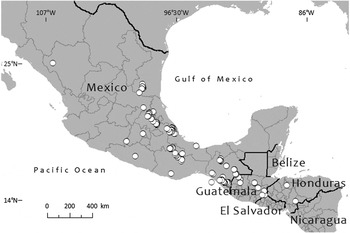
The species of Podocarpus L’Hér. ex Pers. (Podocarpaceae) occurring in the Caribbean Bioregion were treated in the previous paper of this series (Mill, Reference Mill2015). This paper treats those of the adjacent mainland, the countries of Central America and southernmost North America, that constitute the Central America and Northern Mexico Bioregions in the scheme of Dinerstein et al. (Reference Dinerstein, Olson, Graham, Webster, Primm, Bookbinder and Ledec1995).
The Central America Bioregion includes southern Mexico, the Central American countries of Belize, Costa Rica, Guatemala, Honduras and Nicaragua in their entirety, and all but easternmost Panama. It is thus almost but not exactly equivalent to the area covered by Flora Mesoamericana, the difference being that Flora Mesoamericana includes all of Panama (Flora Mesoamericana website, no date). The Central America Bioregion, however, excludes the Chocó-Darién moist forests and Eastern Panamanian montane forests ecoregions of easternmost Panama, placing them in the Northern Andes Bioregion (Dinerstein et al., Reference Dinerstein, Olson, Graham, Webster, Primm, Bookbinder and Ledec1995). This difference is important since it could affect the number of Podocarpus species in the area under study. Podocarpus magnifolius J.Buchholz & N.E.Gray may occur not only in easternmost Panama (in the Northern Andes Bioregion) but also just into the easternmost part of the Central America Bioregion proper. Podocarpus acuminatus de Laub. was recently thought to reach easternmost Panama (de Laubenfels, pers. comm. 16 Feb. 2006) but the specimens concerned have been re-determined and will be treated in another paper in this series. Podocarpus magnifolius presented a different problem. As its main range is mainland South America, and the few records from the Central America Bioregion are all doubtful, an abbreviated treatment is given here (at the end, as a ‘Species Doubtfully Recorded’) with the main account being given in the paper on the Northern and Central Andes Bioregions.
The Northern Mexico Bioregion is contiguous with and mainly to the north of the Central America Bioregion. It contains a very diverse range of biomes and habitats from deserts to warm-temperate/subtropical pine and pine/oak forests. It is in the latter habitat that the single species of Podocarpus occurring in this bioregion, P. matudae Lundell, is found; this occurs in the Sierra Madre Oriental where the southernmost parts of the Nearctic Sierra Madre Oriental pine-oak forests (ecoregion NA0303) are contiguous with the northern parts of the Neotropical Veracruz moist forests (ecoregion NT0176) – the most northerly occurrence of the genus in the New World and the only extant species of the entire family in the Nearctic.
Following the scheme outlined in Dinerstein et al. (Reference Dinerstein, Olson, Graham, Webster, Primm, Bookbinder and Ledec1995, Appendix D), the Central America Bioregion is divided into 41 ecoregions, representing eight different biomes, while the Northern Mexico Bioregion comprises 23 ecoregions in four biomes (11 of them being in deserts and xeric shrublands). In the Central America Bioregion only the Tropical and Subtropical Moist Broadleaf Forest biome (10 ecoregions), the Tropical and Subtropical Coniferous Forests biome (six ecoregions) and, to a much lesser extent, the Tropical Dry Broadleaf Forests biome (two out of seven ecoregions) are inhabited by species of Podocarpus. In the Northern Mexico Bioregion, Podocarpus is restricted to the Tropical and Subtropical Coniferous Forest biome where it occurs in one of six pine-oak forest ecoregions, namely the Sierra Madre Oriental pine-oak forests (NA0303).
Of the four Podocarpus species here accepted as occurring in Central America, two are globally threatened: Podocarpus costaricensis is Critically Endangered while P. matudae (both subspecies) is Vulnerable. The other two are regarded as being of Least Concern but Podocarpus guatemalensis has been classified as threatened in individual countries in its range.
Taxonomic History and Problems
In their revision of the American species of Podocarpus, Buchholz & Gray (Reference Buchholz and Gray1948b) treated four species from the Central America Bioregion: Podocarpus reichei J.Buchholz & N.E.Gray and P. matudae Lundell from Mexico, the latter species also with var. macrocarpus J.Buchholz & N.E.Gray from Chiapas (Mexico) and Guatemala; P. guatemalensis Standl. with three varieties recognised by them, namely var. guatemalensis (apparently very rare, with only the type specimen from Guatemala cited), var. pinetorum (Bartlett) J.Buchholz & N.E.Gray from Belize (as ‘British Honduras’), and var. allenii (Standl.) J.Buchholz & N.E.Gray from Panama and Costa Rica; and P. oleifolius D.Don, with var. oleifolius said to be widely distributed in Central America as well as South America (whence the type was collected, in Peru), and an endemic variety, var. costaricensis J.Buchholz & N.E.Gray (Costa Rica; one specimen from Panama also cited). Podocarpus oleifolius var. macrostachyus (Parl.) J.Buchholz & N.E.Gray (= P. macrostachyus Parl.) was by Buchholz & Gray (Reference Buchholz and Gray1948b) restricted to material from Venezuela and Colombia although many later authors have used those names for material collected within Central America.
De Laubenfels Reference de Laubenfels(1985) recognised only three Central American species of Podocarpus: (1) P. matudae, including P. reichei; (2) P. guatemalensis, including P. allenii Standl. and P. pinetorum Bartlett and without recognition of varieties; (3) P. oleifolius, including P. macrostachyus as the only synonym and with no infraspecific taxa recognised.
Since the revision of Buchholz & Gray (Reference Buchholz and Gray1948b) and the synoptic checklist of de Laubenfels (Reference de Laubenfels1985), two additional Podocarpus species have been described from the Central America Bioregion: P. costaricensis de Laub. (not to be confused with P. oleifolius var. costaricensis) and P. monteverdeensis de Laub., both described from Costa Rica by de Laubenfels (Reference de Laubenfels1991). An additional variety of Podocarpus matudae, var. jaliscanus de Laub. & Silba from Jalisco (Mexico), was also described (in Silba, Reference Silba1990), and later raised to subspecies (Silba, Reference Silba2010). The occurrence of Podocarpus in Jalisco had been recognised much earlier (McVaugh, Reference McVaugh1966, first record; Rzedowski & McVaugh, Reference Rzedowski and McVaugh1966). As mentioned above, the taxon known as Podocarpus macrostachyus or P. oleifolius var. macrostachyus has by many workers been considered part of the Central American Podocarpus flora (e.g. de Laubenfels, Reference de Laubenfels1991; Matamoros & Seal, Reference Matamoros and Seal1996; Bauch et al., Reference Bauch, Koch, Puls, Schwarz and Voiß2006a,Reference Bauch, Quiros, Noldt and Schmidtb) and P. magnifolius has been recorded from the Central American portion of Panama (see ‘Species Doubtfully Recorded’ below, and Silba, Reference Silba1990: 68). Potentially, therefore, seven or eight species and at least five infraspecific taxa of Podocarpus may occur within the Central America and Northern Mexico Bioregions. However, a study of the variation between the specimens suggests that the true number is lower (cf. Farjon, Reference Farjon2009, who recognised the four species Podocarpus costaricensis, P. guatemalensis, P. matudae, P. oleifolius but no infraspecific taxa).
The Podocarpus matudae group
Podocarpus matudae in the broad sense of Farjon (Reference Farjon2009) has the most northerly distribution of the four species that he recognised from the area covered by Flora Mesoamericana. Of the taxa that have been recognised within it, the type variety and Podocarpus matudae var. macrocarpus J.Buchholz & N.E.Gray were both described from mountains in the Soconusco region of Chiapas, Mexico: P. matudae var. matudae from Mt. Paxtal (appearing as ‘Pashtal’ and ‘Pasitar’ on Matuda’s labels) and P. matudae var. macrocarpus from Mt. Ovando. Buchholz & Gray (Reference Buchholz and Gray1948b) separated them by the much larger seeds of var. macrocarpus (to 18 × 14 mm, vs. 8–10 × 7–8 mm in var. matudae) that lacked any crest (crest scarcely evident in var. matudae), the allegedly smaller receptacles of var. macrocarpus, and the longer peduncles of the latter (12–17 mm, vs. 4–6 mm in var. matudae). The supposed receptacle difference requires clarification. Their diagnosis of Podocarpus matudae var. macrocarpus (Buchholz & Gray, Reference Buchholz and Gray1948b: 132) includes the phrases “receptaculo minore, 12–17 mm pedunculato”, implying that the receptacles are smaller than those of P. matudae var. matudae (stated to be 4–6 mm, the same length as its seed) and have peduncles 12–17 mm. However, measurements made by me on the type of Podocarpus matudae var. macrocarpus indicate that the maximum receptacle length, in dried material, is 8–12 mm even when not fully swollen; it is thus larger than in P. matudae var. matudae (not smaller, as claimed in the protologue) and more similar in length to those of P. reichei.
As more and more female material of Podocarpus matudae has been collected, it has become evident that the commonest state of the peduncle of the female cone in the species as a whole is long; the short peduncles found in Podocarpus matudae var. matudae as recognised by Buchholz & Gray (Reference Buchholz and Gray1948b) have only been found in plants from Mt. Paxtal and Mt. Ovando. The much more frequent long-peduncled state has also been collected from Mt. Ovando. Buchholz & Gray also mentioned that Podocarpus matudae var. macrocarpus, as well as P. reichei, had larger seed cones than var. matudae (> 12 mm, instead of < 10 mm). However, with more material available, seed size variation appears more continuous than perceived by them.
Buchholz & Gray (Reference Buchholz and Gray1948b) also noted a phenological difference, in that the pollen cones of var. macrocarpus apparently matured earlier than those of var. matudae. However, this was based on very limited material and very little additional male material has been collected since then from the locus classicus of the variety. On the basis of the specimens they cited, they restricted Podocarpus matudae var. matudae to three collections from localities in the Soconusco region of Chiapas (Mt. Paxtal, Mt. Ovando and what is now Triunfo Biosphere Reserve), whereas P. matudae var. macrocarpus was mainly based on collections from Guatemala but with three collections, including the type, made from Mt. Ovando (Chiapas, Mexico) where the type variety also grows. Farjon (Reference Farjon1998, Reference Farjon2001, Reference Farjon2010) did not recognise Podocarpus matudae var. macrocarpus and that view is accepted here also. These two infraspecific taxa are therefore considered synonyms.
According to Buchholz & Gray (Reference Buchholz and Gray1948b), Podocarpus reichei was distinguishable from P. matudae by the leaves entirely lacking both vascular sclereids and auxiliary sclereids. The seed size and peduncle length ranges quoted were identical to those found in Podocarpus matudae var. macrocarpus. Podocarpus reichei, however, was said to have large receptacles > 12 mm long, compared with 4–6 mm in P. matudae var. matudae, and had a non-overlapping geographical distribution, being found in the Mexican states of Puebla, Veracruz and San Louis Potosí, with one specimen in Buchholz & Gray’s circumscription also cited from Costa Rica, very disjunct from the rest of the range of the species as understood by them. They quoted Reiche (Reference Reiche1927) as saying that pollination took place in spring, similar to Podocarpus matudae var. matudae (whereas according to them P. matudae var. macrocarpus probably shed its pollen in autumn). In other characters Podocarpus reichei seems very similar to P. matudae var. macrocarpus. Nevertheless, some authorities, e.g. Vovides et al. (Reference Vovides, Luna and Medina1997), have kept Podocarpus reichei and P. matudae as separate species although de Laubenfels (Reference de Laubenfels1985: 261) reduced P. reichei to a synonym of P. matudae.
Silba (Reference Silba1990: 68–69) revised Podocarpus matudae, reinstating P. reichei as one variety of it and recognising two others: P. matudae var. matudae [Chiapas (Mexico), Guatemala, El Salvador] and P. matudae var. jaliscanus de Laub. & Silba [Jalisco (Mexico)]. Podocarpus matudae var. jaliscanus was separated on the basis of its leaves being longer and narrower than in var. matudae and falcate; its rather fat, broad male cones (described as 37 × 5 mm) borne on peduncles 1.8 mm long and with longer microsporophyll laminas (‘sterile apices’); and a rather long female cone peduncle to 18 mm long, as in var. macrocarpus. However, Silba (Reference Silba1990) made no mention of Podocarpus matudae var. macrocarpus itself, either as a recognised variety or as a synonym of one of the other three. Podocarpus matudae var. jaliscanus has been examined for this paper and has been found to be a very distinct entity.
Alone among the Central American Podocarpus species, P. matudae has been the subject of a detailed phylogeographic study (Ornelas et al., Reference Ornelas, Ruiz-Sánchez and Sosa2010). These authors found that Podocarpus matudae (which they treated broadly, including P. reichei and, by inference, all infraspecific taxa), had a clear population structure. Eleven different haplotypes were detected, with two of them widespread but some confined to particular local populations. Perhaps unexpectedly, the outlying Jalisco population that Silba had recognised morphologically as Podocarpus matudae var./subsp. jaliscanus had haplotype F, the second most common haplotype and which corresponded to populations of P. matudae from Oaxaca, and to a lesser extent the Sierra Madre Oriental inhabited by plants previously regarded as P. reichei. Morphological differences from the rest of Podocarpus matudae in many features of both male and female cones, especially significant differences in microsporophyll characters not previously noted, suggest that Podocarpus matudae var. jaliscanus could with some justification be raised to the rank of species. However, on account of it sharing haplotype F in common with other populations of Podocarpus matudae lacking the morphological characters of the Jalisco plants, I refrain from doing that and instead accept the subspecies rank awarded to it by Silba (Reference Silba2010).
In this paper, therefore, only two subspecies of Podocarpus matudae are considered worthy of recognition. Both varieties of Podocarpus matudae, as well as P. reichei (other than certain plants of the latter from the far west of Mexico, but including all from the core area of P. reichei in NE Mexico), are regarded as P. matudae subsp. matudae; the Jalisco taxon is recognised as P. matudae subsp. jaliscanus.
The Podocarpus guatemalensis group
Podocarpus guatemalensis was described by Standley (Reference Standley1924) who, in his protologue, commented that, of all the plants collected by him on the north coast of Guatemala in 1922, this was “doubtless the most interesting, important and perplexing”. This was based on his belief that Podocarpus species inhabited high mountains and one was not expected to be found in a coastal thicket at the type locality of Puerto Barrios. The type was taken from a juvenile plant c.2 m tall; no adults could be found. Standley compared it with Podocarpus coriaceus Rich. (Lesser Antilles and Puerto Rico) and P. oleifolius, but noted some differences. Nevertheless he commented that when better material was located it might turn out to be one of those species, and that “it is not a good policy to describe new species from such incomplete material, but … it is desirable to give it a name for purposes of reference”. It has since turned out to be a distinct species, but one that has hardly been collected since in Guatemala.
Next, Bartlett (Reference Bartlett1935: 21, in footnote) described Podocarpus pinetorum Bartl. from “Mountain Pine Ridge of British Honduras” [Belize], differentiating it from P. oleifolius (whose epithet Bartlett mis-spelled ‘oleifera’) by the leaves not sulcate above and from P. guatemalensis by its arboreal stature (25 cm diam.) and leaves half as long and straight, not falcate. He “somewhat reluctantly” separated it from Podocarpus guatemalensis, saying that “there is a possibility that Standley’s specimen [of P. guatemalensis] represents a juvenile state of the same species [P. pinetorum]”.
Finally, Standley (in Woodson & Schery, Reference Woodson and Schery1941: 409–411) described Podocarpus allenii Standl., based on three Panamanian collections by Paul Allen: Allen 2437 (type) and 2424 from Cerro Campana (the latter a seedling) and Allen 2298 from the La Mesa area of Coclé. Echoing Bartlett’s reluctance in describing Podocarpus pinetorum, Standley commented that “It is with considerable diffidence that the writer proposes this new species of Podocarpus”. As Bartlett (Reference Bartlett1935) had done earlier when describing Podocarpus pinetorum, Standley (op. cit., 1941) separated P. allenii from P. oleifolius by the elevated, rather than impressed, costa on the upper leaf surface, and said that, so far as could be judged from leaf characters, P. allenii was more closely related to P. guatemalensis and, like the latter, descended to near sea level. Interestingly, Standley (op. cit., 1941) gave the distribution of Podocarpus guatemalensis as “Guatemala and British Honduras”, suggesting that he was including Bartlett’s P. pinetorum in his concept of P. guatemalensis.
Buchholz & Gray (Reference Buchholz and Gray1948b) reduced Podocarpus allenii and P. pinetorum to varieties of P. guatemalensis, which has nomenclatural priority. They noted that the leaves of Podocarpus guatemalensis var. guatemalensis did not possess vascular sclereids whereas those of P. guatemalensis var. pinetorum had them above the bundle and P. guatemalensis var. allenii had them both above and below the bundle. These differences might have been due, at least in part, to the fact that Podocarpus guatemalensis var. guatemalensis was based on juvenile material whereas the other two varieties were based on specimens collected from adult trees. They thought that Podocarpus guatemalensis var. guatemalensis might represent the juvenile state of what they called P. guatemalensis var. pinetorum, the upland variety from nearby Belize.
De Laubenfels Reference de Laubenfels(1985) included Podocarpus allenii and P. pinetorum in the synonymy of P. guatemalensis, but recognised no infraspecific taxa. Silba (Reference Silba2010: 11), however, elevated the two non-type varieties to subspecies of Podocarpus guatemalensis as part of a general raising in rank of all varieties within Podocarpus. Podocarpus pinetorum was sunk into P. guatemalensis by Torres-Romero (Reference Torres-Romero, Pinto and Lozano1988), Farjon (Reference Farjon1998) and Balick et al. (Reference Balick, Nee and Atha2000) while P. guatemalensis vars. allenii and pinetorum have both recently been subsumed into the species as a whole, but without supporting argument for the decision (Farjon, Reference Farjon2009, Reference Farjon2010). Most recent authors, e.g. those mentioned in the preceding sentence as well as Merello (Reference Merello, Hammel, Grayum, Herrera and Zamora2003) and Eckenwalder (Reference Eckenwalder2009), have treated Podocarpus guatemalensis broadly, without recognising any varieties; that is also the view taken here.
Podocarpus costaricensis
The publication history of Podocarpus costaricensis is convoluted. Silba (Reference Silba1990: 67) gave its place of publication as “Costa Rican Nat. Hist. Mus. Publ. 139. 1989” but I have been unable to trace this; according to one reviewer of this paper, it probably does not exist. On the same page, Silba in February 1990 provided a description of the species in English and cited the type as “Jiménez, de Laubenfels & Chacón 597 (holotype CR)”. However, there was no Latin diagnosis; therefore, that ‘publication’ of the name Podocarpus costaricensis, with that ‘holotype’, was not valid (ICN Art. 39.1: McNeill et al., Reference McNeill, Barrie, Buck, Demoulin, Greuter, Hawksworth, Herendeen, Knapp, Marhold, Prado, Prud’homme van Reine, Smith, Wiersema and Turland2012). De Laubenfels (Reference de Laubenfels1991: 120), in a revision of Costa Rican Podocarpaceae also dated 1990 but not published until January 1991, provided a Latin diagnosis, thus validating the name, but cited a different holotype, namely de Laubenfels 810 (holo MO), saying that this was equivalent to Jiménez et al. 597 at CR. This place of publication and indication of holotype are the ones accepted by IPNI and some recent authors (e.g. Stark Schilling, Reference Stark Schilling2004; Silba, Reference Silba2010), although Farjon (Reference Farjon2009, Reference Farjon2010) continued to regard Silba (Reference Silba1990) as the place of publication. Podocarpus costaricensis was said to be distinct from all other Costa Rican species of Podocarpus in having lanceolate foliage buds with elongated, ± erect, sometimes foliaceous scales. Since its description, it has gained acceptance as a good species (Stark Schilling, Reference Stark Schilling2004; Eckenwalder, Reference Eckenwalder2009; Farjon, Reference Farjon2009, Reference Farjon2010) and it is so accepted here also. However, it remains poorly known.
The Podocarpus oleifolius group
The remaining taxa requiring consideration are Podocarpus oleifolius, P. macrostachyus and P. monteverdeensis. Podocarpus oleifolius and P. macrostachyus were both described relatively early in the taxonomic history of the genus, P. oleifolius by Don in Lambert’s Genus Pinus (Reference Lambert1824) and P. macrostachyus by Parlatore (Reference Parlatore and De Candolle1868) in his treatment of Podocarpus for De Candolle’s Prodromus. The typification of Podocarpus oleifolius will be discussed in the paper of this series dealing with the Northern and Central Andes species as the type taxon is absent from Central America; the conclusions will not affect usage of the name P. oleifolius.
Podocarpus macrostachyus Parl. was based on syntypes from Venezuela and Colombia. The name has often been applied to material from Central America (e.g. de Laubenfels, Reference de Laubenfels1991; Matamoros & Seal, Reference Matamoros and Seal1996; Heiner et al., Reference Heiner, Armando, Quírico and Fabiana2001; Bauch et al., Reference Bauch, Koch, Puls, Schwarz and Voiß2006a,Reference Bauch, Quiros, Noldt and Schmidtb) and west-tropical South America (e.g. Torres-Romero, Reference Torres-Romero, Pinto and Lozano1988; Vicuña-Miñano & Léon, Reference Vicuña-Miñano and León2003; Vicuña-Miñano, Reference Vicuña-Miñano2005). Since the time of Parlatore’s revision for De Candolle’s Prodromus in 1868, there has been much confusion regarding what to call the Central American species of the Podocarpus oleifolius complex, even by the same author. Buchholz & Gray (Reference Buchholz and Gray1948b) reduced Podocarpus macrostachyus to varietal rank under P. oleifolius. De Laubenfels Reference de Laubenfels(1985) initially regarded it as a synonym of Podocarpus oleifolius. However, in his treatment of Costa Rican Podocarpus (de Laubenfels, Reference de Laubenfels1991), he changed his mind and called the Costa Rican plant Podocarpus macrostachyus, stating that P. oleifolius occurred “far away in Peru”, thus implying that he did not accept P. oleifolius sensu stricto as a Central American species. In the same paper (de Laubenfels, Reference de Laubenfels1991), he also described Podocarpus monteverdeensis within this species complex; its status is discussed below. Silba (Reference Silba2010) followed de Laubenfels’s later view, retaining Podocarpus macrostachyus as a separate species, but most recently, publishing under the name J.A. de Silva, he has listed it as a variety within P. oleifolius (Silba & de Silva, Reference Silba and de Silva2014).
As well as the species that have been recognised within the Podocarpus oleifolius complex (which besides those mentioned here include others restricted to South America, to be discussed elsewhere in this series), several infraspecific taxa have been described under P. oleifolius. Buchholz & Gray (Reference Buchholz and Gray1948b) recognised three in addition to the type variety: Podocarpus oleifolius var. costaricensis J.Buchholz & N.E.Gray, P. oleifolius var. macrostachyus (Parl.) J.Buchholz & N.E.Gray, and P. oleifolius var. trujillensis J.Buchholz & N.E.Gray. All these were distinguished from the type variety by their pedunculate, not sessile, pollen cones. All male material of the Podocarpus oleifolius group that I have examined from Central America has pedunculate pollen cones (although, especially in Honduras, the peduncles can be very short); therefore, in that respect, it is not identical to the type of the species and cannot be assigned to the type variety.
Buchholz & Gray (Reference Buchholz and Gray1948b) separated the varieties of Podocarpus oleifolius having pedunculate pollen cones by characters of leaf shape, female cone peduncle length and seed crest prominence. The four varieties they recognised fell into two pairs: Podocarpus oleifolius var. oleifolius and P. oleifolius var. costaricensis had a scarcely evident or completely suppressed seed crest, short female cone peduncles and relatively narrow leaves, whereas P. oleifolius var. macrostachyus and P. oleifolius var. trujillensis had a prominent seed crest and broader leaves. Buchholz & Gray (Reference Buchholz and Gray1948b) regarded the majority of Central American specimens that they examined as belonging to Podocarpus oleifolius var. oleifolius, of which they cited specimens from Mexico, Guatemala, El Salvador and Costa Rica, as well as Colombia, Ecuador and Peru. They placed a minority of specimens from Costa Rica, as well as one from Panama, in Podocarpus oleifolius var. costaricensis, while they considered that P. oleifolius var. macrostachyus was restricted to Venezuela and Colombia, and P. oleifolius var. trujillensis to Venezuela. The last-named variety will be discussed in a future paper of this series.
Examination of Central American female material of Podocarpus oleifolius has shown that most of it has a more-or-less prominent, but short and very blunt, seed crest, but some does not, suggesting that, on the basis of this character, most of it is not P. oleifolius var. oleifolius. However, recent treatments have varied. De Laubenfels Reference de Laubenfels(1991) regarded all of it except Podocarpus monteverdeensis (described in that paper) as belonging to P. macrostachyus, despite some specimens having no crest. Merello (Reference Merello, Hammel, Grayum, Herrera and Zamora2003), however, considered all of it as belonging to Podocarpus oleifolius, within which she synonymised P. monteverdeensis and P. macrostachyus, thereby expanding P. oleifolius to include both non-crested specimens and crested ones. Farjon (Reference Farjon2010) lumped everything in synonymy under a highly variable Podocarpus oleifolius. Interestingly, crest prominence in Central American Podocarpus oleifolius sensu lato seems to follow a distinct geographical pattern: specimens from the western end of the Central American range (Mexico, Guatemala, Honduras, Nicaragua) have prominent crests, while those from further east (Costa Rica and especially Panama) have less prominent crests or almost none. This suggests two things: eastern plants may be influenced by Podocarpus oleifolius sensu stricto (mainland South America: no crest), but the origin of the crest in western specimens is probably independent from its origin in P. macrostachyus, because of its different morphology (wide and extremely blunt, as opposed to tall, narrow and sharply pointed in P. macrostachyus sensu stricto from South America) and the wide disjunction between the crested plants in Mexico to Nicaragua and those in west-tropical South America that match the type material of P. macrostachyus.
Torres-Romero (Reference Torres-Romero, Pinto and Lozano1988), like de Laubenfels (Reference de Laubenfels1991), kept Podocarpus macrostachyus separate from P. oleifolius, citing (and illustrating) additional, previously unnoticed differences in pollen cone characters. These included the shape of the microsporophyll apex (acute in Podocarpus oleifolius, rounded in P. macrostachyus) and whether it was entire (P. oleifolius) or denticulate (P. macrostachyus). These characters are easy to use when male material is available but, unfortunately, that is not often the case. Examination of the relatively few Central American specimens bearing pollen cones of any age has revealed that all of it has microsporophylls with acute, entire apices. This includes the male specimens of Podocarpus oleifolius var. costaricensis although unfortunately none of those seen are from Panama. Therefore, of the Central American material, none of the male specimens at least would fall into Podocarpus macrostachyus using pollen cone characters (the situation in Panama requires confirmation). The seed cones of ‘Podocarpus macrostachyus’ from Central America also differ from South American material: the ‘seeds’ (technically, the visible parts are the integument, sarcotesta and epimatium, not the seed proper) are generally dark and glossy in South American Podocarpus (oleifolius var.) macrostachyus whereas those from Central America are dull and lighter in colour; the crest, when present, tends to have a broad, truncate apex, not narrow and sharply pointed as in South American specimens. These differences also indicate that Central American plants with crested seeds cannot be classified in Podocarpus (oleifolius var.) macrostachyus. Silba & de Silva (Reference Silba and de Silva2014) have also pointed out that there is seemingly a difference in the colour of the receptacles between Podocarpus oleifolius subsp. costaricensis (red) and those of specimens from mainland South America (violet). However, as yet insufficient is known about variation in receptacle colour in South American Podocarpus oleifolius to determine whether the character is useful in the taxonomy of the species complex.
Podocarpus oleifolius var. costaricensis was described by Buchholz & Gray (Reference Buchholz and Gray1948b: 140) on the basis of material collected at Volcán Poás (Dept. Alajuela, Costa Rica). It is not to be confused with Podocarpus costaricensis de Laub., described from Tarrazú, Dept. San José (de Laubenfels, Reference de Laubenfels1991). The latter species is quite different from Podocarpus oleifolius, especially in its bud scale morphology which is similar to that of P. matudae. Podocarpus oleifolius var. costaricensis is indistinguishable from most other Central American specimens that Buchholz & Gray (Reference Buchholz and Gray1948b) assigned to the type variety. In fact, both the latter, sensu Buchholz & Gray, and Podocarpus oleifolius var. costaricensis occur at Volcán Poás (the type locality of the latter variety), according to their determinations of Greenman & Greenman 5375, Smith 6856, Standley 34640 as the type variety (Buchholz & Gray, Reference Buchholz and Gray1948b and determinavit slips on specimens). However, all Central American specimens of ‘Podocarpus oleifolius var. oleifolius’ that bear pollen cones differ from Peruvian material in these being pedunculate, as previously noted.
In their revision, Buchholz & Gray (Reference Buchholz and Gray1948b) restricted Podocarpus oleifolius var. costaricensis to seven specimens from Costa Rica, all from Volcán Poás, and one from Panama (otherwise unlocalised) collected by Sutton Hayes. Later, they appear to have broadened their concept of that variety, for in the Paris herbarium (P) there are two specimens from Colombia (Dept. Valle: Los Farallones), collected by Cuatrecasas in 1944 and 1946, that would greatly extend the range of the variety eastward into mainland South America. One of them (female, Cuatrecasas 17985 collected in 1944) bears their determinavit slip (dated 1946, two years before publication of their revision) while the other (male, with pedunculate cones) does not, although a curatorial annotation implies that they determined it. Both these specimens more resemble Podocarpus oleifolius var. macrostachyus in characters of buds and leaf shape than they do most material of var. costaricensis and therefore they are here excluded from var. costaricensis which, like Buchholz & Gray (Reference Buchholz and Gray1948b), I restrict to Central America. Silba (Reference Silba2010) raised Podocarpus oleifolius var. costaricensis (and all the other varieties, except var. macrostachyus which in that paper he regarded as a full species) to the rank of subspecies. Because there is an apparent disjunction in Panama between the distribution of Podocarpus oleifolius var. costaricensis and the rest of the distribution of the species, the taxon is here treated at subspecific rank.
Podocarpus monteverdeensis was based on male material only, that was collected in a swamp forest on the Cordillera Tilarán, Monteverde, Costa Rica. This was distinguished from Costa Rican material of ‘Podocarpus macrostachyus’ (sensu de Laubenfels, Reference de Laubenfels1991: i.e. Podocarpus oleifolius subsp. costaricensis of the present paper) by its narrower leaves (6–7 mm wide, not 8–10 mm) with less abrupt apex (de Laubenfels, Reference de Laubenfels1991). From ‘Podocarpus oleifolius’ (which de Laubenfels, Reference de Laubenfels1991 said had similarly narrow leaves) it was separated by the less abrupt leaves that in juvenile specimens are elongated into a long-attenuate apex. Silba (Reference Silba2000: 32) added an additional locality for Podocarpus monteverdeensis: Costa Rica: Limón, El Progreso, Valle de la Estrella, 1500–1700 m, Herrera & Chacón 2762 (CR, not seen for this study). In contrast to Podocarpus costaricensis, P. monteverdeensis has not been accepted by workers such as Merello (Reference Merello, Hammel, Grayum, Herrera and Zamora2003) and Farjon (Reference Farjon2009, Reference Farjon2010), both of whom have subsumed it into P. oleifolius. Surprisingly, although it grows in a very well studied and collected biosphere reserve, Podocarpus monteverdeensis is still known only from male and sterile material; no female specimens have been seen. The male cones, which in the specimens seen are immature, are identical in morphology to young male cones of a similar age on other Central American material of Podocarpus oleifolius. When mature, the pollen cones are much more elongate. This is also the case in South American specimens of Podocarpus oleifolius but, in the so far limited amount of male material of this species seen from South America, the mature cones are noticeably narrower than in Central America. It remains to be seen whether this apparent difference will hold true when more material is obtained in connection with the revision of the South American representatives of the Podocarpus oleifolius complex. Taking everything into account, I, like other recent workers, regard Podocarpus monteverdeensis as being a particularly narrow-leaved form of the most widespread form of the P. oleifolius group in Central America, here treated as P. oleifolius subsp. costaricensis. Similar narrow-leaved forms of this subspecies occur elsewhere in Costa Rica (Aguilar 3969, Gamboa 746 etc.) as well as Honduras (Williams & Molina 5297) and Panama (Werff & Herrera 6315), making taxonomic separation of Podocarpus monteverdeensis even more untenable. Several of the specimens were collected in high-elevation swamps, suggesting that Podocarpus monteverdeensis is instead a distinctive ecotype.
Infrageneric classification
As mentioned in the previous paper (Mill, Reference Mill2015), Buchholz & Gray (Reference Buchholz and Gray1948a, Reference Buchholz and Gray1948b) divided their concept of Podocarpus sect. Podocarpus into four informal subsections lettered A–D and included all the Central American species in subsection C. Gaussen (Reference Gaussen1976) took a similar view, including them all in ‘Sous-section 4. Ameriques sauf Chili’.
In the more recent classification of de Laubenfels (Reference de Laubenfels1985), all Central American species of Podocarpus belong to P. subgen. Podocarpus, one of two subgenera defined by that author. As mentioned by Mill (Reference Mill2015), these subgenera have strong molecular support and are being recognised in this revision. However, in the same work, de Laubenfels (Reference de Laubenfels1985) subdivided each subgenus into nine sections. Sections containing Central American species are Podocarpus sect. 6. Pratensis de Laub. (P. oleifolius; de Laubenfels, Reference de Laubenfels1991 also placed P. monteverdeensis in this section, confirming its relationship with the former species), P. sect. 7. Lanceolatus de Laub. (as ‘Lanceolatis’: P. matudae and P. costaricensis) and P. sect. 9. Nemoralis de Laub. (P. guatemalensis and P. magnifolius). Unlike the subgenera, the sections mostly are poorly supported by molecular evidence, with species from the same section appearing in different parts of phylogenetic trees in most recent comprehensive studies (e.g. Biffin et al., Reference Biffin, Conran, Lowe, Turner and Cernusak2011, Reference Biffin, Brodribb, Hill, Thomas and Lowe2012; Knopf et al., Reference Knopf, Schulz, Little, Stützel and Stevenson2012). Therefore, although one or two sections may be natural groupings at least in part, none are being recognised in this series pending further work on relationships within the genus. As with most of the Caribbean species treated by Mill (Reference Mill2015), all Central American species studied by Knopf et al. (Reference Knopf, Schulz, Little, Stützel and Stevenson2012) fell into their tropical American subclade ‘U’.
Materials and Methods
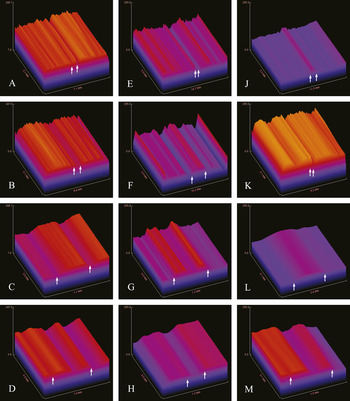
Methods used in this revision were explained in detail in paper II of this series (Mill, Reference Mill2015). The revision utilised herbarium specimens, digital images thereof, and trustworthy literature and/or database records. All herbarium specimens examined were also photographed using a Panasonic Lumix TZ6 digital camera. Most measurements were made off the photographs using ImageJ software (versions 1.45m to 1.48p: Rasband, [1997–]2011–Reference Rasband2014). Measurements were all made on dried material; when fresh, some organs (especially receptacles and seeds) may be larger. ImageJ was also used to generate surface plots of regions of interest on the specimens such as leaf surfaces, midribs, receptacle texture etc. and to produce some of the images accompanying this paper. Settings for surface plot generation were the same as used by Mill (Reference Mill2015). The Fire LUT (look-up table) was used for the colour (online) versions of the resulting images. The midrib region is shown by two white arrows. Lighter shading or hotter colours denote higher elevations (peaks or ridges); darker shading or cooler colours indicate lower elevations (valleys, such as grooves). The three axes on each plot are: x, width of the ‘TS’ of the leaf surface at the plot region; y, thickness of the ‘TS’ (as near zero as possible); z, colour/shading intensity.
Species are treated in alphabetical order, pending a satisfactory classification within Podocarpus subgenus Podocarpus. Herbarium abbreviations follow Index Herbariorum (Thiers, continuously updated). In specimen citations, specimens seen as images are indicated as ‘image’ if the original image is stored on an external website (e.g. P–image), and as ‘photo’ if it was a photograph (taken using either a film or digital camera) made available in some other way, e.g. mounted on a herbarium sheet (e.g. photo F) or supplied by a colleague (e.g. COL–photo).
Distributions are summarised using the Level 3 and 4 names and codes of the International Working Group on Taxonomic Databases for Plant Sciences (TDWG) as compiled for the second edition of its World Geographical Scheme for Recording Plant Distributions (Brummitt, Reference Brummitt2001). In the TDWG scheme, the area covered by this paper is divided between Regions 79 Mexico and 80 Central America. Podocarpus has been recorded native in the following Level 3 units of these Regions: 79 Mexico Central MXC, Mexico Northeast MXE, Mexico Gulf MXG, Mexico Southwest MXS, Mexico Southeast MXT; 80 Belize BLZ, Costa Rica COS, El Salvador ELS, Guatemala GUA, Honduras HON, Nicaragua NIC, Panama PAN. The genus has not been recorded as native from the remaining Level 3 units of these regions, i.e. 79 Mexican Pacific Islands MXI, Mexico Northwest MXN and 80 Central American Pacific Islands CPI. When a Level 3 unit is not further subdivided, it is simply given the three-letter Level 3 code, e.g. GUA, not GUA-OO, but if subdivisions exist then the full 5-letter Level 4 code is given, e.g. MXC-PU for Puebla. When the total distribution of a species extends beyond that covered by this paper, the countries or codes not covered are included within square brackets, while doubtful records are indicated by prefixing the code with a question mark (?), e.g. TDWG: 79 MXC-PU 80 COS ELS [CLM ?VEN].
In the lists of material studied, countries are in SmallCapitals and are listed in the following order: Mexico, Guatemala, Belize, El Salvador, Honduras, Nicaragua, Costa Rica, Panama. Except when required by the context (e.g. in book, paper or journal titles), ‘Mexico’ and ‘Panama’ as names for the entire countries are used rather than ‘México’ and ‘Panamá’, in conformity with TDWG and common English usage, but accents are included wherever necessary for all other place names, including ‘Panamá’ as a first- and second-order division name within the country of Panama. First-order subdivisions of countries (states in Mexico; provinces in Costa Rica; provinces and autonomous regions (comarcas) in Panama; departments in Guatemala, Honduras, El Salvador; departments and autonomous regions in Nicaragua; districts in Belize) are listed alphabetically in Bold, and second-order country subdivisions (municipalities in Mexico, Guatemala, Honduras, El Salvador, Nicaragua; cantons in Costa Rica; districts in Panama) in Bold Italic alphabetically within each first-order unit. Belize has no second-order units, nor has the autonomous region of Guna Yala in Panama. Where necessary, localities were checked using the GeoNames website (www.geonames.org). For old Costa Rican collecting localities, the gazetteer prepared for Missouri Botanical Garden by Mike Grayum (Grayum, Reference Grayum1995–2013) was particularly useful. Where geospatial co-ordinates were not included on the specimen, they were obtained using GeoNames, Grayum (Reference Grayum1995–2013), the gazetteers of Central American countries made available by the Directorio Cartográfico de España (1998–2014) and other sources. A spreadsheet was compiled in Microsoft Excel 2010 and the georeference data were imported into ArcGis version 9.3 (ESRI, 2008) to create distribution maps for each species and infraspecific taxon. For each taxon, a reference to the map is given at the end of the distribution paragraph. Nomenclature of tectonic plates follows Bird (Reference Bird2003).
In this and subsequent papers, collectors will only be cited by surname in the text, e.g. Aguilar 5, unless (1) their initials are necessary to avoid ambiguity (e.g. A. Molina R. and A.R. Molina, who collected both separately and together) or (2) the specimen concerned is not listed in Appendix II. Appendix II gives a full alphabetical list of exsiccatae seen in which the collectors’ initials are given where known, e.g. Aguilar, R. 5; it excludes certain specimens that have not been seen or verified.
Specimen records were assigned to ecoregions using the Wildfinder map of ecoregions (http://worldwildlife.org/science/wildfinder/). Phytogeography is indicated according to the schemes of Takhtajan (Reference Takhtajan, Crovello and Cronquist1986) and Morrone (Reference Morrone2001a,Reference Morroneb, Reference Morrone2006) with the nomenclature in the latter case following Morrone (Reference Morrone2006). These are indicated in the distribution paragraph as Takhtajan and Morrone respectively.
Proposed conservation assessments have been made where necessary, using the categories and criteria of the International Union for the Conservation of Nature (IUCN) version 3.1, second edition (IUCN, 2012) together with version 10.1 of the guidelines for applying them (IUCN Standards and Petitions Subcommittee, 2013). The abbreviations EOO and AOO mean Extent of Occurrence and Area of Occupancy respectively and are used in accordance with the above publications.
Taxonomy
Podocarpus L’Hér. ex Pers. subgen. Podocarpus. – Type: Podocarpus elongatus (Sol.) L’Hér. ex Pers., Syn. Pl. 2(2): 580 (Sept. 1807), nom. & typ. cons. – For description see Mill (Reference Mill2015). Four (possibly five) species native to the Central America and Northern Mexico Bioregions.
Key to species
1a. Leaves without a groove above 2
1b. Leaves with a groove above 3
2a. Leaves with a conspicuous ridge above in the whole lamina; terminal buds spherical; bud scales less than 4 mm long [peduncles less than 5 mm long; receptacle with two bracts]; Mexico to Panama 2. P. guatemalensis
2b. Leaves without a ridge above, or ridge present only at proximal end of lamina; terminal buds conical; bud scales more than 5 mm long [peduncles more than 10 mm long; receptacle with three bracts]; Mexico to El Salvador 3. P. matudae
3a. Terminal buds conical; bud scales more than 6 mm long [Costa Rica only] 1. P. costaricensis
3b. Terminal buds globose or open-globose; bud scales not exceeding 5 mm long [Mexico to Panama] 4
4a. Juvenile leaves up to 16 mm wide (length : width ratio 7–14 : 1), adult ones 6–14 mm wide (length : width ratio typically 5.5–6.5 : 1 in shade leaves, (2–)3.5–4.5(–6) : 1 in sun leaves); outer bud scales curved inwards, not longer than bud diameter, enclosing the inner ones, all the scales subequal 4. P. oleifolius subsp. costaricensis
4b. Juvenile leaves up to 30 mm wide (length : width ratio c.6 : 1), adult ones 30–80 × 12–25 mm (length : width ratio 2.5–3 : 1); outer bud scales erect, longer than bud diameter, not enclosing the shorter inner ones [in area covered by this paper, doubtfully recorded from Panama] P. magnifolius
Species descriptions
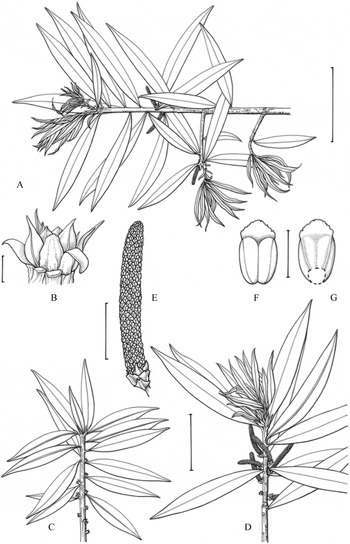
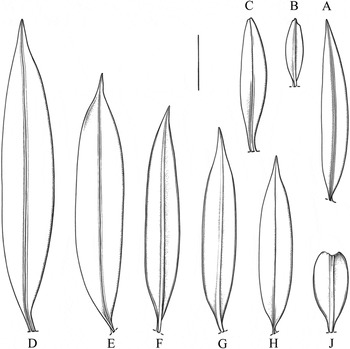
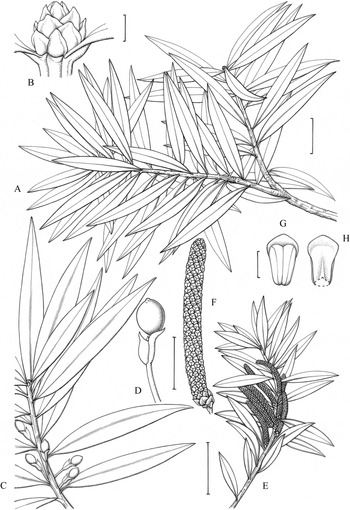
1. Podocarpus costaricensis de Laub., [?Costa Rican Nat. Hist. Mus. Publ. 139 (?1989 not seen, ?non rite publ.)]; [de Laub. ex Silba in Phytologia 68: 67 (2 Feb. 1990, non rite publ., without Latin description, see comments)]; in Brenesia 33: 120 (Jan. 1991 [‘1990’]); non Podocarpus oleifolius var. costaricensis J.Buchholz & N.E.Gray (1948). – Type: Costa Rica, San José, “3 km W of San Marcos de Tarrazú” [label gives different information: 2 km oeste del Cementario de San Pablo de Leon Cortes, 9°40′50″N 84°03′10″W], 1650 m, [20 viii 1988], D.J. de Laubenfels 810 (holo MO, iso US with barcode US00386085 and dated 20 vii 1988, CR–n.v., ?L). The isotype allegedly at L is not listed on its online catalogue of type specimens. Figs 1,2,3A–D.
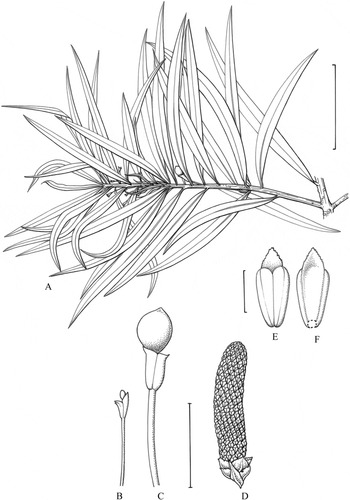
Podocarpus costaricensis. A, Habit, de Laubenfels 810 (holotype). B, Terminal bud, Herrera 7736. C, Branch with male buds, Herrera 7738. D, Branch with male cones, Jiménez 597. E, Male cone, Jiménez 597. F, Microsporophyll and microsporangia (rehydrated), abaxial view, Jiménez 597. G, Microsporophyll and microsporangia (rehydrated), adaxial view, Jiménez 597. Scale bars: A, 8 cm; B, 2 mm; C & D, 2 cm; E, 1 cm; F & G, 1 mm. Drawn by Claire Banks.

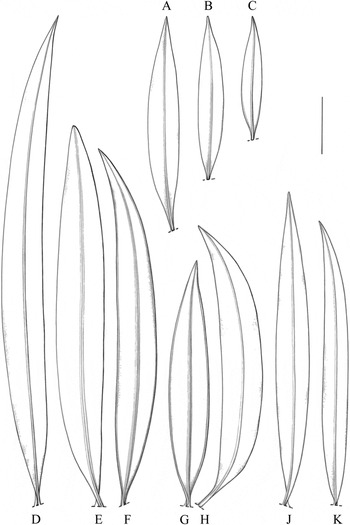
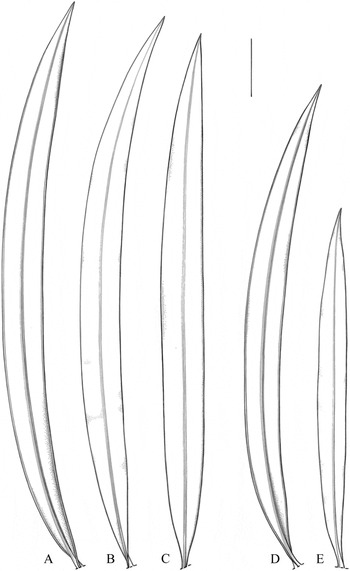
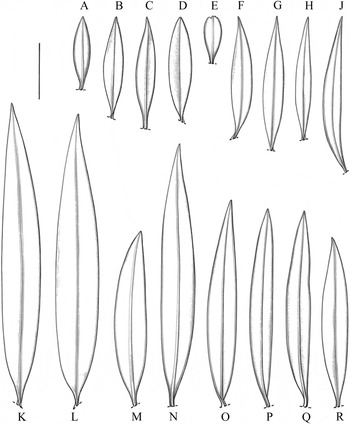
Podocarpus costaricensis: comparative leaf drawings. A, Lepiz 293, adaxial surface. B, Lepiz 293, abaxial. C, de Laubenfels 810, adaxial. D, Jiménez et al. 593, adaxial. E, Herrera 7736, adaxial. F & G, Herrera 7738, abaxial. H, Herrera 7738, adaxial. J, Herrera 7738, abaxial (first-formed leaf). Scale bar 2 cm. Drawn by Claire Banks.

ImageJ Surface Plots of Central American Podocarpus leaves. A–D, Podocarpus costaricensis. A, Adaxial width ‘transverse section (TS)’ (Herrera 7736). B, Abaxial width ‘TS’ (Herrera 7738). C, Adaxial midrib ‘TS’ (de Laubenfels 810). D, Abaxial midrib ‘TS’ (Herrera 7738). E–G, Podocarpus guatemalensis. E, Adaxial width ‘TS’ (Schipp 441). F, Abaxial width ‘TS’ (Schipp 444). G, Adaxial midrib, ‘TS’ near base (Schipp 969). H, Abaxial midrib (Schipp 444). J–M, Podocarpus oleifolius subsp. costaricensis. J, Adaxial width ‘TS’ (Mejía 440). K, Adaxial width ‘TS’ (Williams & Molina 5297). L, Adaxial midrib ‘TS’ (Hatheway 1404). M, Abaxial midrib (Williams & Molina 5297).

Nomenclatural note. Silba (Reference Silba1990: 67) gave the place of publication of this species as “Costa Rican Nat. Hist. Mus. Publ. 139 (1989)”. This reference, which may contain the actual protologue, has not been seen, nor is it included in de Laubenfels’ own list of publications (de Laubenfels, Reference de Laubenfels2007), although that is not exhaustive so its exclusion should not be taken as a guide. If it exists at all, which is highly doubtful, it is not known whether it is a different publication to de Laubenfels’ revision of Costa Rican Podocarpus published in Brenesia (de Laubenfels, Reference de Laubenfels1991). In his four most recent publications that give bibliographic information, Farjon (Reference Farjon1998, Reference Farjon2001, Reference Farjon2009, Reference Farjon2010) regards Silba’s Reference Silba1990 paper as the place of publication. However, in that paper there was no accompanying Latin description so not all the requirements of the Code then in force (Berlin Code, Art. 36.1: Greuter et al., Reference Greuter, Burdet, Chaloner, Demoulin, Grolle, Hawksworth, Nicolson, Silva, Stafleu, Voss and McNeill1988), or the current Code (Melbourne Code, Art. 39.1: McNeill et al., Reference McNeill, Barrie, Buck, Demoulin, Greuter, Hawksworth, Herendeen, Knapp, Marhold, Prado, Prud’homme van Reine, Smith, Wiersema and Turland2012), were met. In his most recent work (Silba, Reference Silba2010: 9), Silba himself now regards the 1991 Brenesia paper as the first place of valid publication, and that is the position accepted here and by IPNI.
Etymology. The epithet refers to Costa Rica where the type was collected. The same epithet has been used for an infraspecific taxon of Podocarpus oleifolius, P. oleifolius subsp. costaricensis (J.Buchholz & N.E.Gray) Silba, and the two entities must not be confused.
Vernacular names. Costa Rica: ciprecillo (Quesada Monge & Fernández Vega, Reference Quesada Monge and Fernández Vega2005a,Reference Quesada Monge and Fernández Vegab; also used for Podocarpus guatemalensis and P. monteverdeensis), ciprés blanco (Quesada Monge & Fernández Vega, Reference Quesada Monge and Fernández Vega2005a,Reference Quesada Monge and Fernández Vegab), cipresillo (Quesada Monge & Fernández Vega, Reference Quesada Monge and Fernández Vega2005a,Reference Reeves, Baker and Romerob; also used for Podocarpus macrostachyus, Escallonia myrtilloides L.f., and Prunus annularis Koehne), cipresillo amarillo (Quesada Monge & Fernández Vega, Reference Quesada Monge and Fernández Vega2005a,Reference Quesada Monge and Fernández Vegab), cobola (González Vace, Reference González Vace2011, perhaps a variant or misprint of the next but also used much earlier by Merker et al., Reference Merker, Barbour, Scholten and Dayton1943), coloba (Quesada Monge & Fernández Vega, Reference Quesada Monge and Fernández Vega2005a,Reference Quesada Monge and Fernández Vegab), lorito (Quesada Monge & Fernández Vega, Reference Quesada Monge and Fernández Vega2005a,Reference Quesada Monge and Fernández Vegab; also used for Cojoba arborea (L.) Britton & Rose, Humiriastrum diguense (Cuatrec.) Cuatrec., and Weinmannia pinnata L.).
Distinguishing features. Podocarpus costaricensis is one of two species in Central America and Mexico that have narrowly conical terminal buds with relatively long, narrow bud scales; the other is Podocarpus matudae. Buchholz & Gray (Reference Buchholz and Gray1948b) in fact thought that a Costa Rican specimen with narrow, conical terminal buds was Podocarpus reichei (here treated as P. matudae) but that specimen has since been found to belong to P. costaricensis. The two species can be distinguished by their different leaf upper (adaxial) surfaces: Podocarpus costaricensis has a median groove whereas P. matudae has a ridge (sometimes flanked by two grooves). Outside Central America, Podocarpus salicifolius Klotzsch & Karst. (mainly found in Venezuela) also has narrowly conical terminal buds but the leaf midrib is slightly raised (not grooved) adaxially and the pollen cones are longer (60–80 mm). Interestingly, the two species share the feature of caducous pollen cone basal scales that are shed by the time the strobili start shedding pollen.
Tree, 10–20(–30) m tall, 25–40 cm d.b.h. Crown rounded, formed from spreading branches. Bark rather rough, exfoliating in long, sometimes interlacing strips; outer bark light reddish brown; inner bark pinkish. At least three orders of branching. Ultimate and penultimate branchlets patent or erecto-patent, diverging at (40–)50–70(–80)°, straight or gently curved; penultimate ones 20–28 cm, 3.8–4 mm thick, becoming greyish brown mottled whitish; ultimate ones 3–8 cm, diverging at (40–)55–70(–80)°, green. Leaf scars ± circular or shortly transverse-elliptic, 1.8–3.3 × 1.6–2.3 mm, greyish to blackish, rather indistinct. Terminal buds bowl-shaped or narrowly urceolate, c.4 × 1–1.5 mm when not foliaceous; base of bud equalling or narrower than width of subtending branch apex, composed of 8–10 scales decussately arranged in three series. Bud scales persistent at branchlet bases, finally leaving shortly elliptic, pinkish brown scars; scales longer than or equalling width of bud, loosely arranged; outer scales longer and narrower than inner, linear-lanceolate, linear-ovate, narrowly lanceolate or narrowly ovate, 2.7–6 mm when not foliaceous × 1.1–2.3 mm, with a tendency to become foliaceous and then to 13 mm long, the tips acuminate to somewhat caudate; inner scales narrowly ovate or ovate, tips acute; all scales brownish with central part of lamina purplish tinged and somewhat rugose abaxially, keeled throughout and slightly pungent at otherwise muticous apex; margins entire, not hyaline. Flushing leaves reddish pink, not glaucous on either surface. Leaves lasting 1 or 2 years, somewhat confined to the distal parts of the branchlets with lower ones slowly caducous, 5–7 per flush, 1–12(–20) mm apart; phyllotaxis 2/5. Petiole 1.6–6 mm, scarcely or not twisted, not or scarcely decurrent; angle of divergence from axis (32–)50–110(–130)°. Lamina spreading horizontally, erecto-patent with respect to axis, deep green and glossy above, medium green and matt beneath, narrowly elliptic, narrowly oblong-elliptic, narrowly lanceolate-elliptic, narrowly lanceolate, narrowly ovate or occasionally elliptic, rarely obovate (only in deformed leaves), normally broadest at or below the middle, (22–)35–100(–135) × (6.7–)8–17 mm, (3.4–)5–7(–8) × as long as broad, straight or slightly falcate, coriaceous and fairly stiff; margins very narrowly and shallowly revolute, entire but occasionally visibly undulating (possibly an artefact of drying); midrib somewhat raised on abaxial surface, impressed in a narrow but quite deep groove between two low ridges on adaxial surface, abaxially similar in colour to rest of lamina; apex slightly asymmetric, acute or gradually to abruptly acuminate with extreme tip rounded, muticous, in deformed obovate leaves broad and truncate or retuse; base slightly asymmetric, cuneate; blade adaxially concave and abaxially almost flat.
Pollen cones borne in definite zones 10–80 mm long, situated immediately above and immediately below the most recent group of vegetative bud scales, i.e. near base of current and apex of previous season’s growth. Pollen cone buds (3–)6–11 in each zone, (0.5–)2–15 mm apart, 2–5 × 1.6–3.5 mm, ovoid to subglobose, greenish, single in leaf axils (older ones not subtended by leaves), ± sessile. Basal scales c.8 in 3 series, caducous before shedding of pollen, light brown with the central portion of the lamina purplish tinged abaxially, keeled, suberect, loosely arranged like those of terminal vegetative buds, ovate or ovate-lanceolate, 2–3.2 × 1–1.4 mm, acute, not pungent, muticous, with scarious entire margins. Common peduncle absent; individual cones subsessile (pedicel 0.6–0.9 mm), erecto-patent, greenish yellow (appearing pinkish brown when dry), narrowly cylindrical, elongating somewhat with age, c.35–55 mm long, c.3.7–4.4 mm wide at middle, slightly narrower at base and apex, straight or curved from base, shedding occurring from base to apex. Microsporophylls 320–400 per cone; 5–6 microsporophylls per long half-spiral, 4–5 per short half-spiral; lamina 0.5–1 × 0.5–0.6 mm, wedge-shaped, broadening distally from a rather narrow base attached near base of microsporangia, the portion visible abaxially broadly triangular or ovate, up-turned, the margin scarious and whitish or whitish buff, the apex acute and somewhat erose. Microsporangia vertical and convergent or parallel, fused, ellipsoid, 0.55–0.75 × 0.3–0.6 mm, brownish green; stomium on abaxial side, central, splitting downwards from distal end and elliptic when open. Pollen white.
Seed cones unknown.
Phenology. New leaves flushing from April to July, beginning at the onset of the rainy season. Pollen cone buds present from February (or earlier) to April, cones shedding pollen in July and August (and possibly earlier and/or later), during the midsummer ‘drought’ at or before leaf flushing. Seed cones not seen but presumably receptive at the same time as pollen shedding, i.e. July/August.
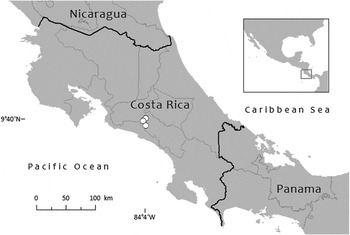
Distribution. Central America. Costa Rica (San José Prov., Tarrazú canton); perhaps endemic to Costa Rica. A specimen from central Panama (Lao 32 & Holdridge, MO–n.v., PMA–n.v.), determined as Podocarpus costaricensis by Farjon in 2004, was re-determined by de Laubenfels in 2012 as P. magnifolius; the identification needs verification. Two specimens from easternmost Panama (Cuadros et al. 3963, MO–n.v.; Gentry & Mori 13662, MO–n.v.), the first of which was cited by Silba (Reference Silba1990: 67) and in the protologue of Podocarpus costaricensis (de Laubenfels, Reference de Laubenfels1991: 121), were determined as that species by Farjon in 2004 and had been accepted as belonging to it by authors such as Merello (Reference Merello, Hammel, Grayum, Herrera and Zamora2003). More recently they were regarded as belonging to Podocarpus acuminatus (de Laubenfels, pers. comm. 16 Feb. 2006; and cf. TROPICOS database). Podocarpus acuminatus is otherwise poorly known from specimens in Venezuela and Brazil, very disjunct from Panama, and those 2006 identifications have since been retracted. The identity of all the eastern Panama specimens that have been assigned to Podocarpus costaricensis needs verification but that is outside the scope of this paper because their localities lie within the Northern Andes Bioregion. Therefore, apart from the possible central Panama records which, because of the doubt surrounding them, are not included in the distribution map (Fig. 4), Podocarpus costaricensis appears to be confined, in the Central America Bioregion, to a very small area of Costa Rica (San José Province). Takhtajan: Caribbean Region (Central American Province). Morrone: Neotropical region, Caribbean subregion, Mesoamerican dominion, Eastern Central America province. TDWG: 80 COS ?PAN. Map: Fig. 4.
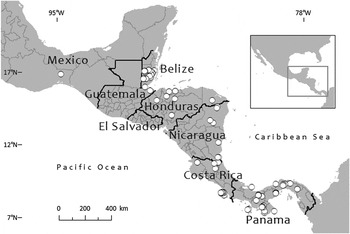
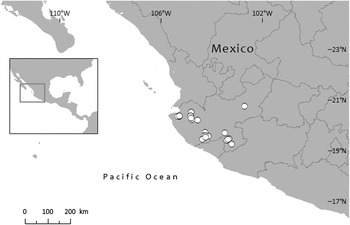
Global distribution of Podocarpus costaricensis.

Specimens examined. Costa Rica. San José:Léon Cortés: 2 km oeste del Cementario de San Pablo de Leon Cortes, 9°40′50″N 84°03′10″W, 1650 m, 20 viii 1988, de Laubenfels 810 (MO, holo, US, iso dated 20 vii 1988, CR–n.v. also dated 20 vii 1988 fide GBIF); ibid., 9°40′50″N 84°30′10″W, 1600 m, 21 vii 1988, Jiménez Madrigal et al. 597 (NY, originally annotated ‘isotype’ but with a later annotation saying that it cannot be one, CR–n.v., MO–n.v.); ibid., 1650 m, 20 viii 1988, de Laubenfels 809 (CR–n.v., MO–n.v.). Tarrazú: San Marcos, San Pablo, de el desvio a Quepos, 0.5 km Camino a San Carlos, 9°38′10″N 84°05′25″W, ‘70 m’ [sic: see note below], 22 ii 1995, Herrera 7736 (F, CR–n.v., K–database, MO–n.v.); ibid., Herrera 7738 (F, NY, MO–n.v., K–database). Fila Bustamante, Fila Diamante, al norte de Esquipulas, 9°34′07″N 84°03′14″W, 1110 m, 19 iv 1994, Lépiz 293 et al. (CR–n.v., INB–n.v., K–database, MO, NY).
Additional record (paratype). Costa Rica. San José:Tarrazú: San Marcos de “Irazú” [sic: a mis-spelling of Tarrazú], 1450 m, 2 iv 1975, Holdridge 6826 (CR–n.v.). – Wrongly assigned in the protologue to Cartago Province; it is clear that this was collected from the same locality as the other specimens from Tarrazú.
Bioregion: Central America. Ecoregion: NT0130 Isthmian-Pacific moist forests.
Ecology. Very little is known about the ecology of this species. It occurs near lower montane rainforest on low hills or well-drained areas in a relatively narrow altitudinal range of 1100–1700 m. Herrera 7736 was said to have been collected at 70 m but putting the co-ordinates into Google Maps in Terrain view (www.google.com/maps/, accessed 2 April 2014) reveals from the contours that the actual altitude must have been c.1450 m. The type was collected on a coffee plantation, near other trees of the same species, and it has chiefly been found so far in similar habitats and at the edge of pastoral grazing areas, very rarely within the rainforest itself. Associated species include Heliocarpus appendiculatus Turcz. and Zinowiewia costaricensis Lundell (Jiménez, Reference Jiménez1999a).
Conservation status (global, IUCN 3.1). Critically Endangered CR B1ab(iii,v) (Farjon, Reference Farjon2013a). A previous assessment of VU (Bachman et al., Reference Bachman, Farjon, Gardner, Thomas, Luscombe and Reynolds2007a) was based on a wrong assumption of the species’ EOO and AOO, which are now regarded respectively as only 41 kmFootnote 2 and 16 kmFootnote 2. Matamoros & Seal (Reference Matamoros and Seal1996) assessed it as EN A1cd using earlier IUCN criteria. Regarded as threatened by extensive coffee plantations and logging. Only the seven cited collections are known from Costa Rica, suggesting that it is uncommon. Estrada Chavarría et al. Reference Estrada Chavarría, Rodríguez González and Sánchez González(2005) had already awarded it the grading of CR, saying that the extent of occurrence in Costa Rica was 1183 kmFootnote 2 (now recalculated as much less) and that there had at that time been a 73% reduction in available habitat. Protected in Costa Rica by a total ban on logging under Decreto Ejecutivo de Veda N° 23700-MINAE of January 1997 (Quesada Monge, 2004).
Uses. None have been reported.
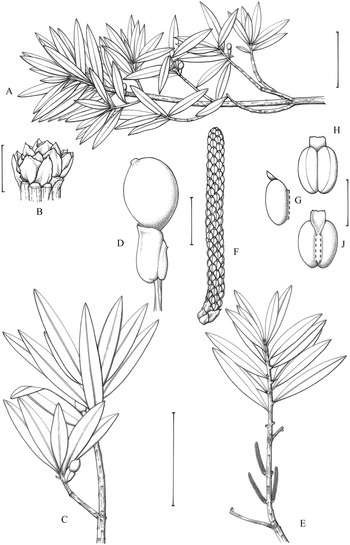
2. Podocarpus guatemalensis Standl., Proc. Biol. Soc. Wash. 37: 49–50 (21 Feb. 1924) non Reiche (Reference Reiche1927). – Type: Guatemala, Dept. Izabal, vicinity of Puerto Barrios, sea level, 2–6 vi 1922, P.C. Standley 25090 (holo US, iso GH). Figs 3E–G,5,6.
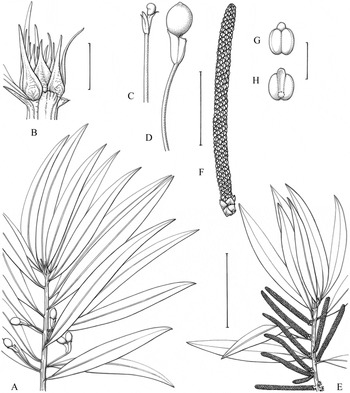
Fig.5.Podocarpus guatemalensis. A, Habit, Gentle 3159. B, Terminal bud, Herrera 1556 (bud possibly unfolding; typical buds are tighter than as drawn). C, Female branch, Gentle 3159. D, Female cone, Gentle 3159. E, Male shoot, Liesner 934. F, Male cone, Liesner 934. G, Microsporangium and apex of microsporophyll (rehydrated), lateral view, Liesner 934. H, Microsporangia and microsporophyll (rehydrated), abaxial view, Liesner 934. J, Microsporangia and microsporophyll (rehydrated), adaxial view, Liesner 934. Scale bars: A, 3 cm; B, D & F, 5 mm; C & E, 5 cm; G, H & J, 1 mm. Drawn by Claire Banks.
 Fig.6.
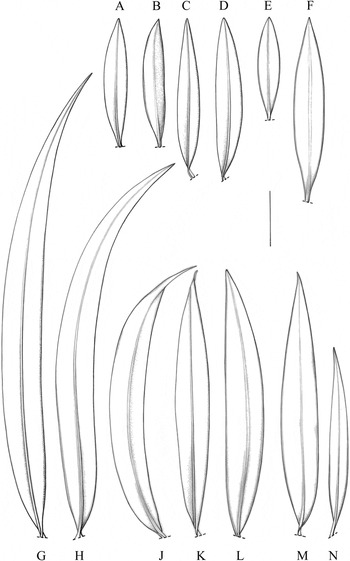
Podocarpus guatemalensis: comparative leaf drawings. A, de Nevers et al. 5449, adaxial surface. B, de Nevers et al. 5449, abaxial. C & D, Herrera 1556, both adaxial. E & F, Gentle 3121, both abaxial. G, Gentry 6243, adaxial. H, McPherson 10339, abaxial (juvenile). J, McPherson 10339, abaxial (juvenile). K, Vargas 1532, adaxial. L, Vargas 1532, abaxial. M & N, Almeda 5584, both abaxial. Scale bar 2 cm. Drawn by Claire Banks.
Podocarpus allenii Standl., Ann. Missouri Bot. Gard. 28: 409 (27 Nov. 1941). – Podocarpus guatemalensis Standl. var. allenii (Standl.) J.Buchholz & N.E.Gray, J. Arnold Arbor. 29: 137 (15 Apr. 1948). – Podocarpus guatemalensis subsp. allenii (Standl.) Silba, J. Int. Conifer Preserv. Soc. 17(1): 11 (2010). – Type: Panama, Cerro Campana, c.1000 m, 21 iv 1941, P.H. Allen 2437 (holo F–image & photo, fragment S–image; iso MO).
Podocarpus pinetorum Bartlett, Carnegie Inst. Wash. Publ. 461: 21 (1935), in adnot. – Podocarpus guatemalensis Standl. var. pinetorum (Bartlett) J.Buchholz & N.E.Gray, J. Arnold Arbor. 29: 137, t. 6 f. 1 (15 Apr. 1948). – Podocarpus guatemalensis subsp. pinetorum (Bartlett) Silba, J. Int. Conifer Preserv. Soc. 17(1): 11 (2010). – Type: Belize: El Cayo District: Mt. Pine Ridge, Bartlett 13109 (holo MICH 1192648–image, iso A, NA 0027047–image, NY, S–database, US 00012022). Balick et al. (Reference Balick, Nee and Atha2000) cite this number (along with others) as voucher material, but misleadingly indicate it as the type of Podocarpus guatemalensis, rather than of P. pinetorum and names based on the latter.


Vernacular names. Belize: cypress de montaña (Balick et al., Reference Balick, Nee and Atha2000). Costa Rica: ciprecillo (Quesada Monge & Fernández Vega, Reference Quesada Monge and Fernández Vega2005a,Reference Quesada Monge and Fernández Vegab; also used for Podocarpus costaricensis, and plants of P. oleifolius subsp. costaricensis from Monteverde), ciprecillo amarillo, ciprecillo blanco, pinillo and piño de montana (all Quesada Monge & Fernández Vega, Reference Quesada Monge and Fernández Vega2005a,Reference Quesada Monge and Fernández Vegab). Honduras: palo de oro (Padilla 185). Nicaragua: ocotillo de llano (Gutiérrez, Reference Gutiérrez2008; Williams, Reference Williams2009). Panama: mountain cypress, cypress, alfajillo (Allen 3970), cuahau (Allen quoted by Standley in Woodson & Schery, Reference Woodson and Schery1941: 409), pinotea (Lao 507; Condit et al., Reference Condit, Pérez and Daguerre2011).
Etymologies. The epithet guatemalensis relates to Guatemala where the type specimen was collected but is somewhat misleading because almost all collections of this species that have been seen are from elsewhere in Central America; Podocarpus guatemalensis appears to be exceptionally uncommon in Guatemala. The epithet allenii commemorates Paul Hamilton Allen (1911–1963), an American botanist who worked on Central American plants and collected the type of Podocarpus allenii; pinetorum alludes to the type locality of Podocarpus pinetorum, Mountain Pine Ridge in Belize, and to the densely shaded pinewoods in which it was growing.
Distinguishing features. The combination of globose terminal vegetative buds and leaves conspicuously ridged on the adaxial surface serves to distinguish Podocarpus guatemalensis from all other Central American species.
Tree, to 45 m tall, 15–70 cm d.b.h. or more. Crown pyramidal to spreading, sometimes dense and compact. Bark rough, flaking; outer bark greyish- or reddish-brown, inner bark reddish or reddish brown. At least three orders of branching, sometimes four; ultimate branchlets in pairs or whorls of 3. Ultimate and penultimate branches erecto-patent, patent or divaricate, diverging at (27–)45–70(–90)°, straight or gently curved or flexuous; penultimate ones to 35 cm, c.2.5–4 mm thick; ultimate ones 3–15(–25) cm, c.1.4–2.3 mm thick, green. Leaf scars circular or shortly elliptic, c.0.7–2 × 0.3–1.1 mm, whitish or greyish white, contrasting with branchlets or concolorous. Terminal buds globose, ovoid-globose or depressed-globose, 1.8–4(–5.5) × 1.1–4.1 mm, with their base wider than or equalling width of subtending branch apex, composed of 8–20 scales in 3, 4 or more series. Bud scales caducous or persistent at branchlet bases, leaving transversely rhombic, pale brownish white scars (or scars absent); scales usually at most equalling bud diameter (occasionally slightly longer), all equal in length or inner ones longer and narrower; scales ovate or ovate-rhombic (outermost ones sometimes suborbicular), 0.9–3.3 × 0.4–2.3 mm, keeled, brown when dried with (often markedly) paler edges, the tips all erect, obtuse or sometimes aristate or mucronate, the arista or mucro when present much shorter than scale body; margins entire, hyaline. Flushing leaves reddish green, not glaucous on either surface. Leaves lasting 1 or 2 years, 11–23 per flush, (0.5)–3.5–5.6(–26) mm apart; phyllotaxis 3/8. Petiole (0.6–)2.2–4.5(–6.5) mm, twisted, shortly decurrent; angle of divergence from axis (29–)47–62(–112)°. Lamina spreading horizontally and slightly drooping, deep to medium green and glossy above, paler and matt beneath, narrowly elliptic, narrowly lanceolate-elliptic, narrowly lanceolate, elliptic or lanceolate-elliptic (adult leaves sometimes narrowly obovate when near apex of shoot), normally broadest at or below middle; juvenile leaves much longer and wider than adult ones, (50–)100–115(–180) × (6.6–)11–13(–18) mm, (5.3–)8–10(–12.7) × as long as broad, normally strongly falcate throughout their length; adult leaves (19.5–)30–70(–113) × (5.2–)8–14(–16) mm and (2.5–)4–7(–8.6) × as long as broad, mostly straight or slightly falcate; both adult and juvenile leaves somewhat coriaceous but flexible; margins slightly thickened but not revolute, entire; midrib not raised on abaxial surface but slightly raised on adaxial surface which has a continuous single ridge throughout its length; apex symmetric or very slightly asymmetric, acute (occasionally shortly acuminate), subacute or obtuse (occasionally emarginate in first-formed leaves of an increment) in adult leaves, long-acuminate with the extreme tip subacute or obtuse in juvenile leaves, muticous, without a shoulder or abrupt narrowing below tip; base asymmetric, cuneate or shortly attenuate; blade adaxially slightly concave or flat, abaxially ± flat.
Pollen cones borne in definite zones 8–16(–30) mm long, situated along central portion of previous season’s growth or sometimes clustered below apex, with 4–8 buds per zone. Pollen cone buds ovoid, 1.6–2.6(–3) × (0.8–)1.1–2.2 mm, (0.7–)1–5(–6.5) mm apart. Basal scales c.4 in 2 series, dark chestnut-brown, somewhat keeled or keels lacking, suberect, ovate, 0.9–1.4 × 0.7–1 mm, obtuse, muticous, with non-scarious entire margins. Common peduncle absent; individual pollen cones single, sessile or very shortly pedicellate (0.5–1 mm), erecto-patent, cream or greenish yellow, narrowly cylindrical, elongating with age, 14–45 mm, 2–3.3 mm wide at middle, very slightly tapered distally, straight or slightly curved, shedding occurring from base to apex. Microsporophylls c.180–260 per cone; 4–5 microsporophylls per long half-spiral, 3–4 per short half-spiral; lamina 0.2–0.8 × 0.25–0.7 mm, green drying brownish, triangular, broadening distally from a narrow base attached to upper 2/3 of microsporangia, the portion visible abaxially subquadrate or broadly quadrate, up-turned (sometimes not obviously), the margin not scarious or white (similar in colour to rest of lamina), the apex truncate and erose. Microsporangia ± vertical and parallel, free, ellipsoid, 0.5–1 × 0.3–0.65 mm, pale yellow-green; stomium on abaxial side, lateral, elliptic when open. Pollen white.
Dioecious. Receptive female cones borne on current growth, subtended by or close to a foliage leaf, pedunculate; peduncle short (sometimes almost absent in plants from Belize), (0.6–)1.2–3.5(–6.5) mm, slender, shorter than whole cone, shorter to occasionally slightly longer than receptacle, spreading or erecto-patent, ridged and compressed, broadening distally or not, without or sometimes with apical bracts; basal scales absent. Prophylls (foliola) absent. Cones 1 or occasionally 2 per peduncle. Receptacle formed of 1 sterile and 1 fertile bract, ± smooth or finely verrucose, subglobose, infundibular or cylindrical, slightly asymmetrical to almost symmetrical, 4.5–6.5(–8.5) mm along long edge, (3.9–)4.6–5.8(–8.3) mm along short edge, (3.8–)4.2–5.5(–8) mm along connation, (0.9–)1.2–1.8 mm wide at base and (2–)2.4–3.5 mm wide at widest point (at or above middle), violet-purple in receptive stage turning green in resting phase and ripening through yellow to finally red, the free tips the same colour as rest of receptacle when ripe; bracts connate and fused, glaucous in receptive and resting phases but not when ripe. Free tips of both fertile and sterile bract reduced or almost absent (reduced to a rim), that of fertile bract triangular, acute, that of sterile bract triangular or a crescent-like rim, subacute to rounded, both muticous. Seeds 1 per receptacle, inserted ± symmetrically on receptacle, ellipsoid or ovoid, 5.2–6.8 × 4.1–5.5 mm, greenish, ± smooth to longitudinally wrinkled, with very reduced apical crest (sometimes almost absent); crest extremely low and blunt, c.0.2–0.4(–0.5) × 0.4–1 mm. Cotyledons narrowly elliptic, horizontally spreading, subacute to acute. First true leaves narrowly lanceolate to narrowly elliptic, straight or usually somewhat falcate throughout, gradually tapered to acuminate apex; up to 4 intercalary cataphylls just above each group of 2 or 3 leaves, the cataphylls small, triangular-ovate, acute, brownish.
Phenology. Immature fruits from at least June, ripe December–March, but phenology very poorly known (Jiménez, Reference Jiménez1999b). Specimens with male buds have been collected in April and July (Belize), June (Oaxaca, Mexico) and late October (Panama), while male strobili shedding pollen have been collected in March and August (Panama: local dry season and midsummer ‘drought’ respectively). Young (post-receptive) female cones have been collected from Belize in May and September (beginning and end respectively of local rainy season), while ripe or almost ripe cones have been gathered between November and March (dry season). Young seedlings have been collected in February and March (Costa Rica: local dry season).
Taxonomy. Three varieties have been recognised: Podocarpus guatemalensis var. guatemalensis (Guatemala), P. guatemalensis var. pinetorum (Belize) and P. guatemalensis var. allenii (Costa Rica and Panama). Justification for that viewpoint, which is accepted here, has been given above in the section dealing with taxonomic problems.
Buchholz & Gray’s description of the reproductive organs of the species (largely copied by Standley & Steyermark, Reference Standley and Steyermark1958) was based “largely upon mature specimens included under the variety pinetorum” (Buchholz & Gray, Reference Buchholz and Gray1948b: 136).
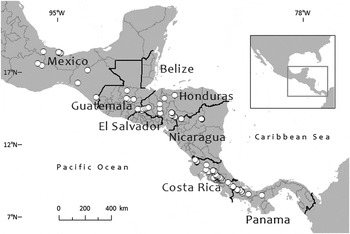
Distribution (in area covered by this paper). Central America: Mexico (Oaxaca and Veracruz only), Guatemala (only the type from Dept. Izabal, despite the specific epithet!), Belize, Honduras, Nicaragua, Costa Rica, Panama; ?El Salvador (fide Farjon, Reference Farjon1998, Reference Farjon2010). The species also occurs in easternmost Panama (Darién) and Colombia (Torres-Romero, Reference Torres-Romero, Pinto and Lozano1988), within the Northern Andes Bioregion. Two specimens from Edo. Miranda (Venezuela), that form the basis of the only Venezuelan records of Podocarpus guatemalensis, were considered by de Laubenfels (Reference de Laubenfels, Luces de Febres and Steyermark1982) to be transitional to Podocarpus trinitensis J.Buchholz & N.E.Gray; their true identity needs re-assessment, which will be done in research for a later paper in this series. Takhtajan: Caribbean Region (Central American Province). Morrone: Neotropical region, Caribbean subregion, Mesoamerican dominion, Mexican Gulf and Chiapas provinces. TDWG: 79 MXS-OA MXG-VC 80 BLZ COS GUA PAN [83 CLM; ?82 VEN]. Map (Central America only): Fig. 7.
Distribution of Podocarpus guatemalensis in Central America.

Steyermark 43803, from Dept. El Progreso, Guatemala, has been re-determined by me as Podocarpus matudae; this probably necessitates a correction to the Red List of Trees of Guatemala (Vivero et al., Reference Vivero, Szejner, Gordon and Magin2006) which lists Podocarpus guatemalensis from Depts. Izabal and El Progreso. Another observation of Podocarpus guatemalensis from Guatemala (Huehuetenango: San Mateo Ixtatán: Cerro Bobí, 5 km SW of San Mateo Ixtatán, 3110 m, 15°48′36″N 91°30′19″W: Matson et al., Reference Matson, Ordóñez-Garza, Bulmer and Eckerlin2012) almost certainly represents misidentified Podocarpus matudae subsp. matudae because all specimens examined from Huehuetenango have turned out to be that taxon even if originally named P. guatemalensis. Farjon’s mention of Podocarpus guatemalensis from El Salvador (Farjon, Reference Farjon1998: 265, Reference Farjon2010: 843) must be questioned: Linares (Reference Linares2005) published what was said to be the first record of the species from El Salvador, but the specimen cited (Allen & Lewy van Severen 7116, EAP) belongs to Podocarpus matudae on the basis of my examination of three other duplicates of that number at F, GH and NY, in agreement with the original determinations and a subsequent one by E.A. Cope on the NY example. Many older records of Podocarpus guatemalensis from Mexico (e.g. Puebla, MXC-PU; Chiapas: SMX-CI, now re-coded MXT-CI in Brummitt, Reference Brummitt2001), that were cited by Farjon (Reference Farjon1998: 265) and Farjon & Page (Reference Farjon and Page1999: 22), refer to P. matudae (or to P. reichei when that taxon is segregated from P. matudae, which is not the case here). The error, originally stemming from Reiche’s account of “Podocarpus guatemalensis” in Mexico (Reiche, Reference Reiche1927), was corrected when Buchholz & Gray (Reference Buchholz and Gray1948b) described Podocarpus reichei; it was also noted by Sharp (Reference Sharp1949) in a correction to his earlier paper (Sharp, Reference Sharp1946). However, there are more recent records of Podocarpus guatemalensis occurring in the Mexican state of Veracruz; most have been published in non-taxonomic papers, e.g. Graham (Reference Graham1976, Reference Graham, Gómez Pompa, Allen, Fedick and Jiménez-Osornio2003), Guerrero & Equihua (Reference Guerrero and Equihua2005), Ramos Álvarez et al. (2008), and need verification. Some may be incorrect; for example, specimens identified as Podocarpus guatemalensis that I have seen from the Naolinco area of Veracruz have all turned out to be P. matudae and this may well be true of all specimens from higher altitudes (above c.1500 m). However, fig. 3 of Ramos Álvarez et al. (2008), which deals with the Parque Ecológico Jaguaroundi on the coast in the far south of Veracruz at Mundo Nuevo, does show a shoot of Podocarpus guatemalensis. Coastal records of Podocarpus guatemalensis from Rancho de Don Filiberto and Punta Gorda (both in Mun. Agua Dulce: Bueno et al., Reference Bueno, Álvarez and Santiago2005) can also be accepted as these belong to the Petén-Veracruz moist forests ecoregion where P. guatemalensis is known to occur.
Specimens examined and other records. Mexico. Oaxaca: San Miguel Chimalapa: Cerro Salomón (Ishiki, Reference Ishiki1988 quoted by Del Castillo et al., Reference Del Castillo, Pérez de la Rosa, Vargas, Rivera García, García-Mendoza, Ordóñez and Briones-Salas2004, possible). Santa María Chimalapa: “El Callejón”, vieja vereda de Lázaro Cárdenas a Santa María, cerca del camino actual que sale de Arroyo Chocolate y sube la falda NE de Cerro Azul-Escolapa, c.8 km al SO [SW] de Santa María, 16°52′N 94°44′W, 10 vi 1986, Hernández G. 2231 (MO). Veracruz: Agua Dulce: Punta Gorda etc. (Bueno et al., Reference Bueno, Álvarez and Santiago2005: see comments under Distribution). Coatzacoalcos: Mundo Nuevo, Parque Ecológico Jaguaroundi (Ramos Alvárez et al., 2008, f. 3: see comments under Distribution).
Guatemala. Izabal:Puerto Barrios: Vicinity of Puerto Barrios, s.l., 2–6 vi 1922, Standley 25090 (US, holotype; GH, isotype). Cerro San Gil, to c.900 m (Ruiz, Reference Ruiz2006).
Belize. Unloc., 1929, Schipp s.n. (F). El Cayo: On Humming Bird Highway, nr Sibun River, i 1955, Forest Dept. Belize s.n. (K–n.v., MO). Blue Hole Section, Humming Bird Highway, 20 ix 1955, Gentle 8880 (MO, NY, S–database, US–database). Hummingbird Highway S of Belmopan, Mile 30, 200–300 ft [61–91 m], 26 vi 1973, Gentry 8575 (MO). Mountain Pine Ridge, 8 v 1931, Bartlett 13109 (MICH–image, holotype of Podocarpus pinetorum; NA–image, NY, S–database, US, isotypes of P. pinetorum). Mountain Pine Ridge, 1944, anon. 23 (F). Mt. Pine Ridge Forest Reserve, Sabala Road, Cojolito Creek, 17°00′N 88°55′W, 400 m, 1 vii 1976, Chaplin C256 (FHO–n.v., MO–2 sheets). Slate Creek, on Chiquibul road, 20 km N of Augustine, Mountain Pine Ridge Forest Reserve, 390 m, viii 1988, Meave & Howe 1197 (MO). Chiquibul, Palmar, 16°33′N 89°02′W, 800 m, 13 iv 1997, Monro 1811 (MO); ibid., 16°33′N 89°02′W, 900 m, 10 ix 1998, Monro & Cafferty 2728 (MO). Mount Margaret, summit, 17°02′33.7″N 88°35′43.8″W, c.850 m, 29 ix 2007, Goodwin 785 (E). Stann Creek: Near Middlesex, 1600 ft [488 m], 7 xi 1929, Schipp 441 (F, GH, MO, NY, S–database); ibid., 1800 ft [549 m], 7 xi 1929, Schipp 444 (F, MO, NY, S–database). Stann Creek Valley, mostly in Silk Grass Reserve, 14 i 1932, Burns 21 (F). Stann Creek District, Stocker 18 (ser. no. 15577) (F). 19 Mile Stann Creek Valley, 400 ft [121 m], 8 vii 1932, Schipp 969 (F, GH, MO, NY, K–database, S–database). Stann Creek Valley, Antelope Ridge, 24 i 1940, Gentle 3159 (GH, NY, S–database, US–database). Near Manatee, 15 xii 1940, Gentle 3452 (A, F, NY, S–database). Stann Creek District, Cockscomb Basin Wildlife Sanctuary, summit of Outlier Peak, c.7 km NW of visitor centre, 16°48′47″N 88°30′16″W (WGS84), 650 m, 6 xi 2006, Goodwin 323 et al. (E). Cockscomb Basin Wildlife Sanctuary, on the way to Outlier Peak, 16°48′50″N 88°30′10″W, 44 m, 15 i 2007, Bell 3 (E). Toledo: Pearce’s sawmill, Temash River, 4 mi from bar [‘c. 6 km from Temash’: K–database], 8 ii 1932, Kinloch 49 (F, NY, K–database). Swasey Branch, Monkey River, 14 iii 1942, Gentle 3967 (A, MO, NY, US–database). Between Rancho Chico and Cockscomb, Monkey River, 23 iii 1943, Gentle 4326 (MO, NY). On way up to ridge crest of a volcanic extension which lies in between two limestone knolls about 2.5 km N of Ramos-Bladen confluence, c.16°31′N 88°51′W, 350 m, 13 iii 1993, Iremonger 536 (MO). Bladen Nature Reserve, c.16°31′N 88°51′W, 16 iii 1993, Iremonger 592 (MO). Along divide of Maya Mountains, Bladen Nature Reserve, 16°31′N 88°57′W, 900–1000 m, 14 v 1996, Holst et al. 5307 (MO).
Honduras. Atlántida:Esparta: 41.5 km E of Tela on Tela-Ceiba Hwy. then 2.7 km N along old timber road, 15°39′N 87°16′W, 100 m, 15 iv 1994, Brant & Zúniga 2850 (MO, wrongly re-determined as Podocarpus matudae by Stark Schilling, Reference Stark Schilling2004). Cortés:Santa Cruz de Yojoa: Cienega Tract, near Agua Azul, 9 ii 1952, Allen 6409 (F). Francisco Morazán:Tatumbla: Mt. Uyuca [Cerro Oyuca], 1 viii 1960, Pfeifer 1829 (CONN–database). Gracias a Dios:Puerto Lempira: Near road crossing of Río Dursuna SW of Dursuna Forest Camp, c.150 m, 5 ii 1981, Proctor 38902 (A, MO, NY, US–database). Awasvila, 7 m, Haufe & Mondragon (Styles & Hughes, Reference Styles and Hughes1983: 280, wrongly given as Depto. Colón). Intibucá: Jésus de Otoro: Subcuenca del Río Cumes (Romero Velásquez, Reference Romero Velásquez2009). Olancho:Mangulile: El Paso Real, 22 v 1974, Padilla 185 (F). Yoro: Yoro: Near Las Delicias, 30 km S of Tela, 600–800 m, 20 ix 1979, Hazlett 3309 (F).
Nicaragua. Jinotega: Cuá-Bocay: Peñas Blancas massif, reserva de Biosfera Bosawas (Gutiérrez, Reference Gutiérrez2008). Nuevo Segovia: Dipilto: Otherwise unloc., c.800 m (Pineda, Reference Pineda2006: 25). Región Autónoma del Atlántico Norte (Zelaya): Cabo Gracias a Dios: Slilma Sía, 14°38′N 83°56′W, 140 m, 24 ii 1971, Little Jr. 25001 (F, MO, US–n.v.). Prinzapolka: Alamicamba, Río Prinzapolka, 13°29′N 84°14′W, 20 m, 17 iv 1971, Little Jr. 25415 (F, MO, US–n.v.). Tronquera: Comarca de El Cabo, Río Leicus, Región de Tronqueras, 60 m, 19 viii 1965, A. Molina R. 14915 (F, NY). Región Autónoma del Atlántico Sur (Zelaya): Bluefields: Bluefields, Base Camp 3.6 km SE of Cerro San Isidro, Río Kama, Río Escondido, 12°05′–12°15′N, 83°45′–84°20′W, 0–65 m, 15 iii 1966, Proctor et al. 27143 (NY). Siuna: 5 km E of El Empalme c.45 km E of Siuna, 16 viii 1977, Danin 77-13-1 (MO). Río San Juan: San Juan de Nicaragua: Reserva Indio-Maiz, Municipio de San Juan del Norte, Cerro el Gigante, 10°46′N 83°53′W, 380–412 m, 24 vii 1996, Rueda et al. 4436 (MO); Cerro el Gigante, 5 km del Río San Juan, 10°46′N 83°53′W, 100–200 m, 21 ix 1998, Rueda et al. 8890 (MO); ibid., same co-ordinates, 412 m, 24 ix 1998, Rueda et al. 8895 (MO). Reserva Indio-Maiz, río abajo 10 km del Cerro Canta Gallo, camino de cazadores La Chiripa, 11°07′N 83°54′W, 100 m, 18 ix 1998, Rueda et al. 8785 (MO). Río Indio, 5 hours upriver from San Juan del Norte (25 Hp), 0.5 km E from Finca Guriel, 11°07′N 83°50–52′W, <20 m, 7 ix 1982, Riviere 258 (MO).
Costa Rica. Alajuela: San Carlos: Boca Tapada, Carretera al río San Juan, Finca Hogar de Ancianos, 10°42′N 84°10′W, 20 m, 23 vi 1993, Jiménez Madrigal 1313 et al. (MO). Guanacaste: Liberia: Parque Rincón de la Vieja, Hacienda Santa María, del mirador siguiendo la Fila al Noreste, camino al Volcán Santa María, 10°48′N 85°19′W, 800–900 m, 19 x 1987, Herrera 917 (NY). Parque Rincón de La Vieja Liberia, del puesto Santa Maria siguiendo el Sendero del Mirador, subiendo por la fila al noroeste, 10°46′N 85°18′W, 1000 m, 28 ii 1998, Herrera 1556 (F, GH). Hacienda Santa María, 20 km NE of Liberia Guanacaste, 700–900 m, i 1983, L.D. Gómez 19810 (MO). Heredia: Sarapiqui: Parque Nacional Braulio Carrillo, La Virgen, Sarapiquí, 500 m NW of Puesto La Ceiba, 10°20′N 84°05′W, 500 m, 13 x 1988, Ballestero 1 (F, MO). Parque Nacional Braulio Carrillo, Estación El Ceibo, 10°22′29″N 84°02′10″W, 500–600 m, 1 x 1989, Aguilar 5 (MO). Puntarenas: Osa: Rincón, siguiendo el cauce en la cuenca superior de la Quebrada Vaquedano, 8°38′45″N 83°35′25″W, 450 m, 24 vii 1990, Herrera 4037 (F, MO). Aguabuena, cuenca superior de Quebrada El Campo, Rincón, 8°42′35″N 83°31′50″W, 300 m, 1 x 1990, Herrera 4429 (F, MO). Rancho Quemado, sector noroeste, 8°41′30″N 83°35′00″W, 250 m, 24 ii 1992, Marín 377 (MO). R.F. Golfo Dulce, Península de Osa, Rancho Quemado, fila c.3 km al sur, 8°43′00″N 83°34′50″W, 200 m, 12 i 1993, Aguilar 1563 (MO). R.F. Golfo Dulce, Península de Osa, Cerro Chocuaco, 8°42′00″N 83°29′10″W, 0–100 m, 25 xii 1997, Aguilar 5332 (MO). Reserva Forestal Golfo Dulce, Fila Ganado hasta Guerra, 8°44′00″N 83°36′00″W, 1–300 m, 28 iii 1991, Hammel 18172 et al. (MO). Marenco Biological Station on NW coast of Osa Peninsula, Sendero Camino Público en route to the Río Claro and beyond on the trail that parallels the ocean, c.1 km from ocean, 15 m, 14 iii 1986, Almeda 5584 et al. (MO). Estac. Biol. Marenco, Sendero Camino Público, 1 km antes de la playa, Pen. Osa, 14 iii 1986, Zamora V. et al. 1205 (MO, seedlings). Near Marenco Biological Station, behind Punta San Jose, NW coast of Osa Peninsula, 8°41′N 83°42′W, 50–100 m, 16–20 ii 1988, W. Burger et al. 12350 (F). Sierpe de Osa, Boca Ganado [river], en Fila Ganado, 8°44′10″N 83°36′50″W, 20–400 m, 23 xi 1993, Vargas 1532 et al. (F). Parque Nacional Corcovado Cerro Rincón, Dos Brazos de Río Tigre, 8°31′30″N 83°28′00″W, 745 m, 3 viii 1990, Herrera 4109 (MO). Osa Peninsula, Los Planes, N of Corcovado National Park, 8°39′52″N 83°41′01″W, 145 m, 19 iii 2003, Anderberg et al. 17 (S–database).
Panama. Bocas del Toro: Ngöbé-Buglé (Kusapin): Island of Escudo de Veraguas, 9°05′N 81°35′W, 5 m, 7 viii 1987, McPherson 11403 (MO). Coclé:Antón: Hills N of El Valle de Anton, vicinity of La Mesa, c.1000 m, 21 i 1941, Allen 2298 (F). La Pintada: Continental divide ridge, Coclesito road, 20 iv 1978, Hammel 2536 (MO). Colón:Colón: 3–4 km E of Agua Clara rain gauge, c.400 m, 9 ix 1975, Dressler 5151 (MO, F–photo). Donoso: Site of proposed copper mine (MPSA), 70 m, McPherson 21171 & Merello (PMA–database). Guna Yala: Comarca de San BlasFootnote 1, El Llano-Cartí road, Km 26.5, 9°19′N 78°55′W, 200 m, 9 iv 1985, de Nevers et al. 5275 (MO, PMA–database). Comarca de San Blas, Cerro Brewster, 9°18′N 79°16′W, 850 m, 21 iv 1985, de Nevers et al. 5449 (MO). Herrera:Las Minas: La Peña, 20 ii 1963, Stern et al. 1751 (MO, US–database). Las Minas, on road to agricultural school, 9 mi from town, 7°42′N 80°45′W, 400 m, 4 viii 1984, Churchill et al. 5947 (MO, PMA–database; label had longitude as 8°45′W). Between Las Minas and El Toro, on Montosa de Chepo, above Chepo, 7°42′04″N 80°51′04″W, 900 m, 26 i 1987, McPherson 10338 (MO, PMA–database); ibid., McPherson 10339 (MO, juvenile). Chepo, Loma El Montuoso, sendero a la toma de agua, 7°43′N 80°50′W, c.900 m, 27 ix 1994, Galdames 1664 et al. (MO, PMA–database). Chepo, sendero a la cima de El Higo, 7°43′N 80°50′W, c.900 m, 28 ix 1994, Galdames 1725 et al. (MO); ibid., same details, Galdames 1734 et al. (MO). Los Santos: Tonosi: c.6 km SW of El Cortezo, along trail back to El Cortezo, 7°25′48″N 80°40′48″W, 29 x 1978, Hammel 5455 (MO). Panamá:Capira: Cerro Campana, 1 ix 1940, Bartlett & Lasser 16943 (MO). Moist upper region of Cerro Campana, c.1000 m, 21 iv 1941, Allen 2424 (F, S–database); ibid., 21 iv 1941, Allen 2437 (F–image & photo, holotype of Podocarpus allenii; S–image, fragment of holotype of P. allenii; MO, isotype of P. allenii). Cerro Campana, 800 m, 7 i 1947, Allen 3970 (E, MO, P–image). Cerro Campana, 2700–3300 ft [823–914 m], 11 iii 1981, Sytsma & D’Arcy 3730 (MO, PMA–database). Cerro Campana, 800–830 m, 3 i 1973, Sucre 9768 et al. (RB165605–image, as Podocarpus sellowii Klotzsch, which is endemic to SE Brazil: Farjon, Reference Farjon2010). Cerro Campana, 8°41′N 79°54′W, c.900 m, 21 i 1985, van der Werff & J. Herrera 6221 (MO). Sendero de Interpretación, 1 km al este del Campamento de los guardábosques INRENARE, 8°40′N 79°55′W, 800–900 m, 14 xi 1991, Correa A. et al. 8321 (F–photo, PMA–database). Chepo: From Torti to the Pilota del Toro, the mountain overlooking Torti Arriba, 50–200 m, 27 viii 1977, Folsom 5052 et al. (MO). Area surrounding Rancho Chorro, mountains above Torti Arriba, Canazas mountain chain, 400–700 m, 3 xii 1977, Folsom et al. 6608 (MO). Panamá: 7 mi N of Cerro Azul on road to Cerro Jefe, 2600 ft [792 m], 13 xi 1965, Blum et al. 1823 (MO). Veraguas:Calobre: La Yequada, 650 m, 10 viii 1972, Lao 507 (MO, PMA–database). Montijo: Isla de Coiba, campamento San Isidro – campamento 10-30, 17NMU1728 [7.55°N 81.77°W], 220 m, 24 i 1994, Castroviejo et al. 13109 SC (MO, PMA–database). Isla de Coiba, sendero de Playa Hermosa a Santa Clara, 17NMU0429 [7.52°N 81.86°W], 25 x 1995, Aranda et al. MB1445 (MO). Santa Fé: Above Santa Fé on slopes of Cerro Tute, 1200–1400 m, 28 ix 1972, Gentry 6243 (MO). Alrededores del Río Primer brazo de Ulabá, 8°33′N 81°07′W, c.800 m, 6 vii 1996, Galdames 3147 et al. (MO, PMA–database). Santa Fé, road to Alto de Piedra, 8°30′56″N 81°06′06″W, 800 m, 30 viii 2001, Merello et al. 2736 (MO). 5 mi W of Santa Fé on road past Escuela Agricola Alto Piedra on Pacific side of divide, 800–1200 m, 18–19 iii 1973, Liesner 934 (MO).
Bioregion: Central America. Ecoregions: NT0303 Central American pine-oak forests, NT0111 Central American Atlantic moist forests, NT0119 Costa Rican seasonal moist forests, NT0129 Isthmian-Atlantic moist forests, NT0130 Isthmian-Pacific moist forests, NT0154 Petén-Veracruz moist forests, NT0167 Talamancan montane forests, NT0209 Central American dry forests, NT0306 Misquito pine forests.
Ecology. Podocarpus guatemalensis occurs in humid and perhumid forest, broad-leaved riparian forest (Meave & Howe 1197, Belize), cloud forest, montane forest and even elfin forest (Goodwin 323, Belize), on a variety of soil types at altitudes of 0–1000 m (perhaps as high as 1200 m). In Belize it has been collected both on deep brown soils and on thin granite soils; it also occurs in river valleys in coastal mountain ranges, and in mountain pine scrub forest over granitic-volcanic substrates (Iremonger et al., Reference Iremonger, Liesner and Sayre1995; Holst et al. 5307; Goodwin et al. 323). Podocarpus guatemalensis, Vachellia cookii (Saff.) Seigler & Ebinger, Cordia gerascanthus L. and Zanthoxylum belizense Lundell, and species of Basiloxylum K.Schum. and Grias L. are all considered indicator species of perhumid tropical forest in Guatemala (Barreda de Hurtado et al., 1999). In the previously poorly known Sierra de las Minas of Guatemala, Podocarpus guatemalensis has been found at 350–600 m in broad-leaved forests on serpentinised substrates at four sites (Quebrada Las Minas, Cerro Tembladero, Gracias a Dios and Camino Río Las Cañas) in the Reserva de Biosfera Sierra de las Minas (San Emeterio & Cavero, 2000). Plants from Panama, previously segregated as var. allenii, tend to occur in cut-over forests where they produce abundant seedlings.
Macrohasseltia macroterantha (Standl. & L.O.Williams) L.O.Williams, Symphonia globulifera L.f. and Vochysia guianensis Aubl. are positively associated with Podocarpus guatemalensis in Honduras (Rodriguez Martinez, Reference Rodriguez Martinez1999). Tabernaemontana sananho Ruiz & Pav. has been recorded as an associate in Panama (Nevers et al. 5449). Associated species are discussed in detail by Del Castillo et al. (Reference Del Castillo, Pérez de la Rosa, Vargas, Rivera García, García-Mendoza, Ordóñez and Briones-Salas2004: Oaxaca, Mexico), Ramos-Álvarez et al. (Reference Ramos Álvarez, Martínez, Nava-Cruz, Martínez-Bravo, Ricker, Nava and Rosas2008: Veracruz, Mexico), Bueno et al. (Reference Bueno, Álvarez and Santiago2005: Rancho Don Filiberto, Veracruz, Mexico), Iremonger et al. (Reference Iremonger, Liesner and Sayre1995: Belize), Bridgewater et al. (Reference Bridgewater, Harris, Whitefoord, Monro, Penn, Sutton, Sayer, Adams, Balick, Atha, Solomon and Holst2006: Belize), Barreda de Hurtado et al. (Reference Barreda de Hurtado, Cabrera, Galtán and González1999: Dept. Izabal, Guatemala), Mejía (Reference Mejía, Kappelle and Brown2001: Honduras), Townsend et al. (Reference Townsend, Butler, Wilson and Austin2009: Honduras) and Pérez Ribera (Reference Pérez Ribera2002: Osa Peninsula, Costa Rica).
The type was collected in densely wooded swamps at low altitude in coastal Guatemala, but may have germinated from seed that had been washed down from higher up. Regeneration may be episodic; when a population in a gallery forest at Slate Creek (Belize) was studied by Kellman et al. (Reference Kellman, Tackaberry and Rigg1998), few trees had small-diameter stems. Colinvaux et al. (Reference Colinvaux, De Oliveira and Bush2000) reported that practically no pollen of Podocarpus was collected over a period of a year in pollen traps within sight of a Podocarpus population on Cerro Campana (Panama); they thus inferred that pollen dispersal of the species concerned (assumed to be P. guatemalensis, the only species known to occur in the locality) did not take place far from the parent tree.
Conservation status (global, IUCN 3.1). Least Concern LC (Bachman et al., Reference Bachman, Farjon, Gardner, Thomas, Luscombe and Reynolds2007b; Farjon, Reference Farjon2010; Thomas & Farjon, Reference Thomas and Farjon2013). Farjon & Page (Reference Farjon and Page1999: 22), however, gave national evaluations of CR in Costa Rica, EN in Guatemala and VU in Honduras, while Vivero et al. (Reference Vivero, Szejner, Gordon and Magin2006) regard it as VU A2cd in Guatemala. Estrada Chavarría et al. Reference Estrada Chavarría, Rodríguez González and Sánchez González(2005) also evaluated Podocarpus guatemalensis as CR in Costa Rica, where it was considered to be in danger of extinction by Jiménez (Reference Jiménez1999b) and assessed as EN under older IUCN criteria by Matamoros & Seal (Reference Matamoros and Seal1996). In 1979, native trees in the Las Delicias area of Honduras were said to be “vanishing fast” (Hazlett 3309). There may be fewer than 100 trees in Cerro San Gil (Izabal, Guatemala, near the type locality: Ruiz, Reference Ruiz2006). According to Oldfield et al. (Reference Oldfield, Lusty and MacKinven1998), populations had become drastically reduced and restricted to the most inaccessible areas as a result of settlement and agriculture; however, the most recent assessment (Thomas & Farjon, Reference Thomas and Farjon2013) paints a much less bleak picture. Podocarpus guatemalensis has been recorded from several protected areas, including the Reserva Protectora de Manantiales Cerro San Gil (Dept. Izabal, Guatemala: Ruiz, Reference Ruiz2006), Area de Conservación Guanacaste, Altos de Campaña, Rincón de la Vieja, Río Indio Maíz and Mountain Pine Ridge Reserves (Bachman et al., Reference Bachman, Farjon, Gardner, Thomas, Luscombe and Reynolds2007b).
Uses. In Honduras the wood is used in construction and furniture (Hazlett 3309) while it is used for poles in Nicaragua (Pineda, Reference Pineda2006). The label of Schipp 441 records that the wood is hard and straight-grained and that, in the late 1920s, saplings were used in Belize as ships’ masts; that of Hammel et al. 18172, collected in 1991, mentions it being felled for timber in Costa Rica at that time.
3. Podocarpus matudae Lundell, Phytologia 1: 212 (1937, ‘matudai’). – Type: Mexico, Chiapas: Mt. Pasitar, 29 xii 1936, E. Matuda 698 (holo MICH–image, male, fragment S [S-C-1535, image]; iso LL–image, MEXU–image, US, MO–photocopy [labelled ‘sheet 2’]). – See Taxonomic Notes (below) regarding status of specimens hitherto regarded as type material but collected on 16 and 30 xii 1936.
Distinguishing features. Podocarpus matudae is one of two Central American species of Podocarpus with narrow, conical terminal vegetative buds, the other being P. costaricensis. This character separates Podocarpus matudae from P. guatemalensis and P. oleifolius, the only other species occurring within its range. Podocarpus costaricensis is geographically disjunct from P. matudae and differs from the latter in its leaves having a single longitudinal groove on the adaxial surface in the region of the midrib. – Two subspecies.
Small to large canopy or subcanopy tree 8–50 m tall, 15–>100(–150) cm d.b.h. Crown domed in large mature trees. Bark smooth when young, scaly in old trees, pinkish brown or light brown, grey when weathered. Three orders of branching. Primary branches spreading or ascending, second- and third-order branchlets subopposite or spirally arranged, erecto-patent to divaricate, ± straight; penultimate ones up to at least 35 cm long and 3–5 mm thick, ultimate ones 30–110(–130) mm, 1–3(–4) mm thick, diverging at (27–)35–70(–85)°. Leaf scars elliptic or ± circular, (1.1–)1.7–2.8(–3.5) × 0.9–1.9 mm, greyish or brownish white, usually ± concolorous with branch. Terminal buds ovoid or more usually narrowly conical, (6.6–)7.4–11.7 × (1.4–)2.4–4(–5.2) mm, (1.4–)1.8–4.6 × as long as broad; base of bud slightly wider or less commonly slightly narrower than apex of subtending twig; scales 6–12, in 2 or 3 series. Bud scales caducous and not leaving scars at branchlet bases, usually considerably longer than bud diameter, narrowly lanceolate or narrowly ovate to linear-lanceolate or linear-ovate; outer ones longer and wider than inner, (4.6–)6–11 × 0.6–1.6 mm; inner ones (3.8–)4.2–8.6 × 0.6–1.1(–2.2) mm; all scales acuminate, ± keeled, greenish, drying brown often with a reddish tinge, the tips of at least some often slightly recurved but sometimes all erect, the margins entire; scales finally becoming foliaceous before flushing. Flushing leaves yellow-green, not glaucous on either surface. Leaves lasting at least 3 years, 9–11(–13) per flush, (0.9–)4–9(–36) mm apart; phyllotaxis 2/5 or 5/13. Petiole c.2–9 (typically 4–7) mm, twisted and ‘crossed-over’ at base, very shortly decurrent; angle of divergence from axis (13–)30–80(–110)°. Lamina spreading horizontally and slightly drooping, deep to medium green, usually glossy above (less commonly greyish- or yellowish-green and matt: Jalisco specimens), paler beneath, narrowly elliptic, narrowly oblong-elliptic, narrowly oblong, narrowly lanceolate (rarely linear-lanceolate), rarely narrowly obovate in first- or last-formed leaves of a growth increment but normally broadest at or less commonly below the middle, juvenile and adult leaves similar in size (juveniles slightly longer), (48–)75–160(–200) × (5.7–)8–20 mm, (4.9–)6.4–11.5(–14) × as long as broad, adult and juvenile leaves straight or falcate throughout length, fairly coriaceous but flexible, margin thickened but usually not revolute (except Jalisco specimens), entire; midrib with a striate band on each side abaxially, raised abaxially but not adaxially, adaxially appearing as a distinct rib or ridge, often flanked on each side by a groove, and usually obscure distally; apex slightly asymmetric, acute or acuminate, with a slight subapical shoulder from which the lamina abruptly narrows to the tip, muticous; base asymmetric, cuneate or shortly attenuate; blade adaxially slightly concave or flat, abaxially flat.
Pollen cones borne in definite zones 15–65 mm long, situated near middle of previous year’s growth. Basal scales (6–)8–10 in 2, 3 or 4 series, green, drying brown (sometimes with pink tinge), usually with broad pale margins (absent from Jalisco specimens), keeled or not, ± erect or spreading, adpressed or not, with tips sometimes curved outwards, broadly to rather narrowly ovate or ovate-lanceolate, 1.6–4.1 × 1–2.4 mm, acute or subobtuse (upper ones sometimes ± truncate in Jalisco specimens), apiculate or not. Common peduncle absent; individual pollen cones borne singly in leaf axils but 2–8 together in each zone, sessile or virtually so, erecto-patent, greenish yellow or greenish white turning pinkish brown after shedding pollen, elongating with age (at least in subsp. matudae; subsp. jaliscanus insufficiently known in this respect), typically linear-cylindrical or narrowly cylindrical and 28–62 × 2.6–3.7 mm but cylindrical to ellipsoid and 26–30 × 3.1–3.7 mm in Jalisco specimens, slightly tapered distally, straight or slightly curved, shedding occurring from base to apex. Microsporophylls 120–300 per cone, 3–5 per long half-spiral, 3–4 per short half-spiral (but 9–15 and 7–8 respectively in Jalisco specimens); lamina usually 0.25–0.46 × 0.23–0.52 mm (but 0.5–1.1 × 0.45–0.83 mm in Jalisco specimens), green or greenish pink drying pinkish- or purplish-brown after shedding of pollen, triangular or semicircular, usually not up-turned, the margin entire or (Jalisco specimens) erose, not scarious or white (or only extremely narrowly so), the apex obtuse, broadly rounded, truncate or sometimes acute. Microsporangia vertical and parallel or (Jalisco specimens) oblique and divergent, fused, ellipsoid, broadly ellipsoid or (when all pollen shed) suborbicular in most of range but ellipsoid in Jalisco material, typically 0.7–1.1 × 0.3–0.6 mm (but c.2.5 × 0.7 mm in Jalisco specimens), greenish or whitish, drying pinkish brown; stomium on abaxial side, lateral or central, an ellipsoid or oblong-elliptic slit becoming circular after shedding. Pollen white.
Dioecious. Receptive female cones borne on current year’s growth, subtended by a leaf or the lowest one by a bud scale, pedunculate; peduncle usually long (sometimes short, but always present), (5–)11–17 mm, slender, green but ± violet near tip (or throughout) when young, equalling or longer (or shorter: Jalisco specimens) than whole cone, usually longer than receptacle (but shorter than it in the type gathering), erecto-patent or spreading, ridged and compressed, usually broadening only slightly distally, without apical bracts. Prophylls (foliola) absent. Cones 1 per peduncle. Receptacle fleshy but not swollen when ripe, formed of 1 sterile and 1 or typically 2 fertile bracts, smooth or (Jalisco specimens) somewhat rugulose at receptivity, infundibular and usually strongly curved, asymmetrical, 5.6–11.1 mm along abaxial edge, 4.3–6.8 mm along adaxial edge, 4.7–8.6 mm along connation, 1.2–2 mm wide at base and 2.5–4 mm wide at widest point of body (excl. free tips), green soon becoming violet-purple at receptive stage and remaining violet or purple until ripe with the free tips paler; bracts connate and fused, glaucous in receptive and resting phases but not when ripe. Free tips of fertile and sterile bracts normally very obvious (less so when 2 fertile bracts present), that of fertile bract(s) triangular or ovate-triangular, (0.6, when 2 present–)1–2.5 × 0.5–2.5 mm, acute, subacute or (some Jalisco specimens) narrowly obtuse, that of sterile bract triangular, 0.6–1.7 × 1–1.5 mm, acute, subacute or obtuse, both muticous and lacking scarious margins or keels. Seeds 1 or frequently 2 per receptacle, inserted asymmetrically or ± symmetrically on receptacle, ellipsoid, 5.8–13.4 × 4.8–10.8 mm, surface (incl. epimatium) green at receptivity but soon turning violet and remaining so till ripe, smooth at receptivity, finally wrinkled, glaucous when receptive and immature but not when ripe, without or with a indistinct triangular, blunt apical crest c.0.4–0.6 × 0.5–1 mm. Cotyledons not seen.
Taxonomic notes. The holotype of Podocarpus matudae at MICH, collected from Mt. Paxtal (‘Pashtal’ or ‘Pasitar’ on Matuda’s labels) on 29 December 1936, bears a large shoot with flushing leaves and a lateral side branch bearing a single attached, immature male cone. There is also a single detached male cone that is shedding pollen and therefore clearly older than the attached cone. These two cones must have formed the basis of the description of the male cones in the protologue (Lundell, Reference Lundell1937), and the description of the cone bracts must have been made from the attached young cone. Lundell appears not to have had female material at his disposal when he described the species. Apart from the holotype, four examples of this 29 December collection have been seen although that at S is only a fragment (one complete leaf, a leaf base and some debris). The specimen at LL comprises a sterile branch and packet contents that include a detached male cone of similar developmental stage to the detached cone on the holotype. The examples at MEXU and US are sterile with flushing leaves; no male cones, even detached, are present, according to the images seen. Whether the detached male cones on the holotype and LL isotype actually belong to the rest of the type collection is therefore uncertain because of their different stage of development. They are, however, less advanced in their development than the cones present on a second male collection made from Mt. Paxtal the following day, 30 December 1936, which is represented in several herbaria. All examples of this latter collection bear shoots with attached male cones that have passed the shedding stage and whose youngest leaves are well past flushing. It was therefore clearly made from a different tree to the one from which the holotype was collected; therefore, examples collected on 30 December cannot be regarded as isotypes of Podocarpus matudae, as they have been hitherto in some herbaria (e.g. NY). One of these 30 December collections from Mt. Paxtal was in fact determined as Podocarpus matudae var. macrocarpus in 1955 by “Buchholz & Gray” (the determiner must have been Gray; Buchholz died in 1951). Unless this was a mistake on her part (Gray in 1952 determined a different example of this collection simply as Podocarpus matudae, and no specimens from Mt. Paxtal were cited under P. matudae var. macrocarpus by Buchholz & Gray, Reference Buchholz and Gray1948b), this would suggest that the two varieties occur together on Mt. Paxtal, as well as on Mt. Ovando where the type of P. matudae var. macrocarpus was collected. Another male specimen numbered Matuda 698 and represented at EAP (image seen), F (n.v.) and S (fragments: image S-C-1533) was annotated as an isotype of Podocarpus matudae by Buchholz & Gray in 1946 but was collected on Mt. Ovando on 16 xii 1936, so is not type material of either variety recognised by Buchholz & Gray (Reference Buchholz and Gray1948b). Although much more material of Podocarpus matudae has been available to me compared with when Buchholz & Gray published their revision, male material of vars. matudae and macrocarpus has still only been seen from their respective type localities.
The only female specimen seen from Mt. Paxtal (Matuda s.n. collected in Jan. 1937, GH) has short peduncles; therefore, the epithet matudae is here applied to the short-pedunculate state, as Buchholz & Gray (Reference Buchholz and Gray1948b) did without explaining explicitly why they had concluded that it should be so applied.
Four infraspecific taxa have been recognised within Podocarpus matudae in the past, at varietal rank: vars. matudae, macrocarpus, reichei and jaliscanus. The history of the recognition, or otherwise, of these at various ranks has been discussed in the section on Taxonomic History and Problems above.
The taxonomic identity of the Costa Rican paratype of Podocarpus reichei (Orosco 324, F) needs re-evaluation but I have not been able to examine it either physically or online. It was collected from San José province ‘on the road to Guadalupe’. Guadalupe (San José province, Goicoechea canton) is c.25 km N of the type locality of Podocarpus costaricensis which, like P. matudae, has long narrow bud scales – the only two Central American species with that character. It is highly probable, therefore, that Orosco 324, which is very disjunct (c.800 km SE) from the otherwise most easterly point of the range of Podocarpus matudae, in fact belongs to P. costaricensis, which had not been described at the time of Buchholz & Gray’s revision.
Distribution (species). Central America: Mexico Northeast (Durango, Hidalgo, Querétaro, San Luis Potosí, Tamaulipas), Mexico Central (Distrito Federal, Puebla), Mexico Gulf (Veracruz), Mexico Southwest (Guerrero, Jalisco, Michoacán, Nayarit, Oaxaca), Mexico Southeast (Chiapas), Guatemala (Chiquimula, El Progreso, Guatemala, Huehuetenango), El Salvador. The species is endemic to Central America and Mexico. Two records from Honduras (Williams & Molina 12174, MO fide GBIF accessed 29 April 2013; Brant & Zúniga 2850, MO) represent misidentifications: the first belongs to Podocarpus oleifolius subsp. costaricensis while the second is P. guatemalensis. A third record from Honduras (Mejía 443, fide GBIF accessed 29 April 2013) has not been seen but Mejía 471 collected two days later from a few kilometres away is also Podocarpus oleifolius subsp. costaricensis. Takhtajan: Caribbean Region (Central American Province) and Madrean Region (Mexican Highlands Province). Morrone: Mexican transition zone (Mexican Pacific Coast province, Transmexican Volcanic Belt province) and Neotropical region, Caribbean subregion, Mesoamerican dominion, Mexican Gulf province and Chiapas province (westernmost part). TDWG: 79 MXC-DF MXC-PU MXE-DU MXE-HI MXE-QU MXE-SL MXE-TA MXG-VC MXS-GR MXS-JA MXS-MI MXS-OA MXS-NA MXT-CI 80 ELS GUA. Maps (individual subspecies): Figs 10 and 14.
Mycological associations. Podocarpus matudae is one of the hosts of Corynelia oreophila (Speg.) Starb. (Benny et al., Reference Benny, Samuelson and Kimbrough1985a; González & Lavin, 1997 as P. reichei) and of Lagenulopsis bispora (Sydow) Fitzp. (Benny et al., Reference Benny, Samuelson and Kimbrough1985b).
Plant–animal interactions. The ‘fruits’ of Podocarpus matudae are known to be eaten by the Resplendent Quetzal, Pharomachrus mocinno La Llave (Solórzano et al., Reference Solórzano, Castillo, Valverde and Ávila2000). Numerous individuals of the beetle Heliscus tropicus (Percheron) (family Passalidae) have been found on rotting logs of Podocarpus matudae (Castillo & Reyes-Castillo, Reference Castillo, Reyes-Castillo, Álvarez-Sánchez and Naranjo-García2003 as P. reichei); they are part of the coleopteran guild that assists in wood decomposition (Reyes-Castillo, Reference Reyes-Castillo, Martín-Piera, Morrone and Melic2000). Caterpillars of the geometrid moth Anisodes gigantula Warren have been collected on Podocarpus matudae (Sánchez-Ramos, Reference Sánchez-Ramos1999; Sánchez-Ramos et al., Reference Sánchez-Ramos, Dirzo and Balcázar-Lara1999 – both as P. reichei). Defoliation of Podocarpus matudae caused by Anisodes gigantula caterpillars in the Reserva de la Biosfera El Cielo (Tamaulipas) may be as high as 76%; the moth is therefore an important phytosanitary problem there (Gaona-García et al., Reference Gaona-García, Sánchez-Ramos, Villalón, Cancino and Coronado Blanco2009). Sánchez-Ramos (Reference Sánchez-Ramos1999) found that slightly more female plants of Podocarpus matudae were grazed by Anisodes gigantula caterpillars in the late wet season than in the early wet season (8.1% vs. 7.4%), but that far more male plants were grazed in the late wet season than females (26.4% males vs. 8.1% females). The difference in grazing of male and female plants was much less in the early wet season and, unlike the late wet season, slightly more females than males were grazed (7.4% vs. 6.4%).
Conservation status (species, global, IUCN 3.1). Vulnerable VU B2ab(ii,iii,v) (Farjon, Reference Farjon2013b). Previously assessed as NT (Bachman et al., Reference Bachman, Farjon, Gardner, Thomas, Luscombe and Reynolds2007c; Farjon, Reference Farjon2010). Farjon (Reference Farjon2013b) stated that, on the basis of herbarium records, it occurred in 47 scattered (severely fragmented) localities and that the trend was a decline. The north-eastern populations frequently called Podocarpus reichei were considered threatened by Pérez de la Rosa (Reference Pérez de la Rosa, Farjon and Page1999: 55) and assessed as DD by Luna Vega et al. (Reference Luna Vega, Alcántara-Ayala, Contreras-Medina and Ponce Vargas2006), who said that the main threats to that taxon (here included in P. matudae subsp. matudae) were due to the interlinked factors of expansion of villages and habitat destruction for agriculture. Employing remote sensing techniques to compare Landsat images of part of the southern Veracruz highlands in two different years (1990 and 2003), Muñoz-Villers & López-Blanco (Reference Muñoz-Villers and López-Blanco2007) detected a dramatic decrease in the amount of tropical montane cloud forest during that period, with percentage cover declining from 32% to 21%. Most of the lost forest had been converted to grassland and crops and most deforestation had occurred within the altitudinal range favoured by Podocarpus matudae. Rojas-Soto et al. (Reference Rojas-Soto, Sosa and Ornelas2012), who used Podocarpus matudae as one of 20 species (16 plants, four birds) of the eastern and southern cloud forests of Mexico to forecast climate change, regarded it as Endangered. It is also regarded as Endangered [EN B2ab(ii,iii)] in the Red List of Mexican Cloud Forest Trees (González-Espinosa et al., Reference González-Espinosa, Meave, Lorea-Hernández, Ibarra-Manríquez and Newton2011), noting that in one of its main strongholds, Chiapas, its habitat had been severely reduced. Cayuela et al. (Reference Cayuela, Rey Benayas and Echevarría2006b) have documented the severe fragmentation of the Chiapas Highlands forests that has occurred since 1975. They estimated that between 1975 and 2000, montane cloud forest, the habitat of Podocarpus matudae, drastically declined from 19.7% of total land cover to only 2.5%. The annual deforestation rate sharply increased from c.1.3% per year between 1975 and 1990 to c.4.8% per year in the period 1990–2000.
Uses. Niembro Rocas (Reference Niembro Rocas1986) states that ‘Podocarpus wood’ is used for making ropes and tool handles in Michoacán, where P. matudae is the only species that has been recorded. Zamudio (Reference Zamudio2002) notes that local people consider the receptacles sweet and edible.
Two subspecies are recognised here.
1a. Buds almost always > 7 mm, composed of 8–12 scales that are not or indistinctly keeled; pollen cones (4–)6–8 per zone, their maximum width 2.6–4.6 mm; microsporophyll lamina very small, 0.25–0.5 × 0.25–0.5 mm, entire 3a. P. matudae subsp. matudae
1b. Buds 5–6.5 mm, composed of fewer (c.6) scales that are distinctly keeled; pollen cones 2–4 per zone, their maximum width 5.5–6.5 mm; microsporophyll lamina larger, 0.5–1.1 × 0.4–0.8 mm, erose 3b. P. matudae subsp. jaliscanus
3a. Podocarpus matudae Lundell subsp. matudae.Figs 8,9, 11A–H.
Podocarpus matudae Lundell var. macrocarpus J.Buchholz & N.E.Gray, J. Arnold Arbor. 29: 132 (15 Apr. 1948). – Podocarpus matudae Lundell subsp. macrocarpus (J.Buchholz & N.E.Gray) Silba, J. Int. Conifer Preserv. Soc. 17(1): 15 (2010). – Type: Mexico, Chiapas: Mt. Ovando [15°24′36″N 92°36′36″W], 5 iv 1936, E. Matuda 956 (holo MICH–image, iso A, MO). – The collection numbered as Matuda 956 but dated July 1938, examples of which are present at F and S, would belong to the type infraspecific taxon, not var. macrocarpus, if they were kept separate.
Podocarpus reichei J.Buchholz & N.E.Gray, J. Arnold Arbor. 29: 131 (15 Apr. 1948). – Podocarpus matudae Lundell var. reichei (J.Buchholz & N.E.Gray) de Laub. & Silba, Phytologia 68: 69 (2 Feb. 1990). – Podocarpus matudae subsp. reichei (J.Buchholz & N.E.Gray) Silba, J. Int. Conifer Preserv. Soc. 17(1): 15 (2010). – Type: Mexico: Puebla: Escarpment above Huauchinango, 6400 ft [1951 m], 7 x 1944, A.J. Sharp 441222 (holo ILL–image). Several paratypes cited from Mexico (all seen; cited below) and one from Costa Rica (Calle de Guadelupe, Orosco 324, n.v., probably misidentified as noted above).
Podocarpus salicifolius sensu Karsten (Reference Karsten1897: 11) non Klotzsch & H.Karst. ex Endl. (1847). – Cited by Buchholz & Gray (Reference Buchholz and Gray1948b: 131) as “Podocarpus coriaceus G.Karst.”, a ‘phantom name’ that does not appear anywhere in Karsten’s work. Buchholz & Gray presumably intended to write Podocarpus salicifolius, rather than P. coriaceus.
Podocarpus guatemalensis sensu Reiche (Reference Reiche1927: 77–78) non Standley (Reference Standley1924).
Podocarpus matudae subsp. matudae. A, Habit (female branch), Matuda 956. B, Terminal bud, Taylor & Nee 262. C, Young female cone, Reznicek 8472 & Nazci. D, Mature female cone, Matuda 956. E, Male branch, Matuda 698. F, Male cone, Matuda 698. G, Microsporangia and microsporophyll apex (rehydrated), abaxial view, Matuda 698. H, Microsporangia and microsporophyll (rehydrated), adaxial view, Matuda 698. Scale bars: A & E, 6 cm; B, 5 mm; C, D & F, 2 cm; G & H, 2 mm. Drawn by Claire Banks.

Podocarpus matudae subsp. matudae: comparative leaf drawings. A, Breedlove 40261, adaxial surface. B, Ventura 17005, adaxial. C, Ventura 17005, abaxial. D, Sharp 441176, adaxial. E, Matuda 956, adaxial. F & G, Gutierrez B. 4080, both abaxial. H, Matuda 698, abaxial. J, Reznicek 8472 & Nazci, adaxial. K, Taylor & Nee 262, adaxial. Scale bar 2 cm. Drawn by Claire Banks.

Etymologies. Podocarpus matudae was named after its collector, Eizi Matuda (1894–1978), a Japanese-born botanist, who was professor of botany at Taihoku University, Formosa (now Taiwan) from 1914 to 1922, and who spent the latter part of his career in Mexico. Lundell’s original spelling ‘matudai’ is an orthographic error to be corrected (Art. 60 with Rec. 60C.1(a): McNeill et al., Reference McNeill, Barrie, Buck, Demoulin, Greuter, Hawksworth, Herendeen, Knapp, Marhold, Prado, Prud’homme van Reine, Smith, Wiersema and Turland2012). De Laubenfels Reference de Laubenfels(1985) continued to spell the name incorrectly, but the orthography was corrected by Silba (1990: 68). The epithet of Podocarpus matudae var. macrocarpus is Latinised from Greek, makro, ‘long’ or ‘large’, karpos, ‘fruit’. Podocarpus reichei honours Prof. Karl Friedrich (Carlos Frederico) Reiche (1860–1929), an authority on the floras of Mexico and Chile; Buchholz & Gray (Reference Buchholz and Gray1948b: 131) give additional information.
Vernacular names. Guatemala: ciprecillo (Standley & Steyermark, Reference Standley and Steyermark1958: 21), curus-té (Huehuetenango: Standley & Steyermark, loc. cit.), kurus-té (Huehuetenango: Steyermark 48543, F). Mexico: cedro prieto (Sharp 46286; Zamudio, Reference Zamudio2002), chusnito (González-Espinosa et al., Reference González-Espinosa, Meave, Lorea-Hernández, Ibarra-Manríquez and Newton2011), lengua de pájaro (González-Espinosa et al., Reference González-Espinosa, Meave, Lorea-Hernández, Ibarra-Manríquez and Newton2011), olivo, palmilla, palmillo, palmito and sabina (all Querétaro and Michoacán: Zamudio, Reference Zamudio2002), sabino (Querétaro and Michoacán: Zamudio, Reference Zamudio2002; Farjon, Reference Farjon2010), tabla (Chiapas: Standley & Steyermark, loc. cit.; Matuda, Reference Matuda1950a: 197, 1950b: 518). Ciprecillo is used in other parts of Central America (e.g. Costa Rica) for both Podocarpus oleifolius subsp. costaricensis and Prumnopitys standleyi (J.Buchholz & N.E.Gray) de Laub., which has a very different appearance with much smaller, distichous leaves.
Leaves glossy and deep to medium green adaxially; margins not revolute. Pollen cones 4–8 per zone, linear- to narrowly cylindrical, 28–62 × 2.6–3.7 mm; basal scales 8–10, with broad pale margins, all similar; microsporophylls 120–200 per cone, 3–5 per long and 3–4 per short half-spiral, the lamina apex small, 0.25–0.46 × 0.23–0.52 mm, its margin subentire down the sides, the apex relatively broad and obtuse, finely erose; microsporangia free, vertical and parallel, ellipsoid, broadest at middle. Peduncle of female cone equalling or longer than whole cone.
Phenology (subspecies). Specimens of Podocarpus matudae subsp. matudae with male cones have been collected in June and July (Tamaulipas: ‘midsummer drought’), August (Mt. Ovando, Sierra Madre de Chiapas: ‘midsummer drought’), and December (Mt. Paxtal, Sierra Madre de Chiapas: winter dry season). In all cases the leaves on the specimens were fully mature, suggesting that in this taxon pollen shedding may not coincide with leaf flushing as is commonly the case in American species of the genus. Receptive female cones have been seen on specimens collected between April and June (towards the end of the main dry season) while ripe cones have been present on specimens collected in July to October (‘midsummer drought’) and January (first half of dry season). In all cases specimens of ‘Podocarpus reichei’ seem to have earlier cone phenology than P. matudae sensu stricto from Chiapas, despite having a more northern distribution. Contreras-Medina et al. (Reference Contreras-Medina, Luna-Vega and Alcántara-Ayala2006) state that, in Hidalgo, ‘Podocarpus reichei’ produces male cones in April and May (transition from dry to wet season) and ripe female cones in November (start of dry season), while in Querétaro and neighbouring areas the male cones are produced in March (end of dry season) and female ones from September to December (end of wet season into first half of dry season) (Zamudio, Reference Zamudio2002).
Distribution (subspecies). Mexico except the far west; Guatemala, El Salvador. This subspecies is endemic to Central America and Mexico. Takhtajan: Caribbean Region (Central American Province). Morrone: Mexican transition zone (Transmexican Volcanic Belt province); Neotropical region, Caribbean subregion, Mesoamerican dominion, Mexican Gulf province and Chiapas province (westernmost part). TDWG: 79 MXC-DF MXC-PU MXE-DU MXE-HI MXE-QU MXE-SL MXE-TA MXG-VC MXS-GR MXS-OA MXT-CI 80 ELS GUA. Map: Fig. 10.
Global distribution of Podocarpus matudae subsp. matudae.

Specimens examined. Mexico. Chiapas: Acacoyagua: Mt. Ovando, 5 iv 1936, Matuda 956 (MICH–image, holotype and A, MO, isotypes of Podocarpus matudae var. macrocarpus). Mt. Ovando, viii 1936, Matuda 698 (GH); ibid., 16 xii 1936, Matuda 698 (EAP–image, F–n.v., S–image: S-C-1533, not type material of var. macrocarpus); ibid., 9–12 iv 1937, Matuda 1847 (A); ibid., 1250–2370 m, vii 1938, Matuda 956 (F); ibid., vii 1938, Matuda 956 (S–image: S-C-1532 as var. macrocarpus; not type material of that name!); ibid., vii 1938, Matuda s.n. (NY; possibly another duplicate of Matuda 956 of July 1938). Mt. Ovando, Escuintla, 1 xi 1939, Matuda s.n. (F; shedding male cones). Mt. Ovando, 5 v 1948, Matuda 17756 (F). La Concordia: El Triunfo, 15°41′17″N 92°47′40″W, 1134 m, 18 iii 2010, Twyford et al. AT451 (E). La Independencia: Third ridge along logging road from Las Margaritas to Campo Alegre, 2300 m, 6 v 1973, Breedlove 34829 (F, MO, NY). La Trinitaria: Los Lagos, 3 mi NW of Rancho San Jose, which is 34 mi SE of Comitán, 5000 ft [1524 m], 15–20 iv 1949, Carlson 1917 (F, 2 sheets, one additionally labelled ‘Emerald Lake’; NY, ‘near Emerald Lake’); ibid., 18 i 1952, Carlson 2300 (F). At the Lago of Monte Bello, 25 mi E of La Trinitaria, 5100 ft [1554 m], 13 iv 1965, Breedlove 9691 (F, US–database). Along the Comitan River at its sumidero [= sink-hole], Lagos de Montebello, 42 km NE of La Trinitaria, 1300 m, 23 x 1971, Breedlove 21100 & Thorne (F, MO, NY, CAS–n.v). E of Laguna Tzikaw, Monte Bello National Park, 1300 m, 13 v 1973, Breedlove 35269 (NY). Mazatán: Mt. Paritas [Paxtal], i 1937, Matuda s.n. (GH). Mt. Pasitar [Paxtal], 29 xii 1936, Matuda 698 (MICH, holo–image, LL–image, MEXU–image, MO–image, S-C-1535–image). Mt. Pashtal [Paxtal], 30 xii 1936, Matuda 698 (F, MO, NY; male; MO sheet det. N.E. Gray as var. macrocarpus). Motozintla de Mendoza: Along road from Toliman to Niquivil, nr Ojo de Agua, 2000 m, 14 xii 1976, Breedlove 42682 (MO, CAS–n.v.). 45–50 km NE of Huixtla along road to Motozintla, 1900 m, 28 xii 1972, Breedlove 30978 & Thorne (MO, NY). SW of Cerro Mozotal, 11 km NW of junction of road to Motozintla along road to El Porvenir and Siltepec, 2100 m, 18 ix 1976, Breedlove 40261 (MO). Tenejapa: Colonia ‘Ach’lum, 8600 ft [2621 m], 26 iv 1966, Ton 909 (GH); ibid., 9100 ft [2774 m], 23 viii 1966, Breedlove 15209 (F, CAS–n.v., US–database); ibid., 9100 ft [2774 m], 12 xii 1966, Ton 1750 (F). Guerrero: Cutzamala de Pinzon: 1 km al Oeste de Ventarrón, 600 m, 17 iii 1973, González Medrano 5600 (ASU–image, MEX–n.v.). Hidalgo:Metepec: 50 km E of Tulancingo, Hidalgo, 1 xi 1943, Gilly 73 (NY, paratype of Podocarpus reichei); ibid., same date, Gilly 75 (ILL–image, NY, paratype and isoparatype respectively of Podocarpus reichei: assignments to state and municipality follow Contreras-Medina et al., Reference Contreras-Medina, Luna-Vega and Alcántara-Ayala2006). Tlanchinol: Tlanchinol, 1450 m, 22 ix 1968, Puig [s.n. or number obscured by specimen] (P–image). Camino a Apantlazol, aproximadamente 10 km al E de Tlanchinol, 20°59′35″N 98°35′51″W, 1300 m, 21 v 1992, Ocegueda Cruz 383 (HUAP–photo). Camino a Lontla, 21°02′07″N 98°38′28″W, 1514 m, 28 v 2004, Contreras-Medina et al. 73 (E). Parada de Lontla, 21°01′15.8″N 98°38′56.4″W, 1469 m, 9 iv 2010, Whiting 35 (E). Oaxaca: Ixtlan de Juárez: Sistema Montañoso del Norte de Oaxaca, Sierra Juárez, above San Juan Yagila, near El Portillo, c.2700 m, 22 xii 1991, Debreczy et al. 31919 (E). Sierra de Juárez, Ruta 175 Tuxtepec a Oaxaca, c.9 km al N de la desviación a Yolox, c.2600 m, 7 iv 1981, Cedillo 661 et al. (MO). Teotitlán del Camino: Puerto Soledad, cerca de la Torre de Microondas, 18°09′38″N 96°59′48″W, 2400 m, 23 viii 2003, Contreras-Medina & S. Córdoba 64 (E). Teotitlán de Flores Magón: Dist. Teotitlán, Puerto de La Soledad, carr. a Huautla, 18°09′36″N 96°59′24″W, 2350 m, 27 iv 1978, Sousa S. 9334 et al. (MO, PMA–database). Totontepec: Along road between Mitla and Zacatepec, 30 km by road ENE of Ayutla, just E of intersection with road to Totontepec, 17°08′N 96°04′W, 2500 m, 22 vi 1986, Diggs et al. 3925 (NY). Distrito Mixe, Totontepec, 17°15′N 96°02′W, c.1900 m, 6 i 1988, Rivera Reyes 0929 & Martin (MO). Distrito de Mixes [sic], Santiago Tepitongo, 17°45′N 96°00′W, c.1800 m, 5 ii 1988, López 200 (NY). Distrito Mixe, Tepitongo, 17°18′N 96°02′W, c.1700 m, 5 ii 1988, López 0200 & Martin (MO; location and other details somewhat different to NY sheet of same number). Puebla: Acaxochitlan: Between Acaxochitlan and Huauchinango, 1700 m, vi 1969, Puig 5198 (P–image); ibid., Puig 5199 (P–image). Sierra Nororiental, 8 km al E de Xocoyolo, 2 km al E de la Calera, 19°57′02″N 97°30′26″W, 1450 m, 11 ii 1999, Contreras J. 7188 (HUAP–photo). Huauchinango: Mountains W of Huauchinango, 1 xi 1943, Lundell 12621 (MO). Huauchinango, 5050 ft [1539 m], 6 x 1944, Sharp 441176 (NY). Escarpment above Huauchinango, 6000 ft [1829 m], 7 x 1944, Sharp 441227 (ILL–image, paratype of Podocarpus reichei); ibid., 25 iii 1945, Sharp 45338 (young female) & 45338a (male) (ILL–images, paratypes of Podocarpus reichei). Huauchinango, 16 v 1967, Puig 2307 (P–image). Huauchinango, 3 viii 1971, Gibson 2580 (CONN–database). 9 km al E de Huachinango, sobre el carretera a Xicotepec de Juárez, 2050 m, 27 vii 1974, Rzedowski 32413 (ASU–image, NY). 5 km al W de Huauchinango, c.2000 m, 29 vii 1974, Patiño 423 (COL–photo). 7 km SW of Huachinango along Hwy. 130, 7 km E of Puebla-Hidalgo boundary, 20°07′N 98°05′W, 1850 m, 28 i 1984, K. Taylor & Nee 266 (NY). 7 km SW of Huachinango along Hwy. 130, 7 km E of Puebla-Hidalgo boundary, 20°07′N 98°05′W, 1850 m, 28 i 1984, K. Taylor & Nee 267 (NY). 6 km W of Huachinango, on road to Tulancingo HGO, 20°04′N 98°03′W, 2000 m, 18 viii 1984, Barrie 930 & Atkinson (NY). 4 km al E de Venta Chica, carretera a Huauchinango, 20°09′02″N 98°05′45″W, 1900 m, 28 viii 1998, Contreras J. 5831 (HUAP–photo). 8 km al E de Venta Grande, camino a Ocpaco, 20°07′03″N 98°04′37″W, 2050 m, 4 vii 2007, Contreras J. 8605 (HUAP–photo). 1.5 km al E de Teopatzingo, 20°05′51″N, 98°03′26″W, 2326 m, 6 vii 2007, Contreras J. 8651 (HUAP–photo). Orilla del canal de la Compañía de Luz y Fuerza, aproximadamente 1 km al NO de la Joya, 20°06′27″N 98°5′11″W, 2178 m, 14 v 2008, Contreras J. 9493 (HUAP–photo; male); ibid., same details, Contreras J. 9494 (HUAP–photo; receptive female). Hueyapan: Sierra Nororiental, 10 km al NE de Hueyapan, camino a Tetelilla, 19°54′54″N 97°23′42″W, 1500 m, 22 v 1998, Contreras J. 5060 (HUAP–database, n.v.). Jonotla: Sierra Nororiental, Monte Alto, 19°59′59″N 97°33′45″W, 1163 m, 29 viii 2013, Onofre 3400 et al. (HUAP–photo). San Luis Potosí:Xilitla: Cerro Prieto W of Xilitla, 22°14′0″N 101°18′21″W, 3800 ft [1158 m], 22 iv 1946, Sharp 46286 (ILL–image: paratype of Podocarpus reichei). Tamaulipas:Gómez Farías: Rancho del Cielo, N of Gómez Farías, 1007 m, 27 viii 1950, Heed 107 (F, NY). Slope above Gómez Farías, 29 viii 1950, Sharp & Hernandez X. 50317 (MO, NY). Rancho del Cielo, 1500 m, viii 1969, Puig 5156 (P–image). Vicinity of Sierra de Guatemala, vicinity of Rancho del Cielo Biological Station of Texas Southmost College, Keller cabin, c.3750 ft [1143 m], 29 vi 1971, Sullivan 654 (NY; specimen comprises male, female and sterile shoots from at least two separate trees). Along trail from Rancho del Cielo to Julilo, between Rancho del Cielo Biological Station and ‘Mine Turn’, 6.5 km NW of Gómez Farías, 1100 m, 19 vi 1982, Nee & Diggs 24503a (P–image). Rancho del Cielo, 1100 m, 31 viii 1983, Labat J.N.L.574 (P–image). Rancho del Cielo Biological Station c.7 km WNW of Gómez Farías, summit of ridge where trail to Indian Springs (Ojo de Agua de los Indios) connects with old logging road paralleling the pipe to the spring, 1400 m, 1 vi 1989, Reznicek 8472 & Naczi (NY). Environs de Casa de Piedra, 1200 m, 9 viii 1969, Puig s.n. (P–image). Veracruz:Atzalán: Below Atzalán, 12 iii 1946, Sharp 46150 (ILL–image, GH–database, paratype and isoparatype respectively of Podocarpus reichei). Chiconquiaco: Las Paredes, dirección Gutierrez Hajers, 19°50′N 96°50′W, 1500 m, 10 ix 1990, Gutierrez B. 4080 (NY). Sierra de Chiconquiaco abajo de Paz Enriquez antes Santa Rita sobre la carretera de Naolinco a Misantla, 1500 m, 22 viii 1976, Vovides & Gómez Pompa 84 (F). Sierra de Chiconquiaco entre Chiconquiaco y Misantla, 1300 m, 19 xi 1963, Gómez Pompa 1151 (A). Santa Rita, Sierra Chiconquiaco, 34-A-4, 1540 m, 9 xii 1966, Gómez Pompa 1814 (GH). Huayacocotla: Along Huayacocotla–Zontecomatlán road, between Barro Colorado and Tepozanes, 2 km by road NE of Agua de La Calabaza and 5 km by road SW of Zilacatipan, 20°38′N 98°27′W, 1800 m, 27 iv 1983, Nee & K. Taylor 26879 (COL–photo, MA–n.v., NY). 17 km NNE (by road) of centre of Huayacocotla, along road to Zontecomatlán, 3.2 [km] NE of Agua de la Calabaza, 20°38′N 98°27′W, 1750 m, 27 i 1984, K. Taylor & Nee 262 (NY). Camino a Rancho Nuevo, Huayacocotla, 1700 m, 11 ii 1972, Hernández Magaña 1498 (NY). Cruz bendita, camino de terracería rumbo a Cerro Gordo delante de Miguel lerdo, 20°40′31″N 98°23′11″W, 2000 m, 30 v 2009, Contreras-Medina & Yberri s.n. (E). Juchique de Ferrer: Cerro de Villa Rica arriba de Plan de La Flor, 19°48′N 96°44′W, 1515 m, 20 viii 1990, Gutierrez B. 4059 (NY). Mishuatlan: En la Cima del Cerro de Acatlan, 1800 m, vii 1981, Chazaro B. & Nareve 1678 (F). Naolinco: Cerca del Mirador, de las cascadas de Naolinco, 1450 m, 4 ii 1971, Ventura A. 3054 (NY). Naolinco, 1510 m, 24 iv 1972, Ventura A. 5277 (ASU–image). Naolinco, 1400 m, 9 ix 1976, Ventura A. 13210 (COL–photo, NY, P–image). Naolinco, 1400 m, 24 iv 1976, Ventura A. 12682 (ASU–image). La Cascada, 1400 m, 28 iii 1980, Ventura A. 17005 (NY). Tatatila: Road beyond Tatatila, beyond marble quarry, descending precipitous gorge toward bridge “Puente del Caballo”, 1800 m, 30 iv 1986, LaFrankie 1099 (GH). Yecuatla: Along very winding road from Naolinco to Misantla, just above Santa Rita and 3 km by road N of Paz de Enriquez, 19°50′N 96°49′W, 1550 m, 2 iv 1983, Nee et al. 26408 (NY). Los Capulines, nr Paz de Enriquez, c.8 km (by air) N of Chiconquiaco, 19°47′N 96°49′W, 1400–1600 m, 13 i 1984, K. Taylor et al. 140 (NY).
Guatemala. Unloc., Aguilar 613 (F). Alta Verapaz: San Juan Chamelco: Montaña Caquipec Chicacnab I, Umgebung der biologischen Station des “Projecto Ecológico Quetzal”, 15°22′48″N 90°11′09″W, 2100–2170 m, 5 iv 1998, Förther 10030 {52} et al. (NY, W–n.v.). Montaña Caquipec Chicacnab I [15°23′52″N 90°11′47″W] dem Weg nach SE zur Laguna [15°23′04″N 90°09′50″W] folgend, 2100–2200 m, 10 iv 1998, Förther 10147 {167} et al. (NY, W–n.v.). Chiquimula: Concepción de las Minas: Middle slopes of Montaña Norte to El Jutal, on Cerro Brujo, SE of Concepción de las Minas, 1700–2000 m, 2 xi 1939, Steyermark 31091 (F; det. as var. macrocarpus by Buchholz & Gray but sterile). El Progreso:Sanarate: Sierra de Las Minas, Montaña Canahui, between Finca San Miguel and summit of mountain, near upper limits of Finca Caieta, 1600–2300 m, 10 ii 1942, Steyermark 43803 (F, MO–n.v., US–database: MO specimen det. Merello as Podocarpus guatemalensis, fide GBIF). Huehuetenango: San Juan Ixcoy: Cerro Huitz, between Barillas and Mimanhuitz, Sierra de los Cuchumatanes, 6500–7800 ft [1980–2377 m], 14 vii 1942, Steyermark 48543 (F). Cerro Huitz, between Mimanhuitz and Yulhuitz, Sierra de los Cuchumatanes, 1500–2600 m, 14 vii 1942, Steyermark 48589 (A, F). San Mateo Ixtatán: Cerro Cananá, between Cananá and Quetzal, Sierra de los Cuchumatanes, 2500–2800 m, 18 vii 1942, Steyermark 49105 (A, F). Between Ixcan and Finca San Rafael, Sierra de los Cuchumatanes, 200–800 m, 24 vii 1942, Steyermark 49472 (F). Santa Cruz Barillas: Between Xoxlac and Nucapuxlac, Sierra de los Cuchumatanes, 1650–2500 m, 17 vii 1942, Steyermark 48921 (F; buds not typical).
El Salvador. Santa Ana: Metapán: Cerro Monte Cristo, 6500 ft [1981 m], 2 i 1959, Allen & Lewy van Severen 7116 (EAP–n.v., F, GH, NY: the EAP sheet was stated to be the first record of Podocarpus guatemalensis for El Salvador by Linares, Reference Linares2005 but this is a misidentification as noted above).
Additional locality records (from GBIF except where stated; all identifications need confirmation; not included in Appendix II ). Mexico. Chiapas:Acacoyagua: Cerro Ovando, Ejido Las Golondrinas, 15°25′30″N 93°38′W, 15 xii 1996, M.A. Pérez Ferrera 1526 (CAS–n.v.). Angel Albino Corzo: Jaltenango de la Paz, 5 v 1991, S. Sinaca C. 1650 (IEB 139743–n.v.). Mapastepec: Reserva El Triunfo, Poligono 1 Canada Honda, 1400 m, M. Heath 309 (CAS–n.v.). Pijijiapan: Camino Ejido El Rosario a La Torre, Polígono Zona de amortiguamiento, 1609 m, 21 iv 2006, J.M. Meléndez 1267 (MO–n.v.). Pueblo Nuevo Solistahuacan: 3 km NW of Pueblo Nuevo Solistahuacan, 28 vii 1970, H. Zuill 211 (CAS–n.v.). Distrito Federal:Coyoacan: Pedregal de San Angel, Ciudad Universitaria, 23 iv 1968, R. Carbajal M. 22 (MEXU–n.v.). Durango:Canelas: San Ramón, anon X-74 (wood sample, US–n.v.). Guerrero:Chilpancingo de Los Bravo: Chilpancingo, 30 km W, Ocoximba-El Fresno, 2430 m, 22 v 1974, R. Dirzo M. & R. Hernández Magaña 21 (MEXU–n.v.). Cutzamala de Pinzón: 1 km W of Ventarrón, 17 iii 1973, F. González Medrano 5600 (MEXU–n.v.). Hidalgo:Agua Blanca de Turbide: Camino de herradura a la comunidad de La Laguna, 26 viii 1998, H. Garcia 435 (IEB–n.v.: Contreras-Medina et al., Reference Contreras-Medina, Luna-Vega and Alcántara-Ayala2006). Paraje Las Ventanas, 2 vi 1995, E. Guizar s.n. (Contreras-Medina et al., Reference Contreras-Medina, Luna-Vega and Alcántara-Ayala2006). Eloxochitlán: 8 km E of Eloxochitlán, 1953 m, 19 iii 1995, I. Luna Vega et al. 1940 (FCME–n.v.: cf. Alcántara Ayala & Luna Vega, 2001; Contreras-Medina et al., Reference Contreras-Medina, Luna-Vega and Alcántara-Ayala2006). Molango de Escamilla: 0.9 km NE of Molocotlán, 1600 m, 29 vi 1997, R. Mayorga Saucedo & O. Alcántara Ayala 698 (FCME–n.v.: Contreras-Medina et al., Reference Contreras-Medina, Luna-Vega and Alcántara-Ayala2006); 1.5 km SE of Acuatitlán, R. Mayorga Saucedo & O. Alcántara Ayala 581 (FCME–n.v.: Contreras-Medina et al., Reference Contreras-Medina, Luna-Vega and Alcántara-Ayala2006). Tenango de Doria: El Texme, 4.5 km al O de Tenango de Doria, camino entre El Texme y El Zetoy, O. Alcántara 1536 (FCME–n.v.: Contreras-Medina et al., Reference Contreras-Medina, Luna-Vega and Alcántara-Ayala2006, also other specimens cited from the municipality). Tlanchinol: Tlanchinol, 9 km S of Tlanchinol, 1600 m, 7 xi 1980, R. Hernández Magaña 5360 (MEXU–n.v.). Oaxaca:San Felipe Usila: Cuenca del Río Perfuma (ladera O). 8.1 km en línea recta al S de Santa Cruz Tepetotutla, 2 iv 1994, C. Gallard 1026 (MO–n.v.). Santiago Zacatepec: 5.2 km al NE de la desviación a Zacatepec, 23 iv 1983, R. Torres 2683 (ARIZ–n.v.). Puebla: Cuetzalan del Progreso: Sierra Nororiental, Cerro Hueytepec, 6 km al S de Taxipéhuatl, 19°58′00″N 97°26′55″W, 1400 m, 10 iii 1998, J.L. Contreras J. 4585 (HUAP–database, n.v.). Querétaro:Jalpan de Serra: La Mesa, 1500 m, 13 vi 2002, S. Zamudio R. & V. Steinmann 11953 (IEB–n.v.; also see Zamudio, Reference Zamudio2002). Veracruz:Coatepec: Between Zapotales and Cinco Palos, 1750 m, 24 vi 1983, H. Navarrete F. 677 (MEXU–n.v.); La Cortadura, G. Castillo-Campos 22884 (XAL–n.v.: García Franco et al., Reference García Franco, Castillo-Campos, Mehltreter, Martínez and Vázquez2008). Emiliano Zapata: Rinconada, 7 vi 1988, C. Durán E. & P. Burgos 377 (IEB). Soteapan: Sierra Santa Maria, lado W, Soteapan, 1220 m, 28 v 1972, J.H. Beaman 6000 (MEXU–n.v.). Xalapa: Parque Ecológico Francisco Javier Clavijero, 1450 m, 25 x 1984, J.I. Calzada 10835 (MEXU–n.v.).
Bioregions: Central America, Northern Mexico. Ecoregions: NT0154 Petén-Veracruz moist forests, NT0233 Veracruz dry forests, NT0303 Central American pine-oak forests, NT0308 Sierra Madre de Oaxaca pine-oak forests, NT0310 Trans-Mexican Volcanic Belt pine-oak forests, NT0176 Veracruz moist forests and contiguous southernmost parts of NA0303 Sierra Madre Oriental pine-oak forests.
Ecology. Podocarpus matudae subsp. matudae occurs in fog forests of the type known as bosque caducifolio at altitudes of 950–2600 m. It occurs in pine-oak or oak forest, pine-oak-Liquidambar forest, montane rainforest and evergreen cloud forest communities and is late-successional (González-Espinosa et al., Reference González-Espinosa, Ramírez-Marcial, Galindo-Jaimes and Kappelle2006). The soils, especially in the NE part of the range of the species, tend to be ferrolithic and acid. However, Podocarpus matudae appears to be indifferent as to whether it occurs on limestone, e.g. in the Sierra Madre Oriental of Mexico, or on volcanic substrates as in the Mexican Transvolcanic Belt. In the mountains above Gómez Farías in Tamaulipas (Mexico), Podocarpus matudae occurs on dissected limestone karst plateau, on black humus-rich soil in an area subject to heavy rainfall and frequent fogs. This area has been much studied because of its interesting mix of temperate northern and tropical southern species, e.g. Prunus serotina and Podocarpus matudae respectively (Hernández X. et al., 1951, who first recorded P. matudae there [as P. reichei]; Martin, Reference Martin1958; Puig et al., Reference Puig, Bracho and Sosa1983; Arriaga, Reference Arriaga1988, Reference Arriaga2000a,Reference Arriagab). Arriaga (Reference Arriaga2000a) found that Podocarpus matudae and Clethra pringlei S.Watson are two of the more important structural species of gap-building phase sites within the canopy. Martin (Reference Martin1958) stated that in the Gómez Farías region Podocarpus matudae only occurred at 950–1700 m, on the east side of the Sierra Madre, and that above 1200 m its distribution was controlled by the development of dolines and other basins. However, as evidenced by the specimen citations above, it occurs at altitudes above 1700 m elsewhere, e.g. Puebla and Veracruz. Podocarpus matudae has also been collected on limestone elsewhere, e.g. Sharp 46286 from Xilitla. It is shade-tolerant and slow-growing (Pedraza & Williams-Linera, Reference Pedraza and Williams-Linera2003 who provide useful information on seedling growth rates under experimental plot conditions). Frost resistance: Zone 9 (−1.1 to −6.6°C: Bannister & Neuner, Reference Bannister, Neuner, Bigras and Colombo2001).
Along with Drimys granadensis L.f., Magnolia sharpii Miranda, Meliosma idiopoda S.F.Blake, Quetzalia guatemalensis (Sprague) Lundell, Persea americana Miller, Weinmannia pinnata L. and species of the genera Cinnamomum Schaeffer, Nectandra Rolander ex Rottb. and Ocotea Aubl., Podocarpus matudae is one of the indicator species of Mexican montane cloud forest, a forest type that has vastly decreased and fragmented in recent decades (Martin, Reference Martin1958; Cayuela et al., Reference Cayuela, Golicher and Rey-Benayas2006a,Reference Cayuela, Rey Benayas and Echevarríab). In the Acatlán Volcano crater (Veracruz) it is associated with one of Mexico’s ten populations of Fagus grandifolia Ehrh. var. mexicana (Martínez) Little, as well as Magnolia schiedeana Schltdl. (Garay-Serrano et al., Reference Garay-Serrano, Bandala and Montoya2012).
Associated species of Podocarpus matudae subsp. matudae are discussed in detail by Williams (Reference Williams1991), González-García (Reference González-García1995) and Martínez-Camilo et al. (Reference Martínez-Camilo, Martínez-Melendez, Perez-Farrera and Lorence2011) for Sierre Madre de Chiapas; Carlson (Reference Carlson1954) and Vázquez-García et al. (Reference Vázquez-García, Pérez-Farrera, Martínez-Meléndez, Nieves-Hernández and Muñiz-Castro2012) for Montebello in La Trinitaria municipality, on the border between Chiapas (Mexico) and Guatemala; Gómez Pompa (1964) and Williams-Linera et al. (Reference Williams-Linera, Toledo-Garibaldi and Hernández2013) for Veracruz, Mexico; and Negrete-Yankelevich et al. (Reference Negrete-Yankelevich, Fragoso, Newton and Heal2007) for Sierra Norte, Oaxaca, Mexico.
Proposed IUCN conservation assessment (subspecies, IUCN 3.1). Vulnerable VU B2ab(ii,iii,v). The EOO and AOO of Podocarpus matudae subsp. matudae are very nearly the same as those for the species as a whole; only the population in westernmost Mexico (centred on Jalisco) is here excluded. Threats to this subspecies are the same as for the species. Therefore the same global grading as for the species is justified. In Guatemala it (as Podocarpus matudae) has been nationally graded CR B1ab(i,ii,iii,iv); C2a(ii) (Vivero et al., Reference Vivero, Szejner, Gordon and Magin2006) but this was based on what they believed to be the single record of the species in Guatemala and thus on incomplete knowledge of its distribution within the country. Martínez-Meléndez et al. (Reference Martínez-Meléndez, Pérez-Farrera and Farrera-Sarmiento2008), again simply as the species, assessed plants from Cerro El Cebú (Chiapas, Mexico) as NT. See also comments under the species as a whole.
3b. Podocarpus matudae Lundell subsp. jaliscanus (de Laub. & Silba) Silba, J. Int. Conifer Preserv. Soc. 17(1): 15 (2010). – Podocarpus matudae Lundell var. jaliscanus de Laub. & Silba, Phytologia 68: 68 (2 Feb. 1990). – Type: Mexico: Jalisco, Puerto de las Tablas, 40 km southeast of Ciudad Guzmán, 1900 m, in canyon bottom with Tilia, Arbutus, Styrax, Carpinus in pine-oak forest, E.L. Little Jr. 17855 (holo US 00928876, iso K–database). Paratypes McVaugh 26417 (MICH) and González 907 (MICH), both from Jalisco State, Mexico. Figs 11J–M,12,13.
ImageJ Surface Plots of Central American Podocarpus leaves. A–H, Podocarpus matudae subsp. matudae. A, Adaxial width ‘transverse section (TS)’ (Lundell 12621: Mexico, Puebla). B, Abaxial width ‘TS’ (Lundell 12621). C, Adaxial midrib ‘TS’ (Lundell 12621). D, Abaxial midrib ‘TS’ (Lundell 12621). E, Adaxial width ‘TS’ (Steyermark 49472: Guatemala). F, Abaxial width ‘TS’ (Breedlove 34829: Mexico, Chiapas). G, Adaxial midrib, ‘TS’ (Steyermark 49472: Guatemala). H, Abaxial midrib (Breedlove 34829: Mexico, Chiapas). J–M, Podocarpus matudae subsp. jaliscanus. J, Adaxial width ‘TS’ (Alcántara et al. 6747: Mexico, Jalisco). K, Abaxial width ‘TS’ (McVaugh 23210: Mexico, Jalisco). L, Adaxial midrib, ‘TS’ (Alcántara et al. 6747). M, Abaxial midrib (McVaugh 23446).

Podocarpus matudae subsp. jaliscanus. A, Habit (female branch), McVaugh 23210. B, Young female cone, McVaugh 23210. C, Mature female cone, McVaugh 23210. D, Male cone, McVaugh 23446. E, Microsporangia and microsporophyll apex (rehydrated), abaxial view, McVaugh 23446. F, Microsporangia and microsporophyll (rehydrated), adaxial view, McVaugh 23446. Scale bars: A, 8 cm; B–D, 2 cm; E & F, 2 mm. Drawn by Claire Banks.

Podocarpus matudae subsp. jaliscanus: comparative leaf drawings. A, McVaugh 23446, abaxial surface. B & C, Webster et al. 2026, adaxial. D & E, McVaugh 23210, abaxial. Scale bar 2 cm. Drawn by Claire Banks.

Etymology. The epithet is derived from the state of Jalisco, Mexico.
Leaves matt adaxially, greyish- or yellowish-green when dried, distinctly revolute. Pollen cones 2–4 per zone, cylindrical to ellipsoid, 26–30 × 3.1–3.7 mm; basal scales c.6, without pale margins, the lowermost narrower and with a longer apical point than the others; strobili of up to 300 microsporophylls arranged 9–15 per long and 7–8 per short half-spiral; microsporophyll lamina relatively large, triangular, 0.5–1.1 × 0.45–0.83 mm, with erose margins and narrowed to an acute apex; microsporangia fused, vertical and parallel but appearing oblique and divergent because of their obovoid shape, tapered at base and broadest near their apex. Peduncle of female cones shorter or somewhat longer than whole cone.
Phenology (subspecies). Male and receptive female cones have been collected between the third week of March and the first week of April, at the same time as leaf flushing and during the height of the dry season where locally there is virtually no rainfall. The male cones begin to develop at least as early as mid-February, again during the dry season but when there is some precipitation. One specimen (McVaugh 23210, collected 22/23 March) has been seen that bears a flush of young (immediate post-receptive) female cones on the current season’s growth, with a ripe receptacle immediately below this on the previous season’s growth; the ripe seed is in its herbarium packet.
Distribution (subspecies). Mexico Southwest (Jalisco). Podocarpus matudae subsp. jaliscanus has been recorded in four main areas of Jalisco: (1) Sierra El Tuito, municipality of Cabo Corrientes, SW of Puerto Vallarta; (2) vicinity of Talpa de Allende and Mascota, in the Sierra Caocoma and neighbouring ranges; (3) Sierra de Manantlán; and (4) the hills around Tecalitlán. Specimens from Nayarit (e.g. González-Flores 1021 from Sierra de San Juan: Valdés et al., Reference Valdés, Franco, Rodríguez, Flores, Hernández, Rodríguez, Mariani and Calzada1995) and Michoacán may also belong to this subspecies but have not been seen to allow verification. This subspecies is endemic to westernmost Mexico. Takhtajan: Caribbean Region (Central American Province). Morrone: Mexican transition zone (Sierra Madre Occidental province). TDWG: 79 MXS-JA ?MXS-MI ?MXS-NA. Map: Fig. 14.
Global distribution of Podocarpus matudae subsp. jaliscanus.

Specimens examined. Mexico. Jalisco: Cabo Corrientes: Steep rocky valley of a stream 5 km N of El Tuito, 650 m, 16–17 xii 1970, McVaugh 25489 (NY). 3–10 km generally E on the road to Mina del Cuale, from the junction 5 km NW of El Tuito, 850–1150 m, 16–19 ii 1975, McVaugh 26417 (MICH–n.v., paratype; IEB 7001–n.v., NY, isoparatypes). El Tuito, Sierra El Tuito (Sierra El Cuale), nr road to mine Zimapan, c.7 km E of Mex. 200, 20°22′N 105°15′W, 1100 m, 3 v 1994, Farjon & Mejía 343 (E). Aproximadamente km 17 del camino del Tuito al Cuale, 20°21′21″N 105°14′54″W, 1759 m, 15 v 2010, Alcántara et al. 6747 (E). Talpa de Allende: Steep mountains 11–12 mi S of Talpa de Allende, in the headwaters of a west branch of Río de Talpa, 1200–1700 m, 18–19 x 1960, McVaugh 20401 (IEB 7003–n.v., MO–n.v., NY). Steep mountains 10–12 mi S of Talpa de Allende, in the headwaters of an east branch of Río de Talpa, 3 mi above Los Sauces, 1400 m, 26 xi 1960, McVaugh 21461 (NY). Headwaters of Río Mascota [20–25 km, airline, SE of Talpa de Allende], … ascending to the west from a point 12–13 km above (S of) El Rincón, on the road to Aserradero La Cumbre, 1700–1900 m, 3–4 iv 1965, McVaugh 23446 (IEB 6997–n.v., MO–n.v., NY). Sierra de Manantlán [30–35 km SE of Autlán], 1–4 km below summit called “La Cumbre”, near lumber-road between El Chante and Cuzalapa, and above abandoned site of Durazno, 19°32′N 104°14′W, 1500–1900 m, 22–23 iii 1965, McVaugh 23210 (NY, IEB 7010–n.v., MO–n.v.). Upper stretches of road above El Durazno to La Cumbre junction, 5.5 km (air) NE of El Durazno, 16 km (air) SSE of Ahuacapán, 19°33′16″N 104°14′39″W, 1875–1920 m, 19 iii 1989, Wetter et al. 2026 (NY). Tecalitlán: Puerta de las Tablas, 40 km SE of Ciudad Guzmán, 1900 m, 16 ix 1960, Little Jr. 17855 (holo US, iso K–database). Tecalitlán, Los Tables, 2050 m, 26 ix 1960, Courbasson & Mahieu s.n. (P–image). Jalisco (cult.). Cultivated at Inst. Bot. Univ. Guadalajara, Zapopan, from wild collection originating in Jalisco, 13 vi 1988, Pérez de la Rosa J-0031 (F, NY).
Other probable records (extracted from GBIF except where otherwise stated; not included in Appendix II or Fig. 14 ). Mexico. Jalisco:Atenguillo: Five sites between 20°10′16.8″–20°11′23.5″N and 104°41′42.5″–104°42′28.1″W (Cuevas Guzmán et al., 2011: 1221). Cuautitlán de García Barragán: Barranca La Nogalera, 1800 m, Rosales-C. 30 (ZEA–n.v.: Vázquez-García et al., 1995); La Cumbre, 1850 m, R. Cuevas-G. 1901 (ZEA–n.v.: Vázquez-García et al., 1995); ibid., 29 iv 1988, R. Cuevas-G. 2860 (IEB 6988–n.v.; also at WIS–n.v., ZEA–n.v.: Vázquez García et al., Reference Vázquez García, Cuevas, Cochrane, Iltis, Santana and Guzman1995); ibid., 22 vii 1988, R. Cuevas-G. 3181 (IEB 143779–n.v.; also at WIS–n.v., ZEA–n.v.: Vázquez García et al., Reference Vázquez García, Cuevas, Cochrane, Iltis, Santana and Guzman1995); ibid., 17 v 1990, R. Cuevas-G. 3848 (IEB 123693–n.v.). Sierra de Manantlán, Biosfera Reserve, Quince Ocotes, transect #1, 27 iii 1991, A. Gentry et al. 73559 (MO–n.v.). Cabo Corrientes: Rincon de Manantlán, 19 iv 2001, E. Carranza G. 6135 (IEB 151093–n.v.). Talpa de Allende: El Ocotillo, 13 v 1993, L. Torres Romero et al. 705 (IEB 7008–n.v.). La America, 23 iv 1987, J.A. Pérez de La Rosa 1381 (IEB 6990–n.v.). Talpa de Allende, 17 xii 1960, R. McVaugh 25289 (IEB 7005–n.v.); ibid., no date, C.L. Díaz-Luna 15976 (IEB 6996–n.v.); ibid., 2 viii 1989, M. Cházaro B. et al. 6044 (IEB 6984–n.v.); ibid., 12 x 1986, S. Zamudio R. et al. 4837 (IEB 7004–n.v.). Tecalitlán: Sierra del Halo, near a lumber road leaving the Colima highway 7 miles SSW of Tecalitlán and extending SE toward San Isidro, 2200 m, 28–30 xi 1959, R. McVaugh & W.N. Koelz 1196 (IEB 7002–n.v., MO–n.v., NY). Halo, 27 i 1991, J.A. Machuca & M. Cházaro B. 6648 (IEB 6999–n.v.). Tecalitlán, 11 x 1987, R. Soltero 690 (IEB 6995–n.v.); ibid., 18 iii 1990, J. Villa C. et al. 686 (IEB 6998–n.v.); ibid., 19 vii 1990, J. Villa C. et al. 803 (IEB 7000–n.v.). 48 km al S de Cd. Guzmán por carr. a Pihuano, luego 15 km por la brecha Llanitos-Mexiquillo, 17 v 1990, V. Pichard 127 (MO–n.v., IEB 6987–n.v.). Mesa El Chayote, 15 km SE of El Chayote, 2525 m, 9 i 1980, H.H. Iltis et al. 2502 (MEXU 351684–n.v.; also WIS fide Vázquez-García et al., 1995; locality details follow Vázquez-García et al., 1995, not GBIF).
Bioregion: Central America. Ecoregion: NT0310 Trans-Mexican Volcanic Belt pine-oak forest.
Ecology (subspecies). Predominantly in steep rocky stream valleys (arroyos) in open pine-oak forests, Abies forest and montane mesophyll forests on decaying or decomposed granitic soils; 650–1920(–2300) m. On several specimens Rogers McVaugh notes the abundance of this species in the barrancas, where according to his field labels it is sometimes the commonest tree. In a three-layered Abies forest at 2200–2300 m near Atenguillo (Jalisco), most of the Podocarpus matudae trees were present in the uppermost stratum although a few were present in each of the two lower layers; in this forest, Podocarpus matudae had the highest basal area and importance value (Cuevas-Guzmán et al., Reference Cuevas-Guzmán, Cisneros-Lepe, Jardel-Peláez, Sánchez-Rodríguez, Guzmán-Hernández, Núñez-López and Rodríguez-Guerrero2011), confirming the impression given by McVaugh’s field notes.
Associates of Podocarpus matudae subsp. jaliscanus are detailed in papers by Rzedowski & McVaugh (1966, as ‘Podocarpus aff. reichei’), González-Villarreal (Reference González-Villarreal2003b) and Cuevas-Guzmán et al. (Reference Cuevas-Guzmán, Cisneros-Lepe, Jardel-Peláez, Sánchez-Rodríguez, Guzmán-Hernández, Núñez-López and Rodríguez-Guerrero2011), and on specimen labels. Selected associates include Abies religiosa (Kunth) Schltdl. & Cham. var. emarginata Loock & Martínez, A. religiosa var. religiosa, A. guatemalensis Rehder var. jaliscana Martínez, Alnus firmifolia Fernald, Arbutus xalapensis Kunth, Bejaria aestuans Mutis ex L., Clethra fragrans L.M.González & R.Delgad., Dioon tomasellii De Luca et al., Pinus douglasiana Martínez, P. oocarpa, P. maximinoi H.E.Moore, P. jaliscana Pérez de la Rosa, Quercus aristata Hook. & Arn., Q. elliptica Née, Q. glaucescens Bonpl., Q. laeta Liebm., Q. laurina Bonpl., Q. magnoliifolia Née, Q. martinezii C.H.Mull. and Q. scytophylla Liebm.
The area where this subspecies occurs is renowned for its very high endemism. Other examples of taxa endemic to the barranca forests of the Talpa de Allende region, and associated with Podocarpus matudae subsp. jaliscanus, include Magnolia pacifica A.Vázquez subsp. pacifica (Vázquez-García, Reference Vázquez-García1994), Clinopodium jaliscanum (McVaugh & Schmid) Govaerts (McVaugh & Schmid, Reference McVaugh and Schmid1967; nomenclature updated), Stevia reticulata Grashoff, S. talpensis Grashoff and S. urceolata Grashoff (Grashoff, Reference Grashoff1974), Tibouchina macvaughii Todzia (Todzia, Reference Todzia1999), Clethra fragrans (González-Villarreal, Reference González-Villarreal2006), Quercus tuitensis L.M.González (González-Villarreal, Reference González-Villarreal2003a) and Populus guzmanantlensis A.Vázquez & R.Cuevas (Vázquez & Cuevas, Reference Vázquez and Cuevas1989).
Proposed IUCN conservation assessment (subspecies: global, IUCN 3.1). Vulnerable VU A2c; B1ab(i,ii,iii)+2ab(i,ii,iii). Podocarpus matudae subsp. jaliscanus occurs in four principal locations in SW Mexico (Jalisco). The EOO is between 5000 and 10,000 km2 while the AOO is probably less than 2000 km2. The locations are severely fragmented. Threats include habitat loss, illegal logging and conversion of natural forest to native culture coffee plantations. The conservation state of the cloud forests in the areas where this subspecies occurs has recently been assessed as critical (Toledo-Aceves et al., Reference Toledo-Aceves, Meave, González-Espinosa and Ramírez-Marcial2011).
4. Podocarpus oleifolius D.Don subsp. costaricensis (J.Buchholz & N.E.Gray) Silba, J. Int. Conifer Preserv. Soc. 17(1): 17 (2010), non P. costaricensis de Laub. ex Silba (Reference Silba1990). – Podocarpus oleifolius D.Don var. costaricensis J.Buchholz & N.E.Gray, J. Arnold Arbor. 29: 140 (15 Apr. 1948), non P. costaricensis de Laub. ex Silba (Reference Silba1990). – Type: Costa Rica: Dept. Alajuela, Volcán Poás, Potrero del Alto, i 1889, H. Pittier 822 (holo US [barcode US00012024], iso UC–image [barcode UC925923], US [barcode US00730622], K–database). Paratypes from same locality: Pittier & Durand 363 (US), Valerio 1627 & 1628 (both F), Cooper 10322 (US, isoparatype K–database), Stork 2519 (F), Jiménez 1008 (US) and one from Panama (Hayes 749, NY). Figs 3J–M,15,16.
Fig.15.Podocarpus oleifolius subsp. costaricensis. A, Habit, Lems 5015. B, Terminal bud, Aguilar 5969. C, Female branch, Hatheway 1404. D, Female cone, Hatheway 1404. E, Branch with male buds, Brenes 5653. F, Male cone, Brenes 5653. G, Microsporangia and apex of microsporophyll (rehydrated), abaxial view, Brenes 5653. H, Microsporophyll (rehydrated), adaxial view, Brenes 5653. Scale bars: A, C & E, 3 cm; B, 2 mm; D & F, 1 cm; G & H, 1 mm. Drawn by Claire Banks.
Fig.16.Podocarpus oleifolius subsp. costaricensis: comparative leaf drawings. Top row: A & C, Madriz AMV 32, abaxial surface. B, Madriz AMV 32, adaxial. D, Bello 2258, adaxial. E, Aguilar 3969 & Garrote, abaxial (first-formed leaf). F & G, Aguilar 3969 & Garrote, adaxial. H, Haber 8525, adaxial. J, Haber 8525, abaxial. Bottom row: K & L, Hatheway 1404, adaxial. M, Hatheway 1404, abaxial. N & O, Lems 5015, abaxial. P & Q, Mejia 440, abaxial. R, Allen 7163, adaxial. Scale bar 2 cm. Drawn by Claire Banks.
Podocarpus monteverdeensis de Laub., Brenesia 33: 120 (Jan. 1991 [‘1990’]). – Type: Costa Rica [Puntarenas], Monteverde, Pantanal Chomogo, Cordillera Tilarán, 10°18′N 84°48′W, 1600 m, 26 viii 1988, D.J. de Laubenfels 814 (holo MO–image [barcode MO010795], iso CR–n.v., US–image, barcode US00386086, date given as 26 vii 1988). Paratypes: same locality, 26 viii 1988, D.J. de Laubenfels 815 (MO, male) & 816 (MO, juvenile); Pantano Chomogo, 1600–1620 m, 22 v 1977, Dryer 1366 (MO).
Podocarpus macrostachyus sensu auct. plur. non Parl. (1868): de Laubenfels (1991: 119); Matamoros & Seal (Reference Matamoros and Seal1996: 128); Romero (Reference Romero1999); Kappelle et al. (2000: 168); Parker et al. (2004: I-5 & I-6). – Podocarpus ‘macrostachys’ [orth. err.] sensu Moya et al. (Reference Moya, Wiemann and Olivares2013) non P. macrostachyus Parl. (1868).
Podocarpus oleifolius D.Don var. macrostachyus sensu auct. plur., non (Parl.) J.Buchholz & N.E.Gray (Reference Buchholz and Gray1948b): Stark Schilling Reference Stark Schilling(2004), Bauch et al. (Reference Bauch, Koch, Puls, Schwarz and Voiß2006a,Reference Bauch, Quiros, Noldt and Schmidtb).
Podocarpus oleifolius [var. oleifolius] sensu Buchholz & Gray (Reference Buchholz and Gray1948b: 139) p.p. quoad spec. mexicanis, guatemalensibus, salvadorensibus, costaricensibus non D.Don (1824).


Vernacular names. Honduras: chilca real (Molina R., 1964), cilca (Torres-Romero, Reference Torres-Romero, Pinto and Lozano1988: 47 – probably a variant or mis-spelling of chilca), ciprecillo (Standley, Reference Standley1937: 64), ciprés de montaña (Molina R., 1964), ciprés real (Morazán: Molina 8811, and Molina R., 1964), cobola (Standley, Reference Standley1937: 64), lenga de Perico (Ocotepeque: Molina 22103). – Both ciprecillo and cobola are also used in Costa Rica for Prumnopitys standleyi; when applied to Costa Rican ‘P. oleifolius’ they apply to its var. costaricensis, including P. monteverdeensis de Laub. The ‘Monte Verde Podoberry’ of Silba (1984: 60, 1986: 171) is not the plant from Costa Rica described as Podocarpus monteverdeensis de Laub., but P. aristulatus Parl. of eastern Cuba (for details see Mill, Reference Mill2015).
Etymologies. The species epithet oleifolius (‘leaf of olive’ [Olea europaea L.]) alludes to the leaf morphology. Although appropriate for many South American forms of the species, it is much less so for most Central American specimens. The subspecific epithet costaricensis refers to Costa Rica while monteverdeensis refers to the province (and National Park) of Monteverde, Costa Rica, in which the type of Podocarpus monteverdeensis was collected.
Distinguishing features. From all other Central American species of Podocarpus (except P. magnifolius, if that species actually occurs), P. oleifolius subsp. costaricensis can be distinguished by the combination of globose to spherical terminal buds and leaves with a groove along the midline of the adaxial (upper) surface. From Podocarpus magnifolius it can be separated by the spherical buds with curved outer bud scales that enclose the inner ones, and the narrower leaves. In Podocarpus oleifolius the adult leaves are typically 4–10 mm wide and the length : width ratio is usually at least 4 : 1 (cf. 2.5–3 : 1 in adult leaves of P. magnifolius). Sun leaves of Podocarpus oleifolius subsp. costaricensis can have a similarly low l : b ratio to P. magnifolius (e.g. Folsom 1787 from Panama, l : b = 2.1–4.1) but they are only 3.5–7(–10) mm wide, not 12–18(–25) mm as described for Venezuelan material of P. magnifolius by de Laubenfels (Reference de Laubenfels, Luces de Febres and Steyermark1982). Podocarpus oleifolius subsp. costaricensis differs from P. oleifolius subsp. oleifolius by the pollen cones being always at least shortly and usually quite distinctly pedunculate (not totally sessile), and from ‘Podocarpus macrostachyus’2 by the low, broad, very blunt seed crest (not relatively long and sharp-pointed). Neither of the latter taxa occur in Central America or Mexico, where Podocarpus oleifolius subsp. costaricensis is here considered to be the only representative of this species complex.
Variable in habit from an emergent or non-emergent tree to a shrub, (4–)6–30 m tall when sexually mature, 20–150 cm d.b.h. Crown rounded conical becoming irregular, dense. Bark smooth, scaly, reddish brown. At least three orders of branching; in few specimens, ‘ultimate-order’ branches occasionally branching again along axis or biramulate at tip. Ultimate and penultimate branches typically in whorls of 3, erecto-patent or occasionally ultimate ones suberect, straight or slightly curved; ultimate ones (4–)9–14(–25) cm, (1.3–)1.6–3(–4.6) mm thick, diverging at (27–)50–65(–90)°, green. Leaf scars elliptic to ± circular, often with marked raised border, c.1–2.5 × 0.6–2 mm, brownish (similar in colour to rest of branchlet). Terminal buds globose, (2.5–)3.5–7(–9.5) × 2.4–5.5(–7) mm, with their base wider than subtending branch apex. Bud scales c.12 (occasionally fewer) in 3 series, finally caducous without leaving obvious scars, at most equalling diameter of bud, the inner ones longer and wider than the outer; scales ovate or ovate-rhombic, outer ones 1.5–2.6(–4.3) × 0.8–1.7(–2.3) mm, inner ones 1.6–3.5(–5.5) × (1–)1.2–2.1(–2.9) mm, not keeled, brownish when dried with the central area often blackish and ± rugose, the tips all erect but sometimes with the extreme tips slightly incurved, obtuse or subacute, muticous; margins entire, narrowly or very narrowly hyaline. Flushing leaves greenish brown to reddish green above and purplish beneath when dried, initially glaucous beneath. Leaves lasting 1 or 2 years, typically c.25–40 per flush (only 11–13 in specimens from Monteverde previously known as ‘Podocarpus monteverdeensis’), (0.4–)1–6(–16, exceptionally 23) mm apart, sometimes crowded (especially sun leaves), showing great variation in shape and size between sun and shade leaves on adult trees, and between adult and juvenile shade leaves; phyllotaxis 3/8. Petiole (1–)1.5–5(–7.5) mm, shorter in sun leaves than shade leaves, slightly twisted; angle of divergence from axis (25–)40–70(–90)°. Lamina spreading horizontally or slightly up-spread or declined but not drooping, erecto-patent, bronze (in dried sun leaves) to deep or medium green above and slightly paler beneath, very variable in shape depending on age of tree and degree of shading, linear-elliptic (Monteverde population), narrowly elliptic to elliptic, narrowly lanceolate-elliptic to lanceolate-elliptic, adult ones (especially in sun at base of flush) narrowly obovate to obovate-elliptic, shade and juvenile leaves normally broadest at or below middle, sun leaves often broader above middle; juvenile leaves much longer and wider than adult shade leaves and the latter longer than adult sun leaves, juvenile ones (80–)100–135(–165) × (9–)11–13.5(–17) mm, (7–)8.5–11(–14) × as long as broad, adult shade leaves (20–)50–60(–95) × (5–)8.5–10(–19) mm and (2.5–)5.5–6.5(–9) × as long as broad, sun leaves (based on few specimens, indicated by * in specimen listing) (11–)23–29(–44) × (3.5–)5–7.5(–10) mm and (2.1–)3.5–4.5(–6) × as long as broad, adult sun and shade leaves mostly straight, juvenile ones normally somewhat falcate throughout their length, adult sun leaves very thick, coriaceous and rigid, shade leaves less so and juvenile foliage even less so and somewhat flexible; margins slightly thickened but not or only scarcely revolute in all leaf types, entire; midrib somewhat raised on abaxial surface but impressed on adaxial surface which has a ± distinct, narrow longitudinal groove throughout; apex asymmetric or ± symmetric, adult leaves often somewhat shouldered and abruptly narrowed below tip but juveniles always gradually tapered, shade and juvenile leaves acute to acuminate, sun leaves subobtuse to subacute, all leaf types normally muticous but adult leaves very occasionally with a sharp aristate tip; base slightly asymmetric, cuneate or shortly attenuate; blade of juvenile and especially adult leaves adaxially shallowly to quite markedly concave (canaliculate), abaxially tending to be convex especially in adult leaves.
Pollen cones borne in ± definite zones (2–)7–28(–42) mm, situated in distal half of branchlet, comprising (2–)5–14 cones. Pollen cone buds ovoid. Basal scales (8, Monteverde)10–12 in 2 or 3 series, warm brown (sometimes with slight green tinge) when dried, somewhat glossy especially when young, in older cones sometimes deteriorating and becoming greyish, finally caducous, suberect to slightly outspread, keeled, ovate-triangular, (1–)1.9–3.8 × 1–2.1 mm, acute or subacute, muticous, with scarious hyaline entire margins. Common peduncle absent; individual cones single in leaf axils, pedicellate, sometimes (especially in Honduras) subsessile but always with at least a very short pedicel, erecto-patent, pinkish brown when dried, ovoid when young becoming narrowly cylindrical, elongating with age, 18–24(–36) mm, 2.3–3.6 mm wide at middle, tapering distally, straight or curved, shedding occurring from base to apex. Microsporophylls 250–300 per cone in typical plants but only 60–130 in plants from Monteverde; 6–7 microsporophylls per long half-spiral, 4–5 per short half-spiral; lamina 0.55–0.8 × (0.53–)0.6–0.8(–0.85) mm, pinkish brown when dried with a conspicuously paler whitish or cream tip, broadly reniform or semicircular, the margin entire or slightly erose, whitish and paler but not scarious, the apex broadly rounded. Microsporangia converging towards cone apex, free, ellipsoid, 0.6–0.9(–1.1) mm, pinkish brown externally and ivory-white inside when dry; stomium on abaxial side, elliptic. Pollen white.
Dioecious. Receptive female cones borne on current growth, subtended by a leaf, pedunculate; peduncle 2–6(–8) mm, slender (0.5–1.5 mm thick), greenish, shorter than or less commonly equalling whole cone, equalling or occasionally longer than receptacle, spreading or erecto-patent [angle of divergence 16–55(–c.90)°], angled and ridged, scarcely broadening at tip; basal scales absent. Prophylls (foliola) absent. Cones 1 per peduncle. Receptacle formed of 1 sterile and 1 (sometimes 2) fertile bract(s), smooth, infundibular or occasionally cylindrical, asymmetrical, 3.6–6.3(–7.2) mm along shorter edge, 4–6.6(–8.7) mm along longer edge, (3.3–)4–5.5(–6.5) mm along connation, 0.8–1.5(–2.4) mm wide at base and 1.7–3.3(–4.5) mm wide at widest point of body (at or above middle), purplish in receptive and resting phases turning red (or ‘bright reddish blue’: Styles & Hughes, Reference Styles and Hughes1983) at maturity, with the free tips normally markedly paler than the body of the receptacle (occasionally concolorous: Panama); bracts connate and fused, glaucous when receptive but not when ripe. Free tips of both sterile and fertile bracts well developed, unequal, ovate, that of the fertile bract(s) (1–)2–3.5 × (0.5–)1–2 mm, that of the sterile one 0.8–1.4(–2.4) × 0.5–1(–1.5) mm, neither free tip keeled, both muticous. Seeds 1 or occasionally 2 per receptacle, inserted asymmetrically on receptacle, ellipsoid or ovoid, 4–6.5(–9) × 3.2–3.5(–5.5) mm, with longitudinal wrinkles on abaxial sides but a large smooth area on the adaxial surface, normally with a distinct, short crest (sometimes absent); crest when present low and blunt, (0.1–)0.4–0.9(–1.2) × (0.3–)0.6–1.5 mm. Cotyledons not seen.
Phenology. Flushing leaves have been collected in February, March, May, July, August and September (the latter two months only in specimens from Monteverde previously recognised as Podocarpus monteverdeensis). Pollen cones appear in (February) March–April (Costa Rica, Honduras), occasionally as late as July and shed pollen usually in April (but July–August in the Monteverde population and in one collection from Honduras in which all the pollen had been shed); pollen cone anthesis is always synchronised with leaf flushing. Somewhat post-receptive female cones, associated with sun leaves, have been collected in Panama in February, at the height of the pronounced winter dry season; surprisingly, given the amount of material available, these are the only young cones that have been seen. Immature resting-phase female cones of the typical state of the subspecies have been collected in April (Costa Rica, Nicaragua), June (Costa Rica), July (Costa Rica, Honduras), September (Honduras), October (Costa Rica, Panama), and November (Costa Rica), while ripe ones have been collected in January (El Salvador), March (Honduras), June (Mexico, Nicaragua), August (Honduras), September (Honduras), and October (Costa Rica). Nothing is known about female cone phenology at Monteverde as none appear to have been collected, but evidence from male phenology suggests that receptivity may be later than in most plants belonging to the typical state of the subspecies. However, much more evidence is required throughout the range of the subspecies.
Distribution (subspecies). Mexico (Chiapas, Oaxaca, Veracruz), Guatemala, El Salvador, Honduras, Nicaragua, Costa Rica, Panama. This subspecies of Podocarpus oleifolius is endemic to Central America and Mexico. Takhtajan: Caribbean Region (Central American Province). Morrone: Mexican transition zone (Transmexican Volcanic Belt province); Neotropical region, Caribbean subregion, Mesoamerican dominion (Mexican Gulf province, Chiapas province, Eastern Central America province, Western Panamanian Isthmus province). TDWG: 79 MXS-OA MXT-CI 80 COS ELS GUA HON NIC PAN. Map: Fig. 17.
Global distribution of Podocarpus oleifolius subsp. costaricensis.

Specimens examined. Mexico. Chiapas:Angel Albino Corzo: Poligono 1, Reserva El Triunfo, 15°39′99″N 92°48′99″W, 1885 m, 3 v 1993, Solorzano 83 (HUAP–photo, as Podocarpus matudae but leaves with groove on adaxial surface). Villa Corzo: SE side of Cerro Tres Picos and the ridges near summit, 2100–2500 m, 28 v 1972, Breedlove 25367 (CAS–n.v., MO). Motozintla: Llano Grande, 10 km al S del Rosario, 2500 m, 19 iv 1988, Ventura & López 5185 (ASU–image). Pueblo Nuevo Solistahuacán: Along ridge above Pueblo Nuevo Solistahuacán, 6500 ft [1981 m], 11 viii 1967, Clarke 388 (MO); ibid., 6500 ft [1981 m], 15 viii 1967, Ton 2797 (NY). 3 km N of Pueblo Nuevo Solistahuacán, 17 ix 1962, Lathrop 5201 (F). Oaxaca:San Juan Petlapa: Petlapa, 1841–1843, Liebmann 14822 (F). Comaltepec: La Esperanza, 17°37′N 96°21′W, c.1600 m, 8 iv 1988, López Luna 0241 & Martin (MO). Veracruz:Mecayapan/Soteapan: Ridgetop of spur on N side of Volcán San Martín Pajapán, c.100 m below summit ridge, 6 km NW of Pajapan, 18°18′30″N 94°43′30″W, 1100 m, 15 vii 1982, Nee et al. 24993 (F, MO, NY). Soteapan: Sierra de Santa Martha arriba de Ocotal Chico, 18°19′N 94°49′W, 1500 m, 22 vi 1972, Beaman 06243 (F–2 sheets). Lado W de la Sierra de Santa Marta cerca de Ejido de Santa Marta, 1220 m, 28 v 1972, Beaman 6000 (NY). Cumbres de Bastonal c.14 km al SE de Lago Catemaco, c.1320 m, 10 vi 1972, Beaman 6144 (F). Cima del Platanillo, ejido de Santa Martha, Sierra de Santa Martha, 18°26′N 95°56′W, 1500 m, 21 xii 1978, Calzada 5108 (F). Cerca de Santa Martha, 18°23′N 94°53′W, 1210 m, 22 xii 1978, Ortega O. et al. 1243 (F).
Guatemala. Baja Verapaz:Salamá: Sierra de las Minas E of Chilascó, 2100 m, 27 v 1950, Lamb 110 (F). Biotopo del Quetzal, WNW of Purulhá, 1500–1600 m, 5 ix 1988, Stevens et al. 25436 (MO). Zacapa:Purulhá: Sierra de Las Minas, upper slopes, along Río Repollal to summit of mountain, 12–13 i 1942, Steyermark 42573 (A, F, MO–n.v.). Sierra de Las Minas, between Loma El Picacho and Cerro de Monos, 2000–2600 m, 16 i 1942, Steyermark 42801 (F). Sierra de Las Minas, middle and upper S-facing slopes of Volcán Gemelos, 2100–3200 m, 26 i 1942, Steyermark 43266 (F).
El Salvador.Chalatenango:Citala: Los Esesmiles, 14°21′N 89°09′W, c.2250 m, 13 i 1942, Tucker 1034 (F, K–database, NY, P–image). Santa Ana: Metapán: Cerro Miramundo, above Hacienda Los Planos, NE of Metapán, 1890–2400 m, 25 ii 1946, Carlson 941 (F). Near summit of Cerro Monte Cristo, 7000–7500 ft [2134–2286 m], 18 i 1959, Allen 7163 (MO–n.v., NY). Rocas Doradas, Montaña Montecristo, 2100 m, 22 v 1963, A. Molina R. & A.R. Molina 12494 (F). Cordillera Miramundo, Mt. Montecristo, El Trifinio, 2000–2200 m, 27–31 i 1966, A. Molina R. et al. 16784 (F, GH, MO–n.v., NY–n.v.). Montecristo, Los Planes, 26 ix 1988, Reyna MLR01407 (F, MO).
Honduras. Comayagua:Comayagua: Comayagua Mountain, 2200 m, 6 iii 1975, Hazlett 2498 (NY). Siguatepeque: Cordillera de Montecillos, Agua Dulce, 27 iv 1984, Hughes 477 (K–database). Cordillera de Montecillos, Montaña de San Juanillo, trail between La Danta and Cerro San Juanillo, 14°29′N 87°53′W, 1900–2000 m, 10 v 1991, Davidse 34276 (MO). Main ridge of the Cordillera de Montecillos Biological Reserve in the San Juanillo area, 14°30′N 88°53′W, 1885 m, 19 vii 1992, Hawkins 544 et al. (MO). Camino a San Juanillo, 11 km al Suroeste de Siguatepeque en la Reserva Biológica Cordillera de Montecillos, 14°29′N 87°53′W, 1940 m, 18 ix 1992, Mejía 249 (MO). Taulabe: Cerro Azul Méambar, on ridge leading to Cerro Azul peak, 10.5 km E of Lago Yojoa, 14°48′N 87°53′W, 1960 m, 12 iii 1993, Hawkins 587 (MO). El Paraiso:Yuscarán: Mt. El Volcán, 1950 m, 16 iii 1947, L.O. Williams & A. Molina R. 12174 (F, MO, NY). Mt. Yuscarán, 2000 m, 7 xii 1948, A. Molina R. 630 (F, GH: atypical: bud scales few, somewhat apiculate). Francisco Morazán: Distrito Central: Mountains SW of San Juancito, 2000 m, 21 v 1947, L.O. Williams & A. Molina R. 12805 (F, GH, MO). Mountains above San Juancito, 2000 m, 25 iii 1948, L.O. Williams & A. Molina R. 13771 (F, GH, MO). Montaña de la Tigra, arriba de San Juancito, 1800 m, 7 viii 1952, L.O. Williams & A. Molina R. 5297 (F). Near Rancho Quemado, San Juancito Mts., 2200 m, 10 iv 1954, L.O. & R.P. Williams 18908 (F, GH). Montaña La Tigra, SW of San Juancito, 2000 m, 18 iii 1959, A. Molina R. 8811 (F, GH); ibid., 2100 m, 31 v 1962, A. Molina R. 10651 (F); ibid., 1800–2100 m, 2 ii 1966, A. Molina R. et al. 16977 (F, MO). Rancho Quemado, 3 iv 1970, Gillis 9606 (A). Cerro La Tigra, near [c.10 km NE of] Tegucigalpa, 12 v 1973, Clewell 3995 (MO). Mt. San Juancito, 6000 ft [1829 m], 19 vi 1948, Glassman 1669 (F, MO–n.v., NY). La Paz:Guajiquiro: Entre Guajiquiro y Marcala en Buena Vista, 6 km al Noroeste de Guajiquiro, en la Reserva Biológica Guajiquiro, 14°10′N 87°52′W, 2100 m, 23 v 1993, Mejía 435 (MO); ibid., 2120 m, 24 v 1993, Mejía 440 (MO). Moguare, 14°10′N 87°53′W, 2130 m, 13 iv 1994, Farjon & Mejía 296 (E). Lempira: Gracias: Ridge overlooking Río Acajual Waterfall, c.12 km SW of Gracias, 14°33′N 88°40′W, 2550 m, 16 v 1992, D’Arcy 17953 (MO, det. de Laubenfels as juvenile Podocarpus monteverdeensis). Mount Celaque National Park, 14°33′N 88°40′W, 2300 m, 7 iv 1989, Renfrow & Renfrow 125 (MO). Tatumbla: Mt. Uyuca, 2000 m, 23 x 1946, L.O. Williams & A. Molina R. 10729 (F, MO). Slopes of Cerro de Uyuca, c.1500 m, 25 xi–5 xii 1946, Standley & L.O. Williams 703 (F, GH); same details, Standley & L.O. Williams 740 (F) & 759a (F). Valle Encantado on Mt. Uyuca, drainage of the Río Yeguare, c.14°N 87°W, 2000 m, 27 i 1948, A. Molina R. 760 (GH). Mt. Uyuca, 2000 m, 27 i 1948, A. Molina R. 760 (F – probably a duplicate of GH specimen but with less detail on label). Mt. Uyuca, 2000 m, 5 xii 1946, L.O. Williams & A. Molina R. 11098 (F, GH, MO). Cerro de Uyuca, c.1600 m, 2 iii 1947, Standley 4845 (F). Mt. Uyuca, 2000 m, 2 iii 1947, L.O. Williams & A. Molina R. 12104 (F, GH, MO–2 sheets). Cerro Uyuca, 1600–1800 m, 9 v 1947, Standley et al. 8014 (F); ibid., same date, Standley et al. 8022 (F). Mt. Uyuca, 2000 m, 7 viii 1947, A. Molina R. 417 (F, GH). Mt. de Uyuca, cerca del Campamento de Las Flores, 2000 m, 4 ix 1948, A. Molina R. 1108 (F, GH). Ocotepeque:Belén Gualcho: Cordillera de Celaque, Cruz Alta, 3 mi N of Belén Gualcho along road to Cucuyagua, 14°30′26″N 88°47′06″W, 1890 m, 23 vi 1994, Davidse et al. 35322 (MO). La Labor: Mt. Cocal of Cordillera Merendón 20 km NW of Ocotepeque, 1800 m, 25 viii 1968, A. Molina R. 22103 (F). Olancho:San Francisco de La Paz: La Pichucha peak of the Agalta National Park, 15°25′N 86°53′W, 2290 m, 14 viii 1991, Hawkins 7 (MO). Sierra de Agalta, Agalta National Park, 2 vi 1992, Hawkins 459 (K–database). Yoro:Yoro: En Pico Pijol, 9 km al Sureste de Nueva Esperanza, en el Parque Nacional Pico Pijol, 15°11′N 87°35′W, 2282 m, 29 v 1993, Mejía 471 (MO).
Nicaragua. Atlantico Norte: Siuna: Cerro La Pimienta, 13°44′40″N 84°59′30″W, 800–1000 m, 14 iv 1979, Grijalva 351 (MO, NY). Cerro La Pimienta number 1, summit and area adjacent to summit, c.13°45′N 84°59′W, c.900–980 m, just below summit, 13 iv 1979, Pipoly 5094 (MO). Cerro El Hormiguerro, W range, c.13°44′N 85°00′W, 1100–1183 m, 15 iv 1979, Pipoly 5168 (MO, NY). Cerro La Pimienta number 1 and 2, eastern range, summit of 2 peaks, northernmost and central, c.13°45′N 84°59′W, 900–1160 m, 17 iv 1979, Pipoly 5231 (MO). Cerro La Pimienta, N slope facing La Garrapata, c.13°45′N 84°59′W, 900–1180 m, 16 iii 1980, Pipoly 6061 (MO). Cerro Saslaya, 20 km W of Siuna, 1100–1400 m, 5 v 1977, Neill 1837 (MO). Cerro Saslaya elfin forest, near summit, 1400–1650 m, 4 v 1978, Neill 3859 (MO). Reserva BOSAWAS, Costado Oeste del cerro Saslaya, 13°46′N 85°02′W, 1300–1651 m, 16 iv 1996, Rueda et al. 4308 (MO). Reserva de BOSAWAS, Cerro La Albóndiga, ubicado al frente del Cerro Saslaya en dirección Este, 1200 m, 15 iv 1999, Rueda et al. 10714 (MO). Along trail from Cerro El Inocente toward Cerro Saslaya, reaching saddle between the peaks and at this point near the source of Caño Majagua, c.13°46′N 85°00–01′W, 1050–1150 m, 8 iii 1978, Stevens 6724 (MO, NY). Nuevo Segovia: Jalapa: Fila al sur del Cerro Mogotón, 20 km NE de Ocotal, 1800 m, 12 vi 1975, Atwood Jr. & Neill 24 (MO). Cerro Mogotón, 13 vi 1975, Atwood Jr. & Neill AN24 (MO, NY).
Costa Rica.Alajuela: Alajuela: Poasito, 26 vii 1962, A. Jiménez 278 (F, MO–n.v.). Juntas: Reserva Biológica Monteverde, Río Peñas Blancas, Cerro Quemado, 10°16′N 84°43′W, 1600 m, 2 viii 1988, Bello 222 (MO). Poás: Volcán Poás, 2400 m, iii 1896, J.D. Smith 6856 (F, GH, K–database, MO–database); ibid., x 1896, Cooper 10322 (US, K–database: paratype and isoparatype respectively); ibid., c.2675 m, 30 i 1922, Greenman & Greenman 5375 (MO). Volcán de Poás, road between Lechena and Hotel, 2100–2600 m, 17 ii 1924, Standley 34640 (F, MO–database with fuller details than F sheet). Volcán Poás, 2500 m, 20 v 1937, Valerio 1627 & 1628 (both F, paratypes of Podocarpus oleifolius var. costaricensis); ibid., 2.5–3.5 mi W of Poasito, 7700–7900 ft [2347–2408 m], 13 vii 1962, Webster et al. 12250 (F, GH, MO–2 sheets (1 n.v.], S–database). Volcán Poás, 2300 m, 26 vii 1963, A. Jiménez 969 (F, MO–n.v.); ibid., 2300–2600 m, 9 i 1964, Lems 5015 (NY); ibid., SE slope, 2500 m, 3 vi 1965, Hatheway 1404 (F, GH, MO–n.v., NY). Volcán Poás, c.20 km NNW of Alajuela, 2700 m, 18 viii 1967, R.J. Taylor 4489 (MO–n.v., NY). Volcán Poás, 26 vii 1963, Lems 630726 (MO–n.v., NY). Finca Traube, S slope of Volcán Poás, c.7500 ft [2286 m], 28 vii 1961, Rossbach 3437 (GH). c.5 km down road from crater of Poás Volcano, 2100 m, 17 iii 1965, Lent 515 (F, MO–n.v., NY). Potrero del Alto, Massif de Poás, 2460 m, 1889, Pittier 822 (US–holotype, US–isotype, A–photo, UC–image, K–database, isotypes). Poás, 6 vi 1928, 8500 ft [2591 m], Stork 2519 (F, paratype; MO, isoparatype). Cordillera Central, S slope of Volcán Poás, along road c.1.5 km below park entrance, 10°10′05″N 84°13′55″W, 2400 m, 8 iii 1994, D. Smith 1329 & S.G. Smith (MO). Cartago:El Guarco: Cordillera de Talamanca, Paso Macho, Finca La Esperanza, junto a Río Macho, 9°42′00″N 83°53′30″W, 2400 m, 24 vi 1994, Ramirez 322 & Lepiz (MO, CR–n.v.). Reserva Forestal Río Macho, Cordillera de Talamanca, Finca La Esperanza, Convenio UNA-DGF, 9°41′50″N 83°53′00″W, 2600 m, 24 vi 1994, Lépiz 383 & Ramirez (MO, CR–2 sheets n.v.). Paraíso: 4 km E of Route 2, Cartago, 3000 m, s.d., Gómez 19582 (ARIZ–n.v., MO). 3 km SE of Villa Mills, 9°34′00″N 83°42′00″W, 2875 m, 17 x 1990, Chacón 20 et al. (F, MO). Villa Mills, 9°33′40″N 83°42′40″W, 2850 m, 24 x 1990, Corrales 1 (MO). Tapantí: El Muñeco, S of Navarro, c.1400 m, 8–9 ii 1924, Standley 33914 (F–2 sheets, MO–n.v.). Cerro Jucosál, 5450 ft [1661 m], 3 iii 1928, Stork 1120 (F, MO). Near El Cañon, 40 km S of Cartago, Cordillera de Talamanca, 2500 m, 26 i 1965, L.O. Williams et al. 28211 (F, MO–n.v., NY). On ridge of Alto Patillos, 6 km SE of Tapantí, 1700 m, 21 v 1967, Lent 979 (F, MO–n.v.). Ridge S of Estrella, 9°47′00″N 83°58′00″W, 5200 ft [1585 m], 22 vii 1932, Stork 3260 (MO). La Cangreja (km 30.5, Carretera Interamericana), 1700 m, 20 vii 1990, Wiemann D.14 (F). Turrialba: [Distrito La Suiza], Nivel Esquias Monge, 2700 m, 5 xii 1966, González-Mesa RGM-30-Y-16 (F, MO–n.v., NY). Guanacaste:Cacao: Parque Nacional Guanacaste, Estación Mengo, Volcán Cacao, 10°55′45″N 85°28′20″W, 1600 m, 15 vii 1989, Hammel 17652 (MO). Parque Nacional Guanacaste, Estación Cacao, 10°55′45″N 85°28′15″W, 1100 m, 2 vi 1990, Bello 2258 (MO)*. Liberia: Entre Guachipelón y el Volcán de la Vieja, 26 v 1932, Brenes 15554 (F, MO–n.v.). Liberia/Alajuela(Curubandé): SW slopes of Volcán Rincon de la Vieja and Volcán Santa Maria along the trail from Had. Guachipelin, 10°48′N 85°21′W, 900–1400 m, 30 vii 1971, Burger & Pohl 7784 (F, MO–n.v.). P.N. Rincón de la Vieja, Cordillera de Guanacaste, Sector Las Pailas, Volcán Rincón de la Vieja, 10°49′25″N 85°20′25″W, 1500–1600 m, 15 viii 1996, Morales 5706 (MO, CR–n.v.). Heredia:Barva: Parque Nacional Braulio Carrillo, Sendero del Transecto, on flat portion of ridge during descent from Cerro Las Marías to old road that leads from San Rafael, Vara Blanca to refugio, 10°10′07″N 84°06′48″W, 2210–2240 m, 30 v 1992, Boyle 881 (F, MO, CR–n.v.). Limón:Kámuk: Cordillera de Talamanca, Atlantic slope, Kámuk massif, main SW ridge from Kámuk peak to Cerro Dudu, 9°16′–9°15′N, 83°02′–83°04′W, 3000–3300 m, 19 ix 1984, Davidse & C. Herrera Ch. 29376 (MO, CR–n.v.). Talamanca: P.N. Cordillera de Talamanca, Cordillera de Talamanca, flanco SE y cumber Cerro Biricuacua, entre Ujarras y San José Cabécar, 9°23′55″N 83°10′10″W, 2600 m, 1 iv 1993, G. Herrera 6159 (MO). Puntarenas: Coto Brus: P.N. La Amistad, sector Pittier, Tararia, Valle del Silencio, sector de acampar a los jardines, 9°07′15″N 82°57′55″W, 2500 m, 14 iv 1986, Quesada 1480 (MO). Sector Pittier, Upper Río Burú, 2010 m, 19 viii 1983, Gómez et al. 21635 (MO, CR–n.v.). Puntarenas: Reserva Biológica Monteverde, in swamp on Sendero Pantanoso, 10°18′N 84°47′W, 1600 m, 26 vii 1988, Haber 8525 et al. (F, MO). Pantano Chomogo, 1600–1620 m, 22 v 1977, Dryer 1366 (MO, paratype of Podocarpus monteverdeensis). Pantanal Chomogo, Cordillera de Tilarán, 10°18′N 84°48′W, 1600 m, 26 viii 1988, de Laubenfels 814 (MO–image, US–image, CR–n.v., respectively holotype and 2 isotypes of Podocarpus monteverdeensis; male); ibid., 26 viii 1988, de Laubenfels 815 (MO, CR–n.v., respectively paratype and isoparatype of Podocarpus monteverdeensis; male); ibid., 26 viii 1988, de Laubenfels 816 (MO, CR–n.v.; juvenile). Monteverde Cloud Forest Reserve, Pacific slope and continental divide, road to divide, swamp along Sendero Pandanoso and Sendero Chomogo, 10°18′N 84°47′W, 1550–1600 m, 14 iii 1990, Haber 9796 & Zuchowski (MO). San José: Talamanca Range, Pacific Slope, 9°37′N 84°11′W, 3000 m, 8 viii 1972, J. & C. Taylor 11786 (MO). Acosta: Fila Aguabuena, Had. Tiquiras, 9°42′01″N 84°10′59″W, 2100–2230 m, 1 vi 1995, Morales 4239 (MO). Curridabat: Zurquí, 1936, Valerio R. 1204 (F). Dota: Near Quebradillas, N of Santa María de Dota, 1800 m, 24 xii 1925, Standley 42993 (F, MO–n.v.). Empalme, 2300 m, 9 ii 1966, Madriz V. AMV-14 (F, MO–n.v.). Salsipuedes [de Dota], 2800 m, 15 xi 1966, Madriz V. AMV-27 (F, MO–n.v., NY). Sphagnum bog next to Pan Am. highway between km 18 & 20 from El Empalme to Villa Mills, 2700 m, 15 viii 1960, Cruz 171 (F, GH, MO–n.v.). Salsipuedes (Carret. Interamericana), 2800 m, 18 xi 1966, Madriz V. AMV-32 (F, MO–n.v.). 4 km este de la ruta entre San Marcos y San Pablo, 9°42′N 84°05′W, 1700 m, 20 viii 1988, de Laubenfels 808 (MO, CR–n.v.). Pérez Zeledón: Near Siberia, c.40 km S of Turrialba, c.2500 m, 3 ii 1979, Berg 972 (F, MO–n.v.). P.I. La Amistad, Cordillera de Talamanca, sobre el Sendero Herradura-Uran, 9°32′28″N 83°35′04″W, 2600–2800 m, 7 iv 1995, Aguilar 3969 & Garrote (CR–n.v., F, K–database, MO, NY). Cuenca Térraba-Sierpe, Estación Cuerici, Camino a la Auxiliadora, 9°33′15″N 83°41′25″W, 2800 m, 28 ix 1996, Gamboa R. 746 (MO, CR–n.v.). On Kruger farm 20 km above El Empalme on road to San Isidro de El General, c.2500 m, s.d., Hengeveld 21 (F). Estación Biológica Cuereci Transecto 0.1 ha no. CM-03-18, 9°33′24.2″N 83°45′08″W, 2825 m, 21 vi 2003, Moran 6737 & Lerner M. (Lerner M. 145) (NY). San José: University of Costa Rica, 1 viii 1965, Croat 634 (MO). Tapantí: Finca Madre Selva, La Trinidad de Dota, km 64, 9°41′N 83°52′W, 2300 m, 22 viii 1988, de Laubenfels 811 (MO, CR–n.v.). Tarrazú: 3 km W of San Marcos de Tarrazú, 9°41′N 84°04′W, 1600 m, 20 viii 1988, de Laubenfels 807 (CR–n.v., MO). San Lorenzo, 1 xii 1995, G. Herrera 8803 (K–database). Vueltas: Forêts du Copey, 1800 m, ii 1898, Tonduz 11717 (P–image). El Copey, 7500 ft [2286 m], 19 iv 1928, Stork 1541 (F); ibid., 19 iv 1928, Stork 1560 (F, MO–n.v.). Miramar: “Alto de La Palma”, 1150–1200 m, 9 ii 1923, Brenes 3840 (F, MO–n.v.). Bois La Palma de San Ramón, 1050–1150 m, 26 vii 1927, Brenes 5653 (F, MO–n.v., NY). La Palma y El Socorro de San Ramón, 24 vii 1928, Brenes 6230 (F, MO–n.v., P–image). La Palma de San Ramón, 28 x 1928, Brenes 6378 (F, MO–n.v.). La Palma, 5–8 viii 1935, Brenes 21345 (NY, with anatomical drawing by Gaussen; see note). La Palma de San Ramón, 3–10 viii 1935, Quiros 272 (F, MO–n.v.).
Panama. Unloc., 1859–1860, Hayes 749 (NY, paratype of Podocarpus oleifolius var. costaricensis)*. Bocas del Toro: Changuinola: Cerro Colorado, top, Bocas Road, 1500 m, 17–18 ii 1977, Folsom & Collins 1752 (MO, shade leaves); ibid., same dates, Folsom & Collins 1787 (MO, sun leaves)*. Headwaters of Río Colubre (Colubre camp), 2400–2500 m, 3 iii 1984, Gómez et al. 22384 (MO). Near Cerro Pata de Macho [Cerro Pate Macho], 1500–1900 m, 7 i 1983, Schmalzel & Roubick 1337 (MO). Cordillera de Talamanca, 2–5 airline km NW of peak of Cerro Echandi on Costa Rican-Panamanian international border, 9°03–04′N 82°50–51′W, 2600–2850 m, 1 & 9 iii 1984, Davidse et al. 25121 (CR–n.v., MO). SE slopes of Cerro Echandi, between Jilguero and Danta Camps, 2600–2800 m, 1 iii 1984, Gómez et al. 22248 (MO). Chiriquí: Gualaca: Cerro Hornitos, 40 km NW of Gualaca, 2238 m, 27 vii 1975, Mori & Bolten 7507 (MO)*. 2 km del campamento el Bijao-Fortuna, 20 iii 1976, Mendoza et al. 279 (MO). Along road between Gualaca and Fortuna dam site, 8.3 mi NW of Los Planes de Hornito, 8°44′N 82°16′W, 1260 m, 9 iv 1980, Croat 49957 (MO). Slope NW of confluence of Río Hornito and Río Chiriquí, 8°44′N 82°13′W, 1050–1100 m, 11 xi 1980, Stevens 18320 (MO). Vicinity of Fortuna Dam, 8°45′N 82°15′W, c.1100 m, 29 iv 1986, McPherson 9130 (MO); ibid., 6 viii 1986, McPherson 9846 (MO). Bugaba: Above Guadalupe, c.2 km N of Cerro Punta, 8°53′N 82°33′W, 2300 m, 18 x 1980, Maas & Dressler 4886 (NY, K–database)*. Cerro Punta, 8°52′N 82°33′W, 2200 m, 24 i 1985, van der Werff & J. Herrera 6315 (MO). Veraguas: Calobre: La Yeguada, Camino de Altos de la Gallota a Cerro Verde, 1000 m, 15 xii 1973, M.D. Correa et al. 1950 (F–image).
Taxonomy. Silba (1984: 65, 1986: 186, 2010: 16; A. D. Silba & de Silva, Reference Silba and de Silva2014: 22) restricted the distribution of the type taxon to north-central Peru; Podocarpus oleifolius var. macrostachyus in his early sense (Silba, Reference Silba1984, Reference Silba1986) has a wider distribution covering “Mexico; Guatemala; Latin America [sic!]; Venezuela; Ecuador; N Peru” although in the most recent paper (A. D. Silba & de Silva, Reference Silba and de Silva2014) only Colombia, Peru and Venezuela are listed. Recently, Podocarpus monteverdeensis has been synonymised with P. oleifolius D.Don (Merello, Reference Merello, Hammel, Grayum, Herrera and Zamora2003; and cf. det. by Merello on holotype), but without supporting argument. Stark Schilling Reference Stark Schilling(2004), on the basis of gross morphology, also synonymised Podocarpus monteverdeensis under P. oleifolius. The arguments for subsuming this narrow-leaved variant under Podocarpus oleifolius subsp. costaricensis have been discussed earlier in this paper. Nevertheless, if phenological differences between the Monteverde plants and the rest of Podocarpus oleifolius subsp. costaricensis exist as mentioned in the phenology paragraph above, they, together with some minor morphological differences noted in the description above, might lend support to the view favoured by de Laubenfels (Reference de Laubenfels1991) that Podocarpus monteverdeensis is a distinct taxonomic entity. Phylogenetic and phylogeographic studies are ideally needed to test the distinctiveness of the Monteverde population but such studies would have to encompass the whole geographic range of the Podocarpus oleifolius species complex and would therefore be logistically challenging.
Some specimens previously identified as Podocarpus pendulifolius J.Buchholz & N.E.Gray, including by de Laubenfels, have since been re-determined as either P. monteverdeensis or P. oleifolius (see TROPICOS and GBIF databases). They include Dryer 1366 from Costa Rica, cited above, as well as some Venezuelan specimens whose identities need to be verified. The latter issue will be dealt with in a later paper of this series.
Brenes 21345 was originally named on its field label as Podocarpus salicifolius Klotsch & G.Karst. That name, applicable to a South American species, has been misapplied to both Podocarpus coriaceus Rich. (Lesser Antilles: see Mill, Reference Mill2015) and to some of the specimens of Podocarpus oleifolius subsp. costaricensis listed here. Brenes 21345 bears an anatomical drawing of the leaf by Gaussen that was used as part of his illustration of what purported to be Podocarpus salicifolius (Gaussen, Reference Gaussen1976, f. 775). However, it appears that most of the drawings that make up Gaussen’s fig. 775 do not actually represent that species but rather Podocarpus oleifolius subsp. costaricensis as noted above, P. coriaceus [the shoot, based on Grébert 88 from Guadeloupe (Mill, Reference Mill2015)], and possibly another species.
Bioregion: Central America. Ecoregions: NT0111 Central American Atlantic moist forests, NT0112 Central American montane forests, NT0113 Chiapas montane forests, NT0119 Costa Rican seasonal moist forests, NT0130 Isthmian-Pacific moist forests, NT0154 Petén-Veracruz moist forests, NT0161 Sierra de los Tuxtlas, NT0162 Sierra Madre de Chiapas moist forests, NT0167 Talamancan montane forests, NT0303 Central American pine-oak forests, NT0308 Sierra Madre de Oaxaca pine-oak forests.
Ecology. Cloud forests and elfin forests, sometimes descending into lower montane rainforest; (900?–)1000–3000(?–3300) m. It is not known whether Podocarpus oleifolius subsp. costaricensis descends significantly below 1000 m because the labels of specimens possibly collected below that altitude all give fairly wide altitudinal ranges (80–500 m). In Chiapas (Mexico), it has been collected in pine/oak forest bordering secondary rainforest (Lathrop 5201). On the Sierra de Las Minas of Guatemala (the only area of that country where it has been recorded), Podocarpus oleifolius is one of the indicator species of cloud forest, along with Alfaroa costaricensis Standl., Billia hippocastanum Peyr., Brunellia sp., Engelhardia sp. and Magnolia guatemalensis Donn.Sm. (Monterroso Salinas, Reference Monterroso Salinas1976). The ecology of this species in Costa Rica has been discussed in detail by Macey (1975: Volcán Poás) and Kappelle et al. (1995, as Podocarpus macrostachyus).
Associates in Chiapas include species of Drimys J.R.Forst. & G.Forst., Ilex L., Liquidambar L., Magnolia L., Ostrya Scop., Pinus L., Quercus and Styrax L. (Breedlove 25367, Clarke 388). Diagnostic associates in the Chirripó National Park (Costa Rica) include Brunellia costaricensis Standl., Miconia confertiflora Almeda, Centropogon talamancensis Wilbur and Elaphoglossum alfredii Rosenst. (Kappelle et al., Reference Kappelle, Van Uffelen and Cleef1995). At Volcán Poás the association is slightly different, being a Quercus–Podocarpus–Schefflera forest, but is most similar to the Quercus costaricensis/Podocarpus forest of Chirripó than any other association. The ecology and floristic composition of Costa Rican oak forests are covered more generally by Kappelle (Reference Kappelle and Kappelle2006). On the Panamanian part of the Cordillera de Talamanca, Podocarpus oleifolius subsp. costaricensis is a component of Quercus/Podocarpus forest with an understory of Chusquea bamboo (Davidse et al. 25121).
The narrow-leaved population of Podocarpus oleifolius subsp. costaricensis at Monteverde (‘P. monteverdeensis’) occurs in montane swamp forest and cloud forest dominated by members of the Lauraceae; associates here are discussed by Haber (Reference Haber, Nadkarni and Wheelwright2000).
Plant–plant interactions. The holotype of a mistletoe, Dendrophthora scopulata Kuijt, was found growing on Podocarpus oleifolius in Francisco Morazán, Honduras (Kuijt & Kellogg, Reference Kuijt and Kellogg1996).
Mycological associations. Podocarpus oleifolius is one of the hosts of Corynelia oreophila (Speg.) Starb. and C. tropica (Auers. & Rab.) Starb. (Benny et al., Reference Benny, Samuelson and Kimbrough1985a). The holotype of Bivallum panamense C.L.Hou & M.Piepenbr. was collected from twigs of Podocarpus oleifolius in Panama (Hou & Piepenbring, Reference Hou and Piepenbring2009).
Plant–animal interactions. Three paratypes of the new weevil species Corthylus simplex S.L.Wood were collected on Podocarpus oleifolius at Volcán Poás (Wood, Reference Wood1974; Wood et al., Reference Wood, Stevens and Lezama1992). Two other weevils, Phloeotribus atavus S.L.Wood and Monarthrum nevermannii (Schedl), have also been collected from Podocarpus oleifolius at this locality (Wood, Reference Wood1969: 6; Wood, Reference Wood1982: 1223–1224; Wood et al., Reference Wood, Stevens and Lezama1991); Phloeotribus atavus was also collected there from Clusia (Wood et al., Reference Wood, Stevens and Lezama1991). Given the locality, the host of all these beetles would have been this subspecies. An unidentified weevil (family Curculionidae) has been recorded from seed of Podocarpus oleifolius in San José, Costa Rica (Arguedas, Reference Arguedas2007).
Proposed IUCN conservation assessment (subspecies). Least Concern LC. Podocarpus oleifolius has been assessed globally as LC by Gardner (Reference Gardner2013). The range of Podocarpus oleifolius subsp. costaricensis in Central America is extensive and includes several protected areas, such as the Parque Nacional de Monteverde in Costa Rica in which the narrow-leaved variant formerly called P. monteverdeensis occurs. Consequently, an assessment of LC for this subspecies is also considered appropriate. In Costa Rica the taxon, as Podocarpus macrostachyus, was nationally assessed as VU under older IUCN criteria (Matamoros & Seal, Reference Matamoros and Seal1996). The same authors gave a separate assessment, of EN B2b, for the Monteverde population (as Podocarpus monteverdeensis).
Uses. The wood is used for poles in Nicaragua (Pineda, Reference Pineda2006). It is fine-textured and easily worked, and in Mesoamerica is used for furniture and would be potentially useful for plywood and general carpentry (Forster et al., Reference Forster, Albrecht, Belisle, Caballero, Galletti, Lacayo, Ortiz and Robinson2002). Bauch et al. (Reference Bauch, Koch, Puls, Schwarz and Voiß2006a,Reference Bauch, Quiros, Noldt and Schmidtb) have documented the properties of the wood of Costa Rican old-growth material of what they called Podocarpus oleifolius var. macrostachyus, in reality subsp. costaricensis. Bauch et al. (Reference Bauch, Koch, Puls, Schwarz and Voiß2006a) focused more on the structural properties of the wood and its economic utility whereas Bauch et al. (Reference Bauch, Quiros, Noldt and Schmidt2006b) discussed the growth dynamics in relation to phenology; they found that intra-annual growth dynamics was strongly correlated with precipitation. Wood formation by the cambium was triggered by the onset of the rainy season (April) and ended with the beginning of the dry season (December); about 60% of annual wood formation took place during the first three months of the rainy season (April–June). Kappelle et al. (Reference Kappelle, Avertin, Juárez and Zamora2000) recorded that the wood of Podocarpus oleifolius subsp. costaricensis (as ‘P. macrostachyus’) was once used as firewood and in construction by campesinos in the Cordillera de Talamanca (Costa Rica) but that it was now out of use because it had become rare.
Species Doubtfully Recorded
Podocarpus magnifolius J.Buchholz & N.E.Gray, J. Arnold Arbor. 29: 133 (1948). – Type: Venezuela, Bolivar: Ptari-tepui, 1585–1600 m, 10–11 xi 1944, J.A. Steyermark 59989 (holo F–image, iso ILL–image, NY–image).
Distribution. In Central America Podocarpus magnifolius has only been recorded from Panama where, if genuinely present, it would appear to reach its western limit in Coclé. The presence of this species in Central America needs confirmation despite determinations of some specimens from Panama as Podocarpus magnifolius by de Laubenfels in 1988 and 2012, including four from the area covered by this paper (Sullivan 501, Carrasquilla 2182, Correa 9902, Lao 32 & Holdridge; all MO and PMA, n.v.). Carrasquilla (Reference Carrasquilla, Davis, Heywood, Herrera-MacBryde, Villa-Lobos and Hamilton1997) regarded his collection 2182 as Podocarpus cf. oleifolius in his account of Cerro Jefé; Sullivan 501 is from almost the same location. The main range of Podocarpus magnifolius is outwith Central America. If it occurs in Colombia, which also needs verification, Panama would be a natural extension of range but otherwise its occurrence there is unlikely.
Cultivated Species
Podocarpus henkelii Stapf ex Dallim. & A.B.Jacks., Handb. Conif. 45, 47 (1923).
Native to South Africa (Cape Province and Natal), possibly with a disjunct population in Tanzania. Podocarpus henkelii sensu lato has very long, very drooping leaves, adult ones being 50–180 × (5–)6.5–8(–10) mm. Various characters of the outer bud scales and female reproductive structures distinguish this from all native Central American and Mexican species. In Central America and Mexico, Podocarpus henkelii is known from a single collection near a botanical garden in Honduras (Croat 42701, MO–n.v.: source, TROPICOS database).
Misapplied Name
Podocarpus salicifolius sensu Durand et al. (1891: 20) in adnot. & sensu Tonduz (1896: 168), non Klotzsch & H.Karst. ex Endl. (1847).
References to Podocarpus salicifolius Klotzsch & H.Karst. ex Endl. from Costa Rica by Durand et al. (Reference Durand, Pittier and Müller1891) and Tonduz (Reference Tonduz1896) are misapplications of that name. Durand et al. (Reference Durand, Pittier and Müller1891) stated that they had collected ‘Podocarpus salicifolius’ from Poás and ‘Barba’. The Poás specimens are the type and one of the paratypes of Podocarpus oleifolius subsp. costaricensis. ‘Barba’ is modern Barva, one of the cantons in Heredia province; no specimen collected by them has been seen from there but a recent collection, Boyle 881, of Podocarpus oleifolius subsp. costaricensis, has been cited from Barva. Tonduz’s two specimens from Volcán Poás, Tonduz 10744 and Tonduz 11717, were both cited under Podocarpus oleifolius by Pilger (Reference Pilger and Engler1903). The former has not been seen but the latter is cited above under Podocarpus oleifolius subsp. costaricensis and it is meanwhile assumed from its provenance that Tonduz 10744 also belongs to that taxon because Volcán Poás is its type locality and no other species of Podocarpus has been recorded from there.
Excluded Name
Podocarpus standleyi J.Buchholz & N.E.Gray, J. Arnold Arbor. 29: 72 (15 Apr. 1948). = Prumnopitys standleyi (J.Buchholz & N.E.Gray) de Laub. (de Laubenfels, Reference de Laubenfels1978).
Discussion
Relationships between the Central American species of Podocarpus
Three recent comprehensive phylogenetic studies of Podocarpaceae have sampled species from Central America. Those by Biffin et al. (Reference Biffin, Conran, Lowe, Turner and Cernusak2011, Reference Biffin, Brodribb, Hill, Thomas and Lowe2012) included two and three species respectively, both sampling Podocarpus matudae and P. guatemalensis and Biffin et al. (Reference Biffin, Conran, Lowe, Turner and Cernusak2011) additionally including P. oleifolius from Costa Rica (i.e. P. oleifolius subsp. costaricensis), as well as Colombian material of what they called P. oleifolius var. macrostachyus. The paper by Knopf et al. (Reference Knopf, Schulz, Little, Stützel and Stevenson2012) sampled three Central American taxa, Podocarpus guatemalensis, P. matudae and P. oleifolius var. costaricensis (here treated as a subspecies). The results of all three papers were similar, namely that the Central American species grouped in a larger clade that Knopf et al. (Reference Knopf, Schulz, Little, Stützel and Stevenson2012) called the tropical American Podocarpus subclade.
Earlier, Stark Schilling Reference Stark Schilling(2004) obtained similar results by sampling three Central American species, i.e. Podocarpus matudae, P. guatemalensis and P. oleifolius [subsp. costaricensis]. Stark Schilling Reference Stark Schilling(2004) and Knopf et al. (Reference Knopf, Schulz, Little, Stützel and Stevenson2012) recovered similar groupings among the Central American Podocarpus species that do not appear to be correlated with morphological characters used to delimit infrageneric taxa. All four studies supported all the Central American species as belonging to Podocarpus subgenus Podocarpus but, in all studies, species from different sections of this subgenus grouped together, while species placed in the same section appeared in different places on the tree, indicating that, while recognition of the subgenus is strongly supported by molecular data, the sections need to be abandoned until fuller data on species relationships are available.
Podocarpus in relation to the geology and geography of the Central American and Northern Mexican Bioregions
Central American palaeogeography, physiography and geomorphology. Central America (excluding Mexico) is a 1500 km long, very narrow isthmus that now connects mainland North and South America. Within this small area is a huge variety of landforms and climates, ranging from tropical rainforest to dryland savannah grassland and even glaciated plateaux. Marshall (Reference Marshall, Bundschuh and Alvarado2007) has summarised the geomorphology of this region, which lies at the boundaries of the North American, Caribbean, Cocos and Nazca tectonic plates. It can be divided into four basement blocks. From NW to SE, these are the Maya Block (approximately SE Mexico, Belize, most of Guatemala), Chortis Block (approximately S Guatemala, El Salvador, Honduras, Nicaragua), Chorotega Block (approximately Costa Rica and the western two-thirds of Panama) and Chocó Block (eastern Panama). Central America can be divided into several physiographic provinces, enumerated by Bridges (Reference Bridges1990) as the Yucatán Plateau, Central American Ranges, Caribbean Coast Plain, Nicaraguan Depression, and Isthmian Ranges. Bridges (Reference Bridges1990) likewise listed the physiographic provinces of southern Mexico (excluding Baja California) as the Gulf Plain, Sierra Madre Occidental, Northern Plateau, Sierra Madre Oriental, Gulf of Mexico Plain, Mesa Central, Neovolcanic Plateau, and Sierra Madre del Sur. Other authorities recognise additional physiographic provinces or give them alternative names. For example, the Neovolcanic Plateau of Bridges (Reference Bridges1990) is most often called the Transmexican Volcanic (or Neovolcanic) Belt (or Axis), often abbreviated TMVB, e.g. Halffter (Reference Halffter1987), Fa & Morales (Reference Fa, Morales, Mares and Schmidly1991), Morrone et al. (Reference Morrone, Espinosa Organista and Llorente Bousquets2002), Contreras-Medina et al. (Reference Contreras-Medina, Luna Vega and Morrone2007) etc., or Sierra Transvolcanica (Marshall & Liebherr, Reference Marshall and Liebherr2000). The western part of the Central American Ranges is sometimes separated as the Chiapas Highlands (Llorente-Bousquets & Escalante-Pliego, 1992; Kerhoulas & Arbogast, 2010).
The mountain ranges of Mexico and Central America are formed from a variety of rock types and this has a bearing on the vegetation. The Sierra Madre Occidental, Transmexican Volcanic Belt (TMVB), and the Chortis, Nicaraguan, Chorotega Volcanic Front provinces (as defined by Marshall, Reference Marshall, Bundschuh and Alvarado2007) form a nearly continuous system of extrusive, mostly late Tertiary volcanic rocks that includes many volcanoes. The Mexican Sierra Madre Oriental, by contrast, is of limestone, as is the Altos de los Cuchumatanes plateau (Guatemala); serpentinite intrusions crop out along the S and SW slopes of the Altos de los Cuchumatanes (Clemons & Burkart, Reference Clemons and Burkart1971). Limestone substrates also occur in Belize, Honduras and elsewhere.
Sierra Madre Occidental and Transmexican Volcanic Belt. These are respectively orientated NW–SE and west–east (the TMVB reaching the Atlantic coast). There have been four main episodes of volcanism (c.30 Ma, 23 Ma, 10 Ma and 4 Ma). The Sierra Madre Occidental is older, with its peak of activity between 38 and 25 Ma, while the TMVB is much younger and still volcanically active. Between 17 and 12 Ma the arc extended east to the Gulf of Mexico; the volcanics of Jalisco, where Podocarpus matudae subsp. jaliscanus occurs, date from then. Since then the orientation of the arc has remained stable (Ferrari et al., Reference Ferrari, López-Martínez, Aguirre-Díaz and Carrasco-Nuñez1999). There are a few scattered records of Podocarpus matudae across the eastern part of the TMVB as well as the disjunct population in Jalisco but it is absent from the Sierra Madre Occidental and the western part of the TMVB.
On the Pacific coast, the Sierra Madre del Sur extends from the southern limit of the TMVB in Michoacán to the Isthmus of Tehuantepec. It is composed of five main terranes of plutonic and Eocene-Oligocene or Miocene volcanic rocks (Morán-Zenteno et al., Reference Morán-Zenteno, Cerca, Keppie, Alaniz-Álvarez and Nieto-Samaniego2007). Podocarpus matudae occurs on these terranes in Guerrero, Oaxaca and Michoacán.
The Sierra Madre de Chiapas and Sierra Los Altos de Chiapas are located in S Mexico, E of the Isthmus of Tehuantepec. They are geologically complex, with six units from south to north: a coastal mountain range (Chiapas massif complex), the Central Depression, the inland High Sierra (Sierra Los Altos de Chiapas), the East Front, and the North Front (Witt et al., Reference Witt, Rangin, Andreani, Olaez and Martinez2012a,Reference Witt, Brichau and Carterb). They are composed of Late Jurassic to Paleogene carbonate rocks whose uplift was not completed till the Pliocene c.3.6 Ma (Padilla y Sánchez, 2007). Podocarpus matudae occurs on both the High Sierra (where the types of both P. matudae subsp. matudae and P. matudae var. macrocarpus J.Buchholz & N.E.Gray were collected) and the Chiapas massif (Ornelas et al., Reference Ornelas, Ruiz-Sánchez and Sosa2010). To the east lie the highlands of Guatemala and the volcanic front mountains of El Salvador, which are of Miocene to Pliocene age. Podocarpus appears to be absent from them.
Pacific ranges of Central America. The Chorotega Volcanic Front Province (Marshall, Reference Marshall, Bundschuh and Alvarado2007) comprises the Cordillera de Guanacaste, Cordillera Central, Cordillera de Tilarán, Cordillera de Aguacate, and Cordillera de Talamanca (Costa Rica), and the Cordillera Central (Panama), as well as foothills such as the Fila de Bustamante, Fila Chonta, Fila San Bosco and Fila Costeña (all on the coastal side of the Cordillera de Talamanca). Its easternmost limit is the Cerro Campana (Altos de Campana) of Panama, a detached easternmost segment of the Central American volcanic chain, where the most recent volcanic eruption was in the Pleistocene, c.1.55–1.33 Ma (Defant et al., Reference Defant, Clark, Stewart, Drummond, de Boer, Maury, Bellon, Jackson and Restrepo1991). Uplift of this chain mainly took place in the Miocene and has continued in phases till the Pleistocene or even Holocene (Volcán Poas, Costa Rica: type locality of Podocarpus oleifolius subsp. costaricensis) (Marshall et al., Reference Marshall, Idleman, Gardner and Fisher2003). The highest peaks of some ranges were glaciated (Marshall, Reference Marshall, Bundschuh and Alvarado2007). There are numerous very young stratovolcanoes, e.g. Rincón de la Vieja (Cordillera de Guanacaste), Barva, Irazú, Platanar, Poás, and Turrialba (Cordillera Central, Costa Rica) and Cerro Campana (Panama), some of which are still active (e.g. Rincón de la Vieja: Tassi et al., Reference Tassi, Vaselli, Capaccioni, Giolito, Duarte, Fernandez, Minissale and Magro2005), although the Cordillera de Tilarán and Cordillera de Aguacate are volcanically extinct (Marshall, Reference Marshall, Bundschuh and Alvarado2007). Basaltic or andesitic lavas, tuffs and breccias predominate with some intrusive granodiorites (Alvarado, Reference Alvarado1985; Marshall, Reference Marshall, Bundschuh and Alvarado2007). Podocarpus oleifolius subsp. costaricensis occurs throughout the Cordillera de Guanacaste, Cordillera Central (Costa Rica and Panama) and Cordillera de Talamanca as well as the Fila de Bustamante, while its narrow-leaved variant ‘P. monteverdeensis’ occurs on the Cordillera de Tilarán. The Fila de Bustamante is also the locus classicus for the narrowly endemic Podocarpus costaricensis. Podocarpus guatemalensis occurs on the slopes of the volcanoes of the Cordillera de Guanacaste (Costa Rica) and the Cordillera Central and Cerro Campana of Panama but appears to be absent from the other ranges. No species has so far been recorded from the coastal ranges of the Fila Chonta, Fila San Bosco or Fila Costeña, or from the Cordillera de Aguacate.
Atlantic and inland ranges of Mexico and Central America. The northernmost range on the Atlantic coast is the Sierra Madre Oriental (Mexico). The rocks are mostly Triassic and Lower Cretaceous limestones with some shale, sandstone and Tertiary rhyolite lavas. The High Sierras are of limestones (Bridges, Reference Bridges1990). The easternmost portion of the TMVB is the Xalapa (Jalapa) Highlands of NW Veracruz, most of which are covered by Quaternary lava flows (2.6 and 0.87 Ma) with many scoria volcanic cones (Rodríguez et al., Reference Rodríguez, Morales-Barrera, Layer and González-Mercado2010). Outcrops of Mesozoic limestone basement are present near Naolinco and around Jacomulco and Chavarrillo. Podocarpus matudae occurs in both the Sierra Madre Oriental and Xalapa Highlands, as well as the Naolinco area.
The Sierra de los Tuxtlas is a small volcanic outcrop on the coast of southern Veracruz, immediately W of the Isthmus de Tehuantepec. Volcanism began in the Late Miocene c.7 Ma, with four volcanoes formed between 3 and 1 Ma, and the most recent eruption of the historically active San Martín Tuxtla volcano in 1793 (Nelson & Gonzalez-Caver, Reference Nelson and Gonzalez-Caver1992; Espindola et al., Reference Espindola, Zamora-Camacho, Godinez, Schaaf and Rodríguez2010). Podocarpus oleifolius subsp. costaricensis is present in the tropical rainforest on these volcanoes.
The Cordillera de los Cuchumatanes (Guatemala) are part of the Maya Highlands Province (Marshall, Reference Marshall, Bundschuh and Alvarado2007). They are a deeply dissected mountain block formed of Cretaceous limestone and dolomite and exhibiting cockpit-karst features (Lachniet & Roy, Reference Lachniet and Roy2011). La Torre (3837 m) is the highest non-volcanic peak in Central America. The Altos de los Cuchumatanes were uplifted c.1000 m in the Late Tertiary or Pleistocene (Blount & Moore, Reference Blount and Moore1969) and glaciated during the Pleistocene (Lachniet & Roy, Reference Lachniet and Roy2011). Podocarpus matudae occurs.
The Sierra de Santa Cruz (Guatemala) is a mass of Upper Cretaceous ultramafic ophiolitic rocks, with some Cretaceous sedimentary formations (Williams, Reference Williams1975; Rosenfeld, Reference Rosenfeld1990). The Sierra de las Minas, between the very seismically active Polochic and Motagua Faults, also has soils derived from underlying metamorphic and ultrabasic rocks. It is subject to hurricanes, landslides and intense rainfall (Restrepo & Alvarez, Reference Restrepo and Alvarez2006) and is the only mountain range in Guatemala where Podocarpus oleifolius subsp. costaricensis has been recorded; perhaps surprisingly, Podocarpus seems not to have been collected from the Sierra de Santa Cruz. Much of Alta Verapaz is of limestone karst (Walper, Reference Walper1960). Podocarpus guatemalensis occurs there and on karstic terrain in the adjacent lowland called Biotopo Chacón Machaca (Castillo Lemus, Reference Castillo Lemus2005).
The Maya Mountains (Belize) are one of the largest (c.4000 km2) exposed areas of Palaeozoic rocks within the Maya Block. Shales, mudstones and siltstones predominate (Ortega-Gutiérrez et al., Reference Ortega-Gutiérrez, Solari, Ortega-Obregón, Elías-Herrera, Martens, Morán-Icál, Chiquín, Keppie, Torres De León and Schaaf2007). There are also three granitic plutons: Mountain Pine Ridge, Cockscomb Ridge (incl. Victoria Peak) and the Hummingbird/Mullin area (Penn et al., Reference Penn, Sutton and Monro2004; Martens et al., Reference Martens, Weber and Valencia2010). The Vaca Plateau on the Guatemalan border is limestone karst (Penn et al., Reference Penn, Sutton and Monro2004). Podocarpus guatemalensis (‘P. pinetorum’) occurs on the granitic plutons of the Mountain Pine Ridge and Stann Creek areas, and on volcanic substrates in the Bladen Reserve.
The mountain ranges of N and C Honduras are lithologically variable, comprising Cretaceous sandstones, mafic volcanic rocks and limestone (Rogers, Reference Rogers1998). The Cordillera Nombre de Dios and Sierra La Esperanza, Cordillera Isabella, and Montañas de Comayagua are mostly of Permian metamorphic rocks, with Jurassic clastic rocks in the latter (Taylor, Reference Taylor1963; Rogers et al., Reference Rogers, Mann and Emmet2007). Podocarpus guatemalensis and P. oleifolius subsp. costaricensis occur on some of these ranges.
The Cordillera (or Serrania) de San Blas (Panama) and the contiguous Serrania del Darién (Northern Andes Bioregion; to be treated in a subsequent paper) run along the Atlantic coast of eastern Panama. Both became emergent land from the Late Miocene (7–6 Ma) (Coates & Obando, Reference Coates, Obando, Jackson, Budd and Coates1996; Coates et al., Reference Coates, Collins, Aubry and Berggren2004). Geologically the Cordillera de San Blas is similar to the Azuero Peninsula (see below); they may represent opposite ends of an arc that extended between them across the Caribbean Large Igneous Province (CLIP), whose active regions changed between 70 and 20 Ma and which was bent as the S-bend in Panama evolved (Whattam et al., Reference Whattam, Montes, McFadden, Cardona, Ramirez and Valencia2012). Podocarpus guatemalensis (‘P. allenii’) occurs.
Lowland regions. These include (W–E and N–S) the Llanura Costera, Isthmus de Tehuantepec, Yucatán Peninsula, Costa de Miskitos, Caribbean coast of Panama, Santa Elena, Nicoya, Osa and Azuero Peninsulas (Costa Rica), and Coiba Island (Panama). Podocarpus is absent from some of these areas, including the Llanura Costera and the Yucatán, Santa Elena and Nicoya Peninsulas. In some cases this is due to absence of suitable habitat, e.g. the coastal swamps of Llanura Costera and coastal parts of Yucatán Peninsula, but it is more difficult to explain its absence from inland Yucatán Peninsula where there is limestone karst (Marshall, Reference Marshall, Bundschuh and Alvarado2007) that the genus exploits in the Caribbean (Mill, Reference Mill2015) and Guatemala (this paper). One reason may be that the Peninsula did not begin to emerge from the sea until the Miocene (Bridges, Reference Bridges1990; Padilla y Sánchez, 2007). The Santa Elena Peninsula is the only known ultrabasic remnant in southern Central America (Azéma & Tournon, Reference Azéma, Tournon, Audouin, von Huene, Azema, Coulbourn, Cowan, Curiale, Dengo, Faas, Harrison, Hesse, Ladd, Muzylov, Shiki, Thomson, Westberg and Orlofsky1982). Much of its flora consists of genera found on ultramafic rocks elsewhere in the Caribbean (Reeves et al., Reference Reeves, Baker and Romero2007) but Podocarpus is apparently not represented despite it favouring such substrates in the Caribbean (Mill, Reference Mill2015). The Nicoya Peninsula is a Cretaceous assemblage of igneous and sedimentary rocks (basalts, dolerites, gabbros, diorites, cherts and limestones) accreted to the rest of Costa Rica between c.136 and c.84 Ma (Denyer & Gazel, Reference Denyer and Gazel2009). Again, Podocarpus is absent, despite the Peninsula being geologically similar to the Osa Peninsula where it is frequent. However, much of the Nicoya Peninsula is now devoted to coffee plantations, so it is possible that forest clearance has led to local extinction of Podocarpus. Climate could be another limiting factor (see below).
The Isthmus de Tehuantepec lies between the Gulf of Mexico to the N and the Gulf of Tehuantepec to the S. It post-dates the Late Miocene (c.6 Ma) Chiapas orogeny (Barrier et al., Reference Barrier, Velasquillo, Chavez and Gaulon1998). It was apparently once forested but has become much more arid since the Pliocene. It is a major biogeographic barrier for many taxa, especially upland ones, with species either not crossing it or else being genetically differentiated, thus forming ‘cryptic species’ that have not yet been recognised morphologically [e.g. Palicourea padifolia (Willd. ex Roem. & Schultes) C.M.Taylor & Lorence (Gutiérrez-Rodríguez et al., Reference Gutiérrez-Rodríguez, Ornelas and Rodríguez-Gómez2011)]. Podocarpus matudae occurs on either side of the Isthmus with the populations being genetically completely differentiated in a similar way to those of Palicourea padifolia (Ornelas et al., Reference Ornelas, Ruiz-Sánchez and Sosa2010; Gutiérrez-Rodríguez et al., Reference Gutiérrez-Rodríguez, Ornelas and Rodríguez-Gómez2011), but is absent from the Isthmus itself due to lack of habitat and/or forest clearance.
The Costa de Miskitos (E Nicaragua, N from Bluefields to Puerto Cabezas) was subsea until the Miocene (Coates et al., Reference Coates, Collins, Aubry and Berggren2004). Rock types include Tertiary volcanics, limestones, conglomerates, volcanic rocks and serpentinites. Inland are a few small mountain ranges (e.g. Cerro La Pimienta, Cerro Saslaya), at least the latter being composed of dioritic volcanics (Venable, Reference Venable1994). Podocarpus guatemalensis and P. oleifolius subsp. costaricensis are present, the former occurring on the coastal lowlands, the latter on the uplands around Siuna (Cerro La Pimienta, Cerro Saslaya).
From Punta Manzanillo (E of the Panama Canal) to Punta Chiriquí, the N coast of Panama consists of narrow beaches separated by low cliffs where the mountains reach the sea. Podocarpus guatemalensis has been collected from the island of Escudo de Veraguas at almost sea level; all other Panamanian specimens of that species seen have been collected from higher ground, mostly > 200 m, in contrast to its preference for lowland in Nicaragua and Costa Rica.
The interior in the NE of the Osa Peninsula (Costa Rica) constitutes the Rincón Block (Vannucchi et al., Reference Vannucchi, Fisher, Bier and Gardner2006), an Early Palaeocene–Early Eocene basalt oceanic island or seamount that accreted probably before 52 Ma (Vannucchi et al., Reference Vannucchi, Fisher, Bier and Gardner2006; Denyer & Gazel, Reference Denyer and Gazel2009). Most of the rest of the Peninsula is formed from the Osa-Caño Accretionary Complex which accreted most probably in the Middle/Late Eocene to Middle Miocene (Denyer et al., Reference Denyer, Baumgartner and Gazel2006) but the lowlands around Corcovado in the W are Late Quaternary. Most of the Peninsula is everwet (annual rainfall c.4300 mm: Solano Quintero & Villalobos Flores, 2001). Many collections of Podocarpus guatemalensis are known from the Peninsula, always on either the Golfito Basalts or thin strips of metamorphic rock belonging to the Late Cretaceous/Late Eocene San Pedrillo Unit that are exposed around the Marenco Biological Station and Río Tigre.
The Peninsula de Azuero (Panama) comprises three main units: (1) the upland Cerro Hoya, which is of limestone underlain by igneous strata and represents a Pacific oceanic island volcano that was accreted to Panama in the Early–Middle Eocene (Buchs et al., Reference Buchs, Arculus, Baumgartner and Ulianov2011); (2) the basaltic Azuero Accretionary Complex in the SW, representing accreted Cretaceous–Eocene seamounts and oceanic islands (Buchs et al., Reference Buchs, Arculus, Baumgartner, Baumgartner-Mora and Ulianov2010; Corral et al., Reference Corral, Griera, Gómez-Gras, Corbella and Cardellach2010); and (3) the Azuero Marginal Complex that constitutes the remainder and is another assemblage of accreted oceanic islands and arc-related sequences related to the CLIP. Most of this became emergent land only 12–11 Ma (Coates et al., Reference Coates, McNeill, Aubry, Berggren and Collins2005). Podocarpus guatemalensis has been collected from Cerro Hoya and on the volcanic substrates of the Azuero Accretionary Complex and Azuero Plateau, as well as from Coiba Island, which is also part of the Azuero Marginal Complex (Buchs et al., Reference Buchs, Arculus, Baumgartner, Baumgartner-Mora and Ulianov2010).
Palaeohistory of Podocarpus in Central America and Mexico
Much of Central America is geologically extremely young, in particular Costa Rica and the Isthmus of Panama, and its geological evolution is extremely complex and often controversial. The oldest parts are the Maya and Chortis Blocks, whose basements are Lower Palaeozoic with overlying younger strata. The origin, and extent, of the Chortis Block is a matter of controversy. Until recently the three main schools of thought were that it either migrated up to 1100 km from (1) SW of Mexico or (2) W of Santiago (Chile) to its present position between 45 and 0 Ma (Keppie & Morán-Zenteno, Reference Keppie and Morán-Zenteno2005), or (3) was formed in situ between North and South America (James, Reference James2006, Reference James2009a,Reference Jamesb). However, an alternative hypothesis, termed the Pirate model, for the origin of these blocks has been recently proposed (Keppie, Reference Keppie2012; Keppie & Keppie, Reference Keppie and Keppie2012). This hypothesises that both blocks were derived from the western part of the Gulf of Mexico, i.e. they represent parts of the North American plate that have been ‘captured’ by the Caribbean plate (hence ‘Pirate model’). There is also recent evidence that Yucatán collided with the rest of Mexico in the Miocene after having migrated through the Gulf of Mexico from Florida (Kim et al., Reference Kim, Clayton and Keppie2011). The southern part of the Chortis Block has been segregated as a newly defined terrane (‘Mesquito Composite Oceanic Terrane’: Baumgartner et al., Reference Baumgartner, Flores, Bandini, Girault and Cruz2008) that comprises most of Nicaragua, northernmost Costa Rica, and possibly also the basement of at least parts of Jamaica, Hispaniola and Puerto Rico.
The distribution maps presented in this paper indicate that Podocarpus species at present extend throughout Central America, indicating dispersal into the region from South America. However, the individual maps of the more widely distributed species show some interesting patterns. First, the genus is entirely absent from the Yucatán block. Whether this is due to habitat unavailability (or loss) or a failure to colonise after that block collided with the rest of Mexico in the Miocene is a matter for conjecture. Being low-lying, colonisation by Podocarpus matudae and P. oleifolius is ruled out as those are montane cloud forest species, but there would seem to be little to prevent colonisation by P. guatemalensis which prefers low altitudes. Second, at the present time, all species bar Podocarpus guatemalensis are absent from the eastern part of the Isthmus of Panama. The eastern limits of the three widespread taxa are different: Podocarpus matudae extends to Honduras but is absent from Nicaragua eastwards; P. oleifolius subsp. costaricensis is distributed from Mexico to western Panama but, based on the large amount of material seen, is absent from the central and eastern parts of the Isthmus of Panama, thus isolating the subspecies from the rest of the species in mainland South America and providing biogeographical justification for its taxonomic recognition; while P. guatemalensis extends right across the entire Isthmus and into Colombia (the absence of dots in the extreme east of Panama in Fig. 7 is artificial; the records of Podocarpus guatemalensis from Darién will be mapped in the paper of this series dealing with the species of the Northern and Central Andes). Podocarpus oleifolius subsp. costaricensis is also interesting because there is a gap in the distribution in Nicaragua, with many collections in Guatemala and Honduras and again along the Cordillera Central from Costa Rica to SW Panama, but only isolated records in Nicaragua, mainly from Cerro La Pimienta and the nearby Cerro Saslaya (Fig. 17). Its absence from much of Nicaragua is no doubt because Podocarpus oleifolius subsp. costaricensis is a cloud forest taxon and the habitat is for the most part unavailable because of low altitude.
The closure of the Isthmus of Panama severed the Atlantic and Pacific Oceans and united the Americas, allowing the event known as the Great Biotic Interchange (the migration of flora and fauna from North to South America and vice versa) to take place. Ornelas et al. (Reference Ornelas, Ruiz-Sánchez and Sosa2010, Reference Ornelas, Sosa, Soltis, Daza, González, Soltis, Gutiérrez-Rodríguez, Espinosa de los Monteros, Castoe, Bell and Ruiz-Sanchez2013) proposed a North American origin for Podocarpus matudae, even suggesting that its ancestors could have migrated from eastern Asia. Phylogenetic studies of the genus as a whole, as well as morphological taxonomy, do not support this hypothesis. All extant E Asian members of Podocarpus belong to P. subgenus Foliolatus whereas all the Central and South American ones belong to P. subgen. Podocarpus. Within the latter, Podocarpus matudae groups with the other tropical South American species (Stark Schilling, Reference Stark Schilling2004; Biffin et al., Reference Biffin, Conran, Lowe, Turner and Cernusak2011; Knopf et al., Reference Knopf, Schulz, Little, Stützel and Stevenson2012). Therefore, Podocarpus matudae is here considered to have a South American origin and to have migrated W and N through Central America along with the ancestors of the other Central American species. Podocarpus matudae is one of the only two species of the genus whose phylogeography has been studied so far (the other is the South American Podocarpus parlatorei Pilg.). Divergence time for the Podocarpus matudae crown clade has most recently been estimated as 25.34 (40.11–8.90) Ma (Ornelas et al., Reference Ornelas, Sosa, Soltis, Daza, González, Soltis, Gutiérrez-Rodríguez, Espinosa de los Monteros, Castoe, Bell and Ruiz-Sanchez2013). This is much earlier than the until recently generally accepted Pliocene (c.3 Ma) timing of final closure of the Panamanian Isthmus and agrees well with the Oligocene/Miocene timing now gaining favour (Montes et al., Reference Montes, Cardona, McFadden, Morón, Silva, Restrepo-Moreno, Ramírez, Hoyos, Wilson, Farris, Bayona, Jaramillo, Valencia, Bryan and Flores2012; Bacon et al., Reference Bacon, Mora, Wagner and Jaramillo2013). Until their phylogeographies become known, assumptions about the other Central American taxa of Podocarpus must be tentative but it is meantime assumed that they also could not have migrated into what is now Central America before South America collided with it (23–25 Ma: Farris et al., Reference Farris, Jaramillo, Bayona, Restrepo-Moreno, Montes, Cardona, Mora, Speakman, Glascock and Valencia2011). Indeed, the colonisation was probably much more recent, given that much of the land where the genus occurs was not uplifted till the Miocene, Pliocene or even Holocene as outlined in the preceding section.
Podocarpus fossils (all pollen) are known from various localities and ages in Central America, including the Oligo-Miocene palynoflora of Chiapas (Mexico) (Graham, Reference Graham1999), southern Costa Rica in the Miocene (Graham, Reference Graham1988a, identified as P. oleifolius), the early Miocene Uscari locality in Costa Rica (Graham, Reference Graham1987), the Paraje Solo upper Miocene locality of Veracruz, Mexico (Graham, Reference Graham1976) and the Pliocene Gatun Formation of Panama (Graham, Reference Graham1991). The post-Miocene datings of these agree with the hypothesis that colonisation only took place after the mountain chains were uplifted. An example of a locality where the genus is present in the modern flora but not (so far) as fossils is Alta Verapaz, Guatemala (Graham, Reference Graham1988b).
Distribution and phenology of Central American Podocarpus species in relation to altitude and climate
The Central American Podocarpus species differ in their individual ecological requirements although there are many points in common. Podocarpus matudae and especially P. oleifolius subsp. costaricensis are cloud forest trees. Podocarpus guatemalensis can occur in cloud forest, although more typically it occurs in humid forest at lower altitudes, descending to near sea level. Its altitudinal range (0–1000, ?–1200 m) overlaps slightly with that of Podocarpus matudae but most specimens of P. guatemalensis have been collected below 650 m, the lowest altitude at which P. matudae has been collected (in Jalisco: subsp. jaliscanus). Only one or two specimens of Podocarpus guatemalensis have been collected above 950 m, the lowest altitude at which P. matudae subsp. matudae has been collected. Podocarpus oleifolius subsp. costaricensis also occurs only above 900 m. Both it and Podocarpus matudae reach as high as 2600 m, with P. oleifolius subsp. costaricensis reaching the highest altitudes of any Central American species of Podocarpus (3000 m, possibly 3300 m). This agrees with the altitudinal preferences of Podocarpus oleifolius s.l. in South America (de Laubenfels, Reference de Laubenfels, Luces de Febres and Steyermark1982, Reference de Laubenfels1994; Torres-Romero, Reference Torres-Romero, Pinto and Lozano1988; Brako & Zarucchi, Reference Brako and Zarucchi1993; Martín, Reference Martín, Killeen, Emilia García and Beck1993). Little is known about Podocarpus costaricensis; from the few specimens seen, it appears to occupy only medium altitudes of 1100–1700 m.
Although substrate is very significant, rainfall appears to be equally or more important in determining where the Central American species of Podocarpus do and do not occur. This is hardly surprising; conifers in general and podocarps in particular are drought sensitive (Brodribb, Reference Brodribb2011).
Rainfall in most of Mexico and Central America tends to be seasonal and bimodal with two maxima, usually in June and September, a long winter dry season or ‘verano’ (up to 4 or 5 months being typical but occasionally longer, e.g. 6 months in Cordillera de Guanacaste), and a shorter drier period (‘veranillo’) in summer. The latter typically occurs in July and August, but is later in some areas, e.g. September or October at La Selva, Costa Rica (Newstrom et al., Reference Newstrom, Frankie and Baker1994). There are wide variations; the Osa Peninsula (Pacific Costa Rica) is everwet with > 4000 mm rainfall whereas the Nicoya Peninsula is much drier (c.1800–2400 mm) with a 4–5-month dry period (Solano Quintero & Villalobos Flores, 2001). The Caribbean coasts of Panama, Costa Rica and Honduras lack the characteristic bimodal maximum rainfall distribution with midsummer drought. Instead, rainfall varies little between January and October, with 180–300 mm per month (Taylor & Alfaro, Reference Taylor, Alfaro and Oliver2005). By contrast, the Cordillera de Guanacaste is exceptionally dry because the gaps between the volcanoes allow the trade winds to blow between the Caribbean and the Pacific, accentuating the drought during the 6-month dry season (Opler et al., Reference Opler, Frankie and Baker1980). Portig (Reference Portig1965) and Magaña et al. (Reference Magaña, Amador and Medina1999) have both provided maps or charts that show the months of early and late rainfall maxima in Central America and southern Mexico. These portray just how complex are the patterns. Rainfall is much higher in Panama and Costa Rica compared with the more northerly countries, which have a longer, drier main dry season. The ‘midsummer drought’ (canicula or veranillo) in July and August is also more pronounced in northern Central America compared with Panama. The early rainfall maximum occurs in June in much of Mexico, Belize, Guatemala, El Salvador and Nicaragua, but in certain parts of Mexico and Nicaragua it occurs in July. The late rainfall maximum occurs over most of the area in September, but in the eastern Yucatán Peninsula and parts of Nicaragua and S Guatemala it is in October, November or even winter. Many Central American angiosperm trees time flowering and flushing of new vegetative growth to occur during the main dry season (Janzen, Reference Janzen1967). The Central American Podocarpus species, except P. costaricensis, follow this pattern, with male cones shedding at the height of the main dry season and ripe female cones present at the start of the following dry season. In Podocarpus costaricensis, however, male strobilus anthesis appears to coincide with the veranillo (midsummer drought). Although female cones of this species have not been collected, they must also be receptive during the veranillo. Whether anthesis of female strobili in Podocarpus costaricensis also occurs during the main dry season, as in the other species, is currently unknown because of the paucity of specimens and general lack of knowledge about this species. The local variations in the onset and ending of the two rainfall seasons will have profound effects on the phenology of Podocarpus species; data from herbarium collections show considerable differences in the timing of male and female coning phases of the same species over its range, doubtless linked to the timing of the dry and wet seasons.
Fog precipitation is very important as an additional water resource in the cloud forests where most Central American Podocarpus species grow. Throughout the region, fog interception has been experimentally shown to be much more important in the dry season than in the rainy season (Vogelmann, Reference Vogelmann1973; Cavelier et al., Reference Cavelier, Solis and Jaramillo1996; Holder, Reference Holder2003, Reference Holder2004; Holwerda et al., Reference Holwerda, Bruijnzeel, Muñoz-Villers, Equihua and Asbjornsen2010). Cloud or fog water interception increases with even a slight increase in altitude, e.g. from 23.4 mm (< 1%) of total water inputs at 2100 m to 203.4 mm (7.4%) at 2550 m in Guatemalan cloud forest (Holder, Reference Holder2003). This factor is probably important to Podocarpus oleifolius subsp. costaricensis, which grows at particularly high altitudes.
Looking to the future, global climate change may well adversely affect the Podocarpus species of Mexico and Central America, if several recent forecasts are to be believed. Enquist (Reference Enquist2002) used modelling to predict the effects of different regimes of climate change on temperature and rainfall in Costa Rica. High-elevation tropical forest zones, such as cloud forest, would be more sensitive to temperature changes and lower altitude ones to precipitation changes. Premontane forest, lower montane forest and montane forest would be particularly sensitive – these are forest types inhabited by Podocarpus species in Costa Rica. Rauscher et al. (Reference Rauscher, Giorgi, Diffenbaugh and Seth2008) have predicted that the MSD (midsummer drought/dry spell) will become longer, happen earlier and intensify, increasing water stress on plants adapted to high precipitation, such as Podocarpus. Rojas-Soto et al. (Reference Rojas-Soto, Sosa and Ornelas2012) have predicted that cloud forest in the Los Tuxtlas and El Cielo Biosphere Reserve regions of Mexico could disappear by 2050, causing the extinction of the local populations of Podocarpus matudae. Monterroso-Rivas et al. (Reference Monterroso-Rivas, Gómez-Díaz and Tinoco-Rueda2013), however, suggest partly conflicting scenarios for Podocarpus matudae in Hidalgo. Of the eight tree species they studied, Podocarpus matudae was by far the most ecologically specialised, with the lowest optimal area (1.2% of the study area, with 92% of habitat unsuitable). Both models they used predicted that the percentage of unsuitable habitat would decrease by > 70% by 2050, suggesting that climate change could benefit the species. However, one model predicted a further decrease in optimal area, from 1.2% to 0.6%, whereas the other predicted an increase in optimal area, to 3.6%. Therefore, the effects of climate change on different populations of Podocarpus matudae could be different.
Acknowledgements
Like the previous one in this series, this paper has made use of the late Darian Stark Schilling’s 2004 MSc thesis on Central American and Caribbean Podocarpus but the treatment here diverges from his in one or two cases and is much expanded. Nevertheless I owe a deep debt of gratitude to this promising, hard-working young researcher whose life was tragically cut short by an accident in his native Chile in 2011.
Claire Banks drew the excellent illustrations. James Richardson kindly photographed specimens of Podocarpaceae in COL and UDBC for me. The herbaria of A, F, GH, MO, NY and US are thanked for specimen loans while I am grateful to BM and especially P for putting specimen images online and to GH, K, S and US for their online specimen databases. Some specimen records were obtained through the portals of IABIN (Red Interamericana de Información sobre Biodiversidad) and GBIF (Global Biodiversity Information Facility). I am extremely grateful to Allen Coombes for kindly sending high-quality scanned photographs of specimens in the HUAP herbarium, as well as for his thorough review. A second, anonymous, reviewer is also thanked for valuable suggestions and insights that have helped to improve the paper.
The Royal Botanic Garden Edinburgh is supported by the Scottish Government’s Rural and Environment Science and Analytical Services Division. Claire Banks’s illustrations were financed by the James and Eve Bennett Trust.
Appendix I
List of accepted names and synonyms
This list includes all accepted names and synonyms appearing in the main text. It also lists autonyms, even when not mentioned in the main text, together with the publication in which they were first established. Accepted names are in bold, synonyms in italic. Each accepted name or synonym is followed either by a number in bold indicating the accepted species and its place in the sequence of species in this paper, or by the accepted name of the species when this is not one of the native or cultivated species of Podocarpus treated in this paper. For example Podocarpus allenii is a synonym of species 2. Podocarpus guatemalensis.
Podocarpus allenii Standl. – 2
Podocarpus costaricensis de Laub. – 1
Podocarpus guatemalensis sensu Reiche (1927: 77–78) non Standl. – 3a
Podocarpus guatemalensis Standl. – 2
Podocarpus guatemalensis Standl. subsp. allenii (Standl.) Silba – 2
Podocarpus guatemalensis Standl. subsp. guatemalensis (autonym established by Silba, Reference Silba2010: 11, by publication of subspp. allenii and pinetorum) – 2
Podocarpus guatemalensis Standl. subsp. pinetorum (Bartlett) Silba – 2
Podocarpus guatemalensis Standl. var. allenii (Standl.) J.Buchholz & N.E.Gray – 2
Podocarpus guatemalensis Standl. var. guatemalensis (autonym established by J.Buchholz & N.E.Gray, 1948: 137, by publication of vars. allenii and pinetorum) – 2
Podocarpus guatemalensis Standl. var. pinetorum (Bartlett) J.Buchholz & N.E.Gray – 2
Podocarpus ‘macrostachys’ [sic] sensu Moya et al. (Reference Moya, Wiemann and Olivares2013) non P. macrostachyus Parl. – 4
Podocarpus macrostachyus sensu de Laub. (1991: 119) non Parl. – 4
Podocarpus macrostachyus sensu Kappelle et al. (2000: 168) non Parl. – 4
Podocarpus macrostachyus sensu Matamoros & Seal (1996: 128) non Parl. – 4
Podocarpus macrostachyus sensu Parker et al. (2000: I-5 & I-6) non Parl. – 4
Podocarpus macrostachyus sensu Romero (Reference Romero1999) non Parl. – 4
Podocarpus matudae Lundell – 3
Podocarpus matudae Lundell subsp. jaliscanus (de Laub. & Silba) Silba – 3b
Podocarpus matudae Lundell subsp. matudae (autonym established by Silba, Reference Silba2010: 15 when publishing subspp. jaliscanus, macrocarpus and reichei) – 3a
Podocarpus matudae Lundell subsp. macrocarpus (J.Buchholz & N.E.Gray) Silba – 3a
Podocarpus matudae Lundell subsp. reichei (J.Buchholz & N.E.Gray) Silba – 3a
Podocarpus matudae Lundell var. jaliscanus de Laub. & Silba – 3b
Podocarpus matudae Lundell var. macrocarpus J.Buchholz & N.E.Gray – 3a
Podocarpus matudae Lundell var. matudae (autonym first established by J.Buchholz & N.E.Gray, 1948: 132, by publication of var. macrocarpus) – 3a
Podocarpus matudae Lundell var. reichei (J.Buchholz & N.E.Gray) de Laub. & Silba – 3a
Podocarpus monteverdeensis de Laub. – 4
Podocarpus oleifolius D.Don subsp. costaricensis (J.Buchholz & N.E.Gray) Silba – 4
Podocarpus oleifolius D.Don var. costaricensis J.Buchholz & N.E.Gray – 4
Podocarpus oleifolius D.Don var. macrostachyus sensu Bauch et al. (Reference Bauch, Koch, Puls, Schwarz and Voiß2006a,Reference Bauch, Quiros, Noldt and Schmidtb) non (Parl.) J.Buchholz & N.E.Gray – 4
Podocarpus oleifolius D.Don var. macrostachyus sensu Stark Schilling Reference Stark Schilling(2004) non (Parl.) J.Buchholz & N.E.Gray – 4
Podocarpus oleifolius [var. oleifolius] sensu Buchholz & Gray (1948: 139) p.p. quoad spec. mexicanis, guatemalensibus, salvadorensibus, costaricensibus non D.Don – 4
Podocarpus pinetorum Bartlett – 2
Podocarpus reichei J.Buchholz & N.E.Gray – 3a
Podocarpus salicifolius sensu Durand et al. (1891: 20 in adnot.) non Klotzsch & H.Karst. ex Endl. – 4
Podocarpus salicifolius sensu H.Karst. (1897: 11) non Klotzsch. & H.Karst. ex Endl. – 3a (see note under the synonym)
Podocarpus salicifolius sensu Tonduz (1896: 168) non Klotzsch & H.Karst. ex Endl. – 4
Podocarpus standleyi J.Buchholz & N.E.Gray – Prumnopitys standleyi (J.Buchholz & N.E.Gray) de Laub.
Appendix II
Index of exsiccatae
The following list includes all specimens cited in this paper. Numbers in bold indicate the species determination, using the numbering sequence in the present paper. Collectors’ initials are enclosed in square brackets, e.g. Holdridge, [L.R.], when they were not given on the label but have been ascertained using sources such as Index Herbariorum or herbarium databases. Herbaria are only indicated for type material. The same collection or collector is listed more than once when within another person’s numbering series or where there could be doubt concerning the principal surname.
Aguilar, R. 5 – 2; 613 – 3a; 1563 – 2; 5332 – 2; Aguilar, R. 3969 & Garrote, O. – 4; Alcántara, O. et al. 6747 – 3b; Allen, P.H. 2298 – 2; 2424 – 2; 2437 – 2 (F, holotype, S, holotype fragment and MO, isotype of Podocarpus allenii Standl., P. guatemalensis var. allenii (Standl.) J.Buchholz & N.E.Gray and P. guatemalensis subsp. allenii (Standl.) Silba); 3970 – 2; 6409 – 2; 7163 – 4; Allen, P.H. & Lewy van Severen, M. 7116 – 3a (not 2, contrary to citing in previous literature of the EAP example of this number as first record of 2 from El Salvador; see discussion in main paper under 3a); Almeda, F. 5584 et al. – 2; Anderberg, A. et al. 17 – 2; anon. 23 (1944, Mountain Pine Ridge, Belize) – 2; Aranda, J. et al. MB1445 – 2; Atwood Jr., J.T. & Neill, D.A. 24 (12 vi 1975) – 4; AN24 (13 vi 1975) – 4
Ballestero, M. 1 – 2; Barrie, F.R. 930 & Atkinson, T. – 3a; Bartlett, H.H. 13109 – 2 (MICH, holotype, NA, NY, S, US isotypes of Podocarpus pinetorum); Bartlett, H.H. & Lasser, T. 16943 – 2; Beaman, J.H. 06243 – 4; 6000 – 4; 6144 – 4; Bell, A.K. 3 – 2; Bello, E. 222 – 4; 2258 – 4; Berg, C.C. 972 – 4; Blum, K.E. et al. 1823 – 2; Boyle, B. 881 – 4; Brant, A.E. & Zúniga, R. 2850 – 2; Breedlove, D.E. 9691 – 3a; 15209 – 3a; 25367 – 4; 34829 – 3a; 35269 – 3a; 40261 – 3a; 42682 – 3a; Breedlove, D.E. 21100 & Thorne, R.F. – 3a; 30978 & Thorne, R.F. – 3a; Brenes, A.M. 3840 – 4; 5653 – 4; 6230 – 4; 6378 – 4; 15554 – 4; 21345 – 4; Burger, W.C. et al. 12350 – 2; Burger, W.C. & Pohl, R.W. 7784 – 4; Burns, J.A. 21– 2
Calzada, J.I. 5108 – 4; Carlson, M.C. 941 – 4; 1917 – 3a; 2300 – 3a; Castroviejo, S. et al. 13109 SC – 2; Cedillo, R. 661 et al. – 3a; Chacón, R. 20 et al. – 4; Chaplin, G. C256 – 2; Chazaro B., M. & Nareve, H. 1678 – 3a; Churchill, H.W. et al. 5947 – 2; Clarke, O.F. 388 – 4; Clewell, A.F. 3995 – 4; Contreras J., J.L. 4585 – 3a; 5060 – 3a; 5831 – 3a; 7188 – 3a; 8605 – 3a; 8651 – 3a; 9493 – 3a; 9494 – 3a; Contreras-Medina, R. & Córdoba, S. 64 – 3a; Contreras-Medina, R. & Yberri, F. s.n. (30 v 2009) – 3a; Contreras-Medina, R. et al. 73 – 3a; Cooper, J.J. 10322 – 4 (paratype of var. & subsp. costaricensis, US); Corrales, J.F. 1 – 4; Correa, M.D. et al. 1950 – 2; Correa A., M.D. et al. 8321 – 2; Courbasson & Mahieu s.n. (26 ix 1960) – 3b; Croat, T.B. 634 – 4; 49957– 4; Cruz, M. 171 – 4; Cruz, S. Ocegueda see Ocegueda Cruz, S.
D’Arcy, W.G. 17953 – 4; Danin, A. 77-13-1 – 2; Davidse, G. 34276 – 4; Davidse, G. & Herrera Ch., C. 29376 – 4; Davidse et al. 25121 – 4; 35322 – 4; de Laubenfels, D.J. 807 – 4; 808 – 4; 809 – 1; 810 – 1 (MO, holotype; CR, US, isotypes); 811 – 4; 814 – 4 (MO, holotype and CR, US, isotypes of Podocarpus monteverdeensis); 815 – 4 (CR, MO, respectively isoparatype and paratype of Podocarpus monteverdeensis); 816 – 4; de Nevers, G. et al. 5275 – 2; 5449 – 2; Debreczy, Z. et al. 31919 – 3a; Diggs, G. et al. 3925 – 3a; Dressler, R.L. 5151 – 2; Dryer, V.J. 1366 – 4 (MO, paratype of Podocarpus monteverdeensis)
Farjon, A. & Mejía, D. 296 – 4; 343 – 3b; Folsom, J.P. & Collins, L. 1752 – 4; 1787 – 4; Folsom, J.P. 5052 et al. – 2; 6608 – 2; Forest Dept. Belize s.n. (i 1955, Sibun River) – 2; Förther, H. 10030 {52} et al. – 3a; 10147 {167} et al. – 3a
Galdames, C. 1664 et al. – 2; 1725 et al. – 2; 1734 et al. – 2; 3147 et al. – 2; Gamboa R., B. 746 – 4; Gentle, P.H. 3159 – 2; 3452 – 2; 3967 – 2; 4326 – 2; 8880 – 2; Gentry, A. 6243 – 2; 8575 – 2; Gibson, A.C. 2580 – 3a; Gillis, W.T. 9606 – 4; Gilly, C.L. 73 – 3a (ILL, paratype and NY, isoparatype of Podocarpus reichei); 75 – 3a (ILL, paratype and NY, isoparatype of Podocarpus reichei); Glassman, S.F. 1669 – 4; Gómez, L.D. 19582 – 4; 19810 – 2; Gómez, L.D. et al. 21635 – 4; 22248 – 4; 22384 – 4; Gómez Pompa, A. 1151 – 3a; 1814 – 3a; González Medrano, F. 5600 – 3a; González-Mesa, R. RGM-30-Y-16 – 4; Goodwin, Z.A. 785 – 2; Goodwin, Z.A. 323 et al. – 2; Greenman, J.M. & Greenman, M.T. 5375 – 4; Grijalva, A. 351 – 4; Gutierrez B., C. 4059 – 3a; 4080 – 3a
Haber, W. 8525 et al. – 4; Haber, W. 9796 & Zuchowski, W.– 4; Hammel, B. 2536 – 2; 5455 – 2; 17652 – 4; Hammel, B. 18172 et al. – 2; Hatheway, W.H. 1404 – 4; Haufe & Mondragon s.n. – 2; Hawkins, T. 7 – 4; 459 – 4; 587– 4; Hawkins, T. 544 et al. – 4; Hayes, S. 749 – 4 (NY, paratype, P. oleifolius var. costaricensis); Hazlett, D. 2498 – 4; 3309 – 2; Heed, W.B. 107 – 3a; Hengeveld, P. 21 – 4; Hernández G., H. 2231– 2; Hernández Magaña, R. 1498 – 3a; Herrera, G. 917 – 2; 1556 – 2; 4037 – 2; 4109 – 2; 4429 – 2; 6159 – 4; 7736 – 1 (see comments in text concerning correct altitude of locality); 7738 – 1; 8803 – 4; Herrera, J. – see under van der Werff; Holdridge, [L.R.] 6826 – 1 (paratype); Holst, B.C. et al. 5307 – 2; Hughes, C.E. 477 – 4
Iremonger, S. 536 – 2; 592 – 2
Jiménez, A. 278 – 4; 969 – 4; Jiménez Madrigal, Q., et al. 597 – 1 (not type material); 1313 et al. – 2
Kinloch, J.B. 49 – 2
Labat, J.N. J.N.L. 574 – 3a; LaFrankie, J.V. 1099 – 3a; Lamb, F.B. 110 – 4; Lao, E.A. 507 – 2; Lathrop, E.W. 5201 – 4; Lems, K. 5015 – 4; 630726 – 4; Lent, R.W. 515 – 4; 979 – 4; Lépiz, E. 293 et al.– 1; 383 & Ramirez, V.H. – 4; Lerner M., T. 145 – 4 (also numbered Moran, R.C. 6737); Liebmann, F.M. 14822 – 4; Liesner, R.L. 934 – 2; Little Jr., E.L. 17855 – 3b (US, holotype; K, isotype); 25001 – 2; 25415 – 2; López, E.V. 200 – 3a; López, E.V. 0200 & Martin, G.J. – 3a; López Luna, R. 0241 & Martin, G.J. – 4; Luna, R. López see López Luna, R.; Lundell, C.L. 12621 – 3a
Maas, P.J.M. & Dressler, R.L. 4886 – 4; Madrigal, Q. Jiménez see Jiménez Madrigal, Q.; Madriz V., A. AMV-14 – 4; AMV-27 – 4; AMV-32 – 4; McPherson, G. 9130 – 4; 9846 – 4; 10338 – 2; 10339 – 2; 11403 – 2; McPherson, G. 21171 & Merello, M. – 2; McVaugh, R. 20401 – 3b; 21461 – 3b; 23210 – 3b; 23446 – 3b; 25489 – 3b; 26417 – 3b (MICH, paratype; IEB, NY, isoparatypes); McVaugh, R. & Koelz, W.N. 1196 – 3b; Marín, J. 377 – 2; Matuda, E. 698 (viii 1936, Mt. Ovando) – 3a (not type material); 698 (16 xii 1936, Mt. Ovando) – 3a (not type material); 698 (29 xii 1936, Mt. Pasitar [Paxtal]) – 3a (MICH, holotype; LL, MEXU, MO, S, isotypes); 698 (30 xii 1936, Mt. Pashtal [Paxtal]: F, MO, NY) – 3a (not type material); 956 (5 iv 1936, Mt. Ovando) – 3a (MICH, A, MO: holotype and 2 isotypes respectively of Podocarpus matudae var. macrocarpus); 956 (vii 1938, Mt. Ovando: F, S) – 3a; 1847 – 3a; 17756 – 3a; s.n. (1 xi 1939, Mt. Ovando) – 3a; s.n. (i 1937, Mt. Paritas [Paxtal]) – 3a; s.n. (vii 1938, Mt. Ovando) – 3a; Meave, J. & Howe, A. 1197 – 2; Medrano, F. González see González Medrano, F.; Mejía, D. 249 – 4; 435 – 4; 440 – 4; 471 – 4; Mendoza, R. et al. 279 – 4; Merello, M. et al. 2736 – 2; Mesa, R. González see González-Mesa, R.; Molina R., A. 417 – 4; 630 – 4, atypical; 760 – 4; 1108 – 4; 8811 – 4; 10651 – 4; 14915 – 2; 22103 – 4; Molina R., A. & Molina, A.R. 12494 – 4; Molina R., A., et al. 16784 – 4; 16977 – 4; Monro, A.K. 1811 – 2; Monro, A.K. & Cafferty, S. 2728 – 2; Morales, J.F. 4239 – 4; 5706 – 4; Moran, R.C. 6737 & Lerner M., T. (Lerner M. 145) – 4; Mori, S. & Bolten, A. 7507 – 4
Nee, M. & Diggs, G. 24503a – 3a; Nee, M. & Taylor, K. 26879 – 3a; Nee, M. et al. 24993 – 4; 26408 – 3a; Neill, D. 1837 – 4; 3859 – 4
Ocegueda Cruz, S. 383 – 3a; Onofre, L.C. 3400 et al. – 3a; Ortega O., R. et al. 1243 – 4
Padilla, F.T. 185 – 2; Patiño, A. 423 – 3a; Pérez de la Rosa, J.A. J-0031 – 3b; Pfeifer, H.W. 1829 – 2; Pipoly, J.J. 5094 – 4; 5168 – 4; 5231 – 4; 6061– 4; Pittier, H. 822 – 4 (US, holotype of Podocarpus oleifolius var. costaricensis; A, US isotypes); Pompa, A. Gómez see Gómez Pompa, A.; Proctor, G.R. 38902 – 2; Proctor, G.R. et al. 27143 – 2; Puig, H. [s.n.?] (22 ix 1968) – 3a; s.n. (9 viii 1969) – 3a; 2307 – 3a; 5156 – 3a; 5198 – 3a; 5199 – 3a
Quesada, J. 1480 – 4; Quiros, M. 272 – 4
Ramirez, V. 322 & Lepiz, E. – 4; Reed, W.B. 107 – 3a; Renfrow, J. & Renfrow, D. 125 – 4; Reyna, M.L. MLR01407 – 4; Reznicek, A.A. 8472 & Naczi, R.F.C. – 3a; Rivera Reyes, J. 0929 & Martin, G.J. – 3a; Riviere, R. 258 – 2; Rossbach, G.B. 3437 – 4; Rueda, R. et al. 4308 – 4; 4436 – 2; 8785 – 2; 8890 – 2; 8895 – 2; 10714 – 4; Rzedowski, J. 32413 – 3a
Schipp, W.A. 441 – 2; 444 – 2; 969 – 2; s.n. (1929, Belize) – 2; Schmalzel, R.J. & Roubick, D.1337 – 4; Sharp, A.J. 45338 – 3a (ILL, paratype of Podocarpus reichei); 45338a – 3a (ILL, paratype of Podocarpus reichei); 46150 – 3a (ILL, GH, paratype and isoparatype respectively of Podocarpus reichei); 46286 – 3a (ILL, paratype of Podocarpus reichei); 441176 – 3a; 441222 – 3a (ILL, holotype of Podocarpus reichei); 441227 – 3a (ILL, paratype of Podocarpus reichei); Sharp, A.J. & Hernandez X., E. 50317 – 3a; Smith, D. 1329 & Smith, S.G. – 4; Smith, J.D. 6856 – 4; Solorzano, S. 83 – 4; Sousa S., M., 9334 et al. – 3a; Standley, P.C. 4845 – 4; 25090 – 2 (US, holotype; GH, isotype); 33914 – 4; 34640 – 4; 42993 – 4; Standley, P.C. et al. 8014 – 4; 8022 – 4; Standley, P.C. & Williams, L.O. 703 – 4; 740 – 4; 759a – 4; Stern, W.R. et al. 1751 – 2; Stevens, W.D. 6724 – 4; 18320 – 4; Stevens, W.D. et al. 25436 – 4; Steyermark, J.A. 31091 – 3a; 42573 – 4; 42801– 4; 43266 – 4; 43803 – 3a; 48543 – 3a; 48589 – 3a; 48921 – 3a (buds not typical); 49105 – 3a; 49472 – 3a; Stocker, C.L. 18 (ser. no. 15577) – 2; Stork, H.E. 1120 – 4; 1541– 4; 1560 – 4; 2519 – 4 (F, paratype; MO, isoparatype); 3260 – 4; Sucre, D. 9768 et al. – 2; Sullivan, J.R. 654 – 3a; Sytsma, K. & D’Arcy, W.G. 3730 – 2
Taylor, K. et al. 140 – 3a; Taylor, K. & Nee, M. 262 – 3a; 266 – 3a; 267 – 3a; Taylor, J. & Taylor, C. 11786 – 4; Taylor, R.J. 4489 – 4; Ton, A.S. 909 – 3a; 1750 – 3a; 2797 – 4; Tonduz, A. 11717 – 4; Tucker, J.M. 1034 – 4; Twyford, A. et al. AT451 (E) – 3a
Valerio, M. 1627 – 4 (F, paratype of Podocarpus oleifolius var. costaricensis); 1628 – 4 (F, paratype of P. oleifolius var. costaricensis); Valerio R., J. 1204 – 4; van der Werff, H. & Herrera, J. 6221 – 2; 6315 – 4; Vargas, G. 1532 et al. – 2; Ventura A., F. 3054 – 3a; 5277 – 3a; 12682 – 3a; 13210 – 3a; 17005 – 3a; Ventura, E. & López, E. 5185 – 4; Vovides, A.P. & Gómez Pompa, A. 84 – 3a
Webster, G.L. et al. 12250 – 4; Wetter, M.A. et al. 2026 – 3b; Whiting, M. 35 – 3a; Wiemann, M.C. D.14 – 4; Williams, L.O. & Molina R., A. 5297 – 4; 10729 – 4; 11098 – 4; 12104 – 4; 12174 – 4; 12805 – 4; 13771 – 4; Williams, L.O. & Williams, R.P. 18908 – 4; Williams, L.O. et al. 28211 – 4
Zamora V., N., et al. 1205 – 2