Healthcare organizations increasingly view the rate of healthcare worker (HCW) vaccination against influenza to be an important quality and safety indicator. The rate of HCW influenza vaccination has received significant attention from regulatory agencies, payers, accreditation agencies, such as The Joint Commission, and national professional and advocacy organizations.Reference Koh and Gordon 1 Influenza vaccination is a critical element in efforts to promote health and prevent disease among patients and HCWs alike. Since 2012, The Joint Commission has required all accredited organizations to establish an annual employee influenza vaccination program and to measure and improve their vaccination rates. 2
Despite significant efforts to increase acceptance of influenza vaccination among US HCWs, the Centers for Disease Prevention and Control (CDC) estimates the national rate of HCW vaccination to be 79.0%.Reference Black, Yue and Ball 3 Systematic review of the literature on interventions designed to increase HCW acceptance of influenza vaccine demonstrates that promotion efforts (education and/or access) are marginally effective in the absence of policy supports.Reference Lam, Chambers, MacDougall and McCarthy 4 While healthcare employer policies requiring vaccination are consistently associated with higher rates of vaccination, 2 , Reference Greene, Fowler and Krein 5 the relationship between HCW awareness of employer policy and influenza vaccination acceptance in nonmandatory settings is not as well understood.Reference Shrikrishna, Williams, Restrick and Hopkinson 6 , Reference Riphagen-Dalhuisen, Gefenaite and Hak 7 VHA has made influenza vaccination of HCW a national organizational priority and a performance goal. The purpose of this survey research was to explore variation in and to identify predictors of vaccine acceptance in a national random sample of VHA HCW. We focused on demographics as well as 3 categories of predictors: access, education, and policy.
METHODS
We conducted a voluntary anonymous intranet-based survey of a computer-generated random sample of 5% of the VHA’s 321,000 employees. The sample was unweighted and was stratified by Veterans Integrated Service Network (VISN), a regional operations unit, to ensure balanced geographic representation. This sample included all paid employees, both part time and full time. Participants were recruited from this sampling frame by e-mail invitation sent to their VA work address between April 5 and April 15, 2016, with a follow-up reminder e-mail sent at the midpoint of the survey period. The survey included 11 items representing a subset of questions from the CDC national, annual opt-in survey of healthcare providers. 2 This study was reviewed by the VA central IRB and was deemed exempt from approval.
Participants were asked to respond to the question “Have you been vaccinated for flu this season (between July 1, 2015 and today)?” using the following response options: “yes,” “no,” or “rather not say/not sure.” Respondents self-selected their occupation from a list of dozens of choices that mirror the annual VA All Employee Survey (AES) options.Reference Osatuke, Draime and Moore 8 These occupations were grouped into 5 professional categories: physicians, other licensed independent provider (eg, nurse practitioner, psychologist, dentist), other certified or licensed providers (eg, registered nurses, licensed practical nurse, respiratory therapist), health assistants (eg, nursing assistant, health technician), and nonclinical. These categories are based on the VHA national policy for credentialing healthcare professionals; this policy defines those occupations that require licensure, registration, or certification and which professionals can serve as licensed independent providers. 9
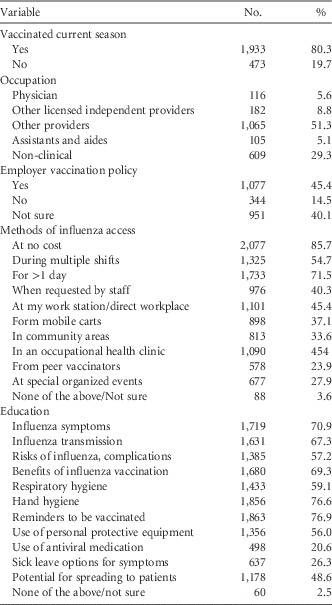
Employees were also asked “Does your employer have any policy concerning influenza vaccination of employees?” with “yes,” “no,” or “not sure” as possible responses. This item was used as an indicator of employee awareness of organizational policy. Access to influenza vaccination was assessed using the question: “During this influenza season, how has your employer made influenza vaccination available where you work?” Respondents could select among 11 different local practices designed to increase vaccine access (Table 1). All potential response options were derived from the original CDC survey instrument. To assess education efforts, we used responses to the question “During this influenza season, did your employer communicate or display information about any of the following topics?” Respondents could select multiple options from 11 common elements included in educational campaigns promoting vaccination. For both access and education, we summed the number of items a respondent indicated as being present. We created quartiles based on the total number of access and/or education practices a respondent indicated were in place at their worksite. For the access question, quartiles consisted of valid responses of ≤2, 3–4, 5–6, and ≥7. For the education question, quartiles approximating an equal distribution among respondents were also created: ≤3, 4–7, 8–10, and ≥11.
Measures of Frequency of Influenza Vaccination Acceptance and Distribution of Characteristics of Respondents in a National Random Sample of VHA Healthcare Personnel

Statistical Analysis
Receipt of vaccination was regressed on responses to the policy question, access quartile score, and education quartile score in bivariate and multivariate logistic models. Multivariate models were applied in analyses of all respondents and of individual occupational groups. SAS 9.2 was used for the analyses (Cary, NC).
RESULTS
Of the 14,392 participants who received the survey at their e-mail addresses, 2,504 (17.4%) responded. The overall reported vaccination rate among survey participants was 80.3%. Significant differences were observed among professional groups, with self-reported rates (from highest to lowest) among physicians (95.6%), other licensed independent providers (88.3%), other licensed or certified providers who do not practice independently (81.2%), assistants and aides (79.0%), and nonclinical staff (80.7%). Table 1 provides frequency response counts among other questions asked on the survey.
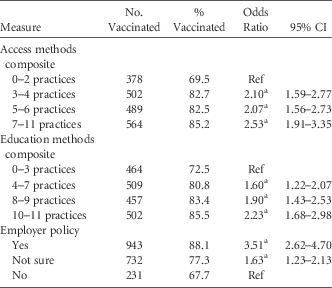
We next examined bivariate models of the influence of access, education efforts, and awareness of employer policy (Table 2). Respondents reporting 2 or fewer access options received influenza vaccination less (69.5%) than those with ≥3 access options (82.7%). Respondents who reported fewer informational activities at their facility were less likely to be vaccinated than those reporting 4 or more such activities (72.5% vs 80.8%, respectively). Respondents who believed their facility lacked a vaccination policy were least likely to be vaccinated than those who were unsure a policy existed and those who believed there was a policy (67.7% vs 77.3% vs 88.1%, respectively). The odds of vaccine acceptance generally increased with intensity of both types of influenza vaccine promotion activities (access and education).
Vaccination Receipt and Association With Access, Education, and Employer Policy

NOTE. CI, confidence interval.
a P<.05.
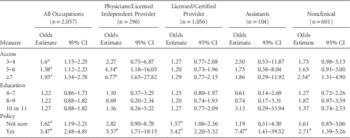
In the multivariate logistic regression models (Table 3), among all respondents, those with more options for access to vaccination reported a greater likelihood of receiving it. Significantly different odds ratios were 1.61, 1.58, and 1.93 comparing the 3 higher quartiles of access to the lowest quartiles, respectively. Higher levels of employer education efforts were positively but nonsignificantly associated with vaccine receipt. For individual occupational categories, access was significantly associated with vaccine receipt by physicians and nonclinical staff; respondents with ≥7 methods of accessing vaccination were significantly more likely to report being vaccinated.
Multivariate Logistic Regression Results for Vaccination Receipt Among Healthcare Providers

NOTE. CI, confidence interval.
a P<.05.
Perceived employer policy was the strongest predictor of vaccine acceptance in the multivariate model. Compared to employees who believed that the facility had no influenza vaccination policy, individuals who were either unsure whether their facility had a policy or sure that it did had successively higher odds of vaccination (odds ratio [OR], 1.62; 95% confidence interval [CI], 1.19–2.21; and OR, 3.47; 95% CI, 2.48–4.81, respectively). HCW awareness of employer policy was a significant predictor for all occupational groups. Strong effects were seen for individuals reporting their employer had a policy, with odds ratio estimates ranging from 2.71 (for nonclinical staff) to 7.47 (for assistants). In the other licensed/certified provider occupation-specific model, individuals who reported being unsure whether the hospital had a policy also had significantly higher odds ratios than respondents who did not perceive a facility policy (OR, 1.57; 95% CI, 1.06–2.36).
DISCUSSION
Increasing voluntary acceptance of influenza vaccination among US HCWs has proven to be a persistent challenge. Individual and institutional barriers persist even in the face of evidence-based, multipronged influenza campaigns.Reference Talbot, Dellit, Hebden, Sama and Cuny 10 , Reference Rakita, Hagar, Crome and Lammert 11 Prior studies have focused on how promotion campaigns that increase access and HCW education can improve vaccine acceptance.Reference Hirsch, Hodgson and Davey 12 , Reference Chambers, Crowe and Lam 13 An increasing body of evidence demonstrates that mandatory HCW influenza vaccination policies achieve consistently high rates. Less is known about the relationship between understanding of employer policy and vaccine acceptance among HCWs. A limited number of prior studies addressing this topic found low rates of policy awareness and understanding of policy elements among HCWs.Reference Seale, Leask and MacIntye 14 – Reference Maurer, Harris, Black and Euler 16 Our data suggest that increasing HCW awareness of employer policy may be an important, and frequently missed, target for seasonal influenza vaccination campaigns.
The HCW influenza vaccination rate has been used as a measure of both patient safety and quality of occupational health care. The VHA has made HCW influenza vaccination a healthcare system priority, although not mandatory. The VHA national policy encourages vaccination of all HCWs with the goal of reaching the Healthy People 2020 target of 90%. 17 This policy is also consistent with The Joint Commission, the US Department of Health and Human Services (HHS), the National Vaccine Advisory Committee (NVAC), and the National Quality Forum (NQF) HCW influenza vaccination guidance. The importance of HCW influenza vaccination to the VHA patient care mission has been communicated through multiple channels: in national policy, in memos from leadership, and in other communications efforts. At VHA facilities, there has been long-standing local investment in multifaceted campaigns to promote access, education, and uptake of influenza vaccination among staff and patients. Influenza vaccination is available free of charge to HCWs at all VHA facilities, consistent with Affordable Care Act and The Joint Commission requirements. Despite this concerted effort, HCW influenza vaccination coverage has remained quite variable across facilities and rarely approached 90%.
To better understand the reasons for this underachievement and to explore potential remedies, we aimed to document variation and identify predictors of vaccine acceptance in a national, random sample of VHA HCW. We focused on how specific influenza campaign promotion activities (access, education) and employer policy awareness predict vaccination acceptance. The results of this investigation provide insight into the impact of these organizational efforts on the awareness and behaviors of frontline VHA staff/employees that are associated with influenza vaccine acceptance.
In the current study, factors facilitating influenza vaccine acceptance are similar to those reported in the literature. For example, education and ease of access are the 2 most common influenza vaccine campaign components seen in hospital settingsReference Koh and Gordon 1 , Reference Lam, Chambers, MacDougall and McCarthy 4 ; this was true for the VHA as well. Occupational variation in vaccine acceptance was similar to that seen in other settings.Reference Riphagen-Dalhuisen, Gefenaite and Hak 7 , Reference Hollmeyer, Hayden, Poland and Buchholz 18
In this study, the category of HCW position was highly predictive of vaccine acceptance. Providers with independent clinical practice authority (ie, physicians, nurse practitioners, psychologists) reported the highest rates of vaccination, and acceptance progressively declined with decreasing independence and practice oversight requirements (ie, licensing, certification). This finding suggests that perceived accountability for patient outcomes (and not merely degree of education or professional training) may be an important predictor of influenza vaccine acceptance among HCW. Furthermore, providers with greater autonomy and prior education may be more familiar with vaccine safety and effectiveness data as well as the importance of vaccination as a part of patient safety. Bivariate tests showed a dose–response trend between intensity of facility promotion activities (both access and educational) and increased HCW acceptance rates. In multivariate analyses, access remained a statistically significant predictor while educational efforts did not. This finding is consistent with earlier work showing that education alone is a weakly effective intervention.Reference Lam, Chambers, MacDougall and McCarthy 4 , Reference Modak, Parris, Dilisi and Premkumar 19 , Reference Llupià, Mena, Olivé and Quesada 20 Access, particularly availability on more than 1 occasion, is a consistent predictor of influenza vaccine acceptance across studies and settings for both patients and HCWs.Reference Lam, Chambers, MacDougall and McCarthy 4 , Reference Razouki, Knighton and Martinello 21 Prior publications from the VHA have also shown that greater resources and leadership attention directed toward influenza vaccination was correlated with higher rates of acceptance.Reference Razouki, Knighton and Martinello 21 , Reference Schult, Awosika and Hodgson 22
In all models, awareness of employer policy regarding influenza vaccination of HCWs was the strongest predictor of vaccine acceptance; this observation was consistent with prior findings.Reference Hollmeyer, Hayden, Poland and Buchholz 18 In this study, the mandatory versus nonmandatory nature of the policy in individual facilities was not specified, though no facility had a policy of mandated HCW influenza vaccination during the 2015–2016 season. However, the overall vaccination rate among HCWs who were aware that a policy was in place was 88.1% compared with 67.7% among respondents who perceived no employer policy. Other work has also shown a positive association between HCW influenza vaccination receipt and its priority in the view of leadership.Reference Razouki, Knighton and Martinello 21 , Reference Ajenjo, Woeltje, Babcock, Gemeinhart, Jones and Fraser 23 , Reference Sartor, Tissot-Dupont, Zandotti, Martin, Roques and Drancourt 24 Taken together, the findings from this study suggest that HCW awareness of the importance of influenza vaccination to patients and their employer may drive acceptance. The importance of policy understanding versus mandates or consequences is not well understood. Accurate knowledge of policy may reflect either or both effective leadership, education, and campaign marketing efforts directed toward HCWs.
The strengths of this study include a large sample size (N>2,400) and capture of respondents representing all 140 major VA medical centers. The sample is diverse geographically and by occupation. Thus, while the findings may not be representative of individual VA medical facilities, the aggregate national data are of value. Additionally, these results can be compared to the national CDC survey and similar studies that also use voluntary survey methodology to assess influenza vaccination coverage. For example, the overall percentage of respondents reporting receipt and the occupational distribution in this study are reassuringly consistent with other studies of US HCWs in facilities without mandates.Reference Black, Yue and Ball 3
This study has several limitations. The response rate was low (17.4%). Due to the voluntary, anonymous nature of the survey, the potential for selection bias was significant. Analysis of VHA administrative data showed a lower percentage of HCW received vaccinations in house (at their medical facilities) compared to survey findings. VHA employees who accepted voluntary influenza vaccination may have been more likely to participate in our survey, compared to those who refuse vaccination, thus biasing results toward higher vaccination acceptance. VHA employees are surveyed on a regular basis, as both federal and healthcare employees.Reference Osatuke, Draime and Moore 8 Individuals who respond to surveys as a matter of habit in general may be overrepresented in this study. The retrospective design relied on individual recollection, making it impossible to establish causality. The data on facility campaign activities (access, education) were entirely self-reported. The survey instrument included only 1 item from the annual CDC survey assessing presence or absence of employer policy. Within a national, federal healthcare system, the term “employer” is subject to interpretation. Specifically, we did not assess who individual VHA HCWs perceive as a definitive source of employer policy (federal government, VISN, local facility or local supervisors). This policy awareness question also did not evaluate respondents’ knowledge of policy details or identify specific consequences of noncompliance. As a result, it is not possible to know whether respondents assumed any existing policy was mandatory. These questions warrant further study to assess VHA HCW’s specific knowledge of employer policy and consequences.
Quality, safety, and value are the dominant priorities of most healthcare organizations, particularly with passage of the Affordable Care Act. This cultural shift focuses providers on how their choices impact quality and safety with every patient encounter. HCW influenza vaccination has become a prominent part of this same larger conversation. A similar large panel survey of US HCWs found that slightly more than a third (34%) of respondents believed that vaccination did not offer protection to their contacts. Maurer et alReference Maurer, Harris, Black and Euler 16 have suggested that raising awareness of influenza vaccination as a patient safety issue could further increase support for HCW vaccination requirements. Consistent marketing and communication of healthcare system policy on HCW influenza vaccination and its relationship to patient safety may be an important facilitator of vaccine acceptance. Many healthcare facilities already have significant investments and expertise in social marketing to both patients and employees. Local influenza campaigns should include specific messaging to improve HCW awareness and knowledge of employer policy and points of access. Even without a mandate, ensuring that staff understand the importance of HCW influenza vaccination as a matter of patient safety and organizational priority may improve vaccine acceptance.
ACKNOWLEDGMENTS
The authors would like to thank Dr Carla Black with the CDC’s National Center for Immunization and Respiratory Diseases for her collaboration on the project design.
Financial support: This work was prepared independently, without financial support. The views expressed in this manuscript are those of the authors, and do not necessarily reflect the position or policy of the Department of Veterans Affairs or the United States government.
Potential conflicts of interest: All authors report no conflicts of interest relevant to this article.
Disclaimer: The views expressed in this article are those of the authors and do not necessarily reflect the position or policy of the Department of Veterans Affairs or the United States government.