Introduction
Candida pelliculosa, teleomorph name Wickerhamomyces anomalus,Reference Spruijtenburg, Rudramurthy and Meijer1 is a fungus capable of causing serious infections including candidemia. It is found in the environment, including soil and wastewater.Reference Riley, Haridas and Wolfe2 C. pelliculosa can cause healthcare-associated infections (HAI) in newborns and severely immunocompromised adult patients.Reference Spruijtenburg, Rudramurthy and Meijer1,Reference Chan, Cartwright, Reddy, Kraft and Wang3,Reference Chakrabarti, Singh and Narang4
While healthcare-associated fungemia outbreaks caused by C. pelliculosa are rare, they are increasingly reported. These outbreaks have primarily occurred in neonatal intensive care units (NICUs)Reference Spruijtenburg, Rudramurthy and Meijer1 and have been linked to insufficient infection prevention and control (IPC) practices.Reference Spruijtenburg, Rudramurthy and Meijer1, Reference Riley, Haridas and Wolfe2
Cases of osteoarticular fungal infection related to injection with contaminated medicine have previously been documented.Reference Litvintseva, Hurst and Gade6 For example, a U.S. outbreak in 2012 identified 35 patients who developed osteoarticular infection after receiving injections with methylprednisolone contaminated with Exserohilum rostratum.Reference Kauffman and Malani7 While osteoarticular infections caused by C. pelliculosa are rare, cases have been reported.Reference Song, Park and Byun5 Studies assessing the genomes and phylogenetic structure of clinical isolates in outbreak settings are limited.Reference Spruijtenburg, Rudramurthy and Meijer1
Here, we describe the public health response and genomic assessment of a cluster of C. pelliculosa cases among patients who received osteoarticular injections.
Materials and methods
Epidemiological and field investigation
In June 2022, the Michigan Department of Health and Human Services (MDHHS) was notified of a cluster of C. pelliculosa joint infection cases following osteoarticular steroid injections at an outpatient facility. Investigators defined a case of C. pelliculosa infection as a positive culture grown from a knee joint sample following osteoarticular injections between February and July 2022. Two cases were confirmed by positive culture of C. pelicullosa from joint fluid. Suspected cases were defined as patients reporting inflammatory or septic arthritis following osteoarticular injections, but for whom fungal cultures were negative or not obtained.
MDHHS performed an onsite site visit at the affected facility in July. Medical chart abstraction was performed for all cases to collect information on demographics, injection procedures, symptoms, laboratory testing, and treatment and outcomes. A team of three infection preventionists from MDHHS performed Infection Control Assessment and Response (ICAR) interviews and observations of IPC practices with five clinic staff, focusing on medication preparation and storage and procedures for joint injections.
Genomic investigation
Four C. pelliculosa isolates were available from clinical specimens collected between June and July. Three isolates were from two patients, while the fourth was an unrelated isolate from the same Michigan facility, included for comparison. These isolates were sent to the U.S. CDC for species confirmation and whole-genome sequencing (WGS).
In addition, eight C. pelliculosa isolates from the Mycotic Diseases Branch fungal collection were randomly selected for comparison. Total DNA was sequenced on the Illumina MiSeq platform.
Data analysis
Sequencing data were analyzed using MycoSNP-nf v1.5 workflow as described by Bagal et. al.Reference Bagal, Phan and Welsh8 (https://github.com/CDCgov/mycosnp-nf) with the added parameter–ploidy 2 for analysis of diploid organisms. An in-house code was also used to calculate SNP distances and infer phylogenetic relationships without ignoring heterozygous SNP sites (Supplemental Material).
Human subjects
This activity was reviewed by the CDC and was conducted consistent with applicable federal law and CDC policy (see e.g., 45 CFR part 46, 21 CFR part 56; 42 USC §241(d); 5 USC §552a; 44 USC §3501 et seq).
Results
Epidemiological and field investigation
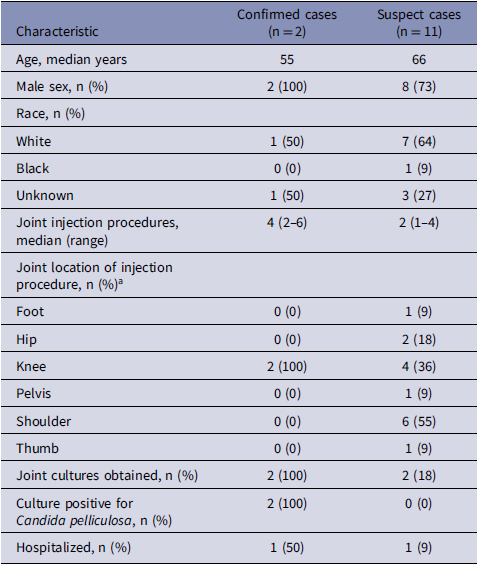
During February – July 2022, thirteen patients reported inflammatory or septic arthritis following osteoarticular injections (Table 1). Culture specimens were not available for most patients. Two patients had synovial fluid cultures positive for C. pelliculosa, and one patient had a shoulder tissue culture positive for Cutibacterium acnes, no other organisms were recovered. The first confirmed case patient was a 57-year-old man with a history of bilateral knee osteoarthritis who had received multiple osteoarticular injections and therapeutic arthrocentesis at the index outpatient facility. Two positive cultures for Candida pelliculosa (B23226 and B23228) were obtained from both knee joints, collected 20 days apart.
Clinical and demographic characteristics of suspected and confirmed C. pelliculosa joint infection cases

Table 1. Long description
A table comparing clinical and demographic characteristics of suspected and confirmed C. pelliculosa joint infection cases. The table has 12 rows and 3 columns. The columns are labeled Characteristic, Confirmed cases (n = 2), and Suspect cases (n = 11). The rows include Age, median years; Male sex, n (%); Race, n (%); Joint injection procedures, median (range); Joint location of injection procedure, n (%); Joint cultures obtained, n (%); Culture positive for Candida pelliculosa, n (%); and Hospitalized, n (%). Row 1: Age, median years, Confirmed cases: 55, Suspect cases: 66. Row 2: Male sex, n (%), Confirmed cases: 2 (100), Suspect cases: 8 (73). Row 3: Race, n (%), Confirmed cases: White 1 (50), Black 0 (0), Unknown 1 (50), Suspect cases: White 7 (64), Black 1 (9), Unknown 3 (27). Row 4: Joint injection procedures, median (range), Confirmed cases: 4 (2-6), Suspect cases: 2 (1-4). Row 5: Joint location of injection procedure, n (%), Confirmed cases: Foot 0 (0), Hip 0 (0), Knee 2 (100), Pelvis 0 (0), Shoulder 0 (0), Thumb 0 (0), Suspect cases: Foot 1 (9), Hip 2 (18), Knee 4 (36), Pelvis 1 (9), Shoulder 6 (55), Thumb 1 (9). Row 6: Joint cultures obtained, n (%), Confirmed cases: 2 (100), Suspect cases: 2 (18). Row 7: Culture positive for Candida pelliculosa, n (%), Confirmed cases: 2 (100), Suspect cases: 0 (0). Row 8: Hospitalized, n (%), Confirmed cases: 1 (50), Suspect cases: 1 (9).
a Case patients may have had injection procedures in more than one location, therefore joint locations totals reflect >100%.
The second confirmed case patient was a 53-year-old man with history of left knee osteoarthritis who had received two osteoarticular injections at the index facility and subsequently had C. pelliculosa (B23225) isolated from the left knee joint. The first patient’s second isolate and the second patient’s only isolate were collected 6 days apart. Their joint injection procedures occur in close temporal proximity to the collection of samples (less than 40 days a part). The clinic physician initiated empiric antifungal treatment for all symptomatic patients. At the end of the outbreak period, the majority of patients had moderate to complete resolution of symptoms, while a few patients continued to receive follow-up at the clinic.
The site visit team identified gaps in injection-safety IPC practices. The medication preparation area was shared with the lab processing area suggesting overlap of clean and dirty areas. Providers were using single-dose vials as multidose (e.g., sodium bicarbonate vials) that were stored at room temperature and used throughout the day, sterile water bags to prepare medications for multiple patients, and the same syringe with different needles to pull medications from multidose vials.
Genomic sequencing analysis
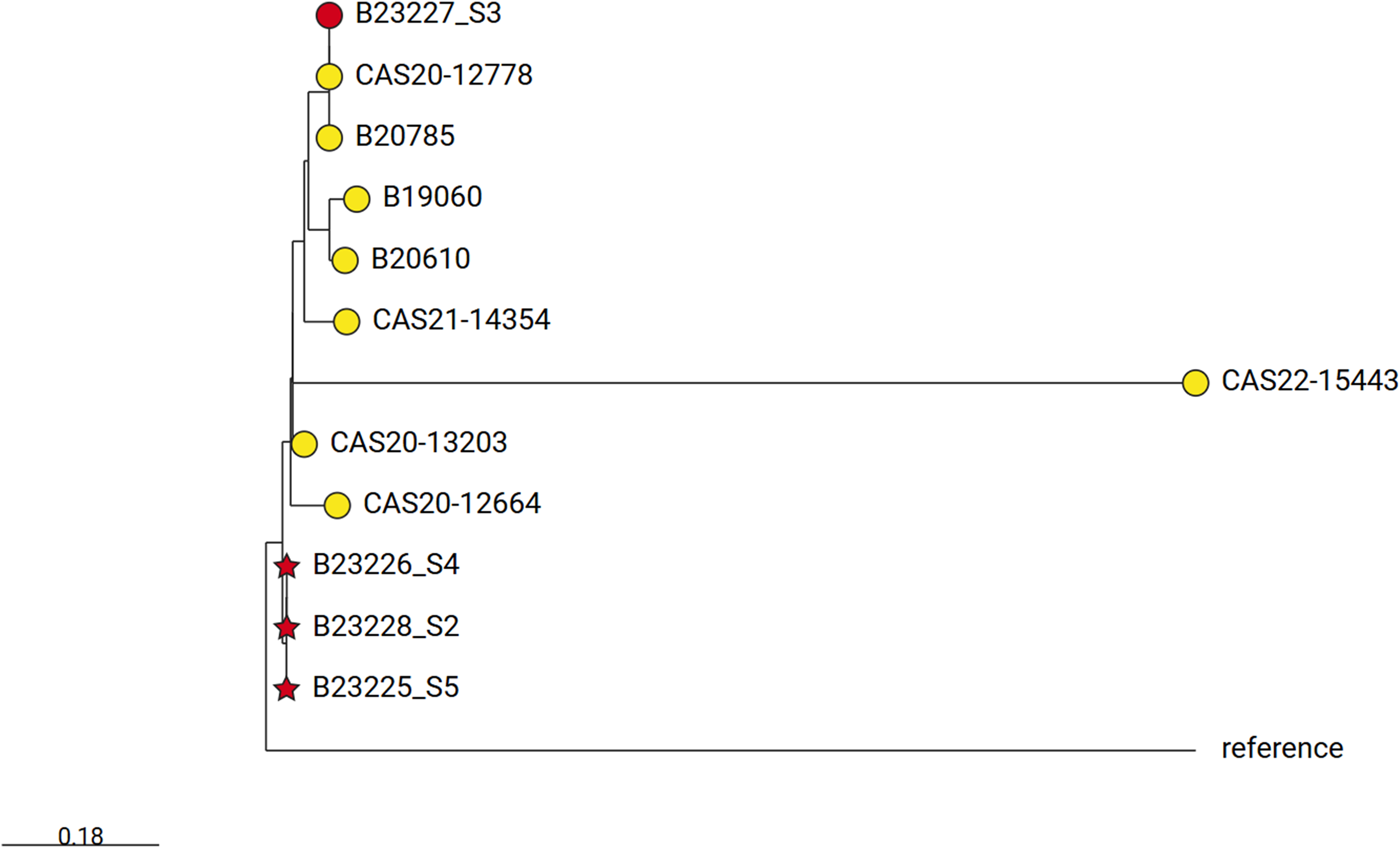
The phylogenetic analysis conducted with MycoSNP-nf showed that three C. pelliculosa isolates from the two confirmed case-patients clustered together (Figure 1), with a genetic distance ranging from 2 to 19 single nucleotide polymorphisms (SNPs). This cluster included isolates B23226 and B23228 that were from the same patient taken 20 days apart, which were 2 SNPs apart. The additional isolate from another Michigan facility (B23227) was 3,624 to 3,832 SNPs apart from the other three isolates from the patients who received osteoarticular injections; this single isolate clustered with randomly selected C. pelliculosa isolates from other US states (Figure 1).
Maximum likelihood tree. Isolates from patient with osteoarticular infections represented as red stars and one additional isolate from same facility in Michigan as red circle. Isolates from other US states included for comparison are represented as yellow circles. Pairwise distances are based on the Wickerhamomyces anomalus NRRL Y-366–8 (C. pelliculosa) reference genome GCF_001661255.1 using Fasttree. Tree visualization performed with Microreact v. 252.

Discussion
Three lines of evidence—epidemiologic data, IPC practice observations, and genomic analysis—suggest a common source for the cluster of C. pelliculosa cases. Epidemiologic data identified patients with a common procedure and medications. Gaps in IPC related to medication preparation were observed during the site visit, and WGS indicated the three isolates from two patients were genetically closely related.
A prompt public health response mitigated further infections through improvements in IPC practices and procuring new medications for osteoarticular injections. Recommendations were made in real-time, and the facility received an infection control assessment and response (ICAR) action plan. The facility proactively stopped using their stock of osteoarticular medications, procured new products, and ceased practice of using single-dose vials as multidose. The last report of inflammatory or septic arthritis symptom onset was mid-May with a procedure date in April 2022. There were no additional cases after the site visit and changes made in July.
Good IPC practices are critical to preventing HAI infections caused by C. pelliculosa.Reference Zhang, Cao, Li, Chen, Ding and Liu9 In this cluster investigation, multiuse of single-use medication and syringes and preparing medication in a dirty area likely led to contamination of osteoarticular drug for multiple patients during osteoarticular injections. IPC interventions such as preparing medications in a designated clean area; using needles and syringes for one medication only, using manufactured prefilled syringes; entering medication containers with a new needle and a new syringe, even when obtaining additional doses for the same patient; and ensuring single-dose or single-use vials, ampules, and bags or bottles of parenteral solution are used for one patient only can prevent infections and save lives (https://www.cdc.gov/infectioncontrol/guidelines/core-practices/index.html).
WGS findings revealed low diversity within a patient (2 SNPs) and across linked case patients (17–19 SNPs). A recent study on C. pelliculosa outbreaks in India, which included WGS results for 11 isolates, showed a maximum of 8 SNPs apart among cluster isolatesReference Spruijtenburg, Rudramurthy and Meijer1 indicating low diversity. These cases were connected by a common exposure to injectable medicines, akin to a previous meningitis outbreak caused be Exserohilum rostratum, where WGS revealed nearly identical genomes.Reference Litvintseva, Hurst and Gade6 We hypothesize C. pelliculosa could have propagated in the medication vials, similar to other fungal outbreaks related to medications.Reference Litvintseva, Hurst and Gade6,Reference Vasquez, Zavasky and Chow10
Our study has limitations, including difficulty of comparing SNPs distances due to variations in bioinformatic methods and the low number of available clinical isolates (n = 3); isolates from the medication vials and from the hospital environmental were not obtained.
We report two osteoarticular infections in a facility with lapses in IPC practices, suggesting extrinsically contaminated medication as the source. WGS showed low genetic diversity among cluster isolates supporting the hypothesis of a common point source infection. Future investigations of C. pelliculosa clusters may benefit from combined epidemiological and genomic approaches.
Supplementary material
The supplementary material for this article can be found at https://doi.org/10.1017/ice.2026.10438.
Data availability statement
Genomic sequences underlying this study were deposited in the National Center for Biotechnology Information (NCBI) Sequence Read Archive (SRA) database (BioProject accession: PRJNA1031671).
Acknowledgements
The authors would like to thank all the staff of Michigan Department of Health and Human Services Infection Prevention Unit. We also thank to Bridgette Blasingame from Mycotic Diseases branch, CDC. We acknowledge Oak Ridge Institute for Science and Education (ORISE) for financial support for EM.
Competing interests
All authors: No potential conflicts of interest
Disclaimer
The findings and conclusions in this report are those of the authors and do not necessarily represent the official position of the Centers for Disease Control and Prevention. Use of trade names is for identification only and does not imply endorsement.