Introduction
The use of herbicides during the last eight decades created a strong selection pressure for the evolution of herbicide-resistant weed biotypes, which reduced the efficacy of herbicide treatments. More than 500 unique cases of herbicide resistance have been documented worldwide within 256 species (Heap Reference Heap2019). Italian ryegrass is one of the most troublesome resistant weeds because of the high frequency of established multiple- and cross-resistant populations (Brunharo and Hanson Reference Brunharo and Hanson2018) and physiological characteristics such as a high out-crossing rate, which allows the rapid spread of some weedy traits (Giddings Reference Giddings2000; Karn and Jasieniuk Reference Karn and Jasieniuk2017; Meyers Reference Meyers2015).
Once herbicide-resistant Italian ryegrass populations become established, the management and control of these populations can be challenging. Italian ryegrass can produce between 2,000 and 6,000 seeds per plant, causing a large increase to the seed bank and intensifying the problem over time (Bagavathiannan and Norsworthy Reference Bagavathiannan and Norsworthy2012; Steadman et al. Reference Steadman, Ellery, Chapman, Moore and Turner2004; Young and Whitesides Reference Young and Whitesides1987).
Weed seed banks can be one of the major sources of weed persistence (Cousens and Mortimer Reference Cousens and Mortimer1995; Davis Reference Davis2006); thus, control and management of the seed bank can be a positive way to reduce herbicide-resistant biotypes in a field. Some management techniques that can minimize and reduce the size of a seed bank include crop rotation and tillage (Bagavathiannan and Norsworthy Reference Bagavathiannan and Norsworthy2012; Buhler et al. Reference Buhler, Hartzler and Forcella1997; Davis Reference Davis2006). Managing late-season escapes in crops to prevent seed production could reduce the weed seed bank.
Previous research on weed species in rangeland areas showed that application of synthetic auxin herbicides can affect seed viability and can be used as a management tool to reduce the seed production of invasive annual grasses such as downy brome (Bromus tectorum L.) (Rinella et al. Reference Rinella, Haferkamp, Masters, Muscha, Bellows and Vermeire2010, Reference Rinella, Masters and Bellows2013). These herbicides kill dicotyledonous plants by generating an auxin overdose that leads to an alteration of the cytoskeleton, causing epinasty and creating an environment vulnerable to the reactive oxygen species (ROS) generated by the increased auxin level (Christoffoleti et al. Reference Christoffoleti, Figueiredo, dePeres, Nissen and Gaines2015).
This symptomology is not usually observed in mocotyledonous plants, because abscisic acid (ABA), ethylene, and production of ROS have been shown not to be lethal in grasses (Christoffoleti et al. Reference Christoffoleti, Figueiredo, dePeres, Nissen and Gaines2015; Grossmann Reference Grossmann2003, Reference Grossmann2010). However, the auxinic herbicide quinclorac controls some grass species such as Echinochloa, Digitaria, and Brachiaria (Grossmann Reference Grossmann2010), indicating a possible variation among grass species in response to auxinic herbicides. Synthetic auxin herbicides can sterilize seeds of grass species such as wheat (Triticum spp.) and corn (Zea mays) when applied to these crops at advanced growth stages (Friesen et al. Reference Friesen, Born, Keys, Dryden, Molberg and Siemens1968; Rinella et al. Reference Rinella, Kells and Ward2001, Reference Rinella, Masters and Bellows2013; Sikkema et al. Reference Sikkema, Brown, Shropshire and Soltani2007). Providing another indication that grass species can vary in their response is previous research showing that perennial grasses were more tolerant to late applications of synthetic auxins (Rinella et al. Reference Rinella, Masters and Bellows2013; Sheley et al. Reference Sheley, Duncan, Halstvedt and Jacobs2000; Shinn and Thill Reference Shinn and Thill2004).
Hormonal balance and ratios are crucial during seed development. Previous research with Arabidopsis thaliana showed that ABA plays an important role in seed development, dormancy, and the formation of endosperm. The ABA present in the seed is synthesized in the maternal plant and zygotic tissue, indicating that ABA production in the maternal plant during seed development can influence seed development (Kanno et al. Reference Kanno, Jikumaru, Hanada, Nambara, Abrams, Kamiya and Seo2010; Rock and Quatrano Reference Rock, Quatrano and Davies1995). Previous research indicated that alterations in activity of the auxin response factor 2 gene (ARF2) can affect the seed size in Arabidopsis thaliana (Schruff et al. Reference Schruff, Spielman, Tiwari, Adams, Fenby and Scott2006).
Grass seed growers in Oregon have raised questions regarding the control of late-season escapes of Italian ryegrass in tall fescue grown for seed. Because previous research showed that perennial grasses are less susceptible than annual grasses to synthetic auxin treatments and can vary within and among species, we hypothesized that use of a synthetic auxin herbicide applied late in the growing season could reduce the seed viability of Italian ryegrass and therefore the weed seed bank without reducing viability of tall fescue seeds.
The objectives of this study were to evaluate the effects of synthetic auxin herbicides applied at different growth stages on seed viability of Italian ryegrass biotypes and tall fescue.
Materials and Methods
Greenhouse Experiments
The experiments were conducted in 2017 and 2018 in greenhouses located at Corvallis, OR (44.34037°N, 123.1710.3°W). Four greenhouses were used to separate Italian ryegrass biotypes to prevent cross pollination and to produce seeds for viability comparison. The greenhouse was set at a photoperiod of 16 h using supplemental light with 700 µmol m−2 s−1 intensity and a temperature range between 18 and 21 C.
Four biotypes of Italian ryegrass were used. The biotypes came from different areas in the Willamette Valley in western Oregon and had different herbicide resistance traits: EPSPS inhibitor resistant (‘PR’) (44.57211°N, 122.53016°W), ACCase inhibitor resistant (‘RD’) (45.28589°N, 123.03204°W), ALS inhibitor resistant (‘TS’) (44.43374°N, 122.50299°W), and a biotype susceptible to those three modes of action (‘FG’) (45.33129°N, 123.06555°W).
Seeds of each population were germinated in four 11- by 11- by 2.8-cm germination boxes (156C container; Hoffman Manufacturing Inc., Corvallis, OR) in a growth chamber with a photoperiod of 16 h of light and a light/dark temperature regime of 21 C/10 C in May 2017 for the first experiment and January 2018 for the second experiment. Seedlings were transplanted 10 d after germination into 15.24 by 12.70-cm pots and kept in the greenhouse. Plants were watered daily, and 15 g of a 24-8-16 fertilizer (The Scotts Company LLC, 14111 Scottslawn Road, Marysville, OH) was diluted in 3.6 L of water and evenly distributed over the pots once a week. A complete randomized block design was used in both years. Five blocks were used, and each block consisted of six pots with individual Italian ryegrass plants.
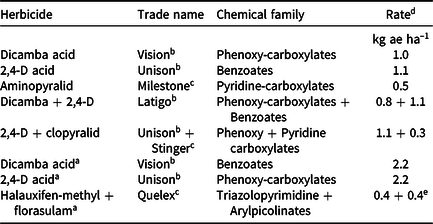
Eight synthetic auxin herbicide (WSSA Group 4) treatments were sprayed at two different growth stages (BBCH 49 boot stage and BBCH 59 anthesis stage) (Table 1). The higher rates of dicamba, 2,4-D, and the halauxifen-methyl + florasulam treatments were sprayed only in the 2018 trial.
Herbicides applied in greenhouse and field experiments.

a Applied only on 2018 trials.
b Helena Agri-Enterprises, LLC, Collierville, TN. https://helenaagri.com.
c Corteva Agriscience, Wilmington, DE. https://www.corteva.com
d All treatments sprayed with non-ionic surfactant 0.25% v/v.
e kg ai ha−1.
Each plant was sprayed using an air cabinet sprayer (Generation III Spray Chamber; De Vries Manufacturing, 86956 State HWY 251, Hollandale, MN) set to deliver 187 L ha−1 with a flat-fan spray Teejet nozzle 8004. Nozzles were set at 63.5 cm above the target. After the application, plants were allowed to mature, and seeds were harvested when seed moisture was 45% determined according to Silberstein et al. (Reference Silberstein, Mellbye, Chastain and Young2010).
Field Experiments
Field trials were conducted during 2017 and 2018 at multiple locations. The first study was conducted at the Hyslop Experimental Farm at Oregon State University (44.37571°N, 123.11381°W), where two study sites were utilized between February and July 2017. One site was planted with Italian ryegrass (Florida 80 cultivar; NJAES/Rutgers University), and the other was an established 2-yr-old turf-type tall fescue (Rebel XLR cultivar; NJAES/Rutgers University). Plots were 3.0 by 10.4 m. The soil is an Amity silt loam with 3.0% organic matter and pH of 6.2. Average annual precipitation was 1,092 mm with an average annual temperature of 12 C.
A second study was conducted between February and June 2017 in a 3-yr-old tall fescue field (AST 5112 cultivar; Allied Seed LLC, 9311 Highway 45, Nampa, ID) infested with Italian ryegrass located north of Dallas, OR (45.02543°N, 123.19456°W). Plots were 3.0 by 10.4 m. The soil was a Dayton silt loam with 3.3% organic matter and pH of 5.9. Average annual precipitation ranged from 1,016 to 1,143 mm with an average temperature of 12 C.
The third study was conducted at Schmidt Experimental Farm at Oregon State University (44.37383°N, 123.12453°W) between March and July of 2018 in two adjacent areas. One area contained a 3-yr-old tall fescue (Rebel XLR cultivar; NJAES/Rutgers University) stand, and the other area was recently planted with Italian ryegrass (Florida 80; NJAES/Rutgers University). Plots were 1.8 by 3.7 m. The soil was a Woodburn silt loam with 4.0% of organic matter and pH of 5.7. The average annual precipitation was 1,092 mm with an average annual temperature of 12 C.
The fourth study was conducted between April and July 2018 in a 4-yr-old tall fescue (Penn RK4 cultivar; Pennington Seed, Inc., 270 Hansard Avenue, Lebanon, OR) field infested with Italian ryegrass near Gaston, OR (45.27532°N, 123.08439°W). Plots were 1.8 by 3.7 m. The soil was a Helvetia silt loam with 3.5% organic matter and pH of 6.2. The average annual precipitation was 1,143 mm with an average annual temperature of 14 C.
Treatments applied at each field experiment were the same used in the greenhouse trial, with some treatments only applied in the 2018 trials (Table 1). Plants were treated at two growth stages (BBCH 49 boot stage and BBCH 59 anthesis stage). For all field trials nitrogen (40-0-0 fertilizer at 90 kg ha−1), fungicide (Quilt Excel Syngenta Crop Protection, Greensboro, NC), and irrigation were used as needed. Weeds were hand pulled as needed. Seeds were harvested according to optimal moisture as proposed by Silberstein et al. (Reference Silberstein, Mellbye, Chastain and Young2010).
For the Hyslop and Schmidt trials, a strip split randomized block design was used, with herbicides as the primary treatment and growth stage as the secondary treatment. For Gaston and Dallas, a complete randomized block design was used. Four blocks were used for each treatment combination.
Seed Tests
Seed viability and speed of germination were evaluated using a standard seed germination test with four replications (Elias et al. Reference Elias, Copeland, McDonald and Baalbaki2012). In this trial, 100 seeds per replication were placed in standard Petri dishes containing blue blotter paper soaked in distilled water. The Petri dishes were placed in sealed plastic bags to avoid water loss and placed in a germination chamber set with a photoperiod of 16 h with a light intensity of 700 µmol m−2 s−1 and a light/dark temperature regime of 21 C/15C during light and dark periods, respectively. Seeds were kept in the chamber for 14 d, and five germination counts were made (3, 5, 7, 10, and 14 d); seeds that germinated were removed on each count. Seeds were considered germinated if both radicle and coleoptile were visible. After the last count, seeds that did not germinate were tested using tetrazolium to determine seed viability (Elias et al. Reference Elias, Copeland, McDonald and Baalbaki2012). Total viability was the sum of seeds that germinated after each count plus the seeds that were viable in the tetrazolium test.
Seed weight of 1,000 seeds was measured with two subsamples for each replication (greenhouse and field). A seed counter (Old Mill seed counter Model 850-2; International Marketing and Design Corp., 13802 Lookout Road, Suite 200, San Antonio, TX) was used to count the seed samples.
Data Analysis
Because of the differences in experimental design, the Dallas and Gaston trials were analyzed as one group (Trial A) and the Hyslop and Schmidt Farm trials as another group (Trial B). Greenhouse trial data were combined. Before fitting the models, data structure was analyzed for assumptions of normality and homogeneity using diagnostic plots and Levene’s test. Diagnostic plots showed that data were overdispersed with non-normality pattern. Seed viability and weight data were modeled using a generalized linear mixed model via PQL (Penalized Quasi-Likelihood) to account for data overdispersion and non-normality (Bolker Reference Bolker2017), using as fixed effects herbicide treatments, growth stage, and species (field trial) or biotypes (greenhouse trial) and their interactions to explain the response variables. Blocking and year factors, possible variability of growth stage, and species/biotypes were counted as random effects in the model. The data were subjected to an analysis of deviance using a Wald chi-square test type test II procedure, and mean differences were quantified using an HSD Tukey’s test at a 5% significance level.
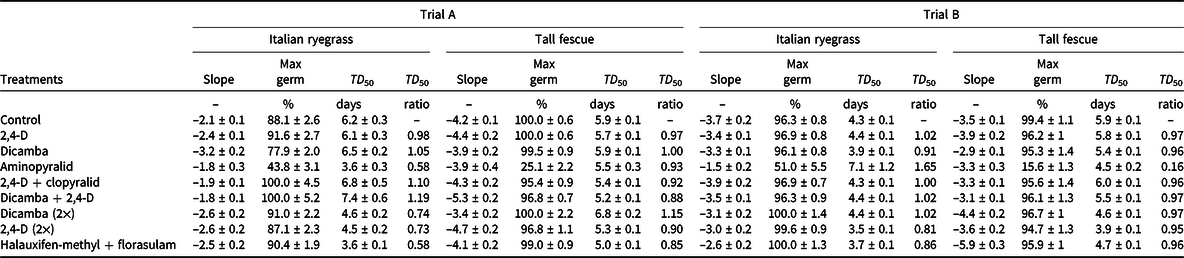
The speed of germination was calculated using the germination data collected from each evaluation day and fitting the data using a three-parameter log-logistic regression (Eq. 1) (Ritz et al. Reference Ritz, Pipper and Streibig2013).
 $${y = c + }{{{GermMax - c}}}\over{{{\rm{1 + }}{{\left( {{x}\over{{T{D_{50}}}}} \right)}^b}}}$$
where y is the response, GermMax refers to the maximum germination, and c refers to the lower limit of the sigmoid curve. TD 50 denotes the time in days for 50% of seed germination, x refers to the time to 50% of the seeds germinated between GermMax and c, and b refers to the relative slope of the curve around TD 50. The ratio of TD 50 of each treatment with the control was used to assess the effects over germination speed. Analyses were conducted using R software (R Core Team 2018) with the following packages: lme4 (Bates et al. Reference Bates, Sarkar, Bates and Matrix2007), MASS (Venables and Ripley Reference Venables and Ripley2002), Multcomp (Hothorn et al. Reference Hothorn, Bretz, Westfall, Heiberger, Schuetzenmeister, Scheibe and Hothorn2016), Tidyverse (Wickham Reference Wickham2017), and drc (Knezevic et al. Reference Knezevic, Streibig and Ritz2007).
Results and Discussion
Greenhouse Study
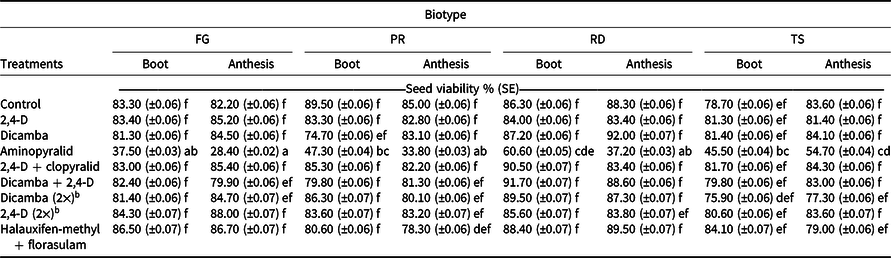
The greenhouse study results indicated that aminopyralid applications reduced viability and seed weight of the different Italian ryegrass biotypes (Table 2 and 3). When averaged over biotypes, the reduction in seed viability caused by aminopyralid was 36% when applied at boot and 48% when applied at anthesis. The FG biotype was the most susceptible to aminopyralid at both growth stages. The RD biotype was the least affected by aminopyralid when it was applied at the boot stage. TS biotype seed viability was less affected by aminopyralid treatments. However, during seed germination at the initiation of this experiment, the biotype TS already showed poor germination compared to the other biotypes. This may be the reason viability reduction effects were not as pronounced for this specific biotype.
Seed viability (%) after synthetic auxin applications to Italian ryegrass biotypes (FG, PR, RD, and TS) at boot and anthesis stages in a greenhouse study.a

a Means in the table followed by the same letter are not significantly different (HSD Tukey P value < 0.05); means were compared within all population and growth stages.
b Abbreviation: 2×, Two times the field rates of 2,4-D and dicamba.
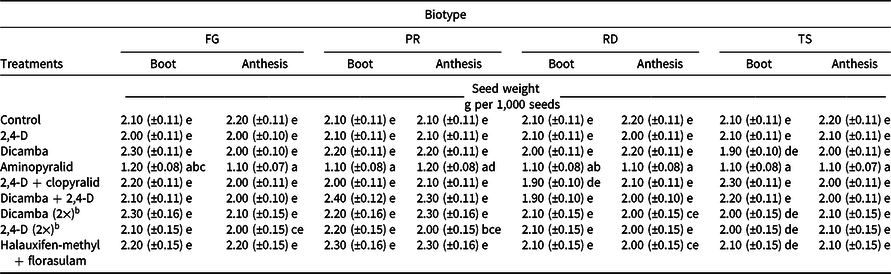
Seed weight (g per 1,000 seeds) after synthetic auxin applications to Italian ryegrass biotypes (FG, PR, RD, and TS) at boot and anthesis stages in a greenhouse study.a

a Means in the table followed by the same letter are not significantly different (HSD Tukey P value < 0.05); means were compared within all population and growth stages.
b Abbreviation: 2×, Two times the field rates of 2,4-D and dicamba.
Seed weight followed a pattern similar to viability, with aminopyralid reducing seed weight. No differences were found between growth stages; seed weight for plants sprayed at boot stage averaged 1.2 g per 1,000 seeds and at anthesis stage 1.1 g per 1,000 seeds, indicating a reduction of 45% and 50%, respectively, compared to the control weight. FG biotype plants had the largest seed weight reduction; however, there were no differences among the other biotypes.
No effects of 2,4-D and dicamba applications were quantified for seed viability and weight. These results are in contrast with previous research that reported effects on seed viability with other grass species such as downy brome (Ball Reference Ball2014; Rinella et al. Reference Rinella, Masters and Bellows2013), where it was documented that benzoate and phenoxy-carboxylate herbicides reduced viability of this species. The same results were not observed with Italian ryegrass in multiple biotypes, strengthening the hypothesis that the effect of synthetic auxin herbicides may vary within grass species and among herbicide chemical families in this herbicide group.
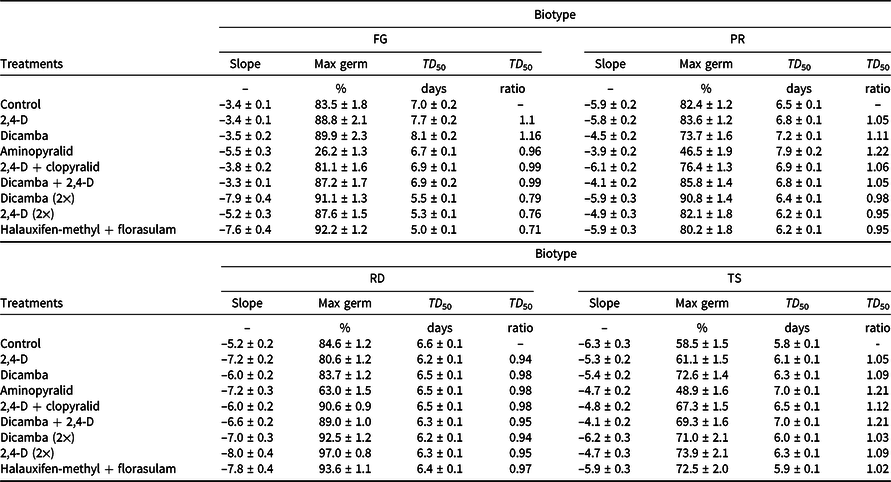
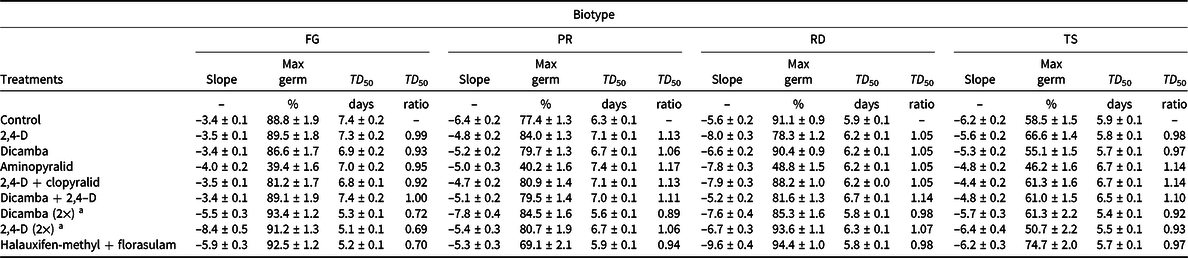
Speed of germination results indicated a variation of response to synthetic auxin herbicides among biotypes ranging from 1 to 2 d (Tables 4 and 5). For the FG biotype, there was an increase in the speed of germination for the treatments 2,4-D (2×), dicamba (2×), and halauxifen-methyl + florasulam when applied at both growth stages. Both PR and TS biotypes had a decrease in speed of germination of 1 to 2 d when aminopyralid was applied at both stages. Some effects of dicamba + 2,4-D and 2,4-D + clopyralid applications were observed. The RD biotype was less affected by all treatments, and 2,4-D + clopyralid applied at anthesis stage was the only treatment that reduced germination speed. Despite some of the effects observed, it is difficult to make inferences regarding the effect of synthetic auxin herbicides on speed of germination and management implications as a result of the lack of uniformity of the effects on the different biotypes.
Parameters of logistic regression and standard errors for the speed of germination test on seeds from the greenhouse trial for each biotype sprayed at boot growth stage.a

a Abbreviations: 2×, Twice the field rates of 2,4-D and dicamba; Max germ, maximum germination after trial period; TD 50, time in days for 50% of seeds to germinate; TD 50 ratio, calculated by dividing each treatment TD 50 by the control TD 50.
Parameters of logistic regression and standard errors for the speed of germination test on seeds from the greenhouse trial for each biotype sprayed at anthesis growth stage.a

a Abbreviations: 2×, Twice the field rates of 2,4-D and dicamba; Max germ, maximum germination after trial period; TD 50, time in days for 50% of seeds to germinate; TD 50 ratio, calculated by dividing each treatment TD 50 by the control TD 50.
Field Study
Despite the differences in experimental design, the results were similar in all field trials. Aminopyralid treatments were the only treatments that reduced seed health (viability and weight), and results were similar to those observed in the greenhouse.
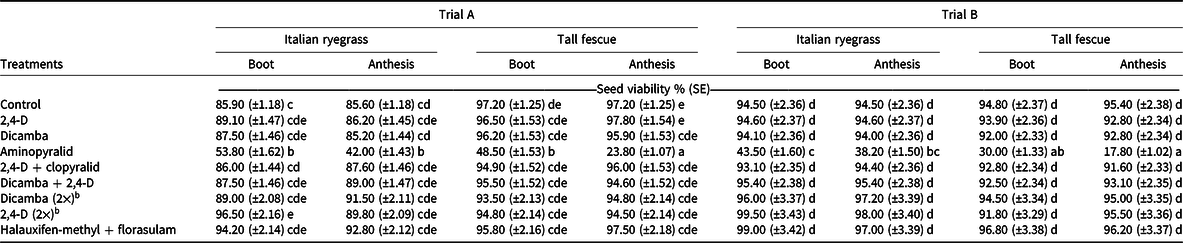
Aminopyralid affected the seed viability and weight of both species (Tables 6 and 7). The average effect of aminopyralid on seed viability was greater in tall fescue than Italian ryegrass in both Trials A and B. Aminopyralid reduced seed viability of Italian ryegrass when applied at boot 46%, whereas at the anthesis stage the reduction was 55%. Conversely, tall fescue had a greater sensitivity to the treatment when applied at anthesis, with an average seed viability reduction of 79% compared with 59% when aminopyralid was sprayed at boot stage.
Seed viability (%) after synthetic auxin applications on Italian ryegrass and tall fescue at boot and anthesis stages in field trials.a

a Means in the table followed by the same letter are not significantly different (HSD Tukey P value < 0.05). Means were compared within the two species and growth stages; each trial was analyzed separately.
b Abbreviation: 2×, Twice the field rates of 2,4-D and dicamba.
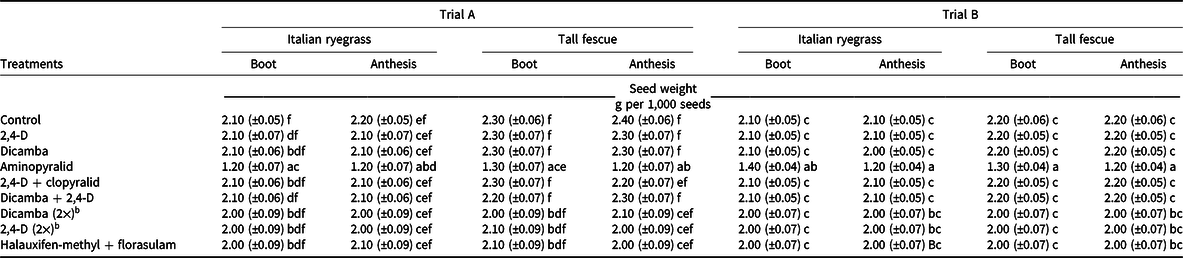
Seed weight (g per 1,000 seeds) after synthetic auxin applications on Italian ryegrass and tall fescue at boot and anthesis stages in field.a

a Means in the table followed by the same letter are not significantly different (HSD Tukey P value < 0.05). Means were compared within the two species and growth stages; each trial was analyzed separately.
b Abbreviation: 2×, Twice the field rates of 2,4-D and dicamba.
Similar results were documented for seed weight reduction with aminopyralid application; however, no difference was seen between species. The average seed weights in Italian ryegrass after application of aminopyralid was 1.20 g per 1,000 seeds at boot stage and 1.10 g per 1,000 seeds at anthesis, indicating reductions in seed weights of 39% and 42%, respectively, when compared to the control. For tall fescue, the average seed weights were 1.25 g per 1,000 seeds at boot and 1.20 g per 1,000 seeds at anthesis, indicating seed weight reductions of 46% and 47% for boot and anthesis when compared to the control, respectively.
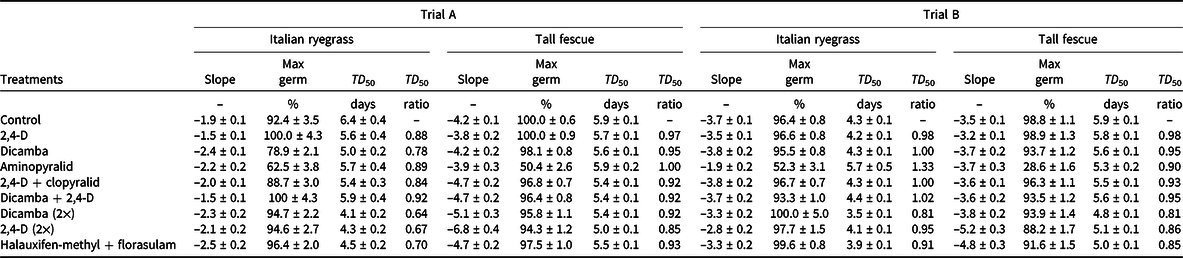
Results for the speed of germination test (Tables 8 and 9) showed some similarities to the ones observed in the greenhouse study. The synthetic auxin herbicide aminopyralid affected the speed of germination by 1 or 2 d; however, these results were not different among the treatments, nor were they consistent among the different trials.
Parameters of logistic regression and standard errors for the speed of germination test on seeds from the field trial for each population sprayed at boot growth stage.a

a Abbreviations: 2×, Twice the field rates of 2,4-D and dicamba; Max germ, maximum germination after trial period; TD 50, time in days for 50% of seeds to germinate; TD 50 ratio, calculated by dividing each treatment TD 50 by the control TD 50.
Parameters of logistic regression and standard errors for the speed of germination test on seeds from the field trial for each species sprayed at anthesis growth stage.a

a Abbreviations: 2×, Twice the field rates of 2,4-D and dicamba; Max germ, maximum germination after trial period; TD 50, time in days for 50% of seeds to germinate; TD 50 ratio, calculated by dividing each treatment TD 50 by the control TD 50.
These results are in contrast to results of previous research that reported that perennial grasses were generally less susceptible to synthetic auxin treatments than annual grasses (Rinella et al. Reference Rinella, Masters and Bellows2013; Sheley et al. Reference Sheley, Duncan, Halstvedt and Jacobs2000; Shinn and Thill Reference Shinn and Thill2004). In contrast, our results indicate differences in susceptibility to aminopyralid between perennial tall fescue and annual Italian ryegrass.
Management Application
Results of the studies indicate that aminopyralid applications, when properly timed, can reduce seed health of the two grass species. Aminopyralid is currently registered for use in rangelands, pastures, and some noncrop areas, and was previously shown to reduce the viability of grass species such as downy brome and medusahead [Taeniatherum caput-medusae (L.) Nevski] (Ball Reference Ball2014; Kyser et al. Reference Kyser, Peterson, Davy and DiTomaso2012; Rinella et al. Reference Rinella, Masters and Bellows2013). Although aminopyralid is not registered for all crops and sites, this herbicide could successfully reduce the viability of Italian ryegrass seeds and potentially minimize the management issues with the weed over time. The variability observed in the results between species and biotypes may indicate that an optimum application rate for this herbicide is still lacking.
Tall fescue showed a greater susceptibility to aminopyralid, especially when applied at the anthesis stage; thus, aminopyralid cannot be used for control of Italian ryegrass in tall fescue seed production.
In some crops, such as perennial orchards and tree crops, synthetic auxin herbicides could be utilized, albeit with careful planning to minimize physical drift and volatility. Aminopyralid should be considered for further studies in areas such as in orchards, where the herbicide will not have a direct contact with the crop.
Future Studies
Aminopyralid was the only herbicide in this study that reduced seed viability and seed weight in both crop and weed. These results raise questions about how some synthetic auxins affect seed development but others do not. Different synthetic auxin molecules may involve different auxin receptors in the mechanism affecting seed viability. Studies regarding the effects of aminopyralid on the Italian ryegrass seed bank should be conducted to test the hypothesis that the use of this herbicide could reduce the presence of Italian ryegrass over time. Studies should be conducted in other cropping systems to evaluate the feasibility of using aminopyralid to reduce Italian ryegrass seed viability. The present study focused on testing the most frequently used synthetic auxin herbicides in tall fescue seed production in western Oregon––with the exception of aminopyralid, which is not registered for use in grass seed production. Follow-up studies should be conducted with other herbicides such as aminocyclopyrachlor to survey for structure–activity relationships.
Acknowledgments
Funding for this project was supplied in part by the Oregon Grass Seed Council, 494 State Street No. 220, Salem, OR 97301. No conflicts of interest have been declared.