It is hard to find a Georgian English composer listed with the kingdom's political and social elites. Except for George Frideric Handel, of course, whose rise from fashionable artist to theatrical entrepreneur and cultural Messiah changed music's social position in unpredictable ways.Footnote 1 From the exceptional commissioning of the 1727 Coronation anthems onwards,Footnote 2 Handel trod a risky yet consistent path that extricated him from the company of his fellow musicians. Behind the confidence of doubling admission prices for Deborah (1733), the self-aggrandizing in the score of Alexander's Feast and (possibly) the Vauxhall Gardens statue (1738), the refusal to join Lord Middlesex's opera company (1743) and, not least, the disregard for other composersFootnote 3 lies Handel's ambition to create a unique social space, one which blends the rewards of a living celebrity with the glory of a fallen hero.Footnote 4 That such a daring vision, one that Handel's friends and supporters also shared,Footnote 5 came true is astonishing. Indeed, Handel's self-awareness is a milestone in the social history of music.
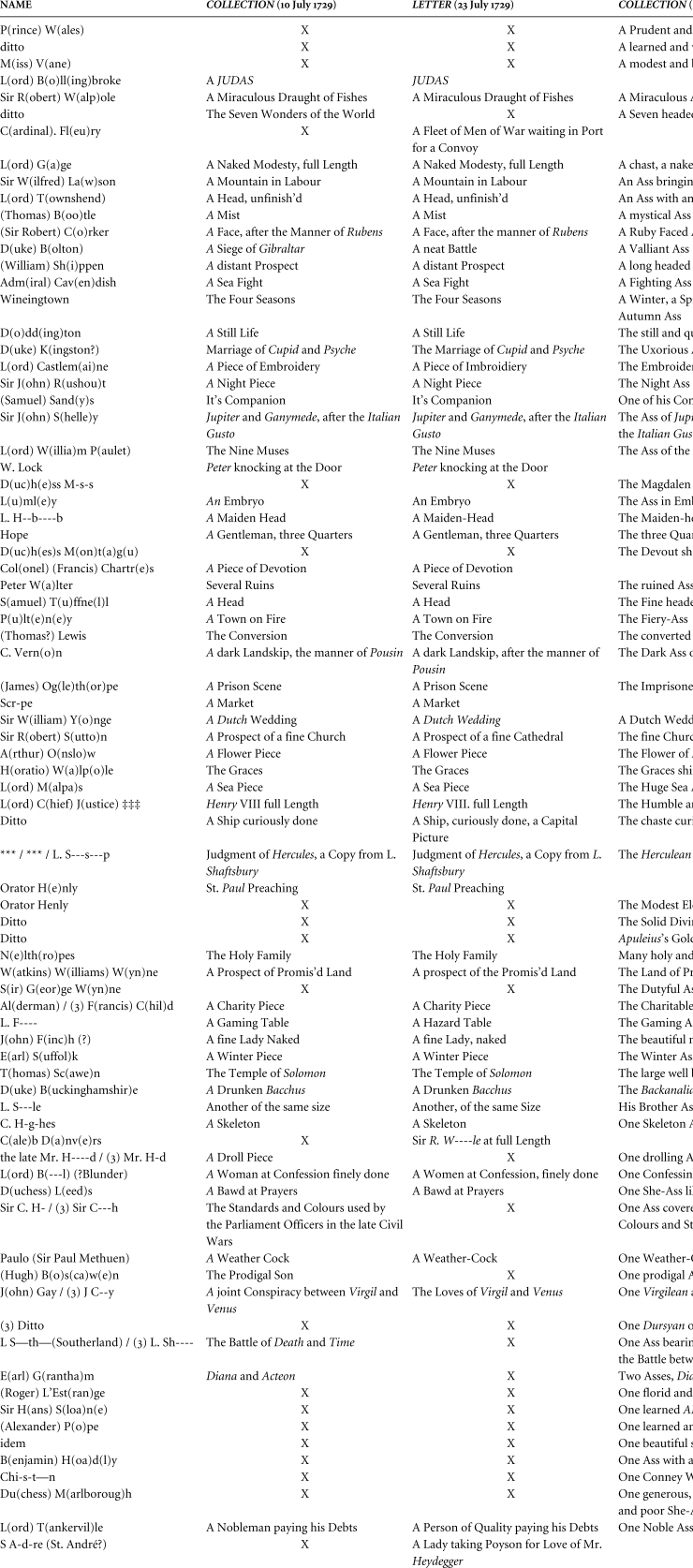
We already know that from the 1720s on Handel is regularly listed as composer of the Chapel Royal and music master to the Royal Princesses.Footnote 6 A hitherto obscure document, however, places him in a new setting, exactly when his social ambitions were taking off. A Collection of several choice, fine, finnicking, strange, wonderful, surprizing and astonishing Jack-Asses, She-Asses and Owls, which have of late weekly been seen, and pissed upon by a certain Fox at Vaux-hall (Figure 1) is a broadside (32 × 19 cm) featuring a two-column list of eminent persons, each labelled as an ass or an owl marked by physical, social and moral characteristics. It survives in a single copy at the Huntington Library, bound together with other printed and manuscript ephemera attributed chiefly to Jonathan Swift and his circle.Footnote 7 Its uniqueness, satirical content and reference to the popular Vauxhall Gardens make it an intriguing addition to Handel documentation.
A Collection of several choice, fine, finnicking, strange, wonderful, surprizing and astonishing Jack-Asses, She-Asses and Owls, which have of late weekly been seen, and pissed upon by a certain Fox at Vaux-hall. Undated broadside, US SM (Huntington Library) 143253. Reproduced by permission of The Huntington Library, San Marino, California

In this article I extract from the new source the maximum information on Handel, first by identifying the cryptic names in the list and then by probing their known or potential links with the composer. While satirical statements do not constitute facts and can be entirely fictional, they typically contain an element of truth (satire being an attack on ‘wickedness or folly’Footnote 8). Joseph Goupy's famous caricature does not prove Handel to have been a hog, nor should the Scandalizade's reference to the composer's waistline as ‘Three Yards, at the least’ be taken literally.Footnote 9 Both allude, however, to his gluttony, a fact attested to by reliable witnesses. Upon this basis, and lacking counter-evidence, I regard the Collection as reality stretched or distorted rather than a figment of someone's imagination.
If walking a tightrope on the edge of factual and potential reality can be risky, it also expands the historiographical matrix, heightens intellectual tension, may yield surprising insights and can disclose obscure intersections. Needless to say, the validity of this approach can be assessed only retrospectively and according to the fruits it bears. As in previous essays on Handel, I aspire towards an organic discourse whose ‘parts’ may or may not be causally related, yet they all emerge from a common source: not a question hatched in terms of a certain school of thought or methodological practice, but the undisputed reality of a new document and its power to unsettle existing views. A growing tree of life rather than a tight chain of reasoning is my objective. Without the linearity provided by a single argument, the reader will have to reach the end before the rich cultural tapestry of Handel's England appears in all its splendour and with its full weight of contradictions.
ID, PLEASE
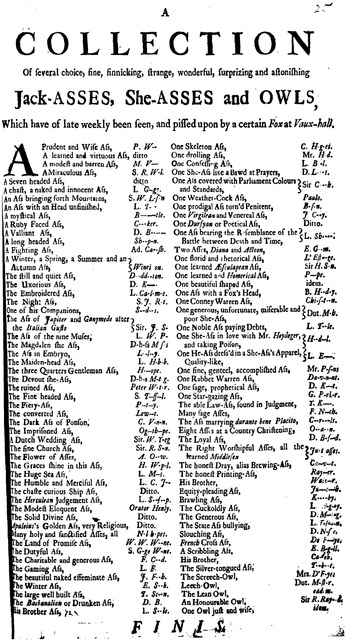
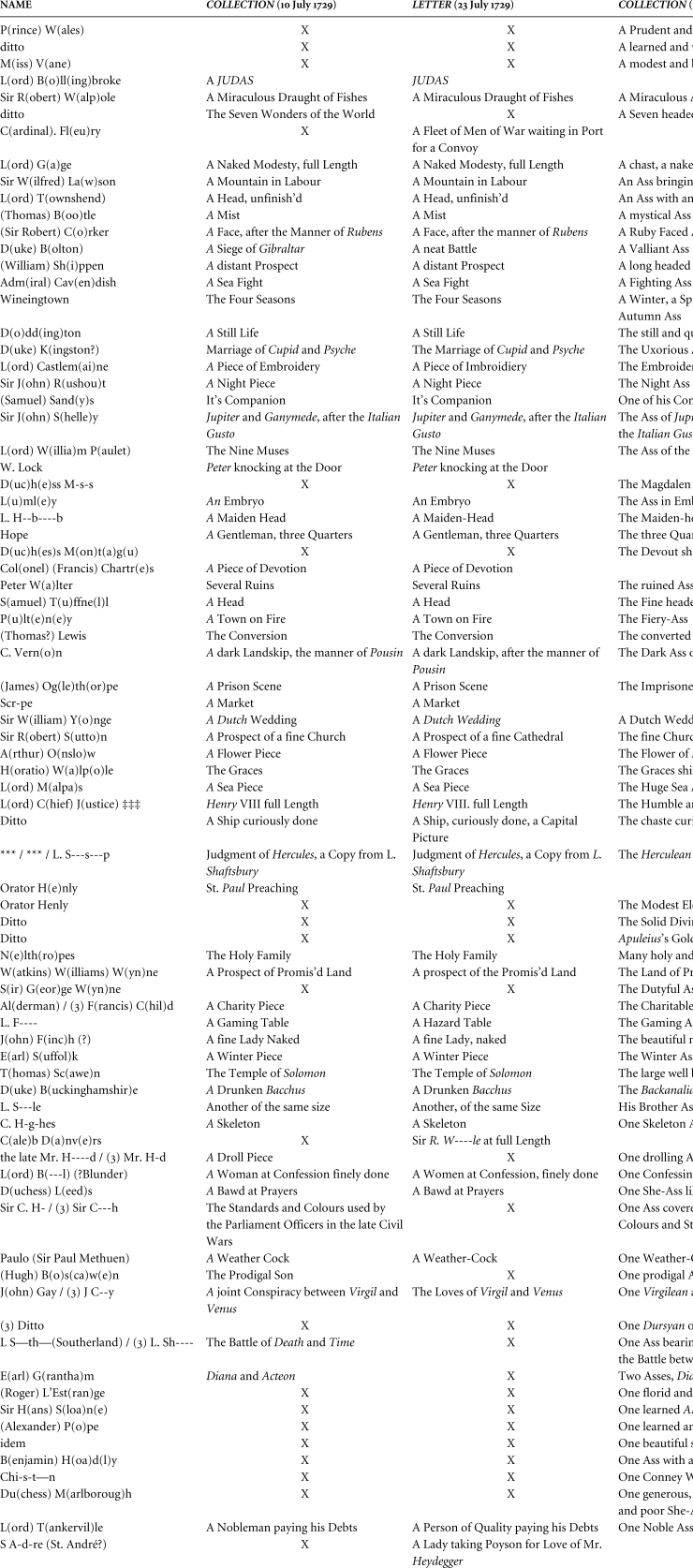
Nothing seems to be known about the Collection itself, and a cursory view of its content will only puzzle the reader. Following satirical etiquette, the names appear with ellipses to protect the author from libel but with sufficient provision of letters to allow (variable spelling notwithstanding) for a good guess about their owners (see Table 1). Generic initials like ‘D’, ‘L’ and ‘S’ readily invoke titles (Duke, Lord, Sir). Students of early Georgian England will have no problem recognizing the names of Sir Robert Walpole (‘S. R. W-l’) and his brother Horatio (‘H. W-p-l’), George Dodington (‘D--dd--ton’), William Pulteney (‘P--t--y’) and Sir William Young or Yonge (‘Sir. W. Y-eg’). Identification is possible in a few cases thanks to a person's rare initials, as for example Watkins Williams Wynne (‘W. W. W--ne’), the Speaker of the House of Commons Arthur Onslow (‘A. O--w’), the President of the Royal Society Sir Hans Sloane (‘Sir H. S-n’) and, not least, Alexander Pope (‘P-pe’). Occasionally the attached description helps secure an identity among various possibilities: ‘Fighting’ suits well a commander like Admiral Cavendish (‘Ad. Ca--sh’); ‘Scribbling’ allows the identification of Eustace Budgell (‘E. B-g-ll’), publisher of the weekly Bee, as well as that of ‘His Brother’ at the Craftsman Caleb D'Anvers (‘C--leb’), a pseudonym of Nicholas Amherst;Footnote 10 and George Parker (‘G. P-rk-r’), famous for his astronomical calendars, becomes a safe choice once we consider him as ‘Star-gazing’.Footnote 11 Most of the remaining identifications are based on consultation of contemporary Parliamentary lists.
Individuals listed in A Collection of several choice, fine, finnicking, strange, wonderful, surprizing and astonishing Jack-Asses, She-Asses and Owls, which have of late weekly been seen, and pissed upon by a certain Fox at Vaux-hall

A FOX HOLED IN VAUXHALL
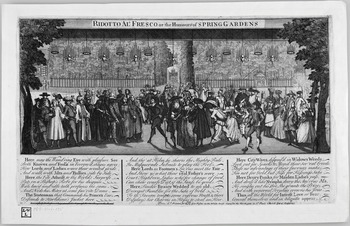
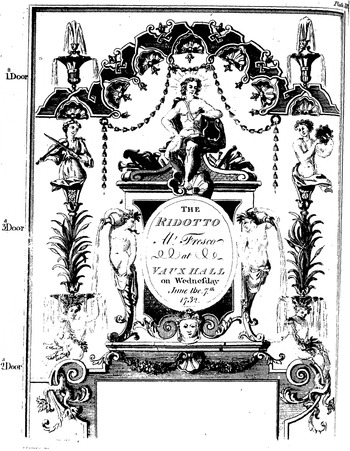
Once we have secured as many identities as possible, we may proceed to the alluded event. Obscure in many ways, the title of the print shown as Figure 2 reveals only its geographical reference, the Spring Gardens at Vauxhall.Footnote 12 The venue had been open to the public since the Restoration, but its prestige had declined in proportion to its fame as a ‘rural Brothel’.Footnote 13 In 1728 Jonathan Tyers (1702–1767) leased the property and, on Hogarth's suggestion,Footnote 14 sought to reinvent its function. Thanks to his entrepreneurial zeal the gardens bloomed into London's fashionable entertainment for the summer. Following meticulous preparation,Footnote 15 the inaugural ridotto al fresco of 7 June 1732 became the talk of the town:
there were about 100 Soldiers planted, with their Bayonets fix'd, at the outward Doors and along the Avenues to the House, to prevent any Disturbance: The Chief of the Company went in between Nine and Eleven; and the Dresses for the most Part, were Dominees [sic] and Lawyers Gowns, tho' one Third of the Company had no Dresses or Masks: It is reckon'd there were about 400 People there, and about ten Men to one Woman. The Company broke up between Three and Four on Thursday Morning, and about Five the Soldiers cross'd the Water to return Home[.]Footnote 16
Security was a real issue: two nights prior to the event, an excited mob had stormed the premises after being denied free admission:
I belive thier / Was a great many people kill'd at a la frisko / Because thier was a great many Poeple / Went to see it a monday and so the People / Thought to get a good Deal of mony & ask'd / A Shilling for seeing of it & the common / People was so angrey that the[y] broke down / The fence & got in & knock'd down every / Body they mett with;Footnote 17
So effective was Tyers's damage control that the incident is absent from the contemporary press. Even without it, the hyped publicity was sufficient to rouse satirical invective.Footnote 18 A collection of poems on arbor vitae, aptly named The Ladies Delight, concludes with a piece on the ridotto, whose ‘national’ significance is described thus:
A satirical who's who of London's rich and powerful, the Collection seems to be yet another response to the ridotto craze. It is no coincidence that the Prince of Wales's initials (‘P. W—’) top the list: the ground landlord of the property, ‘His Royal Highness, attended by several Noblemen and Gentlemen, &c. went in about Ten, and staid about two Hours, and then return'd with his Company’.Footnote 20 One of them must have been George Dodington (‘D--dd--ton’), the Prince's new political advisor.Footnote 21 His departure for the Continent the following day (Thursday 8 June)Footnote 22 offers a terminus ante quem and can lock in the association of the document with Vauxhall's opening night (the Earl of Essex, too, departed for Turin on 18 June, days before the ridotto's reprise on 21 JuneFootnote 23). The date of 7 June might also explain the common appearance of Heidegger (who is not properly listed as an attendee) and Handel. Still in a business partnership, they could have used the occasion to publicize their premiere of Acis and Galatea, only three nights later (Saturday, 10 June).Footnote 24 It is more likely, however, that the list combines attendance on both dates (as Miss Vane, the Prince's mistress, gave birth to his reputed child on 5 June, she could conceivably have attended only the second ridotto).Footnote 25
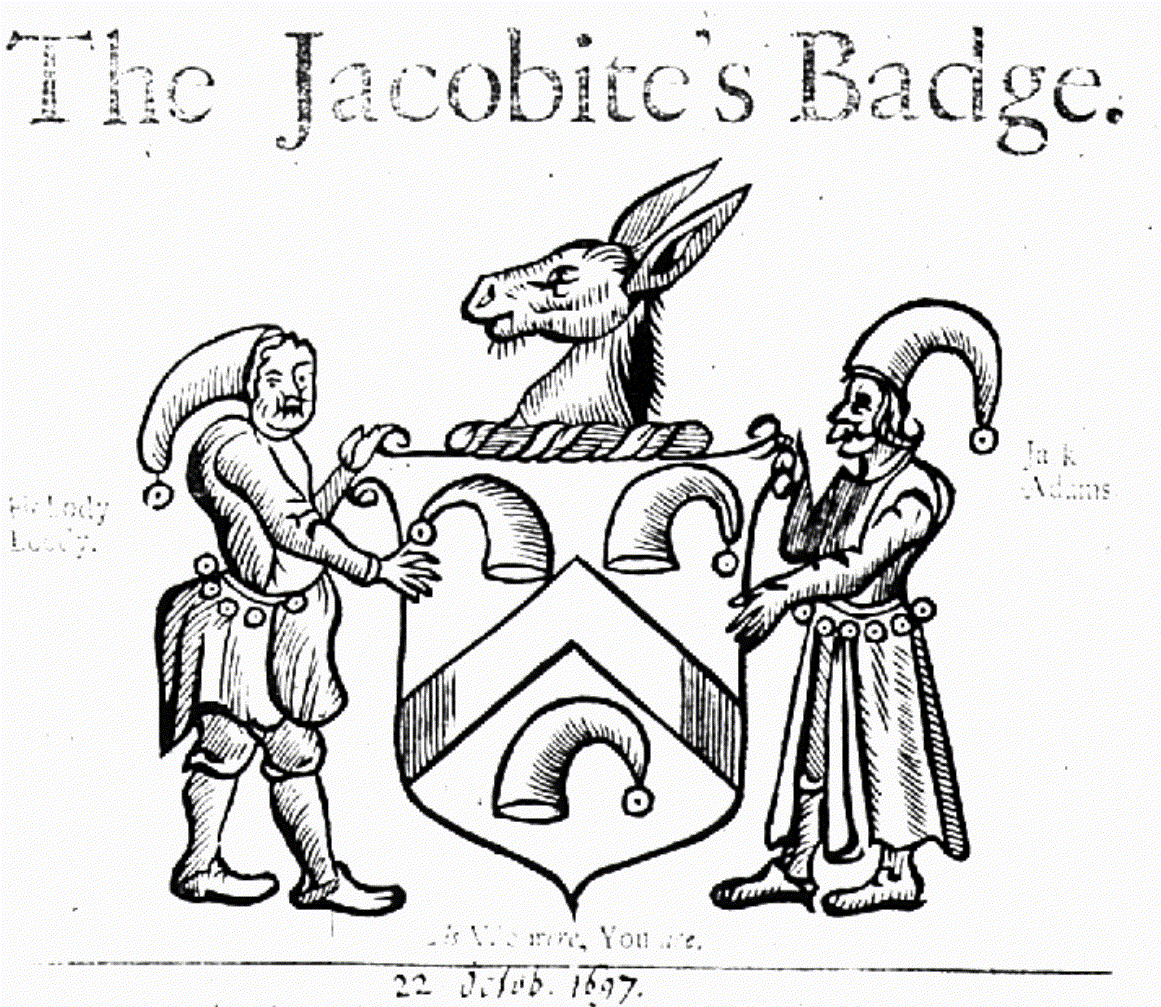
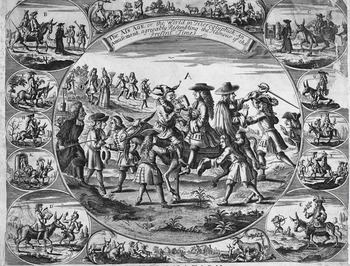
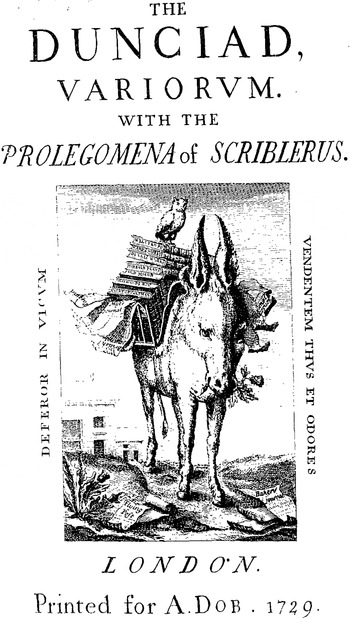
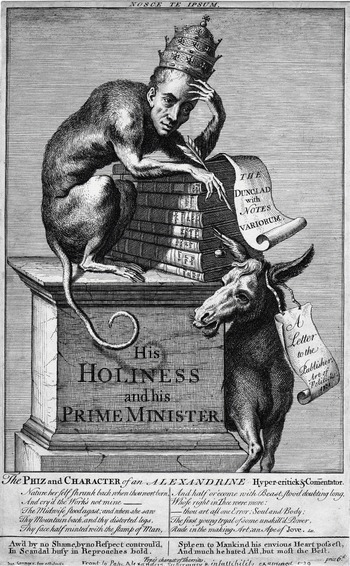
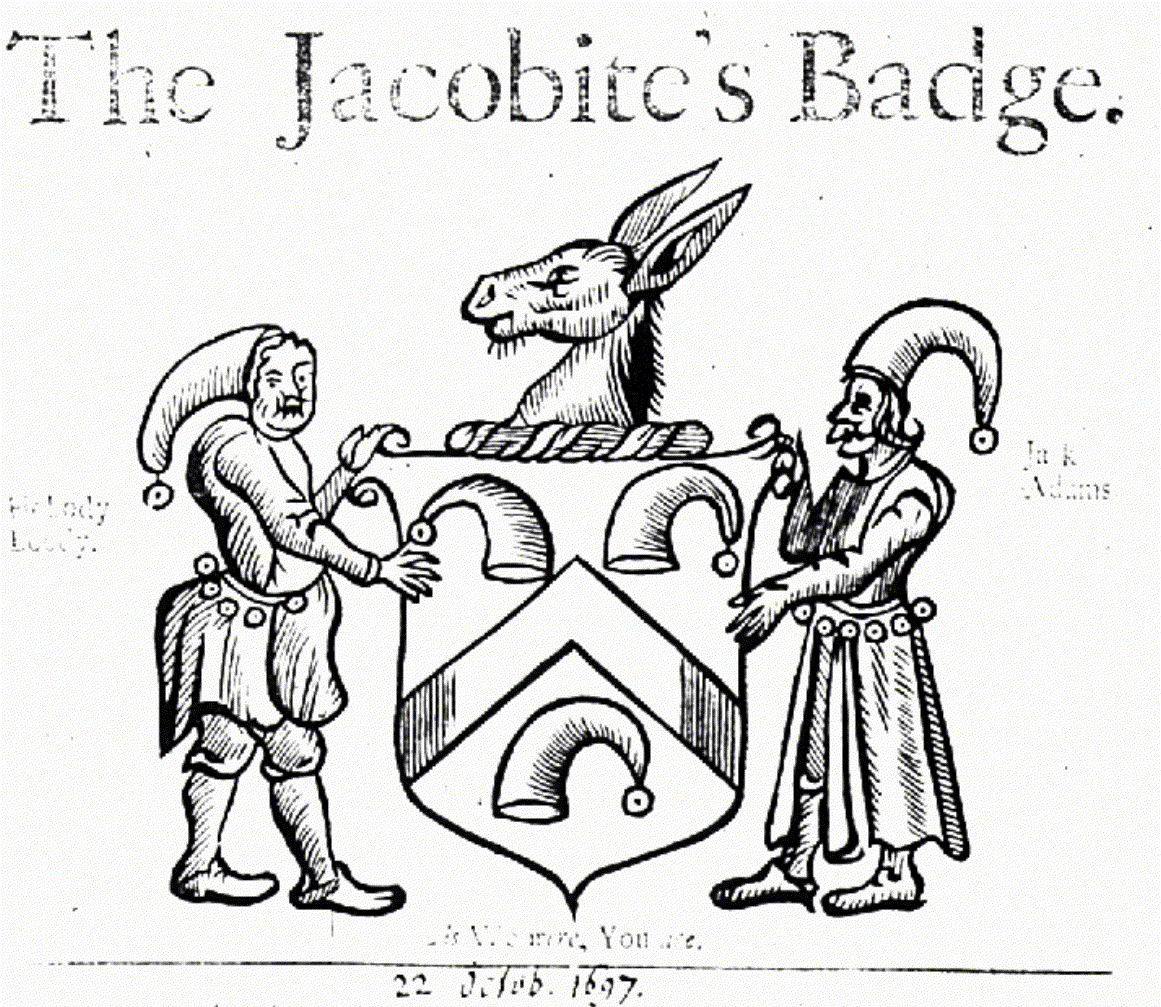
The application of an ‘ass/owl’ template in the list was anything but random. Both animals had strong allegorical associations going back to Aesop's time. The ass, in particular, was a popular emblem of ignorance, pride, stupidity, infatuation and sloth.Footnote 26 (The exhibition of a ‘Flying Ass’ at the ill-reputed Belsize House at Hampstead must have strengthened this last link.Footnote 27) Despite its reputation as Minerva's favourite bird, the owl, too, had its share of negative associations, most notably as ‘the attribute of NIGHT personified, and of Sleep’.Footnote 28 With the explosion of print culture amidst the turbulent politics of early eighteenth-century Britain their popularity as tools of allegorical attack rose. An ass's head defines the satirical ‘Jacobite's Badge’ from 1697 (see Figure 3). In 1711 ‘The Ass Age’ (Figure 4) offered an elaborate critique of the times depicting representatives from all walks of life riding on asses. Among the characters of the farcical The British Stage; or, The Exploits of Harlequin (1724) we find an ass and an owl, representing the Town and the Theatre respectively.Footnote 29 More famous is the title engraving for Pope's Dunciad, portraying an ass fraught with the dull literary productions of the age (Figure 5). The asinine image was soon returned to the censor with His Holiness and his Prime Minister, which has a Pope-faced monkey on a pedestal and an ass standing by (Figure 6).Footnote 30 We find similar deployments later in the century. The Congress of the Beasts (1748), a satire on the Aix-la-Chapelle peace conference (whose translation is curiously ascribed to Heidegger), portrays the various delegations as animals, with Britain being a lion under the skin of an ass.Footnote 31 Handelians also recall the braying ass and perched owl in versions of Goupy's famous cartoon of the composer (and perhaps the animal-headed singers in ‘The Opera House or the Italian Eunuch's Glory’).Footnote 32
Whatever the satirical aims of the compiler might have been, the selection of both animals is certainly appropriate for an outdoors evening entertainment like the Vauxhall ridotto. Mr Tyers would have been proud to learn that the list contains only three ‘owls’ (boring guests). The division of asses according to sex might be tempting for theorizing buffs, yet it seems to follow the male–female ratio of those listed. Handel and Miss Vane are exceptions, perhaps because of the publicity they enjoyed in late spring 1732 (the one through Esther and the other as the pregnant mistress of the heir apparent).
Ridotto Al' Fresco or the Humours of Spring Gardens (London: George Foster, after 1732), US FAy 740.0.7.2. Courtesy of The Lewis Walpole Library, Yale University

The Jacobite's Badge (London: printed for the use of the successors of Jack Adams and Hobody Boody, 1697). Broadside B124(2), Houghton Library, Harvard University. Used by permission
The Ass Age, or the World in Hieroglyphick (London, 1707). Broadside (detail), GB Lbma AN333660001. © The Trustees of the British Museum. Reproduced with permission

The mystery here is, naturally, the identity of the ‘Fox’ and the meaning of his ‘piss[ing] upon’ the guests. Could this have been an ironic reference to Tyers, who charged a full guinea for admission? Or could the ‘Fox’ have been a Georgian paparazzo, spying for some Grub Street paper? David Coke has reminded me that ‘Fox Hall’ was a common form of reference to the Gardens, suggesting that the name should apply to its proprietor. What is more, Tyers's overtly moralizing stance (the decorations of the early 1730s censured vices like pride and greed) evoked the proverbial hypocrisy of the fox in Aesop's fables. The effort at moral regeneration of London's corrupt elites in an Arcadian setting was an ideal target for satire.Footnote 33
Far more intriguing than the Fox's identity are some new Handelian links. The Collection features several acquaintances of Handel: The Duke of Newcastle, first governor of the Royal Academy of Music,Footnote 34 and William Pulteney, Wilfred Lawson, William Yonge, Richard Castlemayne and Thomas Gage, who had been directors of the company.Footnote 35 This may be one of his first documented social encounters with them in a public event. Perhaps not surprisingly, the two names fully spelled out in the list belong to public entertainers and popular targets of satirical invective, ‘Orator Henly’ and ‘Mr. Heydeger’. John Henley (1692–1756) was a notorious preacher whose bizarre mix of topics, histrionic performance and, not least, subservience to Walpole's administration made him a synonym for nonsense and a constant object of attacks.Footnote 36 As he is minimally known to Handelians, I shall discuss him later in the article. Attention has to turn to John James (or Jacob) Heidegger (1666–1749), whose close proximity to Handel at this period helps secure the identity of ‘H--d-l’ as George Frideric. After reviewing his career and early ties with the composer, I shall focus on their business partnership during the ‘Second Academy’ years (1729–1734) and explain their alluded-to presence at the ridotto al fresco.
HANDELCUFFS: HEIDEGGER
A foreigner by birth, Heidegger began his social climb in England during the early 1700s and grew to become the undisputed king of big spectacles and an administrative pillar of London's Italian opera. His role as propagator of foreign taste and luxury alarmed contemporary moralists, and in 1723–1724 his ridotto entertainment faced organized opposition from civil and ecclesiastical authorities.Footnote 37 Universally known for his repulsive face or ‘ill-favour'd Visage’,Footnote 38 to which Pope famously alluded in the Dunciad,Footnote 39 Heidegger could barely hide his identity (in ridottos ‘People are admitted disguis'd, [yet] without a Vizard’Footnote 40).
Active in London's opera since at least 1707,Footnote 41 Heidegger first met Handel in the winter of 1710/1711 as assistant manager of the Queen's Theatre and helped his networking in the metropolis.Footnote 42 A young Mary Granville remembered him introducing Handel to her uncle Sir John Stanley, secretary to the Lord Chamberlain.Footnote 43 Heidegger was involved in Rinaldo's first run,Footnote 44 and his name appears alongside Handel's in a payment order from February 1713.Footnote 45 This was after the second performance of Handel's Teseo, when the opera manager Owen Swiney fled the country to avoid bankruptcy. The crisis must have brought the composer closer to Heidegger, now in charge of the King's Theatre.Footnote 46 It was at this venue that Handel had his first benefit night, on 16 May, earning £73:10:11;Footnote 47 Heidegger also signed the libretto dedication of the next Handel production, Amadigi.Footnote 48
Title page of [Alexander Pope,] The Dunciad Variorum. With the Prolegomena of Scriblerus (London: A. Dob, 1729)

His Holiness and his Prime Minister (London, 1729), GB Lbma AN363072001. © The Trustees of the British Museum. Reproduced with permission

Admission ticket for the ridotto al fresco, reprinted in John Nichols, History and Antiquities of the Parish of Lambeth, in the County of Surrey (London: J. Nichols, 1786), 98–99

The years 1713–1717, a period of struggle for Italian opera, helped Heidegger understand the economics of luxury entertainment.Footnote 49 Targeting the kingdom's elites, such enterprises required financial security from the outset. When George I requested a concert on the Thames in 1717, the one of Water Music renown, Heidegger declined the honour of organizing it on financial grounds.Footnote 50 It is no coincidence that his lucrative masquerades appeared regularly during this time.Footnote 51 Unable to sustain opera productions after 1717 on account of low revenue, political instability from Jacobite activities and the deteriorating relations of the King with the Prince of Wales,Footnote 52 he offered the King's Theatre to other profitable uses.
His and Handel's paths converged with the creation of the Royal Academy of Music in 1719, which turned London into a major opera capital. (Joint appearances of their names include a curious subscription to Teatro Fisicosmografico: Overro trattato di Cosmografia.Footnote 53) After the company's collapse in 1728 they joined forces in a new scheme, producing operas until 1734. This was a critical period in Handel's career, witnessing the birth of English oratorio and a bitter division in London's opera world. Unfortunately, the exact terms of their collaboration still elude us. Having thoroughly examined all evidence, Robert D. Hume concludes ‘it is simply not known how their partnership worked’.Footnote 54
‘COPPIA EIDEGRENDELIANA’Footnote 55
The Collection reflects how contemporary satirists understood this partnership. Its description of the composer as ‘One She-Ass in love with Mr. Heydeger’ is intriguing, and calls for an investigation of their relationship. Whatever the financial and administrative division of labour between the two might have been, it is fair to say that Handel was strategically inferior to, if not dependent on, the ‘Swiss Count’. By 1729 Heidegger had accumulated vast experience as an administrator. He had been in charge of the King's Theatre for sixteen years and was unrivalled as an organizer of large-scale entertainments. Admirers and foes alike bowed before his entrepreneurial genius and gave him sole credit for innovative schemes. Already by 1717, Pope had referred to masquerades as ‘Mr Heideker's institution’,Footnote 56 and by 1719 ‘Swiss Count’ was universally (though satirically) recognized as Heidegger's personal title ‘by the Courtesy of England’.Footnote 57 Indeed, by helping project the power and wealth of British elites during the years of Whig supremacy, he acquired national significance (‘What can be a greater Demonstration how rich and powerful a People we are at present, than our Subscriptions to the Opera and Masquerades?’Footnote 58). He certainly enjoyed the approval of George I, who attended nearly half of his company's performances and frequented his masquerades, these last not for the noblest of reasons,Footnote 59 and during the early 1720s he was known as ‘Director of the King's Balls’.Footnote 60 Although protests from the clergy forced the temporary suspension of masquerades,Footnote 61 Heidegger soon replaced them with ridottos (‘a mask'd Masquerade’Footnote 62), which once again were ‘By'th' Court approv'd of, by the K[ing] protected’.Footnote 63 Luckily for him, George II was no less fond of such entertainments: ‘it were to be wished the King would not encourage them’, lamented the Viscount Percival.Footnote 64
His national fame grew even more in 1727 with an innovative system of lighting he devised for the Coronation festivities at Westminster Hall. According to Mary Granville, its ‘1800 candles, besides what were on the tables … were all lighted in less than three minutes by an invention of Mr. Heidegger's, which succeeded to the admiration of all spectators’.Footnote 65 A more detailed account appears in the correspondence of Cesar de Saussure:
When the King and Queen entered the hall the light was beginning to fade. About forty chandeliers, in shape like a crown, hung from the ceiling, each carrying about thirty-six wax candles. On the King's appearance all these candles were suddenly lighted, and everyone in the room was filled with astonishment at the wonderful and unexpected illumination. Little cords of cotton-wool, almost imperceptible to the eye, saturated with sulphur of saltpetre, with spirits of wine, and other ingredients, had been prepared and arranged so as to carry the flame rapidly from one candle to another. This arrangement had been so skilfully prepared that hardly a single candle failed to take fire.Footnote 66
Heidegger received a court appointment (‘Gentleman of the Privy Chamber’) thereafter,Footnote 67 and to the end of his career he would be viewed in unusually lofty terms: ‘It may be said that the English nation has appointed him director of their pleasures’.Footnote 68 His impact on four decades of British culture would be recalled as late as 1771, when Horace Walpole dubbed the entrepreneurial Madam Cornely ‘the Heidegger of the age’.Footnote 69
The above makes clear that for any attempt to revive Italian opera in 1729, Heidegger was indispensable. He controlled the King's Theatre and had the experience and contacts to raise capital, assemble a company and make things happen. Handel's prestige after the 1727 Coronation was, undoubtedly, far greater than ever before, but the artist lacked the social skills, not to mention the capital, to sustain a major theatrical enterprise. Many resented his imperious attitude, and he certainly was short of proper administrative experience. The Fourth Earl of Shaftesbury confirms that during the Academy years Handel ‘was only employed as a Composer, in the same way as Buononcini’.Footnote 70 Even the satirical Contre Temps calls him ‘Professor of Harmony to the Academy’, while reserving the lofty designation ‘High-priest’ for the ‘Swiss Count’Footnote 71 (who had also been ‘Master of Ceremonies’ in the fictional Session of Musicians Footnote 72). Not surprisingly, public reports from the early 1730s, all but one reprinted here for the first time, name Heidegger as the company's head:
[28 March 1730]
We hear that Mr. Heydegger is going to Italy in the Month of June, to engage a new Set of Singers to come over hither against next Winter, the present Voices designing to leave us so soon as the Opera Season is over.Footnote 73
[28 August 1730]
Signor Senisino, the famous Italian Singer, hath contracted to come over hither against the Winter, to perform under Mr. Heydegger in the Italian Operas.Footnote 74
[early October 1730]
Signiora [sic] Senisini, a very famous Singer, arrived here last Week from Italy, and has agreed with Mr. Heydegger to perform in the Italian Operas this Winter.Footnote 75
[9 October 1730]
We hear Mr. Heydegger, Master of the Opera House in the Hay-market, having contracted with some extraordinary voices lately arrived from Italy, to perform in the Italian Operas, designs to open the same with a fine new Opera sat. the 24th instant.Footnote 76
[12 April 1732]
Monsieur Heydegger, we hear, intends to go to Italy this Summer, with a Design to engage some celebrated Singers of both Sexes to come over for the next ensuing Winter Season.Footnote 77
A COURT PROJECT
On what grounds, then, did Handel become ‘joint partner in the thing’ with Heidegger? The most likely explanation is his strong backing from the new monarchs. George II and Caroline had been Handel supporters since 1710Footnote 78 (‘They were both Handelists’Footnote 79) and their sumptuous coronation showed a desire to mark their rule with proper splendour. Given the cultural prestige of the Royal Academy of Music under George I, whom they both hated,Footnote 80 the company's dissolution in 1728 was a setback in their plans for a culturally vibrant reign.Footnote 81 According to Richard G. King, ‘the house of Hanover was involved in the affairs of the Second Academy from the outset’, offering advance publicity to Handel's new productions or intervening during crises.Footnote 82
It was Princess Anne, however, who emerged as the strongest ally of the composer. She had been his personal and favourite student since at least 1723Footnote 83 (‘Handel disdained to teach his art to any but princes’Footnote 84), and would continue to support him even after her departure from London in 1734.Footnote 85 With the ascent of George II, she was created Princess Royal and ‘took a leading role in the public life of a glittering court’.Footnote 86 Uncommon intellectual and artistic gifts fuelled her pride and strong ambition (Hervey calls her ‘the proudest of all her proud family’Footnote 87). According to Horace Walpole, ‘She had early set her heart on being Queen of England’, and, when young, she expressly ‘wished that she had no brothers, that she herself might succeed to the Crown’ (Queen Anne was her godmother).Footnote 88 The arrival, in late 1728, of Frederick Lewis, heir apparent to the throne, after fourteen years of isolation in Hanover, naturally affected her position in court and in the public eye.Footnote 89 Eager to assert leadership as patroness of the arts, she presumably got involved in the efforts to revive opera in London. Her £1200 annual expense account certainly allowed her to offer critical financial support to Handel's company.Footnote 90 Shaftesbury, who wrote explicitly to set the record straight on Handel, affirms that the new company was ‘under the Patronage of The Princess Royal’.Footnote 91
Anne played a critical role in Handel's first oratorio productions. Writing on reliable testimony, Burney credits her with the idea of performing Esther ‘in action’ at the King's Theatre.Footnote 92 Already at a marriageable age, and by April 1732 rumoured to become the next Princess of Orange,Footnote 93 she could easily identify with the virtuous biblical queen (interestingly, Henley's Esther was known to have been a tribute to Queen Anne, whose name she inheritedFootnote 94). Her dislike of Robert Walpole, whom ‘she hated … as the Author of her intended Nuptials’,Footnote 95 found expression in the fall of Haman, the corrupt Persian minister whom many had identified, possibly as early as 1717, with Walpole.Footnote 96 The fact that the Royal Family attended all six Esther performances was undoubtedly a reason for the oratorio's surprising success.Footnote 97 In the summer of 1732 the diplomat Zamboni was assuring his European correspondents of ‘the interest that the Royal Princess takes in all things which concern Handel and the operas’,Footnote 98 and especially of her ‘great interest’ in securing Porporino for his company.Footnote 99 Months later, her encouragement led the composer to raise the admission price to a full guinea for the premiere of Deborah.Footnote 100 Indeed, Robert Hume and Judith Milhous find an impressive twenty per cent of the company's revenue in 1732–1733 coming from the Royal coffers.Footnote 101
What brought Handel back to the King's Theatre in 1729 was, then, not just ‘a combination of passionate commitment to opera, ego, and a lot of sheer blind stubbornness’,Footnote 102 but chiefly the full support of the court. He was the Crown's representative in the new scheme. His ‘love affair’ with Heidegger, as the Collection describes it, was presumably manufactured at St James's Palace in order to raise the cultural prestige of the new monarchy. What else but royal intervention could have forged a partnership out of clashing views on opera revival? Heidegger, acutely aware of financial risks, insisted on rehiring Faustina Bordoni and Francesca Cuzzoni and even Senesino, while Handel, who had been fed up with the star system of the 1720s, called for a fresh beginning with new singers and original productions.Footnote 103 It was the King's aversion to Faustina (‘if Faustina alone returned, he would contribute nothing’Footnote 104) and support for Handel that decided the matter (‘His new plans find favour at Court’). Heidegger, whose participation was not a given, finally submitted to royal wishes and, no doubt, assurances of financial support. Handel then departed for Italy to secure a cast for 1729–1730. The new voices got mixed reactions in London, except at the court: ‘If everyone were as well satisfied with the company as is the Royal Family, we should have to admit that there never had been such an opera since Adam and Eve sang Milton's hymn in the Garden of Eden.’Footnote 105 Paolo Rolli's cynicism only highlights the true identity of the ‘Second Academy’ as a court project.
The opportunistic nature of the ‘Coppia Eidegrendeliana’ is reflected in the low percentage of original works they produced during the years 1729–1734. Compared with the Royal Academy years, revivals now increased roughly from two to four per season and pasticcios from a total of one to seven.Footnote 106 Subject matter also reveals the company's attachment to the new court, particularly the Queen and the Princess Royal. The inaugural production of Lotharius drew on a festal piece for the nuptials of the Bavarian Electoral Prince and centres on a female sovereign, Queen Adelaida, ‘the most renowned Princess of her Time for Beauty and Virtue’.Footnote 107Partenope, the company's second premiere, was the only opera after Rodelinda to be named after its leading female character and, according to Winton Dean, presents a ‘woman's point of view’.Footnote 108 Nor is it accidental that Handel's first English oratorios concern female heroines, with Deborah dedicated to ‘the Greatest and Best of QUEENS’.Footnote 109
THE DIVORCE
Viewing the ‘Second Academy’ as a court-only project helps us reconsider the career of Handel during the early 1730s. The exceptional description ‘She-ass’ could reflect his role as cultural agent of the Crown, with the support of which he turned from employed talent to co-director of a major company; and his being ‘in love’ with Heidegger acknowledges his recent attachment to the veteran impresario. Given the strong and personal involvement of the royal family in the scheme, the existence and duration of a binding contract between the two has little significance. If the Crown was ready to supply up to one fifth of annual revenue (in addition to voluntary cuts in directorial salaries), the company could go on ‘perhaps indefinitely’.Footnote 110 Another consequence is that Esther's ‘Hanoverianising’Footnote 111 could not have been a last-minute stroke of genius. Even if the production was hastily put together, the celebration template must already have been in existence. Handel was acting as a court composer in an entrepreneurial milieu.
This same reason underlies, I suggest, the split between Handel and Senesino, and the ensuing opera wars (1733–1737). New directorial powers gave Handel unprecedented control over his productions and exacerbated his authoritarianism. Bononcini was excluded from the new scheme and Senesino was invited only after a disappointing first season. Memories of his princely treatment during the 1720s must have clashed with the new regime of ‘the Chief Composer, on whom everything depends’.Footnote 112 His experience in Esther, where he performed in a foreign language and without acting (one of his strong points), must have been a cause of resentment towards Handel (‘[Senesino's] implacable hatred to Handel, for making him sing in the English Oratorio's, whereby he incurr'd the Pope's Displeasure’Footnote 113). Within a year, his relation with the composer had deteriorated to such an extent that the latter had to dismiss him.Footnote 114
Although Thomas McGeary is right to assert the primacy of the Handel–Senesino rivalry over politics as the cause for the opera schism in LondonFootnote 115 – ‘the first Symptom of this Rupture’, according to a source, was Senesino's impregnating ‘a Favourite of Heidegger's’Footnote 116 – we should recall that both musicians were cultural outposts of influential constituencies. It is hard to believe that they jeopardized the city's most prestigious entertainment in the absence of support from their respective patrons. Without the Royal family's sponsorship there could not have existed a ‘Dominion of Mr Handel’,Footnote 117 nor would the composer have become ‘so arbitrary a prince, that the Town murmurs’.Footnote 118 We find a causal link between the two in the satirical Harmony in an Uproar (1733), where Handel, in a fictional apology, admits ‘I was prodigiously caress'd at Court … but more particularly [by] the divine Princess Urania … This Favour … created me fresh Foes’.Footnote 119 One can readily imagine the explosive combination of a ‘proud & saucy’ composer being aggressively promoted by a Princess ‘of a most imperious & ambitious nature’.Footnote 120 The building-up of public resentment against Handel preceded Deborah's premiere. In a rarely cited footnote Burney reports that Handel refused to allow his subscribers to ‘occupy their particular boxes in the Haymarket theatre, when he performed there his oratorio of Esther, in the summer [May] of 1732’.Footnote 121 Equally important is the fact that both oratorios were tributes to the Crown and received explicit encouragement from the Princess Royal. Either Handel exploited the unconditional patronage of the Crown or the latter's enemies used him to resist the court. The struggle over the Excise Bill, Walpole's attempt to increase revenue by changing taxation for wine and tobacco, gave further momentum to anti-Handelism (the Earl of Stair, who led opposition to the Excise, would become one of the directors in Senesino's company), and the interchangeability of the Crown's favourite composer and minister became almost inevitable.Footnote 122 It is worth asking whether the outcry against Walpole emboldened Senesino and his party to confront Handel.
If Heidegger stayed with Handel for one more season (1733–1734), it was not necessarily because of contractual obligations. Senesino's ‘contre-opéra’Footnote 123 had no institutional legitimacy and received no royal bounty, and the Town's reaction to his coup was anybody's guess; even Cuzzoni's participation was uncertain (‘Cuzzoni they say don't come’Footnote 124). Handel, by contrast, scored a financial and cultural triumph with his Oxford Act performances (July 1733), and the fervently anticipated marriage of the Princess Royal secured him prestige and visibility during the season. This is not to say that Heidegger, a cultural unifier of the upper classes, enjoyed his awkward position in a dismembered company (Baron De la Warr implies that Handel's ruin is a prospect ‘the Poor Count will not be sorry for’Footnote 125). As a businessman, he understood the folly of operatic competition, especially at a time when a single company could barely pay its expenses. The successful debut, honoured by royal attendance,Footnote 126 and resilience of Senesino's opera must have led to a reconsideration of his partnership with Handel. Given that the latter would never have capitulated to Senesino, regardless of financial cost, Heidegger very likely welcomed the end of their association. Whether Handel moved to Covent Garden theatre of his own accord or because Heidegger refused him the King's Theatre is an open question. It says a lot, however, that they would never again resume their partnership (in 1736 Baron Bielfeld identified Heidegger as Handel's ‘redoubted rival’Footnote 127); and for their sole future collaboration, in 1737–1738, Handel was assigned compositional duties only. The important thing is that his divorce from Heidegger and the departure of the Princess Royal, his most fervent patron, marked the beginning of his period in the wilderness. (The subsequent clash of the Princess with George II, because of her ambition to replace the deceased Caroline as the King's most intimate advisor,Footnote 128 probably put an end to her influence on Handel's career and brought the composer closer to the Prince of Wales.)
By casting Handel as Heidegger's sweetheart, the Collection enables us to comprehend the degree of his transformation in the years 1732–1734. The successes of Esther and the Oxford Act performances, along with strong patronage from the Princess Royal, pushed his assertiveness to the limit, consolidating anti-Handelian sentiment from the 1720s into a party that actively sought his professional death (‘Handell will be ruined I belive’Footnote 129). It was time for him to widen his support base and reach out to broader segments of British society, like the ones crowding the popular Gardens at Vauxhall.
HANDEL AND THE VAUXHALL GARDENS
It has long been assumed that Handel's links with the Spring Gardens began in 1738 and centred on the Roubiliac statue, whose commission remains, however, something of a puzzle. The Collection revises the date backwards by six years, at the very start of Jonathan Tyers's enterprise. Moreover, by pairing Handel and Heidegger, it offers a plausible exegetical frame for the celebrated artwork.
Recent scholarship has focused on Tyers's cultural politicsFootnote 130 while leaving untouched the contributions of Heidegger in raising the Gardens' profile (‘by the Address of … H———r they first began to shine, sparkle, and draw thither numberless Admirers’Footnote 131). Reports and verses from June 1732 credit Heidegger for the innovative ridotto al fresco (‘Who to Ridotto gave an English Birth’Footnote 132). Tyers presumably contracted the ‘Swiss Count’ to organize the opening night's entertainment for an exclusive clientele (‘At the particular Desire of several Persons of Quality’Footnote 133). The close links of Heidegger to the Prince of Wales, landlord of the Gardens, were publicly known (‘His Royal Highness the Prince of Wales is to sup next Week with Mr. Heydegger the Manager of the Masquerades, at his House at Barn-Elms; on which Occasion the Trees leading from the Water-Side to the House are to be illuminated with Flambeaux’).Footnote 134 Lighting the huge property was another challenge that he was qualified to tackle.Footnote 135 The ‘Ten Thousand Wax Lights, and the spangled Chandeliers, which are to run cross the Alley, the Grove, and the Bal-Room’Footnote 136 required a lighting system as efficient as the one he had used for the Coronation in 1727.
Heidegger seems to be, then, the critical link between Handel and the Vauxhall Gardens. As suggested earlier, the composer's appearance at the ridotto could have related to the forthcoming premiere of Acis and Galatea, whose pastoral theme was in full alignment with the publicity on the Gardens (see Figure 7).Footnote 137 A long satirical essay printed on Saturday, 3 June glossed the entertainment as a distortion of the Arcadian topos (‘Midnight ACADEMY at VAUX-HALL’ directed by ‘Diana Goddess of Chastity’).Footnote 138 Hardly a coincidence, then, that the following Monday (5 June) Handel expanded his advertisement of Acis and Galatea, stressing what it had in common with the Gardens: ‘the Scene will represent, in a Picturesque Manner, a rural Prospect, with Rocks, Groves, Fountains and Grotto's; amongst which will be disposed a Chorus of Nymphs and Shepherds, Habits, and every other Decoration suited to the Subject’.Footnote 139 His presence at the ridotto undoubtedly served as a reminder of the premiere. Whether the rich scenery of his production alluded to the Spring Gardens or the ridotto al fresco boosted attendance for Acis and Galatea is a question with no ready answer.Footnote 140 However, the proximity of the two opening nights, 7 and 10 June respectively, suggests their synergetic relationship.
Synergy may be the right way to understand how Handel's Vauxhall statue came to exist. Back in the early 1720s, when opposition to masquerades was growing, Heidegger introduced ridottos, a mixed entertainment of music and dance. It was an ingenious move that drew on his dual expertise in opera and balls, immortalized in Hogarth's famous engraving. His first ridotto, on 15 February 1722, opened with a concert of ‘24 Select Songs, which lasted about two Hours, after which, the Company Pass'd over a Bridge, from the Pit to the Stage, where a Duke and Dutchess led up a Ball’.Footnote 141 Given that the songs were ‘chosen out of the late Operas’ and sung by the Royal Academy of Music cast (Senesino, Baldassari, Robinson and Salvai),Footnote 142 Handel was almost certainly a feature composer (performances of his Floridante, on 13 and 20 February, framed the ridotto). The ridotto's reprise on 6 March also included ‘musick / in two places. / Singing’.Footnote 143 Explicit references to Handel's music appear, significantly, in 1729. Heidegger's Assemblies of 13 and 27 March and of 10 April at the Haymarket Theatre began with ‘the Instrumental Opera [overture]’ of Julius Caesar, Otho and Radamistus respectively,Footnote 144 and in May there was advertised ‘a general Collection of Minuets made for the Balls at Court, the Opera's and Masquerades, consisting of 60 in Number. Compos'd by Mr. HANDEL’.Footnote 145 It makes sense that for the exceptional circumstances of the ridotto al fresco, a novel entertainment for the elites, Heidegger also turned to his business partner for musical splendour. Thus Handel would provide music for the event and get free publicity for Acis and Galatea.
There is good reason why the composer would have maintained links with the Vauxhall Gardens through the 1730s. Their opening during summer presented no threat to Italian opera. On the contrary, they provided an excellent venue for his instrumental repertory (vocal music was introduced there in 1745Footnote 146). Perhaps more crucial, their rising popularity kept his profile visible at a time of professional struggle. Facing ruinous competition and blacklisted by former patrons (‘Point d'accommodement à jamais avec le Sr Händel’Footnote 147), the composer needed to expand his support base. His move to Covent Garden theatre, his letters to new acquaintances like Charles Jennens and independent reports about his ‘nouvel amy’Footnote 148 all suggest that Handel was reconfiguring his social network.Footnote 149 The Gardens were invaluable as a pool for new contacts and potential supporters.
Tyers had much to gain from Handel, too. During the 1730s the Gardens relied substantially on music, their visual attractions being quite elementary. Music helped unify the vast space and make patrons gravitate towards ‘the grand Rendezvous of the joyous Multitudes’,Footnote 150 the Grove. This was a pricey open restaurant generating extra income for Tyers, who thus had the incentive to provide first-class entertainment. Indeed, by 1737 music alone became a sufficient reason to visit the Gardens (‘I sail'd, triumphant, on the liquid Way, / To hear the Fidlers of Spring-Gardens play’Footnote 151). Their repertory must have included Handel, the kingdom's most celebrated and prolific composer. Already by 1729 ‘All his Overtures made into Concertos for Violins, in 7 Parts’Footnote 152 were publicly available. Twenty-four in number by 1732,Footnote 153 they gave much choice to the ensemble, which performed ‘about three Tunes (I believe I should have said Pieces) in an Hour’Footnote 154 for three to four hours. Indeed, publicity for the Handel statue in 1738 mentions that ‘his Harmony has so often charm'd even the greatest Crouds [there] into the profoundest Calm and most decent Behaviour’.Footnote 155
The idea of Handel himself performing at the Gardens may seem unlikely. It is entirely possible, though, especially after Tyers added, in 1737, a ‘fine Organ, which has been so long preparing for’Footnote 156 (two seasons earlier Handel had introduced organ concertos into performances of oratorios). Confirmation of Handel's direct involvement with the Gardens comes from a hitherto unknown travelogue discovered by this writer at the Folger Shakespeare Library.Footnote 157 Its anonymous French author visited London in the spring of 1738, just in time to witness both Handel's benefit and the unveiling of Roubiliac's statue. His excursion to Vauxhall on Friday 14 April (OS) yielded the following description:
On range alors sous les arbres, un grande nombre de tables et l'on y sert tous ce quel'on peut desirer. L'oreille y est flatée autant quele gout car des Sept heures du soir on commence une symphonie charmante qui dure jusqu'a dix, les meilleurs morceaux de Musique y sont executér par les joüeurs d'instrumens les plus habiles. M Hindel celebre compositeur dirige ce concert et fournit les pieces[.] Il est en grande veneration dans celieu, on luy á elevé une Statue de marbre, c'est un Apollon qui touche de la lyre. Ici les talents recoivent les memes honneurs qu'ailleurs on rend aux souverains. Les Muziciens se placent sur un lieu elevé, et le monde se rassemble pour entendre le concert autour de deux grandes pavillons ouverts de tous côtés.Footnote 158
Under the trees many tables are arranged upon which there are served everything one may desire. The ear here is pleased as well as the palate because from seven o'clock in the evening a delightful music begins, lasting until ten; the best pieces of music are performed by the most skilful instrumentalists. Mr Handel, the famous composer, directs this concert and provides the music. He is greatly respected in this place; they have erected a statue of marble in his honour; it is Apollo playing on the lyre. Here the talented receive the same honours that others offer to sovereigns. The musicians are placed on a raised platform, and the people assemble to hear the concert around two great pavilions with open sides.
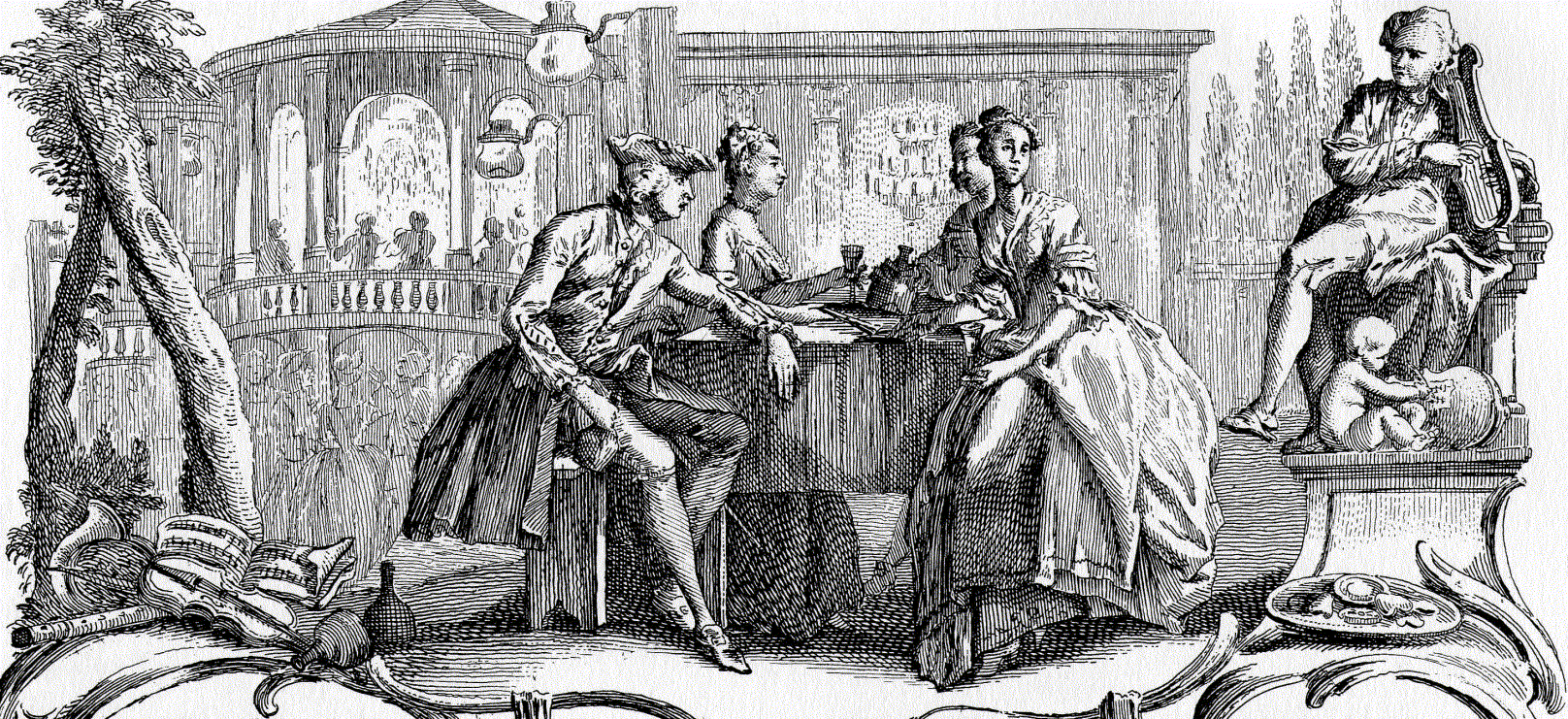
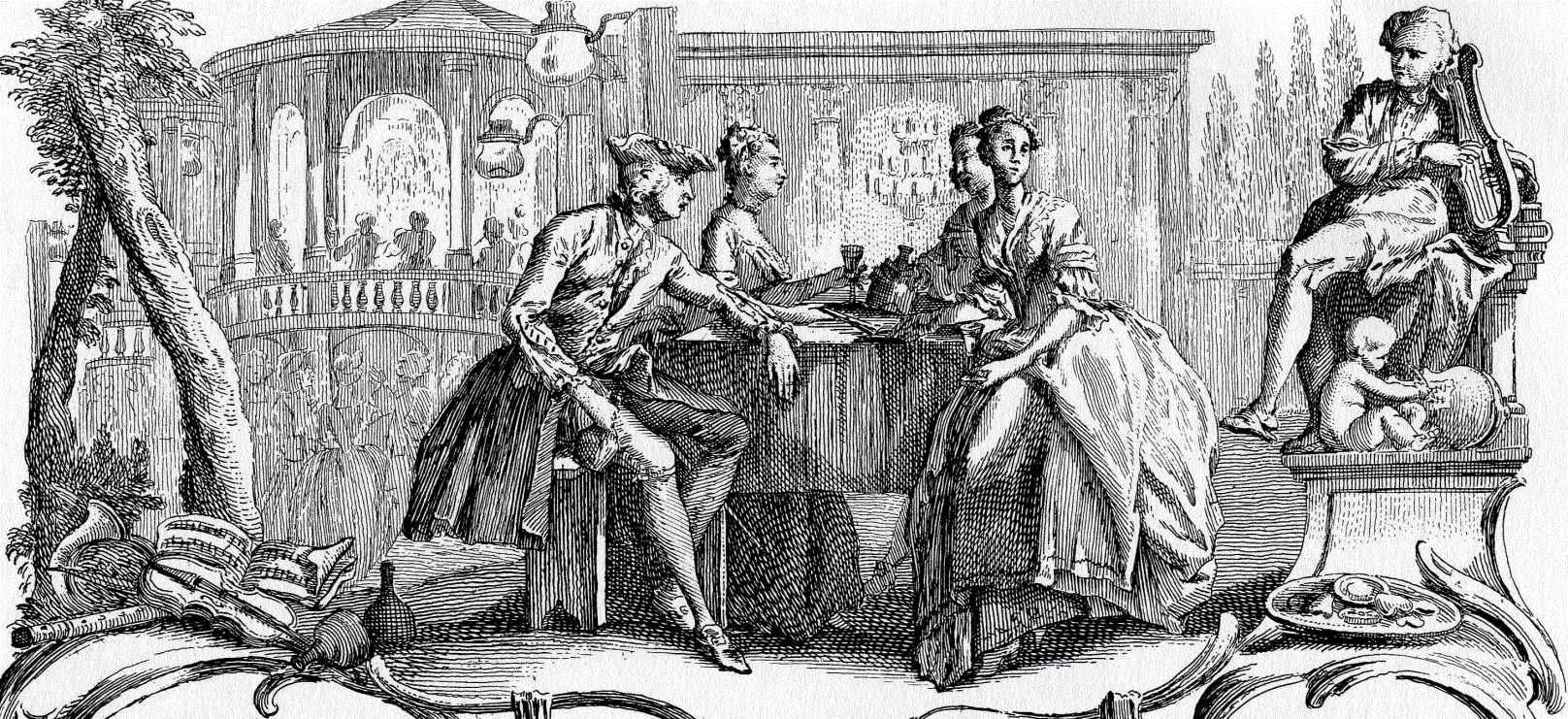
Roubiliac's statue was something more than a publicity coup, then; and so was Tyers's generous purchase of fifty tickets for the composer's benefit.Footnote 159 Handel had been actively involved in the Spring Gardens years before Tyers commissioned his ‘Effigies’.Footnote 160 The statue visually grounded, indeed personified, music in the Gardens as much as it honoured Handel in the wake of his 1737 collapse (which must have deprived the venue of his services that summer). This is wonderfully captured in an engraving from George Bickham's Musical Entertainer (see Figure 8), where the statue attracts the (bodily and visual) attention of an eating party, while the actual musical venue and performers recede into a shadowy background.Footnote 161 To a degree, Roubiliac's statue was the technological ancestor of our video-projected close-ups of musicians during live performances, a response to the modern imperative for visual stimulation.Footnote 162 The concept involves Cartesian division and displacement of constituent elements (a performer's image and sound) to enhance perception. Vauxhall's instrumentalists, spatially restricted to the upper floor of the Music Temple and visually overpowered by the surrounding trees, gave place to an archetype musician (Apollo/Orpheus) that combined the material permanence of stone with the cultural radiance of Handel. If there was any talismanic power in the statue, it served commercial rather than nationalistic aims: Bickham's engraving accompanies ‘The Pleasure's of Life’, a song about women and wine, both of them being readily available in the Spring Gardens at a price.
INVISIBLE HANDELPRINTS: JOHN HENLEY AND ENGLISH ORATORIO
Unlike the prominence of Heidegger and the Vauxhall Gardens in Handel bibliography, John (‘Orator’) Henley remains virtually unknown among musicologists. A controversial figure, a disillusioned cleric turned grotesque lecturer, he stood at the cultural antipodes of Handel. His fully spelled name and triple listing attest to his high value as a satirical target. The Collection is the first source documenting the appearance of the two men at the same social event, and as such invites a long overdue study of their intersections.
Henley's Oratory, as both term and spectacle, had been well established by the time Esther reached the stage. Already by 1727 we find him satirically linked with the production's star, Senesino, in The Devil to Pay at St. James's, a lampoon on Italian opera once attributed to John Arbuthnot.Footnote 163 In a story entitled ‘How SENESINO … is going to leave the Opera, and sing Psalms at Henley's ORATORY’ we read that the castrato, disgusted with the Faustina–Cuzzoni battles, ‘went the other Day to offer himself to Mr H—y, to officiate as Clerk in his Oratory’.Footnote 164 The author equates Italian opera and Henley's chapel as sites of absurd theatricality and empty vocalism. A similar clustering appears in Henry Fielding's ‘The Pleasures of the Town’, second part of The Author's Farce (1730), where ‘Signior Opera’ and ‘Dr. Orator’ compete for the hand of the Goddess Nonsense (‘your Oration is like your self; because it has a great deal of Nonsense in it’).Footnote 165 Henley himself was not innocent here: he publicly defended burlesque teaching as based on the Bible,Footnote 166 and closed the Oratory Transactions. No II with ‘A Dissertation upon Nonsense’.Footnote 167 His sermons were certainly known for their ‘sensational and theatrical excesses’.Footnote 168 The author of Touch-Stone found it appropriate to close ‘an ESSAY upon MASQUERADES’ with comments on Henley.Footnote 169 Pope's attack on him in the Dunciad was couched in terms applicable to Italian Opera as well: ‘How honey'd nonsense trickles from his tongue!’.Footnote 170 (Henley retaliated on 17 July 1728 with ‘An Anatomical Discovery that Mr. Pope's Spleen is bigger than his Head’,Footnote 171 and continued in later years with the poem Tom o'Bedlam's Dunciad: or, Pope, Alexander the pig Footnote 172 and an extensive discourse Why How now, Gossip Pope? … Exposing the Malice[,] Wickedness and Vanity of his Aspersions on J. H. in that Monument of his own Misery and Spleen, the Dunciad.Footnote 173) Few could have imagined in 1727 that Senesino would be part of a musical type of oratory (as Handel's ‘clerk’) and his English would offer as much entertainment as a Henley sermon (‘Senesino … made rare work with the English Tongue[;] you would have sworn it had been Welch’Footnote 174).
‘The Pleasures of Life’ (detail), in George Bickham, The Musical Entertainer (London [, 1737–1739]), volume 2, 21; reprinted in Monuments of Music and Music Literature in Facsimile. First Series: Music, volume 6 (New York: Broude Brothers, 1965)
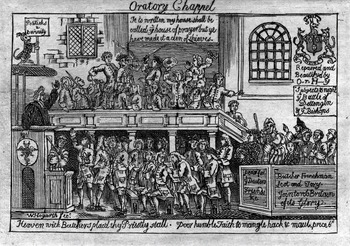
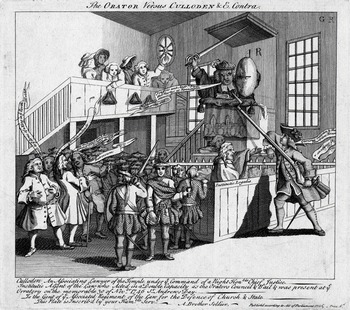
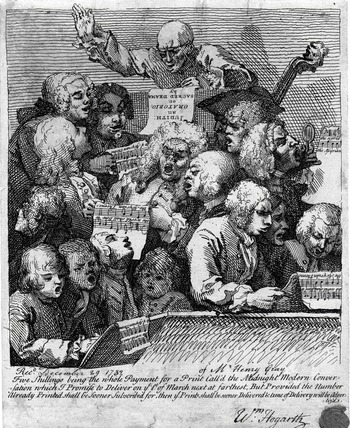
In this wide context, Esther's generic title, venue and performance setting in May 1732 could readily have evoked Henley. The eyewitness in See and Seem Blind, a review of the 1732 theatrical season, describes Handel as being ‘plac'd in a Pulpit[;] I suppose they call that (their Oratory)’ (compare Figures 9 and 10). He also calls oratorio a ‘Religious Farce, for the duce take me if I can make any other Construction of the Word, but he [Handel] has made a very good Farce of it’Footnote 175 (Pope described Henley's orations as ‘Buffoonry’Footnote 176). Unaware of Continental oratorios, he uses Henley as a point of reference to account for Esther's novelties. He was not the only one. Hogarth, too, may have drawn on the preacher's famous gesticulations for the agitated conductor in ‘Chorus Singers’ (Figure 11), portraying a rehearsal of the non-Handelian oratorio Judith (1733).Footnote 177 He had already used Henley as the subject of The Christening (also known as Orator Henley Christening a Child),Footnote 178 and would include him, as was generally accepted, in A Midnight Modern Conversation (1733), for which the ‘Chorus Singers’ served as subscription ticket.Footnote 179 We know from John Nichols, the artist's first biographer, that at least one of the figures in the print ‘was designed’ for a friend.Footnote 180 Henley, too, could have been in Hogarth's mind: the print came out in late December 1732, months after the oratory–oratorio conflation in See and Seem Blind and on the heels of another public controversy over a letter Henley supposedly published in the St. James's Evening Post.Footnote 181
Oratory Chapel, anonymous print (1746), GB Lbma AN358310001. © The Trustees of the British Museum. Reproduced with permission

The considerations above suggest that Esther's Hanoverian trappings (coronation anthems) could not prevent embarrassing associations with Henley's Oratory, thus making the work open to abuse. They also raise a new possibility: the ecclesiastical ban on a staged Esther Footnote 182 could relate, at least partly,Footnote 183 to the hostility between Henley and his former patron Edmund Gibson. The powerful clergyman, who as Bishop of Lincoln had ordained Henley,Footnote 184 recanted promises of advancement to the young priest. Henley became increasingly frustrated and disillusioned, criticized his theological positionsFootnote 185 and charged him with orchestrating attacks on the Oratory (in 1737 he would openly write about ‘a perfidious Pr[elat]e’Footnote 186). There is certainly evidence that Gibson was disturbed about its influence. In a letter to Lord Townshend from 1726, he confided that ‘if Henley were able to carry his point in the metropolis of the kingdom’, then pretty soon there would be ‘a Henley in every diocese’, and he considered the preacher a subversive element threatening ‘the constitution of the Church’.Footnote 187 The Touch-Stone booklet confirms that ‘the Cl[er]gy are in general averse to his Design, and are to a Man join'd to decry the H[enl]ynists’.Footnote 188 One of the latter openly complained that the preacher ‘has been as much assaulted in Pamphlets and publick Papers, and with Scandal and Aspersion in private Conversations, as if he was prime Minister, and was to answer for all the Sins, both of Church and State’.Footnote 189 Such strong disapproval of the Oratory might have influenced Gibson's attitude towards the Handel production of Esther, probably triggering an association of terms comparable to that in See and Seem Blind. If theatre-goers could register the common features of Henley's Oratory and an oratorio in English (‘AN ENGLISH Oration’ is listed among Henley's worksFootnote 190), so would a clergyman in charge of the Chapel Royal and its singers, whose concerns about music in sacred contexts were well known.Footnote 191
The Orator versus Culloden & E. Contra, anonymous print (1747), GB Lbma AN00358332_001. © The Trustees of the British Museum. Reproduced with permission

Unexpected support for this hypothesis comes from a fact that, while mentioned by Winton Dean in a footnote, has remained unexplored since 1959.Footnote 192 Henley's poetic debut was Esther Queen of Persia. An Historical Poem in Four Books,Footnote 193 which appeared a year before Brereton's adaptation of the Racine tragedy.Footnote 194 The nearly one-thousand-line poem was sufficiently ‘approv'd by the Town, and well receiv'd’Footnote 195 to get a second edition in 1715 (its modified title, The History of Queen Esther. A Poem in Four Books, suggests an effort to avoid confusion with Brereton's piece and also foreshadows Handel's own ambivalence in 1732)Footnote 196 and to earn Henley, not yet thirty years old, a place in An Historical Account of the Lives and Writings of our most Considerable English Poets of 1720 (‘This Gentleman has Published an Excellent Poem upon the Scripture History of ESTHER’).Footnote 197 In 1724 the poem appears as the second item – though misleadingly dated 1712 – in Henley's published catalogue of works,Footnote 198 and two years later A Guide to the Oratory calls it ‘The first Appearance [Henley] made in the World as a Writer’.Footnote 199 Among the Oratory's subjects for 30 April 1727 we find ‘The Court of Ahasuerus; the Politicks and Success of Haman, with the Characters of Mordecai and Queen Esther’.Footnote 200 As if these reminders were not enough, a satirical poem of 16 September 1731 refreshed public memory of Henley's Esther: ‘And whilst I write these lines’, claims the satirist, ‘[Apollo] guides my quill. / And all the Town will own, I'll lay a tester, / That this Epistle's better than Queen Esther’, which the notes fully identify as Henley's production.Footnote 201 The satire was reprinted in 1732,Footnote 202 which makes the Henley–Esther link publicly available around the time of Handel's production.
William Hogarth, Chorus Singers (1732). GB Lbma AN233118001. © The Trustees of the British Museum. Reproduced with permission

Is it possible that Gibson saw in a staged Esther the same danger of secularizing religion as in Henley's Oratory? Did he even know that the Henleyan Esther ‘was not used in Handel's libretto’?Footnote 203 Questions like these remind us that critical facets of the composer's work were shaped outside musico-textual considerations. Their recovery lies in our willingness to distinguish between a historical Handel (one that participated in multiple discourses, musical or not) and a culturally variable one (Handel the baroque composer) shaped and reshaped by generations of performers, listeners and critics of his works.
A ‘MERCURIAL’ HANDEL?
Handel's physical condition from the 1730s onward has attracted serious attention, from medical diagnoses to broad arguments about his artistic choices.Footnote 204 All accounts share a common beginning chronologically – namely his 1737 collapse – and seem to agree on at least one cause, lead poisoning from drinking fortified wines.Footnote 205 Lead was not, however, the only dangerous substance widely available. Known today for its lethal toxicity, mercury was used at that time as universal remedy (‘what great Cure was ever done without it?’Footnote 206). It was thought to clear blockage in the blood vessels and other tracts by virtue of its heaviness, thus restoring the free circulation of the fluids. Its swift action against various symptoms and ailments generated enthusiastic response (‘the most gentle and sovereign of all Remedies’, ‘a capital Enemy to Diseases’Footnote 207). Despite grave objections against its use in crude form, various authors assured the public of its great benefits. In 1732 one of them claimed that mercury ‘has effected hundreds of Cures within these two Years, more than all the other Drugs put together’, and estimated that ‘perhaps ten thousand People have of late daily taken it crude’.Footnote 208
Handel could have been one of them. Within satire's large interpretive margin, his ‘taking Poison’, as the Collection puts it, could have alluded to mercury use (classified by ancient medical authorities as a poisonFootnote 209). Indeed, certain uses of mercury were considered outright poisonous. Dr Allen's Synopsis medicinae describes its equivocal results:
Quick-silver [mercury] can scarce be reckoned amongst the Number of Poisons; for it is well known, that in some Cases some Ounces of it may be drank without Damage, but it's external use is of much more pernicious Consequence, as may be seen in those, who in the Venereal Distemper or the like, make use of Mercurial Ointments. It has been suddenly fatal to a great many; occasions a trembling, Stupidity, a Palsey, perpetual Lameness, &c. … Though Quick-silver is not violent, yet some preparations of it are most Venemous, as Mercur. praecipit of various kinds; but Merc. sublimat. corrosivus taken inwardly, produces the worst Symptoms of all of them.Footnote 210
If the Collection indeed alludes to mercury use, then it may qualify as the earliest reference to Handel's medical condition, and mercury poisoning could be added as a contributing factor to his troubles during the early 1730s. Mental imbalance and irrational behavior, its trademark symptoms, already appear in the wake of Deborah's failed premiere: ‘This Accident … has thrown [Handel] into a deep Melancholy, interrupted sometimes by raving Fits … then he breaks out into frantick, incoherent Speeches’.Footnote 211 As late as 1760, John Mainwaring acknowledged ‘how greatly his senses were disordered at intervals, for a long time, appeared from an hundred instances, which are better forgotten than recorded’.Footnote 212 If Isaac Newton's mental collapse in 1693 can now be attributed to mercury poisoning,Footnote 213 we should think seriously how Handel's possible use of mercury influenced his affairs in the 1730s.
A TWIST OF AN EPILOGUE
The above discourse, exhaustive in detail and of unusual origin (a one-page document) rests on a premise of trust. Instead of dismissing the Collection as an oddity worth circulating in academic parties only, I resolved to accept it as stretched reality and distorted record of an actual event with real participants. This was not without reason. Establishing facts in the stormy waters of British public life during the 1730s is often impossible: actual events freely mix with rumours and planted intelligence, calumnies and wishful thinking, and often suffer from archaic reporting techniques. Heidegger was announced to be dead in 1735 (untrue) and household accounts list the Prince of Wales as attending Israel in Egypt's failed premiere in 1739 (all surviving evidence suggests otherwise).
However pragmatic, my strategy inevitably results in gains and losses. The source did serve me as a ladder to re-examine Handel's career during the ‘Second Academy’ and explore hitherto obscure encounters with persons, places and institutions. On the downside, it led to a discovery that might shake the reader's confidence in my project: Handel's description in the Collection is, among many others, a transplant from a previous satirical list.
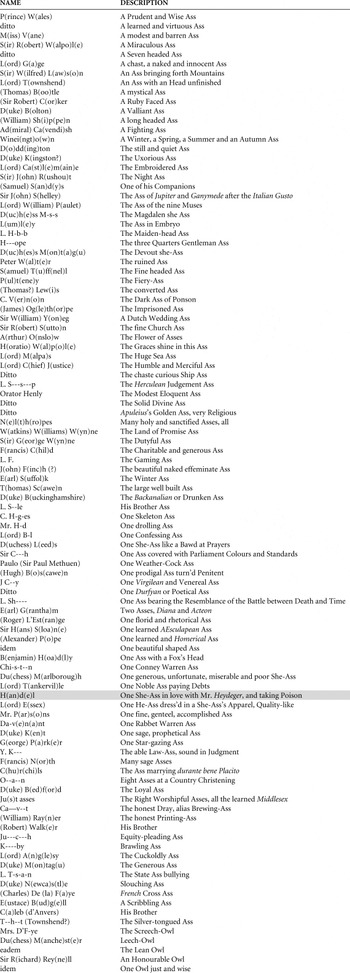
The story throws us back into politics. When in 1729 Robert Walpole arranged the allocation of an extra £115,000 from public funds to the Crown's Civil List, many considered it a parliamentary coup. William Pulteney (1684–1764), Walpole's arch-enemy and a friend of Swift, condemned the measure in a Letter from a Member of Parliament to his Friend in the Country, where he listed all MPs voting for and against the bill. Intensifying his reaction, he also produced a satirical list of personages crowding Westminster Hall.Footnote 214 The list first came out separately on 10 July as A Collection of Several Pictures by the Best Hands, &c.; Which where [sic] lately to be View'd adjoining to the Court of Requests; And when the Town fills, will be exhibited there again to Publick View.Footnote 215 Extremely popular, it reached a third edition (‘With ADDITIONS’) by 18 July and was incorporated (as ‘the compleat Collection of Pictures’) in the Letter's fourth edition on 23 July.Footnote 216 Lady Hervey recorded the following day that ‘there is a great deal of wit stirring in town. I have seen a collection of pictures, some of which are admirably good, others I do not understand, and some few I do not much like.’Footnote 217 Table 2 consolidates all three satirical lists, showing the transfer or mutation of descriptions between 1729 and 1732.
The revival of the list in summer 1732 offers one last insight about the ridotto al fresco. With admission set at one guinea (worth two opera tickets), Tyers was seeking to create as exclusive an environment as a court, perhaps an Arcadian version of St James's. The high concentration of elites and the pretentious setting must have evoked the 1729 Collection. That the Vauxhall list is significantly revised (of its ninety-three names, thirty-two appear for the first time, while twenty from the previous lists are absent) suggests a response to an actual event with known participants and validates my trust in the document.
What about Handel? Does the new discovery strengthen or undercut the claims of this article? At first glance, it is unsettling that his description might have originated with someone else. Lowell Lindgren has instantly recognized ‘S A-d-re’ as Nathanael St André (1679/80–1776), surgeon and anatomist to George I's royal household since 1723, Heidegger's Swiss compatriot, a master of viola da gamba and a notorious self-publicist.Footnote 218 In the mid and late 1720s he was enmeshed in controversies that eventually destroyed his career. His role in publicizing Mary Toft, a Surrey woman claiming to have given birth to fourteen rabbits (and a fifteenth one with St André's help), deserves a place in the annals of medical credulity.Footnote 219 In 1725 he asserted he had been poisoned by strangers, causing the launch of a criminal investigation, and publicly described his overcoming the dreadful experience. Poisoning also features in the last of his scandals, in 1728. His eloping with the wife of his friend and dying patient Samuel Molyneux, MP and secretary to the Prince of Wales, fuelled rumours that he had poisoned the unfortunate husband.Footnote 220 When a Reverend Madin openly accused him, St André filed a lawsuit, which was judged nonsuited on 26 June 1729, two weeks before the appearance of the Collection.Footnote 221
‘A Lady taking Poyson for Love of Mr. Heydegger’ evokes these incidents and possibly alludes to a common appearance at St James's court of Heidegger with St André or Molyneux's widow. What made the description also available for Handel is Heidegger, naturally, whose connections and experience as problem-fixer were indispensable both to a novice theatrical manager and to a royal physician on the verge of losing his career. Like St André, Handel had received wide publicity in the weeks preceding the Collection: he had just returned from Italy after securing talent for the new opera season.Footnote 222 Whether poisoning is to be understood allegorically (close proximity to Heidegger, a king of vice and corruption for moralists) or factually (medicinal use of mercury) will have to remain an open question. The latter now seems less plausible (the description fits St André better than Handel), yet not impossible: the wonder drug had broad circulation among the upper classes, and the collapse of Handel's health in 1737 is firmly linked to chronic poisoning. On the positive side, knowing that the description dates back to 1729, at the start of his partnership with Heidegger, justifies my broad investigation of the ‘Second Academy’ years and my claims on the nature of their relationship.
FLIRTING WITH THE CARNIVALESQUE
Where does this all leave us? The cornucopia of data, the ever-shifting possibilities, the allusions, hypotheses and contradictions in this essay may produce bewilderment and frustration to the reader. Is there any certainty? Can anything be taken as fact? Yes: the existence of the document that set in motion this historiographical extravaganza. Everything else is reconstruction to some degree. The reader needs to understand, however, that I am dealing with hidden corners of history, the ones inaccessible to the square brick of theory yet within reach for a flexible brush, whose soft hairs, each an open-ended conjecture, could probe and recover them for musicology.
Furthermore, my treatment reflects the document's own carnivalesque spirit. Reversing scholarly etiquette, I begin with an answer and proceed to reconstruct possible questions applicable to it: why would Handel have been present at the ridotto al fresco?; how did his forthcoming production of Acis and Galatea relate to the pastoral utopia of the Vauxhall Gardens?; who could have served as his liaison with the venue and Jonathan Tyers?; why is he listed as inferior to Heidegger? I also remove the divide between factual and potential reality to accommodate the broad interpretive margin in satire. Finally, I break with traditional scholarly presentation, replacing the linearity of causally interlocked statements with parallel or sibling discourses. This approach helps recover information hitherto unknown or suppressed, and exposes the complexities informing Handel's life and career in the most dynamic social setting Europe had encountered in two millennia.
My flirting with the carnivalesque is emblematically cast in the opening braying ‘hee-haw … llelujah’, a caustic distortion of Handel's signature chorus. The ‘Second Academy’ years were a cause for celebration because of his social advancement. At the same time they saw his closest proximity to the Hanoverian monarchy, particularly the Queen and the Princess Royal, making him no less subject to satire than other cultural pillars of the Whig supremacy. Amidst the adulation of the recent commemorative year of 2009, the irreverent ‘hee-haw … llelujah’ serves as a historiographical mantra invoking the Georgian Handel, an ambitious man and partisan artist who in the early 1730s gave plenty of reason for some to claim ‘what an ass!’.
Individuals listed in the three satirical lists