1. Introduction
What firm characteristics give them the confidence to invest in settings rife with decentralized, often violent, local expropriation? Existing work on the political economy of investment typically assumes investments are threatened by a centralized autocrat. In this literature, mechanisms such as checks and balances (North, Reference North1990; North and Weingast, Reference North and Weingast1989), political connections (Haber et al., Reference Haber, Razo and Maurer2003) or the threat of collective action (Gehlbach and Keefer, Reference Gehlbach and Keefer2011, Reference Gehlbach and Keefer2012; Weingast, Reference Weingast1997) are necessary to align the interests of autocrats and investors to create confidence that property rights will be respected. Recent research suggests, however, that sub-national officials acting independently (and often without the knowledge) of central authorities can also pose substantial expropriation risks to firms. Although the solutions to centralized expropriation are well-studied, less is known about how to stave off threats from sub-national authorities (Firestone, Reference Firestone2010; Markus, Reference Markus2012; Mattingly, Reference Mattingly2016; Rochlitz, Reference Rochlitz2014).
Consider the illustrative case of the Russian firm Agromol in 2008. Two former security officials convinced regional authorities to imprison Agromol's head for embezzlement after he refused to sell at below market rates. Regional firms took this as a signal to appease predatory demands by security officials (even retired ones) to avoid a similar fate. While Agromol's owner was eventually freed, doing so required intervention by higher-level regional and national authorities and substantially degraded the company's assets.Footnote 2 Subsequent, centralized solutions such as legislation prohibiting pre-trial detention of entrepreneurs for economic crimes did little to slow local expropriation.Footnote 3 Only securing direct national interventions promised relief, leading Russia to establish a business ombudsman on par with its human rights ombudsman to help local entrepreneurs secure such interventions.
Existing work has difficulty explaining investment given pervasive decentralized expropriation due to its singular focus on a central state with full control over lower-level officials. In this paper, we join a growing body of work questioning this assumption and exploring how and when firms invest under conditions of extensive, local level predation by sub-national officials (Firestone, Reference Firestone2010; Markus, Reference Markus2012, Reference Markus2015; Mattingly, Reference Mattingly2016; Rochlitz, Reference Rochlitz2014). Theoretically, we also emphasize that where expropriation is commonplace, the average firm is insecure about their property rights and less willing to invest. We extend this work by arguing that some firms have characteristics that enable them to defend themselves by both enabling them to attract attention from central authorities and aligning these authorities' incentives with actually defending them. In settings with decentralized expropriation, leveraging these characteristics grants firms a comparative advantage that should make their investments less sensitive to decentralized expropriation. We particularly focus on firms with large-scale employment, direct political connections, collective action potential, and foreign ownership, since hurting them can have important consequences (electoral, financial or reputational) for the center. Knowing that they can call on protection from above, such firms should be more secure in their property rights and in investing in hostile environments.
Empirically, we test the argument using a large-scale survey of Russian manufacturing firms and a unique, regional-level dataset of predation by local officials. Because most of these resulted in public arrests, we argue that they provide signals about the insecurity of local property rights. Our research design has three empirical advantages over existing work. First, our measure of expropriation captures variation in actual local-level property rights abuses, which can be tied to individual firm-level investment decisions. Although there is a large micro-level literature on firms' responses to corruption, regulatory barriers and other forms of malfunctioning institutions, little work has been done on expropriation per se.Footnote 4 Where expropriation has been explored, the focus has been on perceptions of property rights security, rather than investment (Frye, Reference Frye2017; Markus, Reference Markus2012, Reference Markus2015), or macro-level, cross-country data (Alfaro et al., Reference Alfaro, Kalemli-Ozcan and Volosovych2008; Faria and Mauro, Reference Faria and Mauro2009; Okada, Reference Okada2013). Second, existing studies typically pool responses, arguing that if particular individual-level characteristics increase perceptions of property-rights security they must mitigate the impact of weak institutions. By contrast, our research design exploits sub-national variation, which enables us to separate firm-level characteristics associated with investment generally from those specifically operating where local expropriation is rife. Finally, focusing on a single country enables us to ameliorate many of the omitted variable concerns common to cross-national survey research. As a federal country with a long, common history and regulatory structure, unobservable and omitted variation in the legal system, regulatory structure, regime type, historical path dependency, etc. are less likely to bias our results.
In the next section, we briefly present our argument and our empirical expectations. Section 3 introduces the data and presents our research design. Section 4 presents the main results. Section 5 concludes.
2. Investment under local expropriation risk
Much of the work on the political economy of investment focuses on investor responses to expropriation risk from a centralized state with a territorial monopoly on violence. In North's (Reference North1990) archetypical model, a unitary state maximizes the leader's utility by balancing short-term rents and longer-term revenue. Because of the state's monopoly of violence, the leader can unilaterally capture rents through direct expropriation or policy change, creating uncertainty that makes investments risky. Moreover, her monopoly on violence means that the leader's promises are not credible, since there is no recourse if the state revises or reneges. To resolve this dilemma, the state must tie its own hands or enable third parties to credibly threaten it. Commonly studied mechanisms include institutions that establish checks and balances (North and Weingast, Reference North and Weingast1989), ease collective action (Gehlbach and Keefer, Reference Gehlbach and Keefer2011, Reference Gehlbach and Keefer2012; Weingast, Reference Weingast1997) or link firms and the state via hybrid ownership structures (Haber et al., Reference Haber, Razo and Maurer2003). Common to all these is the creation of a credible mechanism for punishing state expropriation or opportunism by imposing significant costs on it, thus aligning the state's incentivizes with investors'.
More recent work on the political economy of development has relaxed the unitary state assumption. Drawing on classic work on bureaucratic politics, these models assume that local, low-level representatives of the state can act independently to maximize their utility, which may not align with their superiors' (Huber and Shipan, Reference Huber and Shipan2002). By using their access to the state's coercive tools, they can extract rents from local investors (Beazer, Reference Beazer2012; Gerber and Mendelson, Reference Gerber and Mendelson2008; North et al., Reference North, Wallis and Weingast2009). Crucially, however, their ability to do so depends on the capacity and will of the central state to detect and punish local abuses. For example, the Communist Party of China attempted to limit local expropriation by linking the career prospects of its officials to growth targets and establishing an extensive system for monitoring performance. This system helps to explain why local Chinese officials focus so much on investment and local growth (Jia et al., Reference Jia, Kudamatsu and Seim2015; Landry et al., Reference Landry, Lü and Duan2018). China is somewhat exceptional, however, in that the centralized state has reasonable information about local level development outcomes. In much of the developing world, states lack the capacity to monitor local outcomes and shape them (Markus, Reference Markus2012, Reference Markus2015).
Absent formal institutions, firms may be able to rely on informal mechanisms to draw central authorities into intervening in local predation. Work on bureaucratic discretion suggests that interested third-parties (civil society, private individuals, or self-interested industries) can shape bureaucratic enforcement by alerting politicians to perceived abuses (Mccubbins et al., Reference Mccubbins, Noll and Weingast1987; McCubbins and Schwartz, Reference McCubbins and Schwartz1984). In these models, the state can credibly commit to acting on bureaucratic misbehavior as reported by third-parties, who can credibly threaten to impose costs on it. Although developed in a democratic context, our earlier discussion suggests that the model might extend to cases where firms provide services (see below) the state needs to reproduce power. The state's desire for these services should grant such firms a comparative advantage in attracting the state's attention to defend their property rights from local officials, making them less sensitive to the risks of decentralized predation. Thus, if firms know they can impose costs on central authorities for failing to defend them, they will be more likely to invest.
Which firms are most likely to be able to impose costs on the center? One potential cost is electoral. The bureaucratic politics literature posits that politicians can credibly commit to policing their bureaucracies, when complaints about performance come from important political constituencies, who can threaten to withhold electoral support (Beazer, Reference Beazer2012; Mccubbins et al., Reference Mccubbins, Noll and Weingast1987). Even in non-democratic settings, however, work on autocratic survival suggests that politicians may be able to credibly commit to listening to the complaints of firms that are critical for economic growth (Gandhi, Reference Gandhi2008), generating revenue (Gehlbach, Reference Gehlbach2008), or mobilizing employees to support the regime (Frye et al., Reference Frye, Reuter and Szakonyi2014; Mares and Zhu, Reference Mares and Zhu2015). Such firms are generally quite large and provide important resources for regime maintenance. Failure to cater to them can hurt autocrats directly, by making it more difficult to mobilize supporters (Magaloni, Reference Magaloni2006) or triggering protests (Robertson, Reference Robertson2010), or indirectly, by destabilizing the economy and eroding popular and elite support (Reuter and Gandhi, Reference Reuter and Gandhi2011). In either case, catering to large firms is important for preserving political support and forestalling social instability, which may increase the likelihood that firms can secure central protection against local expropriation.
H1: Firms with a large number of employees are less sensitive to rising rates of decentralized expropriation. As the threat of decentralized expropriation increases, small- and medium-sized firms are less likely to invest.
In addition, a large body of work on the firm-level returns to political connections has long shown that firms with direct ties to politicians generally receive privileged access to public goods, government contracts, and property rights protection (see Faccio et al., Reference Faccio, Masulis and McConnell2006; Frye and Iwasaki, Reference Frye and Iwasaki2011; Gehlbach, Reference Gehlbach2008; Szakonyi, Reference Szakonyi2018). Typically, these benefits arise from an implicit exchange, in which the politicians trade benefits for access to rents and revenue (Gehlbach, Reference Gehlbach2008) or electoral support (Frye et al., Reference Frye, Reuter and Szakonyi2014; Mironov and Zhuravskaya, Reference Mironov and Zhuravskaya2016). The arrangement is credible, because the politicians are typically granted direct stakes in the company, board positions, or directorships. These arrangements, coupled with the side payments, align politicians' interests with the company's. As Haber et al. (Reference Haber, Razo and Maurer2003) document, these arrangements encourage investment particularly well in settings where the central state is relatively weak. Nor do firms necessarily need direct connections to the center. Links to political constituencies that underpin the regime – regional governors or elites, military strongmen, etc. – allow for indirect access to the autocrat and can be used to call their attention. Other papers suggest ownership structure – particularly an ownership stake by the state or hidden ownership – tends to be correlated with political connections (Frye and Iwasaki, Reference Frye and Iwasaki2011; Yakovlev and Govorun, Reference Yakovlev and Govorun2011).
H2: Firms with political connections are less sensitive to rising rates of decentralized expropriation. As the threat of decentralized expropriation increases, firms without political connections are less likely to invest.
Another firm-level characteristic that may enable firms to call the attention of central officials is foreign ownership. Foreign firms can appeal to their home governments in disputes. Although foreign governments may lack the power to intervene directly in the domestic affairs of other states, the nature of international diplomacy nonetheless affords them access to top-level officials and potential leverage. As such, intervention by a foreign government can, at the minimum, bring the attention of the central state to the plight of firms that would otherwise be ignored. This ‘backdoor lobbying’, as Markus (Reference Markus2012) puts it, gives foreign firms channels for redress unavailable to domestic firms. Indirectly, firms with foreign owners or investors can also benefit from the ability to access foreign media markets and shape the perceptions of other investors, which can pressure officials to intervene to solve local problems.
H3: Firms with foreign ownership are less sensitive to rising rates of decentralized expropriation. As the threat of decentralized expropriation increases, firms without foreign ownership are less likely to invest.
A final characteristic that may enable firms to draw the center's attention is their ability to engage in collective action. Empirically, case studies of both Russia and Ukraine suggest that business associations play a key role in helping individual firms defend their property rights (Duvanova, Reference Duvanova2013; Markus, Reference Markus2012). This could operate through one of two mechanisms: the central state's fear for its political survival or the ability of such groups to access leaders. With respect to political survival, individual firms are unlikely to be large enough to cause enough disruption to attract the attention of top-level authorities. By engaging in collective action, however, firms can pool their resources and take advantage of economies of scale to stage protests, mount public relations campaigns, slowdown the economy, or withhold government revenue. These actions create political threats, forcing officials to intervene to preserve regime stability. Even where business associations are unable or unwilling to challenge the central state, their ability to pool resources still makes them well-positioned to draw its attention. By dint of their size, such organizations are likely to have political connections themselves or to be able to lobby central authorities directly. Consequently, collective action can magnify the plight of individual association members and therefore make it more likely that the center will step in to defend them. This suggests:
H4: Firms that are business association members are less sensitive to rising rates of decentralized expropriation. As the threat of decentralized expropriation increases, firms that are not business association members are less likely to invest.
3. Data and methodology
To test our hypotheses we use data from three separate datasets. We take firm-level data from the Russian Firms in a Global Economy (RuFIGE) survey carried out in 2014.Footnote 5 The RuFIGE sample includes 1,950 firms in 60 Russian regions. The sampling frame for the survey was constructed using data from the Ruslana database of Russian firms, which includes the universe of firms registered with the central government. The sample distribution of firms in the survey is approximately nationally representative in terms of size and sectoral composition.Footnote 6 To measure the intensity of decentralized expropriation in Russia's regions, we drew on data on publicly reported instances of expropriation attempts by local and regional officials across all 83 of Russia's regions collected by the NGO Business Against Corruption (BAC) (Kazun, Reference Kazun2015). Finally, we also make use of aggregated data on the quality of the institutional environment in Russian regions from the 2011–2012 Business Environment and Enterprise Performance Survey (BEEPS) to distinguish expropriation from other symptoms of bad institutions. Although the BEEPS survey's sample enables us to generate aggregate indicators using regionally representative firm-level data, its regional sample only covers 35 RuFIGE regions. Altogether, our analytical sample therefore consists of 1,536 firms in 35 Russian regions, which represent 79% of the original firms in the RuFIGE dataset. In the analysis that follows, we reweight the sample in order to insure it remains fully nationally representative by size and sector.Footnote 7 We discuss and further justify the use of each of these datasets below.Footnote 8
Our main analysis makes use of a probit regression model with robust standard errors clustered by region. In order to examine the direct effects of decentralized expropriation on firms' investment decisions, we use an equation with the following form:

where Investment for firm i in region r is a dummy variable drawn from the RuFIGE survey asking firms if they made a capital investment between 2011 and 2013. The variable takes on a value of 1 if firms answer in the affirmative and a 0 otherwise. Expropriation is our measure of the intensity of decentralized expropriation, which we discuss in detail below, in region r. Finally, Regional Controls and Firm Controls are a vector of additional control variables for region r and firm i (respectively), which we also discuss below.
Because we are interested in the relationship between certain firm level characteristics, decentralized expropriation, and investment, we next estimate a set of probit regression models with robust standard errors clustered by region that include interaction terms between our measure of decentralized expropriation risk and our variables of interest defining different sub-groups of firms (small, medium, and large firms; firms with and without state ownership, etc.). This equation takes the formFootnote 9:

where Investment, Expropriation, and Firm Controls are the same as in equation (1). Group_Member is a set of dummy variables taking on a value of 1 for firms with the characteristics of interest discussed in Section 2 (also, see below) and 0 otherwise. Non-Group_Member is a set of dummy variables equal to 1 for firms without the characteristics of interest and 0 otherwise. Straightforwardly, the coefficient of the interaction between these variables and the expropriation measure can be interpreted as the effect of expropriation risk on the investment decisions of firms in each particular group. The equation for this model differs from a standard model with interactions; however, its coefficients are a simple linear combination of those in the standard model.Footnote 10 We use this specification, as opposed to a more traditional interaction model, for ease of interpretation. Nonetheless in Appendix F (Tables F1 and F2) we show that our results provide similar results to a more traditional probit model specification with interactions.Footnote 11
Measuring decentralized expropriation
Our measure of decentralized expropriation takes advantage of publicly reported instances of predation by local and regional officials across Russia's regions (Kazun, Reference Kazun2015). The underlying data derive from a dataset of complaints to the NGO ‘Business Against Corruption’ (BAC) by entrepreneurs (http://www.nocorruption.biz/?cat=6), which we aggregated at the regional level. The BAC project was initiated in 2011 by one of Russia's leading business associations ‘Delovaya Russiya’ (DR), supported by then Prime Minister Vladimir Putin. The goal was to document and review cases of illegal and violent attacks on firms at the regional level. By gathering data from across the country, BAC was explicitly meant to empower firms to engage in collective action in defense of their property rights and help draw federal attention to predation (Yakovlev et al., Reference Yakovlev, Sobolev and Kazun2014).
Our measure uses referrals to BAC's ‘Public Council’ as reported in the dataset. Once formally registered with BAC, complaints go through an extensive, multi-layered verification process to gage their authenticity, including reviews by the regional DR branch, the BAC executive council, and a team of leading Russian lawyers. Cases that make it through this process are then referred to BAC's ‘Public Council’. Our measure is simply the number of cases referred between 2011 and 2013 (586 total) per 10,000 firms in the respective region to normalize them. These represent the first year in which BAC began collecting data and the year before our survey was fielded, respectively. Figure 1A in Appendix A shows the distribution of this variable across all of Russia's regions.
Our research design relies on information about the attacks in the BAC dataset being publicly known to firms and thus shaping their investment decisions. Both the typical process for decentralized expropriation in Russia and the data collection process used by BAC are consistent with this assumption. Typically, attempts by local officials to expropriate firms in Russia go through a series of stages following the initial demands.Footnote 12 Refusal to cooperate usually results in an official inquiry into a (typically fabricated) criminal charge, which can escalate to an official arrest and criminal proceedings. Prior to an arrest and formal charges, these expropriation attempts are rarely public information. Firms are unlikely to advertise being under investigation for fear of reputational or business costs. Authorities have discretion over whether to officially register and publicize investigations and likely want to avoid damaging the value of their target by doing so. Arrest and formal charges, however, are hard to hide, because someone is physically incarcerated and courts convened to hear the case. They thus serve as signals to firms trying to gage local expropriation risk. We discuss this in further detail in Appendix B and present illustrative case studies in Appendix C.
Given the discussion above, our research strategy relies on the fact that arrests in the BAC dataset occur before firms made the investment decisions reported in our survey. Unfortunately, the BAC does not publish full information about the dates of arrest, initiation of criminal proceedings, or court hearings tied to the complaints in its dataset and much of these data are under official seal. In order to understand the timing of when cases were added, we engaged in qualitative analysis of open source data (media and court statistics) and recovered information about 390 unique cases (69%) from our dataset.Footnote 13 We conclude that typical cases from the dataset began on average 2 years before complaints were actually submitted to BAC, such that arrests occurred mostly in 2009 and 2011 (see Appendix B). For this reason, we believe that the investment decisions between 2011 and 2013 (our dependent variable) were likely made taking into account the information about the attacks that later appeared in the BAC dataset.Footnote 14
The major advantage of our data is that it provides a clear picture of expropriation in a form that firms intuitively understand. Filings to the BAC are generally undertaken by firms that cannot receive relief through the legal system and have no fear of escalating conflicts with the regional authorities.Footnote 15 These cases are often highly public and involve publicized arrests, so unrelated firms are likely to have heard of cases in their regions irrespective of exposure to the BAC data. The data have an intuitive interpretation: the more cases filed in a region, the more likely officials are to expropriate that region's firms.
A major limitation on our data is that it is effectively self-reported, so it may not include all cases of local predation. Regional level characteristics, particularly those associated with poor institutional quality (rampant corruption, poor legal systems, weak political competition, etc.), may lead to systematic under- or over-reporting in some regions. This said, we do not observe any direct relationships between our measure of raiding and other measures associated with a poor institutional environment, such as political competition (both vote totals for United Russia and the margin of victory of the winning party in regional elections) or crime rates (both murders and economic crimes). As Table A1 in Appendix A indicates, correlations between these variables and the raiding measures are quite low. Nevertheless, we control for some of these to separate out the specific effect of decentralized expropriation and help mitigate potential bias.
Firm level characteristics
In Section 2, we argued that some firms have characteristics that make them more likely to be able to call the attention of the central state to local officials' expropriation attempts. To test these propositions, we use a number of firm level variables taken from the RuFIGE survey.
The first characteristic that we highlight is firm size (H1). As noted in Section 2, large firms are likely to have preferential access to state officials at the highest level due to their importance for the economy and, through it, social stability. Failure to cater to such firms can adversely influence the firms' workers, their dependents, and complimentary firms, which in turn can trigger social unrest and threaten central leaders. Such firms are also important in Russia as a tool for mobilizing voters for the ruling party, making them important for political stability (Frye et al., Reference Frye, Reuter and Szakonyi2014). We measure size using a simple measure of the number of employees firms report that is recoded into an ordinal scale, where zero represents small firms (less than 100 employees), one medium-sized firms (less than between 101 and 499 employees), and two large firms (greater than 500 employees). This measure of size best captures the central feature of large firms – the size of the workforce that depends on them and which they can mobilize – which theory suggests enables them to attract attention from the center.
It is worth noting that firm size may also capture other mechanisms linking expropriation risk to investment, such as large revenue flows or asset endowments that make predation lucrative. These correlates complicate analysis, because they generate potentially ambiguous predictions about the behavior of large firms under decentralized expropriation.Footnote 16 Large revenue flows increase the potential payoff to predators for capturing firms but also provide firms more monetary resources to defend themselves.Footnote 17 Similarly, lootable assets may make it easier for predators to extract value from captured firms, while at the same time making it harder for predators to leverage hold up costs to take over firms (e.g. Williamson, Reference Williamson1979).Footnote 18 Consequently, it is important to account for such correlates as much as possible in order to avoid bias.
We attempt to account for these possibilities directly in two ways. First, in our main specifications, we make use of sectoral dummy variables, which should capture much of the sectoral-level variation in asset liquidity and specificity that arises from firms' product market strategies. Second, in a series of robustness checks (see Appendix F), we also include controls for revenue. Thus, any remaining effect of employee size should flow from its correlation with the importance of the firm for social stability and reproducing power, our two main theoretical channels of interest.
The second characteristic that we highlighted in Section 2 is the presence of political connections between the firm and state officials (H2). While our survey does not provide a direct measure of political connections, a wide body of literature has worked to identify characteristics that make firms more likely to possess them. Here, we focus on two proxies for political connections that emerge from the extensive literature on political connections and their benefits for Russian firms (Frye, Reference Frye2002; Slinko et al., Reference Slinko, Yakovlev and Zhuravskaya2005; Yakovlev and Zhuravskaya, Reference Yakovlev, Zhuravskaya, Kornai, Matyas and Roland2009). Our first proxy measure for political connections is a dummy variable equal to 1 when the firm reports that the state has an ownership stake in it and 0 otherwise. In Russia, the state is often able to parlay relatively small stakes into directorships or board seats for current and former state officials (Frye and Iwasaki, Reference Frye and Iwasaki2011; Szakonyi, Reference Szakonyi2018).
Our second proxy variable is a novel measure that we believe proxies for political connections more generally. Our survey features a number of detailed questions about the property structure of firms and who owned them. About 20% of firms refused to answer this question, however. Refusing to answer this question suggests that such firms are reluctant to make public the details of their ownership structure, even when granted anonymity. In previous work using similar questions, such firms are much more likely to benefit from government support (at all levels), while also being more likely to make voluntary contributions to the social development of the regions that mirror those made by politically connected firms (Yakovlev and Govorun, Reference Yakovlev and Govorun2011). Such firms are also less likely to belong to groups that require firms to disclose information publicly. Although this is not dispositive proof of political connections, the fact that firms appear to derive political benefits while also making contributions similar to those of known politically connected firms is highly suggestive that such firms are hiding sensitive connections from public scrutiny.
Crucially, however, refusing to answer the ownership question is unlikely to indicate illicit ties that could increase their vulnerability to predation by attracting federal attention to wrongdoing.Footnote 19 As noted above, the sampling frame for our survey used data derived from the central government's own official register of firms. Consequently, firms in our survey (and their ownership and financial data) are already well known to the center. Moreover, as noted above, such firms are also more likely to receive federal aid, indicating they have few qualms about attracting federal attention. Taken together, it is unlikely they fear the center's scrutiny. Instead, we believe such firms more likely worry about public scrutiny of their political connections. We therefore introduce a dummy variable which takes on a value of 1 for firms that did not respond to the question about property structure and 0 otherwise.
The third characteristic that we argued should be associated with a greater ability to call the attention of central authorities to attempted local expropriation is foreign ownership (H3). We measure foreign ownership with a dummy variable equal to 1 if firms report having foreign owners. The final characteristic that we highlight is the ability of firms to engage in collective action (H4), which we proxy for with a simple dummy variable that takes on a value of 1 for firms that report membership in at least one business association and 0 otherwise.
Before moving on to our controls, we should note that all of the main, firm-level characteristics of interest in this study have been previously cited as important predictors of firms' behavior in Russia and other transition economies (Beazer, Reference Beazer2012; Djankov and Murrell, Reference Djankov and Murrell2002; Frye, Reference Frye2017). Even where expropriation risk is small, we would therefore expect that these variables to have a direct relationship to investment decisions. Because of this, we include them in all of our specifications.
Controls
In all of our specifications, we include a vector of firm-level controls to account for alternative explanations for firms' investment strategies. In addition to our main firm-level characteristics of interest (see above), this vector includes the age of the firm, dummy variables for state supportFootnote 20 and state contracts for the firm, a vector of sector dummies, and a vector of dummies for the type of locality the firm operates in (city/town/village). All of these have been shown by previous literature to shape investment decisions in Russia and other transition settings (Beazer, Reference Beazer2012; Brown et al., Reference Brown, Earle and Telegdy2006; Djankov and Murrell, Reference Djankov and Murrell2002; Frye, Reference Frye2017). In our preferred specifications, we do not include a control for firm's reported revenue, since a large portion of our sample refused to answer this question. We do, however, present results that include this variable in a series of robustness checks discussed after our main results.Footnote 21
We also include a vector of regional level control variables in all of our specifications. This vector includes Gross Regional Product (GRP) per capita and two measures of the quality of institutions in Russian regions – corruption and the quality of the judicial system. The quality of institutions likely matters in its own right but also (as noted above) likely shapes the extent to which decentralized expropriation is reported. Controlling for these features therefore allows us to both separate out the effects of decentralized expropriation from other symptoms of poor institutions and helps mitigate systematic bias in our measure of decentralized expropriation.
We estimate corruption and the quality of the judicial system in Russia's regions from the 2011–2012 Russian Regions BEEPS survey, discussed above. Our measure of corruption is a regional-level aggregate of responses to asking if the following statement is true: ‘It is common for firms in my line of business to have to pay some irregular “additional payments or gifts” to get things done with regards to customs, taxes, licenses, regulations, services, etc.’. Our measure of the quality of the judicial system in the regions is also a regional aggregate of a question about whether the respondent disagrees or agrees with the following statement: ‘The court system is fair, impartial and uncorrupted’.
In a series of robustness checks reported after our main specifications, we also estimate regressions that include other regional-level controls, such as value added to regional GRP by natural resources (i.e. resource wealth), growth in GRP, the number of years the regional governor is in power, share of votes for the President Putin at the 2012 Presidential elections, distance to Moscow, population, urbanization rate, and unemployment rate in the region. All of these variables are meant to control for various potential regional-level explanations for investment and help guard against spurious or omitted variables. Descriptive statistics for all variables are presented in Appendix Table D1 and we provide a table of correlations for the regional-level variables used in the main analysis in Appendix Table D2.
4. Results and discussion
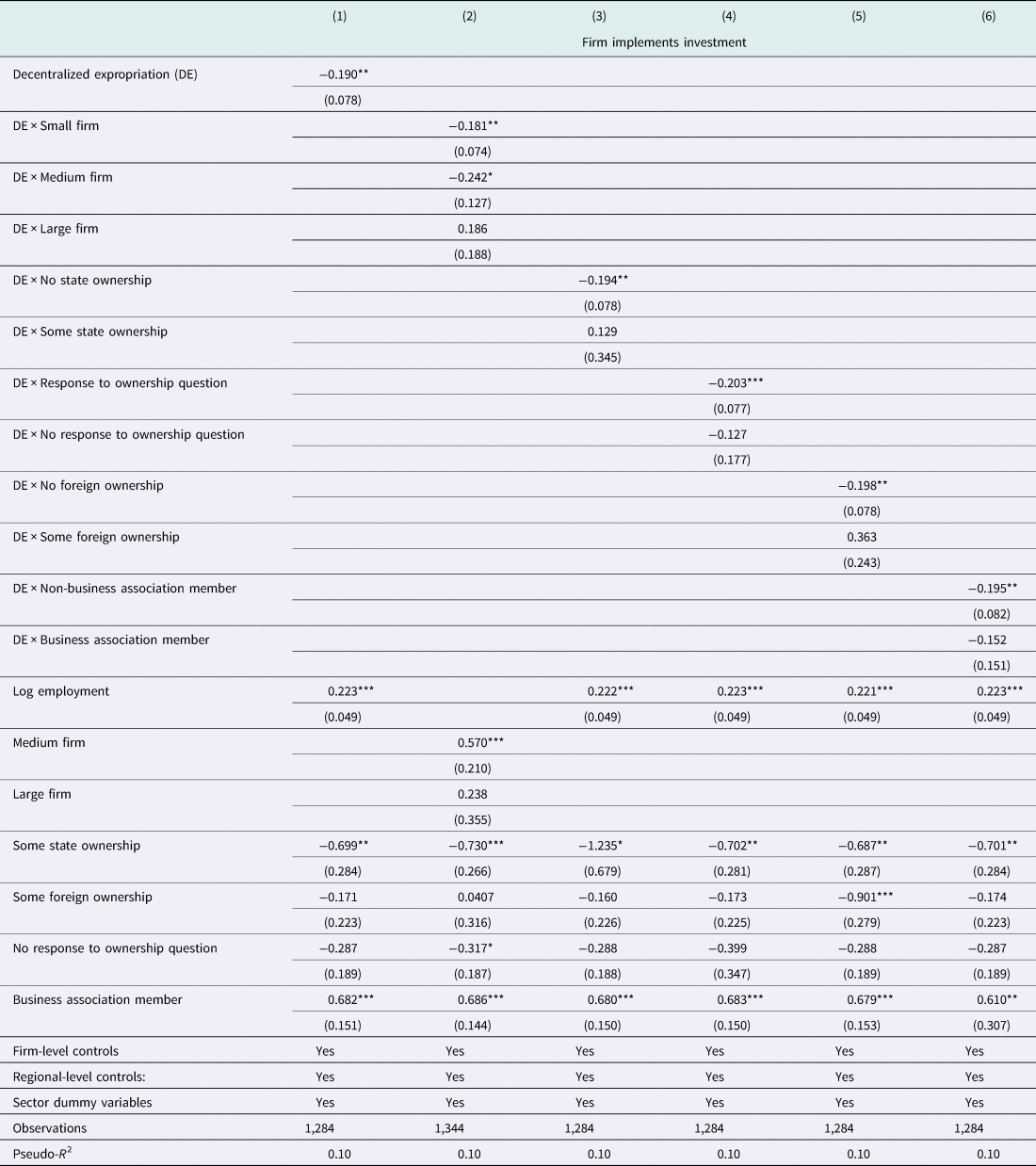
The results of our main analysis are presented in Table 1. For brevity, we only report results for our variables of interest. The full table can be found in Appendix Table E1. Model 1.1 examines the unconditional relationship between the intensity of decentralized expropriation and investment decisions, controlling for firm-level characteristics. As expected, a higher number of expropriation attempts has a negative and statistically significant (p < 0.05) association with the probability of investment. With respect to specific controls, we find that firm size, membership in business associations, and receipt of state orders are all positive predictors of investment and are statistically significant at or above conventional levels. Firms where the state has an ownership stake, by contrast, are less likely to invest ceteris paribus.
Decentralized expropriation and firms' investment decisions

Robust standard errors clustered at the level of regions in parenthesis. Firm-level controls include the age of the firm, receipt of government support, receipt of state orders, and the type of locality the firm is in. Regional-level controls include log GRP per capita, corruption, and quality of judicial system. See text for descriptions.
***p < 0.01, **p < 0.05, *p < 0.1.
As we argued above, however, some firms should be better able to defend themselves from the effects of decentralized expropriation and therefore less sensitive to it. Models 1.2–1.6 introduce the various firm-level characteristics of interest discussed in Section 2 and test the argument. Model 1.2 examines firm size. The interaction term between decentralized expropriation intensity and our dummy variables for small- and medium-sized firms are negative and statistically significant (p < 0.05 and p < 0.1, respectively). For large firms, the interaction is instead positive, although this result is not statistically significant at conventional levels. These results are in line with our hypothesis that large firms are better able to call attention from central authorities to local expropriation attempts, making their investment decisions less sensitive to rising decentralized expropriation (H1). By contrast, small- and medium-sized firms, whose defenses are much weaker, are less likely to invest in regions with high levels of decentralized expropriation.
Models 1.3 and 1.4 focus on political connections as a potential defense mechanism to mitigate the effects of decentralized expropriation (H2). Model 1.3 shows that firms without state ownership are less likely to invest as the intensity of decentralized expropriation increases, a result which holds at the 95% confidence level. Firms with state ownership, conversely, are more likely to invest as the intensity of decentralized expropriation increases, although this result does not hold at conventional levels of significance. This suggests that state owned firms are less sensitive than private firms to decentralized expropriation and is consistent with the notion that political connections aid firms in defending themselves against local predation. It is also worth noting that that magnitude of the negative effect of decentralized expropriation on the investment decisions of firms with no state ownership outweighs the negative direct effect of state ownership. Consequently, non-state owned firms in settings with decentralized expropriation are even less likely to invest than state-owned firms.
Model 1.4 introduces another proxy for political connections: the transparency of firms' ownership structure. It suggests that firms that are fully transparent (i.e. less likely to be hiding political connections) are also less likely to invest in regions with high levels of decentralized expropriation at conventional levels (p < 0.05). While firms that hide their ownership structure are also less likely to invest in regions with frequent decentralized expropriation, this result is statistically indistinguishable from zero. Again, these findings are consistent with the notion that political connections make it easier for firms to call the attention of the central state to local predation, thus providing defenses that make firms' investment decisions less sensitive to decentralized expropriation.
Model 1.5 explores whether foreign ownership can help firms protect themselves (H3). As expected, firms without foreign ownership are less likely to invest in regions with high levels of decentralized expropriation at conventional levels (p < 0.05). While foreign firms appear more willing to invest in regions with higher levels of decentralized expropriation, the result is statistically indistinguishable from zero. Taken together, these findings suggest that foreign firms are indeed better protected against decentralized expropriation than domestic firms and are less sensitive to decentralized expropriation.
Finally, Model 1.6 explores business association membership. Recall that business association membership is a strong proxy for the ability of firms to engage in collective action, which should help them defend themselves from local predation (H4). As expected, the interaction term between firms without business association membership and decentralized expropriation has a negative and statistically significant relationship to firms' investment (p < 0.05). Firms that are not members of business associations are less likely to invest as the intensity of decentralized expropriation increases. While firms that were members of business associations were also less likely to invest as decentralized expropriation increases, the magnitude of the coefficient is smaller than that for non-member firms and the result does not hold at conventional levels of statistical significance. These findings are consistent with the notion that firms with access to tools for facilitating collective action are better protected against decentralized expropriation.
To show that the form of our equation does not affect the results, Appendix F presents the results of the above analysis using conventional, classical-form specifications. Both the main results (Appendix Table F1) and Wald tests of joint significance (Appendix Table F2) comport with the results reported here. For robustness, we also reran our main specification including controls for the log of firms' self-reported revenue from the RuFIGE survey. As noted above, only about half of the sample responded to this question, however. To account for this, we assigned a value of 0 to the log revenue variable for firms that refused to answer this question. We then included a new dummy variable in the specification equal to 1 if the firm refused to answer the revenue question (and 0 otherwise) to distinguish these firms from those that provided information.Footnote 22 Results are reported in Appendix Table F3. Introducing this variable does not change any of our main results materially.
In addition, we also ran supplemental models using a wide range of additional regional-level variables, including value added to regional GRP by natural resources (i.e. resource wealth), growth rate of GRP, the number of years the regional governor has been in power, the share of votes for President Putin in the 2012 Presidential elections, distance to Moscow, population, urbanization rate, and regional unemployment rates. These variables represent various characteristics of regions' social, demographic, political, or economic structure that might also help explain firms' investment decisions. None of these additions altered our results, suggesting our main results are not driven by spurious correlations with regional-level variables.Footnote 23
5. Conclusion
This paper explores the conditions under which firms invest in settings where local officials abuse the coercive power of the state to expropriate firms. We argue that decentralized expropriation emerges from the principal agent problem between the central state and local officials, which enables the latter to abuse the state's powers. Because monitoring such officials is costly, the central state has difficulty policing them. Consequently, solutions that would normally induce investment by constraining the central state may not actually induce firms to invest. Drawing on work on bureaucratic accountability, we argue that firms should be more willing to invest if the central state can be trusted to punish low level officials and if the firm is confident it can draw its attention to abuse. We argue that the ability to disrupt regional economies and problematize regime survival, political connections, foreign ownership, and the ability to engage in collective action all make firms more confident they can draw the central state's attention. Such firms should therefore be less sensitive to decentralized expropriation when making investment decisions. Firms without such characteristics, however, should be less confident and therefore be less likely to invest where decentralized expropriation is high. We go on to find support for the argument using micro-level from a survey of Russian firms and a unique dataset of actual attempts by local officials to expropriate firms across Russia's regions.
Our work speaks to the need to be nuanced about how states can build the credible commitments needed to induce investment. We join a growing body of literature that shows that principal agent problems between the central state and its functionaries have important implications for investment (Beazer, Reference Beazer2012; Markus, Reference Markus2012; North et al., Reference North, Wallis and Weingast2009). We contribute to this work empirically by showing that firms' investment decisions vary greatly in their sensitivity to decentralized expropriation. Our results suggest that more attention needs to be paid to which firms find particular commitment mechanisms credible. Heterogeneity in firms' characteristics might also require heterogeneity in the ways the state promises to constrain itself and its agents. Here, we have focused our attention on the state's ability to credibly commit to intervene to punish local officials and those characteristics that might make it more receptive to firms' cries for help. Future work is needed to uncover additional solutions to this problem and the firm level features that might make them more credible.
Just as importantly, our work also speaks to a growing literature on the effects of political connections. Existing work has primarily highlighted the advantages that such connections bring to firms (Faccio et al., Reference Faccio, Masulis and McConnell2006; Frye and Iwasaki, Reference Frye and Iwasaki2011; Szakonyi, Reference Szakonyi2018), which are at worst distortionary to the broader economy. Our work ties into this literature to the extent that decentralized expropriation in Russia emerges from a specialized type of political connection, in which local officials are used to advance business interests. By contrast, however, the effects of these political connections in our work depress investment by the average firm. They represent a form of ‘destructive’ entrepreneurship (Baumol, Reference Baumol1990), which can crowd out market-based business strategies and stunt economic growth. Our work therefore speaks to the importance of examining how political connections help and hinder unconnected firms and their broader implications for economic behavior.
Finally, our paper has several important policy implications. Straightforwardly, governments looking to improve investment need to limit the ability of state officials to abuse their powers. Even in an authoritarian setting with weak institutions, like Russia, there is a great deal of sub-national variation in the extent to which officials abuse power and the impact of this on investment. For officials at the national level, the key is likely to provide regional-level officials with both sticks (firings, criminal proceedings) and carrots (promotions, federal money, etc.) that can lead localities to self-police. At the sub-national level, our work suggests that officials looking to jumpstart growth can work to provide firms with the tools to resist decentralized expropriation. Promoting civil society, and particularly business associations, is among the easiest and most low-cost such measures.