Implications
Little is known about how increasing sward species complexity may affect milk production and composition in grazing dairy cows. The aim of this study was to determine how pastures sown with one, three, four and five species – including grasses, legumes and chicory – affect pasture chemical composition and nutritive value, pasture dry matter (DM) intake, milk production and milk solids production of grazing dairy cows. Pastures sown with greater sward species complexity showed better nutritive value and higher pasture DM intake, milk production and milk solids production than simpler pastures, in all seasons.
Introduction
Improved sown pasture areas supply a large proportion of the feed used by dairy cattle in Europe. Traditionally, sown grasslands have been based on a two-species (grass–legume) mixture (Høgh-Jensen et al., Reference Høgh-Jensen, Nielsen and Milan-Thamsborg2006). Legumes offer important potential benefits when mixed with perennial ryegrass through (i) increased pasture production, (ii) symbiotic N2 fixation, (iii) mitigating and facilitating adaptation to climate change, as elevated atmospheric CO2, warmer temperatures and drought–stress periods rise, (iv) increasing pasture nutritive value and intake, leading to (v) higher milk production (Harris et al., Reference Harris, Auldist, Clark and Jansen1997; Ribeiro-Filho et al., Reference Ribeiro-Filho, Delagarde and Peyraud2003; Lüscher et al., Reference Lüscher, Mueller-Harvey, Soussana, Rees and Peyraud2014). However, grass–clover swards are not well adapted to a large range of weather conditions (Høgh-Jensen et al., Reference Høgh-Jensen, Nielsen and Milan-Thamsborg2006). It would be worthy to examine the effect of introducing more complex mixtures, including grasses, legumes and forbs. In practice, the flexibility allowed by the use of pastures with more than two sown species would make pasture-based milk production systems more resilient to adverse weather conditions due to the complementarity between species on growth rate and nutritive value of the multi-species swards (MSS).
Increasing the botanical complexity of swards has been suggested as a means of raising annual pasture productivity and decreasing seasonal variability of pasture dry matter (DM) production, facing drought conditions (Sanderson et al., Reference Sanderson, Soder, Muller, Klement, Skinner and Goslee2005). There is a rising interest from scientists to examine the effect of MSS on pasture chemical composition and nutritive value, pasture DM intake (Deak et al., Reference Deak, Hall and Sanderson2009; Sanderson, Reference Sanderson2010) and milk production in grazing dairy cows (Sanderson et al., Reference Sanderson, Soder, Muller, Klement, Skinner and Goslee2005; Soder et al., Reference Soder, Sanderson, Stack and Muller2006; Chapman et al., Reference Chapman, Tharmaraj and Nie2008). Evidence from these studies suggests that the yield benefit mainly results from including drought-tolerant species (i.e. forbs such as chicory), especially in mid-summer when drought stress reduces productivity of dominant cool-season sward species (Skinner, Reference Skinner2008).
Chicory is well known as a highly productive species, with high nutritive value and low fibre concentration (Barry, Reference Barry1998; Li and Kemp, Reference Li and Kemp2005). Higher voluntary intake in steers (Morel et al., Reference Morel, Schmid, Soney, Aragon and Dufey2014) and sheep (Niderkorn et al., Reference Niderkorn, Martin and Baumont2014) has been found for mixed swards including chicory compared with perennial ryegrass swards. Under grazing management, the effect of including chicory in mixed swards on dairy cow performance is unclear. Pasture DM intake and milk production were unaffected by inclusion of chicory in the studies of Soder et al. (Reference Soder, Sanderson, Stack and Muller2006) and Muir et al. (Reference Muir, Ward and Jacobs2014), but increases in milk production and pasture DM intake were found in the studies of Li and Kemp (Reference Li and Kemp2005) and Chapman et al. (Reference Chapman, Tharmaraj and Nie2008). In order to investigate the potential advantages of MSS, a 2-year study was conducted to test the hypothesis that increasing botanical complexity from 1 (grass) to 5 sward species (grasses-legumes-forb) would affect pasture chemical composition, pasture DM intake, milk production and milk solids production of grazing dairy cows. The duration of the study allowed for grazing in all seasons, so as to investigate whether the effect of the sward’s botanical complexity on cow performance would be different depending on the season.
Materials and methods
Location, treatments and experimental design
The experiment was conducted over 2 years: September 2011–August 2012 (year 1) and September 2012–August 2013 (year 2) at the Institut National de la Recherche Agronomique (INRA) experimental dairy farm of Méjusseaume (1.71°W, 48.11°N, Le Rheu, France). The soils are loamy with a pH value of 6.0, an organic matter (OM) content of 3%, and dry quickly during summer drought periods. The swards were sown in September 2010, 1 year before starting the experiment. Four treatments were compared by seeding pastures with a combination of 1–5 sward species as described in Table 1. The sward species were as follows: perennial ryegrass (L, Lolium perenne L.), white clover (Trifolium repens L.) and red clover (Trifolium pratense L.), both referred to as T for Trifolium since they were always sown together, chicory (C, Cichorium intybus L.), and tall fescue (F, Festuca arundinacea Schreb.). The four treatments were applied by combining 1 (L), 3 (LT), 4 (LTC) or 5 (LTCF) of these sward species, to increase botanical complexity of pastures. Treatment L was considered as the control, and LT as a commonly used grass–legume mixture in temperate pasture-based milk production systems. In LTC, chicory was added as a deep-root forb well adapted to dry summers and with good nutritive value. Finally, in LTCF, tall fescue was added, as a more drought-resistant grass than perennial ryegrass, increasing tolerance to dry soil conditions. The experiment was a randomised complete block design with four replicates of each treatment. The total area (8.7 ha) was divided into four blocks (replicates) and each block was subdivided into four paddocks (treatments) with random distribution of treatments within each block.
Sowing rate (kg/ha) of each species in the four types of sward treatments

L=Lolium; T=Trifolium sp.; C=Cichorium; F=Festuca.
Cows
Treatments within each block were simultaneously grazed by four homogeneous herds of 7–10 autumn-winter-calving Holstein dairy cows, using a rotational grazing system. The same cows could not be used during the 2 years of the study, and several pre-experimental periods were needed to allocate cows in the four herds (Supplementary Table S1). A total of six pre-experimental periods were considered throughout the trial, during which all cows were managed similarly as a single herd. Average herd characteristics during the pre-experimental periods were as follows: lactation stage (181±85.4 days in milk), milk production (27.4±7.52 kg/day), milk fat concentration (37.1±3.79 g/kg), milk protein concentration (31.2±2.39 g/kg), BW (627±15.2 kg) and body condition score (2.16±0.19). On average, cows were 100, 164 and 280 days in milk and yielded 35.4, 26.4 and 20.3 kg/day of milk, respectively, in the pre-experimental spring, summer and autumn periods considered.
Grazing management and pastures
Due to the limited grazing area compared with the herd size, permanent grazing within the experimental area was not possible. Consequently, grazing was organised by rotations, each herd being allocated to one treatment for all the duration of the rotation. Block 1, grazed at the start of each rotation, was considered as the adaptation period. Only data recorded on blocks 2–4 were thus used for statistical analyses. Cows grazed non-experimental pastures as a single herd between two experimental rotations. In total, over the 2-year study, cows were grazing within the experimental area during 236 days (124 days in year 1 and 112 days in year 2), during 13 grazing rotations (seven rotations in year 1 and six rotations in year 2), with a mean rotation duration of 18 days (15, 25 and 18 days in autumn, spring and summer, respectively). On average, yearly, two rotations were carried out in autumn, 2.5 rotations in spring and two rotations in summer. Within a grazing rotation, the four blocks were grazed successively, always in the same order. Within each block, the four herds grazed simultaneously in one of the four paddocks, one herd being dedicated to one treatment for the entire rotation and until the next pre-experimental period. During the eight rotations without intake measurement (see Animal measurements section), a rotational grazing system was used (2–6 days of residence time/paddock according to season and pasture availability). During the five rotations with intake measurement (see Animal measurements section), a strip-grazing system was employed using temporary electric fences. Fresh pasture was allocated once daily after the morning milking and the pasture access time was approximately from 0900 to 1530 h and from 1700 to 1830 h. Cows were thus at grazing 20 h daily and received no supplement. The total residence time per paddock and therefore area on offer each day was calculated 1 or 2 days before grazing from the pre-grazing pasture mass estimated as described in the Sward measurements section. The two following management rules were taken into account: (1) same grazing calendar (i.e. same dates) between treatments to avoid time lag, and (2) similar pasture allowance (19 kg DM/cow per day>4 cm) between treatments, to define a medium-to-high grazing pressure (Pérez-Prieto and Delagarde, Reference Pérez-Prieto and Delagarde2013) for controlling post-grazing sward height. To combine both rules, additional, mobile, non-experimental dairy cows were needed to adjust grazing pressure within each block and between treatments based on differences in pre-grazing pasture mass. Pasture refusals were mowed once per paddock and per year in late spring to a 5–6 cm stubble height, and the clipped residues were left in place. The nitrogen fertilisation level was similar between treatments (75 kg N/ha per year) by implementing three equal applications of 25 kg N/ha per rotation of ammonium nitrate in spring and early summer after grazing. Water and mineral blocks were always available to each herd during grazing. The walking distance from paddocks to the milking parlour averaged 610 m.
Sward measurements
Pre-grazing pasture mass (PM, kg DM/ha), pre-grazing (PrH, cm) and post-grazing sward heights, sward bulk density (D, kg DM/ha per cm) and pasture allowance were determined for each treatment in each block and rotation, according to Ribeiro-Filho et al. (Reference Ribeiro-Filho, Delagarde and Peyraud2005). Pre- and post-grazing sward heights were measured with an electronic rising plate metre (30×30 cm and 4.5 kg/m2, AGRO-Systèmes, La Membrolle, France) on the days before and after grazing by taking 60 and 50 measurements/treatment at random, respectively, across four diagonals of each paddock, that is, 100–120 measurements/ha. Pre-grazing sward height was adjusted (aPrH, cm) by pasture daily growth rate (GR, cm/day) estimated by weekly measurement of sward height, and considering lag time (LT, days) between measurement days and average grazing days within the paddock: aPrH=PrH+[(GR×LT)/2]. Pre-grazing pasture mass above 4 cm was calculated by multiplying the adjusted pre-grazing sward height by the sward bulk density above 4 cm: PM=D×(aPrH−4). Frequent measurement of sward bulk density (each rotation, block and treatment) allowed calibration of the pasture mass/height relationship, providing an accurate estimation of pasture mass without using a global equation for calibration of the rising plate metre.
To determine sward bulk density, four strips of 8×0.5 m/treatment were cut with a motor scythe to a post-cutting sward height of 4 cm above ground level. The pasture height on each strip was measured with a rising plate metre, before and after mowing (15 measurements/strip), making it possible to estimate bulk density by dividing pasture mass by cutting depth. The total quantity of pasture collected in each strip was weighed and a fresh, representative 500 g subsample was oven-dried for 48 h at 60°C to determine pasture DM concentration. Another fresh 500 g subsample was collected at the same time, washed and oven-dried for 48 h at 60°C before being analysed for ash and CP in blocks 1–4, for fibre in blocks 2 and 4, and for pepsin-cellulase digestibility (PCd) in blocks 2 and 4, but only during rotations with intake measurement.
Pasture botanical composition was determined for each treatment in 12 of the 13 grazing rotations carried out during the experiment (except in the grazing rotation 13 in late summer). A fresh pasture subsample of ~1000 g was taken from blocks 2 and 4 before grazing. Handfuls of pasture were randomly collected at each of the four steps across four diagonals in each paddock to a cutting height of 3–4 cm above ground level. A fresh representative 500 g pasture subsample was immediately separated into seven botanical components (L. perenne L., T. repens L., T. pratense L., C. intybus L., F. arundinacea Schreb., unsown species and senescent material), each constituent being oven-dried for 48 h at 60°C to determine botanical composition on a DM basis.
Animal measurements
Cows were milked twice daily at 0730 and 1600 h, and milk production was recorded at each milking. Milk fat and protein concentrations were measured individually during six consecutive milkings/week, by near IR spectrophotometry using a Milkoscan instrument (Foss Electric, Hillerød, Denmark). Production of 4% fat-corrected milk (4% FCM) was calculated according to INRA (2007). The BW of each cow was recorded automatically once daily after morning milking.
Individual pasture DM intake was determined during five rotations, namely rotations two in autumn, five and 11 in spring and six and 12 in summer. Intake (I) was measured using ytterbium as an external marker for estimating faecal output (FO) and using faecal composition (N and ADF) for estimating digestibility (D) of selected pasture (Ribeiro-Filho et al., Reference Ribeiro-Filho, Delagarde and Peyraud2005), with the relationship I=FO/(1−D).
At each intake measurement period, each experimental cow was dosed twice daily before milking, at least 7 days before the first faecal sampling, with a cellulose stopper (Carl Roth, Karlsruhe, Germany) containing 0.8 g of ytterbium oxide (Yb2O3) used as an inert external marker. Faecal grab samples were collected from each cow twice daily after milking during a total of 6 days, 3 days in block 2 and 3 days in block 4, and then stored at 4°C. The daily faecal samples were composited by cow and rotation and then oven-dried for 72 h at 60°C before chemical analyses. Net energy and metabolisable protein balance were calculated as the ratio between supply and requirements according to INRA (2007).
Chemical analyses
Oven-dried pasture and faeces samples were ground through a 0.8-mm screen before chemical analyses. Methods of laboratory chemical analyses for ash, nitrogen, fibre and ytterbium have been described by Pérez-Ramírez et al. (Reference Pérez-Ramírez, Peyraud and Delagarde2012). PCd was determined following the Aufrère and Michalet-Doreau (Reference Aufrère and Michalet-Doreau1988) method.
Statistical analyses
Pasture samples and management
Treatment effects on grazing management and pasture characteristics were evaluated using the following model of ANOVA:
 $$\eqalignno{ Y_{{ijklm}} {\rm \,{\equals}}\, & \mu {\rm {\plus}}Yr_{i} {\rm {\plus}}S_{j} {\rm {\plus}}R_{k} (Yr_{{\rm i}} {\times}S_{j} ){\rm {\plus}}P_{l} {\rm {\plus}}T_{m} {\rm {\plus}}Yr_{i} \cr & {\times}S_{j} {\rm {\plus}}T_{m} {\times}S_{j} {\rm {\plus}}T_{m} {\times}Yr_{i} {\rm {\plus}}T_{m} {\times}Yr_{i} {\times}S_{j} {\rm {\plus}}e_{{ijklm}} $$
where Y ijklm , µ, Yr i , S j , R k (Yr i ×S j ), P l , T m , Yr i ×S j , T m ×S j , T m ×Yr i , T m ×Yr i ×S j and e ijklm represent the analysed variable; the overall mean; the fixed effect of the year (i=1–2); the fixed effect of the season (j=1–3); the fixed effect of the grazing rotation within year and season (k=1–13); the fixed effect of the block (l=1–4); the fixed effect of the treatment (m=1–4); the interaction between year and season; the interaction between treatment and season; the interaction between treatment and year; the interaction between treatment, year and season; and the residual error term; respectively. The effect of year, season and year×season were tested using rotation within each year and season as the residual term.
Three orthogonal contrasts were applied on treatment means for testing: the effect of introducing clover in perennial ryegrass swards (contrast T: L v. LT); the effect of MSS compared with single perennial ryegrass/clover mixtures (contrast M: LT v. LTC/LTCF); the effect of introducing tall fescue in MSS (contrast F: LTC v. LTCF).
Botanical components
The chemical composition of the seven botanical components was analysed as follows:
 $$\eqalignno{Y_{{ijkno}} {\rm \,{\equals}}\, & \mu {\rm {\plus}}Yr_{i} {\rm {\plus}}S_{j} {\rm {\plus}}R_{k} (Yr_{i} {\times}S_{j} ){\rm {\plus}}Sp_{n} {\rm {\plus}}Sp_{n} {\times}S_{j} {\rm {\plus}}Sp_{n} \cr & {\times}Yr_{i} {\rm {\plus} }e_{{ijkno}} $$
where Y ijkno , Sp n , Sp n ×S j , Sp n ×Yr i and e ijkno represent the analysed variable; the fixed effect of the botanical component (n=1–7); the interaction between botanical component and season; the interaction between botanical component and year; and the residual error term; respectively.
Three orthogonal contrasts were applied on treatment means for testing: the effect of chicory v. legumes (C v. L); the effect of chicory v. grasses (C v. G); the effect of grasses v. legumes (G v. L).
Animal production
Animal data related to milk production, milk solids production, milk composition and BW were analysed using covariance analysis by PROC Mixed Statistical Analysis System (SAS) Institute (1999) following the model below:
 $$\eqalignno{ Y_{{ijklmh}} {\rm \,{\equals}}\, & \mu {\rm {\plus}}Yr_{i} {\rm {\plus}}S_{j} {\rm {\plus}}R_{k} (Yr_{i} {\times}S_{j} ){\rm {\plus}}Pr_{l} {\rm {\plus}}T_{m} {\rm {\plus}}Yr_{i} {\times}S_{j} \cr & \!\!{\rm {\plus}}\!T_{m}{\times}S_{j} {\rm {\plus}}C_{h} {\rm {\plus}}b_{1} X_{{hijklm}} {\rm {\plus}}b_{{\rm 2}} DIM_{{hijklm}} {\rm {\plus}}e_{{ijklmh}} $$
where Y ijklmh , Pr l , C h , b 1 X hijklm , b 2 DIM hijklm and e ijklm represent the analysed variable; the fixed effect of the parity (l=1–2); the random effect of the cow (h=1–40); the pre-experimental covariate for each experimental variable when available; the days in milk at the start of the trial; and the residual error term; respectively. Owing to the differences in covariate means between parities or between rotations, covariates were centred within parity and rotation in order to use deviations of the covariates from the mean parity or rotation as the covariates rather than their absolute values. Similarly, days in milk was centred within rotation.
Pasture intake and energy and protein balance were analysed using covariance analysis by PROC Mixed SAS Institute (1999), using the following model:
 $$Y_{{ijlmh}} {\rm \,{\equals}}\,\mu {\rm {\plus}}Yr_{i} {\rm {\plus}}S_{j} {\rm {\plus}}Pr_{l} {\rm {\plus}}T_{m} {\rm {\plus}}T_{m} {\times}S_{j} {\rm {\plus}}C_{h} {\rm {\plus}}e_{{ijlmh}} $$
where Y ijlmh and e ijlmh represent the analysed variable and the residual error term; respectively.
The three orthogonal contrasts (T, M and F) described above were applied to all animal variables.
Results
The average monthly temperatures in year 1 (12.0°C) and year 2 (11.2°C) were in line with the last 30-year average (11.8°C). Nevertheless, the annual rainfall was slightly lower in year 1 (627 mm) and then marginally higher in year 2 (855 mm) compared with the last 30-year average (728 mm).
Pasture botanical composition, pasture mass, height and allowance
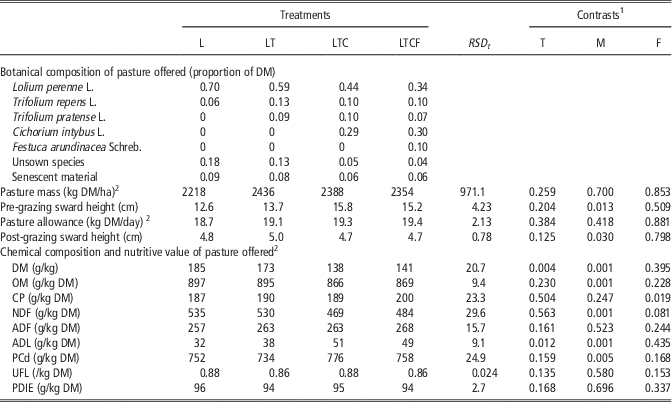
Perennial ryegrass proportion based on DM ranged from 70% for L to 34% for LTCF swards (Table 2). Clover represented ~20% of DM for LT, LTC and LTCF swards ranging from 25% in autumn to 15% in spring. Chicory represented 30% of DM for MSS, ranging from 20% in spring to 46% in autumn. Tall fescue represented 10% of DM for LTCF swards, independently of the season. Proportions of unsown species decreased with increasing sward botanical complexity.
Mean pasture botanical composition (12 rotations) and pasture characteristics (13 rotations) of multi-species swards rotationally grazed by dairy cows (2 years)
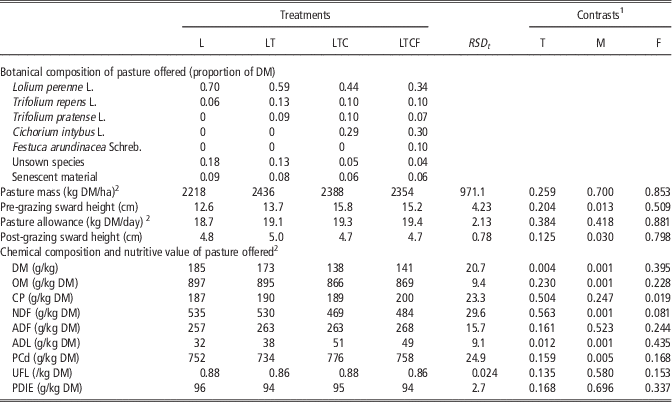
L=Lolium; T=Trifolium sp.; C=Cichorium; F=Festuca; RSD t =residual standard deviation of the model for the effect of the treatment; DM=dry matter; OM=organic matter; PCd=Pepsin-cellulase Digestibility; UFL=Unité Fourragère Lait (feed unit for milk production; 1UFL=7.115 MJ NE); PDIE=protein truly digestible in the intestine, with energy-limiting microbial synthesis in the rumen (INRA, 2007).
1 Orthogonal contrasts: T (L v. LT), M (LT v. LTC/LTCF) and F (LTC v. LTCF).
2 Determined above 4 cm.
Pre-grazing pasture mass averaged 2350 kg DM/ha above 4 cm and was unaffected by treatment (Table 2). Pre-grazing sward height averaged 14.3 cm and was higher for MSS than for mixed swards (+1.8 cm, P<0.05). As planned, pasture DM allowance was similar between treatments. Post-grazing sward height was lower for MSS than for mixed swards (4.7 v. 5.0 cm, P<0.05). There was no treatment×season interaction for pre-grazing pasture mass, pasture allowance, pre- or post-grazing sward height (Supplementary Table S2).
Pasture chemical composition and nutritive value
Pasture DM concentration was lower for mixed swards than for ryegrass swards (−12 g/kg, P<0.01), and for MSS than for mixed swards (−34 g/kg, P<0.001; Table 2). Pasture OM concentration was lower for MSS than for mixed swards (−28 g/kg DM, P<0.001), with a greater effect in autumn than in spring and summer (interaction treatment×season, P<0.001; Supplementary Table S2). Pasture CP concentration was higher for LTCF than for LTC (+11 g/kg DM, P<0.05). Pasture NDF concentration was lower for MSS than for mixed swards (−54 g/kg DM, P<0.001), and this occurred particularly during autumn (−85 g/kg DM, interaction treatment×season, P<0.05). Pasture ADL concentration was higher for mixed swards than for ryegrass swards (+6 g/kg DM, P<0.05) and higher for MSS than for mixed swards (+12 g/kg DM, P<0.001). Pasture PCd was higher for MSS than for mixed swards (+33 g/kg DM, P<0.01), and this difference occurred mainly in autumn (+88 g/kg DM, interaction treatment×season, P<0.07).
The chemical composition differed between the seven botanical components considered (Table 3). On average, legumes were characterised by lower DM and NDF concentrations, and by higher CP and ADL concentrations than grasses. Chicory had a very specific chemical composition, with lower DM and OM concentrations than grasses and legumes, low NDF concentration, close to that of legumes, similar CP concentration to that of grasses, and similar ADF and ADL concentrations as those in red clover.
Chemical composition (g/kg DM: 12 rotations) of the botanical components in multi-species swards rotationally grazed by dairy cows

RSD=residual standard deviation of the model for the effect of the species; DM=dry matter; OM=organic matter.
1 P-value: sp=species effect, sp×s=species×season effect.
2 Orthogonal contrasts: chicory v. legumes (C v. L), chicory v. grasses (C v. G) and grasses v. legumes (G v. L).
Milk production, milk composition and BW
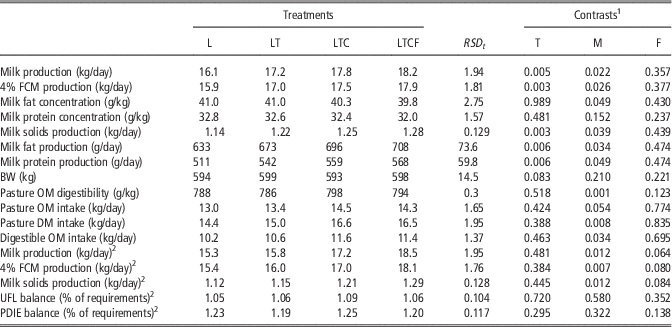
Milk production averaged 17.3 kg/day and was higher by 1.1 kg/day for mixed swards than for ryegrass swards (P<0.01), and higher by 0.8 kg/day for MSS as opposed to mixed swards (P<0.05) (Table 4). On average, milk fat concentration was lower for MSS than for mixed swards (−1.0 g/kg, P<0.05), but this mainly occurred in autumn (−2.7 g/kg) and not in spring (+0.5 g/kg) (interaction treatment×season, P<0.001; Supplementary Table S3). FCM production, milk fat production, milk protein production and milk solids production followed the same trends as milk production, and were higher for mixed swards than for ryegrass swards (P<0.01), and higher for MSS than for mixed swards (P<0.05). Milk protein concentration and BW were unaffected by treatment.
Milk production, milk composition and BW (13 rotations), pasture dry matter (DM) intake and nutrient balance (five rotations) of dairy cows rotationally grazing on multi-species swards

L=Lolium; T=Trifolium sp.; C=Cichorium; F=Festuca; RSD t =residual standard deviation of the model for the effect of the treatment; FCM=fat-corrected milk; OM=organic matter; DM=dry matter; UFL=Unité Fourragère Lait (feed unit for milk production; 1UFL=7.115 MJ NE); PDIE=protein truly digestible in the intestine, with energy-limiting microbial synthesis in the rumen (INRA, 2007).
1 Orthogonal contrasts: T (L v. LT), M (LT v. LTC/LTCF) and F (LTC v. LTCF).
2 Corresponding to the five rotations where pasture DM intake is measured.
Digestibility, intake, energy and protein supplies
Pasture OM digestibility averaged 792 g/kg and was higher for MSS than for mixed swards, independently of season (+10.0 g/kg, P<0.001; Table 4). Pasture DM intake averaged 15.6 kg/day and was 1.6 kg higher for MSS than for mixed swards (P<0.01). This positive effect of MSS compared with mixed swards on pasture DM intake was at its lowest in autumn (+0.7 kg DM/day) and its greatest in summer (+2.3 kg DM/day) (interaction treatment×season, P<0.05; Supplementary Table S3). Pasture OM intake and pasture digestible OM intake followed the same trends as pasture DM intake, with higher values for MSS than for mixed swards, and greater positive effect of MSS in summer than in autumn and spring. Pasture intake was similar between mixed swards and ryegrass swards. Considering only the five rotations with pasture DM intake measurement, milk production, FCM production and milk solids production were higher for MSS than for mixed swards (P<0.05), and tended to be higher for LTCF than for LTC (P<0.10), independently of season. On average, there were no difference between treatments in net energy and metabolisable protein supply, which averaged 107% and 122% of requirements, respectively.
Discussion
Pasture botanical composition clearly differed between treatments, even if clover and fescue proportions were lower and chicory proportion was higher than expected. Nonetheless, this study allowed us to determine the effect of introducing clover, chicory and fescue in ryegrass swards on pasture chemical composition, pasture DM intake, milk production and milk solids production of grazing dairy cows in different seasons. Although some significant interactions between season and treatment occurred for pasture botanical and chemical composition, the overall effects of sward type on animal performance did not strongly differ between seasons. This could be related to the weather conditions, consistently favourable for pasture growth and nutritive value in both years, including the critical early summer period for the ryegrass swards. Finally, pre-grazing pasture mass and pre-grazing pasture allowance were similar between treatments, enabling an unbiased comparison of sward types under similar grazing conditions and management.
Effect of introducing clover in ryegrass swards
Including clovers in perennial ryegrass swards had no effect on pasture nutritive value and pasture DM intake, yet a positive effect on daily milk production (+1.1 kg/day) and milk solids production. These results may be regarded as consistent with the literature given the difference in clover content between ryegrass and mixed swards observed in our experiment (6% v. 22%, i.e. only a 14% increase in clover content), along with the high quality of the ryegrass pastures.
In fact, clovers are recognised as highly digestible and protein-rich species, with a voluntary intake known to be 10%–20% greater than that of grasses (Peyraud, Reference Peyraud1993; Ribeiro-Filho et al., Reference Ribeiro-Filho, Delagarde and Peyraud2003; INRA, 2007), due to their lower fibre concentration, lower resistance to chewing and faster rate of particle breakdown (Dewhurst et al., Reference Dewhurst, Delaby, Moloney, Boland and Lewis2009). Consequently, inclusion of white clover in a grass-based diet generally improves pasture nutritive value and enhances daily pasture DM intake and milk production of dairy cows, either at grazing (Harris et al., Reference Harris, Auldist, Clark and Jansen1997; Phillips and James, Reference Phillips and James1998; Ribeiro-Filho et al., Reference Ribeiro-Filho, Delagarde and Peyraud2003) or indoors (Harris et al., Reference Harris, Clark, Auldist, Waugh and Laboyrie1998), provided that clover represents at least 20%–30% of pasture DM. In our study, the increase in milk production of 1.1 kg/day for mixed compared with ryegrass swards is within the range of 1–3 kg/day, as reported by Ribeiro-Filho et al. (Reference Ribeiro-Filho, Delagarde and Peyraud2003) in several short-term experiments. The amplitude of the positive effect of clover may depend on the ratio between grass and clover quality, and on the proportion of clover in the swards (Harris et al., Reference Harris, Auldist, Clark and Jansen1997; Harris et al., Reference Harris, Clark, Auldist, Waugh and Laboyrie1998). The greatest milk production response to clover inclusion observed in the literature, almost 3 kg/day, has been observed with low grass nutritive value and clover content of >50% in the Harris et al. (Reference Harris, Auldist, Clark and Jansen1997) study, where clover largely increased pasture nutritive value, which was not the case in this experiment. Including clover in ryegrass swards had no clear effect on milk composition, similarly to the results of Harris et al. (Reference Harris, Auldist, Clark and Jansen1997) and Ribeiro-Filho et al. (Reference Ribeiro-Filho, Delagarde and Peyraud2003).
Effect of multi-species swards compared with single ryegrass/clover mixtures
In our study, MSS were characterised by a high proportion of chicory (30%) that replaced perennial ryegrass, with no changes in the clover proportion compared with the single ryegrass/clover mixture. The high nutritive value of MSS observed might, thus be related to the high proportion of chicory and to the specific chemical composition of this species, as previously found in many studies (Barry, Reference Barry1998; Sanderson, Reference Sanderson2010; Muir et al., Reference Muir, Ward and Jacobs2014). Due to the high mineral concentration of chicory, as in other forbs, MSS containing chicory may be regarded as an interesting option for enhancing macro- and micro-minerals supply (Barry, Reference Barry1998; Marley et al., Reference Marley, Fychan, Scott, Davies and Sanderson2013). Low chicory NDF concentration, related to high OM digestibility, may also be regarded as a nutritional advantage, leading to high energy concentration and nutritive value of MSS pastures (INRA, 2007; Muir et al., Reference Muir, Ward and Jacobs2014). Low NDF concentration is also cited as one of the main factors explaining high voluntary intake, such as in clovers, through faster ruminal particle breakdown and passage rates (INRA, 2007; Dewhurst et al., Reference Dewhurst, Delaby, Moloney, Boland and Lewis2009). Conversely, the low DM concentration of chicory may be regarded as a potential factor limiting the intake of MSS containing a high proportion of chicory, given that internal water is known to limit pasture DM intake (Cabrera-Estrada et al., Reference Cabrera-Estrada, Delagarde, Faverdin and Peyraud2004). In our experiment, the positive effect of the presence of chicory on pasture DM intake suggests that the negative effect of chicory’s low DM concentration is largely compensated by the positive effect of the low NDF concentration or any other component on daily intake. This is in line with several previous studies, where intake and/or milk production have been found to increase when chicory was included in mixed pastures and fed to dairy cows, either at grazing (Chapman et al., Reference Chapman, Tharmaraj and Nie2008; Totty et al., Reference Totty, Greenwood, Bryant and Edwards2013) or indoors (Barry, Reference Barry1998; Minnee et al., Reference Minnee, Clark, McAllister, Hutchinson and Lee2012). The increase in milk production after inclusion of chicory in the diet generally ranges from 1 to 2 kg/day, but an increase in milk production as high as 6 kg/day has been observed for cows grazing clover–chicory mixtures in summer when compared with low-quality grass-based pastures (Chapman et al., Reference Chapman, Tharmaraj and Nie2008).
Advantages of MSS on milk production and milk solids production were clearly due to the cumulative effect of improved pasture chemical composition and higher pasture DM intake. An additional reason may be that a mixture of several forages has positive associative effects on daily intake, probably through an increased motivation to eat while no digestive interactions have been detected when mixing several forages (Niderkorn et al., Reference Niderkorn, Martin and Baumont2014). This may be also related to the high ingestibility of chicory per se (Niderkorn et al., Reference Niderkorn, Martin and Baumont2014).
Some studies reported no positive effects of MSS or chicory on daily pasture DM intake or milk production in grazing dairy cows, but these studies were generally carried out at high concentrate supplementation levels, namely 9 kg/day in Soder et al. (Reference Soder, Sanderson, Stack and Muller2006) and 6 kg/day in Muir et al. (Reference Muir, Ward and Jacobs2014). In our study, the lower milk fat concentration found in MSS compared with mixed swards during autumn may be related to the higher milk production and to the highest chicory proportion in the swards, leading to the lowest diet fibre concentration.
Effect of introducing tall fescue in multi-species swards
In our study, the fact that introducing tall fescue had no overall effect on pasture DM intake nor on milk production may be related to the low tall fescue proportion in swards (10%); as fescue partly replaced perennial ryegrass, whereas clover and chicory proportions were unaffected. Grazing pure tall fescue generally had no effect, or else decreased milk production in dairy cows by 1 or 2 kg/day when compared with pure perennial ryegrass (Lowe et al., Reference Lowe, Bowdler, Casey and Moss1999), due to greater fibre concentration and lower digestibility, pasture DM intake being only slightly affected (INRA, 2007). There is evidence that replacing 10% of DM diet from ryegrass to fescue would only have small effects on cow nutrition, which is in line with the results of Chapman et al. (Reference Chapman, Tharmaraj and Nie2008) in mixed swards. Greater effects would be expected with older swards as tall fescue is well known for its relatively low rate of establishment compared with other grass species.
Conclusion
The comparison of perennial ryegrass monoculture, grass–legume mixed swards, and MSS containing grasses, legumes and chicory, only grazed by lactating dairy cows during 2 years, has shown that increasing sward botanical complexity from one to five species under similar grazing management has positive effects on animal performance. All sown species were of good pasture nutritive value, but inclusion of both clovers and of chicory made it possible to improve pasture chemical composition and to enhance milk production and milk solids production on a per cow basis. The advantages of grazing multi-species over mixed swards on milk production and milk solids production are due to the cumulative effects of enhanced sward quality and increased pasture DM intake, in all seasons, with relation to the very specific chemical composition of chicory. How increasing sward botanical complexity may increase the grazing system’s resilience to climate events such as drought, and may affect pasture utilisation and milk production on a per hectare basis still remains to be investigated.
Acknowledgements
The research leading to these results received funding from the European Community’s Seventh Framework Programme under the grant agreement no. FP7-244983 (MultiSward). The financial support of the Fundación Juana de Vega in the form of the first author’s post-doc fellowship is acknowledged. Acknowledgements are also extended to all the staff at the INRA dairy farm of Méjusseaume (UMR1348 PEGASE, Le Rheu, France) and the technicians at UMR1348 PEGASE (Saint-Gilles, France) for chemical laboratory analyses.
Supplementary Material
To view supplementary material for this article, please visit http://dx.doi.org/10.1017/S1751731116000331