1. Introduction
The Permian continental record of the Iberian Pyrenees represents a well-known red-bed and volcaniclastic succession (e.g. Mey et al. Reference Mey, Nagtegaal, Roberti and Hartevelt1968; Martí, Reference Martí1983, Reference Martí1996; Gisbert, Reference Gisbert and Folch1986; Gascón & Gisbert, Reference Gascón and Gisbert1987; Galé, Reference Galé2005). However, vertebrate footprints are restricted to the late Cisuralian Peranera Formation tracksites studied here (see also Voigt & Haubold, Reference Voigt and Haubold2015) and the younger Palanca de Noves locality (Ribera d'Urgellet, Alt Urgell, Catalonia; Robles & Llompart, Reference Robles and Llompart1987; Fortuny et al. Reference Fortuny, Sellés, Valdiserri and Bolet2010, Reference Fortuny, Bolet, Sellés, Cartanyà and Galobart2011), presumably of middle Permian age or younger. In the rest of the Iberian Peninsula and in the Balearic islands, two additional Permian fossil sites are known: Peña Sagra in the Cantabrian Mountains (Gand et al. Reference Gand, Kerp, Parsons and Martínez-García1997; Demathieu et al. Reference Demathieu, Torcida Fernández-Baldor, Demathieu, Urién Montero, Pérez-Lorente, Ruiz-Omeñaca, Piñuela and García-Ramos2008) and Cala Pilar in Menorca island (Pretus & Obrador, Reference Pretus and Obrador1987). The location of the Pyrenean Basin at the Gondwana–Laurasia boundary is critical to better understand the faunal distribution across Pangaea during Permian time. The scarcity of tetrapod body fossils can be compensated with the presence of tetrapod footprints, by far more abundant during late Palaeozoic time and reliable faunistic indicators at the family level (Falcon-Lang et al. Reference Falcon-Lang, Gibling, Benton, Miller and Bashforth2010). The potential use of trace fossils as environmental indicators is explored here for a better understanding of the faunistic response to the low-latitude aridization processes occurring during latest Carboniferous – late Permian times (Chumakov & Zharkov, Reference Chumakov and Zharkov2002; Gibbs et al. Reference Gibbs, Rees, Kutzbach, Ziegler, Behling and Rowley2002; Roscher & Schneider, Reference Roscher, Schneider, Lucas, Cassinis and Schneider2006; Benton & Newell, Reference Benton and Newell2014; Michel et al. Reference Michel, Tabor, Montañez, Schmitz and Davydov2015). Voigt & Haubold (Reference Voigt and Haubold2015) recently published material from the Peranera Formation in the Vall de Manyanet area (Pallars Jussà, Catalonia), mainly focusing on ichnotaxonomy and tetrapod footprint biostratigraphy. Our field prospections in this formation largely improve the Pyrenean ichnological record, allowing a reliable palaeoenvironmental reconstruction based on the integration of ichnology and facies analyses.
The aim of the present work is to expand on and provide new insights on the Pyrenean ichnotaxa, particularly on the Peranera Formation. The new findings reveal a noteworthy tetrapod diversity and distribution during early Permian time and allow the palaeoenvironmental settings in Central Pangaea to be reconstructed. Our aim is to compare our findings with other nearby ichnoassociations, to evaluate their uniformity and distribution. Photogrammetry has recently been revealed as a powerful tool in palaeoichnology, mostly applied in order to study large dinosaur footprints in detail (e.g. Petti et al. Reference Petti, Avanzini, Belvedere, De Gasperi, Ferretti, Girardi, Remondino and Tomasoni2008; Castanera et al. Reference Castanera, Vila, Razzolini, Falkingham, Canudo, Manning and Galobart2013) and other associated tetrapod footprints (Belvedere et al. Reference Belvedere, Jalil, Breda, Gattolin, Bourget, Khaldoune and Dyke2013). Our study is the first to apply photogrammetry to Permian tetrapod ichnites in order to assist in an enhanced morphological characterization and to minimize the effects of substrate conditions and the behaviour of the trackmakers, allowing reliable taxonomic attributions.
2. Material and methods
2.a. Fieldwork
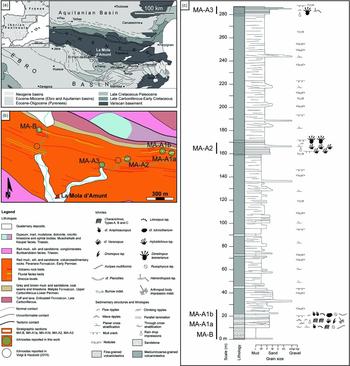
The present work was developed in two outcrops situated north of Les Esglésies and La Mola d'Amunt towns, on the roads to Benés and Avellanos villages respectively, on Vall de Manyanet at Pallars Jussà region (south-central Pyrenees, Catalonia, Iberian Peninsula; Fig. 1a, b). In this work, we use lithostratigraphy (Fig. 1b) by Mey et al. (Reference Mey, Nagtegaal, Roberti and Hartevelt1968), Nagtegaal (Reference Nagtegaal1969), Zwart (Reference Zwart1979) and Martí (Reference Martí1983), although other nomenclatures at the Pyrenean scale exist (e.g. depositional units of Gascón & Gisbert, Reference Gascón and Gisbert1987; Galé, Reference Galé2005). Further studies are needed for a detailed global correlation of the depositional units, so the lithostratigraphic divisions are used here instead. The studied outcrops correspond to a sequence at 114m from the base of the Peranera Formation in the El Pont de Suert-Sort Permian Basin (Zwart, Reference Zwart1979; Martí, Reference Martí1983), and the localities with trace fossils are referred to as La Mola d'Amunt-Avellanos (MA-A) and La Mola d'Amunt-Benés (MA-B).
Geographical and geological setting. (a) European situation and regional geology. (b) Geological map of the studied area based on field observations, maps from Zwart (Reference Zwart1979) and orthophoto (scale 1:5000) obtained from Institut Cartogràfic de Catalunya webpage (ICC; http://www.icc.cat). (c) Synthetic stratigraphic section (at 114m from the base of the Peranera Formation) including sequences of tetrapod footprints. Note the differences between different ichnoassociations.

Five stratigraphic sections were measured: one at MA-B (Section MA-B) and four at MA-A (from east to west and from the stratigraphically lower to higher: MA-A1a, MA-A1b, MA-A2 and MA-A3; Fig. 1b, c; see also supplementary Appendix S1, Fig. S1, available at http://journals.cambridge.org/geo). These five sections include all the footprints described here and have been used to characterize the palaeoenvironmental setting and succession. The field tracking of strata (assisted with photointerpretation) allowed the five sections to be correlated to produce a synthetic section (Fig. 1b, c). In order to reconstruct the fluvial and volcanosedimentary palaeoenvironments of the ichnites-bearing rocks described in the area, a sedimentological study determination (based on lithologic succession, sedimentary structures and lateral variations) was carried out. A correlation between lithofacies associations and ichnoassociations can provide information on the palaeoenvironmental setting.
2.b. Ichnological study
Organism dynamics and substrate cohesion have an important influence on tracks and trackways shape and patterns (Hasiotis et al. Reference Hasiotis, Platt, Hembree, Everhart and Miller2007; Falkingham, Reference Falkingham2014), giving a wide range of extramorphological variation (i.e. morphologies not depending on the shape of the limbs). As a consequence, a single trackmaker could imprint many different forms, complicating the identification and classification of ichnites (e.g. Petti et al. Reference Petti, Bernardi, Ashley-Ross, Berra, Tessarollo and Avanzini2014).
The quantitative and qualitative parameters analysed in 78 vertebrate tracks and 4 trackways follow Haubold (Reference Haubold1971), Leonardi (Reference Leonardi1987) and Hasiotis et al. (Reference Hasiotis, Platt, Hembree, Everhart and Miller2007). Considering the sample, we selected the best-preserved footprints for a correct ichnotaxonomic determination following the suggestions of Haubold et al. (Reference Haubold, Hunt, Lucas and Lockley1995), Haubold (Reference Haubold1996) and Bertling et al. (Reference Bertling, Braddy, Bromley, Demathieu, Genise, Mikuláš, Nielsen, Nielsen, Rindsberg, Schlirf and Uchman2006). The descriptions were made by direct observation of the specimens (both in the field and in the laboratory) and also by digital photographs with different light positions. Biometric measurements were made with ImageJ software (version 1.46r, available for download from http://rsbweb.nih.gov/ij/). In this work, ichnite refers to both tetrapod and invertebrate trace fossils, while footprint and track only refer to tetrapod trace fossils. We also provide additional figures (see supplementary Appendix S1, Figs S1–S5, available at http://journals.cambridge.org/geo) and the parameters measured on tetrapod footprints of all the analysed taxa (supplementary Appendix S2, Tables S1–S11), as well as the systematic ichnology of the invertebrate trace fossils (supplementary Appendix S3). The tetrapod swimming traces (scratches), which represent a large sample of the ichnoassemblage, are described as specific ichnotaxa. The possible association with footprints is discussed in Section 4.b.6 (see Melchor & Sarjeant, Reference Melchor and Sarjeant2004 for further discussion, and Petti et al. Reference Petti, Bernardi, Ashley-Ross, Berra, Tessarollo and Avanzini2014 for an alternative nomenclature).
2.c. Photogrammetry
In order to analyse tetrapod footprints, 3D photogrammetric models of 18 specimens have been generated following the procedures of Matthews (Reference Matthews2008) and Falkingham (Reference Falkingham2012). Photographs were taken with digital compact camera Sony DSC-T200 8.1 megapixels. Three different software programs were used: VisualSFM v0.5.22 (http://www.ccwu.me/vsfm/) and MeshLab v.1.3.2 (http://meshlab.sourceforge.net/) to generate the 3D models; and ParaView v.3.98.1 (http://www.paraview.org) to elaborate the depth maps and contour lines (see also Falkingham, Reference Falkingham2012; Belvedere et al. Reference Belvedere, Jalil, Breda, Gattolin, Bourget, Khaldoune and Dyke2013).
2.d. Permits, repositories and material
Most of the studied material is on outcrop (in situ) and still remains in the field. On the other hand, several specimens (ex situ) were legally collected by the authors during field works in July 2012 (under the permit PINTER 8432) and July 2013 (under the permit 213K121N-080–450–563–760–610–787–823–871–2013–1–9833); both permits were issued by Departament de Cultura of the Generalitat de Catalunya (Catalan local government). Several silicone moulds and synthetic resin replicas of some tetrapod footprints were also made. The collected specimens, as well as the footprint moulds and replicas, are stored at the Museum of the Institut Català de Palaeontologia Miquel Crusafont (Sabadell, Spain). Tetrapod footprints collections from Museum für Naturkunde (MfN; Berlin, Germany), Musée Fleury (MFL; Lodève, France), Muséum National d'Histoire Naturelle (MNHN; Paris, France) and Institut des Sciences de l’Evolution-Montpellier (ISE-M, Université Montpellier 2; Montpellier, France) were studied first-hand by one of the authors (E.M.) and are also used for comparison with the Iberian Pyrenean specimens, housed at the Institut Català de Paleonologia (IPS; Sabadell, Spain).
The recovered specimens and the replicas studied here are: IPS-73723, IPS-73724, IPS-73726, IPS-83730, IPS-73739, IPS-73741, IPS-73742, IPS-73743, IPS-73744, IPS-73745, IPS-82604, IPS-82605, IPS-82606, IPS-82607, IPS-82608, IPS-83712 and IPS-83722. Specimens not recovered have no code, but are situated on the relative stratigraphic level and georeferenced.
3. Geological setting
The Catalan Pyrenees expose several Permian volcanic and sedimentary successions aligned in a belt that extends from El Pont de Suert (west) to Camprodon (east) (Fig. 1a). These rocks accumulated in strike-slip continental basins at the end of the Variscan Orogeny, resulting from the amalgamation of Pangaea (Speksnijder, Reference Speksnijder1985; Martí, Reference Martí1996). Such rocks, of late Carboniferous – late Permian age, are unconformably overlaid by the Triassic Buntsandstein, Muschelkalk and Keuper facies (Nagtegaal, Reference Nagtegaal1969; Gisbert, Reference Gisbert and Folch1986; Gascón & Gisbert, Reference Gascón and Gisbert1987; Martí, Reference Martí1996).
In the studied area, the Peranera Formation mainly consists of a volcanic-siliciclastic sequence composed of alternating deposits of tuffs, ignimbrites, breccia levels and cinerites (ash beds) with edaphic limestone nodules, and with sporadically intercalated fluvial deposits (mudstones, siltstones and sandstones) (see Mey et al. Reference Mey, Nagtegaal, Roberti and Hartevelt1968; Nagtegaal, Reference Nagtegaal1969; Gisbert, Reference Gisbert and Folch1986; Martí, Reference Martí1996; Fig. 1c; supplementary Appendix S1, Fig. S1, available at http://journals.cambridge.org/geo). The volcaniclastic sediments are completely different from its fluvial lithofacies (see Section 4.a below) and broadly display three main lithofacies: (1) clast-supported lithic breccia (facies mlBrf and dblBrf in the sense of Branney & Kokelaar, Reference Branney and Kokelaar2002); (2) volcaniclastic sandstone facies (VSF in the sense of Martí, Reference Martí1996); and (3) fine-grained ashes and lutites. These deposits are classically attributed to reddish Autunian facies and dated as early Permian in age (Gisbert, Reference Gisbert and Folch1986; Martí, Reference Martí1996).
4. Results
4.a. Sedimentology and facies associations
The sections of La Mola d'Amunt-Benés (MA-B) and La Mola d'Amunt-Avellanos (MA-A1a, MA-A1b) are situated 114m from the base of the Peranera Formation, and contain the fluvial strata which yielded the footprints (Figs 1, 2; supplementary Appendix S1, Fig. S1, available at http://journals.cambridge.org/geo). These sections are correlated by a distinctive basal ignimbrite bed of thickness 1.5–2.5m. A massive mudstone-texture volcanosedimentary succession (6–12m thick) lying above this ignimbrite contains five to six thin interbedded cinerites of 5–10cm thick.
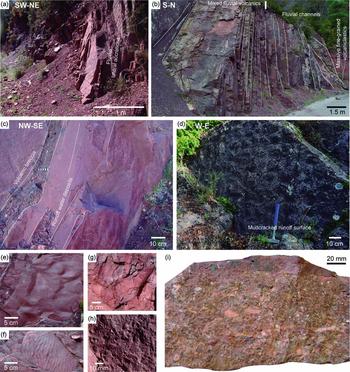
Deposits bearing ichnites. (a) Fluvial interval upper part from the MA-A1a section, top sequence to SSW. (b) Fluvial interval from the MA-B section, top sequence to S; the mixed fluvial-volcanic deposits contain cf. Ichniotherium. (c) Unconfined runoff surface, the upper surface is the level with Hyloidichnus isp. at MA-A2 7.90m. (d) Surface subjected to high temperatures from the MA-A3 section. (e) Flow ripples from the MA-B section. (f) Wave ripples from the MA-B section. (g) Mudcracked surface from the MA-A1a section. (h) Raindrop impressions from the MA-A2 section. (i) Hand sample of a volcanic breccia with a mudstone – very-fine-sandstone layer from a runoff water flow.

The fluvial beds (Fig. 2a, b) present channels with erosive bases and lateral accretions. A sigmoid-like morphology is recognized in most of the strata (each of thickness 20–30cm and sets of thickness c. 1m), with several sedimentary structures such as planar and through cross-stratification, lunate, linguoid and straight-crest flow ripples and climbing and wave ripples (Fig. 2b, e, f). These traits are typical of meandering systems. Mudcracks are also present (Fig. 2g), indicating an episodical emersion. The fluvial deposits result from relatively continuous functional perennial systems which were eventually abandoned.
In section MA-B the fluvial deposits are relatively coarse (fine to medium sandstone), whereas in MA-A1a and MA-A1b the deposits are relatively fine grained (fine to very fine sandstone). In all the outcrops the fluvial deposits correspond to confined flows, but in section MA-B the facies correspond to deeper parts of the channel. Raindrop impressions and mudcracks are more abundant on MA-A1a and MA-A1b than on MA-B, so the fluvial system dried more frequently and water level was probably lower than in MA-B.
Sections MA-A2 and MA-A3 (Fig. 2c, d) contain massive tabular ignimbrites (up to 1.5m thick), and volcaniclastic breccia levels with rough planar cross-stratification. Sections encompass two short intervals of ignimbrite beds covered by millimetric- to centimetric-scale mudstone – very-fine-sandstone layers (Fig. 2i). These thin layers preserve water flow ripples, raindrop impressions (Fig. 2d, h), mudcracks and the ichnites described in Section 4.b. These structures probably indicate sedimentation by unconfined runoff rainwaters which fell after the deposition of the pyroclastic flow. The lack of confinement of these surfaces implies they were comparable to fluvial mudflats or floodplains.
4.b. Systematic ichnology
The tetrapod footprints presented in this work include the following ichnotaxa: Batrachichnus salamandroides, Limnopus isp., cf. Amphisauropus, cf. Ichniotherium, Dromopus isp., cf. Varanopus, Hyloidichnus isp. and Dimetropus leisnerianus (Figs 3–11). Three different swimming trace morphotypes all assigned to Characichnos isp. are associated to the first three ichnotaxa listed above (Fig. 11). Voigt & Haubold (Reference Voigt and Haubold2015) reported from the same formation (see Fig. 1b) the presence of Batrachichnus, Limnopus, Dromopus, Varanopus and Hyloidichnus. The works by Robles & Llompart (Reference Robles and Llompart1987) and Fortuny et al. (Reference Fortuny, Sellés, Valdiserri and Bolet2010) correspond to a completely different Pyrenean tracksite (i.e. different formation and situated in a different basin, in the sense of Galé, Reference Galé2005), presumably younger. Our data therefore expand the late Cisuralian ichnoassemblage and provide new details on the ichnotaxonomy of most of these ichnotaxa.
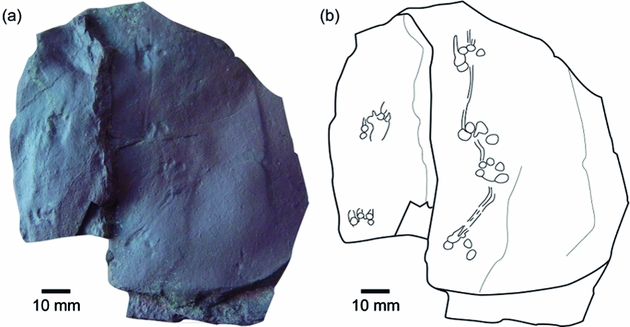
Batrachichnus salamandroides specimen (IPS-73741–5) from site MA-A1a. (a) Photo; (b) ichnites outline.

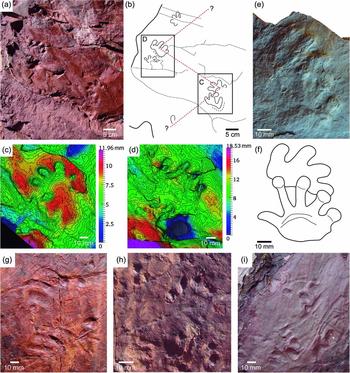
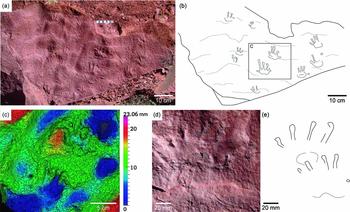
Limnopus isp. tracks. (a–d) Trackway and isolated track from MA-A1a 18.15m. (a) Photograph; (b) ichnites outline; (c) 3D model of the right set; and (d) 3D model of the left set. (e, f) Isolated right set (IPS-73724). (e) Photograph; and (f) ichnites outline. (g–i) Digit tip tracks. (g) Two tracks with trailing digits from section MA-A1a at 10.20m; (h) pes track and diverse digit tips from section MA-A1a at 10.20m; and (i) tracks with expulsion rim on the posterior part of the digits from section MA-A1b at 12.00m.

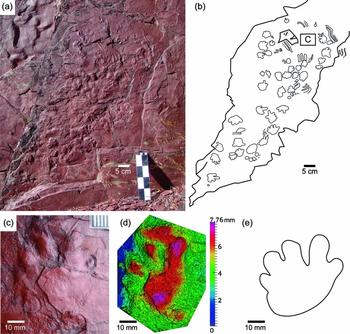
cf. Amphisauropus tracks from section MA-B. (a, b) Mass occurrence of tracks in surface at 17.75m. (a) Photograph; and (b) ichnites outline. (c–e) Manus outlined in (b). (c) Photograph; (d) 3D model; and (e) ichnite outline.

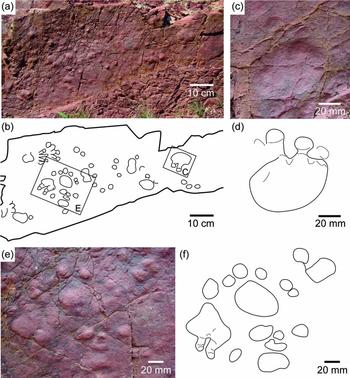
cf. Ichniotherium from section MA-B at 22.60m. (a) Entire surface; (b) ichnites outline; (c) and (e) detail of the ichnites outlined in (b). (d, f) Ichnites outline of (c) and (e), respectively.

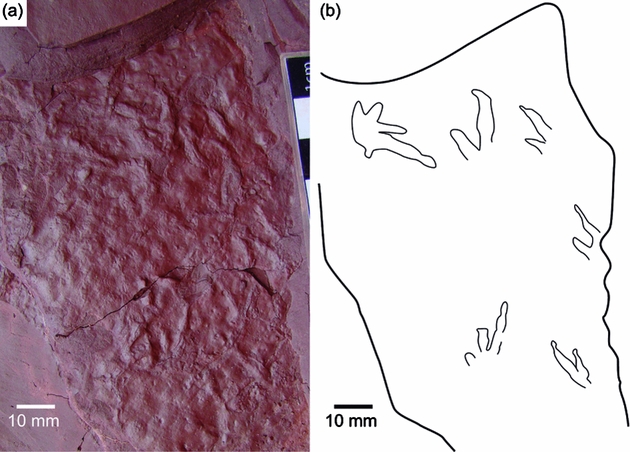
Dromopus isp. specimens from section MA-B at 22.40m. (a) Photograph; and (b) ichnites outline.
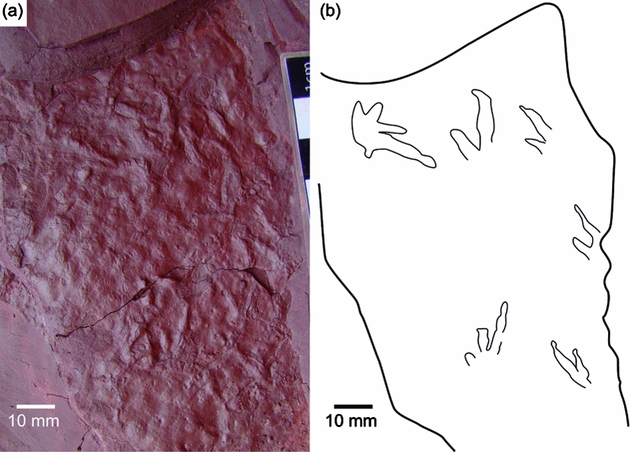
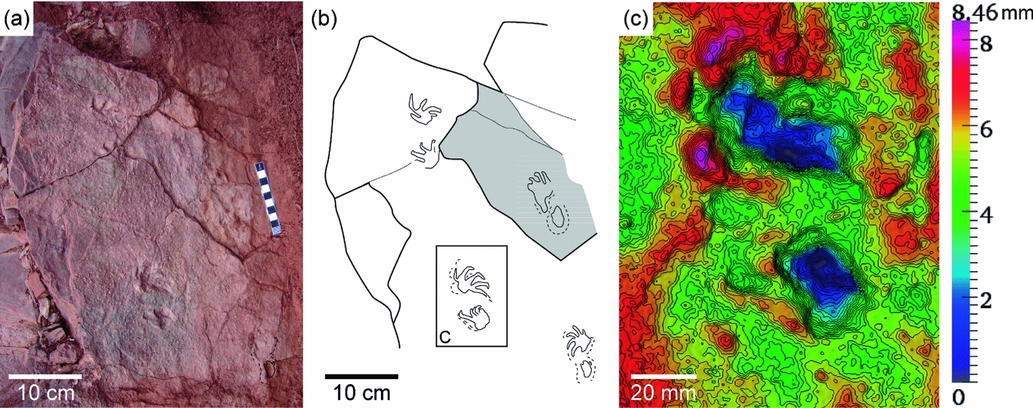
cf. Varanopus footprints from section MA-A1a 10.50m. (a) Trackway; (b) ichnites outline; and (c) 3D model outlined in (b).

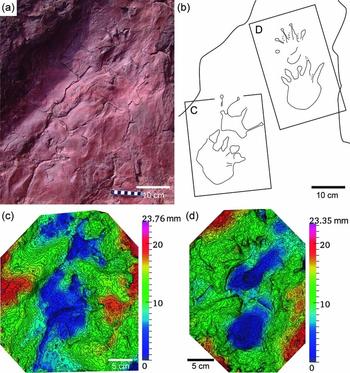
Hyloidichnus isp. footprints from section MA-A2. (a) Ichnites from surface at 7.90m; (b) ichnites outline; (c) 3D model of the manus-pes set outlined in (b); (d) manus-pes set from surface at 7.30m; and (e) ichnites outline.

Dimetropus leisnerianus footprints from section MA-A2 at 8.60m. (a) Entire surface; (b) ichnites outline; (c, d) 3D models of the manus-pes sets outlined in (b).

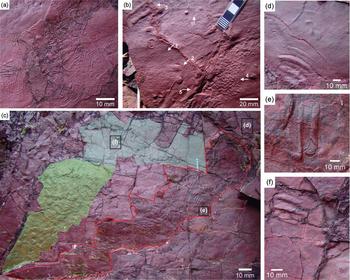
Swimming traces and associated ichnites. (a) Characichnos Type A. (b) Characichnos Type A (1), Limnopus isp. digit tip footprints (2), Characichnos Type B (3), Rusophycus isp. (4) and plant remains (5) (MA-B ex situ slab not recovered). (c) Section MA-B at 17.50m with Limnopus isp. footprints and Characichnos Type B (surface bounded in red), at 17.75m with cf. Amphisauropus footprints and Characichnos Type C (in the lower and upper part of the coloured surface, respectively). (d, e) Detail of Characichnos Type B outlined in (c). (f) Detail of Characichnos Type C outlined in (c).

4.b.1. Temnospondylian tracks
Ichnogenus Batrachichnus Woodworth, Reference Woodworth1900
Ichnospecies Batrachichnus salamandroides (Geinitz, Reference Geinitz1861)
(Fig. 3; supplementary Appendix S2, Tables S1, S2, available at http://journals.cambridge.org/geo)
Material and stratigraphic position: In section MA-A1a, five fitting slabs ex situ with six tracks (marks and casts, i.e. both in concave and convex relief): IPS-73741, IPS-73742, IPS-73743, IPS-73744 and IPS-73745.
Description: The footprints are grouped in different manus-pes sets, but only one is nearly complete, settled in a trackway. The footprints are usually digitigrade or semiplantigrade, except for one that is plantigrade. All the ichnites are wider than long and terminate in rounded digit tips without claw marks. Three tracks present a shallow sole impression. In front of all the tracks there are scratches formed when digit tips dragged the surface to advance. Tracks of the manus (6×11mm) are presumably tetradactyl, whereas those of the pedes (8×12mm) are pentadactyl. The relative length of the digits is not significant (supplementary Appendix S2, Table S1, available at http://journals.cambridge.org/geo) and ichnites are rotated either inwards or outwards from the midline, without following any pattern. Pace angulations of the manus and the pedes are low (<60º), this being indicative of sprawling locomotion of the trackmaker.
Discussion: The small size of the ichnites (<20mm), the alternating sets, the low stride angulations, the tetradactyl manus and the rounded digits are diagnostic of the ichnospecies Batrachichnus salamandroides, known from Carboniferous – lower Permian deposits of France (Gand & Durand, Reference Gand, Durand, Lucas, Cassinis and Schneider2006), Germany (Voigt, Reference Voigt2005), New Mexico (Lucas et al. Reference Lucas, Minter, Spielmann, Hunt and Braddy2005; Voigt & Lucas, Reference Voigt and Lucas2015), Canada (Falcon-Lang et al. Reference Falcon-Lang, Gibling, Benton, Miller and Bashforth2010; Stimson, Lucas & Melason, Reference Stimson, Lucas and Melason2012) and Poland (Voigt et al. Reference Voigt, Niedźwiedzki, Raczyński, Mastalerz and Ptaszyński2012). The shape and the size of the extremities and the glenoacetabular distances (30–35mm) of branchiosaurids and micromelerpetontid temnospondyls and also lepospondyls are comparable to these footprints, so these groups are suggested to be trackmakers of B. salamandroides (Gand & Durand, Reference Gand, Durand, Lucas, Cassinis and Schneider2006; Voigt, Reference Voigt2012; E.M., personal observation).
Ichnogenus
Limnopus
Marsh, Reference Marsh1894
Ichnospecies
Limnopus isp.
(Figs 4, 11b–d; supplementary Appendix S1, Figs S2a–c, S3; supplementary Appendix S2, Tables S3, S4, available at http://journals.cambridge.org/geo)
Material and stratigraphic position: In section MA-A1a, numerous tracks in concave epirelief at 10.20–10.50m and 10.90m (replica IPS-82606), one trackway composed of two manus-pes sets and one partial manus track (replica IPS-82608), 16 partial tracks at 18.15m and one slab ex situ partially covered with ten tracks (IPS-83730). In section MA-A1b, several tracks in concave epirelief at 12.00–13.00m. In section MA-B, numerous tracks in convex hyporelief at 15.00–18.00m, one slab ex situ with one manus-pes set (IPS-73724) and one large block ex situ not recovered.
Description: Two different track shapes are recognized. The first (Fig. 4a–f) consists of ichnites with rounded, clawless digit tips and shallow oval (wider than longer) palm and sole impressions, some with an expulsion rim. The manus tracks are semiplantigrade to plantigrade, and wider (43–54mm) than long (32–38mm). The ichnites are tetradactyl with wide digits. The relative digit length is I<II≤IV<III. The digits I, II and IV are slightly rotated inwards, whereas digit III is straighter. All the digits present a rounded to elliptical shape. The digits I and II are more deeply impressed than the others. The pedes are pentadactyl and plantigrade, slightly wider (50–57mm) than long (37–48mm), and with a sole sometimes U-shaped. The digits I–V divarication is over 100°. The digit relative length is I≤V<II<III<IV. The pedes digits are proportionally longer than those of the manus, and digit V is rotated outwards. The digit tips are rounded and deeply impressed. The average width is greater in the manus (53mm) than in the pes (50mm). This is probably caused by the uncommon preservation of complete pedes in the larger-size tracks (see Fig. 4a–d; supplementary Appendix S2, Table S3, available at http://journals.cambridge.org/geo). In some sets, the pedes partially overstep the manus (Fig. 4e, f). In the trackway, the manus impressions are rotated inwards and the pedes are deformed (Fig. 4a–d). The low pace angulation (69°) and the relative large trackway external width (322mm) indicate a sprawling posture of the trackmaker.
The second type of tracks (Figs 4g–i, 11d; 2 in Fig. 11b) is the most abundant: it is generally unguligrade, formed by rounded digit tip prints in groups of two to five (commonly formed by four digit tips), and is spreaded in an arc with widths similar to those of the first track shape (both morphologies present a width/length ratio of 0.6–0.8). Some tip impressions show an expulsion rim in their posterior part. Some tracks appear as semiplantigrade because a very shallow sole or palm impression is preserved. Some digit tip prints are anteriorly elongated and slightly curved inward (i.e. scratches), with a similar track pattern than that of the previously described Batrachichnus salamandroides. At 17.75m in section MA-B, a well-defined trackway is formed by digit tip prints that are in contact with one another and present pace angulations of 92° (supplementary Appendix S1, Fig. S3 and Appendix S2, Table S4, available at http://journals.cambridge.org/geo).
Discussion: The two described track shapes belong to the same ichnotaxon because they present analogue proportions and some transitions between the two morphologies were found; they therefore represent different preservational states (Fig. 4a, h, i). The tetradactyl manus with a wide, large palm impression, the rounded clawless digit tips, the relative digit lengths, the pentadactyl pedes with a shallow impression of digit V and a U-shaped sole, as well as the pace angulations, are diagnostic of the ichnogenus Limnopus (e.g. Baird, Reference Baird1952; Gand, Reference Gand1988; Tucker & Smith, Reference Tucker and Smith2004; Voigt, Reference Voigt2005; Marchetti, Avanzini & Conti, Reference Marchetti, Avanzini and Conti2013; Voigt & Haubold, Reference Voigt and Haubold2015). Specimens reported here are different from those assigned to Batrachichnus salamandroides; there are two discrete populations of size (supplementary Appendix S2, Tables S1, S3, available at http://journals.cambridge.org/geo), indicating no transition between both ichnogenera. The 3D model analyses reveal that within all tracks the manus digits I and II are the most deeply impressed, probably because they are the most functional as suggested in other ichnogenera (Avanzini et al. Reference Avanzini, Neri, Nicosia and Conti2008). This is also indicated by the inwards orientation of the manus footprints, an uncommon feature in the ichnogenus in which the manus is often parallel to the midline (Voigt, Reference Voigt2005; Fig. 4a–f). Similar specimens are found in the upper Carboniferous deposits of England (Tucker & Smith, Reference Tucker and Smith2004) and the lower Permian deposits of France (Gand, Reference Gand1988; Demathieu et al. Reference Demathieu, Gand and Toutin-Morin1992), Italy (Marchetti et al. Reference Marchetti, Ronchi, Santi, Schirolli and Conti2015 a, b), Germany (Haubold, Reference Haubold1970, Reference Haubold1971; Voigt, Reference Voigt2005) and North America (Baird, Reference Baird1952). Haubold (Reference Haubold2000) only considered the ichnospecies L. vagus, L. zeilleri and L. cutlerensis (see also Voigt, Reference Voigt2005) to be of possible ichnotaxonomic value. Recently, Lucas & Dalman (Reference Lucas and Dalman2013) identified L. heterodactylus as the first described ichnospecies; it should therefore be used instead of L. vagus in case of synonymy (see also Marchetti, Avanzini & Conti, Reference Marchetti, Avanzini and Conti2013). Nevertheless, due to the preservation of the specimens described here, ichnospecies remain uncertain. The potential trackmakers for Limnopus are temnospondyl amphibians similar to eryopsids (Gand, Reference Gand1988; Van Allen et al. Reference Van Allen, Calder and Hunt2005; Voigt, Reference Voigt2005; Gand & Durand, Reference Gand, Durand, Lucas, Cassinis and Schneider2006).
4.b.2. Seymouriamorph tracks
Ichnogenus cf. Amphisauropus Haubold, Reference Haubold1970
(Figs 5, 11c; supplementary Appendix S1, Fig. S2d–l and Appendix S2, Table S5, available at http://journals.cambridge.org/geo)
Material and stratigraphic position: In section MA-B, at 15.00–15.20m, 16.00m, 16.50m, 17.75m (replica IPS-82605), 21.50m and 23.80m, as well as one slab ex situ with one manus and three partial pes digits (IPS-73723). All the tracks are in convex hyporelief.
Description: The ichnites are coupled in manus-pes sets. The manus are plantigrade to semiplantigrade and wider (31–52mm) than long (19–39mm). They are pentadactyl with short digits terminated in rounded and relatively large clawless digit tips, more deeply impressed than the rest of the footprint (Fig. 5). The digit length increases from digit I to IV. The length of digit V is similar to that of I. The pedes, larger than the manus, are plantigrade to semiplantigrade and pentadactyl. They are longer (32–57mm) than wide (27–51mm) and their digit length increases from I to IV. The length of digit V falls between those of I and II. The digits III and IV are the longest. Commonly, digits III and IV are the most deeply impressed followed by digits I and II, while digit V is not always preserved. In sets, the pedes never overstep the manus; the latter are rotated inwards at approximately 90° from the pes orientation (i.e. the manus width axis is aligned with the pes length axis; supplementary Appendix S1, Fig. S2j–l, available at http://journals.cambridge.org/geo).
Discussion: The plantigrade to semiplantigrade pentadactyl tracks with broad sole, the rounded digit tips, the measured relative digit lengths, the manus sensibly wider than long and inwards-oriented with respect to the pes (supplementary Appendix S2, Table S5, available at http://journals.cambridge.org/geo) are diagnostic traits of Amphisauropus (see Haubold, Reference Haubold1970; Voigt, Reference Voigt2005). However, this assignation remains tentative due to the lack of trackways, and the overall poor preservation of the specimens. The specimens from the site MA-B present shorter and more robust digits than tracks assignable to A. kablikae (the only valid ichnospecies sensu Voigt, Reference Voigt2005) described by Haubold (Reference Haubold1970, Reference Haubold1971), Gand (Reference Gand1988), Nicosia, Ronchi & Santi (Reference Nicosia, Ronchi and Santi2000), Lucas, Lerner & Haubold (Reference Lucas, Lerner and Haubold2001), Lucas, Spielmann & Lerner (Reference Lucas, Spielmann, Lerner, Lueth, Lucas and Chamberlain2009), Van Allen et al. (Reference Van Allen, Calder and Hunt2005), Voigt (Reference Voigt2005, Reference Voigt2012), Avanzini et al. (Reference Avanzini, Neri, Nicosia and Conti2008), Voigt et al. (Reference Voigt, Lagnaoui, Hminna, Saber and Schneider2011 a, Reference Voigt, Niedźwiedzki, Raczyński, Mastalerz and Ptaszyński2012), Marchetti et al. (Reference Marchetti, Ronchi, Santi, Schirolli and Conti2015 a, b). The Pyrenean specimens are smaller (but similar in shape) than those assigned to Amphisauropus isp. by Hminna et al. (Reference Hminna, Voigt, Saber, Schneider and Hmich2012) in the Argana Basin (Morocco). According to Lucas, Lerner & Haubold (Reference Lucas, Lerner and Haubold2001) and Voigt (Reference Voigt2005), the trackmakers of Amphisauropus could belong to the seymouriamorph group.
4.b.3. Diadectomorph tracks
Ichnogenus cf. Ichniotherium Pohlig, Reference Pohlig1892
(Fig. 6; supplementary Appendix S2, Table S6, available at http://journals.cambridge.org/geo)
Material and stratigraphic position: In section MA-B, at 23.20m, at least 16 tracks in convex hyporelief.
Description: The footprints are pentadactyl and plantigrade, with a characteristic oval-shaped laterally expanded sole impression. The digits are preserved as rounded impressions. The tips are the most deeply impressed parts, and often the only preserved parts. Some tracks only preserve the sole or some digit tips. The digits relative length is I<II≤V<III<IV, and the sole impression is opposite to digits II–V. At least two manus-pes sets are preserved and partial trackways can be established, although these groupings remain tentative due to the partial preservation of most of the footprints.
Discussion: The position and shape of the sole and the assumed morphology and length of the digits can be tentatively attributed to cf. Ichniotherium (see Voigt, Berman & Henrici, Reference Voigt, Berman and Henrici2007). This ichnogenus, common in German basins (Voigt, Reference Voigt2005; Voigt, Berman & Henrici, Reference Voigt, Berman and Henrici2007), has also been reported in the French basin of Lodève (Gand & Durand, Reference Gand, Durand, Lucas, Cassinis and Schneider2006), the Moroccan basin of Khenifra (Voigt et al. Reference Voigt, Saber, Schneider, Hmich and Hminna2011 b), Colorado (Voigt, Small & Sanders, Reference Voigt, Small and Sanders2005), New Mexico (Lucas et al. Reference Lucas, Voigt, Lerner and Nelson2011) and Canada (Brink, Hawthorn & Evans, Reference Brink, Hawthorn and Evans2012). The specimens described here are preserved in a different substrate (tabular bed, coarser with rough aspect), formed in drier conditions than the rest of the strata bearing footprints, which suggests different palaeoenvironmental conditions associated with this ichnospecies. This is in concordance with the attribution of Ichniotherium to inland zones (e.g. Brink, Hawthorn & Evans, Reference Brink, Hawthorn and Evans2012), being separated from ichnotaxa commonly found in wetter environments. The trackmakers assigned to Ichniotherium are most probably early amniote diadectids (Voigt, Berman & Henrici, Reference Voigt, Berman and Henrici2007).
4.b.4. Eureptilian tracks
Ichnogenus Dromopus Marsh, Reference Marsh1894
Ichnospecies Dromopus isp.
(Fig. 7; supplementary Appendix S2, Table S7, available at http://journals.cambridge.org/geo)
Material and stratigraphic position: In section MA-B, at 22.40m, six footprints in convex hyporelief.
Description: Of the six isolated footprints described here, four of them preserve only two digit impressions, another is composed of three digits and the last is presumably pentadactyl. The largest ichnite is 22.7mm in length, and the relative digits length increases from digit II to IV. The digits are relatively long with pointed tips, indicating the presence of claws. The digits are slightly curved inward. The digits III and IV are the most deeply impressed, followed by the digit II. The digit IV is remarkably longer than the digit III. Mean divarication of the digits III and IV is 24.8°.
Discussion: The shape of the digits as well as their relative length (with the digit IV sensibly longer than the digit III) and the deeper impression of digits III and IV are diagnostic traits of the ichnogenus Dromopus. It is the most widespread ichnotaxon in early Permian and Carboniferous basins (Voigt, Reference Voigt2005); similar specimens have been reported from German (Voigt, Reference Voigt2005), Polish (Voigt et al. Reference Voigt, Niedźwiedzki, Raczyński, Mastalerz and Ptaszyński2012), Italian (Avanzini, Bernardi & Nicosia, Reference Avanzini, Contardi, Ronchi and Santi2011; Marchetti et al. Reference Marchetti, Ronchi, Santi, Schirolli and Conti2015 a, b), French (Gand, Reference Gand1988; Gand & Durand, Reference Gand, Durand, Lucas, Cassinis and Schneider2006), Moroccan (Voigt et al. Reference Voigt, Lagnaoui, Hminna, Saber and Schneider2011 a, b) and also North American (Van Allen et al. Reference Van Allen, Calder and Hunt2005; Lucas et al. Reference Lucas, Voigt, Lerner and Nelson2011; Voigt & Lucas, Reference Voigt and Lucas2015) basins. Dromopus specimens described here are commonly preserved as incomplete didactyl tracks; there is therefore still no consensus on possible ichnospecific differentiations due to the lack of diagnostic traits. The trackmakers referred to Dromopus are small- to medium-sized sauropsids, in particular araeoscelids and bolosaurids (Voigt et al. Reference Voigt, Niedźwiedzki, Raczyński, Mastalerz and Ptaszyński2012).
Ichnogenus cf. Varanopus Moodie, Reference Moodie1929
(Fig. 8; supplementary Appendix S2, Tables S8, S9, available at http://journals.cambridge.org/geo)
Material and stratigraphic position: In section MA-A1a, at 10.50m (replica IPS-82607), eight tracks settled in a trackway in concave epirelief.
Description: The trackway is composed of eight tracks grouped in four manus-pes sets. The footprints have an expulsion rim, higher in the outer or lateral sides of the trackway than in the inner side. Both manus and pedes are probably pentadactyl and semiplantigrade. The digits I–IV are curved inwards (more in manus than in pes tracks) with pointed and sharply curved tips, indicating the presence of claws. The digit length increases from digit I to IV, digit V length in pedes is uncertain and in manus it is similar to the length of digit I.
The manus tracks are slightly wider than long (39×38mm) with divarication of digits I–V over 130°, whereas the pedes are longer than wide (24×31mm) with the divarication of digits I–V less than 90° (supplementary Appendix S2, Table S8, available at http://journals.cambridge.org/geo). The pes tracks appear smaller than the manus tracks, but this corresponds to extramorphological variation (see following discussion). The third set is situated in the surface of the layer below the other ichnites, and therefore corresponds to an undertrack. The manus is a highly deformed shallow footprint, much longer than wide. The preserved digits are also wider, and the digit tips are sharply curved inwards and pointed as in the other manus ichnites. The pes track is a shallow impression outlined by a low expulsion rim. The manus tracks, on average 47mm distant from the pedes, are slightly rotated inwards towards the trackway midline. The manus tracks are generally more deeply impressed than the pedes tracks and with higher expulsion rims. The trackway parameters are similar in manus and pedes. The pace angulations indicate a sprawling locomotion (<90°).
Discussion: The shape of the digits (rotated inwards with curved clawed tips), the measured relative lengths of the digits, the divarication of digits I–V, the stride angulation and the stride/pes length proportion (supplementary Appendix S2, Tables S8, S9, available at http://journals.cambridge.org/geo) are diagnostic traits of Varanopus (sensu Haubold & Lucas, Reference Haubold and Lucas2003; Voigt, Reference Voigt2005; Voigt & Haubold, Reference Voigt and Haubold2015), but due to the poor preservation of the tracks the assignation should remain tentative. These tracks resemble those reported by Moodie (Reference Moodie1929, p. 364–5) (a single set) or those of further studies (e.g. Haubold, Reference Haubold1971; Gand, Reference Gand1988; Nicosia, Ronchi & Santi, Reference Nicosia, Ronchi and Santi2000; Haubold & Lucas, Reference Haubold and Lucas2001, Reference Haubold and Lucas2003; Lucas, Spielmann & Lerner, Reference Lucas, Spielmann, Lerner, Lueth, Lucas and Chamberlain2009; Voigt, Reference Voigt2005, Reference Voigt2012; Voigt, Small & Sanders, Reference Voigt, Small and Sanders2005; Marchetti et al. Reference Marchetti, Ronchi, Santi, Schirolli and Conti2015 a, b). The sets show that the pes tracks are smaller than the manus tracks, and the manus palms are much deeper than the digits. These traits are probably due to substrate conditions, with a trackmaker possibly advancing on the substrate under water level (on this surface there are also swimming scratches). The elongated manus undertrack from the third set indicates a dragging component of the manus on the substrate surface, due to a strong limb impression of the trackmaker. This ichnotaxon is found in several early Permian localities from Europe and North America and potentially from Morocco (see Voigt et al. Reference Voigt, Lagnaoui, Hminna, Saber and Schneider2011 a for discussion). The trackmakers assigned to this ichnotaxon could be eureptiles such as captorhinids (Haubold & Lucas, Reference Haubold and Lucas2003; Voigt, Reference Voigt2005; Gand & Durand, Reference Gand, Durand, Lucas, Cassinis and Schneider2006).
Ichnogenus Hyloidichnus Gilmore, 1927
Ichnospecies Hyloidichnus isp.
(Fig. 9; supplementary Appendix S2, Table S10, available at http://journals.cambridge.org/geo)
Material and stratigraphic position: In section MA-A2, four tracks in the surface at 7.30m and ten tracks in the surface at 7.90m. All the tracks are in concave epirelief.
Description: Four manus-pes sets have been identified. The manus impressions are closer and slightly rotated to a hypothetical trackway midline (although there are no true trackways preserved). The manus lengths and widths are 41–75mm and 69–84mm, respectively. The digit V is often not preserved, and track widths cannot always be measured. The pes tracks are slightly larger than the manus tracks (supplementary Appendix S2, Table S10, available at http://journals.cambridge.org/geo). The digits are relatively large and straight with wide and rounded to T-shaped tips. The digit V is directed outwards. The digit relative length is V<I<II<III<IV and the digit depth impression decreases from digit I to V. The ichnites in the surface at 7.90m are semiplantigrade to plantigrade (Fig. 9a–c) and those at 7.30m are digitigrade to semiplantigrade (Fig. 9e, f).
Discussion: The two surfaces yield tracks with different preservation, probably because of different substrate conditions at the moment of the track impression; the lower-level surface might have been dryer and harder than the upper level because the ichnites from the former are shallower than those from the latter, and with less features preserved. Despite these differences in preservation, these tracks correspond to the same ichnogenus as they have similar digit morphology, relative length and divarication (supplementary Appendix S2, Table S10, available at http://journals.cambridge.org/geo). Based on the manus/pes proportions, the slender digits with wider tips, the relative digit length (with a relatively short pes digit V) and impression depth and the size of the digits in relation to the shallow sole and palm impressions, these footprints are assigned to Hyloidichnus (see Gilmore, Reference Gilmore1927; Haubold, Reference Haubold1971; Gand, Reference Gand1988). Material referred to Hyloidichnus was previously described by Voigt & Haubold (Reference Voigt and Haubold2015) in a locality nearby to MA-A2. However, the specimens described here are larger in size (up to lengths of 68.9mm in the manus and 74.5mm in the pedes). The ichnospecies identification remains uncertain due to the lack of trackways and because there is still no consensus on the ichnospecific differentiation (e.g. Gand, Reference Gand1988; Marchetti, Avanzini & Conti, Reference Marchetti, Avanzini and Conti2013). Hyloidichnus has been reported in Permian deposits of Peña Sagra, Spain (Gand et al. Reference Gand, Kerp, Parsons and Martínez-García1997), Argana, Morocco (Voigt et al. Reference Voigt, Hminna, Saber, Schneider and Klein2010; Hminna et al. Reference Hminna, Voigt, Saber, Schneider and Hmich2012), Italy (Avanzini, Bernardi & Nicosia, Reference Avanzini, Contardi, Ronchi and Santi2011; Marchetti, Avanzini & Conti, Reference Marchetti, Avanzini and Conti2013; Marchetti et al. Reference Marchetti, Ronchi, Santi, Schirolli and Conti2015 b), France (Gand, Reference Gand1988; Gand, Reference Gand1993; Gand & Durand, Reference Gand, Durand, Lucas, Cassinis and Schneider2006) and North America (Gilmore, Reference Gilmore1927; Lucas et al. Reference Lucas, Krainer, Chaney, DiMichele, Voigt, Berman and Henrici2013). The possible Hyloidichnus trackmakers are captorhinid eureptiles (Voigt et al. Reference Voigt, Hminna, Saber, Schneider and Klein2010; Hminna et al. Reference Hminna, Voigt, Saber, Schneider and Hmich2012).
4.b.5. Synapsid tracks
Ichnogenus Dimetropus Romer & Prince Reference Romer and Price1940
Ichnospecies Dimetropus leisnerianus (Geinitz, Reference Geinitz1863)
(Fig. 10; supplementary Appendix S1, Fig. S2m-o; Appendix S2, Table S11, available at http://journals.cambridge.org/geo)
Material and stratigraphic position: In section MA-A2, two manus-pes sets at 8.60m. In section MA-A3, one manus-pes set at 4.70m. All the tracks are in concave epirelief.
Description: The manus-pes sets are formed by plantigrade pentadactyl ichnites. The palm and sole impressions are deep and the digit shape is not well preserved. The tracks are similar in length and width. The pedes impressions (120–135mm in length) are larger than the manus impressions (102–120mm in length). The digits of the manus are long (c. 40% of track length) and straight with similar divarication. The relative length of the digits is I<II≤V<III<IV. Digits of the manus have the lateral walls collapsed, indicative of a saturated substrate. The digits of the pedes are short in relation to sole length and width, and in digit IV of the second set there is a shallow claw impression. The manus palms and the pedes soles are more deeply impressed than the digits, indicating a strong plantigrade track. The ichnites from section MA-A2 seem to correspond to the same trackway, as the tracks are rotated towards a hypothetical trackway midline (Fig. 10). The footprints from section MA-A3 are deformed (supplementary Appendix S1, Fig. S2m–o, available at http://journals.cambridge.org/geo), but they have been identified because of the similarity in shape to those of MA-A2 although the pes is just a shallow sole impression and in the manus only two digits are well distinguished. The cause of the low preservation quality of the ichnites from section MA-A3 is probably due to the runoff water circulation soon after their impression.
Discussion: The size of the plantigrade footprints with large, rounded, deep palm and sole impressions (>50% of track length), the straight digits with claw marks (although shallow), the relative digit length, the divarication of digits I–V and the manus-pes proportion are diagnostic traits of Dimetropus leisnerianus (see Voigt, Reference Voigt2005). This ichnogenus is known from Permian tracksites from northern land masses (e.g. Haubold, Reference Haubold1971, Reference Haubold1984; Gand, Reference Gand1988; Van Allen et al. Reference Van Allen, Calder and Hunt2005; Voigt, Reference Voigt2005; Lucas et al. Reference Lucas, Voigt, Lerner and Nelson2011, Reference Lucas, Krainer, Chaney, DiMichele, Voigt, Berman and Henrici2013; Voigt et al. Reference Voigt, Niedźwiedzki, Raczyński, Mastalerz and Ptaszyński2012) and also from Tiddas (Voigt et al. Reference Voigt, Lagnaoui, Hminna, Saber and Schneider2011 a) and Khenifra basins (Voigt et al. Reference Voigt, Saber, Schneider, Hmich and Hminna2011 b) in Morocco. Dimetropus also appears in German early Carboniferous sites (Voigt & Ganzelewski, Reference Voigt and Ganzelewski2010). The pelycosaur synapsids, including caseids, edaphosaurids, ophiacodontids and sphenacodontids, are traditionally considered as the trackmakers of Dimetropus (Haubold, Reference Haubold1971, Reference Haubold2000; Gand, Reference Gand1988; Voigt, Reference Voigt2005; Voigt et al. Reference Voigt, Lagnaoui, Hminna, Saber and Schneider2011 a, b).
4.b.6. Tetrapod swimming traces
Ichnogenus Characichnos Whyte & Romano Reference Whyte and Romano2001
Ichnospecies Characichnos isp.
(Fig. 11; supplementary Appendix S1, Fig. S3, available at http://journals.cambridge.org/geo)
Material and stratigraphic position: Type A (associated with Batrachichnus salamandroides): one slab ex situ (IPS-73739) from site MA-A1a, the tracks are in convex hyporelief. In section MA-B, numerous tracks in convex hyporelief at 16.80m, one slab ex situ with Acripes multiformis and Rusophycus isp. at the uppermost surface (IPS-73726) and one slab ex situ not recovered. Type B (associated with Limnopus isp.): in section MA-A1a, numerous tracks in concave epirelief at 10.20–10.50m and 10.90m (replica IPS-82606). In section MA-A1b, several tracks in concave epirelief at 12.00–13.00m. In section MA-B, numerous tracks in convex hyporelief at 15.00–18.00m (replica IPS-82604 at 17.50m), 20.10–20.30m and 23.00m, and one large block ex situ not recovered. Type C (associated with cf. Amphisauropus): in section MA-B, numerous tracks in convex hyporelief at the upper part of the surface at 17.75m.
Description: Where present, these ichnites are abundant. Three groups of ichnites differing in shape and size can be recognized.
Type A. The tracks are composed of relatively large and narrow (1×5–20mm) scratches (digit tip prints dragged on the surface). Most of them are sinuous, although some are straight. A hooked end is present in some scratches. The tracks have a maximum of four scratches, but usually three. Two different track sizes are present: 10mm width or 5–6mm. Although most of the tracks are aligned in the same direction, no clear groups of tracks or trackway patterns can be identified due to the high abundance of tracks, which usually overstep one another. In some parts in section MA-B at 16.80m (Fig. 11a) scratches have no preferential directions and are accompanied by invertebrate trace fossils (Acripes multiformis and arthropod body impressions; Fig. 1c), and sometimes also by larger scratches of Type B.
Type B. The ichnites are formed by two, three or four digit scratches slightly curved or sinuous (Fig. 11b–e). Tracks with two scratches are usually in contact. The scratch associated with each digit measures 10mm in width and 30–60mm in length. In most surfaces these tracks are isolated or accompanied by digit tip tracks of the second morphology of Limnopus isp., except in the surface at 17.50m in section MA-B which is plenty of scratches aligned in the same direction (Fig. 11c). Some scratches present a hooked end (Fig. 11e) such as those of Type A. At 10.35m in section MA-A1a there are several scratches and digit tip tracks of Limnopus isp. displayed in different trackways, demonstrating the association between these swimming traces and Limnopus isp. Some of these scratches have a large expulsion rim on the posterior part, suggesting an anteroposterior limb movement.
Type C. These scratches measure in average 5×25mm. They are usually in groups of three digit scratches, or in some case with a fourth print (Fig. 11c, f). Traces of this morphotype are smaller and relatively narrower than those of Type B. In the surface at 17.75m from section MA-B there is a transition from cf. Amphisauropus to these scratches, in some cases impressed by the same trackmaker individual (Fig. 11c). Swimming traces appear largely abundant, also with some digit tip imprints of Limnopus isp. (supplementary Appendix S1, Fig. S3, available at http://journals.cambridge.org/geo).
Discussion: Swimming scratches with the same shapes and range of sizes are referred to the ichnogenus Characichnos defined by Whyte & Romano (Reference Whyte and Romano2001). Scratches similar to Type A have been associated with tracks of Batrachichnus salamandroides described by Lucas et al. (Reference Lucas, Voigt, Lerner and Nelson2011). These three types of scratches are interpreted as swimming traces (Gand, Reference Gand1989; Whyte & Romano, Reference Whyte and Romano2001; Melchor & Sarjeant, Reference Melchor and Sarjeant2004; Gand et al. Reference Gand, Tüysüz, Steyer, Allain, Sakınç, Sanchez, Șengor and Sen2011; Lucas et al. Reference Lucas, Voigt, Lerner and Nelson2011; Lovelace & Lovelace, Reference Lovelace and Lovelace2012). The hooked ends observed in Types A and B show the changing direction of the limb when it was being raised up, indicating that the trackmaker was probably swimming close to the substrate. The superimposition of different specimens renders the identification of the trackway pattern impossible due to the contact of trackmakers with substrate, which was not regular. The associations of scratches with Batrachichnus salamandroides, Limnopus isp. and cf. Amphisauropus indicate a transition of walking to swimming locomotion of the trackmakers, probably due to a transition of relatively shallow to relatively deep water. The potential trackmakers of these swimming traces are probably those of the associated walking gait footprints: branchiosaurids and micromelerpetontid temnospondyls and lepospondyls for Type A; large temnospondyls for Type B; and seymouriamorphs for Type C.
5. Discussion
5.a. Ichnoassociations and environmental setting
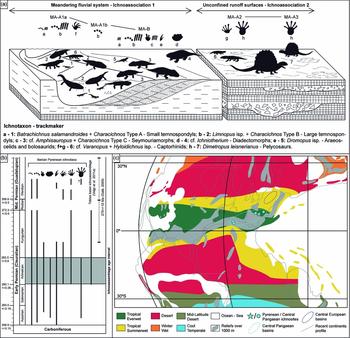
Two ichnoassociations are observed: (1) one composed of Batrachichnus salamandroides, Limnopus isp., cf. Amphisauropus, cf. Ichniotherium cf. Varanopus and Characichnos, and yielded in the meandering river environment; and (2) the other composed of Hyloidichnus isp. and Dimetropus leisnerianus, and is yielded in the unconfined runoff surfaces (Fig. 12a).
(a) Palaeoenvironments of the Pyrenean tetrapod ichnotaxa and potential trackmakers (tetrapod silhouettes and palaeoenvironmental settings are not scaled). (b) Ichnoassemblage age interval (grey area) for the Iberian Pyrenean tetrapod footprints. The age ranges of different ichnospecies are those of French, Italian, German and North American basins (after Gand & Durand, Reference Gand, Durand, Lucas, Cassinis and Schneider2006; Lucas et al. Reference Lucas, Voigt, Lerner and Nelson2011; Voigt, Reference Voigt2012; Marchetti et al. Reference Marchetti, Ronchi, Santi, Schirolli and Conti2015 a, b; Voigt & Haubold, Reference Voigt and Haubold2015; Voigt & Lucas, Reference Voigt and Lucas2015). The Tiddas Basin ichnotaxa, the most similar Moroccan ichnoassemblage to the Pyrenean assemblage, are not differentiated as they are on the same stratigraphic levels (see Voigt et al. Reference Voigt, Lagnaoui, Hminna, Saber and Schneider2011 a). Question mark (?) on upper Dimetropus leisnerianus interval indicates dubious specimens. The radiometric dating cited in Galé (Reference Galé2005) overlaps with the potential age interval. Footprints intervals are calibrated to the current standard chronostratigraphic scale (available from http://www.stratigraphy.org). Silhouettes of the ichnites as in (a); modified from Gand & Durand (Reference Gand, Durand, Lucas, Cassinis and Schneider2006). (c) Palaeogeography from Ziegler et al. (Reference Ziegler, Hulver, Rowley and Martini1997) and palaeoclimate based on Rees et al. (Reference Rees, Ziegler, Gibbs, Kutzbach, Behling and Rowley2002), map for Artinskian stage (middle early Permian) and approximate positions of Central Pangaean and Central European basins.

The thick sandstone–mudstone layers from sections MA-A1a, MA-A1b and MA-B (Fig. 2a, b) represent meandering fluvial deposits. All these three sections present a similar pattern with abundant swimming tracks in the central-lower part and with footprints showing a walking behaviour in the other levels, probably impressed in drier conditions. Most of the ichnites are preserved on the mudstone layers deposited after the channel functionality (i.e. small ponds and oxbow lakes), so trackmakers inhabited channels during quieter environment conditions.
Extramorphological variations in Limnopus isp. tracks probably reflect different palaeoenvironments. The first morphology (Fig. 4a–f) may correspond to walking tracks in subaerial conditions (with wet and soft substrate) while the second morphology (Fig. 4g–i) corresponds to a mixture between subaerial and subaquatic conditions. The associated swimming tracks (Characichnos Type B; Fig. 11b–e) correspond to shallow-water environments. Section MA-A1a presents a succession from lower levels with abundant tracks of digit tips of Limnopus isp. and scratches of Characichnos Type B (10.20–10.50m) to higher levels with Limnopus isp. walking gait tracks (18.15m). Successive tetrapod track associations are observed in section MA-B (from base to top) as follows.
-
1. Limnopus isp. + cf. Amphisauropus + Characichnos Type B (15.50–16.50m): tracks impressed in a relatively quiet environment. This association represents subaerial to subaquatic environments, as indicated by both walking and swimming tracks.
-
2. Limnopus isp. + Characichnos Types A and B + cf. Amphisauropus (16.50–17.50m): abundant tracks of swimming gait (scratches) from higher water level interval (i.e. high flow-rate environment).
-
3. cf. Amphisauropus + Characichnos Type C + Limnopus isp. (17.75m, track surface with two parts): in one part walking gait tracks without a preferential orientation, similar to those from the first domain, are abundant. These tracks may correspond to the higher part of the fluvial scroll. The other part is dominated by swimming scratches, which are assumed to be impressed in the deeper part of the channel.
-
4. cf. Amphisauropus (21.50m and 23.80m) + cf. Ichniotherium (23.20m): tracks impressed in irregular surfaces corresponding to subaerial environments. Limnopus isp. tracks are sporadic. The occasional mud-cracked surfaces with scratches and surfaces covered with notostracan trace fossils are indicative of channel desiccation after ichnites impression. The strata bearing these footprints are similar to the ignimbrites with unconfined runoff surfaces identified in sections MA-A2 and MA-A3 (Fig. 2a; supplementary Appendix S1, Fig. S1, available at http://journals.cambridge.org/geo).
Tetrapod footprints from sections MA-B and MA-A1a indicate a progressive drying process from the base to the top (from swimming to walking gait footprints). Interestingly, it has been suggested that seymouriamorphs (the potential cf. Amphisauropus trackmakers) and diadectomorphs (potential cf. Ichniotherium trackmakers) may have had ecological advantages during dry seasons (Falcon-Lang et al. Reference Falcon-Lang, Gibling, Benton, Miller and Bashforth2010; Brink, Hawthorn & Evans, Reference Brink, Hawthorn and Evans2012). If confirmed, this could explain the dominance of these ichnotaxa in the upper part (fourth association) in section MA-B. On the other hand, section MA-A1b only yields Limnopus isp. tracks in one interval; this is probably due to the lack of surfaces cropping out, limiting palaeoenvironmental inferences.
The invertebrate ichnites (see supplementary Appendix S3, available at http://journals.cambridge.org/geo) from ichnoassociation 1, dominated by notostracan trace fossils (i.e. Rusophycus isp. and Acripes multiformis), are only identified in section MA-B; they are more abundant in the central part of the fluvial system deposits (supplementary Appendix S1, Fig. S1, available at http://journals.cambridge.org/geo). Trackmakers are likely to have required regular or constant water presence (Buatois et al. Reference Buatois, Mangamo, Maples and Lanier1998; Avanzini et al. Reference Avanzini, Bernardi, Nicosia and Dar2011). These conditions would have prevailed in the deepest part of the fluvial channel. Such environments would represent periods of transport inactivity of the channel due to the avulsion of the meandering system, which is consistent with the observed setting (small ponds and oxbow lakes).
Outwith the fluvial meandering environment, unconfined runoff surfaces are present and correspond to sections MA-2 and MA-A3. They consist of mud-draped ignimbrites, resulting from exposure to water runoff (Fig. 2c, d, i). The tetrapod footprints and trace fossils of Helminthopsis isp. are preserved on the surface of mudstone layers, while the undetermined trace fossils burrowed the ignimbrites (supplementary Appendix S1, Fig. S5, available at http://journals.cambridge.org/geo).
The Hyloidichnus isp. tracks are interpreted to have formed in humid and warm climate conditions (Gilmore, Reference Gilmore1927; Gand, Reference Gand1988). The flow in temporary water bodies formed ripples, while mudcracks are indicative of subaerial exposure and long dry periods (Gand et al. Reference Gand, Kerp, Parsons and Martínez-García1997, Reference Gand, Tüysüz, Steyer, Allain, Sakınç, Sanchez, Șengor and Sen2011; Minter & Braddy, Reference Minter and Braddy2009). These features are recognized in the strata containing ichnoassociation 2. The tetrapod footprints could have been impressed both during and after the presence of water flow, when the substrate was soft. Helminthopsis isp. and burrows indicate shallow-water palaeoenvironments or moist substrate (Avanzini et al. Reference Avanzini, Bernardi, Nicosia and Dar2011). The Helminthopsis isp. specimens overprint flow ripples. Consequently, these traces were formed after runoff flow within the presence of a body of water or a substrate with high water content.
Considering the tetrapod ichnofacies proposed by Hunt & Lucas (Reference Hunt, Lucas, Lucas, Cassinis and Schneider2006, Reference Hunt and Lucas2007), the Iberian Pyrenean ichnoassemblage may correspond to both Batrachichnus and Characichnos ichnofacies (see also Minter & Braddy, Reference Minter and Braddy2009). The environment inferred for the Batrachichnus ichnofacies is a fluvial plain, whereas the environment for the Characichnos ichnofacies is a shallow lacustrine (see Hunt & Lucas, Reference Hunt and Lucas2007). These environmental inferences are in accordance with our sedimentological results. Within the ichnoassemblage, Limnopus isp. and Hyloidichnus isp. are the most abundant specimens in ichnoassociations 1 and 2, respectively (Fig. 1c; supplementary Appendix S1, Fig. S1, available at http://journals.cambridge.org/geo). Ptaszyński & Niedźwiedzki (Reference Ptaszyński and Niedźwiedzki2004) proposed that such an abundance might be the result of: (1) gregarious behaviour of the trackmakers; or (2) habitat preferences. Otherwise, the high concentration of footprints and also invertebrate trace fossils is restricted to wetter palaeoenvironments during dry seasons (Falcon-Lang et al. Reference Falcon-Lang, Gibling, Benton, Miller and Bashforth2010). Roscher & Schneider (Reference Roscher, Schneider, Lucas, Cassinis and Schneider2006) reported wet phases that interrupted the aridization transition from Carboniferous to Permian (see Section 5.d below); deposits from these time intervals may therefore also present a higher concentration of ichnites.
5.b. Ichnofaunal diversity and age
The ichnotaxa found in all the studied sections can be compared with those of other dated basins. Amphisauropus appears at the base of the Permian succession in Canada and Germany (Van Allen et al. Reference Van Allen, Calder and Hunt2005; Voigt, Reference Voigt2012), while the oldest Ichniotherium tracks are from Carboniferous deposits of Germany (Voigt & Ganzelewski, Reference Voigt and Ganzelewski2010) and the youngest tracks from upper lower Permian deposits of Morocco (Voigt et al. Reference Voigt, Saber, Schneider, Hmich and Hminna2011 b). Hyloidichnus ranges from the upper Artinskian (lower Permian) succession in the Lodève (Gand & Durand, Reference Gand, Durand, Lucas, Cassinis and Schneider2006) and Midland basins (Gilmore, Reference Gilmore1927; Lucas et al. Reference Lucas, Voigt, Lerner and Nelson2011) to the middle–upper Permian deposits of the Argana Basin (Voigt et al. Reference Voigt, Hminna, Saber, Schneider and Klein2010), the Lodève Basin (Gand & Durand, Reference Gand, Durand, Lucas, Cassinis and Schneider2006) and the Italian Southern Alps (Avanzini, Bernardi & Nicosia, Reference Avanzini, Bernardi, Nicosia and Dar2011). Dimetropus is known from Carboniferous (Voigt & Ganzelewski, Reference Voigt and Ganzelewski2010) to Cisuralian (lower Permian) deposits (Gand & Durand, Reference Gand, Durand, Lucas, Cassinis and Schneider2006; Voigt et al. Reference Voigt, Lagnaoui, Hminna, Saber and Schneider2011 a). Haubold & Lucas (Reference Haubold and Lucas2003) and Voigt & Haubold (Reference Voigt and Haubold2015) pointed out that Batrachichnus, Limnopus, Amphisauropus, Varanopus, Dimetropus and Dromopus are characteristic ichnogenera of the Artinskian (upper lower Permian) deposits of Europe, Morocco and North America. The main difference in the Kungurian-aged and younger strata is the lack of Erpetopus (e.g. Haubold & Lucas, Reference Haubold and Lucas2001, Reference Haubold and Lucas2003; Hminna et al. Reference Hminna, Voigt, Saber, Schneider and Hmich2012; Marchetti, Bernardi & Avanzini, Reference Marchetti, Bernardi and Avanzini2013; Marchetti, Santi & Avanzini, Reference Marchetti, Santi and Avanzini2014) and therapsid footprints (Gand et al. Reference Gand, Garric, Demathieu and Ellenberger2000; Avanzini, Bernardi & Nicosia, Reference Avanzini, Bernardi, Nicosia and Dar2011).
The Peranera Formation base is aged 270 ± 10Ma according to radiometric dating of calc-alkaline igneous rocks (see Galé, Reference Galé2005). The underlying Malpàs Formation flora is dated as late Carboniferous – early Permian in age (Álvarez-Ramis & Doubinger, Reference Álvarez-Ramis and Doubinger1987; Talens & Wagner, Reference Talens and Wagner1995). Pereira et al. (Reference Pereira, Castro, Chichorro, Fernández, Díaz-Alvarado, Martí and Rodríguez2014) provided absolute ages for the ignimbrites and ignimbritic enclaves older that the studied strata (i.e. Erillcastell Formation and equivalents), resulting in an age range of c. 310–273Ma (late Carboniferous – early Permian). A magmatic activity of c. 276–266Ma (early–middle Permian) was also noted by Pereira et al. (Reference Pereira, Castro, Chichorro, Fernández, Díaz-Alvarado, Martí and Rodríguez2014). These age ranges are in agreement with our biostratigraphic results. Accordingly, the age of the present ichnoassemblage should be late early Permian (Fig. 12b), as pointed out by Voigt & Haubold (Reference Voigt and Haubold2015).
5.c. Footprint biogeography: late early Permian
Only the integrated discussion of ichnofaunal diversity, age and environmental constrictions (Fig. 12a) can support the palaeobiogeography of tetrapod footprints, probably linked to the palaeoclimatic patterns (Fig. 12b, c). The general palaeobiogeographic patterns can be inferred comparing different basins and stratigraphic succession of ichnotaxa (e.g. Gand & Durand, Reference Gand, Durand, Lucas, Cassinis and Schneider2006; Voigt et al. Reference Voigt, Lagnaoui, Hminna, Saber and Schneider2011 a, b).
The late early Permian (Artinskian) vertebrate fauna, based both on skeletal (Lucas, Reference Lucas, Lucas, Cassinis and Schneider2006) and ichnological (e.g. Gand & Durand, Reference Gand, Durand, Lucas, Cassinis and Schneider2006; Hunt & Lucas, Reference Hunt, Lucas, Lucas, Cassinis and Schneider2006; Voigt et al. Reference Voigt, Lagnaoui, Hminna, Saber and Schneider2011 a; Voigt & Haubold, Reference Voigt and Haubold2015) record, was worldwide uniform. However, the comparison of the Artinskian ichnoassemblages from Spanish, Southern French and Moroccan basins with that from the German Tambach Formation of Central Europe (Voigt, Reference Voigt2012) highlights differences in the presence and the relative abundance of certain ichnotaxa, probably due to environmental/climatic conditions or to an incorrect interpretation of the Tambach Formation age.
Ichnotaxa identified in the Iberian Pyrenean Basin are also present (at least at ichnogenus level) in nearby basins from Central Pangaea of this stage (Gand et al. Reference Gand, Kerp, Parsons and Martínez-García1997; Gand & Durand, Reference Gand, Durand, Lucas, Cassinis and Schneider2006; Voigt et al. Reference Voigt, Lagnaoui, Hminna, Saber and Schneider2011 a, b). These comparisons infer that the Central Pangaean faunas were dominated by amphibian temnospondyls, captorhinid eureptiles and also subordinated seymouriamorphans and synapsids such as pelycosaurs (Fig. 12a). Diadectomorphs were also present, represented by assumed Ichniotherium specimens, but their tracks are scarce and poorly preserved.
The Peña Sagra footprints (northern Spain) are found in a red-bed succession interpreted as shallow-water deposits that underwent frequent subaerial exposure (i.e. mudflat; Gand et al. Reference Gand, Kerp, Parsons and Martínez-García1997). This is indicated by the abundance and repeated occurrence of mudcracks and raindrop impressions, similarly to the Peranera Formation (Fig. 1c; supplementary Appendix S1, Fig. S1, available at http://journals.cambridge.org/geo). The low ichnotaxa diversity from Peña Sagra, possibly due to sampling bias, is correlated with the Rabejac Formation ichnoassemblage from the Lodève Basin (Gand et al. Reference Gand, Kerp, Parsons and Martínez-García1997). The palaeoenvironments from the Khenifra Basin middle and upper members (Central Morocco) are considered to belong to a floodplain with minor ponds and small lakes (Voigt et al. Reference Voigt, Saber, Schneider, Hmich and Hminna2011 b). The Tiddas Basin (Central Morocco) footprints are preserved in a succession of reddish-brown sandstones, siltsones and mudstones attributed to deposits of an episodically inundated mudflat (Voigt et al. Reference Voigt, Lagnaoui, Hminna, Saber and Schneider2011 a). The sedimentological data from the French Permian basins (e.g. Lodève, Saint-Affrique, Gonfaron) indicate lacustrine, playa, fluviatile and floodplain palaeoenvironments for the tracksites (Demathieu, Gand & Toutin-Morin, Reference Demathieu, Gand and Toutin-Morin1992; Gand & Durand, Reference Gand, Durand, Lucas, Cassinis and Schneider2006). Roscher & Schneider (Reference Roscher, Schneider, Lucas, Cassinis and Schneider2006) inferred a dominantly fluvial environment for the Lodève Basin, a floodplain setting with periodically water-filled ponds, sheetfloods, braided rivers and adjacent lakes. Homogeneous ichnoassemblages conditions are therefore considered for the Central Pangaean basins of this period, with prevailing mudflat and floodplain palaeoenvironments.
The comparison with Central Europe reveals differences in the proportions of the assumed Artinskian ichnoassemblages, as well as in the presence of some ichnogenera. In Central Pangaea the dominating ichnotaxa are Batrachichnus and Limnopus (Gand, Reference Gand1988; Gand & Durand, Reference Gand, Durand, Lucas, Cassinis and Schneider2006; Lucas et al. Reference Lucas, Voigt, Lerner and Nelson2011), whereas Ichniotherium is the most abundant in Central Europe (Germany; see Voigt, Reference Voigt2005, Reference Voigt2012).
Ichniotherium is also reported in Morocco (I. sphaerodactylum; Voigt et al. Reference Voigt, Saber, Schneider, Hmich and Hminna2011 b), southern France (cf. Ichniotherium; Gand, Reference Gand1989; Gand & Durand, Reference Gand, Durand, Lucas, Cassinis and Schneider2006), North America (Voigt, Small & Sanders, Reference Voigt, Small and Sanders2005), and Canada (Brink, Hawthorn & Evans, Reference Brink, Hawthorn and Evans2012). Nevertheless, the presence of Ichniotherium is scarce in the low latitudes of Pangaea, in Morocco only a partial track has been reported and in southern France specimens are not abundant and of dubious attribution (see Gand & Durand, Reference Gand, Durand, Lucas, Cassinis and Schneider2006). In the present work, assumed Ichniotherium specimens (Fig. 6) preserved in a peculiar substrate (medium to fine sandstone with rough aspect) are reported. The ichnogenus Hyloidichnus has not been reported in Central Europe (see Voigt, Reference Voigt2005, Reference Voigt2012 for a discussion), but it is present in Central Pangaea except in the Khenifra Basin (Voigt et al. Reference Voigt, Saber, Schneider, Hmich and Hminna2011 b).
5.d. Palaeoclimatic ichnoassemblage zones: late early Permian
The trend of the late Palaeozoic global climate was the transition from humid conditions during Carboniferous time to the development of arid and semiarid environments during early–middle Permian time (e.g. Haubold, Reference Haubold1985; Gascón & Gisbert, Reference Gascón and Gisbert1987; Schneider et al. Reference Schneider, Körner, Roscher and Kroner2006). This aridization process, influenced by the distribution of the land masses (i.e. the Pangaea supercontinent), resulted in the development of the globally known red-bed deposits (Chumakov & Zharkov, Reference Chumakov and Zharkov2002; Gibbs et al. Reference Gibbs, Rees, Kutzbach, Ziegler, Behling and Rowley2002; Roscher & Schneider, Reference Roscher, Schneider, Lucas, Cassinis and Schneider2006; Michel et al. Reference Michel, Tabor, Montañez, Schmitz and Davydov2015). In the upper parts of sections MA-B and MA-A1a (Fig. 1c; supplementary Appendix S1, Fig. S1, available at http://journals.cambridge.org/geo), palaeosols resemble those attributed by Gascón & Gisbert (Reference Gascón and Gisbert1987) to a tropical steppe climate with relatively low annual precipitation (250–450mm/year), which is also in accordance with the low-latitude Permian aridization.
The homogeneity of the Central Pangaean ichnoassemblages and palaeoenvironments indicates a diffuse Gondwana–Laurasia boundary during early Permian time, which might suggest a possible palaeogeographic continuity and widespread palaeoenvironmental conditions. This is in accordance with Roscher & Schneider (Reference Roscher, Schneider, Lucas, Cassinis and Schneider2006), who suggested that the Trans-Pangaean Belt did not exist and the Variscan Chain maximum elevation migrated through the continent due to the Gondwanian clockwise rotation. On the other hand, Sinisi et al. (Reference Sinisi, Mongelli, Mameli and Oggiano2014) pointed out that the more humid conditions (with punctual arid episodes) in Central Pangaea were influenced by the presence of the South European Variscan Chain. The latter could have influenced climate but was not a geographic barrier for faunal distribution in Central Pangaea, as suggested by the similarity of the ichnoassemblages discussed above.
Rees et al. (Reference Rees, Ziegler, Gibbs, Kutzbach, Behling and Rowley2002) performed a palaeoclimatic model for the Sakmarian and established latitudinal biomes equivalent to present day different climates. In a tentative palaeogeographic (from Ziegler, Hulver & Rowley, Reference Ziegler, Hulver, Rowley and Martini1997) and palaeoclimatic (based on Rees et al. Reference Rees, Ziegler, Gibbs, Kutzbach, Behling and Rowley2002) reconstruction during Artinskian time (Fig. 12c), Central Pangaean basins are situated in the tropical everwet biome (in the sense of Rees et al. Reference Rees, Ziegler, Gibbs, Kutzbach, Behling and Rowley2002: tropical, humid, minimum of 40mm of precipitation per month during all year), whereas the Central European basins are in the tropical summerwet biome (in the sense of Rees et al. Reference Rees, Ziegler, Gibbs, Kutzbach, Behling and Rowley2002: tropical, humid summers or semihumid, minimum of 40mm of precipitation per month during summer season; see also Chumakov & Zharkov, Reference Chumakov and Zharkov2002; Gibbs et al. Reference Gibbs, Rees, Kutzbach, Ziegler, Behling and Rowley2002; Roscher & Schneider, Reference Roscher, Schneider, Lucas, Cassinis and Schneider2006; Schneider et al. Reference Schneider, Körner, Roscher and Kroner2006; Michel et al. Reference Michel, Tabor, Montañez, Schmitz and Davydov2015). These climate variations could explain the differences observed between the Central Pangaean and Central European basins as described in Section 5.c above. We therefore suggest a climatic control for the fauna distribution among Pangaea, as has been previously suggested for the (?)middle–late Permian deposits of Niger (Sidor et al. Reference Sidor, O’Keefe, Damiani, Steyer, Smith, Larsson, Sereno, Ide and Maga2005), rather than different environmental conditions or different ages of the tracksites. Nevertheless, these possibilities cannot be discarded at the present state of knowledge.
6. Conclusions
1. The study of diagnostic morphological features of selected material, with the aid of photogrammetric techniques, has enhanced systematic determinations. The Permian Iberian Pyrenean Basin yields unexpected ichnofaunal diversity. This ichnoassemblage comprises Batrachichnus salamandroides, Limnopus isp., cf. Amphisauropus, cf. Ichniotherium, Dromopus isp., cf. Varanopus, Hyloidichnus isp., Dimetropus leisnerianus and three types of Characichnos. Based on biostratigraphic correlations, this ichoassamblage could be late early Permian in age (Artinskian).
2. Two ichnoassociations appear restricted to water-laid deposits within a volcaniclastic succession. The comparison with other ichnoassociations of late early Permian Pangaea allows any biostratigraphic change in the studied sections to be excluded. Instead, each ichnoassociation suggests distinctive palaeoenvironmental conditions. Ichnoassociation 1 is found in meandering fluvial deposits. Water fluctuations are inferred by the type of tetrapod footprints, which suggest both subaqueous (scratches and digit tip tracks) and subaerial palaeoenvironments (plantigrade or semiplantigrade tracks). Ichnoassociation 2 is found in unconfined runoff surfaces (mudflats covering pyroclastic flows), where the tetrapod footprints record a walking gait. Mudcracks and raindrop impressions are present in all sections, suggesting dry seasonal conditions.
3. Our data suggest that the South European reliefs of the Variscan Chain could have influenced climate, but it was not a geographic barrier preventing faunal distribution through different sites of Artinskian Central Pangaea.
4. The ichnites suggest that, at that time, climate was wetter in Central Pangaea than in Central Europe. The Central Pangaean basins are indeed dominated by ichnofauna constricted to wetter environments (i.e. Batrachichnus and Limnopus), whereas in Central European basins the most common ichnofauna are those from inland drier settings (i.e. Ichniotherium). Some common ichnotaxa from Central Pangaea (i.e. Hyloidichnus) are also absent from Central Europe. It should be noted that data on assumed late Cisuralian sites of Central Europe are few; further studies are therefore reccomended. The available information supports previous climatic models, stressing the potential of ichnites in palaeoenvironmental and palaeoclimatic reconstructions and suggesting climatic control on faunal distribution within Pangaea.
Acknowledgments
We would like to express our gratitude to J. Á. López-López, M. Vilalta, M. Plà, R. Gaete, L. Rossell and A. López for their support during field work and J. Galindo, L. Celià and C. Cancelo for access to the collection and lab facilities. We are very grateful to N.L. Razzolini, Dr I. Díaz-Martínez and Dr P. Falkingham, whose suggestions improved the 3D model footprints. Dr J. Marigó revised the English grammar. Comments and suggestions of two reviewers, Dr J.-S. Steyer and Dr L. Marchetti, greatly improved a previous version of the manuscript. E.M. and J.F. thank Professor Dr G. Gand for his comments, suggestions and guidance on Lodève basin tracksites and S. Fouché, who kindly allowed access to the Musée Fleury (Lodève) track collection. E.M. is deeply indebted to Dr D. Schwarz, Dr H. Mallison, Dr F. Witzmann, Professor Dr N.-E. Jalil, Dr M. Vianey-Liaud and Dr L. Marivaux for their kindness and help during visits to collections under their care. This work was supported by the SYNTHESYS Project (E.M., DE-TAF-2560 at MfN, and FR-TAF-3621 and FR-TAF-4808 at MNHN; http://www.synthesys.info/) and Secretaria d'Universitats i de Recerca del Departament d'Economia i Coneixement de la Generalitat de Catalunya (E.M., expedient number 2013 CTP 00013, at ISE-M) for visits to collections. E.M. received financial support from the PIF grant of the Geology Department at UAB. Field works have been developed on the project ‘Vertebrats del Permià i el Triàsic de Catalunya i el seu context geològic’ and ‘Evolució dels ecosistemes amb faunes de vertebrats del Permià i el Triàsic de Catalunya’ (ref. 2014/100606), based at Institut Català de Paleontologia and we acknowledge the financial support of the‘Departament de Cultura (Generalitat de Catalunya)’.
Declaration of interest
None.
Supplementary material
To view supplementary material for this article, please visit http://dx.doi.org/10.1017/S0016756815000576