The advent of new information and communication technologies (ICT) has led to Internet becoming a new context for social communication and has changed the way people socialize. Despite the benefits and opportunities offered by ICT in terms of connections between people, creating new social bonds or the feeling of belonging to a group, the exploration of one’s own identity or the development of social skills (Arab & Díaz, Reference Arab and Díaz2015) still present communicative and affective challenges which provide the opportunity to learn and develop through the use of digital devices. These social activities, as well as having a positive potential in terms of communication and creating affective bonds, can also give rise to episodes of hatred, aggression and other social imbalances which have harmful effects for all those involved (Hartung & Renner, Reference Hartung and Renner2013; Ohannessian & Vannucci, Reference Ohannessian and Vannucci2020; Vannucci et al., Reference Vannucci, Simpson, Gagnon and Ohannessian2020). Furthermore, the later years of childhood, especially adolescence, are a time when forging friendships and intense social communication are at their peak, with both positive and negative effects (Marín-López et al., Reference Marín-López, Zych, Ortega-Ruiz, Hunter and Llorent2020).
There have been many studies describing certain aspects of adolescents’ social behavior, such as making threats or insults, giving someone ‘the cold shoulder’, humiliations, and so on, as well as their intensive use of social media (Garmendia et al., Reference Garmendia, Jiménez, Karrera, Larrañaga, Casado, Martínez and Garitaoanadia2019). During this social communication online, adolescents sometimes resort to behavior which is intended to do psychological and social harm (Hartung & Renner, Reference Hartung and Renner2013). Many of these actions have been accurately described as phenomenon involving harassment and bullying, which has been termed cyberbullying (Dennehy et al., Reference Dennehy, Meaney, Walsh, Sinnott, Cronin and Arensman2020). This has now become a familiar term, and refers to any unjustified, intentional and repeated aggression, through electronic devices and digital media, against another person who is incapable of defending themselves, and which causes an imbalance of power with negative consequences for the victim and the aggressor (Smith, Reference Smith2015). These are the main behavioral aspects which have been identified in cyberbullying; however, recent authors have stresses more the fact that the behavior is intentional and repeated over time and that there is an imbalance of power between the victim and the aggressor (Dennehy et al., Reference Dennehy, Meaney, Walsh, Sinnott, Cronin and Arensman2020).
Social Media and Socialization in Childhood and Adolescence
Social media provide a framework which includes everyone with whom an individual has contact and is associated with an individual’s psycho-social development (Spies Shapiro & Margolin, Reference Spies Shapiro and Margolin2014). The use of social media like Facebook, Instagram, Tik Tok, Twitter or WhatsApp has become a major feature of social activities in young people’s daily lives. In particular, among adolescents, communication and their affective-social life during the time they spend on social media play a fundamental role in their socialization process, since they facilitate social interaction by publishing and sharing personal, social information between followers and friends (Chang & Chen, Reference Chang and Chen2014; Lee, Reference Lee2014; Reinecke & Trepte, Reference Reinecke and Trepte2014; Spies Shapiro & Margolin, Reference Spies Shapiro and Margolin2014; Vannucci et al., Reference Vannucci, Simpson, Gagnon and Ohannessian2020). Although under 16s are legally protected against the use of digital applications for social media, their use has spread to children much younger than 16 (Mascheroni & Cuman, Reference Mascheroni and Cuman2014). According to the National Institute of Statistics (Instituto Nacional de Estadística [INE], 2020), 69,5% of the population aged between 10 and 15 have mobile phones or Smartphones, 91.5% use a computer and tablets and 94.5% make use of the internet. As regards young people between the ages of 16 and 24, 93% have used social media and applications such as Facebook, YouTube, Twitter, etc. (INE, 2020). The high use of these applications has been justified by Tejada Garitano et al. (Reference Tejada Garitano, Castaño Garrido and Romero Adonegui2019), as an adolescent need to inquire about the multiple possibilities of language and communication, and the benefits that they can bring to young people’s development and social learning are undoubted, as long as what circulates on these media is not harmful, aggressive or callous.
The negative consequences of using social media have been linked to causes such as the digital divide between adolescents and families (Arab & Díaz, Reference Arab and Díaz2015), which makes some of the actions carried out online such as uploading photos, videos, spreading information, etc., trigger or foster other problems such as bullying or cyberbullying (Tejada Garitano et al., Reference Tejada Garitano, Castaño Garrido and Romero Adonegui2019). However, in addition to these risks, the use of social media stimulates and obviously biases the intense, intimate communication among schoolchildren, which can be positive or negative (Krause et al., Reference Krause, Baum, Baumann and Krasnova2021). In fact, the use of social media entails extremely fast, fluid communication between people. Research have extensively highlighted that Internet facilitates the appearance, development, and maintenance of different types of relationships and behavior, such as cybergossip (Smith et al., Reference Smith, Leonis and Anandavalli2021).
Cybergossip
Cybergossip is an apparently innocent form of dialogue, which features evaluative comments expressed by two or more people about another person who is not present but who is known by those involved in the conversation (Bechtoldt et al., Reference Bechtoldt, Beersma and Dijkstra2020; López-Pradas et al., Reference López-Pradas, Romera, Casas and Ortega-Ruiz2017). This type of online behavior has its origin in face-to-face or direct gossip, which can be defined as an evaluative conversation between two or more participants about one or more absent people (Dores-Cruz et al., Reference Dores-Cruz, Nieper, Testori, Martinescu and Beersma2021; Foster, Reference Foster2004; McDonald et al., Reference McDonald, Putallaz, Grimes, Kupersmidt and Coie2007). Both phenomena can be seen as a way of obtaining information about others, and building/reinforcing social bonds (Baumeister et al., Reference Baumeister, Zhang and Vohs2004; Hartung & Renner, Reference Hartung and Renner2013).
Cybergossip, which usually occurs when people share personal information with their friends and followers (Chang & Chen, Reference Chang and Chen2014; Lee, Reference Lee2014; Reinecke & Trepte, Reference Reinecke and Trepte2014; Spies Shapiro & Margolin, Reference Spies Shapiro and Margolin2014), can be private, public, or semi-public, depending on the person’s profile (Oh et al., Reference Oh, Ozkaya and LaRose2014; Reinecke & Trepte, Reference Reinecke and Trepte2014). Among its recognized functions, there is the need to transfer information, entertainment, maintaining friendship, creating new links, or influencing other members of the group (Foster, Reference Foster2004; López-Pradas et al., Reference López-Pradas, Romera, Casas and Ortega-Ruiz2017). While gossip has been viewed traditionally as a kind of aggression and mockery, from a more current perspective, it is often seen as an important form of social communication which unites the group by sharing information about its members (Baumeister et al., Reference Baumeister, Zhang and Vohs2004). Although the aim of gossip is often to inform people about other people’s deviant behavior, positive comments are also shared (Caivano et al., Reference Caivano, Leduc and Talwar2020). However, individuals often do not admit to talking about others or gossiping and tend to claim that they use social media less frequently than others, and even criticize people who they know take part in gossiping (Bechtoldt et al., Reference Bechtoldt, Beersma and Dijkstra2020). Gender has been recognized as a relevant variable, with previous studies on gossip recognizing a higher tendency for girls to gossip and encourage others to do so (Caivano & Talwar, Reference Caivano and Talwar2021; Perry & Pauletti, Reference Perry and Pauletti2011), mainly on the topic of physical appearance (Archer & Coyne, Reference Archer and Coyne2005), or, in contrast, that boys participated more than girls in same-sex gossip (Haux et al., Reference Haux, Engelmann, Herrmann and Tomasello2016; McGuigan & Cubillo, Reference McGuigan and Cubillo2013). However, other studies reflect that, regarding social issues or academic achievements, no differences are apparent between gender (Nevo et al., Reference Nevo, Nevo and Derech Zehavi1993). Despite the fact that there are relatively few studies on gender differences in cybergossip in adolescents, the results seem to show that both boys and girls take part in cybergossip equally, unlike in offline gossip (Romera et al., Reference Romera, Herrera-López, Casas, Ortega Ruiz and Del Rey2018).
Studies about social networking site use recognize their detrimental and beneficial effects in social relationships (Krause et al., Reference Krause, Baum, Baumann and Krasnova2021). The study of cybergossip has been linked to social behavior strategies (Falla et al., Reference Falla, Ortega-Ruiz and Romera2021). Gossip may provide the group with information about individuals who do not comply with established norms, and it can also help to praise and reinforce the behavior of individuals belonging to that group. Some studies have shown that cybergossip helps people to learn, within their peer group, the rules about what is permitted or not in their interpersonal relationships (Baumeister et al., Reference Baumeister, Zhang and Vohs2004). It follows therefore that positive comments can help an individual to gain popularity within the group and new members to be accepted (Bechtoldt et al., Reference Bechtoldt, Beersma and Dijkstra2020). According to the social theories based on social comparison gossip may imply the development of social skills or community participation (Wert & Salovey, Reference Wert and Salovey2004). So, in adolescence gossip plays a key role in relationships increasing closeness to a group, supporting system with friends and understand the type of socially acceptable behaviors (Wert & Salovey, Reference Wert and Salovey2004). Consequently, the gossip offers the possibility to gain more liking from peers and more social adjustment (Wargo Aikins et al., Reference Wargo Aikins, Collibee and Cunningham2017).
According to the literature, due to particularities of the social networking site environment and the quality of interactions, cybergossip may imply to online-specific effects on users’ social relationships. Results of the reviewed studies suggest that when communication problems between both the person posting a message and those who reading it arises, it mostly results in increases of other risk behavior such as bullying or cyberbullying (Romera, Camacho, et al., Reference Romera, Camacho, Ortega-Ruiz and Falla2021). Therefore, cybergossip can be a tool used by bullies to manipulate information and turn it to a negative use for spreading rumors or other forms of relational aggression (Jacobs et al., Reference Jacobs, van Hee and Hoste2020; Wargo Aikins et al., Reference Wargo Aikins, Collibee and Cunningham2017). In fact, recent studies have demonstrated that intense and frequent social media use and messaging applications is associated with cyberbullying (Craig et al., Reference Craig, Boniel-Nissim, King, Walsh, Boer, Donnelly, Harel-Fisch, Malinowska-Cieślik, Gaspar de Matos, Cosma, den Eijnden, Vieno, Elgar, Molcho, Bjereld and Pickett2020; Estévez et al., Reference Estévez, Cañas, Estévez and Povedano2020). Moreover, research has shown that there is a clear link between cybergossip and cyberbullying (López-Pradas et al., Reference López-Pradas, Romera, Casas and Ortega-Ruiz2017; Romera et al., Reference Romera, Herrera-López, Casas, Ortega Ruiz and Del Rey2018).
The Present Study
Although awareness about the impact of ICT and social media on adolescents’ social relationships has increased, there are still relatively few studies on cybergossip (Laghi et al., Reference Laghi, Schneider, Vitoroulis, Coplan, Baiocco, Amichai-Hamburger, Hudek, Koszycki, Miller and Flament2013; Subramanian, Reference Subramanian2013). Most of the research has been carried out in the field of computer science (Apolloni et al., Reference Apolloni, Malchiodi and Taylor2013), with few studies looking at the phenomenon from a psychological or educational angle (Gabriels & De Backer, Reference Gabriels and De Backer2016), proving that gossip is a cooperative and an efficient interactive way, within social network, for learning or social adjustment.
Despite this lack of research, some advances have been made in the link between cybergossip and cyberbullying (Romera et al., Reference Romera, Herrera-López, Casas, Ortega Ruiz and Del Rey2018), and in the comprehension of the role of cybergossip in the improvement of interpersonal relationships (López-Pradas et al., Reference López-Pradas, Romera, Casas and Ortega-Ruiz2017). However, the previous literature has not yet evaluated the extent to which involvement in cybergossip can be linked to social adjustment, knowing, that this, in turn, is also linked to the appearance and continuance of bullying and cyberbullying. The aims of this work were therefore: (a) To explore the differences in the levels of involvement in cybergossip between social adjustment, bullying and cyberbullying; (b) to analyze the possible gender differences in the interaction between the study variables.
The study hypotheses were as follows:
1a. Adolescents who are frequently involved in cybergossip are expected to be more socially adjusted than adolescents with a medium or low involvement.
1b. Adolescents who are frequently involved in cybergossip are expected to be more involved in bullying and cyberbullying behavior than adolescents with a medium or low involvement.
2. There will be no gender differences in bullying and cyberbullying depending on the level of involvement in cybergossip.
Methods
Participants
The incidental sampling consisted of 510 schoolchildren (49.4% girls) from secondary schools in the city of Córdoba, Spain, and the province, whose ages ranged between 12 and 17 (M = 14.01; SD = 1.38). Of these, 28.2% were in 1st year of secondary school, 25.5% in 2nd year, 21.6% in 3rd year and 24.7% in 4th year. The participants attended two state schools, with a medium socio-economic level.
Instruments
To measure bullying, it was used the European Bullying Intervention Project Questionnaire (EBIP-Q; Brighi et al., Reference Brighi, Ortega, Scheithauer, Smith, Tsormpatzoudis, BarKoukis and Del Rey2012, validated in Spanish by Ortega-Ruiz et al., Reference Ortega-Ruiz, Del Rey and Casas2016). This survey consists of 14 items, 7 of which refer to aggressive behavior (e.g., “I have excluded or ignored someone” or “I have hit, kicked or pushed someone”) and 7 others to victimization (e.g., “someone has threatened me” or “someone has insulted me”). The responses were Likert-type with five response options (from 0 = no to 4 = more than once a week). The internal consistency values with the study sample were optimal (adequate reliability of the scale; victimization α = .835, ωh = .880; aggression α = .721, ωh = .822; total α = .847, ωh = .921).
Cyberbullying was measured using the European Cyberbullying Intervention Project Questionnaire (ECIPQ) scale (Del Rey et al., Reference Del Rey, Casas, Ortega-Ruiz, Schultze-Krumbholz, Scheithauer, Smith, Thompson, Barkoukis, Tsorbarzoudis, Brighi, Guarini, Pyzalski and Plichta2015; validated in Spanish by Ortega-Ruiz et al., Reference Ortega-Ruiz, Del Rey and Casas2016). The questionnaire is made up of 22 items measuring two dimensions; cybervictimization (e.g., “someone has created a fake account to impersonate me on social media or WhatsApp”) and cyber-aggression (e.g., “I have posted someone’s personal information on the internet”). The responses were Likert type with five options (from 0 = never to 4 = always). The internal consistency indices for the study sample were optimal (cybervictimization α = .836; ωh = .931; cyber-aggression α = .804; ωh = .929; total α = .884; ωh = .924).
Cybergossip was measured through the Cybergossip Questionnaire-Adolescents (CGQ-A; Romera et al., Reference Romera, Herrera-López, Casas, Ortega Ruiz and Del Rey2018). The instrument is made up of 9 items referring to four main functions of cybergossip: Informing (e.g., “I tell my friends on Social Media or WhatsApp the things I find out that happen to others”), influencing others (e.g., “When someone in my group does something wrong, I tell the rest of my colleagues through Social Media or WhatsApp so they know”), forming friendships (e.g., “I have posted comments from other friends or colleagues to be allowed to join a group on Social Networks or WhatsApp”) and having fun (e.g., “I chat to my group of friends on Social Media or WhatsApp about what happens to the other classmates to have a laugh”) (Foster, Reference Foster2004). The frequency scale was Likert-type with five response options (0 = never to 4 = always). Internal consistency with the study sample was adequate (α = .792; ωh = .853).
The Social Adjustment Scale (Herrera-López et al., Reference Herrera-López, Romera-Félix, Ortega-Ruiz and Gómez-Ortiz2016) was used. This scale measures consists of 8 items (e.g., “My classmates help me when I need it” or “My classmates or friends come to me when they have a problem”), with a Likert-type scale with seven response options (from 1 = totally false to 7 = totally true). The internal consistency indices for the study sample were optimal (α = .862; ωh = .894).
Procedure
The two schools were chosen for their ease of access. Permission was obtained from the regional government, the school council, and the students themselves, and an informed consent form was signed by the families (active family consent). This study complied with the Declaration of Helsinki, on confidentiality, privacy and informed consent and was approved by the Ethics Committee of University of Cordoba.
The questionnaires were completed on paper in the normal classroom. Information was previously given to the participants about the objectives of the study, as well as its voluntary, anonymous, and confidential nature. The participants were reminded of the importance of answering the questions truthfully and, were given 20 minutes to fill in the questionnaires, while the researchers were present to answer any possible questions that might arise.
Data Analysis
The Little´s Missing Completely at Radom (MCAR) test was used to deal with missing data. A lack of randomness was observed in the missing data, with the missing not at random (MNAR) pattern (Little’s MCAR test: 2,484.9 (1,936); p < .001). However, as the percentage of missing values for each variable ranged from 0.3% to 1%, it was decided to run the analyses without these data (Bennett, Reference Bennett2001). In all analyses, N was specified.
To categorize the cybergossip variable a percentile distribution was made, considering high and low scores as criteria (establishing scores below and above the mean), with a variable with three groups (low, medium, and high) (S = .061; K = –1.588). Descriptive analyses were also carried out, in which the M (mean) and SD (standard deviation) were calculated. Student’s t test was used to study mean differences. A multivariate analysis of variance, MANOVA, was performed to assess the difference in significance between the levels of involvement in cybergossip (low, medium, high) and the dependent variables (victimization; bullying; cybervictimization; cyberbullying; social adjustment). The Tukey and Games-Howell Post Hoc tests were used according to the homogeneity of the variance. To estimate the effect of the difference between groups, Cohen’s d statistical test was performed.
In addition, an analysis of variance, ANOVA, was carried out to confirm the data obtained in the MANOVA analyses. This statistical test was used because it allows us to check between which groups the differences were observed. Again, MANOVA and ANOVA were replicated in the study to compare the groups based on gender. In these comparisons, the different roles or scores within the dependent variable of cybergossip were also considered. Finally, the effect size of the sample was analyzed (partial Eta squared = η2) (minimum 0 ≤ η2 ≤ .009; small .01 ≤ η2 ≤ .089; medium .09 ≤ η2 ≤ .249; large η2 ≥ .25), following the criteria by Tabachnick and Fidell (Reference Tabachnick and Fidell2007). Cohen’s d statistic was reported for effect size in two-to-two comparisons. A value below .50 was considered a low effect, between .50 and .80 a moderate effect and above .80 a large effect (Cohen, Reference Cohen1992).
All the analyses were carried out using the SPSS Statistical Package for Social Sciences, Version 22.0.
Results
Descriptive Results
The descriptive results showed that a total of 494 participants (3.1% lost) were assigned to a level of involvement in cybergossip: 183 participants (37%) had a low, 144 a medium (29.1%), and 167 a high (33.8%) level of involvement in cybergossip.
Differences of means were found in the frequency of involvement in cybergossip in relation to gender (χ2 = 6.847; p = .033). Girls showed a higher frequency of involvement compared to boys (girls = 50.6%; boys = 49.4%), with a low frequency of 31.5%, a medium of 30.2% and a high prevalence of 38.3%, and boys with a low frequency of 42.2%, medium of 28.5% and high of 29.3%.
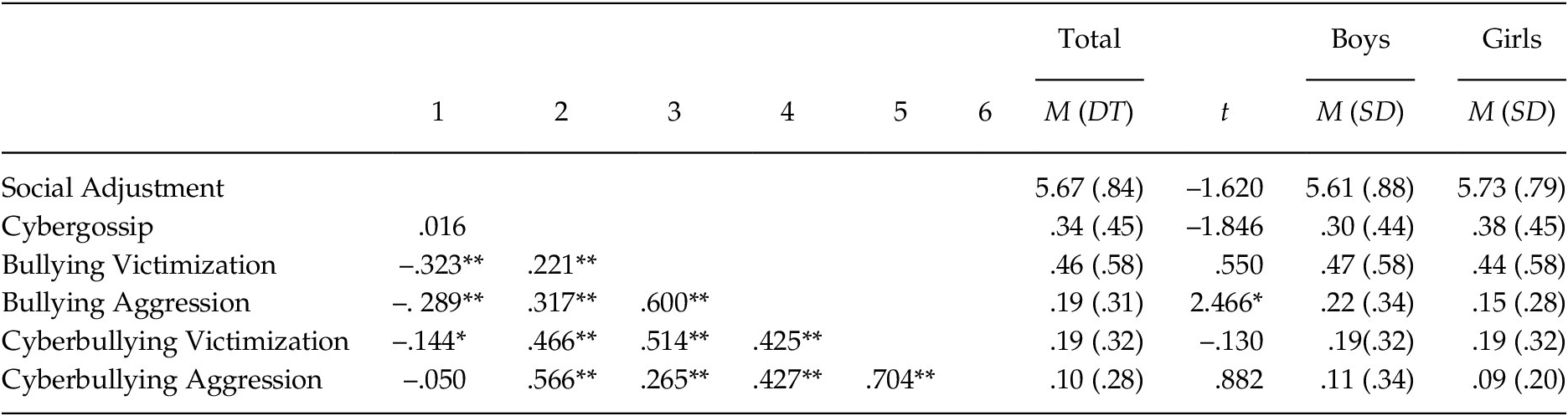
Table 1 shows the correlations and descriptive analyses of the study variables. Boys showed a greater involvement in bullying aggression. A positive relationship was observed between the variables of cybergossip, bullying victimization, bullying aggression, cyberbullying victimization, and cyberbullying aggression, with scores ranging between .22 to .56. Social adjustment negatively correlated with bullying victimization, bullying aggression, and cyberbullying victimization.
Correlations, Descriptive, and Gender Differences According to all Variables

Note. M = average; SD = Standard deviation; t = t-Student.
*p < .05. **p < .001.
Peer Social Adjustment, Bullying and Cyberbullying Behavior in the Type of Involvement in Cybergossip
There were significant differences in the multivariate analyses (MANOVAS) performed for the set of variables and cybergossip: Wilks Lambda, Λ = .797, F (2, 487) = 11.623, p < .001 (mean effect size, η2 = .107).
Cybergossip-Social Adjustment
In MANOVA, F (2, 492) = .904, p = .406), and ANOVA, F (2, 493) = .756, p = .470, no statistically significant differences were found for the social adjustment between the different groups of cybergossip (Low M = –.025, SD = 1.073; Medium M = .085, SD = .950; High M = –.046, SD = .976).
Cybergossip-Bullying Behavior
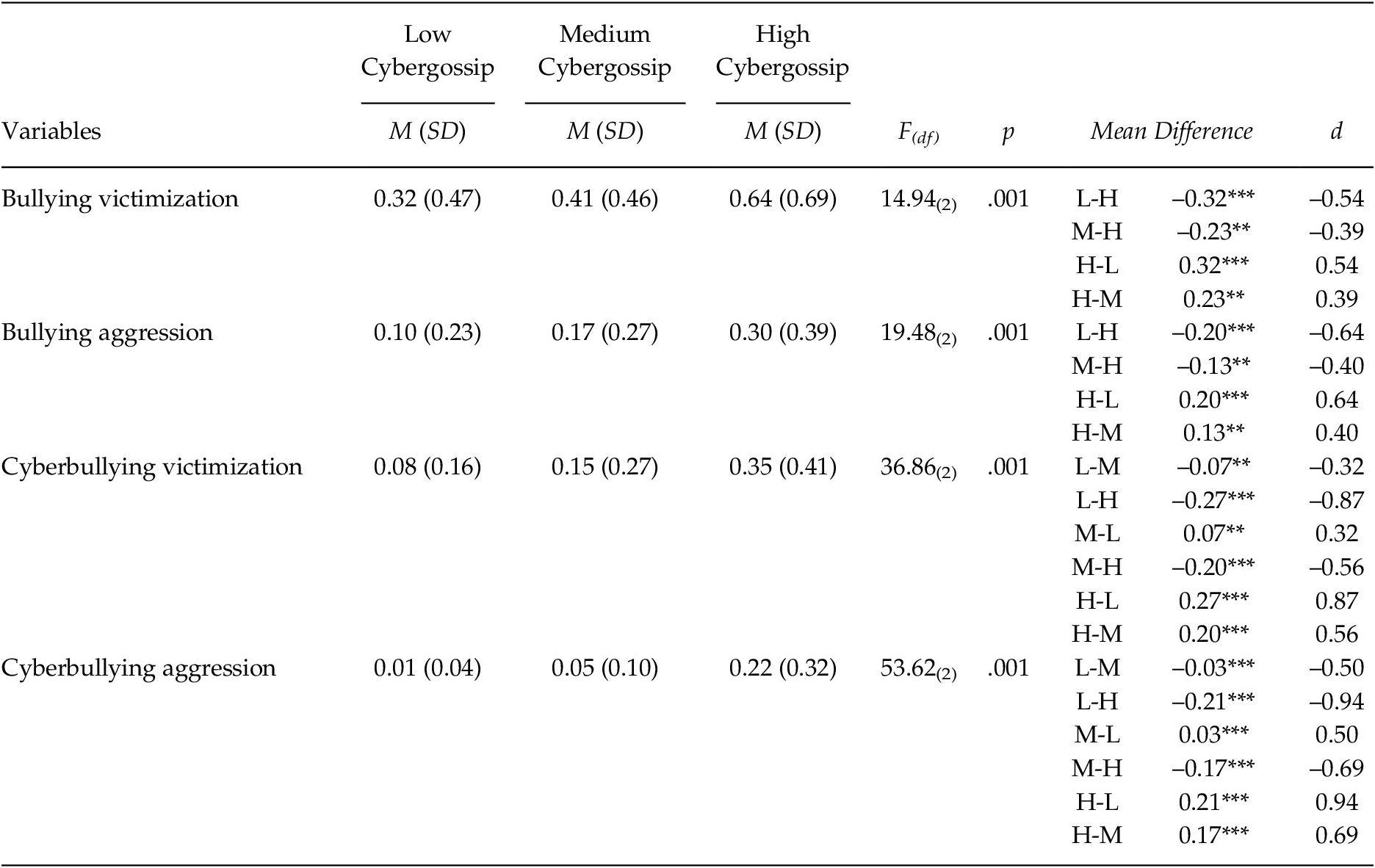
As regards the differences between the behavior of victimization in bullying as a function of the frequency of involvement in cybergossip, MANOVA showed significant differences, F (2, 492) = 15.21; p <.001. The ANOVA confirmed significant scores for bullying victimization behavior. The Games-Howell post hoc tests showed that schoolchildren with a high involvement in cybergossip obtained significantly higher scores for victimization behavior (Table 2).
ANOVA Results Comparing Cybergossip Levels on Variables

Note. M = Mean; SD = Standard deviation; df = Degrees of freedom; d = Cohen’s d; L = Low; M = Medium; H = High.
*p ≤ .05. **p ≤ .01. ***p ≤ .001.
As regards the relationship between cybergossip and bullying, the MANOVA showed significant differences, F (2, 492) = 19.35; p < .001. The ANOVA confirmed significant scores for aggressive behavior in bullying. The Games-Howell post-hoc tests indicated that students with a high involvement in cybergossip obtained significantly higher scores in aggressive behavior, compared to the low and medium involvement groups (Table 2).
Cybergossip and Cyberbullying Behavior
The results in MANOVA revealed significant differences between cybervictimization and the different levels of involvement in cybergossip F (2, 492) = 38.30; p < .001. The ANOVA confirmed significant scores for cyberbullying victimization behavior. The Games-Howell post-hoc tests showed that schoolchildren with high involvement in cybergossip obtained significantly higher scores for cybervictimization behavior (Table 2).
As for the differences between cyberbullying behavior and the frequency of involvement in cybergossip, the data obtained from the MANOVA show significant differences, F (2, 492) = 53.67; p < .001). The ANOVA confirmed significant scores for aggressive behavior in cyberbullying, and the Games-Howell post-hoc tests showed that students with high involvement in cybergossip obtained significantly higher scores in cyberbullying behavior (Table 2).
Results for the Degree of Involvement in Cybergossip and Social Adjustment, Bullying and Cyberbullying Behavior, according to Gender
As regards the differences in the frequency of involvement in cybergossip (low, medium, and high) and the independent variables (victimization, aggression, cybervictimization, cyberbullying and social adjustment), the data obtained from the ANOVA for gender showed significant differences with bullying (victimization-bullying) and cyberbullying (cybervictimization and cyberbullying), but not with social adjustment. For parsimony, only the results identified as significant have been shown.
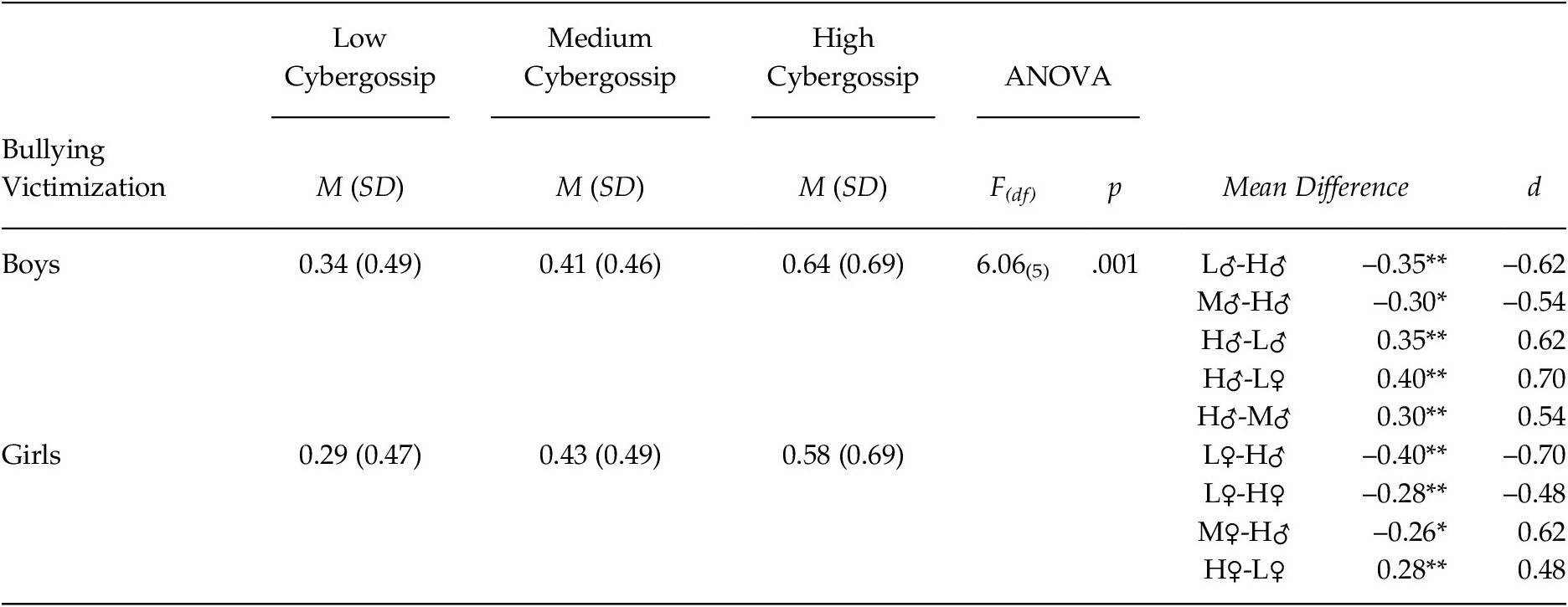
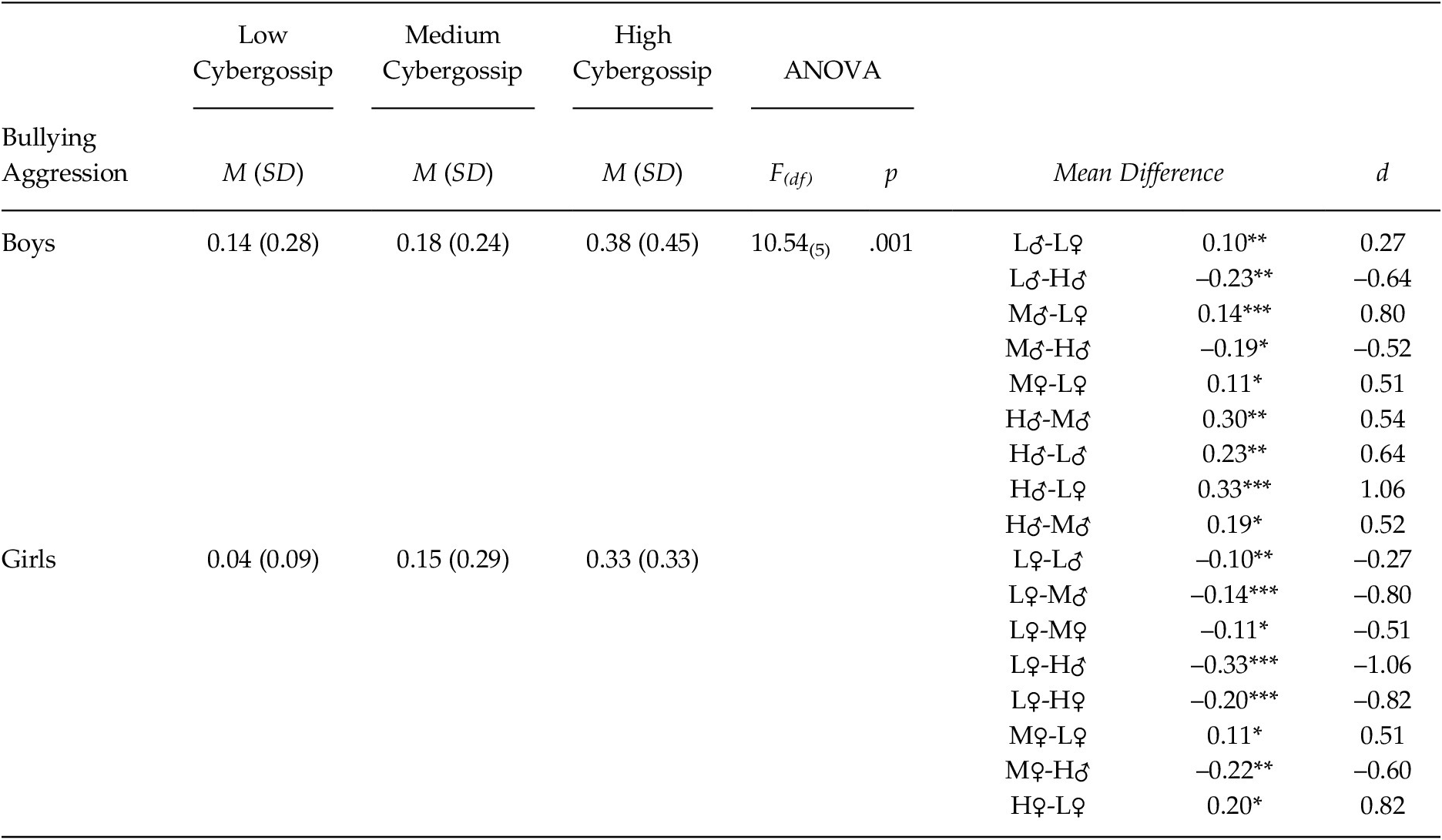
The Games-Howell post-hoc tests for the comparison between cybergossip and victimization, F (5, 488) = 6.06; p < .001, showed significant mean differences in girls: For low involvement (M = 0.29; SD = 0.47) compared to ‘high’ boys and girls, and for high involvement (M = 0.58; SD = 0.69) compared to ‘low’ girls. The boys showed significant differences: At the low level (M = 0.34; SD = 0.49) compared to ‘high’ boys, at the medium level (M = 0.39; SD = 0.42) compared to ‘high’ boys and at the high level (M = 0.70; SD = 0.67) compared to ‘low’ boys and girls and ‘medium’ boys (Table 3). The data obtained in the Games-Howell post-hoc tests for the comparison between cybergossip and bullying, F (5, 488) = 10.54; = p < .001), showed significant differences between various groups of involvement and gender (Table 4).
ANOVA Results Comparing Cybergossip Levels on Bullying Victimization by Gender

Note. M = Mean; SD = Standard deviation; df = Degrees of freedom; d = Cohen’s d; L = Low; M = Medium;
H = High; ♂ = boys; ♀ = girls.
*p ≤ .05. **p ≤ .01. ***p ≤ .001.
ANOVA Results Comparing Cybergossip Levels on Bullying Aggression by Gender

Note. M = Mean; SD = Standard deviation; df = Degrees of freedom; d = Cohen’s d; L = Low; M = Medium;
H = High; ♂ = boys; ♀= girls.
*p ≤ .05. **p ≤ .01. ***p ≤ .001.
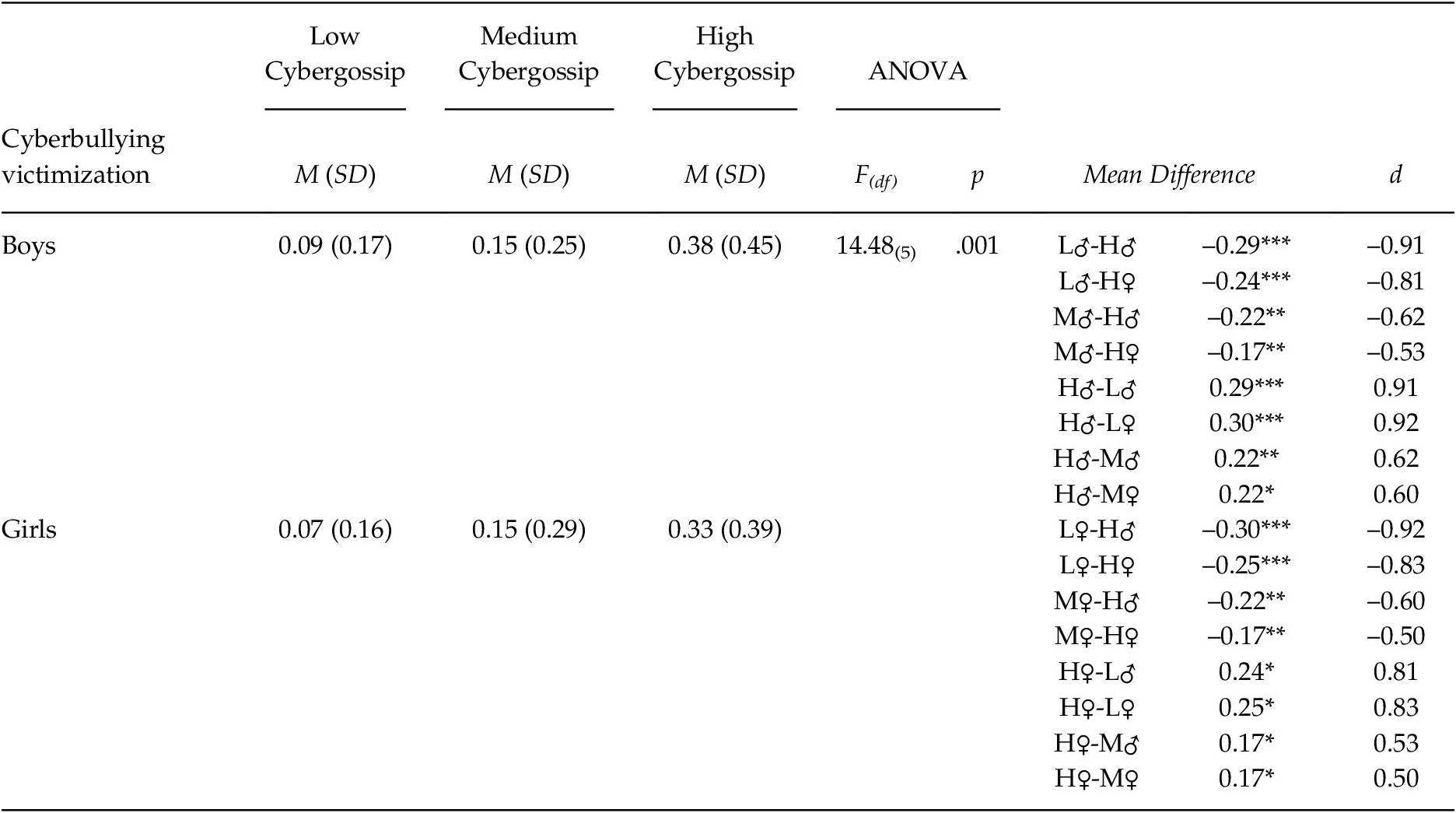
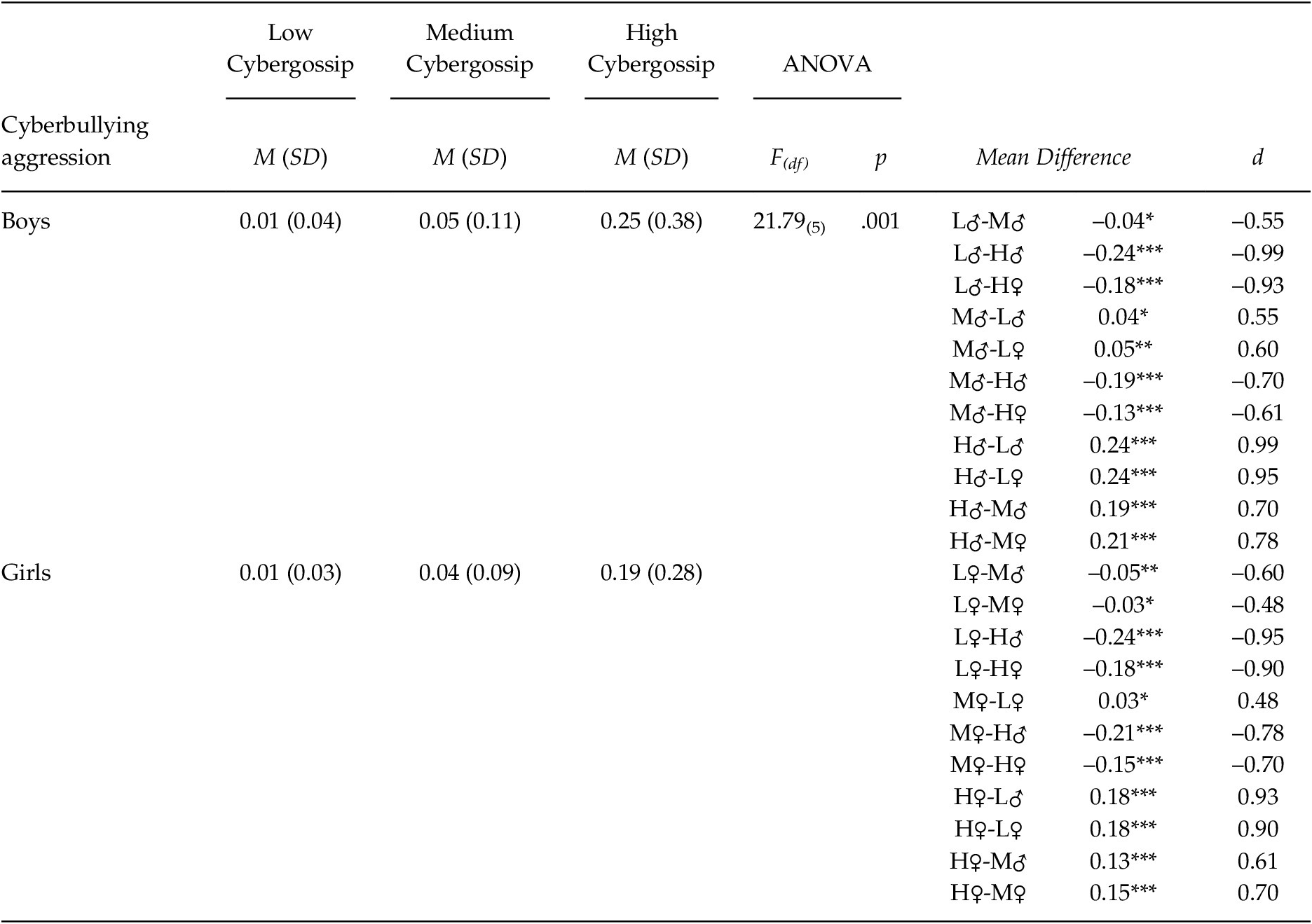
The Games-Howell post-hoc tests for the comparison between cybergossip and cybervictimization showed significant differences between the different levels of involvement (high, medium and low) and gender in girls, F (5, 488) = 14.48; p < .001. In low involvement (M = 0.07; SD = 0.16) with ‘high’ boys and girls, in medium involvement (M = 0.15; SD = 0.29) with ‘high’ boys and girls and in high involvement (M = 0.33; SD = 0.39) with all groups except for ‘high’ boys. The boys showed significant differences: at the low level (M = 0.09; SD = 0.17) with ‘high’ boys and girls, at the medium level (M = 0.15; SD = 0.25) with ‘high’ boys and girls and at the high level (M = 0.38; SD = 0.45) with all but ‘high’ girls (Table 5). The data obtained in the Games-Howell post-hoc tests comparing cybergossip and cyber-aggression, F (5, 488) = 21.79; p < .001, identified significant differences between various groups of involvement (low, medium, and high) and gender (Table 6).
ANOVA Results Comparing Cybergossip Levels on Cybervictimization by Gender

Note. M = Mean; SD = Standard deviation; df = Degrees of freedom; d = Cohen’s d; L = Low; M = Medium;
H = High; ♂ = boys; ♀= girls.
*p ≤ .05. **p ≤ .01. ***p ≤ .001.
ANOVA Results Comparing Cybergossip Levels on Cyberaggression by Gender

Note. M = Mean; SD = Standard deviation; df = Degrees of freedom; d = Cohen’s d; L = Low; M = Medium; H = High;
♂ = boys; ♀ = girls.
*p ≤ .05. **p ≤ .01. ***p ≤ .001.
Discussion
The aim of this work was to analyze the relationship between the frequency of adolescent involvement in cybergossip and peer social adjustment, as well as their involvement in bullying and cyberbullying, both as perpetrators and victims, observing any possible differences as regards gender. In the first hypothesis, it was expected that adolescents with a high involvement in cybergossip to show greater social adjustment than adolescents with a medium or low involvement. Here, although it appears that taking part in gossip can encourage the development of social norms and acceptance within the peer group, the issue is not so clear-cut (Bechtoldt et al., Reference Bechtoldt, Beersma and Dijkstra2020). Our results indicate, contrary to the expected hypothesis, that there are no differences between the levels of involvement in cybergossip and the social adjustment of adolescents; that is, gossiping may, to a greater or lesser extent, be related to both social acceptance and rejection by peers (Wargo Aikins et al., Reference Wargo Aikins, Collibee and Cunningham2017). Although it should continue to accept that gossip, in its direct version or via social media, should be understood as a form of social communication that can either help to create or reinforce bonds of friendship or, on the contrary, hinder them if it evolves into a form of bullying or ridicule.
Also, in the first hypothesis of this study, it was expected that adolescents with a high involvement in cybergossip would present significantly higher levels of participation in bullying and cyberbullying. The results indeed showed that adolescents with a high level of involvement in cybergossip were more involved in bullying, victimization, cyberbullying and cybervictimization. These results confirm previous studies that have shown that cybergossip promoted the development of bullying, which can subsequently turn into cyberbullying behavior in online environments (Falla et al., Reference Falla, Ortega-Ruiz and Romera2021; López-Pradas et al., Reference López-Pradas, Romera, Casas and Ortega-Ruiz2017; Romera, Ortega-Ruiz et al., Reference Romera, Ortega-Ruiz, Runions and Falla2021). These results may be explained because a higher and intense use of social networking use and instant messaging leads adolescents to be more involved in risky behaviors (Craig et al., Reference Craig, Boniel-Nissim, King, Walsh, Boer, Donnelly, Harel-Fisch, Malinowska-Cieślik, Gaspar de Matos, Cosma, den Eijnden, Vieno, Elgar, Molcho, Bjereld and Pickett2020). Although no precise relationship between cybergossip and bullying has been established from the scientific evidence, most virtual relationships that adolescents maintain are with their own classmates, hence the connection between both phenomena among young people who share the same social groups (Romera, Camacho, et al., Reference Romera, Camacho, Ortega-Ruiz and Falla2021).
Previous studies have confirmed that cybergossip leads to the appearance of cyberbullying behavior, because of the way it can quickly reach a large number of recipients and the fact that this behavior can take place at any time and place (López-Pradas et al., Reference López-Pradas, Romera, Casas and Ortega-Ruiz2017; Romera et al., Reference Romera, Herrera-López, Casas, Ortega Ruiz and Del Rey2018). The results seen in the present research may be due to the fact that the participants spent more time using messaging applications or social media (Estévez et al., Reference Estévez, Cañas, Estévez and Povedano2020; Romera, Casas, et al., Reference Romera, Casas, Muñoz and Ortega-Ruiz2021), and due to the problems which can arise in the communicative exchanges produced in online relationships, without gestures or non-verbal communication, which can lead to misunderstandings or errors in the interpretation of the information between the sender and the receiver (Montepare, Reference Montepare2014). Moreover, comments made about others could generate a rejection on the part of those who receive these messages, causing to react aggressively towards the gossiper, now becoming the victims. This behavior can also be driven by the impulsiveness that interactive environments enable.
The second hypothesis did not expect to find gender differences in bullying and cyberbullying according to the level of involvement in cybergossip. However, gender differences were observed among girls and boys depending on the level of involvement in cybergossip and, our results no confirmed this hypothesis, it supports the idea that girls and boys engage in cybergossip in similar ways. Although there are contradictory studies which found a greater involvement in gossip of girls when compared with the situation with adolescent boys (Caivano & Talwar, Reference Caivano and Talwar2021), attributing to girls different style of relationship in which they spend a lot of time on social media and using digital devices, they attach more importance to their interpersonal relationships and also they present higher rates of social anxiety about feeling rejected (Perry & Pauletti, Reference Perry and Pauletti2011). These results coincide with the studies that recognize a similar prevalence of cybergossiping among both genders (Romera et al., Reference Romera, Herrera-López, Casas, Ortega Ruiz and Del Rey2018).
The findings of this study contribute to the knowledge about the connection between cyberbehavior and the involvement in bullying and cyberbullying. The results clearly point to a direct relationship between the frequency or intensity of cybergossip behaviors and involvement in aggression, victimization, cyberaggression, cybervictimization. Thus, this work is highly relevant for the field of education, because, as well as advancing our knowledge of the emerging phenomenon of cybergossip, they show the need to ensure that adolescents use social media appropriately and to monitor, in educational contexts, the extremely frequent use that adolescents make of these applications. Despite of high percentage of involvement in cybergossip, there are positive effects in terms of peer acceptance, social adjustment, communication, and exchange, but there are also risks for learning and social development. Schools and families should monitor the use of digital tools, to strengthen their positive aspects and try to prevent the already significant risk of interpersonal violence (bullying-cyberbullying) from increasing (López-Pradas et al., Reference López-Pradas, Romera, Casas and Ortega-Ruiz2017), as well as the immoral and socially problematic side of gossiping. Both schools and families should be aware of emerging phenomena such as cybergossip via social media among adolescents within their peer group. Although it has been shown that cybergossip is a complex online behavior related to risky behavior such as bullying and cyberbullying, when oriented and monitored correctly, it becomes an effective communicative tool to support the social life of peers (Romera et al., Reference Romera, Herrera-López, Casas, Ortega Ruiz and Del Rey2018). In particular, programs related to health and social competence promotion, and focus on the prevention of negative behaviors in social network can be designed for scholars who begin to spread rumors about their peers, since the positive use of cybergossip and the promotion of social and emotional well-being online could prevent the aggression and cyberaggression.
The limitations of this study lie in the size of the sample, the measurement of the variables and the design. Future research should include a larger number of participants and a more diverse geographical area, which would allow us to use a more suitable, balanced representation of the population in general and more generalizable results. Measuring the variables through self-reports can lead to a bias from unwanted factors of social desirability. As regards the design, since this kind of behavior is constantly changing and given its psycho-evolutionary importance, longitudinal designs are the most suitable; only in this way can we affirm that the relationship between the variables studied remains fixed over time. For these reasons, the present research should be treated with caution. Future lines of research leading on from these results could focus attention on social adjustment, as no significant results were obtained for this variable when compared with cybergossip, as well as on longitudinal designs and working with a more geographically and culturally diverse sample.