Introduction
Seed germination is a complex developmental process that marks the beginning of the life cycle of a higher plant. For over 40 years, seed biologists have understood that the balance between the inhibitory actions of abscisic acid (ABA) and the stimulating actions of gibberellins (GA) is the primary determinant of seed dormancy and germination (Luckwill, Reference Luckwill1952; Karssen and Laçka, Reference Karssen, Laçka and Bopp1985; Footitt et al., Reference Footitt, Douterelo-Soler, Clay and Finch-Savage2011; Rajjou et al., Reference Rajjou, Duval, Gallardo, Catusse, Bally, Job and Job2012). In coat-imposed dormancy species, germination can be achieved via simple removal of or damage to the seed coat. Previous work has shown that the seed coat may restrict germination by controlling permeability to either water, oxygen or germination inhibitors that leach from the seed (Edwards, Reference Edwards1968; Wyatt, Reference Wyatt1977; Corbineau and Côme, Reference Corbineau and Côme1993). Arabidopsis seeds have a single endosperm cell layer between the embryo and the seed coat, and endosperm-imposed dormancy prevails over embryo- and seed coat-imposed dormancy with the phytohormones GA and ABA regulating germination in a tissue-specific manner (Penfield et al., Reference Penfield, Rylott, Gilday, Graham, Larson and Graham2004; Lee et al., Reference Lee, Piskurewicz, Turecková, Strnad and Lopez-Molina2010). ABA is biosynthesized mainly in the endosperm of dormant seeds and transported to the embryo in order to repress embryo expansion and therefore germination (Lee et al., Reference Lee, Piskurewicz, Turecková, Strnad and Lopez-Molina2010; Kang et al., Reference Kang, Yim, Choi, Kim, Lee, Lopez-Molina, Martinoia and Lee2015). However, Arabidopsis seeds still display some degree of coat-imposed dormancy, and alterations in seed coat development or pigmentation often result in reduced dormancy (Shirley et al., Reference Shirley, Kubasek, Storz, Bruggemann, Koornneef, Ausubel and Goodman1995; Debeaujon et al., Reference Debeaujon, Léon-Kloosterziel and Koornneef2000, Reference Debeaujon, Nesi, Perez, Devic, Grandjean, Caboche and Lepiniec2003).
Upon imbibition, GA promotes Arabidopsis germination processes and ABA inhibits them (Müller et al., Reference Müller, Tintelnot and Leubner-Metzger2006; Piskurewicz et al., Reference Piskurewicz, Jikumaru, Kinoshita, Nambara, Kamiya and Lopez-Molina2008). Arabidopsis seeds germinate in a two-step process that involves longitudinal splitting of the seed coat along the embryo axis followed by emergence of the radicle through the micropylar endosperm (Liu et al., Reference Liu, Koizuka, Homrichhausen, Hewitt, Martin and Nonogaki2005; Müller et al., Reference Müller, Tintelnot and Leubner-Metzger2006). Both these events require embryo expansion, with the latter generally considered as completion of seed germination. Under certain germination conditions or genetic backgrounds radicle emergence through both the endosperm and seed coat can occur prior to longitudinal splitting of the seed coat (Piskurewicz et al., Reference Piskurewicz, Jikumaru, Kinoshita, Nambara, Kamiya and Lopez-Molina2008, Reference Piskurewicz, Turecková, Lacombe and Lopez-Molina2009; Lee et al., Reference Lee, Piskurewicz, Turečková, Carat, Chappuis, Strnad, Fankhauser and Lopez-Molina2012), demonstrating that control of the two phases of germination can be separated and therefore may be under separate control.
GA induces germination via destabilization of the DELLA proteins, which are negative regulators of GA-inducible genes (Lee et al., Reference Lee, Cheng, King, Wang, He, Hussain, Lo, Harberd and Peng2002; McGinnis et al., Reference McGinnis, Thomas, Soule, Strader, Zale, Sun and Steber2003; Tyler et al., Reference Tyler, Thomas, Hu, Dill, Alonso, Ecker and Sun2004; Cao et al., Reference Cao, Hussain, Cheng and Peng2005). The requirement for exogenous GA to promote seed coat rupture and germination in the ga1-3 background, which is disrupted in GA biosynthesis, can be compensated for by loss of function mutations in the DELLA genes (e.g. ga1-3 rgl2-1 gai-t6 rga-t2) in non-dormant seeds (Piskurewicz et al., Reference Piskurewicz, Turecková, Lacombe and Lopez-Molina2009). Curiously, exogenously applied ABA has been shown to repress endosperm rupture but not seed coat rupture (Müller et al., Reference Müller, Tintelnot and Leubner-Metzger2006; Linkies et al., Reference Linkies, Müller, Morris, Turecková, Wenk, Cadman, Corbineau, Strnad, Lynn, Finch-Savage and Leubner-Metzger2009; Piskurewicz et al., Reference Piskurewicz, Turecková, Lacombe and Lopez-Molina2009). However, under low GA conditions induced by paclobutrazol, aba1-6 mutant seeds exhibit seed coat rupture, suggesting that endogenous ABA synthesis is still somehow required in the repression of both endosperm and seed coat rupture (De Giorgi et al., Reference De Giorgi, Piskurewicz, Loubery, Utz-Pugin, Bailly, Mène-Saffrané and Lopez-Molina2015).
ABA-INSENSITIVE 3 (ABI3), ABI4 and ABI5 encode B3-, AP2- and bZIP-type transcription factors, respectively, which are important for the ABA responses during seed maturation, seed germination and seedling establishment. ABI3 is a seed- specific regulator that plays a crucial role in all three of these seed stages (Giraudat et al., Reference Giraudat, Hauge, Valon, Smalle, Parcy and Goodman1992; Parcy et al., Reference Parcy, Valon, Kohara, Misera and Giraudat1997; Nambara et al., Reference Nambara, Hayama, Tsuchiya, Nishimura, Kawaide, Kamiya and Naito2000; Finkelstein et al., Reference Finkelstein, Gampalab and Rock2002; Lopez- Molina et al., Reference Lopez-Molina, Mongrand, McLachlin, Chait and Chua2002; Delmas et al., Reference Delmas, Sankaranarayanan, Deb, Widdup, Bournonville, Bollier, Northey, McCourt and Samuel2013). ABI4 has been shown to play a role in controlling oil mobilization in the embryo of germinating seeds (Penfield et al., Reference Penfield, Li, Gilday, Graham and Graham2006b) while ABI5 has been shown to control germination downstream of ABI3 by regulating GA and ABA responses (Lopez-Molina et al., Reference Lopez-Molina, Mongrand and Chua2001, Reference Lopez-Molina, Mongrand, McLachlin, Chait and Chua2002; Lee et al., Reference Lee, Piskurewicz, Turečková, Carat, Chappuis, Strnad, Fankhauser and Lopez-Molina2012).
Analysing the expression pattern of ABI transcription factors during seed germination in the presence of ABA, we have previously observed that ABI3 is expressed ubiquitously throughout the seed, including the endosperm, while ABI4 is restricted to the embryo (Penfield et al., Reference Penfield, Li, Gilday, Graham and Graham2006b). Both ABI3 and ABI5 are expressed throughout the embryo but unlike ABI3, ABI5 expression is confined to the micropylar region of the endosperm through which the radicle emerges (Penfield et al., Reference Penfield, Li, Gilday, Graham and Graham2006b). This region of the endosperm plays an important role in the regulation of seed germination and in many species is characterized by a distinct gene expression pattern and cell wall composition compared with the lateral endosperm (Bewley, Reference Bewley1997).
Remarkably, GA biosynthesis pathway genes (GA3ox1 and GA3ox2) can be traced to the cortex and endodermis cells in the hypocotyl transition zone that exhibits early expansion to complete germination, suggesting that GA triggers germination by specific cell expansion (Yamaguchi et al., Reference Yamaguchi, Kamiya and Sun2001; Topham et al., Reference Topham, Taylor, Yan, Nambara, Johnston and Bassel2017). Additionally, GA induces genes encoding cell-wall-modifying enzymes such as expansins (EXPAs), which constitute one of the four molecular mechanisms of cell wall loosening in plants (Cosgrove, Reference Cosgrove2005). Expansins are encoded by a multi-gene family and are very conserved among higher plants (Shcherban et al., Reference Shcherban, Shi, Durachko, Guiltinan, McQueen-Mason, Shieh and Cosgrove1995; Hutchison et al., Reference Hutchison, Singer, McInnis, Diaz-Sala and Greenwood1999; Cosgrove, Reference Cosgrove2005). Expansins are thought to play multiple roles during the life cycle of higher plants, including in seed germination (Chen and Bradford, Reference Chen and Bradford2000; Chen et al., Reference Chen, Dahal and Bradford2001; Yan et al., Reference Yan, Wu, Yan, Hu, Ali and Gan2014; Marowa et al., Reference Marowa, Ding and Kong2016).
We have previously shown that cotyledon expansion precedes radicle protrusion during Arabidopsis seed germination and that this process is mediated by DELLA-protein growth repressors and ABA (Penfield et al., Reference Penfield, Gilday, Halliday and Graham2006a). Given that seed coat rupture requires expansion of the embryo, we set out to investigate the contribution of the ABI3, ABI4 and ABI5 transcription factors in the repression of seed coat rupture in A. thaliana seeds.
Materials and methods
Plant materials and growth conditions
All transgenic lines used in this study were described previously: abi3-5 (abi3) (Ooms et al., Reference Ooms, Léon-Kloosterziel, Bartels, Koornneef and Karssen1993); abi4-1 (abi4) (Penfield et al., Reference Penfield, Li, Gilday, Graham and Graham2006b); abi5-7 (abi5) (Nambara et al., Reference Nambara, Suzuki, Abrams, McCarty, Kamiya and McCourt2002); ga1-3 (ga1) (Piskurewicz et al., Reference Piskurewicz, Turecková, Lacombe and Lopez-Molina2009); and ga1-3 rgl2-1 gai-t6 rga-t2 (ga1 della3) (Piskurewicz et al., Reference Piskurewicz, Turecková, Lacombe and Lopez-Molina2009). abi4 and abi5 were in Columbia (Col) background, while abi3, ga1 and ga1 della3 were in Landsberg erecta (Ler). Plants were grown in a greenhouse supplemented with artificial light to give a photoperiod of 16 h light at a temperature of 20–22°C. Seeds were harvested when plants had stopped flowering and siliques had started to dehisce, and size sieved using a sieve with mesh size of 250 µm. All seeds used in this study were after-ripened, i.e. seeds had lost primary dormancy.
Germination assays
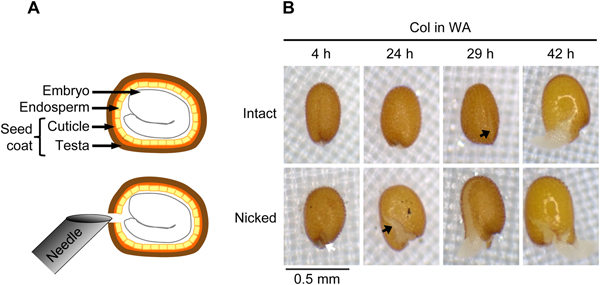
Sterilized seeds were plated on medium containing 0.9% (w/v) water agar. Plates were supplemented with ABA (Sigma-Aldrich) according to the germination condition examined. Percentage of seed coat rupture and radicle protrusion was scored after 5 days of imbibition. Nicking was performed in seeds after 1 h of imbibition using a needle to puncture the seed according to Fig. 1A. Between 50 and 100 seeds were used to check seed coat rupture and radicle emergence and repeated at least twice. Differences between results stated in the text are statistically significant as determined by Student's t-test (P ≤ 0.01). Pictures of seeds were taken using a GXMXTL3 stereo microscope (GT Vision) coupled with a GXCAM-HICHROME Camera (GT Vision).
Effect of nicking on the two-step germination of Arabidopsis Col seeds. (A) Scheme of a mature Arabidopsis seed showing the different tissues (on top) and the nicking technique applied to a seed using a 0.3 mm ø needle. Nicking (white arrow) was performed after 1 h of imbibition. (B) Images show intact and nicked non-dormant Col seeds that were imbibed in water agar (WA) plates. Black arrow: testa rupture. Scale bar is 0.5 mm.

Real-time PCR gene expression assays
Total RNA was extracted from three biological replicates of frozen seed tissue (200 nicked seeds were used for each replicate) as described previously (Vaistij et al., Reference Vaistij, Gan, Penfield, Gilday, Dave, He, Josse, Choi, Halliday and Graham2013). cDNA synthesis was performed using standard methods. qPCR was performed using iQ SYBR Green Supermix and the MyiQ Real-Time PCR detection system (Bio-Rad) according to the manufacturer's instructions. The primer sequences used in this study are described in Supplementary Table 1, and expression of UBQ11 was used for normalization.
Results and Discussion
Exogenous ABA blocks seed coat rupture of nicked seeds
Nicking is a common procedure used in both dormant and GA-deficient seeds to promote germination. In Arabidopsis, nicking disrupts the integrity of both the seed coat and the endosperm (Fig. 1A). In non-dormant seeds, as expected, disruption of the endosperm did not affect the appearance of radicle protrusion (Fig. 1B, bottom panels). This finding is consistent with the fact that the role of the endosperm is to synthesize and continuously release ABA towards the embryo to block germination of dormant seeds (Lee et al., Reference Lee, Piskurewicz, Turecková, Strnad and Lopez-Molina2010; Kang et al., Reference Kang, Yim, Choi, Kim, Lee, Lopez-Molina, Martinoia and Lee2015). However, because nicking disrupts the integrity of the seed coat, we questioned whether or not nicking would also affect the appearance of seed coat rupture during germination, i.e. display radicle protrusion without prior seed coat rupture. For the purpose of this work, we only considered as non-artificial seed coat rupture (not promoted by puncturing) those longitudinal openings that were at least a third the size of the seeds. Nicking was performed in non-dormant Col seeds after 1 h of imbibition using a needle to puncture the chalazal region in order to create a continuum between the embryo and external medium (Fig. 1A). Intact Col seeds showed seed coat and endosperm rupture after 29 and 42 h of imbibition, respectively (Fig. 1B, top panels), while Col nicked seeds showed seed coat and endosperm rupture after 24 and 29 h of imbibition, respectively (Fig. 1B, bottom panels). Thus seed coat nicking does not affect the appearance of seed coat rupture per se, but it does decrease the post-imbibition period to both seed coat rupture and radicle protrusion compared with intact seeds.
In tetrazolium uptake assays, several reports have shown that defects in the seed coat properties are associated with less dormancy, more permeability to tetrazolium salts and more sensibility to exogenous ABA (Debeaujon et al., Reference Debeaujon, Léon-Kloosterziel and Koornneef2000; Beisson et al., Reference Beisson, Li, Bonaventure, Pollard and Ohlrogge2007; Vishwanath et al., Reference Vishwanath, Kosma, Pulsifer, Scandola, Pascal, Joubès, Dittrich-Domergue, Lessire, Rowland and Domergue2013; MacGregor et al., Reference MacGregor, Kendall, Florance, Fedi, Moore, Paszkiewicz, Smirnoff and Penfield2015). De Giorgi et al. (Reference De Giorgi, Piskurewicz, Loubery, Utz-Pugin, Bailly, Mène-Saffrané and Lopez-Molina2015) reported a thick cutin-containing cuticular layer inside the seed coat which surrounds the whole endosperm of Arabidopsis seeds. These authors also showed that toluidine blue staining of embryos only occurs when this cuticle is disrupted. Hence, we hypothesized that the embryo is inaccessible to exogenous ABA and this is why ABA treatment does not block seed coat rupture in non-dormant seeds. To investigate this, we combined seed coat nicking and exogenous ABA treatment for 120 h after imbibition. Consistent with previous work (Müller et al., Reference Müller, Tintelnot and Leubner-Metzger2006), 10 µM ABA-treated intact wild-type seeds all showed seed coat rupture, but no radicle protrusion (Fig. 2B, C). Following seed coat nicking, 10 µM ABA efficiently blocked seed coat rupture of both Ler and Col seeds (Fig. 2B,C,E,F). At 5 µM ABA nicked Col seeds showed a decreased frequency of seed coat rupture (Supplementary Fig. 1). These results demonstrate that seed coat nicking results in seed coat rupture becoming sensitive to exogenous ABA, presumably because the nicking results in the ABA accessing the embryo and blocking expansion. In the case of exogenous ABA, we propose that the cuticle prevents ABA uptake until the embryo expands and causes seed coat rupture, after which ABA then is taken up and blocks any further expansion of the radicle and endosperm rupture. Nicking of the seed coat will disrupt the cuticle, allowing immediate uptake of ABA and blockage of embryo expansion seed coat rupture and radicle emergence. This explanation is consistent with our previous demonstration that cotyledon expansion is necessary for seed coat rupture (Penfield et al., Reference Penfield, Gilday, Halliday and Graham2006a).
Effect of ABA on the appearance of testa rupture in nicked seeds. (A–C) Percentage of seed coat rupture (SCR) and radicle protrusion (RP) in intact and nicked ga1, ga1 della3, Ler, abi3, Col, abi4 and abi5 seeds that were imbibed in water agar (WA) plates supplemented with 10 µM ABA for 120 h. Nicking was performed according to Fig. 1A. (D–F) Representative images showing ga1, ga1 della3, Ler, abi3, Col, abi4 and abi5 seeds 120 h after imbibition in WA plates supplemented with 10 µM ABA. Scale bar is 0.5 mm.

ABI5 represses seed coat rupture of nicked seeds in the presence of exogenous ABA
Previous studies have shown that DELLA loss of function mutations lead to an induction of seed coat and endosperm rupture in Arabidopsis under low GA conditions (Cao et al., Reference Cao, Hussain, Cheng and Peng2005; Piskurewicz et al., Reference Piskurewicz, Turecková, Lacombe and Lopez-Molina2009). We previously reported that GA and the DELLA proteins regulate cotyledon expansion prior to endosperm rupture (Penfield et al., Reference Penfield, Gilday, Halliday and Graham2006a). Consistent with these reports, we found that the della3 mutant rescues the ga1 phenotype by showing seed coat rupture but not radicle emergence through the endosperm of intact seeds treated with ABA (Fig. 2A). However, when nicked, only a small percentage of the ga1 della3 seeds showed seed coat rupture and about 30% showed radicle protrusion without prior visible seed coat rupture in the presence of ABA, while ga1 seeds remained quiescent (Fig. 2A,D). The fact that DELLA proteins, mainly RGL2, promote ABA synthesis (Lee et al., Reference Lee, Piskurewicz, Turecková, Strnad and Lopez-Molina2010) could explain the leaky seed coat rupture and radicle protrusion observed in the ga1 della3 nicked seeds. Taken together, these results suggest that DELLA proteins are at least partly involved in the ABA-dependent repression of seed coat rupture and radicle protrusion during germination.
To establish if the ABA-insensitive transcription factors are involved in the response of nicked seeds to exogenous ABA, we used loss of function abi3, abi4 and abi5 mutants. Consistent with previous reports (Ooms et al., Reference Ooms, Léon-Kloosterziel, Bartels, Koornneef and Karssen1993; Finkelstein, Reference Finkelstein1994; Bies-Etheve et al., Reference Bies-Etheve, da Silva Conceicao, Giraudat, Koornneef, Léon-Kloosterziel, Valon and Delseny1999), we found that intact abi3, abi4 and abi5 seeds are insensitive to exogenous application of ABA in comparison with their respective wild-types (Fig. 2B,C). ABA-insensitive mutants abi1-1, abi2-1 and abi3-4 show a large cotyledon phenotype compared with their corresponding wild-types (Penfield et al., Reference Penfield, Gilday, Halliday and Graham2006a). We did not observe seed coat rupture in either intact or nicked seeds of abi3 in the presence of exogenous ABA, although seeds clearly showed radicle protrusion (Fig. 2B,E). ABI3 is a critical component of the network involved in many processes during seed development including the positive regulation of FUSCA3, a transcriptional factor that bears similarity to the B3 region of the ABI3-like proteins, which directly represses TRANSPARENT TESTA GLABRA1 (TTG1) (Tsuchiya et al., Reference Tsuchiya, Nambara, Naito and McCourt2004; Delmas et al., Reference Delmas, Sankaranarayanan, Deb, Widdup, Bournonville, Bollier, Northey, McCourt and Samuel2013; Chen et al., Reference Chen, Zhang, Li, Kulaveerasingam, Chew and Yu2015). TTG1 also causes the transparent testa phenotypes, which includes deficiency in pigment accumulation in the seed coat (Debeaujon et al., Reference Debeaujon, Léon-Kloosterziel and Koornneef2000; Sagasser et al., Reference Sagasser, Lu, Hahlbrock and Weisshaar2002; Chen et al., Reference Chen, Zhang, Li, Kulaveerasingam, Chew and Yu2015). It is possible that altered composition of abi3 seed coats renders them more resistant to rupture compared with wild-type when the radicle protrudes.
Nicked seeds of abi4 do not show seed coat rupture in the presence of exogenous ABA (Fig. 2C,F), which is consistent with our previous findings that the events leading to germination in the endosperm of abi4 seeds are completely blocked under concentrations of PAC or ABA inhibitory to wild-type seeds (Penfield et al., Reference Penfield, Li, Gilday, Graham and Graham2006b). Bossi et al. (Reference Bossi, Cordoba, Dupré, Mendoza, Román and León2009) demonstrated that ABI4 acts as a transcriptional activator of the expression of ABI5 through direct binding to CE1-like cis-acting elements in the promoter of ABI5; while Lopez-Molina et al. (Reference Lopez-Molina, Mongrand, McLachlin, Chait and Chua2002) have shown that ABI5 acts downstream of ABI3 in order to repress germination in the presence of ABA. Thus, it is possible that, in the abi4 mutant background, an early exposure to ABA promoted by nicking blocks seed coat rupture via the ABI3/ABI5 pathway described by Lopez-Molina et al. (Reference Lopez-Molina, Mongrand, McLachlin, Chait and Chua2002).
As expected, abi5 nicked seeds are insensitive to exogenous ABA showing more than 80% seed coat rupture (Fig. 2C,F). In contrast to these findings Piskurewicz et al. (Reference Piskurewicz, Jikumaru, Kinoshita, Nambara, Kamiya and Lopez-Molina2008, Reference Piskurewicz, Turecková, Lacombe and Lopez-Molina2009) indicate that ABI5 is not involved in the repression of seed coat rupture under low GA conditions. However, this rather contradictory result may be due to the fact that GA is required to promote seed coat rupture.
ABI5 regulates expression of EXPANSINs in nicked seeds treated with ABA
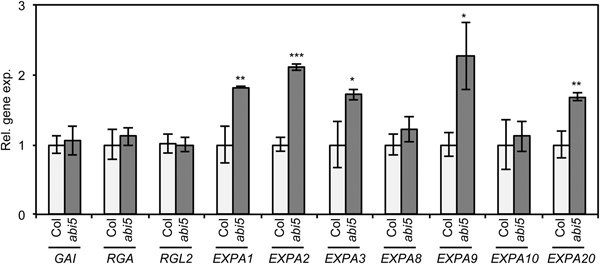
Piskurewicz and others (Reference Piskurewicz, Jikumaru, Kinoshita, Nambara, Kamiya and Lopez-Molina2008, Reference Piskurewicz, Turecková, Lacombe and Lopez-Molina2009) reported that RGL2, RGA and GAI are responsible for repression of seed coat rupture under low GA conditions, while Lee et al. (Reference Lee, Piskurewicz, Turečková, Carat, Chappuis, Strnad, Fankhauser and Lopez-Molina2012) have shown that ABI5 directly regulates the expression of RGL2, RGA and GAI under FR conditions. However, we did not observe any differences in the transcript levels of RGL2, RGA or GAI between Col and abi5 nicked seeds in the presence of ABA (Fig. 3).
Expression of DELLA and EXPANSIN genes in nicked Col and abi5 seeds in the presence of ABA. Transcript levels of GAI, RGA, RGL2, EXPA1, EXPA2, EXPA3, EXPA8, EXPA9, EXPA10 and EXPA20 genes, normalized to UBQ11 expression and expressed relative to Col, in 24 h ABA-treated Col and abi5 nicked seeds. Data are means ± SD of three biological replicates. Asterisks indicate statistically significant difference according to two-tailed Student's t-test (*P < 0.05; **P < 0.01; ***P <0.001).

A recent study showed that seeds of an endosperm-specific expansin mutant (exp2) are delayed in germination in comparison with the wild-type (Yan et al., Reference Yan, Wu, Yan, Hu, Ali and Gan2014). In addition to this, using the β-glucuronidase (GUS) assay with a pAtEXP2:GUS construct these authors observed GUS staining in the radicle prior to germination. In an earlier study, a tomato expansin, LeEXPA4, was found to be involved in the control of germination by contributing to cell wall loosening in the micropylar endosperm (Chen and Bradford, Reference Chen and Bradford2000). Interestingly, in the presence of ABA, ABI5 expression is limited to the micropylar region of the endosperm, but also expressed in the embryo (Penfield et al., Reference Penfield, Li, Gilday, Graham and Graham2006b), which led us to speculate that ABI5 is involved in the repression of genes associated with cell wall loosening in the micropylar region of the endosperm through which the radicle must emerge for germination to occur.
Publically available transcriptomic data (vseed.nottingham.ac.uk) was used to select seven expansin genes that are highly expressed in imbibed Arabidopsis seeds for comparative expression analysis in abi5 and wild-type. Remarkably, EXPANSIN 1 (EXPA1), EXPA2, EXPA3, EXPA9 and EXPA20 expression were all increased in abi5 nicked seeds compared with Col in the presence of ABA, while no significant changes were observed in the expression of EXPA8 and EXPA10 (Fig. 3). These results support a role for ABI5 in repressing the expression of expansins which in turn could lead to decreased embryo expansion and failure of the seed coat to rupture in the presence of ABA. It will be interesting to establish if the same suite of expansin genes are altered in an ABI5-dependent manner in the micropylar region of the endosperm and in the embryo in response to ABA.
Conclusion
Combining the data presented here with the current understanding of how seed coat rupture is regulated, we propose that ABI5 plays a key role in integrating ABA and GA responses in addition to DELLA proteins to control embryo expansion. Previous reports have established that control of seed coat rupture involves modulation of GA and ABA responses mediated by DELLA proteins, largely by RGL2 (Piskurewicz et al., Reference Piskurewicz, Jikumaru, Kinoshita, Nambara, Kamiya and Lopez-Molina2008, Reference Piskurewicz, Turecková, Lacombe and Lopez-Molina2009; De Giorgi et al., Reference De Giorgi, Piskurewicz, Loubery, Utz-Pugin, Bailly, Mène-Saffrané and Lopez-Molina2015). In the present work we have shown that, when exogenous ABA is readily available to the embryo as a consequence of nicking, ABI5 is required to repress seed coat rupture. Our data further indicate that ABI5 may act via repression of EXPANSIN genes, which are associated with cell wall loosening, thus affecting embryo expansion.
Supplementary material
To view supplementary material for this article, please visit https://doi.org/10.1017/S0960258519000059
Author ORCIDs
Ian A. Graham, 0000-0003-4007-1770
Acknowledgements
We thank George Bassel for helpful discussion, and Luis Lopez-Molina for donating abi5-7 and ga1-3 rgl2-1 gai-t6 rga-t2 seeds.
Financial support
T.B.-G. was funded by the Brazilian Government Coordenação de Aperfeiçoamento de Pessoal de Nível Superior (CAPES) Program. I.A.G. received support from the UK Biotechnology and Biological Sciences Research Council (grant BB/J00216X/1) and The Garfield Weston Foundation.