Introduction
Until relatively recently, contacts between economics and evolutionary biology were quick to be deemed controversial, as when Chicago school economists explored the lessons of sociobiology for human economic behavior in the 1970s. The atmosphere has considerably cooled off since then, but there are still bouts of name-calling when an economist chooses to rely on biological evolution to develop theoretical constructs in her own discipline (for a recent example, see the symposium on Gregory Clark's A Farewell to Alms [2007] in the August 2008 issue of the European Review of Economic History).
More substantially, there is also an unsettled debate over the heuristic value of models derived from evolutionary biology to represent economic change – the domain of study of evolutionary economics. A recent exchange between evolutionary economists is typical of the apparent dead-end reached between the skeptics and promoters of biology-inspired theories in this subfield of economics. Richard Nelson, although one of the founding fathers of evolutionary economics, judged that one should preferably not take theories developed in evolutionary biology as one's starting point, and then try to make empirical phenomena in economics fit their constraints. It would be a “much sounder and more promising position . . . to pay close attention to the empirical phenomena one is theorizing about, and the actual processes that seem to be at work, and develop one's theory around one's understanding of these” (Nelson Reference Nelson2007, 352). To which his opponents in this debate, economist Geoffrey Hodgson and management theorist Thorbjørn Knudsen, replied that “it is a much sounder and more promising position to develop testable hypotheses from a theory that adequately captures the stylized features of the processes we wish to understand” (Hodgson and Knudsen Reference Hodgson and Knudsen2007). We contend that this frontal divergence of views is typical and seems unlikely to be solved through analytical arguments. What makes for such a persistent soul searching about the role of evolutionary biology in economics, and can it be further understood by probing the nature of the interdisciplinary relationship between economics and biology?Footnote 1
Exchanges between economics and biology have been investigated from a variety of angles. In connection with the linguistic turn in philosophy of science, several nomenclatures of biological analogies and metaphors have been imagined, and their relative merits have been assessed by methodologists of economics (Khalil Reference Khalil1998 and Reference Khalil2009; Klamer and Leonard Reference Klamer, Leonard and Mirowski1994; Morgan Reference Morgan, Maasen, Mendelsohn and Weingart1995; Vromen Reference Vromen1995; Cohen Reference Cohen and de Marchi1993; Hodgson Reference Hodgson2002). At stake is the precise characterization of the biological analogies under discussion. “Evolutionary” thinking encompasses both ontogenic and phylogenic evolution, and within the class of models of phylogenic evolution one can pick among Lamarckian, Weismanian, and/or Darwinian processes, to start with (Hodgson Reference Hodgson1993; Hodgson and Knudsen Reference Hodgson and Knudsen2006). Naturally, practitioners of evolutionary economics are also active in the discussion, instantiating their claims by elaborating models and narratives and by debating on which approach seemed to capture best economic change (Witt Reference Witt and Dopfer2005). Yet, these different perspectives do not address directly the question of why there is so little agreement on the heuristic value of biology for evolutionary thinking in economics.
In order to achieve a better understanding of how evolutionary theories imported from biology to economics come to be embraced or doubted, we suggest that a look back at a particular critical discussion of evolutionary thinking in economics will be fruitful. The contextualized examination of the most articulate criticism of biological evolutionism in economics, formulated in the middle of the twentieth century by Edith Penrose (1914–1996), provides convenient ground to ponder what can motivate a skeptical stance towards interdisciplinary contacts, and what sort of arguments are at play. Here, the historical and contextualized method of investigation – instead of say, the analytical approach that has been favored so far – yields practical and substantial benefits. From a practical point of view, the historical distance between the topic studied here and our contemporary concerns plays the role of a protective buffer, which permits us to explore questions about the interplay between the social and scientific that would surely not be as accessible were we to ask contemporary economists and biologists.Footnote 2 Second, the reexamination of Penrose's critical view on biological analogies represents an exercise in the deconstruction of the “canon” of the discipline – widely shared views on the origins of evolutionary economics based on the interpretation of founding texts, framing today's perceptions of the identity of the field and the limits of its “natural” boundaries. Penrose is today most often remembered as the theoretician of an organic theory of the growth of the firm.Footnote 3 Reconstructing her portrait by adding more dimensions to it will invite us to revisit today's entrenched views on one episode of the founding of evolutionary economics, and flesh out new perspectives for its future development.
Published in 1952 in the American Economic Review, Edith Penrose's “Biological Analogies in the Theory of the Firm” criticized three different instances of biological analogies in the contemporary theory of the firm. Two such analogies had been developed by Kenneth Boulding, the unorthodox economist interested in ecological and organic metaphors in social science. The third biological analogy targeted by Penrose was UCLA economist Armen Alchian's concept of “economic natural selection” which compared economic competition to a Darwinian process, a landmark paper which triggered a renewed interest in evolutionary thinking in economics (Alchian Reference Alchian1950; Boulding Reference Boulding1950).Footnote 4
Philosophical studies discussing Penrose's article most often take Alchian's article as their departure point, and present her criticism of biological analogies as a sparring partner for Alchian’ argument (Lagueux Reference Lagueux1993 and Reference Lagueux1998; Vromen Reference Vromen1995). Another thread of literature struggles to find methodological coherence between Penrose's critical stance toward biological analogies and her theory of the growth of the firm, many finding ironical that “her own work is very much consistent with evolutionary economics” (Foss Reference Foss1998, 483; see Penrose Reference Penrose1955, Reference Penrose1959a and Reference Penrose1959b).Footnote 5 Indeed, Penrose had made clear that she would retain an important element from biological theories in her own version of the theory of the firm:
The growth approach has so far been expounded in any systematic form only by the “biological economists” [Armen Alchian and Kenneth Boulding – CL] – by those who view firms as organisms and conclude that they grow like organisms. That variant of the growth approach leaves no room for human motivation and conscious human decision and I think should be rejected on that ground. . . . I want here to suggest an alternative growth approach which, in common with the biological variant, insists that a predisposition to grow is inherent in the very nature of firms, but which, in contrast, makes growth depend on human motivation – in the usual case on the businessman's search for profits. (Penrose Reference Penrose1955, 531; emphasis added)
In other places in her works discussing the theory of the firm, there is indeed the feeling that Penrose could have easily built upon the most celebrated biological analogy by British economist Alfred Marshall, who compared the dynamics of growth and eventual decay of firms in an industry to the cycle of growth of trees in a forest (compare Edith T. Penrose Reference Penrose1959a, 7–8 with Marshall Reference Marshall1920, 316–317). The contemporary appeals of using biological analogies to develop a theory of organic (endogenous) growth is also clear from the writings of American economist Allyn Young, who wrote a theoretical exposition of the growth of businesses in an explicitly analogical fashion, and on which Penrose relied to further her own theoretical arguments (Young Reference Young1928; Young Reference Young, Mehrling and Sandilands1999; Penrose Reference Penrose1959a, 71).Footnote 6 It makes it all the more meaningful and curious that Penrose devoted a full piece of her writing targeting biological analogies in particular.
Much later in her life, Penrose seemed to be less and less critical of biological analogies, praising now “the growth of evolutionary thinking in economics generally” (Edith T. Penrose Reference Penrose1995), citing the works of Richard Nelson, Sidney Winter, and Geoffrey Hodgson in illustration. To the latter, she confided that she “had revised her opinion. She was deeply fascinated with evolutionary and other explanations of human consciousness. She did not take human deliberation as given or for granted” (Hodgson Reference Hodgson2004a, 191).
It would then seem that Penrose's intellectual evolution paralleled in certain ways the evolution of the relationships between social science and biology in the postwar period: from a staunch opposition to a much more conciliatory attitude. It might then pay to have a closer look at the broader intellectual climate in which Penrose wrote her contributions, in order to provide a more detailed explanation for the “decomposition and growth” of biological thinking in economics (Hodgson Reference Hodgson and Dopfer2005). We do not pretend that Penrose's stance vis-à-vis biological analogies was dictated by the political and social circumstance she lived in, and in any case we lack any direct evidence pointing in this direction. Nor do we suppose that this micro-history should play the role of a rigid template explaining other instances of affection or disaffection for biological analogies. More modestly, we will make the case that the story of Penrose shows how the social, political, and scientific levels were densely interrelated in her life at the time when she wrote her criticism of biological analogies in economics, suggesting that such dimensions might also play a role in today's good and bad fortunes of interdisciplinary contacts between biology, economics, and social sciences in general.
A brief survey of Penrose's Reference Penrose1952 article and its reception will establish that a central argument of her paper, namely that biological analogies project a conservative bias, has been consistently ignored. Next, we will discuss how this argument built on the concept of “social Darwinism” of contemporary fame, substantiating our claim that many different layers – social, scientific, and political – stand in the background of her rejection of biological analogies. We will then examine elements of Penrose's biography to understand why conservatism was a matter of special concern for her at that time. In conclusion, we will reflect on the possibility of pinning down a clear link between the intellectual climate of an epoch and contemporary developments in theorizing. Finally, a coda presents a last significant insight on how intertwined personal, political, and professional matters were for the Penroses at the time.
Penrose on Analogies
Penrose's Reference Penrose1952 paper is original in several respects. Published in the flagship journal of the American Economic Association, it presents itself as “not so much concerned to present an analytical critique of the theory” than a discussion of methodological issues related to the value of analogical reasoning in economics (Penrose Reference Penrose1952, 811). In a period when the neoclassic orthodoxy was strengthening in economics and allowing for a diminishing measure of pluralism, major journals still accepted papers on methodological issues from time to time, as in the case of the debate over mathematic formalism in economics (Morgan and Rutherford Reference Morgan and Rutherford1998).
Nevertheless, the discussion of analogies in science remained an oddity. Reflections about the linguistic and rhetorical dimension of scientific discourse would flourish only ten years later with the publication of philosopher Max Black's Models and Metaphors, and later still in economics (Black Reference Black1962; McCloskey Reference McCloskey1983). Hence, Penrose's analysis of the two functions of analogies had some pretense of originality. She distinguished between a first function of analogical reasoning, which consists in comparing a well known series of events to the events in need of explanation. For such an analogy to carry explanatory value, “there must be some reason for believing that the two series of events have enough in common for the explanation of one, mutatis mutandis, to provide at least a partial explanation of the other” (Penrose Reference Penrose1952, 807). This, Penrose would argue, was not the case for biological analogies in the theory of the firm.
Analogies between biological organisms and social entities tend to leave out of the picture the fact that intentionality plays a determinant role in the social realm. Conscious motives, such as the striving for profits by entrepreneurs, are a cardinal factor of explanation in any theory of the firm, and should not be left out of the analysis simply because a biological analogy would not make room for it. Rather, argued Penrose, this is a sign that the biological analogy should be discarded. This argument is upheld by philosopher Maurice Lagueux, who concludes that without an analysis of intentionality, social sciences would surrender their raison d'être to the natural sciences (Lagueux Reference Lagueux1998, 179–180).
A second function of analogies is at work when “resemblances between two phenomena are used to add a picturesque note to an otherwise dull analysis and to help the reader to see more clearly the outlines of a process being described.” Penrose acknowledged that this kind of analogies is indeed “indispensable to human thought” (both quotes from Penrose Reference Penrose1952, 807), but denied that biological analogies as deployed by Armen Alchian and Kenneth Boulding were of this innocuous sort. In Alchian's economics natural selection, just as in Boulding's ecological interpretation of social forms, it would appear that the analogy provides indeed a necessary scaffold, or even the foundations, for their conclusions.Footnote 7
The interesting issue of the epistemological validity of analogies should not let us forget a related issue discussed by Penrose, namely the conservative dimension of biological analogies in social science.
The Meaning of Social Darwinism in 1952
In her article, Penrose pointed repeatedly to the undesirable consequences of using biological analogies:
To abandon their [firm's] development to the laws of nature diverts attention from the importance of human decisions and motives, and from problems of ethics and public policy, and surrounds the whole question of the growth of the firm with an aura of “naturalness” and even inevitability. (Penrose Reference Penrose1952, 809)
The role of biological analogies in social thought has been widely discussed by historians in connection with the historiography of social Darwinism (Hofstadter [1944] Reference Hofstadter1992; Bannister Reference Bannister1979; Bellomy Reference Bellomy1984; Degler Reference Degler1991; Hodgson Reference Hodgson2004b; Leonard Reference Leonard2009). “Social Darwinism” usually refers to evolutionary arguments in defense of laissez-faire economics, imperialism, eugenics, racism, and other views held by intellectuals who do not share the reformist agenda typical of the Progressive Era. In many people's eyes, social Darwinism is simply a “Bad Thing,” commented historian Robert Bannister ironically. Since the 1970s however, scholars studying social Darwinism have pointed out that Progressive intellectuals (such as sociologist Lester Ward or institutionalist economist John Commons) resorted to evolutionary arguments as much as the so-called social Darwinists, and later historians documented that the Progressive movement was also impregnated with racist and eugenic conceptions deemed typical of their opponents, while the usual suspects of social Darwinism (Herbert Spencer and Graham Sumner) did not defend all the conservative views attributed to them. As a result of this hopeless confusion, it is today widely agreed that social Darwinism is more misleading than helpful as a terminological innovation for historians to work with.Footnote 8 But in 1952, at the time of the publication of Penrose's article, all these historiographical nuances were yet to surface. She referred simply to the presentation of social Darwinism that was widely available at the time, which was Hofstadter's Social Darwinism in American Thought published in 1944.
In this book, Hofstadter examined the use of biological analogies such as “the survival of the fittest” in the social thought of prominent intellectuals of the Gilded Age and the Progressive Era (about 1870–1920). His overall conclusion was unambiguous:
Whatever the course of social philosophy in the future, however, a few conclusions are now accepted by most humanists: that such biological ideas as the “survival of the fittest,” whatever their doubtful value in natural science, are utterly useless in attempting to understand society; that the life of man in society, while it is incidentally a biological fact, has characteristics that are not reducible to biology and must be explained in the distinctive terms of a cultural analysis. (Hofstadter [1944] Reference Hofstadter1992, 176)
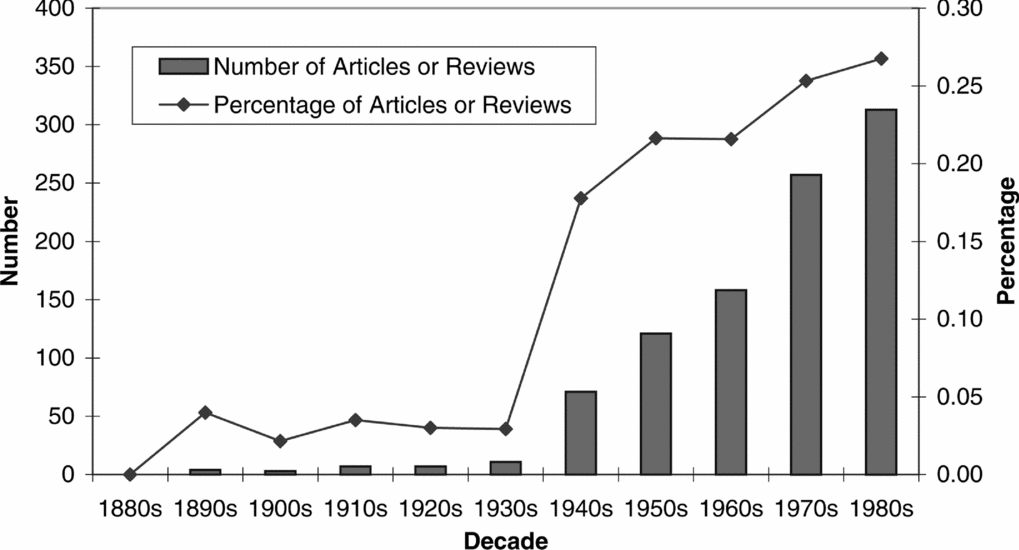
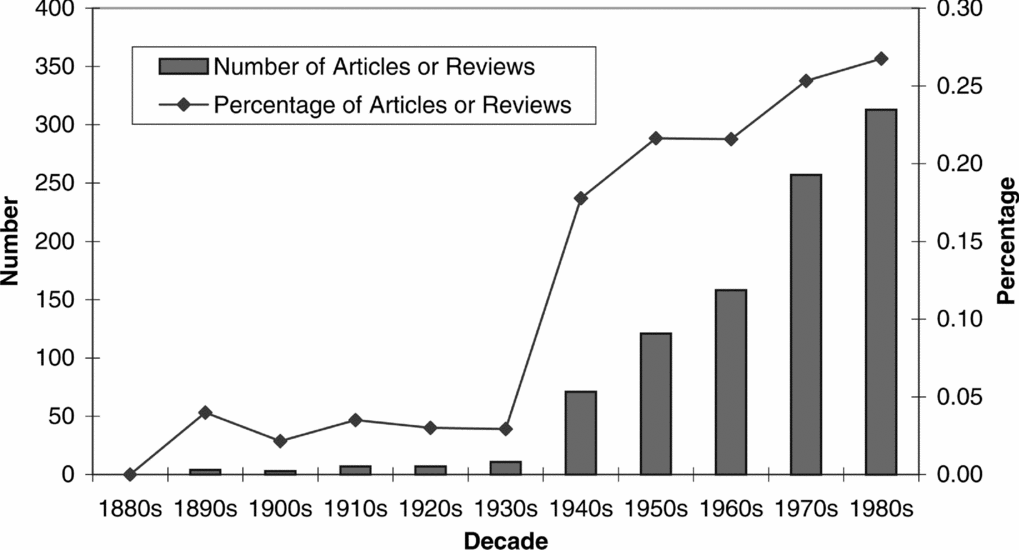
Bellomy and Hodgson have demonstrated the considerable influence of Hofstadter's book not only in terms of increasing the popularity of the expression “social Darwinism,” but also in the matter of decisively shaping the accepted definition of it. Hodgson's bibliometric study shows that “social Darwinism” was a label which was scarcely used in Anglo-Saxon academic journals – in fact, a mere nine times were recorded prior to 1914 in his search in the JSTOR database (see fig. 1).
The number and percentage of articles and reviews in the JSTOR database in which “Social Darwinism” appears. Reproduced from Hodgson Reference Hodgson2004b, 236.
In parallel, Bellomy shows that it is Hofstadter's book which solidified the evasive concept of social Darwinism – notably by identifying Herbert Spencer and Graham Sumner as the main figures of this intellectual “movement,” and by portraying Lester Ward as their “critic.” It is then of significance that Penrose based her appreciation of the social value of biological analogies on this influential book – this reference signaling a shift from purely analytical grounds to an appreciation motivated by cultural and social concerns. Mentioning the “aura of naturalness” which is brought by biological analogies to economic issues, Penrose refers to Hofstadter's authority in a long footnote:
See the discussion in Richard Hofstadter, Social Darwinism in American Thought pp. 30ff. and the quotation (p. 31) he gives from John D. Rockefeller: “The growth of a large business is merely a survival of the fittest . . . The American Beauty rose can be produced in the splendor and fragrance which bring cheer to the beholder only by sacrificing the early buds which grow up around it. This is not an evil tendency in business. It is merely the working out of a law of nature and a law of God.” (Penrose Reference Penrose1952, n. 13)Footnote 9
At another place, Penrose establishes a connection between the archetype of social Darwinism, Herbert Spencer, and any use of biological analogies:
The analogy [Alchian's economic natural selection] I am concerned with here avoids the crudities and attempts to avoid the value judgments that characterized the 19th century doctrine of Spencer and his followers in their application of these principles [biological evolution and natural selection] to society. It is very modern in its emphasis on uncertainty and statistical probabilities. Nevertheless, it is open to the same basic objections that in my opinion adhere to all such biological analogies. (Penrose Reference Penrose1952, 809–810)
It is a most diplomatic way to affirm that economic natural selection is fundamentally not so different from the social Darwinism of Spencer. This establishes that Penrose's rejection of biological analogies were also grounded in a socio-cultural evaluation echoing a contemporary and popular pronouncement. This would not be surprising, since this micro-history would merely confirm a trend that has been well identified at the macro-level. Historians have contended that the demise of evolutionary thinking in mid-century social thought was due at least as much to transformations of the American society as to advances in the scientific realm. In the interwar period and during the Second World War, American identity reshaped itself from ethnic-based conceptions – looking for the true nature of the American “stock,” to an ideological definition – where being American was above all about adhering to a certain creed. This transition caused a general receding of evolutionary explanations in social science, because they placed the nature and destiny of human groups out of reach of social and political reform, and were even at a superficial level too reminiscent of the biologically inspired ideologies of the Nazi and Fascist states.
Since her personal philosophical beliefs as well as analytical principles were at stake in Penrose's rejection of biological analogies, does it entail that this rejection was ill-founded? We rather think that this situation calls for an examination of the philosophical beliefs in question. In this way, we will achieve a precise understanding of how analytical and philosophical motives converged to make biological analogies a quasi taboo in social science in the middle of the twentieth century.Footnote 10
The Values of Edith Penrose
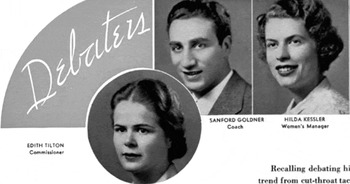
Edith Elura Tilton was born on 15 November 1914 in Los Angeles.Footnote 11 She grew up in a “close and supportive family.” Her father was a road engineer and the family followed him as he traveled for his surveys of the road network of California, before they eventually settled in San Luis Obispo. Her mother had an independent, affirmative personality, traits that would later also be typical of Edith's character. Edith entered the University of California at Berkeley and according to an interview she gave in the early 1990s, she first experimented with “jurisprudence, philosophy, history, [and] psychology but eventually chose economics because this was the period of the great depression and the economy was in severe trouble. So I chose economics as the most interesting and relevant subject” (Parkin and King Reference Parkin and King1992, 187). During her studies, Edith Tilton was much involved in the Forensics Council, representing her university in local tournaments with debates on such themes as “Is there a possibility of a third political party in the United States?” or “Should the Townsend Plan [an ambitious social security plan] be adopted?” (see fig. 2). Beyond an ability to defend her arguments and knowledge of rhetorical devices, it testified to an appetite to voice her opinion on matters of public interest.
Edith Tilton, Commissioner of the Foresincs Council (University of California at Berkeley Year Book 1936, 238).

In 1934, Edith married David Burton Denhardt, a fellow student at UC Berkeley (class of 1933). After receiving her B.A. in economics in 1936 she moved with him to northern California. There, she took a job as a social worker with a Depression Relief agency while her husband began working as a lawyer and an aspirant district attorney.Footnote 12 But in 1938, David B. Denhardt was killed in a hunting accident when Edith was four months pregnant with their first child (Penrose and Pitelis Reference Penrose and Pitelis1999, 4). Her life took a different turn when she went back to Berkeley to study and met Ernest F. Penrose, a professor of economics there. Like Edith, Penrose “came from a relatively humble background.” Born in Britain, he “had served in the trenches during the First World War, and had managed to finance himself through Cambridge after the war, and had come to Berkeley from Japan through the Stanford Food Institute” (ibid.). He acquired American citizenship in 1937 (ibid.).Footnote 13
Edith and Ernest Penrose moved in 1939 to the International Labour Office (ILO) in Geneva, at the suggestion of its newly appointed director John Winant. Winant was a figure of the New Deal, a Republican governor who had been chosen in 1935 by Franklin Roosevelt to head the Social Security Board, and resigned in 1936 during the presidential campaign only “so that he could better defend the new program, alongside Roosevelt, from criticisms by the Republican party” (Freedman Reference Freedman2000). A man with a reputation of great humanity and rightness, he had a deep concern for social justice and human rights, which he saw as the fundamental route to peace, “ahead of property rights” (Lorenz Reference Lorenz2001, 129). Edith and Ernest Penrose worked as economic specialists and advisors for Winant from 1939 to 1941. Edith published reports on the impact of war on the food and textile industries (Denhardt 1941; idem 1943).Footnote 14 The active concern of the Penroses for social distress, which marks their careers, is highlighted during their stay in Geneva by the help they provided to people escaping the Nazis.Footnote 15 In 1941, when Roosevelt sent Winant to London as US ambassador to the UK, Edith and Ernest Penrose followed him as economic adviser (Ernest) and special assistant (Edith). Ernest was closely involved in the discussions between J. M. Keynes and Harry Dexter White, the Assistant to the Secretary of the Treasury who was in charge of the negotiations leading to the Bretton Woods conference. The couple followed Winant again when he moved to the US delegation for the Economic and Social Council of the United Nations in 1947, before finally relocating to the campus of Johns Hopkins, where Ernest Penrose obtained a chair in Human Geography. Edith Penrose earned a Masters degree then a PhD in economics with Fritz Machlup, studying the history of the patent systems. She then moved to her study of the theory of the growth of firms, while lecturing for the department of economics (Machlup and Penrose 1950; Penrose Reference Penrose1951).
The death of Roosevelt in April 1945 marked a radical shift in American foreign and domestic policy. During the war, Roosevelt had been keen on considering the Russians as allies, investing a large amount of trust and goodwill in their relationships. This came to an abrupt end with Harry Truman's presidency. Inexperienced in foreign affairs, and lacking empathy for the Russians, Truman suddenly converted the American's position from a posture of dialogue and prudent cooperation to outright defiance and threat (Chafe Reference Chafe1995; Miscamble Reference Miscamble2007). Economists like Ernest Penrose who had implemented the agenda of Roosevelt's policies became branded as “New Dealers” suspected of sympathy for the communists or even of being Soviet agents in the eye of the new administration and secret services – sometimes for good reasons (Haynes and Klehr Reference Haynes and Klehr1999). In a few years, many senior economic officials became judged undesirable or were prosecuted for their sympathies to communism, consequently the corridors of Truman's administration were emptied of their presence. In the professional network of the Penroses, Harry Dexter White and others directly felt the turn in the events.Footnote 16 This political turn had direct consequences for the Penroses as well.
Edith Penrose and the Lattimore Defense Fund
In March 1950, on the floor of the U.S. Senate, Joseph McCarthy accused Professor Owen Lattimore, a member of the Johns Hopkins faculty, of being the top Soviet espionage agent in the U.S., adding that his [McCarthy's] anti-communist crusade rested wholly on Lattimore's case (Evans Reference Evans1977; Newman Reference Newman1992; Lewis Reference Lewis1993). This led to the opening of an investigation by the Subcommittee of the Committee for Foreign Relations, which held its first hearing of Lattimore on April 6, 1950.
Edith and Ernest Penrose had close ties with Lattimore. Like Lattimore, Ernest Penrose had served in top positions in the foreign policy arm of Roosevelt's administration with Harry Dexter White, and both had spent several years living in the Far East, which also defined their academic interests.Footnote 17 Ernest Penrose was a specialist of Japan where he lived from 1925 to 1930, while Lattimore was the leading authority in Mongolian studies, and an expert on China. After the Penroses’ arrival at Johns Hopkins in 1947, much “was expected to grow out of [Ernest Penrose's] relation to the Walter Hines Pages School of International Relations as he works with Owen Lattimore,” and the two families became social friends.Footnote 18 But with Lattimore under attack, the relation with the Penroses turned to one of assistance.
On April 20, 1950, Ernest Penrose wrote a letter to the Baltimore Sun in support of Lattimore, expressing his conviction that accusations against him would turn out to be false, as they had been in the case of William Remington, an economist in the government accused of being a communist and who was subsequently completely vindicated and reinstated, argued Penrose.Footnote 19
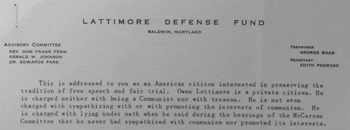
The costs for the defense of Lattimore, even with a law firm offering to serve for free, were to run very high, with a procedure which eventually lasted more than five years before all the charges against Lattimore were dropped. At the initiative of George Boas, a professor of philosophy at Johns Hopkins, a “Lattimore Defense Fund” was set up in January 1953 with the goal to gather funds to pay for the legal fees. Edith Penrose was nominated secretary of the fund, a position which reveals to what extent she perceived that not being passive and speaking up was necessary in the context of conservative threats to academia (fig. 3). The funding drive was a success – ultimately, $38,000 were collected through nearly 2000 contributors, and all the charges against Lattimore were finally dismissed in June 1955.Footnote 20
Header of the letter sent to seek financial support for Owen Lattimore. This copy was attached to a letter from Fritz Machlup to Kenneth Boulding sent February 1st, 1953. Box 77, Folder 5 “May 1953,” Kenneth Boulding Papers, Bentley Library, University of Michigan at Ann Arbor.

This position in the Lattimore Defense Fund came with considerable risks for Edith Penrose, as the creation of the fund had triggered the opening of an investigation by the FBI, in which any sign of political left-leaning was taken as indicting evidence.Footnote 21 Indeed, a few months after the creation of the Lattimore Defense Fund, the Penroses were called to testify in an executive session on “Internal Security – Subversion in the School System” before the Senate Internal Security Subcommittee chaired by Senator William E. Jenner, a staunch supporter of McCarthy. Testifying came with considerable pressure to “name names.” The choice to name names or not was a particularly distressing experience, as it entailed balancing the betrayal of friends and personal convictions against the prospect of losing one's job or worse if one refused to (Navasky Reference Navasky1980). For the Penroses, the transcript of their testimony shows that they were asked a series of questions about communist “front” organizations on the UCLA campus in the late 1930s, to which the Penroses did not answer with any precision, invoking their lack of knowledge and memories on the matter. The Penroses walked away from the hearings without further trouble, assured that no publicity of their hearing would be given.
This traumatic experience of confrontation with Mccarthyism, which threatened the Penroses in their private and professional lives, lasted from 1950 to 1953 and beyond (see the coda to this essay). It gives a better sense of Edith Penrose's wariness with respect to the conservative turn in academia in postwar America – which has been felt by many other Keynesian or institutionalist economists of her generation (see for example the testimonies of economists Paul Samuelson in Colander and Landreth Reference Colander and Landreth1997, and John Galbraith Reference Galbraith1982).
Conclusion and Coda
The professional experience of Edith Penrose at the International Labour Office as well as the web of her familial, personal, and professional connections to personalities threatened by the conservative turn represented by Truman's administration and McCarthyism all shed light on the defiance towards conservatism expressed in her “Biological Analogies and the Theory of the Firm” in 1952. At the time she was writing her article, Edith Penrose was directly experiencing in her personal life the conservative turn in the intellectual climate at the national and international level. In this context, the interpretation of all biological analogies as cases of social Darwinism, à la Richard Hofstadter, may have made considerable sense to her: through this lens, the reintroduction of evolutionary and organic analogies in economics rooted competitive market economies in nature, implying fallaciously that social reforms so typical of the New Deal welfare state should be considered a potential disturbance and nuisance to this natural economy. Under this light, biological analogies in economics were inherently suspect of supporting the “status quo,” and for this motive they should be fought against (Penrose Reference Penrose1952, 809). This stance might have reflected intimate personal values, but one should also note that it fitted a widely shared worldview at the time. As cultural historian Carl Degler has remarked, the reformist spirit since the 1930s was all infused with a “wish to establish a social order in which innate and immutable forces of biology played no role in accounting for the behavior of social groups” (quotation from Degler Reference Degler1991, viii, cited in Hodgson Reference Hodgson and Dopfer2005, 119)Footnote 22 – a progressive credo which was at the core of Penrose's battles against biological analogies in economics and McCarthyist attacks on her campus.
This historical note provides further support to studies of the interactions between personal values and theorization work in economics (Samuels Reference Samuels and Roy Weintraub1977; Cherrier Reference Cherrier2008): as Beatrice Cherrier has established, there are cases when there exists a “lucky consistency” between the values of an economist and his or her scientific results. Similarly, we find that the rejection of conservative biological analogies by Edith Penrose is consistent with her denunciation and engagement against political conservatisms, both antagonistic to her faith in social reform and progressivism. This concomitance should not be read as an indication of a faulty methodology; rather, “cognitive and political values provide substantive hypotheses on the world that influence research, [and] methodological choices shape the channels whereby these values actually enter the theorizing process and survive the confrontation with facts” (Cherrier Reference Cherrier2007; emphasis in the original). In Penrose's view, biological analogies did not qualify as a proper methodology in economics – hereby revealing the alignment between her own methodological preferences and personal values.
In the past few years, interdisciplinary contacts between economics and biology have diversified: analogical reasoning has been complemented by the proposal of “generalization” as a mode of unification between the two disciplines (Aldrich et al. Reference Aldrich, Hodgson, Hull, Knudsen, Mokyr and Vanberg2008), and also by the increasing development of joint team work by biologists and economists in neuroeconomics (e.g., Pine et al. Reference Pine, Seymour, Roiser, Bossaerts, Friston, Curran and Dolan2009; Krajbich et al. Reference Krajbich, Camerer, Ledyard and Rangel2009). At face value, these new forms of interdisciplinary science should prove more impenetrable to extrinsic influence – because of the ambitions of a strict logical construct represented by “universal Darwinism,” or thanks to the straightjacket of an experimental program – both meant to display a rigor which analogies lacked. Alternatively, these methodological developments can also be considered as new channels through which values will not be annihilated, but will flow along different, uncharted paths. In which case, and in relation with the social and political climate of our times, we should expect more, not fewer episodes of contestation targeting the exchanges at the fluctuating border between economics and biology.
Coda
McCarthyism died out slowly in 1955–1958 with several decisions by the Supreme Court reinstating some basic defense rights to individuals suspected of being communists (McCarthy himself died in 1957). However, some of the central features of McCarthyism remained firmly in place.
In 1958, while on leave to Baghdad University with Edith, Ernest Penrose applied for a position with the United Nations, which triggered the opening of an investigation by the FBI.Footnote 23 FBI special agents interviewed Ernest Penrose's current and past colleagues, neighbors, employers, and their local contacts from the American Legion. They were quick to find that in 1953 one of their informants had “advised [them] that Mrs. Ernest T. Penrose, wife of Dr. Ernest Francis Penrose, was observed by the informant forwarding letters soliciting funds for the defense of Owen Lattimore.”Footnote 24
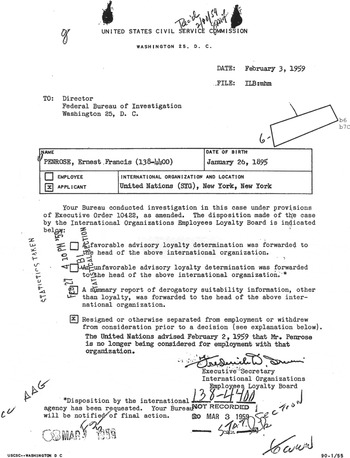
The FBI unearthed some other damaging elements, but the association with Lattimore figured centrally in the synopsis of the final report sent to the Civil Service Commission, in charge of assessing the loyalty of applicants for the International Organizations Employees Loyalty Board.Footnote 25 The investigation also found that the Penroses had been called to testify before the Jenner Committee in March 1953. Internal memos show that FBI agents also got access to the content of the hearings, supposedly held in secrecy. Ernest Penrose's “testimony contains no admissions of communist activity but does reflect background data and possible evasiveness in answering questions re communism” (Office Memorandum from [name concealed] to A. Rosen, December 1st, 1958, Penrose file). Despite the reassuring words by Senator Jenner at the time that “there [would] be no publicity concerning this meeting,”Footnote 26 an unidentified source “stated that there would be no objection to disseminating Penrose's testimony to the Civil Service Commission. [The unknown source] asked that it be given the same security as our reports, or, in fact, made part of a report.”Footnote 27 Unsurprisingly, after receiving the report on Ernest Penrose in January 1959, the Civil Service Commission indicated that the United Nations had stopped considering him for employment (see fig. 4 in the Appendix). Still in Baghdad at that time, the Penroses finally moved to England, where they had two sons in schools. Edith “successfully applied for a joint readership in economics with reference to the Middle East at the London School of Economics and the School of Oriental and African Studies (SOAS)” (Penrose and Pitelis 1999, 6) and one year before the expected date, Ernest Penrose retired.
Appendix
The final decision by the UN regarding Ernest Penrose's application (Penrose file, closing page).

Acknowledgments
I thank David Tilton Denhardt (Edith Penrose's son) and Woody Hastings (husband of Fritz Machlup's daughter Hanna) for sharing their memories in interviews (David Tilton Denhardt also provided detailed comments on a quasi-final draft of this paper). I thank Beatrice Cherrier for providing me with a copy of the Machlup-Friedman correspondence. For valuable suggestions, I thank participants in the session “Historicizing the Contributions of Women in the History of Economics” of the 2009 meeting of the History of Economics Society. This implies in no way that any of these persons agree with the interpretations I make here. I also acknowledge the clerical and financial support of the Bentley Historical Library (University of Michigan at Ann Arbor); the kind assistance of librarians at the Hoover Institution; The Rare Book, Manuscript, and Special Collections Library at Duke University; the Sheridan Libraries at Johns Hopkins University; the American Philosophical Society Library; and the Center for Legislative Archives at the National Archives and Records Administration. The financial support of Erasmus Research Institute in Management and Agence Nationale de la Recherche is gratefully acknowledged.