Child attachment is predictive of short- and long-term psychosocial adaptation and cognitive functioning in normative as well as clinical groups. To date, numerous studies have demonstrated that insecurely attached children, in particular those showing disorganized behaviors, are at greater risk for psychopathology, behavior problems, stress dysregulation, and poor cognitive performance (see Lyons-Ruth & Jacobvitz, Reference Lyons-Ruth, Jacobvitz, Cassidy and Shaver2008; van IJzendoorn, Schuengel, & Bakermans-Kranenburg, Reference van IJzendoorn, Schuengel and Bakermans-Kranenburg1999, for narrative and meta-analytic reviews). It has been shown that insensitive caregiving behaviors and high-risk ecological contexts are among the most important precursors involved in the development of attachment insecurity. Already in the first phase of their longitudinal work, Egeland and Sroufe (Reference *Egeland and Sroufe1981) pointed out the negative and dramatic impact of neglecting and abusive maternal behavior for the development of attachment security. Their work, based on a sample of low socioeconomic status (SES) families, was to lead the way for the study of child attachment in high-risk samples. In the past three decades the number of studies examining attachment of maltreated children and those living in socioeconomically disadvantaged families, including adolescent mothers, minority groups, and low-income families, has increased significantly. However, to date, it is unclear how socioeconomic risk factors and maltreating parental behavior separately and in combination impact on attachment relationships.
Because attachment is currently one of the key concepts most broadly used to build intervention programs designed for high-risk, disadvantaged, and/or maltreated children (for reviews, see Bakermans-Kranenburg, van IJzendoorn, & Juffer, Reference Bakermans-Kranenburg, van IJzendoorn and Juffer2003; Berlin, Ziv, Amaya-Jackson, & Greenberg, Reference Berlin, Ziv, Amaya-Jackson and Greenberg2005; Oppenheim & Goldsmith, Reference Oppenheim and Goldsmith2007), the integration and clarification of existing findings on the role of environmental risks and maltreatment for the development of attachment is urgently needed. To disentangle the differential impact of maltreatment and socioeconomic risks on the development of attachment and to inform intervention approaches for high-risk populations, the current study tested meta-analytically whether proportions of insecure attachments and more specifically disorganized attachments varied as a function of risks (high-risk maltreated children, high-risk nonmaltreated children, and normative low-risk samples). Using a multivariate approach, we also examined the predictive value of specific constellations of risk factors or accumulation of risks for attachment security and disorganization, and tested whether the interaction effect of maltreatment and risk contributed to the prediction of attachment classifications.
Studies of nonmaltreated, typically developing children have demonstrated that sensitive, contingent, and responsive maternal caregiving behavior promote the development of a secure attachment relationship (Ainsworth, Blehar, Waters, & Wall, Reference Ainsworth, Blehar, Waters and Wall1978; De Wolff & van IJzendoorn, Reference De Wolff and van IJzendoorn1997). Securely attached children use their primary caregiver as a base from which to explore their environments and, when distressed, they retreat to their attachment figure for protection and comfort. In contrast, insensitive (i.e. intrusive, rejecting, inconsistently responsive) maternal behavior has been associated with the development of insecure attachment relationships. In distress, insecure–avoidant children tend to actively ignore or avoid proximity and contact with their attachment figure. Children with an insecure–resistant pattern show strong proximity seeking but combine this behavior with angry contact resistance. Although children with insecure–avoidant and insecure–resistant attachments are not able to optimally use their attachment figure as a secure base, they can rely on organized strategies to regulate emotions and behaviors in times of stress (Main & Solomon Reference Main, Solomon, Greenberg, Cicchetti and Cummings1990), and find sufficient protection in the caregiver's presence to terminate the activation of their attachment system. Their insecure attachment strategies can be considered adaptations to a less than optimal child rearing environment (Main, Reference Main1990).
Some children from each of these three organized (secure, insecure–avoidant, and insecure–resistant) attachment patterns also display (sometimes momentary) anomalous behaviors such as disordered, incomplete, or undirected sequencing of movements, or demonstrate confusion or apprehension toward their caregiver. These children are classified as disorganized (the most anxious type of insecure attachment) over and above their underlying attachment pattern. Some of these children seem to experience a breakdown of their underlying organized (secure or insecure) attachment strategy (Hesse & Main, Reference Hesse and Main2006; Main & Solomon, Reference Main, Solomon, Greenberg, Cicchetti and Cummings1990). Other children classified as disorganized display episodes of disorganized behaviors without showing any clear resistant, avoidant, or secure behavior reflective of an underlying organized strategy. Past studies have demonstrated that although most disorganized children at young ages (infants and preschoolers) develop a controlling role-reversed attachment strategy by the time they reach school age (Main & Cassidy, Reference Main and Cassidy1988; Wartner, Grossmann, Fremmer-Bombik, & Suess, Reference Wartner, Grossmann, Fremmer-Bombik and Suess1994), some school-aged children still show disorganized behavior without having developed any strategies of the organized or even the controlling kind (Moss, Cyr, & Dubois-Comtois, Reference Moss, Cyr and Dubois-Comtois2005). Hence, some children may not develop an organized strategy at all, and those living in conditions with more extreme disruptions in the parent–child relationship are certainly at greater risk to develop and maintain such disorganized behaviors.
It has been hypothesized that attachment disorganization is caused by frightening/frightened and extremely insensitive parental behavior (Hesse & Main, Reference Hesse and Main2006; Lyons-Ruth, Bronfman, & Parsons, Reference Lyons-Ruth, Bronfman and Parsons1999; Main & Hesse, Reference Main, Hesse, Greenberg, Cicchetti and Cummings1990). In support of this, recent studies on nonmaltreated children have demonstrated that anomalous parenting, involving momentary parental dissociative behavior, animal-like attack posture, haunted voice, rough handling, or withdrawn behavior, is related to the development of attachment disorganization (see Madigan, Bakermans-Kranenburg, et al., Reference Madigan, Bakermans-Kranenburg, van IJzendoorn, Moran, Pederson and Benoit2006, for a meta-analytic review). According to Hesse and Main (Reference Hesse and Main2006), disorganized children are caught in an unsolvable paradox: their attachment figure and potential source of comfort is at the same time a source of unpredictable fright.
Maltreating behaviors are probably some of the most frightening behaviors a child may be exposed to, and serious dysfunctions in the parent–child relationship have been observed in maltreating families. Notably, disciplinary practices of maltreating parents have been described as highly inadequate, with parents being more likely to inconsistently use threat, punishment, coercion, and power assertion to gain child compliance (Chilamkurti & Milner, Reference Chilamkurti and Milner1993; Lorber, Felton, & Reid, 1984). In particular, abusive mothers have shown more aversive, intrusive, and controlling behavior toward their child, in contrast to neglecting mothers who seem to display greater inconsistencies in response to their child behavior and a lack of ability in establishing age-appropriate limits (Bousha & Twentyman, Reference Bousha and Twentyman1984; Crittenden, Reference Crittenden1981). These hostile versus helpless patterns of behaviors have both been observed by Lyons-Ruth et al. (Reference Lyons-Ruth, Bronfman and Parsons1999) in mothers of disorganized children. Not only are maltreating parents insensitive, and do not regulate and buffer their child's experience of distress, but they also activate their child's fear and attachment systems at the same time. The resulting experience of fright without solution is characteristic of maltreated children, and is probably the most salient process through which maltreated children develop attachment disorganization.
It is not surprising that past studies on child maltreatment have found children of abusive and neglecting mothers more likely to show insecure attachment behavior, mainly of the disorganized type, than nonmaltreated children living in similar low SES families. Specifically, Cicchetti, Rogosch, and Toth (Reference *Cicchetti, Rogosch and Toth2006) examined infant–mother attachment in a sample of 137 13-month-old maltreated infants. Compared to children living in low SES families (n = 52), Cicchetti and colleagues found that 90% of maltreated infants were classified as disorganized as opposed to 42% in the comparison group. Moreover, 9% of the maltreated infants were classified as organized insecure (avoidant or resistant), whereas 25% of infants in the comparison group showed organized insecure attachment behavior. Barnett, Ganiban, and Cicchetti (Reference *Barnett, Ganiban and Cicchetti1999; see also Carlson, Cicchetti, Barnett, Braunwald, 1989; Beeghly & Cicchetti, Reference Beeghly and Cicchetti1994), using a nonoverlapping sample of low SES participants, examined attachment of 22 12-month old maltreated infants. They observed that within the maltreated group none of the infants exhibited organized insecure attachments but 86% were classified as disorganized. In the comparison group (n = 22), 14% were judged organized insecure and another 14% as disorganized. Lyons-Ruth, Connell, Grunebaum, and Botein (1990; see Lyons-Ruth & Jacobvitz, Reference Lyons-Ruth, Jacobvitz, Cassidy and Shaver1999, for percentages) also examined attachment quality of nine 18-month-old maltreated infants. Five (55%) were classified as disorganized and two (22%) were judged organized insecure.
Similar results are found in samples of older children. In 95 maltreated children with a mean age of 24 months, Crittenden (Reference *Crittenden, Belsky and Nezworski1988; see also Crittenden, Reference Crittenden1985, Reference Crittenden1992) demonstrated that 37% of maltreated children showed a mixture of insecure ambivalent and avoidant attachment patterns (A/C), in comparison to 7% of nonmaltreated children living in similar low SES families (n = 29). This combination of approach–avoidance behavior is also a characteristic of the disorganized attachment classification. Crittenden reported that 48% of maltreated children showed organized insecure attachments in comparison to 34% in the nonmaltreated group. Cicchetti and Barnett (Reference *Cicchetti and Barnett1991) examined attachment in a sample of 44 30-month-old children. Thirty-six percent of maltreated children showed organized insecure attachment and another 36% exhibited disorganized attachments. In the comparison group, 20% showed organized insecure attachments and 15% were judged disorganized. Finally, Moss et al. (2007) examined a sample of maltreated children (n = 44) ranging from 1 to 5 years of age. Compared to children living in low SES families (n = 15), Moss and her team found that 55% of maltreated children were classified as disorganized as opposed to 33% in the comparison low SES group. Similar proportions of organized insecure children were found in the maltreated group (32%) and the low SES nonmaltreated children group (33%).
The picture is somewhat different when examining children's attachment as a function of type of maltreatment. Neglected children seem to be particularly at risk to develop organized insecure attachments whereas children who have been physically abused may tend to show disorganized attachments. Valenzuela (Reference *Valenzuela1990) specifically examined attachment in infants who were severely neglected. In a sample of 41 19-month-old chronically underweight infants, she found that 32% of neglected infants were classified as disorganized as opposed to 61% who showed organized insecure attachments. In line with these results, Crittenden (Reference *Crittenden, Belsky and Nezworski1988) also found a high proportion of organized insecure attachments in neglected children, that is 79% (n = 20) of neglected children, as opposed to only 29% (n = 22) in physically abused children. Inversely, 20% of neglected children, in comparison to 50% of physically abused children, showed disorganized behavior.
Three other studies, conducted prior to the development of the coding system for disorganized attachment behavior, also report higher proportions of insecure attachments in samples of maltreated children in comparison with nonmaltreated children of high-risk samples. Using a sample of 31 mothers identified as seriously neglecting or abusing their infant during their first year of life, Egeland and Sroufe (Reference *Egeland and Sroufe1981) found that 65% of infants showed insecure attachments compared to 43% in the comparison low SES group. When examining attachment as a function of type of maltreatment, 67% of neglected children and 50% of physically abused children showed insecure attachments. However, because there were only four children in the physically abused group, it is difficult to draw any firm conclusion. Lamb, Gaensbauer, Malkin, and Shultz (1985) examined attachment in a sample of 17 19-month-old maltreated infants. Their results demonstrated that 88% of maltreated children in comparison to only 12% in the nonmaltreated high-risk comparison group showed insecure attachments. When examining attachment as a function of type of maltreatment, Lamb et al. (Reference *Lamb, Gaensbauer, Malkin and Schultz1985) found that 81% of neglected children and 86% of physically abused children showed insecure attachments. Again, these results should be interpreted with caution because only six children were included in the physically abused group. Finally, Schneider-Rosen and Cicchetti (Reference *Schneider-Rosen and Cicchetti1984) examined attachment in 37 19-month-old maltreated infants. Whereas 67% of maltreated children were classified insecure, in the comparison low SES group only 26% were judged insecure.
It is believed that maltreatment has more negative impact on child development than socioeconomic risk factors. From an ecological point of view (see Belsky, Reference Belsky1980; Bronfenbrenner, Reference Bronfenbrenner1979; Cicchetti & Lynch, Reference Cicchetti and Lynch1993; Cicchetti & Valentino, Reference Cicchetti, Valentino, Cicchetti and Cohen2006), interactions exist between all levels of the ecology, for example, reciprocal influences may be found between cultural values (macrosystem), poverty (exosystem), marital conflicts (microsystem), child genetic vulnerabilities (ontogenic development), and child developmental outcomes. However, risk factors associated with levels that are closer to the child, such as caregiving behaviors, are supposed to have more influence on child development. Hence, abusive or neglecting parenting is more likely to impact on children's developmental outcomes than more distal socioeconomic risks. Nevertheless, socioeconomic risk such as low educational level, low income, adolescent or single parenthood, ethnic minority, or substance abuse might jeopardize the child's sense of security in the absence of child maltreatment because they may compromise the quality of parental caregiving. Low income as well as ethnic minority status may increase the number and intensity of the daily hassles that parents experience, which may decrease sensitive parenting behavior and thereby negatively impact the child's attachment security (for an example, see Bakermans-Kranenburg, van IJzendoorn, & Kroonenberg, 2004). Low educational level has been shown to be associated with lower parental sensitive responsiveness to their children (De Wolff & van IJzendoorn, Reference De Wolff and van IJzendoorn1997). Furthermore, when children witness their parents struggling with financial problems and with keeping a job or partner, the attachment relationship may be directly influenced because the child senses the basic helplessness and insecurity of the caregiver (Raikes & Thompson, Reference *Raikes and Thompson2005), which may lead to the activation of the fear system and ultimately to the development of disorganized attachment. According to Lyons-Ruth and colleagues (1999), attachment disorganization does not only emerge from direct fear of the caregiver, but also from the absence of regulation of fearful arousal such as seen in extremely insensitive caregivers. These parents may, for example, lack supervision in dangerous situations or withdraw from the infant–parent interaction when the child expresses attachment needs, thereby activating their child's attachment system even more. These more subtle but frequent parental behaviors, which may characterize the chaotic and neglecting environment of multiple-risk families, might be as negative in their consequences as directly frightening parental behavior (Lyons-Ruth et al., Reference Lyons-Ruth, Bronfman and Parsons1999). Although parental frightening/frightened behavior constitutes one pathway to disorganization, the failure of a caregiver to terminate the child's activation of the attachment system may create chronic hyperarousal of the attachment system that may constitute a second pathway to disorganization.
To date, little is known about the different ways socioeconomic risks might impact the development of children's attachments. Are there different risk constellations that are associated with attachment insecurity? Alternatively, what is the differential impact of specific risk factors on attachment security? Specifically, researchers have argued that individual risks are not as influential for children's development as is the total number of risk factors (Rutter, Reference Rutter, Kent and Rolf1979; Sameroff, Seifer, & McDonough, Reference Sameroff, Seifer, McDonough, DelCarmen-Wiggins and Carter2004). Cumulative risk studies have demonstrated that the more risk factors children are exposed to, the worse their outcomes for behavior problems and cognitive development (Ackerman, Izard, Schoff, Youngstrom, & Kogos, Reference Ackerman, Izard, Schoff, Youngstrom and Kogos1999; Pungello, Kupersmidt, Burchinal, & Patterson, 1996; Sameroff, Bartko, Baldwin, Baldwin, & Seifer, 1998; Sameroff, Seifer, Barocas, Zax, & Greespan, 1987). Socioeconomic risks are pervasive. Not only do they tend to characterize a family for a prolonged amount of time (e.g., poverty, ethnic minority, adolescent parenting), but they also have the propensity to co-occur and cluster in the same families and individuals (Belsky & Stratton, Reference Belsky, Stratton, Browne, Hanks, Stratton and Hamilton2002; Bronfenbrenner, Reference Bronfenbrenner, Husten and Postlethwaite1994; Sameroff et al., Reference Sameroff, Seifer, McDonough, DelCarmen-Wiggins and Carter2004). The cumulative and enduring effect of risks might create precarious situations in which children get more prone to distress and are less securely attached.
Few studies have, however, investigated the predictive role of cumulative risk for the development of attachment security, and results are not consistent. Shaw and Vondra (Reference Shaw and Vondra1993) found for a high-risk sample that the more risk factors characterized a family, the more likely children were to develop insecure attachments, but this was only evident in families with at least three or four stressors. Research by Belsky and colleagues (Belsky, Reference Belsky1996; Belsky & Isabella, Reference Belsky, Isabella, Belsky and Nezworski1988; Belsky, Rosenberger, & Crnic, 1995), conducted with normative samples, support the cumulative risk hypotheses. Conversely, a study on high-risk families by Fish (Reference *Fish2001) indicated that the sole presence of risk was enough to be predictive of children's attachment insecurity. Notably, the cumulative risk indexes used in the above studies included a variety of risk factors such as socioeconomic (e.g., income, maternal education, marital status, minority status) and/or psychological factors associated with maternal functioning (e.g., parental stress, depression). When teasing apart socioeconomic risks from those associated with maternal functioning, Shaw and Vondra (Reference Shaw and Vondra1993) found that risks associated with caregiving behavior were more common among families with insecure children.
Overall, findings on child attachment in maltreating and high-risk families leave an important question unanswered: are children under conditions of maltreatment more likely to develop insecure attachments of a disorganized type than children under the cumulative impact of socioeconomic risks, who may develop more insecure attachments of the organized kind? In a previous meta-analysis of the prevalence of disorganized attachment (thus excluding studies using the Attachment Q-Sort [AQS] measure), van IJzendoorn et al. (Reference van IJzendoorn, Schuengel and Bakermans-Kranenburg1999) found that nearly half of maltreated children showed disorganized (48%) or organized insecure attachment behavior (43%). Similar proportions were found for children prenatally exposed to substance abuse (43% and 37%, respectively), but lower proportions of disorganized attachments were reported for children living in high-risk families, that is, children living in low SES families (25%), and children of adolescent mothers (23%). However it was not tested meta-analytically whether proportions of disorganized and organized insecure attachments varied as a function of the various maltreatment and socioeconomic risk groups. Moreover, van IJzendoorn et al.'s study presented no information on children of families belonging to ethnic minority groups. Few studies on ethnic minority families have been conducted and they have shown low to moderate rates of disorganized attachment (18% on average; see Barnett et al., Reference *Barnett, Ganiban and Cicchetti1999; Heinicke et al., Reference *Heinicke, Fineman, Ruth, Recchia, Guthrie and Rodning1999; Lieberman, Weston, & Pawl, Reference *Lieberman, Weston and Pawl1991).
Including the pertinent studies examining child attachment in maltreating and high-risk families, the current set of meta-analyses examined the differential impact of maltreatment and socioeconomic risks on attachment security and disorganization. We hypothesized that proportions of insecure attachments, especially of the disorganized type, would be higher in studies of maltreated children in comparison to high-risk samples with nonmaltreated children, and compared to normative low-risk samples derived from previous meta-analyses (van IJzendoorn et al., Reference van IJzendoorn, Schuengel and Bakermans-Kranenburg1999: four-way classification; and van IJzendoorn, Goldberg, Kroonenberg, & Frenkel, Reference van IJzendoorn, Goldberg, Kroonenberg and Frenkel1992: three-way classification). We further explored whether proportions of secure and disorganized attachments varied as a function of the type of maltreatment and individual risk factors (e.g., maternal education, marital status). Finally, we hypothesized that the cumulative impact of socioeconomic risks would better predict attachment insecurity or disorganization for nonmaltreated high-risk children than individual risks, and we explored whether cumulating socioeconomic risks had a similar impact on attachment security and disorganization as child maltreatment.
Method
Data collection
Child maltreatment and high-risk studies were first collected using several digital databases. Risk was defined as any socioeconomic factor that may potentially compromise the quality of caregiving behavior (i.e., maternal education, income, maternal age at child birth, marital status, ethnicity, and substance use). PsycINFO, Dissertation Abstracts, and Medline were searched with the keyword attachment combined with maltreatment, risk, or a related term (e.g., abuse, neglect, sexual abuse, substance abuse, low income, adolescent mother, low education, single mother, black mother, and ethnicity). Then, the references of the collected papers, dissertations, and book chapters were searched for relevant studies.
Studies were included if they provided data on the attachment quality of maltreated children (physically or sexually abused, or neglected) or children living in socioeconomically disadvantaged families. Only those studies using validated observational measures of attachment patterns (i.e., separation–reunion procedures or doll play tests; e.g., Spieker & Bentley, 1994; Stacks, Reference *Stacks2002) or using the continuous AQS measure (e.g., Tarabulsy et al., Reference *Tarabulsy, Bernier, Provost, Maranda, Larose and Moss2005) were included.
Because the focus of our paper was to examine the (differential) impact of high socioeconomic risk and parental maltreating behavior on children's attachment security and disorganization, we compared studies of maltreated children with those of nonmaltreated children at socioeconomic risk. Clinical samples such as those of parents with depression, anxiety, or other psychiatric problems (e.g., Teti, Gelfand, Messinger, & Isabella, Reference Teti, Gelfand, Messinger and Isabella1995) were excluded because of their potential confounding of maltreatment and clinical status. For the same reason we excluded samples of children with clinical disorders (e.g., preterm babies, conduct disorders, hyperactivity, congenital abnormalities, e.g., Crittenden, Reference Crittenden1985; DeKlyen, Reference DeKlyen1996). We decided to include substance abuse studies (although parental substance abuse and maltreatment may be confounded) for two reasons. First, previous work indicated that parents with an alcohol or drug problem are likely to live in high socioeconomic risk contexts. Second, substance abuse studies were also included in the earlier meta-analysis on disorganized attachment by van IJzendoorn et al. (Reference van IJzendoorn, Schuengel and Bakermans-Kranenburg1999), who found that maternal substance abuse (43%) was as predictive of disorganization as maltreatment (48%). Studies on reactive attachment disorder (e.g., Zeanah et al., Reference Zeanah, Scheeringa, Boris, Heller, Smyke and Trapani2004) were excluded because of the ongoing debate about the unsettled relation between this disorder and attachment disorganization (see O'Connor & Zeanah, Reference O'Connor and Zeanah2003; van IJzendoorn & Bakermans-Kranenburg, Reference van IJzendoorn and Bakermans-Kranenburg2003). An additional rationale for focusing on socioeconomic risk factors instead of other types of risks such as parental psychopathology was that socioeconomic risks are easier to ascertain from studies that did not assess more specific proximal parenting behaviors. Studies with nonbiological caregivers (e.g., foster parents, institutionalized, or adopted children; O'Connor et al., Reference O'Connor, Marvin, Rutter, Olrisk and Britner2003; Stovall-McClough & Dozier, Reference Stovall-McClough and Dozier2004) were excluded. However, some studies with biological parents included nonbiological parents as well (Barnett, Kidwell, & Leung, Reference *Barnett, Kidwell and Leung1998; Seifer et al., Reference *Seifer, LaGasse, Lester, Bauer, Shankaran and Bada2004). These were retained only if nonbiological caregivers constituted less than 40% of the sample or if current nonbiological caregivers had been the child's primary caregiver since the first few months of life. Finally, intervention studies (e.g., Lieberman et al., Reference *Lieberman, Weston and Pawl1991) were included if they provided pretest or control group data. However, some studies only provided post intervention data for both the control and intervention groups as a whole. These were included only if the intervention had not been significantly effective in changing attachment (e.g., Raikes & Thompson, Reference *Raikes and Thompson2006).
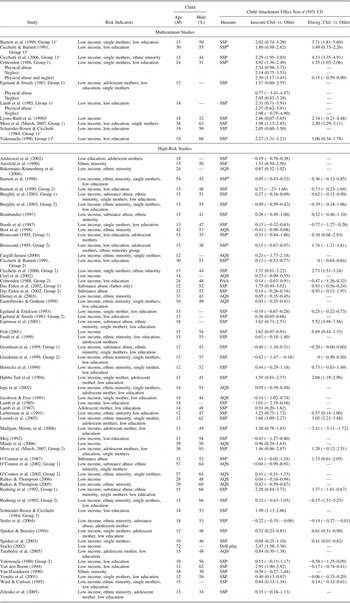
Overall, we found 55 studies yielding a total of 69 samples of children: 59 samples (n = 4,336) included nonmaltreated children from high-risk groups and 10 samples (n = 456) included maltreated children from high-risk groups. All studies used for this meta-analysis included independent, nonoverlapping samples of children. Table 1 presents an overview of the included studies. Attachment security was examined in all 55 studies, whereas attachment disorganization was examined in seven samples of maltreated children and 34 samples of high-risk nonmaltreated children. All studies were coded for socioeconomic risks according to six major risk indicators (see below and Table 2 for the coding system). Table 1 lists the risk factors coded for each study. As expected, most studies were characterized by several risks.
Risk indicators, child characteristics and d effect sizes for child attachment insecurity and disorganization of maltreatment and high-risk studies

Note: SSP, Strange Situation procedure; AQS, Attachment Q-Sort measure.
aStudies with neglected, physically abused, and/or sexually abused children.
bCassidy and Marvin procedure.
cCrittenden Preschool Attachment System.
dStudy including only neglected children.
eModified SSP.
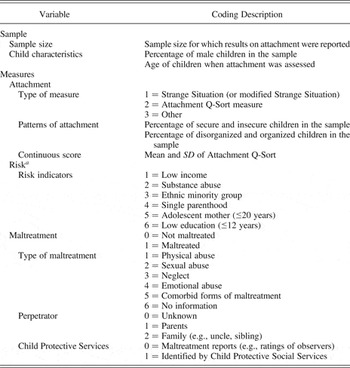
Coding system for the studies included in the meta-analytic sample

aA risk indicator was coded when at least 50% of the sample was characterized by this risk.
Children included in the 10 maltreatment studies were either physically abused, sexually abused, neglected, emotionally maltreated, or had experienced multiple forms of maltreatment. The most widely accepted definitions of types of maltreatment have been described in Cicchetti and Valentino (Reference Cicchetti, Valentino, Cicchetti and Cohen2006). Based on these descriptions, we defined (a) sexual abuse as sexual contact or attempted sexual contact between a caregiver or other responsible adult and a child, (b) physical abuse as injuries inflicted by an adult on a child by nonaccidental means, (c) neglect as the failure to provide minimum standards of physical care, and (d) emotional maltreatment as the persistent and extreme refusal to consider a child's basic emotional needs (e.g., belittling, intimidating, severe indifference).
Coding system
A standard coding system was used to rate each study on sample characteristics and measures of attachment, risk and maltreatment (see Table 2). We coded sample size, child gender, and child age at assessment. Information on attachment included the type of attachment measure and the percentages of secure and disorganized children or the mean and standard deviation of the AQS. We coded the following socioeconomic risk indicators: (a) low income, (b) maternal substance abuse (including children who were prenatally exposed to alcohol/drug and children with a parent currently using alcohol/drug), (c) ethnic minority group, (d) single parenthood, (e) adolescent mother, and (f) low education. This selection of risk factors was exhaustive of the information provided by the studies included in the current set of meta-analyses. Information regarding maltreatment included: (a) whether or not children had been maltreated, (b) type of maltreatment, (c) perpetrator status, and (d) whether child maltreatment was ascertained by Child Protective Services (CPS) or identified by others (e.g., ratings by observers or responses to questionnaires). Studies were coded independently by two coders (C.C. and E.E.). Coders achieved good reliability, and intraclass correlations and kappas ranged from .67 to 1.00 (M = .97, k = 12 studies). Disagreements were discussed and final scores reflected the consensus of the two coders.
Data analyses
A binomial test, using the chi-square statistic, was conducted to compare the studies' distributions of attachment patterns (secure vs. insecure, and disorganized vs. organized attachment classification) to the normative low-risk distribution of attachment patterns derived from the meta-analysis of van IJzendoorn et al. (Reference van IJzendoorn, Schuengel and Bakermans-Kranenburg1999; four-way classification (N = 2,104) A: 15%, B: 62%, C: 9%, D: 15%) and van IJzendoorn et al. (Reference van IJzendoorn, Goldberg, Kroonenberg and Frenkel1992; three-way classification (N = 1,584), A: 21%, B: 67%, C: 12%). Data of the studies using the continuous AQS measure were compared to the mean and standard deviation of the AQS in a normative low risk set of studies (M = 0.32, SD = 0.16, N = 2,516) reported in the meta-analysis of van IJzendoorn, Vereijken, Bakermans-Kranenburg, and Riksen-Walraven (Reference van IJzendoorn, Vereijken, Bakermans-Kranenburg and Riksen-Walraven2004).
An examination of the maltreatment studies indicated that in the large majority of studies maltreatment had been reported to CPS agencies. In most cases, the perpetrator was the mother, in other words, the attachment figure with whom the Strange Situation or the AQS was performed. Only a small number of children, as mentioned in three studies (Barnett et al., Reference *Barnett, Ganiban and Cicchetti1999; Cicchetti et al., Reference *Cicchetti, Rogosch and Toth2006; Moss et al., 2007), were not abused or neglected by their attachment figure: they had either been abused by another person or they had witnessed their attachment figure maltreating an older sibling. Because most studies did not report attachment data as a function of perpetrator status we could not test for this moderator in our analyses. In addition, because there were fewer than four studies with different perpetrator status, we could not compare this set of studies with that of studies with the attachment figure as the perpetrator.
In many studies children had experienced multiple forms of maltreatment, but only two studies specifically reported data on the attachment of children with multiple forms of maltreatment in comparison to children experiencing one form of maltreatment. We therefore did include this moderator in our analyses. More specifically, Crittenden (Reference *Crittenden, Belsky and Nezworski1988) and Egeland and Sroufe (Reference *Egeland and Sroufe1981) provided data on children who were both neglected and abused. However, because this concerned very few children (n = 3) in the Egeland and Sroufe study, effect sizes were computed only for the Crittenden study (see Table 1). Some studies however compared attachment of physically abused children with attachment of those who had been neglected (Crittenden, Reference *Crittenden, Belsky and Nezworski1988; Egeland & Sroufe, Reference *Egeland and Sroufe1981; Lamb et al., Reference *Lamb, Gaensbauer, Malkin and Schultz1985). Effect sizes for these distinct outcomes were included in our meta-analyses (see Results).
The outcomes of all studies were inserted into Borenstein, Rothstein, and Cohen's (2004) Comprehensive Meta-Analysis (CMA) Program, which computed an effect size for each study (Cohen d) as well as fixed and random effect model parameters. Some studies presented data on more than one group (e.g., one maltreated children high-risk group and one nonmaltreated children high-risk group). Effect sizes were computed for each group. Each child was included in the meta-analysis only once. CMA also provides confidence intervals (CIs) around the point estimate of the effect size for each study (see Table 1). According to Cohen's (1988) criteria, a d value of up to 0.20 is considered a small effect, a d value of about 0.50 is a moderate effect, and a d value of about 0.80 and higher can be seen as a large effect. In the current meta-analyses, a positive d value represents a lower proportion of secure children or a higher proportion of disorganized children in comparison with the normative set of studies. For each study, we also computed the Fisher Z as an equivalent to the correlation coefficient r with better distribution characteristics (see Mullen, Reference Mullen1989). These scores were used to conduct the multivariate analyses and to check for outlying effect sizes. The set of studies included in the current meta-analyses did not have outliers (smaller than Z = −3.29 or larger than Z = 3.29).
Significance tests and moderator analyses were performed through fixed or random effects models, depending on the homogeneity of the study outcomes. Fixed effects models are based on the assumption that effect sizes observed in a study estimate the corresponding population effect with random error that stems only from the chance factors associated with subject-level sampling error in that study (Lipsey & Wilson, Reference Lipsey and Wilson2001; Rosenthal, Reference Rosenthal1995). This assumption is not made in random effects models (Hedges & Olkin, Reference Hedges and Olkin1985). Random effects models allow for the possibility that there are random differences between studies that are associated with variations in procedures, measures, settings, that go beyond subject-level sampling error, and thus point to different study populations (Lipsey & Wilson, Reference Lipsey and Wilson2001). Whether fixed or random models can be used depends on the homogeneity of the set of effect sizes. The Q-statistics for the homogeneity of the specific set of effect sizes are presented (see Tables 3 and 4), as well as the Q-statistics testing the significance of the moderators (Borenstein et al., Reference Borenstein, Rothstein and Cohen2004; Mullen, Reference Mullen1989; Rosenthal, Reference Rosenthal1995). Asterisks for Q indicate heterogeneity of the specific set of studies. From Tables 3 and 4 it can be seen that several data sets were heterogeneous. In these cases, the random effects model parameters (significance, confidence intervals) were presented (see Table 3 and 4); they are more conservative than the fixed effects parameters, and the moderator tests should be considered to be descriptive of the specific set of studies at hand (Rosenthal, Reference Rosenthal1995). Contrasts were only tested when at least two of the subsets consisted of at least four studies (Bakermans-Kranenburg et al., Reference Bakermans-Kranenburg, van IJzendoorn and Juffer2003).
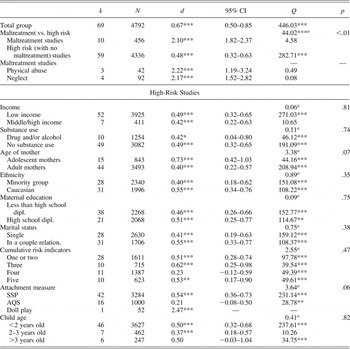
Attachment insecurity for maltreatment and high-risk studies: moderators

Note: k, number of studies; d, effect size; CI, confidence interval of the effect size; SSP, Strange Situation procedure; AQS, Attachment Q-Sort. aQ for comparison.
*p < .05. **p < .01. ***p < .001.
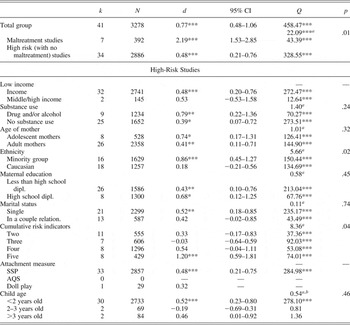
Attachment disorganization for maltreatment and high-risk studies: moderators

Note: k, number of studies; d, effect size; CI, confidence interval of the effect size.
aQ for the comparison;
bComparison: <2-year-old children vs. >2-year-old children; SSP, Strange Situation procedure; AQS, Attachment Q-Sort.
*p < .05. **p < .01. ***p < .001.
Potential publication bias was estimated using the Duval and Tweedie (Reference Duval and Tweedie2000) trim-and-fill method that is available in CMA. In a funnel plot each study's effect size is plotted against its precision (1/SE). The plot is shaped as a funnel if there is no publication bias. However, small studies with negative or nonsignificant results tend to be more difficult to get published, and this might be visible as a lack of studies in the bottom left-hand corner of the funnel plot. In the trim-and-fill method the studies located right from the funnel are considered to be symmetrically unmatched, and their missing counterparts are imputed as mirror images of the trimmed outcomes. A new, adjusted combined effect size (with CI) can be computed, reflecting the combined effect size when no publication bias would have been present. The robustness of the combined effect size was also examined by computing the fail-safe number, which is the number of studies with null results that would be needed to change the effect size into a nonsignificant outcome (Mullen, Reference Mullen1989; Rosenthal, Reference Rosenthal1991).
Results
Maltreatment studies
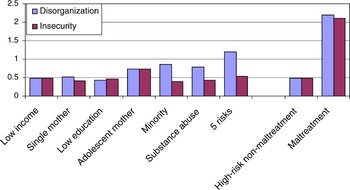
The combined effect size for security for the total set of studies with maltreated children (k = 10, n = 456) was d = 2.10, in a homogeneous set of outcomes (CI = 1.82–2.37). Similar results were found for attachment disorganization: the combined effect size for disorganization for the total set of studies with maltreated children reporting on disorganized attachment (k = 7, n = 392) was d = 2.19 in a heterogeneous set of outcomes (CI = 1.53–2.85). Hence, there were substantially smaller numbers of secure and higher numbers of disorganized attachments in maltreated children compared to children from normative low-risk backgrounds (see Table 3). It would take 471 studies on attachment security and 283 studies on attachment disorganization with null results to cancel out these combined effects sizes. Funnel plots showed no publication bias. The difference in attachment security and disorganization between maltreated and nonmaltreated children amounted to more than two standard deviations.
Neglect versus physical abuse
Out of the 10 studies conducted on maltreated children, three provided specific data on the attachment security of physically abused children and four of neglected children. The combined effect size for samples of physically abused children (k = 3, n = 42) was d = 2.22 in a homogeneous set of outcomes (CI = 1.19–3.24). The combined effect size for samples of neglected children (k = 4, n = 92) was d = 2.17 (CI = 1.52–2.82). Because the set of studies on physically abused children was too small (fewer than four studies), we were not able to formally test the difference between physically abused and neglected children. However, on a descriptive level, we notice that the confidence intervals of both sets of studies are completely overlapping, indicating no differences in attachment security between physically abused and neglected children.
Only one study provided data on attachment disorganization of neglected children (Valenzuela, Reference *Valenzuela1990) and no study reported on the prevalence of disorganization of physically abused children. Therefore, it was not possible to compare neglected and physically abused children on attachment disorganization.
High-risk nonmaltreated children versus maltreated children
The combined effect size for security in the total set of high-risk studies with nonmaltreated children (k = 59, n = 4,336) was d = 0.48 in a heterogeneous set of outcomes (CI = 0.32–0.63). The combined effect size for disorganization was also d = 0.48 (k = 34, n = 2,886), in a heterogeneous set of outcomes (CI = 0.21–0.76). These results showed significantly lower proportions of secure children and more disorganization in high-risk nonmaltreated samples in comparison with children from low-risk backgrounds. It would take 1,903 studies with null results on attachment security and 450 studies with null results on attachment disorganization to cancel out these combined effects sizes. Funnel plots showed no publication bias.
Contrasting the maltreatment and high-risk studies indicated lower proportions of secure children and higher proportions of disorganized children in maltreated samples compared to high-risk nonmaltreated samples (Q = 44.02, p < .01 for security, and Q = 22.09, p < .01 for disorganization), see Tables 3 and 4.
High-risk studies
Risk indicators
The 59 high-risk samples of nonmaltreated children were broken down according to six criteria or risk indicators: (a) income, (b) substance abuse, (c) adolescent mothers, (d) ethnic minority group, (e) education, and (f) single parenthood. We compared subsets of studies on the basis of these different risks. For example, out of the 59 studies of high-risk nonmaltreated children, 15 involved adolescent mothers and 44 concerned adult mothers. Although these studies were characterized by several other similar risk indicators, we were able to compose two different subsets of studies on the basis of the mothers' age at child birth. These two subsets of high-risk studies (i.e., adolescent and adult mothers) were then compared to the set of normative low-risk studies provided in the meta-analyses of van IJzendoorn et al. (Reference van IJzendoorn, Goldberg, Kroonenberg and Frenkel1992, 1999, 2004), as well as compared to each other. This procedure was used for each of the risk indicators. Table 3 and Table 4 present the effect sizes, CIs, and Q statistics for each risk indicator.
Income, substance abuse, maternal age at child birth, educational level, and single parenthood did not significantly moderate the combined effect size for attachment security and for attachment disorganization. Type of attachment measure and child age at assessment were not significant moderators either. We were not able to test contrasts regarding attachment disorganization for all moderators, as some subsets contained fewer than four studies, for example, in the case of child age over 2 years old. Ethnicity and number of risk factors did not moderate the effect size for attachment security, but they were significant moderators for attachment disorganization.
Concerning ethnicity, significantly more disorganized attachment was found in studies with minority groups (d = 0.86, k = 16, n = 1,629) in comparison with children from low-risk backgrounds. The proportion of disorganized children in studies of high-risk Caucasian mothers (d = 0.18, k = 18, n = 1,257) was not significantly different from that found in the set of normative low-risk studies. The difference between the two groups was significant (Q = 5.66, p = .02; see Table 4). The data on ethnicity shows most mothers of minority groups were also single. To better understand the effect of ethnicity on disorganization, we then compared single minority mothers with single Caucasian mothers. The proportion of secure children in studies of single minority mothers (d = 0.36, k = 18, n = 1,746) was not significantly different from that found in the set of single Caucasian mothers (d = 0.49, k = 10, n = 884, Q = 0.30, p = .59). Significantly more disorganized attachments were found in studies with single minority groups (d = 0.86, k = 14, n = 1,510) in comparison with studies of single Caucasian mothers (d = 0.01, k = 7, n = 789, Q = 4.43, p = .04).
The set of studies with five risk indicators showed a significantly higher proportion of disorganized children (d = 1.20, k = 8, N = 429) in comparison with children from low-risk backgrounds. Similar differences were not found for the sets of studies with one to two risk indicators (d = 0.33, k = 11, N = 555), three risk indicators (d = −0.03, k = 7, N = 606), or four risk indicators (d = 0.54, k = 8, N = 1,296). Because there were only five studies with one risk indicator, we combined these studies with those showing two risks. Studies with more than five risk indicators were absent. The contrast comparing subsets of studies with four levels of risk (one to two, three, four, and five risk indicators) was significant (Q = 8.36, p = .04). The post hoc contrast between studies with five risks versus studies with fewer than five risks was also significant (Q = 7.12, p < .01). Hence, children living in families characterized by five risk indicators were significantly more likely to be disorganized than children living in families characterized by a lower number of risks.
Five risks versus maltreatment
To test whether nonmaltreated children living under the impact of a high number of risks were as likely as maltreated children to show secure attachment behavior, we compared studies of maltreated children (k = 10) with studies on nonmaltreated children with the highest level of risk (five risk indicators, k = 10). A significant contrast was found (Q = 27.99, p = .01), showing that maltreated children (average number of risk indicators: M = 2.50, SD = 0.27) were less likely to develop secure attachment than children exposed to five risk indicators. However, the contrast for disorganization was not significant (Q = 2.07, p = .15). Hence, children living in families characterized by five risk indicators (k = 8 studies) did not show significantly less attachment disorganization than maltreated children (k = 7 studies; average number of risk indicators: M = 2.43, SD = 0.30). Figure 1 presents the combined effect sizes for risk indicators and maltreatment status.
Combined effect sizes for risk indicators and maltreatment status. [A color version of this figure can be viewed online at journals.cambridge.org/dpp]

Multivariate analyses
Principal component analysis
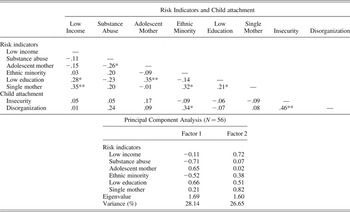
To examine whether attachment security and disorganization were related to a specific constellation of risk indicators, we conducted a principal component analysis on the six risk indicators (low income, substance abuse, adolescent mother, low education, ethnic minority group, and single parenthood) with varimax rotation to derive potential dimensions of risk from the 59 high-risk samples. Results yielded two components with an eigenvalue larger than 1. The first component represented low-educated adolescent mothers, whereas the second component represented single low-income mothers with low education. Correlations among risk indicators and loadings of the two factors are presented in Table 5.
Factor loadings for risk indicators and correlations among risk indicators and child attachment insecurity and disorganization

Note: For analyses on child attachment insecurity, N = 59; for analyses on child attachment disorganization, N = 34. Factor 1, low-educated adolescent mothers; Factor 2, single low-income mothers with low education.
*p < .05. **p < .01.
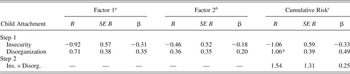
Two multiple regression analyses were conducted to examine whether attachment security and disorganization were significantly related to the risk components. The first regression analysis with the first component, low-educated adolescent mothers, as the dependent variable and Fisher's Z scores of security and disorganization effect sizes per study as the independent variables revealed no significant regression equation, R 2 = .12, F (2, 31) = 2.12, p = .14 (see Table 6). The results of the second regression analysis with the second component, single low-income mothers with low education, as the dependent variable were also nonsignificant, R 2 = .04, F (2, 31) = 0.63, p = .54. Neither attachment insecurity nor disorganization was significantly related to a specific constellation of risks. The addition of an interaction term for the two predictors did not change these outcomes.
Summary of hierarchical regression analyses for the association between risk and attachment insecurity and disorganization

Note: N = 34. Factor 1, low-educated adolescent mothers; Factor 2, single low-income mothers with low education.
aR 2 = .12, p = .14.
bR 2 = .04, p = .54.
cR 2 = .20, p = .03 for Step 1; R 2change = .04, p = .25 for Step 2.
*p < .05.
Cumulative risk
A multiple regression analysis was conducted to examine the link between cumulative risk and attachment, and to test whether the interaction between child attachment security and disorganization contributed to the association found between cumulative risk and attachment. The first step included both Fisher's Z scores of attachment insecurity and disorganization. These two variables were centered and their interaction term was included in the second step of the regression model. Results revealed that the first step of the model was significant, R 2 = .20, F (2, 31) = 3.82, p = .03. In line with the results presented in the previous section on cumulative risk, attachment disorganization was associated with a higher level of risk (β = 0.49, p = .01), whereas attachment security was not related to the cumulative risk score (β = −0.33, p = .08). The inclusion of the interaction term at the second step did not significantly contribute to the prediction of the cumulative risk score, R 2 = .04, F (1, 30) = 1.18, β = 0.31, p = .25 (see Table 6).
Discussion
The aim of this study was to examine the impact of maltreatment and socioeconomic risks on attachment security and disorganization. Taken as a whole, results of the current meta-analyses showed that children living under high-risk conditions, whether they were maltreated or not, are more likely to develop insecure and disorganized attachment patterns than children living in low-risk families. The impact of maltreatment on attachment security and disorganization amounts to more than two standard deviations, which is an extremely large effect size, whereas the impact of high risk without maltreatment is nearly half a standard deviation (a medium effect size) for both attachment security and disorganization.
When various risk factors and constellations of risk factors were compared, results revealed different child attachment outcomes as a function of the type and number of risks. In particular, maltreated children are less likely to develop secure attachments and more likely to develop disorganized attachments compared to nonmaltreated children living in high-risk conditions. However, disorganization is also more likely to emerge in children exposed to the cumulative impact of socioeconomic risks. In fact, children exposed to five risks are almost as likely as maltreated children to become disorganized. This is not the case for attachment security: maltreated children are less likely to develop a secure attachment pattern than children exposed to five risk indicators. In addition, children of minority group mothers are more prone to become disorganized in comparison to those living with high-risk Caucasian mothers.
Maltreatment and attachment
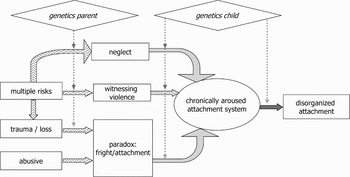
Child maltreatment has a strong impact on attachment. It creates fright without solution for a child because the attachment figure, whom the child would approach for protection in times of stress and anxiety, is at the same time the source of fright, whether this attachment figure is the perpetrator, a potential perpetrator (in cases of sibling abuse), or failing to protect the child against the perpetrator (see Figure 2; Hesse & Main, Reference Hesse and Main1999, Reference Hesse and Main2000, Reference Hesse and Main2006). In line with studies showing a greater proportion of organized–insecure and disorganized attachments in samples of maltreated children in comparison to similar high-risk nonmaltreated children samples (Barnett et al., Reference *Barnett, Ganiban and Cicchetti1999; Crittenden, Reference *Crittenden, Belsky and Nezworski1988, Egeland & Sroufe, Reference *Egeland and Sroufe1981; Lamb et al., Reference *Lamb, Gaensbauer, Malkin and Schultz1985; Lyons-Ruth et al., Reference *Lyons-Ruth, Connell, Grunebaum and Botein1990; Valenzuela, Reference *Valenzuela1990), this meta-analysis shows substantial combined effects sizes of d = 2.14 for attachment security and d = 2.20 for attachment disorganization. According to Cohen (Reference Cohen1988), these markedly large effects indicate a nonoverlap of at least 80% of the two distributions of maltreated and nonmaltreated high-risk children. This implies that the chances for a maltreated child to develop a secure, nondisorganized attachment pattern are very small. As shown in Figure 1, the chances for a maltreated child to be insecure or disorganized are not different. This is contrary to our hypothesis that a higher prevalence of disorganized attachment compared to organized–insecure attachment would be found in samples of maltreated children. Given that the disorganized classification was developed to more adequately grasp attachment behavior of difficult to classify cases, which were mainly composed of maltreated children (Main & Solomon Reference Main, Solomon, Greenberg, Cicchetti and Cummings1990), we had expected a stronger association between maltreatment and attachment disorganization compared to the association between maltreatment and attachment insecurity. Of course, child maltreatment usually goes together with insensitive parenting. In a number of children this might lead to an avoidant or resistant organized attachment strategy. These insecure behaviors may also be seen in children with a disorganized classification.
Attachment disorganization: a multiple-pathway model of risk and maltreatment.

The number of studies examining attachment of maltreated children is small. Strikingly, we found only 10 studies with validated measures of attachment that examined attachment security, 7 of which examined also disorganized attachment. Although the set of maltreatment studies is relatively small, our estimates of combined effect sizes reported for attachment security and disorganization of maltreated children show lower 95% confidence boundaries that are still more than 1.5 SD from zero, again pointing to large effect sizes. Because of the small set of studies, we were unable to statistically test for differences between (physically) abused and neglected children. Considering the confidence boundaries around the point estimates for abuse and neglect, we note that the impact of both types of maltreatment on attachment seems similar.
Collecting data on high-risk samples is a difficult task, especially when working with the child welfare system. Maltreated children are often victims of multiple forms of abuse, making it difficult to compare the different types of abuse or to constitute groups of sufficient size for data-analytic purposes. In addition, researchers are facing important methodological challenges as maltreated children may often change child-rearing arrangements or live in areas that are dangerous not only for the research participants but also for the researchers themselves. Selective sampling may be an important problem to consider because children who are at highest risk or most severely maltreated may be inaccessible to researchers. Conjoint work with the child welfare system may also raise legal and ethical issues involving sharing information with clinical workers or being asked to provide a statement in court. Thus far, remarkable and rigorous work has been conducted by several research groups pioneering this important but also challenging issue. However, there still is an urgent need for more information.
Cumulative risk and attachment
Notably, the present meta-analysis reveals that whereas the mere presence of risk is sufficient to affect attachment security and disorganization, cumulative risks appear to impact disorganized attachment more strongly. The more socioeconomic risk factors children are exposed to, the more children take on a pathway leading to attachment disorganization. This result is in line with the large body of research showing that specific constellations of risks are less strongly related to negative developmental outcomes than cumulating risks (Ackerman et al., Reference Ackerman, Izard, Schoff, Youngstrom and Kogos1999; Pungello et al., Reference Pungello, Kupersmidt, Burchinal, Burchinal and Patterson1996; Sameroff et al., Reference Sameroff, Seifer, Barocas, Zax and Greenspan1987, Reference Sameroff, Bartko, Baldwin, Balwing, Seifer, Lewis and Feiring1998). Although there is a possibility that researchers did not systematically report every single socioeconomic risk that characterized their sample, and therefore underestimate the total number of risks, none of the two factors identified with the principal component analysis was associated with child attachment, whereas the accumulation of risk factors did make a difference. This supports the cumulative risk hypothesis.
Multiple pathways to disorganization
Our results indicate that not only is attachment disorganization more likely to emerge in children exposed to several socioeconomic risks, but also that those exposed to five risk factors are almost as likely as maltreated children to become disorganized. One explanation for this finding is that undetected or unsubstantiated cases of maltreatment might be found in multiple-risk families with a disorganized child. Alternatively, parenting behavior as negative in its consequences as maltreatment may mediate the link between socioeconomic risks and child attachment disorganization. Recent research on frightening/frightened parental behavior (Hesse & Main, Reference Hesse and Main2000, Reference Hesse and Main2006) may shed light on the behavioral mechanisms through which family risks influence the development of attachment disorganization. It has been recognized that attachment disorganization emerges when the child experiences fear of the parent, which impedes the child's capacity to develop an organized attachment strategy or causes a breakdown of an existing strategy for the use of the parent as a safe haven in times of stress.
Hesse and Main (Reference Hesse and Main2006) have suggested that parental frightening behaviors may result from nonintegrated memories and emotions associated with experiences of trauma (e.g., loss, abuse). In multiple-risk environments parents may actually have experienced loss or other trauma more often than in single or no-risk environments (Lynch & Cicchetti, Reference Lynch and Cicchetti1998; Oravecz, Koblinsky, & Randolph, Reference Oravecz, Koblinsky and Randolph2008). As a parent interacts with his or her child, the environment or the child's own behavior may trigger the reminiscence of past trauma and provoke the parent's entrance into an altered or dissociative state of mind, increasing the likelihood of parental frightening or frightened behaviors (e.g., looming, using a haunted voice, freezing, interacting with the child as though he or she was in control) that constitute an irresolvable paradox for the child, resulting in attachment disorganization (see Schuengel, Bakermans-Kranenburg, & van IJzendoorn, Reference Schuengel, Bakermans-Kranenburg and van IJzendoorn1999, for empirical proof of this linkage). In the absence of direct maltreatment, parental frightening behavior might be proposed to be a key mechanism through which parents at high levels of socioeconomic risk and exposed to more traumatic experiences prompt the development of attachment disorganization.
Without concrete evidence about the higher prevalence of frightening behavior in parents from multiple-risk environments, we would like to suggest two other pathways to attachment disorganization. First, parents' withdrawal from interacting with the child because of overwhelming personal or socioeconomic problems and daily hassles is speculated to lead to a chronic hyperaroused attachment system in the child. In fact, children in families from a multiple-risk background may be subjected to some type of parental neglect that seems to be unavoidable in chaotic living and child rearing circumstances. Solomon and George (Reference Solomon, George, Solomon and George1999) elaborated on Main and Hesse's (1990) concept of “fright without solution,” suggesting that the caregiver's repeated failure to protect the infant and satisfy attachment needs when they have been aroused subject the infant to an extreme and continuous state of fear. The child may ultimately be faced with the frightening realization that, when in need of protection, the caregiver is unlikely to provide a haven of safety and to terminate the child's need for proximity and close protective contact (Madigan, Bakermans-Kranenburg, et al., 2006). In line with this contention, Lyons-Ruth and colleagues (1999) also suggest that disorganized attachment relationships may not only result from frightening or frightened parenting behavior but also from an extremely insensitive caregiver. In their model, lack of response (i.e., withdrawal from interactions), or extremely insensitive responses (i.e., aggressive handling of the child, harsh discipline, lack of supervision in dangerous situations, affective communications errors without repair) can be as fear provoking for the child as parental behaviors that are directly frightening. Using a sample of high-risk families including a small number of maltreated children, they found that both frightening and extremely insensitive behavior were more likely to characterize mothers with a disorganized child than mothers with an organized insecure child.
Second, domestic violence may more often occur in multiple-risk conditions (Cicchetti & Lynch, Reference Cicchetti and Lynch1993). Children who witness violence in the family, including partner violence, have been shown to run a greater risk of becoming disorganized. Zeanah et al. (Reference Zeanah, Danis, Hirshberg, Benoit, Miller and Heller1999) documented a dose–response relation between mothers' exposure to partner violence and infant disorganization. With increasing levels of violent relationships with current partners, mothers were increasingly likely to have infants with disorganized attachments. Zeanah et al. (Reference Zeanah, Danis, Hirshberg, Benoit, Miller and Heller1999) speculate that witnessing parental violence could elicit fear in a young child about the mother's well-being and her ability to protect herself as well as the child against the violence.
Thus, we suggest multiple and nonexclusive pathways to attachment disorganization involving either child maltreatment by abusive parents or parental neglect in a chaotic multiple-risk family environment. The pathway of abuse is based on the idea of (physically or sexually) maltreating parents creating fright without solution for the child who cannot handle the paradox of a potentially protective as well as abusive attachment figure, and thus becomes disorganized.
Another pathway is associated with the chaotic environment of multiple-risk families leading to neglect of the attachment needs of the children. Parents' withdrawal from interacting with their children because of urgent problems and hassles in other domains of functioning (securing an income, loss of a job, discrimination, housing problems) creates a chronic hyperaroused attachment system in a child who does not know to whom to turn for consolation in times of stress. Chronic activation of the attachment system at a high level of alertness may in the end lead to a breakdown of organized attachment strategies or impede children's capacity to even develop an organized insecure attachment strategy. Marital discord and domestic violence in multiple-risk families may also lead to elevated levels of disorganization as the child is witnessing an attachment figure unable to protect herself in her struggle with a partner. Finally, multiple-risk environments lead to parents experiencing more losses and other traumatic events that may remain unresolved and trigger frightening or frightened parenting behavior that has been shown to result in disorganized attachment (see Figure 2 for the multiple-pathway model).
Genetic moderators
Individuals may be less or more susceptible to environmental pressures (Belsky, Reference Belsky1997) such as parental unresolved loss (van IJzendoorn & Bakermans-Kranenburg, 2006) and insensitive parenting in the case of the children (Bakermans-Kranenburg & van IJzendoorn, Reference Bakermans-Kranenburg and van IJzendoorn2006. 2007; Barry, Kochanska, & Philibert, 2008) or daily hassles in the case of the parents (van IJzendoorn, Bakermans-Kranenburg, & Mesman, Reference van IJzendoorn, Bakermans-Kranenburg and Mesman2008), and child maltreatment may work out very differently for different children (Caspi et al., Reference Caspi, McClay, Moffitt, Mill, Martin and Craig2002). These examples point to potentially important genetic explanations of resilience and vulnerability in maltreating families or families at risk for maltreatment (see Figure 2). Genetic differences in dopamine-related genes might make parents less or more vulnerable to daily hassles (van IJzendoorn et al., Reference van IJzendoorn, Bakermans-Kranenburg and Mesman2008), and genetic differences in monoamine oxidase A may make children less or more vulnerable to become antisocial in adulthood after experiences of maltreatment in childhood (Caspi et al., Reference Caspi, McClay, Moffitt, Mill, Martin and Craig2002). The study of genetic moderation of the influence of multiple-risk environments on parenting and of abusive or risk environments on child development has just begun, but it has already shown considerable promise in solving at least part of the puzzle why some individuals are more susceptible to extreme environmental pressures than others.
Important questions regarding the association between maltreatment and attachment remain to be addressed in future research. In particular, why do some maltreated children develop a secure attachment pattern, and what characterizes these children? How does attachment security constitute a protective factor in high-risk contexts? Attachment security is most likely to interact with other protective factors such as the child's biological constitution or the caregivers' psychosocial resources. Psychosocial risk, that is, risk associated with parental functioning such as parental stress, depression, social support, or psychopathology, has been associated with attachment. However, few studies have indicated the differential impact of socioeconomic and parental psychosocial risks on child attachment (but see Raikes & Thompson, Reference *Raikes and Thompson2005; Shaw & Vondra, Reference Shaw and Vondra1993). More studies are needed to examine how these two types of risk interrelate and influence child attachment, and how genetic factors may protect or exacerbate these influences.
Ethnicity and single parenthood
Our study also shows a higher proportion of disorganized children in families with a minority group mother in comparison to families with a Caucasian mother among nonmaltreated high-risk children. Noteworthy, most mothers of minority groups were also single. Although children of African American, Asian, or non-White mothers might be exposed to different cultural environments or parental practices in comparison to children of Caucasian mothers, most findings of cross-cultural studies on attachment have shown the universality of child attachment processes (van IJzendoorn & Sagi, Reference van IJzendoorn, Sagi, Cassidy and Shaver2008). Our results showing more disorganized attachments in studies of single minority mothers in comparison to studies of single Caucasian mothers point to the importance of being both single and a visible minority. Unfortunately, we were not able to contrast single and nonsingle mothers from minority groups because there were only two studies of minority group mothers that were not single. Being a single mother may limit access to financial or social resources, increase social isolation, and maternal stress, and result in inadequate caregiving behavior and child disorganized attachment. This process seems to be more problematic for children of high-risk minority group mothers than for those of high-risk Caucasian mothers. Bakermans-Kranenburg et al. (Reference *Bakermans-Kranenburg, van IJzendoorn and Kroonenburg2004) demonstrated that the link between low-income African American families and child attachment insecurity (as assessed with the AQS) was partially mediated by maternal insensitivity, and that low income appeared to be a more important factor than ethnicity. As suggested by these authors and others (see also McLoyd, Reference McLoyd1990), high-risk characteristics might be more persistent in African American families than in deprived Caucasian families for which high-risk conditions are more of a transitory phenomenon. Additional stressors such as the experience of racism or isolating language barriers might play an important role.
Prevention and intervention
Attachment-based parenting interventions are currently being developed and evaluated. Several randomized control trials are starting to provide data on the effectiveness of attachment interventions with high-risk populations (for reviews, see Berlin et al., Reference Berlin, Ziv, Amaya-Jackson and Greenberg2005; Juffer, Bakermans-Kranenburg, van IJzendoorn, Reference Juffer, Bakermans-Kranenburg and van IJzendoorn2008). Interventions with a focus on ecological variables such as social support appear less effective than those promoting parental sensitive behavior. However, very few of these intervention studies were conducted with maltreated children and their biological parents. Results of our meta-analyses suggest that preventive efforts to reduce child maltreatment may not only be oriented toward reinforcing sensitive parenting behavior but also try to alleviate less immediate contextual issues such as parenting stress, social support, home safety, and job placement. In the practice of child protective agencies it may be a necessary condition to address socioeconomic risks before fruitful focused efforts to enhance parenting skills become possible.
Recently, a major randomized control study by Cicchetti et al. (Reference *Cicchetti, Rogosch and Toth2006) has demonstrated the remarkable effectiveness of an attachment-based intervention for maltreating families. After going through 23 sessions of child–parent psychotherapy, which focused on enhancing maternal sensitivity through maternal reinterpretation of past attachment experiences, a substantial reduction in infant disorganized attachment, and an increase in attachment security was observed for the intervention group. However, change in maternal sensitivity seemed not, as it would have been expected, the mediator of change in child attachment. The absence of a mediating effect points to other mechanisms explaining changes in child attachment. The intervention may also have reduced parental frightening behavior and thereby enhanced child attachment security. In addition to testing programs with a dual focus on socioeconomic risks and insensitive parental behavior, our study also points to the need of focusing on frightening parental behavior as a potential mediator of changes in child attachment. Through video feedback maltreating parents may be enabled to better recognize their own frightening behavior toward their child, and a focus on sensitive and positive behavior could follow to facilitate repair of these disrupted epochs of interaction with the child.
Cleary, further research on potential behavioral mediators of abuse and on focused intervention programs for maltreated children is needed. The lack of evidence-based interventions for maltreatment may have led some clinicians to rely on so called holding therapies in which children are forced to make physical contact with their parent or other caregivers although they strongly resist these attempts. Holding therapy however has not been proven to be effective (Chaffin et al., Reference Chaffin, Hanson, Saunders, Barnett, Zeanah and Berliner2006; O'Connor & Zeanah, Reference O'Connor and Zeanah2003; Sroufe, Erickson, & Friedrich, Reference Sroufe, Erickson and Friedrich2002), and in some cases such therapies have been harmful for children (Chaffin et al., Reference Chaffin, Hanson, Saunders, Barnett, Zeanah and Berliner2006). Holding therapy is not implied at all by attachment theory. Therapists force the parent or caregiver to be extremely insensitive and to ignore clear signs from the child not wanting physical contact. At the core of intervention programs informed by attachment theory, sensitive parenting is the careful reading of children's attachment signals and needs, and the prompt and adequate response to those signals (Ainsworth et al., Reference Ainsworth, Blehar, Waters and Wall1978).
Conclusion
Our meta-analyses highlighted that child attachment insecurity and attachment disorganization are strongly impacted by maltreating parental behavior and by cumulative socioeconomic risks. These risks may be important moderators of program effectiveness with maltreating parents.