During sentence planning, a nonlinear, preverbal thought or message is transformed into a linear, forward-flowing utterance (Bock, Reference Bock1982, Reference Bock and Ellis1987a, Reference Bock, Miller and Eimas1995; Levelt, Reference Levelt1989). This transformation is achieved through a series of coordinated and overlapping activities that can be viewed as “computational problems” (Bock, Reference Bock and Ellis1987a, p. 337) to be solved quickly by a limited-capacity cognitive processing system. Viewing language production in this way invites questions about the nature of these computational problems, the solutions offered by the production system, and how these solutions interact with cognitive processing capacity. Although these questions apply to children no less than adults, child-focused studies of specific computational challenges in sentence planning are limited. Questions about computational challenges, however, may be particularly germane in early development. Where available, the evidence indicates important similarities between adults and children in the nature and organization of the activities involved in sentence planning (Jaeger, Reference Jaeger1992; McDaniel, McKee, & Garrett, Reference McDaniel, McKee and Garrett2010; Stemberger, Reference Stemberger1989). Children, like adults, must coordinate incremental, temporally overlapping activities during sentence planning and production, but may experience limitations in doing so. The rate and patterning of dysfluencies within sentences, for example, suggests greater challenges in the ability to “sustain concurrency of processing” McDaniel et al., Reference McDaniel, McKee and Garrett2010, p. 88), in children than in adults, and in younger children than in older children. No doubt, some of these challenges reflect general cognitive constraints on information processing. We can also ask, however, how specific planning challenges affect capacity or are accommodated by the production machinery in developing language users. In this study, we examine how computational challenges related to the timing of lexical activation and integration with syntactic plans affect children's sentence production.
VARIATION IN LEXICAL PROCESSING DURING SENTENCE PLANNING
The sentence planning process is divided into overlapping components responsible for message planning, grammatical encoding, and phonological/phonetic encoding (Bock & Levelt, Reference Bock, Levelt and Gernsbacher1994; Ferreira & Slevc, Reference Ferreira, Slevc and Gaskell2007; Levelt, Reference Levelt1989). Given a developing message, grammatical encoding processes activate and select the words to express this message, and integrate them within a syntactic plan. This is achieved through the activities of both lexical and syntactic processing streams. Message-level inputs provide activation to lemmas, or abstract, syntactically marked word representations. Speakers select the words for their utterance and assign grammatical roles such as subject and object. Speakers also retrieve morphophonological word form representations and create a serially ordered syntactic plan (Bock & Levelt, Reference Bock, Levelt and Gernsbacher1994; Ferreira & Slevc, Reference Ferreira, Slevc and Gaskell2007). An important computational problem arises as lexical and syntactic processes come together to create the sentence. The time course of lexical processing is variable, likely influenced by a range of contextual factors (such as prior activation or richness of semantic input, e.g., Barry, Hirsh, Johnston, & Williams, Reference Barry, Hirsh, Johnston and Williams2001; Griffin & Bock, Reference Griffin and Bock1998) and features of the word itself such as frequency, age of acquisition, neighborhood density, or number of alternative names (e.g., Barry, Morrison, & Ellis, Reference Barry, Morrison and Ellis1997; Oldfield & Wingfield, Reference Oldfield and Wingfield1965; Vitevitch, Reference Vitevitch2002). Ultimately, however, these words must be produced one at a time, in a way that respects both the message and the grammar of the language (Bock, Reference Bock1982; see also Bock, Reference Bock and Ellis1987a).
There are two related proposals as to how variability in lexical processing might affect sentence production. The first is that the timing of lexical processing can influence syntactic plans. When possible, syntactic choices may follow from the timing or level of activation of lexical items, by mapping earlier or more activated lemmas to “higher,” and (in English) earlier-positioned sentential roles, such as the subject (Bock, Reference Bock1982, Reference Bock and Ellis1987a; Levelt, Reference Levelt1989). This might entail an alternation, for example, between The cat is licking the baby and The baby is being licked by the cat based on earlier activation of the lemma for cat versus baby, respectively.
Research with adults indicates that lexical activation timing or availability can influence syntactic structure choices and/or word order (Altmann & Kemper, Reference Altmann and Kemper2006; Bock, Reference Bock1986, Reference Bock1987b; Bock & Irwin, Reference Bock and Irwin1980; Bock & Warren, Reference Bock and Warren1985; Davidson, Zacks, & Ferreira; Ferreira & Dell, Reference Ferreira and Dell2000; Gleitman, January, Nappa, & Trueswell, Reference Gleitman, January, Nappa and Trueswell2007). In a seminal investigation, speakers alternated the form of their descriptions of transitive scenes following semantic primes, to place the primed element in the subject position (Bock, Reference Bock1986). In Bock's experiment, speakers repeated prime words and described pictures under the guise of a memory test. For example, prior to describing a scene of lightning striking a church, they repeated either thunder (i.e., related to and intended to facilitate processing of lightning) or worship (i.e., related to church; Bock, Reference Bock1986, p. 577). The results revealed that speakers were more likely to produce a sentence such as “The church is being struck by lightning,” following worship, and more likely to produce a sentence such as “Lightning is striking the church” following thunder.
In the present study, we examined the effects of a similar manipulation on children's utterances. In addition to looking at syntactic choices, however, we also examined the effects on production when syntactic choices and lexical processing dynamics do not align. Although lexical activation order can determine syntactic choices, it often does not. Syntactic choices are likely to reflect, among other things, the combined priorities of the lexical stream and the strength of activation or accessibility of the alternative syntactic options (see Bock, Reference Bock and Ellis1987a, p. 373). Given the limits of the grammar and syntactic preferences or activation dynamics, it is not always felicitous or possible to make early use of early activated words. Investigations of lexically guided syntactic choices, for example, often examine lexically driven alternations between active and passive transitive structures, an alternation with a strong bias toward the active. Within such studies and presumably in real-life speaking situations, lexical activation dynamics may often be at odds with syntactic preferences or choices.
Bock (Reference Bock1982) identified these conflicting contexts as a potential source of processing difficulty or drain on computational resources during sentence production. A proposed motivation for lexically guided syntactic planning is to minimize these processing costs (Bock, Reference Bock1982; Ferreira & Dell, Reference Ferreira and Dell2000). A lexical–syntactic mismatch may negatively affect processing efficiency from the perspective of time, if it creates a planning conflict that must be resolved before the sentence can be produced (Bock, Reference Bock1982). It may also create extra working memory (WM) demands, if early-available words must be buffered or held in an activated state until they can be used. Lexical buffering may come at a cost to WM resources available for other aspects of sentence planning and production (Bock, Reference Bock1982). This idea is consistent with a view of WM, broadly defined, as a limited-capacity ability, system, or “pool of operational resources” (Just & Carpenter, Reference Just and Carpenter1992, p. 122) that enables processing and temporary maintenance of task-relevant information during complex cognitive tasks (Baddeley, Reference Baddeley2003; Just & Carpenter, Reference Just and Carpenter1992). As costs to WM resources are incurred, decrements in performance may appear. If mismatches between lexical activation dynamics and syntactic plans do create WM costs, these costs may be observed in the efficiency or integrity of sentence production.
This perspective on lexically driven processing costs provides a context to examine priorities, challenges, and mutual influences among components of the sentence production process in development. The noted similarities between adult and child production systems (Jaeger, Reference Jaeger1992; McDaniel et al., Reference McDaniel, McKee and Garrett2010; Stemberger, Reference Stemberger1989) would predict that children, like adults, face similar issues related to the integration of lexical and syntactic plans. As with adults, the timing of lexical activation may or may not converge with preferred syntactic structures. We would expect that it is architecturally possible for children's syntactic decisions to follow from lexical activation dynamics, and there is some, albeit limited, evidence to support that expectation. For example, in cued sentence recall studies, preschool-aged and young school-aged children are more likely to alternate to a passive sentence (away from the correct active transitive response) when given a picture of the patient as the recall cue (Dewart, Reference Dewart1979; Turner & Rommetveit, Reference Turner and Rommetveit1968). In other research, repetition priming influenced the position of words within children's sentence productions (Streim & Chapman, Reference Streim and Chapman1987). Four-, 6-, and 8-year-old children described multicharacter scenes, sometimes preceded by naming a picture of one of the characters. The characters that were previewed and prenamed occurred earlier in the sentences that followed. The authors interpreted the earlier placement effect as “consistent with . . . the frequency with which the target appears in the subject position” (Streim & Chapman, Reference Streim and Chapman1987, p. 62), although actual analyses of sentence structure and position were not reported.
For children, as for adults, however, structural choices are likely to also be influenced by syntactic considerations. Early in development, limits in the knowledge of and/or productivity with different syntactic structures may place considerable constraints on children's choices. Consider the often-studied alternation from active to passive structures. Recent studies indicate that some knowledge of the passive is available to children as young as 3 years of age (Bencini & Valian, Reference Bencini and Valian2008; Shimpi, Gámez, Huttenlocher, & Vasilyeva, Reference Shimpi, Gámez, Huttenlocher and Vasilyeva2007). At the same time, there is a long history of research documenting challenges with the comprehension and production of passives in the preschool years (see Deen, Reference Deen, de Villiers and Roeper2011, for a review of findings and theories on passive acquisition). The passive emerges later than the active in children's productions. It is infrequent, generally dispreferred, and possibly difficult for young children to activate even after it has emerged (Marchman, Bates, Burkardt, & Good, Reference Marchman, Bates, Burkardt and Good1991; Shimpi et al., Reference Shimpi, Gámez, Huttenlocher and Vasilyeva2007). Thus, although the timing of lexical activation may favor different sentence structures in different contexts, children may not be able to easily vary their syntactic choices to align with lexical influences, depending on their age, language knowledge, or facility with the different syntactic alternatives.
Given capacity limits in early development, the hypothesized processing costs associated with conflicts between lexical activation and syntactic plans may have particularly noticeable effects on children's sentences. It is well documented that processing capacity increases through childhood to adulthood (Kail & Salthouse, Reference Kail and Salthouse1994), and as previously noted, young children appear to operate closer to their capacity limits during sentence production than older children (see McDaniel et al., Reference McDaniel, McKee and Garrett2010). If sentence production is WM capacity dependent, and if lexical buffering places extra demands on WM capacity, then a child's production capacity limits may be strained or exceeded when lexical activation order conflicts with syntactic structure. Children may have particular difficulty absorbing the extra processing costs of lexical–syntactic conflicts while continuing to plan or produce the sentence.
To date, evidence of processing costs from lexical–syntactic conflicts is limited. This is true whether one turns to the adult or the developmental literatures, and whether one looks for costs to sentence planning time or for costs that emerge after sentence onset as a result of lexical buffering. One study has directly tested the expectation of a relationship among lexical activation order, sentence structure, and WM capacity (Slevc, Reference Slevc2011). In that study, adult speakers were presented with a cue word (Experiment 1) or question (Experiment 2) that directed them to a target picture to describe. The pictures could be described with either double object or prepositional datives, and the cues made reference to either the theme or the goal in the scene. The speakers described the scenes either under a condition of no WM load or while maintaining a list of words in memory. In Experiment 2 (but not Experiment 1), WM performance (recall of words after producing the sentence) was better when the form of the response placed the cued item in the earlier postverbal position. This result provided support for the idea that a mismatch between lexical availability and sentence structure creates a strain on WM capacity during sentence production.Footnote 1
Beyond those initial observations, there is limited evidence to either support or refute the idea that mismatches between lexical processing and sentence structure have negative effects on real-time sentence construction. In one study (Davidson et al. Reference Davidson, Zacks and Ferreira2003), a visual cue to word fixation order influenced older adult speakers’ choices among dative alternatives. However, response time (RT) and dysfluency, taken as indicators of processing difficulty, did not differ between responses showing lexical–syntactic convergence and those showing a mismatch. In contrast, in a study of the effects of word-form activation on sentence planning (through phonological, rather than semantic, priming) Bock (Reference Bock1987b) reported post hoc evidence that adults’ dysfluencies in phrasal conjunct and transitive sentences occurred more often when word form activation and production order did not match. Related to planning time, Altmann and Kemper (Reference Altmann and Kemper2006) provided evidence that lexical–syntactic mismatches may produce RT costs. In one analysis (analysis of “control” transitive activity verbs), older adults’ speech onset times for active sentences were slower than their onset times for passives when the word presentation order favored the passive. This was in contrast to the usual finding that active sentences are initiated more quickly than passives. Younger adults have not shown this effect (Altmann & Kemper, Reference Altmann and Kemper2006; Gleitman et al., Reference Gleitman, January, Nappa and Trueswell2007, Experiment 2). To our knowledge, no studies have examined any of these effects in children.
PURPOSE, QUESTIONS, AND EXPERIMENTAL DESIGN
In this study, we examined the influence of lexical and syntactic processing dynamics on children's sentence productions. Following Bock (Reference Bock1986), we made use of semantic priming paired with sentential descriptions of transitive scenes. Semantic priming studies demonstrate that speakers name pictures and/or produce words more quickly when they are preceded by semantically related pictures or words (Bajo, Reference Bajo1988; Carr, McCauley, Sperber, & Parmalee, Reference Carr, McCauley, Sperber and Parmelee1982; Huttenlocher & Kubicek, Reference Huttenlocher and Kubicek1983; Sperber, McCauley, Ragain, & Weil, Reference Sperber, McCauley, Ragain and Weil1979). Such effects have long been accounted for in terms of spreading activation and residual activation that provides a boost or “head-start” to processing the target when it appears (Collins & Loftus, Reference Collins and Loftus1975; McNamara & Holbrook, Reference McNamara, Holbrook, Healy and Proctor2003). The influence of a semantic prime on lexical processing can be understood as the result of activation spreading along conceptual/semantic network links and between conceptual/semantic and lemma-level networks.
The present study contrasted two conditions. In the patient-primed condition, the transitive scenes were preceded by a prime picture that was related to the patient and designed to favor a patient-subject sentence structure. In the control condition, the “prime” picture was designed to be neutral with respect to sentence structure. The scenes were designed to elicit active transitive descriptions and to allow the passive alternation. Half of the scenes were also designed to allow descriptions using anticausative alternating verbs, providing the additional option of producing a simple intransitive sentence with the patient as subject (e.g., “The apple is rolling” or “The apple is being rolled by the monkey” vs. “The monkey is rolling the apple”). In production studies using patient-focused questions to elicit patient-subject sentences, results have demonstrated that the agentless intransitive is accessible even for children as young as 2 to 4 years old (Braine, Brody, Fisch, & Weisberger, Reference Braine, Brody, Fisch and Weisberger1990) and more accessible than the passive (Loeb, Pye, Richardson, & Redmond, Reference Loeb, Pye, Richardson and Redmond1998).
Our immediate goals were to find out if the prime manipulation influenced syntactic choice, if mismatches between lexical timing and syntactic plans produced costs to sentence production processing, and if the effects varied with age. As a secondary question, we asked if the effects of lexical–syntactic conflicts on sentence production were modulated by WM. Regarding structural choices, we predicted that although the overall rate of patient-subject sentences would be low, it would be higher in the patient-primed condition. We also anticipated that older children would alternate between structures more often than would younger children. In order to examine the costs of lexical–syntactic conflicts, we compared language measures for (agent-subject) active transitive sentences following patient-related primes, compared to the control condition. The language measures included speech onset latencies (RT) as an indicator of time needed to resolve lexical–syntactic conflicts, fluency as an indicator of WM capacity challenges related to lexical buffering, and mean length of utterance in morphemes (MLUm) as a global indicator of processing difficulty. Developmental research has reported a relationship between MLU and WM or short-term verbal memory capacity (Adams & Gathercole, Reference Adams and Gathercole1995; Blake, Austin, Cannon, & Lisus, Reference Blake, Austin, Cannon and Lisus1994). In all cases, we expected to observe performance decrements in the primed condition, resulting from processing pressures introduced by the conflict between lexical processing dynamics and syntactic plans: longer RTs, higher rates of dysfluency, and shorter MLUs. We also expected younger children to exhibit greater costs than older children.
METHOD
Participants
Forty-eight typically developing, monolingual English-speaking children completed the study. There were 24 4-year-olds (11 girls) and 24 7-year-olds (18 girls). The mean age within the 4-year-old group was 4 years, 1 month (4;1; range = 3;4–4;9); in the 7-year-old group it was 7;1 (range = 6;4–7;11). The participants were considered to be monolingual if English was their first language and the primary language used at home and at school. Typical language development was defined by parental report. In addition, no child scored more than 1 SD below the mean on the recalling sentences subtest of either the Clinical Evaluation of Language Fundamentals—Preschool—Second Edition (4-year-old group; Wiig, Secord, & Semel, Reference Wiig, Secord and Semel2004) or the Clinical Evaluation of Language Fundamentals—4th Edition (7-year-old group; Semel, Wiig, & Secord, Reference Semel, Wiig and Secord2003). Scaled scores ranged from 7 to 19 for the younger group (M = 12.9, SD = 2.76) and from 7 to 15 for the older group (M = 12.0, SD = 2.26).Footnote 2 Maternal education was collected as a proxy for socioeconomic status. It was high overall, but did not differ between the two groups (p = .36, Fisher’s exact test). Two mothers reported high school plus additional training (1 in each age group), 3 reported college education (n = 1, 4-year-old group; n = 2, 7-year-old group), 18 reported bachelor's level education (n = 12, 4-year-old group; n = 6, 7-year-old group), and 24 reported graduate education or an advanced degree either completed or in progress (n = 10, 4-year-old group; n = 14, 7-year-old group).Footnote 3
An additional 11 children participated but were not included in the final sample. One 7-year-old was bilingual. Nine 4-year-olds either did not complete the task (n = 5) or responded in ways that were not scoreable (e.g., using pretend words). Finally, 1 child was excluded due to an age error. These children were replaced.
Stimuli
The stimuli consisted of 14 picture-animation sets. Each animation depicted an animate agent producing a transitive action on an animate (n = 7) or inanimate (n = 7) patient. Each animation was paired with a patient-related prime picture and a control picture. An example of a picture-animation stimulus set is as follows: a horse as the agent and a car as the patient with the verb lift (“The horse is lifting the car”). It was paired with wheel as the patient-related prime picture and leaf as the control picture. Appendix A lists the full set of stimuli. The color images used in the stimuli came from several sources. A number came from the Rossion and Pourtois (Reference Rossion and Pourtois2004) Snodgrass and Vanderwart-like object set, available as freeware from http://www.nefy.ucl.ac.be/facecatlab/stimuli.htm. The remaining images were obtained from publicly or commercially available, royalty-free clip art sites.
Animation stimuli
The animations consisted of 10-s scenes, prepared using Adobe Flash (Adobe Systems Incorporated, 1993–2008). The words associated with the agent and patient in each scene were comparable in age of acquisition (AoA), frequency, and name length in syllables. The primary basis for pairing agents and patients was the age at which 75% of children are reported to produce the word according to the McArthur–Bates Communicative Development Inventory (MCDI; Dale & Fenson, Reference Dale and Fenson1996), or where these values were not available, the data provided by Morrison, Chappell, and Ellis (Reference Morrison, Chappell and Ellis1997) for 75% correct picture naming. MCDI AoA values were further categorized as very early (<24 months), early (25–30 months), or later/not included in the MCDI (>30 months). The agents and patients either fell within the same MCDI grouping, or if MCDI values were missing, fell within one 6-month age band of each other in the Morrison et al. norms. Agent and patient pairing was further constrained by word frequency (Grade 1 U-values for occurrences per million in The Educator's Word Frequency Guide; Zeno, Ivens, Millard, & Duvvuri, Reference Zeno, Ivens, Millard and Duvvuri1995) and length in syllables, to the extent possible given the other constraints. Across the stimulus set, there were no significant differences between agents and patients in AoA, t (13) = 0.87, p = .40, frequency, t (13) = 0.11, p = .91, or length, t (13) = 1.0, p = .34. Left-right positioning of the agent versus the patient was balanced across the stimulus set.
Picture stimuli
Given that thematic relationships may show more consistent semantic priming for young children (McCauley, Weil, & Sperber, Reference McCauley, Weil and Sperber1976), all prime-target pairings had a thematic basis of some kind (e.g., related by event schema, temporal, or spatial co-occurrence, such as highchair/baby and cheese/mouse). Several pairings also contained a categorical relationship. Evidence for some degree of verbal association with either adults or children was available for the majority of the prime-target pairs (Entwisle, Reference Entwisle1966; McCauley et al., Reference McCauley, Weil and Sperber1976; Moss & Older Reference Moss and Older1996; Palermo & Jenkins, Reference Palermo and Jenkins1964). No pairs contained close synonyms that might interfere with target processing (Wheeldon & Monsell, Reference Wheeldon and Monsell1994). Phonological relationships between primes and targets were limited as much as possible. Each control picture was selected to have no semantic or phonological relationship to the agent or patient in the animation that it was paired with, and to be similar to the patient-related prime in AoA, frequency, and word length in syllables.
Pilot research with 32 typically developing, monolingual English-speaking 4- and 7-year-olds (n = 8 boys and girls at each age) demonstrated that, relative to the control pictures, the patient-related prime pictures had a mean facilitative effect of 89 ms on latencies to name pictures of the patients, F (1, 30) = 10.48, p = .003, ηp2 = 0.26 (Charest, Reference Charest2012).
Procedure
Participation occurred over two sessions. During the first session, participants completed the primed sentence production task. During the second session they completed the WM task and the recalling sentences task (Semel et al., Reference Semel, Wiig and Secord2003; Wiig et al., Reference Wiig, Secord and Semel2004). Participation occurred at children's homes, at the University of British Columbia, or in a quiet room at their school or childcare center.
Sentence production task
The stimuli were presented using E-Prime 2.0 experimental software (Schneider, Eschman, & Zuccolotto, Reference Schneider, Eschman and Zuccolotto2002). Within each trial, the participants alternated between naming a picture and describing the animation. There were 28 trials divided into two blocks, each containing an equal number of prime and control trials. Each of the 14 stimulus scenes occurred once per block. The presentation order of the blocks was counterbalanced within each age. The order of trials was randomized by the E-Prime software.
Prior to the sentence production task, the participants were familiarized with the agent, patient, and prime stimuli. They pointed to pictures of each referent after the experimenter named them. For the task, the children sat at a small table at a comfortable distance facing a laptop computer. They wore a head-mounted microphone connected to the E-Prime serial response box for registering speech onset times. Responses were also audio recorded for later transcription.
The instructions directed the children to name each picture as soon as they had identified it (“as soon as you know it”), and to describe the actions in the animations as soon as possible (“Say what's happening in the movie as soon as you know”). The instructions were designed to encourage children to respond in a timely manner, but not before they had determined the content of the animation.
The task began with three demonstration trials to model the task structure. The experimenter used a different syntactic structure for each demonstration: one active transitive, one passive, and one agentless intransitive. Two practice trials followed. The demonstration and practice trials were repeated once if necessary.
The experimenter initiated each trial when the child appeared to be ready. At the onset of the trial, an orienting “+” appeared in the center of the screen for 1 s. The prime or control picture then appeared for up to 5 s. The onset of the child's response triggered the voice key, and the picture disappeared. The orienting cue again appeared 1 s after the onset of the naming response. The animation began 1 s later, for a total interval of 2 s between the onset of the prime response and the onset of the animation. The onset of the sentence response triggered the voice key for the purpose of recording RT, but did not cause the animation to terminate. The animation remained on the screen for its entire 10-s duration, regardless of when the child responded.
Feedback was limited to general comments of interest and encouragement. Breaks occurred between trials as needed, and between blocks. The instructions were repeated before Block 2.
TRANSCRIPTION, SCORING, AND RELIABILITY
The first author transcribed all sentence responses orthographically, following coding conventions to allow counting of morphemes and dysfluencies by the Systematic Analysis of Language Transcripts (SALT) software (Miller & Iglesias, Reference Miller and Iglesias2006). Prior to transcription, a research assistant isolated the digital audio record of each utterance from its preceding prime/control picture response and saved it to a separate file. Transcriptions were based on these de-identified utterances. The research assistant transcribed all of the prime responses based on the original audio files.
Al1 instances of silent pauses; filled pauses (e.g., uh/um); repetitions of sounds, words, or phrases; and revisions of sounds, words, or phrases were coded as dysfluencies. Coding of silent pauses was completed in two steps. During the initial transcription, the first author noted any apparent silent pauses in each utterance, and then measured the length of each in Adobe Soundbooth (Adobe System Incorporated, 2006–2010). Pauses of 500 ms or longer were retained. In order to account for differences in pause length, each 500-ms interval was scored as a pause (for a similar procedure, see McDaniel et al., Reference McDaniel, McKee and Garrett2010). Thus, for example, a pause measuring 2.5 s counted as five pauses in the final tally.
Each utterance was coded for the structure of the sentence. The children produced a variety of verbs to describe the actions, and codes were not contingent on use of the intended or modal verb. The major response categories included patient-subject, active transitive (agent subject), other, and unscoreable. Main clauses and any dependent clauses were coded. Conjoined clauses that followed the primary response and contained a subject (e.g., “The cat is licking the baby and the baby's eyebrows are going up”) were not coded.
Patient-subject sentences included passives and as well as intransitives with patient subjects. Utterances were coded as active transitive if they had a subject and a patient object. All active transitive responses were coded in this category, including responses that varied structure of the verb phrase (e.g., “The elephant is twirling and lifting the butterfly”) or omitted the auxiliary, and responses containing adjunct information after the patient (e.g., “The duck is bouncing the ball on the street”). The other code was applied to responses that did not fit into any of the above categories, including agent-subject intransitives (e.g., “The crocodile is cooking”) or noun phrases (e.g., “crocodile”). Finally, a number of responses were categorized as unscoreable, due primarily to difficulties with the prime portion of the trial or with off-task behavior, including utterances in which the child (a) made an error in the prime portion (e.g., a naming error for the prime or failed to respond at all), (b) produced an error of lexical selection for the patient, (c) spoke between the prime and the animation or was off-task at the animation onset, (d) addressed a question to the researcher, or (e) responses containing experimenter error. Synonyms and near synonyms that preserved the thematic relationship between prime and target were allowed (e.g., lake for pond).
Reliability for the different measures was computed as follows. A linguist who was blind to prime condition retranscribed all responses for 12 (25%) randomly selected participants (6/age group). For these transcripts, the first author recoded instances of dysfluency other than silent pausing, for which reliability was computed separately. Reliability, computed as a point-by-point comparison between the original and retranscribed responses, was 91%. In order to calculate reliability for silent pauses, the research assistant listened to all 28 utterances of 10 randomly selected participants (21%). Using the first author's original record, the assistant measured and coded each potential pause and also noted any that the experimenter had missed. Reliability, based on the code ultimately given to a pause (1 if 500–1000 ms, 2 if 1000–1500 ms, etc.), was calculated at 92%. Finally, the research assistant recoded each utterance in 10 randomly selected files (21%), according to the major response categories. Reliability, calculated as the total number of agreements divided by the total number of utterances, was 98%.
WM task
The WM task was adapted from Moser and Johnston (Reference Moser and Johnston2004), and it was designed to include a processing component while being accessible to young children. The task required children to recall words while making a judgment about the size of the real-world referents. The stimuli consisted of 26 monosyllabic words, their corresponding color drawings, and a small box. One half of the words represented real-world referents that would fit in the box (e.g., mouse), and the other half designated referents that would not (e.g., cow). All of the words had an AoA of 30 months or younger according to the production norms of the MCDI (Dale & Fenson, Reference Dale and Fenson1996).
Prior to the task proper, the children were familiarized to the stimuli and categorization task. They pointed to each picture after the experimenter named it, and then practiced categorizing the pictures, placing them either in the box or, in the case of large referents, on a card marked with an X. All sorting errors were identified and resolved through discussion. The experimenter then listed the items within each category again to ensure familiarity.
The box and the card remained visible throughout the task. The pictures did not. Prior to the test trials, each participant viewed a demonstration trial and completed a practice trial. The experimental trials began with two-word lists. There were five two- and three-word lists, and four lists with four, five, six, and seven words. The order of lists and order of words within lists was constant across all participants. During the test trials, the words were presented live by the experimenter. After a list was presented, the child repeated back each word, touching the box if the referent was small or the X if it was large.
SCORING AND RELIABILITY
Credit for a word was contingent on correct recall and categorization. Credit was not contingent on recalling the words in the same order in which they had been presented. Occasional self-corrections were credited as correct. If the participant succeeded on at least three lists in a level (recalling and correctly categorizing each item in the list), he or she progressed to the next level. If the participant succeeded on two lists at a level, the experimenter presented the first list at the next level. If the child did not pass this list, the task ended. However, if the child did succeed with this list, the task continued. This was done to ensure that the task captured each child's maximal performance and to guard against temporary lapses in attention creating artificially low scores. Testing ended when a participant succeeded on fewer than two lists at a level, or succeeded on two lists but then did not pass the first list presented at the next level. Scores were based on the total number of words successfully recalled and categorized across the entire task. Reliability was obtained by a research assistant who coded responses online during the task administration for eight participants (17%). Agreement between the two experimenters, calculated on a word-by-word basis, was 99%.
RESULTS
Scoreable trials
Prior to analysis, one stimulus item (bend) was removed from the data set because the younger children had difficulty identifying the agent (genie). Fewer than 50% of scoreable responses from the 4-year-olds used the expected label, and many children hesitated or asked questions about the agent's identity. Within the remaining data set, 90.3% of responses (N = 1,128) were available after exclusion of unscoreable responses.
Analyses on all scoreable responses
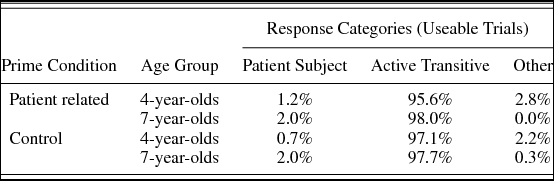
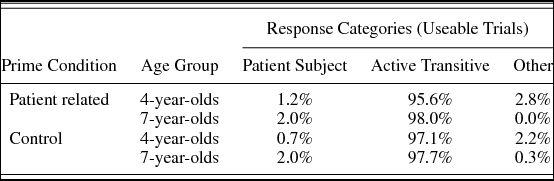
Table 1 presents the distribution of response types by age and prime condition. As can be seen, the distribution was similar in the two prime conditions. Of note, fewer than 2% overall of the scoreable responses had a patient-subject structure (i.e., passive or agentless intransitive). Because the rate of patient-subject responses was so low, we do not report inferential statistics on the distribution of response types. We instead focus our analyses on the scoreable responses that did not have a patient-subject structure. These responses varied in length and content. We examined MLUm of responses in each prime condition, excluding patient-subject responses. MLUm was computed automatically by the SALT program (Miller & Iglesias, Reference Miller and Iglesias2006). A 2 (age group) × 2 (prime condition) analysis of variance (ANOVA) conducted on MLUm revealed a significant main effect of prime condition, F 1 (1, 46) = 6.51, p = .014, ηp2 = 0.124. Responses were shorter in the patient-primed condition (M = 6.96 morphemes, SD = 0.698; M CONTROL = 7.15, SD = 0.88). The main effect of age group was not significant, F 1 (1, 46) = 1.99, p = .19, ηp2 = 0.037, nor was the interaction between prime condition and age group, F 1 (1, 46) = 0.09, p = .77, ηp2 = 0.002. In the ANOVA over items, the main effect of prime condition was significant, F 2 (1, 12) = 6.48, p = .026, ηp2 = 0.35, as was the main effect of age group, F 2 (1, 12) = 15.04, p = .002, ηp2 = 0.56. The interaction was not significant, F 2 (1, 12) = 0.01, p = .93, ηp2 = 0.001.
Percentage of responses from usable trials that fell into each response category, across age groups and prime conditions
The data provide little evidence for syntactic alternations driven by the prime manipulation. However, the effect on MLUm suggests that the manipulation perturbed sentence planning in other ways. The following analyses look further at the predicted impact of lexical–syntactic processing conflicts on sentence production outcomes. In order to provide a relatively consistent context for the RT and dysfluency measurements, we restricted these analyses to active transitive responses. We also reran the MLU analysis on this data set in order to provide a more uniform basis for comparison of outcomes among the different variables. All three analyses were based on the same set of responses.
Analyses on active transitive responses
RT
We examined whether speech onset RTs for active transitive responses were slower in the patient-primed condition than in the control condition. Reponses containing a false start with all or part of the patient label were excluded. Children were included in the analysis if they produced at least five data points in each prime condition. Twenty-one 4-year-olds and all 24 7-year-olds met this requirement.
Speech onset RT was defined as the latency from the onset of the animation to the onset of the subject phrase. Although RTs were registered by the E-Prime serial response box, two situations required manual recovery of RTs. Some children produced many extraneous noises (e.g., tongue clicks or lip pops) that affected the registered RT. In order to identify these noise artifacts, a research assistant examined the auditory and visual records of each response. A second research assistant who was blind to the prime condition of each trial then measured the time offset between the noise artifact and the first vocalization. This offset was added to the RT recorded by E-Prime. Trials in which the relevant onsets could not be unambiguously identified were discarded. In total, voice key artifacts required manual calculation of the RT for 31.3% of trials. The number of RTs calculated manually did not differ by prime condition, F 1 (1, 43) = 0.13, p = .72, or age group, F 1 (1, 43) = 2.61, p = .11.
In addition to voice key artifacts, children sometimes produced vocal hesitations (e.g., filled pauses) prior to the onset of speech. This occurred more often in the responses of the 4-year-olds (M = 15.4% of trials) than in the 7-year-olds (M = 4.8%), F 1 (1, 43) = 5.96, p = .019, but did not differ in frequency between the prime conditions, F 1 (1, 43) = 2.64, p = .11. In trials where a filled pause occurred before the onset of the subject phrase, a research assistant manually calculated the offset between the dysfluency and the response onset, and added this value to the recorded RT.
Extreme latencies that were greater than 9 s or more than 3 SD above a participant's condition mean were trimmed as outliers (n = 2 per condition), leaving 882 data points for analysis. There were more available trials in the control condition than in the patient-primed condition, F 1 (1, 43) = 4.22, p = .046, although the absolute difference between means was relatively small (M CONTROL = 10.1, M PATIENT PRIMED = 9.5). The mean number of trials per condition was also higher for the 7-year-olds (M = 10.4) than for the 4-year-olds (M = 9.1), F 1 (1, 43) = 6.66, p = .013.
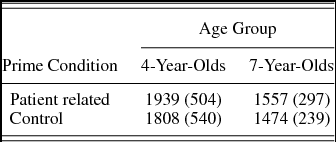
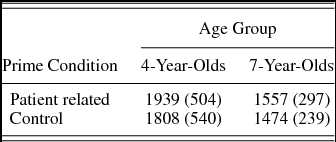
Table 2 presents the mean RTs for active transitive responses, by age group and condition. Mean onset latencies were 107 ms slower in the patient-primed condition than in the control condition, and 359 ms slower in the responses of the younger group than in the older group. A 2 (prime condition) × 2 (age group) ANOVA revealed significant main effects of both prime condition, F 1 (1, 43) = 4.86, p = .033, ηp2 = 0.102, and age group, F 1 (1, 43) = 10.32, p = .002, ηp2 = 0.194, but no significant interaction, F 1 (1, 43) = 0.25, p = .62, ηp2 = 0.006. In the ANOVA by items, although the effect size for prime condition was large, the effect was not significant, F 2 (1, 12) = 2.73, p = .12, ηp2 = 0.185. The main effect of age group was significant, F 2 (1, 12) = 24.44, p < .001, ηp2 = 0.67. The interaction was not, F 2 (1, 12) = 0.10, p = .75, ηp2 = 0.008.
Mean (standard deviation) speech onset response time (ms) by prime condition and age group, active transitive responses
Dysfluency
Dysfluencies were tallied by the SALT program (Miller & Iglesias, Reference Miller and Iglesias2006), taking into account all silent pauses, filled pauses, repetitions, false starts, and other revisions occurring after the onset of the subject phrase and up to the completion of the object (i.e., patient) phrase.
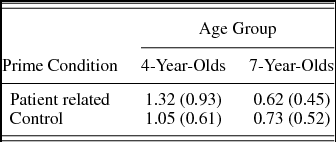
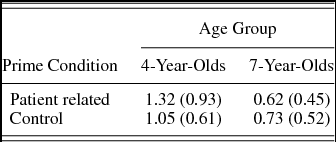
Table 3 presents the mean number of dysfluencies per utterance for each prime condition and age group. The results of a 2 (prime condition) × 2 (age group) ANOVA revealed a significant main effect of age group only, F 1 (1, 43) = 10.53, p = .002, ηp2 = 0.197. The main effect of prime condition was not significant, F 1 (1, 43) = 0.48, p = .49, ηp2 = 0.011, nor was the interaction, F 1 (1, 43) = 2.75, p = .11, ηp2 = 0.06. In the analysis by items, the main effect of prime condition was again not significant, F 2 (1, 12) = 0.83, p = .38, ηp2 = 0.065. The effect of age group was significant, F 2 (1, 12) = 16.19, p = .002, ηp2 = 0.57, and the interaction approached significance, with a large effect size, F 2 (1, 12) = 4.26, p = .061, ηp2 = 0.26. As can be seen in Table 3, the difference between condition means was in the direction of greater dysfluency in the primed condition for the 4-year-olds and greater dysfluency in the control condition for the 7-year-olds. This difference in direction of effects was also seen in the data averaged over items.
Mean (standard deviation) number of dysfluencies per utterance by prime condition and age group, active transitive responses
MLU in active transitive sentences
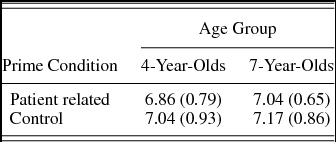
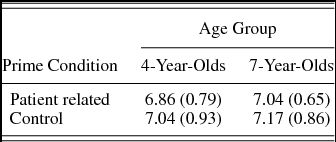
Table 4 presents the mean MLUm by condition and age group. Again, the ANOVA revealed a significant main effect of prime condition, F 1 (1, 43) = 4.18, p = .047, ηp2 = 0.09, with shorter utterances in the patient-primed condition (M = 6.94 morphemes, SD = 0.71) than in the control condition (M = 7.11, SD = 0.89). The main effect of age group was not significant, F 1 (1, 43) = 0.49, p = .49, ηp2 = 0.01, nor was the interaction F 1 (1, 43) = 0.09, p = .77, ηp2 = 0.002. In the ANOVA by items, the effect of prime condition approached significance, with a large effect size, F 2 (1, 12) = 4.46, p = .056, ηp2 = 0.27. The main effect of age group was significant, F 2 (1, 12) = 11.44, p = .005, ηp2 = 0.49. The interaction was not, F 2 (1, 12) = 0.497, p = .49, ηp2 = 0.04.
Mean (standard deviation) mean length of utterance by prime condition and age group, active transitive responses
Correlations with WM
Our final analyses explored the relationship between the language variables, the priming manipulation, and WM capacity. The two youngest children in the study had difficulty understanding the WM task and were therefore excluded from these analyses. Scores on the WM task were higher for the 7-year-olds (M = 52.9 words, SD = 10.41) than for the 4-year-olds (M = 38.4, SD = 10.24), t (44) = 4.75, p < .001, η2 = 0.34.
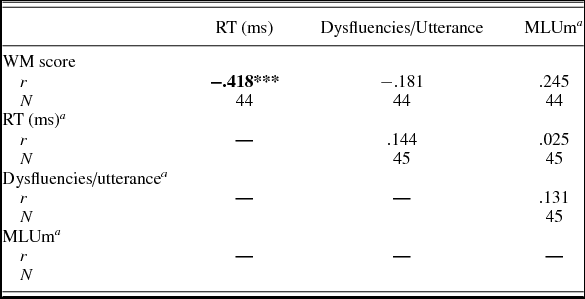
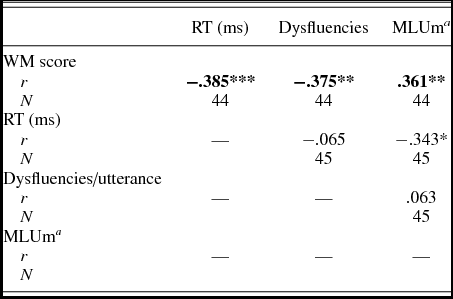
We examined whether WM scores were correlated with the language variables computed for the active transitive responses in each of the prime conditions. Tables 5 and 6 present the correlations between WM and the language variables. The correlations among the different language variables are also presented for further information. Significant correlations are indicated with asterisks. In addition, significant correlations between WM and language variables, the focus of this analysis, are in bold. Within each condition, the set of three correlations between WM and the language variables was treated as a family, and significance was evaluated with adjustments for multiple comparisons using the Holm–Bonferroni method. Table 5 presents the correlations between WM and the language variables in the control condition. There was a moderate, negative correlation between WM and RT, indicating that the children who took longer to initiate their responses were the children with lower scores on the WM task. Table 6 presents the correlations between WM and the language variables in the patient-primed condition. There were moderate, statistically significant correlations between WM and all language variables in this condition. This includes dysfluencies per utterance, which did not reveal a significant effect of the prime manipulation in the ANOVA reported above. There was again a negative correlation between WM and RT, of slightly smaller magnitude than in the control condition. The correlation between WM and dysfluency was negative, indicating that lower WM scores were associated with a higher dysfluency rate. The correlation between WM and MLUm was positive, indicating that lower WM scores were associated with shorter sentence responses.
Correlations for WM scores and language variables, control condition
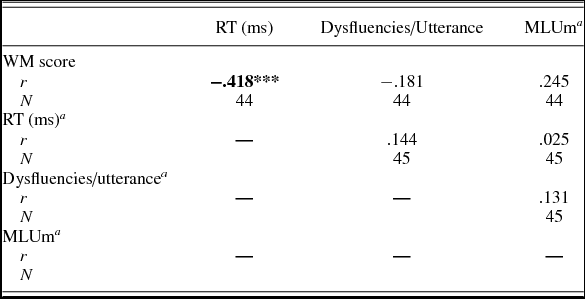
Note: WM, Working memory; RT, response time; MLUm, mean length of utterance in morphemes. The significant correlation between WM and language variables is in bold.
aIn active transitive sentences.
*p < .05. **p < 02. ***p ≤ .01. All p values are two tailed.
Correlations for WM scores and language variables, patient-primed condition
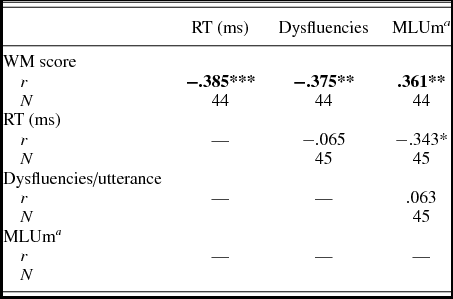
Note: WM, Working memory; RT, response time; MLUm, mean length of utterance in morphemes. Significant correlations between WM and language variables are in bold.
aIn active transitive sentences.
*p < .05. **p < 02. ***p ≤ .01. All p values are two tailed.
DISCUSSION
In the present study, we investigated how children's descriptions of transitive animations were affected by primes that promoted early availability of the patient. The participants produced very few patient-subject sentences even though the primes were designed to create a lexical processing dynamic favoring such structures. However, lexical processing dynamics did influence sentence production insofar as onset latencies were longer and sentences were shorter following the patient-related primes. These results support the view that the relationship between syntactic plans and the order of lexical activation can be a source of challenge during sentence production (Bock, Reference Bock1982). The study findings extend our understanding of language production mechanisms within a limited capacity perspective, and provide insight into the priorities of the language production system during sentence planning. Below, we comment on these priorities followed by a discussion of the processing challenges.
Lexical and syntactic processing priorities
We had anticipated that active transitive responses would dominate, and this proved to be the case. However, we had also anticipated that patient-subject sentences, although relatively infrequent, would occur more often following the patient-related primes. This would be consistent with prior evidence that lexical activation dynamics can determine syntactic choice (Bock, Reference Bock1986). This result did not materialize. For the 7-year-olds, the rate of patient-subject sentences was virtually identical in the two prime conditions. For the 4-year-olds, although the rate of patient-subject sentences was numerically higher in the patient-primed condition (1.2% vs. 0.7% of control trials), the overall frequency of these responses was too low to warrant further analysis or interpretation.
Why did more alternations not occur following the lexical–semantic primes? One possibility would be that the primes failed to influence sentence structure because they failed to influence the timing of lexical activation. However, the observed effects on processing efficiency argue against that interpretation, as do our pilot data demonstrating effects of the primes on picture naming latencies. A more likely account is that the priming manipulation influenced the timing of lexical activation, but that lexical influences were ultimately not able to overcome other priorities or constraints during syntactic planning.
Limited knowledge of the passive, or challenges deploying that knowledge, likely played a role in the children's very limited production of patient-subject sentences in this study. However, for the older children at least, the passive alternation should have been within their ability (Marchman et al., Reference Marchman, Bates, Burkardt and Good1991). In addition, half of the scenes were designed to provide a patient-subject syntactic option (the agentless intransitive) that should have been known to even the youngest children in the study. The children, however, made very little use of this option.
Of course, simply having productive knowledge of the passive does not ensure that children will use it or be able to access it easily (Marchman et al., Reference Marchman, Bates, Burkardt and Good1991; Shimpi et al., Reference Shimpi, Gámez, Huttenlocher and Vasilyeva2007). Although there were processing costs associated with active productions following the patient-related primes (as discussed below), the potential processing costs of producing passives may have been even greater. Children attempting to access a nascent or infrequently practiced form may have found themselves pushed beyond their capacity trying to complete the necessary procedures (Rispoli & Hadley, Reference Rispoli and Hadley2001). Thus, balancing the processing difficulties associated with different response options may have played a part in children's responses.
The absence of lexically driven syntactic alternations stands in contrast to the fact that other factors have been shown to motivate patient-subject sentences in children of a similar age, who presumably were armed with comparable knowledge. For example, children as young as 3 and 4 years old show an increase in the rate of production of passive and agentless intransitive sentences following discourse or pragmatic pressure from patient-focused questions (Braine et al., Reference Braine, Brody, Fisch and Weisberger1990; Harris & Flora, Reference Harris and Flora1982; Loeb et al., Reference Loeb, Pye, Richardson and Redmond1998; Marchman et al, Reference Marchman, Bates, Burkardt and Good1991). Syntactic activation dynamics or history also affect syntactic choice: in syntactic priming studies, children in this age range show a higher rate of passive responses following passive primes (Huttenlocher, Vasilyeva, & Shimpi, 2004; Messenger, Branigan, & McLean, Reference Messenger, Branigan and McLean2011; Shimpi et al., Reference Shimpi, Gámez, Huttenlocher and Vasilyeva2007). These patterns suggest that syntactic, pragmatic, or discourse factors have a stronger influence on children's decisions about sentence subjects and sentence structures than do lexical processing dynamics. However, given that this study did not include an adult control group, any conclusions regarding developmental constraints on syntactic choices remain tentative. Although it may be difficult to design matched studies for young children and adults, future work on this topic would benefit from the observations of adults’ responses to the same stimuli.
Given the noted similarities between children's and adults’ production systems, we assume that, with the right conditions, lexically driven syntactic alternations in children's speech would be possible. An informative direction for future research would be to examine what those conditions might be. This might include examining structures that do not have as strong a bias as the active/passive alternation. In addition, given that verbs participate in different sentence structures with varied frequency (Connine, Ferreira, Jones, Clifton, & Frazier, Reference Connine, Ferreira, Jones, Clifton and Frazier1984; Gahl, Jurafsky, & Roland, Reference Gahl, Jurafsky and Roland2004), a worthwhile endeavor might be to examine whether verb-frame co-occurrence frequencies affect the relative influence of lexical processes on syntactic plans. The meaning characteristics of the verb stimuli may also affect the interplay between lexical and syntactic processes (e.g., Altmann & Kemper, Reference Altmann and Kemper2006). For young children, verbs that can take a stative interpretation (e.g., scare) may produce a greater number of passive alternations, because these types of verbs often form the basis of children's earliest passive or passive-like constructions (Israel, Johnson, & Brooks, Reference Israel, Johnson and Brooks2000). Finally, we also note that stronger lexical activation manipulations might be possible, such as embedding several primes within a story lead-in.
Lexical–syntactic conflicts produce processing costs
The most compelling result of this study is the demonstration that lexical–syntactic conflicts do create processing costs and impact the efficiency of sentence planning and production (Bock, Reference Bock1982). These costs were observed in sentence onset latencies and sentence length. To our knowledge, this is the first demonstration of such effects in young children's sentence production.
Onset latencies to begin producing active transitive sentences were on average 107 ms longer following patient-related primes than following control pictures. This difference is consistent with the prediction (Bock, Reference Bock1982) that a mismatch between lexical activation order and syntactic planning sets up a conflict to be resolved, and that resolving the conflict has real-time implications for sentence planning outcomes. Of interest for future research will be to consider whether the time needed for conflict resolution simply adds to the planning time without changing other aspects of the planning process, or if the lengthening of initial planning time has other consequences. As we will discuss below, the current study provides hints that such lengthening may have consequences for sentence length.
Our RT results differ from findings reported by Davidson et al. (Reference Davidson, Zacks and Ferreira2003) for older adults. As previously noted, Davidson et al. reported no difference in RT for dative sentences that either maintained or were in conflict with lexical activation order. We examined a different population and used a different method to manipulate lexical activation order, so there may be several reasons for the differences in outcomes. One potential reason for the different findings, however, may relate to the structures under investigation. Transitive and dative alternations differ with respect to whether the alternation affects the starting point of the sentence or the arrangement of postverbal material. Manipulations affecting the relative activation level of agent versus patient referents, and thus the starting point of the sentence, may produce more reliable or substantial consequences for speech onset RT.
Turning to MLUm, sentences were shorter following the patient-related primes than following the control pictures. Although the differences were small in absolute magnitude, they were associated with medium to medium-large effect sizes, and should be interpreted within the limits on likely variation imposed by the nature of the stimuli and task. The effects on MLUm are consistent with the conclusion that the lexical–syntactic conflicts strained processing resources, at a cost to other aspects of sentence planning and production. The results of the correlation analysis suggest that the processing difficulty in the primed condition was related to WM capacity. There was no significant relationship between WM and MLU in the control condition, whereas in the patient-primed condition, lower WM scores were associated with lower MLUs. Within the framework that we have adopted for this study, the most likely explanation for this association is that lexical buffering demands in the patient-primed condition created additional WM costs and strained capacity, with consequences for sentence length.
The MLU results invite future investigations into the changes to sentences that might occur as a result of lexical–syntactic conflict. MLU can be influenced by multiple factors, including lexical choices, syntactic elaborations, and the production or omission of grammatical function words and bound morphemes. Here, we briefly consider two aspects of sentence production that have received attention in the developmental literature, namely, referential choice and consistency in grammatical morpheme production. With respect to referential choice, it has been noted that children might use pronouns instead of full nouns when processing costs are otherwise high (Bloom, Reference Bloom1990). Such a strategy could result in shorter MLUs if the pronouns replaced full noun phrases (e.g., the cat vs. it/he). In the current study, the rate of pronoun use across scoreable trials was virtually identical in both conditions, accounting for 6% of agent references and 2% of patient references. Another potential contributor to differences in MLU between conditions is a difference in the rate at which grammatical function words and bound morphemes are produced. It has long been noted that challenges to processing capacity during sentence production may result in omissions of obligatory morphemes. For example, studies of children with impaired and typical language development have identified argument-structure, clausal complexity, and syntactic priming as potential contributors to variation in the production and omission of obligatory morphemes (Grela & Leonard, Reference Grela and Leonard2000; Leonard et al., Reference Leonard, Miller, Grela, Holland, Gerber and Petucci2000; Owen, Reference Owen2010). The current study provided a context for the auxiliary is. Although there were a number of children showing no variability in their auxiliary use, the rate of production was 5.6% lower in the primed condition. This difference, however, was not significant. Thus, the effects of the prime on MLU in this study did not seem to be specific to variations in pronoun or auxiliary use. However, this may be a productive direction for future work focused on children who produce auxiliaries with more variability. Future work would also benefit from a broader examination of changes to content and structure using stimuli that invite greater flexibility in production choices, such as optional modifying words and phrases.
Although the results of both the RT and MLU analyses were in keeping with our expectations, the results of the dysfluency analysis were not. While the sentence responses were somewhat shorter and took longer to plan in the patient-primed condition, once they were initiated, they were not produced reliably less fluently. This may indicate that the extra processing costs incurred by the patient-related primes were accommodated by extra planning time and shorter sentences, leaving no further challenges to disrupt production. With this possibility noted, the lack of a dysfluency effect nonetheless invites further consideration of the mechanisms involved. We had anticipated that the patient-related primes would increase dysfluency because of lexical buffering costs to WM during sentence production. It may be that the primes did not disrupt dysfluency because they did not produce lexical buffering costs, or did not produce costs sufficient to overload WM capacity. However, the correlation results suggest that, at least for some children some of the time, lexical buffering costs may have put pressure on WM capacity. In the patient-primed condition, there was a significant, moderate, negative correlation between WM and dysfluency. Lower WM scores were associated with a higher rate of dysfluency. The fact that this relationship was not observed in the control condition suggests that WM pressures were more of a factor for sentence outcomes in the patient-primed condition.
Nonetheless, given the correlation between WM and dysfluency in the patient-primed condition, the lack of a significant prime condition effect on dysfluency rates is somewhat surprising. This is especially true given that the relationship between MLUm and WM was essentially of the same magnitude (actually, somewhat weaker), yet the prime condition effect on MLU was significant. A possible explanation for this difference can be found in the patterns of correlations among the different language variables. An examination of these values reveals that RT and MLU were significantly, negatively correlated in the patient-primed condition (r = –.343, p = .021). Longer mean RTs were associated with shorter mean MLUs. RT and dysfluency were not correlated (r = –.065, p = .669). Moreover, there was no correlation between RT and MLUm in the control condition (r = .025, p = .870). One potential interpretation of this correlation is that it could reflect a relationship at the utterance level between time costs and costs to sentence length. That is, the participants may have sometimes prepared a shorter response as an accommodation to the need to give more time “up front” to resolving lexical–syntactic conflicts. This, in conjunction with WM costs after sentence onset, may have been sufficient to produce a statistically reliable MLU difference. The lack of a relationship between RT and dysfluency rates suggests that such dual pressures did not apply to postonset fluency. This proposal is admittedly speculative, and will need to be confirmed in future research.
The WM-related results extend the prior evidence (Slevc, Reference Slevc2011) that lexical–syntactic relationships interact with WM, and show that this interaction has implications for sentence production. Language performance is negatively affected by lexical–syntactic mismatches, at least among children who have less language experience and are more capacity-constrained than adults. At the same time, the results of this study point to limits on the effects of WM costs related to lexical buffering within a relatively simple production context.
One final aspect of the data merits mention. The current results provide less evidence than anticipated regarding the range of variation in processing costs that might be seen in different age groups. In this study, we had anticipated that the younger children, with less language experience and greater capacity constraints, would show relatively greater difficulty accommodating the processing challenges introduced by the prime. The results, however, provided no evidence for such differences: none of the language variables showed an interaction between prime condition and age. It may be that a more continuous variable, such as WM ability, would be a better determinant of the extent of challenges that will be observed. We also note that the participants in both groups in this study had relatively strong language skills, as evidenced by their scores on the Recalling Sentences task of the Clinical Evaluation of Language Fundamentals—Preschool—Second Edition and the Clinical Evaluation of Language Fundamentals—Fourth Edition (Semel et al., Reference Semel, Wiig and Secord2003; Wiig et al., Reference Wiig, Secord and Semel2004). It remains possible that different outcomes would be observed across a greater developmental time span or with exceptionally vulnerable speakers, or with more challenging language content, such as later-acquired or less frequent lexical items.
Summary and conclusions
In conclusion, the results of this investigation indicate that conflicts between the time course of lexical activation and syntactic plans have negative consequences for children's sentence production efficiency and integrity. These effects extend to sentence planning speed and length, likely indicative of the extra time and processing resources needed to resolve the conflict. This study provides further evidence that the relationship between lexical and syntactic processes affect WM resources during language planning and production. A promising direction for future research would be to further examine the nature of these WM costs and the limits or extent of their influence on sentence production outcomes. Finally, within the age range that was investigated in the current study, lexical–syntactic conflicts do not appear to have greater negative effects for younger children than for older children.
APPENDIX A
Stimulus items

ACKNOWLEDGMENTS
This work was supported by a Doctoral Award from the Canadian Child Health Clinician Scientist Program (to M.C.), a CIHR Strategic Training Initiative in partnership with the SickKids Foundation, the Child & Family Research Institute (BC), the Women & Children's Health Research Institute (Alberta), and the Manitoba Institute of Child Health. We thank Rebecca Kowalenko and Janice Bedard for assistance with data coding and analysis, and Carol Boliek for providing helpful comments on a previous version of this manuscript.