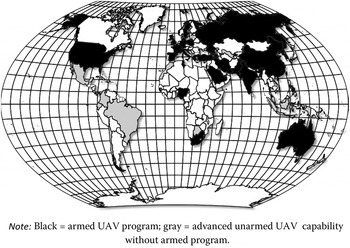
Unmanned Aerial Vehicles (UAVs), more popularly known as “drones,”Footnote 1 have become emblematic of twenty-first century military technologies.Footnote 2 UAVs came to prominence after the 11 September 2001 attacks (hereafter 9/11) as the United States began experimenting with a drone previously designed for intelligence gathering, surveillance, and reconnaissance (ISR), the MQ-1 Predator, to launch precision strikes against high-value targets.Footnote 3 Since 9/11, the US military has used UAVs extensively for tracking and striking insurgents and terrorists in Afghanistan, Iraq, and elsewhere. The United States is not the only country investing in UAV technology, however. Nearly thirty countries currently have armed drone programs, while more than two dozen states possess advanced unarmed drones, as Figure 1 shows.
Global trends in UAV proliferation

What accounts for the surging interest in drones globally? State investments in particular military technologies—ranging from tanks and other mechanized vehicles to missile defense systems—have long been seen as consequential for the international security environment.Footnote 4 So it is with UAVs: drone proliferation may influence world politics by reducing barriers to the use of military force, enhancing surveillance of contested territories, or helping countries target adversaries.Footnote 5 Policy-makers and scholars are increasingly concerned about the strategic implications of UAV diffusion, even if drones are less destructive than military technologies such as nuclear weapons.Footnote 6 As Christof Heyns, the UN Special Rapporteur on extrajudicial, summary, or arbitrary executions states, drone proliferation can do “structural damage to the cornerstones of international security.”Footnote 7 Although much of the popular and scholarly interest in UAVs stems from targeted killings, unarmed drones may also be strategically relevant because they give countries greater surveillance capabilities.
Despite the importance of this issue, the drivers of drone proliferation remain poorly understood. There is interesting cross-national variation in the adoption of UAVs. While countries such as China, Iran, Russia, and Turkey, are investing significantly in armed and unarmed UAVs, others, like Egypt and Taiwan, have so far refrained from developing sophisticated drones. What accounts for this variation?
We examine this question in the context of debates about interests versus capacity—or willingness versus opportunity—in explaining policy adoption.Footnote 8 Interest-based theories suggest that states adopt technologies or policies to meet key strategic or political objectives. In the UAV case, interest-based arguments predict that states will develop UAV technology when they face security threats, especially high levels of terrorism and border disputes with neighboring countries. A state's domestic political institutions can also shape its incentives to field drones. Democracies might be more likely to acquire UAVs as part of a general trend toward capital-intensive militaries.Footnote 9 The relatively large selectorates in democratic regimes could make elected leaders and elites particularly wary of military casualties, providing those states with an added incentive to seek drones. Alternatively, autocracies, worried about insurgencies in their own countries, could seek UAVs to help them more effectively pursue domestic political opponents.
But willingness is just one side of the ledger. A state's capacity to develop and effectively field UAV technology can also influence the degree to which drones spread. Supply-side arguments suggest that organizational and financial constraints may limit the types of UAVs that countries can build and/or operate. At the same time, some states—particularly allies of the major UAV producers—might be able to bypass the technological hurdles of building UAVs by importing them.
We test these arguments using an original data set on UAV proliferation. Our analysis focuses on the most militarily relevant types of drones: armed UAVs and advanced unarmed UAVs.Footnote 10 The findings provide support for the interest-based logic. Countries that experience a greater number of terrorist attacks are more likely to adopt advanced UAVs and have armed UAV programs. Having a greater number of territorial disputes is also associated with a higher likelihood of drone proliferation, but only for advanced systems used primarily for monitoring and surveillance. In addition, as predicted, both autocracies and democracies are significantly more likely to pursue armed UAVs than mixed regimes.
There is also support for capacity-based arguments. While the barriers to acquiring UAVs are arguably declining, up until this point, advanced economies are still significantly more likely to acquire advanced UAVs and have an armed UAVs program. Alliance relationships with UAV suppliers, by contrast, are unrelated to drone proliferation, perhaps because there is not yet a robust market for sophisticated drones.
The results contribute to two general debates in international relations research. First, scholars have debated whether demand- or supply-side factors play a bigger role in the spread of military technologies.Footnote 11 Although there is a tendency for analysts to emphasize either interests or capacity, both considerations play a significant role when it comes to drone proliferation. The salience of supply-side factors in the early stages of some types of UAV proliferation is interesting given that the technological barriers are relatively low, compared to technologies such as aircraft carriers or nuclear weapons. Even when it is relatively “easy” to develop a military technology, supply-side constraints can still shed light on proliferation dynamics, based on our findings, especially for more advanced versions of the technology. Second, our findings also engage scholarly debates about how regime type influences military policy. In contrast to research suggesting regime type does not influence military equipment purchases,Footnote 12 we show that regime type matters but not in a linear fashion. Dictators and democratic leaders face their own unique incentives to develop specific types of drones.
This research note proceeds by explaining why studying drone proliferation is valuable in the context of academic research on diffusion. We then introduce a typology to distinguish among drones with different capabilities. The next section develops the theories in greater detail and identifies testable hypotheses. We subsequently describe our new UAV data set and identify key variables, and then present findings from our empirical analysis. After presenting our main results, we identify likely proliferators based on our model, shedding light on the countries most likely to adopt drones—and potentially utilize drone strikes—over the next decade. We conclude with a discussion of the implications stemming from our analysis.
Why Study Drone Proliferation?
Scholars interested in policy adoption have looked at the importance of interests and capacity in studying a diverse set of topics, including central bank independence, war, democratization, and international economic organizations.Footnote 13 Understanding why countries adopt a new military capability similarly requires appreciating the interests of relevant actors in acquiring it and the capacity of those actors to develop and absorb the technology. One could, in theory, seek to better understand how interests and capacity affect the diffusion of military technology by studying a variety of different technologies: ballistic missiles, helicopters, jet aircraft, and many others. To be sure, there is value in studying the diffusion of all military technologies. There are at least four reasons to study the causes of drone proliferation specifically.
First, there is widespread interest in drones among policy-makers, journalists, and public intellectuals. As one indication of this, the word drones appeared in more than 500 articles in the New York Times from 1 January 2012 to 3 May 2016.Footnote 14 Drones are probably less “revolutionary” than some analysts imply, but they nonetheless influence international peace and stability in important ways.Footnote 15 It is therefore worthwhile to know which countries possess drones and to better understand why they might have obtained them.
Second, drones are a particularly interesting test case for theories of military technology diffusion.Footnote 16 Because UAVs are uninhabited they are useful for understanding when states adopt technologies that may reduce the costs of using military force—an issue that has attracted significant attention in scholarship.Footnote 17
Third, journalists and policy analysts frequently make strong claims about drones. Yet emerging views about drone proliferation are usually based on speculation instead of rigorous empirical analysis. Studying drone proliferation presents an opportunity to apply social science methods to a policy-relevant question at a time when there is interest in “bridging the gap” between policy and academia.
Fourth, we are still in the early stages of the drone proliferation process. This presents us with some analytic challenges since, as proliferation continues, the patterns we identify may not hold in the future. However, testing theories of military technology diffusion in the initial adoption phase lowers the risk of post-hoc outcome bias thanks to knowledge of proliferation outcomes. For more mature technologies, such as tanks or nuclear weapons, there is the danger that knowledge about the real-world spread of the technology may inadvertently creep into the theoretical discussion, risking curve fitting. In addition, predictions about future “proliferators,” which we will generate based on our statistical model, will likely be more useful for a newer military technology, such as drones.
A UAV Typology
UAVs did not simply come into existence after 9/11. Drones saw action in several wars of the twentieth century, including the Vietnam War, Iran-Iraq War, the 1982 Lebanon War, and the Persian Gulf War. Fulfilling military missions with unmanned aircraft is hardly a new phenomenon, though the sophistication of the platforms has grown significantly over the last fifteen years.
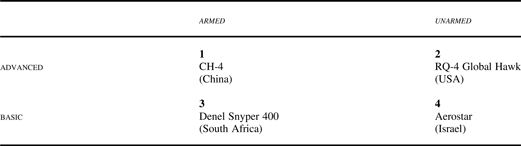
Explaining the contemporary spread of UAVs requires us to define the particular technologies involved, since all UAVs are not created equal. Table 1 illustrates two key distinctions between types of UAVs.Footnote 18
UAV typology

First, we distinguish between armed and unarmed UAVs. Unarmed drones can be used for only surveillance missions while armed systems can carry out lethal missions, in addition to surveillance missions. Armed UAVs attract media attention because of their controversial role in the war on terror but unarmed drones could have implications for international security too, in part because they increase situational awareness.
Second, we distinguish between “advanced” and “basic” UAVs. Advanced UAVs have significant loitering capabilities and can generally operate over the horizon. More basic drones, by contrast, are shorter range and tend to employ less sophisticated technology. We classify drones as advanced if they can remain in the air for at least twenty hours, operate at an altitude of at least 16,000 feet, and have a maximum takeoff weight of at least 1,320 pounds (the online appendix includes a list of UAVs that qualify and provides further details on these criteria). Basic UAVs include systems that do not meet all of these thresholds.Footnote 19
Based on these two distinctions, we categorize UAVs into the quadrants depicted in Table 1. While drones in each quadrant are potentially relevant for world politics today, we focus on drones in quadrants 1–3 because these systems carry the most strategic significance. However, in our empirical analysis we briefly analyze the spread of basic UAVs to explore whether our findings change when we examine less sophisticated systems.
Why Do Countries Pursue and Adopt New Military Technologies?
Interest/Willingness: The Demand Side of UAV Proliferation
Competition is often a critical driver of policy adoption and research suggests that countries often develop new technologies or policies in response to international threats.Footnote 20 Countries in threatening security environments, according to this line of thinking, are the most likely to augment their military capabilities.
Strategic factors could plausibly predict UAV proliferation as well if countries believe that acquiring certain types of UAVs will improve their security. Countries might desire current-generation UAVs for several reasons. First, using drones for surveillance or strike missions allows countries to avoid putting their pilots at risk. Second, drones provide the ability to loiter over a target, providing real-time awareness that inhabited aircraft cannot provide. Rather than conducting high-speed passes with a manned fighter or bomber, taking pictures with a satellite (which requires coordination with other assets to then launch an attack), or putting soldiers on the ground at risk, drones can hover and maintain persistent surveillance on a target. Third, without the fuel and safety requirements that come from having to house and protect a pilot, many drones can stay in the air for longer than inhabited equivalents. Unmanned aircraft are therefore well suited for missions that require detailed surveillance over a long period.Footnote 21 Compare, for example, an RQ-4 Global Hawk Block 40, a US surveillance drone, to a U-2, a manned surveillance airplane flown by the United States military since 1957. Each flies at very high altitudes—60,000 to 65,000 feet for the Global Hawk and 70,000 feet for the U-2. Yet while the U-2 can stay in the air for only several hours at a time, a single Global Hawk could, in theory, loiter around a target at only 310 knots TAS (True Air Speed) for up to twenty-four hours.Footnote 22
Current-generation drones also have limitations. Even advanced drones such as the MQ-9 Reaper are slower than their manned counterparts, armed drones carry smaller weapons loads than comparable manned platforms, and current-generation drones generally lack stealth capabilities, meaning even countries with rudimentary air defenses or older fighters have the capacity to shoot down advanced drones of today. When Iran reportedly scrambled its inhabited F-4 Phantom fighters after detecting an American Predator nearing Iranian airspace, the US military had to deploy its own inhabited fighters to protect the Predator.Footnote 23 Drones also raise concerns about information security. Insurgents in Iraq, for example, reportedly hacked into American MQ-9 Reaper drones.Footnote 24 Operating the most advanced current-generation drones requires sophisticated logistical support for global strike operations (though these constraints apply less to other operations), including well-trained troops and data-processing capabilities. This may constrain some states from successfully fielding the most advanced current-generation drones.Footnote 25
Drones are therefore by no means a risk-free military technology. Yet, in general, states in more competitive international security environments should be more interested in UAVs. Given that states in territorial disputes often face particularly strong security threats,Footnote 26 those countries may be especially motivated to obtain drones.
Countries that have border or maritime disputes with neighboring countries may be interested in monitoring troop movements or other activity along contested territory, making the surveillance capabilities of drones potentially attractive.Footnote 27 The ability of current-generation drones to do deep cross-border surveillance is somewhat limited, since many UAVs still lack synthetic aperture radar (SAR) and moving target indicator (MTI) capabilities, though these systems are spreading.Footnote 28 Currently, high-end inhabited systems can peer much farther into hostile territory from “safe” airspace than most drones. However, even if drones do not provide surveillance capabilities exactly equivalent to inhabited systems, they can nonetheless increase situational awareness in border areas without placing pilots at risk, including areas near contested borders or in disputed territories not currently in conflict. At the very least, many policy-makers seem to believe that this is the case. Japan and China have both acquired advanced drones to monitor the disputed Senkaku Islands region,Footnote 29 while Vietnam is deploying drones for surveillance in the South China Sea.Footnote 30
States may seek new military technologies when they feel threatened by their neighbors, even if they do not fully appreciate the specific capabilities that those technologies provide. The case of tank proliferation in the 1920s provides a potentially useful illustration: many states with security concerns acquired tanks—despite the limitations of first-generation tank technology—to practice with the new technology and try to better understand its utility. This may apply to UAVs, too. States that worry about experiencing military conflict, which tends to be those in territorial disputes, may be especially likely to seek UAVs, regardless of their technological limitations. If nothing else, states can gain experience operating drones while the technology matures.
In sum, there is both a direct and indirect linkage between interstate territorial disputes and UAV proliferation, though other security factors may motivate UAV acquisition as well. While we have focused on unarmed drones, it is also possible that interstate territorial disputes provide an additional incentive to acquire armed UAVs. To date, however, drone strikes have rarely been launched against other governments, in part because strike operations usually require permissive airspace. This logic leads to the following prediction:
H1
Countries with international territorial disputes should be more likely than dispute-free states to obtain UAVs.
Threats from terrorists or insurgents could likewise motivate states to build UAVs. Governments that are frequently targeted with political violence face personnel and monitoring challenges when it comes to insurgents or terrorists. The ability to deliver strikes against (or simply monitor) non-state actors without putting their own people at risk could be attractive.Footnote 31 Especially given the speed and stealth limitations of current-generation drones, they are most useful in environments where they are unlikely to be shot down—for example, when tracking insurgents or terrorists in your own country or with the permission of a host government. Countries that face terrorist threats, then, should be especially likely to pursue UAVs, particularly after the demonstration effects of witnessing the use of UAVs after 9/11. This leads to a second interest-based prediction:
H2
Countries facing terrorist threats should be more likely than states that do not experience terrorism to obtain UAVs.
A state's regime type may also shape its willingness to invest in certain types of drones. Prior research provides mixed support for the relationship between domestic institutions and military capabilities. While Sechser and Saunders showed that democracies are not more likely to acquire capital-intensive military platforms in general, for example, Way and Weeks find that regime type does influence the pursuit of nuclear weapons.Footnote 32
UAVs may appeal to both democratic and authoritarian leaders but for quite different reasons. For democracies, which are generally more concerned about the political costs of casualties, UAVs used in dangerous situations are attractive because they do not put the pilot's life at risk. Democracies tend to prefer capital-intensive militaries rather than labor-intensive ones.Footnote 33 By reducing the risk of death to pilots relative to inhabited aircraft, UAVs allow countries to further substitute capital for labor. In addition, the expected lower unit and associated labor costs for some UAVs (regardless of the more complicated reality), could make them desirable for democracies facing budgetary pressure in the area of defense.Footnote 34 The case of Poland underscores this point: in 2012, Warsaw discussed replacing its fleet of SU-22 fighters with armed UAVs as a result of their perceived lower costs and useful capabilities.Footnote 35
Authoritarian regimes, by contrast, often focus on control of their own militaries as a central issue in how they develop their forces. Many authoritarian leaders live under the constant threat of coups or domestic strife, which may be backed by the military.Footnote 36 Dictators often depend on military support to remain in power.Footnote 37 At the same time, given the persistent threat of military-backed coups, dictators are often deeply distrustful of military commanders, and the domestic population more generally. They therefore value military capabilities that (1) increase their control over the military and (2) help reduce their vulnerability to a military revolt. UAVs may help dictators achieve both of these objectives.
Given that autocracies are more likely than democracies to face internal strife and use force domestically, UAVs could also offer autocrats the ability to conduct what Cronin calls “remote control repression.”Footnote 38 Since UAVs can be operated from command strongholds in some cases, as opposed to troops in the field, they offer more direct oversight of those using force. Especially for regimes with smaller selectorates that already face challenges in delegating the use of military force to groups behind those most loyal to the regime, in the early adoption period of UAVs, they could appear to have special benefits from a control perspective. For example, autocrats could more centrally coordinate repression campaigns. In short, the ability to operate drones from centralized locations or secure bases means that dictators can have a small number of loyal regime supporters controlling the use of force. US Deputy Secretary of Defense Robert Work further argues that because autocratic regimes do not trust their people, they will “naturally gravitate” towards automated solutions such as robotics that they believe could help decrease their reliance on a wider set of the population.Footnote 39
Some recent examples illustrate the plausibility of this logic. For instance, in August 2014, China deployed drones for domestic surveillance in Xinjiang in response to a new round of riots and violence.Footnote 40 Given China's vast territory and the ongoing risk of protests and conflict in Xinjiang, Tibet, and elsewhere, UAVs appear useful for the central government in Beijing to monitor its periphery.
There is no reason to expect that mixed regimes are uninterested in UAVs, of course. If our argument is correct, however, we should see more interest on the part of democracies and more extreme autocracies, especially given that the world is still in the early adoption period for UAVs in general.Footnote 41
H3
Democracies and autocracies should be more likely to pursue UAVs than mixed regimes.
Capacity/Opportunity: The Supply-Side of UAV Proliferation
Whether a state adopts a new capability also depends partially on its capacity, which research shows in areas as varied as central bank independence and nuclear weapons. Supply-side constraints may similarly influence UAV proliferation, especially during the early adoption period of technology diffusion.Footnote 42 According to one line of thinking, effectively using UAVs for over-the-horizon operations could present operational complications.Footnote 43 A gatekeeper may be an underlying technological base that gives the state the resources to build or buy a UAV and the technical capacity to operate UAVs over long distances or in strike configurations.Footnote 44 Retired Pakistani General Talat Masood underscored these technological challenges when discussing Pakistan's drone program: “[UAVs] are on a high priority. But even if a weapons system is on a high priority because of the complexity and the advanced nature of the technology it may take some time before it is mastered and its full utilization is made.”Footnote 45
Based on this view, states that lack an underlying technological base may lack the capacity to effectively field drones. This is especially true in an early adoption period, such as with UAVs in the first decade plus of the twenty-first century. The relationship between technological capacity and UAV development may change rapidly, however. This logic leads to the following prediction:
H4
More advanced economies should be more likely than less-developed states to pursue UAVs.
There are reasons to expect, by contrast, that many countries will have the capacity to effectively operate drones, meaning the level of economic development necessary for UAV operations may be low. Many countries already operate fourth-generation fighter aircraft—a more complex technology than current-generation drones—suggesting that those same states could field drones with relative ease. Moreover, the dual-use nature of most of the underlying technology associated with UAVs, especially for shorter-range UAVs, means that many countries with advanced information economies, such as Singapore and Japan, have the capacity to build their own UAVs in a way that they would not for stealth technology, whose underlying characteristics are not dual use.Footnote 46 This logic suggests that a state's technological capacity should not be associated with UAV acquisition after the earliest adoption period, since economically underdeveloped states can easily manage an arsenal of drones.
To the extent that supply-side constraints exist, states may also attempt to bypass them by purchasing UAVs from other countries. Israel and China are both significant UAV exporters.Footnote 47 Markets for technologies with military relevance tend to be politicized. All states therefore may not have an equal opportunity to import UAV technology. Many political factors influence trade in military-relevant technologies, but prior research shows that alliances are particularly salient.Footnote 48 Given the obvious strategic significance of UAVs, countries should be more willing to share drones with their alliance partners. This leads to a second supply-side hypothesis:
H5
Military allies of major UAV suppliers are more likely to field UAVs than non-allies of those states.
Research Design
To test the hypotheses, we draw on an original cross-sectional data set we created that measures states’ drone capabilities on 31 December 2014.Footnote 49 The proliferation of current-generation drones is a relatively recent phenomenon: only Israel and the United States possessed Predator-like drones prior to 2000, and the majority of states that now have this capability obtained it in the last five years.Footnote 50 The data set includes 203 state-level observations with complete information for 158 countries.
We construct two dependent variables based on our UAV data set: advanced uav and armed uav program. Each variable is dichotomous; it is coded 1 if a country possesses the relevant UAV capability and 0 if it does not.Footnote 51
Our armed uav program variable includes possession and attempts to develop a lethal drone capability. We classify states as having an armed program if at least one of three conditions is met: (1) an entity within the country is currently developing an armed UAV, (2) the government has purchased or attempted to purchase an armed UAV, or (3) a leader or senior government official has made a public statement expressing interest in an armed drone capability (recognizing that some countries may have a low chance of acquiring those capabilities). We provide all of the sources used to construct the dependent variables along with case descriptions in the online appendix.Footnote 52
Our statistical models include the following independent variables:
-
• territorial disputes. The total number of ongoing territorial disputes in which a state is involved, using data from the CIA World Factbook.
-
• terrorism. The logged number of terrorist incidents that a country experienced over the previous five years—from 1 January 2010 to 31 December 2014—based on the Global Terrorism Database.Footnote 53
-
• autocracy and democracy. We create two dichotomous variables related to regime type, based on the twenty-one-point composite measure from the Polity IV project.Footnote 54 Autocracy is coded 1 if a country has a Polity score between −10 and −7 in 2014, and 0 otherwise. Democracy is coded 1 if a state's Polity score falls between + 7 and + 10 in the same year, and 0 if it does not. By including indicators for democracy and autocracy in our statistical model, we can isolate the difference between mixed regimes and the two other regime types.Footnote 55
-
• gdp per capita. As a proxy for technological prowess, we measure a country's national wealth based on the log of its gross domestic product (GDP) per capita in 2014, using data from the World Bank.Footnote 56 We also show the results are robust when using alternative measures of technological capacity such as high-technology exports and national production of scientific and technical journal articles.Footnote 57
-
• alliance with uav supplier. Drawing on the Correlates of War (COW) Formal Alliance data set, this variable, which tests part of the supply-side logic, measures whether a state has a defense pact with key UAV exporters: China, Israel, or the United States.
We focus on a small number of variables that, in our view, should be most closely associated with UAV proliferation. However, our findings are similar when we add additional covariates and use alternative measures of our core independent variables.
Empirical Findings
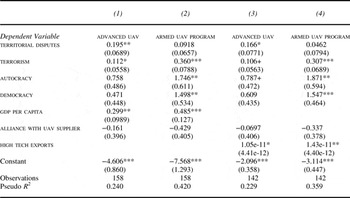
Table 2 contains the results of a probit analysis with robust standard errors. The dependent variable is either advanced uav (Models 1 and 3) or armed uav program (Models 2 and 4). Each model includes all of the independent variables we described, although Models 3 and 4 use an alternate measure of technological capacity.
Probit analysis of UAV proliferation.

Notes: Standard errors in parentheses. +p < .10; *p < .05; **p < .01; ***p < .001.
We first consider how well our models explain UAV proliferation. To do so, we calculate the predicted probability of UAV proliferation for each observation and compare it to each country's actual behavior. Models that perform well generally produce probabilities of less than 50 percent if an event (in our case UAV proliferation) does not occur, and probabilities greater than 50 percent if it occurs. By this standard, we correctly classify 85 percent of observations in the advanced drone proliferation model (Model 1), and 88 percent for armed programs (Model 2). There are surely omitted drivers of UAV proliferation, but these results suggest that our model explains the early stage of UAV proliferation well.
Turning to the specific results, the security-related variables are generally associated with UAV proliferation. Territorial disputes is statistically significant and positive in Model 1 (p < 0.01), indicating that increases in territorial conflict are associated with a greater likelihood of having advanced UAVs. This variable is also substantively important in influencing the probability of drone proliferation: a one-standard-deviation increase in the number of territorial disputes nearly doubles the probability of advanced UAV adoption (from 0.13 to 0.23 percent).Footnote 58 However, territorial disputes is statistically indistinguishable from 0 in Model 2 (p = 0.162). Territorial conflict, therefore, is not associated with an increased risk of pursuing armed drones. These findings provide mixed support for H1. As additional states seek armed drones in the coming years, a clearer relationship between these two variables might emerge. Yet these findings could also suggest that states in territorial disputes value UAVs principally for intelligence and surveillance rather than for armed attacks. India's use of drones to patrol the disputed Kashmir region and China's use of UAVs to monitor activity in the Senkaku Islands, for instance, demonstrate the growing role of drones for states with contentious borders.
One might argue that our treatment of interstate threats—which focuses strictly on territorial disputes—is overly narrow because drones may help states manage other types of threats. As an alternate test of the argument that interstate security threats provide states with incentives to obtain UAVs, we substituted a variable measuring the total number of states with whom a country shares a border for our territorial disputes measure. Including the borders variable, which prior research uses as a proxy for a country's interstate threat environment, produces similar findings.Footnote 59
Terrorism is statistically significant and positive in Model 1 (p < 0.05) and Model 2 (p < 0.001), revealing that increases in political violence are associated with a greater likelihood of having advanced UAVs and armed-drone programs. A one-standard-deviation increase in terrorism raises the probability of advanced UAV proliferation by about 50 percent (from 0.13 to 0.19), while nearly quadrupling the likelihood of having an armed UAV program (from 0.07 to 0.26). Thus, the amount of terrorism a country experiences plays a key role in whether it adopts drones of varying degrees of sophistication, consistent with H2.
France, for example, purchased unarmed MQ-9 Reapers from the United States when it intervened in Mali in 2013 to boost its surveillance capabilities and help it track alleged insurgents and al Qaeda operatives. According to Defense Minister Jean-Yves Le Drian, France sent unarmed surveillance drones to West Africa to help “eliminate all traces of al Qaeda.”Footnote 60 Ethiopia also uses drones in counterterrorism operations. As Tekle writes, “With Eritrea-backed rebels and Somalia's al-Qaeda linked al-Shabaab terrorists repeatedly posing threats to national security, using UAVs will be crucial for Ethiopia to avert planned attacks.”Footnote 61
Consistent with H3, we find evidence that democracies and autocracies are different from mixed regimes when it comes to armed UAV proliferation. In Model 2, autocracy and democracy are positive and statistically significant (p < 0.01). These variables do not achieve conventional levels of statistical significance in Model 1, however, indicating that the anticipated regime type differences are currently absent in the case of unarmed drones.
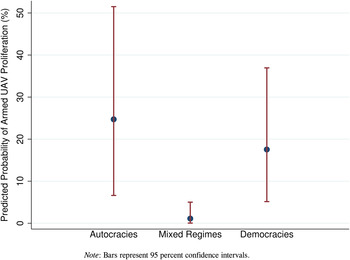
To illustrate these findings, Figure 2 reports the predicted probability of having an armed program for autocracies, democracies, and mixed regimes, based on Model 2. As the figure shows, autocracies and democracies are dramatically more likely than mixed regimes to have an armed UAV program: the predicted probability of proliferation for autocracies and democracies is about 25 percent and 18 percent, respectively, compared to 1 percent for mixed regimes.Footnote 62 As our theory expects, there is not a statistically distinguishable difference between democracies and autocracies. Overall, these findings lend support to our argument that authoritarian and democratic leaders are likely to value lethal drones, albeit for different reasons, in this early stage of the proliferation process.
Regime type and the predicted probability of armed UAV programs

Many European democracies, for example, facing limited defense budgets and publics worried about casualties, are turning to drones. As Singer notes, “Nations in NATO that said they would never buy drones, and then said they would never use armed drones, are now saying, ‘Actually, we're going to buy them.’ We've seen the UK, France, and Italy go down that pathway. The other NATO states are right behind.”Footnote 63 At the same time, authoritarian leaders seem to be increasingly aware that armed drones may carry benefits for domestic monitoring and repression.
Given the varying behavioral tendencies of different types of autocracies, are some autocratic regimes more likely than others to seek armed drones?Footnote 64 In particular, personalistic regimes—for example, Iraq under Saddam Hussein—may be drawn to military technologies that provide more centralized control over the use of force.Footnote 65 Results available in the online appendix show, however, that personalistic regimes are not more likely than others to have an armed UAV program.Footnote 66 To date, adopters include single-party regimes (e.g., China), monarchies (e.g., Saudi Arabia), and personalistic regimes (e.g., Russia). Accordingly, while some personalistic dictators clearly desire drones, we do not find clear differences between authoritarian regimes in terms of their propensity to seek armed UAVs.Footnote 67
What about supply-side factors? Gdp per capita is statistically significant and positive in Model 1 (p < 0.01) and Model 2 (p < 0.001). These findings hold when we measure technological capacity using an alternate measure based on high-technology exports (Models 3 and 4).Footnote 68 From a substantive standpoint, economic capacity is clearly important in shaping UAV proliferation. A one-standard-deviation increase in gdp per capita nearly doubles the predicted probability of having advanced drones (from 0.13 to 0.25), while more than tripling the likelihood of having an armed UAV program (from 0.06 to 0.22).
At this stage in the UAV proliferation process, technological capacity appears to matter, consistent with Hypothesis 4. At the same time, supply-side constraints appear to be declining, as the acquisition and use of armed UAVs by Nigeria, Iraq, and Pakistan shows.Footnote 69 It would be a mistake to conclude, therefore, that sophisticated drones are necessarily beyond the reach of many countries, even if economic capacity is generally associated with the early adoption of certain types of UAVs.
The findings are less supportive of Hypothesis 5, however. Alliance with uav supplier does not achieve conventional levels of statistical significance in our main models. This likely reflects the way one leader in drone technology, the United States, has shared basic UAVs widely while restricting exports of more sophisticated Predator-like systems. Close defense ties with UAV producers by no means guarantees access to sensitive drone technology. Moreover, suppliers other than the United States—particularly China and Israel—seem willing to sell to just about any able buyer regardless of international political factors.
Identifying Future UAV Adopters
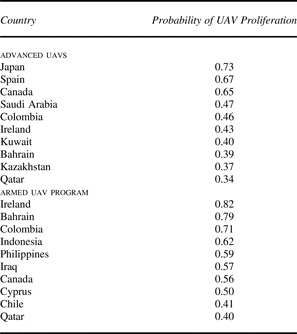
How are UAVs likely to spread in the future? Using the estimates from Models 1 and 2, we identify likely candidates for advanced and armed-drone proliferation. Table 3 lists the ten most likely UAV adopters, based on our models. In one sense, these states are outliers based on our theoretical framework, particularly in cases where the probability is above 50 percent: our theories, and therefore our models, predict that they should have proliferated but had not by the end of 2014.
Likely candidates for future advanced and armed UAV programs

The results also illustrate the potential predictive power of our model, however. For example, the top three “predicted” proliferators for advanced UAVs are Japan, Spain, and Canada. Since the creation of the data set, all have either acquired or are now pursuing advanced UAVs. In the case of armed UAVs, Iraq has now acquired a CH-4 armed drone from China, while Canada is pursuing armed drones as well.Footnote 70 Nearly all of Bahrain's neighbors have acquired armed UAVs.
Implications, Limitations, and Directions for Future Research
The arguments and evidence presented here underscore that a state's interests and capacity play a key role in shaping the drone proliferation process. In particular, states are much more likely to develop drones when they stand to benefit from the strategic applications of the technology. Higher levels of terrorism and, to a lesser extent, territorial disputes are associated with a greater likelihood of UAV proliferation. Regime type also shapes the spread of armed UAV programs. We find evidence that democracies and autocracies are more likely than mixed regimes to develop lethal UAVs. A state's regime type has little effect on unarmed drone proliferation, however. In terms of capacity, GDP per capita is among the strongest predictors of whether a country has UAVs. Yet having alliance ties to major UAV suppliers does not appear to increase the odds of pursuing armed drones or fielding sophisticated unarmed systems.
While the world is in the early stages of UAV proliferation, meaning these results are necessarily preliminary, this research note advances knowledge about drones and world politics in two main ways.
First, because of the prominence of US drone-strike operations, most existing research on drones focuses on drone strikes and democratic incentives to acquire drones. Fearing casualty-sensitive publics, democratic states, according to an emerging wisdom, are the most likely to seek drones, in part because they remove pilots from danger. Our analysis suggests that this view is only partially correct. While democracies may value UAVs, autocracies also have significant internal-security incentives to develop armed UAVs. Some autocracies view drones as useful for gaining more centralized control over the use of force, which could be useful for domestic repression. UAVs, therefore, may be useful to states more focused on addressing both domestic and international threats to stability. This finding contributes to scholarly understanding of how a state's domestic institutions influence the type of military that it develops.
Second, the pace of UAV proliferation is quite rapid—particularly relative to many past military technologies. And some relatively poor countries have acquired advanced UAVs. However, it is important to draw a distinction between basic UAVs and advanced or armed drones. When it comes to advanced and armed drones, technological constraints still limit the types of UAVs some countries can operate, thereby providing some support for supply-side theories of military technology diffusion.
As unit costs come down and commercial UAV technology diffuses more widely, however, it is possible that UAVs will become like tanks and fighter aircraft—a regular part of most national militaries. Advanced drones could also stay out of reach for some states, even as the capabilities of the most advanced UAVs grow.
This research note helps lay the groundwork for additional research on the causes and political effects of weapons proliferation. UAVs provide an interesting test case for understanding how interests, capacity, and regime type intersect to influence the spread of military technologies. Yet this only scratches the surface in terms of the relevance of drone proliferation for international relations research. By removing pilots from the risk of death, UAVs raise questions about just war, international law, and the ethics of conflict. The spread of drones also has implications for guns-versus-butter discussions, debates about deterrence and crisis stability, and research on arms racing. Thus, studying UAV proliferation should remain a fruitful area of inquiry.
Supplementary Material
Supplementary material for this research note is available at https://doi.org/10.1017/S0020818317000121.