Introduction
Over the past decades, a growing body of literature has examined the associations between individual religious involvement and subjective wellbeing (SWB), which is usually assessed by the affective indicator happiness and the cognitive component life satisfaction (Ellison Reference Ellison1991; Villani et al. Reference Villani, Sorgente, Iannello and Antonietti2019; Witter et al. Reference Witter, Okun, Stock and Haring1984). It was generally found that religious involvement was positively associated with SWB, indicated by higher levels of happiness and life satisfaction (Ellison Reference Ellison1991; Koenig et al. Reference Koenig, McCullough and Larson2001). However, much of the evidence supporting the important role of religious involvement in individual SWB was from the United States and other Western Judeo-Christian societies, and the religious and spiritual landscape is quite different in other cultural contexts, such as in East Asia where levels of overall religious involvement tend to be lower. Several cross-national studies have shown that religious benefits for health and wellbeing were greatest in highly religious social and cultural settings; therefore, such benefits might be relatively weaker within the East Asian cultural context (Clobert Reference Clobert2021; Hayward and Elliott Reference Hayward and Elliott2014). Although religious identities tend to be mutually exclusive in Judeo-Christian settings, this is not the case in East Asia, where individuals often participate in and identify with multiple religious traditions (Oostveen Reference Oostveen2019). In addition, most common religious and spiritual traditions such as Buddhism and Taoism in East Asia are non-theistic in nature, suggesting that many of the theoretical arguments developed and employed on religion and SWB in Western contexts might need further examination.
Although there has been a small but growing literature on religion and various wellbeing outcomes in Mainland China, Taiwan and Japan (Liu et al. Reference Liu, Schieman and Jang2011; Lu and Gao Reference Lu and Gao2017; Roemer Reference Roemer2010), very few studies have focused specifically on older adults in these cultural settings, despite the demographic shift towards an ageing population in these societies. Moreover, whereas Western-based scholars have increasingly investigated the contingencies in the link between religion and SWB by age, gender, socio-economic status (SES) and other aspects of social location (Bengston et al. Reference Bengtson, Putney, Silverstein and Harris2015; Levin et al. Reference Levin, Taylor and Chatters1994; Zimmer et al. Reference Zimmer, Jagger, Chiu, Ofstedal, Rojo and Saito2016), these issues remain understudied under East Asian contexts.
To fill in the above-mentioned literature gap, this study aims to examine the relationship between individual religious involvement and SWB by focusing on older adults in a major city in Taiwan – Taichung, an overlooked Asian cultural context, to examine the religion–SWB association. In doing so, it incorporates both the affective and the cognitive aspects of SWB and explores subgroup variations by gender and age, two important demographic features that could potentially modify the focal relationships.
Theoretical and empirical framework
Religious involvement and SWB
Studies in Western societies have revealed the positive association between religious involvement and SWB (Ellison Reference Ellison1991; Lim and Putnam Reference Lim and Putnam2010; Steger and Frazier Reference Steger and Frazier2005). According to the classic works on the topic, individual religious involvement has often been operationalised into indicators such as denominational ties, divine relations and social integration (Ellison Reference Ellison1991; Ellison et al. Reference Ellison, Gay and Glass1989). Similarly, the 4B model of religious identity (Saroglou Reference Saroglou2011) conceptualises religious involvement into believing (personal conviction and faith in religious doctrines), belonging (affiliation with a religious group), behaving (practices and rituals performed in private and public settings) and bonding (attachment to the religious group). Among these aspects, frequency of religious participation has been found to be the most consistent and salient correlate of SWB (Ferris Reference Ferris2002). In addition, the religion–SWB association has been found to be substantial; it was estimated that the gross effects of religious involvement account for 2 per cent to 6 per cent of variations in SWB, which means that it is just as or more potent than education, social activity and race/ethnicity (Inglehart RF Reference Inglehart, Diener, Helliwell and Kahneman2010; Myers Reference Myers2000; Witter et al. Reference Witter, Stock, Okun and Haring1985).
Several explanations have been put forward by previous studies relating to the religion–SWB association. The first explanation is congregational social relations and the resulting social integration, as well as tangible and socio-emotional support. It was found that religious involvement could enhance SWB because religious organisations could offer chances for social interactions between like-minded people and the building up of friendships and social ties (Ellison et al. Reference Ellison, Gay and Glass1989; Krause Reference Krause2008). The second explanation is about development of divine relations. Religious involvement could provide ongoing nurturing, guidance and solace through interactive prayer with a divine other, and this is especially effective in helping individuals cope with life stressors (Belding et al. Reference Belding, Howard, McGuire, Schwartz and Wilson2010; Inglehart RF Reference Inglehart, Diener, Helliwell and Kahneman2010). Lastly, meaning, purpose and a religious ‘plausibility structure’ (Berger Reference Berger1967) indicate the role of religion in providing a coherent system for interpreting major events and daily life, and a degree of certainty regarding one’s place in this world and one’s prospects in the hereafter (Ellison Reference Ellison1991; Ellison and Levin Reference Ellison and Levin1998). All these psycho-social resources derived from individual religious involvement, in turn, tend to promote SWB.
Subgroup variations by gender and age
Despite the positive associations between individual religious involvement and SWB, the relationship might also vary by certain demographic characteristics, such as gender. Females were found to be more religious (by virtually any indicator) than males and this gender difference has been confirmed across different cultures in Western societies (Francis and Penny Reference Francis, Penny and Saroglou2014; Miller and Stark Reference Miller and Stark2002). In addition, the association between religious involvement and SWB indeed has exhibited gender differences (Levin and Taylor Reference Levin and Taylor1993; McFarland Reference McFarland2010). Stronger associations between religious engagement and health among females have been found, indicating that religion is generally more protective for females (Keonig Reference Keonig1999; McCullough et al. Reference McCullough, Hoyt, Larson, Koenig and Thoresen2000). On the other hand, according to the resource substitution theory (Ross and Mirowsky Reference Ross and Mirowsky2006), the scarcity of one resource increases the importance of another. For men who lack social support from alternative resources, religious practice may lead to more health benefits for them than for women. Some studies indeed provided empirical evidence supporting this theory: men were found to gain more mental health benefits for each one-unit increment in religious practice or belief, and such benefits were long term (Krause et al. Reference Krause, Liang, Shaw, Sugisawa, Kim and Sugihara2002; Maselko and Kubzansky Reference Maselko and Kubzansky2006; McFarland Reference McFarland2010). The divergent findings might be partially owing to inconsistent measures of religious involvement used in the different studies (Kvande et al. Reference Kvande, Klöckner and Nielsen2015). Taken together, very few studies have examined the gender-related pattern in the relationship between religious involvement and SWB in the Taiwanese context. Therefore, this has become one of the focuses of this study.
Apart from subgroup variations by gender, age differences have also been discussed in prior research. Studies showed that cohorts born in the early 20th century tended to be more religious than those born in the later 20th century since the importance of religion has been in decline over the past decades (Hayward and Krause Reference Hayward and Krause2013). Even controlling for period and cohort effects, it was found that older adults were more religious than younger adults (Hout and Greely, Reference Hout and Greeley1998; Witter et al. Reference Witter, Stock, Okun and Haring1985). Older adults may also derive more benefits from religious involvement. According to Erikson’s (Reference Erikson1980) psycho-social development theory, integrity is essential in late adulthood: older adults who develop integrity tend to perceive their lives as meaningful and generally feel satisfied. Given religion’s ability to offer a comprehensive framework for understanding and organising human events (Berger Reference Berger1967, Reference Berger1970), it becomes increasingly important in late life when older adults seek a sense of coherence and order to enhance their integrity.
Some studies of Western societies (Ellison Reference Ellison1991) have revealed significant age interactions for both life satisfaction and happiness, offering empirical evidence supporting the increasing importance of religious involvement with age. However, studies on age differences have mostly focused on general young–old comparisons by grouping those older than 55 or 60 as a whole (Lechler and Sunde Reference Lechler and Sunde2020; Yeager et al. Reference Yeager, Glei, Au, Lin, Sloan and Weinstein2006). Very few studies have examined the nuanced differences within the population of older adults, for whom seeking a sense of coherence and wholeness is essential. Focusing on older adults in Taiwan, this study examines whether the relationship between religious involvement and SWB varies between the young-old and the old-old.
East Asia: the Taiwanese cultural context
Despite extensive discussion on religious involvement and SWB, most studies have been conducted within Western cultural contexts. This focus has often overlooked older adults in East Asian cultural contexts, who exhibit distinct and unique characteristics of religious involvement (Dong and Zhang Reference Dong and Zhang2015; Wong et al. Reference Wong, Lonner and Wong2007). Taiwan, in particular, stands out owing to its high level of religious diversity and the syncretic nature of its religious practices. Older adults in Taiwan are highly religious, with more than 80 per cent of the population adhering to folk religion while simultaneously identifying with Buddhism and Daoism (Fu et al. Reference Fu, Chang, Du and Liao2015). The religious landscape is characterised by syncretism, with individuals integrating elements of multiple religions. This syncretic practice allows for a flexible and inclusive approach to spirituality and religious practice, which is less about exclusive belief systems and more about practical and ritualistic engagement (Clart and Jones Reference Clart and Jones2003). This can include a wide array of practices such as ancestor worship, temple festivals and the use of talismans, all of which are integral to daily life and community identity (Jordan and Overmyer Reference Jordan and Overmyer1986). In Taiwan, religion remains a powerful socialisation force (Liu Reference Liu2009). Even among those who are not affiliated with any religious traditions, many are active in spiritual seeking (Chiu Reference Chiu2006).
Religious involvement can benefit the health of old adults in various ways within the Taiwanese cultural context. Studies have shown that Taiwanese older adults often engage in religious practices not only for spiritual fulfilment but also for social support and community cohesion (Lin et al. Reference Lin, Chou, Chen, Chen, Yang, Chen, Sun, Wen, Yip, Chu and Chen2015; Zimmer et al. Reference Zimmer, Chiu, Saito, Jagger, Ofstedal and Lin2020). The communal aspect of religious activities, such as temple gatherings and religious festivals, plays a significant role in enhancing social networks and providing emotional support, thereby contributing positively to SWB (Chang W-C Reference Chang2015; Liu et al. Reference Liu, Koenig and Wei2012). Furthermore, the practice of ancestor worship and the emphasis on filial piety within Taiwanese culture also provide a sense of continuity and belonging, reinforcing intergenerational bonds and social stability (Hsu et al. Reference Hsu, Lew-Ting and Wu2001; Yan and Chen Reference Yan, Chen, Demir and Sümer2018).
Despite these potential benefits, studies on religion and health in Taiwan are limited and existing research has produced inconclusive findings. For instance, Liu et al. (Reference Liu, Schieman and Jang2011) found that religious-based supernatural beliefs were associated with higher levels of distress, whereas daily prayer was associated with less distress. Another study (Shiah et al. Reference Shiah, Chang, Chiang and Tam2016) revealed that older adults’ religiosity was not correlated significantly to mental health and wellbeing, while the same non-significant pattern was observed when the relationship between religious belief and SWB was examined (Ding et al. Reference Ding, Huo and Jin2022). Inadequately specifying measures of religious involvement or failing to assess a wide range of indicators of religious involvement might have contributed to the inconsistent findings in Taiwanese society.
To further efforts along this line in Taiwan, this study aims to examine how various aspects of individual religious involvement are associated with SWB among older adults, a life stage that highly values a sense of coherence and integrity. In addition, gender and age variations in the associations are taken into consideration. Specifically speaking, this study proposes the following hypotheses:
Hypothesis 1: Overall, individual religious involvement is positively associated with SWB among older adults in Taiwan.
Hypothesis 2: Gender moderates the relationship between religious involvement and SWB such that the association is different for males and females.
Hypothesis 3: Age moderates the relationship between religious involvement and SWB such that the association is different for the old-old and the young-old.
Methods
Data
In this study, we analysed survey data collected in Taichung City, Taiwan. Taichung is the second largest city in Taiwan, located in the middle of the west coast with a population of 2.8 million. Statistics from the Taichung City government reveal that the average life expectancy climbed from 78.98 in 2010 to 81.11 in 2020, and the percentage of older population rose from 8.69 per cent to 13.63 per cent during the same period. The 2017 Taichung Good Elderly Life Survey was supported by the Taiwan Ministry of Science and Technology; researchers from Tunghai University collected data from April to August 2017. The sampling scheme targeted a population between the ages of 56 and 85 based on the household registration information provided by the Taichung Civil Affairs Bureau in December 2016. A total of 645 questionnaires were collected from 1,600 potential older adults using four-stage (ie cities/counties, districts, administrative neighborhoods and individuals) stratified random sampling with the ‘probability proportional to their size’ method and face-to-face interviews in Mandarin or Taiwanese. Data absence was minimal; therefore, missing data analysis was not carried out.
Measures
Dependent variables
Consistent with previous studies (Ellison Reference Ellison1991; López-Ortega et al. Reference López-Ortega, Torres-Castro and Rosas-Carrasco2016; Nima et al. Reference Nima, Cloninger, Persson, Sikström and Garcia2020), SWB was operationalised into life satisfaction and happiness. Life satisfaction is a composite index across five statements: ‘In most ways my life is close to ideal’; ‘The conditions of my life are very good’; ‘I am satisfied with my life’; ‘So far, I have got the important things I want in my life’; and ‘If I could live my life again, I would change nothing’. Responses ranged from ‘1 = strongly disagree’ to ‘5 = strongly agree’. An average index was computed with higher scores representing higher levels of life satisfaction. Cronbach’s Alpha was 0.862. Happiness was assessed by asking respondents, ‘All in all, how happy are you these days?’ Responses ranged from ‘1 = not at all happy’ to ‘5 = very happy’ with higher scores indicating higher levels of happiness.
Independent variables
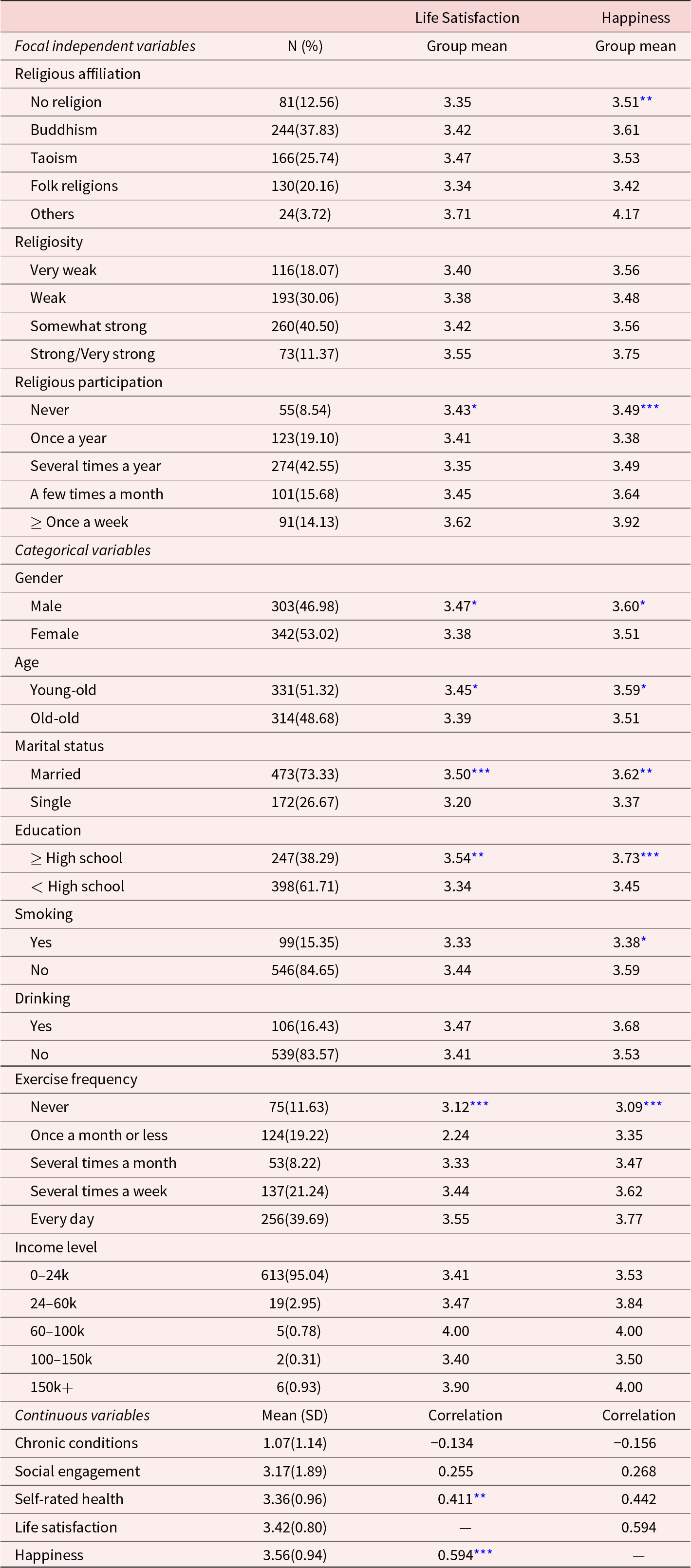
Guided by the classic works in the literature (Ellison Reference Ellison1991; Ellison et al. Reference Ellison, Gay and Glass1989), religious involvement was assessed in relation to three aspects: religious affiliation, religiosity (ie strength of religious beliefs) and frequency of religious participation. Religious affiliation was measured by asking respondents, ‘What is your religious belief?’ Possible responses were ‘No religion’, ‘Buddhism’, ‘Taoism’, ‘Folk religion’, ‘Yi Guan Tao’, ‘Islam’, ‘Catholicism’, ‘Protestant Christianity’ or ‘Others’. Due to the small number of respondents in certain categories during the initial analysis, we combined Folk religion and Yi Guan Tao (n-=11) were combined into a single category “Folk religions”, while Protestant Christianity (n=14), Catholicism (n=5), Islam (n=1) and other small groups were grouped together into a new category labeled as “Other”, as reflected in the descriptive Table 1.
Sample characteristics and bivariate analyses (N = 645)

Notes: T-tests and ANOVA tests were carried out to compare the means of life satisfaction and happiness among different groups.
* P < 0.05; **P < 0.01; ***P < 0.001.
Religiosity was measured by asking respondents about their attitude (1 = not at all strong, 2 = not strong, 3 = somewhat strong, 4 = strong = very strong) towards the following question: ‘How strongly do you follow your religious beliefs?’ We combined ‘4 = strong’ with ‘5 = very strong’ and recoded it as ‘4 = strong/ve ry strong’.
Frequency of religious participation was measured by asking respondents, ‘How often do you participate in private/public religious activities (ie prayer, meditation, Bible study, going to church, visiting temple and so on)?’ Possible responses were ‘1 = never’, ‘2 = once a year’, ‘3 = several times a year’, ‘4 = a few times a month’, ‘5 = once a week’, ‘6 = several times a week’ and ‘7 = every day’. The last three responses were combined and recoded as ‘ ≥ once a week’.
Covariates
Covariates included demographic variables such as age (< 70 years old = 1), gender (male = 1), marital status (married/partnered = 1), education (≥ high school = 1) and annual family income (measured in Taiwan dollars, with ‘1 = 0–24k’ as the reference group). Individual health behaviours such as smoking (yes = 1), drinking (yes = 1) and frequency of physical exercise (from ‘1 = never’ to ‘5 = every day’, with ‘1 = never’ as the reference group) were included. Moreover, health status variables – number of chronic conditions (0–10), frequency of social engagement (1–10) and levels of self-rated health (from ‘1 = very poor’ to ‘5 = very good’) – were also incorporated as covariates. Age and gender were examined as moderating variables in the data analysis.
Statistical analysis
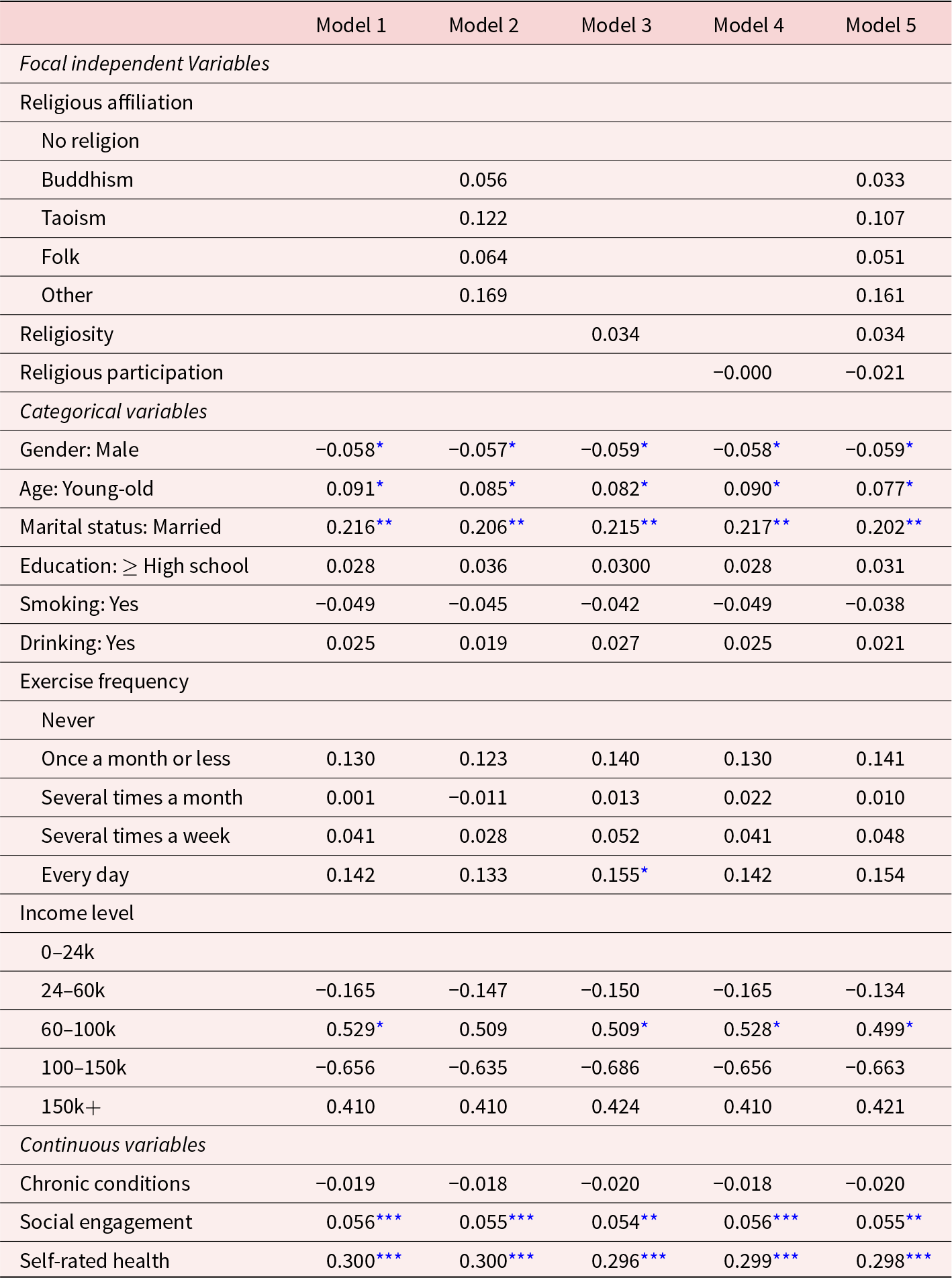
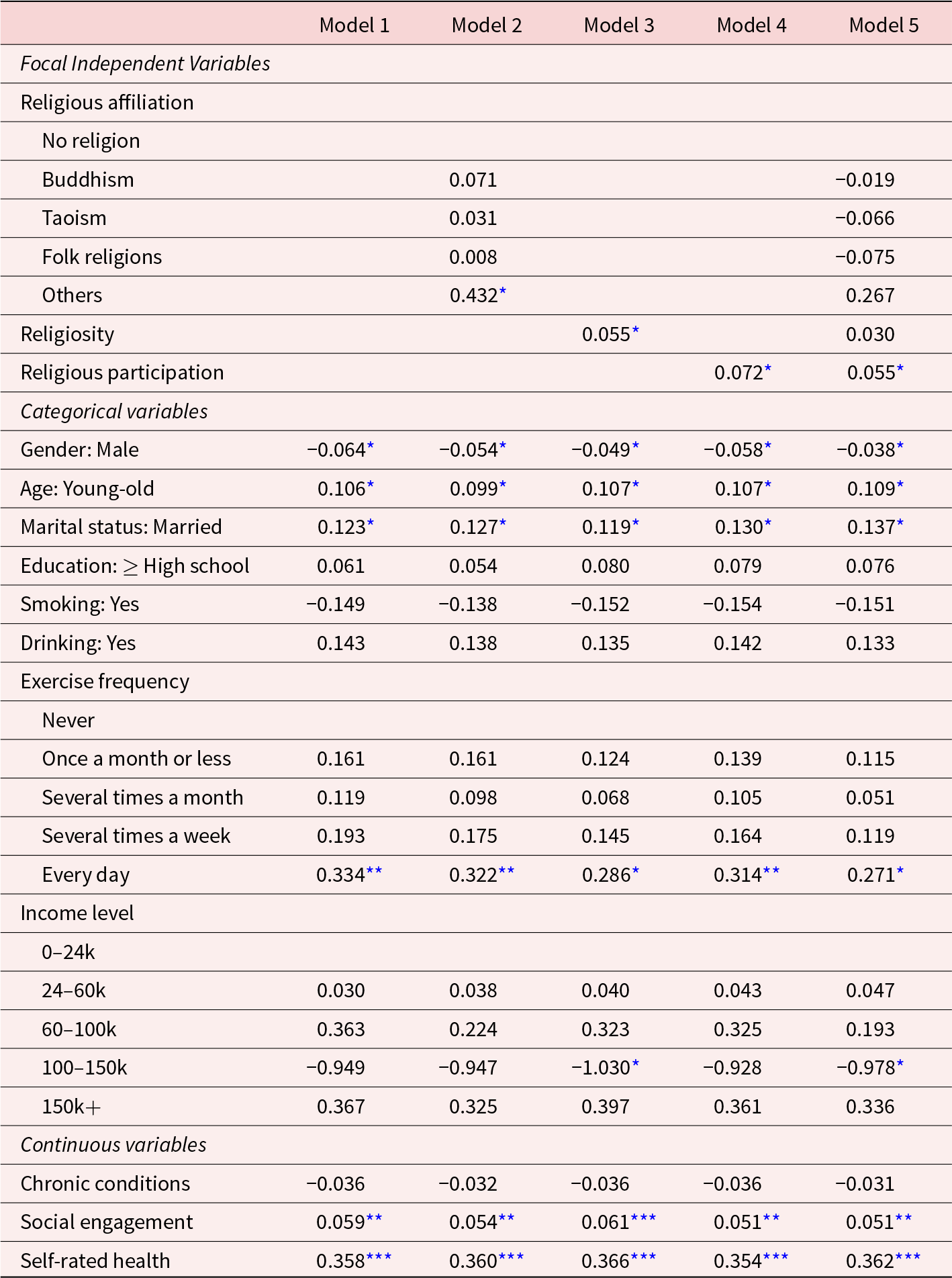
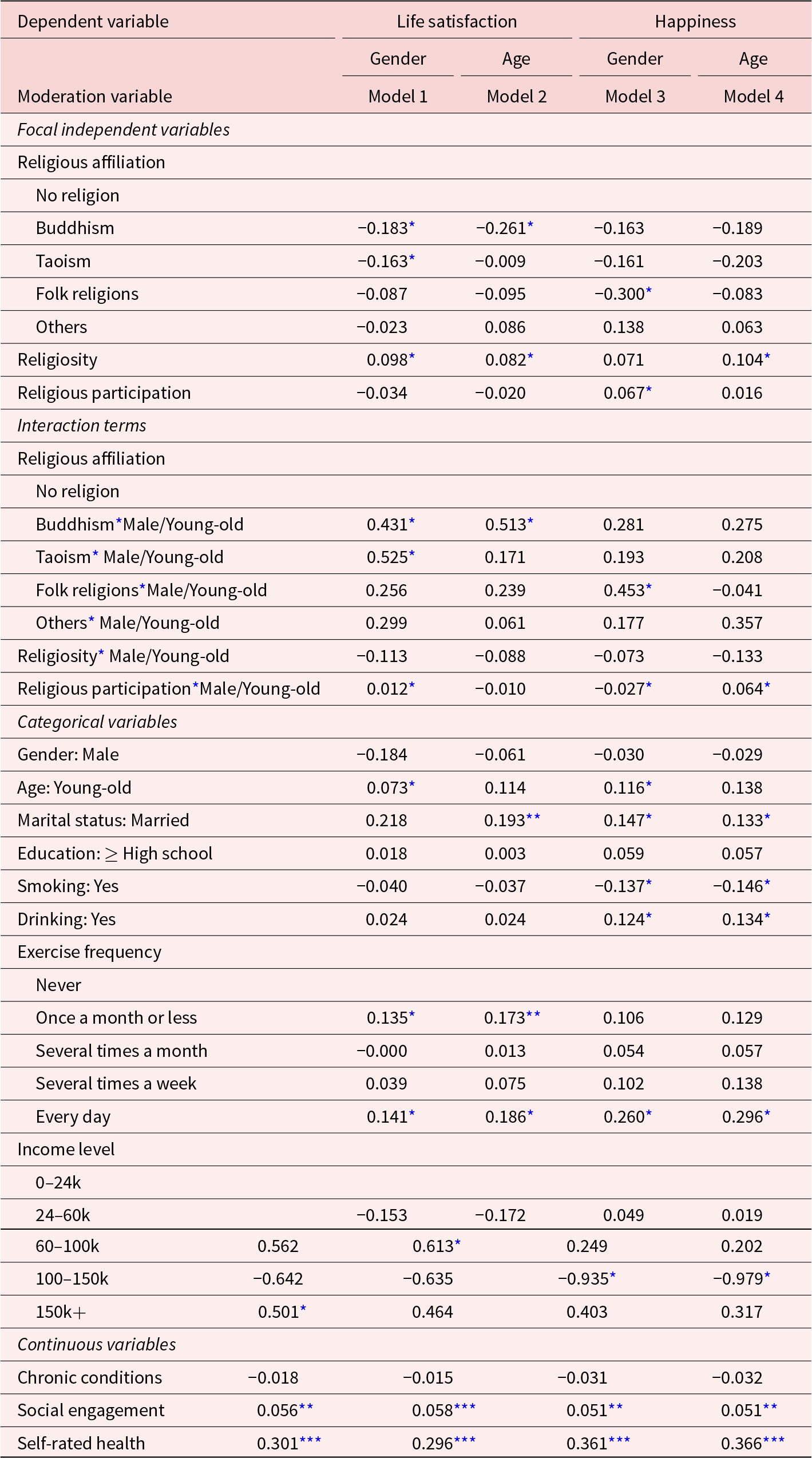
Data analysis was conducted using R software (version 4.0.3). Descriptive statistics are summarised in Table 1. For categorical variables, group means of life satisfaction and happiness were calculated and significance tests (T-test and ANOVA) were carried out. For continuous variables, correlation coefficients with life satisfaction and happiness were calculated and presented separately. In Tables 2–3, Ordinary Least Square (OLS) regressions were performed with SWB as the dependent variable and indicators of religious involvement as focal independent variables, controlling for socio-demographics. In Table 2 with life satisfaction being the dependent variable, Model 1 included demographics and Models 2–5 added indicators of religious involvement separately and jointly. Similarly, Table 3 examined the effects of religious involvement on happiness. To examine gender and age differences, interaction terms between moderating variables and each indicator of religious involvement were included. The results, summarised in Table 4, focused on gender differences in Models 1 and 3, and age group differences in Models 2 and 4. Additionally, subsample analysis and alternative model specifications were conducted to further assess the robustness of the regression model.
Regress religious involvement and covariates on life satisfaction (N = 645)

Notes: Standardized coefficients were provided.
* P < 0.05; **P < 0.01; ***P < 0.001.
Regress religious involvement and covariates on happiness (N = 645)

Notes: Standardized coefficients were provided.
* P < 0.05; **P < 0.01; ***P < 0.001.
Regress religious involvement and covariates on life satisfaction and happiness including interaction terms

Notes: Standardized coefficients were provided.
* P < 0.05; **P < 0.01; ***P < 0.001.
Results
Table 1 describes sample characteristics. Regarding religious affiliation, 12.56 per cent of older adults reported no religious affiliation, more than 60 per cent identified with Buddhism and Daoism, and approximately 20.16 per cent adhered to folk religion. A little more than half (51.87 per cent) of respondents identified as having somewhat/strong/very strong religious faith, and more than 70 per cent reported participating in religious activities at least several times a year. Additional analyses (not shown) revealed that levels of religiosity and religious participation did not vary much among different religion affiliations: more than half of the respondents who believed in Buddhism (64.32 per cent), Daoism (57.22 per cent) or folk religion (53.07 per cent) identified as having somewhat/strong/very strong faith. And more than 70 per cent of these respondents reported attending religious activities at least several times a year; participation rates were 77.38 per cent for Buddhists, 82.54 per cent for Daoists and 73.85 per cent for those adhering to folk religion.
As for demographics, the sample had more females (53.02 per cent) than males (46.98 per cent) and a higher percentage of young-old respondents (51.32 per cent) compared to the old-old (48.68 per cent). More than half of the respondents were younger than 70 years old (51.32 per cent) and the majority were married (73.33 per cent). Most respondents did not have the habit of smoking (84.65 per cent) or drinking (83.57 per cent). The average levels of life satisfaction and happiness were 3.42 and 3.56, respectively. Table 1 also shows that religious participation was significantly related to both life satisfaction and happiness, whereas religiosity was not. For religious affiliation, those belonging to other religions reported a significantly higher mean level of happiness. Males, compared to females, and the young-old, compared to the old-old, reported higher levels of life satisfaction and happiness.
We used OLS regressions to examine the associations between religious involvement and SWB and summarised the results in Tables 2–4. Our findings regarding the relationship between religious involvement and SWB among older adults remained stable through robustness tests, confirming the stability and reliability of the results. Table 2 reveals that, for the whole sample, no significant religious involvement variables were found. However, demographics such as gender, age, marital status, social engagement and self-rated health remained significantly associated with life satisfaction across all models. In Table 3, where happiness is the dependent variable, the inclusion of religious involvement variables in separate models shows some significant results: other religion (β = 0.432, Model 2) compared to no religion, religiosity (β = 0.055, Model 3) and religious participation (β = 0.072, Model 4) are all statistically significant at the 0.05 level. Similar to the results in Table 2, covariates such as gender, age, marital status, exercising every day, age, social engagement and self-rated health are significant across all models.
Subgroup variations were examined and the results of interactions are summarised in Table 4. Models 1 and 2, which regressed on life satisfaction, show that gender and age group significantly moderated the association between religious involvement and life satisfaction. For males, compared with no religion, Buddhism (β = 0.248, as calculated by 0.431 − 0.183, same hereinafter) and Daoism (β = 0.362) are significantly associated with higher levels of life satisfaction. For females, Buddhism (β = −0.183), Taoism (β = −0.163) and religiosity (β = 098) are significantly associated with life satisfaction. Age, social engagement and self-rated health remain significant covariates for both subsamples. As for age group differences, the young-old benefited significantly from Buddhism (β = 0.252), while for the old-old, religiosity (β = 0.082) is significantly associated with life satisfaction. Marital status, social engagement and self-rated health are the significant covariates. Therefore, in the context of life satisfaction, Hypotheses 2 and 3 are supported, whereas Hypotheses 1 is not supported by the data.
In terms of happiness, results in Models 3 and 4 reveal that, for males, folk religion (compared to no religion) is significant (β = 0.153), while for females the effect of folk religion is negative (β = −0.300). Religious participation is positively significant for both groups (β = 0.040 and β = 0.067 for males and females, respectively). Marital status, smoking, drinking, social engagement and self-rated health remain significant across the two groups. Age group interaction results show that, for the young-old age group, religious participation (β = 0.080) is statistically significant, whereas for the old-old group religiosity (β = 0.104) is significant. Similar covariates are significant. In the context of happiness, Hypotheses 1, 2 and 3 are all supported by the data.
Discussion
Focusing on older adults in Taichung, Taiwan, this study examined the associations between individual religious involvement and SWB, and explored potential gender and age differences in the associations. Demographic analyses showed that the surveyed older adults were quite active in all aspects of religious involvement, and this is in accordance with the previous literature, indicating religion as an important socialisation factor in the East Asian context (Liu et al. Reference Liu, Schieman and Jang2011). By examining an array of religion involvement, this article also documented patterns that largely deviated from those based on Western samples in prior research. First, no significant associations between any aspect of religious involvement and life satisfaction were found, but nearly all aspects of individual religious involvement were significantly associated with happiness when added into the models individually, and religious participation remained significant even when all other variables on religious involvement were taken into consideration.
With regard to the above-mentioned major finding of the study, we put forward the following explanation: life satisfaction and happiness are distinct constructs of SWB, with life satisfaction a long-term cognitive perception based on achieving lifelong goals and happiness more of a momentary experience that arises spontaneously (Badri et al. Reference Badri, Alkhaili, Aldhaheri, Yang, Albahar and Alrashdi2022; Kahneman and Riis Reference Kahneman, Riis, Huppert, Baylis and Keverne2005). For older adults in Taichung, they might rely more on other social resources in achieving long-term goals, for instance family and peer support, as reflected in Table 2 (significant covariates such as marital status, income and social engagement). This, to some extent, echoed Liu’s study (Reference Liu2010), which found that Taiwanese religions usually did not require or emphasise exclusive membership and denominational loyalty, which may lead to weak or little benefits of religious involvement, especially religious affiliation on certain health aspects. However, for the short-term aspects of SWB such as happiness and religious involvement, especially religious participation could have instant benefits. This is in accordance with the social support theory, which suggests that religious participation, as a special cultural element, can increase social interaction with a religious community and help people to gain more support, thus improving happiness (Krause et al. Reference Krause, Ellison, Shaw, Marcum and Boardman2001; McFadden Reference McFadden1995). In many circumstances, religious societies can provide a source of comfort to those facing difficult situations, and the sense of belonging and support, in turn, can increase individual happiness (Hou et al. Reference Hou, Wu and Huang2023). In addition, Fan et al. (Reference Fan, Wang and Fan2019) proposed that Taiwanese people tend to have a strong utilitarian orientation when using religion as a tool to cope with stressors or fulfil specific needs in daily life. For instance, they often turn to religion primarily in times of urgent need, which could help explain the short-term happiness benefit of religion for older adults in Taiwan. The findings of this study also support the 4B models of religious involvement, confirming the multi-dimensional impact of religious involvement on individual wellbeing (Saroglou Reference Saroglou2011, Reference Saroglou and Saroglou2014).
Additionally, our analysis revealed significant variations across different gender groups. Descriptive statistics showed that, on average, females had lower levels of life satisfaction and happiness compared to males. For males, Buddhism and Taoism were significantly and positively associated with life satisfaction, while for females the associations were negative, but they benefited from religiosity. One speculation is that older females in Taiwan often have lower educational levels than males (as indicated in Table 1), which might lead to stronger religious beliefs. The Buddhist belief in Karma, which views life’s suffering and misery as inevitable, could contribute to anxiety and depression (Liu Reference Liu2009), resulting in negative health effects. In contrast, males with higher levels of education are more likely to engage in religious activities such as event organisation and participation in Buddhism or Daoism scriptural discussion, which could have more positive effects on their health (Zhang Reference Zhang2010). Moreover, it was found that the patriarchal rituals and norms of religions in Chinese society were sometimes regarded as tools for males to achieve social control and social influence, thereby attaining long-term fulfilment (Moon et al. Reference Moon, Tratner and McDonald2022).
A similar pattern was observed for happiness. Folk religion was significantly associated with higher levels of happiness for males, whereas females experienced negative effects from folk religion but gained benefits from religious participation. For religious participation, females tended to engage more frequently in collective worship activities and other rituals. As a result, the role of congregations in providing social relations and support is likely more vital for them than for males (Miller and Stark Reference Miller and Stark2002). As for folk religion, we conjecture that, similar to Buddhism and Taoism, certain characteristics of Chinese folk religion might explain this counter-intuitive finding. Some gods, deities and spirits in the folk religion pantheon are violent and rebellious, with ghostly origins and a history of demanding offerings through harmful acts. Such elements might invoke fear and uncertainty, potentially serving as stressors with negative health consequences (Liu et al. Reference Liu, Schieman and Jang2011; Shahar and Weller Reference Shahar and Weller1996). For females who received lower levels of education, it is possible that they were more susceptible to these negative aspects of religious involvement.
Lastly, this study revealed age differences. Correlation analysis in Table 1 showed that, with increasing age, levels of life satisfaction and happiness declined, with happiness declining more substantially than life satisfaction. The significant positive/negative pattern of Buddhism was also observed among the young-old/old-old in terms of life satisfaction. We speculate that for the young-old, active participation in Buddhist communal activities such as group meditation and temple visits provides substantial social support and a sense of community, thereby enhancing their life satisfaction (LaBelle et al. Reference LaBelle, Hastings, Vest, Meeks and Lucier2023). Mindfulness and meditation practices offer effective stress coping mechanisms, while engagement in altruistic activities fosters a sense of purpose and fulfilment. Conversely, the old-old may encounter physical constraints and health issues that limit their ability to fully participate in these activities, potentially leading to frustration and decreased satisfaction (Cowden et al. Reference Cowden, Nakamura, Chen, Case, Kim and VanderWeele2022). Additionally, increased dependency on others for attending religious activities and the perceived burden of religious duties can contribute to stress. Over time, this accumulated stress may negatively impact long-term health outcomes. For happiness, the positive effects of both religiosity and religious participation reinforced the health benefits of religious involvement. The old-old were found to be more susceptible to the benefits of religiosity, while the young-old experienced greater benefits from religious participation. We speculate that this distinction can be understood by examining the varying needs and circumstances of these age groups. For the old-old, who may be limited in their ability to fully participate in certain activities and who may have experienced the loss of family members and peers, there is a tendency to turn to religion for emotional and psychological comfort. They often become more pious and seek spiritual support through religion (Krause et al. Reference Krause, Liang, Shaw, Sugisawa, Kim and Sugihara2002; Malone and Dadswell Reference Malone and Dadswell2018). In contrast, the young-old are generally more physically active and socially engaged, leading them to derive greater benefits from participating in communal religious activities. These activities provide social interaction, a sense of belonging and structured support systems, which are essential for maintaining happiness and promoting health in this age group.
This study has some limitations that need to be addressed. The cross-sectional nature of the data prevents us from making causal inferences with regard to the focal relationships. Also, self-report measures might involve recall bias, resulting in an underestimation of the focal associations. Lastly, the data did not include important variables such as individual cognition levels, which, to some extent, may limit the accuracy of our assessment of individual wellbeing.
Despite these limitations, our study makes at least four significant contributions to the current literature on religion and health. First, we included three different aspects of religious involvement – religious affiliation, religiosity and religious participation – providing a comprehensive assessment of individual religiousness. Second, we explored two aspects of SWB – life satisfaction and happiness – thereby deepening our understanding of both the cognitive and the affective benefits of religious involvement. Third, by using authoritative data from a representative sample of Taiwanese older adults in Taichung City, we specifically focused on this population at a life stage when individuals seek coherence and integrity, and when religion often becomes increasingly important. Last, by focusing on subgroup variations, an understudied area in the literature on religion and health, this study provided evidence revealing the gender and age-related patterns in the association between religious involvement and SWB in a non-Western context, where religion presents unique features. Building on the current study, scholars are well-positioned to conduct qualitative studies to identify pathways through which various aspects of religious involvement may affect individual wellbeing. Cross-culture comparisons with other Asian contexts are also encouraged for future research. The findings of this study are informative for policy and clinical interventions aimed at promoting life satisfaction and happiness for specific age and gender groups through religious involvement. For instance, forming community programs that encourage religious involvement and offering group therapy sessions can help address specific concerns and build supportive networks for older adults.
Financial support
Funding was provided by the Ministry of Science and Technology, Taiwan, MOST 104-2410-H-029 -041-SS3.
Competing interests
The authors declare no competing interests.
Ethical standards
This Taichung Project’s IRB number is 104WFD0150098. It received approval from China Medical University and Hospital, Taichung, Taiwan.