Introduction
Nitric oxide (NO) is produced in animals from L-arginine in a process catalyzed by NO-synthase. Some NO physiological effects, such as the mediation of acetylcholine (parasympathetic mediator) action, relaxation of smooth muscle tonus (Ignarro, 1989; Moncada et al., Reference MONCADA, PALMER and HIGGS1991), some central effects (anti – stress effect (Malyshev et al., Reference MALYSHEV, ZENINA, GOLUBEVA, SALTYKOVA, MANUKHINA, MIKOYAN, KUBRINA and VANIN1999; Smirin et al., Reference SMIRIN, POKIDYSHEV, MALYSHEV, VANIN and MANUKHINA2000)), and its intensive production in course of embryogenesis (Blum et al., Reference BLUM, MOREL, HAMMON, BRUCKMAIER, JAGGY, ZURBRIGGEN and JUNGI2001; Battaglia et al., Reference BATTAGLIA, CIOTTII, NOTARANGELO, FRATTO, FACCHINETTI and DE ALOYSIO2003; von Mandach et al., Reference VON MANDACH, LAUTH and HUCH2003; Ribeiro et al., Reference RIBEIRO, OGANDO, FARINA and FRANCHI2004; Retsky et al., Reference RETSKY, SHAKHOV, BLIZNETZOVA, ARTEMIEVA, KAVERIN, ERMAKOVA and KOSMATYCH2004; Titov et al., Reference TITOV, VARIGINA and FISININ2007; Reference TITOV, VINNIKOVA, FISININ, BLIZNETSOVA and RETSKY2008c), spermatogenesis (Amiri et al., Reference AMIRI, SHEIKH and NAJAFI2007; Chaturvedi and Kumar, Reference CHATURVEDI and KUMAR2007; Kumar and Chaturvedi, Reference KUMAR and CHATURVEDI2008) and mediation of gene expression (Vasil'eva et al., Reference VASIL'EVA, STUPAKOVA, LOBYSHEVA, MIKOYAN and VANIN2001; Zhou and Brune, Reference ZHOU and BRUNE2005) are interesting with respect to poultry breeding. It is possible that this activity could allow regulating animal development and its productivity. The main limitation for the practical use of NO and its donors is the lack of knowledge about how it directly impacts physiological action and how other factors affect its metabolism in animals. It is known, for example, that nitrite and nitrate are the end products of NO oxidation in water solutions containing oxygen (Licht et al., Reference LICHT, TANNENBAUM and DEEN1988; Kharitonov et al., Reference KHARITONOV, SUNDQUIST and SHARMA1995). In order to use NO appropriately, a guarantee is required that the usage wouldn't be connected with production of such toxins or other active nitrogen forms such as nitrogen dioxide or peroxynitrite, within the organism (Cammack et al., Reference CAMMACK, JOANNOU, CUI, MARTINEZ, MARAJ and HUGHES1999).
The avian embryo is convenient for the investigation of NO production and metabolism in embryogenesis because of its relatively large size and the fact it develops outside of the hen, which permits monitoring all stages of development.
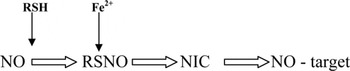
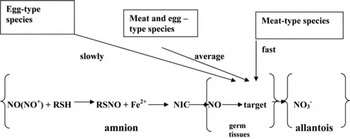
Nitric oxide is short-lived substance. Its half-life time in live tissues ranges from a fraction of second to several seconds (Moncada et al., Reference MONCADA, PALMER and HIGGS1991). It is considered that NO physiological effects are mediated by its metabolites, which act as NO-storage pool. S-nitrosothiol (RSNO) is one of the main NO-store (Gaston, Reference GASTON1999; Rassaf et al., Reference RASSAF, PREIK, KLEINBONGARD, LAUER, HEI, STRAUER, FEELISCH and KELM2002; Severina et al., Reference SEVERINA, BUSSYGINA, PYATAKOVA, MALENKOVA and VANIN2003). RSNO produces different nitrosyl-iron complexes (NIC) under the action of the ferrous cation. Researchers have reported that some organic nitro-compounds (RNO2) can produce nitrosyl-iron complexes (Lima et al., Reference LIMA, BONINI, AUGUSTO, BARBEIRO, SOUZA and ABDALLA2005; Titov, Reference TITOV2008). Some NIC are considered as NO-donors that directly interact with the physiological targets of NO (Vanin, Reference VANIN2009; Vanin et al., Reference VANIN, HUISMAN and and VAN FAASSEN2002a; Reference VANIN, MULLER, ALENCAR, LOBYSHEVA, NEPVEU and STOCLET2002b; Severina et al., Reference SEVERINA, BUSSYGINA, PYATAKOVA, MALENKOVA and VANIN2003) (Figure 1).
NO physiological effects are realised by the activation of guanylate cyclase (smooth muscle tonus, platelet aggregation) (Braughler, Reference BRAUGHLER1983; Stamler et al., Reference STAMLER, SINGEL and LOSCALZO1992; Severina et al., Reference SEVERINA, BUSSYGINA, PYATAKOVA, MALENKOVA and VANIN2003) and regulation of caspase activity (apoptosys) (Li et al., Reference LI, BILLIAR, TALANIAN and KIM1997; Kim et al., Reference KIM, CHUNG, SIMMONS and BILLIAR2000).
Proposed mechanism of realization of NO physiological effects (according to Vanin et al., Reference VANIN, MULLER, ALENCAR, LOBYSHEVA, NEPVEU and STOCLET2002b, Severina et al., Reference SEVERINA, BUSSYGINA, PYATAKOVA, MALENKOVA and VANIN2003).

Nitric oxide in embryogenesis
It is known that embryogenesis is accompanied by intensive NO production. Accumulation of NO metabolites has been observed during fertilized egg-cell incubation (Battaglia et al., Reference BATTAGLIA, CIOTTII, NOTARANGELO, FRATTO, FACCHINETTI and DE ALOYSIO2003; von Mandach et al., Reference VON MANDACH, LAUTH and HUCH2003), in the amniotic fluid and in the blood of newly born animals (Blum et al., Reference BLUM, MOREL, HAMMON, BRUCKMAIER, JAGGY, ZURBRIGGEN and JUNGI2001; Retsky et al., Reference RETSKY, SHAKHOV, BLIZNETZOVA, ARTEMIEVA, KAVERIN, ERMAKOVA and KOSMATYCH2004; Ribeiro et al., Reference RIBEIRO, OGANDO, FARINA and FRANCHI2004; Titov et al., Reference TITOV, VARIGINA and FISININ2007; Titov et al., Reference TITOV, VINNIKOVA, FISININ, BLIZNETSOVA and RETSKY2008c). Effects of NO on tissue differentiation and apoptosis have been reported (Li et al., Reference LI, BILLIAR, TALANIAN and KIM1997; Kim et al., Reference KIM, CHUNG, SIMMONS and BILLIAR2000). High concentrations of S-nitrosothiols in animal and human milk (Silanikove et al., Reference SILANIKOVE, SHAPIRO, SHAMAY and LEITNER2005; Titov, Reference TITOV2008) give rise to the possibility of NO participation in post-embryonic development in both mammals and humans, but the specific role of NO in embryogenesis is not known. Some researchers have presented correlations between NO metabolites in the medium surrounding ovo, fertility (Fabregues et al., Reference FABREGUES, BALASCH, MANAU, CREUS, JIMENEZ, CARMONA, CASAMITJANA and VANRELL2000) and successful implantation (Moncada et al., Reference MONCADA, PALMER and HIGGS1991; Fabregues et al., Reference FABREGUES, BALASCH, MANAU, CREUS, JIMENEZ, CARMONA, CASAMITJANA and VANRELL2000). There is data regarding a similar correlation with spermatozoid mobility and other semen properties (Wu et al., Reference WU, HUANG, TSAI, LUI and LIU2004; Amiri et al., Reference AMIRI, SHEIKH and NAJAFI2007; Chaturvedi and Kumar, Reference CHATURVEDI and KUMAR2007; Kumar and Chaturvedi, Reference KUMAR and CHATURVEDI2008). Attempts to estimate the effects of NO-donors and NO-synthase blockers on embryo development have not been successful as yet (Alexander et al., Reference ALEXANDER, CHAU and TUAN2007).
Certain shortcomings with the previous experimental approaches have made more detailed research impossible. Firstly, most of the researchers considered an embryo as a homogeneous object excreting NO into the surrounding medium, whereas the embryo is a heterogeneous and complex interactive environment. Embryo internal NO metabolites and how they change during the course of development are important parameters for this research.
Secondary, only nitrite and nitrate compounds, as stable end products of NO metabolism, have been estimated. However, the substances mediating NO physiological effects, such as RSNO and NIC, are significant as NO depots. Nitrite and nitrate have no such function in physiological effects (Rassaf et al., Reference RASSAF, PREIK, KLEINBONGARD, LAUER, HEI, STRAUER, FEELISCH and KELM2002).
Methodological problems for nitric oxide metabolites determination in biological materials
More detailed research of NO production and metabolism in the course of embryo development is required. Firstly, there is the need to estimate the levels of physiological NO donors and their transformation. Classical methods are not sufficient for the complete and specific determination of nitro- and nitroso-compounds contents in such complex systems as seen in biological materials (Jourd'heuil et al., Reference JOURD'HEUIL, HALLEN, FEELISCH and GRISHAM2000; Tsikas, Reference TSIKAS2000; Tarpey et al., Reference TARPEY, WINK and GRISHAM2004; Titov et al., Reference TITOV, PETRENKO and VANIN2009b; Reference TITOV, PETRENKO, VANIN and STEPURO2010; Davis et al., Reference DAVIS, LEFFLER, ANDERSON, SODERBERG and MEREDITH1985; Cox, Reference COX1980; Yoshizumi et al., Reference YOSHIZUMI, AOKI, MATSUOKA and ASAKURA1985). Preventive decontamination of the object from admixtures is necessary for all these methods, although the cleaning procedure and acid medium that is necessary for most of these methods can induce incontrollable transformation of the nitro- and nitroso-compounds (Davis et al., Reference DAVIS, LEFFLER, ANDERSON, SODERBERG and MEREDITH1985; Tarpey et al., Reference TARPEY, WINK and GRISHAM2004; Titov et al., Reference TITOV, PETRENKO and VANIN2009b).
Determination of nitro- and nitroso-compounds based on their direct impact on physiological conditions, without any modification, would be a more appropriate methodological approach. Such methods should be based on the specific properties of these substances that directly affect physiological conditions. Enzymes attract interest in this connection, because their action is highly specific. Methods of nitrate and nitrite determination based on usage of nitrate and nitrite reductases are known (Hamano et al., Reference HAMANO, MITSUHASHI, Yu., AOKI, SEMMA, ITO and OJI1998; Tarpey et al., Reference TARPEY, WINK and GRISHAM2004), but these methods are able to detect only nitrate and nitrite.
The enzymatic sensor, based on the specific ability of all nitroso-compounds to inhibit catalase with the comparatively same efficiency which increases 100 fold in the presence of chloride and thiocyanate, has been developed in the joint research program of the Russian State Medical University and the Institute of Chemical Physic of Russian Academy of Science. Other known catalase inhibitors have no such specificity and normally are not present in biological subjects in significant concentrations. This allows the estimatation of total nitroso-compounds in the subject by comparison of catalase activity before and after addition of chloride (Titov, Reference TITOV2008; Titov et al., Reference TITOV, PETRENKO and VANIN2008a; Reference TITOV, PETRENKO and VANIN2009b; Reference TITOV, PETRENKO, VANIN and STEPURO2010), following appropriate calibration.
Determination of NIC is based on the compounds ability to lose its inhibitive property in a medium containing an iron chelator and NO ‘trap’. RSNO can be determined as a substance that produces NIC under the influence of ferrous cations, from which acquires its properties. Nitrite and N-nitroso-compounds (RNNO) produce no NIC in a neutral medium and do not lose their inhibitive properties in the presence of an iron chelator and NO trap (Titov, Reference TITOV2008; Titov et al., Reference TITOV, PETRENKO and VANIN2008a; Reference TITOV, PETRENKO and VANIN2008b; Reference TITOV, PETRENKO and VANIN2009b; Reference TITOV, PETRENKO, VANIN and STEPURO2010).
Determination of the total amounts of nitro-compounds is based on their ability to be reduced to a nitroso-state by VCl3 and then be determined as nitroso-compounds. Determination of high molecular organic nitro-compounds, that are able to produce iron-nitrosyl complexes (RNO2), is based on their ability to acquire the NIC property from the effects of ferrous cation and thiol. Inorganic nitrate has no such property (Titov et al., Reference TITOV, PETRENKO and VANIN2008a; Reference TITOV, PETRENKO and VANIN2009b). Sensitivity of this method is up to 50 nM, which is significantly more than that of classic methods (Tarpey et al., Reference TARPEY, WINK and GRISHAM2004). This enzymatic sensor, due to its high specificity and sensitivity, gives rise to the possibility of express analysis of NO metabolites in biological tissues and any changes in the course of the physiological process. This has resulted in the above-mentioned findings regarding the high nitro- and nitroso-compounds concentration in the amniotic fluid of cow embryos and in newborn calf blood (Blum et al., Reference BLUM, MOREL, HAMMON, BRUCKMAIER, JAGGY, ZURBRIGGEN and JUNGI2001; Christen et al., Reference CHRISTEN, CATTIN, KNIGHT, WINYARD, BLUM and ELSASSER2007; Retsky et al., Reference RETSKY, SHAKHOV, BLIZNETZOVA, ARTEMIEVA, KAVERIN, ERMAKOVA and KOSMATYCH2004), although it was established that these samples contain mostly high molecular nitrates (RNO2), iron-nitrosyl complexes and S-nitrosothiols. Nitrite is contained in trace amounts (Titov, Reference TITOV2008; Titov et al., Reference TITOV, VINNIKOVA, FISININ, BLIZNETSOVA and RETSKY2008c; Reference TITOV, AKIMOVA, VINNIKOVA and FISININ2009a).
Changing nitric oxide metabolites content in different parts of the fertilized poultry egg during its development
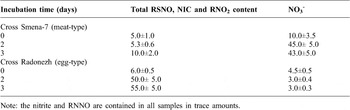
According to the reports of Titov et al. (Reference TITOV, VINNIKOVA, FISININ, BLIZNETSOVA and RETSKY2008c), the albumen of fertilized poultry eggs contain μMol concentrations of nitro- and nitroso-compounds. These compounds are contained in the yolk in trace amounts and are not accumulated thereafter, although levels in albumen increase during the course of incubation. A comparison of their accumulation process in embryos of two breeds, a Smena-7 (broiler) and Radonezh (layer), showed that, in the first case, mainly nitrate was accumulated in the albumen and in the second case RSNO, NIC and RNO2 were present (Table 1). This showed that development of the bird embryo, from the start, is accompanied by the accumulation of various NO metabolites in the albumen. Their qualitative composition is different in embryos from these two crosses. Consequently, we can assume that any qualitative differences in NO metabolism in embryos of these two lines existed before the formation of the amniotic and allantoic covers.
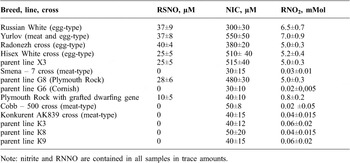
Nitro- and nitroso-compounds accumulate only in the developing embryo, and hence it can be proposed that their basic generators are germ tissues. To check this proposition, it is necessary to determine NO metabolite levels in different parts of the embryo after formation of the embryo covers. Amniotic fluid is in direct contact with germ tissue, and the total content of NO metabolites in amniotic fluid of avian embryos of different breeds varies from tens of μMol to several mMol (Titov et al., Reference TITOV, VARIGINA and FISININ2007). These are represented by RSNO and NIC, compounds that are considered as a physiological NO storage pool (Vanin et al., Reference VANIN, MULLER, ALENCAR, LOBYSHEVA, NEPVEU and STOCLET2002b; Severina et al., Reference SEVERINA, BUSSYGINA, PYATAKOVA, MALENKOVA and VANIN2003) and also by RNO2 that has the same ability according to some researchers (Lima et al., Reference LIMA, BONINI, AUGUSTO, BARBEIRO, SOUZA and ABDALLA2005; Schopfer et al., Reference SCHOPFER, BAKER, GILES, CHUMLEY, Ph., BATTHYANY, CRAWFORD, PATEL, HOGG, BRANCHAUD, LANCASTER and FREEMAN2005). Nitrite and nitrate were determined in the amniotic fluid in trace amounts (Table 2).
Content of NO metabolites (µM) in the albumen of chicken embryos during the first days of development (Titov et al., Reference TITOV, VINNIKOVA, FISININ, BLIZNETSOVA and RETSKY2008c).

Note: the nitrite and RNNO are contained in all samples in trace amounts.
The content of NO metabolites in the amniotic fluid can vary considerably (by 1-2 orders of magnitude) between different individuals of the same poultry species, but is a relatively stable index within specific lines and crosses. For example, embryos of the cross bred Radonezh and Smena-7 contain high (several mMol) and low (tens of uMol) total nitro- and nitroso-compounds concentration in amnion respectively. To clarify the reason for this difference, it is necessary to observe the changing levels of these compounds in different parts of embryos of these breeds in course of their development. This observation could answer the question – is this difference due to different production intensity of these substances, or is there is some difference in their metabolism?
Content of NO metabolites in amniotic fluid of avian embryos on the 11th day of incubation (Titov et al., Reference TITOV, VARIGINA and FISININ2007).

Note: nitrite and RNNO are contained in all samples in trace amounts.
It was established that the total content of nitro- and nitroso compounds in amniotic fluid of avian embryos was not significantly changed from the time of final formation of the embryo (the 7th day of incubation) until the concluding stage of the pre-foetal period (the 14th day) (Titov et al., Reference TITOV, AKIMOVA, VINNIKOVA and FISININ2009a).
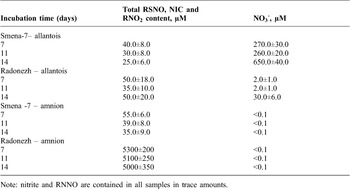
The content of RSNO, NIC and RNO2 in allantois does not exceed a few tens of micromoles, but in the course of the embryo's development, nitrate accumulates, most intensively in the allantois of Smena-7 embryos (Table 3).
Change in NO metabolites in amnion and allantois of embryos of Smena-7 and Radonezh crosses from 7 to 14 day of incubation (Titov et al., Reference TITOV, AKIMOVA, VINNIKOVA and FISININ2009a).

Note: nitrite and RNNO are contained in all samples in trace amounts.
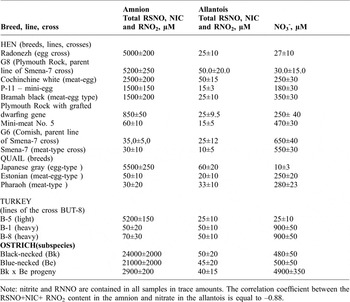
A similar regularity was noted in embryos of other breeds of chickens as well as quail, turkey and ostrich. A negative correlation was found between total NO metabolites in the amnion and nitrate content in allantois (Titov, Akimova et al., 2009). Ostriches are distinguished by the highest content of nitro- and nitroso - compounds in their amnion. This index is about equal in embryos of the African black-necked and blue-necked subspecies. However, in embryos of their hybrids which are distinguished by a high rate of live weight gain (Turevich, 2002), this level has been 10 times smaller than in cases when both parents belong to the same subspecies, and nitrate concentration in allantois of the hybrid embryo has been 10 times greater accordingly (Table 4).
Content of NO metabolites in amnion and allantois of embryos of different avian species in the pre-foetal period: hen (d14), quail (d12), turkey (d21), ostrich (d30) (Titov et al., Reference TITOV, AKIMOVA, VINNIKOVA and FISININ2009a).

Note: nitrite and RNNO are contained in all samples in trace amounts. The correlation coefficient between the RSNO+NIC+ RNO2 content in the amnion and nitrate in the allantois is equal to –0.88.
Basic features of nitric oxide metabolism in developing bird embryos
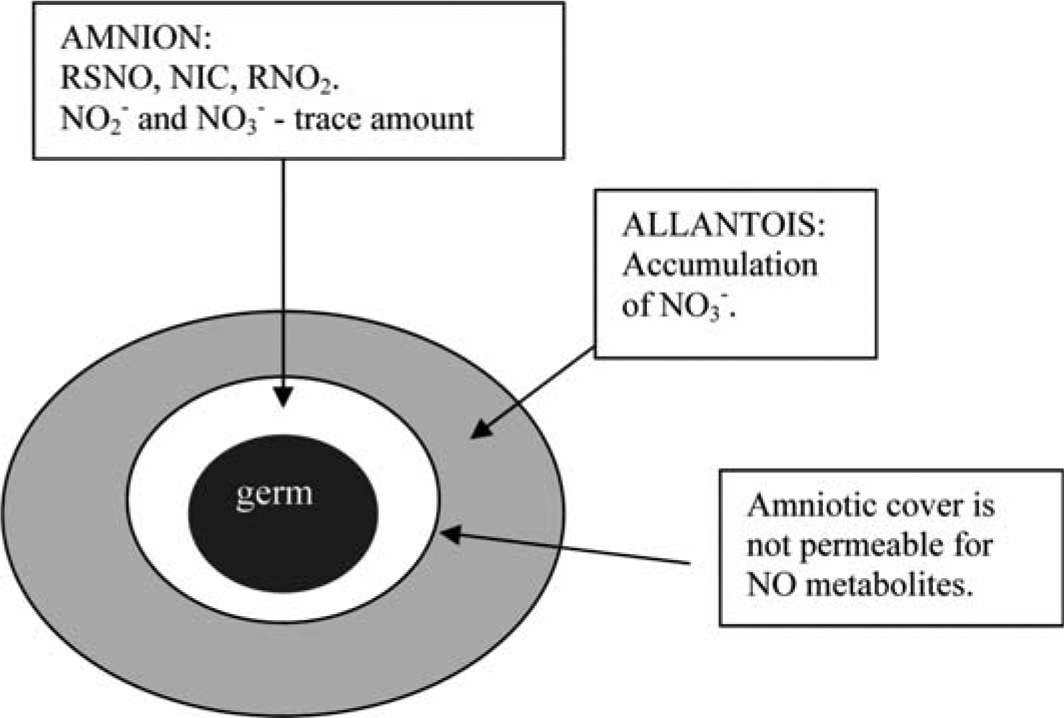
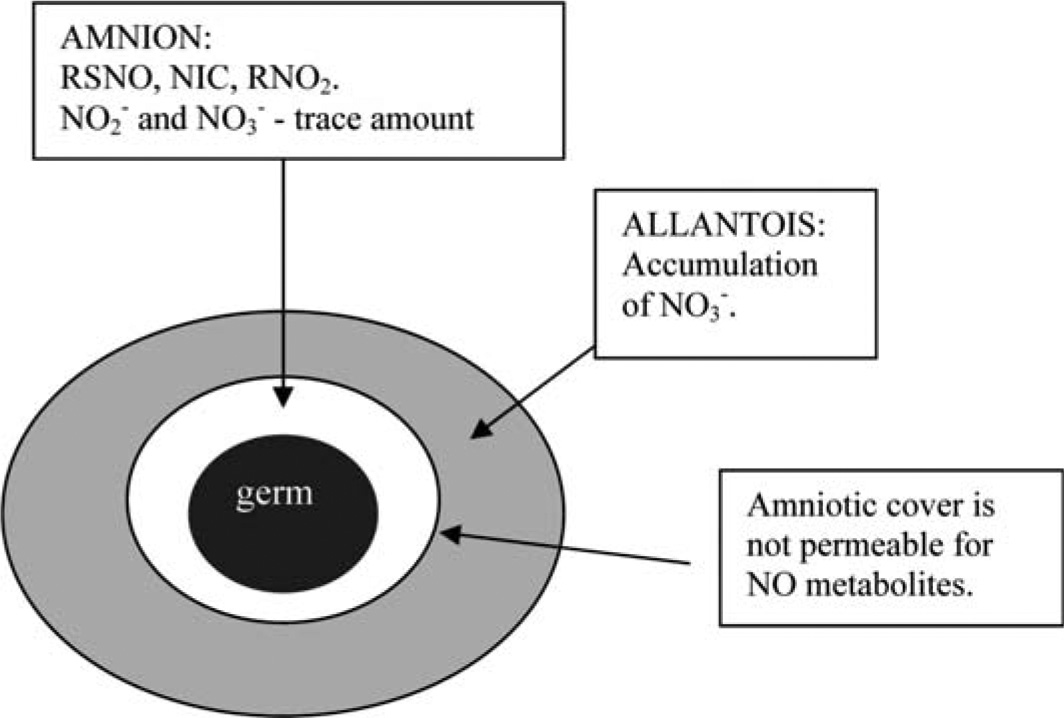
As has been established, bird embryo development is connected with NO metabolite accumulation in the albumen from the beginning of incubation (Table 1). The amniotic sac is formed at the third day of embryo development. NO metabolites in the amniotic fluid are presented mostly as RSNO, nitrosyl-iron complexes (NIC) and high molecular nitro-compounds that are able to produce such complexes (RNO2). Nitrate and nitrite are contained in trace amounts (Table 2). Nitrate accumulates initially in the albumen and, after formation of embryo covers, it accumulates in the allantois (Table 1, 3). Thus, the germ develops in a medium which contains physiological NO-donors but no nitrite or nitrate. Allantois, on the contrary, contains low concentrations of NO-donors but nitrate accumulates there. Therefore it can be proposed that the amniotic cover is impermeable to nitro- and nitroso-compounds, and that some kind of regulating system is present to prevent accumulation of nitrite and nitrate in the amnion. A negative correlation between the total concentration of NO metabolites in the amnion and that of nitrate in the allantois has been established for all observed species (Table 4). Furthermore, the following regularities have been established:
• Bird embryo development is accompanied by the intensive accumulation of NO metabolites in albumen from the beginning of incubation. Content is significantly varies in embryos of different lines and crosses within species.
• Amniotic fluid contains S-nitrosothiols, iron-nitrosyl complexes and high molecular nitrate in significant concentrations (up to several mMol) but inorganic nitrate and nitrite are present in trace amounts.
• Nitrate accumulates in the allantois in the course of embryo development (Figure 2).
• A negative correlation was established between total concentration of nitro- and nitroso-compounds in the amnion and nitrate concentration in the allantois at the concluding stage of the pre-foetal period (Table 4).
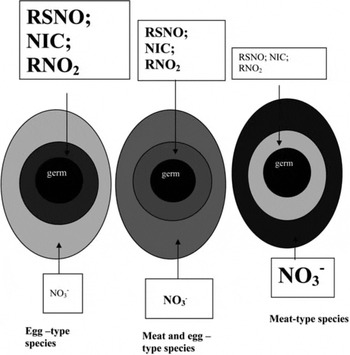
• The embryo of the most of meat-type breeds contains low concentration of nitro- and nitroso-compounds in the amnion and high concentration of nitrate in the allantois compared to that of egg-type breeds (Figure 3). These parameters in some mini-egg layers and meat/egg-type breeds were found to be intermediate (Tables 2 and 4).
Basic regularities of NO metabolites accumulation in bird embryo after formation of embryo covers (Titov et al., Reference TITOV, AKIMOVA, VINNIKOVA and FISININ2009a).
Negative correlation between nitro- and nitroso-compounds content in amnion and content of nitrate in allantois (Titov et al., Reference TITOV, AKIMOVA, VINNIKOVA and FISININ2009a).

Features of development that are correlated with nitric oxide metabolites content in different parts of embryo
Nitric oxide and its metabolites, especially donors of NO, have great physiological significance. Hence it can be supposed that there is a connection between their embryonic content and certain features of embryo and post-embryo development. According to the data of Titov et al. (Reference TITOV, VARIGINA and FISININ2007; Reference TITOV, AKIMOVA, VINNIKOVA and FISININ2009a) presented in Tables 2 and 4, NO metabolites in the amniotic fluid and in the allantois of a poultry embryo with the same breed can vary significantly up to 1-2 orders of magnitude. But these indices remain relatively stable within the same line or cross. For the tested meat breeds, the index of nitro- and nitroso compounds concentration in amnion was significantly less, and that of nitrate content in allantois was accordingly more than that seen for the layer breeds. Thus there is some interconnection between these indices and certain qualities of adult birds. But what are these qualities? Hens of layer breeds, lines and crosses presented in Table 2 have very different indices of body weight and egg productivity. For example, hens of Yurlov breed surpass hens of Hisex White breed in body weight by 3.6 times and are inferior in egg productivity by 1.6 times (Royter et al., Reference ROYTER, YEGOROVA, VARAKINA and SHAKHNOVA2005), but there is no correlation between these indices and NO metabolites content in the amnion.
In the amniotic fluid of embryos of all broiler crosses, total NO metabolites are 100 times smaller and nitrate in allantois are, accordingly, greater than in that of egg breeds (Tables 2-4). All broilers gain weight very quickly, and during the first 4-6 weeks of life broilers gain more weight than layers do in 20 weeks (Royter et al., Reference ROYTER, YEGOROVA, VARAKINA and SHAKHNOVA2005).
Estonian (meat/egg) and Pharaoh (meat) quail breeds gain body weight faster than the Japanese gray breed (egg laying) 1.5 and 2 fold respectively. Egg productivity of Estonian and Japanese breeds does not differ significantly and exceed the Pharaoh breed by 1.4 times (Royter et al., Reference ROYTER, YEGOROVA, VARAKINA and SHAKHNOVA2005). Their embryos had the same differences in the amniotic and allantois content of NO metabolites as broilers and laying hen breeds (Tables 2 and 4). The same dependence was also observed in cases of turkey and ostrich (Table 4).
In all cases, the breeding for more rapid weight gain has resulted in a noticeable decrease of NO-metabolites content in amniotic fluid of embryos compared with layer breeds. In all cases, a negative correlation between NO metabolites concentration in amnion and nitrate in allantois was observed (Tables 3 and 4; Figure 3).
It was supposed that the processes presented in Figure 1 run comparatively slowly in the embryos of egg lines and their crosses, and is comparatively fast in meat breeds (Figure 4).
The difference between nitro- and nitroso-compounds content in amnion and allantois of different breeds embryo is consequence of different velocity of NO metabolism, according to our proposition.

Some perspectives for the practical application of the established correlations
It has been established that the embryos of lines and crosses characterised by high rates of post-hatch weight gain contain less NO metabolites in the amnion and more nitrate in the allantois than laying breeds. These characteristics can be used in selection work for separation of parent pairs and also for phenotype determination of unclear individuals. This has been used in the course of ostrich breeding (Vinnikova and Titov, 2008). It is not always possible to determine the ostrich species, especially of a female, by using only its phenotype characteristics. Methods based on the comparison of egg morphology characteristics cannot give definite answer in every case (Turyevich, Reference TURYEVICH2002). Methods based on the control of other genetically determined parameters, such as body measures, have the same shortcomings (Kulikov and Bokov, 2000). Genetic analysis is a comparatively expensive procedure and cannot give definite answers in every case because of the need for gene markers (Turyevich, Reference TURYEVICH2002,). A need in cheap and simple method that would give a definite answer in every case is necessary to allow such work.
The amniotic and allantois fluids of the ostrich embryo contain significantly higher concentrations of nitro- and nitroso-compounds than that of chickens, quail and turkey, however similarities have been observed. Progeny of black-necked and blue-necked sub-species are characterised by significantly more intensive weight gain compared to their parents (Kulikov and Bokov, 2000; Turyevich, Reference TURYEVICH2002). Embryos of this hybrid contain significantly (10 times) less nitro- and nitroso-compounds in the amnion and, accordingly, more nitrate in allantois than their parents (Table 4).
Conclusions
Embryogenesis is the complex process that includes many NO-mediated physiological processes: tissue differentiation, apoptosis, regulation of gene expression and smooth muscle tonus, among other functions. It has been established that bird embryogenesis, as with that of mammals, is associated with intensive accumulation of NO metabolites in embryo. After the formation of embryo covers, these substances are distributed between different parts of embryo. S-nitrosothiols, nitrosyl - iron complexes and high molecular nitrates, that are considered NO physiological donors, accumulate mainly in amniotic fluid, and inorganic nitrate accumulates in the allantois. Embryo of lines and crosses characterised by high post-hatching weight gain (meat breeds) contain less NO donors in their amnion and more nitrate in the allantios than laying breeds. A negative correlation was established between NO donors in the amnion and nitrate in the allantois (r=- 0.88). It was proposed that the difference is a result of different intensity of NO consumption by germ tissues. The value of this difference can attain two orders of magnitude, and these indices are comparatively stable within one line or cross. Therefore these characteristics can be used in selection work for separation of parent pairs and for phenotype determination of individuals.
Clarification of a specific physiological role of NO and its metabolites in embryogenesis is needed to determine the possibility of actively changing NO donors levels in embryos for correction of foetal development.
Acknowledgments
The authors thank Prof. Vanin A. (Institution of Chemical Physics of Russian Academy of Sciences n.a. Semyenov N.N.) for helpful consultation and discussion. This work was supported by the Russian Foundation for Basic Research No. 08-04-90015 Bel_a and 08-04-13529ofi_ts.