I. Introduction
THE past forty years have seen a pervasive rise in income inequality across the advanced democracies of Western Europe, North America, and the Asia-Pacific region,Footnote 1 especially at the very top of the income distribution.Footnote 2 This inequality has occurred alongside major structural change through which these economies transitioned from Fordism—an economic system built around the mass production and mass consumption of standardized consumer goods—to the knowledge economy, in which service sectors dominate economic activity and human capital is central to economic prosperity.Footnote 3
The two phenomena are closely linked. The revolution in information and communications technology (ict) that underpinned the transition to the knowledge economy increased the demand for college-educated workers with complementary skills. That in turn led to a rise in the wage premia for more-educated workers.Footnote 4 The effects on wage dispersion were further compounded by the increasing automation of occupations that focused on routine tasks.Footnote 5 The ict revolution and globalization also allowed top managers, CEOs, and entrepreneurs to apply their talents to a much wider pool of resources and to reach a substantially larger audience than had been possible in previous generations. The rapidly rising compensation of the top 1 percent in the knowledge economy therefore reflects both the increasing complexity of their work and their enhanced ability to reap the rewards of their talents.Footnote 6
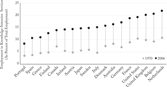
The transition to the knowledge economy began in earnest after the crisis of Fordism in the 1970s. Figure 1 shows the employment expansion in knowledge-intensive service sectors, such as finance, insurance, business services, and telecommunications, between 1970 and 2006.Footnote 7 Growth of knowledge employment was ubiquitous in the advanced democracies over this period; the average employment expansion was close to nine percentage points. The rise of the knowledge economy is clearly demonstrated by this substantial shift in economic structure away from traditional industries and toward ict-intensive service sectors.Footnote 8
Expansion of Employment in Knowledge-Intensive Services in Advanced Democracies between 1970 and 2006a

Although the transition to the knowledge economy has exerted upward pressure on inequality in all the advanced democracies, we observe striking differences in the inequality trajectories of different economies. When looking at the evolution of two widely used measures of income inequality—the income share of the top 1 percent and the 90/10 wage ratioFootnote 9—it is clear that inequality has grown more rapidly in the Eng-lish-speaking countries than in the continental European and Nordic economies.Footnote 10
The United Kingdom and the United States particularly stand out. In the UK, the top 1 percent income share was 7 percent in 1970, but rose to 15 percent by 2006. The change in the US was even more striking, with the share rising from 11 to 20 percent over the same period. As might be expected, employment in knowledge-intensive services also expanded in the UK and the US between 1970 and 2006, but the biggest movement into knowledge-intensive services was in the Netherlands and Belgium, where the growth of inequality has been much more subdued. In the Netherlands, for example, the top 1 percent income share actually fell from just under 9 percent in 1970 to close to 5 percent in the mid-1990s. It rose slowly afterward, but remained under 7 percent in 2006. In addition, the other continental European and Nordic economies saw equivalent or greater expansions in knowledgeintensive services than the other English-speaking countries (Australia, Canada, and Ireland), but experienced substantially smaller upswings in inequality. This poses a clear puzzle: given the common pressures from the transition to the knowledge economy, why hasn’t income inequality risen to the same extent across the advanced democracies?
Despite the abundance of theoretical and empirical evidence on the effects of technological progress on labor markets and inequality, there are only a few cross-country empirical analyses that estimate the effects of the transition to the knowledge economy on income inequality in the advanced democracies.Footnote 11 These studies use a range of different measures of the knowledge economy and income inequality, but typically find that the expansion of knowledge-intensive employment is positively associated with income inequality.Footnote 12 Although this emerging empirical literature helps us to understand the relationship between the knowledge economy and income inequality, it cannot explain why some advanced democracies have managed to expand employment in knowledge-intensive services and simultaneously maintain relatively high wage solidarity across the workforce while others have not.
The analysis in this article sheds new light on this puzzle by taking a comparative perspective. A large body of empirical work in comparative political economy (cpe) finds that labor market institutions, such as coordinated wage bargaining, trade unions, and employment protection legislation (epl), help restrain dispersion in the distribution of income.Footnote 13 But there hasn’t been a cross-country empirical study that investigates whether labor market institutions can diminish the effects of the transition to the knowledge economy on income inequality.
We fill this gap in the literature by carrying out a panel data econometric analysis using an unbalanced data set that covers eighteen countries in the Organisation for Economic Cooperation and Development (oecd) from 1970 to 2007. We investigate whether the effect of the knowledge economy on income inequality varies across countries with different labor market institutions. The results show that the expansion of employment in knowledge-intensive services increases income inequality, but that this effect is mitigated by the presence of coordinated wage setting, strict epl, and high bargaining coverage. Although we find that union density mitigates the increases in earnings dispersion that result from the transition to the knowledge economy, unions are the only labor market institution that don’t also reduce increases in top income shares.
Our results show that industrial relations systems have played a significant part in keeping income inequality in check in the continental European and Nordic countries during the transition to the knowledge economy. The findings complement recent work that emphasizes the role played by industrial relations systems (often heavily reformulated) in Scandinavia in sustaining more egalitarian labor market outcomes in the knowledge economy.Footnote 14
The results stand in stark contrast to Lucio Baccaro and Chris Howell’s argument that due to the common trajectory of liberalization among advanced democracies, industrial relations institutions have lost much of their capacity to achieve egalitarian outcomes in the post- Fordist era.Footnote 15 Our findings also question the related argument that industrial relations systems have been superseded by redistribution and education spending as the main safeguards against income inequality in the knowledge economy.Footnote 16
II. The Knowledge Economy, Labor Market Institutions, and Income Inequality
The postindustrial era has been marked by a dramatic increase in income inequality within the advanced democracies. The richest households in society have typically pulled away from the rest,Footnote 17 and incomes across the spectrum have become more dispersed.Footnote 18 Within this general trend, there have also been significant cross-country differences, with the Anglo-Saxon countries typically seeing the greatest rises.Footnote 19 The need to identify the factors driving national income inequality has risen to the top of the agenda for many scholars and policymakers, especially in the wake of the 2008 global financial crisis. A large body of theoretical and empirical literature in economics, political science, and sociology suggests many potential explanations for the changes seen in income inequality in the advanced democracies.
Claudia Goldin and Lawrence Katz suggest that educational investment (that is, the supply of skills) hasn’t kept pace with technological advancement (the demand for skills) in the US, which has put upward pressure on the wages of skilled workers.Footnote 20 Evelyne Huber and John Stephens find evidence supporting the Goldin-Katz hypothesis in a wider panel data analysis of oecd economies.Footnote 21 But the supply of and demand for skills is likely to be less important in explaining the diverging income of the top 1 percent as mass systems of higher education have provided college education to a substantial proportion of the workforce. Instead, Facundo Alvaredo, Anthony Atkinson, Thomas Piketty, and Emmanuel Saez find that the changes in the income share of the top 1 percent can be better explained by tax policy, changes in the bargaining power of managers and employees, the greater individualization of pay, and capital income.Footnote 22 In a panel data study of sixteen oecd countries over the entire twentieth century, Jesper Roine, Jonas Vla- chos, and Daniel Waldenström find that top income shares are boosted by rapid economic growth and financial development, and are reined in by banking crises and progressive tax systems.Footnote 23 Turning to an influential political science analysis on the rise of top incomes in the US, Jacob Hacker and Paul Pierson point to the profound role of government policy in creating the current winner-take-all pattern. They also highlight the remarkable ability of the most affluent households, and the lobbyists representing their interests, to shape public policy in their favor.Footnote 24
A number of national and cross-country empirical studies identify financialization—the increasing influence of financial markets and financial actors over economic policymaking and economic outcomesFootnote 25— as another important driver of both greater wage disparities and the concentration of income in the most affluent households.Footnote 26 Financialization affects inequality both directly and indirectly. Workers in the finance sector are typically paid much more than the average worker is.Footnote 27 The spread of shareholder value maximization models of corporate governance in the financial and nonfinancial sector privileges shortterm profits and encourages cost cutting and mass layoffs, which disproportionately affect ordinary workers.Footnote 28 Relatedly, Ken-Hou Lin and Donald Tomaskovic-Devey provide strong empirical evidence that the way nonfinancial firms in the US increasingly rely on earnings realized through financial channels has led firm surpluses to be split more in favor of managers and owners—which has contributed to significant rises in earnings dispersion and in top executives’ share of total compensation.Footnote 29 Financialization can also weaken those labor market institutions that act to constrain inequality, such as unions, centralized wage bargaining, and epl.Footnote 30 Recent contributions from Thibault Darcillon and Anthony Roberts and Roy Kwon also find evidence that labor market institutions can moderate the effects of financialization on income inequality.Footnote 31
Other scholars highlight the rise in international trade liberalizations, finding that reductions in trade tariffs lead to increased inequality.Footnote 32 Cross-country studies on inequality and globalization show that measures of trade and capital account integration, such as southern import penetration and outward investment flows, have significant positive effects on within-country inequality but are less pertinent to explaining cross-country differences.Footnote 33 But Cheol-Sung Lee, François Nielsen, and Arthur Alderson find that these globalization effects are mitigated in countries with larger public sectors.Footnote 34
Despite the wide-ranging explanations forwarded for changes in income inequality, the dominant factors in the literature remain technological change and labor market institutions. These two are the focus of this article. In the remainder of our literature review, we look at the direct effects of technological change and labor market institutions on income inequality. We then turn to the potential interaction effect between the two factors, which is at the heart of our empirical analysis.
The Knowledge Economy and Inequality
Since the 1970s, technology has structurally transformed the advanced democracies. The common overarching narrative among comparative political economists is that the advanced economies transitioned from the Fordist manufacturing system of the post-World War II golden age to the knowledge economy of the postindustrial era.Footnote 35 The Ford- ist system was built on the dual pillars of mass production and mass consumption, and was supported by collective bargaining, a generous welfare state, and Keynesian demand-management policies. This system collapsed under the weight of short-term factors, such as industrial conflict and oil price shocks, and longer-term factors, such as globalization, de-unionization, and technological change.Footnote 36 The knowledge economy that arose in its place is distinct from its predecessor in a number of ways. Manufacturing has receded in importance and service sectors now dominate economic activity. Complementarities in production between skilled and semiskilled workers have been replaced by complementarities between skilled workers and new icts.
These changes brought about a huge increase in the skill and education levels of large segments of the labor force, facilitated by the rapid expansion of higher education.Footnote 37 The welfare state, collective bargaining, and labor unions have generally lost importance over time, but in the knowledge economy, there are still significant and theoretically salient differences in labor market institutions and welfare states among the advanced democracies.Footnote 38
Of course, the cpe perspective on structural change glosses over substantive cross-national differences. For example, Fordism certainly wasn’t the same everywhere.Footnote 39 As Torben Iversen and David Soskice concede in their influential article on distribution and redistribution in the knowledge economy, Fordism “took on more or less skill-intensive forms and economies of scale were important to different degrees.”Footnote 40 But what’s important for the purposes of research into the relationship between the knowledge economy and income inequality is that the economies of advanced democracies have faced a similar set of secular trends, including technological change, deindustrialization, and globalization, since the 1970s. These trends put upward pressure on income inequality through a number of common channels, including the rising skill premium for highly educated workers, worsening labor market dualization, the expansion of temporary and precarious work, and the shrinking core of unionized production workers.Footnote 41
The ict revolution that underpins the transition to the knowledge economy has been shown to be a key driver behind the upward trend of earnings inequality since the 1980s. In their cross-national study into the drivers of inequality in oecd countries, Wen-Hao Chen, Michael Förster, and Ana Llena-Nozal find that technological change, measured by ict intensity, r and d expenditure, and patents, significantly widens wage dispersion and accounts for more of the within-country variation in inequality than do trade or financial factors.Footnote 42 In a complementary panel data study covering fifty-one countries between 1981 and 2003, Florence Jaumotte, Subir Lall, and Chris Papageorgiou find that technological progress exerts a greater effect on income inequality than trade or financial globalization.Footnote 43
The diffusion of ict throughout the advanced democracies created a sharp upturn in demand for college-educated workers because their high-level, general skills are complements in production of ict. This additional demand for skilled workers led to a rise in the relative wages of more-educated workers.Footnote 44 The losers from technological change have typically been those workers in the middle of the skill distribution whose jobs focus on routine tasks that can be easily replicated by computers or machines.Footnote 45
The knowledge economy also contributed to the rapid rise in the income of the top 1 percent in the postindustrial era. Kevin Murphy and Ján Zabojník provide a market-based explanation for the explosion of ceo pay, arguing that managing a corporation today requires much more focus on general, transferable skills, such as management, economics, accounting, and computing, than on the firm-specific knowledge that was important in the predigital era. This shift has created a highly competitive global market for the best ceos.Footnote 46 In a study of more than 2,500 publicly traded firms, Heekyung Kim and Erik Brynjolfsson find that information technology (it) intensity strongly predicts ceo pay.Footnote 47 Building on Luis Garicano and Esteban Rossi-Hanberg’s work, they argue that it increases the effective size of the firm run by a ceo, due to the greater information available for decision-making, the ease with which the ceo’s decisions can be passed through the business hierarchy, and the wider scope for monitoring and enforcing those decisions.
The integration of capital and goods markets that came with ict and globalization also allows highly talented managers, ceos, and entrepreneurs to operate in more markets and to reach more customers. The rapidly rising compensation of the top 1 percent in the knowledge economy therefore reflects both the superior ability of those individuals to reap the rewards of their talents and the greater complexity of their roles.Footnote 48 One aspect of the knowledge economy, particularly in new digital technologies, that reinforces this dynamic is the existence of large network effects whereby the value of a product rises with the number of people using it (for example, social media platforms). Network effects often lead to the creation of winner-take-all or winner-take-most markets, in which the first mover in an industry gets a disproportionate amount of the returns.Footnote 49 Work on the effects of the knowledge economy on top incomes also ties into recent evidence that trends in the personal and functional distributions of income in the US are increasingly driven by greater earnings dispersion among firms. Thus superstar firms in knowledge-intensive industries, such as finance, technology, and business services, make greater profits and pay considerably higher wages than less productive firms within their own (and other) industries.Footnote 50
Labor Market Institutions and Inequality
An abundance of empirical evidence shows that patterns of income inequality in the advanced democracies are shaped by institutional factors, such as wage coordination, trade union density, collective bargaining coverage, and EPL. The inequality-constraining effects of labor market institutions have been found in numerous time-seriesFootnote 51 and cross-national panel studies.Footnote 52 In a simple model in which unions bargain with employers over the wage, “if labor market institutions improve the outside option more for unskilled than for skilled workers, this will strengthen their bargaining position and tend to compress the skill wage differential.”Footnote 53 It could be argued that the theoretical channel might apply to the full range of labor market institutions, but as Winfried Koeniger, Marco Leonardi, and Luca Nunziata admit, labor market institutions are complex and multifaceted, and are also likely to affect wage differentials through many other channels.Footnote 54 The remainder of this subsection addresses the literature on each labor market institution in turn.
In an empirical study of oecd countries, Michael Wallerstein finds, “the more wage and salaries are set in a centralized manner, the more egalitarian the distribution of wages and salaries.”Footnote 55 Wallerstein identifies three theoretical channels that explain this relationship: economic (that is, wage differentials in decentralized wage-setting systems are inefficient), political (compressed wages in centralized wage-setting systems reflect the preferences of the median wage earner), and norms (centralized bargaining influences norms around fairness).Footnote 56 Other empirical studies also emphasize the importance of wage coordination. Francine Blau and Lawrence Kahn’s much-cited analysis finds that decentralized wage-setting systems in the US provide the most persuasive explanation for the higher level of wage inequality in the US than in the other oecd countries.Footnote 57 Focusing on Israel, Tali Kristal and Yi- non Cohen find that decentralization explains a significant part of the escalating earnings inequality since 1970. They highlight the reduction in the use of extension orders and the spread of local agreements as particularly salient factors.Footnote 58
There is substantial evidence that labor unions, in their role as both wage bargainers and political actors, influence class-based inequity in politics and public policy, and therefore reduce economic disparities.Footnote 59 David Card, Thomas Lemieux, and Craig Riddell find that in Canada, the UK, and the US, unions have an equalizing effect on the dispersion of male wages across skill groups. They flatten the wages of union workers—who are concentrated in the middle of the income distribution—relative to nonunion workers, and they compress the wages of union members.Footnote 60 Card finds similar effects in a microdata study on the US, with union decline accounting for 15 to 20 percent of the rise in male income inequality between the early 1970s and early 1990s.Footnote 61 It is also argued that unions help institutionalize norms of equity.Footnote 62 Bruce Western and Jake Rosenfeld present evidence to support this theory, showing that nonunion wages are less dispersed in highly unionized industries and regions in the US.Footnote 63
The strength of unions and their bargaining power can be measured in two ways: through union density (union members as a proportion of wage and salary earners) or through bargaining coverage (employees covered by collective wage bargaining agreements as a proportion of wage and salary earners). Although the two measures are often closely related, that is not always the case. France, for example, had bargaining coverage of 98 percent in 2012 but union density below 8 percent.Footnote 64 Thus, examining both measures provides a fuller picture. Existing cross-country empirical studies predominantly focus on union density, since those data are more readily available.Footnote 65 Notably, Stefan Thewissen, Olaf van Vliet, and Chen Wang are an exception. They argue that bargaining coverage will be negatively associated with earnings inequality because wages vary less between workers when bargaining agreements cover more of the workforce.Footnote 66 They find strong evidence supporting their hypothesis in an analysis of sectoral earnings inequality in eighteen oecd countries.Footnote 67
The richest households in the advanced democracies are unlikely to be those of union members or individuals covered by collective bargaining agreements. Still, their incomes are affected by the strength of labor unions.Footnote 68 Unions can serve as an important check on executive compensation by instituting fairness norms, cutting the resources available for high executive pay (through higher worker wages), and restraining the use of stock options in ceo pay. Unions also reduce the need for highly paid managers and supervisors, since unionized workplaces foster greater worker discretion and performance.Footnote 69 In fact, there is a strong negative relationship in the US between union presence and ceo compensation.Footnote 70 Given the major role that executive compensation plays in the income share of the top 1 percent, it is not surprising that cross-country studies also consistently find a negative relationship between union density and top 1 percent income shares.Footnote 71
There is evidence that along with industrial relations systems, epl can also influence the distribution of income. Daniele Checchi and Cecilia García-Peñalosa find that oecd countries with stricter epl, where workers are much harder to fire, typically have lower levels of household income inequality.Footnote 72 Some argue that epl reduces wage inequality between skilled and unskilled workers, as the substantial fixed-cost component means epl offers greater protection to unskilled workers.Footnote 73 It is also shown that epl is associated with lower use of incentive pay,Footnote 74 which can reduce income inequality because of the positive association between the use of incentive pay schemes, such as bonus pay and commissions, and wage inequality.Footnote 75
The Interaction of Labor Market Institutions and the Knowledge Economy
The preceding subsections highlight the vast literature on the direct effects of the transition to the knowledge economy and labor market institutions on income inequality in advanced democracies. The literature commonly views these two dominant explanations for rising income inequality as distinct and competing. Several recent contributions empirically assess their relative importance.Footnote 76 Kristal and Cohen analyze industry-level data from the US and find that weakening institutions (unions and minimum wages) explain about half the rise in wage inequality since the late 1960s, whereas computerization explains only about a quarter.Footnote 77 A time-series study using aggregate data came to the opposite conclusion, with the effect of ict investment outstripping that of the declining unionization rate.Footnote 78 Looking across the oecd countries using panel data, the oecd finds that institutions are the more important factor.Footnote 79 It is clear that in studies weighing the two explanations, the results depend on the empirical approach taken. What all these studies fail to take into account—and one possible source of the lack of consensus—is the potential effects of interaction between labor market institutions and the expansion of the knowledge economy.
To date, the literature pays relatively little attention to whether the relationship between the expansion of knowledge-intensive services and income inequality depends on national labor market institutions. To the best of our knowledge, there are no cross-national empirical studies that investigate whether labor market institutions can mitigate the inequality-enhancing effects of the transition to the knowledge economy. Despite the lack of panel data analyses of the relationship, the literature identifies several theoretical arguments that motivate our focus on this interaction.
In the 1990s, the divergence of US and continental European wage inequality and the beginnings of the ict revolution provided fertile ground for economic theories looking to explain cross-country differences in labor market outcomes. Paul Krugman’s influential hypothesis suggests that the answer lies in labor market institutions.Footnote 80 Krugman posits that even though the US and continental Europe were both subject to the same skills-biased technical change, stronger labor market institutions in continental Europe, such as unions and employment protection, made these countries better able to contain wage dispersion— but only at the expense of low-skilled employment. While intuitive and persuasive, the Krugman hypothesis is not adequately supported by the empirical evidence. It implies that employment losses in continental Europe should be concentrated in low-skilled occupations, but a close inspection of labor market statistics shows that employment losses were fairly evenly distributed across skills groups.Footnote 81
An alternative theory that better fits the stylized facts was proposed in a series of articles by Daron Acemoglu and Jörn-Steffen Pischke around the turn of the twenty-first century;Footnote 82 their core argument is that human and physical capital-investment decisions by firms are dependent on labor market institutions. Faced with the expansion of the world technology frontier caused by the ict revolution, countries with institutions that compress wages, such as unions and coordinated wage bargaining, should see relatively more investment in both worker training and technologies complementary to low-skilled labor. In countries where these institutions are absent, investment instead shifts toward technologies complementary to high-skilled workers. These effects occur because technological change offers different investment incentives for firms depending on the extent to which labor market institutions (or other factors) compress the wage structure.
Acemoglu and Pischke’s theory implies less skills-biased technical change in countries with strong labor market institutions—and consequently a smaller rise in the wage gap between skilled and unskilled workers. Building on the analyses in previous work with Acemoglu, Pischke presents empirical evidence that accords with their theory, showing that on-the-job training and physical capital investments were focused more on high-skilled workers in the US than in Europe during the 1980s, when wage inequality dramatically diverged on both sides of the Atlantic.Footnote 83 In a complementary empirical analysis, Koeni- ger and Leonardi compare the effect of capital investment on wage inequality using industry-level data from Germany, with its strong labor market institutions, and from the US, with its flexible labor markets.Footnote 84 They find that capital deepening pushed up wage differentials by more than 7 percent in US industries during the 1980s, but actually reduced wage differentials in German industries by 5 to 7 percent over the same period, due to investment directed more toward unskilled workers in Germany.
Following the tradition of Acemoglu and Pischke, more recent work by the sociologist Daniel Oesch and his various coauthors argues that whether technological change leads to upgrading (as seen in northern Europe) or polarization (as seen in Britain and the US) depends in part on national labor market institutions and welfare regimes.Footnote 85 Institutions that prop up the wages of low-skilled workers provide an incentive for firms to invest in skills and technologies that enhance the productivity of the interpersonal service workers typically located at the bottom of the skill and income distribution in the knowledge economy.Footnote 86 (One example is the introduction of self-service checkouts in supermarkets.) Hence, Oesch sees institutions as mitigating the relationship between the expansion of the knowledge economy and rising income inequality. Caroline Lloyd, Claudia Weinkopf, and Rosemary Batt find further evidence of this type of interaction effect in a multicountry case study of call-center workers in Europe.Footnote 87 Through a series of in-depth interviews and workplace observations, they discover that call-center employees in the UK, which has few labor market protections and little collective representation, are less skilled, have less complex and diverse roles, and are paid less relative to the median, than are call-center employees in Denmark and France.
Research conducted by Angelo Martelli focuses specifically on whether national labor market institutions shape the response of employment structures to technological change in Europe. Martelli finds that epl effectively mitigates employment losses in industries and occupations that are susceptible to routinization (that is, computers or machines replacing labor in carrying out routine tasks).Footnote 88 By contrast, union density was not found to alleviate the effects of routinization on the employment structure. Martelli also looks at how epl affects wage inequality, finding that it restricts dispersion in the upper tail of the earnings distribution (90/50) while raising dispersion in the lower tail (50/10). He finds that the former effect is larger in magnitude, concluding that epl both contains the wage effects of routinization and compresses the overall wage distribution (that is, the 90/10 wage ratio).
Roberts and Kwon look at whether the impact of financialization on income inequality differs across varieties of capitalism.Footnote 89 One of their measures of financialization is the employment share of the finance, insurance, and real estate sectors. Finance and insurance are knowledgeintensive industries that make extensive use of ict, so their results are relevant for our study. These scholars find that financialization increases wage dispersion and top incomes more in liberal market economies, such as the Anglo-Saxon countries, than in coordinated market economies, such as the continental European and Nordic countries. Liberal market economies have lower employment protection, weaker collective bargaining, and more shareholder-oriented corporate governance, all of which make them more amenable to profit-making strategies that rely on short-termism, cost cutting (including mass layoffs), and nonproduction (that is, financial) activities.Footnote 90
Labor market institutions can also restrain the incomes of the most affluent workers in knowledge-based industries. As noted in our literature review, the roles of top managers and CEOs grew more complex with the ict revolution, which put upward pressure on their compensation.Footnote 91 Knowledge-intensive industries, such as technology and finance, are particularly iCT-intensive and prone to winner-take-all markets and a disproportionate share of income and profits going to the most productive superstar firms.Footnote 92 Hacker and Pierson (along with many others) argue that labor unions have the organizational and financial resources, as well as the motivation, to rein in the compensation of executives and to ensure packages are structured in the interests of the firm as a whole and not just management.Footnote 93 It follows that countries with stronger labor market institutions are likely better placed to contain the rise in executive compensation from the ict revolution and the shift of employment into knowledge-intensive industries. Hacker and Pierson also argue that organized labor focuses on the broad concerns of those with modest incomes, and can help to ensure that public policy doesn’t simply represent the interests of the rich. In the shift to the knowledge economy, one could consider financial deregulation and tax policies to be salient political conflicts that have dramatic implications for the distribution of income.Footnote 94
III. Data and Measures
Our empirical analysis uses an unbalanced panel data set covering eighteen oecd countries from 1970 to 2007. The countries in the sample—Australia, Austria, Belgium, Canada, Denmark, Finland, France, Germany, Greece, Ireland, Italy, Japan, the Netherlands, Portugal, Spain, Sweden, the UK, and the US—vary markedly in their industrial relations systemsFootnote 95 and, more broadly, in the organization of their political economies.Footnote 96
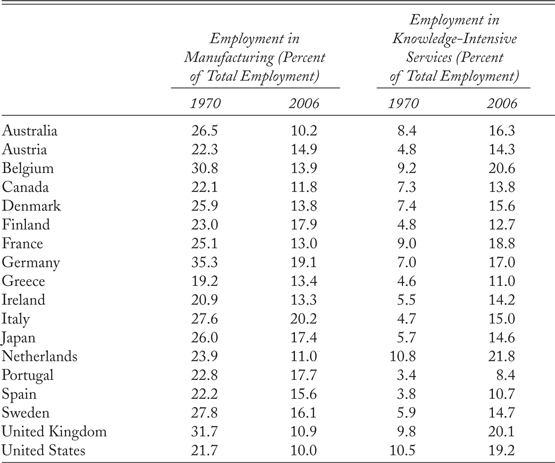
As noted above, Fordism didn’t take the same form in all the advanced democracies in the sample, especially in the late-developing peripheral Eurozone countries.Footnote 97 But by the start of the sample period in 1970, manufacturing employment was just as important in the peripheral Eurozone countries as it was in many of the higher-income OECD countries, such as Austria, Finland, the Netherlands, and the US (see Table 1). During the period under analysis, the eighteen countries faced the same secular trends (technological change, deindustrialization, and globalization) and without exception saw employment shift from manufacturing into knowledge-intensive services and other sectors. The combination of common structural changes and cross-country variation in knowledge employment, labor market institutions, and income inequality makes these countries a suitable sample for our research. The sample also closely aligns with previous cross-country empirical analyses that estimate the relationship between knowledge employment and income inequality.Footnote 98
Employment Shares in Manufacturing and Knowledge-Intensive Services, 1970 and 2006a

Source: EU klems Growth and Productivity Accounts: November 2009 Release (updated March 2011), available at http://www.euklems.net, as described in O’Mahony and Timmer 2009.
a Knowledge-intensive services comprise three sectors: post and telecommunications, financial intermediation, and renting of machinery and equipment and other business activities.
Dependent Variable
We use two measures of income inequality as our dependent variables, which allows us to test the effects of our key independent variables on different parts of the income distribution. The first measure is the income share of the top 1 percent from the World Wealth and Income Database.Footnote 99 The second is the 90/10 wage ratio, which is the ratio of gross earnings received by a worker at the 90th earnings percentile to that received by a worker at the 10th earnings percentile, taken from the OECD Labor Force Statistics.Footnote 100 Both our income inequality measures are before taxes and transfers (that is, prior to government redistribution), which is appropriate for research looking at the effects of the knowledge economy and labor market institutions on income inequality. In other words, we focus on distribution rather than redistribution.
Our main reason for choosing these two measures of income inequality is that they most closely match the theoretical channels identified in our literature review. Acemoglu and Pischke’s theoretical models focus on the wage differential between skilled and unskilled labor, and they commonly utilize the 90/10 wage ratio to test their theories.Footnote 101 The literature also shows that inequality at the very top of the income distribution is heavily influenced by the compensation of entrepreneurs, top managers, and CEOs.Footnote 102 The top 1 percent income share is the most accurate inequality measure available for capturing the earnings of the most affluent people in society. It is calculated using tax returns and because it avoids top coding, it captures income growth at the very top of the income distribution much better than do traditional measures based on household surveys.Footnote 103 In addition to theoretical considerations, these measures have superior data availability over other measures of income inequality, especially over time, which is crucial for panel data analysis. We also want our results to contribute to the wider empirical literature on the determinants of income inequality in the advanced democracies, where the 90/10 wage ratioFootnote 104 and the income share of the 1 percentFootnote 105 are two of the most frequently used measures.
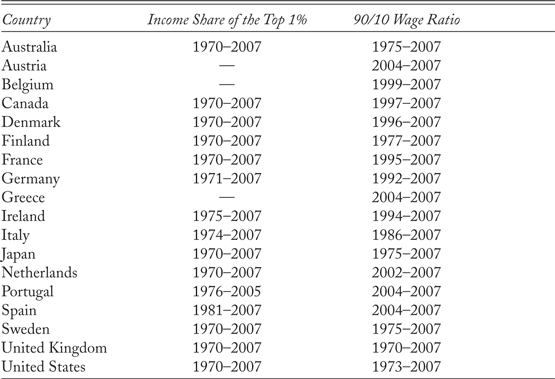
The data availability, and therefore the samples, vary slightly for the two measures. The sample for the regression models using the top 1 percent income share covers fifteen countries (no data are available from the World Wealth and Income Database for Austria, Belgium, or Greece) and 541 country-year observations. The sample for the regression models using the 90/10 wage ratio covers all eighteen countries, but as this measure typically has shorter time series, the sample has only 322 country-year observations. Full details of the country-year coverage for our dependent variables are in Appendix Table A1.
Key Independent Variables
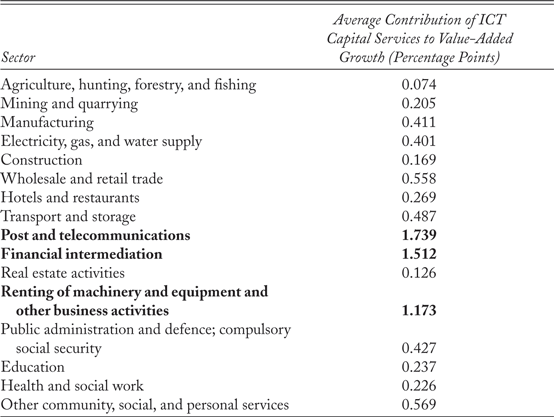
The measure of the knowledge economy we use follows Anne Wren’s definition of dynamic services, which combines the sectors that have seen the greatest diffusion of new icts.Footnote 106 Table 2 uses EU klems data to show the average contribution to value-added growth of ict capital services across sixteen sectors for twelve advanced democracies between 1983 and 2006.Footnote 107 Three sectors stand out as having significantly higher ict contributions than the others: post and telecommunications, financial intermediation (covering finance and insurance), and renting of machinery and equipment and other business activities (an area dominated by business services like legal, technical, computer, and advertising services). Our measure of knowledge-intensive services adds up employment in these three sectors from the EU klems Growth and Productivity Accounts and expresses it as a percentage of total employment.Footnote 108 Data on knowledge-intensive employment for the eighteen countries in our sample are available from 1970 to 2007.Footnote 109
Knowledge-intensive services have characteristics that set them apart from the other service sectors. Wren finds that they typically have higher productivity growth and are more likely to be traded internationally.Footnote 110 This is no coincidence. The ict revolution drastically reduced the cost of performing routine, programmable tasks,Footnote 111 which pushed up productivity in iCT-intensive sectors.Footnote 112 It has also lowered many of the technical barriers to trade in services because digitized information can be stored and transported across the globe at almost no cost.Footnote 113
The Contribution of ict Capital Services to Value-Added Growth across Sectors in Twelve Advanced Democracies, 1983-2006a

Source: EU KLEMS Growth and Productivity Accounts: November 2009 Release (updated March 2011), available at http://www.euklems.net, as described in O’Mahony and Timmer 2009.
a The advanced democracies included are Australia, Austria, Belgium, Denmark, Spain, Finland, France, Italy, Japan, the Netherlands, the UK, and the US.
Previous studies that estimate the effects of the knowledge economy on income inequality also construct measures of knowledge employment from sectoral data. Daniela Rohrbach and Evelyne Huber, Jingjing Huo, and John Stephens aggregate employment in sectors they deem to be knowledge intensive (using data from the OECD Structural Analysis (stan) database and the EU KLEMS database, respectively).Footnote 114 These authors select different sectors: Rohrbach includes high-tech manufacturing industries in her definition,Footnote 115 whereas Huber, Huo, and Stephens focus solely on services.Footnote 116 Huber, Huo, and Stephens’s measure includes sectors traditionally dominated by government provision, such as public administration, health, and education.Footnote 117
We believe Wren’s measure of knowledge employment is superior to these alternative measures for three main reasons.Footnote 118 First, employment in the sectors chosen by Wren expanded dramatically across the advanced democracies since the collapse of the Fordist system (see Figure 1). Second, the knowledge-intensive sectors were selected through a transparent data-driven procedure (see Table 2). Third, the theoretical and empirical literature summarized in the section above identifies ict as the central mechanism that connects the transition to the knowledge economy to changes in income distribution.Footnote 119
Another approach taken in earlier empirical work is to construct a measure of knowledge employment based on occupations. Kwon and Roberts use International Labour Organization data to construct a measure of knowledge employment that comprises managers, professionals, technicians, and associate professionals.Footnote 120 All these occupations focus on nonroutine, cognitive tasks that require the type of high-level general skills that are strongly complementary to ict.Footnote 121 This alternative measure of knowledge employment is only available from 1980, but as a robustness test for our main results, we also run our analysis using this measure (as outlined in Section IV).Footnote 122
The other key independent variables are the four measures of labor market institutions. We take the coordination of wage setting and the adjusted bargaining (or union) coverage rate from the Institutional Characteristics ofTrade Unions, Wage Setting, State Intervention and Social Pacts (ictwss) database.Footnote 123 The former measures the degree of coordination of wage setting on a five-point scale running from firm- level bargaining to formal or informal centralized bargaining that sets explicit minimum or maximum rates of wage growth. The latter measures the proportion of all employees with the right to bargaining who are covered by collective (wage) bargaining agreements. We collect data on trade union membership from the joint database compiled by the oecd and Jelle Visser.Footnote 124 Trade union density measures the proportion of employees who are members of trade unions. Finally, we use the oecd Labor Force Statistics measure of epl for workers on permanent contracts, which is expressed on a scale of zero to six, with higher values indicating that workers are harder to dismiss.
Control Variables
In our models with controls, we include a selection of additional variables found to be drivers of income inequality in the theoretical and empirical literature. These variables cover the broad areas of education, financialization, globalization, and the economy.
Goldin and Katz argue that the postindustrial era in the US is marked by both a rise in the demand for higher education and a slowdown in educational expansion.Footnote 125 With education losing the race against technology, the excess demand for educated labor creates upward pressure on the wages of more educated workers. The Goldin-Katz hypothesis has been found to hold across the advanced democracies.Footnote 126 We include education expenditure as a percentage of gross national income from the World Bank World Development Indicators to account for investment in human capital, and hence, increases in the supply of educated workers.
Many panel data studies find that higher levels of financialization are associated with greater income inequality in the advanced democracies.Footnote 127 Finance is one ofthe subsectors within our measure of knowledge- intensive services. To ensure that financialization is not driving our main results, we therefore control for stock market capitalization as a percentage of gdp (from Roine, Vlachos, and Waldenström) and private credit as a percentage of gdp (from the Financial Development and Structure Dataset).Footnote 128 These measures control for aspects of financial-sector growth over the post-Fordist era that affect inequality through different channels than those hypothesized for the broader knowledgeintensive service sector (as set out in the literature review), such as the increased use of stock options in the compensation of top managers and CEOs, and the dramatic rise in household borrowing. As an additional robustness test for our main results, we also rerun our analysis with the financial intermediation sector excluded from our measure of knowledge employment (as outlined in Section IV).
Globalization is another secular trend taking place alongside the transition to the knowledge economy. Goods and capital markets have become much more integrated over time, which has had knock-on effects for inequality. We control for two different aspects of globalization: outward investment flows and import competition from developing economies. Investment outflows are measured by outward foreign direct investment as a percentage of gdp. Alderson and Nielsen and Lee, Nielsen, and Alderson find that higher outward investment flows lead to greater income inequality.Footnote 129 The inflow of imports from the Global South into the advanced democracies is a major feature of the postindustrial era. We follow other studies and measure southern import penetration by the value of imports of manufactured goods (Standard International Trade Classification [sitc] Rev 1. 5-8) from developing economies as a percentage of gdp (calculated using data from the UN comtrade database and the oecd National Accounts).Footnote 130
In addition, we control for conditions in the labor market using the unemployment rate as a percentage of the civilian labor force (from the oecd Labour Force Statistics).Footnote 131 We also collect and test a number of other potential control variables, including measures of human capital, partisanship, trade openness, and economic development. But as these are highly correlated with other explanatory variables in the data set, we dropped them from the final specifications due to concerns about collinearity.
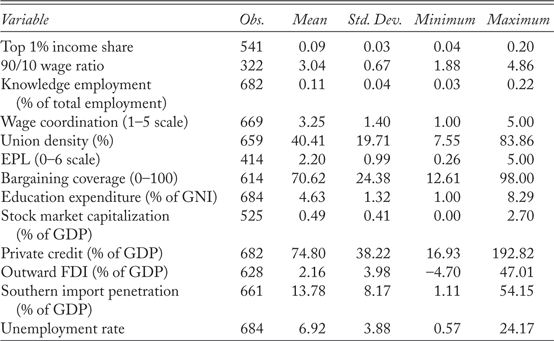
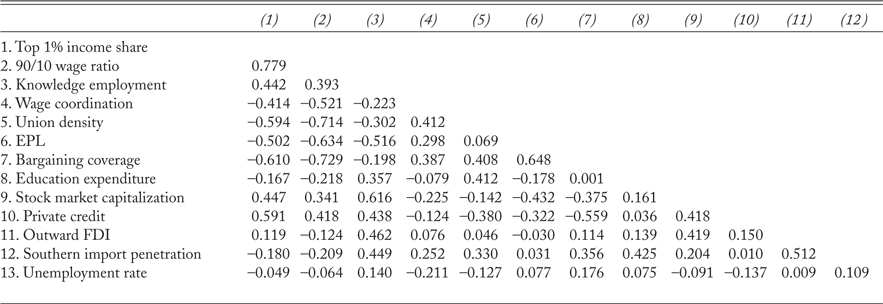
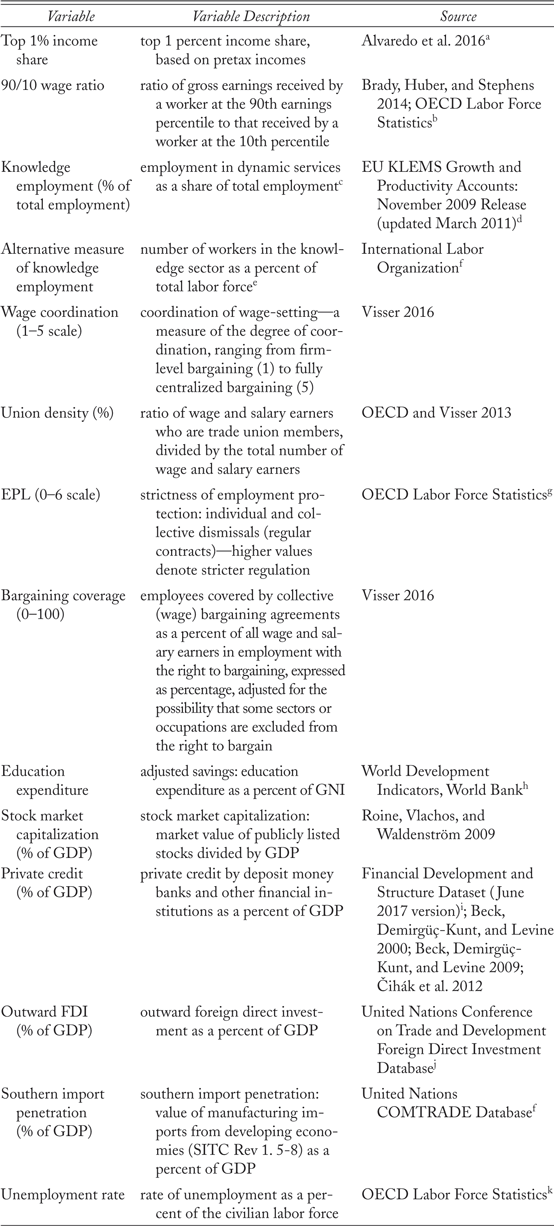
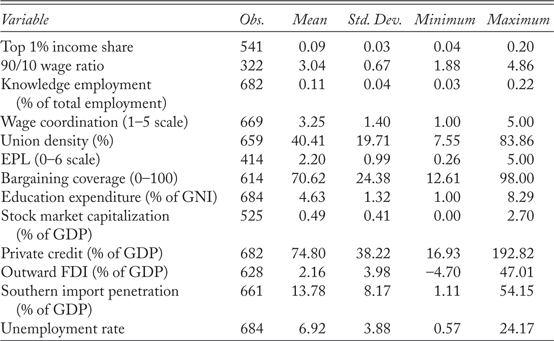
The summary statistics for the two dependent variables, the key independent variables, and the control variables are shown in Table 3. The small number of missing values across the data set have been linearly interpolated. The correlation matrix is in the Appendix (Table A2), as is the complete list of variable definitions and sources (Table A3).
IV. Empirical Strategy
We use unbalanced time series cross-sectional (tscs) data covering eighteen oecd countries for our analysis. We employ Prais-Winsten regressions as our empirical strategy, as these are widely used in the empirical literature investigating the determinants of inequality in advanced democracies.Footnote 132 Prais-Winsten regressions are estimated using ordinary least squares (ols) and include both panel-corrected standard errors and a correction for first-order autoregression. The approach helps mitigate the problems of serial correlation, groupwise hetero- skedasticity, and contemporaneous cross-sectional correlation that are common in regression analyses using tscs data.Footnote 133
Summary Statistics
Our empirical strategy has clear advantages over other widely used approaches. Nathaniel Beck and Jonathan Katz use Monte Carlo experiments to show that for the types of tscs data used in comparative politics, ols models with panel-corrected standard errors provide more accurate estimates of standard errors than feasible generalized least squares estimation and entail little loss of efficiency.Footnote 134 We deal with serial correlation by including a correction for first-order autocorrelation. That is preferable to the alternative approach of adding a lagged dependent variable, which would absorb much of the substantively interesting variation in our tscs data and risk biasing the coefficient estimates on our main independent variables.Footnote 135
Given that the unit of analysis in our tscs data is countries, we also include country fixed effects in our regressions, which control for unobserved, time-invariant, country-specific factors that influence inequality. Country fixed effects help guard against omitted variable bias and are commonly employed in Prais-Winsten regression models.Footnote 136
The equations estimated in the empirical analysis are:
 $$y_{it}=\beta_0+\beta_1 X_{it}+\beta_2 W_{it}+\beta_3 X_{it}*W_{it}+\delta_i +\epsilon_{it}$$
and
 $$y_{it}=\beta_0+\beta_1 X_{it}+\beta_2 W_{it}+\beta_3 X_{it}*W_{it}+\sum\beta_k Z_{itk}+\delta_i\epsilon_{it}.$$
In both sets of models, y it refers to our measures in income inequality: the income share of the top 1 percent and the 90/10 wage ratio. The main independent variables in the analysis are X it, the share of total employment in knowledge-intensive services, and W it, our measures of labor market institutions. The interaction of our main independent variables, X it * W it, is crucial for testing the main hypotheses of our study. To make the regression coefficients easier to interpret, we mean- center the knowledge employment measure in all regression models. The coefficients on the labor market institutions, β 2, can therefore be interpreted as the effect of the labor market institutions on income inequality when knowledge employment is at its average value in the sample. Our four labor market institutions are tested in separate regression models, all of which also include country fixed effects, δ i, and an intercept term, β 0. The second set of models also includes a vector of k control variables, represented by Z itk.
For the reasons outlined, we believe that our empirical strategy is the most appropriate for our tscs data, but we made sure to check the robustness of our results to alternative specifications. We first reran the analysis adding decade dummies and testing fixed- and random-effects models. To assuage any concerns about potential endogeneity in our regressions, especially reverse causality, we then used three different approaches that have been widely employed in the empirical literature on the determinants of income inequality: (1) lagging all the explanatory variables by one period,Footnote 137 (2) two-stage least-squares (2sls) using lagged values (first three lags) of our key independent variables (and their interaction) as instruments (iv 2sls),Footnote 138 and (3) Arellano-Bond dynamic panel estimators.Footnote 139 The results of the alternative specifications are in tables SI to S6 in the supplementary material.Footnote 140
We also checked the robustness of the results to using alternative measures of knowledge employment and to using a common sample for the inequality measures. Table S7 in the supplementary material shows the results when we drop the financial intermediation sector from our measure of knowledge employment (to help allay any fears that finan- cialization is driving the main results).Footnote 141 Table S8 shows the results when we use Kwon and Roberts’s alternative, occupations-based measure of knowledge employment (to check that the results aren’t specific to the measure of knowledge employment used).Footnote 142 Table S9 shows the results when we restrict the sample to only the 303 country-years in which data are available for both our measures of inequality.Footnote 143
V. Results
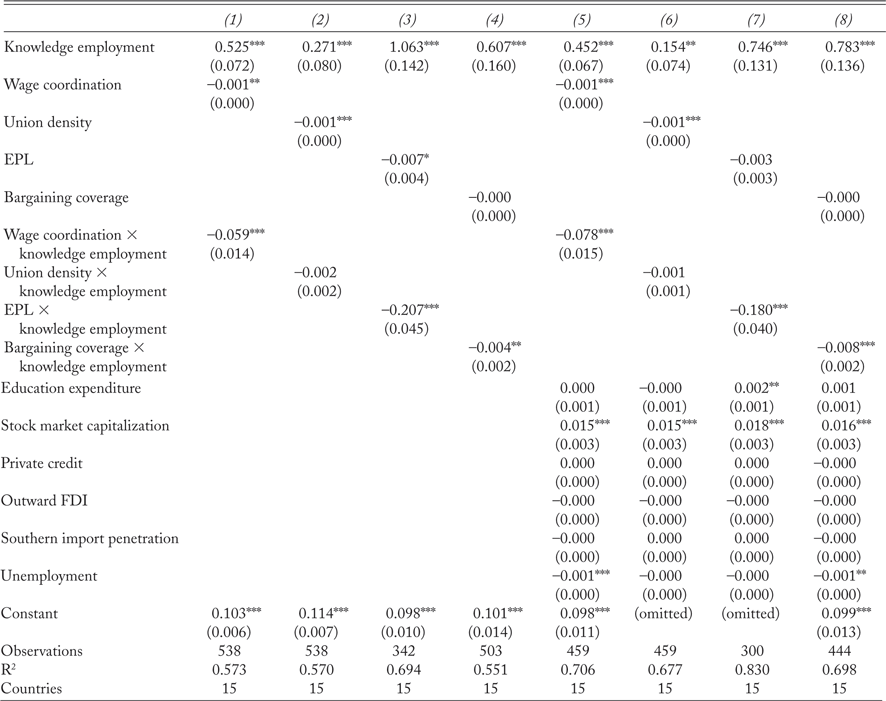
The results for the top 1 percent income share are shown in Table 4. Models 1 to 4 show the results from the baseline regressions, which include our main independent variables and an interaction term as well as country fixed effects. In all four models, knowledge employment is positively associated with the income share of the top 1 percent and significant at the 99 percent level. The interaction effects between knowledge employment and the four labor market institutions are all negative, but the effects are only statistically significant for wage coordination, epl, and bargaining coverage—not for union density. The baseline results tentatively support the hypothesis that the presence of strong labor market institutions reduces the effect of the transition to the knowledge economy on top income shares.
Models 5 to 8 in Table 4 introduce a full set of control variables. These models take account of other important drivers of inequality and cover education, financialization, globalization, and the economy. The results show that the effects of the expansion of knowledge employment on the income share of the top 1 percent is conditional on the strength of labor market institutions. The interaction effects for all the labor market institutions aside from union density are significant, negative, and have a similar magnitude to the baseline regressions. Only one of the control variables—stock market capitalization—is statistically significant across all the models. We find that stock market capitalization is positively associated with top income shares.
Knowledge Employment, Labor Market Institutions, and the Income Share of the Top 1 Percent (Prais-Winsten Regressions)a
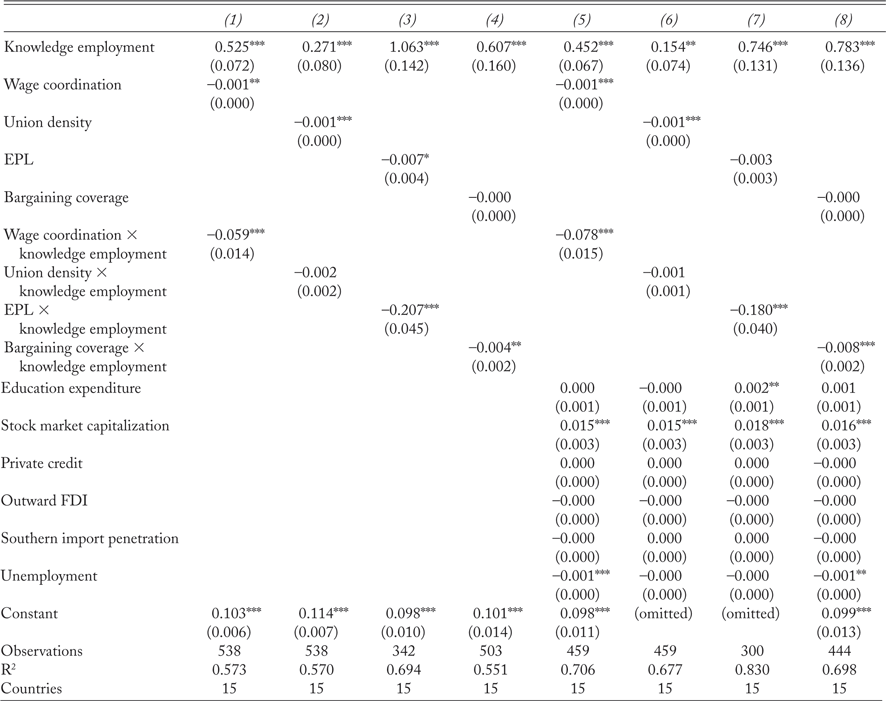
*p < 0.1, **p < 0.05, and ***p < 0.01
a Prais-Winsten regressions (panel-corrected standard errors and ar(l) corrections) with country fixed effects in all models. Unbalanced panel using data from 1970 to 2007. Pairwise option used to compute the covariance matrix. Knowledge employment is mean-centered and comprises three sectors: post and telecommunications, financial intermediation, and renting of machinery and equipment and other business activities.
The main effects on the labor market institutions are negative (and mostly statistically significant) across all eight models, which suggests that labor market institutions exert a negative effect on the top 1 percent income share at the average level of knowledge employment in the sample. This fits with the previous empirical literature on the role of labor market institutions in restraining the income growth of the most affluent households.Footnote 144
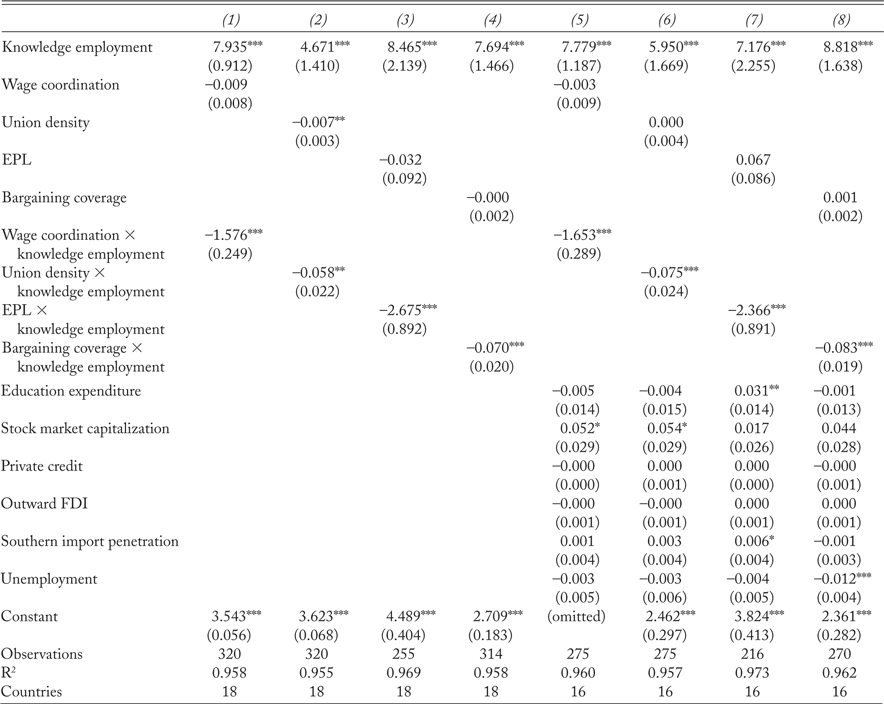
The results in Table 5 show the same eight regression models, but with the 90/10 wage ratio as the dependent variable. The same patterns emerge for the main independent variables. In all eight regression models, knowledge employment is positively associated with the 90/10 wage ratio and is highly statistically significant. The interaction effects are also negative and significant in the baseline models and in the models with controls for all four labor market institutions. Hence, although higher union density is not found to mitigate the effects of the knowledge economy on top income shares, it is found to moderate the effects on the wider income distribution. From models 5 to 8 in Table 5, we can see that none of our control variables exerts consistent, statistically significant effects on the 90/10 wage ratio.
Turning to the main effects of labor market institutions on the 90/10 wage ratio, we see that they are mainly statistically insignificant. This doesn’t necessarily undermine previous empirical studies that find labor market institutions have a negative effect on the 90/10 wage ratio,Footnote 145 but it does suggest that the effects of labor market institutions operate through a channel that differs from those identified in previous studies. Our results suggest that the most salient effects of labor market institutions on earnings inequality occur through their ability to alleviate the inequality-enhancing effects of the transition to the knowledge economy.
Knowledge Employment, Labor Market Institutions, and the 90/10 Wage Ratio (Prais-Winsten Regressions)a

* p < 0.1, ** p < 0.05, and *** p < 0.01
a Prais-Winsten regressions (panel-corrected standard errors and ar(1) corrections) with country fixed effects in all models. Unbalanced panel using data from 1970 to 2007. Pairwise option used to compute the covariance matrix. Knowledge employment is mean-centered and comprises three sectors: post and telecommunications, financial intermediation, and renting of machinery and equipment and other business activities.
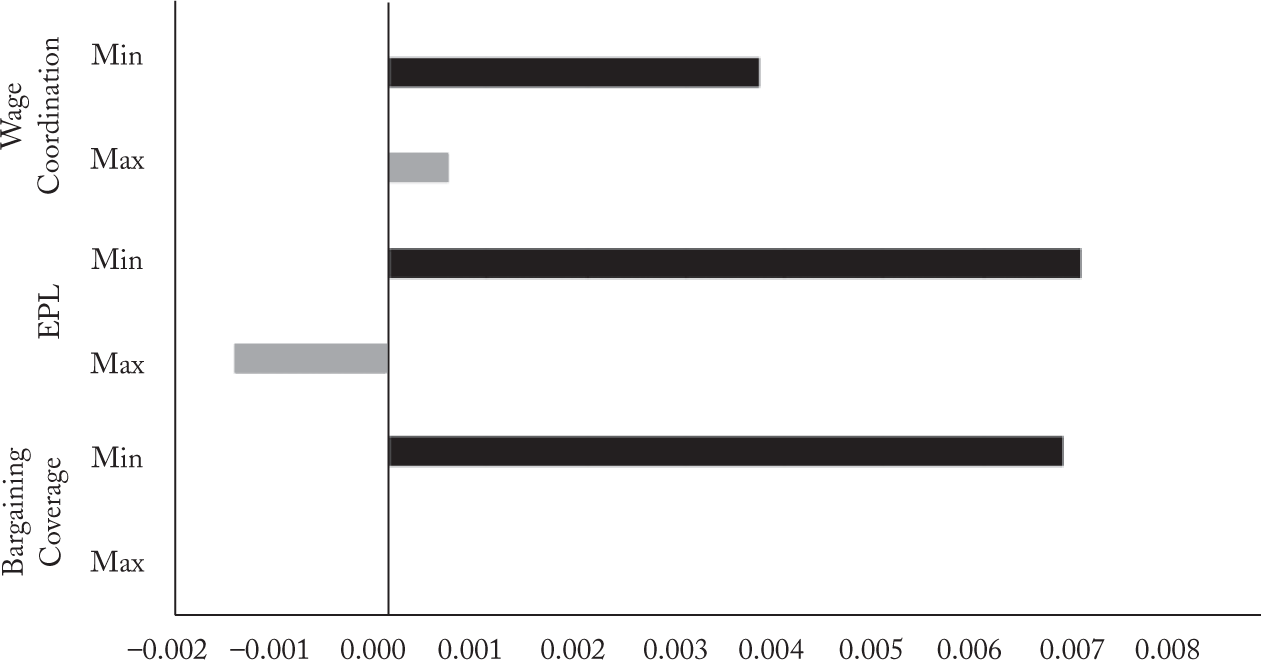
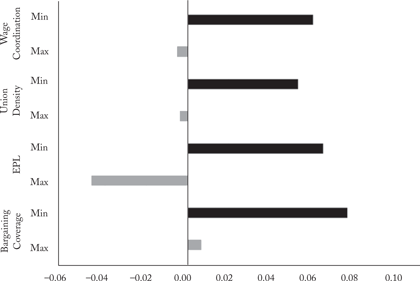
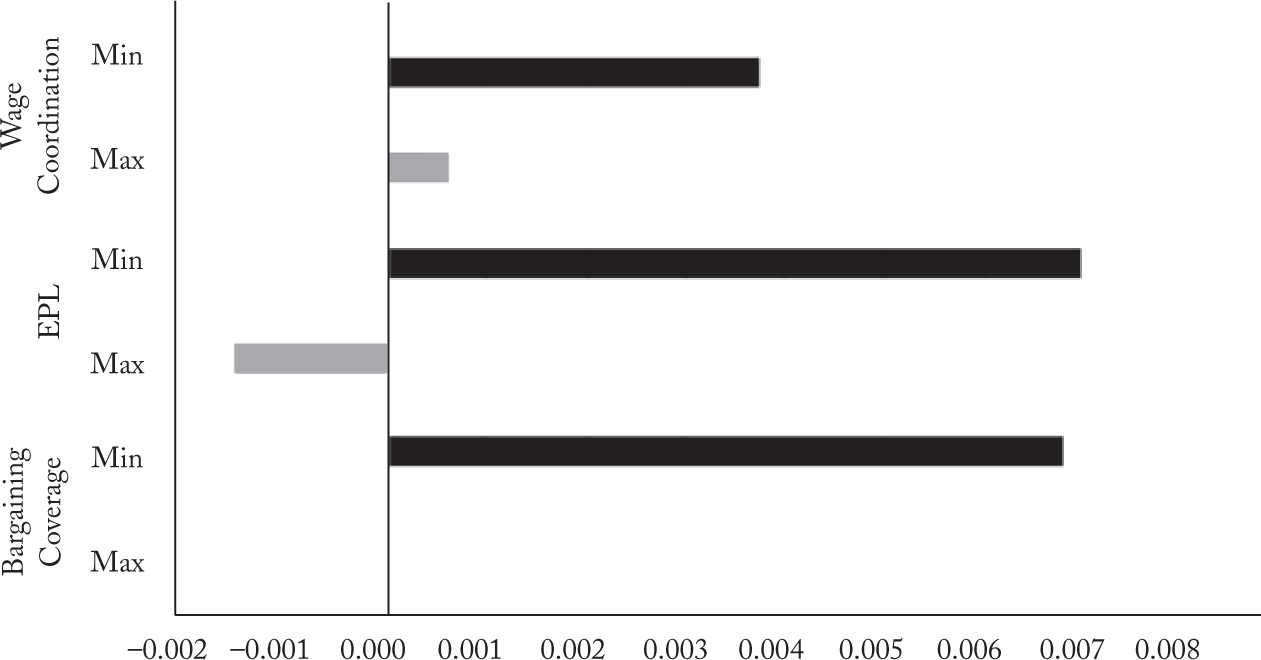
To get a clearer picture of the magnitude of the mitigating effects of labor market institutions, Figures 2 and 3 show the estimated effects of a one percentage point increase in employment in knowledge-intensive services on our two measures of inequality when our labor market institutions are at the minimum and maximum values observed in the sample (see Table 3). We don’t include union density in the figure for the top 1 percent income share, as the interaction effect isn’t statistically significant (see Table 4). Figure 2 shows that for the income share of the top 1 percent, an increase in knowledge employment is associated with an increase in inequality when wage coordination and collective bargaining coverage are very weak, but has little or no effect when they’re at their highest levels. epl exhibits a similar pattern, but the expansion of the knowledge economy is found to reduce inequality when employment protection is extremely strict. This finding should be taken with a grain of salt, however, as the maximum value for epl pertains only to Portugal between 1985 and 1989. Outside those country-years, epl is rarely above three in our sample. At three, the estimated effect of a one percentage point increase in knowledge employment on the top 1 percent income share would be small and positive, and hence, more in line with the results for wage coordination and bargaining coverage.
Estimated Effect on the Income Share of the Top 1 Percent of a One Percentage Point Increase in the Share of Knowledge Employment
Estimated Effect on the 90/10 Wage Ratio of a One Percentage Point Increase in the Share of Knowledge Employment

Similar patterns emerge for the 90/10 wage ratio, as shown in Figure 3. The effect of the expansion of the knowledge economy on inequality is positive when labor market institutions are weak, but negligible (or negative) when they are strong. Again, the same caveat applies to the epl findings. At an epl of three, the effect on the 90/10 wage ratio of an expansion of knowledge employment is also small and positive. Overall, these marginal effects figures highlight the role that strong labor market institutions can play in mitigating the inequality associated with the transition to the knowledge economy.
The results of the alternative specifications and robustness tests are shown in tables S1 to S9 of the supplementary material.Footnote 146 We can see that the main results of the analysis are largely unaffected by our empirical strategy. The variables of theoretical interest exhibit the same relationships when we include decade dummies to our Prais-Winsten regressions (Table S1) or when we use fixed-effects models (Table S2) or random-effects models (Table S3). As in the main results, the only interaction effect that isn’t consistently statistically significant and negative is between knowledge employment and union density in the top 1 percent income shares regressions.
The empirical strategies in tables S4 to S6 aim to assuage any fears that endogeneity is unduly influencing the results in the main analysis.Footnote 147 Both the model with all the dependent variables lagged by one period and the iv 2sls model strongly reinforce the results from our baseline Prais-Winsten regressions. The same key independent variables are statistically significant and the coefficients are about the same magnitude (although the knowledge economy exerts a slightly larger effect on the 90/10 wage ratio in the instrumental variables models). In the Arellano-Bond dynamic panel estimation, the main results are substantively comparable, but fewer of the interaction effects are statistically significant. The interaction effect on wage coordination is negative and significant for both measures of inequality, as well as for bargaining coverage for the top 1 percent income share and union density for the 90/10 wage ratio.
Across all the alternative specifications, stock market capitalization is found to exert a consistently statistically significant positive effect on the top 1 percent income share, just as in the main results. But unlike the main results, it is also positively associated with the 90/10 wage ratio across many of the alternative specifications.
Tables S7 and S8 show that the results are also robust to using different measures of the knowledge economy. That gives us confidence that our analysis is capturing the theoretical mechanisms we’ve identified rather than any competing explanations, such as financialization.Footnote 148 Table S9 shows that the results are robust to using a common sample for our inequality measures.Footnote 149
VI. Discussion
The study of the distribution of income, especially income inequality, is central to cpe. But it has only become more salient with the rise in labor market stratification during the postindustrial era.Footnote 150 Our findings make a valuable contribution to many of the key cpe debates on the knowledge economy, labor market institutions, and income inequality.
Baccaro and Howell’s seminal work on liberalization argues that the industrial relations systems of the advanced capitalist economies have been transformed in a common neoliberal direction since the 1990s, a change that has undermined the egalitarian model of negotiated capitalism.Footnote 151 Although it is clear from our data set that the postindustrial era has seen substantial liberalization in the industrial relations arena, our findings suggest that differences in the strength of labor market institutions across countries remain an important driver of cross-country differences in income inequality.
The results of our study also push back against Iversen and Soskice’s claim that the lack of complementarities between low- and high-skilled workers in the knowledge economy means that industrial relations systems are no longer important safeguards of wage solidarity.Footnote 152 We find strong evidence that industrial relations continue to be important, but our results are in no way dependent on contemporary industrial relations systems being underpinned by the complementarities and coalitions of the Fordist era. Like Kathleen Thelen, we view industrial relations systems as dynamic and open to reformulation. Thelen argues that it is precisely the ability of industrial relations systems to adapt—in both form and function—to the challenges of the knowledge economy that allows them to uphold egalitarian outcomes.Footnote 153 For example, Denmark has one of the lowest levels of inequality in the advanced democracies (see Figure S1 in the supplementary material),Footnote 154 but its current model of supply-side solidarity is very different from the wage-leveling approaches pursued by Danish unions in the Fordist era. The dominant interests in the union movement now stretch beyond traditional blue-collar workers to include the salaried employees of the knowledge-intensive service sectors. Thus, the unions push hard for both labor market flexibility and rights to education and training, as they prize equality of opportunity over equality of outcomes.Footnote 155
A consistent finding in our empirical analysis is that wage coordination can mitigate the effects of the transition to the knowledge economy on income inequality. On the surface, this finding may appear to conflict with recent contributions that point to wage coordination— and coordinated capitalism more generally—no longer necessarily being associated with greater equality across the workforce.Footnote 156 But unlike our measures of inequality, these contributions tend to focus on the bottom half of the income distribution, so they don’t take adequate account of the effects of wage coordination on restraining earnings higher up the income distribution. In addition, we find strong evidence that union density and bargaining coverage also dampen the inequality-inducing effects of the transition to the knowledge economy, especially for the 90/10 wage ratio. This finding chimes with the common argument in this strand of the literature that egalitarian outcomes in the knowledge economy are concentrated in countries with more inclusive and more encompassing industrial relations systems (for a given level of wage coordination).Footnote 157
The only interaction effect in our analysis that isn’t consistently statistically significant and negative is one between union density and knowledge employment in the top 1 percent income shares regressions. But this finding doesn’t contradict the existing empirical literature that shows that union density helps contain the rise of top incomesFootnote 158 because the coefficient on union density itself is consistently statistically significant and negative across our regression models. Higher union density therefore directly reduces the top 1 percent income share rather than mitigating the effects of the transition to the knowledge economy (as the other labor market institutions do). This shows that the effect of unions on executive compensation stretches across the economy and isn’t confined to knowledge-intensive service sectors.
Looking beyond the key independent variables, we find that only stock market capitalization exhibited consistent, statistically significant effects across the alternative specifications in our analysis. This supports the voluminous empirical literature on the importance of financializa- tion for income inequality.Footnote 159 It also hints at the specific mechanisms that might be at work, such as the increasing use of stock options as ceo compensation and the gains to management and owners (and the losses to rank-and-file production workers) from the shift to shareholder value oriented models of corporate governance.
VII. Conclusion
The ict revolution and the transition to the knowledge economy in the advanced democracies have created winners and losers. Workers with university education and the most affluent households have reaped most of the gains, often at the expense of workers lower down the income distribution whose jobs can be easily substituted by machines and computers. The dominant narrative in the emerging cpe literature on the knowledge economy is that the complementarities between skilled and semiskilled workers that underpinned industrial relations systems in the Fordist era have been undermined by the ict revolution such that strong labor market institutions are no longer the main guarantors of wage solidarity across the labor force.Footnote 135
Our empirical analysis of eighteen advanced democracies between 1970 and 2007 challenges that argument. It shows that the presence of strong labor market institutions played an important role in mitigating the upward pressure on income inequality from the transition to the knowledge economy. We find that the effects of expanding knowledge employment on both the income share of the top 1 percent and the 90/10 wage ratio are moderated by more coordinated wage bargaining, stricter epl, and higher bargaining coverage. We also find that union density mitigates the effects of the transition to the knowledge economy on the 90/10 wage ratio, but not on the top 1 percent income share. Our results complement the wider empirical literature that finds that industrial relations systems and the power of organized labor can limit wage dispersion across the workforce and constrain the income growth of society’s most affluent households.Footnote 161 We go beyond the earlier literature by showing that the effects of labor market institutions in the postindustrial era operated through their capacity to counteract the pressures on wage solidarity arising from the rapid expansion of knowledge-intensive service sectors.
The analysis presented in this article has several important limitations that point to fruitful avenues for future work. The Prais-Winsten regression models pin down the importance of labor market institutions for mitigating the inequality effects of the transition to the knowledge economy, but have a limited amount to say about the underlying mechanisms. Our cross-country comparative analysis would therefore be nicely complemented by microlevel empirical analyses or qualitative case study analyses of how labor market institutions interact with the expansion of knowledge employment to ensure a wage solidarity that is greater in the Nordic countries and some parts of continental Europe than elsewhere. The extent to which producer groups have adapted their strategies and forms of coordination in the knowledge economy is also hard to ascertain from the national measures of labor market institutions used in this study, and requires further investigation. Additionally, the advanced democracies vary not only in their expansion of knowledge-intensive services, but also in other aspects of their economic structure, such as the prevalence of employment in low- skilled, interpersonal services and the extent to which traditional manufacturing jobs have been preserved. The clear challenge for future cpe work on the knowledge economy will be to bring together insights on the distributive implications of the full spectrum of structural changes since the 1970s, and to work toward a more unified conceptual framework for analyzing the effects of structural change on income inequality in the advanced democracies.
This article makes an important contribution to the growing body of comparative work that looks at how national institutions can attenuate the effects of major economic changes on income inequality in advanced democracies.Footnote 162 We provide evidence against the argument that labor market institutions are redundant in the knowledge economy; in fact, we find that they play a central role in advanced democracies in alleviating the upward pressure on income inequality arising from the continued march of workers into knowledge-intensive service sectors.
Supplementary Material
Supplementary material for this article can be found at https://doi.org/10.1017/S0043887118000333.
Data
Replication data for this article can be found at https://doi.org/10.7910/DVN/EUC80S.
Acknowledgments
Special thanks to Anthony Roberts and Roy Kwon for their extensive comments on an earlier version of this article and for sharing their data. We also thank the three anonymous reviewers, as well as Kathleen Thelen, Peter A. Hall, Waltraud Schelkle, Bob Hancke, Orkun Saka, Francesco Amodio, Andrea Garnero, and Niccolo Durazzi for their detailed and insightful comments. We are grateful for feedback from those who attended presentations on this research at the European Institute at the London School of Economics, the Department of Political Economy at King’s College London, the European Department at the International Monetary Fund, the Institute of Labor Economics (World Bank) 2018 Network on Jobs and Development Conference, and the American Political Science Association 2018 Annual Meeting.
Appendix
Country-Year Coverage for the Dependent Variables

Correlation Matrix

Variable Descriptions and Sources

Authors
David Hope is a lecturer in the Department of Political Economy at King’s College London and a visiting research fellow at the International Inequalities Institute at the London School of Economics and Political Science. He researches at the intersection of economics and political science and focuses on the advanced democracies. Hope’s research interests include varieties of capitalism, growth models, the knowledge economy, inequality and redistribution, populism, and macroeconomics. He can be reached at david.hope@kcl.ac.uk.
Angelo Martelli is a postdoctoral research fellow at the London School of Economics European Institute, where he works on the Economic and Social Research Council project, “Structural Reforms and European Integration: Theory, Measurement and Econometric Evidence.” He is also a consultant for the Jobs Group of the World Bank and a policy fellow for the Open Innovation Team of the UK Cabinet Office and HM Treasury. His research interests span labor economics and European political economy, with a particular focus on the impact of technology on the evolution of employment structures across Europe and the implications for labor market institutions and income inequality. He can be reached at a.martelli@lse.ac.uk.