INTRODUCTION
Major depressive disorder is common in the general population with an estimated lifetime prevalence of 15–17% (APA, 1994). Although it is mainly regarded as a disorder of affect, there is a wealth of evidence suggesting that it is accompanied by a deficit in cognitive function (Goodwin, Reference Goodwin1997; Austin et al. Reference Austin, Mitchell and Goodwin2001; Rose & Ebmeier, Reference Rose and Ebmeier2006). The true pattern of cognitive impairment in adult depression remains a matter of controversy because most studies are modest or small in size, and hence cognitive deficits tend to differ between and within studies, in both their nature and severity (Rose & Ebmeier, Reference Rose and Ebmeier2006). Apart from differing psychometric properties, there are a number of factors that are likely to account for any observed variability. These include the type and/or severity of depression (Austin et al. Reference Austin, Ross, Murray, O'Carroll, Ebmeier and Goodwin1992; Channon et al. Reference Channon, Baker and Robertson1993; Ravnkilde et al. Reference Ravnkilde, Videbech, Clemmensen, Egander, Rasmussen and Rosenberg2002; Baudic et al. Reference Baudic, Tzortzis, Barba and Traykov2004), age (Austin et al. Reference Austin, Ross, Murray, O'Carroll, Ebmeier and Goodwin1992), medication status, co-morbid medical illness, and history of electroconvulsive therapy (ECT) (Lesser et al. Reference Lesser, Boone, Mehringer, Wohl, Miller and Berman1996). The presence or absence of depression-related deficits in geriatric depression has been noted in episodic memory (e.g. Beats et al. Reference Beats, Sahakian and Levy1996; Kramer-Ginsberg et al. Reference Kramer-Ginsberg, Greenwald, Krishnan, Christiansen, Hu, Ashtari, Patel and Pollack1999; Portella et al. Reference Portella, Marcos, Rami, Navarro, Gasto and Salamero2003; Baudic et al. Reference Baudic, Tzortzis, Barba and Traykov2004; Butters et al. Reference Butters, Whyte, Nebes, Begley, Dew, Mulsant, Zmuda, Bhalla, Meltzer, Pollock, Reynolds and Becker2004; Bhalla et al. Reference Bhalla, Butters, Zmuda, Seligman, Mulsant, Pollock and Reynolds2006; King et al. Reference King, Cox, Lyness, Conwell and Caine2006; Sheline et al. Reference Sheline, Barch, Garcia, Gersing, Pieper, Welsh-Bohmer, Steffens and Doraiswamy2006 – positive; Baune et al. Reference Baune, Suslow, Engelien, Arolt and Berger2006 – negative), semantic memory (Butters et al. Reference Butters, Whyte, Nebes, Begley, Dew, Mulsant, Zmuda, Bhalla, Meltzer, Pollock, Reynolds and Becker2004; Bhalla et al. Reference Bhalla, Butters, Zmuda, Seligman, Mulsant, Pollock and Reynolds2006; Sheline et al. Reference Sheline, Barch, Garcia, Gersing, Pieper, Welsh-Bohmer, Steffens and Doraiswamy2006 – positive; Ravdin et al. Reference Ravdin, Katzen, Agrawal and Relkin2003; Butters et al. Reference Butters, Whyte, Nebes, Begley, Dew, Mulsant, Zmuda, Bhalla, Meltzer, Pollock, Reynolds and Becker2004 – negative), executive function (Beats et al. Reference Beats, Sahakian and Levy1996; Lockwood et al. Reference Lockwood, Alexopoulos and van Gorp2002; Nebes et al. Reference Nebes, Pollock, Houck, Butters, Mulsant, Zmuda and Reynolds2003; Baudic et al. Reference Baudic, Tzortzis, Barba and Traykov2004; Butters et al. Reference Butters, Whyte, Nebes, Begley, Dew, Mulsant, Zmuda, Bhalla, Meltzer, Pollock, Reynolds and Becker2004; Sheline et al. Reference Sheline, Barch, Garcia, Gersing, Pieper, Welsh-Bohmer, Steffens and Doraiswamy2006 – positive; Boone et al. Reference Boone, Lesser, Miller, Wohl, Berman, Lee, Palmer and Back1995; Baune et al. Reference Baune, Suslow, Engelien, Arolt and Berger2006; Elderkin-Thompson et al. Reference Elderkin-Thompson, Mintz, Haroon, Lavretsky and Kumar2007 – negative) and processing speed (Kramer-Ginsberg et al. Reference Kramer-Ginsberg, Greenwald, Krishnan, Christiansen, Hu, Ashtari, Patel and Pollack1999; Nebes et al. Reference Nebes, Butters, Mulsant, Pollock, Zmuda, Houck and Reynolds2000; Portella et al. Reference Portella, Marcos, Rami, Navarro, Gasto and Salamero2003; Butters et al. Reference Butters, Whyte, Nebes, Begley, Dew, Mulsant, Zmuda, Bhalla, Meltzer, Pollock, Reynolds and Becker2004; Baune et al. Reference Baune, Suslow, Engelien, Arolt and Berger2006; Bhalla et al. Reference Bhalla, Butters, Zmuda, Seligman, Mulsant, Pollock and Reynolds2006; Sheline et al. Reference Sheline, Barch, Garcia, Gersing, Pieper, Welsh-Bohmer, Steffens and Doraiswamy2006 – positive; Boone et al. Reference Boone, Lesser, Miller, Wohl, Berman, Lee, Palmer and Back1995 – negative).
Few studies have examined cognitive deficits in geriatric depression with respect to age of depression onset (Naismith et al. Reference Naismith, Hickie, Turner, Little, Winter, Ward, Wilhelm, Mitchell and Parker2003), and most of the data come from studies that do not distinguish between individuals with late-onset (LOD) and early-onset depression (EOD). The clinical features of LOD might be expected to lead to a characteristic and more severe cognitive impairment. LOD is defined by onset after the age of 50–65 years and is associated with a high medical burden as well as neurological abnormalities that are not always clinically evident in the early stages of the disorder (Alexopoulos, Reference Alexopoulos2003). There is consensus that LOD differs from EOD (Steingart & Herrmann, Reference Steingart and Herrmann1991; Murata et al. Reference Murata, Kimura, Omori, Kado, Kosaka, Iidika, Itoh and Wada2001) in that it is associated with a lower rate of family history of depression (Devanand et al. Reference Devanand, Adorno, Cheng, Burt, Pelton, Roose and Sackeim2004) and a higher prevalence of dementia (Alexopoulos, Reference Alexopoulos2003). Patients with LOD have consistently been found to demonstrate more magnetic resonance scanning (MRI) abnormalities and cerebrovascular pathology than healthy controls (Lesser et al. Reference Lesser, Boone, Mehringer, Wohl, Miller and Berman1996) and patients with EOD (Lesser et al. Reference Lesser, Boone, Mehringer, Wohl, Miller and Berman1996; Devanand et al. Reference Devanand, Adorno, Cheng, Burt, Pelton, Roose and Sackeim2004). Neuroimaging studies point to frontostriatal disruption caused by subcortical, white-matter and periventricular hyperintensities (Lin et al. Reference Lin, Kuo, Chiang, Chen and Chen2006). By contrast, EOD is associated with a significant degree of apparently selective hippocampal volume loss (e.g. Bell-McGinty et al. Reference Bell-McGinty, Butters, Meltzer, Greer, Reynolds and Becker2002). Rapp et al. (Reference Rapp, Dahlman, Sano, Grossman, Haroutunian and Gorman2005) suggest that this may be related to the long-standing effects of decreased hippocampal neurogenesis due to recurrence of depression. Temporal lobe dysfunction (Goodwin, Reference Goodwin1997; Sweeney et al. Reference Sweeney, Kmiec and Kupfer2000; Austin et al. Reference Austin, Mitchell and Goodwin2001) could result from excess glucocorticoid effects on the hippocampus during each subsequent depressive episode (e.g. Post, Reference Post1992; Bemelmans et al. Reference Bemelmans, Goekoop and Kempen1996). Indeed, studies have suggested that cumulative depression duration is related to changes in hippocampal volume (Sheline et al. Reference Sheline, Sanghavi, Mintun and Gado1999; Shah et al. Reference Shah, Glabus, Goodwin and Ebmeier2002; Lampe et al. Reference Lampe, Hulshoff Pol, Janssen, Schnack, Kahn and Heeren2003).
It would not be surprising if these two depression subtypes, LOD and EOD, were associated with distinct and unique neuropsychological profiles (see Lampe et al. Reference Lampe, Hulshoff Pol, Janssen, Schnack, Kahn and Heeren2003). Where they have been compared, small-scale studies have supported such a possibility. Rapp et al. (Reference Rapp, Dahlman, Sano, Grossman, Haroutunian and Gorman2005) reported the presence of deficits in attention/executive function in LOD compared with patients with EOD. Executive dysfunction is characteristic of the clinical presentation of most patients with LOD (Murphy & Alexopoulos, Reference Murphy and Alexopoulos2006), remains present even after amelioration of depressive symptoms (Alexopoulos et al. Reference Alexopoulos, Kiosses, Heo, Murphy, Shanmugham and Gunning-Dixon2005), and may predict treatment response (Alexopoulos et al. Reference Alexopoulos, Kiosses, Heo, Murphy, Shanmugham and Gunning-Dixon2005; Potter et al. Reference Potter, Kittinger, Wagner, Steffens and Krishnan2006). Thus, LOD and executive dysfunction may be closely interlinked, perhaps through disruption in white-matter integrity (Murphy & Alexopoulos, Reference Murphy and Alexopoulos2006). Executive failures may be broadly related to cognitive slowing (e.g. Butters et al. Reference Butters, Whyte, Nebes, Begley, Dew, Mulsant, Zmuda, Bhalla, Meltzer, Pollock, Reynolds and Becker2004) and frontostriatal abnormalities (Sheline et al. Reference Sheline, Barch, Garcia, Gersing, Pieper, Welsh-Bohmer, Steffens and Doraiswamy2006).
Consistent with evidence of medial temporal lobe dysfunction in patients with EOD, this patient group has been found to demonstrate deficits in episodic memory (e.g. Salloway et al. Reference Salloway, Molloy, Kohn, Gillard, Duffy, Rogg, Tung, Richardson, Thomas and Westlake1995; Rapp et al. Reference Rapp, Dahlman, Sano, Grossman, Haroutunian and Gorman2005; Rainer et al. Reference Rainer, Mucke, Zehetmayer, Krampla, Kuselbauer, Weissgram, Jungwirth, Tragl and Fischer2006). In addition, the results of several studies comparing individuals with recurrent and first-episode depression (Bieliauskas, Reference Bieliauskas1993; Basso & Bornstein, Reference Basso and Bornstein1999; Fossati et al. Reference Fossati, Harvey, Le Bastard, Ergis, Jouvent and Allilaire2004) indicate that recurrent depression is associated with increased memory dysfunction. However, the relative dysfunction in LOD and EOD subtypes remains uncertain. Some studies have claimed that there is more cognitive impairment in LOD as compared with EOD (Salloway et al. Reference Salloway, Molloy, Kohn, Gillard, Duffy, Rogg, Tung, Richardson, Thomas and Westlake1995; Alexopoulos, Reference Alexopoulos2003, Reference Alexopoulos2005; Janssen et al. Reference Janssen, Beekman, Comijs, Deeg and Heeren2006), while others have not (Holroyd & Duryee, Reference Holroyd and Duryee1997; Brodaty et al. Reference Brodaty, Luscombe, Parker, Wilhelm, Hickie, Austin and Mitchell2001).
The present study is a systematic review and meta-analysis of the literature on the neuropsychology of LOD and EOD. We have examined multiple aspects of cognition simultaneously, to determine whether deficits are differential. To our knowledge, no previous study has attempted to quantify the mean effects across a range of cognitive functions in LOD. Our hypothesis was that individuals with EOD would demonstrate greater impairment on measures of episodic memory as compared with controls and, possibly, patients with LOD. In LOD patients, we expected the neuropsychological profile to be associated with greater dysfunction in the areas of executive function and processing speed.
METHOD
Data acquisition
Studies investigating the cognitive profile of patients with unipolar depression were included in this systematic review. Studies were retrieved systematically from Medline and EMBASE using the search terms (‘depression’ or ‘depressed’) and (‘geriatric’ or ‘late life’ or ‘old age’ or ‘late onset’ or ‘elderly’ or ‘older’) and (‘cognitive’ or ‘cognition’ or ‘neuropsychology’ or ‘neuropsychological’), and reference lists of these studies were scanned for additional, relevant studies. The search was completed in September 2006. The inclusion criteria were as follows: studies had to be of cross-sectional design, including a sample of patients with LOD and either healthy controls or a sample of patients with EOD, or both. Patients were required to meet the diagnostic criteria of major or minor unipolar depression according to DSM-III-R/DSM-IV. Means and standard deviations of neuropsychological tests had to be available, or could be derived, or were made available by the authors. The following variables were recorded in a structured fashion: (i) mean and standard deviation of all neuropsychological measures for healthy controls, patients with LOD and EOD, (ii) sample characteristics, and (iii) study design.
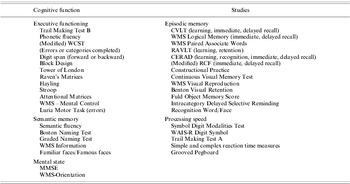
The data were organized into composite measures representing different aspects of cognitive function. These included (i) executive functioning (including measures of working memory, selective attention, cognitive flexibility, set shifting, and planning/problem solving), (ii) processing speed, (iii) episodic memory (measures of immediate and delayed recall, learning, and recognition), (iv) semantic memory and (v) mental state. A list of neuropsychological tests contributing to each composite measure can be found in Table 1. If more than one test was used to represent a domain effect for any single study, representative effect sizes were computed, using mean scores weighted by number of subjects and pooled standard deviations.
Key to tests summarized

WCST, Wisconsin Modified Card Sorting Test; WMS, Wechsler Memory Scale; WAIS-R, Wechsler Adult Intelligence Scale-Revised; CVLT, California Verbal Learning Test; RAVLT, Rey Auditory Verbal Learning Test; CERAD, Consortium to Establish a Registry for Alzheimer's Disease; RCF, Rey Complex Figure; MMSE, Mini-Mental State Examination.
Statistical analysis
Demographic variables were analysed by means of a univariate analysis of variance (ANOVA). To investigate the magnitude of impairments on different aspects of cognitive function, a random-effect meta-analysis was chosen. This method is more appropriate than the fixed effects model when there is a high degree of heterogeneity (Egger et al. Reference Egger, Smith and Phillips1997). The meta-analysis was performed on StatsDirect version 2.4.5 (StatsDirect Ltd, Sale, Cheshire, UK) using Cohen's d as effect size. Differences were regarded as significant when the 95% confidence interval did not include zero. Variability of effects between the studies was investigated using as a test for heterogeneity, the Q (‘non-combinability’ for d+) test.
RESULTS
Demographic variables
Ten studies (Salloway et al. Reference Salloway, Molloy, Kohn, Gillard, Duffy, Rogg, Tung, Richardson, Thomas and Westlake1995; Brodaty et al. Reference Brodaty, Luscombe, Parker, Wilhelm, Hickie, Austin and Mitchell2001; Murata et al. Reference Murata, Kimura, Omori, Kado, Kosaka, Iidika, Itoh and Wada2001; Elderkin-Thompson et al. Reference Elderkin-Thompson, Kumar, Bilker, Dunkin, Mintz, Moberg, Mesholam and Gur2003; Naismith et al. Reference Naismith, Hickie, Turner, Little, Winter, Ward, Wilhelm, Mitchell and Parker2003; Baldwin et al. Reference Baldwin, Jeffries, Jackson, Sytcliffe, Thacker, Scott and Burns2004; Butters et al. Reference Butters, Whyte, Nebes, Begley, Dew, Mulsant, Zmuda, Bhalla, Meltzer, Pollock, Reynolds and Becker2004; Rapp et al. Reference Rapp, Dahlman, Sano, Grossman, Haroutunian and Gorman2005; Gallassi et al. Reference Gallassi, Di Sarro, Morreale and Amore2006; Rainer et al. Reference Rainer, Mucke, Zehetmayer, Krampla, Kuselbauer, Weissgram, Jungwirth, Tragl and Fischer2006) were identified that met the criteria for inclusion. Sample characteristics are displayed in Table 2. Studies varied substantially with respect to the cut-off age of onset used to define LOD, with cut-offs ranging from 50 to 65 years of age. Four studies were identified that compared LOD with controls and three studies that compared LOD with EOD. Three studies included all three groups of interest. A one-way ANOVA indicated that there were no significant differences between study groups in terms of age (F=0·68, df=2, p>0·05) and years of education (F=0·82, df=2, p>0·05). All patients were studied when currently depressed; patients with EOD and LOD had almost identical mean depression severity as measured by the 21-item Hamilton Depression Rating Scale (HAMD; F=0·01, df=1, p>0·05), but the range was greater in the EOD group.
Demographic characteristics of studies included in the meta-analysis

LOD, Late-onset depression; EOD, early-onset depression; HAMD, Hamilton Depression Rating Scale; s.d, standard deviation; n.a., not applicable.
Effect sizes
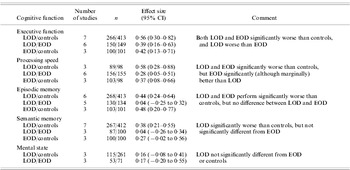
Effect sizes and the numbers of patients and studies they are derived from are displayed in Table 3. Executive function and measures of processing speed were impaired in both patient groups compared with controls. However, patients with LOD displayed larger deficits in executive function than EOD groups when compared with controls and when compared directly with EOD groups. By contrast, patients with LOD and EOD exhibited deficits in episodic and semantic memory that were broadly comparable when compared with controls and not different when compared with each other. There were no significant differences between patients with LOD, EOD and controls on measures of overall cognitive function [i.e. the Mini-Mental State Examination (MMSE) and the Wechsler Memory Scale (WMS)-Orientation], confirming the absence of gross cognitive impairments comparable with dementia groups.
Effect size
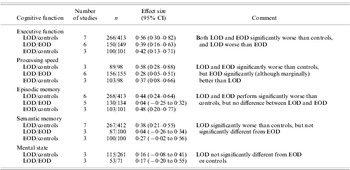
LOD, Late-onset depression; EOD, early-onset depression; CI, confidence interval.
Combinability of studies
The test for heterogeneity failed to reach significance for any cognitive domain tested, indicating that the variability in test scores between studies did not exceed that expected by chance.
DISCUSSION
The results show that the depressed state in LOD is broadly associated with greater impairments of executive function and processing speed than is the early onset form, while episodic and semantic memory impairments are more similar than different in the LOD and EOD groups. The consistency of the findings and the advantage of combining all currently available studies now allows real confidence in what has hitherto been the tentative conclusion of under-powered studies.
Neuropsychological profiles of patients with LOD and EOD
Effect sizes for comparisons between patients with LOD and healthy controls were relatively large and significant across all specific domains of cognitive functioning. Patients with LOD demonstrated impairments in executive functioning, processing speed, episodic and semantic memory.
Consistent with our hypothesis, the numerically largest deficits in LOD were seen for executive functioning. In contrast with the high degree of inconsistency regarding executive dysfunction in adult depression, the findings in this patient group appear surprisingly consistent: only one study (Gallassi et al. Reference Gallassi, Di Sarro, Morreale and Amore2006) failed to find a significant impairment. The pronounced deficits in executive function may be explained by the unique neuropathological profile of LOD. Both neuroimaging and neuropathological studies indicate frontostriatal abnormalities in LOD and substantive evidence that LOD is characterized by pronounced white-matter hyperintensities compared with both healthy controls (Lesser et al. Reference Lesser, Boone, Mehringer, Wohl, Miller and Berman1996) and patients with EOD (Lesser et al. Reference Lesser, Boone, Mehringer, Wohl, Miller and Berman1996; Devanand et al. Reference Devanand, Adorno, Cheng, Burt, Pelton, Roose and Sackeim2004). In addition, LOD has been associated with cerebrovascular disease risk factors, which may also play an important role in causing cognitive impairment (Sheline et al. Reference Sheline, Barch, Garcia, Gersing, Pieper, Welsh-Bohmer, Steffens and Doraiswamy2006). Although Naismith et al. (Reference Naismith, Hickie, Turner, Little, Winter, Ward, Wilhelm, Mitchell and Parker2003) failed to find a significant association between neuropsychological performance and vascular risk, future studies should certainly investigate whether vascular burden may act as a potential mediator of executive dysfunction.
The presence of executive dysfunction, and by inference vascular pathophysiology, in LOD has important implications both for predicting outcome and improving treatment. A high degree of executive dysfunction has been linked to poor or delayed response to antidepressants (Alexopoulos et al. Reference Alexopoulos, Kiosses, Heo, Murphy, Shanmugham and Gunning-Dixon2005; Potter et al. Reference Potter, Kittinger, Wagner, Steffens and Krishnan2006) as well as depression recurrence (Alexopoulos et al. Reference Alexopoulos, Meyers, Young, Kalayam, Kakuma, Gabrielle, Sirey and Hull2000). For example, in a study by Alexopoulos et al. (Reference Alexopoulos, Kiosses, Heo, Murphy, Shanmugham and Gunning-Dixon2005), abnormal scores on initiation/perseveration or response inhibition measures were associated with reduced improvement in depressive symptoms of geriatric depressed patients who were treated with selective serotonin reuptake inhibitors (SSRIs). As this pattern of cognitive impairment is so common in LOD, it may be possible to develop treatment approaches that are specific to this particular subtype of depression. This is important, as there is evidence to suggest that more comprehensive treatment approaches to late-life depression may result in higher response rates (Rapp et al. Reference Rapp, Dahlman, Sano, Grossman, Haroutunian and Gorman2005).
Previous studies have suggested that cognitive impairments in depression may be mediated in part or wholly by more basic deficits, such as processing speed (e.g. Salloway et al. Reference Salloway, Molloy, Kohn, Gillard, Duffy, Rogg, Tung, Richardson, Thomas and Westlake1995; Butters et al. Reference Butters, Whyte, Nebes, Begley, Dew, Mulsant, Zmuda, Bhalla, Meltzer, Pollock, Reynolds and Becker2004; Sheline et al. Reference Sheline, Barch, Garcia, Gersing, Pieper, Welsh-Bohmer, Steffens and Doraiswamy2006). The results suggest that processing speed may well be impaired to the same extent as executive function in patients with LOD. Unfortunately, this finding rests on only three studies (Naismith et al. Reference Naismith, Hickie, Turner, Little, Winter, Ward, Wilhelm, Mitchell and Parker2003; Butters et al. Reference Butters, Whyte, Nebes, Begley, Dew, Mulsant, Zmuda, Bhalla, Meltzer, Pollock, Reynolds and Becker2004; Rapp et al. Reference Rapp, Dahlman, Sano, Grossman, Haroutunian and Gorman2005). Further studies would be required to settle this question with a reasonable degree of certainty.
Our results are consistent with relative preservation of executive function and processing speed in patients with EOD compared with patients with LOD. Patients with EOD are still likely to be impaired, but the functional deficits may reflect a lesser burden of frontostriatal pathology.
Individuals with LOD demonstrated a medium-sized deficit on measures of episodic memory, comparable with studies investigating episodic memory function in adult depression (Wolfe et al. Reference Wolfe, Granholm, Butters, Saunders and Janowsky1987; Austin et al. Reference Austin, Ross, Murray, O'Carroll, Ebmeier and Goodwin1992; Burt et al. Reference Burt, Zembar and Niederehe1995; Ilsley et al. Reference Ilsley, Moffoot and O'Carroll1995; Grant et al. Reference Grant, Thase and Sweeney2001; Ravnkilde et al. Reference Ravnkilde, Videbech, Clemmensen, Egander, Rasmussen and Rosenberg2002; Fossati et al. Reference Fossati, Harvey, Le Bastard, Ergis, Jouvent and Allilaire2004). In adult depression, the basis of memory impairment remains controversial. It has been argued that memory dysfunction may be caused by reduced motivation and difficulties sustaining effort, rather than a mnemonic deficit per se (Weingartner et al. Reference Weingartner, Cohen, Murphy, Martello and Gerdt1981; Cohen et al. Reference Cohen, Weingartner, Smallberg, Pickar and Murphy1982; Bazin et al. Reference Bazin, Perruchet, De Bonis and Feline1994). Hence a large deficit in executive function may, in part, mediate impairment in episodic memory in LOD. While most studies in adults found an impairment on measures of new learning and recall in the presence of spared recognition and implicit memory (e.g. Ilsley et al. Reference Ilsley, Moffoot and O'Carroll1995), encoding problems may still be mnemonic and attributable to hippocampal dysfunction. The possibility remains that deficits in episodic memory in LOD are equally independent of executive dysfunction and have some neuropathological origin, in particular hippocampal dysfunction. In fact, several recent studies (Steffens et al. Reference Steffens, Byrum, McQuoid, Greenberg, Payne, Blitchington, MacFall and Krishnan2000; Lloyd et al. Reference Lloyd, Ferrier, Barber, Gholkar, Young and O'Brien2004; Hickie et al. Reference Hickie, Naismith, Ward, Turner, Scott, Mitchell, Wilhelm and Parker2005) have found that hippocampal volume reductions with MRI were most pronounced in LOD. Further neuroimaging studies are needed to clarify this relationship.
In contrast to previous reports from individual studies showing a greater impairment on episodic memory measures in EOD compared with LOD (e.g. Salloway et al. Reference Salloway, Molloy, Kohn, Gillard, Duffy, Rogg, Tung, Richardson, Thomas and Westlake1995; Rapp et al. Reference Rapp, Dahlman, Sano, Grossman, Haroutunian and Gorman2005), we found no significant difference between the two patient groups in the meta-analysis. Previous studies provided evidence that recurrence increases the severity of episodic memory deficits in non-elderly depression (Bieliauskas, Reference Bieliauskas1993; Basso & Bornstein, Reference Basso and Bornstein1999; Fossati et al. Reference Fossati, Harvey, Le Bastard, Ergis, Jouvent and Allilaire2004), and is related to reductions in cortical and striatal grey matter, as well as changes in hippocampal volume (Sheline et al. Reference Sheline, Sanghavi, Mintun and Gado1999; Shah et al. Reference Shah, Glabus, Goodwin and Ebmeier2002; Lampe et al. Reference Lampe, Hulshoff Pol, Janssen, Schnack, Kahn and Heeren2003). By definition, older patients with EOD have typically experienced more than one episode of depression, and there is evidence that EOD is associated with significant reductions in hippocampal volume (Bell-McGinty et al. Reference Bell-McGinty, Butters, Meltzer, Greer, Reynolds and Becker2002). Nevertheless, the present meta-analysis failed to provide evidence that the memory deficits in EOD are larger than those seen in individuals with LOD.
Semantic memory has thus far received little attention in the literature on LOD and it is perhaps surprising that a deficit was found with a remarkable degree of consistency. However, semantic memory tasks also often require executive function in order to perform well. For example, category fluency, although generally regarded as a valid measure of semantic memory, relies heavily on initiation. In addition, the individual is required to perform this task within a limited period of time, which makes processing speed an important factor for good performance. Future studies should use measures that reflect semantic memory function more accurately, such as confrontation naming tests. In parallel with episodic memory, individuals with EOD and LOD appear to perform at highly similar levels on measures of semantic memory (Naismith et al. Reference Naismith, Hickie, Turner, Little, Winter, Ward, Wilhelm, Mitchell and Parker2003; Butters et al. Reference Butters, Whyte, Nebes, Begley, Dew, Mulsant, Zmuda, Bhalla, Meltzer, Pollock, Reynolds and Becker2004; Rapp et al. Reference Rapp, Dahlman, Sano, Grossman, Haroutunian and Gorman2005), in terms of both semantic fluency and naming ability.
Finally, we found no significant difference between individuals with LOD and EOD in clinical measures of overall cognitive function. This may appear surprising given the LOD patients' poorer performance on measures of executive function and processing speed. However, it is consistent with some other reports (e.g. Holroyd & Duryee, Reference Holroyd and Duryee1997; Brodaty et al. Reference Brodaty, Luscombe, Parker, Wilhelm, Hickie, Austin and Mitchell2001) and may simply demonstrate the low sensitivity of bedside cognitive screening measures compared with experimental measures of function. Additional variability may have been added by the inconsistent definition of the age cut-off between groups (discussed later).
In summary, there was no consistent difference between patient groups in episodic and semantic memory. The failure to find a difference may reflect a ‘floor’ effect due to both groups performing poorly when significantly depressed (Brodaty et al. Reference Brodaty, Luscombe, Parker, Wilhelm, Hickie, Austin and Mitchell2001), but the present meta-analysis was sensitive to larger effects on processing speed and executive functioning in the patient groups.
Limitations
The present synthesis has several limitations. Studies varied substantially with respect to certain key factors, most notably current drug treatment and case definition. While patients in some studies were free of antidepressants (e.g. Elderkin-Thompson et al. Reference Elderkin-Thompson, Kumar, Bilker, Dunkin, Mintz, Moberg, Mesholam and Gur2003; Gallassi et al. Reference Gallassi, Di Sarro, Morreale and Amore2006), those in others were not (e.g. Brodaty et al. Reference Brodaty, Luscombe, Parker, Wilhelm, Hickie, Austin and Mitchell2001; Murata et al. Reference Murata, Kimura, Omori, Kado, Kosaka, Iidika, Itoh and Wada2001; Baldwin et al. Reference Baldwin, Jeffries, Jackson, Sytcliffe, Thacker, Scott and Burns2004; Rainer et al. Reference Rainer, Mucke, Zehetmayer, Krampla, Kuselbauer, Weissgram, Jungwirth, Tragl and Fischer2006). The results of the present study are, accordingly, confounded by the effects of antidepressant medication, independent of, or in combination with, the effects of depression (see Rogers et al. Reference Rogers, Kasai, Koji, Fukuda, Iwanami, Nakagome, Fukuda and Kato2004). Studies also differed in how they defined LOD, with cut-offs relating to age of onset ranging from 50 to 65 years of age. As such, some participants regarded as suffering from LOD in one study would have been viewed as suffering from EOD in another study. This is further complicated by the fact that it is extremely challenging to determine the age of onset accurately because of factors such as inaccurate medical records or reporting bias (Holroyd & Duryee, Reference Holroyd and Duryee1997). Defining patient groups by age of onset generates another problem: it is possible that individuals with EOD may also develop risks associated with LOD throughout their lifetime; individuals classified as EOD may therefore in addition demonstrate clinical and neuropsychological features of LOD. Studies included in this review generally did not control for this. While all these confounding factors could have obscured differences between groups or could have increased random error, they are unlikely to have operated to create the important differences we observed.
The present study is also limited by the heterogeneity of cognitive tests used to assess particular aspects of cognitive function and the inconsistency with which test batteries were designed. Thus, chosen measures varied across studies in terms of the nature of stimuli, the amount of effort required, the period of delay, and the amount of assistance provided (Burt et al. Reference Burt, Zembar and Niederehe1995). It is therefore potentially problematic that we collapsed effects across different tests to create composite measures. Moreover, most neuropsychological tests have never been refined to tap a single cognitive domain uniquely: they represent practical compromises to test particular domains primarily, but necessarily may involve others. This makes it difficult to isolate the primary deficit that is causing poor task performance on a particular measure (Austin et al. Reference Austin, Mitchell and Goodwin2001). The decision to assign a particular test to particular composite measure is, to some extent, open to dispute and could affect the pattern of results. As there is no gold standard methodology, it is regrettable that so many idiosyncratic choices seem to dominate practice.
Finally, studies contributed differentially to each respective effect size. Thus, studies that contributed to the effect size in one domain of cognitive function were not necessarily identical to studies contributing to the effect size in another cognitive domain. It is reassuring that the tests for heterogeneity did not reach significance for any of the effect sizes calculated, so studies appear to have been comparable. Nevertheless, our methodology represents a compromise between what was possible and what is desirable. Ideally, we should control for any potential sample differences when determining whether deficits qualify as differential (Henry & Crawford, Reference Henry and Crawford2005). Because of the small number of studies investigating the neuropsychology of LOD, it was not possible to compare deficits on different constructs if and only if the same participants contributed to them. Once a greater number of studies assessing cognition in LOD have been published, reviews should use this rigorous methodology.
CONCLUSION
We report here, for the first time, the results of a systematic review and meta-analysis of the cognitive deficits in geriatric depression. The methodology of this approach allows us to place more confidence in what has hitherto been the tentative conclusion of under-powered studies. In summary, it appears that LOD is characterized by pronounced impairments in most areas of cognitive function, in particular executive function and processing speed. The relationship between cognitive deficits and underlying neuropathological changes requires further examination. It is difficult to know with certainty whether specific impairments are mediated by more fundamental deficits, such as slowed processing. It is vital that future studies investigate this issue by administering tests assessing different aspects of cognitive functioning systematically. Given the distinctive cognitive profile of LOD, treatment approaches could be developed that are specific to this particular subtype of depression.
Contrary to previous suggestions, the present results do not indicate that patient groups differ in terms of episodic memory, although individuals with EOD demonstrate greater preservation of executive functioning and processing speed. Consistent with clinical data, this indicates that LOD and EOD may reflect partially distinct disease processes possibly mediated by different neuropathological mechanisms.
Future studies investigating cognitive function in depression should reduce heterogeneity by examining LOD and EOD separately. This will reduce the inconsistencies that have thus far been reported in the literature on geriatric depression. Depression in the elderly is a brain disease characterized by an underlying functional neuropathology (Austin et al. Reference Austin, Mitchell and Goodwin2001). The study of cognitive abnormalities may well be pointing to the neural substrates implicated in the disorder.
DECLARATION OF INTEREST
None.