Introduction
Although secondary metabolites have been used in taxonomy at different levels, in many cases molecular data do not correspond with the chemical variation and the correlation between them has to be evaluated for each case de novo. As recent molecular studies show, subtle morphological and chemical characters can support the distinction of phylogenetic lineages as species (e.g. Goffinet & Miądlikowska Reference Goffinet and Miądlikowska1999; Kroken & Taylor Reference Kroken and Taylor2001; Molina et al. Reference Molina, Crespo, Blanco, Lumbsch and Hawksworth2004; Divakar et al. Reference Divakar, Molina, Lumbsch and Crespo2005, Reference Divakar, Crespo, Blanco and Lumbsch2006), which suggests that the real number of species is higher than previously known. In several genera, analyses of molecular markers show that chemical variants do not form monophyletic groups(Articus et al. Reference Articus, Mattsson, Tibell, Grube and Wedin2002; Buschbom & Mueller Reference Buschbom and Mueller2006; Nelsen & Gargas Reference Nelsen and Gargas2008). In other studies, lichen chemotypes seem to be distinct species (Tehler & Källersjö Reference Tehler and Källersjö2001; Lumbsch et al. Reference Lumbsch, Nelsen and Lücking2008), while Stocker-Wörgötter et al. (Reference Stocker-Wörgötter and Elix2004) and Nordin et al. (Reference Nordin, Tibell and Owe-Larsson2007) suggested monophyly of some chemically variable taxa. Considering the distinct phenotypical variation within the Micarea prasina group, the authors decided that it would be of interest to analyse the correlation between phenotype and variation in molecular markers at least in the M. micrococca complex.
The first attempt to show the relationships between the different species of the genus Micarea Fr. was made by Hedlund (Reference Hedlund1892) who presented a very provisional ‘phylogenetic’ scheme based on morphological and anatomical features. Coppins (Reference Coppins1983) in his European monograph on Micarea included 45 species and distinguished several infrageneric groups characterized by morphology and/or containing similar secondary metabolites or internal apothecial pigments, concluding that, for example, there was a M. prasina group comprised of M. prasina Fr., M. hedlundii Coppins and M. levicula (Nyl.) Coppins, and probably M. misella (Nyl.) Hedl., M. melanobola (Nyl.) Coppins and M. synotheoides (Nyl.) Coppins also belong to this group. Micarea prasina was regarded, however, in a wide sense and included three different chemotypes containing unidentified prasina unknowns A, B and C (Coppins Reference Coppins1983), with an additional chemical strain with xanthones found at a later date (Coppins Reference Coppins, Purvis, Coppins, Hawksworth, James and More1992). In 1984, the unknowns A, B and C were identified as methoxymicareic, micareic and prasinic acids respectively (Elix et al. Reference Elix, Jones, Lajide, Coppins and James1984), and the taxonomy of M. prasina was reorganized with specific status given to each chemical race (Coppins & Tønsberg Reference Coppins and Tønsberg2001; Coppins Reference Coppins2002). Since that time, these metabolites have been treated as the main diagnostic characters for the M. prasina group i.e. micareic acid was known to be present exclusively in M. prasina, prasinic acid exclusively in M. subviridescens (Nyl.) Hedl., methoxymicareic acid only in M. micrococca (Körb.) Gams ex Coppins, whereas the xanthones (thiophanic acid with satellites) characteristic of M. xanthonica Coppins & Tønsberg are also present in lichens outside this group (Tønsberg Reference Tønsberg1992; Orange et al. Reference Orange, James and White2001). In 2001, van den Boom and Coppins (Reference van den Boom and Coppins2001) described M. viridileprosa Coppins & v.d. Boom, another granular member of the M. prasina group, containing gyrophoric acid. Recent studies on Micarea in Poland have shown that micareic acid is not produced solely by M. prasina, as it was also detected in M. nowakii Czarnota & Coppins (Czarnota Reference Czarnota2007). This species, despite its non-granular thallus, and also M. tomentosa Czarnota & Coppins that does not produce any substance detectable with TLC, probably belong to M. prasina group (Czarnota Reference Czarnota2007).
In view of the chemical affinities between M. prasina and M. nowakii, the detection of particular substances within the M. prasina group is insufficient for the determination of at least some species, especially those referred to the morphologically variable M. prasina s. lat. This seems to be crucial for the taxonomy of M. micrococca, currently defined mainly by the presence of methoxymicareic acid, which is morphologically variable, and may represent a group of closely related taxa that should be treated within the M. micrococca complex. Moreover, after the separation of M. viridileprosa and M. xanthonica, it was suggested that further investigation of M. prasina s. lat. is necessary, preferably using molecular techniques in order to understand the relationship of the strains previously defined by Coppins (Reference Coppins1983).
A major step to resolve the phylogeny of many species belonging to the former Micareaceae was made by Andersen and Ekman (Reference Andersen and Ekman2005). Their analysis of the mitochondrial small subunit ribosomal DNA (mtSSU rDNA) showed that the infrageneric aggregations are probably more different than previously thought. This and other work by Andersen (Reference Andersen2004) including more data sets expose at least eight groups among which only some look the same as those designated earlier by Coppins (Reference Coppins1983). One of them, the M. prasina group appears to be, however, non-monophyletic. Some species with a thallus composed of goniocysts are closely related to the type of the genus, namely M. prasina Fr., and form a small, distinct and well-supported clade including M. prasina, M. hedlundii, M. micrococca and M. xanthonica (Andersen Reference Andersen2004). The aforementioned molecular analyses were focused at the family level. However, in order to resolve a problem of infra-group division or a role of secondary metabolites for taxonomy within the M. prasina group further studies are necessary.
The general aim of the present work was to use mitochondrial rDNA sequences to clarify the phylogenetic relationships in M. prasina and related taxa as well as species delimitation in M. micrococca complex.
Materials and Methods
Taxon sampling
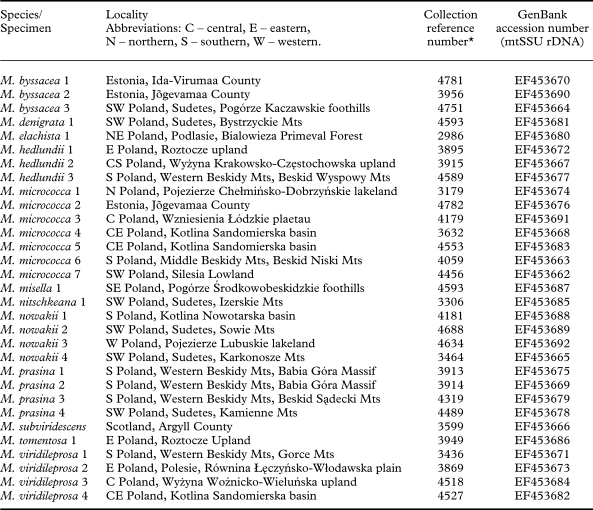
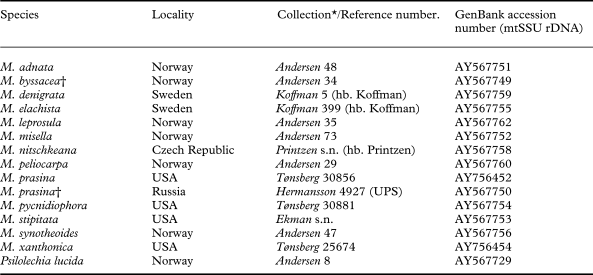
Fourteen European taxa corresponding to the M. prasina group (sensu Andersen Reference Andersen2004) and five other species were used in this study. Thirty-one sequences were generated for the analysis and fifteen were obtained from GenBank. Detailed descriptions of the material are presented in Tables 1 and 2. Micarea denigrata, M. nitschkeana as well as M. peliocarpa and M. leprosula were included in the analyses since they were considered as outgroups for the M. prasina group (Andersen Reference Andersen2004). Psilolechia lucida was used as an outgroup for Micarea s. lat. since both genera were formerly considered as belonging to the same family Micareaceae (Hafellner Reference Hafellner1984; Eriksson et al. Reference Eriksson, Baral, Currah, Hansen, Kurtzman, Rambold and Laessøe2004).
List of specimens of Micarea and their new mtSSU rDNA sequences generated for the current study

* All new specimens analysed were collected by P. Czarnota and are deposited in the GPN herbarium.
List of sequences from Micarea species downloaded from GenBank

* all deposited in BG unless stated otherwise.
† sequences obtained from GenBank as representing M. micrococca and M. hedlundii respectively.
DNA extraction, PCR amplification and DNA sequencing
DNA was extracted directly from pieces of thalli or apothecia using the modified CTAB method (Guzow-Krzemińska & Węgrzyn Reference Guzow-Krzemińska and Węgrzyn2000) and used for PCR-amplification of mtSSU rDNA. The primers mrSSU1 and mrSSU3R (Zoller et al. Reference Zoller, Scheidegger and Sperisen1999) were used as PCR and sequencing primers. 50 μl PCR mix contained 1·25 U RedTaq polymerase (Sigma), 0·2 mM of each of the four dNTP's, 0·5 μM of each primer and 10–50 ng of genomic DNA. PCR amplifications were performed using a Tetrad MJ Research thermal cycler with the following programme: initial denaturation at 95°C for 10 min and 6 cycles at 95°C for 1 min, 62°C for 1 min and 72°C for 105 s, and then 30 cycles at 95°C for 1 min, 56°C for 1 min and 72°C for 1 min, and a final extension step at 72°C for 10 min. PCR products were resolved on agarose gels in order to determine DNA fragment lengths. Subsequently, PCR products were purifiedusing High Pure PCR Product Purification Kit (Roche) and sequenced using ABI PRISM BigDye Terminator Cycle Sequencing Ready Reaction Kit (Perkin-Elmer Applied Biosystems). Sequencing of both strands of each PCR product was performed. The sequencing reaction products were resolved on ABI310 DNA Sequencer at the Intercollegiate Faculty of Biotechnology of the University of Gdańsk and the Medical University of Gdańsk or ABI3730XL using Macrogen (Korea) sequencing service (www.macrogen.com).
Sequence alignment and phylogenetic analysis
The newly generated mtSSU rDNA sequences (Table 1) were compared to the sequences available in GenBank database (http://www.ncbi.nlm.nih.gov/BLAST/) using BLASTN search (Altschul et al. Reference Altschul, Gish, Miller, Myers and Lipman1990). The sequences were aligned with sequences of selected representatives of the genus Micarea and Psilolechia lucida obtained from GenBank (GenBank Accession Numbers are given in Table 2). Prealignment was done using ClustalX software (Thompson et al. Reference Thompson, Gibson, Plewniak, Jeanmougin and Higgins1997) (with the following parameters: gap opening = 15; gap extension = 6·66), followed by manual optimization using the program Seaview (Galtier et al. Reference Galtier, Gouy and Gautier1996). Portions of the alignment with ambiguous positions that might not have been homologous were eliminated. The phylogenetic analyses were performed using PAUP* 4.0b10 (Swofford Reference Swofford2001). Maximum parsimony (MP) method was used as optimality criterion. Heuristic searches were performed with 1000 random sequence additions and TBR branch swapping was used. Gaps were treated as fifth state. The support for the branches was tested with bootstrap method with 1000 replicates.
Maximum likelihood analyses were performed with the fast likelihood software PHYML Online v. 3.0 (Guindon & Gascuel Reference Guindon and Gascuel2003; Guindon et al. Reference Guindon, Lethiec, Duroux and Gascuel2005), starting with a BioNJ tree or maximum parsimony tree. The HKY+I+G model was selected based on Hierarchical Likelihood Ratio Tests in Modeltest 3.5 (Posada & Crandall Reference Posada and Crandall1998). The parameters (Ts/ts ratio = 5·411, P-inv = 0·384, gamma parameter = 0·539) for the search were estimated from the data assuming HKY85 model in PHYML 3.0. Using the same program, non-parametric bootstrap analyses were performed with 1000 bootstrap replicates.
The data were also analysed using a Bayesian approach (MCMC) in MrBayes 3.2 (Huelsenbeck & Ronquist Reference Huelsenbeck and Ronquist2001; Ronquist & Huelsenbeck Reference Ronquist and Huelsenbeck2003). The analyses were performed assuming HKY model of nucleotide substitution and the parameters were estimated in MrBayes. The program was set to use an invariant gamma distribution and no molecular clock was assumed. A MCMC run with 2 000 000 generations employing 4 chains (one cold and three heated) was selected starting from random trees and a temperature parameter value of 0·08. All topologies were assumed to be equally probable. Every 100th tree was saved, except for the initial 2000 trees. Tracer 1.4.1 software (Rambaut & Drummond Reference Rambaut and Drummond2007) was used to determine when the log-likelihood values of the sample points reached a stable equilibrium. The initial 2000 trees were discarded as burn-in and the majority-rule consensus trees were calculated to obtain posterior probabilities of which values above 95% were considered to be significant supports. The phylogenetic tree was drawn using TreeView (Page Reference Page1996).
To test whether our mtSSU rDNA data are consistent with the monophyly of the M. micrococca complex, we performed the Shimodaira-Hasegawa test (Reference Shimodaira and Hasegawa1999) employing the HKY+I+G model. An alternative topology tree with the constraint of the monophyly of the M. micrococca complex was generated and compared with the most likely tree employing the S-H test using RELL bootstraps with 10 000 replicates in PAUP* 4.0b10 (Swofford Reference Swofford2001).
Morphology and chemistry
The material was examined with light microscopes. Hand cut apothecial sections and squashed thallus preparations, were mounted in water and KOH. IKI was used for the detection of an exciple, KOH for epihymenial, pycnidial as well as thallus pigments, and NaClO for gyrophoric acid. TLC was employed according to standard methods (Orange et al. Reference Orange, James and White2001); using solvents A and C. Specimens of M. micrococca, M. prasina and M. hedlundii used in a previous molecular study (Andersen Reference Andersen2004) have been included here and revised.
Results
A total of 31 new mtSSU rDNA sequences were generated; 15 sequences were downloaded from GenBank. The final alignment consisted of 46 sequences with 1053 characters. Ambiguous positions were excluded, and of the 611 characters, 206 were variable and 165 were parsimony-informative.
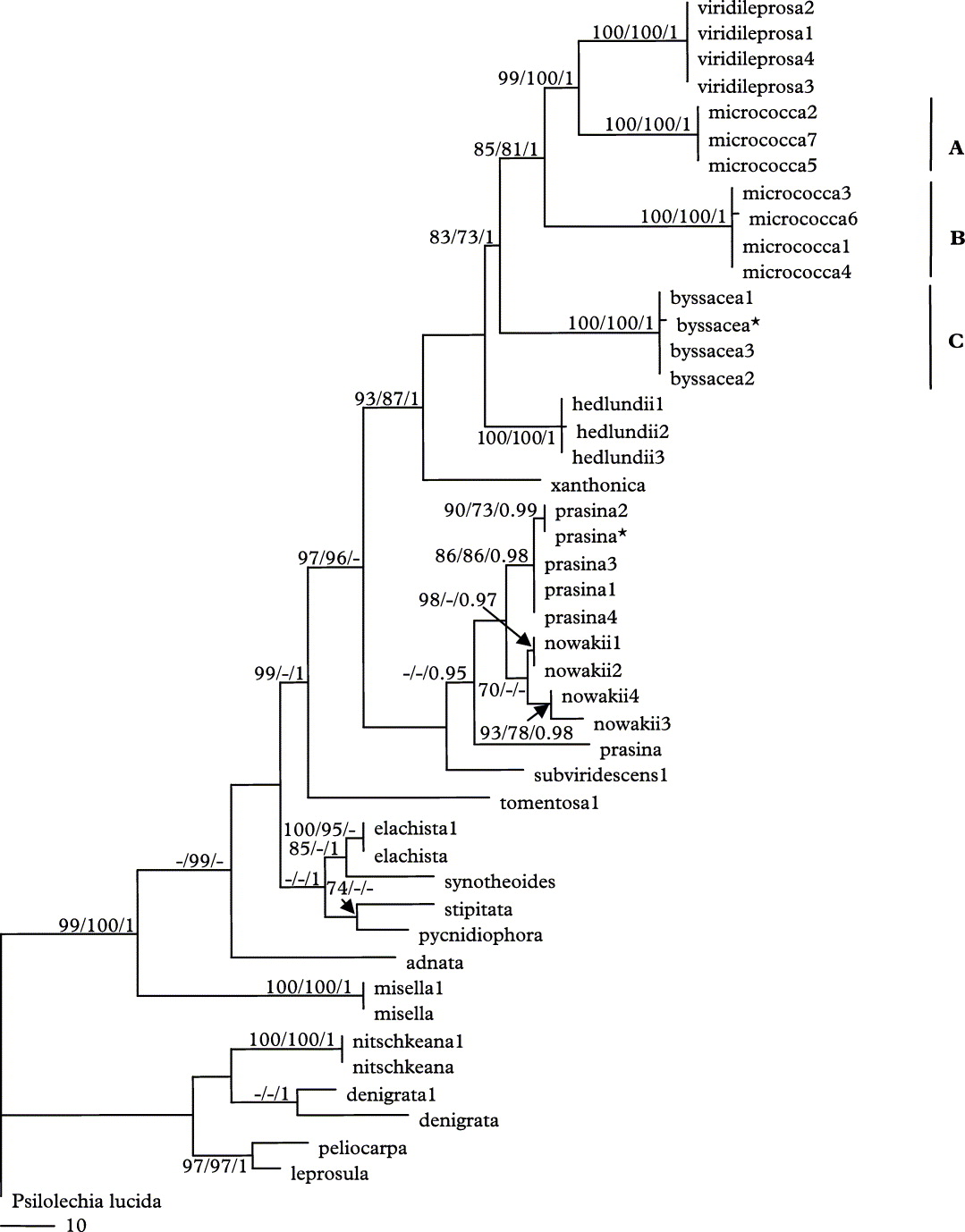
Since the topology of trees using maximum parsimony, maximum likelihood methods and B/MCMC approach were similar, we decided to present only the MP tree with bootstrap supports for both MP and ML methods and posterior probabilities for Bayesian analyses (Fig. 1).
One of the most parsimonious trees. The most likely phylogenetic tree and the majority rule consensus tree from Bayesian approach have a very similar topology and are not shown. Bootstrap supports above or equal to 70 for ML/MP methods and posterior probability values above or equal 95% are shown at the branches. Groups A, B and C corresponding to the M. micrococca complex are shown on the right-hand side of the tree. Group A represents M. micrococca s. str. Specimens labelled here as byssacea* and prasina* were obtained from GenBank as representing M. micrococca and M. hedlundii respectively.

The phylogenetic tree (Fig. 1) shows that members of the M. prasina group form two clades with M. prasina and M. micrococca respectively. Micarea micrococca treated as a well-defined morphologically variable species containing methoxymicareic acid (see Czarnota Reference Czarnota2007) is not monophyletic and forms three distinct lineages (A, B and C, see Fig. 1), each of which is strongly supported in the Bayesian, MP and ML analyses and represents a different morphotype. The Shimodaira-Hasegawa alternative topology test rejected (P = 0·0042) the monophyly of the M. micrococca complex by comparing the constrained monophyletic tree with the unconstrained tree. Moreover, the three lineages of the M. micrococca complex can be distinguished by the presence of different introns between the universally conserved regions U5 and U6. The shortest intron in this position is present in specimens forming group B (represented by samples micrococca 1, 3, 4 and 6). A considerably longer intron is present in group C represented by byssacea 1, 2 and 3; however, the sequence downloaded from GenBank (accession no AY567749), also belonging to this group, lacks an intron in this position. A revision of this original collection confirmed its phenotypical similarity to other samples of this group, thus they are all regarded here as M. byssacea (see Table 2). Perhaps the missing intron was removed from the sequence before submission to GenBank. Specimens of group A (micrococca 2, 5 and 7) have an intron of a similar length (but different sequence) to that of M. hedlundii and M. viridileprosa.
The newly sequenced specimens of M. viridileprosa form a very strongly supported monophyletic lineage. It is a sister species to that representing group A, recognized here as M. micrococca s. str., due to the characters identical to those of Biatora micrococca Körb., a basionym of this recently emended species (Coppins Reference Coppins2002; Czarnota Reference Czarnota2007).
The newly sequenced M. subviridescens belongs to the M. prasina group and M. nowakii and M. tomentosa also belong there, as previously suggested by Czarnota (Reference Czarnota2007). Micarea nowakii is closely related to M. prasina, although the bootstrap support is very low for this clade. Micarea prasina appears to be paraphyletic, and the sample from North America seems to be closer to M. nowakii than to European specimens of M. prasina s. str., but it is uncertain due to insufficient support. Moreover, the sequence no. AY567750 obtained from the GenBank also belongs to the M. prasina s. str. lineage (see Fig. 1), although it was previously treated as M. hedlundii (Andersen Reference Andersen2004). A revision of the original collection showed that M. hedlundii and M. prasina s. str. were intermixed (e.g. micareic acid detected by TLC); the material taken for DNA analyses was probably a mixture of both species or M. prasina only and this sequence in fact represents M. prasina?
Three newly generated sequences of M. hedlundii form a well-supported monophyletic clade related to the M. micrococca complex. All samples of this species are characterized by the presence of an intron at position 271 of the alignment (between universally conserved regions U3 and U4). This intron was not found in other species analysed.
Discussion
Andersen (Reference Andersen2004) established eight phylogenetic groups within the genus Micarea based on combined analyses of mtSSU rDNA, nuclear ITS1-5.8S-ITS2 rDNA and β-tubulin sequences from 61 species, excluding the M. sylvicola group (sensu Coppins Reference Coppins1983) which has recently been demonstrated as belonging to Psoraceae (Andersen & Ekman Reference Andersen and Ekman2005).
The M. prasina group proposed by Andersen (Reference Andersen2004) contains many species that differ in thallus structure, size and shape of ascospores, pycnidia and dimensions of conidia, as well as apothecial pigmentation; however, their ascomata are immarginate, without or with a very poorly developed excipulum, and branched paraphyses of one type only. Except for M. eximia with a dark purplish-brown hypothecium and bright green, K− hymenium, other members of Andersen's M. prasina group have a hyaline hypothecium and hymenium. Several of them have the ‘Sedifolia-grey’ pigment (see Meyer & Printzen Reference Meyer and Printzen2000) within the epihymenium, thallus or/and pycnidial walls. Presumably M. adnata, M. micrococca s. str. (see below), M. pycnidiophora, M. stipitata, M. viridileprosa, M. xanthonica and the so far not sequenced M. levicula lost this pigment during evolution. The chemistry of the M. prasina group is variable. Even in species closely related to M. prasina s. str., micareic, methoxymicareic and gyrophoric acids, and xanthones, as well as prasinic acid produced by M. subviridescens, were detected (Elix et al. Reference Elix, Jones, Lajide, Coppins and James1984; Boom v.d. & Coppins Reference van den Boom and Coppins2001; Coppins & Tønsberg Reference Coppins and Tønsberg2001). This confirms that a close phylogenetic relationship does not have to correspond with chemical similarities, as has already been presented in molecular studies of other lichen groups (e.g. Buschbom & Mueller Reference Buschbom and Mueller2006; Nelsen & Gargas Reference Nelsen and Gargas2008, Reference Nelsen and Gargas2009).
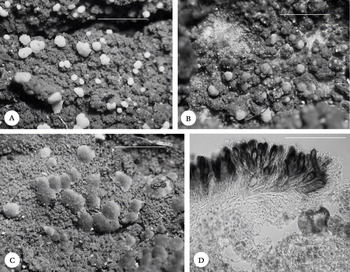
In our study, specimens of three well-supported lineages A, B and C (Fig. 1), recently considered as M. micrococca (Czarnota Reference Czarnota2007), have the same chemistry (methoxymicareic acid), although those representing groups A and C essentially differ in morphology. The delimitation of two distinctive species namely, M. micrococca (Körb.) Gams ex Coppins s. str. (represented by samples of group A) and M. byssacea (Th. Fr.) Czarnota, Guzow-Krzemińska & Coppins comb. nov. (group C) is proposed (see Taxonomy). Specimens belonging to group B represent a transitional morphotype between A and C (Fig. 2), with more characters in common with group A. This putative new taxon forms small, convex apothecia resembling those in M. micrococca s. str., but they are variously coloured and frequently have a slight greyish tinge resulting in a K± and C± slightly violet apothecial reaction as in M. byssacea. Samples of this group represent a few exsiccatae examined during this study, for example, Vĕzda Lichenes Selecti Exsiccati no. 90, H [as Catillaria prasina (Fr.) Th. Fr.] and no. 1467, H (as M. prasina Fr.).
The Micarea micrococca complex. A, M. micrococca s. str., habitus [Czarnota 3953 (GPN)]; B, M. micrococca s .lat. morphotype B, habitus (clade B in Fig. 1) [Czarnota 4179 (GPN)]; C & D, M. byssacea [Cieśliński & Tobolewski s.n. (KTC)]; C, habit; D, apothecial section with well-developed excipulum; after treating with KOH and IKI. Scales: A–C = 1 mm; D = 100 μm.

According to Grube and Kroken (Reference Grube and Kroken2000), recognition of a new species is possible when single-gene phylogeny shows the strongly supported monophyly of the corresponding lineage and is also supported by clear phenotypic character. In our case, however, at the moment it seems to be better to regard specimens of the group B within M. micrococca s. lat. As the morphological characters, distributional and ecological data do not clearly define group B, no taxonomic innovation is proposed until more molecular multilocus data are available.
Micarea viridileprosa forms a strongly supported monophyletic clade sister to the true M. micrococca (group A, see Fig. 1). Both species occupy similar ecological niches and frequently grow together on the bases of trunks of different kinds of trees, especially within older pine and mixed pine-deciduous forests in lowlands. However, these two species differ in their secondary metabolite production, i.e. gyrophoric and methoxymicareic acid, respectively.
In general, the M. micrococca complex is more chemically diversified (at least four different chemical ‘cases’, including that without any metabolites) than the strict group of M. prasina, where both species, M. prasina s. str. and M. nowakii, contain exclusively micareic acid. All Polish specimens of M. prasina used in this study have been collected from similar substrata (soft lignum of decaying coniferous stumps) and were morphologically very similar, differing only in the colour intensity of their thalli and apothecia. The results of this study show that the Polish specimens belong to two mtSSU alleles, separated by a two nucleotide substitution in the dataset analysed (or nine if taking into account excluded parts of the alignment), whereas a single American specimen is considerably more different. It suggests that there is more infraspecific genetic variation within M. prasina s. str. than is currently supposed. A revision of this American collection showed morphological similarity to European material of M. prasina, except for a more coralloid thallus structure, slightly brighter and more minutely granular thallus and lack of ‘Sedifolia-grey’ pigment in apothecium and goniocysts. Similar specimens containing micareic acid from Europe are also known to the authors; these are usually corticolous specimens accompanied by free-living algae or other lichens, as is the case of the American sample analysed. However, such specimens were not included in this work and further studies of similar morphotypes would be desirable.
Recently, Czarnota (Reference Czarnota2007) synonymized M. melanobola (Nyl.) Coppins with M. prasina as no distinct characters other than apothecial and pycnidial pigmentation were found (the concentration of pigments is a variable character for many species in the genus, e.g. M. denigrata or M. peliocarpa). However, in the light of this study, this taxonomic innovation should also be reinvestigated using molecular data. Unfortunately, several attempts to obtain mtSSU rDNA sequences from blackish morphotypes of M. prasina were unsuccessful.
Some other sterile collections producing micareic acid and forming more or less delimited, ± globose soralia-like structures, in contrast to typical M. prasina s. str., have an incompletely granular thallus. Perhaps these are also another form of M. prasina growing in places covered with a particularly dense layer of non-lichenized algae. However, the relationship between different morphotypes currently included in M. prasina s. str. needs further molecular studies.
The phylogenetic position of M. hedlundii close to the M. micrococca complex is rather surprising. The species is almost identical with M. prasina s. str., except for the distinctly stalked, tomentose pycnidia and pigment ‘Intrusa-yellow’ in the goniocysts (see fig. 2 in Czarnota Reference Czarnota2007).
Micarea tomentosa (see Czanota 2007) is represented here by a single sample, since several other attempts to obtain more sequences have been unsuccessful. Fortunately, the result of this study seems to be satisfactory and sufficient to confirm its position within the broad M. prasina group (Fig. 1) and shows that it is probably a basal species for M. prasina s. lat. The species is morphologically very similar to M. prasina s. str., both having a bright green, minutely granular thallus, 0–1-septate spores and ‘Sedifolia-grey’ pigment, at least in pycnidial walls.
Taxonomy
Micarea micrococca s. str. (Körb.) Gams ex Coppins
In Coppins Checklist of Lichens of Great Britain and Ireland: 86 (2002).—Biatora micrococca Körb. Parerga Lich.: 155 (1860).—Catillaria micrococca (Körb.) Th. Fr. Lich. Scand. 2: 571 (1874).—Lecidea micrococca (Körb.) Crombie J. Bot. 14: 361 (1875).—Biatorina micrococca (Körb.) Arnold Flora 67: 565 (1884).—Micarea prasina f. micrococca (Körb.) Hedl. Bih. Kongl. Svenska Vetensk.-Akad. Handl. III, 18(3): 77, 87 (1892).—Micarea micrococca (Körb.) Gams Kleine Kryptfl. 3: 67 (1967), comb. inval. (Art. 33.2); type: Germany, Baden-Württemberg, ‘Würtemberg’, on Pinus bark, K. A. Kemmler [L—neotype, selected by Coppins (Reference Coppins1983), n.v.; WRSL—syntype!, possibly part of the original gathering (Czarnota Reference Czarnota2007)]. See also notes (ii) in Coppins (Reference Coppins1983: 174).
Lecidea prasiniza var. prasinoleuca Nyl. Flora 64: 7 (1881); type: Germany, Baden-Württemberg, Heidelberg, Königstuhle, on Picea abies, 1880, Zwackh [Zwackh, Lichenes Exsiccati no. 593A (H-NYL 21601—lectotype!; Czarnota Reference Czarnota2007)].
(Fig. 2A)
General note. Diagnostic characters, distribution, habitat and list of collections examined are given only for true M. micrococca (represented in Fig. 1 by samples of group A).
Thallus minutely granular, bright green to olive-green, composed of small goniocysts. Photobiont ‘micareoid’, algal cells ± globose, 4–7 μm.
Apothecia usually numerous, whitish-cream, cream, 0·1–0·3 mm diam., immarginate from the beginning, convex to hemispherical, simple to adnate or sometimes tuberculate. Hymenium and hypothecium colourless to slightly yellowish, without any greyish or olive tinge, K−, C−. Paraphyses numerous, branched and anastomosed, hyaline throughout or sometimes surrounded by pale straw coloured gel-matrix, 0·8–1·2 μm wide, slightly increasing above. Excipulum absent or sometimes developed in young apothecia, composed of paraphysis-like hyphae, colourless. Ascospores oblong-ovoid, elipsoid, (0–)1-septate, 10–12(–16) × 3–4·5 μm.
Pycnidia usually abundant, sessile or immersed between goniocysts, white to whitish-cream with widely gaping ostioles or bearing white blobs of cylindrical mesoconidia (3·8–)4·5–5·5 × 1·2–1·5 μm, or narrowly cylindrical or fusiform microconidia 5–7·5(–8) ×0·8–1 μm.
Chemistry. Thallus and apothecia K−, C−, Pd−. TLC: methoxymicareic acid.
Distribution and ecology. Micarea micrococca s. str. is a common species, probably distributed worldwide, but often reported as M. prasina since it was treated before 2002 as a synonym (see Coppins Reference Coppins1983, Reference Coppins2002). It seems to be especially frequent in Europe, from where some of the revised collections mentioned below originate. It is abundant at the bases of conifers as well as deciduous trees in different kinds of forest communities, but in pine and spruce forests covering European lowlands it is mostly found on wet parts of trunks bordering a mossy zone or soil. In humid woods it also grows on branches or stems of dwarf shrubs, for example, Calluna vulgaris and Vaccinium species. Micarea micrococca s. str. is an ecologically tolerant species found in forest of various ages, but its frequent occurrence within young managed woodlands and secondary coniferous monocultures suggests that it is a primary colonizer of acidic bark. Occasionally it grows on lignum, for example, fallen logs, often contaminated by non-lichenized gelationous algae, and sometimes it occurs on acid rocks (e.g. GPN 2811). Associated species on tree bark include Cladonia coniocraea, C. digitata, Lepraria spp., Micarea denigrata, M. viridileprosa and Scoliciosporum chlorococcum, and on wood it is accompanied by M. prasina and, for example, Placynthiella dasaea and P. icmalea.
Remarks. Mainly due to its pale apothecia and bright green, minutely granular thallus, M. micrococca resembles several species of other genera, for example Scoliciosporum pruinosum, Bacidia hemipolia f. pallida (see Czarnota and Coppins Reference Czarnota and Coppins2007) or Bacidina phacodes as well as other members of the M. prasina group, namely M. prasina (pale coloured samples), M. levicula, M. pycnidiophora, M. stipitata, M. viridileprosa and M. xanthonica. It can be easily distinguished, however, from the first group of species by ovoid 0–1-septate ascospores and small-celled (5–7 μm diameter), ‘micareoid’ type of photobiont, (while ascospores of the first group of these species are acicular and algal cells are more than 10 μm in diameter). Moreover, Bacidia hemipolia forms characteristic, black, globose pycnidia in contrast to the white and gaping pycnidia produced by M. micrococca. Furthermore, the conidia are smaller in Bacidia hemipolia and much longer in Bacidina phacodes and Scoliciosporum pruinosum than in Micarea micrococca.
Within the wide M. prasina group (sensu Andersen Reference Andersen2004), only M. micrococca and the newly combined M. byssacea contain methoxymicareic acid. Therefore, to distinguish them from other similar ‘granular’ members of the group with no positive spot reaction (especially some pale or sterile forms of M. prasina and M. subviridescens), TLC analyses should be performed. Thalli, apothecia or pycnidia of M. levicula, M. pycnidiophora and M. viridileprosa react C+ red due to the presence of gyrophoric acid and M. xanthonica contains xanthones reacting C+ orange. Micarea stipitata differs morphologically from M. micrococca in having distinctly stalked pycnidia.
Collections of M. micrococca are morphologically highly distinctive from M. byssacea which form darker pigmented apothecia containing ‘Sedifolia grey’, K+ violet pigment within an epihymenium and goniocysts. Sometimes M. byssacea develops pale apothecia, but they are usually adnate and larger, and its granular thallus is always more olive and not so mealy as that observed in M. micrococca (see also note ‘v’ below M. byssacea).
Exsiccatae: Arnold Lichenes Exsiccati no. 279 (H, WRSL) [as Biatora micrococca Körb.; Germany, bei Eichstätt, 1864, Arnold], no. 1122 (H-NYL p.m. 4505, WRSL) [as Biatorina prasiniza Nyl.; Switzerland, Kanton Zürich, 1885, Hegetschweiler]; no. 1472 p.p. (WRSL) [as Biatorina prasiniza Nyl.; Germany, Oldenburg, 1889, Sandstede + p.p. M. byssacea]; Arnold Lichenes Monacenses Exsiccati no. 243 (H) [as Biatorina micrococca Körb.; Germany, München, 1892, Arnold]; Lojka Lichenotheca Universalis no. 30 (M) [as Lecidea prasiniza Nyl. v. prasinoleuca (Nyl.) Zw.; Germany, Heidelberg, 1880, Zwackh]; Rabenhorst Lichenes Europaei no. 733 (H, WRSL) [as Biatora micrococca Körb.; Germany, bei Frantfurt?, Bagge]; Räsänen Lichenes Fenniae Exsiccati no. 651 (H) [as Catillaria prasina (Fr.) Vain. forma cum apotheciis omnino hyalino-albidis; Finland, Satakunta, 1938, M. Laurila], no. 653 (H) [as Catillaria micrococca (Zwackh) Th. Fr.; Finland, Jämsä, 1938, A. Koskinen]; Zwackh Lichenes Exsiccati no. 314 p.p. (M) [as Lecidea micrococca (Körb.) Nyl.], no. 416 (H-NYL 21698, M) [as Biatora micrococca Körb.; Germany, Heidelberg, Febr. 1861, Zwackh], no. 541 (M) [as Lecidea prasiniza var. prasinoleuca Nyl.; Germany, Heidelberg, 1884, Zwackh], no. 591A p.p. (M) [as Lecidea prasiniza Nyl. + p.p. M. byssacea], no. 593A (M) [as L. prasiniza; for all Zwackh's gatherings: Germany, Heidelberg, auf dem Königstuhl, 1880, Zwackh].
Additional specimens examined. Czech Republic: Rychlebské hory: valley of Bilá Voda stream, 50° 24′ 35″N, 16° 53′ 38″E, 2004, P. Czarnota 4211 (GPN).—Estonia: Jõgevamaa County: Endla Nature Reserve, Männikjärve Bog, 58° 52′ 21″N, 26° 14′ 56″E, 2004, P. Czarnota 3963 (GPN).—Lithuania: Prienai district: Gojus forest, Stakliškės forest district, 2002, P. Czarnota 4978 (GPN).—Poland: Wybrzeże Trzebiatowskie coastland: between Łukęcino and Pobierów villages, 1986, W. Fałtynowicz (GPN ex UGDA-L 3702). Pojezierze Chełmińsko-Dobrzyńskie lakeland: Wzgórza Dylewskie Landscape Park, 2002, P. Czarnota (GPN). Równina Sępopolska plain: c. 1·5 km SW of Wilczyny village, 1989, S. Cieśliński (KTC). Równina Mazurska plain: c. 3 km SW of Szczytno town, 1993, S. Cieśliński (KTC). Równina Bielska plain: Białowieża Primeval Forest, Browsk forest division, forest section no. 23B, 1983, S. Cieśliński & Z Tobolewski (KTC); ibid., Hajnówka forest division, forest section no. 329A, 1982, S. Cieśliński & Z. Tobolewski (KTC); forest section no. 572, 2002, P. Czarnota 3054 (GPN). Równina Drawska plain: Puszcza Drawska Forest, between Recz and Kalisz Pomorski towns, 2006, P. Czarnota 4820 (GPN). Równina Łukowska plain: by road between Łuków and Międzyrzec Podlaski towns, 51° 58′ 25″N, 22° 40′ 24″E, 2005, P. Czarnota 4718 (GPN); ibid., near ‘Jata’ nature reserve in the vicinity of Żdżary village, 51° 57′ 11″N, 22° 11′ 53″E, 2005, P. Czarnota 4657 (GPN). Równina Łęczyńsko-Włodawska plain: Lasy Parczewskie Wood, 51° 30′ 14″N, 23° 02′ 53″E, 2004, P. Czarnota 4226 (GPN); ibid., Poleski National Park, 51° 25′ 37″N, 23° 10′ 51″E, 2004, P. Czarnota 3872 (GPN). Kotlina Zasiecka basin: Bory Zielonogórskie Forest, 51° 45′ 02″N, 14° 49′ 25″E, 2005, P. Czarnota 4505 (GPN). Kotlina Raciborska basin: Lasy Raciborskie Forest, 50° 16′ 33″N, 18° 22′ 59″E, 2005, P. Czarnota 4442 (GPN). Równina Oleśnicka plain: Bory Namysłowskie Forest, 50° 57′ 28″N, 17° 28′ 09″E, 2005, P. Czarnota 4450 (GPN). Wyżyna Kielecka upland: Wzgórza Opoczyńskie hills, Trzemoszna forest district, 1979, Z. Kurczyńska & K. Toborowicz (KTC). Płaskowyż Kolbuszowski plateau: c. 2 km S of Przedbórz village, 50° 09′ 02″N, 21° 45′ 31″E, 2005, P. Czarnota 4537 (GPN). Middle Roztocze upland: near Żytki settlement, 50° 23′ 23″N, 23° 29′ 47″E, 2005, P. Czarnota 4703 (GPN). Eastern Roztocze upland: Puszcza Solska Forest, 50° 23′ 37″N, 23° 14′ 45″E, 2005, P. Czarnota 4725 (GPN). Pogórze Dynowskie upland: c. 2 km W of Barycz village, 2003, P. Czarnota (GPN).
Micarea byssacea (Th. Fr.) Czarnota, Guzow-Krzemińska & Coppins comb. nov
Catillaria prasina β [var.] byssacea Th. Fr. Lich. Scand. 2: 573 (1874) [Basionym].—Biatora byssacea Zwackh Flora 45: 510 (1862), non Hampe Linnaea 25: 709 (1852); nom. illeg. (Art. 53.1).—Micarea prasina f. byssacea (Th. Fr.) Hedl. Bih. Kongl. Svenska Vetensk.-Akad. Handl. III, 18(3): 87 (1892).—Lecidea byssacea (Th. Fr.) Vain. Természetr. Fuz. 22: 320 (1899); type: Germany, Baden-Württemberg, Heidelberg, ‘Königstuhle’, on bark of young Quercus, 1880, Zwackh 177 (H-NYL 21618—neotype!; designated here).
Nomenclatural notes. (i) The name Biatora byssacea Zwackh is illegitimate because it is a later homonym of Biatora byssacea Hampe (1852), a non-lichenized perithecioid fungus; type: Tasmania [as Van Diemensland], on decayed timber, Ch. Stuart (M – lectotype!; designated here); see also note (vi) in Coppins (Reference Coppins1983: 174).
(ii) The first legitimate use of Zwackh's epithet byssacea was by Th. Fries (Reference Fries1874) at the varietal rank, and the epithet should be attributed solely to him, and not as ‘byssacea (Zwackh) Th. Fr.’. Accordingly, the first legitimate use at species level was as a Lecidea by Vainio (Reference Vainio1899), and should be cited as L. byssacea (Th.Fr.) Vain. (Art. 58.1).
(iii) At first sight it would appear that Catillaria prasina β [var.] byssacea Th. Fr. is superfluous since Fries included ‘Lecidea viridescens var. misella Nyl. in Br. et Rostr. Dan. p. 93’ as a synonym. However, in Branth and Rostrup's Lichens Daniae, p. 93 [originally published as Botanisk Tidskrift 3: 219 (1869)], this name was not cited at varietal rank, but as a ‘forma’.
(iv) Each legitimate name mentioned above by Fries, Hedlund and Vainio were referring to Biatora byssacea Zwackh used as their first synonym, and Zwackh was originally presented by them as the original author; Fries (Reference Fries1874) among several European gatherings of Catillaria prasina β byssacea examined did not definitely indicate the specimen which could be treated as a distinct type of the name. Because of lack of any material suitable for the lectotypification, the specimen collected in the same locality as that mentioned in Zwackh's (1862) protolog of B. byssacea was found and designated here as a neotype. The neotypified specimen was chosen from the herbarium H-NYL since this collection was originally labelled by Zwackh as Biatora byssacea, although specimens from Zwackh's collection housed in M were also examined.
(v) Specimens of the M. micrococca complex formerly named as Micarea (= Catillaria) prasina Fr. f. laeta Th. Fr. (e.g. Malme Lichenes Suecici Exsiccati no. 23) are included here. With the exception of mostly completely pallid apothecia, phenotypical characters correspond well with the neotype of M. byssacea; thus we propose to treat this pallid form as another morphotype of the latter.
Thallus minutely granulosae, green to olive-green, composed of small goniocysts surrounded by K± violet gel-matrix. Photobiont ‘micareoid’, algal cells ± globose, 4–7 μm.
Apothecia usually numerous, olive-grey, whitish-grey, grey to blackish-grey, occasionally some of them whitish to cream, (0·1–)0·2–0·6 mm diam., immarginate from the beginning, but often with paler, whitish outer part, mostly adnate, convex to hemispherical. Hymenium hyaline, but in darker apothecia slightly greyish to olivaceous grey, K± violet, C± violet, because of ‘Sedifolia-grey’ pigment, confined to gel-matrix. Hypothecium hyaline, colourless to slightly yellowish, without greyish or olive tinge. Paraphyses numerous, branched and anastomosed, hyaline throughout, 0·8–1·2 μm wide. Excipulum usually developed, in young apothecia 10–20 μm wide and disappearing when mature, composed of paraphysis-like hyphae, colourless. Ascospores oblong, oblong-ovoid, ellipsoid, 0(–1)-septate, (6–)8–12(–13) × 2·7–3·5(–4·2) μm.
Pycnidia sometimes present, especially those bearing microconidia, sessile or immersed between goniocysts, to 40(–50) μm wide, white to greyish-white with gaping ostioles; pycnidial walls around ostiolum usually hyaline to slightly olivaceous, and then K± violet, C± violet; mesoconidia (3·8–)4·5–5·5 × 1·2–1·5 μm and microconidia 5–7·5(–8) × 0·8–1 μm identical to those produced by M. micrococca s. str.
Chemistry. Thallus and apothecia K−, C−, Pd−. TLC: methoxymicareic acid.
Distribution and ecology. Micarea byssacea seems to be widespread in Europe (at least in the northern part); however, to define its correct world distribution, collections of M. prasina and M. micrococca sensu Coppins (Reference Coppins1983) and Czarnota (Reference Czarnota2007) need to be re-examined. The specimens examined here (including those used in molecular analyses) originated from Scandinavia, Germany, Estonia, Lithuania, Czech Republic, Slovakia and Poland.
Micarea byssacea is a forest epiphyte probably having no preferences for particular phorophytes. It has been found also on ± hard wood of decaying stumps of coniferous trees. In Poland (from where most of the collections cited originate) almost all of the collections were from more or less natural hornbeam, black bog alder or ash-alder forests, especially within large woodlands in the north-east of the country. This would suggest that M. byssacea does not possess such a large ecological plasticity as M. micrococca s. str., with which it is occasionally associated within mixed, pine-deciduous woodlands. More observations from boreal regions of the Holarctic can answer the question whether M. byssacea is also as frequent in pine or pine-spruce forests as M. micrococca s. str.
Remarks. Collections referred to M. byssacea were previously included by Coppins (Reference Coppins1983) in M. prasina s. lat. due to insufficient diagnostic characters and recently by Czarnota (Reference Czarnota2007) in M. micrococca because of the presence of methoxymicareic acid. In the light of the present study, M. byssacea appears to be a separate taxon. Owing to the granular thallus and greyish, piebald to blackish-grey, sometimes convex to hemispherical apothecia, M. byssacea resembles some forms of M. prasina. The latter is also very variable in morphology, but produces micareic acid; therefore, correct delimitation of doubtful gatherings should be determined by TLC. There are also some differences in their ecology, since M. byssacea grows mainly on the bark of trees (especially deciduous), while M. prasina is usually found on soft lignum. For differences and affinities to M. micrococca see under that species.
Exsiccatae. Lojka Lichenotheca Universalis no. 29 (H) [as Lecidea prasiniza Nyl.; Germany, Heidelberg, 1880, Zwackh], no. 30 (H) [as Lecidea prasiniza Nyl. v. prasinoleuca Nyl.; Germany, Heidelberg, 1880, Zwackh]; Magnusson Lichenes Selecti Scandinavici Exsiccati no. 134 (H) [as Catillaria prasina (Fr.) Th. Fr. f. laeta Th. Fr.; Sweden, Västergötland, 1927, A. H. Magnusson]; Malme Lichenes Suecici Exsiccati no. 24 (H) [as Micarea prasina Fr. f. byssacea (Zw.) Th. Fr.; Sweden, Södermanland, 1895, O. Malme]; Rabenhorst Lichenes Europaei no. 676 (WRSL, M) [as Micarea prasina Fr.; Germany, Homburg, 1863, Mesler?]; Räsänen Lichenes Fenniae Exsiccati no. 652 (H) [as Catillaria sordidescens (Nyl.) Vain.; Finland, Satakunta, 1939, M. Laurila]; Zwackh Lichenes Exsiccati nos. 314 p.p. (M), 591A p.p. (M), 591B (M), 592B (H-NYL 21626, M) and no. 592C (H-NYL 21625, M) [all as Lecidea prasiniza Nyl.; Germany, Heidelberg, 1880, Zwackh].
Additional specimens examined. Czech Republic: Příbram district: NPR Drbákov – Albertovy skály, 49° 43′ 04″N, 14° 21′ 34″E, alt. c. 460 m, 2008, Czarnota 5274 (GPN).—Estonia: Jõgevamaa County: Endla Nature Reserve near Tomma village, Männikjärve Bog, 58° 52′ 20″N, 26° 16′ 07″E, 2004, P. Czarnota 3956 (GPN). Ida-Virumaa County: near Oonurme village, key-habitat at Kautvere, 59° 10′ 28″N, 26° 57′ 36″E, 2004, P. Czarnota 4781 (GPN).—Lithuania: Prienai district: Balbieriškis forest, 2002, P. Czarnota 4982 (GPN).—Poland: Bory Tucholskie Forest: Woziwoda forest division, 2002, P. Czarnota 3056 (GPN). Pojezierze Chełmińsko-Dobrzyńskie Lakeland: Wzgórza Dylewskie Landscape Park, 2002, P. Czarnota 3241 (GPN). Pojezierze Olsztyńskie lakeland: 3 km NE of Dobre Miasto town, 1989, S. Cieśliński (KTC p.p. with M. micrococca s. str.); ibid, c. 1·5 km SSW of Zebruń village, 1989, S. Cieśliński (KTC). Pojezierze Mrągowskie lakeland: Puszcza Piska Forest, 1987, S. Cieśliński (KTC). Great Masurian Lakes region: Puszcza Piska Forest, 1988, S. Cieśliński (KTC, p.p. with M. micrococca s. str). Pojezierze Ełckie lakeland: Puszcza Borecka Forest, 1987, S. Cieśliński (KTC), 1987, S. Cieśliński & Z. Tobolewski (KTC). Równina Kurpiowska plain: ‘Surowe’ nature reserve near Myszyniec village, 1982, S. Cieśliński (KTC). Kotlina Biebrzańska basin: Biebrza Valley, 1986, S. Cieśliński (KTC). Równina Augustowska plain: Puszcza Augustowska Forest, 1986, S. Cieśliński (KTC, p.p. with M. micrococca s. str.); ibid., ‘Cmentarzysko Jaćwingów’ nature reserve, 1986, S. Cieśliński (KTC). Wysoczyzna Białostocka plateau: Puszcza Knyszyńska Forest, 1984, S. Cieśliński (KTC). Równina Bielska plain: Białowieża Primeval Forest, Browsk forest division, 1983, S. Cieśliński & Z Tobolewski (KTC); ibid., Hajnówka forest division, 1983, S. Cieśliński & Z. Tobolewski (KTC, p.p. with M. micrococca s. str.), 1984, S. Cieśliński & Z. Tobolewski (KTC, p.p. with M. micrococca s. str.); ibid., Białowieski National Park, 1990, S. Cieśliński (KTC). Równina Drawska plain: Puszcza Drawska Forest, ‘Łubówko’ nature reserve, 52° 52′ 55″N, 15° 49′ 55″E, 2006, P. Czarnota 4827 (GPN). Pojezierze Łagowskie lakeland: Łagów village by Ciecz Lake, 2006, P. Czarnota 4828 (GPN). Wyżyna Woźnicko-Wieluńska upland: 7 km S of Olesno town, 50° 48′ 38″N, 18° 24′ 31″E, 2005, P. Czarnota 4520 (GPN). Góry Świętokrzyskie Mts: Kielce forest division, 1986, Bidziński (KTC). Carpathians: Gorce Mts, Gorce National Park, 49° 34′ 32″N, 20° 08′ 07″E, alt. 710 m, 2008, P. Czarnota 5716 (GPN).—Slovakia: Carpathians: Níske Tatry Mts, ‘Ohnište’ range, 48° 57′ 24″N, 19° 42′ 46″E, alt. 1220 m, 2008, A. Guttova, P. Czarnota 5376, J. P. Halda, Z. Palice (GPN).
This research was supported by the University of Gdansk task grant no. DS/1480-4-114-07 and partially by a grant from the Polish Ministry of Science and Higher Education no. N N304 306835 (2008–2010). We are very grateful to two anonymous reviewers for valuable criticism of the manuscript, their comments and improvements of the text, to Dr Brian Coppins and Dr John McNeill for recommending the correct citation and nomenclatural notes for the newly combined Micarea byssacea, and especially to Prof. Mark Seaward for his linguistic corrections and other improvements. We gratefully acknowledge Prof. Stanisław Cieśliński for making his collections of M. prasina s. lat. available for the study, Dr Martin Kukwa for helpful comments and assistance with TLC analyses, Prof. Grzegorz Węgrzyn for his support and Dr Joanna Jakóbkiewicz-Banecka for her assistance with the sequencing work.