Intonation is widely believed to be a precocious aspect of children's language development (Locke, Reference Locke1983). In fact, is sometimes claimed that children control the intonation system before they produce any words (Bever, Fodor & Weksel, Reference Bever, Fodor, Weksel, Bar-Adon and Leopold1971). Although subsequent research has not substantiated these claims (Cruttenden, Reference Cruttenden1997), at least some primitive components of intonation appear during the first year of life (Snow & Balog, Reference Snow and Balog2002). To account for these early-developing precursors of intonation, researchers have pointed to universal physiological mechanisms linked jointly to respiration and affect. Others have suggested that early intonation reflects an interaction between production constraints and linguistic experience (Snow, Reference Snow2006). This paper continues to investigate the debate defined by these opposing theories. We begin by sketching a model of intonation that provides a phonetic basis for positing that physiological constraints on speech production could account for some or all of children's early intonation behaviors.
A sketch of intonation
The term ‘intonation’ refers broadly to the contrastive use of pitch patterns, or melody (Crystal, Reference Crystal1991). On the physical level, pitch corresponds to changes in the fundamental frequency of the voice (f 0). The physiological correlate of f 0 – the rate of vibration of the vocal folds – is controlled by subglottal pressure and laryngeal tension (Kent & Murray, Reference Kent and Murray1982; Bolinger, Reference Bolinger1986). As part of the larger system of suprasegmentals (pitch, length and loudness), intonation itself has two subsystems. One of these, the accentual system, makes selected syllables and words in utterances more prominent than others. In accordance with Bolinger's (Reference Bolinger1986) ‘pitch accent theory,’ this system constitutes the foundation of intonation because accent prominences are produced principally by changes in pitch or ‘pitch obtrusions.’
The second system marks syllables and words at the trailing edges of phrase, clause and utterance units. This system, which also involves pitch changes, is sometimes described as ‘cadence,’ by analogy to its musical counterpart (e.g. Vanderslice & Ladefoged, Reference Vanderslice and Ladefoged1972). The heart of intonation lies in ‘nuclear tones’ (Cruttenden, Reference Cruttenden1997), which represent the intersection of the pitch accent and cadence systems. These intersecting points occur at or near the end of variable-length units that Cruttenden calls ‘intonation-groups.’ In this paper, intonation-groups or ‘utterances’ are temporally cohesive strings of syllables comparable in length to a simple sentence (e.g. This is your cat?), a phrase (e.g. a cat), or a word spoken in isolation (e.g. cat).
The tones that mark the right edge of intonation-groups are said to be ‘nuclear’ because they begin on the prosodic nucleus or nuclear accent of the intonation-group, which is the last and most prominent accented syllable of a polysyllabic utterance. From the nuclear accent, the tones continue to the ending boundary of the intonation-group. If an utterance has only one syllable or ends with an accented syllable, the nuclear tone is simply expressed in that syllable. Thus, while the examples of intonation-groups cited in the previous paragraph vary in length from one to four syllables, the nuclear tone in all three cases is initiated and completed in a single utterance-final syllable. This monosyllabic condition is the smallest phonetic environment in which nuclear tones can be expressed. I will refer to this basic unit as a ‘monosyllabic tone.’ To emphasize its utterance-final position, Bolinger (Reference Bolinger1986) described the same unit as a ‘terminal.’
Nuclear tones can be analyzed into still smaller units or ‘tonal features’ (Cruttenden, Reference Cruttenden1997), two of which are important in this paper. The first of these is accent range or the ‘width’ of pitch change, a feature associated with the syntactic boundary-marking function of intonation (Cooper & Sorensen, Reference Cooper and Sorensen1981; 't Hart, Collier & Cohen, Reference 't Hart, Collier and Cohen1990). By virtue of phonetically marking the right edge of an utterance, the salient pitch contour of nuclear tones also signals a possible turn-taking in conversation (Wells & Local, Reference Wells and Local1993). In accordance with a theory of intonation that is grounded in the notion of ‘pitch change’ (Snow & Balog, Reference Snow and Balog2002), accent range serves as the dependent measure of children's intonation in this investigation and its background studies.
The second tonal feature is the primary direction of the nuclear pitch change, falling or rising. The directional class of tones or ‘contour type’ is associated with general meanings that Cruttenden (Reference Cruttenden1981) described as ‘closed’ versus ‘open.’ Among other functions, these global meanings convey the pragmatic implications of utterances as one of the universals or near-universals of intonation. In this study, contour type is an independent variable that is hypothesized to affect children's accent range.
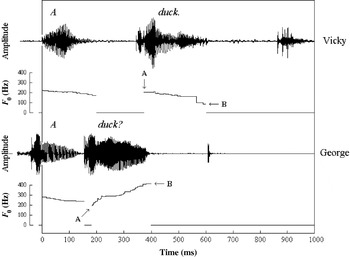
Figure 1 illustrates intonation-groups, nuclear tones, and tonal features with utterances produced by Vicky and George, two of the four-year-old participants in Snow's (Reference Snow1998a, Reference Snow2002) studies. Each analysis panel shows the time waveform or amplitude of the signal (upper portion), which corresponds to the perceived loudness, and the fundamental frequency (lower portion), which corresponds to the perceived pitch. The left edge of the panel marks the onset of voicing (the portion of the time waveform to the left of the panel's edge is voiceless and therefore not part of the intonation contour). The monosyllabic tones in both examples extend from the points marked ‘A’ (the peak or valley of the nuclear accent) to ‘B’ (the right edge boundary). The accent range or width of pitch change from A to B in both panels is slightly more than one octave.
Time waveform and f 0 contour of phrases with falling or rising monosyllabic tones spoken by four-year-olds (A=the utterance-final accent peak or valley, B=the right edge boundary).

In Figure 1, the tone in the word duck has a falling contour in the top panel and a rising contour in the bottom panel. The melody of rises is the inverse of falls. The different pitch curves also reflect different motor bases (Sundberg, Reference Sundberg1979). Rising pitch, for example, is generally ascribed to contraction of the cricothyroid, one of the extrinsic laryngeal muscles (Zemlin, Reference Zemlin1968). Falling pitch, on the other hand, is usually ascribed to a decline in either subglottal pressure (e.g. Atkinson, Reference Atkinson1978) or intrinsic laryngeal tension (e.g. Sundberg, Reference Sundberg1979).
Most importantly, experimental research has shown that the different control bases of rises versus falls give rise to different rates of pitch change. Adults (but not trained singers) change pitch more slowly when producing rising contours than falling contours. Because speed of pitch change is partly a function of the force per unit of mass to be moved, the asymmetrical findings about falls and rises suggest that in most speakers the cricothyroid musculature is not as ‘well developed and quick in operation’ as the pitch-lowering mechanism (Sundberg, Reference Sundberg1979: 77). Due to the increased force per unit of mass that must be developed in rapid pitch elevations, then, it is more effortful to raise than to lower pitch, a conclusion that is shared even by researchers who posit a different mechanism for lowering pitch than the one that Sundberg proposed, for example, Ohala & Ewan (Reference Ohala and Ewan1973). Thus, the direction of pitch change constitutes a major physiological constraint on intonation production, supporting the traditional claim that falls and rises are, respectively, the unmarked and marked contours (Lieberman, Reference Lieberman1967).
Loudness is a second phonetic exponent of rising versus falling tones in many languages including English (Allen, Reference Allen1983; Rossi, Reference Rossi1978; Oller, Reference Oller1972). The physical correlate of loudness is amplitude, and the physiological correlate is subglottal pressure, one of the determinants of f 0. As a universal or near-universal, falling pitch contours are accompanied with a decrease in subglottal pressure and a drop in loudness. Rising contours in English, on the other hand, are associated with either an increase or no change in loudness, that is, the absence of a drop (Oller, Reference Oller1972; Allen, Reference Allen1983). As a result, the intensity contours of rising pitch and the associated demands on the respiratory system contribute to the physiological difficulty of raising pitch.
How do infants develop the falling and rising tones that are illustrated by the four-year-old speakers in Figure 1? The traditional ‘breath group’ theory (Lieberman, Reference Lieberman1967) posits that the falling tone is physiologically based. According to this theory, a fall in pitch at the ends of breath groups is the natural result of declining subglottal pressure during speech production. A second part of the theory predicts that rising intonation develops differently than falling intonation because the underlying physiological mechanisms are different. In contrast to the inferred physiological and universal basis of falling contours, the appearance of rising contours is attributed to children's specific language experience instead (Lieberman, Reference Lieberman1967).
Implicitly, then, the theory suggests that falls stabilize at the time of the child's earliest speech-like vocalizations. Rises, however, are acquired at a later period. In support of the breath group theory, acoustic studies of the vocalizations of infants learning English (Kent & Murray, Reference Kent and Murray1982) confirm that falls predominate during the first year of life, a bias the authors, in fact, attributed to the physiological naturalness of falling pitch. On the other hand, cross-linguistic evidence shows that the relative frequencies of falls and rises begins to reflect native language input at 1 ; 6 (Hallé, Boysson-Bardies & Vihman, Reference Hallé, Boysson-Bardies and Vihman1991) and in children as young as 0 ; 7 to 0 ; 11 (Whalen, Levitt & Wang, Reference Whalen, Levitt and Wang1991). Thus, if there is a biologically determined bias toward falls, this bias can be modified by language experience in the late babbling period and during early meaningful speech, another key assumption of the breath group theory.
An alternative theoretical position is that even falling intonation is acquired through the child's experience with native language input (Snow & Balog, Reference Snow and Balog2002). According to this linguistically-based theory, it is not expected that either contour type would be established innately or in the first weeks and months of infancy. Instead, falling and rising contours might develop in a parallel manner late in the prelinguistic period or after the onset of meaningful speech. Leopold (Reference Leopold1947), for example, reported that Hildegard produced falling and rising contours in her first words and proto-words but not earlier in the babbling period.
Summarizing, the competing theories discussed above predict different relationships between children's chronological age or stage of language development and their acquisition of falling versus rising contours. The studies of infant vocalizations that were cited in the preceding paragraphs confirmed some expectations of one theory or the other. However, the acoustic studies of children learning English and other languages weren't designed to compare across stages of development; diary studies similarly weren't intended to compare across the tone direction classes; and neither type of study evaluated the accent range of infant vocalizations, the foundation of tone production in the phonetic features approach that supports this study. To determine the normal pattern in which infants and toddlers acquire tone contours and to test physiologically- versus linguistically-based models of intonation development, Snow (Reference Snow2006) analyzed the accent range and direction of tones produced by 60 children ranging in age from 0 ; 6 and 1 ; 11. The results indicated that falling and rising intonation had similar U-shaped patterns of development. That is, for both contour types, there was a period of rapid growth in children's accent range at 1 ; 6–1 ; 8 months after an equally sharp regression at 0 ; 9–0 ; 11.
The non-linear pattern corroborates other studies of infants' production and perception of intonation (Best, Levitt & McRoberts, Reference Best, Levitt and McRoberts1991; D'Odorico & Franco, Reference D'Odorico and Franco1991). Most importantly, the U-shaped curve resolves much of the conflict between opposing theories because it suggests that intonation development is governed by an interaction between physiological and linguistic influences. For example, the falling contour was established early, in accordance with a respiration-based model. On the other hand, the discontinuities in the development of falling contours did not support a key assumption of the breath group theory, namely, that falls – the ‘unmarked’ pattern – result naturally from passively controlled and unlearned mechanisms. Similarly, experimental data have suggested that rapid pitch changes even in the context of falling contours require an active speech production effort in adults (Sundberg, Reference Sundberg1979) and four-year-olds (Snow, Reference Snow2004). In sum, rises and falls may not be as different from one another, physiologically and developmentally, as traditional views have implied. To determine the nature and timetable of physiological effects on emerging intonation, then, additional and perhaps more pervasive constraints on pitch production need to be taken into account, as discussed next.
Utterance and tone length
Snow's (Reference Snow2006) study was restricted to monosyllabic utterances, the most frequent type of vocalization in the age range of 0 ; 6 to 1 ; 11. Indeed, monosyllables constituted the only stress and length category in which one or more falling and rising contours were represented in the speech samples of all 60 children. However, polysyllabic utterances are also of interest because longer vocalizations (i.e. three or more syllables) are the most representative category at subsequent stages of development, for example, in four-year-olds (Snow, Reference Snow2002). Polysyllabic utterances are also relevant to the topic of physiological–linguistic effects on intonation because long versus short vocalizations potentially correspond to constraints on speech production that are analogous to those associated with falls versus rises.
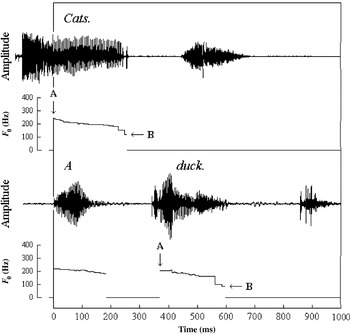
Both intonation-groups in Figure 1 are two syllables in length. However, monosyllabic tones can be produced in longer utterances, on the one hand, or they can be spoken in isolation, on the other. Figure 2, for example, illustrates monosyllabic tones in one- versus two-syllable utterances that Vicky produced. The top panel of Figure 2 represents a monosyllabic utterance (cats), which by definition is also a monosyllabic tone. The bottom panel represents a monosyllabic tone in a two-syllable utterance (a duck), the same utterance that was displayed in the top half of Figure 1. Again, each falling tone extends from the accent peak marked ‘A’ to the boundary marked ‘B.’
Time waveform and f 0 contour of variable length utterances with monosyllabic tones spoken by Vicky, aged 4 ; 2 (symbols as in Figure 1).

The two nuclear tones have the same structure and direction of pitch change. The only difference lies in the prenuclear portion of the utterances, that is, a difference in the overall length of utterance as measured by the number of syllables. Studies of adult speakers are mixed about the effects of utterance length on intonation production. In short to moderate utterance lengths (such as illustrated in Figure 2), Pierrehumbert (Reference Pierrehumbert1979) did not find any difference in the total width of pitch change or ‘declination’ that occurs throughout sentence production. However, in long versus short utterances (not illustrated in Figure 2), speakers tend to ‘reset’ the initial f 0 at a higher level (Cooper & Sorensen, Reference Cooper and Sorensen1981), placing increased demands on the vocal mechanism responsible for raising pitch. In anticipation of long versus short utterances, adult speakers also inhale a greater volume of air in the preutterance phase of speech breathing (Winkworth, Davis, Ellis & Adams, Reference Winkworth, Davis, Ellis and Adams1994). In sum, polysyllabic utterances potentially entail an extra degree of effort at the respiratory and/or laryngeal levels of speech control. Thus, an increase in utterance length could impose a second physiologically based constraint on intonation production in addition to the previously discussed effect of rising versus falling pitch. Although Snow's (Reference Snow2004) study did not find any evidence for constraints of this type in a group of ten ten-year-olds, it is possible that utterance length could affect children's intonation at periods of peak development and change, that is, shortly before 1 ; 0 and between 1 ; 0 and 2 ; 0.
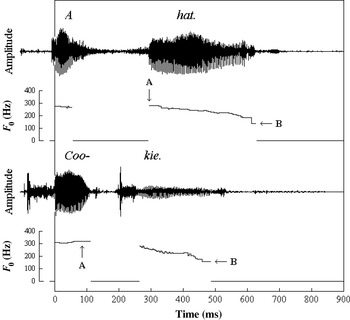
The four examples in Figures 1 and 2 correspond to monosyllabic tones, three of which are embedded in polysyllabic utterances. In languages like English, which permit stress on the final, penultimate or antepenultimate syllable, the tone-bearing structure itself can be polysyllabic. For example, the citation form of a two-syllable word with initial stress like tiger is a disyllabic tone. Variations in tone length are illustrated in Figure 3 with examples of disyllabic utterances produced by Clara, another four-year-old in Snow's (Reference Snow1998a) study. The top panel depicts a monosyllabic tone, similar to the examples in Figure 1 and the lower panel of Figure 2. The bottom panel of Figure 3 depicts a disyllabic tone. As in Figures 1 and 2, the tones begin on the last accented syllable ‘A’ and continue to the ending boundary ‘B.’
Time waveform and f 0 contour of polysyllabic utterances with variable length tones spoken by Clara, aged 4 ; 6 (symbols as in Figure 1).

The phonetic relation between the tones in Figure 3 is different across languages. In some languages, the accent range is narrower in monosyllabic tones than in polysyllabic tones; that is, the former tones are said to be ‘truncated.’ In other languages, including English, the wide accent range that is typical of disyllables is maintained in single-syllable tones without truncation (Cruttenden, Reference Cruttenden1997). As a result of this ‘tonal compression’ in English monosyllables, the tones of different length shown in Figure 3 not only have the same structure but also, on average, the same pitch variation between the points marked ‘A’ and ‘B’ (Ashby, Reference Ashby1978; Snow, Reference Snow1998a).
The tones in Figure 3, however, differ with respect to production constraints. Because the same accent range is produced in one- and two-syllable tone-bearing words, monosyllabic versus disyllabic melody patterns imply different rates of pitch change. As shown by Pierrehumbert (Reference Pierrehumbert1981), the rapid pitch change in monosyllables is especially dramatic when a monosyllabic word with a short vowel like bit is compared to a disyllable with a long stressed vowel like rival. The examples in Figure 3 illustrate the asymmetry between tones of different length even when the vowels in both words are short. In the nuclear word hat (duration of voicing=331 ms), f 0 falls from 282 to 141 Hz. In the octave scale this magnitude of change in fundamental frequency corresponds to 1202 cents (1 octave=1,200 cents) and the average rate of pitch change is 3636 cents/s. In cookie (duration from the beginning to the end of voicing=488 ms), f 0 falls from 319 to 157 Hz (1235 cents), an average rate of pitch change of 2532 cents/s. The rate of pitch change is more than 40% greater in the monosyllable than in the disyllable.
The reader might recall that the discussion of rises versus falls in the preceding pages of the introduction pointed to the close connection between speed of pitch change and vocal effort (e.g. Sundberg, Reference Sundberg1979). In light of this axiomatic connection, the modest rate of pitch change in two-syllable tones could be produced with little or no intentional effort, especially if the contour is falling. The rapid change in pitch in monosyllables, however, would require a concerted degree of purposeful effort even if the contour was falling. In terms of physiological effects on the magnitude and velocity of pitch change, then, trochaic disyllables could have the same theoretical relation to monosyllables that falls have to rises. Developmentally also, two-syllable tones might stabilize early in child speech, as a result of universal tendencies, but single-syllable tones would be acquired at a later stage of development as a result of specific language experience.
This hypothesis is supported by preliminary studies of falling tones in the speech of one- and four-year-olds (Snow, Reference Snow2004). Acoustic data showed that the one-year-olds' speed of pitch change was the same (i.e. relatively slow) regardless of the length of the tone-bearing string. Snow concluded that infants change pitch at a ‘default’ rate that is passively determined by natural biological tendencies associated with respiration and phonation. Four-year-olds also approximated this posited ‘default’ rate when they produced tones in the supportive context of disyllabic strings. However, in a way suggesting intentionality, the preschoolers (similar to adults) changed pitch at a much faster rate in the short span of monosyllables. Summarizing, the hypothesis that single-syllable tones are more constrained by speech physiology than polysyllabic tones is supported by converging evidence from linguistic, experimental and developmental studies. Thus, when children's polysyllabic speech samples are analyzed before and after the milestone time of their first birthday, the interaction of physiological versus linguistic influences on intonation development might be different from what the monosyllabic data alone suggest.
To address these issues, this study compared the accent range of tones in meaningful and non-meaningful monosyllabic utterances to similar tones in longer meaningful and non-meaningful utterances produced by children between the ages of 0 ; 6 and 1 ; 11, for example, single-syllable utterances like [dɛ] there and [tɑ] could be compared to the last (stressed) syllable of [ˈʔʌʔəˈʔɛ] and [əˈbʊʔ] ball. In a second analysis, the study compared monosyllabic tones to disyllabic tones produced by the same children in meaningful and non-meaningful utterances of varying length, for example, the italicized portion of [təˈdʌk] duck could be compared to the corresponding portion of [ˈmʌˈkikə] more cookies.
Tone classes and stress patterns
In addition to the intonation of child speech, which is the primary focus of this study, another level of prosodic analysis and theory pertains to metrical or stress patterns, that is, sequences of strong and weak syllables. The speech samples in Figures 1–3 of this paper that have been described in terms of intonation-groups and tones can alternatively be analyzed as stress patterns. In the top panel of Figure 3, for example, the disyllabic utterance with a monosyllabic tone has a weak-strong pattern. In the lower panel, an utterance of the same length with a disyllabic tone has a strong-weak pattern. Another common pattern in English (although it is not analyzed in this study) is strong-weak-weak, for example, animal and elephant. Whereas tones express melodies, stress patterns convey impressions of rhythm – weak-strong feet are iambs, strong-weak are trochees, and strong-weak-weak are dactyls. Iambic rhythms are also described as ‘ascending’ because they ascend from a low to a high level of stress. Similarly, the stress patterns of trochaic and dactylic rhythms are ‘descending.’
The paired reciprocal terms ‘ascending–descending,’ which describe sequential patterns of stress and accent, are independent of the terms ‘rising–falling,’ which describe directional patterns of pitch change. For example, the statement a duck has an ascending rhythm but a falling tone. However, there is a close relationship between each metrical term (e.g. ascending) and its tonal counterpart (e.g. rising). Each of these semantically related terms, for example, implies an increasing pattern of prosodic energy over time, that is, an increase, respectively, in level of stress or the fundamental frequency of the voice. Most importantly, the rhythmic system itself, based on strong/weak syllables, is closely related to the tonal system, based on pitch contours, because strong syllables are typically accented (i.e. produced by a pitch obtrusion) and the accentual pattern of spoken utterances is one of the two components of pitch change that intersect in nuclear tones. Thus, the same phonetic features are represented in accents and tones.
In light of the phonetic connection between the rhythmic and melodic systems, the dissociation between one- and two-syllable tones that is hypothesized in this study is relevant to models of prosody based on stress patterns. In fact, Bolinger (Reference Bolinger1986) described an asymmetry in production constraints between types of rhythm that is identical to the one that is anticipated in this study between monosyllabic and disyllabic tones: ‘Given the prevalence of downturns in pitch to mark accents, and the need for following syllables to accommodate the accentual turn, it seems that English must favor descending rhythms’ (p. 86). From a diachronic perspective, Bolinger pointed out that this preference for descending rhythms in English has resulted historically in the backshifting of stress in most borrowings of French nouns whose citation forms originally had the ascending rhythm of polysyllabic French words, e.g., levee, sabotage, intrigue and ally. In summary, the naturalness of descending rhythms derives from the same effortless or passive control of pitch change that was attributed theoretically, in a preceding section of the introduction, to disyllabic tones and, in a still earlier section, to falling contours.
A preference for strong–weak rhythms has also been proposed for children, for example, the Trochaic Hypothesis (Allen & Hawkins, Reference Allen, Hawkins, Yeni-Komshian, Kavanagh and Ferguson1980). Allen and colleagues attributed the preference to universal production and perception constraints. A more recent version of the theory – the Trochaic Template Hypothesis (Gerken, Reference Gerken1994) – attributed the bias to a language-specific production constraint. Vihman, DePaolis & Davis (Reference Vihman, DePaolis and Davis1998) also concluded that the trochaic bias is not universal, but they argued that children's favored metrical patterns originate from an interaction between native language experience and the child's individual language acquisition strategy. Interestingly, Vihman et al. also emphasized the role of universal physiological constraints. They suggested that an f 0 pattern is more physiologically natural when it falls continuously across two syllables, as in trochees, than when it falls in the final syllable only, as in iambs. This hypothesis for children is consistent with the phonetically-motivated account that Bolinger proposed for English-speaking adults. In agreement with these claims for children and adults, the present study of intonation suggests that a bias toward trochaic rhythms, as observed in some English-speaking children, could be grounded in speech melody.
Another tenet of the Trochaic Template Hypothesis has to do with the structure of the template that children are hypothesized to use as a production filter. The theory specifies that the unstressed syllable following the stressed syllable is optional. That is, the strong-(weak) template permits two patterns – strong and strong-weak. Thus, a foot consisting of a single stressed syllable (e.g. cat) fits the template just as well as a trochaic pattern does (e.g. tiger). This suggests that monosyllabic utterances like cat are in a different class from iambic disyllables like giraffe or a cat. In the framework of the present study, however, the weak syllable following the strong one is a critical element. Indeed, an intonation-based model suggests that monosyllables and iambs comprise a single tone class, and that trochees and dactyls are in a different class.
A second goal of the study is to examine these issues about metrically based developmental theories. The analyses will re-evaluate the same types of questions that were asked about intonation when the speech samples are restricted to canonical exemplars of single-syllable feet (e.g. the top panel of Figure 2), such as studied by Snow (Reference Snow2006), and disyllabic iambs and trochees (e.g. Figure 3), such as studied by Vihman et al. (Reference Vihman, DePaolis and Davis1998).
Summarizing, the study addresses three questions. Question 1 (with two parts) is about intonation development and questions 2 and 3 are about the intonation of metrical patterns: (1) Is the accent range of children's intonation affected by the length of (a) the tone-bearing string, or (b) the utterance in which tones are embedded? (2) Do monosyllabic feet belong to a different tonal class than iambic feet? (3) Is there an intonational versus metrical basis for the preference that some English-speaking children demonstrate for trochaic (strong-weak) patterns? Most importantly, the answers to these questions are brought to bear on larger theoretical issues such as the physiological versus linguistic basis of emerging intonation, the nature of prosodic markedness constraints, and the claims of the Trochaic Template Hypothesis.
METHODS
Participants
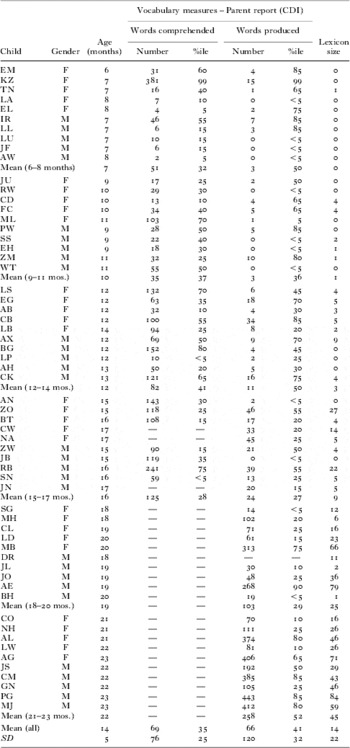
Sixty infants and toddlers participated. There were five girls and five boys in each of six age groups (see Table 1). The children and their families were recruited by a newspaper advertisement in the vicinity of Lafayette, Indiana. By parent report, the participants met the following screening criteria for chronological age, normal development, and native language status: (1) between 0 ; 6 and 1 ; 11; (2) no unusual prenatal, sensory, or developmental concerns; and (3) from English-speaking homes (General American dialect). All participants also demonstrated hearing sensitivity within normal limits, defined as 20 dB HL or better at 500 Hz, 1000 Hz, 2000 Hz, and 4000 Hz (American National Standards Institution [ANSI], 1969). For children younger than 1 ; 4, 30 dB or better at 500 Hz was accepted if all other findings of the VRA procedures and bilateral tympanometry were within normal limits.
Infant participants: Demographic and parent report data (Lexicon size=number of different words produced in the experimental session. CDI=MacArthur Communicative Development Inventory)

Note: To compute mean scores, percentiles that were less than 5 were assigned the value of 2·5.
Materials
Throughout the play session, the following toys were within the child's reach or line of sight on the shelves of a wooden bookcase: a baby doll in a crib, a lion puppet, a teddy bear, a brightly painted wooden telephone, a bucket, a mobile (attached to the upper shelf of the bookcase), and a plastic toy airplane. During the second half of the play routine, all children participated with an adult experimenter in five play activities centered around the following materials: (1) baby toys including blocks, balls, and a plastic bucket; (2) a soft toy duck and a cat puppet; (3) a baby doll, with doll clothes, a cup, bottle, and toy foods; (4) hidden objects such as a clear plastic container containing a wind-up toy; and (5) a crib and blanket, which set the stage for a ‘Going night-night’ routine. Based on studies of developmentally young children (e.g. Stark, Bernstein & Demorest, Reference Stark, Bernstein and Demorest1993), five of the experimenter-initiated activities were modified in the following ways for children younger than 0 ; 10: a mobile with Winnie the Pooh characters was used instead of the cat puppet in activity (2); a lion puppet was introduced as an alternative that the child could choose instead of the baby doll and the doll clothes in activity (3); and a tightly closed bottle of liquid for bubbles was used as the hidden object in activity (4). These variations ensured that the play routine was developmentally appropriate for prelinguistic children.
Procedures
In a laboratory suite, the participants sat down on a play mat on the floor. The interactions were videotaped and audiotaped. The child and parent each wore a wireless electret condenser lapel microphone. A Telex FMR-70 wireless system relayed the audio signals to a stereo cassette recorder and a camcorder. Within 15 days before the experimental play session, the parent completed the appropriate MacArthur Communicative Development Inventory (Fenson et al., Reference Fenson, Dale, Reznick, Thal, Bates, Hartung, Pethick and Reilly1993). If the child was 0 ; 6 or 0 ; 7 at the time of testing, the CDI form was sent to the parent when the child was at least 0 ; 8.
Each child and his or her mother participated individually in the experimental play session. During the first 10–15 minutes, the parent and baby played together alone, as they might do at home. Parents were asked to repeat any vocalizations they believed to be meaningful. In the next 20–25 minutes, an experimenter joined them. The experimenter sat down in front of the child and brought out toys from a cloth bag. The activities encouraged infants to attend to objects, to give, take, and show objects, to interact with adults, and to make requests; activities that may elicit different kinds of vocalizations (Stark et al., Reference Stark, Bernstein and Demorest1993). Eleven experimenters (the investigator, a male research assistant, and nine female research assistants) each interacted with one to twelve children.
The hearing screening using VRA procedures (and tympanometry if the child tolerated the procedure) was usually conducted immediately after the play session. For some children, the hearing screening was scheduled on a different day but within 15 days of the play session.
Transcription
Ten research assistants each analyzed all or part of the data for 1 to 14 children. Using criteria and procedures modeled after those described by Stoel-Gammon (Reference Stoel-Gammon1989), the analyst phonetically transcribed speech-like utterances, that is, vocalizations containing a voiced vocalic element. Cries, gasps, screeches, whispering, laughing, and other non-speech-like vocalizations were not transcribed. The transcription also did not record singing, nursery rhymes, or routines such as saying the ABCs or counting. The analyst transcribed all utterances in the first social context. In the second context, the analyst transcribed the child's speech-like utterances until: (1) 100 meaningful or non-meaningful utterances were transcribed; and (2) 35 minutes had elapsed. If there were fewer than 100 meaningful or non-meaningful utterances in the second context, the analyst transcribed all utterances in that context.
The transcription grouped vocalizations into ‘utterances,’ that is, one or more speech-like vocalizations bounded by: (1) a turn-taking; (2) a non-speech-like vocalization; or (3) a pause of at least 1100 ms – the temporal criterion used by Branigan (Reference Branigan1979).
The transcriber judged each utterance to be non-meaningful or meaningful. Meaningful utterances (i.e. single-word utterances or longer vocalizations containing at least one word) were identified on the basis of four criteria: (1) some phonetic relation to an adult-based word; (2) appropriate use in context; (3) consistency; and (4) the parent's verbal or non-verbal confirmation that the child's utterance was meaningful. Only spontaneously produced words were analyzed.
Utterances were assigned a phonological complexity level based on Stoel-Gammon (Reference Stoel-Gammon1989). ‘Level I’ utterances contained vowels, syllabic consonants, or syllables with glides or glottal consonants (e.g. [ʔɛ], [wʌ], or [haɪ] hi). Level I vocalizations are often described as ‘precanonical.’ Level II utterances contained one or more CV(C) syllables with a true consonant (e.g. [bɑ], [mæ], or [dʌ] duck). Level III utterances contained two or more true consonants that differ in place or manner (e.g. [bɑt], [nʌp], or [dʌk] duck). Oller (Reference Oller, Yeni-Komshian, Kavanagh and Ferguson1980) described non-meaningful utterances at levels II and III, respectively, as ‘canonical’ and ‘variegated.’ In this study, levels II and III were collapsed to create a single ‘canonical’ syllable type.
Utterances were assigned to one of seven syllable-length categories: one to six syllables and more than six syllables. If the syllables of multisyllabic utterances were perceived as having unequal prominence, the transcribers assigned primary stress to the most prominent syllables. If the syllables were perceived as having equal prominence, the transcribers assigned primary stress to each syllable. Finally, all utterances were assigned to one of five tone length and stress pattern categories. The first and most basic category included monosyllabic utterances, for example, all utterances cited in the previous paragraph. All other categories were based on the stress pattern of the last two syllables: strong-weak (e.g. [ˈɡæɡɛ], [ˈnʌˈbʌkət] another blanket), [ˈʔæʔo] uhoh); weak-strong ([ʊˈnʊ] no, [əˈaʊ] meow, [ˈtɛəˈhoʊn] telephone); strong-strong (e.g. [ˈɛˈɛɹˈbeɪn] airplane, [nɛˈbɑˈbeɪˈbʌb], [ˈwʌˈwoʊ] woof-woof), or weak-weak. The last category was typically part of an infrequently occurring dactylic pattern (e.g. [əˈɡʌɡɛɡi]) which was not analyzed acoustically.
A second person carried out reliability judgments of the first ten utterances in each social context for each child. Across all categories (boundaries, consonants, syllable type, meaningful vs. non-meaningful, and stress pattern and length), the percentage of agreement was 88%.
Instrumental analysis
The instrumental analysis sampled tones in five categories: social context (parent only vs. experimenter and parent); linguistic function (non-meaningful vs. meaningful); syllable type (precanonical vs. canonical/variegated); utterance length (1–6 syllables); and stress pattern of the penultimate syllable, if applicable, and the last syllable (monosyllabic, iambic, trochaic, or spondaic). Thus, there were 128 combinations of categories and levels (‘utterance types’). A maximum of ten consecutive analyzable utterances in each utterance type was selected in the transcribed sample that was bounded by the first 100 meaningful or non-meaningful utterances, whichever occurred first. Utterances were considered not analyzable if: (1) any f 0 values reached 1000 Hz or more; or (2) CSpeech reported 0-values for more than half of the signal duration of marginally speech-like utterances. Because these data selection criteria were designed to produce highly diverse and representative speech samples, no additional controls were imposed on variables such as pragmatic intention, emotional level, and discourse functions such as initiations and responses. Balog & Roberts (Reference Balog and Roberts2004) discuss prosodic effects associated with some of these topics in children's early meaningful speech.
The duration and f 0 contour of monosyllabic and disyllabic tones meeting the selection criteria were measured using the CSpeech signal analysis system (Milenkovic & Read, Reference Milenkovic and Read1992), with a 16-bit resolution and a sampling rate of 22 KHz. In accordance with procedures described by Allen & Hawkins (Reference Allen, Hawkins, Yeni-Komshian, Kavanagh and Ferguson1980), the analyzed portion of each syllable was the vocalic nucleus. The boundaries of each vocalic nucleus were set at the amplitude peak of the first or last periodic cycle that was visually distinct in the time waveform. Syllable duration was calculated as the difference between the boundaries. The duration of disyllables was calculated as the time interval between the initial boundary of the first syllable and the ending boundary of the second syllable.
The pitch extraction algorithms of CSpeech generated fundamental frequency (f 0) values between the applicable syllable boundaries. Portions of the signal that the automatic routines did not analyze correctly were edited via manual procedures supported by CSpeech. For example, sometimes 0-values were reported for intervals of the signal that by visual inspection were periodic. The contour was described as ‘falling’ if the maximum f 0 preceded the minimum f 0. Otherwise it was ‘rising.’ Accent range was calculated as the logarithmic difference between the maximum and minimum f 0, expressed in cents (1 octave=1,200 cents). This latter measure expressed the frequency data in terms of perceptually equivalent units (Burns & Ward, Reference Burns, Ward and Deutsch1982).
To illustrate the acoustic measures, the duration of the falling tone in the word duck in the top panel of Figure 1 was 232 ms; the maximum f 0 ‘A’ was 204 Hz and the minimum ‘B’ was 98 Hz. The contour was classified as falling because the maximum f 0 preceded the minimum. The accent range was calculated by the formula (1,200/log 2) (log (204/98))=1,273 cents.
A second person carried out reliability measurements of two randomly selected monosyllables for each of two infants in each age group. The mean measures for the two analysts were within 12 ms for duration, 9·6 Hz for minimum f 0, 5·6 Hz for maximum f 0, 4 Hz for f 0 range, and 112 cents for accent range.
RESULTS
To ensure that the two social contexts did not result in different intonation characteristics, an initial statistical test analyzed the children's accent range as a function of the social context. There was no evidence that the children's intonation differed by social context at any age range. For the rest of the analyses, therefore, the data from the two play contexts were pooled.
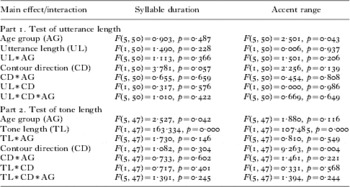
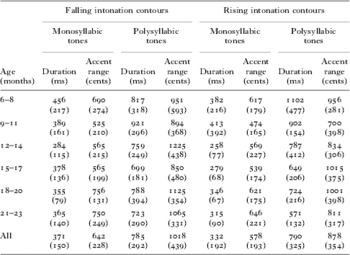
The statistical evaluations are reported in two parts. The main evaluation in each part used 2 mixed 6×2×2 Analyses of Variance (ANOVAs) to analyze the infant-toddler data (6 groups of children ranging in age from 0 ; 6 to 1 ; 11). There were 2 ANOVAs in each part because 2 dependent variables were evaluated (accent range and tone duration), each of which was represented by a single mean score for each child. Although the focus of this study was on accent range, tone duration was also evaluated to rule out the possibility that significant effects on accent range, if any, are secondary effects of duration. In all analyses, the between-subjects variable was age group. One of the 2 within-subjects variables was contour direction. The other within-subjects variable pertained to differences in the number of syllables produced – single-syllable tones in monosyllabic versus polysyllabic utterances in Part 1 and monosyllabic versus disyllabic tones in Part 2. The linguistic hypothesis predicted effects related to age, whereas the physiological hypothesis predicted main effects or interactions involving tone direction and length. The results are summarized in Table 2.
Summary of statistical tests

In addition to the tests summarized in Table 2, 2 supporting ANOVAs were conducted in Parts 1 and 2. These were similar to the main analyses except that accent range was the only dependent variable evaluated. The first of the supporting analyses was designed to determine the relationship between children's development of intonation from 0 ; 6 to 1 ; 11 and their continuing development between the ages of 1 ; 9–1 ; 11 and 4 ; 0. Because this comparison involved only 2 age groups, the ANOVA had a mixed 2×2×2 design. The hypothesis predicted that significant changes occur before rather than after the children's second birthday.
The other supporting ANOVA was designed to determine whether the infant-toddler findings of the main analysis were confirmed when the analyzed utterances are disyllabic rhythmic patterns. Because there were too few children represented in one or both of the metrical patterns involving rising contours, this analysis was restricted to falling contours. The ANOVA thus had a mixed 6×2 design. The hypothesis predicted that the intonation findings based on rhythm patterns are the same as those that are based on tone patterns.
Part 1: Utterance length
This analysis compared monosyllabic tones in single-syllable utterances to monosyllabic tones in utterances that ranged from two to six syllables in length. All 60 of the infants and toddlers produced one or more falling and rising monosyllabic tones in monosyllabic utterances. In the polysyllabic conditions, 1 child did not produce any falling contours and 4 children did not produce any rising contours. Of the 3,485 utterances that were analyzed, 1,993 were in monosyllabic utterances (57%), and 2,101 were falls (60%).
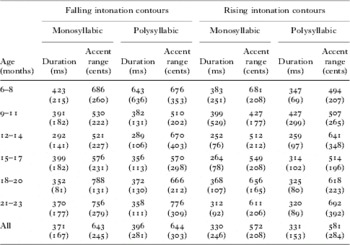
Table 3 lists the results for syllable duration and accent range by age group, contour direction, and utterance length. The data reflect the group means of averages for each child. The ANOVA (see Table 2, Part 1) showed that there were no significant effects for duration. For accent range, there was a main effect of age, but no other main effects and no significant interactions. The findings indicate that accent range was affected only by age but not by contour direction or length of utterance.
Means and standard deviations (in parentheses) of syllable duration and accent range in monosyllabic nuclear tones by age group, contour direction, and utterance length

Multivariate pairwise comparisons among age groups were used as post hoc tests. To interpret the results, ‘strong’ and ‘weak’ versions of the U-shaped curve hypothesis were defined. Strong confirmation of the hypothesis required that three statistical criteria be met: (1) one or more of the youngest groups and (2) one or more of the oldest age groups will be significantly different from one or more of the middle groups, but (3) the relevant youngest and oldest groups will not be different from one another. Weak confirmation of the hypothesis required that two of the three criteria be met.
The post hoc tests showed that the youngest group (0 ; 6–0 ; 8) did not differ from any of the other groups. The next age group (0 ; 9–0 ; 11) produced a significantly narrower accent range than the two oldest groups (1 ; 6–1 ; 8 and 1 ; 9–1 ; 11). Finally, the 1 ; 3–1 ; 5 group produced a narrower accent range than the 1 ; 6–1 ; 8 group. These results are similar to those previously reported for monosyllabic utterances except that, in the present analysis of all monosyllabic tones, the decline from the 0 ; 6–0 ; 8 to 0 ; 9–0 ; 11 groups was not significant (i.e. the first criterion was not met). Because only two of the three criteria were met, the findings confirmed only a weak version of the U-shaped curve hypothesis.
To ensure that the intonation production of the oldest group of children in this study reflects a stable acquisition pattern, the 10 children in the 1 ; 9–1 ; 11 group were compared to the same number of four-year-olds in Snow's (Reference Snow1998a, Reference Snow2002) studies. All of the four-year-olds produced one or more falling and rising monosyllabic tones in polysyllabic utterances. In the monosyllabic utterance conditions, all 10 also produced one or more falling tones, but 3 children did not produce any rising contours. Of the 231 utterances that were analyzed, 60 were monosyllabic (26%) and 178 were falls (77%).
As expected, there was no main effect of age or utterance length. However, there was a main effect of contour direction (F(1, 15)=21·640, p=0·0003), indicating that falls had a wider accent range than rises. There was also a significant interaction between contour direction and age (F(1, 15)=8·755, p=0·0098). Post hoc tests revealed that the interaction resulted from the fact that falls had a greater accent range than rises in the four-year-olds (F(1, 6)=14·504, p=0·009) but not in the younger children. The main developmental change between the age of 2 ; 0 and 4 ; 0 is that the gap between falling and rising contours widens.
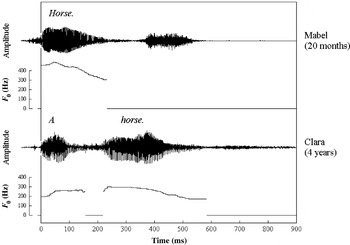
Using examples from individual children, Figure 4 illustrates the similarity in monosyllabic tone production between the two groups of toddlers (1 ; 6 to 1 ; 11) and four-year-olds. The top panel depicts the single-word utterance horse produced by Mabel, a 1 ; 8 girl (MB in Table 1). The accent range of 812 cents is within a standard deviation of the mean falling pitch change produced by children between the ages of 1 ; 6 and 1 ; 8. The bottom panel shows the same tone in the phrase a horse produced by four-year-old Clara (see also Figure 3). The accent range (966 cents) is comparable to the mean for four-year-olds in monosyllabic tones (1,046 cents).
Time waveform and f 0 contour of variable length utterances with monosyllabic tones spoken by Mabel, aged 1 ; 8, and Clara, aged 4 ; 6.

To determine whether the findings for monosyllabic tones in utterances of different length apply to rhythm patterns with final stress that differ in length, the samples for infants and toddlers were restricted to single-syllable utterances (one-syllable feet) versus two-syllable iambic patterns. All 60 of the infants and toddlers produced one or more falling and rising monosyllabic tones in monosyllabic utterances. In the disyllabic (iambic) conditions, 52 children produced at least one falling contour, but only 39 children produced rising contours. Because the percentage of children represented in the latter group was less than the minimum of 85% that is needed for analysis, the comparison was restricted to falling tones. Of the 1,462 utterances that were analyzed, 1,199 (82%) were monosyllabic.
For accent range, there was a main effect of age (F(5, 46)=2·891, p=0·024), but no other main effects and no significant interactions. These findings indicate that accent range in utterances ending with an accented syllable is not affected by length, whether utterances are defined as tonal or rhythmic patterns.
Part 2: Tone length
In light of the findings from Part 1, monosyllabic tones were collapsed across utterance length categories. Disyllabic (trochaic) tones were also collapsed across utterance length categories because only 58 of the 60 children produced falling disyllabic tones in the minimum utterance length condition (two syllables) and only 48 children produced rising tones in that condition. Part 2 compared monosyllabic tones to disyllabic tones by age group and contour direction.
All 60 of the infants and toddlers produced one or more falling and rising monosyllabic tones, as discussed in Part 1. In the disyllabic tone conditions, all children produced one or more falling contours, but 7 children did not produce any rising contours. Of the 4,463 utterances that were analyzed, 3,485 had monosyllabic tones (78%) and 2,849 were falls (64%).
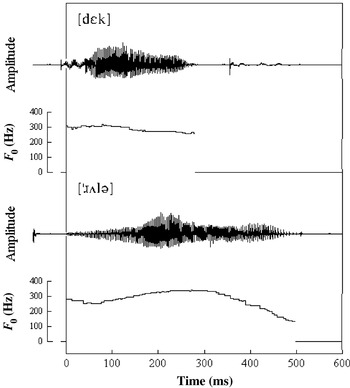
Table 4 lists the results for tone duration and accent range by age group, contour direction, and tone length. As in Table 3, the data reflect the group means of averages for each child. The ANOVA (see Table 2, Part 2) showed that there was a significant effect of tone length on duration, a finding that was expected given that the disyllables were roughly twice as long as the monosyllables. For accent range, there was also a main effect of tone length, and an effect of contour direction, but no other main effects and no significant interactions. The results indicated that the accent range of all children was wider in disyllabic than in monosyllabic tones and wider in falling tones than in rising tones. Using examples from a 1 ; 0 girl, Abby (AB in Table 1), Figure 5 illustrates the difference in accent range between a monosyllabic tone and a disyllabic tone for children between the ages of about 0 ; 10 and 1 ; 5. The top panel represents a single-syllable babbled utterance. The narrow accent range (361 cents) is within a standard deviation of the mean falling pitch change produced by 1 ; 0–1 ; 2 children. The bottom panel shows a disyllabic tone in another babbled utterance produced by the same child. The wide accent range (1,639 cents) is roughly comparable to the upper range of falling pitch changes that toddlers and even preschoolers produce, as discussed next.
Time waveform and f 0 contour of variable length utterances and tones spoken by Abby, age 1 ; 0.

Means and standard deviations (in parentheses) of tone duration and accent range in nuclear tones by age group, contour direction, and tone length

As in Part 1, the 10 children in the oldest group of infants and toddlers (1 ; 9–1 ; 11) were compared to the group of 10 four-year-olds in Snow's (Reference Snow1998a, Reference Snow2002) studies. All of the preschoolers produced one or more contours in each tone length and directional category. Of the 364 utterances that were analyzed, 231 had monosyllabic tones (63%) and 283 were falls (78%).
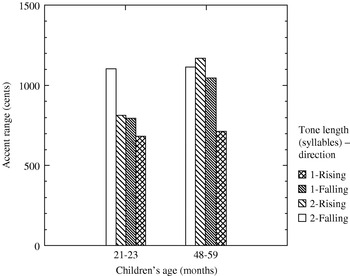
The ANOVA showed that there was a main effect of tone length on accent range (F(1, 17)=8·562, p=0·009) and a main effect of contour direction (F(1, 17)=5·994, p=0·025), but no significant interactions. The results indicated that, for all children, accent range was wider in disyllabic tones than in monosyllabic tones and wider in falls than rises, in agreement with the findings for children from 0 ; 6 to 1 ; 11. When tones of different length are analyzed, the results do not show any developmental effects across the age range of 0 ; 6 to 4 ; 0. The comparison between the 1 ; 9–1 ; 11 group and four-year-olds is displayed in Figure 6.
Mean accent range by length of tone, contour direction, and the children's age.

To determine whether the findings for tones of different length apply to contrasting rhythm patterns, the analyzed samples for infants and toddlers were restricted to disyllabic iambic and trochaic utterances. In the iambic conditions (the same data that were analyzed in Part 1), 52 of the infants and toddlers produced one or more falling contours, but only 39 produced rising contours. In the trochaic conditions, 58 children produced falling contours, but only 48 produced rising contours. Because the percentage of children represented in the conditions with rising contours was less than 85% (the designated minimum needed for analysis), the comparison was restricted to falling tones. Of the 739 utterances that were analyzed, 476 (64%) were trochaic.
For accent range, there was a main effect of rhythm type (F(1, 45)=12·064, p=0·001), but no other main effects and no significant interactions. The findings indicate that the accent range of disyllabic tones in trochaic utterances was wider than that of monosyllabic tones in iambic utterances. In sum, children's accent range production is the same whether utterances are defined by monosyllabic versus polysyllabic tones or by iambic versus trochaic rhythms.
DISCUSSION
The analysis of monosyllabic tones showed that children's intonation develops substantially at 1 ; 6–1 ; 8, a result that confirms a number of previously reported findings. Moreover, the comparison between the oldest group of toddlers in this study and preschool children in a related investigation suggested that children's advances in tone production toward the middle of the second year of life represent the acquisition of a mature pattern. In fact, these data imply that children at 1 ; 6 control the wide intonation contour that is a language-specific characteristic of English monosyllables. The present study, however, in which utterances of varying length were analyzed, indicated only a weak version of the regression pattern that had been observed previously in monosyllabic utterances (Snow, Reference Snow2006). Changes in intonation behaviors, whether they are regressions or advances, are important in the theory of this study because they are interpreted as evidence of linguistic learning. In the absence of a robust regression pattern in the prelinguistic period, there was clear evidence for learning based on developmental change only after about 1 ; 6.
The first part of the analysis also showed that the children's accent range between 0 ; 6 and 1 ; 11 was not affected by contour direction or by small to moderate differences in utterance length. Previous research had reported a ‘marginally significant’ effect of contour direction in monosyllabic utterances produced by the same group of 60 children (Snow, Reference Snow2006) and no effect of utterance length in a smaller study of one- and four-year-olds (Snow, Reference Snow2004). Thus, the present findings are largely in agreement with previously reported results. Contour direction and utterance length are important in the theoretical framework of this study because they are potentially linked to physiological constraints on tone production. The non-significant findings for both variables confirmed most predictions of a linguistic model of intonation development in the six age groups of children and all linguistically-based predictions in the two oldest groups.
The second part of the analysis focused on the role of tone length instead of utterance length. There was no effect of age and thus no evidence of learning across stages of development – contrary to the key prediction of linguistically-based theories. In fact, even the youngest infants produced intonation in a way that was comparable to preschoolers. In addition, falling tones had a wider accent range than rising tones, and disyllabic tones had a wider accent range than monosyllabic tones. These results for children from 0 ; 6 to 1 ; 11 extended the findings that had been previously reported only for one-year-olds (Snow, Reference Snow2004) and confirmed all predictions of physiologically-based theories. In sum, the pattern of findings in the second part of the study, which included tones of varying length, was the opposite of the pattern that had been obtained in the first part, which was restricted to single-syllable tones. Indeed, the polysyllabic results supported a physiologically-based theory in all age groups as consistently as the monosyllabic results confirmed a linguistically-based theory in the two oldest groups. Taken together, the results suggest that physiological constraints govern children's earliest uses of accent range; but by about 1 ; 6, children's intonation patterns begin to reflect their linguistic experience.
The study did not find evidence of an interaction between age and either tone direction or length, the most important (albeit implicit) prediction of the breath group theory. Nevertheless, the main effects in the second analysis were generally consistent with physiologically-based models. First, the effect of contour direction supported the assumption of the breath group theory that the falling contour is the unmarked pattern of intonation. That is, falling pitch is assumed to be the natural and passively controlled result of speech breathing. Rising contours, on the other hand, are said to be marked because they require speech production effort (Lieberman, Reference Lieberman1967) or at least more effort than falls (Sundberg, Reference Sundberg1979). Thus, rises are expected to develop more gradually than falls. The comparatively narrow accent range of pitch elevations throughout the period of study confirmed these physiological, linguistic, and developmental expectations.
The results also showed an even more robust effect of tone length. This strong effect is especially striking in the absence of any effect for length of utterance. Although both hypothesized effects were based on ostensibly similar features of length, they were associated theoretically with the opposite type of constraint. In the case of utterance length, the hypothesis predicted that an increase in the number of syllables adjacent to a nuclear tone would increase the overall production effort and constrain the production of the nuclear tone itself. In the case of tone length, the hypothesis predicted that an increase in the number of syllables within a tone would actually decrease the physiological demands on tone production and facilitate the targeted pitch change. This latter effect was the one that was actually observed.
Presumably disyllabic versus monosyllabic tones facilitated rather than suppressed intonation production because the extra tone-bearing syllable permitted the children to change pitch at a slow rate, possibly a ‘default rate,’ that requires little or no effort. Short monosyllabic tones, on the other hand, require considerable effort to produce a rapid fall or rise in pitch. Interestingly, low versus high constraints on speed of pitch change also provided the basis for claiming that falls are more natural than rises, as discussed in the preceding paragraphs. In sum, disyllables have the same phonetic and developmental relation to monosyllables that falls have to rises. The implication for a theory of prosodic markedness is that the ideal unmarked intonation pattern is characterized not only by falling pitch but also by a polysyllabic tone-bearing frame.
The intonation findings are also relevant to metrical models of early speech such as the ‘Trochaic Hypothesis’ (Allen & Hawkins, Reference Allen, Hawkins, Yeni-Komshian, Kavanagh and Ferguson1980). This connection is owing to the fact that metrical units correspond to stress patterns that step up to or down from accented syllables, and accents in turn share a common melodic foundation with tones. In fact, when trochaic words like tiger and iambs like giraffe are spoken in isolation, they correspond exactly to disyllabic and monosyllabic tones. This common melodic thread unifies the rhythmic and tonal systems in the same way that the tonal features of length and direction were unified in the preceding paragraph. A generalization that emerges, on the level of intonation as a whole, is that ‘ascending’ versus ‘descending’ rhythms and ‘rising’ versus ‘falling’ contours both reflect an increase in vocal effort that is needed to appropriately accelerate or decelerate the fundamental frequency of the voice. Thus, natural tendencies of intonation production could explain the preference for descending or trochaic rhythms that is observed in some children (Vihman et al., Reference Vihman, DePaolis and Davis1998).
These observations about biological universals that favor trochaic rhythms also imply that iambic rhythms have unique properties and advantages. As Bolinger (Reference Bolinger1986) pointed out: ‘The very effort of stretching a syllable that must – when alone and accented at the end – be spread over a pitch turn adds to the force of the utterance: the terminal gains by being iambic’ (p. 86). In diachronic evidence supporting this idea, Bolinger observed that many words borrowed into English from French have retained the original pattern of word-final stress: ‘Colorful adjectives such as abject, obtuse, concise, ornate, averse, absurd, obscene, picturesque, verbose, intense, replete, robust, divine, and many more acquire a special intensity by virtue of the terminal accent, and they resist backshifting the stress’ (p. 352). Production studies also suggest that terminal accent patterns are highly salient for one- and two-year-olds (e.g. Snow, Reference Snow1998b).
Finally, the results for both rhythmic types are relevant not only to the general import of the trochaic theory but also to the specific template itself. The theory claims that the template applies not only to the trochaic pattern but also to monosyllabic feet. This implies that a stressed monosyllable like cat is developmentally equivalent to a disyllable like tiger but different from a cat or giraffe. An intonation-based account of these forms, however, suggests that the single syllable and iambic feet constitute a natural class because they have the same monosyllabic nuclear tone. Conversely, these melodic units are different from trochees and dactyls because the tone lengths are different.
An implication for developmental metrical models is that the trochaic template may be limited as a general production guide for children because it does not capture the natural tone classes that constitute the cornerstone of early prosodic development. From the standpoint of perception, an important implication of the kinship among tones with a ‘terminal accent’ is that the perceptual advantage that was proposed for iambic patterns is shared by monosyllabic feet. Indeed, the salience of monosyllabic tones generally may account for the preference that some children have for iambic rhythms even when both rhythm types are frequently represented in the input, as in English (Vihman et al., Reference Vihman, DePaolis and Davis1998). These children, perhaps, are sensitive to the perceptual cues associated with ascending rhythms and the system of pitch cadence. Conversely, English-speaking children who prefer trochaic patterns might be sensitive instead to the production cues associated with descending rhythms and the system of pitch accents.
The priority of this study was to analyze intonation in the broadest possible range of developmental utterance types – precanonical, canonical, and meaningful. The tonal features model, which provided the theoretical basis of the study, was nicely suited to this purpose because it is based on constructs such as stress-accent and position-in-utterance that can be defined for all three utterance types. For these reasons, the analysis didn't take into account a number of form-class variables which are necessarily restricted to meaningful speech. Among disyllabic utterances, for example, trochaic patterns could be lexical (e.g. tiger) or phrasal (e.g. Hold it). Similarly, iambic patterns could be giraffe or a duck. Still other possibilities include compounds or phrases with more than one stressed syllable in a pattern that is ascending (e.g. northwest or big duck) or descending (e.g. birthday).
In this study, trochaic patterns were predominately lexical, iambic patterns were predominately phrasal, and compounds or ‘double-stressed’ phrases were infrequent. In fact, the distribution of these forms appeared to be remarkably similar to the one that Snow (Reference Snow2004) reported in an analysis of 120 disyllables produced by a group of ten four-year-olds. Indeed, in that study, there were no examples of lexical iambs or compounds. In fact, because there were only two instances of phrases with more than one accented lexical item like need sock, utterances of this type were not even analyzed in the 2004 study. As a result, trochaic and iambic patterns are confounded with lexical versus phrasal contexts in studies of children between the ages of 1 ; 0 and 4 ; 0. Thus, it is not known whether children's intonation is the same in lexical iambs or trochees as it is in phrasal utterances with the same stress pattern.
An additional problem in this regard is that one-year-olds frequently blur the adult-based distinction between lexical and phrasal structures and between one- and two-syllable patterns. For example, young children often produce iambic or spondaic patterns for lexical items that are plausibly traceable to phrases in adult speech (Vihman et al., Reference Vihman, DePaolis and Davis1998), e.g. [ʔəˈbɑ] ball and [bəˈkɑ] car. Similar examples produced as spondees include [ˈwɑˈbɑ] or [ˈbɑˈʔɑ] ball and [ˈʊːˈdis] please. A complementary kind of mismatch between adult and child forms occurs when children produce lexical monosyllables for words or phrases that are disyllabic in adult speech (e.g. [æp] apple, [mæ] banana, and [bɑ] a ball). Clearly, one of the priorities of future research in this area is to evaluate not only the linguistic-prosodic forms that children actually produce but also the potentially quite different forms that were originally modeled in the input.
In conclusion, children developed the characteristic wide accent range of English monosyllables at 1 ; 6–1 ; 8. However, children in the youngest age groups produced polysyllabic tones in a relatively adult-like way and there was no change throughout the period of study. Owing to the biomechanical link between tone length and speed of pitch change, the latter finding suggests that the accent range of children's earliest intonation patterns is physiologically based and universal. However, evidence of the effects of specific language listening experience is unmistakable at about 1 ; 6 when children control ‘tonal compression’ in monosyllables, a language-specific feature of English intonation. From the standpoint of markedness theory and its application to developmental prosody, the results suggest that rises and monosyllables, the marked forms of intonation, imply increased demands on the vocal mechanisms for raising and lowering pitch. Finally, the implication for the Trochaic Template Hypothesis is that the preference for trochaic rhythms that some children demonstrate may be traceable to constraints on intonation production in addition to individual differences and frequency patterns in the input.