Introduction
Belgian and European agricultural production systems are heavily dependent on the import of protein-rich animal feed. The Focus Group on Protein Crops of the European Innovation Partnership addressed this dependency and supported the strategy to increase and enhance the production of protein crops cultivated in Europe, including the production of soybean (Glycine max (L.) Merr.) (Schreuder and De Visser, Reference Schreuder and De Visser2014). Soybean production in the world reached 276 million tons in 2013, but production in the EU is considerably low (1.2 million tons in 2013) (FAOSTAT, 2015). The local production of protein crops such as soybean could provide an answer to a number of environmental challenges in Europe, such as soil quality, nitrogen management, agro-biodiversity and greenhouse gas emissions (Schreuder and De Visser, Reference Schreuder and De Visser2014).
Owing to the short and cold growing season, only soybean cultivars of the earliest maturity group are suitable for Belgium (MG000). The optimal planting time is around 1st of May, when the risk of spring frost is sufficiently low. MG000-varieties need around 1435 growing degree days (GDD; °C Day) to mature with a base temperature of 6°C, while MG00-varieties need 110 GDD more (1545 GDD) (Schori et al., Reference Schori, Charles and Peter2003). Data from the weather station of Merelbeke/Lemberge (in the North of Belgium) during the period of 1981–2014 demonstrate that MG000-varieties would have been able to mature before the 15th of October except for 2 years (1984 and 1996). MG00-varieties would not have been able to mature in 10 years during the last 34 years and are thus more risky for cultivation. Cold nights during the flowering period are also risky for the yield potential of soybean and cause considerable flower abscission for susceptible genotypes (Gass et al., Reference Gass, Schori, Fossati, Soldati and Stamp1996).
A soybean-breeding program for Belgian conditions might offer an answer to several challenges in the protein debate. When the financial balance of soybean production is comparable to crops such as winter wheat, the crop can be a valuable supplement in a farmer's rotation. Therefore, the objectives of this study were (1) to search for a soybean ‘plant type’ that is suitable/optimal for cultivation in Belgium; (2) to establish a base population for further breeding and (3) to assess the influence of an early planting date on the development of soybean. In addition, an early planting date might be a good test for screening cold tolerance in soybean genotypes.
Materials and methods
A field experiment under nets was installed in 2013 in Merelbeke, Belgium (50°58′N 3°46′E) with 49 varieties and 23 breeding lines from 18 different seed companies/research institutes/universities and 337 genebank accessions from two genebank sources. The genotypes belonged predominantly to MG000-0, although the maturity group was not known for all genotypes. The experiment was installed as a split plot experiment in two complete blocks with the planting date as the whole-plot factor and genotype as the split-plot within the whole-plot factor. The early planting date was 16 April 2013 and the late planting date 07 May 2013. The seeds were inoculated with 2 × the recommended dose of Rhizoflo (Jouffray-Drillaud, Cissé, France). In each main plot, the varieties were replicated twice, while the genebank accessions were present only once. The genotypes were sown in small 1-m rows with 50 cm inter-row spaces and 6–8 cm inter-seed spaces. Accessions were grouped according to maturity group to minimize border effects.
The experimental field was a sandy loam soil (pH-KCl 6.13 and %C 0.99), fertilized with 36 kg N/ha, 20 kg P2O5/ha, 220 kg K2O/ha and 20 kg MgO. The plots were treated with 700 g/ha metolachlor 1 d after planting and 480 g/ha bentazon+150 g/ha fluazifop-P-butyl in the V1–V2 stage. A manual weeding correction was necessary in July.
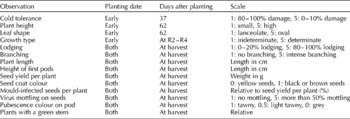
During the field trial, several observations were made in the course of the season: flowering date and maturity date were estimated from weekly observations of the V-stage and R-stage (Fehr and Caviness, 1977) and expressed as the number of days after 31 December 2012. A row of plants were in a certain stage when 50% or more of the plants in that row were in that particular stage. The other observations are listed in Table 1. Cold tolerance or tolerance to low temperatures after sowing was evaluated as the absence/presence of leaves with yellow or brown/black spots when plants were on average between the stage of emergence (VE) and the cotyledon stage (VC). The V-stage observed at 16 June 2013 of the early planting date (62 d after planting) was used in the further analysis, because this observation could be directly compared with the observation of plant height at the same date. Growth type was evaluated when plants were between the scores of R2 and R4.
Observations during the field experiment (early planting date: 16 April 2013; late planting date: 7 May 2013)

When a score of R8 was given to a row, four plants (if possible) were harvested from that row and left to dry in an open paper bag for at least 6 weeks. The plants were threshed and the seeds were wind-cleaned and manually sorted in three categories: clean seeds, mould-infected seeds and seeds with (virus) mottling.
The moisture content of 12 varieties belonging to different maturity groups was determined by manually harvesting the seeds of four plants for each planting date on 19 September 2013. The seeds were dried for 96 h at 72°C.
Principal Component Analysis and a construction of a correlation matrix was performed in R (R Core Team, Reference Core Team2014) with the observations of the late planting date and cold tolerance, plant height, leaf shape, V-stage and growth type from the early planting date (Table 1). Virus mottling was only used in the construction of the correlation matrix, with exclusion of the genotypes with black or brown seed coat colour. A distance matrix based on the Euclidean distance was the starting point for a Partitioning Around Medoids (PAM) cluster analysis. The optimal number of clusters was determined by evaluating Wilks' Lambda and silhouette plots for k= 4 to 15 clusters. Data from observations at both planting dates were analysed using STATISTICA (Statsoft, Tulsa, USA) as a linear-mixed model with planting date as a fixed effect and block and genotype as random effects, using type III sum of squares.
Results
In general, 2013 had a cold spring but a warm summer (Table S1, available online). During harvest (September–October–November), there was on average more rainfall compared with the last 34 years (Table S1, available online). Only 325 genotypes were included in the analysis (Table S2, available online), because not all genotypes germinated at both planting dates and some genotypes showing symptoms of virus infection were removed out of the field during the trial to prevent further virus transmission, e.g. by aphids. Of them, 24 genebank accessions did not germinate. On average, the field emergence was 33% for genebank accessions and 52% for varieties, but there was quite some variation between genotypes.
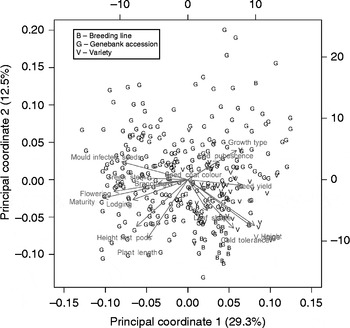
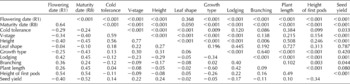
From Fig. 1 and Table 2, it can be clearly observed that flowering date and maturity date are well correlated for the late planting date: the arrows are both parallel and r= 0.64. The earliest genotypes flowered on 1 July 2013 and matured on 3 September 2013 for the late planting date. Growth type (determinate = 5, indeterminate = 1) is antagonistic with those two traits and has a negative correlation with the maturity date (r= − 0.43). In other words, earlier maturing genotypes tend to have a determinate growth type within this dataset. These determinate growth types are shorter (r= − 0.60 with plant length) and less susceptible to lodging (r= − 0.34).
Biplot of the principal component analysis with standardized observations among soybean genotypes. The letters represent the genotypes (‘G’, ‘B’ and ‘V’), and the arrows show the relative loadings of the observations. Cold tolerance, height, leaf shape, V-stage and growth type were observed in the row plots from the early planting date; the other observations were from the late planting date (early planting date: 16 April 2013; late planting date: 7 May 2013).

Correlation matrix of the observed agronomic characteristics of 325 soybean genotypes (above diagonal: P-values, below diagonal: r coefficients; early planting date: 16 April 2013; late planting date: 7 May 2013)
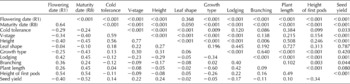
Cold tolerance was scored for the early planting date and has a clear positive correlation with V-stage (r= 0.59) and plant height (r= 0.56) at the end of June (Table 2). Remarkably, both traits were negatively correlated with maturity (r= − 0.40 and r= − 0.45 respectively): cold tolerant and early-maturing genotypes had thus on average a better vegetative development at the end of June.
Seed yield per plant (measured in single row plots) had a negative correlation with flowering date and maturity date (Table 2; r= − 0.40 and − 0.52, respectively). The height of first pods was, as expected, associated not only with the plant length at harvest (Fig. 1; r= 0.49); but also with the flowering date and maturity date (r= 0.54 for both observations). Remarkably, plant height at the end of June and plant length at harvest were not correlated: r= − 0.05 (P= 0.508). This lack of correlation is due to the presence of genotypes with a determinate and semi-determinate growth habit: vegetative growth of determinate plants is inhibited when the plants start to flower (from July onwards), while indeterminate plants keep growing during the flowering period.
Most varieties and breeding lines clustered together in the right-bottom part of the biplot (Fig. 1). They were associated with high cold tolerance and good vegetative development (V-stage and plant height) and a better seed yield per plant.
During the field trial, some genotypes showed symptoms of white mould (Sclerotinia sclerotiorum) and downy mildew (Peronospora manshurica), but the most important disease was soybean mosaic virus (SMV).
Cluster analysis revealed an optimal number of seven clusters, based on silhouette plots and Wilks' Lambda. These seven clusters grouped similar ‘plant types’ in the whole dataset and showed ranges of the measured characteristics (Table 3; Table S2, available online). Several clusters exhibited interesting characteristics for parent selection. The first two clusters comprised the majority of genotypes with black or brown seeds. Cluster 1 contained early-maturing genotypes (situated in the left-upper corner of Fig. 1). These genotypes have a determinate growth type and are among the shortest of this evaluation. As expected, they have good scores for lodging. Cluster 2 contained late-maturing and indeterminate genotypes with long plants and the highest first pods. Cluster 3 contained very late maturing genotypes with a high amount of mould-infected seeds and high scores of lodging. Cluster 4 contained most varieties and represents the most desirable plant type: early flowering, high cold tolerance, good vegetative development, high seed yield and a low fraction of mould-infected seeds and plant with green stems. A disadvantage is the low height of first pods. Cluster 5 has interesting seed yield potential. Cluster 6 contains most varieties of the later maturing genotypes. These genotypes have a good vegetative development and combine a indeterminate to semi-determinate growth type with average scores for lodging. Cluster 7 comprised late-maturing moderate-branched genotypes with the lowest score for cold tolerance and high fractions of mould-infected seeds, together with suboptimal scores for lodging.
Average agronomic characteristics of the seven clusters, based on a PAM clustering analysis with 325 soybean genotypes (early planting date: 16 April 2013; late planting date: 7 May 2013)

DOY, day of the year.
a Number of varieties in the cluster/total number of genotypes in the cluster.
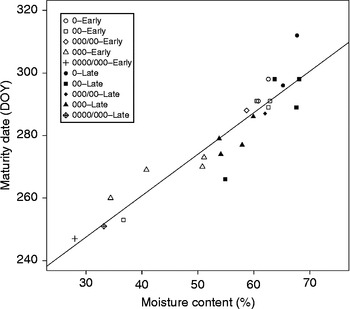
We determined the moisture content of 12 varieties on 19 September 2013 (Fig. 2). The maturity date (R8) of the earliest variety was 4 September 2013 for the early planting date, but its moisture content was 28% as on 19 September, too high for harvest. There was a very good correlation between the moisture content and the observed maturity date (r= 0.93, P< 0.001). Most varieties had a moisture content that reflected well their maturity group rating, except for one variety of MG00 that rather belonged to MG000.
Maturity date in relation with moisture content at day 262 (19 September 2013). The legend mentions the different maturity groups and the planting dates (early planting date: 16 April 2013; late planting date: 7 May 2013). DOY, day of the year.

Table 4 lists the differences between early and late planting dates. Planting three weeks earlier (16 April compared with 7 May) resulted in (on average) 8 d earlier flowering and 7 d earlier maturing. Seed yield per plant was not significantly different for both planting dates. The early-planted set was more vulnerable to lodging, contained less branches, and had a lower height of first pods and a higher fraction of mould-infected seeds (Table 4).
Average agronomic characteristics (SE) of the two planting dates (n 325 genotypes) (early planting date: 16 April 2013; late planting date: 7 May 2013)

DOY, day of the year.
Discussion
This study evaluated 409 varieties, breeding lines and genebank accessions planted at two different planting dates in a row-plot experiment to explore the genotypes suitable for growing in Belgium. It is noteworthy that the results are based on only one location in 1 year. However, the creation of a base population for further breeding asks for a wide diversity in genotypes and the aim of this study was to evaluate a high number of genotypes, rather than evaluating a limited set for 2 or 3 years and on more locations. Moreover, we wanted to exclude unsuitable genetic material by negative selection as a first stage for further breeding.
At maturity (R8), it takes normally another 5–10 d of good drying weather to harvest soybean (McWilliams et al., Reference McWilliams, Berglund and Endres2004). The optimal period for harvesting soybeans is around the end of September and the beginning of October (between day 260 and 290). Starting from the middle of October, maturation becomes more difficult because of dew in the morning and insufficient drying hours during the day. This affects the seed quality: the late-maturing clusters in Table 3 contained on average a higher fraction of mould-infected seeds compared with the early-maturing clusters.
The earliest maturing genotypes in the dataset matured at the beginning of September for the late planting date. Unfortunately, these genotypes are determinate, very short and have a low yield potential. Rosenzweig et al. (Reference Rosenzweig, Goloenko and Davydenko2003) compared MG00 cultivars in Belarus and found the best ten indeterminate accessions yielding 9% more than the best ten determinate yield accessions. Maturity was same for both the groups, but indeterminate cultivars had a higher node number and plant height and required, in general, fewer days to start flowering. Schori et al. (Reference Schori, Charles and Peter2003) preferred also semi-determinate or indeterminate growth types, because the determinate type was less performant in Swiss conditions. The determinate growth type blocks its vegetative growth after the start of flowering and thus requires minimum number of days for growth before flowering to achieve its full yield potential. The indeterminate growth type allows for an earlier start of flowering, because vegetative development can continue while flowering. Cooper (Reference Cooper2003) concluded from maximum yield experiments at Wooster, Ohio, that yield potential of soybean could be increased by the development of soybean cultivars that bloom earlier while maintaining maturity. However, an early flowering date in Belgium poses a risk for flower abscission during cold nights. In general, the moisture content of the MG000-evaluated varieties was still high on 19 September 2013, so crossings with very early-maturing genebank accessions (from clusters 1 and 4) might be necessary to reach an early MG000 rating and guarantee as such an optimal harvest in Belgian conditions. Within such crossings, care must be taken to maintain the indeterminate or semi-determinate growth habit. Another solution would be an earlier planting date (at the end of April), but there is a risk for frost injury and increased flower abscission in colder nights.
Vegetative development (V-stage and height 9 weeks after planting) was associated with cold tolerance evaluated at the early planting date and negatively correlated with flowering date and maturity date. Cluster 4 (with the majority of the early-maturing varieties) showed a good vegetative development and crossings with members of this cluster are desirable to obtain varieties with good weed suppression. Jannink et al. (Reference Jannink, Orf, Jordan and Shaw2000) demonstrated that early plant height 7 weeks after emergence is a perfect indirect selection criterion for weed suppressive ability. A good vegetative development will not only decrease the heavy dependency of soybean production on herbicides, but also generate well-developed plants that are able to give a good flowering start and the necessary photosynthetic input for seed filling. Moreover, Vollmann et al. (Reference Vollmann, Wegentristl and Hartl2010) demonstrated that strong weed competition caused reduced plant height, reduced grain yield and a delayed maturity, the latter two characteristics being important challenges for Belgian soybean production. Cluster 4 could be improved for plant length (without violating maturity), lodging and the height of first pods with genotypes from other clusters.
Seed quality was mainly affected by mould infection and mottling. Mottling could be a symptom of SMV infection following stresses such as cold (Funatsuki and Ohnishi, Reference Funatsuki and Ohnishi2009). At harvest, only 13% of the seed lots with yellow seeds at harvest contained no mottled seeds, while 55% contained more than 50% mottled seeds within a seed lot. This could have been prevented by planting only clean seeds, but then problems with seed availability for several genebank accessions would have arisen.
The observed collection of genebank accessions and varieties showed a wide variation in agronomic characteristics and has potential to find genotypes adapted to the Belgian conditions. Crossing the current MG000 varieties with very early-maturing genotypes might be necessary to guarantee an optimal soybean harvest, but one should take into account the tight link between early maturity and the less desired determinate growth type.
Supplementary material
To view supplementary material for this article, please visit http://dx.doi.org/10.1017/S1479262115000180
Acknowledgements
The authors are grateful for the excellent assistance in visual scoring to Geert Lejeune and the forage breeding group for careful field maintenance support.