1. INTRODUCTION
A recent paper (John Wilde Crosbie, Reference Crosbie2009) contained an examination of the development of the COLREGS from the early 19th century to the present day. This led him to conclude that the current form of the COLREGS is over-complicated and unsuited to present day conditions. Also that they should be replaced by a much simpler convention based on proposals by Commander (later Vice-Admiral) P. H. Colomb of the UK Royal Navy in the late 1800s (Colomb, Reference Colomb and Brent1866 & Reference Colomb1885) It has to be said that Colomb advocated somewhat different ideas at different stages of his career. One of these, adapted by John Wilde Crosbie (JWC) is referred to in the following sections as the Colomb/Crosbie proposal, and some of its implications are considered in this paper.
A general rule to implement the Colomb/Crosbie proposal might state that a vessel taking action to avoid collision should not pass ahead of the other vessel. Either vessel in an encounter would be permitted to take appropriate action. In a case where a vessel sees another crossing from her own starboard bow, an alteration of course to starboard to pass under the stern of the approaching ship would be appropriate action and similar to the usual action taken under the current rules. In the case of a ship which sees another crossing from her port bow, an alteration of course to port would be appropriate action under the Colomb/Crosbie convention but this would be quite different to the requirement to maintain course and speed under the current rules.
Clearly, there is a possibility in either of the above situations that, if each ship attempts to pass astern of the other, their actions might cancel and there would be a renewed risk of collision. However, for reasons which he explains in his paper, JWC believes that such conflicting actions would be rare and, if they should occur, they could easily be resolved.
JWC bases his conclusions on an analysis of COLREG developments and the views of commentators, particularly in the UK during the 19th century, when the COLREGS first became properly formalised. He provides no experimental evidence to support his arguments, but the present author is reminded of the results of some radar simulator trials he conducted some thirty years ago. These results have never been published but, since they shed light on the possible acceptability of JWC's conclusions, they are reported in the following sections of this paper.
2. EXPERIMENTAL DESIGN
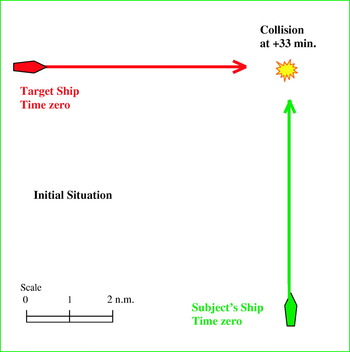
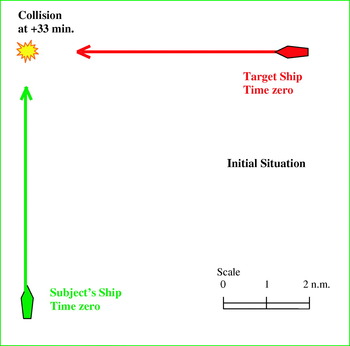
In this section, two radar simulator experiments are described. In the first, each subject was presented with a situation in which a “target vessel” was approaching from the port bow of the subject's “own ship” (see Figure 1). The target vessel's course was at right angles to the own ship's course. The own ship's full speed was 15 knots, but it was initially set at half speed of 10 knots. Collision would occur after 33 minutes if the subject took no action. The second experiment presented each subject with a similar situation except that the target ship was approaching from the own ship's starboard bow (see Figure 2).
Experiment 1 – Port bow threat.

Experiment 2 – Starboard bow threat.

In every case, the collision avoidance action taken by the subjects could be allocated to one of three categories: Alteration of course to starboard, alteration of course to port, or change of speed only. These categories are abbreviated to “Stbd”, “Port” and “Speed” respectively in the tables of Section 3. Most of the subjects were mariners with at least six years of watchkeeping experience. There was also a smaller “control group” of naïve subjects with no seagoing experience and no knowledge of the COLREGS.
Separate analyses were conducted for the two experiments and for each of the experienced and naïve groups of subjects. That is, four analyses in all. In every case, a χ2 test was used to find whether there was evidence that subjects had significant preferences amongst the three categories of action defined above. The null hypothesis was an equal probability that the subjects would choose any of the three categories of action. The alternative hypothesis was that this would not be the case. A 0·05 level of significance was considered sufficient to reject the null hypothesis. The results are summarised in Section 3, below.
3. ANALYSES
3.1. Port bow approach, naïve subjects
Of the 15 naïve subjects who were presented with the port bow situation, the numbers observed to take each of the three categories of action appear in the first row of Table 1.
Naïve subjects, port bow threat.

Thus χ2=(O−E)2/E=38/5=7·6. This is greater than χ2 (2, 0·05)=5·99. We therefore reject the null hypothesis and conclude there is significant evidence that the subjects prefer some manoeuvres rather than others. In this case, they clearly prefer alterations of course to port rather than alterations of course to starboard, and this provides some justification for describing an alteration of course to port as a “natural” manoeuvre in the given situation.
3.2. Starboard bow threat, naïve subjects
Of the 14 naïve subjects who were presented with the starboard bow situation, the numbers observed to take each of the three categories of action appear in the first row of Table 2.
Naïve subjects, starboard bow threat.

Giving χ2=(O−E)2/E=40·7/4·7=8·7. This is greater than χ2 (2, 0·05)=5·99. We therefore reject the null hypothesis and conclude that there is significant evidence that the subjects prefer some manoeuvres rather than others. In this case, alterations of course to starboard are preferred to alterations of course to port. As before, this provides some justification for describing alterations of course to starboard as “natural” manoeuvres in the given situation.
3.3. Port bow approach, experienced subjects
Of the 23 experienced subjects who were presented with the port-bow situation, the numbers observed to take each of the three categories of action appear in the first row of Table 3.
Experienced subjects, port bow threat.

In this case, χ2=(O−E)2/E=4·7/7·7=0·61. This is less than χ2 (2, 0·05)=5·99. We therefore accept the null hypothesis and conclude that experienced subjects do not have a preference among the three categories of action. In particular, there is no evidence to suggest that they prefer alterations of course to starboard rather than alterations of course to port in the given situation.
3.4. Starboard bow approach, experienced subjects
Of the 24 experienced subjects who were presented with the starboard bow situation, the numbers observed to take each of the three categories of action appear in the first row of Table 4.
Experienced subjects, starboard bow threat.

And χ2=(O−E)2/E=338/8=42·2. This is greater than χ2 (2, 0·05)=5·99. We therefore reject the null hypothesis and conclude that there is significant evidence to suggest that experienced subjects have a preference among the three categories of action in this type of encounter. It is clearly a strong preference for alterations of course to starboard.
4. INITIAL RESULTS
4.1. “Natural” manoeuvres
In Sections 3.1 and 3.2, naïve subjects, with no knowledge of the COLREGS, altered course to port for a threat on their port bow and altered course to starboard for a threat from the starboard bow. These are consistent responses, since one situation is the mirror image of the other. Also, since it was taken by the majority of naïve subjects, we may consider these to be “natural” actions rather than responses to a set of rules.
4.2. Comparison with the COLREGS, port bow threat
In the case of a vessel approaching from a subject's starboard bow, the natural action is in accordance with the COLREGS. In the case of a vessel approaching from a subject's port bow, the natural action is entirely different to that prescribed by the COLREGS. Rule 17, somewhat illogically (see also Stitt, 2002) requires the subject's vessel, (i) to keep her course and speed and (ii) if she does take action, not to alter course to port. Rule 19, which applies in restricted visibility, states that an alteration of course to port should be avoided for an approaching vessel detected by radar forward of the beam.
Experienced subjects, faced with a threat from the port bow, were equally divided between alterations of course to starboard (in accordance with the COLREGS) and alterations of course to port (in accordance with natural action and with the Colomb/Crosbie convention).
4.3. Comparison with the COLREGS, starboard bow threat
Moving on to the results for the situation where the target vessel is approaching from a subject's starboard bow, we find that both naïve and experienced subjects take similar action. That is, alterations of course to starboard.
In this situation, an alteration of course to starboard was the natural action of the naïve subjects and it is also permitted under rule 15 of the COLREGS and under rule 19 when, in restricted visibility, the approaching vessel is detected by radar. With no conflicting considerations involved, all the experienced subjects (except one who decreased speed) altered course to starboard. In doing so, they complied with both the COLREGS and the Colomb/Crosbie recommendations.
5. THE EFFECT OF EXPERIENCE
5.1. Conflict with the COLREGS
The experiments described in Section 3 above were not, originally, designed to test the Colomb/Crosbie proposals. However, as discussed in Section 4, they shed some light on how readily those proposals might be accepted by mariners. The results show that a considerable proportion of experienced mariners appear willing to take action as implied by the Colomb/Crosbie convention, even in cases where such action is clearly opposed to action prescribed by the COLREGS. Clearly, this proportion could be expected to increase if the present COLREGS were repealed.
5.2. Rapid versus slow disengagement
In many collision encounters, the navigator has a choice between an action which resolves the situation quickly but which initially involves a more rapid approach to the other vessel, and an action which gives a more prolonged disengagement and which initially decreases the rate of approach to the other vessel.
In the case of a threat from the starboard bow (as in Figure 2) a manoeuvre for rapid disengagement corresponds with both the COLREGS and “natural” action, – that is an alteration of course to starboard. As the results reported in Section 3.4 show, practically all experienced mariners take this action.
In the case of a threat from the port bow (as in Figure 1) a manoeuvre to achieve rapid disengagement, – that is an alteration of course to port, is contrary to the COLREGS. As the results reported in Section 3.3 show, experienced mariners are equally divided as to which way they alter course.
5.3. Rationale for a hypothesis
In the port bow case of Figure 1, one choice is of a safe but time consuming action of an alteration of course to starboard or a reduction of speed. The other choice is an apparently riskier, but more efficient, alteration of course to port or an increase in speed. About half of the experienced subjects took the latter choice although it was clearly not sanctioned by the COLREGS so it is of interest to speculate as to why this should be the case. A clue is perhaps provided by an observation that the novelist and aircraft designer Nevil Shute (1948) made in respect of the airman, Captain Samuelson, in his book “No Highway”:
“Like every pilot in the world, he veered instinctively away from a policy of playing safe.”
The present author, in his more introspective moments, noticed this temptation to make risky choices during his own service at sea but, not having had the universal acquaintance with every other navigator that Mr Shute apparently enjoyed with every pilot in the world, had considered it to be a personal character defect and had kept quiet about it (until now).
A more objective approach to a possible tendency of experienced subjects to take risky action may be explained in terms of behaviour theory as developed by B F Skinner (Skinner, Reference Skinner1953). This suggests that an alteration of course to port, although contrary to the COLREGS, leads to a rapid disengagement and relief from anxiety so it is reinforced on every occasion that it is successful. And since collisions at sea are rare events, it almost always is successful. On the other hand, an alteration of course to starboard may break the initial collision situation but it leads to a prolongation of the encounter and therefore a continued period of anxiety until disengagement is finally achieved and the own ship can resume its original course. If this suggestion is correct, then alterations of course to port for a threat on the port bow should be more common amongst the more experienced mariners. This was taken as the basis of a working hypothesis for a supplementary analysis.
6. A SUPPLEMENTARY ANALYSIS
6.1. Purpose
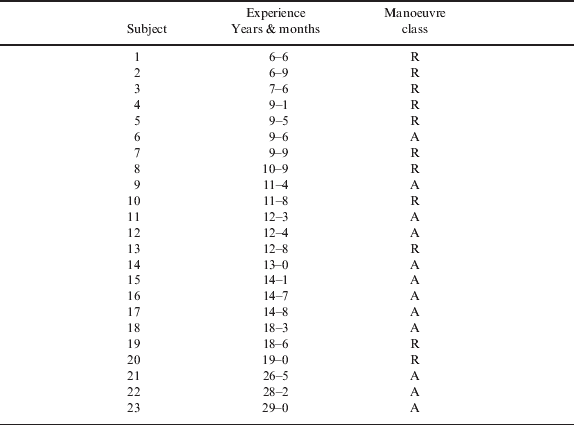
This analysis was conducted to test the above hypothesis by investigating a possible relationship between the actions taken by mariners and their respective lengths of experience. For this purpose, their actions were divided into two groups according to whether they were in conformity with the restricted visibility COLREGS (rule following) or in conflict with the COLREGS (rule averse).
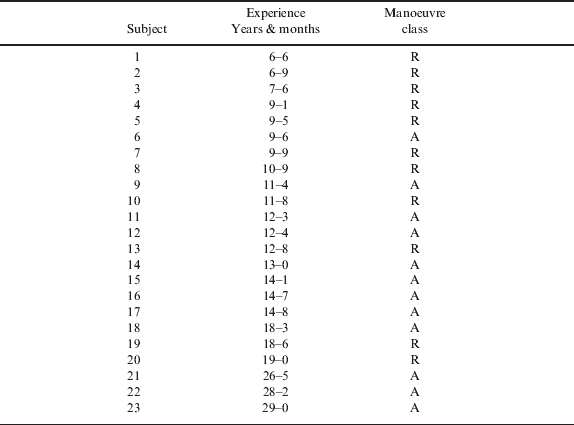
In the port bow approach, this corresponded to a choice between a safe manoeuvre that would prolong the encounter (alteration of course to starboard or reduce speed) and a riskier manoeuvre that would resolve the encounter quickly (alteration of course to port or an increase in speed). In Table 5, the type of manoeuvre chosen is tabulated against the length of experience of 23 subjects. A Rule–following alteration of course to starboard or reduction of speed is coded as “R”. A rule-Averse alteration of course to port or increase in speed is coded as “A”.
Experience v. Manoeuvre Class.
6.2. Analysis
In order to analyse the data in Table 5, we note that, because of wastage amongst younger mariners, experience within a random group is likely to be highly skewed rather than normally distributed. Also the effect of experience on a mariner's behaviour is unlikely to be linear. For example, the second ten years of a mariner's experience is likely to have less effect on his behaviour than the first ten years. This implies that means and standard deviations, calculated arithmetically, may not be reliable statistics in the context of this analysis.
Of the available non-parametric methods of analysis, the Mann-Whitney U test seems appropriate because it is reasonable to expect that the effect of experience, although not linear with years, is nevertheless a continuum which increases as the length of service increases. The test depends upon ranking but not on an interval scale and, since it does not assume a particular distribution, it appears to be valid for the present analysis. Loss of power in the Mann-Whitney U test as compared with a Student's “t” test is accepted in return for its greater generality.
For the purpose of this test, we set up the null hypothesis that a subject's tendency to take either “A” or “R” class action is not affected by his length of experience. The alternative hypothesis is that, with increasing experience, he becomes more likely to take “A” class action than “R” class action. From Table 5, we note that 11 subjects took actions of class “A” and 12 subjects took actions of class “R”. The value of the Mann-Whitney U statistic is calculated as 26. This is less than 28, the value for a one tailed test at a 1% level of significance. We therefore reject the null hypothesis and accept the alternative hypothesis that, as experience increases, mariners are more likely to choose actions that resolve an encounter quickly. Typically, they are more ready to alter course to port for a threat from the port bow.
7. DISCUSSION
7.1. Manoeuvre risk and effectiveness
Although the results show that the more experienced mariners are inclined to alter course to port for a threat on their port bow, it is necessary to consider the safety aspect of such action. Clearly, there is a risk that a subsequent alteration of course to starboard by the target ship would recreate a risk of collision. With this in mind, it is instructive to remind ourselves of Colomb's thinking in this matter (Colomb, Reference Colomb and Brent1866, Reference Colomb1885). As noted previously, he modified his views from time to time during the course of his career, but he always considered it right to alter course to port for a threat from the port bow. His dislike of an alteration of course to starboard was because it could expose the whole length of one's own ship to the oncoming threat, thus increasing the risk of collision. An alteration of course to port, on the other hand, would turn one's own ship end on to the approaching threat, thus decreasing risk of collision.
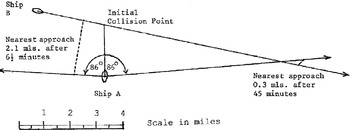
In Colomb's view, turning to port also results in a more effective manoeuvre, giving a greater miss-distance and a more rapid disengagement as compared to an equivalent alteration of course to starboard. Colomb claimed that, in response to a threat from the port bow, an alteration of course to port would be seven times more effective than an alteration of course to starboard. It is not clear from where Colomb conjured the magic number of seven, but Figure 3 illustrates the kind of situation he might have had in mind. The own ship (A) is proceeding at 10 knots with 2 miles to go to the collision point. The target ship (B) is proceeding at 12·5 knots with 2·5 miles to go to the collision point.
Port versus Starboard course change.

In the circumstances of Figure 3, an alteration of course to port by 86 degrees (as compared to a similar alteration of course to starboard) would result in a miss distance seven times greater, a time to closest point of approach seven times shorter, and a deviation from track seven times less.
7.2. Applicability of the experimental results
As noted previously, the experiments described in this paper were not intended specifically to test the Colomb/Crosbie proposals. A limitation is that, since they were conducted in a radar simulator, the experiments all assumed restricted visibility. The applicable COLREG was therefore Rule 19. Having said that, it is a considerable advantage if action taken in restricted visibility is compatible with that taken in good visibility so there is no conflict if the weather suddenly clears. The actions recorded may thus be considered typical of those taken in restricted visibility and an indication of actions that might be taken in good visibility.
The view that, in restricted visibility, many collision avoidance actions are similar to those taken in good visibility is supported by Syms (Reference Syms2003) in his analysis of the results of a Nautical Institute survey.
A point of difference is that, for the manoeuvre classes used in the supplementary analysis described in Section 6, an increase in speed was included as an “A” type (rule averse/rapid disengagement) manoeuvre. An increase in speed was an option because, in the reduced visibility assumed for the experiments, a subject's ship was initially set at half speed (10 knots).
In good visibility, with a ship proceeding at its service speed, an increase in speed to pass ahead of the target vessel would not be possible. It is tempting to speculate that the 2 (out of 23) experienced subjects who increased speed to pass ahead of the target vessel would have chosen to alter course to port if they had not had the option of increasing speed. It would be of interest to confirm this, or otherwise, by an experiment using a simulator with a visual display as suggested above.
8. CONCLUSIONS
8.1. Summary
The Colomb/Crosbie proposal that a ship taking action to avoid collision should not cross ahead of the other vessel has been considered in the light of radar simulator experiments conducted by the author for a different purpose some years ago.
In the case of a threat approaching from a broad angle on the starboard bow (Figure 2) it was found that an alteration of course to starboard was the favoured manoeuvre. This was compatible with both the Colomb/Crosbie proposal and the current COLREGS in both clear weather and restricted visibility. It was also the favoured manoeuvre of the naïve subjects with no seagoing experience and no knowledge of the COLREGS.
In the case of a threat approaching from a broad angle on the port bow (Figure 1) it was found that naïve subjects favoured an alteration of course to port. Experienced subjects were equally divided amongst an alteration of course to port, an alteration of course to starboard and an alteration of speed. This might be thought a surprising result in that one would have expected experienced mariners to all comply with rule 19 or rule 17 of the COLREGS and avoid an alteration of course to port.
The author's interpretation of this result is that an alteration of course to port in the circumstances of Figure 1 is an attractive manoeuvre to mariners and that they would readily accept a convention, such as the Colomb/Crosbie proposal, that allowed such a manoeuvre.
It is also of interest that, in the same situation, a manoeuvre, such as an alteration of course to port, which leads to a rapid disengagement becomes more acceptable as a mariner's experience increases.
Returning to the above observation that many experienced mariners chose to disregard Rule 17 or 19 we should not, perhaps, be too surprised since a number of commentators have, over the years, noted that mariners take a relaxed attitude to following the COLREGS. For example, Fricker (Reference Fricker1965) observed that,
The most startling factor of the (US) Coast guard analysis was the prevalent tendency of the parties to disregard the basic rules for preventing collisions.
Later, Syms (Reference Syms2003) analysed the results of a Nautical Institute survey into mariners' interpretations of Rule 19 in a hypothetical collision situation and concluded that,
Fewer than a quarter picked the correct action for both vessels to alter course to starboard.
And Belcher (Reference Belcher2002) stated that
In practice it has been found that people do not bureaucratically follow prescriptive rules, but rather utilise their own experience and stock of knowledge to adapt the rules to their perception of the reality of the situation.
Finally, Salinas (2006) found that, in relation to Rule 19d,
….. it has been clearly proved there exists complete disagreement between what the COLREGS state and what seafarers really do.
At this stage, it should be made clear that the author is not taking a position for or against the Colomb/Crosbie proposal. He is simply presenting some evidence that strongly suggests that an action taken in accordance with that proposal would be acceptable to mariners in two particular situations. Furthermore, in the case of a threat from the port bow, it would seem that the proposal would be more acceptable than the requirements of the current Rules 15, 17 and 19. The author does recommend that the Colomb/Crosbie proposal is worth further investigation.
8.2. Recommendations
Firstly, it is recommended that further tests should be conducted for the two experiments described in Sections 2 and 3 of this paper, but with the specific purpose of investigating the Colomb/Crosbie proposal and in a simulator with a daylight display.
Secondly, there are many more potential collision situations that need to be considered both for different angles of approach and for different speed ratios between the two ships. For example, when a target ship is approaching from 10 degrees on the port bow, and the own ship is 50% faster than the target ship, an alteration of course to starboard (in accordance with Rule 19) appears to be equally effective for resolving the situation as an alteration of course to port (in accordance with Colomb/Crosbie). For greater speed differentials, an alteration of course by the faster ship to cross ahead of the slower ship may sometimes be a safe and effective manoeuvre (Kemp, Reference Kemp2002).
There is a general attraction in the Colomb/Crosbie proposal that it allows the faster of two ships to take action whatever the circumstances of an encounter. Or, as proposed by Undrum (Reference Undrum2005),
…. when two ships engage in a serious collision risk, the ship with the greater manoeuvrability should perform the collision avoidance manoeuvre.
It might well be, as JWC suggests, that a Colomb/Crosbie convention would be more suited to the e-Navigation age than the current COLREGS. However, it must be recognised that adoption of the Colomb/Crosbie proposal would require such a radical change in the long accepted Rules for Avoiding Collisions at Sea that it might well be impossible to ever achieve international agreement. That might be a shame.
ACKNOWLEDGEMENT
This paper is an expanded version of a paper presented at the TransNav-09 Symposium, held at the Gdynia Maritime University from 17–19 June 2009. Permission given by the TransNav Organising Committee to use this material is much appreciated.