

Introduction
The gross tax gap is defined as the amount of true tax liability faced by taxpayers that is not paid on time. The Internal Revenue Service’s (henceforth, IRS) most recent estimates of the gross tax gap for the year 2006 are $450 billion or 16% of the true tax liability.Footnote 1 One potential avenue for reducing the tax gap is through increased spending on enforcement. However, in the budget agreement reached between the Republican-controlled House and the Democratic-controlled Senate in April 2011, funding on enforcement-related activities by the IRS was reduced by over $700 million relative to the $6 billion requested by the agency for fiscal year (FY) 2012. At the time of the bipartisan agreement reached between both chambers of Congress, Speaker John Boehner’s office released a statement on the issue: “The Obama administration has sought increased federal funding for the [IRS] … This increased funding is denied in the agreement”.Footnote 2 Episodes like these have caught the attention of pundits. In a post in The New York Times Economix blog, Bruce Bartlett, who held senior policy positions in the Reagan and George H. W. Bush administrations wrote:
Unfortunately, Republicans have been treating the I.R.S. like a political punching bag for years, cutting its personnel and restricting its ability to do its job. The number of I.R.S. employees fell to 84,711 in 2010 from 116,673 in 1992 despite an increase in the population of the United States of 53 million over that period. (Bartlett Reference Bartlett2012)
The action by the Speaker of the House alluded to in the previous paragraph would not be an isolated example of political actors attempting to influence the course of direction at the agency. In 1997 during the presidency of Bill Clinton, the IRS came under scrutiny when a series of conservative non-profit organisations like the Heritage Foundation and Citizens Against Government Waste were the targets of audits, prompting a bipartisan effort in the Senate to investigate the accusation that a political motivation was behind such audits (Mattos Reference Mattos1997). More recently, the revelation by IRS exempt organisations division chief, Lois G. Lerner, that IRS employees singled out applications from “Tea Party” groups for 501c(4) tax-exempt status for additional scrutiny has raised questions about the possibility that the President or Congress may try to alter the priorities of the agency in order to have it serve his (or their) political goals. In spite of the significant tax gap of $450 billion and the anecdotal evidence presented above that political ideology impacts the operation of the IRS, there has been no systematic examination of the extent to which partisan control influences the resources allocated to the IRS. The lack of empirical literature on the topic motivates this article. I seek to answer a number of questions: Do party ideologies matter for tax administration? Does Democratic control of the Presidency and Congress induce the allocation of more resources on tax administration and enforcement relative to Republican control? Furthermore, does the allocation of greater resources to the IRS translate to outcomes of interest such as audits?
Before seeking to answer these questions, it is worth taking a step back and asking a more fundamental question of why political actors would choose to achieve their policy goals through a change in enforcement resources rather than through an explicit change in the tax code. As Kopczuk (Reference Kopczuk2006) points out, changing the tax code typically requires politically costly tax reform, and “tax avoidance – letting well enough alone” may be all that is possible. Kopczuk’s insights suggest that it may be politically infeasible for policymakers to explicitly reduce tax rates even if they would like to reduce the tax burden on their constituents.
This insight echoes the findings of Mahoney and Thelen (Reference Mahoney and Thelen2010) who argue that in the face of the high veto probabilities that result in political gridlock, whole-scale change of existing rules (or displacement) may not be possible. Instead, such a political environment may be conducive to conversion when rules formally remain the same but are interpreted and enacted in new ways. In the context of enforcement of the nation’s tax laws, politicians desiring a lower tax burden for their constituents may achieve those goals not by reducing statutory tax rates, but by reducing enforcement and increasing opportunities for avoidance. Although reduced enforcement leading to greater opportunities for avoidance may not be the most efficient way of reducing the tax burden, that might be all that is possible given political gridlock and intense scrutiny from the media and the public on statutory tax rates.
This is the basic intuition for the current article: as significant reductions in statutory tax rates require expending valuable political capital and are unlikely to occur in the presence of gridlock, they are rare. Politicians desiring lower tax burdens on their constituents may therefore attempt to affect the level of tax collection by varying the budget of the IRS, the administrative agency in charge of tax collection and enforcement, and by altering how its resources are spread across various activities. In particular, if we assume that Republican politicians want to reduce the effective tax rate for individuals and corporations (either because of innate preferences or because that represents the views of their supporters) and if we accept the premise that it is more difficult to change the tax code (e.g. the statutory rates) than to reduce the likelihood of audits, then we arrive at a simple conclusion: Republican Presidents and Republican Congresses may try to reduce effective tax rates by reducing the likelihood of audits – potentially through starving the IRS of resources.
The article examines whether the political affiliation of the party controlling the White House, the Senate and the House affects the size of the overall IRS budget and workforce and its allocation among various activities. It finds that, over the period 1978–2010, although there is no effect of the party affiliation of the President on the overall IRS budget and workforce, party affiliation of the President makes a difference to the share of those resources that are allocated towards enforcement. Enforcement-related activity, in particular the number of criminal investigators and revenue officers is significantly higher during a Democratic Presidency. In contrast to the lack of influence of the President on budgets, it appears that Democratic control of the chambers of Congress matters for the overall level of resources available to the IRS.
Beyond the analysis of IRS resources and personnel, in an examination of audit activity, the article also finds that over the period 1978–2010, the likelihood of corporate audits are higher on average under Democratic administrations than under Republican administrations. The higher intensity of audit activity extends beyond corporate income tax returns to returns of individual income tax and estate tax.
The results in this article, taken as a whole, suggest that although the President has no significant influence on overall budgetary levels and resources, he does have a more pronounced influence on the allocation of these resources to enforcement-related activity. In so demonstrating, this article contributes to a literature in political science that has focussed on gradual change and has suggested that changes to public policy need not result from major exogenous events alone, but can also arise from small shifts that are often not easily discernible (e.g. Howell Reference Howell1992; Mahoney and Thelen Reference Mahoney and Thelen2010; Baumgartner Reference Baumgartner2013; Rocco and Thurston Reference Rocco and Thurston2014). Where it goes beyond the existing literature is in taking a quantitative lens to the study of American tax policy and in making the case that oscillating enforcement strategies between administrations can contribute to differences in tax policy even absent any formal changes to the tax code.
The article is laid out in the following sections. A brief Literature Review section offers a preview of the papers, which document the effect of politics on fiscal policymaking and the responsiveness of bureaucratic agency behaviour to political actors. The next section uses data from the Policy Agendas Project to show that changes to the tax code are on the agenda of Republican Presidents and offers anecdotal evidence that the President and Congress can actually exert control over the operations of the IRS. The following section describes the data and the empirical specifications used for testing the hypotheses of partisan influence. Having presented the data and the empirical specifications, I turn to the results on IRS budgets, personnel resources and the likelihood of an audit for various types of returns. I conclude in the last section and draw out implications for public policy more generally.
Literature review
This article relates to a broad literature that documents the effects of politics on decisionmaking in the economic realm. For example, Poterba (Reference Poterba1994) finds that in the late 1980s when regional economic downturns and increased expenditure demands led to substantial state budget deficits, political factors played an important role in the adjustment process. Deficit adjustment was much faster in states where the state house and governorship were controlled by the same party than when control was divided (see also Alt and Lowry Reference Alt and Lowry1994). Furthermore, tax increases and spending cuts were both significantly smaller in gubernatorial election years than at other times in the face of substantial state budget deficits. In addition to these political factors, state fiscal institutions also appeared to have real effects on the speed and nature of fiscal adjustment to unexpected deficits (Poterba Reference Poterba1994). Beyond noting the role of fiscal institutions and divided government in affecting fiscal policymaking, Reed (Reference Reed2006) finds partisan differences on taxes at the state level using data from 1960 to 2000. Tax burdens are higher when Democrats control the state legislature as compared with when Republicans are in control with the political party of the governor having little effect after controlling for partisan influences in the state legislature.
There is also a large body of work that examines the responsiveness of bureaucratic agency behaviour to political actors at different levels of the government and to various economic and social conditions. The literature mainly finds that bureaucratic agencies are responsive to the preferences of Presidents (Wood Reference Wood1990; Wood and Waterman Reference Wood and Waterman1991, Reference Wood and Waterman1993; Olson Reference Olson1995; Scholz and Wood Reference Scholz and Wood1998) and/or Congress (Weingast and Moran Reference Weingast and Moran1983; Wood Reference Wood1992; Olson Reference Olson1995, Reference Olson1996).
Focussing more narrowly on the issue of tax administration, few papers have looked at the question of whether political ideology matters for enforcement of the nation’s tax laws by the IRS. In an early examination of the issue, Scholz and Wood (Reference Scholz and Wood1998) look at the ratio of corporate to individual audits at the state level over the period 1974–1992 and find that the odds of corporate versus individual audits change with different Presidential administrations and increase with increased Democratic control over Congress.
Another paper that has examined the effects of political influences on tax administration is Young et al. (Reference Young, Reksulak and Shughart2001). The authors use panel data for 33 IRS districts over a 6-year period from 1992 to 1997 and find evidence that “the fraction of individual tax returns audited is significantly lower in districts that are important to the President electorally and that have representation on key congressional committees” (Young et al. Reference Young, Reksulak and Shughart2001, 201). Although the paper is relevant for our analysis, their conclusions must be tempered by a number of considerations. First, the study looks at a relatively short period from 1992 to 1997 and during 5 of these 6 years, President Bill Clinton was in the White House. Thus the evidence of executive branch pressure on the IRS could be unique to his administration. Second, during these 6 years, one party controlled both chambers. During the first 3 years, 1992–1994, Democrats controlled both the Senate and the House, whereas in the second half, from 1995–1997, control of Congress switched to Republican hands. Thus, using this limited period of time from 1992 to 1997 does not let us identify the effects that stem from controlling only one chamber of Congress independently of the effects of unified congressional control by a single party.
Compared with the literature cited above, the present work offers a number of advantages. First, it analyses changes in tax administration and enforcement over a significantly longer period of time than has been considered in any previous study. The period spanning FYs 1978–2010 analysed in the article spans three Democratic (Carter FY 1976–1980, Clinton FY 1993–2000 and Obama FY 2009–2010) and three Republican administrations (Reagan FY 1981–1988, Bush I FY 1989–1992 and Bush II FY 2001–2008). It also encompasses a number of significant political movements; for example, the Reagan revolution of the 1980s, the Republican control of the House after a gap of 40 years in 1994 following the “Contract with America”, the closely divided electoral landscape of the early 2000s and the Democratic triumph of the 2006 and 2008 electoral cycles. In addition, barring Scholz and Wood (Reference Scholz and Wood1998), which looks at the ratio of corporate to individual audits, no previous study has investigated the effect of political ideology on audit rates of corporations. Even though corporate income tax revenue averaged only around 23% of personal income tax revenue over the sample period 1978–2010, the amount of revenue obtained through audits of corporate income tax returns was over half the amount generated directly through all audits. For example, in FY 2010, of the total recommended additional taxes and penalties of $44.8 billion, $26.2 billion or a full 58% came from audits of corporate income tax returns.Footnote 3 The dominance of taxes and penalties from audits of corporations holds for the entire sample period and is not unique to 2010. For example, for 1978, the starting year of the sample period, recommended taxes and penalties from audits of corporations amounted to 53% of the $6.3 billion recommended on the basis of all audits. Thus, if one is to examine enforcement activity at the IRS and see whether political influences are operative on audit activity, audit rates of corporate income tax returns need to be at the front and centre of that analysis.
This article addresses that need by focussing on the variation in the likelihood of audits for corporations of different sizes over time for the period 1978–2010. In addition, this article analyses and finds similar effects in terms of partisan influence on audits of individual income tax returns and estate tax returns.
Tax enforcement as a tool for policy conversion
The Introduction presents the claim that sub rosa form of tax enforcement (or retrenchment) may be used by politicians as an alternative to changing the tax code. Using the terminology of Mahoney and Thelen (Reference Mahoney and Thelen2010), actors forced by the gridlocked institutional environment engage in conversion through budgetary and enforcement changes rather than engaging in displacement through changes to the tax code. However, this suggests that the actors are making a conscious choice to engage in institutional conversion. In order to convince the reader that this is plausible, I turn to the Policy Agendas Project and offer evidence on the basis of analysing the same.Footnote 4 , Footnote 5
The Policy Agendas Project State of the Union (SOTU) Address data set tabulates information on each quasi-statement in Presidential SOTU Speeches.Footnote 6 Given the time period of analysis in the article, I focus on all such speeches between 1978 and 2010 and count the number of quasi-statements made in total as well as those statements that pertain to tax policy.Footnote 7 Although the total number of quasi-statements made by Democratic Presidents during this period (6,740) is larger than the total number of quasi-statements made by Republican Presidents (4,970), Republican Presidents made 213 quasi-statements on the topic of tax policy in contrast to Democratic Presidents who made only 154 quasi-statements on this topic. The difference is accentuated when expressed in relative terms: approximately 4.3% of all quasi-statements made by Republican Presidents were on the topic of tax policy, whereas only 2.3% of all quasi-statements made by Democratic Presidents were on this topic.
Furthermore, reading each quasi-statement made on the topic of tax policy by Presidents during this period and placing it in the context of the larger SOTU address, I classify quasi-statements into three groupings: those that were in favour of tax cuts, those opposed to tax cuts and those that were neutrally disposed with respect to tax cuts. Of the quasi-statements made by Republican Presidents on tax policy, I classify 81.2% of those as being unambiguously in favour of a tax cut, whereas only 44.8% of quasi-statements made by Democratic Presidents express a similar sentiment. In contrast, 25.3% of the quasi-statements made by Democratic Presidents argue in favour of tax increases, whereas only 1.4% of all quasi-statements made by Republican Presidents call for a tax increase. These data are presented in Table 1 with notes following the table offering more details of the classification methodology adopted as well as one example of each type of statement.
Quasi-statements made by Democratic and Republican Presidents, classified based on whether they were in favour of or opposed to or neutral with respect to tax cuts

Source: Author analysis based on Policy Agendas Project.
Note: Only quasi-statements classified under topic 107 (taxation, tax policy and tax reform) and sub-topic 2009 (IRS administration) are included in the analysis above. Quasi-statements were classified as being in favour of tax cuts if the President’s position was unequivocally in favour of cutting taxes or tax rates for all groups of taxpayers. They were classified as being opposed to tax cuts if there was an explicit mention of increasing taxes or tax rates for at least some taxpayers. Finally, they were classified as being neutral with respect to tax cuts if either (1) there was no reference to cutting or increasing taxes or (2) within that single quasi-statement, there was a reference to both increasing taxes for some taxpayers and decreasing taxes for others or (3) the President simply stated facts without drawing any normative implications from that statement. One example of each type of statement is given below:
∙ Favour: I propose that we cut the maximum tax rate on capital gains to increase long-term investment [quasi-statement ID 13330 by President George H. W. Bush in his 1989 State of the Union (SOTU) address].
∙ Opposed: and we will ensure that, through effective tax enforcement, foreign corporations who make money in America pay the taxes they owe to America (quasi-statement ID 14495 by President Bill Clinton in his 1993 SOTU address).
∙ Neutral: I have appointed a bipartisan panel to examine the tax code from top to bottom (quasi-statement ID 18654 by President George W. Bush in his 2005 SOTU address).
The evidence presented above suggests that Republican Presidents have historically had tax cuts on their agenda at a higher rate than Democrats. Although this evidence of greater Republican interest in reducing taxes is a useful first step in supporting the assertions of the article, it is not sufficient. It would be also helpful to offer evidence that supports the article’s assertion that the President and Congress can actually exert control over the operations of the IRS. While a formal empirical analysis is deferred until later, the two anecdotes that follow suggest that the President has an influence on the administration of the nation’s tax laws. I also note that the Commissioner of the IRS and its general counsel are political appointees who are appointed by the President, confirmed by the Senate and can be dismissed by the President at will, unlike Commissioners who serve on independent agencies such as the Federal Communications Commission (FCC) or the Securities and Exchange Commission for fixed terms. The IRS is also a part of the cabinet under the Department of Treasury and existing research finds that agencies that are a part of the cabinet are more amenable to Presidential influence (e.g. Lewis Reference Lewis2003; Canes-Wrone et al. Reference Canes-Wrone, Howell and Lewis2008):
-
1. A quarter century ago, President Nixon tried unsuccessfully to force the IRS to “go after our enemies and not go after our friends”. Today, the practice is more subtle. Members of Congress or the White House usually attach to their referral a letter from a like-minded constituent or a news article alleging wrongdoing. The Clinton White House once referred a conservative organization that relentlessly pursued the claim that [Vincent] Foster had not committed suicide, as ruled by authorities, but was murdered. Presidential aides also forwarded a complaint faxed to President Clinton from a supporter in Beverly Hills, California, that the Western Journalism Center was engaged in a “vicious media campaign to hurt you”. The fax didn’t allege any specific tax violations. It simply noted the center was tax-exempt and “needs investigation”. The IRS audited the group, but eventually upheld its tax-exempt status. (Margasak and Solomon Reference Margasak and Solomon1999)
-
2. The Times’s David Cay Johnston reported yesterday that on Oct. 10, the I.R.S. commissioner Mark Everson told his troops to delay tax enforcement in areas affected by Hurricane Katrina – until after the midterm elections and the holiday season. Until after the elections? Mr. Everson also said that in his mind the elections were part of a continuum that ran through the holidays. That would make him the only person in the country who envisions Congressional campaigns as the start of Christmas shopping season. Mr. Everson does his agency and law-abiding taxpayers a disservice. In delaying the enforcement actions, there’s no avoiding the appearance of a political motivation. Many voters in the devastated areas are bound to be angry at President Bush and, by extension, Republicans. By easing up now, the I.R.S. avoids stoking that anger. The possibility that Mr. Everson is wielding power in ways to please his boss, President Bush, is especially disturbing given that he has courted that suspicion before. After the administration failed repeatedly this year to achieve its goal of repealing the estate tax, the I.R.S. moved to eliminate the jobs of nearly half of the agency’s lawyers who audit estate tax returns. (Emphasis added) Mr. Everson’s explanation that the employees were no longer needed was unconvincing because the agency would not release enough data for researchers to independently verify his claim. Mr. Everson needs to admit his mistakes, rather than trying to say they were not mistakes at all. And to make the I.R.S. more transparent. And to stay out of politics. (The New York Times Editorial Board 2006)
The fact that the President is able to influence the activities of the IRS, in part perhaps through his choice of a Commissioner, does not however suggest that Congress is unable to influence the agency. For example, the decision by the IRS in 1995 to cease its Taxpayer Compliance Measurement Program, which conducted exhaustive audits of about 50,000 taxpayers, was viewed widely as “bowing to the will of Congress” (Associated Press 1995). In addition to Congress’ Constitutional authority of appropriating funds for the agency, the usual tools of oversight such as hearings by standing committees and studies by congressional agencies (such as the Government Accountability Office) are available to lawmakers.
Empirical methodology and data
Having offered anecdotal evidence suggesting that questions of tax policy are on the minds of Republican Presidents and that the President and Congress can have an influence on the operations of the IRS, I describe the data and lay out the empirical methodology used in the article to document the nature of partisan influence. As I use data on IRS budgets to examine the nature of partisan influence on tax administration and enforcement, it is worth pointing out that budgets can make a difference in the ability of the IRS to enforce the nation’s tax laws, given an earlier finding that, in the case of the Food and Drug Administration (FDA) and the FCC, budgets appeared be too blunt a tool for change (Carpenter Reference Carpenter1996). The following anecdotes offer support for the claim that budgets do matter in the case of the IRS:
-
1. Increasing pursuit of offshore tax havens and the country’s wealthiest individuals and corporations is not just smart politics. History suggests it is also good policy. Thus, while the Internal Revenue Service may be unpopular with the public at large, the maxim “you need to spend money to make money” has added significance in the area of tax enforcement. (Temkin Reference Temkin2010)
-
2. U.S. tax collections may decline by $4 billion annually if the U.S. Congress cuts the budget of the tax-collecting Internal Revenue Service, according to a letter from the IRS commissioner on Monday. In a letter to congressional tax-writing committees, IRS Commissioner Douglas Shulman said steep IRS budget cuts would sap revenue collections and hamper the agency’s ability to pursue identity theft, offshore tax evasion and other fraud. (Temple-West Reference Temple-West2011)
-
3. Some folks cheer when the Internal Revenue Service’s budget shrinks … But before you join the starve-the-IRS-beast cause, keep this in mind: while recent budget cuts may have chipped away at the IRS’ collection and enforcement activities, they have also hastened a dramatic decline in taxpayer service. On Wednesday, the IRS released annual tables showing it audited just 0.96% of individual tax returns in fiscal 2013 ended Sept. 30, the lowest since 2005, and that the audit rate for those earning $1 million plus, (a particular focus in recent years), fell from 12.48% in 2011 to 10.85% in 2013. Buried on the last of nine pages of numbers was the change most likely to affect the average law-abiding Jane Taxpayer: just 60.5% of taxpayers who called the IRS’ toll-free assistance line got through to a human being last year, down from 74% in 2010 and 87% in 2004. In her 2013 Annual Report to Congress released today, National Taxpayer Advocate Nina E. Olson offered additional indicators of collapsing service and named IRS budget cuts the second biggest problem facing taxpayers (emphasis added), both because of substandard service and because, she contends (and studies she has commissioned seem to support), rotten service may lead to more tax noncompliance. (Novack Reference Novack2014)
The above anecdotes suggest that budgets matter for the operation of the IRS and therefore, the President and Congress may attempt to influence the activities of the IRS through their choice of an annual budget and how it is allocated across various activities.
Description of data
The primary source of data for this article is the annual IRS Data Books, which offer a detailed picture of the IRS’ operations. I obtain data on IRS operating costs and number of IRS personnel [full-time equivalents (FTEs)] from the Data Books. These books also provide data on the personnel resources devoted by the IRS to enforcement-related activity. However, the IRS does not break down these overall numbers to the level of individuals vis-a-vis corporations and hence the numbers pertain to resources geared towards all entities served by the IRS: individuals, corporations, estates, trusts and others.
In addition to obtaining data on IRS’ budgetary and personnel resources, I also obtain data on the number of tax returns audited and the number of tax returns filed in any given year for (1) corporations, (2) individuals, (3) estates and (4) trusts (fiduciaries) from these Data Books. A note on the availability of corporate audit data: although aggregate data regarding audit rates of corporations are available over a longer period of time, data disaggregated based on the size of the corporation (assets held) are only available for the period from FY 1978 onwards; hence, the choice of 1978 as the starting point for all our analysis. Having a breakdown of the likelihood of audit by asset class is useful because an aggregate number of audits does not distinguish between whether those audits are of the largest corporations or of relatively small corporations. The presence of disaggregated data also makes it possible to control for the fact that in any given year the largest corporations are more likely to be audited than corporations of a smaller size simply by virtue of their size.
The number of asset classes in which the IRS reports information changes from year to year. However, it is possible to construct an integrated time series for the percent of returns audited for corporations in four asset classes for the entire period from 1978 to 2010: those with assets less than $1 million, assets between $1 and $10 million, assets between $10 and $100 million, and assets in excess of $100 million. In addition, we have data on all corporations for which the size of their assets is not known.Footnote 8
The political variables included in the analysis pertain to the partisan control of the White House and the two chambers of Congress. As budgets are set by the President in conjunction with Congress, I introduce interaction variables between party of the President and control of Congress. Given multicollinearity, I am left with two dummy variables as a result of the introduction of this interaction: the first dummy variable assumes a value of 1 when Democrats control the White House and both chambers of Congress and 0 otherwise.Footnote 9 The second dummy variable assumes a value of 1 when Republicans enjoy a similar control of all three institutions and 0 otherwise. Details regarding the data sources are provided in the Appendix.
One important aspect is the choice of the appropriate lag structure in the specification. Budgets and priorities for a given FY are generally set in the prior FY. Thus audit rates, IRS budgets and personnel, and their allocation to various activities in FY t can only be ascribed to decisions reached in the previous FY (t−1), which are a function of the political environment at that point of time. The first step in setting the federal budget involves the President presenting a budget proposal for the coming FY to Congress on or before the first Monday in February. This gets debated in Congress, which is expected to complete action on a budget resolution by 15 April (Keith Reference Keith2008) followed by the preparation and passage of appropriations bills and other spending and receipts legislation before the start of the FY. Disagreements between the two chambers of Congress are resolved in a conference committee comprised of some members from the House and the Senate.Footnote 10 Although the 15 April deadline for passage of the budget resolution is frequently not met, it generally remains the case that the decisions regarding priorities for a given FY are taken in the prior FY. Hence, I consider the first lags of all exogenous variables. I provide summary statistics in Table 2.
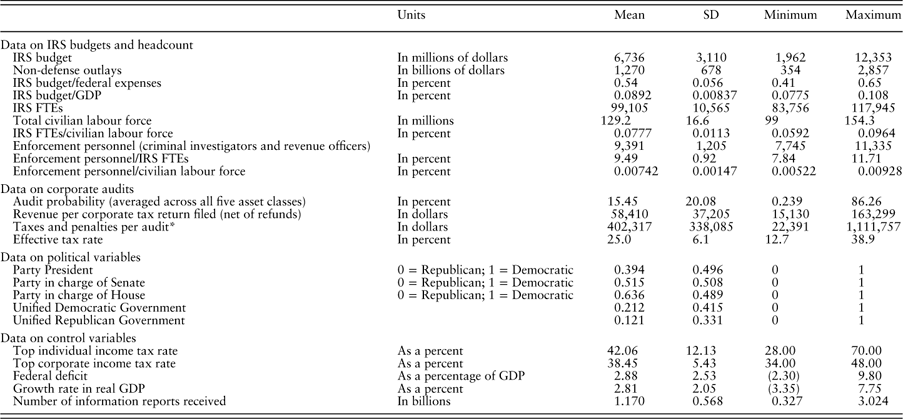
Summary statistics for the period 1978–2010
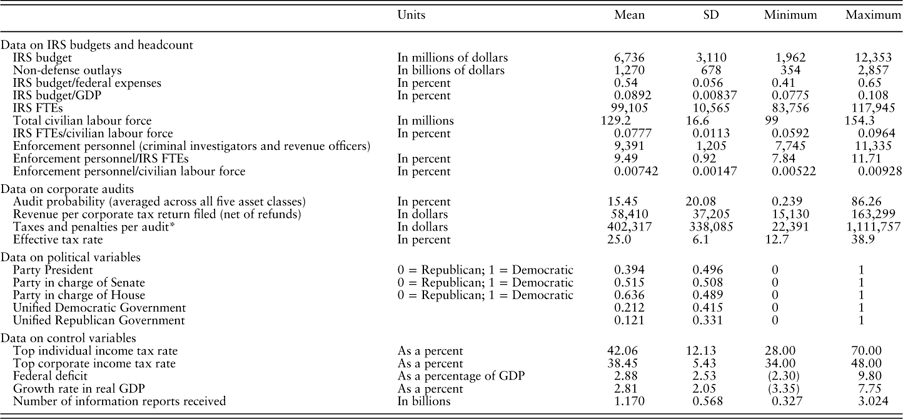
Source: Author analysis based on IRS Data Books and other sources listed in the Appendix.
* It may appear surprising that the average level of recommended taxes and penalties per audit is much higher than the average net revenue collected per return filed. This is because audit rates are significantly higher for the largest corporations and hence the “average” corporation, which is audited is significantly larger than the “average” corporation, which files a tax return.
IRS=Internal Revenue Service; FTEs=full-time equivalents; GDP=gross domestic product.
Empirical approach
Effect of political ideology on IRS resources and allocation to enforcement-related activity
In analysing the resources available to the IRS, I start off by examining the overall IRS budget for the reasons offered earlier regarding the importance of the budget in conducting the IRS’ operation. As the IRS budget has grown over time in nominal terms simply as a result of inflation, it needs to be normalised. I use different alternative approaches for normalisation. The first normalisation scales it down by a deflator that converts current dollar outlays to constant dollars. The second approach scales the IRS budget by all non-defense-related federal outlays as that ratio might better reflect the extent to which different administrations prioritise enforcement of the nation’s tax laws. Federal outlays on non-defense items are also susceptible to partisan influence similar to those on the IRS budget, whereas the size of the national economy is less likely to be affected by the political orientation of the actors involved. Thus, in the third approach, I scale the IRS budget by gross domestic product (GDP) as that gives a sense of the resources available to the IRS relative to the size of the national economy.
Given that the analysis spans a 33-year period from 1978 to 2010, it is appropriate to control for many economic and policy factors that have changed over this window. As a number of these factors are likely to be correlated with the party makeup of the Presidency and Congress, omitting these may result in overstating the identification of the effect of party affiliation on tax administration practices. To guard against that possibility, in all of the analysis that follows, I control for four factors that may independently influence IRS resources (and allocation of resources) in addition to the political party affiliations of the actors involved:
-
1. Tax rates: one consideration that may affect the allocation of resources within the IRS are tax rates. For an IRS that is simply concerned with collecting higher revenues for the federal government, the marginal gains from auditing tax returns would be higher in the presence of a higher tax rate. In addition, individuals and corporations may also have varying inclinations to under-report income depending on the tax rate they are subjected to.
-
2. Size of the federal deficit: the Tax Reform Act of 1986 (TRA’86) under President Reagan involved sizeable reductions in the statutory tax rates along with a broadening of the tax base designed such that it would be revenue-neutral. In the aftermath of the passage of TRA’86, the IRS was also provided with additional resources to close and/or detect tax loopholes as “the upshot of a concerted effort to avoid other legislated increases in taxes to meet budget deficits” (Steuerle Reference Steuerle2008, 90). Thus, it is possible that a higher federal deficit results in the allocation of more resources on enforcement in order to improve revenue collections by the Treasury.
-
3. Growth rate of the national economy: tax collections are highly responsive to the growth of the national economy and enforcement could possibly take a backseat in a situation where growth in the national economy results in buoyant revenue collections.
-
4. Changes in information reporting: changes in the amount and types of information reporting is likely to have independent, apolitical effects on tax administration practices. As information reporting becomes more and more prevalent, the need for explicit audits could reduce as the federal government acquires the ability to automatically generate notices to taxpayers in case of any discrepancies between the information provided on these reports and those in the returns filed by taxpayers. This automatic matching process has become easier for the IRS with advances in information technology and as more and more information returns are received by it in electronic rather than in paper form (IRS Data Books).
In order to deal with these potentially important influences on the resources available to the IRS, I introduce the following control variables: the top marginal tax rate on individual income, the size of the federal deficit (expressed as a percentage of GDP), the growth rate in real GDP and the number of information reports received by the government. In addition to these control variables, I introduce a linear time trend to control for any secular changes over time between 1978 and 2010. Finally, given the fact that the IRS is a cumbersome bureaucracy and resources and administrative practices are “sticky”, I introduce a lagged term that accounts for the persistence in resources from one year to the next.Footnote 11 The specification used is:
 $$\eqalignno{ IRS\,budget_{t} = \,\,& \beta _{0} {\plus}\beta _{{\rm 1}} {\times}Party\,President_{{t{\minus}1}} {\plus}\beta _{{\rm 2}} {\times}Party\,Senate_{{t{\minus}1}} \cr & {\plus}\beta _{{\rm 3}} {\times}Party\,House_{{t{\minus}1}} {\plus}\beta _{{\rm 4}} {\times}Unified\,Democratic\,Government_{{t{\minus}1}} \cr & {\plus}\beta _{{\rm 5}} {\times}Unified\,Republican\,Government_{{t{\minus}1}} {\plus}\beta _{{\rm 6}} {\times}IRS\,budget_{{t{\minus}1}} \cr & {\plus}\beta _{{\rm 7}} {\times}X_{t} {\plus}\mu _{t} {\plus}{\varepsilon}_{t} $$
In the above specification, “Party President” is a dummy variable coded 1 when a Democrat is in the White House and 0 otherwise. Likewise, “Party Senate” and “Party House” are also dummy variables, coded 1 when Democrats are in charge of the Senate and the House, respectively. The term, “Unified Democratic Government” is coded 1 when the White House and both chambers of Congress are controlled by Democrats, with the variable, “Unified Republican Government” being defined similarly.Footnote 12 X t represents the controls, µ t represents a linear time trend and ε t represents the error term, which includes all influences that are not being captured in the regression specification.
I use specifications similar to (1) when I analyse the nature of partisan influence on (a) the number of all IRS personnel or (b) the number of enforcement personnel dedicated to criminal investigation and revenue collection. In all specifications, I include the control variables laid out earlier and also introduce a lagged term to account for the persistence in the levels of the dependent variables.
Effect of political ideology on likelihood of corporate audits
Using data from the IRS Data Books, I examine the hypothesis of whether Democratic administrations and Democratic Congresses audit more corporate returns over the period 1978–2010. The specification used is:
 $$\eqalignno{ Log\,number\,of\,returns\,audited_{{i,t}} = \,\,& \beta _{0} {\plus}\beta _{{\rm 1}} {\times}Party\,President_{{t{\minus}1}} \cr & {\plus}\beta _{{\rm 2}} {\times}Party\,Senate_{{t{\minus}1}} {\plus}\beta _{{\rm 3}} {\times}Party\,House_{{t{\minus}1}} \cr & {\plus}\beta _{{\rm 4}} {\times}Unified\,Democratic\,Government_{{t{\minus}1}} \cr & {\plus}\beta _{{\rm 5}} {\times}Unified\,Republican\,Government_{{t{\minus}1}} \cr & {\plus}\beta _{{\rm 6}} {\times}Log\,number\,of\,returns\,filed_{{_{{i,}} _{{t{\minus}1}} }} \cr & {\plus}\beta _{{\rm 7}} {\times}X_{t} {\plus}\alpha _{i} {\plus}\mu _{t} {\plus}{\varepsilon}_{{i,t}} $$
where i indexes asset class. As before, in order to account for changing macroeconomic conditions and tax laws, I include controls for the federal deficit, GDP growth rate, number of information reports received, and top marginal tax rate on corporate income along with linear time trends. I also control for the log of number of returns filed in the prior calendar year in that asset class as the number of returns audited may go up with an increase in the number of returns filed. Finally, I control for the fact that corporations with more assets (e.g. assets more than $100 million) are audited at rates higher than those for corporations that have fewer assets (e.g. assets less than $1 million) through the use of asset-class-specific effects in the regression.Footnote 13
Given the possibility that patterns of audit activity are persistent over time, in an alternate specification, I introduce a lagged term for the probability of an audit for that asset class in the prior FY. In both specifications, I introduce the dependent variable, number of returns audited, in logarithmic form to reduce heteroskedasticity (Wooldridge Reference Wooldridge2008, 274). I use similar specifications to analyse the nature of partisan influence on the number of audits of returns of (a) individual income or (b) estates or (c) trusts.
Discussion of empirical specification
It is worth making a few observations regarding the choice of empirical specification. As there are 23=8 possible configurations of control of the Presidency, the Senate and the House, it is theoretically possible to introduce as many as seven dummy variables. However, in practice, over the period from 1978 to 2010, we do not observe all of the eight configurations possible in the data set.Footnote 14 Specifically, over this period, I do not find any instance in which Democrats controlled the Presidency and control of Congress was split between the two parties. Democratic Presidents either faced a Congress that was controlled by Democrats or a Congress that was controlled by Republicans. As a result, only five dummy variables representing political control of the various branches of government can be introduced in these regressions.
The second observation relates to the restrictions that are being implicitly placed on the model as a result of the choice of empirical specification. Under either specification (1) or (2), two restrictions are being imposed:
-
1. The effect of a change in control of the Presidency when Congress is split does not depend on how Congress is split (i.e. whether there is a Democratic Senate and Republican House or vice versa).
-
2. The effect of a change in control of the Senate when the President and House are split does not depend on how the President and House are split (i.e. whether there is a Democratic President and Republican House or vice versa).
These two restrictions jointly imply that:
-
3. The effect of a change in control of the House when the President and Senate are split does not depend on how the President and Senate are split (i.e. whether there is a Democratic President and Republican Senate or vice versa).
In order to lay out the hypotheses with respect to the estimated coefficients, the
 $$\hat{\beta }$$
s, I present three tables, each of which focusses on the difference that a change in control of one of the three institutions has on the dependent variable. The first table represents the level of the dependent variable for the four possible configurations of Congress and focusses on the role played by a change in control of the Presidency.
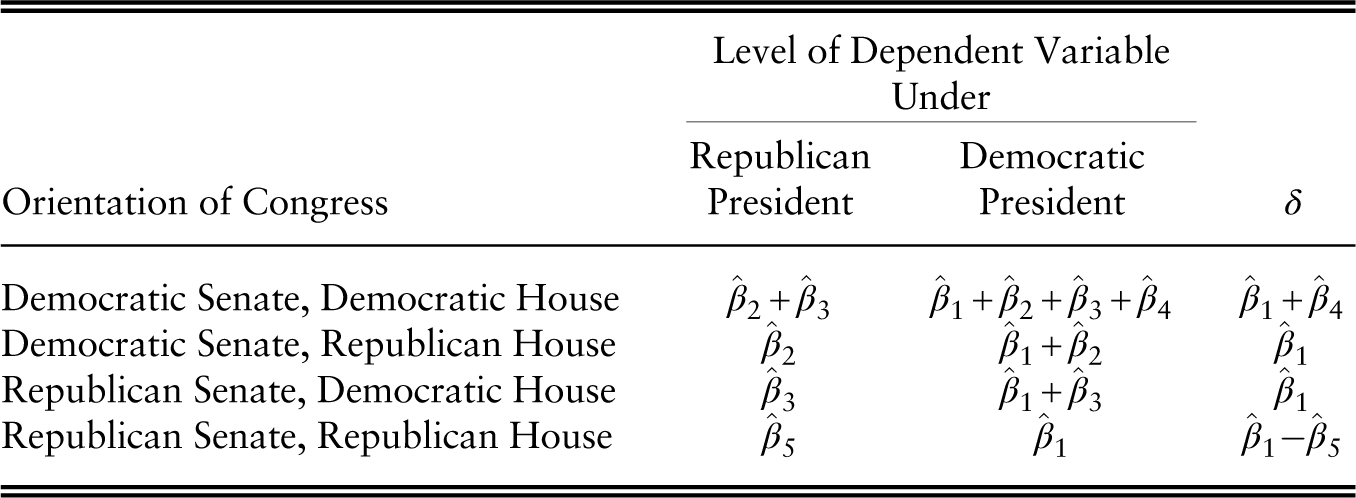
I also illustrate how the dependent variable changes as we move from a Republican-controlled Senate to a Democratic-controlled Senate for each of the four possible configurations of the Presidency and the House.
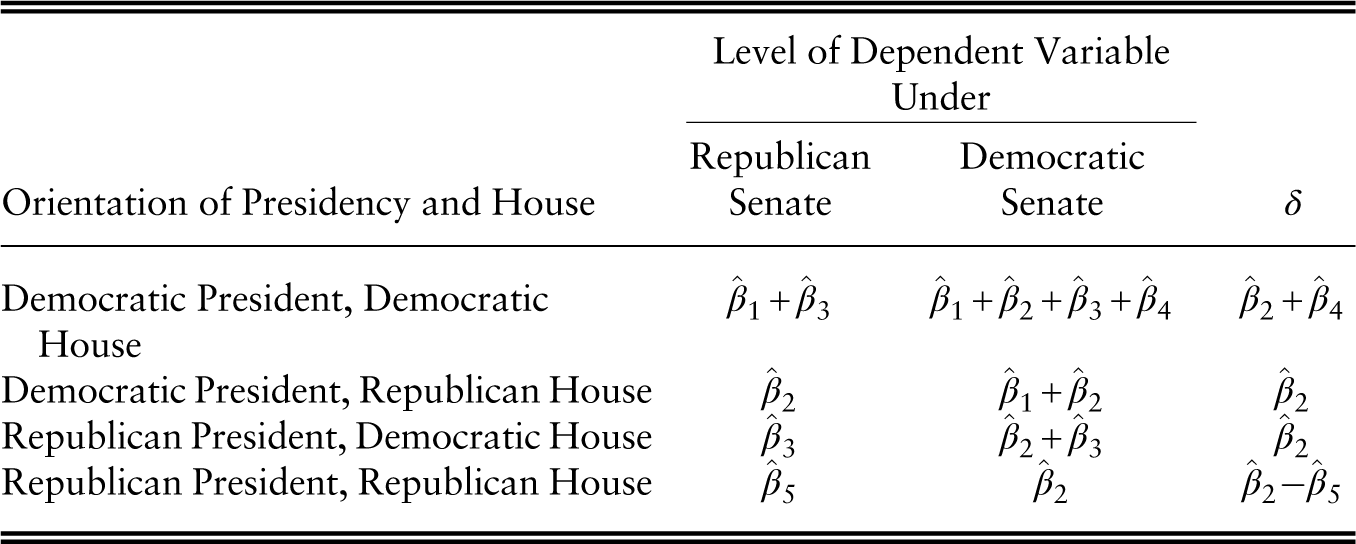
Finally, the third table illustrates how the dependent variable changes as we move from a Republican-controlled House to a Democratic-controlled House.
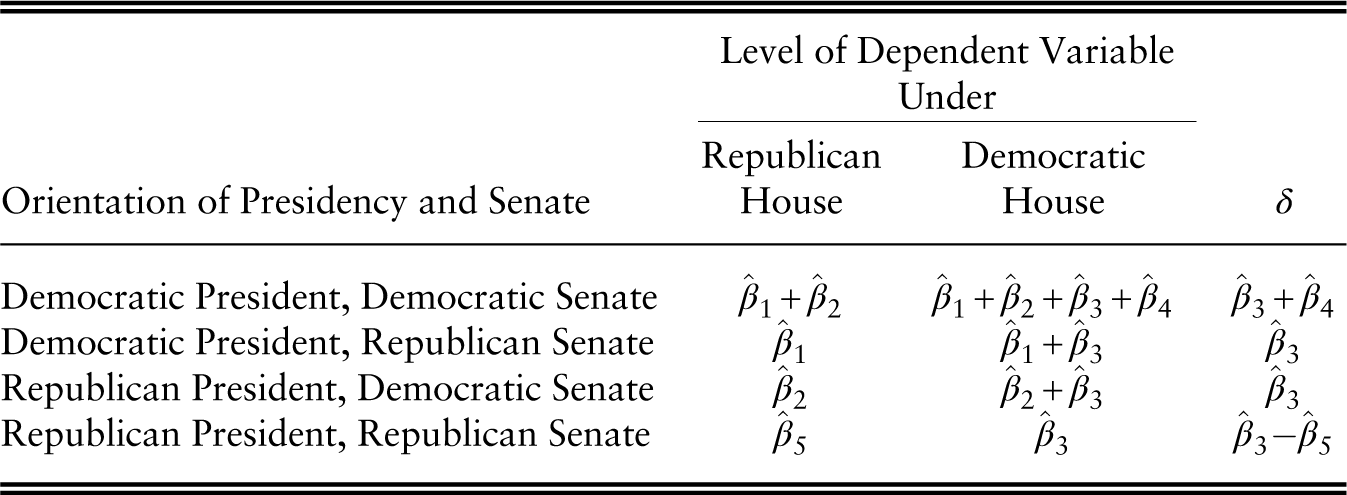
The tables above also reveal how each of the coefficients can be interpreted:
-
∙
 $\hat{\beta }_{1} $
is the effect of switching to a Democratic President holding constant that gridlock exists before and after the switch.
-
∙
$\hat{\beta }_{2} $
is the effect of switching to a Democratic Senate holding constant that gridlock exists before and after the switch. -
∙
$\hat{\beta }_{3} $
is the effect of switching to a Democratic House holding constant that gridlock exists before and after the switch. -
∙
$\hat{\beta }_{4} $
is the extra effect of any institution switching to Democratic when said switch eliminates gridlock (i.e. takes us away from a gridlocked government to a uniformly Democratic one). -
∙ −
$\hat{\beta }_{5} $
is the extra effect of any institution switching to Democratic when said switch creates gridlock (i.e. takes us away from a uniformly Republican government to a gridlocked one).


These interpretations result in the following null hypotheses for the theory:
 $\hat{\beta }_{1} $
>0,
 $\hat{\beta }_{2} $
>0,
 $\hat{\beta }_{3} $
>0,
 $\hat{\beta }_{4} $
>0 and
 $\hat{\beta }_{5} $
<0.
Results
Results on IRS budget and personnel
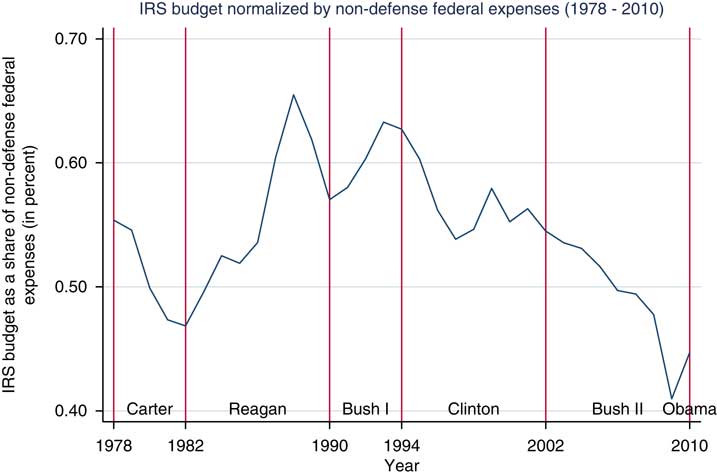
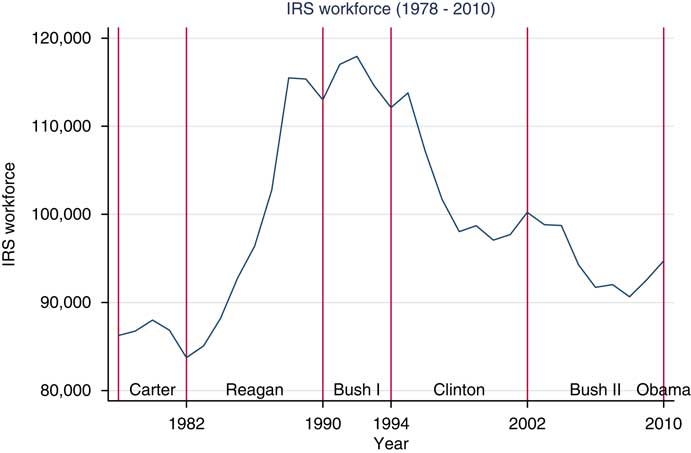
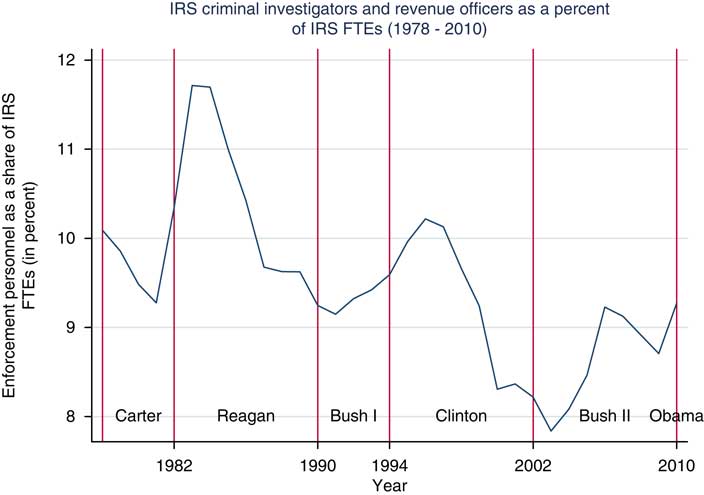
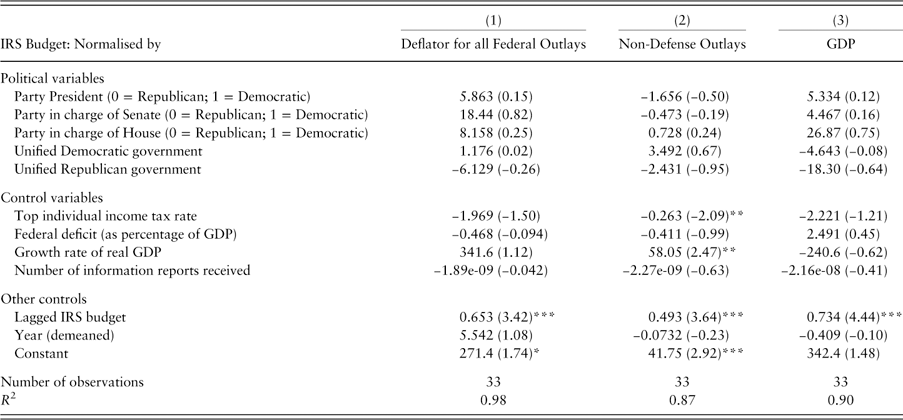
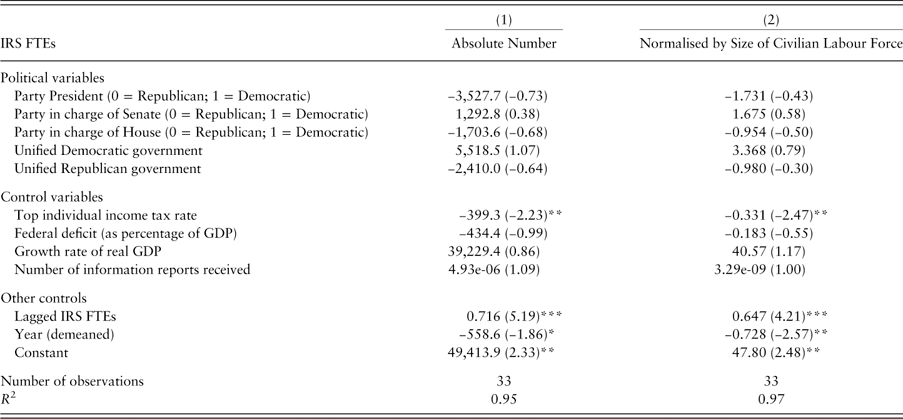
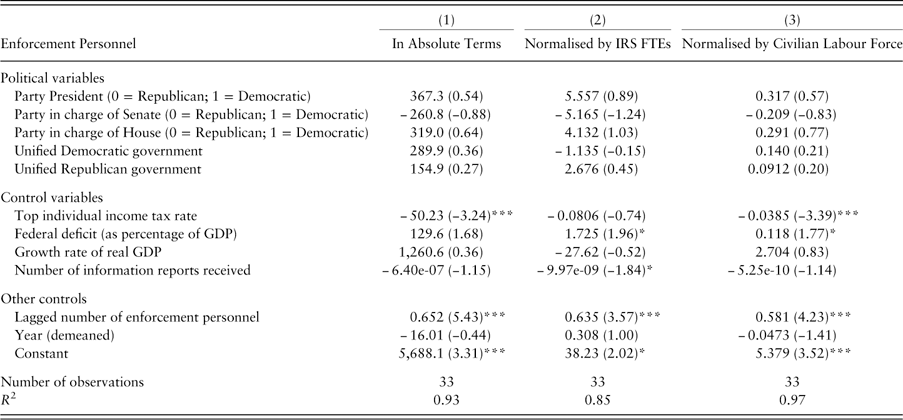
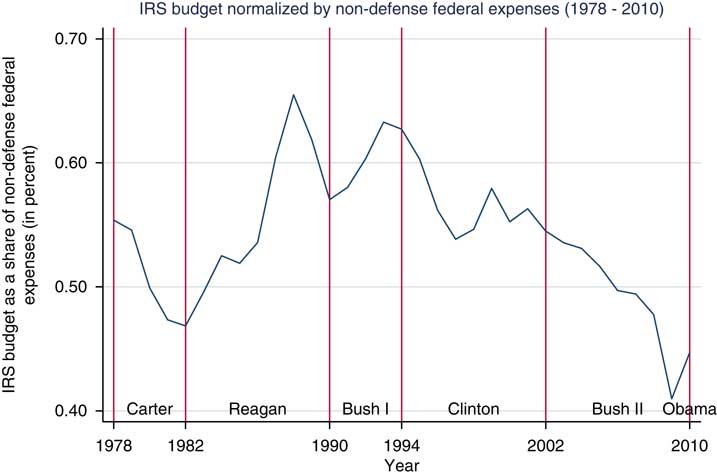
Figure 1–3 and Tables 3–5 provide the results of the analyses in which I examine variations in the IRS budget, its workforce and the emphasis on enforcement over the period 1978–2010. As was noted before, the IRS data on its overall resources or their allocation to enforcement-related activity is not broken out by individuals and corporations but includes all resources that are geared towards serving all classes of taxpayers. The dependent variables have been rescaled in Tables 3–5 so as to avoid having unnecessary zeros in the estimated coefficients. The economic and statistical significance of the results is unchanged if we avoid rescaling the dependent variable in these tables.
Internal Revenue Service (IRS) budget normalised by non-defense federal expenses (1978–2010) Source: Author analysis based on IRS Data Books.
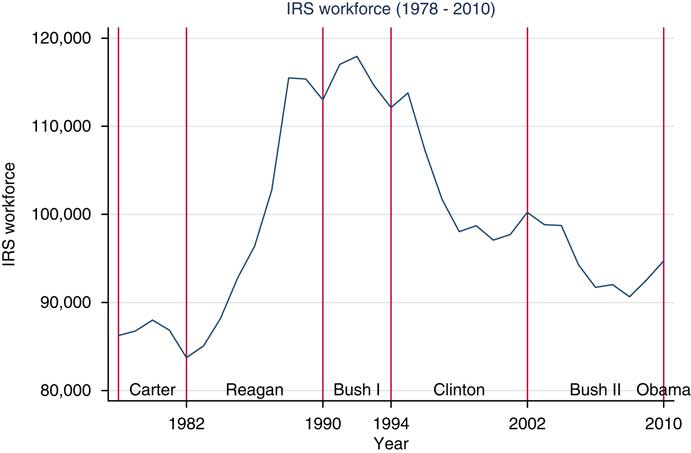
Internal Revenue Service (IRS) workforce (1978–2010) Source: Author analysis based on IRS Data Books.
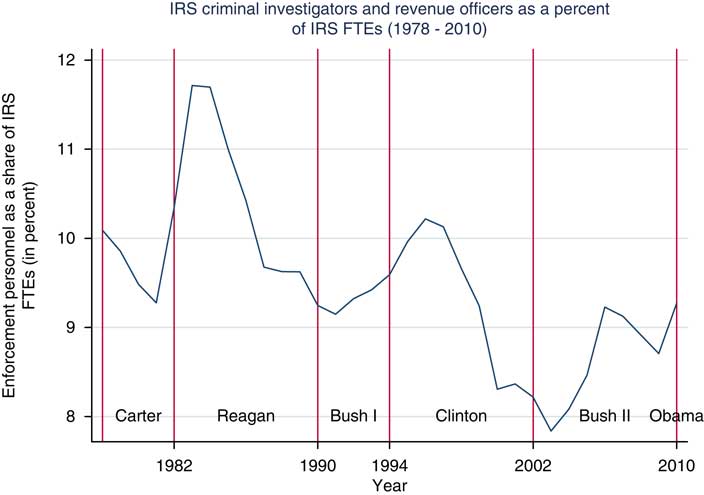
Criminal investigators and revenue officers normalised by number of Internal Revenue Service (IRS) personnel (1978–2010) Source: Author analysis based on IRS Data Books. FTEs=full-time equivalents.
Partisan influences on IRS budget over the period 1978–2010
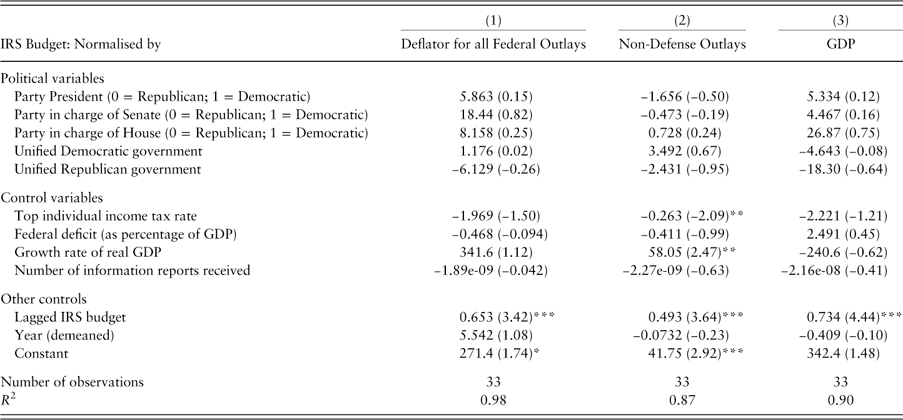
Note: Robust t statistics, reported in parentheses.
IRS=Internal Revenue Service; GDP=gross domestic product.
*p<0.10, **p<0.05, ***p<0.01.
Partisan influences on IRS workforce over the period 1978–2010
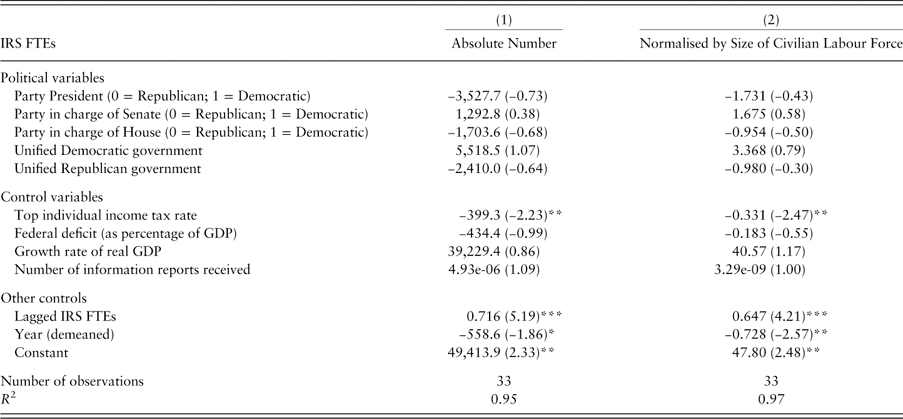
Note: Robust t statistics, reported in parentheses.
IRS=Internal Revenue Service; FTEs=full-time equivalents; GDP=gross domestic product.
*p<0.10, ***p<0.01.
Partisan influences on the number of enforcement personnel over the period 1978–2010
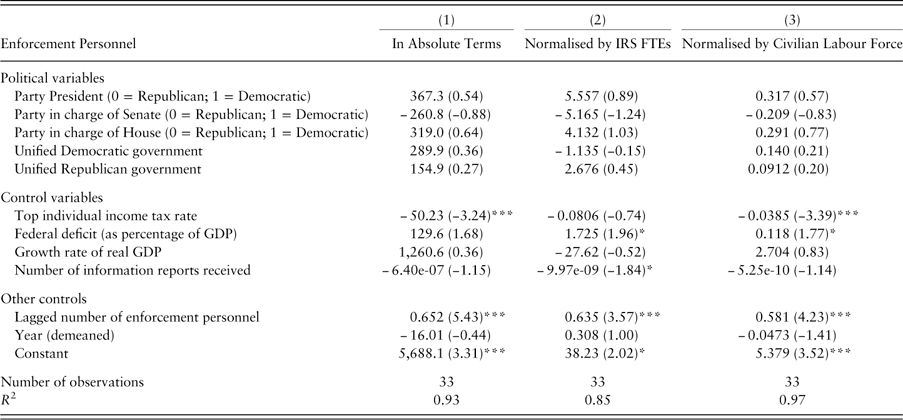
Note: Robust t statistics, reported in parentheses.
IRS=Internal Revenue Service; FTEs=full-time equivalents; GDP=gross domestic product.
*p<0.10, ***p<0.01.
Overall IRS resources
Figure 1 presents the underlying data while Table 3 presents the results of estimating specification (1) with the IRS budget as the dependent variable of interest. The IRS budget has been scaled by a deflator in column (1) that converts current dollar outlays to constant dollars, by non-defense outlays in column (2) and by GDP in column (3).
As the regression includes interaction terms, interpreting the magnitude of the effects involves looking at the straight term (e.g. coefficient on “Party of the President”) along with the interaction terms. In order to facilitate an understanding of the effect that control of the White House, the Senate and the House has on the IRS budget, I list the various configurations possible and calculate the difference resulting from a change in control of each institution. For example, using the coefficients in column (1) of Table 3, the following table enables estimation of the difference that a change in control of the White House makes to the IRS budget.Footnote 15 , Footnote 16
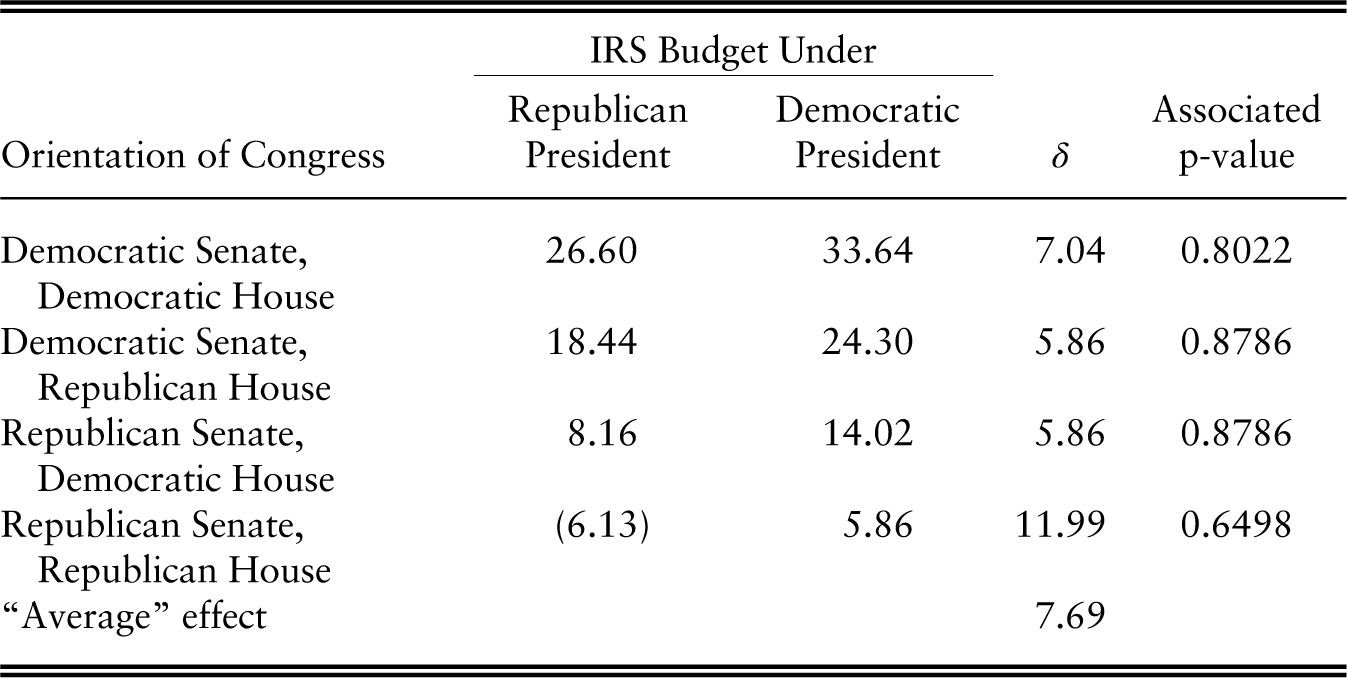
As the results in the above table suggest, party affiliation of the President does not make a statistically significant impact on the size of the overall IRS budget for any of the four possible configurations of Congress. In contrast, a table similar to the one above focussing on the role played by the Senate suggests that Democratic control of the Senate matters more in terms of raising the IRS budget.
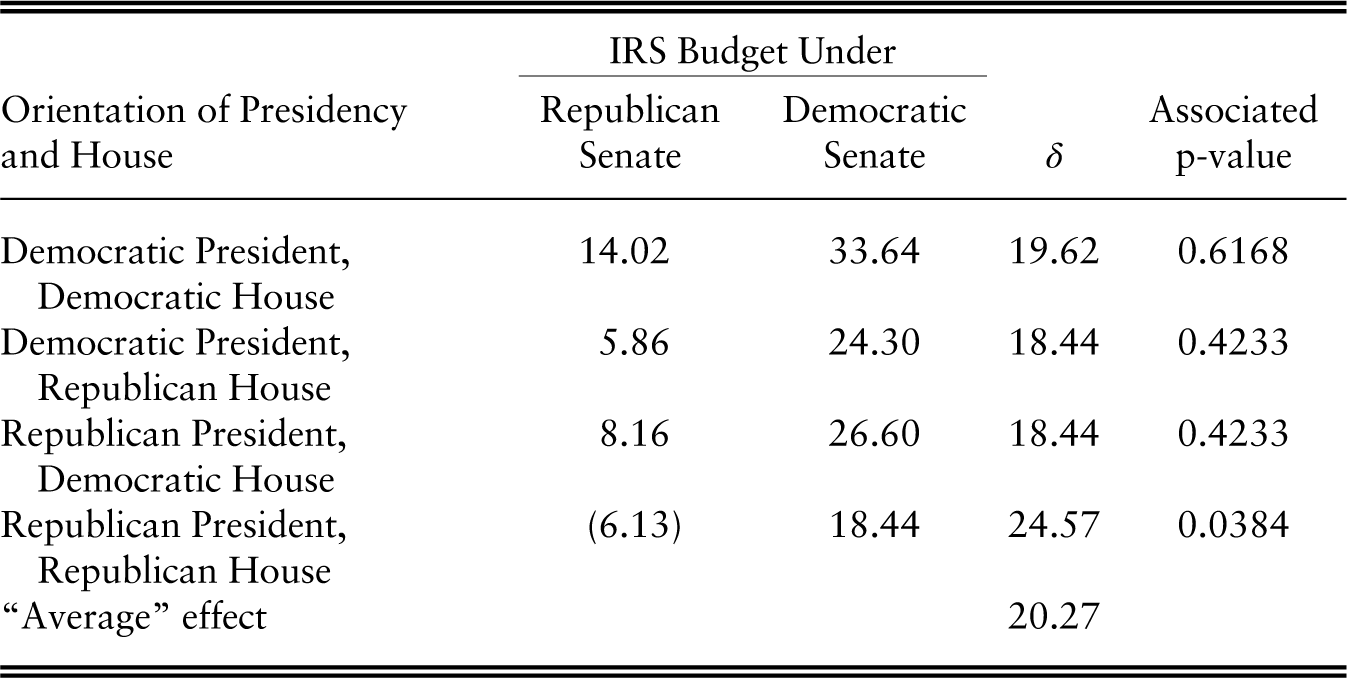
The above table suggests that when the control of the Senate switches from Republicans to Democrats, it makes a statistically significant difference to the IRS budget in one of the four possible configurations. The average value of IRS budget when deflated (and rescaled) is 831 and hence an increase of 24.57 resulting in the second to last row from a change in control of the Senate when Republicans control the Presidency and the House translates to an increase of about 3% in the IRS budget.Footnote 17
The final table hones in on the role played by the House in influencing the IRS budget.
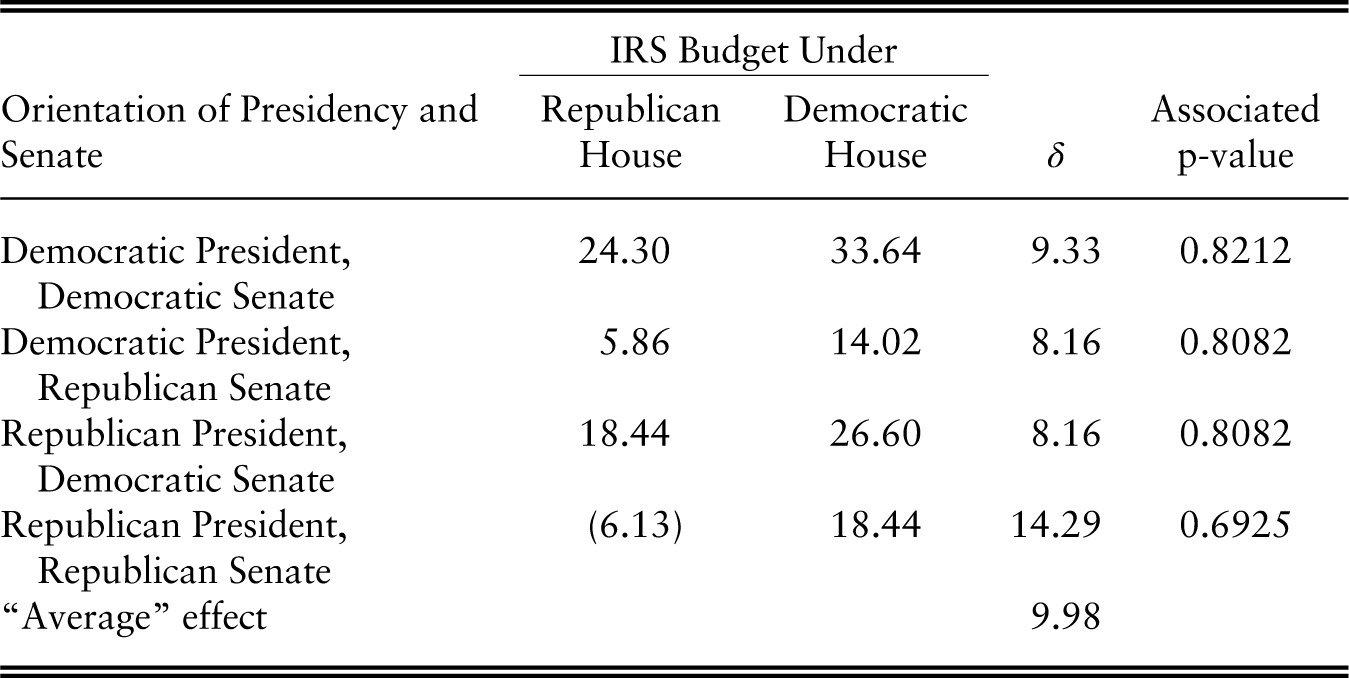
This table suggests that the House has a limited influence on the IRS budget. A switch in control of the House from Republican to Democratic hands does not make a statistically significant difference for any of the four possible configurations. However, all the four-point estimates for a change in control of the House are positive and the average effect is larger than the average calculated previously for a change in control of the Presidency.
Although the specific numbers vary based on the specification, an analysis similar to the one above using coefficients from columns (2) and (3) of Table 3 suggests that in each of those cases, control of the Presidency has little influence on size of the IRS budget relative to the control of the chambers of Congress.
A story similar to the one outlined for the IRS budget emerges from considering the size of the IRS workforce. Two approaches of looking at the size of the IRS workforce are adopted: first, I consider the raw number of personnel without any normalisation and second, I normalise the number of personnel by the size of the civilian labour force. Figure 2 presents the secular variation in the absolute number of FTEs, while Table 4 analyses the extent of partisan influence on the absolute number of FTEs and the number of FTEs normalised by the civilian labour force.
In order to understand the effect that a change in control of each institution plays in influencing the number of IRS personnel, I look at all possible configurations and calculate the difference that a change in control of each institution makes to the number of personnel. For example, using the coefficients in column (1) of Table 4, the following table enables me to compute the difference that a change in control of the White House makes to the number of IRS personnel.
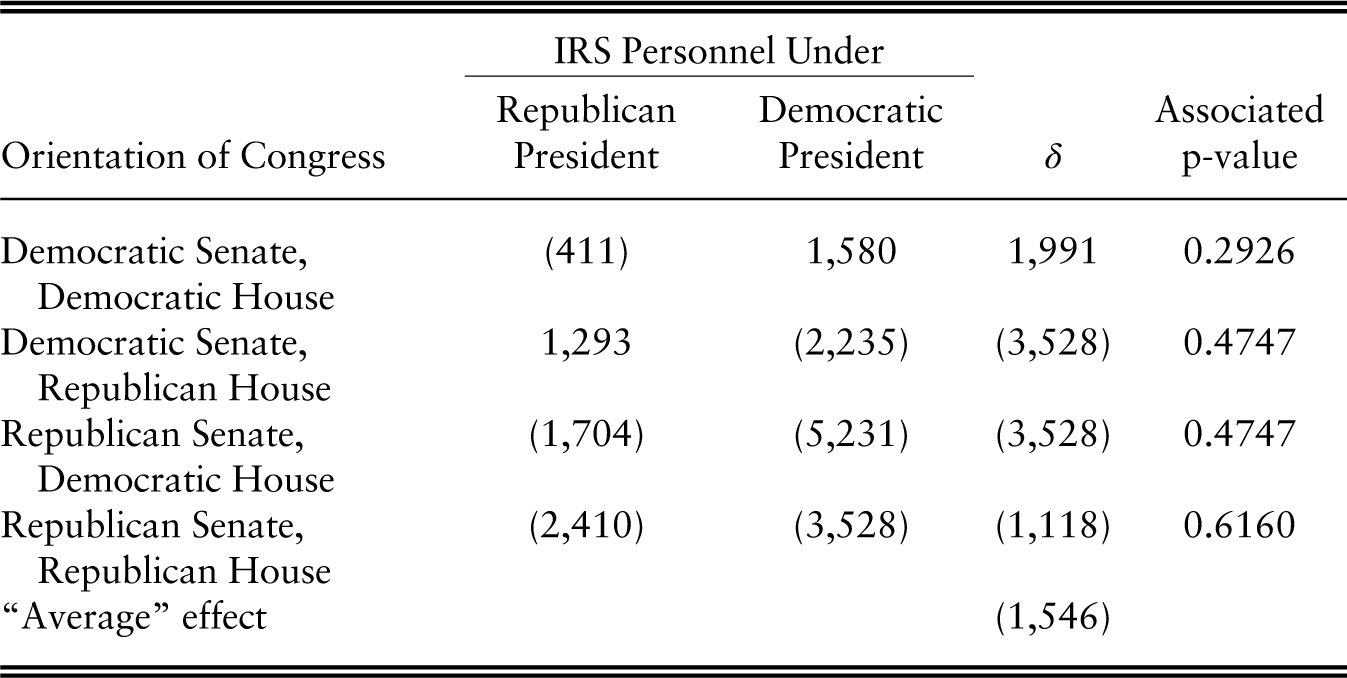
As the results in the above table suggest, party affiliation of the President appears to not make a statistically significant impact on the size of the overall IRS workforce for any of the four possible configurations of Congress. In contrast, a table similar to the above focussing on the role played by a switch in control of the Senate suggests that Democratic control of the Senate matters substantively in terms of raising the number of IRS personnel.
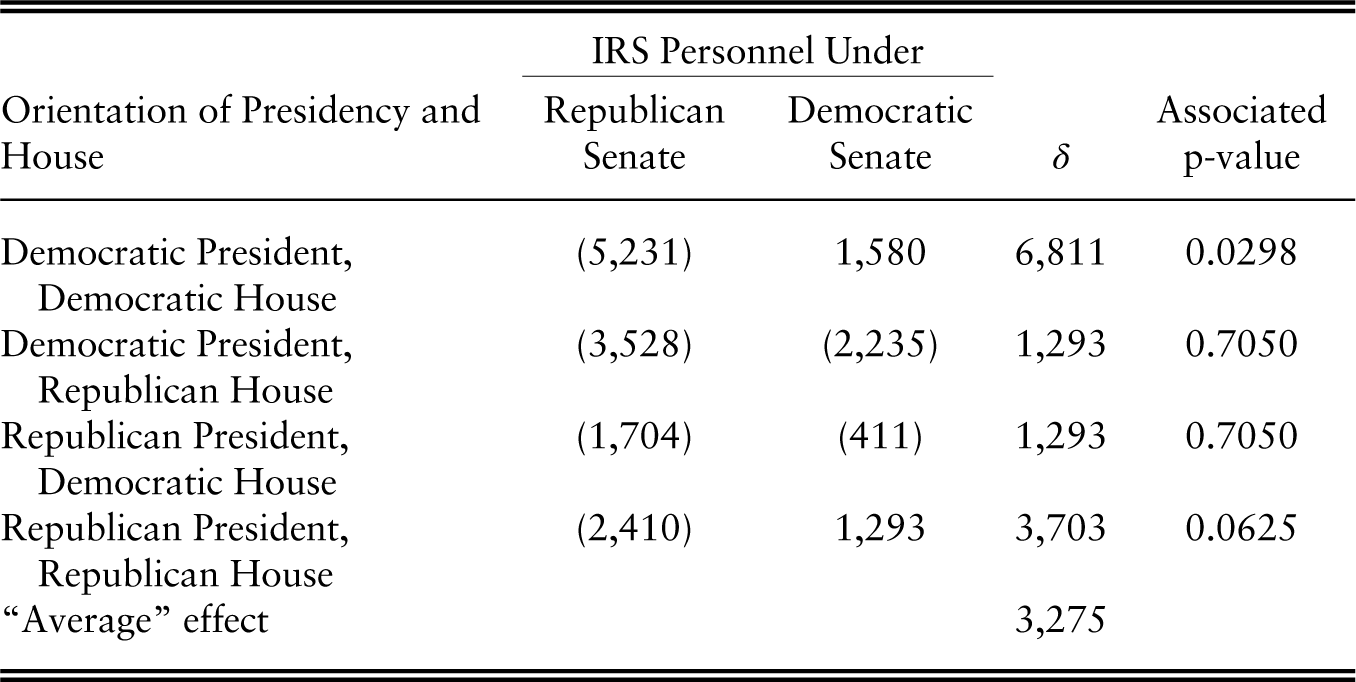
Based on the above table, it would appear that a change in control of the Senate from Republican to Democratic hands results in an increase in the number of IRS personnel, with the increase being statistically significant in two of the four possible configurations. The average number of IRS personnel over the period 1978–2010 is 99,105 and hence an increase of 3,703 resulting in the second last row from a change in control of the Senate when we have a Republican President and a Republican-controlled House translates to an increase in the size of the workforce of about 4%. This is similar in magnitude to what we observe when considering the effect of Democratic control of the Senate on the IRS budget.
The final table focusses on the role played by a switch in control of the House on the number of IRS personnel.
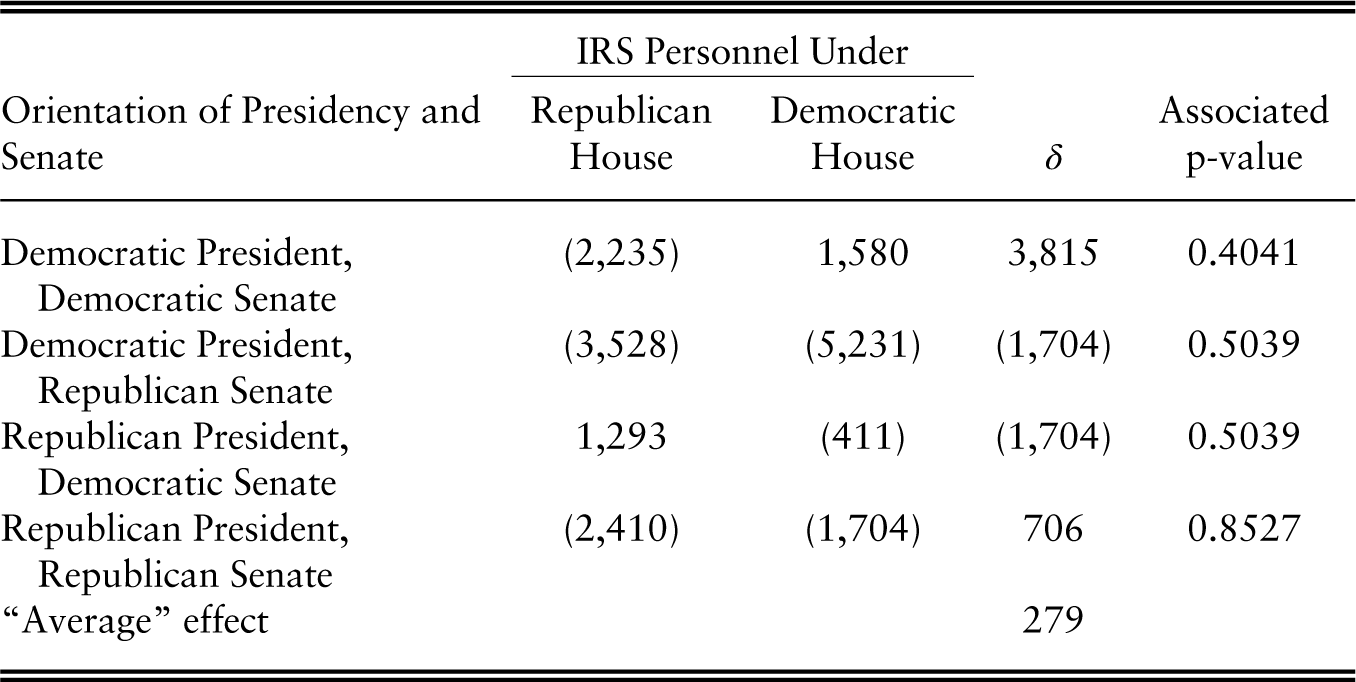
Consistent with the observations earlier, this table suggests that the House has a limited influence on the size of the IRS workforce. Although a switch in control of the House from Republican to Democratic hands does not result in a statistically significant difference in the number of IRS personnel for any of the four possible configurations, the average effect across the four configurations is positive, unlike the average effect we observe for a change in control of the Presidency. The results presented are similar if we use the coefficients in column (2) of Table 4 when the number of FTEs is normalised by the size of the civilian labour force. They suggest no Presidential influence but a considerable influence of Congress, and in particular, the Senate on the number of IRS personnel.
Thus, the picture that emerges from the results in Tables 3 and 4 and the subsequent analyses is that the party of the President has no significant influence on the overall resources available to the IRS. Congress, on the other hand, has a more significant role to play in influencing the resources available to the IRS. These observations are consistent with the findings of scholars who have noted the increased influence of Congress relative to the President in the budget-setting process following passage of the Congressional Budget and Impoundment Control Act of 1974 (e.g. Thurber Reference Thurber1988; Wlezien Reference Wlezien1994).
Allocation of IRS’ resources towards enforcement
The theoretical framework provided in the Introduction suggests that the President would choose the least-cost instrument available to him to achieve his political goals. If, as our discussions suggest, Republican Presidents would like to minimise the tax burden for individuals and corporations, then one possible way of achieving that would be to cut the overall IRS budget or workforce. However, the analysis based on the coefficients in Tables 3 and 4 suggests that Republican Presidents are not able to significantly reduce the funding level of the IRS and conversely, Democratic control of the Presidency appears not to raise the level of resources available to the IRS either.
Although the focus thus far has been on overall budgetary and personnel resources available to the IRS, examining budgets for indications of institutional change can obscure changes in the content of policy administration. A stable budget for the IRS can co-exist with significant shifts in how resources are allocated among various activities. In that case, it may not be very meaningful to look at overall resources but to look at disaggregated data to see if IRS employees are shifted from one function to another to better align with the administration’s priorities. Moreover, if administrations hire more IRS employees in order to provide high levels of customer service and be responsive to the needs of taxpayers, then the total number of FTEs may not be the appropriate measure to look at in any case. In either scenario, there will not be a perceptible change in the total number of employees but in the tasks they are assigned to and the number of returns they can audit. As my focus is on the extent to which different administrations decide to crack down on tax evasion and avoidance, in the remainder of the analysis in this sub-section, I examine whether a change in administration from Republicans to Democrats increases the resources dedicated to reducing tax evasion and improving revenue collection.
One way of looking at this question is to look at the number of criminal investigators and revenue officers that the IRS hires. Criminal investigators look into two broad categories of cases: tax violations and money laundering violations (Dubin Reference Dubin2004). The 2000 Data Book of the IRS also suggests that if we are to focus on resources devoted to ensuring tax compliance, it may be worthwhile to focus on criminal investigation:
IRS Criminal Investigation’s primary resource commitment is to develop and investigate Legal Source tax investigations. Legal Source tax investigations involve legal industries and legal occupations and more specifically, legally earned income, in which the primary motive or purpose is the violation of tax statutes: Title 26 (tax violations) and Title 18 (tax related) of the U.S. Code … The prosecution of Legal Source Tax Crimes cases is key to promoting voluntary compliance with the tax laws. (Emphasis added)
In addition to criminal investigators, I include revenue officers within the IRS in the category of personnel dedicated to enforcement activity. The role of the revenue officer is to collect taxes that are delinquent and have not been paid to the IRS and to secure tax returns that are overdue from taxpayers.Footnote 18 Therefore, Figure 3 and Table 5 examine partisan influences on the number of IRS employees that are dedicated to enforcement-related activity. As with the earlier analysis regarding IRS FTEs, I adopt a number of alternative normalisations to assure the reader of the robustness of the results. Column (1) simply looks at the raw number of enforcement personnel, column (2) normalises the number of enforcement personnel by the total number of IRS FTEs and finally column (3) normalises the number of enforcement personnel by the size of the civilian labour force.
As before, I look at all possible configurations and calculate the difference that a change in control of each institution makes to the number of enforcement personnel. For example, using the coefficients in column (1) of Table 5, I construct the following table that enables me to compute the difference that a change in control of the White House makes to the number of enforcement personnel.
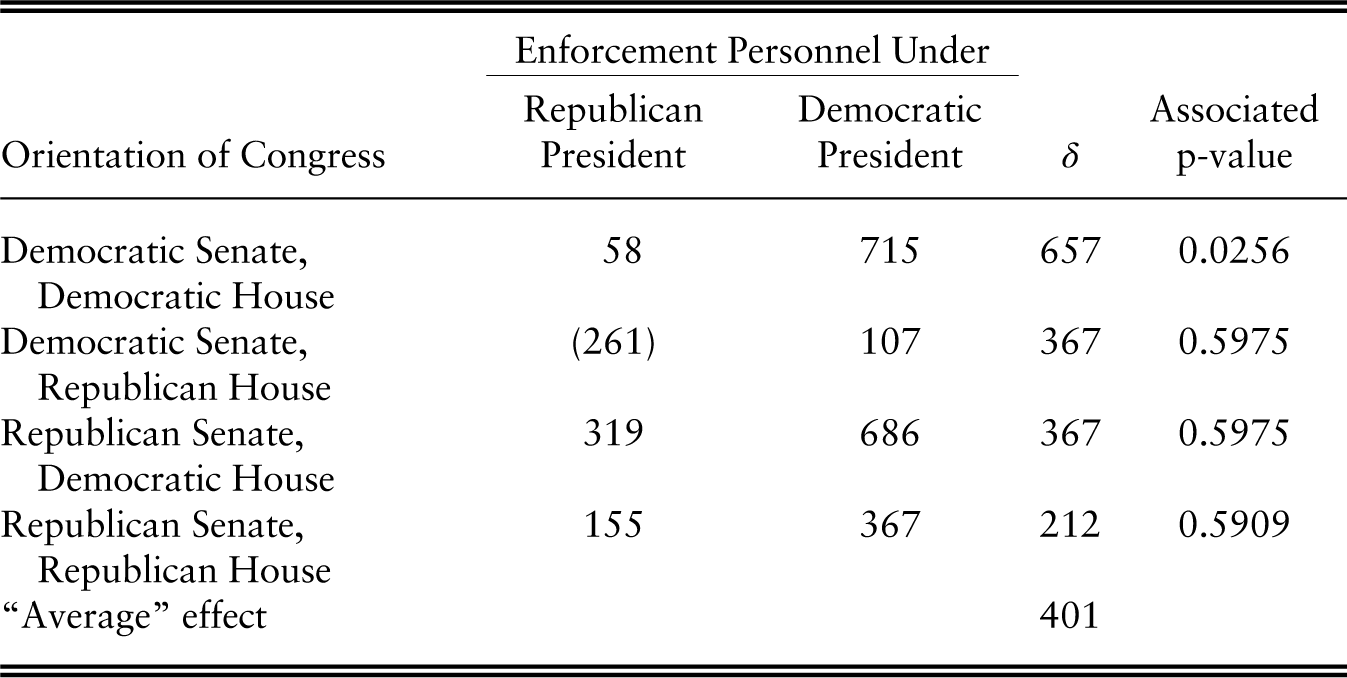
As results in the above table suggest, party affiliation of the President results in a statistically significant impact on the number of enforcement personnel when Congress is controlled by Democrats. When averaged across all four configurations of Congress, a switch in control of the Presidency from Republicans to Democrats translates to an increase of about 401 enforcement personnel. Given that the average number of enforcement personnel over the period 1978–2010 was 9,390, this represents an increase of about 4% in the number of such personnel. In contrast, a table similar to the above focussing on the role played by a switch in control of the Senate suggests that Democratic control of the Senate does not matter in terms of raising the number of enforcement personnel. The role played by the House in terms of the number of enforcement personnel is similar to the role played by the President: a change in control of the House from Republican control to Democratic control is also associated with an increase in the number of such personnel.
The picture that emerges from Figure 3 and the above analysis is that administrations of different political dispositions are perhaps able to influence the allocation of personnel to tax enforcement. These results are consistent with the framework outlined in the Introduction, which suggests that administrations prefer to choose the least-cost instrument available to them to influence policy.
Audits of Corporations
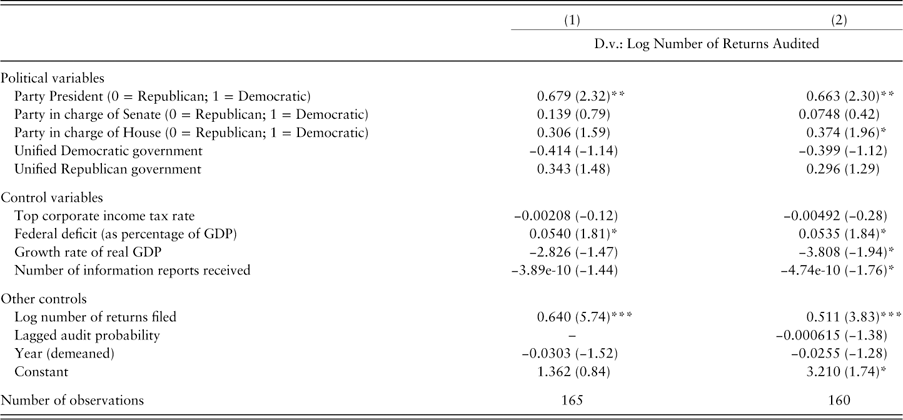
Having examined the resources available to the IRS, I present the results from the analysis of partisan influence on the likelihood of audits for all corporations for the period 1978–2010 using specification (2) in Table 6. The dependent variable in this analysis is the log of number of returns audited controlling for the log of number of returns filed in the prior calendar year. Column (1) does not introduce any lags for audit probability in the prior FY, whereas column (2) introduces a lagged term for the audit probability in the prior FY.
Partisan influences on audits of corporate income tax returns over the period 1978–2010
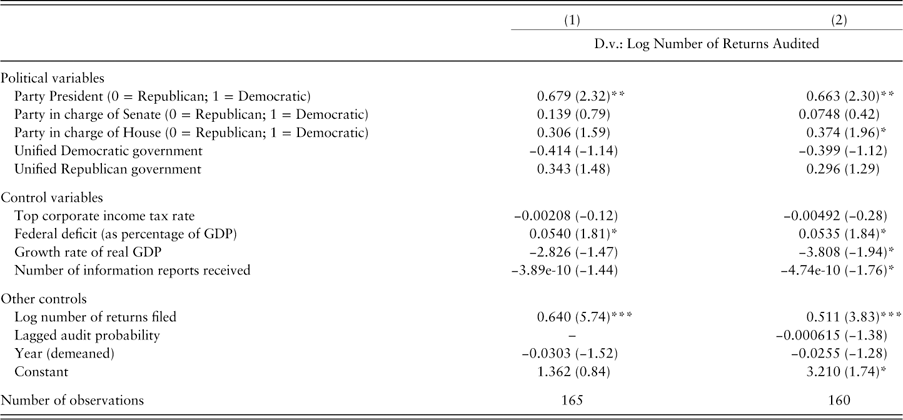
Note: t statistics, reported in parentheses. I use the command “xtreg” with random effects in Stata 13 for the estimation. The choice between a fixed effects and a random effects specification is made on the basis of a Hausman test. The p-value that the random effects specification is inconsistent is 0.6318 [column (1)] and 0.9604 [column (2)], indicating the appropriateness of a random effects specification.
GDP=gross domestic product.
*p<0.10, **p<0.05, ***p<0.01.
As before, I look at all possible configurations and calculate the difference that a change in control of each institution makes to the likelihood of an audit. Using the coefficients in column (1) of Table 6, the following table helps me compute the difference that a change in control of the White House makes to the number of corporate income tax returns audited.
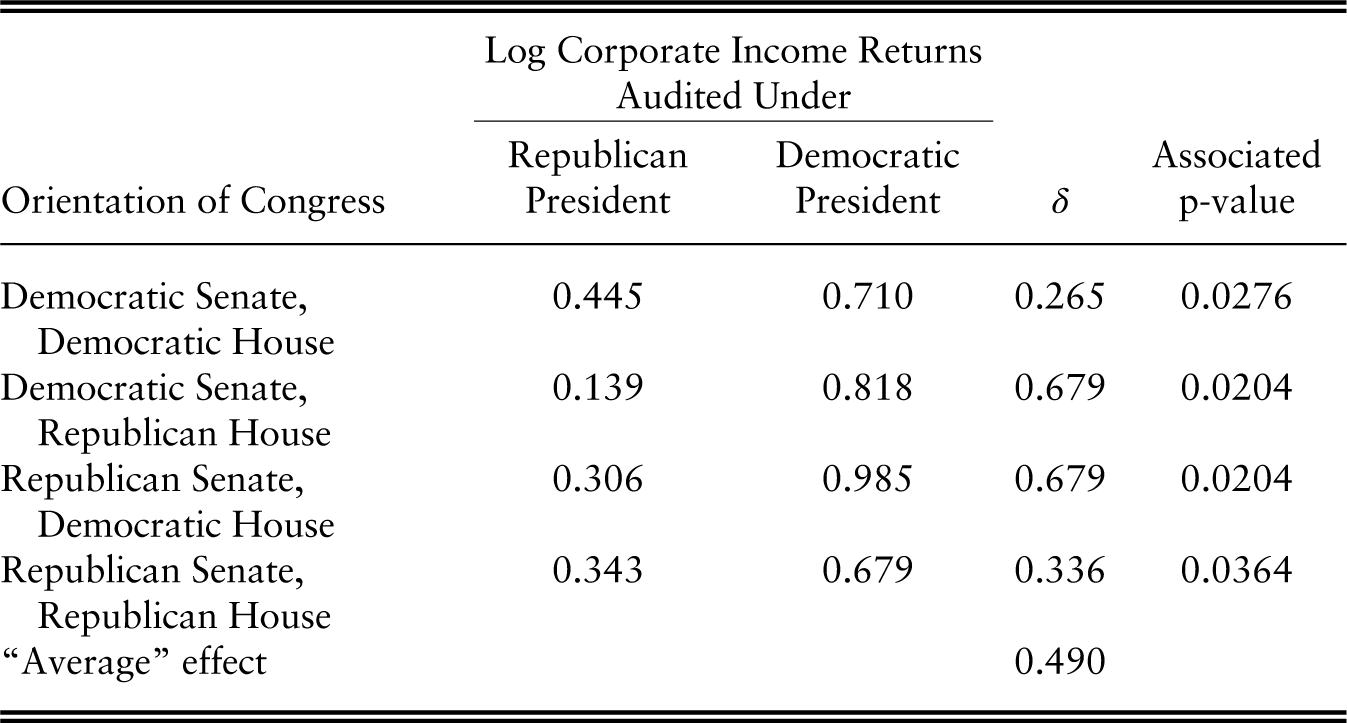
As results in the above table suggest, party affiliation of the President makes a statistically significant impact on the number of returns audited for all four possible configurations of Congress. Expressed in terms of the mean of the dependent variable, the increase of 0.490 when averaged across the four configurations of Congress translates to an increase of about 5% in the number of returns audited.
The following table highlights the role played by a change in control of the Senate.
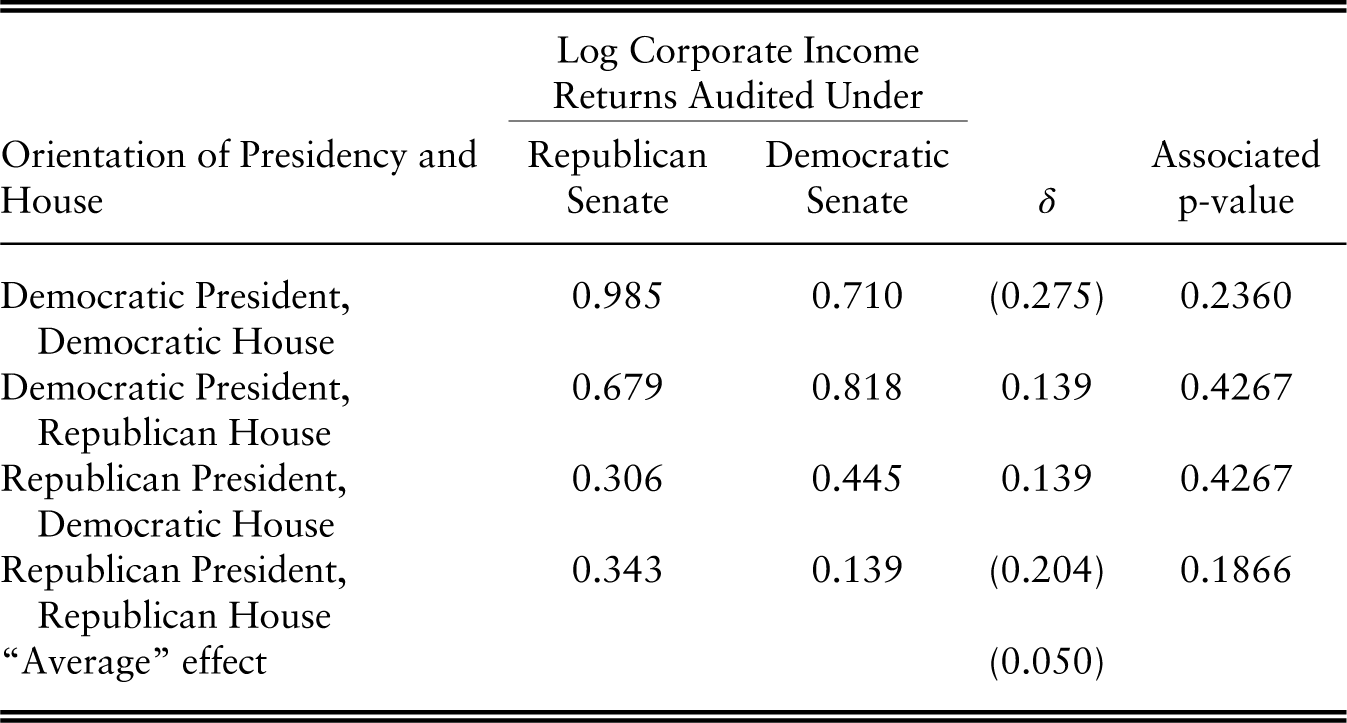
The above table suggests that although the role of the Senate in affecting the number of audits of corporate income tax returns varies based on the orientation of the Presidency and the House, it is not statistically significant for any of the four possible configurations and is small in economic terms.
The final table hones in on the role played by the House in influencing the number of corporate income returns audited.
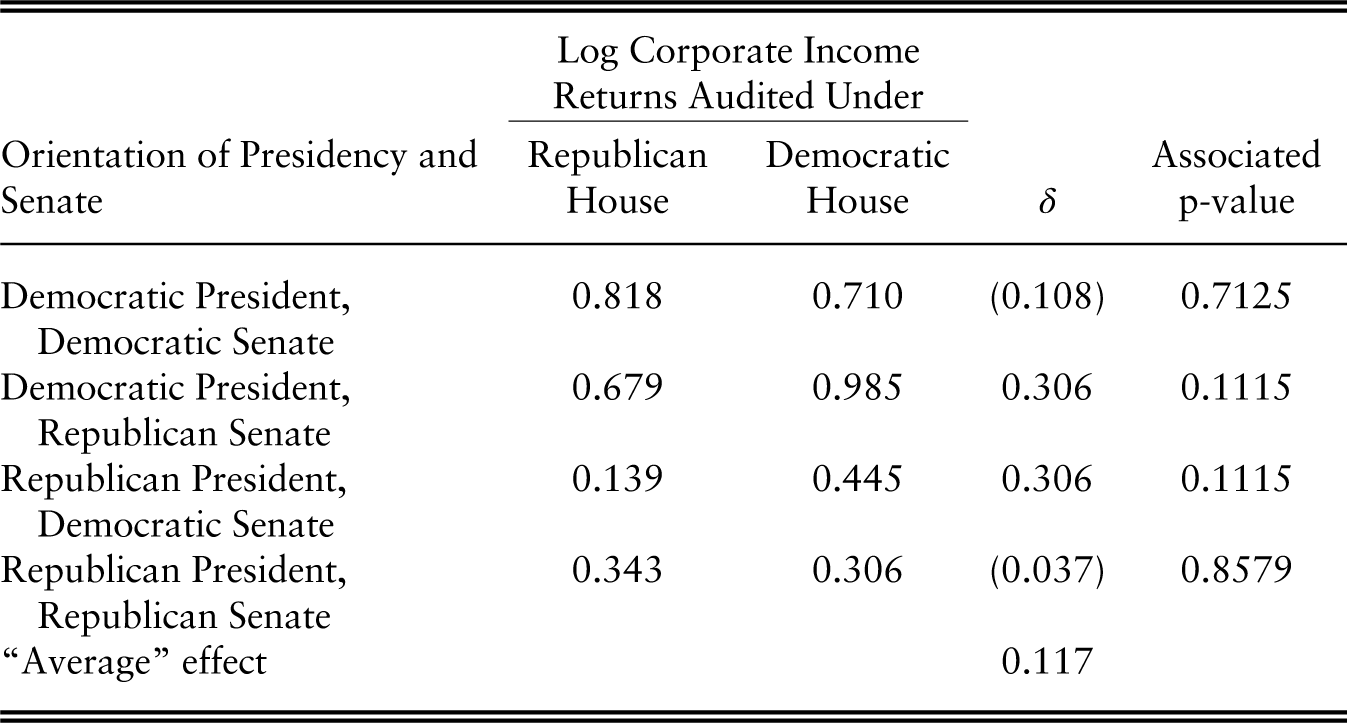
This table suggests that the House has, at best, a modest influence on the number of audits of corporate income tax returns. A switch in control of the House from Republican to Democratic hands does not make a statistically significant difference for any of the four possible configurations. This pattern of results is replicated if we consider the coefficients in column (2) in which we introduce a lagged term for the percent of returns audited in the prior FY to account for the persistence in IRS administrative practices.
Overall, the tentative take-away from these tables is that the partisan affiliation of the President matters more in influencing the intensity of corporate audit activity, whereas control of the Senate and the House seem to matter less. The finding that a change in control of the Presidency matters for audits of corporate income tax returns is consistent with the earlier analysis, which suggests that such a change also makes a difference to the number of enforcement personnel.
Audits of individuals, estates and trusts
The reason for a focus on corporate audits in this article has been twofold: first, as mentioned earlier, for the entire period from 1978 to 2010, audits of corporations have yielded over half of the revenue generated from audits of all types of returns and hence to analyse whether political influences influence IRS operations, audit rates of corporate income tax returns need to be at the front and centre. Second, other than an earlier contribution by Scholz and Wood (Reference Scholz and Wood1998) who look at the ratio of corporate to individual audits at the state level over the period 1974–1992, there has been no examination of whether differences in partisan control of Congress make a difference to the intensity of audit activity for corporations.
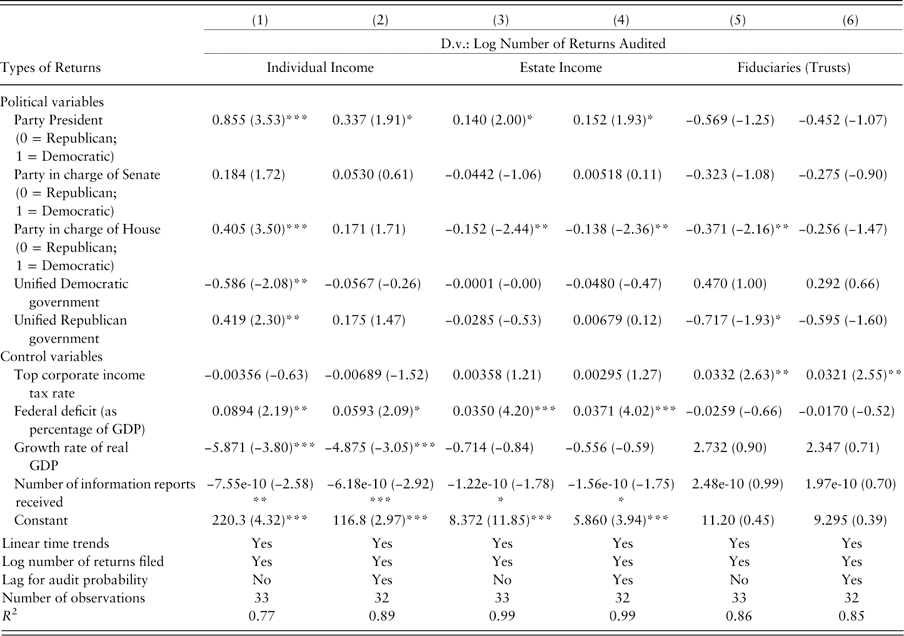
Notwithstanding this focus on corporate audits, I also analyse audit activity for other types of returns.Footnote 19 Table 7 examines variation in the intensity of audit activity for three different types of returns separately: (1) individual income tax returns; (2) estate tax returns; and (3) fiduciary returns (returns filed by trusts) using a specification very similar to the one adopted earlier.Footnote 20 Data regarding the number of returns filed and the number of returns audited is available from the IRS Data Books for the entire period from 1978 to 2010.
Partisan influences on audits of individual income tax, estate tax and fiduciary returns over the period 1978–2010
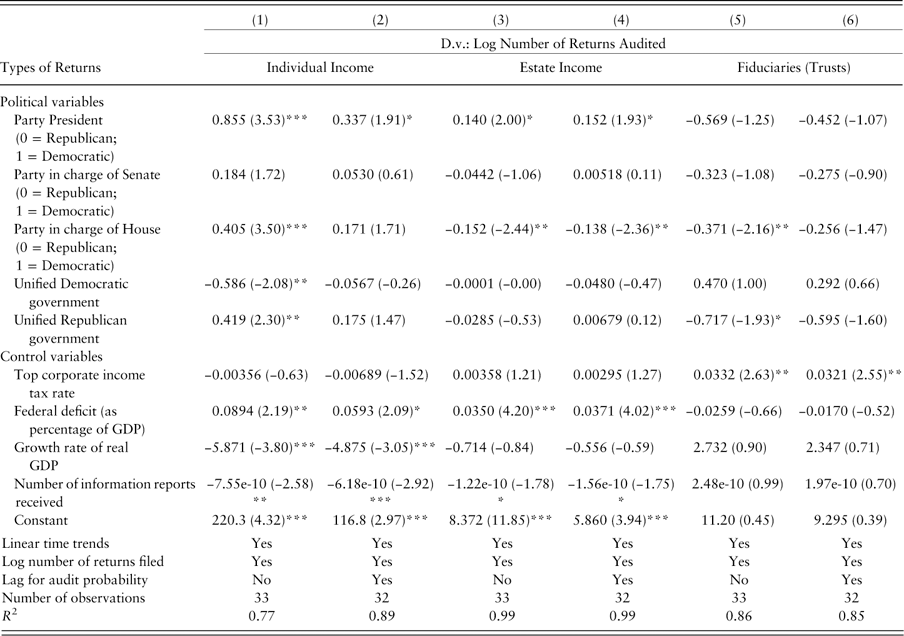
Note: Robust t statistics, reported in parentheses. Columns (3)–(6) also include a control for the top corporate income tax rate.
GDP=gross domestic product.
*p<0.10, **p<0.05, ***p<0.01.
As before, I look at the various configurations and calculate the difference that a change in control of each institution makes to the likelihood of an audit. Using the coefficients in column (1) of Table 7, the following table helps us estimate the difference that a change in control of the White House makes to the number of individual income tax returns audited.
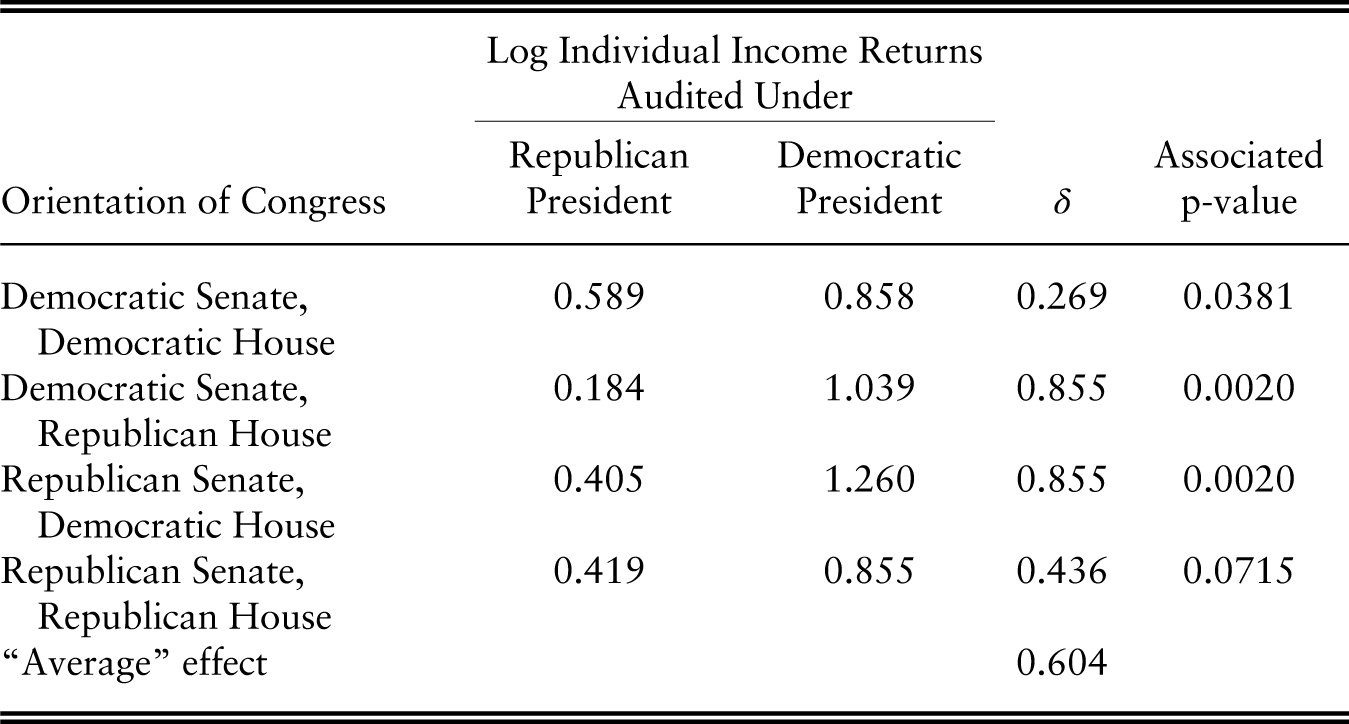
As results in the above table suggest, party affiliation of the President makes a statistically significant impact on the number of returns audited for all four possible configurations of Congress. Given that the mean of the dependent variable is 14.02, the average increase of 0.604 in the number of individual income tax returns audited attributed to the President would correspond to an increase of about 4% in the number of audits.
The following table highlights the role played by a change in control of the Senate.
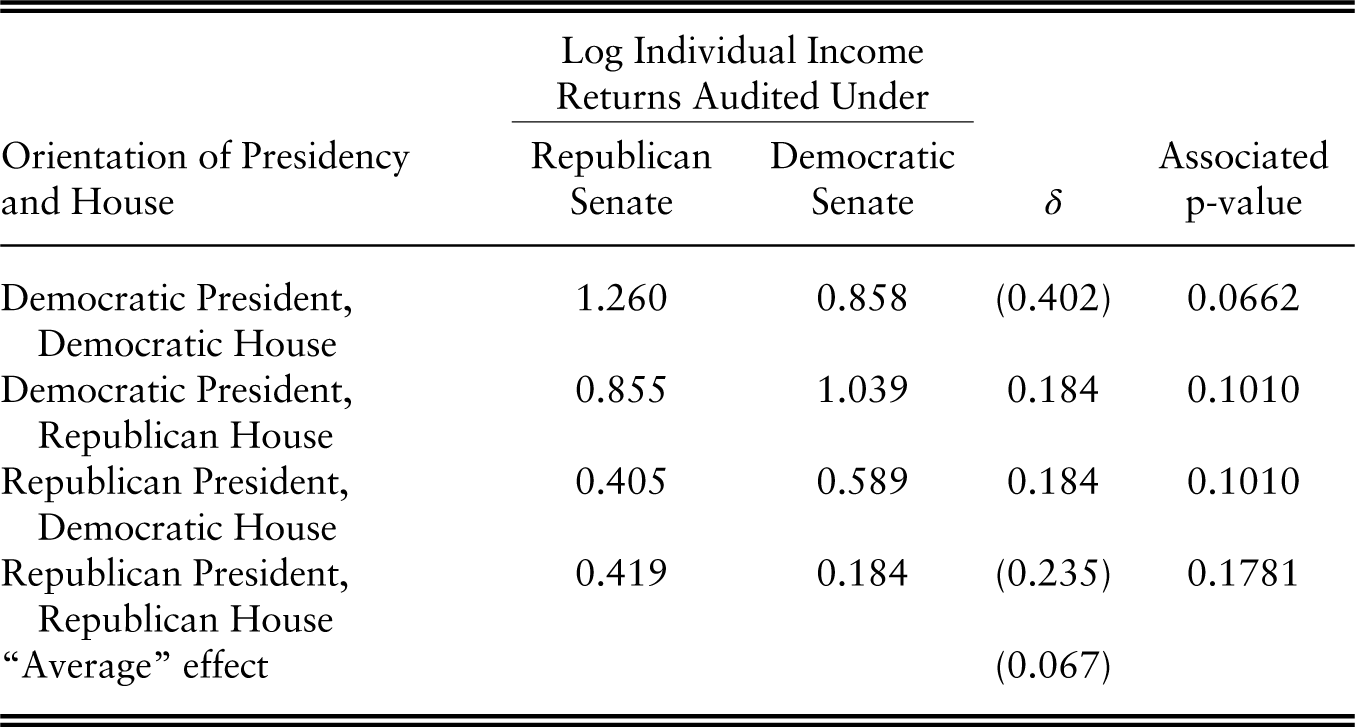
It is hard to draw definitive conclusions from the above table regarding the influence of the Senate on the number of audits of individual income tax returns. In general though, a switch in control of the Senate from Republican to Democratic hands does not appear to make an economically significant difference to the intensity of audits.
The final table hones in on the role played by the House in influencing the number of individual income tax returns audited.
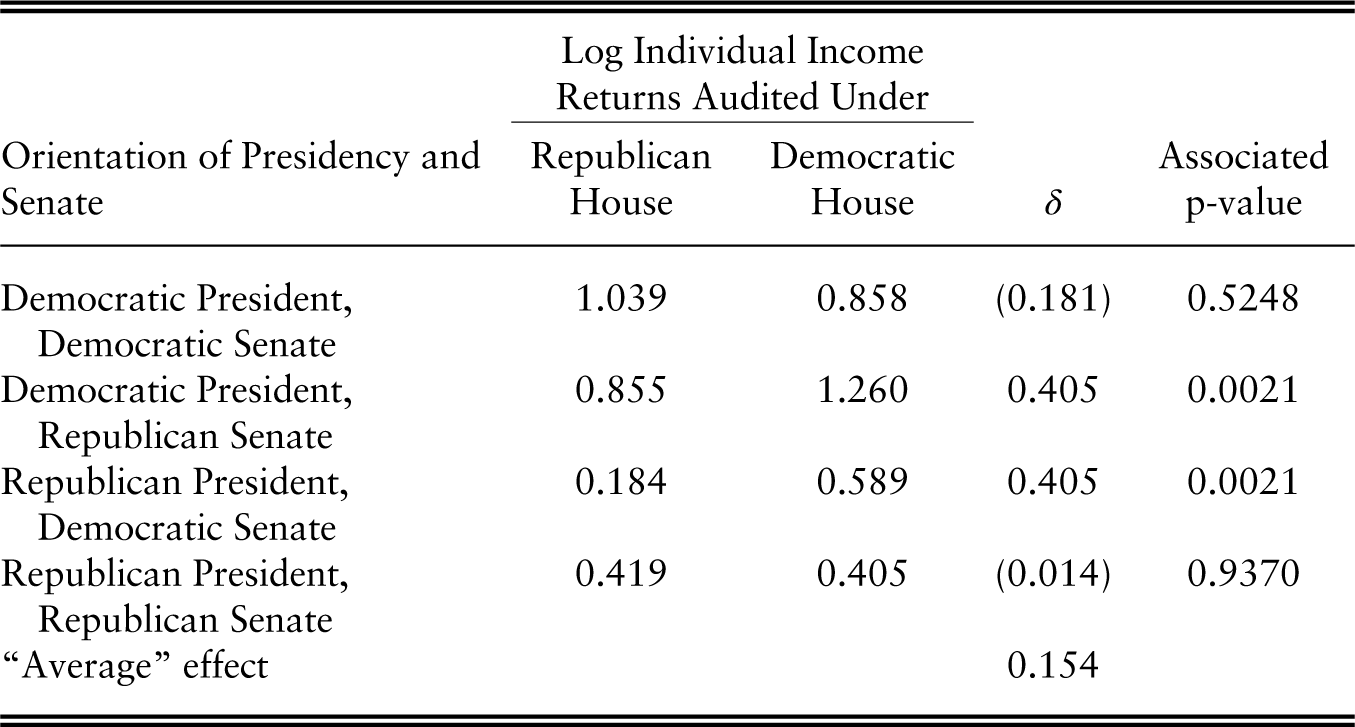
This table suggests that the House has a modest influence on the number of audits of individual income tax returns. A switch in control of the House from Republican to Democratic hands makes a statistically significant difference only when control of the Presidency and Senate is split between Republicans and Democrats. For the two other configurations of the Presidency and the Senate, a switch in the control of the House does not make a statistically significant difference to the number of individual income tax returns audited. The average effect across the four configurations for a change in control of the House is also considerably smaller than the corresponding average effect for a change in control of the Presidency.
The tentative take-away from this analysis is that the partisan affiliation of the President matters most in influencing the intensity of audit activity for individual income tax returns, whereas control of the Senate and the House seem to matter less. The pattern of results is identical if we consider the coefficients in column (2) in which we introduce a lagged term for the percent of individual income tax returns audited or if we consider the coefficients in columns (3) and (4), which examine the variation in number of estate tax returns audited.Footnote 21 In each case, Democratic administrations are significantly more likely to audit tax returns compared with Republican administrations. I also note that based on the coefficients in columns (1)–(4), audit activity increases statistically significantly with an increase in the federal deficit but decreases with an increase in the number of information reports received by the IRS, consistent with the a priori expectations of these control variables.
Summary of results
The conclusion that emerges from the empirical analysis conducted thus far is that the President has no influence on the overall budgetary and personnel resources commanded by the IRS. In contrast, however, the President is able to exert more subtle influences on the direction of the agency through changes in the number and share of IRS employees who are employed as criminal investigators and revenue officers. These subtle influences also manifest themselves in the higher frequency of audits of corporations, individuals and estates under Democratic administrations.
Perhaps unsurprisingly, Congress emerges as a powerful actor in the budget-setting process. The evidence presented suggests that Democratic control of Congress, in particular, the Senate increases the level of budgetary and personnel resources available to the IRS. In contrast to its effects on the budget, the Senate and the House have relatively less influence on the extent of enforcement conducted by the IRS and on the intensity of audit activity. This final observation is consistent with the work of scholars who have noted the diminishing influence of Congress on the operation of executive agencies relative to the President (e.g. Moe Reference Moe1987; Kagan Reference Kagan2001).
Conclusions
The key contribution of the article is in demonstrating that altering statutory tax rates are not the only way that political actors can influence tax policy. Instead, budgets, personnel and institutional practices of auditing can be and indeed are influenced in a systematic manner by the actors in charge. The article offers evidence that enforcement-related resources and audits of corporations, individuals and estates are higher under Democratic administrations as compared with Republican administrations. Preliminary work by the author and others (Hoopes et al. Reference Hoopes, Mescall and Pittman2012) also suggests that the higher intensity of corporate audits manifests itself in the form of a higher effective tax rate paid by corporations.Footnote 22 This increase in the effective tax rate comes about with no change in the tax code but from a greater emphasis on detecting corporate tax avoidance under Democratic administrations. The overall picture that emerges from the empirical findings of the article is that the IRS is an agency receptive to the kinds of political influences that have been documented elsewhere for other federal agencies.
Taking a step back, the larger contribution of the article stems from its use of hitherto unexplored quantitative data to identify American tax policy as highly mutable and subject to institutional conversion. In other words, the article suggests that even in the presence of rules that do not formally change, political actors, namely, the President and Congress, can influence the operation of those rules by altering the resources made available for their enforcement and by subtle cues they send, perhaps through their political appointees. It contributes to a very limited literature that has explored the interaction between politics and tax administration and illustrates that the relentless focus by politicians and the media on statutory tax rates may miss changes that occur at a level below the surface of legislative change but are nevertheless material in affecting revenue collections by the Treasury. Whether such institutional conversion represents a legitimate use of constitutional authority or whether it fails to meet the criteria for legitimacy is beyond the scope of this article but represents an interesting avenue for exploration.
Although the examination of variation in IRS resources and intensity of audit activity was motivated by the goal of better understanding the effects of political ideology on tax administration and enforcement, the underlying intuition that motivated the analysis is much more broadly applicable. The intuition is that when faced with political gridlock and scrutiny by the media and the public, political actors will make use of the least-cost instrument available at their disposal to realise their desired policy goals. As the cost of using a given policy instrument increases, politicians may attempt to circumvent that instrument by using other instruments at their disposal, which do not involve the active cooperation and support of other stakeholders. The increasing use of executive orders (e.g. Mayer Reference Mayer2001; Cooper Reference Cooper2002; Howell Reference Howell2003) and signing statements (e.g. Kelley and Marshall Reference Kelley and Marshall2008; Pfiffner Reference Pfiffner2008; Whitford Reference Whitford2012) to accomplish policy goals can be viewed as perhaps another illustration of these tendencies at work.
The framework laid out in this article can easily be extended to analysing activities of other federal agencies such as the Federal Trade Commission or the Environmental Protection Agency where Republicans and Democratic politicians have historically held different viewpoints about the missions of these agencies. Future research should explore the use of such less obvious instruments (including executive orders and signing statements) in contexts besides the setting examined here of administration and enforcement of the nation’s tax laws.
Acknowledgements
The author thank Anthony Bertelli (the editor), three anonymous referees, James E. Alt, James R. Hines Jr., Jeffrey L. Hoopes, Laura Kawano, Fabio Menendez, Dana M. Muir, Dan Silverman, Jagadeesh Sivadasan and Joel Slemrod for their suggestions. The author also thank seminar participants at the Association for Public Economic Theory (2011), the Eastern Economic Association (2012), the Michigan Tax Invitational (2012) and the Social Science History Association (2011) for their comments. All errors are the author’s own.
APPENDIX
Data sources:
-
∙ Data on the size of the IRS budget and personnel, its allocation across functions, the number of information reports received, and the number of returns filed and audited is obtained from the IRS Data Books available on the IRS website at http://www.irs.gov/taxstats/article/0,,id=226923,00.html (accessed 11 March 2014).
-
∙ The numbers for non-defense federal outlays, deflator, the size of the federal deficit and growth rate of real GDP are from the Office of Management and Budget at http://www.whitehouse.gov/omb/budget/Historicals (accessed 11 March 2014). I use Table 10.1 to obtain the deflator and construct the growth rate of real GDP. I use Table 15.6 to construct the size of the federal deficit as a percentage of GDP.
-
∙ The corporate income tax rates are available at http://www.jct.gov/publications.html?func=startdown&id=3719 and http://www.irs.gov/pub/irs-soi/02corate.pdf (accessed 14 December 2011). The top individual income tax rate is extracted from http://www.irs.gov/uac/SOI-Tax-Stats-Historical-Table-23 (accessed 11 March 2014).
-
∙ Data on corporate profits are available at http://www.bea.gov/iTable/index_nipa.cfm (accessed 29 December 2011). I use Tables 6.16 B, 6.16 C and 6.16 D to construct a comprehensive time series of corporate profits over the period 1978–2010.
Select robustness checks (RCs)
I conduct a number of RCs to explore the sensitivity of the result that Democratic administrations are more likely to audit corporate income tax returns. In each of these RCs that were conducted, the substantive finding that the frequency of audits for corporations with a Democrat in the White House is higher is unchanged. Full results are available on request from the author:
-
1. RC 1 – alternative specifications:
-
(a) Fixed effects versus random effects: the choice of a random effects specification versus a fixed effects specification is made on the basis of a Hausman test. However, I also examine the robustness of the results to random effects specification as Griliches and Hausman (Reference Griliches and Hausman1986) stress that observing consistent estimates across alternative panel data estimation techniques supports the absence of serious errors in variables problems. The results reported in Table 6 are robust to a fixed effects specification.
-
(b) Introducing additional interactions between the party of President and term of the President: different parties may need to cater to different political bases and Republican Presidents may be especially reluctant to audit corporations in their first term in office. To allow for this possibility, I introduce an interaction term between party of the President and the term of the President. There appears no support for this hypothesis that the effect of having a Republican in the White House is different between the two terms; in both terms, Republican administrations audit significantly fewer corporate returns than Democratic administrations.
-
-
2. RC 2: additional lags for number of returns filed: I explore alternate specifications in which I control for the log of the number of returns filed in all three calendar years before the FY for which data is being reported. This is done because “audits completed in the current year include a mix of returns filed during the previous three years” (Scholz and Wood Reference Scholz and Wood1998, 152). The results thus obtained are very similar to those in Table 6.
-
3. RC 3: dropping corporations that belong to the largest asset class: one concern with the results above might be that for the largest firms, audit probabilities are close to 1 and there is limited variation in the percent of returns audited over time. That is not entirely true as in this sample, for the asset class that includes the largest firms, namely, those with assets in excess of $100 million, audit probabilities average 0.47 and vary between a low of 0.21 in 2009 to a high of 0.86 in 1985. In any case, however, the results are robust to the exclusion of firms that belong to this asset class.
-
4. RC 4: issues with drift across nominal asset classes: the figures on the likelihood of assets are constructed using the IRS Data Books in terms of nominal asset classes – for example, corporations with assets between $1 and $10 million, corporations with assets between $10 and $100 million, etc. where the thresholds are not adjusted for inflation. One possible issue with the use of nominal thresholds is that over time, as the average asset size of corporations increases because of inflation, more and more corporations will fall in asset classes that correspond to (nominally) larger thresholds. However, given constraints on the IRS budget, fewer and fewer of such corporations that belong to (nominally) larger asset classes would be audited resulting in a general decline in the likelihood of audits over time for those asset classes. This decline in likelihood of an audit could then be attributed to a change in partisan control of the Presidency and the Congress possibly biasing us in favour of a spurious positive finding between political ideology and audit frequency. To rule out this alternative explanation, I introduce an additional control variable, namely, the fraction of returns that are filed by small firms in any given year. In doing so, I define small firms as all corporations that have assets less than $10 million, the same definition as is used by the IRS. The results obtained in Table 6 are robust to the inclusion of this additional control variable.