Introduction
Cognitive deficits are considered a core feature of schizophrenia (Kahn & Keefe, Reference Kahn and Keefe2013) and make an impact on the long-term outcome of the illness in several ways. For example, they are significantly associated with treatment non-adherence (Keefe et al. Reference Keefe, Bilder, Davis, Harvey, Palmer, Gold, Meltzer, Green, Capuano, Stroup, McEvoy, Swartz, Rosenheck, Perkins, Davis, Hsiao and Lieberman2007a ), greater risk of relapse (Chen et al. Reference Chen, Hui, Dunn, Miao, Yeung, Wong, Chan and Tang2005), poorer overall symptom response (Davidson et al. Reference Davidson, Galderisi, Weiser, Werbeloff, Fleischhacker, Keefe, Boter, Keet, Prelipceanu, Rybakowski, Libiger, Hummer, Dollfus, Lopez-Ibor, Hranov, Gaebel, Peuskens, Lindefors, Riecher-Rossler and Kahn2009) and impaired functionality (Bowie et al. Reference Bowie, Leung, Reichenberg, McClure, Patterson, Heaton and Harvey2008; Nuechterlein et al. Reference Nuechterlein, Subotnik, Green, Ventura, Asarnow, Gitlin, Yee, Gretchen-Doorly and Mintz2011). As such they have become targets for intervention, both psychological (Porter et al. Reference Porter, Bowie, Jordan and Malhi2013) and pharmacological. Most studies indicate that: cognitive impairments in schizophrenia are generalized, with baseline deficits falling 1–2 standard deviations below the mean (Dickinson et al. Reference Dickinson, Ragland, Gold and Gur2008; Aas et al. Reference Aas, Dazzan, Mondelli, Melle, Murray and Pariante2014); are evident during the prodromal phase of illness (Woodberry et al. Reference Woodberry, McFarlane, Giuliano, Verdi, Cook, Faraone and Seidman2013); show some progression prior to, during and shortly after the illness onset (Tandon et al. Reference Tandon, Nasrallah and Keshavan2009); and display a relatively stable trajectory over the long-term course of the illness (Bozikas & Andreou, Reference Bozikas and Andreou2011; Barder et al. Reference Barder, Sundet, Rund, Evensen, Haahr, Ten Velden, Joa, Johannessen, Langeveld, Larsen, Melle, Opjordsmoen, Rossberg, Simonsen, Vaglum, McGlashan and Friis2013; Rajji et al. Reference Rajji, Voineskos, Butters, Miranda, Arenovich, Menon, Ismail, Kern and Mulsant2013). The response of cognitive impairment to antipsychotic treatment remains controversial, with studies often compounded by methodological shortcomings and inconsistencies. Most studies have focused on possible benefits of the second-generation antipsychotics (SGAs) over first-generation antipsychotics (FGAs) (Keefe et al. Reference Keefe, Silva, Perkins and Lieberman1999). While FGAs have sometimes been considered ineffectual in treating cognitive deficits (Stip et al. Reference Stip, Chouinard and Boulay2005), others have reported modest improvements (Mishara & Goldberg, Reference Mishara and Goldberg2004) and more recent, carefully conducted studies using more appropriate lower doses of FGAs reported cognitive improvements that were indistinguishable from those of SGAs (Keefe et al. Reference Keefe, Bilder, Davis, Harvey, Palmer, Gold, Meltzer, Green, Capuano, Stroup, McEvoy, Swartz, Rosenheck, Perkins, Davis, Hsiao and Lieberman2007a ; Davidson et al. Reference Davidson, Galderisi, Weiser, Werbeloff, Fleischhacker, Keefe, Boter, Keet, Prelipceanu, Rybakowski, Libiger, Hummer, Dollfus, Lopez-Ibor, Hranov, Gaebel, Peuskens, Lindefors, Riecher-Rossler and Kahn2009). Studies reporting improvement with antipsychotic treatment generally conducted baseline assessments while patients were actively psychotic, and it is not clear whether improvements were due to a direct cognitive-enhancing effect or whether they were non-specific and secondary to improvements in psychopathology. Additionally, it has been proposed that at least part of the improvement may be ascribed to a practice effect (Goldberg et al. Reference Goldberg, Keefe, Goldman, Robinson and Harvey2010).
Methodological limitations of previous studies include small samples, short study duration, no healthy controls, chronic patient samples with varying degrees of exposure to antipsychotics, non-standardized cognitive test batteries, inconsistent timing of baseline assessments (acutely ill versus stabilized) and excessive doses of FGA (Davidson et al. Reference Davidson, Galderisi, Weiser, Werbeloff, Fleischhacker, Keefe, Boter, Keet, Prelipceanu, Rybakowski, Libiger, Hummer, Dollfus, Lopez-Ibor, Hranov, Gaebel, Peuskens, Lindefors, Riecher-Rossler and Kahn2009; Bozikas & Andreou, Reference Bozikas and Andreou2011; Buchanan et al. Reference Buchanan, Keefe, Umbricht, Green, Laughren and Marder2011; Goldberg et al. Reference Goldberg, Keefe, Goldman, Robinson and Harvey2010; Keefe et al. Reference Keefe, Buchanan, Marder, Schooler, Dugar, Zivkov and Stewart2013). Also, longitudinal studies often have high attrition rates, thereby reducing the statistical power of the study (Bozikas & Andreou, Reference Bozikas and Andreou2011). Finally, another important potential confounder is non-adherence to antipsychotic medication.
The present study aimed to assess the acute and longer-term effects of a FGA on cognitive performance compared with matched healthy controls. We attempted to address several of the above limitations by selecting antipsychotic-naive or minimally treated patients with a first psychotic episode, using a standardized cognitive test battery, treating patients according to a standard algorithm with a single antipsychotic and utilizing a low-dosing strategy, using a depot antipsychotic to provide assured adherence, assessing participants at three time points (pre-treatment, post-acute treatment and at 12 months) and including matched healthy controls.
Method
This was a single-site, longitudinal, case–control study assessing the effects of treatment over 12 months with flupenthixol decanoate on cognitive performance. We obtained approval to conduct the study from the Human Research Ethics Committee of Stellenbosch University Faculty of Medicine and Health Sciences. The study was conducted in accordance with the International Conference on Harmonization guidelines on good clinical practice (International Conference on Harmonization, 1996) and was registered at the South African National Clinical TrialsRegister (DOH-27-0710-1957; http://www.sanctr.gov.za/SAClinicalTrials/tabid/169/Default.aspx).
Participants
Patients were recruited between April 2007 and March 2011 from first admissions to Tygerberg and Stikland hospitals, as well as from patients presenting at community clinics in the metropolitan and rural areas of the North Eastern part of Cape Town, the Winelands and the Cape West Coast. After explaining the purpose, procedures, risks and benefits, written informed consent was obtained from patients and/or their legal guardians. Inclusion criteria were men and women, in- or out-patients, aged 16–45 years, and a first psychotic episode meeting Diagnostic and Statistical Manual of Mental Diseases, fourth edition, text revisions (DSM-IV TR; American Psychiatric Association, 1994) diagnostic criteria for schizophrenia, schizophreniform or schizo-affective disorder. Exclusion criteria were lifetime exposure to >4 weeks of antipsychotic medication, previous treatment with a long-acting depot antipsychotic, serious or unstable general medical condition, mental retardation or overt substance abuse. We also excluded patients who were not fluent in English or Afrikaans, the languages of the psychologists who conducted the MATRICS (Measurement and Treatment Research to Improve Cognition in Schizophrenia) Cognitive Consensus Battery (MCCB) assessments, and those with an educational level of lower than grade 7. A group of healthy controls, matched for age, sex, ethnicity and level of education, was recruited through personal contacts and advertisements from the same catchment area as the patients.
Treatment
There was a 1-week lead-in period of oral flupenthixol (1–3 mg/day) followed by long-acting flupenthixol decanoate injections every 2 weeks for the duration of the study. The initiation dose was 10 mg every 2 weeks. Additional oral flupenthixol was prescribed at the discretion of the investigator. Permitted concomitant treatment included lorazepam for sedation, orphenadrine or biperiden for extrapyramidal symptoms, propranolol for akathisia, antidepressants and medication for general medical conditions. No benzodiazepines, propranolol or anticholinergics were permitted in the 12 h prior to the assessments. Prohibited medications included other antipsychotics, mood stabilizers and psychostimulants.
Assessments
Cognitive function was assessed by means of the MCCB which was developed specifically to measure cognitive functioning and potential treatment response in schizophrenia. The MCCB measures seven cognitive domains and a composite score. The seven domains are: speed of processing; attention/vigilance; working memory; verbal learning; visual learning; reasoning and problem solving; and social cognition (Nuechterlein et al. Reference Nuechterlein, Green, Kern, Baade, Barch, Cohen, Essock, Fenton, Frese III, Gold, Goldberg, Heaton, Keefe, Kraemer, Mesholam-Gately, Seidman, Stover, Weinberger, Young, Zalcman and Marder2008). The MCCB was administered by psychologists under the supervision of an experienced clinical psychologist (M.R.O.) and psychiatrist (R.S.) at baseline, month 6 and month 12. Training sessions were conducted at study initiation and at regular periods throughout the study, and inter-rater reliability for the composite score was excellent (intraclass correlation = 0.9). For the baseline assessment, a window period of up to 2 weeks was permitted for patients who were too ill to cooperate adequately for the MCCB assessments. Randomized alternate forms were used on repeat assessments for visual learning, verbal learning and the Neuropsychological Assessment Battery mazes (Stern & White, Reference Stern and White2003). Double data entry into the MCCB computer program was performed and raw scores were converted to T-scores for the seven domains and a composite T-score. Age- and sex-corrected norms were used according to the guidelines outlined in the MCCB manual (Nuechterlein & Green, Reference Nuechterlein and Green2006).
Patients were assessed with the Structured Clinical Interview for DSM-IV (SCID; First et al. Reference First, Spitzer and Williams1994), the Positive and Negative Syndrome Scale (PANSS; Kay et al. Reference Kay, Fizbein and Opler1987), the Social and Occupational Functioning Assessment Scale (SOFAS; American Psychiatric Association, 1994), the Calgary Depression Rating Scale for Schizophrenia (CDSS; Addington & Addington, Reference Addington and Addington1993), the Birchwood Insight Scale (BIS; Birchwood et al. Reference Birchwood, Smith, Drury, Healy, Macmillan and Slade1994), the World Health Organization Quality of Life Questionnaire-Brief Version (WHOQOL-BREF; World Health Organization, 1998) and the Premorbid Adjustment Scale (PAS; Cannon-Spoor et al. Reference Cannon-Spoor, Potkin and Wyatt1982). Clinical outcomes will be reported separately.
Statistical analyses
The statistical analysis plan was determined prior to conducting the analyses. Analyses were performed on all participants who completed sufficient components of the baseline MCCB assessment to calculate the composite score. We employed linear mixed-effect models for continuous repeated measures (MMRM) to assess the changes in MCCB composite and domain scores over time. Within analyses Fisher's least significant difference (LSD) was used for multiple comparisons of post hoc tests. Cohen's d effect size was calculated for MCCB composite score change from baseline to month 6 from the means and standard deviations obtained for patients and controls. We conducted Pearson correlational coefficient analyses to investigate relationships between changes in MCCB scores and changes in psychopathology and functionality scores. Change scores were calculated by subtracting the baseline score from the endpoint (last observation carried forward) score. To investigate predictors of change in MCCB composite score we conducted multiple linear regression using the following selected demographic and baseline clinical variables: age; sex; ethnicity; duration of untreated psychosis (DUP); recent substance abuse; PAS; BIS; baseline scores for PANSS total score PANSS factor-analysis derived domains of positive, negative, disorganized, excitement/hostility and depression/anxiety (Emsley et al. Reference Emsley, Rabinowitz and Torreman2003); CDSS total score; SOFAS; and WHOQOL-BREF transformed scores for domains 1–4. As there was an indication of multicollinearity we conducted best subsets regression analysis. All tests were two-tailed. Significance for the MMRM analyses was set at p < 0.006 after Bonferroni correction for multiple comparisons (eight tests). Within analyses Fisher's LSD was used for multiple comparisons of post hoc tests. For the intra-group differences the Bonferroni-adjusted significance level was 0.001 (32 tests) and for the between-group comparisons the adjusted significance level was 0.002 (24 tests).
Results
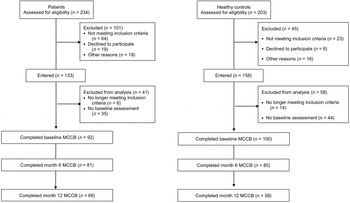
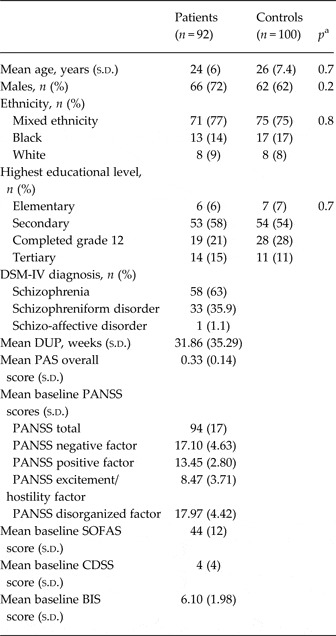
The baseline demographic and clinical characteristics of the patients and healthy controls are provided in Table 1. There were no significant group differences for age, sex, ethnicity or educational status. The study flow diagram for patients and controls is provided in Fig. 1. Although completion rates were comparatively good, as with all longitudinal studies there was considerable attrition at month 12. Sixty-six of 92 (72%) patients and 58 of 100 (58%) controls completed the 12-month cognitive assessments. The baseline MCCB composite and domain scores for patients who dropped out were not significantly different from those who completed the study. Of the patients, 37 (40%) had received prior antipsychotic treatment, for a mean (s.d.) of 10.4 (6.6) days. For those who had received treatment, MCCB composite scores were significantly lower at baseline [9 (16) v. 16 (15), p = 0.03] but the change scores did not differ significantly from the never-treated patients [11 (14) v. 8 (11), p = 0.2].
Study flow diagram for the patients and healthy controls. MCCB, MATRICS (Measurement and Treatment Research to Improve Cognition in Schizophrenia) Cognitive Consensus Battery.

Demographic and baseline clinical characteristics for the patients and healthy controls

s.d., Standard deviation; DSM-IV, Diagnostic and Statistical Manual of Mental Diseases, fourth edition; DUP, duration of untreated psychosis; PAS, Premorbid Adjustment Scale; PANSS, Positive and Negative Syndrome Scale; SOFAS, Social and Occupational Functional Assessment Scale; CDSS, Calgary Depression Rating Scale for Schizophrenia; BIS, Birchwood Insight Scale.
a Paired t tests for continuous variables and χ 2 test for categorical variables.
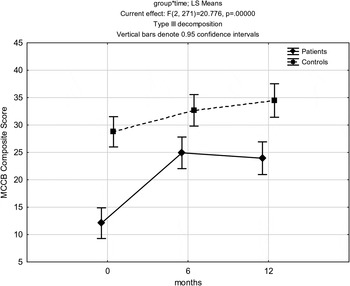
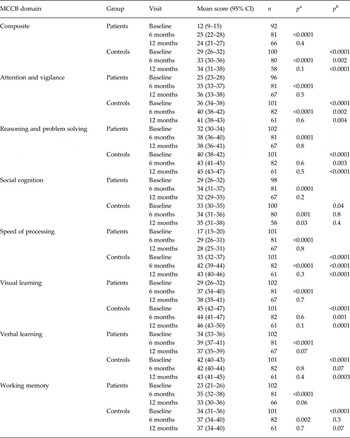
Fig. 2 shows the least-squares mean MMRM results for the MCCB composite score over the 12-month treatment period for the patients and controls. There was a significant group × time effect (F 2,271 = 20.776, p ≤ 0.0001), with patients showing a greater degree of improvement. Further significant group × time effects were found for the domains of attention and vigilance (F 2,281 = 10.094, p = <0.0001), visual learning (F 2,285 = 13.284, p ≤ 0.0001), verbal learning (F 2,285 = 5.3301, p = 0.005) and working memory (F 2,284 = 17.203, p ≤ 0.0001). In all cases the patients showed a greater degree of change. Group × time effects did not achieve significance at the corrected level for reasoning and problem solving (F 2,285 = 3.3008, p = 0.04), speed of processing (F 2,284 = 3.7175, p = 0.03) and social cognition (F 2,277 = 2.8419, p = 0.06). Table 2 provides least-squares means and 95% confidence intervals (CIs) for patients and controls at 0, 6 and 12 months for the cognitive domains. The effect size (Cohen's d) from baseline to month 6 for the MCCB composite score was 0.87 for the patients and 0.34 for healthy controls. For all of the MCCB domains patients demonstrated a pattern of significant improvements between baseline and month 6, but not between months 6 and 12. For the controls improvements from baseline to month 6 reached adjusted significance levels for the composite score, attention and vigilance and speed of processing, but not for reasoning and problem solving, social cognition, visual learning, verbal learning and working memory. As was the case with the patients, there were no significant improvements in any of the domains from month 6 to month 12. At 12 months, scores remained significantly lower for patients versus controls for the composite score (p ≤ 0.0001), reasoning and problem solving (p ≤ 0.0001), speed of processing (p ≤ 0.0001) and verbal learning (p ≤ 0.0001).
MATRICS (Measurement and Treatment Research to Improve Cognition in Schizophrenia) Cognitive Consensus Battery (MCCB) composite scores at 0, 6 and 12 months for the patients and healthy controls. LS, Least squares.

Least-squares mean and 95% CI scores for the patients and healthy controls at each time point, for each of the MCCB cognitive domains

CI, Confidence interval; MCCB, MATRICS (Measurement and Treatment Research to Improve Cognition in Schizophrenia) Cognitive Consensus Battery.
a Intra-group differences over time. p Values at 6 months are for differences between months 0 and 6, and p values at 12 months are for differences between months 6 and 12. The adjusted significance level is 0.001.
b Between-group differences at each of the time points. The adjusted significance level is 0.002.
MCCB scores for patients and controls were very low compared with US norms. While this may in part be explained by educational and cultural differences, it could also be that, despite the fact that we postponed testing of patients deemed unable to cooperate sufficiently, the participants in our study were more acutely ill and therefore untestable, thereby creating a ‘floor effect’. We therefore conducted two reanalyses of the data. In the first we removed all of the patients with a score of 0 on any of the tests, as they probably represented the most acutely ill and possibly untestable subjects. Results were similar to the original analysis. There was a significant group × time effect for the MCCB composite score (F 2,231 = 9.6550, p = 0.00009) (online Supplementary Fig. S1) as well as for the domains of visual learning (F 2,238 = 6.0646, p = 0.003), verbal learning (F 2,238 = 2.1371, p = 0.1) and working memory (F 2,237 = 6.1997, p = 0.002), but not for attention and vigilance (F 2,237 = 4.3365, p = 0.01), reasoning and problem solving (F 2,238 = 2.3517, p = 0.1), speed of processing (F 2,238 = 0.55733, p = 0.6) and social cognition (F 2,233 = 1.6453, p = 0.2). Online Supplementary Table S1 provides least-squares means and 95% CIs for patients and controls at 0, 6 and 12 months for the cognitive domains. In the second reanalysis we utilized the raw scores of the individual tests, to ensure that issues of scaling were not responsible for some of the observed effects. Once again a similar pattern emerged. Patients generally had lower baseline scores and several of the cognitive tests showed significant group × time effects, with patients showing relatively greater improvements but scores remaining lower than controls at endpoint. Online Supplementary Table S2 provides least-squares means and 95% CIs for patients and controls at 0, 6 and 12 months for the raw scores of the individual cognitive tests.
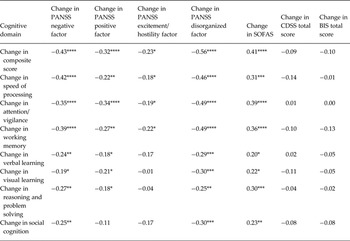
Mean (s.d.) change scores (baseline to endpoint) for symptom and functionality measures were: PANSS total score −41 (21.6); negative factor −6.8 (5.2); positive factor −8 (4.2); excitement/hostility factor −3.3 (3.8); disorganized factor −7.5 (4.9); SOFAS 15.9 (13.4); CDSS total score −2 (4); BIS 0.5 (2.5). Pearson correlation coefficients for cognitive change scores and symptom and functionality change scores are provided in Table 3. Improvements in cognitive performance were significantly correlated with improvements in PANSS positive, negative and disorganized factor domains, and with SOFAS scores, but not with CDSS or BIS scores.
Pearson correlations between cognitive change and clinical change from baseline to endpoint

PANSS, Positive and Negative Syndrome Scale; SOFAS, Social and Occupational Functioning Assessment Scale; CDSS, Calgary Depression Rating Scale for Schizophrenia; BIS, Birchwood Insight Scale.
* p < 0.05, ** p < 0.01, *** p < 0.001, **** p < 0.0001.
The regression analysis model for prediction of change in MCCB composite score (R = 0.59, R 2 = 0.34, p ≤ 0.0001) suggested that higher baseline PANSS total score (p = 0.001), higher baseline PANSS excitement/hostility domain score (p = 0.03), female sex (p = 0.02), longer DUP (p = 0.02), higher pre-morbid adjustment general subscale score (p = 0.03) and higher baseline MCCB composite score (p = 0.01) were all significant predictors of greater cognitive improvement.
Discussion
Compared with matched healthy volunteers, the patients performed significantly worse at baseline in all of the cognitive domains, except social cognition. After 6 months of antipsychotic treatment the patients demonstrated substantial improvements in all of the cognitive domains, but with no further improvement at 12 months. Despite the substantial initial improvements the patients failed to achieve the same level of cognitive performance as the matched controls, with scores at 12 months remaining significantly lower for the composite domain as well as for reasoning and problem solving, speed of processing and verbal learning. This is consistent with previous work describing persistent cognitive deficits compared with healthy controls in clinically stabilized first-episode patients (Bilder et al. Reference Bilder, Goldman, Robinson, Reiter, Bell, Bates, Pappadopulos, Willson, Alvir, Woerner, Geisler, Kane and Lieberman2000). While the course of cognitive improvement with antipsychotic treatment is controversial (Nielsen, Reference Nielsen2011), our findings support studies indicating stability over time (Nielsen, Reference Nielsen2011; Ekerholm et al. Reference Ekerholm, Firus, Fagerberg, Soderman, Terenius, Agartz, Jonsson and Nyman2012), and are consistent with previous work indicating that there is little additional cognitive benefit beyond the initial gains in the first few months of treatment (Keefe et al. Reference Keefe, Sweeney, Gu, Hamer, Perkins, McEvoy and Lieberman2007b ).
The magnitude of cognitive improvement was considerable. The ‘large’ effect size (Cohen, Reference Cohen1988) of 0.87 for the MCCB composite score change in the patients compares favourably with that reported in other studies assessing various SGAs (Keefe et al. Reference Keefe, Seidman, Christensen, Hamer, Sharma, Sitskoorn, Lewine, Yurgelun-Todd, Gur, Tohen, Tollefson, Sanger and Lieberman2004, Reference Keefe, Seidman, Christensen, Hamer, Sharma, Sitskoorn, Rock, Woolson, Tohen, Tollefson, Sanger and Lieberman2006, Reference Keefe, Sweeney, Gu, Hamer, Perkins, McEvoy and Lieberman2007b ; Harvey et al. Reference Harvey, Rabinowitz, Eerdekens and Davidson2005; Davidson et al. Reference Davidson, Galderisi, Weiser, Werbeloff, Fleischhacker, Keefe, Boter, Keet, Prelipceanu, Rybakowski, Libiger, Hummer, Dollfus, Lopez-Ibor, Hranov, Gaebel, Peuskens, Lindefors, Riecher-Rossler and Kahn2009). Possible reasons for this could be that the patients in the present study were experiencing a first psychotic episode – known to respond more favourably to treatment (Lieberman et al. Reference Lieberman, Perkins and Jarskog2007) – as well as that they were more acutely ill as evidenced by their higher baseline PANSS scores. Also, assured adherence may have played a role. Another consideration is the effect of previous exposure to the cognitive test battery. It has been argued that cognitive improvement observed with antipsychotic treatment may be due to practice effects (Goldberg et al. Reference Goldberg, Goldman, Burdick, Malhotra, Lencz, Patel, Woerner, Schooler, Kane and Robinson2007, Reference Goldberg, Keefe, Goldman, Robinson and Harvey2010). Inclusion of a control group of healthy volunteers allowed us to assess this in our study. While improvements were observed in some of the domains in the controls, these were of a smaller magnitude than those of the patients, and the primary outcome measure reported a significant group × time effect with greater improvements observed in patients. Our results are therefore consistent with others suggesting a beneficial effect over and above practice effects for antipsychotic treatment (Davidson et al. Reference Davidson, Galderisi, Weiser, Werbeloff, Fleischhacker, Keefe, Boter, Keet, Prelipceanu, Rybakowski, Libiger, Hummer, Dollfus, Lopez-Ibor, Hranov, Gaebel, Peuskens, Lindefors, Riecher-Rossler and Kahn2009).
The question as to whether antipsychotics have a cognitive enhancing effect per se or whether the cognitive improvements are non-specific and secondary to the antipsychotic action of these compounds remains unanswered. Certainly, the weak but significant correlations between cognitive improvement and reductions in excitement/hostility scores suggest that some of the patients may have been compromised in their ability to cooperate with testing at baseline. Also, the moderate to strong correlations observed between changes in MCCB scores and changes in several PANSS domain scores and SOFAS scores suggest that the cognitive improvement is not independent, but occurs in association with the overall improvements in psychopathology. Our findings need to be considered within the context of several other studies reporting substantially weaker correlations between cognitive improvement and psychopathology improvement, in the effect size range of small to medium (Keefe et al. Reference Keefe, Seidman, Christensen, Hamer, Sharma, Sitskoorn, Lewine, Yurgelun-Todd, Gur, Tohen, Tollefson, Sanger and Lieberman2004, Reference Keefe, Bilder, Davis, Harvey, Palmer, Gold, Meltzer, Green, Capuano, Stroup, McEvoy, Swartz, Rosenheck, Perkins, Davis, Hsiao and Lieberman2007a ; Davidson et al. Reference Davidson, Galderisi, Weiser, Werbeloff, Fleischhacker, Keefe, Boter, Keet, Prelipceanu, Rybakowski, Libiger, Hummer, Dollfus, Lopez-Ibor, Hranov, Gaebel, Peuskens, Lindefors, Riecher-Rossler and Kahn2009). Possible explanations for this discrepancy could be that our patients were more symptomatic (baseline PANSS total scores were somewhat lower in the other studies, ranging from 73.9 to 88), and that our patients had less exposure to antipsychotics prior to study entry.
The substantial improvements in cognitive performance that we observed after treatment with flupenthixol are consistent with two other recent studies reporting cognitive improvement in patients treated with FGAs. In the Clinical Antipsychotic Trials of Intervention Effectiveness (CATIE) study comprising patients with chronic schizophrenia small improvements were reported for patients treated with perphenazine, of similar magnitude to those observed with SGAs. In fact, there was a trend to greater cognitive improvement in the perphenazine-treated patients at 18 months (Keefe et al. Reference Keefe, Bilder, Davis, Harvey, Palmer, Gold, Meltzer, Green, Capuano, Stroup, McEvoy, Swartz, Rosenheck, Perkins, Davis, Hsiao and Lieberman2007a ). (However, the CATIE sample was biased insofar as patients with tardive dyskinesia – which is associated with cognitive impairment – were not randomized to perphenazine.) Similarly, in the European First Episode Schizophrenia Trial (EUFEST) in a first-episode sample moderate improvements in cognitive performance were reported with haloperidol-treated patients, again not being significantly different from those treated with SGAs (Davidson et al. Reference Davidson, Galderisi, Weiser, Werbeloff, Fleischhacker, Keefe, Boter, Keet, Prelipceanu, Rybakowski, Libiger, Hummer, Dollfus, Lopez-Ibor, Hranov, Gaebel, Peuskens, Lindefors, Riecher-Rossler and Kahn2009). These results differ from several earlier studies in which SGAs were reported to have greater benefits than FGAs in reducing cognitive impairments in schizophrenia (Keefe et al. Reference Keefe, Silva, Perkins and Lieberman1999). One possible explanation for these discrepancies could be related to a dose effect of the FGAs. Earlier studies frequently used excessive doses of haloperidol as a comparator, with a risk of extrapyramidal symptoms and concomitant anticholinergic treatment interfering with cognition (Keefe et al. Reference Keefe, Bilder, Davis, Harvey, Palmer, Gold, Meltzer, Green, Capuano, Stroup, McEvoy, Swartz, Rosenheck, Perkins, Davis, Hsiao and Lieberman2007a ). In the CATIE and EUFEST studies care was taken to select an appropriate dose range for the FGA, as was the case in the present study where we employed a low dosing strategy. However, a recent meta-analysis of the long-term effects of antipsychotics including recent studies again reported advantages for SGAs over FGAs (Desamericq et al. Reference Desamericq, Schurhoff, Meary, Szoke, Macquin-Mavier, Bachoud-Levi and Maison2014). Also a meta-analysis of the effects of haloperidol on cognition found that studies that used a low dose of haloperidol (<10 mg) did not yield larger effect sizes for overall cognitive function or specific neuropsychological measures than studies that used a high dose (>10 mg) (Woodward et al. Reference Woodward, Purdon, Meltzer and Zald2007). Also, flupenthixol, belonging to the thioxanthene class, possesses a receptor binding profile that is not dissimilar to some SGAs. It antagonizes D1–5 dopamine, 5-hydroxytryptamine (5-HT2), H1 histamine and α 1 adrenergic receptors (de Wit, Reference de Wit, Stolerman and Rice2010). First introduced about 50 years ago, it continues to be widely prescribed by psychiatrists. A recent Cochrane review reported that there are few data from clinical trials investigating its absolute effects, and suggested that flupenthixol may well be worthy of careful investigation, partly to ensure that this inexpensive active drug is not forgotten (Shen et al. Reference Shen, Xia and Adams2012).
Several demographic and baseline clinical variables significantly predicted neurocognitive improvement, although the model selected was only able to account for a relatively small portion of the variability (R 2 = 0.34).
Study weaknesses
There are several limitations to this study. First, as an open, non-comparative study investigator expectation bias may have inflated the patient responses after treatment. Second, the absence of a SGA comparator precludes direct comparison of the effects of flupenthixol with these agents. Third, we did not include a psychosocial intervention aimed at improving cognition. Fourth, results are not necessarily generalizable to other populations with different sociodemographic features. Finally, although fluency in English or Afrikaans was a requirement for inclusion, not all patients were tested in their first language.
Strengths of this study
To the best of our knowledge this is the first study utilizing MCCB comparing cognitive performance versus healthy controls in untreated or minimally treated first-episode patients who were treated uniformly, with a single antipsychotic. The design was able to address several methodological shortcomings of previous studies. In addition to removing the confounding effects of disease chronicity and previous antipsychotic treatment it also eliminated potential differential effects of multiple antipsychotics. Also, use of a long-acting injectable antipsychotic removed another important confounder, namely non-adherence. Finally, this study provides information on the use of the MCCB in a unique population. Results were broadly consistent with those reported in other populations, suggesting the suitability of the MCCB in assessing changes in cognition in different settings.
In conclusion, this study reports substantial improvements in cognitive function in first-episode patients during acute treatment with flupenthixol decanoate, a FGA. These improvements were over and above the practice effect and were significantly correlated with improvements in psychopathology and functionality.
Supplementary material
For supplementary material accompanying this paper visit http://dx.doi.org/10.1017/S0033291715000860
Acknowledgements
This study was funded by grants from the New Africa Partnership Developments (NEPAD) through the Department of Science and Technology, South Africa, the National Research Foundation of South Africa, the Medical Research Council of South Africa, Discovery Foundation and Harry Crossley. Use of the MATRICS was made possible by a grant from MATRICS Assessment Inc.