I. INTRODUCTION
Designing and developing high-performance anode materials with higher power and energy densities are especially significant for the scale-up applications of lithium ion batteries (LIBs) in electric vehicles, plug-in hybrid electric vehicles, and large energy storage devices.Reference Etacheri, Marom, Elazari, Salitra and Aurbach1–Reference Ge, Rong, Fang and Zhou6 Nickel oxide (NiO) anode as a candidate of the commercially available graphite possesses advantages of high theoretical capacity (∼718 mAh/g), low cost, and environmental benignity, and thus represents a kind of promising material in LIBs. However, NiO endures poor cycle performance because large volume change caused by conversion reactions between NiO and lithium may lead to electrode pulverization and electrical detachment.Reference Poizot, Laruelle, Grugeon, Dupont and Tarascon7–Reference Nuli, Zhang, Guo, Liu, Yang and Wang10 Additionally, poor electronic/ionic conductivities also limit the application of NiO anode. Therefore, various strategies are attempted to overcome those disadvantages, in which compounding nanostructured NiO with some conductive buffer matrix is demonstrated to be an effective approach.Reference Pan, Qin, Liu and Wang11–Reference Zhou, Wang, Yin, Li, Li and Cheng22 Especially, NiO-based nanocomposites, that are assembled from one-dimensional (1D) carbon nanotubes (CNTs) or two-dimensional (2D) graphene sheets and 1D NiO nanoparticles or 2D NiO nanosheets, represent ideal architectures with some merits such as large liquid–solid interface area, short diffusion path for Li+ diffusion, high electronic conductivity for fast electron transfer, and effective cushion against severe volumetric expansion during repeated cycling.Reference Lu, Li, Sun, Li and Fu16–Reference Zhou, Wang, Yin, Li, Li and Cheng22 For example, crystallized NiO/MWCNT nanocomposites reported by Xu et al.Reference Xu, Sun and Gao20 had a discharge capacity of ∼800 mAh/g at 50 mA/g over 50 discharge/charge cycles. NiO nanoplates grown on graphene synthesized by Hwang et al.Reference Hwang, Kim, Yun and Ryu21 were capable of delivering the maximum discharge capacity of 856 mAh/g with superior rate properties and cycle performance. Zhou et al.Reference Zhou, Wang, Yin, Li, Li and Cheng22 prepared a composite of 2D NiO nanosheets anchored strongly on 2D graphene sheets through a C–O–Ni bridge, which exhibited attracting lithium storage capability. However, rare studies have been reported on the composites consisting of 1D carbon materials and 2D oxide nanoflakes so far, which still remains a challenge in terms of synthetic method and lithium storage performance.
In this work, core/shell composites consisting of 2D NiO nanoflakes and 1D polypyrrole-based carbon nanotubes (PCNTs) have been prepared through a convenient pH-controlled approach, followed by heat treatment under inert atmosphere. The as-prepared composite is morphologically, structurally, and electrochemically characterized by transmission electron microscopy, scanning electron microscopy, x-ray diffraction (XRD), and electrochemical tests. Results indicate that porous NiO/PCNT composites have high capacity, good cycling performance, and rate capability.
II. EXPERIMENT
All the reagents were used as received unless otherwise stated. Fresh pyrrole (Py, 99%, Aldrich Chemical Co., Milwaukee, WI) by distillation was used. For pure NiO, an ammonia hydroxide solution (5%) was added slowly into 100 mL of 0.2 M nickel chloride (NiCl2) solution until the pH ≈ 9.5 followed by further stirring for another 24 h. The green precipitate was collected by being filtered and washed with deionized water and ethanol several times. After being dried at 80 °C overnight, the precipitate was thermally transferred into pure NiO at 250 °C under inert atmosphere for 2 h with a heating rate of 10 °C/min. To investigate the morphology evolution of nickel hydroxide [Ni(OH)2], various Ni(OH)2 precursors with pH values of 8.5, 9.0, 9.5, and 10.0 were prepared. The preparation of Ni(OH)2/PCNT precursor resembled the described method with a change of pH value (pH ≈ 9.5).Reference Fan, Mi, Xu and Gao23 The Ni(OH)2/PCNT was then heated at 250 °C under inert atmosphere for 2 h to generate the NiO/PCNT composite.
Morphological characterization was performed on a Supra 55VP field-emission scanning electron microscope (SEM; Carl Zeiss, Oberkochen, Germany) and a Hitachi 600 transition electron microscope (TEM; Hitachi Co., Tokyo, Japan), respectively. The powder XRD pattern was recorded using a Bruker D8 x-ray diffractometer (Bruker AXS GmbH, Karlsruhe, Germany) with a Cu Kα radiation (λ = 0.154056 nm). Thermogravimetric analysis (TGA) was conducted on a Netzsch DSC 200 F3 thermogravimetric analyzer (NETZSCH-Gerätebau GmbH, Selb, Germany) with a heating rate of 10 °C/min from 25 to 900 °C in air.
The working electrode was made by mixing active material, super P, and polyvinylidene fluoride at a mass ratio of 80:10:10 in N-methyl pyrrolidinone. This mixture slurry was coated on a copper foil, dried, and roll-pressed. This foil was then cut into circular disks, and vacuum-dried at 120 °C for 12 h. The loading of active materials is about 0.5 mg. Anodic performance was evaluated on TOSCAT-3100 battery cycler (Toyo system, Tachikawa-Shi, Tokyo, Japan) using coin-typed half cells assembled in an argon-filled glovebox. Lithium foil was used as the counter electrode. The electrolyte consisted of 1 M lithium hexafluorophosphate (LiPF6) solution in an ethylene carbonate/dimethyl carbonate mixture (1:2, V/V). The assembled cells were cycled between 0.01 and 3 V (versus Li/Li+).
III. RESULTS AND DISCUSSION
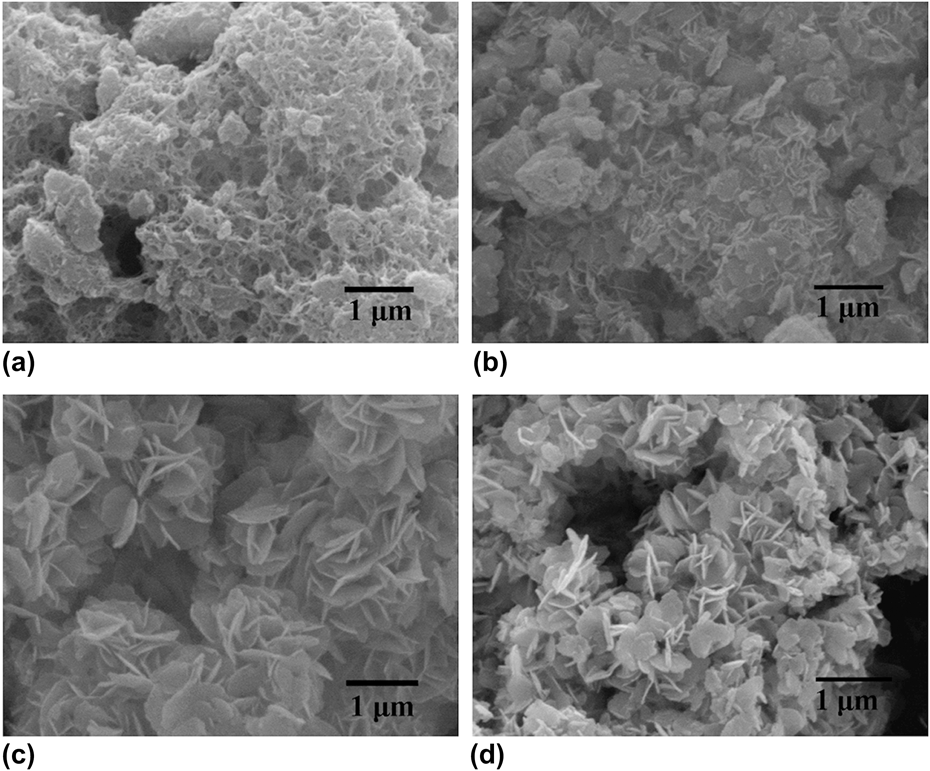
Typical morphology evolution of Ni(OH)2 precursors is presented in Fig. 1. Versatile variation in morphology can be conveniently controlled by the alteration of pH values. As shown in Fig. 1, a low pH value of 8.5 leads to the formation of aggregated Ni(OH)2 nanofibers [Fig. 1(a)]. As the pH value increases to 9.0, nanoflake-like morphology can be observed in Fig. 1(b), and a clear nanoflake-stacked flower-like shape can be obtained by increasing the pH value up to 9.5 [Fig. 1(c)]. The size of nanoflakes displays a decreasing tendency with further increase of the pH value [Fig. 1(d)]. Similar phenomenon was reported in the previous literature,Reference Palanisamy and Raichur24,Reference Li, Wang, Nie, Wang and Wei25 which might be due to the partial dissolution of Ni(OH)2 to [Ni(NH3)n]2+ complex based on the following reactionReference Shi, Wang, Zhao, Du and Li26
 $${\rm{Ni(OH)}}_{\rm{2}} + n{\rm{NH}}_{\rm{3}} \cdot {\rm{H}}_{\rm{2}} {\rm{O}} = \,\,{\rm{[Ni(NH}}_{\rm{3}} {\rm{)}}n{\rm{]}}^{{\rm{2 + }}} + {\rm{2OH}}^ - + n{\rm{H}}_{\rm{2}} {\rm{O}}\quad {\rm{.}}$$
Typical SEM images showing the morphology evolution of Ni(OH)2 precursors under different pH values: (a) 8.5, (b) 9, (c) 9.5, and (d) 10.

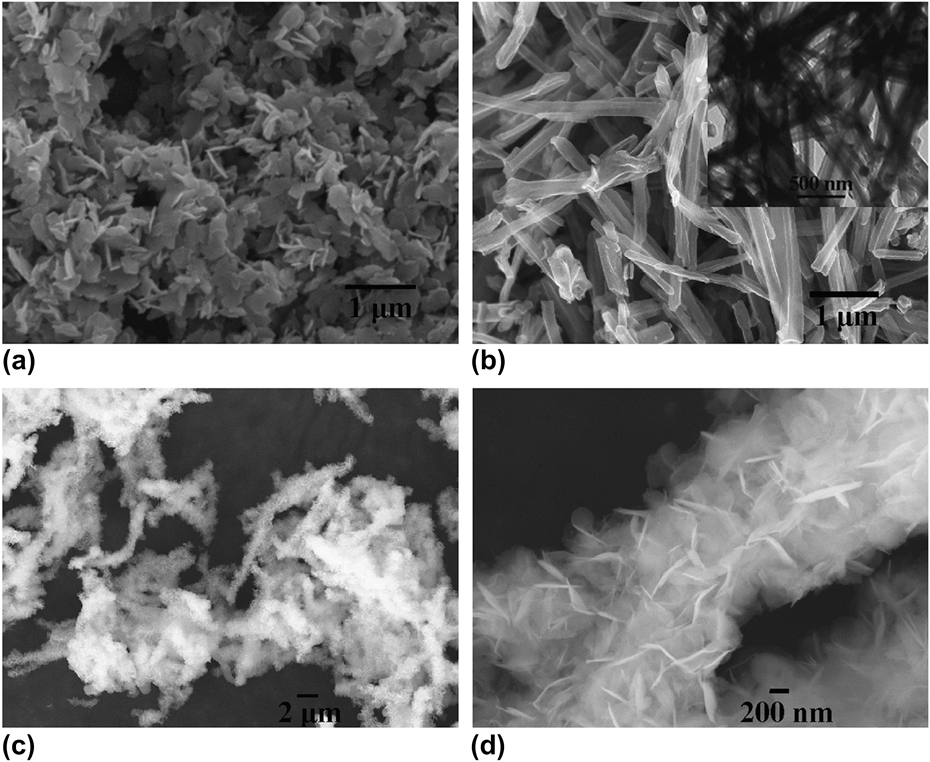
Morphological features of NiO, PCNT, and NiO/PCNT composite are presented in Fig. 2. For pure NiO [Fig. 2(a)], although the flower shape of NiO seems not as apparent as that of the precursor Ni(OH)2, nanoflake morphology with denser packing still remains after thermal decomposition. In comparison with PCNT (∼200 nm in diameter) [Fig. 2(b) and its inset], wire-like NiO/PCNT [Fig. 2(c)] has a rough surface with an obvious increase in diameter, suggesting the presence of NiO on PCNT surfaces. Its diameter and length are around 1 μm and several microns, respectively. The magnified SEM image [Fig. 2(d)] clearly illustrates that interconnected ultrathin NiO nanoflakes (∼10 nm in thickness) are grown uniformly and vertically on PCNT surfaces to form core/shell wires with nano/micro binary structure. Moreover, sheet–sheet and wire–wire interwoven connection in these microwires generates highly porous structures. According to a previous report, continuous surface-open morphology and preferential orientation of core/shell NiO/PCNT composites can improve both charge/mass transport and mechanical integrity of the electrode, which are beneficial to LIB performance.Reference Song, Par, Alamgir, Cho and Liu27
Typical SEM images of (a) NiO, (b) PCNT, and (c, d) NiO/CNT composite with different magnifications. The inset is the TEM image of PCNT.
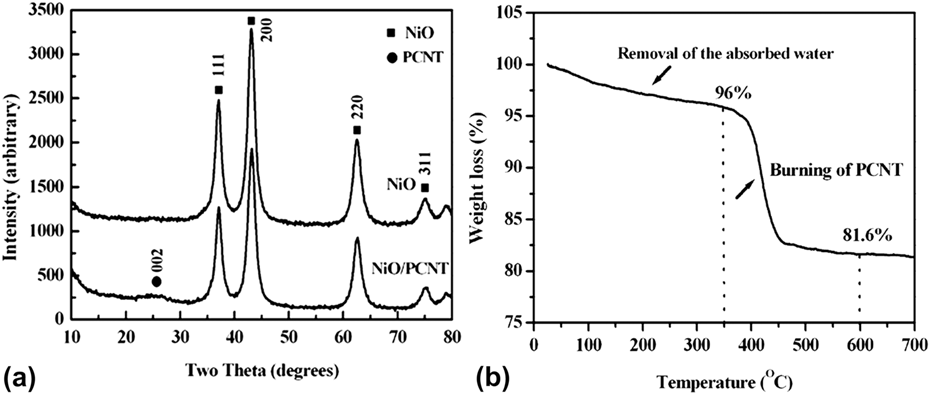
The crystalline structures of samples are investigated by XRD patterns, as shown in Fig. 3(a). The main diffraction peaks at 37.2, 43.1, 62.5, and 75.1°, can be easily identified for (111), (200), (220), and (311) crystal planes of the cubic NiO phase, respectively, in accord with JCPDS card no. 47-1049.Reference Kalam, Al-Shihri, Al-Sehemi, Awwad, Du and Ahmad28 The strong diffraction peaks indicate high crystallinity of these two samples. Besides, the composite has an additional peak from the (002) plane of hexagonal carbon near 25°.Reference Yang, Weidenthaler, Spliethoff, Mayanna and Schuth29 This result indicates that the composite is composed of NiO and carbon. The PCNT content in the composite is analyzed by the TGA curve, as shown in Fig. 3(b). The initial decline of ∼4% up to 350 °C is due to the removal of the absorbed water. Another weight loss of ∼14.2% occurs between 350 and 600 °C, which is attributed to the burning of PCNT. Accordingly, the composite includes ∼14.4% PCNT.
(a) XRD patterns of NiO and NiO/PCNT composite. (b) TGA curve of NiO/PCNT composite.
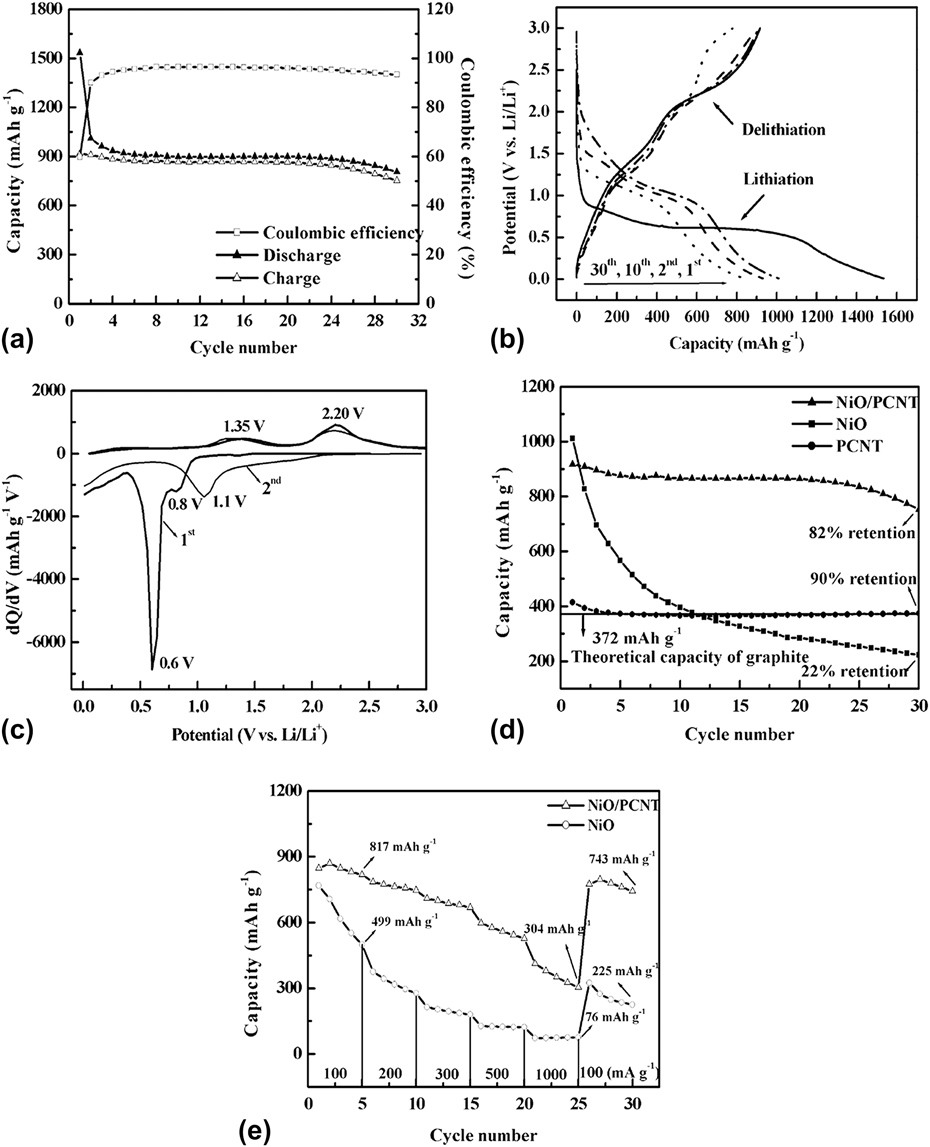
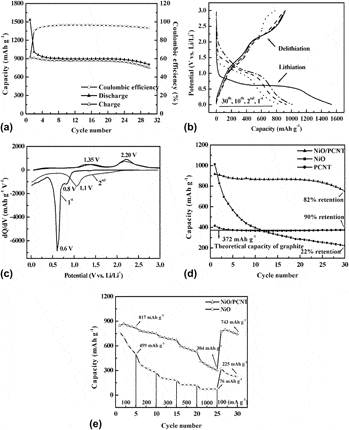
Generally, the structure of the material strongly affects its lithium storage properties. The as-prepared composite possesses good mechanical integrity and thus ensures good electrical connectivity between NiO and PCNT. Conductive PCNTs function as the structural support for effective utilization of NiO and as the conductive phase for fast charge transfer. Additionally, abundant pores on the surface of the NiO/PCNT microwire and between NiO/PCNT microwires provide large electrolyte/electrode interface and short diffusion path for electrons and electrolyte ions, as well as lots of buffering spaces for releasing the internal stress caused by lithiation/delithiation-induced volume change upon cycling. Based on the above merits, the performance of NiO/PCNT may be superior to that of pure NiO. To prove this hypothesis, electrochemical properties of pure NiO, PCNT, and NiO/PCNT anodes for LIBs are compared in a potential range of 0.01–3.0 V versus Li/Li+. Figure 4(a) displays cycling performance of the NiO/PCNT composite at a constant current density of 100 mA/g. The composite shows high initial discharge and charge capacities of 1533 and 917 mAh/g, respectively, with a Coulombic efficiency of 60%. Low initial efficiency is attributed to solid–electrolyte interface (SEI) formation and electrolyte decomposite,Reference Chen, Zhang and Sun30 which is still a challenge to most anode materials.Reference Chen, Zhang and Sun30–Reference Débart, Dupont, Poizot, Lerichen and Tarascon33 From the second cycle, the capacity of the composite has small variation with obviously improved Coulombic efficiency of around 90–97%. After 30 cycles, the discharge and charge capacities still remain at 806 and 752 mAh/g, indicating good cycleability of the composite.
(a) Cycling performance of NiO/PCNT composite at a current density of 100 mA/g. (b) Discharge/charge voltage profile of NiO/PCNT composite at a current density of 100 mA/g. (c) Differential capacity curves of NiO/PCNT composite at a current density of 100 mA/g. (d) Comparison of cycling performance of pure NiO, PCNT, and NiO/PCNT composite at a current density of 100 mA/g. (e) Rate performance of pure NiO and NiO/PCNT composite at various rates. The rates are indicated in Fig. 4(e) and the unit is milliampere per gram.
Figure 4(b) represents the 1st, 2nd, 10th, and 30th discharge/charge profiles of the NiO/PCNT composite at a current density of 100 mA/g. During the first cycle, a large capacity loss (616 mAh/g) can be found, which may be mainly ascribed to both SEI formation and electrolyte decomposition. In the range of 2–30 cycles, discharge and charge curves for each cycle are similar to each other, implying the greatly enhanced reversibility of electrochemical reactions due to the formation of SEI.
To investigate the reaction mechanism of the NiO/PCNT composite, differential capacity profiles that are derived from the 1st and 2nd discharge/charge profiles [Fig. 4(b)] are shown in Fig. 4(c). These curves clearly reflect structural transformations of NiO/PCNT during lithiation and delithiation process. In the first cycle, two cathodic peaks near 0.8 and 0.6 V, are related with the SEI formation (Li+ + electrolyte + e− → SEI) and the reduction of Ni2+O to Ni0 (NiO + 2Li+ + 2e− → Ni + Li2O), respectively. Two anodic peaks at 1.35 and 2.20 V correspond to the partial dissolution of the organic SEI layer and the oxidation of Ni0 (Ni + Li2O → NiO + 2Li+ + 2e−), respectively. These potential values have good resemblance to those of the reported NiO.Reference Wu, Xu, Wu, Xu, Wang, Peng and Zheng31,Reference Varghese, Reddy, Zhu, Lit, Hoong, Subba Rao, Chowdari, Wee, Lim and Sow34,Reference Huang, Tu, Zhang, Xhang, Li, Yuan and Wu35 In the subsequent cycle, the cathodic peak near 0.6 V shifts to a high potential (1.1 V) and anodic peaks still retain the initial potential, indicating the improvement of electrochemical reversibility of the composite.Reference Liu, Or, Jin, Lv, Feng and Sun36
To understand the effect of PCNT in the composite on lithium storage, cycling performance of pure NiO, PCNT, and NiO/PCNT composite is compared under the same conditions. As shown in Fig. 4(d), a clear difference in capacity retention can be seen from the repeated cycles. NiO/PCNT composite exhibits an initial reversible capacity of 917 mAh/g and then retains around 752 mAh/g over 30 cycles with 82% capacity retention, revealing good electrochemical stability. In contrast, pure NiO exhibits a worse capacity of 223 mAh/g over 30 cycles with low retention (22%). As for PCNT, its reversible capacity only slightly decreases from 414 to 374 mAh/g, corresponding to 90% capacity retention. By comparison, the composite has almost twice the theoretical capacity of graphite (372 mAh/g) and PCNT delivers a capacity almost equal to that of graphite, whereas pure NiO only has 40% that of graphite. Of note, the reversible capacity (752 mAh/g) of the composite even after 30 cycles is higher than the theoretical value of NiO (718 mAh/g). Such high capacity might be mainly due to four factors including capacitive properties of NiO, SEI formation, nano-size effect, and synergistic effect of 2D NiO nanosheet and 1D PCNT.Reference Aravindan, Kumar, Sundaramurthy, Ling, Ramakrishna and Madhavi9,Reference Zhu, Hu, Dai and Jiang19,Reference Xu, Sun and Gao20,Reference Zhou, Wang, Yin, Li, Li and Cheng22,Reference Zou and Wang37,Reference Ci, Zou, Zeng, Sheng, Luo and Wen38 Accordingly, the introduction of PCNT into NiO is greatly helpful to improve the cycle performance of the electrode material.
The rate performance of pure NiO and NiO/PCNT composite at various current densities from 100 to 1000 mA/g is displayed to further confirm the positive effect of PCNT. The loading of active materials is about 0.5 mg. As seen in Fig. 4(e), charge capacities of pure NiO and the composite are 499 and 817 mAh/g at a low rate (100 mA/g) at the 5th cycle. When the rate is increased after 5 cycles in step up to a high rate (1000 mA/g), the composite still reaches a charge capacity of 304 mAh/g over 25 cycles, whereas pure NiO only retains 76 mAh/g with fast capacity fading. As the rate finally reverts to its initial value (100 mA/g), the composite and pure NiO retains 87.7% (743 mAh/g) and 29.3% (225 mAh/g) of initial charge capacity over 30 cycles, respectively. As expected, the composite has much higher capacity and better rate performance than pure NiO, indicating the potential of the composite in LIBs.
IV. CONCLUSIONS
Hierarchically porous NiO/PCNT composite is rationally constructed by using 1D and 2D nanocomponents and evaluated as an anode for LIBs. When used as anode materials for LIBs, the composite exhibits greatly enhanced reversible capacity (752 mAh/g after 30 cycles), cycleability (82% capacity retention after 30 cycles), and rate performance (817 mAh/g at 100 mA/g after 5 cycles; 304 mAh/g at 1000 mA/g after 25 cycles) compared to pure NiO. The improved lithium storage performance of NiO/PCNT composite may be benefited from the PCNT introduction and the attractive configuration made of different dimensional nanomaterials.
ACKNOWLEDGMENTS
This work was financially supported from Scientific Research Program of the Higher Education Institution of Xinjiang (Grant No. XJEDU2012I05), the National Natural Science Foundation of China (Grant No. 21063013), and the Scientific Research Starting Foundation for Doctoral Graduate, Xinjiang University (Grant No. 07020428024).