Introduction
[Income disparities] are widening and they will widen much more. That doesn't worry me.
(New Zealand Finance Minister Bill Birch in 1995, cited in Kelsey, Reference Kelsey2000: 1)
We don't begrudge financial success in this country. We admire it.
(Barack Obama, Reference Obama2012)
Income inequality in developed western countries has increased markedly over the last thirty years (OECD, 2011a; Perry, Reference Perry2013). Besides concerns about the fairness of given distributions of wealth, current high levels of economic inequality carry with them a range of socially damaging consequences. These are held to include the erosion of social cohesion and trust (OECD, 2011a; Rothstein and Uslaner, Reference Rothstein and Uslaner2005; Uslaner, Reference Uslaner2008) and democratic responsiveness (Gilens, Reference Gilens2005; Bartels, Reference Bartels2008; Hacker and Pierson, Reference Hacker and Pierson2010), decreasing levels of overall happiness (Layard, Reference Layard2005) and a wide range of negative socio-economic effects (Jencks, Reference Jencks2002) including public health effects (Wilkinson, Reference Wilkinson1996). Recent increases in inequality are associated in part with stagnating incomes in the bottom quintiles, due to historically high levels of unemployment, and to the impact of globalisation and ‘the knowledge economy’ on wages (Stiglitz, Reference Stiglitz2012). But they are also – and importantly – associated with what Hacker and Pierson (Reference Hacker and Pierson2010) call the ‘hyperconcentration’ of wealth and income in the hands of a decreasing number of people: the increasing share of wealth and income held by the wealthiest ten per cent, one per cent and 0.1 per cent (see also Atkinson and Leigh, Reference Atkinson and Leigh2005; Saez, Reference Saez2012; Wade, Reference Wade and Rashbrooke2013).
Those at the top, however, have remained more or less invisible to policy-makers. As previous articles in this journal have noted, ‘while there has been considerable discussion about questions of deservingness in relation to people in poverty, there has been much less discussion of these questions in relation to the wealthy’ (Rowlingson and Connor, Reference Rowlingson and Connor2011: 1; see also Orton and Rowlingson, Reference Orton and Rowlingson2007a). Issues of wealth, in other words, have not been seen as policy ‘problems’ in the same way that issues of poverty have (Hills and Stewart, Reference Hills and Stewart2005; Orton and Rowlingson, Reference Orton and Rowlingson2007a: 61). Taking this discrepancy as its starting point, this present article joins the authors referred to above in seeking to bring ‘the problem of riches’ (Orton and Rowlingson, Reference Orton and Rowlingson2007a) and the question of ‘the deserving rich’ (Rowlingson & Connor, Reference Rowlingson and Connor2011) into the academic, policy and public discussion of inequality, and social policy (see also Burak, Reference Burak2013; Dean, with Melrose, Reference Dean and Melrose1999; McCall and Kenworthy, Reference McCall and Kenworthy2009; Sachweh, Reference Sachweh2012).
Earlier contributions to the emerging literature on the deservingness of the rich have established that wealth and riches can validly be seen as policy problems, due to the relationship between privilege and deprivation (Orton and Rowlingson, Reference Orton and Rowlingson2007a), and due to the implication of the rich in any policy response to inequality: as Rowlingson and Connor (Reference Rowlingson and Connor2011: 2) note bluntly, ‘social policies inevitably involve the wealthy, particularly in relation to taxation policy, and some principles of fairness and justice are needed to guide those policies’. This article contributes to this literature through a summary and a discussion of recent New Zealand public opinion data. The article is chiefly empirical, establishing the extent of the concentration of wealth and income, and exploring what (we think) we know about public attitudes towards the deservingness of the rich. My concerns, however, are also normative (what are the policy implications of focussing on wealthy individuals) and methodological (what are the limits of large-N surveys to ascertain what people ‘really’ think on this issue?)
The deservingness of the rich and the poor
The public inclination to focus on the deservingness of the poor rather than the deservingness of the rich is, of course, only relative. In the wake of the Global Financial Crisis, a degree of popular disquiet and even outrage has been directed at the bonuses paid within the financial services sector, and at a perceived ‘culture of excess’ among the very rich (see Rowlingson and Connor, Reference Rowlingson and Connor2011: 10). The worldwide ‘Occupy’ movement likewise achieved much of its resonance through its explicit construction of an opposition between us ‘the 99%’ and them ‘the privileged 1%’. There is already, moreover, a social consensus that people do not have an absolute or unlimited right to their wealth. In modern democracies, there is broad agreement that the principle of economic individualism is not inviolable and that people – including the wealthy – may legitimately be required to make some of their wealth available – through taxation – for social good purposes (Burak, Reference Burak2013: 100). It makes good sense, then, to explore what the public actually thinks about the deservingness of the rich. How much of what people have ‘earned through their own efforts’ (Brash, Reference Brash2005) do they deserve to keep? On what basis? How much, and on what grounds, may people be rightfully asked to relinquish?
In his work, Wim van Oorschot (Reference Van Oorschot2000: 36) shows that judgments regarding the deservingness of welfare recipients are largely based on perceptions of their level of responsibility for their circumstances, and lists five deservingness criteria: their control over that neediness, their objective level of need, the extent to which they are seen as sharing a common identity with ‘us’, their docility, gratefulness or attitude in regard to the support they receive, and their capacity for reciprocity vis-à-vis that support. To put things another way, considerations of the deservingness of the poor are typically based on some variation of the basic question ‘do they deserve our support?’ In its enactment of an us/them dichotomy, this basic question contains a series of assumptions about ‘us’ as well as about ‘them’: ‘us’ may be taken as referring to law-abiding, hard-working, self-responsible citizens; ‘them’ as an other – a group making claims on the holdings that ‘we’ have acquired through our own efforts.
A presumption for the deservingness of the rich might therefore be seen as an argument that van Oorschot's five deservingness criteria are either satisfied by, or inapplicable to, the rich. The rich might be seen as deserving, in other words, to the extent that they are deemed to be in individual control of their own outcomes, to share an identity with ‘us’ based on admired values, and to meet the criteria of reciprocity by making a positive contribution to society. The criterion of need might be seen as inapplicable to the rich (but see Burak, Reference Burak2013: 111) and that of attitude as moot: if the rich are generally seen as individually responsible for their wealth, they have little need to prove their docility or gratefulness. More generally, the us/them dichotomy is more ambivalent with respect to the rich. While the very rich may often be seen as a ‘them’ distinct from normal, mainstream ‘us’ (and it is this that underpins the resonance of the us contra them framing of the Occupy movement), they are seldom – allowing for certain exceptions – represented as having taken possession of ‘our’ money.
Even more fundamentally, the question of deservingness is structurally different in respect of the rich, compared to the poor. Within a market-based economic system, the questions become ‘do the rich deserve to keep what they already have?’ and ‘do the poor deserve to actively receive something from society?’ Possession, perhaps, ought not to be 90% of the law. But if the market's distribution of wealth is accepted as natural, fair and efficient, and political re-distribution as artificial, arbitrary and wasteful (see Lane, Reference Lane1986: 385) then existing possession – based on one's performance in the market – will powerfully influence perceptions of just deserts. As Hacker and Pierson (Reference Hacker and Pierson2010: 56) note, the very word ‘redistribution’, in its suggestion of ‘the refashioning of a natural order by meddling politicians’, is ‘symptomatic of the pervasive distortions in contemporary discussion’. Choosing to emphasise the question of individual deservingness thus carries normative and political implications: it is likely to direct our attention towards what Robert Lane (Reference Lane1986) calls the ‘market justice’ principle of earned desert and away from the ‘political justice’ principles of equality and need. A proper exploration of the ‘deservingness of the rich’ or of ‘the problem of riches’, then, needs to incorporate not just the question of individual desert (does individual X deserve her holdings Y, or her annual income Z?) but also the bases of preferences for the individualistic principle of earned desert over the society-oriented principles of equality and need.
Rowlingson and Connor (Reference Rowlingson and Connor2011: 3) observe that there is an enormous literature addressing the justice of various economic distributions. As they found, full coverage of even the basic contours of that literature is also beyond the scope of this paper. What we might say, however, is that arguments for the deservingness of the rich might appeal to criteria such as contribution (the wealthy contribute disproportionately to society and should be rewarded for so doing), macro-economic (including incentive) effects (the possibility of becoming wealthy will encourage others towards innovation, effort and risk-taking in socially beneficial ways), or entitlement (the wealthy are entitled to their holdings, so long as they did not violate anyone else's rights in acquiring them).
Taken individually, each of these arguments may be queried and challenged. The claim that disproportionate wealth is based on disproportionate contribution is challenged empirically by Joseph Stiglitz, who notes (2012: 41) the questionable recent contributions to society of many of the highest paid; the modest rewards claimed by many of those who have made profound contributions in science, medicine and the ‘caring professions’ (see also Rashbrooke, Reference Rashbrooke2013) and the policy decisions that influence how the rewards of work are distributed. Arguments from incentive effects are contested by psychological research that shows the limited incentivising effect of financial rewards (Fehr and Falk, Reference Fehr and Falk2002). The broader macro-economic effects of the concentration of wealth are mixed and unclear, with research demonstrating no clear correlation between inequality and economic growth. And prominent theories of entitlement (especially Nozick, Reference Nozick1974) are based on questionable assumptions of the ontological (and normative) primacy of the individual, and of the absolute nature of the right to property.
Perhaps the most effective counter, however, lies in the argument that one can only acquire wealth because of the many and various things that society provides: the ‘unearned, socially created aspects’ of wealth (Rowlingson and Connor, Reference Rowlingson and Connor2011: 11; see also Stiglitz, Reference Sachweh2012: 92–3) such as physical, legal and institutional infrastructure, a viable level of social trust and a healthy and educated workforce. Such arguments are expressed by Titmuss (Reference Titumuss1958), in his explication of the various sorts of welfare enjoyed by the rich, and by Nobel Prize winning economist Herbert Simon (in Singer, Reference Singer, Wallace and Atwan2007: 270) who argues that ‘“social capital” is responsible for at least 90 per cent of what people earn in wealthy societies’.Footnote 1 The myth of the heroic individual wealth creator, then, is precisely that: a myth, and a shaky foundation on which to build a fair social policy. Given the important social aspects of wealth creation, it is reasonable to at least think more seriously about the extent and the strength of society's claims on some portion of the holdings of the wealthy.
Having established the major factors relevant to a consideration of the deservingness of the rich, in the sections below we summarise recent trends in New Zealand in terms of (1) the concentration of wealth and income and (2) public opinion towards inequality generally and the deservingness of the rich more specifically. New Zealand is selected as an ideal site in which to explore these questions. As a uniquely small and remote developed country that was the subject of a remarkably pure version of neo-liberal reform in the 1980s, the connections in New Zealand between public policy and distributive outcomes are particularly clear. The analysis below draws on existing and new public opinion data from New Zealand, supplemented where appropriate with data from elsewhere (primarily from the United Kingdom, the United States and Australia) to show where New Zealand is in line with international trends and where (at times) it diverges.
Poverty, inequality and wealth in New Zealand
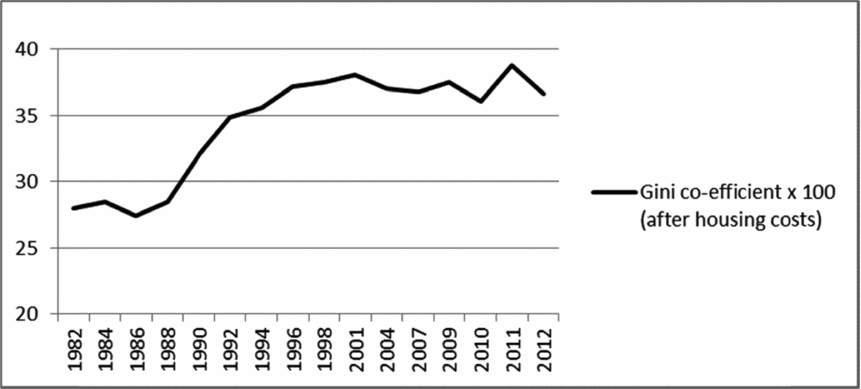
Income inequality in New Zealand ‘rose rapidly from the late 1980s through to the early 1990s, followed by a slower but steady rise through to the early 2000s. It fell from 2004 to 2007’ while recent data display a degree of ‘volatility, reflecting the differing size and timing of the impact of the global financial crisis and economic downturn’ (Perry, Reference Perry2013: 10). This broad trend – illustrated in Figure 1 in terms of the Gini co-efficient – moved New Zealand from being one of the more equal countries in the OECD to one of the more unequal (Perry, Reference Perry2013: 163) and the rate of increase in the decade from the mid-1980s was on some measures the highest out of those countries (OECD, 2011b: 24, 45; Statistics New Zealand, 1999: 9). There was nothing natural or inevitable about these shifts. Rather, they were the predictable result of a period of rapid and rigorous economic liberalisation initiated by the fourth Labour Government (1984–90) and extended by the subsequent National administration (1990–99) (James Reference James and Miller1997, 13–14, 20–3). In terms of specific policy choices, these reforms included the reduction and targeting of benefit entitlements, the privatisation of state assets, targeting and user-pays regimes in the provision of public services, the erosion of union power and collective bargaining provisions, and tax cuts (see Easton, Reference Easton1997; Kelsey, Reference Kelsey2000).
Trends in inequality, 1982−2012 (Gini co-efficient x 100) Source: Perry (Reference Perry2013: 87).

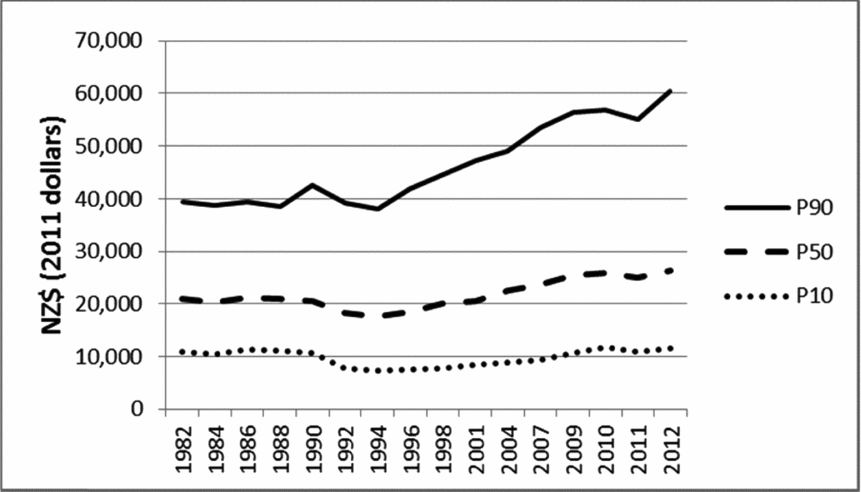
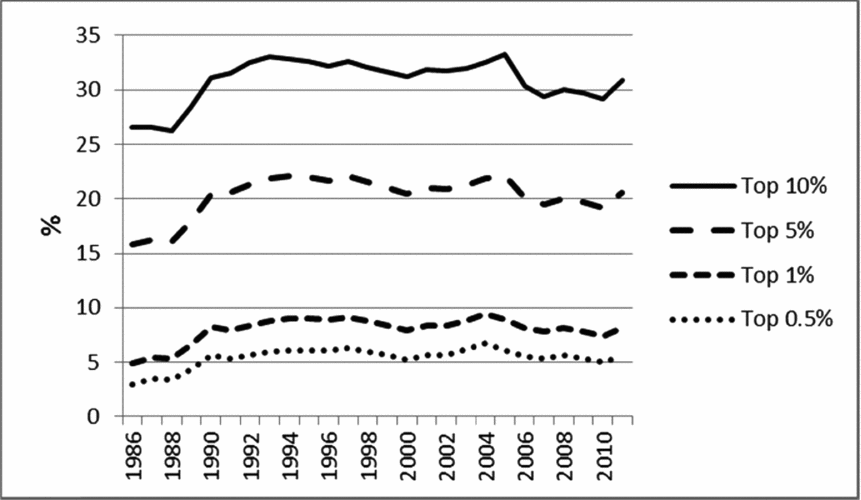
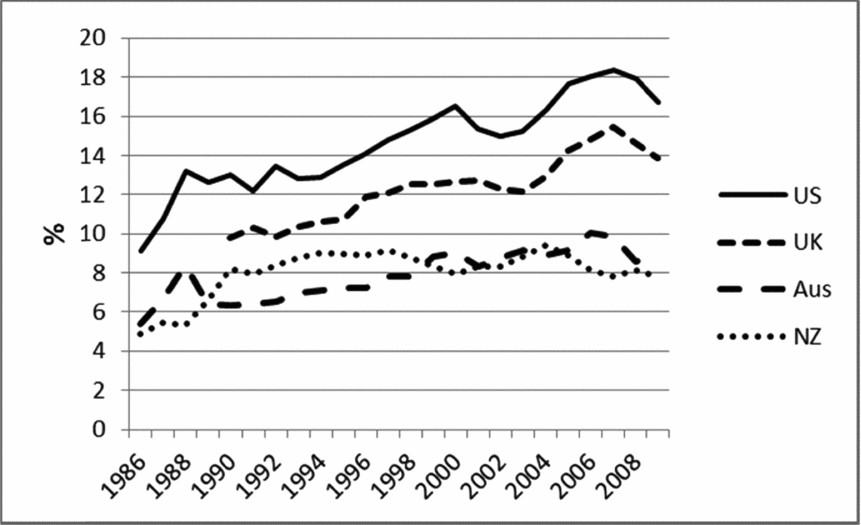
The trends are equally striking at the extreme ends of the income distribution – and especially at the top. Figure 2 shows the real equivalised household incomes (after housing costs) of earners at selected decile boundaries between 1982 and 2012. While the P90 household income rose from $38,600 to $56,500 (a 46% increase), the P10 household income ($11,100 in 1982 decreased through the 1990s before recovering to be essentially the same in 2012 ($10,700). Figure 3, drawing on the datasets of the ‘World Top Incomes Database’ associated with Alvaredo, Atkinson, Piketty and Saez, likewise demonstrates a steady rise in the before-tax income share of those at the very top of the distribution from 1986 to 2005, after which time those shares lessened slightly. The top 1% share of income almost doubled between 1986 (4.88%) and 2004 (9.41%) before falling slightly by 2010 (7.40%). Figure 4 places the New Zealand trends since the 1980s in a cross-national comparison by also including figures for the United Kingdom, the United States and Australia. This figure shows that the top 1% share of income is noticeably lower in New Zealand than in the US and the UK (the rich in New Zealand are not as rich as the rich there, in relative terms), and it highlights how the major changes in the concentration of income occurred in the decade from the mid-1980s.
Real equivalised household incomes (ACH): P90, P50 and P10 Source: Perry (Reference Perry2013: 76).
Share of income going to high-income earners in New Zealand Source: Alvaredo et al. (Reference Alvaredo, Atkinson, Piketty and Saez2014).Footnote 2
Share of income going to the top 1% in nominated countries Source: Alvaredo et al. (Reference Alvaredo, Atkinson, Piketty and Saez2014).
To understand the position of the rich, however, it is necessary to look at measures beyond annual income. There are many ways in which one might earn a very low income in a given year and yet be considered wealthy. As Orton and Rowlingson (Reference Orton and Rowlingson2007a: 69) note, ‘there are a number of reasons why ownership of assets is interesting’. Wealth (more so than income) allows one to plan and invest well for the future, and to ride out short-term financial difficulties (Sherraden, Reference Sherraden1991). Wealth, moreover, is typically distributed far more unequally than income. While the top 10% of income earners captured 32% of national income in 2003, Cheung (Reference Cheung2007: 7–8) reports that the wealthiest 10% of individuals controlled 52% of New Zealand's net wealth (assets minus liabilities) and the top 20% controlled about 70%. In terms of the distribution of wealth, this places New Zealand roughly half-way between Australia and the United Kingdom, where the top 20% hold approximately 60% of national wealth (Neal et al., Reference Neal, Govan, Norton and Ariely2011; Inequality Briefing, 2013) and the United States, where they hold 84% (Norton and Ariely, Reference Norton and Ariely2011).
A proper calculation of what it means to be ‘rich’ or ‘wealthy’ would intuitively include both income and net wealth. Orton and Rowlingson (Reference Orton and Rowlingson2007a: 68–72) note also the importance of including assets in a consideration of the wealthy. Their discussion, however, demonstrates the complexities of doing so, and these complexities are compounded (at least in New Zealand) by a lack of data in relation to the distribution of wealth. This article does not engage with the important task of developing a metric of wealth that combines income and assets.
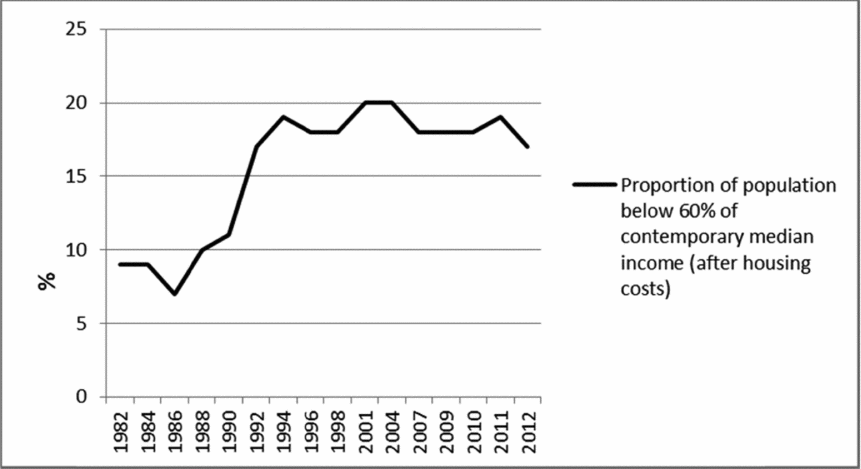
The share of income and wealth held by the richest New Zealanders stands in stark contrast to the position of the poor, and to levels of relative poverty since the 1980s. Cheung (Reference Cheung2007) found that 70% of New Zealand's net wealth was held by the richest 20%, that the poorest 20% – taken collectively – had negative net wealth, and that the bottom 50% of the population held only 5% of the nation's wealth. Various measures of relative poverty (Figure 5 adopts the measure of 60% of median income, after housing costsFootnote 3) show a trend strikingly similar to that for inequality: a rapid rise between the mid-1980s and the mid-1990s, followed by a levelling off and, from the mid-2000s, a moderate drop (as a result, largely, of the Working for Families package of in-work tax credits calculated on the basis of family income and on the number and age of dependent children).
Trends in poverty, 1982−2012 Source: Perry (Reference Perry2013: 111).
Public attitudes towards inequality and the rich
Having established the extent of the increasing concentration of wealth and income in New Zealand, we turn now to an analysis of public opinion towards this concentration, and towards the deservingness (or otherwise) of the rich. Some of the data in this section comes from existing sources: the New Zealand Election Study (NZES, run three-yearly since 1990); and relevant New Zealand modules of the International Social Survey Project (ISSP, especially the modules on ‘inequality’ in 1992, 1999 and 2009). Where appropriate we will refer to extant analyses of these sources (especially Humpage (Reference Humpage2008, Reference Humpage2011)). Existing data will be supplemented with findings from the 2011 New Zealand Justice and Equality Study (NZJES), a representative survey (N = 363) of the New Zealand public aged eighteen years and over. While smaller than the other surveys, the NZJES included items that related to the perceived deservingness of the richest and poorest 10 per cent of New Zealanders.Footnote 4 Invitations to participate were posted to a semi-randomised sample of the electoral roll, with the actual survey conducted online with a hard-copy option available on request. Analysis of other parts of the NZJES data can be found in Skilling (Reference Skilling2013) and the data set is available on request from the author.
Attitudes towards inequality and redistribution
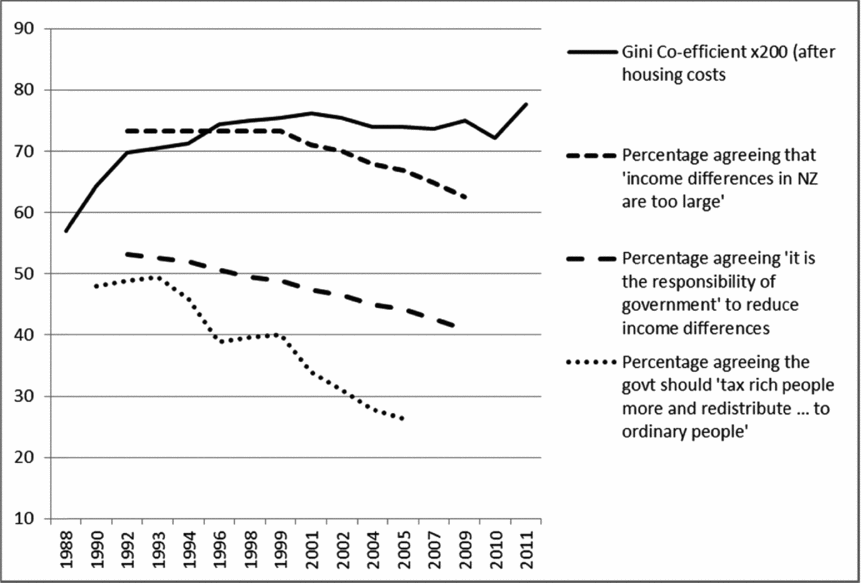
One central puzzle that emerges from the public opinion data is that, even as inequality has remained at historically high levels, public concern about the level of inequality has fallen. Figure 6 shows how agreement with the proposition that ‘income differences in NZ are too large’ fell between 1992 and 2009, from 73% to 63%. It is worth noting here the obvious point that a majority (albeit a slim one) still agrees that there is too much income inequality. Figure 6 also shows, however, a lower level of support for the proposition that the government ought to take responsibility for reducing inequality. It shows, more specifically, that support for the government taxing ‘rich people’ more and redistributing wealth and income to ‘ordinary people’ fell from 48% in 1990 to 26% in 2005. Other NZES data (see Humpage, Reference Humpage2008: 220) shows that support for cutting taxes rose from 36% to 69% between 1993 and 2005.Footnote 5 We confront here the co-existence of concern over inequality in principle with resistance to mechanisms that might reduce inequality in practice (Orton and Rowlingson, Reference Orton and Rowlingson2007b: 19–23).
Trends in inequality versus redistributive sentiments, 1988−2011 Sources: Perry (Reference Perry2013: 87); ISSP (1992, 1999, 2009); NZES (1993, 1996, 1999, 2002, 2005).
These findings can be classed as a puzzle in light of the assumption (see Lind, Reference Lind2005; Stiglitz, Reference Stiglitz2012: 118) in democratic settings that ‘the decisive swing voter . . . [who] almost invariably has an income lower than the average income in society’ has a rational self-interest in redistributive policies and greater equality (Hacker and Pierson, Reference Hacker and Pierson2010: 77). Certainly, a sense of puzzlement is apparent in Peter Taylor-Gooby's (Reference Taylor-Gooby2013: 31, author's emphasis) observation in the United Kingdom: ‘during the past thirty years, incomes have grown more unequal, a small group at the top has captured a much greater share of resources, and poverty has increased’ and yet ‘most people have become . . . markedly less likely to want government to redistribute income or tackle poverty’ (see also Orton and Rowlingson, Reference Orton and Rowlingson2007b: 19–23).
The puzzle, however, might be explained, in part, by differences in how the poor and the (very) rich are imagined by the mainstream ‘us’. Bamfield and Horton's focus group-based research shows the tendency of most people to subjectively place themselves ‘in the “middle” of the income distribution’ (Bamfield and Horton, Reference Bamfield and Horton2009: 5). They thus tend simultaneously to both endorse the proposition that there is too much inequality (too large a gap between themselves and those ‘at the top’) and also to oppose redistributive policy proposals which they fear might represent an extra burden on themselves (ibid.: 28, 39). To this insight, Robert Wade (Reference Wade and Rashbrooke2013: 45) adds that ‘fear of loss is a more powerful motivator than [the] prospect of gain’. As such, ‘middle class anxiety’ is likely to be piqued more by moves to ‘pull up those below them’ than by the prospect of ‘those above them rising even further away’.
Attitudes towards occupational earnings and inequality
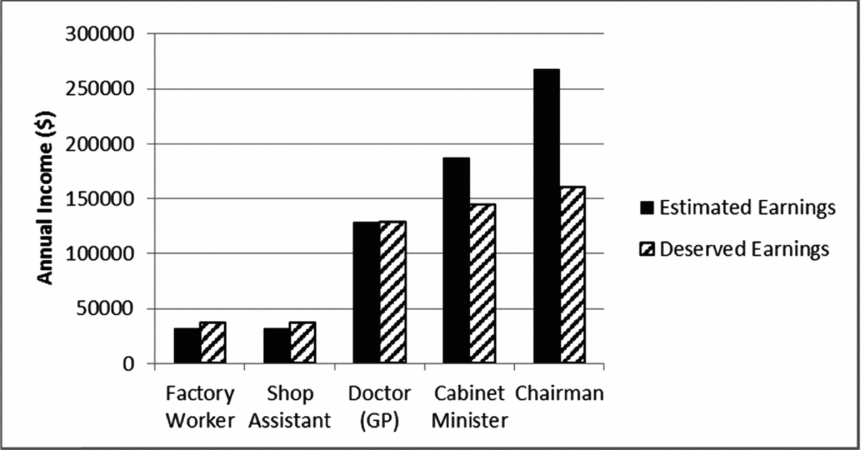
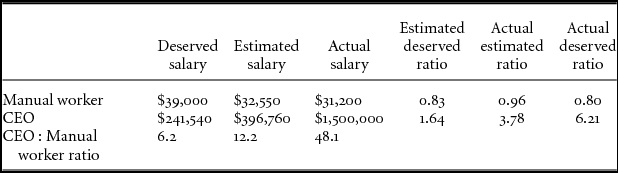
One commonly used method for assessing people's attitudes as to whether the rich deserve their holdings is to ask respondents what level of income various occupational positions deserve, and what level of income they think such positions actually receive. The results shown in Figure 7 come from the 2009 New Zealand module of the ISSP. The 2011 NZJES used different occupations and different measures of income (net weekly income rather than the ISSP's annual gross income) to test the robustness of the former's findings; the results are summarised in Table 1. The two studies delivered strikingly similar results: low-income earners (a factory worker in the ISSP, a manual worker in the NZJES) were believed to earn less than they deserved (ratios of 0.86 and 0.83 respectively) whereas high-income earners (a company chairman in the ISSP, a CEO in the NZJES) were believed to earn more than they deserved (ratios of 1.67 and 1.64).
Estimates of what different occupations should and do earn (NZ$) Source: ISSP (2009).
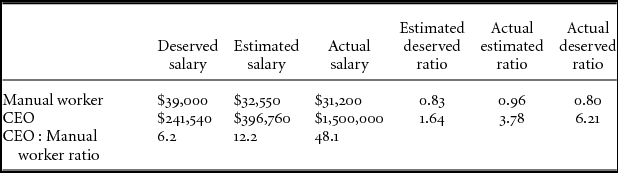
As is common with such questions, however, the most striking results can be found in the difference between people's estimates of the earnings of different occupations, and the actual earnings of those occupations. In the NZJES, respondents’ estimate of a CEO's salary ($400,000 per annum), was much higher than what they thought a CEO should earn ($240,000) but much lower than what the average CEO of a large New Zealand company actually did earn. Given that respondents were asked to estimate the income of the CEO of a ‘large New Zealand company’ (and given the paucity of genuinely large companies in the New Zealand economy) it seems reasonable to use the New Zealand Herald’s (Adams, Reference Adams2012) survey of CEO salaries, which derived an average income of $1.5 million among the top 50 earning New Zealand CEOs. Using this figure, respondents believed that the ratio between the income of a CEO and a manual worker ought to be 6.2. At the same time, they believed the ratio, in reality, to be roughly double that: 12.2. In actuality, the ratio was 48.1: almost four times the perceived actual ratio, and almost eight times the ‘just’ or ‘deserved’ ratio.Footnote 6
Despite these findings, the public evinces little enthusiasm for legislated limitations on earnings (the NZJES found only 18% support for the idea of ‘an upper limit on the amount of money that one person can earn’ (74% were opposed)) or, as we have seen, for government-led redistribution. Much turns, however, on how questions are framed and worded. Using more targeted questions, Esra Burak (Reference Burak2013) shows a substantial level of support for some sort of cap on compensation levels in the United States, and examines the reasons given by those in favour of, and by those opposed to, such a cap. It is interesting to note that this finding of intolerance for extremely high incomes appears to co-exist with broad public support for tax cuts (again, see Figure 6). Indeed, Larry Bartels (Reference Bartels2005) shows how the American public's general discomfort with high levels of inequality co-existed with broad public support for tax cuts that disproportionately benefited the already rich. As Bartels (Reference Bartels2005: 15) notes in this instance, the public ‘largely failed to connect inequality and public policy’.
Attitudes to the deservingness of the rich and the poor
We have already noted the discrepancy between the large amount of academic work on the deservingness of the poor (see Van Oorschot, Reference Van Oorschot2000, and other studies cited there) and the paucity of comparable work on the deservingness of the rich. To address this gap, specific items were included in the 2011 NZJES that asked respondents about their perceptions of the poor, the rich and social welfare recipients, against van Oorschot's deservingness criteria of control, identity, attitude and reciprocity. Respondents were asked to answer these questions while thinking, respectively, of the richest 10% of New Zealanders, the poorest 10% and welfare beneficiaries. While there is clearly a high degree of overlap between the latter two categories, the NZJES kept them as separate categories to test whether attitudes were affected by the explicit framing of the last group as welfare beneficiaries. ‘Beneficiary’ is the commonly used term in New Zealand, and it is more loaded with negative association than, say, welfare recipient.
Control
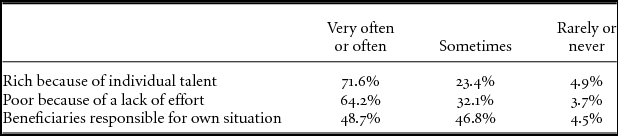
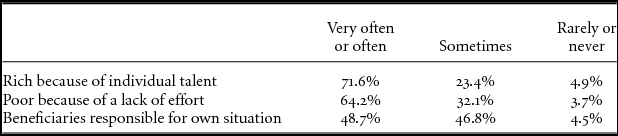
The NZJES explored whether respondents perceived these three groups as being in control of their outcomes by asking how often they thought the richness of the richest New Zealanders was due to their ‘individual talent or ability’, how often the poorness of the poor was due to their ‘lack of effort’ and how often beneficiaries were ‘responsible for their own need of welfare assistance’. Respondents tended to hold individuals (rich, poor and – to a lesser extent – beneficiaries) responsible for their own outcomes (see Table 2). This, in itself, might seem a little surprising, given the high salience in 2011 of clear structural factors for high unemployment, and given the attention that had been paid in some circles to self-perpetuating cycles of privilege. The presumption of individual control is demonstrated most starkly by the very low numbers who felt that individual-based factors such as ability and effort were ‘rarely’ or ‘never’ responsible for the respective positions of the poor (3.7%) and the rich (4.9%). It is worth noting here that the perception of individual control over one's outcomes applies much more strongly to the rich (72%) than it does to the poor (64%) and to beneficiaries (49%). It seems that the public finds it easier, though decreasingly so (see Collins, Reference Collins2006) to see social and structural factors as contributing to need and deprivation, than to see their connection to wealth and privilege.
Identity
Respondents were also asked whether they saw the richest New Zealanders, the poorest and beneficiaries as being ‘similar to [themselves] in terms of attitudes and values’. We posited above that the public, broadly speaking, might find it harder to maintain a clear us/them dichotomy with respect to the rich than with respect to the poor. This hypothesis was borne out to some extent: respondents were far more likely (see Table 3) to see the richest 10% of New Zealanders as similar to themselves than they were the poorest 10% or welfare beneficiaries. Strikingly, over half of respondents felt that the poor and beneficiaries were rarely or never similar to themselves in this regard. The findings here demonstrate, however, that most respondents did not see themselves as particularly similar to any of the nominated groups.

Attitude
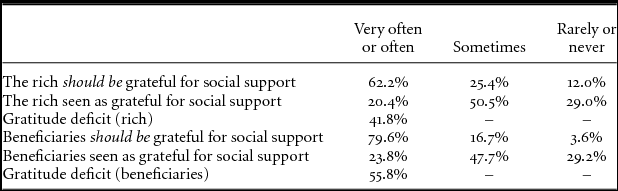
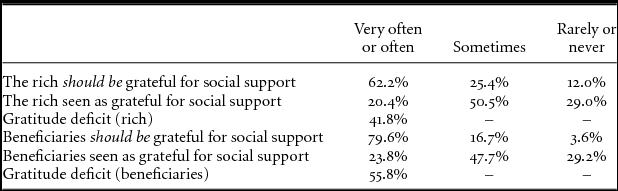
Van Oorschot's (2000: 36) criterion of attitude refers to ‘people's attitude towards support, or their docility or gratefulness’. In exploring public perceptions of the attitude of different groups, the NZJES omitted the poor, and asked how often respondents thought the rich were ‘grateful for the ways in which society might have helped them gain their wealth’ and how often they thought beneficiaries were ‘grateful for the welfare support they receive’. If we look only at the question of whether the two groups were perceived to be grateful, we note an apparent convergence (see Table 4). A similar proportion of the public felt that the rich (20%) and beneficiaries (24%) were often or very often grateful. The proportions who felt that the two groups were rarely or never grateful were identical (29% for both).

A more revealing picture, however, is offered by studying what we might call the ‘gratitude deficit’: the difference between the proportion who felt that a given group ought to be grateful and the proportion who felt that they were, in fact, grateful (see Table 5). While, as we have seen, similar proportions perceived the two groups to be grateful, significantly more felt that beneficiaries ought to be grateful (80%) than felt that way about the richest 10% (62%). The gratitude deficit was thus much larger for beneficiaries (56%) than it was for the wealthy (42%). Apparently, the contention that the wealth of the richest New Zealanders is crucially dependent on ‘unearned, socially created’ factors is not universally accepted. Still, the number of respondents who answered that the rich should be grateful for societal support seems surprisingly high: it is certainly not a common theme in public discourse. It must be acknowledged that the question was forced on respondents. It remains entirely possible that it would not occur to most people, if unprompted, to think in such terms.
Reciprocity
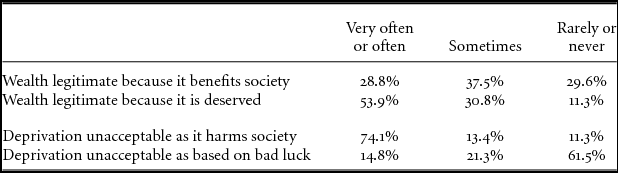
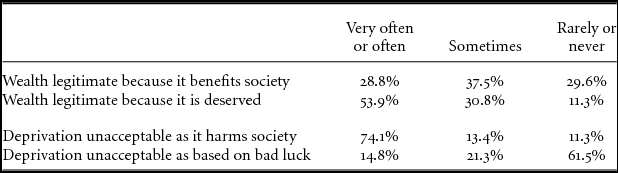
The criterion of reciprocity refers to the idea that one's deservingness of public support is seen as conditional on one's actual or potential contribution back towards society (see Van Oorschot, Reference Van Oorschot2000: 36). The 90% of NZJES respondents who felt that the wealth of the richest 10% was at least sometimes legitimate were asked further about the basis on which they judged that wealth legitimate. As shown in Table 6, respondents showed higher levels of support for the proposition that such wealth is legitimated by it being the ‘deserved reward for [the] efforts’ of the rich (54%) than for the proposition that it is legitimated by virtue of it benefiting society overall (29%). But while individual desert was highly resonant for the legitimation of wealth, considerations of social consequences were far more resonant when respondents were asked to consider what (if anything) might make the position of the poorest 10% unacceptable. The 65% of respondents who felt that such deprivation was unacceptable were asked why they felt that it was. Of those asked this question, 74% felt that it was unacceptable because ‘the existence of poor people often leads to social problems that affect everyone’.Footnote 7 Only 15% felt that the position of the poorest 10% was unacceptable ‘because people who are poor are often just the victims of bad luck’. These findings suggest at a broad level that wealth is widely seen as a matter of individual desert: that wealth is held to be legitimated by desert much more than by its association with reciprocal social benefit.
Need
The criterion of need with respect to the rich was not explored in the NZJES, there being no easy way to explain and ask about their neediness (or their absence of need) in a way that might be comparable to perceptions of the neediness of the poor, or of beneficiaries.
Attitudes towards the deservingness of the rich and towards inequality and redistribution
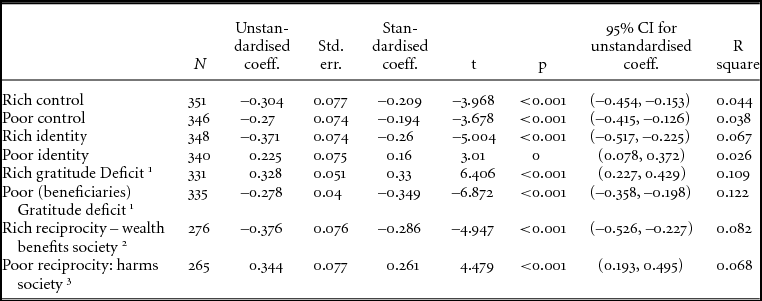
Having discussed and compared public attitudes towards the deservingness of the rich and the poor, it is important to ask also what these attitudes can explain. How closely are people's attitudes towards the deservingness of the rich and the poor associated with their support for redistributive policies? To address this question, we constructed a linear regression model to investigate the relative effects of control, attitude, identity and reciprocity on redistributionist policy preferences and to identify any redundancy among these constructs. The model was constructed by first performing simple univariable regressions between each construct and a dependent variable expressing policy preferences (Question A7c, which asked whether respondents thought that ‘the New Zealand government should reduce inequalities between rich and poor?’, where higher values represent more agreement with the idea that the government should reduce inequalities). The items used as the independent variables for each construct (control, identity, gratitude deficit and reciprocity) are those used in the preceding sections that deal with each of those constructs in isolation. (‘Gratitude deficit’, as discussed above, was selected as a more useful value for the gratitude construct.) In Table 7, each row represents a model with just that single variable in the model with variable A7c as the dependent variable. By examining the size of the R squares and coefficients (where larger values indicate a stronger relationship with the dependent variable) gratitude deficit for the poor seems to be the variable most associated (negatively, in this case) with support for the government reducing inequalities, followed by gratitude deficit for the rich.
Univariable regressions between each construct and the policy preference outcome
Notes:
1Higher values of the gratitude deficit variables represent more agreement with the idea that the poor (beneficiaries) or the rich are not as grateful as they should be.
2 Higher values represent more agreement with the idea that the wealth of the richest 10% is legitimate because it benefits society
3 Higher values represent more agreement with the idea that the poverty of the poorest 10% is unacceptable because it harms society.
Source: NZJES (2011).
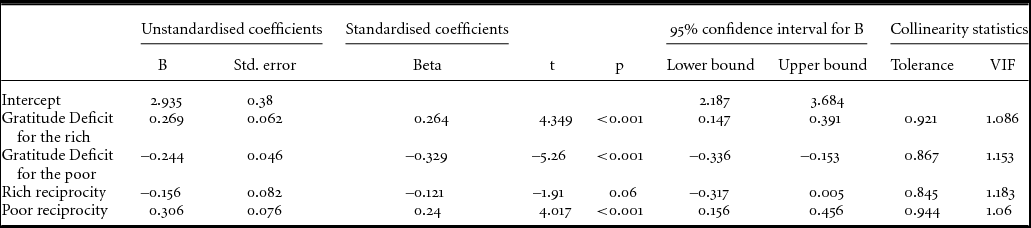
An important observation here is that – generally speaking – deservingness judgments in relation to the rich seem to predict support for reducing inequalities just as strongly as do deservingness judgments in relation to the poor. The univariable results for a particular construct, however, simply show the simple overall bivariate relation: they do not account for the effect of other constructs on the outcome. To progress the analysis, we entered all eight variables into a multivariable model. As there was some redundancy in using all the variables (evident in some large p-values), we performed a backward selection in order to retain in the model only the variables most important in predicting support for (or opposition to) inequality-reducing policies. This procedure removes variables one by one (starting with the variable least associated with the outcome based on an F test). Only variables with a p-value of less than 0.1 were retained in the final model, as shown in Table 8. The redundancy exits and there is nothing to indicate any problems with multicollinearity.
The final model after backward selection
R Square=.301, Adjusted R Square=.288, Residual Standard Error=1.244, N=203
Source: NZJES (2011).
Using the standardised coefficients to compare the relative influence of different variables on people's attitude towards redistributive policies, we see that the gratitude deficit variables have larger effects than the reciprocity variables. Using then the non-standard coefficients to compare the relative importance of variables on the same scale, we see that the perceived gratitude deficit for the rich has more effect on the independent variable than the perceived gratitude deficit for the poor. Of all the constructs tested, respondents’ beliefs about the ‘gratitude deficit’ for the rich have the strongest correlation with attitudes towards the dependent variable. Holding all other variables in the model constant, a one-unit increase on the gratitude deficit variable is associated with an increase of 0.27 units on the reversed policy preference variable. (That is, those who think there is more of a gratitude deficit − the rich are not as grateful as they should be − are more likely to think that the government should reduce inequalities.) In order of relative influence, the next most important variables are gratitude deficit for the poor, reciprocity for the poor and reciprocity for the rich.Footnote 8 The other variables were found to be redundant in their ability to predict policy preferences.
We wished also to assess whether attitudes towards the rich were independent of, or related to, attitudes towards the poor. To test – for each construct – the independence of attitudes to the rich and to the poor, we performed a weighted least squares regression of the attitude toward the rich against the corresponding attitude toward the poor. Only the control construct was found to be related between the question asked about the richest and the poorest 10% (β = 0.21, SE = 0.05, t = 4.20, p < 0.001). The general pattern was that if someone thought that lack of effort influenced why the poorest 10% were poor, they were also more likely to think that talent/ability influenced why the richest 10% were rich. This finding makes intuitive sense, demonstrating that if people hold to the notion of individual responsibility for one's outcomes, they are likely to see this individual responsibility applying to all, whether rich or poor. For the identity, gratitude deficit and reciprocity constructs, no evidence of an association was found.
A methodological note
In the preceding sections, we have summarised what New Zealanders think about inequality and about the deservingness of the rich. In doing so, we have attempted to take public opinion seriously, but not uncritically. Taking public opinion seriously, however, implies being aware of the extent to which opinion surveys can reveal what people really think about complex issues. For while, as Bamfield and Horton (2009: 5) state, large-N surveys are indispensable for ‘revealing [public] attitudes’, they are poorly suited for ‘exploring what motivates them’. Our contention is that survey-based methods need to be supplemented with methods able to explore citizens’ informed, engaged and reflective opinion, and the ways in which people move from their underlying values to policy preferences (Niemeyer, Reference Niemeyer2011). While some research has been conducted using more in-depth qualitative and/or deliberative methods (the work of Dean, with Melrose, Reference Dean and Melrose1999; Bamfield and Horton, Reference Bamfield and Horton2009; and Sachweh, Reference Sachweh2012, make important contributions), it remains, at this stage, significantly outweighed by the large number of empirical studies.
Conclusion
Given the relationship between privilege and deprivation, and given the implication of the rich in any policy response to inequality, this article has joined those calling for greater academic and policy attention to the question of the deservingness of the rich. Noting a relative absence of such attention, this article has explored New Zealand public opinion on the matter. It has shown that the public tends to view the rich as more individually deserving of their outcomes than the poor are deserving of social assistance, at least on the deservingness criteria (van Oorschot, Reference Van Oorschot2000) of control, identity and attitude. It has shown, further, that attitudes towards redistribution are significantly related to deservingness judgments, including judgments about the deservingness of the rich. Attempts to ‘investigate how a public consensus can be built around tackling inequality’ (Bamfield and Horton, Reference Bamfield and Horton2009: 5) must therefore attend to the ways in which people form their opinions about the deservingness of the rich, as well as of the poor. In order to develop a fuller understanding of how people construct and justify their deservingness judgments, further research is required that includes methods able to go beyond the attitudes revealed by opinion surveys.
Acknowledgments
We would like to thank Edwin de Ronde for his contribution to the design and implementation of the 2011 New Zealand Justice and Equality Study, and Martin von Randow and Gerry Cotterell for their assistance on matters of data analysis. Thanks also to the editors of this journal and to the anonymous reviewers for their insightful and constructive comments.