

I. Introduction
“I have a temper, and I lost it. Here it's easier to get a gun than have a bottle of Chardonnay shipped to your house.” —Robert Parker Footnote 1
After the repeal of Prohibition in 1933, states put in place a three-tier system of producers, distributors, and retailers in order to regulate the sale of alcohol in the United States (Colman, Reference Colman2008). Under this system, wineries and other producers of alcoholic beverages must sell their products to state-licensed distributers, or wholesalers, which then sell to retailers.Footnote 2 States may own and run distribution channels within the state, but most license private wholesalers. The three-tier system can make it difficult for wineries, particularly smaller ones, to expand their market because they must develop relationships with new wholesalers in the region they wish to serve. At the same time, the cost of marketing products can make it prohibitively expensive for wholesalers to buy from smaller wineries. These two factors, exacerbated by the trend toward consolidation among wholesalers, make direct shipping an attractive, profitable option for wineries (Riekhof and Sykuta, Reference Riekhof and Sykuta2004).
Recently, Wiseman and Ellig (Reference Wiseman and Ellig2004, Reference Wiseman and Ellig2007) have shown that allowing direct wine shipping significantly lowers wine prices, to the clear benefit of the consumer. Yet in the United States, state governments control direct wine shipping laws—many of which are quite restrictive.
This study details the type of restrictions that are in place and investigates why different states have their respective direct wine shipping laws. To do so, we first map the different wine laws regarding direct shipping in each state. These laws range from little or no restrictions on direct shipping to a complete prohibition, with violations in some states even punishable as a felony. We carefully map each state's complex laws according to a unique set of thirteen different criteria. Second, we conduct a regression analysis to further examine states’ shipping regimes as a function of a set of variables stemming from public finance and special interest group arguments.
II. Mapping Wine Shipping Laws
The Wine Institute's web page (www.wineinstitute.org/initiatives/stateshippinglaws/) provides information on each state's shipping laws. According to the Wine Institute, “The information contained here is specifically designed for use by wineries.”Footnote 3 In addition to an excellent summary of the current practice in each state, the website provides detailed information on governing rules, contact information, and relevant documents (including a copy of a state's direct shipment statutes).
The information on the website clearly shows the profound differences between different state laws: Some states allow direct shipping, and others entirely prohibit sales, with significant variation between both groups. For instance, two neighboring states, Florida and Georgia, allow direct wine shipping but impose excise taxes. The similarities, however, end there. Among other things, Georgia requires shipment licenses, label registration, and special labeling from the winery. It also imposes a customer aggregate volume limit of 12 cases per household per year on off-site sales. Florida does not levy any of these restrictions. Given these variations, state shipping laws should be carefully classified according to their contents in order to be used in empirical analyses.Footnote 4 It is, therefore, imperative to develop a coherent yet detailed framework according to which one classifies each state law.
We develop such a framework by identifying thirteen distinct restrictions or requirements within these laws. These include (1) brand registration, (2) cost of brand registration, (3) solicitation limit, (4) special shipping labels, (5) direct shipping license required, (6) cost of shipping license, (7) distributors prohibited or required, (8) aggregate volume limit, (9) per shipment volume limit, (10) customer aggregate volume limit, (11) consumer license required, (12) tax imposed, and (13) reporting information required.
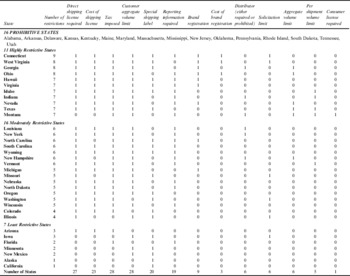
Table 1 presents the results of a content analysis of all state laws according to these thirteen criteria, summing up which of these hurdles exist in each state. For instance, 27 states (out of 34 that allow direct shipment) require direct shipping licenses—in 23 of these states a fee is charged for issuing such a license. Furthermore, of those states where direct shipments are permitted, 28 impose an aggregate volume limit per customer for a given period of time, 28 levy taxes, 20 require special shipping labels, and 19 demand reporting information. Given the relatively high frequency with which these six restrictions are used, they can be classified as “widely” used restrictions or requirements. The remaining seven restrictions are used rarely: For instance, nine states require brand registration, six either prohibit or require distributors’ involvement, six have solicitation limits, six impose aggregate volume limits, and five have per-shipment volume limits. The most rarely seen practices are charging for brand registration—imposed in three states—and a consumer license requirement, which is imposed only by one, Montana.
Thirteen Different Components of States’ Direct Wine Shipping Laws

Table 1 also underscores the variations between states. It categorizes the fifty states into four groups according to their degree of restrictiveness of direct shipping. The first group comprises prohibitive states. In these sixteen states, direct shipment is not permitted. Furthermore, in Kentucky, Tennessee, and Utah direct shipping is considered a felony. The second group is that of highly restrictive states. In these eleven states, seven to nine total restrictions are in place: Direct shipping licenses are required and cost money to acquire, there are aggregate and per-shipment volume limits, taxes are imposed, and brand registration and special shipping labels are required. The sixteen states in the third group are considered moderately restrictive, with a total of four to six restrictions in place. Unlike the previous group, they usually do not impose aggregate volume limits, and they do not ask for brand registration and special shipping labels. Finally, the fourth group comprises the seven least restrictive states, which have one to three restrictions in place. They mainly ask for special shipping labels and impose customer aggregate volume limits, but they do not require direct shipping licenses.
Table 1, column 2 presents the number of restrictions in each nonprohibitive state. Two observations are noteworthy: First, the average number of restrictions is 7.45, 5.31, and 2.00 in the highly, moderately, and least-restrictive groups, respectively. Second, the differences within each group are small: Variances are 0.47, 0.50, and 0.67, respectively. Furthermore, t-values, for two samples assuming unequal variances, are calculated as 7.88 and 9.32, which means at the 1 percent level, we reject the null hypothesis that there is no difference between the highly restrictive and moderately restrictive groups and between the moderately and least-restrictive groups, respectively.
III. Public Finance and Special Interest
How do we explain these statistically significant differences? Why do states regulate direct wine shipping differently? Which factors account for these different regulations? In the following, we advance two potential explanations: public finance and special interests.
The first plausible reason for divergent laws is the public finance argument, which suggests that the financial interests of the state determine its direct shipping policy. Sales taxes on alcoholic beverages in general are higher than those on other commodities, and taxes on alcoholic beverages may constitute a large and stable share of tax revenues for some state governments. It is also well understood that collecting taxes on Internet sales is not easy and often constitutes a revenue loss for states (Bruce, Fox, and Luna, Reference Bruce, Fox and Luna2009; Scanlan, Reference Scanlan2009). Thus, allowing direct wine shipping can result in significant tax revenue losses, providing a strong rationale for states to prohibit it.
Secondly, according to the special interests argument, incumbent politicians make policy choices with the knowledge that their decisions might affect their chances for re-election (Grossman and Helpman, Reference Grossman and Helpman1994, Reference Grossman and Helpman2001; Hillman, Reference Hillman1982). Organized interest groups are able to offer political contributions that politicians value for their potential use in future election campaigns. It is this ability to contribute that gives special interest groups their favored position in the eyes of legislators. Consequently, perhaps the state legislators attempt to set direct shipping laws and vote in ways designed to maximize their own welfare, which is a weighted average of the well-being of their constituency and total contributions that they will receive in return for laws favorable to certain interest groups. Such contributions are most likely to come from wineries, wine wholesalers, and wine retailers in their states. These are the three interest groups in addition to wine consumers that have the most significant stakes involved in direct wine shipment. The three-tier system that exists in the United States determines the framework within which these players interact. In this system, wineries have to go through wholesalers in each state to reach retailers. Consumers then purchase the wine from a retailer.
Hence, in the next section we empirically test the following hypothesis:
States have a prohibitive direct wine shipping law if they are subject to strong special interest groups with regard to direct wine shipping and if their public finances are limited and strongly dependent on federal aid.
We now turn to the specifications of our model before we discuss and flesh out the two arguments used in our hypothesis—special interests and public finance—in more detail.
IV. Model, Variables, and Regression Results
We estimate a logit probability model to empirically test the plausibility of the public finance and special interests arguments. Our dependent variable is the direct wine shipping law of a state, coded 1 for prohibitive states and 0 for others.Footnote 5 Due to the discrete character of the dependent variable (PROHIBITED), we use logit analysis rather than ordinary linear regression. The probability of having a prohibitive law is modeled as a function of a vector of constants (β), times a vector of values for the independent variables (x).Footnote 6 This yields the following basic logit probability model:

where

In the following, we detail how these six explanatory variables were derived from the public finance and special interests arguments.
A. Public Finance Variables
As briefly explained above, taxes on alcoholic beverages are relatively high. It is also difficult to collect taxes on Internet sales. Therefore, allowing direct wine shipping may result in significant tax revenue losses to the state. The impact of this is likely to be particularly severe for states with limited state government revenues and high dependence on federal aid, rendering them vulnerable to earning lower tax revenues. Legislators from these states might, as a consequence, be more reluctant to allow direct wine shipping.
To assess the validity of this argument, we focus on the following two variables: federal aid to state, and total state revenue. Federal aid (FEDAID) is the amount of federal money that a state received, measured by the ratio of federal aid to state revenues. STATEREV is the total state revenue per 100,000 people. We expect to find a positive relationship between PROHIBITED and FEDAID and a negative one between PROHIBITED and STATEREV.
B. Special Interest Variables
To assess the special interest argument we focus on the following four variables: wine wholesalers, wine retailers, wineries, and wine consumers—four interest groups that may be most affected by legislation on direct wine shipment.
The existing three-tier system does not allow wineries and retailers to deal directly with one another. Instead, wineries must go through wine wholesalers. This system gives wholesalers monopsony power over wineries and monopoly power over retailers. In a sense, allowing direct wine shipping would likely result in greater market competiveness, therefore smaller profits for the wholesalers.Footnote 7 As a consequence, any erosion of the existing system would hurt them. Obviously, the smaller the overall number of wholesalers in a given state is, the greater the negative impact on each individual wholesaler if direct wine shipping were allowed. Hence, we expect wine wholesalers to oppose direct wine shipping. Given that large rents are at stake for wine wholesalers, we expect their lobbying efforts to be aimed at defeating any attempt to allow direct wine shipping.
Moreover, groups with a small number of members, such as that of wholesalers, can more easily and effectively organize as a special interest group.Footnote 8 Free-rider problems are less likely in smaller groups, as are divisions after an interest group is established. For these reasons, smaller groups are expected to be more effective at informing and influencing legislators.
Furthermore, ceteris paribus, the smaller the number of wholesalers, the bigger the rent collected by each wholesaler. Accordingly, we expect to find a negative relationship between WHOLESALERS and PROHIBITED.
Like WINERIES and RETAILERS, we initially defined WHOLESALERS as the number of wine wholesalers per 100,000 people. However, given the high correlation between “number of wholesalers” and other explanatory variables in the model, this created multicollinearity problems. Thus, we instead utilize “number of people employed by wine wholesalers per 100,000 people” as our WHOLESALERS indicator. The correlation between “number of wholesalers” and “number of people employed by wine wholesalers per 100,000 people” is 0.59 and statistically significant at the 1 percent level.
Direct wine shipments would allow retailers to buy directly from wineries instead of going through wholesalers. Eliminating the middleman could result in lower prices and grant retailers additional leverage. Even if retailers continued doing business with wholesalers, they might end up realizing more favorable conditions. However, wineries could ship directly to consumers to the detriment of wine retailers. Because of these two potential effects, one positive and the other negative for retailers, it is difficult to predict the impact of direct wine shipping on retailers.Footnote 9 Hence, we have no a priori expectation on the sign of the relationship between PROHIBITED and RETAILERS, which we quantify as the number of wine retailers per 100,000 people.
Clearly, wineries are most likely to support direct wine shipping. Loosening the existing system in favor of a more competitive one could help wineries by expanding their potential sales channels. In addition to wholesalers, both retailers and consumers would be able to buy directly from wineries. We define WINERIES as the number of wineries per 100,000 people. Given the geographic concentration in a handful of states—California, Oregon, Washington, New York, and a small number of wineries elsewhere—we expect a strong negative relationship between WINERIES and PROHIBITED.
Finally, wine consumers can be expected to benefit from direct wine shipping given the likely consequence of a larger variety to choose from and lower overall prices. Yet the size and heterogeneity of the group of consumers makes it almost impossible for them to organize as a special interest group. We define CONSUMERS as the per-capita adult consumption of wine in gallons. Because of the difficulty involved in organizing as a special interest group, we expect to find no significant relationship between CONSUMERS and PROHIBITED.
C. Data Sources
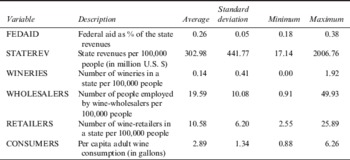
We used the U.S. Census Bureau statistics for 2005 for all variables except CONSUMERS. The 2002 NAICS Code for wholesalers is 424820, for wineries 31230, and for retailers 445310. (For details, see www.census.gov/cgi-bin/epcd/srchnaics02indc). For CONSUMERS, we used data from the Adams Wine Handbook (Adams Beverage Group, 2005, p. 17) for 2004. Table 2 gives an overview of our explanatory variables and reports descriptive statistics.
Summary of the Explanatory Variables

D. Regression Results
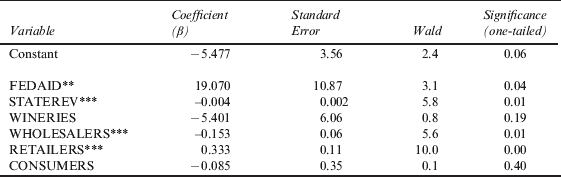
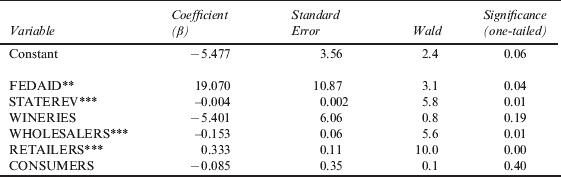
Table 3 summarizes the estimation results. It shows that the estimated coefficients are statistically significant for both public finance–related variables: FEDAID is significant at the 5 percent level and STATEREV at the 1 percent level. The higher federal aid is as a percentage of state revenues, the more likely it is that the state has a prohibitive direct wine shipping law. Similarly, the higher the state's own revenues per 100,000 people are, the less likely it is that the state has a prohibitive law. Following our initial expectations, these results indicate that perhaps state legislators assign significant importance to the implications of direct shipping laws, that is, potential loss in tax revenues.
Logit Model Maximum Likelihood Estimates
Note:
* one-sided significance at the 10% level;
** significant at the 5% level;
*** significant at the 1% level.
Dependent Variable: PROHIBITED=1 if direct wine shipping is not allowed, or 0 otherwise.
Table 3 presents mixed results regarding our special interests argument. The estimated coefficients for both WINERIES and CONSUMERS are as expected in terms of their size and the directionality of their effects on the dependent variable, but they are not statistically significant. This implicitly confirms our expectations on the behavior of CONSUMERS, following the argument that even though consumers would likely benefit from direct shipping, they might be unable to organize and lobby for corresponding legislation.
The estimated coefficient for WHOLESALERS is significant at the 1 percent level. The estimation result indicates that an increase in the number of people employed by wine wholesalers per 100,000 people significantly lowers the probability of having a prohibitive direct wine shipping law. This result is in line with our a priori expectation. The estimated coefficient for RETAILERS is significant at the 1 percent level. Although we did not have an a priori expectation about the sign of this coefficient, the estimation results suggest that an increase in the number of wine retailers significantly increases the probability of having a prohibitive direct wine shipping law.
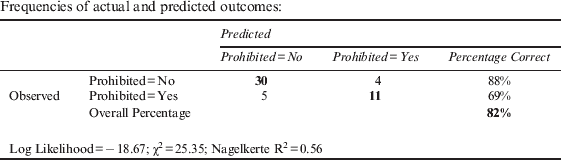
Table 3 also demonstrates how well the model predicts the outcomes: 88 percent of the nonprohibition states are accurately predicted by the model, and 69 percent of the prohibition states—in a total of 41 of the 50 states, for an 82 percent accuracy rate.
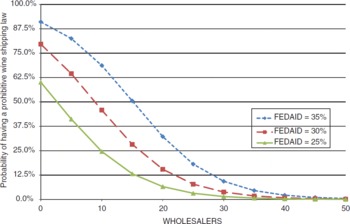
The logit model maximum likelihood estimate provides strong support for our public finance argument and underlines the importance of special interest groups, such as wholesalers. The story is illustrated in Figure 1. It shows the probability of having a prohibitive direct wine shipping law as a function of WHOLESALERS in three different types of states: States receiving (1) relatively high federal aid as a percentage of their revenues, that is, 35 percent; (2) average federal aid as a percentage of their revenues, that is, 30 percent; and (3) relatively low federal aid as a percentage of their revenues, that is, 25 percent.Footnote 10 For example, for a state with a high level of federal aid (35 percent), the probability of having a prohibitive law can be brought down from 83 percent to 49.9 percent by increasing the number of people employed by wine wholesalers from 5 per 100,000 to 15 per 100,000.
Marginal effect of FEDAID and WHOLESALERS on probability of having a prohibitive wine shipping law

According to the estimation results, both federal aid and the concentration of wholesalers play an important role in prohibitive shipping laws. For example, our calculations show that, depending on the level of federal aid, the effect of having 5 instead of 30 people employed by wine wholesalers makes a difference in the probability of having a prohibitive law of between forty and seventy percentage points. Our calculations also show that in a state with a relatively high level of federal aid compared to a state with a relatively low level, the probability of having a prohibitive shipping law is (on average) nineteen percentage points higher.
V. Concluding Remarks
Our analyses demonstrate significant variations among states’ direct wine shipping laws, beyond simply whether they have a prohibitive law. We identify a unique set of thirteen different features of the existing nonprohibitive laws, conducting a content analysis. Trying to explain why some states have prohibitive laws while others do not, we develop two arguments that may be part of an explanation, namely, special interest considerations and public finance arguments. The results of our regression estimation indeed provide strong support for both arguments that we put forth as likely factors influencing states’ decisions on prohibiting direct shipping. It appears that legislators concerned about incurring losses in state tax revenues and protecting the wholesalers and retailers that benefit from the three-tier system (at the expense of the wineries and wine drinkers) are more likely to impose restrictions on direct wine shipment.
As to paths for further research into the phenomenon under study here, a detailed examination of tax rates, tax revenues, actual wine price differentials, and volume of wine sales in different states may further advance our understanding of the motives and mechanisms behind these laws. Furthermore, it would be interesting to analyze the impact of the thirteen different conditions imposed upon direct wine shipping on prices and volume of direct wine shipping.