On March 11, 2011, Japan was hit by a massive earthquake, known as the Great East Japan Earthquake (GEJE), with a magnitude of 9.0. It was followed by a devastating tsunami with a running height of more than 30 m. Reference Ishigaki, Higashi and Sakamoto1 Most coastal cities and towns on the Pacific side near the epicenter were devastated by the tsunami, and nearly 20,000 casualties were caused by this single disaster. Reference Nakahara and Ichikawa2 It was the most catastrophic natural disaster in the past decade to directly hit an advanced country and cause colossal damage to life and property. After the earthquake, approximately 400,000 survivors in the coastal area of the Pacific side of east Japan were temporarily relocated, and approximately 120,000 of them were forced to live in postdisaster prefabricated temporary housing. Reference Tanji, Tomata and Sekiguchi3 Prefabricated temporary housings were urgently constructed in wide fields of school grounds or public parks, Reference Sekiguchi, Hagiwara and Sugawara4 and functioned as a temporary residence for the victims with rented housing. Some of these emergent prefabricated temporary housing exist as of 2021, a total of 10 y after the GEJE. The exact impact of the experience of dislocation on the subsequent long-term mental health status has not been fully elucidated. Consequently, an assessment of the mental health risks in these dislocated victims and effective interventions to address their prolonged distress are urgent concerns. Furthermore, as social participation and personal support from others protect the mental health of victims, Reference Goodwin, Sugiyama and Sun5,Reference Matsuyama, Aida and Hase6 evaluating the psychosocial status and specific social interaction habits among victims stratified by previous and current residential types are also important.
Shichigahama Town is located in the devastated coastal areas of Miyagi Prefecture, which is closest to the epicenter. This town was once inhabited by approximately 20,000 residents before the GEJE. However, in the tsunami, one-fourth of the town was submerged in water. More than 2000 residents’ houses were totally or majorly damaged, and the number of evacuees in refugee camps or evacuation shelters peaked to more than 6000 people 2-3 d after the earthquake. Reference Nakaya, Nakamura and Tsuchiya7 The local government rapidly built a large number of emergency prefabricated temporary housing to protect those who lost their homes in the tsunami.
Since the occurrence of the GEJE, the mental health status and social interaction activities of the victims across Shichigahama Town have been regularly followed up. Reference Nakaya, Nakamura and Tsuchiya8 In this cross-sectional study performed 5 y after the disaster, victims whose residences were destroyed by the tsunami were recruited to evaluate the long-term impact of the experience of living in a prefabricated temporary housing following a disaster on their subsequent long-term psychosocial and psychiatric status. Then, the psychological status and social interaction activities were compared between those with and without a history of living in postdisaster prefabricated temporary housing.
Methods
Study Design
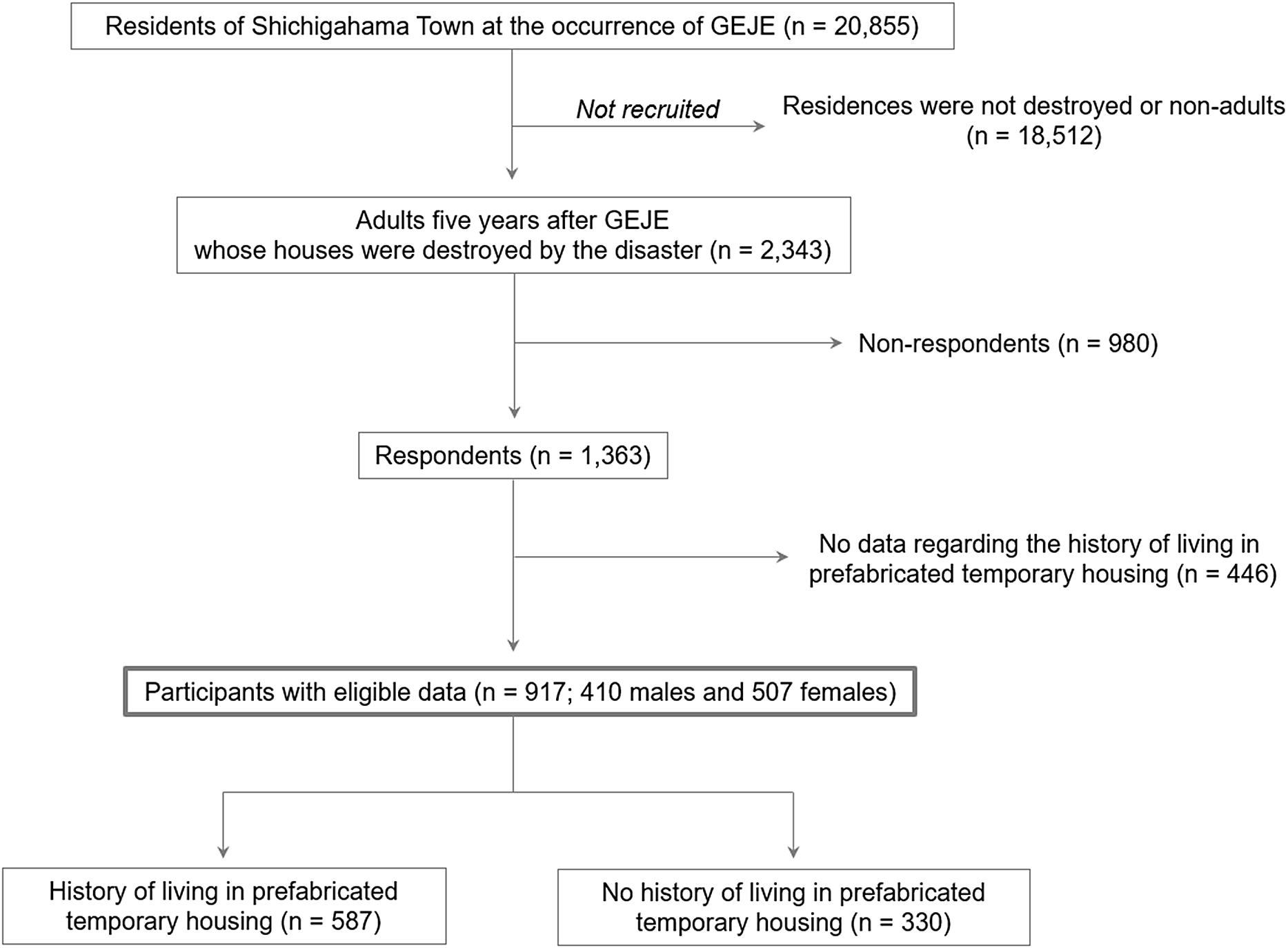
Among the 20,855 residents of 6627 households in Shichigahama Town, all 2343 adult residents (≥ 18 y old 5 y after the GEJE), whose houses were destroyed by the disaster, were initially recruited 5 y after the GEJE, in November 2016. The level of house damage due to the tsunami was objectively and uniformly judged by local government officials based on the criteria established by the Japanese government. Paper-based questionnaires to inquire about the present and previous residential conditions, social interaction activities, and mental health conditions were sent to all the 2343 study candidates by means of mail, with the rationale of their recruitment and the clarification that their participation in this assessment was optional. Of these, 1363 (58.2%) residents responded and agreed to participate in the study, and 917 correctly answered the question about their previous experience of living temporarily in postdisaster prefabricated housing. These 917 respondents (410 males and 507 females) were considered to be eligible and were enrolled for the following analyses. The enrollment flowchart is shown in Figure 1.
Flow-diagram of the study design. A total of 2343 residents in Shichigahama town, whose houses were severely or completely damaged by the disaster, were initially contacted 5 y after the disaster; 1363 responded and 917 offered an eligible complete dataset to be analyzed in the present study. Their demographics, self-reported mental health status, and details of the present social interaction activities were then compared with the history of living in postdisaster prefabricated temporary housing.

Evaluated Variables
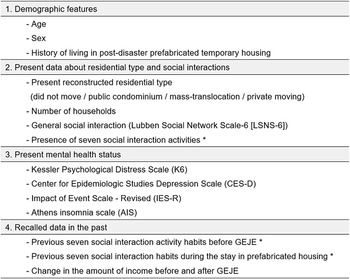
The 917 adult participants were asked about their demographic features, and self-reported mental health and social interaction-related questionnaires (Figure 2) were comprehensively collected. The reconstructed residential types 5 y after the GEJE were chosen from the following 4 categories: (i) reconstructed on the same site, (ii) moved to the disaster-recovery public condominium, (iii) massive relocation to a higher ground, and (iv) privately moved to remote areas.
Evaluated variables 5 y after the GEJE. *The evaluated present and recalled 7 social interaction activity habits are as follows: 1, greeting; 2, having conversation when passing community circular bulletin board; 3, attending local community events; 4, chatting with neighbors on the streets; 5, attending tea party held by neighbors; 6, going out together with neighbors; 7, presence of close family friends. GEJE, 2011 Great East Japan Earthquake.

Assessment of Social Interaction Activity
The present levels of general social networking and interaction activities were assessed using the Lubben Social Network Scale-6 (LSNS-6). Reference Lubben, Blozik and Gillmann9,Reference Kurimoto, Awata and Ohkubo10 The score ranges between 0 and 30, where a higher score suggests better social relationships, and scores < 12 suggest social isolation. As the LSNS-6 was developed to roughly assess personal relationship, mainly focusing on the social support from surrounding people, further evaluation regarding more detailed social interaction habits was required to correctly grasp the long-term psychosocial status among the victims. Thus, participants were asked about the presence of the following 7 specific social interaction habits selected by the authors before mailing the questionnaire sheets:(1) Greeting neighbors, (2) Conversation when passing the community circular bulletin board, (3) Attending local community events, (4) Chatting with neighbors on the streets, (5) Attending tea party held by neighbors, (6) Going out together with neighbors, and (7) Presence of close family friends in the neighborhood,
The community circular bulletin board is a traditional Japanese social system, performed in each neighborhood association with around 10 households to share necessary information in the community. In addition to these 7 present social habits (5 y after the GEJE), the participants were also asked to recall whether they had practiced these social habits before the GEJE, in an attempt to evaluate the potential risk of selection bias in the baseline.
Assessment of Mental Health Conditions
Psychological problems after traumatic events are depression, anxiety, distress, and insomnia, all of which often overlap and may mutually influence each other. Reference Flory and Yehuda11–Reference Krystal14 Thus, the mental health conditions of participants 5 y after the GEJE were comprehensively evaluated using the following 4 questionnaires: Kessler Psychological Distress Scale (K6), Center for Epidemiologic Studies Depression Scale (CES-D), the revised version of the Impact of Event Scale (IES-R), and Athens Insomnia Scale (AIS). The K6 was used to assess the psychological stress responses of participants in the last 30 d. Reference Kessler, Andrews and Colpe15,Reference Furukawa, Kawakami and Saitoh16 The higher the K6 score, the more likely they are to have mood and anxiety disorders accompanied by higher psychological distress. The CES-D was used to screen participants for depression. Reference Lewinsohn, Seeley and Roberts17,Reference Shima, Shikano and Kitamura18 The score ranges between 0 and 60. The higher the CES-D score, the more severe the depressive state of the participants. The IES-R was used to evaluate the severity of posttraumatic stress reaction in the last week. Reference Asukai, Kato and Kawamura19 The IES-R score ranges between 0 and 88 and the higher the IES-R score, the more likely the participant would have suffered a posttraumatic stress reaction. The AIS was used to assess participants for insomnia. Reference Soldatos, Dikeos and Paparrigopoulos20,Reference Utsugi, Saijo and Yoshioka21 The AIS score ranges between 0 and 24. The higher the AIS score, the more severe was the participant’s insomnia. In this study, as participants did not perform these self-reported measures before the disaster, their pre-earthquake scores were unavailable.
Data Analysis
Distributions of quantitative variables with apparent normal distributions are described as means and standard deviations (SDs). Nonnormal distributions were described as median and interquartile range (ie, 25-75 percentiles). The quantitative variables between 2 independent groups were compared using the Student’s t-test or Mann-Whitney U-test, according to the distribution of the evaluated variables. The prevalence between 2 or more groups was compared using the chi-squared test or Fisher’s exact test, according to the size of each cell. The effect size for each comparison was reported with either Phi (ϕ) for the comparison of categorical data, Cohen’s d for Student’s t-test, or effect size of r for Mann-Whitney U-test. While P-values lower than 0.05 were regarded statistically significant, multiple comparisons were simultaneously performed in this study. By adopting the Bonferroni correction method to adjust for multiple comparisons, P-values lower than 0.005 were considered statistically significant in each of the multiple comparisons. The correlation between the 2 variables was evaluated by calculating Spearman’s correlation coefficient (rho) as a nonparametric method. Statistical analyses were conducted using R Statistical Software (version 4.0.5; R Foundation, Vienna, Austria) and SPSS Statistics Base 22 software (IBM, USA).
Results
Participant Characteristics
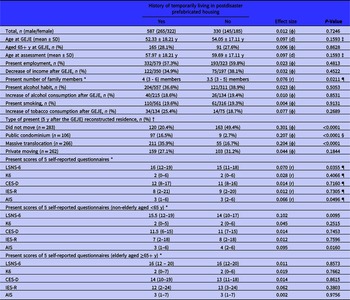
The mean and SD for the age of the enrolled 917 participants in 2016 were 58.6 ± 17.8 y. Among the 917 participants, 587 (64.0%) had a history of living in postdisaster prefabricated temporary housing, while 330 (36.0%) had not. Among the 256 elderly participants aged ≥65 y during the GEJE, 165 (64.5%) had a history of living in prefabricated temporary housing, while the remaining 91 (35.5%) did not. The demographic features, reconstructed present residential type, and self-reported psychosocial and psychiatric scores, based on the history of living in prefabricated temporary housing, are listed in Table 1. The previous history of living in temporary prefabricated housing did not worsen the subsequent scores in the 5 psychosocial or psychiatric measures 5 y after the disaster. Rather, the experience of staying in prefabricated housing resulted in slightly better outcomes in LSNS-6 and AIS at present with unknown mechanisms, although they did not reach the statistical significance of P < 0.005 after the Bonferroni correction. To evaluate the effect of being an elderly person in a prefabricated temporary housing, the present scores of the evaluated 5 psychosocial or psychiatric measures were categorized according to whether the participants were an elderly person during the GEJE, as shown in the bottom of the table. Although they did not reach statistical significance after the Bonferroni correction, the scores of the LSNS-6 (Mann-Whitney U-test; P = 0.0095) and AIS (P = 0.0160) were suggested to be slightly better in those with a history of living in prefabricated temporary housing than in the others among the nonelderly population. Such a tendency was not observed in elderly participants.
Participants’ data according to the history of temporary living in postdisaster prefabricated housing

Note: The shown prevalence next to each number are for the column in each of the two groups stratified by the history of living in prefabricated temporary housing, not for the row. The effect sizes were described with phi (ϕ) for comparisons of categorical data, Cohen’s d for Student’s t-test, or effect size r (
 $ = Z/\sqrt N $
) for Mann-Whitney U test. Unmarked P-values are the results of chi-squared test.
Abbreviations: AIS, Athens insomnia scale; CES-D, Center for Epidemiologic Studies Depression Scale; GEJE, 2011 Great East Japan Earthquake; IES-R, Revised version of the Impact of Event Scale; K6, Kessler Psychological Distress Scale; LSNS-6, Lubben Social Network Scale; SD, standard deviation.
* Median and interquartile range (ie, 25–75 percentiles).
† The shown prevalence aside of each number is for the column (ie, among the total subjects with or without the history of living in postdisaster prefabricated temporary housing).
‡ Student’s t-test.
§ Fisher’s exact test.
¶ Mann-Whitney U test.
Social Interaction Habits 5 Years After GEJE
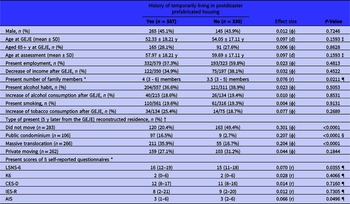
The prevalence of the 7 specific social interaction activity habits before the GEJE (recalled) and 5 y after the GEJE (present) are summarized in Table 2. The prevalence of all 7 social interaction activities significantly decreased after the GEJE, but the decline in these habits after the disaster did not differ according to the history of living in prefabricated temporary housing.
Participants’ data according to the history of temporary living in postdisaster prefabricated housing

Note: The shown prevalence next to each number are for the column in each of the two groups stratified by the history of living in prefabricated temporary housing, not for the row. The effect sizes were described with phi (ϕ) for comparisons of categorical data, Cohen’s d for Student’s t-test, or effect size r (=Z/N) for Mann-Whitney U test. Unmarked P-values are the results of chi-squared test.
Abbreviations: AIS, Athens insomnia scale; CES-D, Center for Epidemiologic Studies Depression Scale; GEJE, 2011 Great East Japan Earthquake; IES-R, Revised version of the Impact of Event Scale; K6, Kessler Psychological Distress Scale; LSNS-6, Lubben Social Network Scale; SD, standard deviation.
* Median and interquartile range (ie, 25–75 percentiles).
† The shown prevalence aside of each number is for the column (ie, among the total subjects with or without the history of living in postdisaster prefabricated temporary housing).
‡ Student’s t-test.
§ Fisher’s exact test.
¶ Mann-Whitney U test.
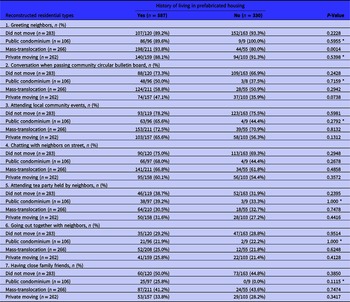
Next, the present prevalence of each social interaction activity stratified by the previous history of living in prefabricated housing and the reconstructed present residential type were further evaluated (Table 3). As a result, previous experience of temporarily living in prefabricated housing did not negatively affect subsequent social interaction activities even after being stratified by the present residential types.
Present social interaction habits as per the present residential types and history of living in prefabricated temporary housing

Note: The table shows number of people who answered questions regarding the present practice of the seven social interaction activity habits, stratified by the types of reconstructed present residence. P-values without the asterisk are the results of chi-squared test.
* Fisher’s exact test.
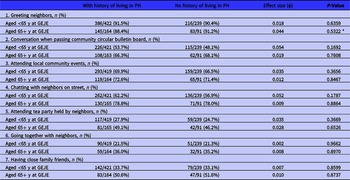
Furthermore, to clarify the impact of being an elderly person in prefabricated temporary housing on the present social interaction activity, Reference Sasaki, Aida and Tsuji22 the present situations of social interaction habits were further evaluated after being stratified by the cutoff age of 65 y during the GEJE (Table 4). Although some of the evaluated social interaction habits showed significant differences in the present prevalence between elderly and nonelderly populations, no habits showed different prevalence between those with a history of prefabricated temporary housing and those without it in both age groups.
Present social interaction habits by the history of living in prefabricated temporary housing in elderly and non-elderly

Note: The present social interaction habits of the 7 evaluated types of social interactions are compared according to the presence of a previous history of living in postdisaster prefabricated housing units, stratified by being an elderly person aged ≥65 y during the Great East Japan Earthquake.
Abbreviations: GEJE, 2011 Great East Japan Earthquake; PH, prefabricated temporary housing.
* Fisher’s exact test. Other unmarked P-values are the results of chi-squared tests.
Correlations Among Residence, Social Interaction, and Mental Health
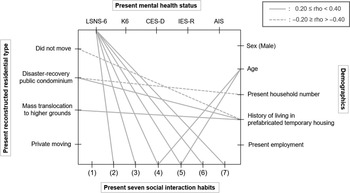
Next, we calculated the Spearman’s correlation coefficients (rho) between the evaluated variables and summarized the achieved results into a correlation network, as shown in Figure 3. The LSNS-6 scores to assess social network and interaction activities were significantly correlated with most social interaction activities. Meanwhile, no self-reported psychiatric measures showed any significant correlations with the evaluated demographic features or residential conditions. The history of living in prefabricated housing and the present employment status were not correlated (rho = −0.02; P = 0.48).
Correlation network between the evaluated demographic and psychosocial variables. The solid lines show positive correlations, and the broken lines indicate negative correlations between the connected variables. The details of the 7 social interaction habits are as follows: (1) greeting, (2) conversation when passing the community bulletin board, (3) attending community events, (4) chatting on the street, (5) attending tea parties, (6) going out together, and (7) close family friends. None of the variables that assessed the present mental health status and social interaction activities correlated with the history of living in prefabricated temporary housing. AIS, Athens insomnia scale; CES-D, Center for Epidemiologic Studies Depression Scale; GEJE, Great East Japan Earthquake; IES-R, Revised version of Impact of Event Scale; K6, Kessler Psychological Distress Scale; LSNS-6, Lubben Social Network Scale.

Discussion
To date, the long-term psychosocial and psychiatric impact of living in postdisaster prefabricated temporary housing have been widely studied by many research groups, but the evidence has not yet been established. A previous study reported that depressive symptoms 2-3 y after the disaster among elderly victims (ie, aged 65+ y at GEJE) who moved into prefabricated temporary housing were worse than those among the elderly who did not move or had moved into other types of residences. Reference Sasaki, Aida and Tsuji22 Another study reported that a longer stay in prefabricated temporary housing may result in higher psychological distress 5 y after the disaster, Reference Tanji, Tomata and Sekiguchi3 a factor that was not evaluated in the present study. Previous studies focused on the negative aspects of living in prefabricated temporary housing after a disaster. Meanwhile, a later study reported a positive impact of temporarily staying in prefabricated housing for the subsequent psychosocial status. Reference Kusama, Aida and Sugiyama23 It showed that, although the psychological distress level was worse among those who moved into prefabricated temporary housing than among those moved into rented housing, the former may have more frequent opportunities for social participation, associated with larger health benefits.
The results of this study demonstrated that the experience of temporarily living in postdisaster prefabricated housing may not have significant, direct negative effects on the long-term mental health or social interaction activities of the victims, assessed 5 y after the massive disaster, if the length of stay in prefabricated housing was not taken into consideration. Certainly, the prevalence in all 7 evaluated social interaction activities significantly declined after the disaster; however, the decline rate did not differ according to the history of temporarily living in prefabricated housing. Furthermore, all 5 batteries assessed for mental health status 5 y after the disaster did not differ according to the history of living in prefabricated temporary housing.
Even the IES-R score, which is generally used for assessing post-trauma phenomena, was not elevated among those who lived in prefabricated housing. This result suggests that the victims who experienced a temporary stay in prefabricated housing may have overcome their stressful experience 5 y after the disaster. Rather, the results hint at the possibility of a weak positive impact of experiencing temporary life in prefabricated housing on long-term mental health conditions. This observation appears contradictory, because being forced to live in small-sized, densely constructed prefabricated housing units after their homes are devastated appears to be a stressful and unpleasant event. However, as described above, a similar finding was also previously reported from a different study group with a larger cohort, which showed a better social participation rate in those with a history of living in prefabricated housing than among those who lived in rented housing units. Reference Kusama, Aida and Sugiyama23 A conceivable possibility is that the experience of forced living in prefabricated housing may have later decreased their threshold to communicate with neighbors.
Prefabricated temporary housing circumstances could have certainly provided more opportunities for social participation and communication with neighbors. Additionally, the experience of living in prefabricated temporary housing may have later elevated the thresholds to feel distressed after moving out, especially among non-elderly victims. Notably, this study does not deny the importance of disaster relief interventions for victims moving into prefabricated temporary housing. Undoubtedly, psychosocial and psychiatric distress would be significantly higher during the stay in prefabricated temporary housing after disasters, and effective interventions are certainly needed for the victims then. Reference Kusama, Aida and Sugiyama23 The expected distress level may differ according to the set time intervals (ie, 1, 3, or 5 y) of the assessment period from the occurrence of a disaster.
Limitations
This study had several limitations. First, the data for social interaction activity before the GEJE were recalled 5 y after the disaster. Consequently, the analysis and data obtained using these previously recalled data may have the risk of recall bias. Second, the details of the 980 nonrespondents in the initially recruited 2343 residents are unknown. The primary forms of bias in survey research include sampling errors with selection bias and nonresponse errors with response bias. The 980 nonrespondents may have yielded a potential risk of selection bias. For example, some nonrespondents may have suffered from severe mental illness or traumatic mental stress and decided not to respond to our investigation, while others may have passed away or even died by suicide. Third, measurement variability may affect the statistical analysis in self-reported survey analyses. Such measurement errors may have erased the actual small difference between the evaluated groups and caused type II errors. Fourth, this study was conducted in a specific region; thus, the generalizability of the achieved results in this study to other populations with different ethnicities or to victims of other types of disasters is uncertain. Fifth, this study did not evaluate the length of stay in prefabricated temporary housing in the case of each participant, which may have some effects on subsequent mental health. This factor warrants further investigation.
Conclusions
The study population showed that, although social interaction activity certainly decreased after the GEJE among the victims, the history of living in postdisaster prefabricated temporary housing may not have a direct negative effect on the subsequent mental health conditions and social interaction activities, 5 y after the disaster. Rather, the experience of living in prefabricated temporary housing may have exerted a slightly positive effect on subsequent social interaction activities after they reconstruct the house and move out of the prefabricated housing.
Acknowledgments
The authors are grateful for the support of the local government staffs of Shichigahama Town. Also, the authors deeply thank all residents of Shichigahama Town for having welcomed the investigation team members and cooperated to this study.
Author Contributions
T.A., T.S., A.H., I.T., T.I., and H.T. conceived and designed the study. T.S. and H.T. led the collection of data and building the original database. All authors were involved in the process of collection and interpretation of the data. T.A., T.S., N.N., Y.K., N.T., M.S., and T.N. performed statistical analyses. T.A. and T.S. drafted the manuscript. All authors critically reviewed, revised the manuscript, and approved the manuscript before submission. N.N., A.H., I.T., T.I., and H.T. supervised the study process.
Funding Statement
This work was supported by the Japanese Ministry of Education, Culture, Sports, Science and Technology (MEXT), the Japan Agency for Medical Research and Development (AMED), and Japanese Ministry of Health, Labour and Welfare.
Conflict of Interest
The authors declare no conflict of interest.
Ethical Standards
The research protocol involved human participants and was approved by the ethics committee of Tohoku University (2011-482). The anonymity and confidentiality of the participants were assured, and the collected data were secured in an appropriate manner, as approved by the review board. All participants were notified that their participation was voluntary and that they could withdraw from the study at any time without penalty or fear of retribution. The participants provided written informed consent. All the processes of this study were performed in accordance with the ethical principles outlined in the current version of the Declaration of Helsinki, as revised in 2013.