In 2005, at the Shanghai Dramatic Arts Centre in China, Walter Asmus, a director renowned for his work on plays by Samuel Beckett, witnessed a rehearsal of the jingju (Beijing opera) adaptation of Waiting for Godot (hereafter Godot) by Taiwan's Contemporary Legend Theatre (CLT). After the performance, he praised the production to Wu Hsing-kuo, artistic director of CLT, stating that ‘what I saw was an interpretation of Godot with your own traditional culture. It is hard to describe, because I never saw anything like this . . . When you performed in this style, the rhythm in it revealed this play's immanent metaphysics that have never been exposed’.Footnote 1 Asmus grasped the production's major contribution to performances of Godot: metaphysics revealed in jingju’s rhythm. Perhaps the observation was rooted in Asmus's personal experience with the play. According to the rehearsal diary he kept for Beckett's Schiller Theatre production of Godot in 1975, Beckett had sought to direct the play in a stylized way by emphasizing somatic and verbal musicality.Footnote 2 Jingju too is characterized by a rich and stylized performing vocabulary, and it may be this that Asmus was responding to. And yet Asmus was unaware that this production was not strictly in the style of jingju; rather it pushed jingju far beyond its conventional borders in order to accommodate the demands of Beckett's play. For the first time, Beckett's aesthetics were encountering traditional Chinese theatre, something connoisseurs of either genre might consider a kind of mission impossible. Yet this intercultural encounter turned out to be fruitful: it gave Godot a new shape and stimulated CLT to innovate in the acting of jingju. How so? Answering this question will require close attention to the acting style of the production. First, however, it is useful to contextualize CLT's Godot within the context of the company's larger project of intercultural adaptations, and to identify the key challenge posed by the play to the production, namely the treatment of comic failure.
Contemporary Legend Theatre and the challenge of Beckett's comic failure
Since its formation in 1986, CLT has been engaged in exploring new performing vocabularies to reinvigorate jingju in Taiwan. Jingju, which came into being in the eighteenth-century Chinese imperial court and prospered particularly in the early twentieth century, is the most popular xiqu (Chinese opera) form in mainland China and Taiwan. Diverse in performing styles and schools, jingju nevertheless commonly features the refined and skilled presentation of stylized performance conventions, which derives from a painstaking regime of performer training. Jingju’s aesthetic standards are preserved in its standing repertoire, which was mostly established in the early twentieth century by numerous jingju masters (such as Mei Lanfang (1894–1961), who famously influenced Brecht's formulation of the Verfremdungseffekt) and was passed down by their disciples. The plays were mostly stories about traditional virtues such as loyalty, filial piety, chastity and righteousness. Such orthodoxy also carries the risk of stagnation, however. According to xiqu historian Wang An-ch'i, in 1970s Taiwan young audiences refused to go to the theatre because they found the way the stories were told and the ideas contained in them outdated. A transformation was needed.Footnote 3 It was in response to such developments that CLT began to experiment with new forms within and beyond jingju, creating more than twenty new plays to date that have brought it young audiences and international renown. These experiments have included ten adaptations of Western classics as part of CLT's stated agenda of ‘transforming the performing system of jingju with the stimulation of alien texts from the West’.Footnote 4 Yet, having adapted Greek tragedy (Oresteia and Medea) and Shakespeare (Macbeth, Hamlet, King Lear and The Tempest), Wu found it necessary to challenge CLT with modern literature.Footnote 5 Thus in 2005 he adapted Beckett's Waiting for Godot, and, in 2013, Franz Kafka's Metamorphosis.
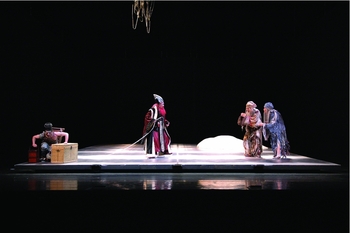
The translation of CLT's Godot was largely faithful to the original text. The stage was empty except for a stone and the tree, which was hung upside down. Character names were localized with specific implications. Vladimir was transliterated as Fei Dimi (廢低迷, ‘abandoned and depressed’), and his diminutive name, Didi, as Titi (啼啼, ‘cry’); Estragon became Ai Taigang (愛抬槓, ‘love to argue for the sake of arguing’), and the diminutive, Gogo, became Kuku (哭哭, ‘weep’); Pozzo was Po Suo (破梭, ‘broken shuttle’); and Lucky was La Ji (垃圾, ‘rubbish’). The living conditions of the characters are implied by their names: negative, depressed, disharmonious, broken and forsaken. Other features of the play, such as silence, stillness, musicality and stylization, remained too.
The arrival of Po Suo (Ma Pao-shan) and La Ji (Lin Chao-hsu). Courtesy of Contemporary Legend Theatre.

Among CLT's experiments that have provided prominent cases for understanding the modernization of jingju, Godot has arguably been the boldest attempt. This adaptation distinguished itself from CLT's other works by its radical stance on jingju, especially on its approach to acting. In the other adaptations, Wu and his colleagues were free to select forms of jingju and non-jingju (such as modern dance, environmental theatre, opera and multimedia performance) and to juxtapose them in a postmodernist style of ‘carefully designed artistic collage’, to borrow Li Ruru's comments on CLT.Footnote 6 Yet in Godot, as Li puts it, ‘jingju as a complete form disappeared’, and only traces were left.Footnote 7
This was a result of the encounter with Godot’s singular form and content, which to some extent restrained CLT's artistic agency. For example, jingju is a musical form, but in this case, musical accompaniment was absent. The regional xiqu forms in China, which number over three hundred, are differentiated and defined by their vocal styles, to which musical instruments make a vital contribution. Connoisseurs, for instance, call their theatre-going activity tingxi (listening to plays) instead of kanxi (watching plays). Music is indispensable because actors’ body movements, singing style and even speech are all instructed by rhythmic percussion or flute and stringed instruments, and the structure, atmosphere and rhythm of a performance are all influenced by musical accompaniment. Theatre scholar Chen Youhan even asserts that ‘without percussion, all movements and rhythm lose their beauty and meaning’.Footnote 8 This might be an exaggeration, but it does point out the vital role of music in jingju.
However, the estate of Samuel Beckett does not permit the use of music in productions of Godot. Therefore its absence in this adaptation would be one of the most significant interruptions for audiences familiar with jingju. Since actors’ bodies conventionally function in time with the musical accompaniment, its absence threatens to impede actors’ appropriate bodily expression, damage the structure and dramatic tension, and finally produce an atmosphere of overall barrenness. Audiences would be consistently challenged to make new sense of disunited elements.
These extreme conditions pushed CLT to innovate in terms of acting approaches, as opposed to repeating conventions, and even to violate jingju’s aesthetic principles. Its major breakthrough lies in physical vocabularies, which rely heavily on actors. However, this in turn highlighted perhaps the most significant challenge posed by Beckett's play for Wu – Beckett's own design, which makes detailed demands upon the actors to achieve a tragicomic effect. In a letter to the German director Carlheinz Caspari, Beckett wrote,
The farce side seems indispensable to me as much from the technical point of view (comic relief) as for reasons to do with the spirit of the play. Therefore neither to be hurried through nor to be overdone. Here unhappiness is the height of the grotesque and every act is a piece of clowning. Laugh at them then and get them laughed at, at unhappiness and at the act, but not all the time, that would be too good, and always a little reluctantly.Footnote 9
In several productions of the play, Beckett's expectation of farce was fulfilled by the actors’ manipulation of Western comic traditions, such as vaudeville, music hall and slapstick. According to Mel Gussow, Beckett would have been quite interested in seeing Laurel and Hardy, the classic slapstick duo, perform Didi and Gogo, as they were physically ideal.Footnote 10 Meanwhile, in the Paris and New York productions, some of the leads were played by vaudeville comedians (Lucien Raimbourg and Bert Lahr).Footnote 11 However, what should be emphasized is that Beckett appropriated and displaced fragments of these comic routines, hence shifting his play from a replication of vaudeville and slapstick to one loaded with his own philosophical and artistic ideas. Instead of literally being clowns, the characters in Godot (particularly the two tramps) imitate clowns by playing comic routines. As Beckett said, ‘They are players . . . They play games’.Footnote 12 Even Didi and Gogo call Lucky and Pozzo's scenes in Act I ‘circus’ and ‘music hall’.Footnote 13 This is also why Beckett and Alan Schneider, director of the 1956 premiere of Godot in the USA, felt discontent with Bert Lahr's overplaying of vaudeville conventions, as, in their view, Lahr had overlooked that the play was more than a piece of clowning.Footnote 14 Thus, as Jonathan Kalb puts it, rather than ‘create with the same sense of excitement and hope for spontaneous applause [they] would carry onto a music hall stage’, the Beckettian actors ‘continually disappoint . . . those expectations’.Footnote 15 The frustration of comic enjoyment ultimately leads to what Beckett called grotesque unhappiness, or, in Iser's words, the ‘stifled laugh’.Footnote 16
While Godot’s theme and theatrical forms are closely tied, jingju lacks those comic routines, so it was implausible for CLT to copy the source play's ‘unmistakable miscarriage of comedy’ directly.Footnote 17 Nevertheless, one abstracted aesthetic approach in Godot could be transplanted: to borrow customary performing devices and unexpectedly fail to achieve their original effect. Having perceived Beckett's appropriation of comic routines, Wu followed suit, claiming a doubled identity within the production: ‘We were actually playing. There were two layers: the jingju professionals [in us] acted the two tramps; meanwhile we, as Kuku and Titi, parodied jingju acting out of sheer boredom’.Footnote 18 Here, Wu is referring specifically to his innovations with the chou role type. Role types refer to the general classification of actors, divided by identity, personality and disposition. Each has its own performing conventions such as costume, face-painting, gesture, vocal style and ways of behaving, and chou is arguably the closest counterpart in jingju to the vaudeville clown aspects of Didi and Gogo's behaviour. Wu then supplemented this with elements from other role types. Po Suo's role type was jing, otherwise called hualian (‘painted face’), which denotes the explosive personality of people with higher status. His behaviour and status fall into this role type, while retaining a comical element that finds its roots in an earlier stage of xiqu, around the fourteenth century, when jing also had the function of performing buffoonery. La Ji's role type was wuchou (martial clown) because he exhibits ample acrobatics and martial movements in his thinking dance, which, if properly handled, would evoke laughter. These choices are indicative of the fact that chou is not as strictly restrained by conventions as other role types in jingju, being endowed with more freedom to alter conventions, to assimilate non-jingju performing vocabularies, and to violate established rules. This became the other reason for the option of this role type.
It is in this context that Wu sought to create comic failure with jingju through parody: actors would appear clumsy and incapable of successfully performing jingju’s conventions, which would relate directly to Beckett's art of failure. At the same time, Godot’s dark and comic aspect is tied to farcical and unrestrained emotions and movements, as well as to violence to the body. These, however, are foreign to the courtly jingju, which values restraint even in comedies, and does not go as far as farce. In this regard, Wu had no choice but to juxtapose jingju with Western comic traditions that are largely incompatible with jingju’s aesthetics.
This strategy of failure and juxtaposition converged in this adaptation, then, and is well illustrated at the very beginning of this play, when chou actors appear in their dilapidated costumes with dejected bodies and countenance. There is a tradition in jingju, at the beginning or the ending of a play, called liangxiang (‘to reveal oneself’): a sculpture-like static posture adopted after certain dance movements when actors make their entrance on the stage or before they are about to exit. It serves to strike audiences with the characters’ sparkling spirit and energy in eyes, gestures and so forth. In the words of Riley, ‘The body in a liangxiang pose . . . is the body which has been through the process of opening . . . It is a body which manifests or radiates presence’.Footnote 19 A successful liangxiang receives immediate applause from connoisseurs. In the beginning, when Kuku and Titi appear, they slowly stagger from a darkened upstage to downstage, their trembling silhouettes defined by an upstage light, as if they are diseased or spiritually exhausted. When light then illuminates them from the front, one notices ragged robes, grey hair and beards, an emotionless, vacant countenance, and hunched backs – which are anything but sparkling with energy or spirit. They look physically present but spiritually absent. Wu therefore breaks with convention from the very beginning. Whilst this is hardly a good liangxiang in a traditional sense, it nevertheless impresses the audience with the characters’ misery and deprivation of dignity. Such a liangxiang is repeated at the end of both acts when the characters say, ‘Yes, let's go’, without moving their feet, which repeats the posture presented at the outset of the play. The emphasis is evident: the endlessness of their vain waiting despite their endeavours.
The four skills as humorous failure
The body in the production therefore becomes a site of irony and incongruity; all the more so when the actors really start to perform with gestures and language. In jingju actor training, all trainees have to master basic crafts otherwise called sigong wufa (the four skills and five canons). The four skills consist of chang (singing), nian (speaking), zuo (dance-acting) and da (combat); the five canons include the use of mouth, eyes, hands, feet and body.Footnote 20 Without mastering these crafts, a performer lacks the means to perform any type of character intended. Each role type has its own techniques, which function not only to imitate reality, but also to convey information, and to be beautiful. Examining how each of the four skills was employed in Godot provides a useful framework for understanding the nuances of CLT's transformation of acting, as well as its strategies to negotiate with Beckett's text and dramaturgy. Specifically, we come to recognize how jingju’s major acting conventions collapse one by one, and at the same time how the alien light from Beckett is cast on jingju’s fragments and gives them new life. As aurality is more important than visuality in traditional jingju, we will start from singing and speaking.
Unlike in conventional jingju, singing is the most insignificant and unnoticeable part of this production of Godot, because the actors seldom sing. Even when they turn some passages of dialogue into singing, it is unaccompanied, and sounds helpless and isolated. Poetic lyrics in jingju are often tethered to the expression of emotions. As an insistent jingju component, melodic poems in singing captivate and amaze audiences as arias do in Western opera. Such a tradition is barely present in this adaptation. Wu has acknowledged that when adapting the text, he bore percussion in mind so that the rhythm of the language could be preserved.Footnote 21 What he does not say is that his composition is a parody of classical aesthetics. Beckett's mundane language is not transposed into classical literary style, as the majority of contemporary jingju plays do, but into vernacular modern Chinese. Even when the tramps sing, their lyrics are nonsensical, so while they rhyme, they are seldom poetic, except for a few songs (such as the part of the famous ‘all the dead voices’ early in Act II).Footnote 22 An example of the nonsensical lyrics is a song shortly after the beginning of Act I. Wu added a few lines when describing what pious things the two tramps have done to await Godot, as they sing:
According to Wu, this song is meant to be ironic.Footnote 24 The lyrics are as trivial as they are meaningless and even vulgar. Humour lies in the emphasis on insignificant content. In traditional jingju, songs and poems are composed within certain rules, as in Western sonnets, or blank verse in order to make them as lyrical as possible. A good poem is also a means for characterization. In singing this song, Kuku and Titi attempt to display their serious attitude toward their waiting. Structurally, this song consists of five couplets which contain two lines in the traditional form, and each line is divided into two semantic and rhythmic units, although the number of characters in each line is fewer than the conventional seven or ten and the numbers differ between couplets.Footnote 25 Figures of speech are employed, such as antithetical sentences (e.g. ‘walk erect’ and ‘sit straight’) and repetition (e.g. ‘wait for him, wait for him’), and a combination of short and long sentences also increases the structural variety – both of which are used to aestheticize the lyrics. Wu's sensitivity to rhythm and rhyme in the lyrics nevertheless betrays some undermining information. Conventionally, as xiqu scholar Zhu Zhaonian puts it, ‘harmony of rhyme and rhythm is pleasant while disharmony is unpleasant, which makes people laugh’.Footnote 26 In the lyrics there is no end rhyme between any two lines except the repetition in the two final lines: they are respectively zheng and duan, wai and xie, sheng and zui, ju and gui, and lai and lai. Their clumsiness in rhyme, as well as nonsensical content, only widens the inner dissociation between form and content, amplifies the absurdity of their waiting and anticipates their ultimate failure to be delivered from their situation. As in this passage, other songs in the production tend to express characters’ inner voices, isolated by the absence of musical accompaniment and an environment of barrenness and darkness. Singing indicates the frustration of jingju’s form and the characters’ spirit, while from the way they speak, one knows more about their personalities and living conditions.
Most of the play consists of dialogues that are used to make sense of the world and break the ever-threatening silence during waiting. Speaking is mostly used for narration and characterization. In jingju there are two linguistic registers of speech style: sanbai (dialect) and yunbai (rhymed speech). Sanbai is spoken by lively or amusing characters from the lower class; it is not far from ordinary dialect, yet it is made more artistic in syntax. Yunbai, which is usually spoken by the aristocracy or those who are thought to be dignified, is characterized by its falsetto voice. While sanbai is ‘employed for prose speeches with a blend of classical and vernacular language in which the vernacular language is dominant, and for prose speeches written entirely in vernacular language’, yunbai is ‘employed for most speeches in poetry and for prose speeches written in classical Chinese, or in a blend of classical and vernacular language in which the classical language is dominant’.Footnote 27 Its distribution also depends on context and personalities, particularly when a character assumes different social identities on varying occasions. Like singing, speaking demands musicality, but more is demanded from yunbai.
Throughout the play, Titi largely speaks sanbai and Kuku yunbai. One thing they have in common is that they do not seem to have the slightest idea of speaking rhythmically: Titi's speech is no different from ordinary speech, while Kuku's is more stylized. Titi, who is portrayed as more down-to-earth, takes care of Kuku and is more informed of their circumstances. In comparison, Kuku constantly falls asleep and forgets about reality, and therefore has little idea of what they are doing. His yunbai excludes other characters and indicates his egotism – in fact, he seems less interested in being saved by the arrival of Godot. However, his lines only preserve the falsetto voice and occasional classical Chinese diction, while his vernacular prose loses yunbai’s musicality created by pauses and varying sound duration. Due to the fact that the syntactical rules in xiqu poems work better with classical Chinese, the use of vernacular modern Chinese falls short of creating xiqu’s musicality. Meanwhile, the lack of percussion also renders the speech less rhythmic than its implicit musicality requires. Such incongruity highlights Kuku's pretentiousness. The degradation of verbal elements as an alienation from traditional aesthetics would mar a knowledgeable jingju audience's aural engagement with the play. Wu also adds many exaggerated gestures and facial expressions to the somewhat ‘tedious’ words and plot. Due to the fact that chou’s fundamental principle is being ‘light-hearted and exaggerated’, dialogues in this adaptation are consistently accompanied by gestures so broad and stylized that one feels actors are making excess fuss of trivia, and physical excess which, according to Louise Peacock, defines slapstick.Footnote 28 For example, before the arrival of Po Suo and La Ji in Act I, when the tramps urge each other to get hanged first, there is no stage direction in the source play, but in the adaptation they make several different stylized gestures as parodies of traditional Chinese courtliness. There are even more exaggerated movements when the two abuse each other to kill time in early Act II. Such juxtapositions of trivia and exaggerated dances abound in this performance. The widened gap between heightened form and degraded content further intensifies the comic tension.
While singing and speaking underscore the meanings to be found in the text of the play, physical movements provide an affective visual shape for audiences, to enable them to perceive the characters’ struggle with waiting and ultimate failure to create meaning. These movements consist of dance-acting and combat. The former includes facial expressions, gestures, dances and minor movements, whilst the latter includes fighting, acrobatics and other intense movement sequences (such as La Ji's dance). With regard to these two aspects, CLT could no longer follow Beckett's legacy, but designed a new and hybrid performing style. With instruction by comedy actor Chin Shih-chieh on European comedic acting styles, the training process involved what Nascimento calls ‘cultural border crossing’, an actor's embodiment of ‘a performative practice foreign to her’.Footnote 29
This becomes clearer through a comparison of chou and slapstick clown traditions. In terms of movements, jingju valorizes order in disorder, which means that even in combat, every gesture and movement should be controlled and orderly to be beautiful. As xiqu scholar Qi Rushan claims, ‘when depicting emotions, even by virtue of being unreasonable and making a scene, movements have to be beautiful – or else they are inappropriate and inartistic’.Footnote 30 Moreover, as Ashley Thorpe puts it, ‘Unlike the clown, the chou is not based upon investigations of an actor's own weakness’.Footnote 31 This is not the case in Godot. Beckett's clowns are characterized by physical clumsiness, an aesthetic principle derived from slapstick. In slapstick, asserts Alan Dale, two conventions are particularly prominent: falls and blows, which are classical physical attacks because of clowns’ ‘obliviousness and ineffectuality’.Footnote 32 Yet Dale also observes that ‘falls’ might equally designate ‘the hero's unawareness of a standing circumstance’, and ‘blows’ ‘the hero's unawareness of a changed circumstance’.Footnote 33 This lends slapstick a metaphysical quality. Slapstick clowns’ distortion, rigidity and grotesque stylization, which are incompatible with Chinese chou aesthetics, facilitate dark farce. In order to make the adaptation more hilarious, CLT chose to assimilate Western comic techniques, which inevitably broke jingju’s conventions. Yet the breaking of conventions cannot be taken as the failure of role types, but instead as the failure of characters. For in slapstick, ‘although the fictional character's body loses control, this is a staged loss of control in the actor's body, a staging which itself requires outstanding mental and physical agility’.Footnote 34 Likewise, feigned failure in Godot derives from careful design and virtuosity.
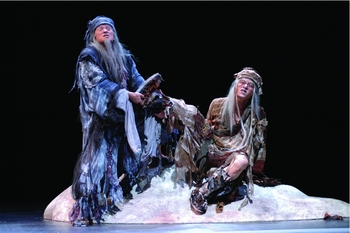
While incessant pratfalls, staggering and other unexpected bodily mistakes, as well as all kinds of smiles (forced, obsequious, satirical, happy, helpless) in this adaptation, remind us of slapstick clowns, the principles of chou in jingju are not completely lost. For example, the way that Titi helps Kuku to take off and put on the shoes at the beginning of the first act is highly stylized because they want their gestures to look beautiful as perceived by a jingju spectator. Their gestures in this scene are also an imitation of slapstick when accidents happen that trap them into comic embarrassment, such as unwittingly hurting each other. Kuku and Titi are slow and clumsy, as if they are too old to control their bodies, which highlights the chaotic nature of their existential conditions. The movement in this scene is rhythmic, carefully designed by the two actors, which is similar to what Beckett demanded for his Schiller Theatre production: ‘a physical theme’ done ‘artificially, with beauty, like ballet’.Footnote 35 Bodily clumsiness, which is essential in slapstick, is contradictory to jingju’s requirement of beauty. The juxtaposition of incongruous agile form and subsequent clumsiness from two different theatrical systems causes a comic feeling of crossing boundaries.
Titi (Wu Hsing-kuo) helps Kuku (Sheng Chien) to take off the shoe. Courtesy of Contemporary Legend Theatre.

Combat is an even fiercer visualization of characters’ failure to perform decent jingju conventions in traditional sense, which also becomes a major source of laughter. La Ji's dance in this adaptation brings the entire play to a dramatic climax. In the original play, this part is a long monologue that expresses his thoughts. In many productions, it is accompanied by forceful physical movements to ‘give confusion a shape’.Footnote 36 In this adaptation, modern dance and jingju’s tanzigong (literally ‘skills on the carpet’, including tumbling, jumping, pouncing and plunging) are fused under the principle of Bergson's snowball effect: ‘an effect which grows by arithmetical progression, so that the cause, insignificant at the outset, culminates by a necessary evolution in a result as important as it is unexpected’.Footnote 37 This is commonly seen in slapstick. On hearing the command of his master to dance, La Ji rigidly stands and mechanically moves his hands and head, his body parts functioning out of sync with one another as though controlled by an inexperienced puppeteer. However, as he moves faster, Lin Chao-hsu's training in tanzigong is manifest; he starts to run, leap, roll and somersault, with violence and increasing speed, until exhausted. Thus his whole dance consists of early rigidity and later agility.
The initial rigidity is perceptibly inspired by contemporary dance routines, such as the circular movements and sudden pauses of break-dance, and the slow, mechanical movements of popping. These arguably emphasize La Ji's dehumanization: an imitation of machinery from initial clumsiness to ultimate disorder, which has a startling comic effect. It is in essence a violation of jingju’s requirement of roundness: ‘Straight lines and angles are to be avoided; positive aesthetic value is perceived in the presentation of a three-dimensional network of circles, arcs, and curved lines’.Footnote 38 To a large extent, jingju’s valorization of moderate, controlled, coherent, round and flowing body movements is deconstructed by La Ji's desperate, mechanical, incoherent movements, and underscores an impression of human beings’ rigid passivity in the world. At the same time, it testifies to the fact that chou is licensed to depart from the strict rule of jingju, and to be more flexible, which makes La Ji's effort artistically coherent. Due to the initial rigidity and later agile tanzigong, there arises an incongruity from ‘two or more things that cannot be reconciled . . . brought together in an oppositional encounter with one another’.Footnote 39 La Ji's dance lasts for some five minutes, fully demonstrating the bodily indestructibility of slapstick clowns.
A new interpretation by and for actors
The title of Wu's adaptation was Waiting for Guotuo (等待果陀). ‘Guotuo’ refers to the Buddha, which adds Buddhism to the metaphysics of this play. This is no coincidence. For one thing, critics have found similarities between this play and Buddhism (Zen Buddhism in particular); for another, this was Wu's conscious choice.Footnote 40 As early as 1997, he started to contemplate how to adapt Godot. It was not until 2005 that he found the strategy for adaptation when he was practising a three-day meditation in a Buddhist temple to treat an illness. During this time, he not only recovered, but also claims to have seen with his mind's eye the road and withered tree from Godot.Footnote 41 Moreover, according to Hyers, Zen and the comic spirit are interconnected, particularly between clowns and Zen Buddhist masters, as both are accustomed to violating rationality and common sense by talking and behaving eccentrically. These masters’ other traits (‘queer antics and strange attire’ or ‘crazy sayings’ and ‘divine madness’) are also shared by the tramps in the Chinese adaptation of Godot, which the previous section has touched on.Footnote 42
Besides this rich connection, the comic devices play another significant part in most of the performance when the two tramps parody jingju to make noise and meaning. However, when tension in their conversation and movement culminates (e.g. after the departure of Po Suo and La Ji in Act I), a short peace follows, as if the play has been halted. The two tramps stand in stillness, frozen, accompanied by a short passage performed by the guqin, a seven-stringed Chinese musical instrument with a history of more than three thousand years, often associated with history, stillness, nature, seclusion and metaphysics. The stillness denies all their make-believe activities of inventing meaning out of nothing and resonates with the notion of Buddhist emptiness, ‘a powerful, mysterious, blissful nothingness, full of potentiality and life’.Footnote 43 Silence and stillness are a positive negation of the preceding meaning-making hustle and bustle. In realizing the futility of waiting, both characters – and perhaps the audience – are expected to perceive the truth of emptiness. Wu writes, ‘In Beckett's text there are many crucial moments of silence, which resemble blankness in Chinese painting, or epiphany in Zen Buddhism . . . Can the characters’ frequent motionlessness after their bustle point out that “dharma is beyond motion”’?Footnote 44 By contrasting bustle and silence, Wu reveals that dharma or Buddha will reside within neither, but in a perception from the individual's mind that transcends this discrimination.
Failure, in this regard, can be seen as the actors’ inevitable propensity to become disconnected from a normative system derived from jingju’s basic principles, despite their best attempts, which is underpinned by the Buddhist idea of non-attachment. By letting go of their artistic habits, the actors are liberated from the obsession with a single theatrical tradition, which, however, does not equal abandonment, but border crossing. This adaptation indicated a bolder way to modernize jingju through refashioning, which conversely changed the look and meaning of the adapted play. The significance of intercultural adaptation lies here as well: an in-depth intercultural dialogue leads to a rediscovery of the self hidden in existing cultural legacies, and rediscovery and reinvention are a key to the renewal of the art of theatre.