Infantile haemangioma is one of the most commonly known benign vascular tumours of infancy and childhood, having an incidence of about 3–10% in the general population.Reference Kilcline and Frieden 1 – Reference Leaute-Labreze, Dumas de la Roque and Hubiche 3 Most of these lesions have a tendency to spontaneously regress without scarring or sequelae;Reference Kilcline and Frieden 1 however, some may require treatment in view of their location or clinical effects, which significantly increase morbidity.
Historically, infantile haemangiomas were treated with steroids,Reference Bennett, Fleischer and Chamlin 4 which, although effective, had numerous associated side effects such as cushingoid facies, personality changes, gastric irritation, diminished growth, hypertension, hyperglycaemia, and hypothalamic–pituitary–adrenal axis suppression, given the duration of treatment.Reference Boon, MacDonald and Mulliken 5 , Reference George, Sharma and Jacobson 6
It was in the year 2008 that a chance discovery revolutionised the treatment of these haemangiomas, when Leaute-Labreze et alReference Leaute-Labreze, Dumas de la Roque and Hubiche 3 discovered a novel use of propranolol for the treatment of haemangiomas. This discovery came to light during the treatment of a patient with infantile haemangioma, who developed steroid-induced cardiomyopathy that then required treatment with propranolol. It was seen that the haemangioma improved in colour and size after initiating propranolol and continued to improve even after the steroids were tapered off.Reference Leaute-Labreze, Dumas de la Roque and Hubiche 3 Since then, several articles and case reports have been published that highlight the advantages of using propranolol over steroids for the treatment of these lesions. Within the span of few years, propranolol has become the first-line treatment for infantile haemangioma.Reference Püttgen 7 , Reference Price, Lattouf and Baum 8
Propranolol is a non-selective beta-blocker and has found important use in cardiovascular diseases such as arrhythmias, cardiomyopathy, and heart failure. The use of propranolol for haemangiomas thus also initiated the involvement of paediatric cardiology in their treatment.
The treatment regimen itself has undergone several modifications, and even with documented side effects such as hypotension, pulmonary symptoms such as bronchoconstriction and wheezing, hypoglycaemia, diarrhoea, gastro-oesophageal reflux, and cool and mottled extremities; propranolol has been found to be well tolerated and effective in infants and children, even as outpatient therapy.Reference Phillips, Penington and Bekhor 9 – Reference Hogeling, Adams and Wargon 13 Literature review has shown a rising trend towards initiating and maintaining treatment of haemangioma with propranolol on an outpatient basis; however, there are as yet no specific guidelines and treatment protocols are largely based on institutional preferences. Some institutions continue to practice initiation of treatment in an inpatient setting for monitoring the side effects of the first dose of propranolol, and maintenance in the outpatient setting, especially for infants younger than 1 month of age.
The practice of routine pretreatment testing with an echocardiogram also varies among different providers and institutions and, similar to the treatment protocol, has no specific consensus guidelines. However, routine pretreatment echocardiogram has not shown any benefits in otherwise healthy children.Reference Tang, Hing and Tang 14
In this review, we sought to compare the cost-effectiveness of initiating treatment with propranolol in an inpatient versus outpatient setting, and objectively observe the expenditures involved in these two alternative pathways. We also included the effect on expenditure when a pretreatment echocardiogram was performed for both pathways.
Methodology
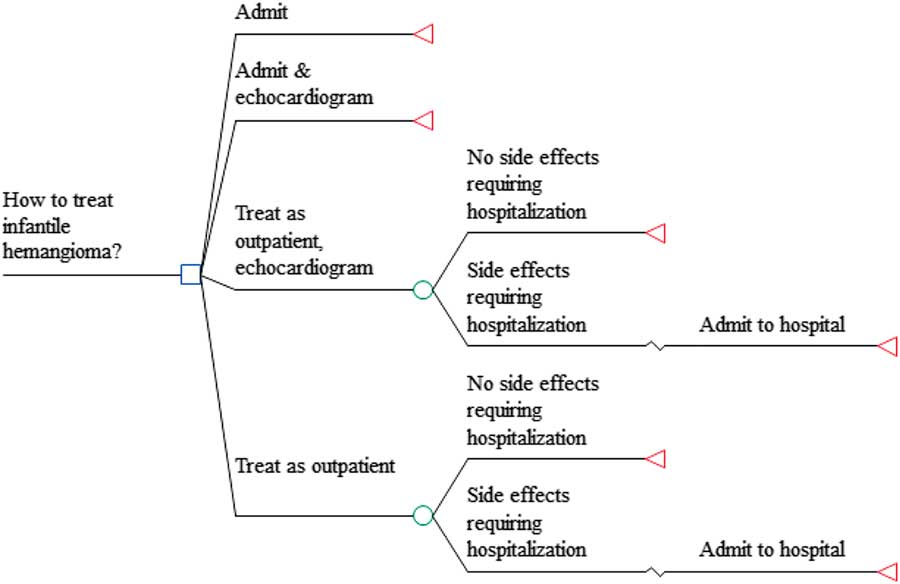
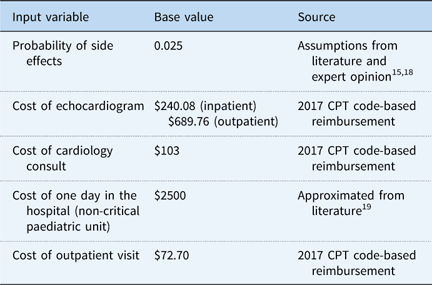
A decision tree model was created using the TreeAge® software, to evaluate the costs of using alternative strategies for treating infantile haemangioma with propranolol. The different strategies included initiating treatment as an inpatient versus outpatient, combined with the alternative of performing a pretreatment echocardiogram for both strategies, and the clinical pathways that followed (Fig 1). The implications of side effects of propranolol requiring hospitalisation were also included for all strategies. Cost and probability assumptions are displayed in Table 1. It was assumed that patients hospitalised for initiating treatment had a 1-day hospital stay under any of the depicted pathways.
Decision tree for alternative treatment strategies for infantile haemangioma.

Input assumptions and sources of values.

Cost analysis was assumed to be based on treatment of haemangioma in patients who were born at term, had no chronic illnesses, a non-life-threatening location of the haemangioma, and those who were not taking any other medications that could potentiate the side effects of propranolol.
Costs incurred in the treatment included both inpatient stays and outpatient visits. These costs were estimated using the 2017 Medicare reimbursement rates for CPT codes for outpatient visits and estimates from the literature review for hospital stays. Table 2 displays the values assumed in this model, as well as the sources for these assumptions.
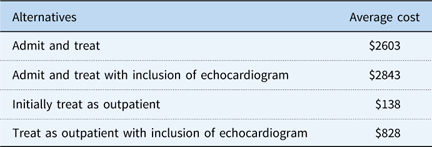
Cost results.

Sensitivity analysis was performed on the probability of side effects associated with propranolol use, resulting in hospital admission based on literature review.Reference Drolet, Frommelt and Chamlin 15 The most significant reported side effects were hypotension, pulmonary symptoms including wheezing and bronchoconstriction, hypoglycaemia, bradycardia, sleep disturbances, diarrhoea, gastrointestinal reflux, and mottled extremities.Reference Drolet, Frommelt and Chamlin 15
Results
On the basis of the decision tree model, the total expected costs for various pathways were determined and are depicted in Table 2. The first two strategies encompassed the alternatives of directly admitting the patient to the hospital to initiate propranolol treatment, with and without performing a pretreatment echocardiogram. The expected costs incurred when propranolol treatment was initiated with the patient being hospitalised for one day was $2603. This expected cost increased to $2843 with the addition of an echocardiogram.
The second strategy was based on initiating propranolol treatment in the outpatient setting. Two strategies were also used for this arm of the decision tree with and without an echocardiogram as above. Without an echocardiogram, the expected cost was $138, which increased to $828 after the addition of an echocardiogram. Each of these strategies included the assessment that a small number of these individuals would incur side effects resulting in their hospitalisationReference Drolet, Frommelt and Chamlin 15 as depicted in Table 1.
The expected costs of each of the four treatment strategies are summarised in Table 2, and this demonstrated that initiating treatment with propranolol as an outpatient had the lowest expected cost.
A sensitivity analysis was performed based on the assumed value of 0.5 based on literature review of side effects of propranololReference Drolet, Frommelt and Chamlin 15 requiring hospitalisation, which revealed a threshold value of 0.972, above which an initial strategy of admitting to the hospital and treating with propranolol, without an echocardiogram, achieved a lower expected cost and became the preferred strategy. This threshold value of 0.972 was above the upper limit of real side-effect experiences. The sensitivity analysis performed on the cost per day of a hospital admission day revealed that there was no value for which any other strategy achieved a lower expected cost.
Discussion
Propranolol is a commonly used beta-blocker in children, and at therapeutic doses – at 1–3 mg/kg/day, dosed at a minimum of 6 hours in between – it has been documented to be safe in those receiving it.Reference Love and Sikka 16 In conjunction to its cardiovascular uses, it has rapidly become the first-line treatment for infantile haemangioma.Reference Leaute-Labreze, Dumas de la Roque and Hubiche 3 Most adverse effects attributed to propranolol administration, however, are rare, and over the years it has been a developing consensus that propranolol is effective and well tolerated in the treatment of these vascular tumours.Reference Hogeling, Adams and Wargon 13
The debate regarding the best practice for initiating propranolol treatment for haemangioma has been long ongoing, and treatment protocols have been driven by institutional preferences. Current levels of evidence, largely based on observational studies and case reports, have favoured initiating propranolol on an outpatient basis, and most centres now do not advocate hospitalisation for the treatment initiation for otherwise normal, healthy infants.
As with protocol for initiation of treatment, pretreatment testing with an echocardiogram has also been seen to be based on institutional preferences, and there has been no singular consensus regarding the optimal practice. Some studies have advocated an indication-driven approach to pretreatment testing with echocardiograms performed if suggested by a thorough history and physical examination.Reference Tang, Hing and Tang 14 , Reference Cushing, Boucek and Manning 17 Those cost comparisons with and without the use of an echocardiogram are displayed in Table 2.
Given the safety profile of propranolol and rising experience with its use as outpatient treatment, we sought to observe the cost-effectiveness of initiating propranolol treatment in the outpatient setting versus admitting a patient for the same. Owing to the extremely rare side effects of propranolol, and good tolerability, it is most cost-effective to initiate propranolol on an outpatient basis. The costs of an outpatient and inpatient visit increases with inclusion of an echocardiogram; thus, the decision to perform this test should be taken judiciously and only after a thorough history and physical exam have been performed and something abnormal is detected in either. The largest cost differential though is with the use of inpatient resources with days in the hospital. Most patients starting first as an outpatient have their problems resolved in that setting, with very few needing the additional treatment in an inpatient setting, secondary to side effects.
Conclusion
Propranolol treatment for infantile haemangioma is cost-effective when initiated in the outpatient setting as compared with hospitalisation for initiation of treatment and observation. There is a cost difference of approximately $2000 between the two methods with initial echocardiograms.
Limitations of the study
The results of this study are based on the data obtained from previously published studies of treatment of infantile haemangioma with propranolol. A few assumptions had to be made in this study to compute the costs associated with each method of treatment.
Financial Support
This research received no specific grant from any funding agency or from commercial or not-for-profit sectors.
Conflicts of Interest
None.
Acknowledgements
None.