The health effects of incidents that involve the large-scale release of a hazardous substance can be reduced if people follow official guidance on how to limit their exposure. Unfortunately, compliance with official guidance is often poor.Reference Lemyre, Corneil and Johnson1 Although it is not fully understood why members of the public do or do not comply with official advice during a major public health incident, a number of factors likely to influence behavior have been identified. For example, studies of public responses to the 2002 outbreak of severe acute respiratory syndrome in Hong Kong found that beliefs about the efficacy of recommended behaviors, the likelihood of personal impact, the severity of consequences, and trust in the ability of authorities to control the situation may all have an impact on compliance with official advice.Reference Lau, Yang, Tsui and Kim2-Reference Tang and Wong4 The role of trust in those providing the guidance is also well established.Reference Rogers, Amlôt, Rubin, Wessely and Krieger5, Reference Glik, Drury, Cavanaugh and Shoaf6 Emotion plays a role too, with higher levels of anxiety associated with behavior change in response to the outbreak of severe acute respiratory syndrome in Hong KongReference Lau, Yang, Tsui and Kim2 and low levels of anxiety associated with limited behavior change in response to the Swine Flu outbreak in the United Kingdom.Reference Rubin, Amlôt, Page and Wessely7
These examples demonstrate that people from different societies and cultures may respond differently to similar major public health incidents. The reasons for these differences are complex and likely to arise from a range of factors including previous experiences with related hazards,Reference Gierlach, Belsher and Beutler8, Reference Rubin, Brewin, Greenberg, Simpson and Wessely9 the current social and political context,Reference Eisenman, Glik and Ong10 and attitudes toward the government.Reference Rubin, Amlôt, Page and Wessely7, Reference Wray, Becker and Henderson11 Identifying the extent to which there are national differences is important, as the occurrence of major incidents that affected the populations of multiple countries (eg, Chernobyl and the H1N1 pandemic) has resulted in increased attempts to share guidance for best practice about communicating with the public.Reference Hyer and Covello12, 13 Identifying cross-national differences in public responses to major public health incidents would help crisis communicators to adjust generic materials or guidelines to their population's own particular set of concerns and likely behavioral responses.
A potentially useful theoretical framework for understanding public responses to official advice during a public health incident is protection motivation theory (PMT).Reference Rogers14, Reference Maddux and Rogers15 PMT was originally developed as a model of preventative health behavior to examine the effects of fear appeals on persuasion, but it can be applied to any threat for which there is an effective recommended response.Reference Eisenman, Glik and Ong10 According to PMT, the extent to which individuals are motivated to protect themselves from a health threat is influenced by two key factors: threat appraisal and coping appraisal. Threat appraisal involves assessing the severity of the threat and the personal risk involved, as well as the emotional response associated with the threat (fear arousal). Coping appraisal consists of response efficacy, self-efficacy, and response costs. Response efficacy is the belief that carrying out recommendations will be effective. Self-efficacy is the extent to which individuals believe that they are capable of carrying out the recommendations. Response costs are the perceived costs of carrying out the recommendations. According to PMT, protective behaviors are more likely to be adopted when there are high levels of threat appraisal, when response efficacy and self-efficacy are also high, and when response costs are low.Reference Floyd, Prentice-Dunn and Rogers16 Coping appraisal is typically seen as having a greater influence on behavioral intentions than threat appraisal.Reference Milne, Sheeran and Orbell17, Reference Ruiter, Abraham and Kork18
In this study we used an online survey to test the strength of association of threat and coping appraisals, anxiety, and trust in authorities with the intention to comply with official advice to stay in place and shelter following a hypothetical chemical spill. Noncompliant outcomes were based on behavioral intentions identified in previous research studies. These included collecting children from school,Reference Rubin, Brewin, Greenberg, Simpson and Wessely9 checking on family and friends,Reference Rubin, Brewin, Greenberg, Simpson and Wessely9 and evacuation.Reference Kasperson and Pijawka19, Reference Ziegler, Brunn and Johnson20 Because previous authors have raised concerns about how the framing of an emergency message might affect public responses,21-Reference Wiedemann and Schiitz23 in our survey, advice was presented in 1 of 3 ways, (1) with reassurance that the health threat was low, (2) with emphasis on the worst case scenario, or (3) with no additional information. To determine whether intention to comply would be influenced by ease of compliance, participants were asked about their behavioral intentions if the incident were to occur if they were at home or in a less convenient location. Two identical surveys were conducted, 1 in the United Kingdom and 1 in Poland, to assess possible national differences in responses. These nations are both subject to European Union regulations and guidance, but have different experiences of and attitudes toward chemical incidents, and the authorities tasked with responding to major public health emergencies. Each survey used conventional opinion poll methods to reach a demographically representative sample of the adult population of that country.
Methods
Design and Participants
An online survey was conducted on our behalf by GMI (Global Market Insite UK Limited). Usable data were obtained from 601 participants in the United Kingdom and 602 participants in Poland. Data collection was carried out simultaneously in both countries between December 3 and 13, 2010. Participants were drawn from the GMI UK and Polish panels to obtain a nationally representative sample for each country (based on sex and age). Participants who completed the survey in less than 35% of the median time were excluded from the sample. Participants who completed the survey were compensated for their time using a points-based system, in which panel members accumulate points that can be exchanged for cash. The survey was approved by a King's College London's Research Ethics Committee.
The Survey
The survey used a hypothetical scenario that involved the collision of 2 tankers at a local petrol station, resulting in the release of chlorine gas. Participants were informed that the police had made a radio announcement, based on the advice of health experts, that asked all local residents to stay indoors with doors and windows closed for the next 8 hours (the full survey text is provided in the online data supplement available at http://www.dmphp.org). This is a realistic recommendation for this scenario. Because previous authors have raised concerns about the impact of framing an emergency message on public responses,Reference Lemyre, Corneil and Johnson1, 21-Reference Wiedemann and Schiitz23 our survey presented the advice in 1 of 3 ways: (1) with reassurance that the health threat was low, (2) with an emphasis on the worst case scenario, or (3) with no additional information (control). Participants were randomized into groups that received 1 of these 3 styles of communication.
The scenario was followed by a multiple-choice question asking, “Which of these actions is the police official recommending?” followed by 3 incorrect and 1 correct response. The question was included to ensure that participants had read and understood the instructions provided. Participants who provided incorrect responses were screened out at this stage.
Questions were presented in a grid format, with the order of questions randomized within each. Participants were also asked to rate the extent to which they trusted government officials, local authorities, and the 3 main emergency services. This was followed by a final screen that requested further demographic information.
The Polish version of the questionnaire was a direct translation of the English questionnaire. However, Polish participants were not asked about their ethnicity, as this is not usual practice in Poland. The definition of “the authorities” for the trust measure was also changed to be locally appropriate.
Behavioral Outcome Measures
All participants were asked how likely they would be to perform 5 actions if the scenario were to occur (1) while they were at home and (2) while they were at a local post office. Only 1 item followed official advice (“stay inside your home/the post office”); the other items were “stay inside your home/the post office for some, but not all of the period,” “leave to check on vulnerable neighbours, family or friends/go home,” “collect your children from school or day-care,” and “leave the area.” Possible response options were “not at all likely” (coded as a score = 1), “not very likely” (score = 2), “fairly likely” (score = 3), “very likely,” (score = 4), and “not applicable” (coded as missing data).
Predictor Variables
Three groups of predictor variables were measured: anxiety, threat and coping appraisal, and trust in authorities. Anxiety was measured using a 6-item state anxiety scale derived from the State-Trait Anxiety Inventory.Reference Marteau and Bekker24, Reference Tluczek, Henriques and Brown25 Participants were asked the extent to which they would feel each of the following emotions if this chemical incident occurred in their local area: calm, tense, upset, relaxed, content, and worried. Possible response items were not at all (coded as a score = 1), somewhat (score = 2), moderately (score = 3), very much (score = 4), and don't know (coded as missing data).
Threat and coping appraisal were measured using 6 items adapted from Teasdale etal.Reference Teasdale, Yardley and Schlotz26 Perceived severity of threat was measured by asking whether participants thought it was likely they would become seriously ill if exposed to the chemicals released in this incident. Perceived likelihood of exposure was measured by asking participants about likelihood of personal exposure if they did not take preventive action. Emotional response was measured by asking participants if they would feel anxious about being exposed to the chemicals released in this incident. Response efficacy was measured by asking participants if they would be safe if they stayed indoors with windows and doors closed. Self-efficacy was measured by asking participants if they thought it would be possible to stay inside with windows and doors closed for the recommended period. Response cost was measured by asking participants if compliance to recommended practice would mean they would be unable to help people they care about. The wording used for each item is shown in the online data supplement.
Trust in authorities was measured using 5 items adapted from Rubin etal.Reference Rubin, Amlôt, Page and Wessely7 The authorities were defined as “the government, the National Health Service and other agencies such as the Health Protection Agency” for British participants and as “the government (at national and local levels), the health care system, and Sanitary Epidemiological Stations” for Polish participants. Participants were asked to rate the extent to which they felt the authorities would do a good job, have sufficient resources, and have the necessary knowledge to respond to this incident. They were also asked whether they felt the authorities would act in the public's best interest when dealing with this incident and whether they felt the authorities would be open and honest in their dealings with the public. Appraisal and trust measures used a 5-point response format. Possible options were strongly disagree (score = 1), tend to disagree (score = 2), neither agree nor disagree (score = 3), tend to agree (score = 4), and strongly agree (score = 5). Participants were also offered the option to give no opinion (coded as missing data).
Demographic Variables
Participants were asked their sex, age, ethnicity (UK only), highest educational qualification, occupation (and whether it was full or part time), whether they had any children (if so, how many they had and how old they were), and whether they had the use of a car. We also recorded whether they took part in the British or Polish survey.
Analyses
Behavioral outcome measures were re-coded into binary variables, with “not at all likely” and “not very likely” given a value of 0 (not likely), and “fairly likely” and “very likely” given a value of 1 (likely). In addition, participants were categorized as “fully compliant” if they had a score of likely for “stay inside” and unlikely for all other behavioral outcomes. “No opinion” and “don't know” responses were coded as missing data.
Cochran's Q tests were employed to examine the association between ease of compliance and behavioral intentions. χ2 tests were used to examine the associations between message presentation and behavioral intentions. Also used were t tests and χ2 tests to examine national differences in demographic features and perception variables.
Binary logistic regressions were used to test the association between demographic variables and behavioral intentions, between perception variables and behavioral intentions, and to examine national differences in behavioral intentions, adjusting for demographic and perception variables that were significantly different between countries.
Results
Sample Characteristics
In total, the online survey was completed by 1203 participants. Of these, 400 (33.3%) were in the control group, 402 (33.4%) were in the reassurance group, and 401 (33.3%) were in the worst case group. Sample characteristics and differences between UK and Polish responses are provided in eTable A.
Behavioral Intentions
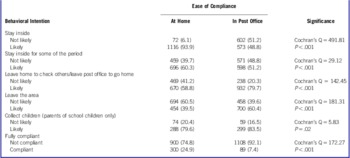
Table 1 shows responses provided by participants for each of the behavioral reactions for the home scenario and the post office scenario.
Frequencies (Percentages) for Behavioral Intentions According to Location

Cochran's Q tests indicated that ease of compliance had a significant effect on every behavioral outcome (all P values ≤ .02).
The most likely reaction in the home scenario was to stay inside, and significantly more participants said they would stay inside in the home scenario than in the post office scenario (Cochran's Q = 491.81, P < .001). Conversely, participants indicated that if the incident occurred while they were in the post office, their most likely reaction would be to head home. Significantly more participants intended to leave the area in the post office scenario than in the home scenario (Cochran's Q = 181.31, P < .001).
A large majority of participants with school-aged children intended to collect their children, regardless of location, but significantly more intended to do so in the post office scenario (Cochran's Q = 5.83, P = .02). A minority of participants reported full compliance in either the home (24.9%) or the post office (7.4%) scenario, but significantly fewer intended to fully comply in the post office scenario than in the home scenario (Cochran's Q = 172.27, P < .001).
Association Between Message Presentation and Behavioral Intentions
Message presentation had no impact on behavioral intentions if the chemical incident occurred while participants were at home (P > .05 for all behavioral outcomes). In the post office scenario, significantly more parents in the worst case scenario and reassurance conditions intended to collect their children from school than in the control group (χ2(2) = 6.9, P = .03), but message presentation had no impact on any other behavioral intention. Frequencies (percentages) and χ2 values for the association between message presentation and behavioral intentions for the home and post office scenario are provided in eTables B and C.
Association Between Demographic Variables and Behavioral Intentions
There was no association between demographic variables and the intention to stay inside in the home scenario. Men were significantly less likely to be fully compliant than women (odds ratio [OR] 0.65, 95% CI 0.50-0.84), and the odds of full compliance were 10.76 times higher for UK participants than for Polish participants (95% CI 7.51-15.41). No other demographic variables were associated with full compliance.
Education, being employed, having school-aged children, and access to a car were all significantly associated with the intention to leave the area. Country was associated with the intention to perform noncompliant behaviors, with UK participants being significantly less likely to have the intention to perform these actions.
Similarly, in the post office scenario, the demographic feature that had most impact on behavioral intentions was country. UK participants were significantly more likely to fully comply (OR 2.08, 1.32-3.28) and significantly less likely to express the intention to perform noncompliant behaviors. UK participants were also significantly less likely to indicate the intention to stay inside in the post office scenario (OR 0.20, 0.15-0.25).
Participants who were not employed were significantly more likely to be fully compliant in the post office scenario. Lower educational level and having school-aged children were associated with the intention to stay inside.
Age was significantly associated with the intention to leave to check on others and to leave the area, with 25- to 44-year-olds more likely to have the intention to perform both of these actions. Unemployment was negatively associated with the intention to leave the area.
Odds ratios for the association between demographic variables and behavioral intentions for both scenarios are provided in eTables D and E.
Association Between Perception Variables and Behavioral Intentions
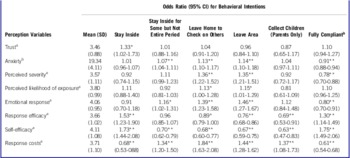
Table 2 shows the associations between perception variables and behavioral intentions for the home scenario. Higher levels of trust were associated with a greater likelihood of staying inside. Response efficacy and self-efficacy were also positively associated with staying inside, whereas response costs were negatively associated with the intention to stay inside.
Association Between Perception Variables and Behavioral Intentions (If at Home)

*Indicates significant association at the .05 level, and **indicates significant association at the .01 level.
aScores range from 1 (strongly disagree) to 5 (strongly agree).
bScores range from 0 (not at all anxious) to 24 (very anxious).
Anxiety was negatively associated with full compliance, as was perceived severity and emotional response. Higher levels of response efficacy and self-efficacy were significantly associated with the intention to fully comply, and response costs were negatively associated with this intention.
Lower levels of response efficacy and self-efficacy and higher levels of response costs were significantly associated with non-compliant behaviors. Higher threat appraisals were significantly associated with the intention to leave home to check on others and leave the area. Higher levels of anxiety were associated with all noncompliant behaviors except for collecting children.
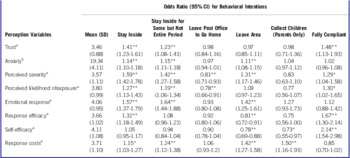
Table 3 shows the correlations between perception variables and behavioral intentions for the post office scenario. Trust, anxiety, threat appraisals, and response efficacy were all significantly positively associated with the intention to stay inside in the post office scenario. There was no association between self-efficacy and the intention to stay inside, and response costs were positively associated with this intention.
Association Between Perception Variables and Behavioral Intentions (If at Post Office)

*Indicates significant association at the .05 level; **indicates significant association at the .01 level.
aScores range from 1 (strongly disagree) to 5 (strongly agree).
bScores range from 0 (not at all anxious) to 24 (very anxious).
Trust, perceived severity, perceived likelihood of exposure, response efficacy, and self-efficacy were all positively associated with the intention to fully comply with the recommended action. Emotional response was not associated with this intention nor was response costs.
Lower levels of perceived severity and perceived likelihood of exposure were associated with the intention of leaving the post office to go home and lower levels of response efficacy and self-efficacy were associated with the intention to leave the area. Lower levels of self-efficacy were also associated with the intention to collect children. Higher threat appraisals were associated with staying inside for some but not all of the recommended period, and higher levels of perceived severity and emotional response were associated with leaving the area.
Mediators of the Differences Between UK and Polish Participants
There were significant educational differences between UK and Polish participants (χ2(2) = 72.48, P < .001). There were also significant differences in perceptions about the incident. Polish participants demonstrated significantly higher levels of anxiety (t[1037.55] = 19.18, P < .001) and scored more highly on perceived severity (t[1167.54] = 10.56, P < .001), perceived likelihood of exposure (t[1175] = 3.10, P = .002), and emotional response (t[1122.60] = 11.10, P < .001). Polish participants also provided lower self-efficacy scores (t[1194] = 5.73, P < .001) and higher response cost scores (t[1147.98] = 8.00, P < .001). Note that since preliminary Levene tests indicated that the variances of the 2 groups were significantly different, the t tests reported here do not assume equal variances, with the exception of perceived likelihood of exposure and self-efficacy scores. The differences between UK and Polish sample characteristics and responses are provided in eTable A.
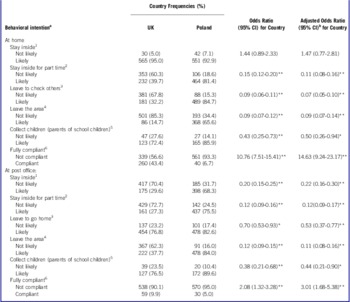
Table 4 shows the associations between country and behavioral intentions, adjusted for the demographic and perception variables that were significantly different between countries. Taking into account differences in demographics and perceptions about the incident, UK participants remained significantly more likely to intend being fully compliant (adjusted OR [AOR] 14.63, 95% CI 9.24-23.17) and less likely to perform all noncompliant behaviors in the home scenario. UK participants also remained significantly more likely to intend being fully compliant (AOR 3.01, 95% CI 1.68-5.38) and significantly less likely to perform all noncompliant behaviors in the post office scenario. Polish participants were also still significantly more likely to say that they intended to stay inside in the post office scenario (AOR 0.22, 95% CI 0.16-0.30).
Association Between Behavioral Intention and Country

*Indicates significant association at the .05 level; **indicates significant association at the 0.01 level.
aAll odds ratios adjusted for education, anxiety, perceived severity, perceived likelihood of exposure, emotional response, self-efficacy, and response cost. Variables 1, 2, 3, 4, and 6 were also adjusted for whether participants had children of school age, children not of school age, or no children.
Comment
The survey results supported existing research regarding non-compliant behaviors in emergency scenarios. Checking on others and collecting children from school were particularly problematic issues. That participants gave priority to ensuring the well-being of significant others is consistent with what is known from previous incidents, for example, checking on the safety of family members and friends in the immediate aftermath of the attack on the World Trade Center on September 11, 2001,Reference Schuster, Stein and Jaycox27 and collecting children from school following the bombings in London on July 7, 2005.Reference Rubin, Brewin, Greenberg, Simpson and Wessely9 In our study, there were also clear differences in levels of compliance, depending on where participants were asked to imagine they were when the incident occurred. This finding suggests that people will be much more inclined to comply with instructions to shelter in place if they are already at home.
Public perceptions about the severity of an incident and the ability of authorities to respond to the situation play a key role in determining the likelihood of compliance with official advice.Reference Lau, Yang, Tsui and Kim2-Reference Tang and Wong4 Good communication during and after an incident is therefore an essential part of a successful response. An issue that has been much debated is the impact of communicating worst case scenarios or “precautionary” statements. For example, it has been suggested that messages emphasizing that recommendations are purely precautionary may actually amplify concerns and reduce trust in public health protection.Reference Wiedemann and Schiitz23 Concerns have also been expressed about the potentially negative impact of “worst case scenario” communications. For example, it has been suggested that during the 2009 H1N1 pandemic, reasonable worst case scenario communications were frequently misinterpreted as predictions.21 Our data suggest that these concerns may be overstated, as responses were largely unaffected by the style of presentation. This finding is consistent with previous research that suggests growing cynicism about media hyperbole in terms of reporting of disasters;Reference Rubin, Amlôt, Page and Wessely7, Reference Wray, Becker and Henderson11 it is possible that the public is becoming adept at seeing past the style of a message.
However our data suggest some ways that communication strategies can be enhanced. PMT has been identified as a potentially useful framework for understanding public responses to recommended health behaviors.Reference Schuster, Stein and Jaycox27 Our data broadly support this contention. In particular, coping appraisal seems to be a key predictor in both the post office and home environments. This finding is consistent with meta-analyses that found coping appraisal to be the primary predictor of intentions and behavior.Reference Milne, Sheeran and Orbell17, Reference Ruiter, Abraham and Kork18 Threat appraisal had a more complex relationship with intended behaviors. When in the post office threat appraisal was associated with staying in. This relationship was not apparent when participants were asked to think about what they would do if at home. Crucially, in both scenarios, threat appraisal was associated with noncompliant behavior. Using threat-based messages may therefore be counterproductive. Again this is consistent with public responses to communications about swine fluReference Rubin, Potts and Michie28 and suggests that more emphasis should be given to addressing coping appraisals in crisis communications.
As shown repeatedly elsewhere,Reference Rogers, Amlôt, Rubin, Wessely and Krieger5 the extent to which the public trusts the authorities providing the advice is also an important factor in determining likelihood of compliance. It is therefore imperative that credible sources are used to communicate official guidance during a major public health incident. Anxiety was associated with noncompliant behaviors in the home scenario, and with staying inside (either for some or all of the requested period) and leaving the area in the post office scenario. This finding suggests that anxiety promotes behavior change, ie, actions that differ from behavioral norms such as heading home in the event of a crisis. This finding also is consistent with previous research.Reference Lau, Yang, Tsui and Kim2, Reference Rubin, Amlôt, Page and Wessely7
A comparison of UK and Polish responses found lower levels of compliance in Poland. Polish participants also demonstrated lower levels of self-efficacy and considered response costs to be higher, which is consistent with noncompliant behaviors according to PMT. However, they also scored higher on all threat appraisal measures, which would usually be associated with the adoption of protective behaviors. Regardless of differences in coping and threat appraisals, country of origin remained a significant predictor of intention to comply. This finding suggests that although coping appraisal plays an important role in behavioral intentions, national differences in compliance cannot be accounted for by differences in perceptions about the event. National differences therefore have important implications for crisis communications, indicating that generic guidance on best practice for communicating with the publicReference Hyer and Covello12, 13 may need to be adapted to accommodate local concerns and likely behavioral responses.
Methodological Limitations
Our survey measured behavioral intentions rather than objectively measured behavior. While behavioral intentions are known to be a key determinant of behavior, other factors such as volitional control, social reaction, and habitual control are likely to affect the extent to which behavior reflects intentions.Reference Webb and Sheeran29 Furthermore, a hypothetical scenario was used to identify likely behaviors and perceptions, which makes it difficult to establish whether our results accurately reflect behaviors that would be performed in the event of a real incident. The fact that the associations we identified between perceptions and behavioral intentions were similar to those found in other, genuine incidentsReference Rubin, Amlôt, Page and Wessely7, Reference Rubin, Brewin, Greenberg, Simpson and Wessely9 provides some reassurance on this issue.
As with all survey studies, the use of self-report data mean that results might be subject to social desirability bias. It is possible that this may account for the discrepancy between the large proportion of participants who indicated they would be likely to stay inside as instructed and the relatively low levels of full compliance found when other behaviors were taken into account. Nevertheless, the very low levels of full compliance suggest that social desirability effects have not had a strong influence on overall findings.
A further issue relates to the measurement of perception variables. Although measures of anxiety and trust were based on scales that have been previously validated, due to survey length limitations, PMT concepts were measured using single items. Some reassurance is provided by the similarity between our findings and research that used multiple measures for these concepts,Reference Schuster, Stein and Jaycox27 but further studies with expanded scales are required to verify these findings.
A final caveat is that although participants were sampled on a quota basis to ensure they were demographically representative for each country, the use of an online survey means that individuals without Internet access were excluded from this sample. Furthermore, the sample was made up of individuals who had volunteered for market research. People who volunteer for research are likely to differ from the general population. For example, they are likely to be better educated.Reference Ebrahim30 This likelihood raises questions about whether the findings may be generalized to the wider population. This issue may have been exacerbated by the possibility of different styles of survey responding in each country,Reference Dolnicar and Gmn31, Reference Harzing32 possibly meaning that observed differences in UK and Polish responses could be a methodological artifact rather than a true reflection of differences in behavioral intentions. However, large differences in responses between countries suggest that culturally specific response biases are unlikely to be able to fully account for our findings.
Conclusions
Coping appraisal appears to be an important predictor of behavioral intentions following a chemical incident emergency, suggesting that successful behavioral interventions must take into account perceptions regarding the efficacy of recommended behaviors, the difficulties people may have in following advice, and their perceptions about the cost of following recommended behaviors. Future research should explore which aspects of coping appraisal are particularly important in these contexts. Overall we found sufficient similarities in procedures and behavioral intentions to suggest that generic principals of risk and crisis communication would be applicable in the United Kingdom and Poland. However, differences between levels of intended compliance between countries suggest that these generic principles of crisis communication may nevertheless need to be adapted to take into account local concerns and likely behavioral responses.
About the Authors
Department of War Studies (Drs Pearce and Rogers) and Department of Psychological Medicine (Drs Rubin and Wessely), King's College London; and Emergency Response Department, Health Protection Agency, London (Dr Amlôt).
Acknowledgments
The study described in this report forms part of a program of research entitled The Public Health Response to Chemical Incident Emergencies (CIE Toolkit), which was conducted with the following research partners: the Health Protection Agency UK, the Swedish Defence Research Agency, the National Kapodistrian University of Athens, the Nofer Institute of Occupational Health (NIOM), the Instituut voor Psychotrauma, and King's College London, with the collaborating partner World Health Organization (WHO) through the International Programme on Chemical Safety (WHO IPCS). Dorota Merecz and Dorota Szoland at NIOM translated the text of the survey into Polish.
Funding and Support
The European Commission Executive Agency for Health and Consumers co-funded this project. James Rubin is funded under the terms of a National Institute of Health Research Career Development Fellowship. Simon Wessely is partially funded by the South London and Maudsley National Health Service Foundation Trust/Institute of Psychiatry National Institute of Health Research Biomedical Research Centre. The views expressed in this report are those of the authors and are not necessarily those of their employers or funders.
Published online: December 7, 2012. doi:10.1001/dmp.2012.56