

Adult attachment theory stipulates that couple relationships are governed by three interrelated behavioural systems—the attachment, caregiving, and sexual systems—all of which are considered to have strong ties to the functioning and adjustment of the individuals comprising the romantic dyad (Bowlby, 1969/Reference Bowlby1982; Fraley & Roisman, Reference Fraley, Roisman, Simpson and Rholes2015; Mikulincer & Shaver, Reference Mikulincer and Shaver2016; Shaver, Hazan, & Bradshaw, Reference Shaver, Hazan, Bradshaw, Sternberg and Barnes1988). This theory offers a comprehensive framework for understanding the factors central to young adult functioning and for explaining the developmental pathways leading to the use of different coping strategies to manage life stressors (Bartholomew & Horowitz, 1991; Mikulincer & Shaver, Reference Mikulincer, Shaver, Deaux and Snyder2012). In recent years, attachment theory has been credited as a guiding framework for understanding the phenomenology of non-suicidal self-injury (referred to herein as self-injury; e.g., Gratz, Conrad, & Roemer, Reference Gratz, Conrad and Roemer2002; Kimball & Diddams, Reference Kimball and Diddams2007; Yates, Reference Yates and Nock2009), a dangerous and prevalent practice utilised widely among community-based young adults (Hasking, Momeni, Swannell, & Chia, Reference Hasking, Momeni, Swannell and Chia2008; Whitlock & Seleckman, Reference Whitlock and Seleckman2014). Despite its theoretical applications, very little empirical investigation has been conducted to examine the links between romantic attachment experiences and self-injury. Moreover, no research has yet examined the potential associations between the romantic caregiving and sexual systems and the occurrence of self-injury, despite their respective links to multiple facets of young adult functioning and coping abilities. The present study sought to provide a better understanding of the factors underlying this troubling phenomenon by exploring its links to all three of attachment theory's behavioural systems.
Overview of Self-Injury and Emotion Regulation
Self-injury encompasses both thoughts of harming oneself, in addition to actual self-injurious behaviours (i.e., cutting and hitting oneself). Thoughts and behaviours are conceptualised as closely interlinked, but are considered putatively different forms of self-injury that differ in frequency, severity, and duration (Nock, Prinstein, & Sterba, Reference Nock, Prinstein and Sterba2009). Despite this theoretical distinction, research has traditionally focused on the examination of behaviours at the exclusion of thoughts. Recent findings attest to the importance of dedicating empirical attention to self-injurious thoughts, as individuals experiencing thoughts have been demonstrated to be at a heightened risk for acting on them (Nock et al., Reference Nock, Prinstein and Sterba2009). In recent years, a number of assessment measures have also been constructed that separately examine thoughts and behaviours (e.g., Ottawa Self-Injury Inventory, Cloutier and Nixon, Reference Cloutier and Nixon2003; Self-injurious Thoughts and Behaviors Interview, Nock, Holmberg, Photos, & Michel, Reference Nock, Holmberg, Photos and Michel2007). Lastly, recent research has also compared the correlates of thoughts and behaviours, with findings identifying that thoughts and behaviours may share certain important correlates (e.g., less parental care, greater parental control, greater unresolved attachment to parents, and greater romantic attachment anxiety as compared to non-self-injurers). In addition, such research indicates that thoughts and behaviours also hold certain differing correlates (i.e., intimate partner violence victimisation linked to behaviours only, greater severity of child sexual abuse reported linked to behaviours; Levesque, Lafontaine, Bureau, Cloutier, & Dandurand, Reference Levesque, Lafontaine, Bureau, Cloutier and Dandurand2010; Martin, Bureau, Cloutier, & Lafontaine, Reference Martin, Bureau, Cloutier and Lafontaine2011). Despite such existing investigations, much remains to be known regarding the potential for shared and differing correlates of self-injurious thoughts and behaviours. Continued research in this vein is warranted, as this would allow for the development of a more thorough and nuanced understanding of the commonalities and differences of self-injurious thoughts and behaviours.
Emotion regulation is conceptualised as the awareness, understanding, and acceptance of emotions, coupled with the ability to internally modulate emotional responses. A lack of such abilities is considered to reflect deficits in emotion regulation (Gratz & Roemer, Reference Gratz and Roemer2004). When faced with an emotionally intense experience, individuals choose from emotion regulation strategies that are available in a given context. When distressed by aversive emotions, young adults may attempt to manage or reduce distress by engaging in self-injurious thoughts or behaviours. As such, self-injurious thoughts and behaviours are considered maladaptive emotion regulation strategies (e.g., Linehan, Bohus, & Lynch, Reference Linehan, Bohus, Lynch and Gross2007; Nixon & Heath, Reference Nixon and Heath2009). Previous research has identified a vast array of factors that are associated with deficits in emotion regulation, such as insecure romantic attachment (e.g., Guzmán-González, Lafontaine, & Levesque, in press; Morel & Papouchis, Reference Morel and Papouchis2015), poor romantic caregiving abilities (Mikulincer & Shaver, Reference Mikulincer, Shaver, Deaux and Snyder2012), and low sexual satisfaction (i.e., Rellini, Vujanovic, Gilbert, & Zvolensky, Reference Rellini, Vujanovic, Gilbert and Zvolensky2012; Rellini, Vujanovic, & Zvolensky, Reference Rellini, Vujanovic and Zvolensky2010). Despite this, it is equally imperative to also identify the risk factors and correlates of specific emotion regulation strategies themselves, as certain ones — such as self-injury — pose life-threatening consequences.
Self-injury is utilised with alarming prevalence rates among community-based young adults (see Whitlock & Seleckman, Reference Whitlock and Seleckman2014, for a review) and constitutes one of the leading causes of death worldwide (Nock et al., Reference Nock, Borges, Bromet, Alonso, Angermeyer, Beautrais and Williams2008). It is among the most fatal maladaptive emotion regulation strategies practised by young adults. While a vast myriad of both adaptive and maladaptive emotion regulation strategies are practised across young adults, identifying the risk factors and correlates of self-injury are of particular importance, given the troubling intersection between prevalence and fatal consequences.
The Tripartite Model of Romantic Attachment
As aforementioned, adult attachment theory contends that romantic relationships involve a combination of three dynamic behavioural systems that mutually influence one another (Mikulincer & Shaver, Reference Mikulincer and Shaver2016; Pietromonaco & Beck, Reference Pietromonaco, Beck, Mikulincer, Shaver, Simpson and Dovidio2015; Shaver et al., Reference Shaver, Hazan, Bradshaw, Sternberg and Barnes1988). In the context of adult romantic relationships, the attachment system is characterised by seeking comfort and security from one's partner during times of distress and hardship (e.g., physical illness, rejection, failure, or conflict). Individuals with anxious attachment patterns doubt that they are deserving of attentive, consistent care from their partners, and thus feel a need to draw attention to their distress. The result is a pattern of hyperactivation characterised by seeking persistent reassurance and proximity from romantic partners. In contrast, individuals with avoidant attachment patterns experience great discomfort with emotional intimacy, as they anticipate that others are not trustworthy or reliable. Such individuals thus demonstrate a pattern of deactivation in response to threat, which is characterised by minimising distress and denying needs for comfort and support from others (Brennan, Clark, & Shaver, 1988; Pietromonaco & Beck, Reference Pietromonaco, Beck, Mikulincer, Shaver, Simpson and Dovidio2015).
The caregiving system is complementary to the attachment system, and is characterised by attempts to alleviate a troubled partner's distress. According to Kunce and Shaver (Reference Kunce, Shaver, Perlman and Bartholomew1994), two dimensions characterise positive or responsive romantic caregiving behaviours: proximity (offering physical and emotional closeness as means of comforting a distressed partner) and sensitivity (the ability to accurately perceive distress cues in one's partner). A deactivated caregiving system is characterised by a withdrawal from caregiving and insisting on emotional distance to a distressed partner seeking comfort (Mikulincer & Shaver, Reference Mikulincer, Shaver, Deaux and Snyder2012). Additionally, two dimensions represent negative or unresponsive caregiving behaviours: controlling caregiving (taking too much responsibility for the partner's problems, while minimising opportunities for the partner to find his or her own means of coping), and compulsive caregiving (becoming over-involved in the partner's problems with minimal regard for his or her actual need for help). Both controlling and compulsive caregiving encompass hyperactivating strategies, as they are intrusive, effortful attempts to demonstrate to one's partner that one can be an effective caregiver (Mikulincer, Reference Mikulincer, Mikulincer and Goodman2006).
Finally, the sexual system encompasses people's motives for engaging in sexual interactions and is expressed through sexual behaviours, emotions, and desires (Birnbaum, Reference Birnbaum2010; Mikulincer, Reference Mikulincer, Mikulincer and Goodman2006). The healthy functioning of the sexual system can be viewed in terms of sexual satisfaction, which refers to the subjective assessment of the positive and negative aspects of one's sexual relationship and experiences (Byers, Demmons, & Lawrence, Reference Byers, Demmons and Lawrence1998; Péloquin, Brassard, Lafontaine, & Shaver, Reference Péloquin, Brassard, Lafontaine and Shaver2014). Sexual satisfaction can be measured according to: self-focused satisfaction (sexual satisfaction generated by one's own experiences and felt sensations) and partner/activity focused satisfaction (sexual satisfaction derived from one's perception of their partner's sexual reactions, and the quality of sexual activities shared; Stulhofer, Bukso, & Brouillard, Reference Stulhofer, Busko and Brouillard2010). Ongoing sexual dissatisfaction (i.e., low self-focused and partner/activity-focused satisfaction) is considered to lead to the hyperactivation or deactivation of the sexual system. Chronic sexual hyperactivation involves mentally preoccupying, intrusive worries and concerns about one's sexual desirability. Alternately, sexual deactivation involves the dismissal of sexual needs and the rejection of sexual activity as a valuable source of pleasure (Birnbaum, Reference Birnbaum2010; Mikulincer, Reference Mikulincer, Mikulincer and Goodman2006).
Theoretical Links Between Self-Injury and the Tripartite Model of Romantic Attachment
Drawing from attachment theory, the developmental psychopathology approach to self-injury proposes that the adverse experiences underlying insecure attachment (e.g., neglectful romantic partner) may affect the individual by leading to the development of a view of self as unlikeable or undeserving of care (i.e., attachment anxiety). Alternately, the individual may come to perceive others as critical or unsupportive (attachment avoidance) and be left to cope with emotional distress alone. Self-injury is thought to emerge from such insecure attachment-related representations of the self as defective and of others as unsupportive. Moreover, self-injury may develop as an emotion regulation strategy among those with insecure attachment orientations (e.g., to a romantic partner), as they may be unable to effectively cope with emotionally laden experiences (for a detailed description of this model, see Yates, Reference Yates and Nock2009).
Attachment theory also provides a conceptual framework whereby the prospective links between maladaptive emotion-regulation strategies (and by extension, self-injury) and the romantic caregiving system may be understood. According to the theory, individuals who are not able to provide sensitive, responsive care to their partners (and who thus engage in unresponsive caregiving behaviours) may lack healthy self-regulatory resources and are more likely to be preoccupied by their own distress (Collins, Guichard, Ford, & Feeney, Reference Collins, Guichard, Ford, Feeney, Mikulincer and Goodman2006; Mikulincer & Shaver, Reference Mikulincer, Shaver, Deaux and Snyder2012).
Finally, attachment theory also maintains that the functioning of the sexual system is tied to individuals’ emotion regulation abilities (Birnbaum, Mikulincer, Szepsenwol, Shaver, & Mizrahi, Reference Birnbaum, Mikulincer, Szepsenwol, Shaver and Mizrahi2014; Mikulincer & Shaver, Reference Mikulincer, Shaver, Deaux and Snyder2012). The chronic, intrusive worries associated with sexual hyperactivation are considered to lead to decreased negative mood regulation abilities. In addition, the dismissal and suppression of sexual needs that encompass chronic sexual deactivation are considered to hinder one's ability to effectively cope with stressors affecting other areas of one's life. Drawing from the theorised ties between sexual dissatisfaction and emotion regulation difficulties, it is plausible that sexual dissatisfaction may also be linked directly to self-injury.
Empirical Links Between Self-Injury and the Tripartite Model of Romantic Attachment
A very small number of recent studies provide converging support for a link between insecure romantic attachment and self-injury. Specifically, findings from Fung's (Reference Fung2008) germinal study of romantic attachment and self-injurious behaviour determined that romantic attachment anxiety (but not attachment avoidance) predicted engagement in self-injurious behaviours among participants recruited from a psychiatric setting. In a similar vein, Levesque et al. (Reference Levesque, Lafontaine, Bureau, Cloutier and Dandurand2010) also found that attachment anxiety (and not attachment avoidance) significantly predicted engagement in self-injurious thoughts and behaviours among community-based young adults. Conversely, Fitzpatrick et al. (Reference Fitzpatrick, Lafontaine, Gosselin, Levesque, Bureau and Cloutier2013), and most recently Braga and Goncalves (Reference Braga and Goncalves2014), demonstrated that both attachment anxiety and avoidance were linked to self-injurious behaviours among their community-based samples. Taken together, evidence garnered from these studies unanimously indicates that attachment anxiety plays a significant role in the use of self-injury. Conversely, existing studies do not report similarly convergent findings with regard to whether attachment avoidance is also linked to self-injury.
To our knowledge, there is presently no literature available regarding links between romantic caregiving behaviours and self-injury. Despite this empirical gap, attachment theorists contend that poor caregiving abilities characterise individuals who may also experience difficulties alleviating their own distress in healthy ways (Collins et al., Reference Collins, Guichard, Ford, Feeney, Mikulincer and Goodman2006). Indeed, one study has explored the psychological correlates associated with romantic caregiving behaviours (Mikulincer & Shaver, Reference Mikulincer, Shaver, Deaux and Snyder2012). Findings revealed that negative romantic caregiving behaviours expressed to one's partner (i.e., controlling caregiving behaviours, low sensitivity to the partner's needs) are associated with emotion regulation problems. According to the authors, this was reflected in lower scores on measures of mood regulation and self-control, and increased scores on measures of emotional intensity and rumination. Given the link demonstrated between caregiving behaviours and emotion regulation difficulties, it is plausible to anticipate that negative caregiving abilities may also be associated with self-injury.
There is a dearth of empirical literature devoted to the examination of associations between sexual satisfaction and emotion regulation difficulties. To our knowledge, only two empirical studies have endeavoured to examine such relations (i.e., Rellini et al., Reference Rellini, Vujanovic and Zvolensky2010; Rellini et al., Reference Rellini, Vujanovic, Gilbert and Zvolensky2012). In the first empirical study published to date, Rellini and colleagues (Reference Rellini, Vujanovic and Zvolensky2010) documented significant negative associations between emotion regulation difficulties and sexual satisfaction among a sample of trauma-exposed males and females. In agreement with such findings, Rellini and colleagues (Reference Rellini, Vujanovic, Gilbert and Zvolensky2012) also reported negative associations between sexual satisfaction and emotion regulation among a sample of women with a history of child maltreatment. In fact, the authors reported that the inverse relation between sexual satisfaction and emotion regulation difficulties was stronger than that observed between sexual satisfaction and child maltreatment. While these results represent an important first step in establishing a link between emotion regulation difficulties and sexual dissatisfaction, no research to date has been devoted to examining how sexual dissatisfaction may relate to the use of specific emotion regulation strategies, such as self-injury.
Taken together, the literature presented above provides a foundation to anticipate that each of the behavioural systems are uniquely linked to the use of maladaptive emotion regulation strategies such as self-injury. Existing theoretical and empirical works provide compelling indication that the quality of one's attachment relationships and experiences are intricately linked to young adult self-injury; however, our understanding of the role of the behavioural systems — the very beating heart of romantic relationships — is punctured by the stark paucity of research in this domain. A detailed investigation examining the systems within one model is necessary in order to both elucidate the ties between all three systems and self-injury, as well as to identify which system(s) most strongly contribute to this dangerous and perplexing problem in order to aid in discerning where treatment and prevention efforts should be prioritised.
Objectives of the Study
Given that very little is known regarding how the functioning of the attachment theory's behavioural systems may be tied to the use of maladaptive emotion regulation strategies such as self-injury, the primary aim of the current study was to investigate these relations in a number of unique ways. First, this investigation aimed to simultaneously examine dimensions of romantic attachment (i.e., attachment anxiety and attachment avoidance), caregiving (caregiving proximity, caregiving sensitivity, controlling caregiving, and compulsive caregiving), and sexual satisfaction (self-focused sexual satisfaction and partner-focused satisfaction) within one model in order to examine their incremental contributions to the use of self-injurious thoughts and behaviours. Second, it currently remains unclear whether both dimensions of romantic attachment insecurity (i.e., anxiety and avoidance) serve to predict self-injury. In an effort to better elucidate such relations, this study aimed to replicate and extend existing findings regarding the associations between both dimensions of romantic attachment and self-injurious thoughts and behaviours. Third, given the documented associations between both romantic caregiving processes and sexual satisfaction and emotion regulation difficulties (Mikulincer & Shaver, Reference Mikulincer, Shaver, Deaux and Snyder2012; Rellini et al., Reference Rellini, Vujanovic, Gilbert and Zvolensky2012; Rellini et al., Reference Rellini, Vujanovic and Zvolensky2010), this study sought to extend knowledge by providing the first examination of whether the functioning of such systems can predict specific emotion regulation strategies, namely self-injurious thoughts and behaviours.
Hypotheses
First, it was hypothesised that participants endorsing self-injurious thoughts and/or behaviours (as indicated by engagement in self-injurious thoughts and behaviours during the past 6 months) would experience greater attachment anxiety and attachment avoidance than participants who do not endorse self-injury. Second, it was hypothesised that participants endorsing self-injurious thoughts and/or behaviours would engage in less responsive caregiving expressed or offered to their partner (low caregiving proximity and low caregiving sensitivity), and more controlling and compulsive caregiving behaviours than participants who did not endorse self-injury. Third, it was hypothesised that participants endorsing self-injurious thoughts and/or behaviours would report lower sexual satisfaction (self-focused satisfaction and partner/activity-focused satisfaction) than participants who do not endorse self-injury. Fourth, the incremental (independent) contributions of the attachment, caregiving, and sexual mating systems in the prediction of self-injurious thoughts and behaviours were examined in an exploratory manner, and as such, no specific a priori hypotheses were proposed. Specifically, variables intended to represent measurement of the three systems (i.e., attachment system measured according to attachment anxiety and attachment avoidance; caregiving system measured according to caregiving proximity, caregiving sensitivity, controlling caregiving, and compulsive caregiving; sexual system measured according to self-focused sexual satisfaction and partner/activity-focused sexual satisfaction) were examined to determine which variables constitute the best predictors of self-injurious thoughts and behaviours. Although thoughts and behaviours are considered separate phenomenon, no separate hypotheses were made with regard to their links to the behavioural systems, based on the lack of past research.
Method
Participants
Two-hundred and sixty-three young adults (231 females; M age = 20.05 years; SD = 1.83) participated in the present study. Participants were recruited from both introductory psychology courses and through external advertisements (detailed description below). Eligibility criteria for participation in the study included: (a) being between the ages of 17 and 25 years of age (as this age range is generally considered to capture the period of young adulthood), (b) being involved in a couple relationship of at least 6 months’ duration at the time of participation, and (c) having a good knowledge of English. The external advertisements were specifically targeted at recruiting participants who have engaged in self-injurious thoughts or behaviours throughout the past 6 months.
The average duration of participants’ current romantic relationship was 2.20 years (SD = 1.40). The majority of participants were involved in a heterosexual relationship (97%), were not married (98%), and were not cohabitating with their partner (81%) at the time of participation. Most participants (90%) in the overall sample were students, while other participants identified as white-collar workers (5%) or as unemployed (1.5%). The remaining 3.5% of participants identified as blue collar workers, as self-employed, or as homemakers. Seventy-eight percent of the sample were of Caucasian descent, while 14.1% of the sample identified as Asian, Black (4.2%), and Middle Eastern (2.7%). Most demographics did not vary based on recruitment method, except that individuals recruited from external advertisements tended to be older (M age = 22.13 years, SD = 2.03, n = 8) than the student participants recruited through the psychology courses (M age = 19.98 years, SD = 1.80, n = 255). Also, fewer externally recruited individuals identified being a student as their primary occupation (50% primary student occupation), in contrast to the course-recruited individuals (91% primary student occupation).
Fourteen percent (n = 37) of participants in the overall sample reported experiencing self-injurious thoughts (but not behaviours) throughout the past 6 months, 10% (n = 25) of participants reported engaging in self-injurious behaviours throughout the past 6 months (all participants who endorsed self-injurious behaviours also endorsed self-injurious thoughts), and 76% (n = 201) of participants reported no engagement in self-injurious thoughts or behaviours throughout the past 6 months. Within the subgroup of participants endorsing self-injury, the average age of onset of self-injury was 14.30 years (SD = 2.92). The most commonly reported methods of self-injury included cutting (50%), scratching (36.4%), and burning (31%).
Procedure
Recruitment through psychology courses
Two hundred and fifty-five participants (224 females) voluntarily registered for the study through an Integrated System of Psychology Research (ISPR), a program offering first-year undergraduate students opportunities to partake in research for additional course credit at an eastern Canadian university. Participants were automatically screened for age, relationship status, and proficiency in English prior to being permitted to register for the study. Each participant was assigned a 5-digit identification code by the ISPR system, which was used to label the data. No other identifying information was collected. Participants were allotted 2 credit points toward their final course grade for partaking in the study.
Recruitment through external advertising
The remaining eight participants (seven females) were recruited through advertisements posted online (Craigslist, Kijiji, and Reddit). Interested individuals were invited to contact the researcher by phone or email in order to receive detailed information regarding the study's procedures. Upon initial contact, participants underwent the same screening process as those recruited through psychology courses and were also assigned a 5-digit identification code. They were given the option to enter into a draw to win one cash prize valued at $100CAD to thank them for their contribution to the research project. Participants wishing to partake in the draw were asked to provide their email address to the researcher as a means to contact the successful candidate. Only the identification codes were entered into the computer database. The email addresses and corresponding identification codes were stored on separate password-protected documents, accessible only to the researcher. All procedures were approved by a university research ethics board.
Once registered for the study, all participants were subsequently provided access to the questionnaire package through a secure and encrypted web-based link (Survey Monkey). The questionnaire package opened with an information letter outlining the voluntary nature of the study and participants’ right to withdraw at any time without consequence. The information letter also provided participants with the contact information of the researchers involved in the study, as well as the contact information for the Protocol Officer for Research in Ethics of the university, should they desire further information regarding the study or their rights as research participants. Subsequent pages presented participants with necessary instructions, followed by the measures of study. Participants were given the option to save their responses and resume participation at a later date by using the study link provided by the ISPR or by the researcher. Upon completion, all participants were provided with a resource list of psychological services available if so desired.
Measures
Sociodemographic questionnaire
This questionnaire was administered to gather personal demographic information (e.g., age, gender, ethnicity/racial background, and years of education) and relationship demographic information (e.g., length of relationship, cohabitation, marital status, and number of children) about participants.
Measure of romantic attachment
The Short-Form Experiences in Close Relationships Questionnaire (ECR-12; Lafontaine et al., Reference Lafontaine, Brassard, Lussier, Valois, Shaver and Johnson2016) is a 12-item measure that evaluates two dimensions of attachment experiences in romantic relationships: anxiety (about rejection or abandonment) and avoidance (of intimacy and dependence). The original version of the ECR contains 36 items (Brennan et al., Reference Brennan, Clark, Shaver, Simpson and Rholes1998), although a shorter, 12-item version of this instrument was used in the present study. Likert-type response formats assess the degree to which an individual identifies with statements regarding how they generally experience romantic relationships. Responses range from: (1) strongly disagree, to (4) neutral/mixed, to (7) strongly agree. Higher scores indicate greater levels of anxiety and avoidance. Items measuring the two dimensions of attachment are averaged individually to create separate indexes of anxiety and avoidance. The ECR is used worldwide, with a wealth of literature attesting to its high reliability and validity (e.g., Alonso-Arbiol, Balluerka, & Shaver, Reference Alonso-Arbiol, Balluerka and Shaver2008; Brennan et al., Reference Brennan, Clark, Shaver, Simpson and Rholes1998; Fraley, Waller, & Brennan, Reference Fraley, Waller and Brennan2000; Lafontaine & Lussier, Reference Lafontaine and Lussier2003). It has been validated for use with a vast number of populations, including young adults involved in both heterosexual and same-sex relationships (Brennan et al., Reference Brennan, Clark, Shaver, Simpson and Rholes1998; Matte, Lemieux, & Lafontaine, Reference Matte, Lemieux and Lafontaine2009). The psychometric properties of the ECR-12 are considered to be as strong as those of the original ECR, with good 1-year test–retest reliability, convergent and predictive validity, as well as acceptable to good internal consistency scores (Cronbach's alphas ranging from α = 0.74–0.89 for the anxiety subscale, and α = 0.71–0.86 for the avoidance subscale) reported by its authors. Internal consistency scores were good for the current sample, with Cronbach's alphas of 0.88 for anxiety, and 0.85 for avoidance.
Measure of caregiving
The Caregiving Questionnaire (CQ; Kunce & Shaver, Reference Kunce, Shaver, Perlman and Bartholomew1994) is a 32-item measure of caregiving as expressed in the context of romantic relationships. This measure evaluates four patterns of caregiving offered or expressed to one's partner: proximity (willingness to provide care needed), sensitivity (the ability to recognise and interpret the partner's needs), controlling caregiving (tendency to take too much responsibility for the partner's problems), and compulsive caregiving (tendency to intrude and become over-involved in the partner's problems). Likert-type response formats are used to assess the degree to which an individual identifies with statements regarding their caregiving behaviours in romantic relationships. Responses range from: (1) not at all descriptive of me, to (6) very descriptive of me. Higher scores on the items measuring proximity and sensitivity indicate greater positive caregiving patterns, while higher scores on items measuring controlling and compulsive caregiving scales represent greater engagement in negative caregiving patterns. Items measuring the four dimensions of caregiving are summed individually to obtain four overall indexes of caregiving. This measure has been validated for use with various populations, including student couples involved in heterosexual (Feeney & Collins, Reference Feeney and Collins2003), and same-sex (Bouaziz, Lafontaine, Gabbay, & Caron, Reference Bouaziz, Lafontaine, Gabbay and Caron2013) relationships. The CQ demonstrates good test–retest reliability and internal consistency indices, with good subscale internal consistency reported by its authors (proximity scale: α = 0.83; sensitivity scale: α = 0.83, controlling caregiving scale: α = 0.87; and compulsive caregiving scale: α = .80). Moreover, internal consistency scores were acceptable to good for the current sample, with Cronbach's alphas of 0.81 for proximity, 0.83 for sensitivity, 0.80 for controlling caregiving, and 0.65 for compulsive caregiving.
Measure of sexual satisfaction
The New Sexual Satisfaction Scale (NSSS; Stulhofer et al., Reference Stulhofer, Busko and Brouillard2010) is a 20-item measure of sexual satisfaction that evaluates two dimensions: a self-focused subscale (sexual satisfaction generated by personal experiences/sensations), and a partner/sexual activity focused subscale (sexual satisfaction derived from an individual's perception of the partner's sexual experience, and the diversity and/or frequency of sexual activities). Likert-type response formats are used to assess sexual satisfaction throughout the last 6 months. Responses include: (1) not at all satisfied, (2) a little satisfied, (3) moderately satisfied, (4) very satisfied, and (5) extremely satisfied. Higher scores indicate greater levels of sexual satisfaction. Items measuring the two dimensions are summed individually to create two indexes of sexual satisfaction. The NSSS is considered an appropriate tool for assessing sexual satisfaction among young adults involved in both heterosexual and same-sex relationships, and has been identified as the most psychometrically sound bidimensional measure of sexual satisfaction (Mark, Herbenick, Fortenberry, Sanders, & Reece, Reference Mark, Herbenick, Fortenberry, Sanders and Reece2014). This measure demonstrates good psychometric properties, with satisfactory construct validity, test–retest reliability, and internal consistency scores reported by its authors (self-focused satisfaction scale: α = 0.91, partner/sexual activity subscale: α = 0.92; Stulhofer et al., Reference Stulhofer, Busko and Brouillard2010). Internal consistency scores were excellent for the current sample, with Cronbach's alphas of 0.94 for self-focused satisfaction, and 0.94 for partner/sexual activity focused satisfaction.
Measure of non-suicidal self-injury
The Ottawa Self-Injury Inventory (OSI; Cloutier & Nixon, Reference Cloutier and Nixon2003; Martin et al., Reference Martin, Cloutier, Levesque, Bureau, Lafontaine and Nixon2013) is a 120-item measure of current and past self-injurious thoughts, behaviours, and intended results of the behaviours. This measure assesses the cognitive, affective, and behavioural components of self-injury, in addition to its functions and addictive features. This questionnaire consists of both quantitative (dichotomous, categorical, and continuous) and qualitative (open-ended) items. One item from the OSI was used to measure engagement in self-injurious behaviours over the last 6 months (i.e., ‘How often in the last 6 months have you actually injured yourself without the intention to kill yourself?’), and a second item was used to assess engagement in self-injurious thoughts over the last 6 months (i.e., ‘How often in the last 6 months have you thought about injuring yourself without the intention to kill yourself?’). A 5-point Likert-type response format is used to indicate the frequency of occurrences of self-injurious thoughts and behaviours. Responses include: not at all, 1–5 times, monthly, weekly, and daily. Each response category was coded with the scores 0, 1, 2, 3, and 4 respectively. Response categories were then collapsed dichotomously to represent: (1) the presence (i.e., at least one incident of self-injury during the past 6 months) and (2) absence of self-injurious thoughts and behaviours (i.e., no self-injury). In the present study, engagement in self-injurious behaviours and thoughts was analysed separately in order to individually examine these two phenomena. Recent studies attest to the psychometric properties of OSI, and it is considered an appropriate tool for assessing self-injurious thoughts and behaviours experienced among young adults (i.e., Bureau et al., Reference Bureau, Martin, Freynet, Alie-Poirier, Lafontaine and Cloutier2010; Cloutier & Nixon, Reference Cloutier and Nixon2003; Martin et al., Reference Martin, Cloutier, Levesque, Bureau, Lafontaine and Nixon2013). The authors reported that this measure demonstrates adequate test–retest reliability (Cloutier & Nixon, Reference Cloutier and Nixon2003) and good internal consistency scores (Martin et al., Reference Martin, Cloutier, Levesque, Bureau, Lafontaine and Nixon2013).
Results
Preliminary Analyses
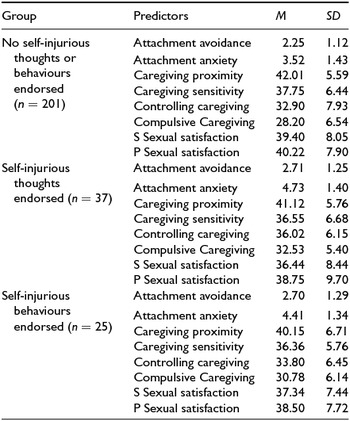
In order to optimise the sample size, missing values for the relevant items (excluding engagement in self-injurious thoughts and behaviours) were estimated using the expectation maximisation method. None of the items had more than 5% missing values, indicating that this option was appropriate for use (Tabachnick & Fidell, Reference Tabachnick and Fidell2013). The data satisfied appropriate assumptions required to conduct the primary analyses. The means and standard deviations for all primary study variables are presented in Table 1.
Correlations between Primary Study Variables and Outcome Variables

Note: Bivariate correlations between primary study variables and outcome variables for Model 1 and Model 2. S Sexual Satisfaction = self-focused sexual satisfaction, P Sexual Satisfaction = partner-focused sexual satisfaction.
*p < .05, **p < .01.
Potential covariates
The potential confounding influences of participant age, sex, and current living arrangements (‘Who do you currently live with?’) were explored, based on the previously established links between these variables and self-injury (e.g., Barrocas, Hankin, Young, & Abela, Reference Barrocas, Hankin, Young and Abela2012; Bureau et al., Reference Bureau, Martin, Freynet, Alie-Poirier, Lafontaine and Cloutier2010; Nixon, Cloutier, & Jansson, Reference Nixon, Cloutier and Jansson2008; Nock, Reference Nock2010). No significant associations were found.
Correlational analyses
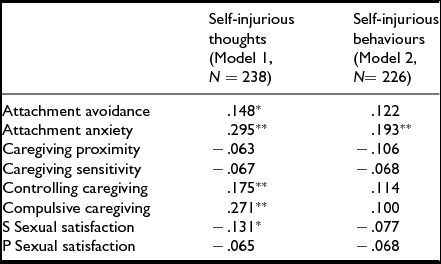
Bivariate correlations were computed in order to examine preliminary relations between primary study variables and outcome variables (see Table 1). Both dimensions of insecure attachment (attachment anxiety and avoidance), as well as compulsive and controlling caregiving, were positively associated with self-injurious thoughts. Sexual satisfaction (self-focused satisfaction) was negatively associated with self-injurious thoughts. In contrast, only attachment anxiety was positively correlated with self-injurious behaviours.
Principal Analyses
Direct linear discriminant analyses (LDA) were conducted to determine the relative contribution of each predictor variable to self-injurious thoughts and behaviours. This statistical approach can be used to discover and interpret linear combinations of predictor variables that best separate two or more groups. LDA is considered a statistically robust and powerful method that produces classification models with strong accuracy when its assumptions of normality are met (Green & Salkind, Reference Green and Salkind2013; Pohar, Blas, & Turk, Reference Pohar, Blas and Turk2004; Tabachnick & Fidell, Reference Tabachnick and Fidell2013).
With regard to the present study, two separate LDAs were performed. The first model examined the associations between attachment theory's three behavioural systems (as measured by two dimensions of romantic attachment, four dimensions of romantic caregiving, and two dimensions of sexual satisfaction) and self-injurious thoughts (LDA Model 1), while the second model examined their relations to self-injurious behaviours (LDA Model 2). For both models examined, the direct LDA method was implemented in order to assess the contributions of all three behavioural systems simultaneously. The two-group method was selected, as self-injury was measured dichotomously in both models; that is, Model 1: non-self-injurers (no thoughts and no behaviours) coded as 0, participants endorsing thoughts (but not behaviours) were coded as 1; Model 2: non-self-injurers coded as 0, participants endorsing behaviours (and thoughts) coded as 2.
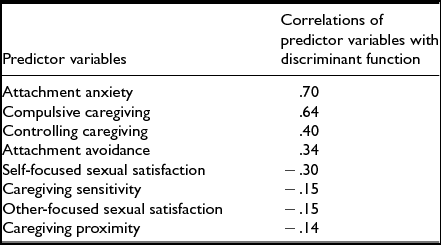
With respect to self-injurious thoughts (N = 238; LDA Model 1), the overall Wilk's lambda was significant (Λ = .84, χ2(8) = 41.68, p ≤ .001), indicating that the predictors as a set differentiated participants endorsing self-injurious thoughts from non-self-injurers. In addition, the predictors as a set accounted for 16% of the between group variability (R 2 = .16). The structure (loading) matrix of correlations was used to assess the incremental contributions of each variable in the prediction of self-injurious thoughts (Table 2). Loadings greater than 0.30 were considered significant to the LDA model (Hair, Black, Babin, Anderson, & Tatham, Reference Hair, Black, Babin, Anderson and Tatham2006), and therefore only significant loadings were interpreted. In order of importance, the significant predictors of self-injurious thoughts are attachment anxiety (0.70, r2 = .48), caregiving compulsivity (0.64, r2 = .40), controlling caregiving (0.40, r2 = .16), attachment avoidance (0.34, r2 = .11), and self-focused sexual satisfaction (–0.30, r2 = .09). Participants endorsing self-injurious thoughts experienced greater attachment anxiety than those not reporting thoughts, greater compulsive caregiving, greater controlling caregiving, and greater attachment avoidance. Participants endorsing self-injurious thoughts also experienced less self-focused sexual satisfaction. The group means and standard deviations are presented in Table 3. Finally, in order to overcome potential bias in the group allocation matrix, a jackknife (one case at a time deleted) quadratic classification procedure was used. Results indicate that for the total usable sample of 238 participants, 200 (84%) were classified correctly, compared with 176 (74%) who would be correctly classified by chance alone.
Structure Matrix Table for Discriminant Analysis of Self-Injurious Thoughts

Note: Pooled within-groups correlations between predictor variables and the standardised canonical discriminant function. The variables are ordered by size of correlation.
Within-Group Means and Standard Deviations

Note: S Sexual Satisfaction = self-focused sexual satisfaction, P Sexual Satisfaction = partner-focused sexual satisfaction.
A second LDA was then conducted (LDA Model 2) to examine the associations between the behavioural systems and self-injurious behaviours (N = 226). Results indicated that the overall model was not significant, as the group of predictor variables as a set were not significantly related to self-injurious behaviours (Λ = .94 x 2(8) = 14.72, p = .065, R 2 = .04). Indeed, the correlational analyses indicated that of the predictor variables examined, only attachment anxiety was significantly related to self-injurious behaviours (see Table 1).
Discussion
The present study aimed to examine links between attachment theory's three behavioural systems (i.e., the romantic attachment system, the romantic caregiving system, and the sexual system) and young adult self-injury. The results of the present study partially support the hypotheses proposed. Findings indicate that the functioning of each of the systems may predict self-injurious thoughts among young adults, and that the three systems may differ in their relative contributions. In contrast, findings indicate that the functioning of the behavioural systems do not significantly predict self-injurious behaviours.
The Attachment Theory's Behavioural Systems and Self-Injurious Thoughts
Dimensions of romantic attachment
Results confirmed expectations that participants endorsing self-injurious thoughts would report experiencing greater attachment insecurity (both attachment anxiety and attachment avoidance) than participants who did not report thoughts. Such results both complement and contrast with those reported by Levesque and colleagues (Reference Levesque, Lafontaine, Bureau, Cloutier and Dandurand2010), which indicated links between attachment anxiety (but not attachment avoidance) and self-injurious thoughts. As such, this study is the first to provide support for the role held by both attachment anxiety and attachment avoidance in the use of self-injurious thoughts. Taken together, findings from the current study and from that of Levesque and colleagues (Reference Levesque, Lafontaine, Bureau, Cloutier and Dandurand2010) provide preliminary indication that attachment anxiety may be a more consistent predictor of self-injurious thoughts than attachment avoidance. When in a state of hyperactivation, anxiously attached individuals tend to engage in attention-oriented, emotion-regulation strategies (Pascuzzo, Cyr, & Moss, Reference Pascuzzo, Cyr and Moss2013) and may rely on the comfort garnered by thoughts of self-injuring as a means to draw attention and comfort from their partners (for a detailed description of the interpersonal-positive reinforcement functions of self-injury, see Nock, Reference Nock2009). Conversely, avoidantly attached individuals tend to rely on deactivating strategies when distressed, and attempt to self-regulate through the suppression of upsetting thoughts and feelings (Fraley & Shaver, Reference Fraley and Shaver1997; Mikulincer & Shaver, Reference Mikulincer and Shaver2016). Such individuals are considered to have missed early opportunities for learning effective emotion regulation (Pascuzzo et al., Reference Pascuzzo, Cyr and Moss2013), as it has been demonstrated that they are more likely to have had emotions minimised or ignored by rejecting attachment figures (Cassidy, Reference Cassidy1994). When attempts to self-regulate through suppression are not successful, individuals may then engage in thoughts of self-injury in an attempt to self-regulate. As such, anxiously attached individuals may more readily engage in thoughts of self-injury to self-regulate, while avoidantly attached individuals may use self-injurious thoughts as a secondary emotion regulation strategy when initial attempts at suppression are not successful. Further research examining the links between attachment anxiety, avoidance, and self-injurious thoughts is needed in order to support or refute this possibility.
Dimensions of romantic caregiving behaviours
In line with the hypotheses proposed, the analyses revealed that participants endorsing self-injurious thoughts reported greater use of both compulsive and controlling caregiving behaviours than those who did not endorse thoughts. This result suggests that individuals experiencing a hyperactivated romantic caregiving system (e.g., becoming overinvolved in a partner's problems) may encounter difficulties effectively attending to and resolving their own emotionally distressing experiences. This finding may be explained by the theoretical notion that maladaptive or suboptimal functioning of the romantic caregiving system, as marked by an inability to offer care that is appropriately contingent on one's partner's needs, is considered to reflect deficits to one's ability to alleviate one's own distress in healthy ways (Collins & Ford, Reference Collins and Ford2010; Collins et al., Reference Collins, Guichard, Ford, Feeney, Mikulincer and Goodman2006). The link between romantic caregiving behaviours and maladaptive coping is further supported by findings documented by Mikulincer and Shaver (Reference Mikulincer, Shaver, Deaux and Snyder2012). Their results demonstrated that negative caregiving behaviours expressed to one's partner were associated with greater emotion regulation difficulties. Conversely, low caregiving sensitivity and low proximity did not emerge as significant (negative) predictors of self-injurious thoughts. According to a theoretical framework proposed by Collins and Ford (Reference Collins and Ford2010), romantic caregiving dynamics are modulated by emotion regulation resources as well as one's skills and abilities in this area (i.e., caregiving expectations, beliefs, and action tendencies). It is possible that the young adults endorsing low sensitivity and proximity in the present study may lack knowledge and abilities regarding how to provide adequate care to a partner, and may not necessarily have a deactivated caregiving system per se (i.e., overt dismissal of one's partner's needs). As such, future research is needed to determine the potential links between caregiving deactivation and emotion regulation strategies such as self-injury.
Dimensions of sexual satisfaction
Findings revealed that participants endorsing self-injurious thoughts reported less self-focused sexual satisfaction (i.e., dissatisfaction with one's personal experience and sensations felt) than participants who did not endorse thoughts. This result provides preliminary evidence of ties between the functioning of the sexual system and the use of self-injurious thoughts, and also lends support to adult attachment theory, which maintains that maladaptive functioning of the sexual system is related to emotion regulation difficulties (Mikulincer & Shaver, Reference Mikulincer, Shaver, Deaux and Snyder2012; Birnbaum et al., Reference Birnbaum, Mikulincer, Szepsenwol, Shaver and Mizrahi2014). Ongoing sexual dissatisfaction is considered to result in hyperactivation (i.e., mentally preoccupying worries about one's sexual desirability) or deactivation (i.e., dismissal of one's sexual needs and interests) of the sexual system, which in turn may compromise one's ability to cope with distressing experiences. This result is also consistent with previous findings documenting associations between sexual dissatisfaction and emotion regulation difficulties (Rellini et al., Reference Rellini, Vujanovic, Gilbert and Zvolensky2012; Rellini et al., Reference Rellini, Vujanovic and Zvolensky2010). In contrast, low partner/activity-focused satisfaction (i.e., dissatisfaction with one's partner's behaviours and sexual activity in general) did not emerge as a significant predictor of self-injurious thoughts. This suggests that dissatisfaction with one's own sexual experience (e.g., negative feelings after sex) may be more closely tied to one's coping abilities than dissatisfaction with one's partner's behaviours (e.g., partner's sexual creativity), and may trigger the hyperactivating and/or deactivating strategies that have been linked to the disruption of healthy, resourceful coping abilities (e.g., Rellini et al., Reference Rellini, Vujanovic, Gilbert and Zvolensky2012; Rellini et al., Reference Rellini, Vujanovic and Zvolensky2010).
Relative Contributions of the Behavioural Systems to Self-Injurious Thoughts
The second objective of the present study was to explore the relative contributions of the three attachment systems in the prediction of self-injury. As described above, the LDA loadings indicated that variables intended to represent facets of each system significantly predicted self-injurious thoughts, and such variables are differentially linked to the use of self-injurious thoughts. Based on the within-groups correlation coefficients (Table 3), attachment anxiety demonstrates the strongest relationship with self-injurious thoughts, followed by dimensions of negative caregiving behaviours (controlling caregiving and compulsive caregiving). Attachment avoidance and self-focused sexual satisfaction were also revealed to have significant but relatively less strong relationships to thoughts. These results suggest that hyperactivation of the attachment (anxiety) and caregiving systems (controlling and compulsive caregiving) hold a crucial role in determining the affect regulation strategies that young adults may employ when distressed, and may be a valuable indicator of risk for engagement in self-injurious thoughts. As described above, individuals experiencing a hyperactivated attachment or caregiving system energetically seek means of garnering attention from their romantic partners when distressed (Mikulincer & Shaver, Reference Mikulincer, Shaver, Deaux and Snyder2012). When hyperactivated, such individuals may be particularly inclined to soothe themselves by thoughts of self-injury in order to elicit attention and sympathy from their partners.
In addition to the relations between attachment anxiety and dimensions of negative caregiving behaviours and self-injurious thoughts, attachment avoidance was also revealed as a significant predictor. These results suggest that while both forms of insecure romantic attachment are linked to self-injurious thoughts, individuals with an avoidant attachment orientation may be somewhat less likely to engage in self-injurious thoughts than those with an anxious attachment. As described above, this finding may be attributed to avoidantly attached individuals engaging in self-injurious thoughts as a secondary coping strategy utilised when attempts at suppression of thoughts and emotions are unsuccessful. A second explanation may be found in the differences between the models of self and others held by anxious and avoidantly attached individuals. Attachment anxiety involves a negative model of the self as unworthy and defective, often coupled with a pedestalised view of others. Alternately, attachment avoidance involves a positive model of the self, but a negative view of others as untrustworthy and unreliable (Mikulincer, Reference Mikulincer, Mikulincer and Goodman2006). Within this context, it is possible that anxiously attached individuals may be more apt to envision harming themselves when distressed than would an avoidantly attached individual who may have a greater penchant for self-preservation.
Finally, LDA loadings demonstrated that self-focused sexual satisfaction was also significantly linked to self-injurious thoughts, although this relationship was the least strong. This suggests that while all three systems are linked to self-injurious thoughts, the functioning of the romantic attachment and romantic caregiving systems may more strongly predict the coping strategies utilised by young adults. This finding may be attributed to the developmental processes underpinning each of the systems. The romantic attachment and romantic caregiving systems owe their roots to childhood experiences, as the functioning of these systems in young adulthood and beyond are partially shaped by interactions with one's primary caregivers in infancy (e.g., Kunce & Shaver, Reference Kunce, Shaver, Perlman and Bartholomew1994; Fraley & Roisman, Reference Fraley, Roisman, Simpson and Rholes2015). These systems— and the early experiences that lead to their development—are considered to hold crucially important roles to the formation of individuals’ affect regulation strategies (Mikulincer, Shaver, & Pereg, Reference Mikulincer, Shaver and Pereg2003; Shaver & Mikulincer, Reference Shaver, Mikulincer, Shaver and Mikulincer2011). While it appears that the sexual system is also linked to affect regulation abilities (e.g., Mikulincer & Shaver, Reference Mikulincer, Shaver, Deaux and Snyder2012; Rellini et al., Reference Rellini, Vujanovic, Gilbert and Zvolensky2012; Rellini et al., Reference Rellini, Vujanovic and Zvolensky2010), this system is continually emerging and developing throughout young adulthood (e.g., Birnbaum, Reference Birnbaum, Simpson and Rholes2015; Johnson, Lafontaine, & Dalgleish, Reference Johnson, Lafontaine, Dalgleish, Simpson and Rholes2015). For young adults, it may not be as centrally tied to one's affect regulation strategies as the attachment and caregiving systems, which rest upon longstanding foundations stemming from childhood.
The Attachment Theory's Behavioural Systems and Self-Injurious Behaviours
Finally, while results indicated that dimensions of all three systems are significantly related to self-injurious thoughts, similar results were not demonstrated with respect to self-injurious behaviours. This finding appears to suggest that the maladaptive functioning of the interrelated systems may be especially implicated in self-injurious thoughts. Further, this result may reflect an area in which the correlates for thoughts and behaviours diverge. While recent findings indicate that self-injurious thoughts and behaviours share a similar set of correlates pertaining to adverse childhood experiences (Martin et al., Reference Martin, Bureau, Cloutier and Lafontaine2011), it may be possible that romantic relationship factors are particularly uniquely linked to the occurrence of self-injurious thoughts. As such, it may be possible that distress resulting from upsetting attachment, caregiving, or sexual experiences may be more frequently alleviated through thinking about harming oneself, rather than actual engagement in self-injurious behaviours. Despite this interpretation, this finding is in contrast to existing literature indicating a link between romantic attachment and self-injurious behaviours (i.e., Braga & Goncalves, Reference Braga and Goncalves2014; Fitzpatrick et al., Reference Fitzpatrick, Lafontaine, Gosselin, Levesque, Bureau and Cloutier2013; Fung, Reference Fung2008; Levesque et al., Reference Levesque, Lafontaine, Bureau, Cloutier and Dandurand2010). With the exception of Fung's (Reference Fung2008) utilisation of a clinical sample, participant sociodemographic profiles between existing studies and the current study sample are similar (i.e., community-based young adults), as are mean scores across measures of attachment (see Braga & Goncalves, Reference Braga and Goncalves2014; Fitzpatrick et al., Reference Fitzpatrick, Lafontaine, Gosselin, Levesque, Bureau and Cloutier2013; Fung, Reference Fung2008; Levesque et al., Reference Levesque, Lafontaine, Bureau, Cloutier and Dandurand2010 for respective mean scores). This inconsistency between existing literature and the current study results is likely to be a result of the relatively fewer participants endorsing self-injurious behaviours in the current overall sample. As a smaller proportion of participants reported engaging in self-injurious behaviours in the current study (n = 25) than in the samples utilised in previous studies (i.e., Braga & Goncalves, Reference Braga and Goncalves2014: n = 84; Levesque et al., Reference Levesque, Lafontaine, Bureau, Cloutier and Dandurand2010: n = 42; Fitzpatrick et al., Reference Fitzpatrick, Lafontaine, Gosselin, Levesque, Bureau and Cloutier2013: n = 90; Fung, Reference Fung2008: n = 40), such a potential effect may not have been detectable.
Limitations and Future Directions
In addition to the explanations provided for the results of the present study, its methodological limitations also merit discussion. First, the functioning of the three attachment theory's systems were measured using self-report questionnaires. While participants’ scores on the constructs measured were intended to reflect the functioning of the three systems, the actual systems themselves were not directly measured per se. It is possible that such constructs do not actually reflect the functioning of the systems. In order to reduce such a potential limitation, well-validated questionnaires that have been widely used in the literature to measure functioning of the three systems were used. Second, although findings suggest that the functioning of the three systems may influence the use of self-injurious thoughts, the correlational nature of the study does not permit us to infer causality regarding these associations despite the hypothesised directionality between the constructs examined. Furthermore, a portion of participants were recruited through online advertisements directed at self-injuring individuals. Thus, it is possible that the individuals accessing such advertisements are not representative of all individuals engaging in self-injury. Despite this, advertisements were only posted on widely accessible, high-traffic websites, thus decreasing the potential for bias. Finally, although recruitment efforts were aimed at both males and females, males were underrepresented in the overall sample. As such, findings may not accurately represent the experiences of young adult males.
Researchers may be interested in replicating the current study with a larger sample of participants engaging in self-injurious behaviours in order to clarify whether the functioning of the three systems is predictive of both thoughts—as evidenced in the present study—as well as actions. Moreover, although the present study sample was appropriate to examine associations between the behavioural systems and self-injury among community-based young adults, researchers may be interested in testing the present model with other populations such as clinical samples or adults engaging in self-injury in order to examine the generalisability of the present findings. In addition, longitudinal research examining the behavioural systems and their links to affect regulation abilities would be helpful in determining the relations between these constructs across the lifespan. Finally, contextual romantic relationship variables such as relationship satisfaction and dyadic trust should be analysed in order to study links between important dimensions of romantic relationship functioning and self-injury.
Implications and Conclusions
This study holds valuable implications for both research and treatment endeavours, in addition to conceptual-level implications for attachment theory as an explanatory framework for young adult self-injury. Generally speaking, the results of the present study suggest that the functioning of all three behavioural systems hold implications for the coping strategies undertaken by young adults during periods of distress. Those individuals experiencing maladaptive functioning of the romantic attachment, caregiving, or sexual systems may be at greater risk for engaging in self-injurious thoughts when faced with overwhelming or emotionally laden experiences.
This study extends existing research into the role of romantic attachment in the prediction of self-injury, as it constitutes the first investigation to indicate a link between both dimensions of insecure romantic attachment and self-injurious thoughts. In addition, the current study also fills certain gaps in research by examining the roles held by the romantic attachment system's complementary systems in the prediction of self-injury. Findings may hold implications for theoretical conceptualisations of the processes whereby adverse attachment experiences lead to self-injury. Current theory (i.e., Yates, Reference Yates and Nock2009) maintains that there is a strong association between attachment and self-injury, but largely focuses on links to childhood attachment experiences. This study's findings suggest that consideration be placed on expanding such a theoretical framework to also place emphasis on the roles of insecure romantic attachment, unresponsive caregiving, and sexual dissatisfaction.
Findings may also hold valuable clinical implications, as they indicate that the quality of young adult romantic relationships should be considered in the assessment and treatment of self-injury. As demonstrated in the present study, individuals engaging in self-injurious thoughts may experience poorer functioning of the three systems. As such, process-experiential therapy approaches effective at improving the quality of individuals’ attachment, caregiving, and sexual experiences — such as Emotion-Focused Therapy (Greenberg, Reference Greenberg2002) and Emotionally Focused Couple Therapy (Johnson, Reference Johnson2004) — may prove useful in reducing the risk of engagement in self-injurious thoughts. Considering that self-injurious thoughts often lead to self-injurious behaviours (Nock et al., Reference Nock, Prinstein and Sterba2009), treating the precipitant factors underlying thoughts through such modalities of therapy may also be an effective means of preventing engagement in harmful self-injurious behaviours. Continued research may eventually lead to a more nuanced and complete understanding of the role held by romantic attachment and its related systems in young adult self-injury.