




1. Introduction
In 1920, MacMahon [Reference MacMahon16] introduced the following two important q-series:
 \begin{align} A_k(q):=&\sum_{0 \lt s_1 \lt s_2 \lt \cdots \lt s_k} \frac{q^{s_1+s_2+\cdots
+s_k}}{(1-q^{s_1})^2(1-q^{s_2})^2\cdots
(1-q^{s_k})^2}
\end{align}
and
 \begin{align}
C_k(q):=&\sum_{0 \lt s_1 \lt s_2 \lt \cdots \lt s_k}
\frac{q^{2(s_1+s_2+\cdots
+s_k)-k}}{(1-q^{2s_1-1})^2(1-q^{2s_2-1})^2\cdots
(1-q^{2s_k-1})^2},
\end{align}
with  $A_0(q)=C_0(q)=1$. MacMahon linked the theory of integer partitions to divisor sums. He realized that these q-series are natural partition generating functions. Namely,
 \begin{align*}
A_k(q)=&\sum_{n=1}^\infty a_k(n) q^n
,\\[6pt] C_k(q)=&\sum_{n=1}^\infty
c_k(n) q^n,
\end{align*}
where
 \begin{align*}
a_k(n):=&\sum_{s_1m_1+s_2m_2+\cdots +s_km_k=n,\atop
0 \lt s_1 \lt s_2 \lt \cdots \lt s_k,\ (m_1,m_2,\ldots
,m_k)\in \mathbb{N}^k} m_1m_2\cdots
m_k ,\\[6pt]
c_k(n):=&\sum_{(2s_1-1)m_1+(2s_2-1)m_2 +\cdots
+(2s_k-1)m_k=n, \atop
0 \lt s_1 \lt s_2 \lt \cdots \lt s_k,\ (m_1,m_2,\ldots
,m_k)\in \mathbb{N}^k} m_1m_2\cdots
m_k.
\end{align*}
Indeed,  $a_k(n)$ (respectively
 $c_k(n)$) is the sum of products of the part multiplicities of partitions of n with k distinct part (respectively odd part) sizes. We note that
 $a_1(n)$ is the usual sum-of-divisors function
 $\sigma_1(n)$, which denotes the sum of positive divisors of n. Furthermore,
 $c_1(n)$ is the sum over all divisors whose conjugate is an odd number. Moreover, MacMahon’s q-series connect these partition functions to several disparate areas of mathematics, such as Hilbert schemes, q-multiple zeta-values, representation theory, and topological string theory, since one can find some papers on the subject [Reference Bachmann and Kühn9, Reference Kreimer14, Reference Le and Murakami15, Reference Pilehrood and Pilehrood21].
In 2013, Andrews and Rose [Reference Andrews and Rose7] established relationships between  $A_k(q)$,
 $C_k(q)$ and Chebyshev polynomials of the first kind and determined recurrence relations of
 $A_k(q)$ and
 $C_k(q)$, as well as proving a conjecture of MacMahon [Reference MacMahon16]. More precisely, they proved the following theorem.
Theorem 1.1 Andrews and Rose [Reference Andrews and Rose7]
We have
 \begin{align*}
2\sum_{n=0}^\infty
T_{2n+1}(x/2)q^{n(n+1)/2}&=(q;q)_\infty^3
\sum_{k=0}^\infty
A_k(q) x^{2k+1},\\
1+2\sum_{n=1}^\infty
T_{2n }(x/2)q^{n^2
}&=\frac{(q;q)_\infty^2}
{(q^2;q^2)_\infty
}
\sum_{k=0}^\infty
C_k(q) x^{2k},
\end{align*}
where  $T_n(x)$ are Chebyshev polynomials of the first kind.
Here and throughout this paper, we use the q-Pochhammer symbol
 \begin{equation*}
(a;q)_\infty:=\prod_{n=0}^\infty (1-aq^n),\qquad
(a;q)_n:=\frac{(a;q)_\infty}{(aq^n;q)_\infty}
\end{equation*}
and for any positive integer k,
 \begin{align*}
(a_1,a_2,\ldots,a_k;q)_n&: =(a_1;q)_n
(a_2;q)_n\cdots (a_k;q)_n,\\[6pt]
(a_1,a_2,\ldots,a_k;q)_\infty&: =(a_1;q)_\infty
(a_2;q)_\infty\cdots (a_k;q)_\infty.
\end{align*}
Furthermore, the q-binomial coefficient is defined by
 \begin{align*}
\left[
\begin{array}{c}
n \\
m \\
\end{array}
\right]
= \left[
\begin{array}{c}
n \\
m \\
\end{array}
\right]_q:=
\left\{
\begin{aligned} & \frac{(q;q)_n}{(q;q)_m(q;q)_{n-m}},
\qquad {\rm if\ }
0\leq m \leq n, \\[6pt]
& 0, \qquad\qquad\qquad\
\qquad {\rm otherwise}.
\end{aligned}
\right.
\end{align*}
In addition, they showed that  $A_k(q)$ is a linear combination of quasimodular forms on
 $SL_2(\mathbb{Z})$ with weight
 $\leq 2k$. In analogy with the work of Andrews and Rose [Reference Andrews and Rose7, Reference Rose22], Bachmann [Reference Bachmann8] proved that
 $C_k(q)$ is a linear combination of quasimodular forms on
 $\Gamma_0(2)$ with weight
 $\leq 2k$. Recently, Amdeberhan et al. [Reference Amdeberhan, Andrews and Tauraso1] discovered some congruences for the coefficients of
 $A_k(q)$. For example, they proved that for
 $n\geq 0$,
 \begin{align*}
a_2(5n+2)&\equiv 0 \pmod 5,\\[6pt]
a_3(7n+3)&\equiv a_3(7n+5)\equiv 0\pmod 7.
\end{align*}
In addition, they conjectured that for  $n\geq 0$,
 \begin{equation*}
a_{10}(11n+7)\equiv 0 \pmod {11}.
\end{equation*}
In a recent paper [Reference Amdeberhan, Ono and Singh2], Amdeberhan et al. represented  $A_k(q)$ in terms of Eisenstein series and used these formulas to obtain explicit and general congruences for the coefficients of
 $A_k(q)$. In particular, they proved Amdeberhan–Andrews–Tauraso’s conjecture as a special case of an infinite family of congruences for
 $a_{k}(n)$. They also showed that the family of quasimodular forms
 $A_k(q)$ forms a sequence of approximations for the three-coloured partition function. More precisely, they proved that for k > 0,
 \begin{equation*}
\frac{1}{(q;q)_\infty^3} =q^{-k(k+1)/2} A_k(q)
+ O(q^{k+1}).
\end{equation*}
More recently, Bringmann et al. [Reference Bringmann, Craig, van Ittersum and Pandey11] proved further results relating MacMahon-type q-series and infinite products. They explored the MacMahon-type functions and discovered new and suggestive arithmetic structure and modular completions. Very recently, Ono and Singh [Reference Ono and Singh20] proved that  $A_k(q)$ and
 $C_k(q)$ give the generating functions for the three-coloured partition function
 $p_3(n)$ and the overpartition function
 $\overline{p}(n)$, respectively. More precisely, they proved the following two interesting identities.
Theorem 1.2 Ono and Singh [Reference Ono and Singh20]
For non-negative integer k,
 \begin{align}
\frac{1}{(q;q)_\infty^3}
=q^{-k(k+1)/2}\sum_{m=k}^\infty
{2m+1\choose {m+k+1}}A_m(q)
\end{align}
and
 \begin{align}
\frac{(q^2;q^2)_\infty
}{(q;q)_\infty^2}=q^{-k^2}
\sum_{m=k}^\infty {2m\choose m+k}C_m(q).
\end{align}
Motivated by the work of Ono and Singh [Reference Ono and Singh20], Jin et al. [Reference Jin, Pandey and Singh13] derived further formulas for reciprocals of other interesting infinite products by using the well-known infinite product identities, such as the quintuple product identity and the septuple product identity.
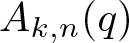
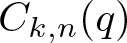
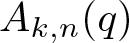
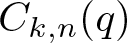
This paper has two main objectives. The first goal is to introduce finite forms of MacMahon’s q-series and establish finite forms of Ono–Singh’s identities (1.3) and (1.4). Our results generalize Theorem 1.2. The second goal is to prove some identities involving  $A_{k,n}(q)$,
 $C_{k,n}(q)$, and certain infinite products based on two Bailey pairs.
We first define the following two q-series:
 \begin{align}
A_{k,n}(q)=\sum_{m=0}^\infty
a_{k,n}(m)q^m:=\sum_{1\leq s_1 \lt s_2 \lt \cdots \lt s_k \leq n}\frac{q^{s_1+\cdots+s_k}}{
(1-q^{s_1})^2\cdots (1-q^{s_k})^2}
\end{align}
and
 \begin{align}
C_{k,n}(q)=\sum_{m=0}^\infty
c_{k,n}(m)q^m:=\sum_{1\leq s_1 \lt \cdots \lt s_k \leq
n}\frac{q^{2(s_1+s_2+\cdots+s_k)-k}}{
(1-q^{2s_1-1})^2(1-q^{2s_2-1})^2\cdots
(1-q^{2s_k-1})^2},
\end{align}
where  $0\leq k \leq n$ are integers and
 $A_{0,n}(q)=C_{0,n}(q)=1$. Note that
 $a_{k,n}(m)$ (respectively
 $c_{k,n}(m)$) is the sum of products of the part multiplicities of partitions of m in which there are exactly k different sizes of parts (respectively odd parts) and every part
 $\leq n$ (respectively
 $2n-1$). Note that
 \begin{align}
\lim_{n\rightarrow \infty}A_{k,n}(q)=A_k(q),
\qquad \lim_{n\rightarrow
\infty}C_{k,n}(q)=C_k(q).
\end{align}
Therefore,  $A_{k,n}(q)$ and
 $C_{k,n}(q)$ are the finite forms of
 $A_k(q)$ and
 $C_k(q)$, respectively.
The following two theorems are the finite forms of (1.3) and (1.4), respectively.
Theorem 1.3. Let  $n ,j$ be integers with
 $n\geq 0$ and
 $0\leq j \leq n$. Then,
 \begin{align}
\frac{1}{(q;q)_{n}^2}
q^{j(j+1)/2
}\left[
\begin{array}{c}
2n+1 \\
n+1+j \\
\end{array}
\right]_q
=&
\sum_{k= j }^n
{2k+1\choose k+j+1}
A_{k,n}(q).
\end{align}
Theorem 1.4. Let  $n,j$ be integers with
 $n\geq 0$ and
 $-n\leq j\leq n$. Then,
 \begin{align}
\frac{q^{j^2}}{(q;q^2)_n^2}\left[
\begin{array}{c}
2n \\
n+j \\
\end{array}
\right]_{q^2}
=\sum_{k=|j|}^n
{2k\choose k+j}C_{k,n}(q).
\end{align}
Identities (1.8) and (1.9) are interesting since their left sides involve q-binomial coefficients, while their right sides involve binomial coefficients.
Let  $n\rightarrow \infty$ in (1.8) and (1.9), we arrive at (1.3) and (1.4), respectively.
Based on Theorems 1.3 and 1.4, we deduce the following corollary:
Corollary 1.5. Let  $n\geq 0$ be an integer. Then
 \begin{align}
\frac{(-q;q)_n^2}{(q;q)_n^2} =\sum_{k=0}^n
4^k A_{k,n}(q)
\end{align}
and
 \begin{align}
\frac{(-q;q^2)_n^2}{(q;q^2)_n^2} =\sum_{k=0}^n
4^k C_{k,n}(q).
\end{align}
Taking  $n\rightarrow \infty$ in (1.10) and (1.11) and using (1.7), we obtain
 \begin{align}
\frac{(-q;q)_\infty^2}{(q;q)_\infty^2}
=\sum_{k=0}^\infty
4^k A_{k }(q)
\end{align}
and
 \begin{align}
\frac{(-q;q^2)_\infty^2}{(q;q^2)_\infty^2} =\sum_{k=0}^\infty
4^k C_{k }(q).
\end{align}
Remark 1.6. Identities (1.12) and (1.13) can also be proved by using (1.3), (1.4), and the following identities
 \begin{equation*}
\sum_{j=0}^\infty q^{j(j+1)/2} =\frac{(q^2;q^2)_\infty^2
}{(q;q)_\infty},\qquad \sum_{j=-\infty}^\infty
q^{j^2}=\frac{(q^2;q^2)_\infty^5
}{(q;q)_\infty^2(q^4;q^4)_\infty^2}.
\end{equation*}
Utilizing some results on Bailey pairs [Reference Andrews4, Reference McLaughlin, Sills and Zimmer19], we prove the following two theorems involving  $A_{k,n}(q)$ and
 $C_{k,n}(q)$.
Theorem 1.7. Let j be a non-negative integer. Then
 \begin{align}
\frac{q^{3j(j+1)/2}
}{(q;q)_\infty}
=&\sum_{n= j }^\infty
\sum_{k= j }^n {2k+1\choose
k+j+1} \frac{(q;q)_n
}{(q^{n+1};q)_{n+1}} q^{n^2+n} A_{k,n}(q),
\end{align}
 \begin{align}
\frac{(-q;q^2)_\infty}{(q^2;q^2)_\infty
}q^{2j^2+3j}=&(1+q^{2j+1})
\sum_{n=j}^\infty
\sum_{k=j}^n {2k+1\choose k+j+1} \frac{(-q;q^2)_n(q^2;q^2)_n
}{(q^{2n+2};q^2)_{n+1}}q^{n^2+2n} A_{k,n}(q^2)
,
\end{align}
 \begin{align}
\frac{(-q;q)_\infty}{(q;q)_\infty
}q^{j^2+2j}=&\frac{(-q;q)_{j+1}}{
(-1;q)_j}
\sum_{n=j}^\infty
\sum_{k=j}^n {2k+1\choose k+j+1}
\frac{(-1;q)_n (q;q)_n
}{(q^{n+1};q)_{n+1}}q^{n(n+3)/2
} A_{k,n}(q)
,
\end{align}
 \begin{align}
\frac{(-q;q)_\infty}{(q;q)_\infty
}q^{j^2+ j}=&
\sum_{n=j}^\infty
\sum_{k=j}^n {2k+1\choose k+j+1}
\frac{(q^2;q^2)_n
}{(q^{n+1};q)_{n+1}}q^{n(n+1)/2
} A_{k,n}(q)
.
\end{align}
Theorem 1.8. Let j be an integer. Then
 \begin{align}
\frac{q^{3j^2}}{(q^2;q^2)_\infty}
=&\sum_{n=|j|}^\infty\sum_{k=|j|
}^{n} {2k\choose
k+j}
\frac{( q;q^2)_n^2
}{(q^2;q^2)_{2n}}q^{2n^2}
C_{k,n}(q) ,
\end{align}
 \begin{align}
\frac{(-q;q^2)_\infty
q^{2j^2}}{(q^2;q^2)_\infty}
=&\sum_{n=|j|}^\infty\sum_{k=|j| }^{n}
{2k\choose
k+j}\frac{(q;q^2)_n
}{(q^4;q^4)_{n}}q^{n^2}
C_{k,n}(q),
\end{align}
 \begin{align}
2\frac{(-q^2;q^2)_\infty
q^{2j^2+j}}{(q^2;q^2)_\infty(1+q^{2j})}
=&\sum_{n=|j|}^\infty\sum_{k=|j| }^{n}
{2k\choose
k+j}\frac{(-1;q^2)_n
(q;q^2)_n^2
}{(q^2;q^2)_{2n}}q^{n^2+n}
C_{k,n}(q).
\end{align}
Based on the q-Gauss sum and a q-analogue of Bailey’s  $_{2}F_{1}
(-1)$ sum [Reference Gasper and Rahman12, p. 354], we prove the following two theorems.
Theorem 1.9. Let j be a non-negative integer. Then
 \begin{align}
\frac{(q^2;q^2)_\infty
}{(q;q)_\infty^2}q^{j(j+1)}&=
\sum_{n=j}^\infty
\sum_{k=j}^n {2k+1\choose
k+j+1} \frac{(q;q^2)_n q^n}{(q^2;q^2)_n
(1-q^{2n+1})} C_{k,n}(q),
\end{align}
 \begin{align}
\frac{(q;q)_\infty^2
(q^4;q^4)_\infty^2
}{
(q^2;q^2)_\infty^5}
(-1)^j q^{j^2+j}
=&
\sum_{n=j}^\infty
\sum_{k=j}^n \frac{2j+1}{k+j+1} {2k \choose
k+j}
\frac{(q;q^2)_n^2 (-q)^n }{(q^2;q^2)_n
(-q;q^2)_{n+1}}
C_{k,n}(q),
\end{align}
 \begin{align}
\frac{( q;q )_\infty
}{(q^2;q^2)_\infty^2}
(-1)^j q^{2j^2}
=&
\sum_{n= j }^\infty
\sum_{k= j }^n {2k\choose k+j}
\frac{(-1)^n (q;q^2)_n^2
}{(q^4;q^4)_n(-q;q^2)_n} q^{n^2}
C_{k,n}(q),
\end{align}
 \begin{align}
\frac{(-q;q^2)_\infty
}{(q^2;q^2)_\infty}q^{2j(j+1)}
=&
\sum_{n=j}^\infty
\sum_{k=j}^n
{2k+1\choose
k+j+1}
\frac{(q;q^2)_n q^{n^2+2n
}
}{(1-q^{2n+1})(q^4;q^4)_n}C_{k,n}(q).
\end{align}
Theorem 1.10. Let j be an integer. Then
 \begin{align}
\sum_{n=|j|}^\infty
\sum_{k=|j|}^n {2k\choose k+j}
\frac{(q;q^2)_nq^n }{(q^2;q^2)_n
(1-q^{2n+1})}
C_{k,n}(q)
=&\frac{(q^2;q^2)_\infty^2
}{(q;q^2)_\infty^2}
\sum_{n=|j|}^\infty
{2n\choose n+j} A_n(q^2),
\end{align}
 \begin{align}
\sum_{n=|j|}^\infty
\sum_{k=|j|}^n {2k\choose k+j}
\frac{(q;q^2)_n^2 (-q)^n }{(q^2;q^2)_n
(-q;q^2)_{n+1}}
C_{k,n}(q)
=& (-1)^j\frac{(q^2;q^2)_\infty^2
}{(-q;q^2)_\infty^2}
\sum_{n=|j|}^\infty
{2n\choose n+j} A_n(q^2),
\end{align}
 \begin{align}
\sum_{n=|j|}^\infty
\sum_{k=|j|}^n {2k\choose k+j}\frac{(-1)^n (q;q^2)_n^2
}{(q^4;q^4)_n(-q;q^2)_n} q^{n^2}
C_{k,n}(q)
= & (-1)^j\frac{(q^2;q^4)_\infty^2}{(-q;q^2)_\infty
}
\sum_{k=|j| }^{\infty}
{2k\choose
k+j}C_{k }(q^2) ,
\end{align}
 \begin{align}
\sum_{n=|j|}^\infty
\sum_{k=|j|}^n {2k\choose k+j}
\frac{ (q;q^2)_n
}{(q^4;q^4)_n } q^{n^2}
C_{k,n}(q) =&\frac{(q^2;q^4)_\infty^2}{
(q;q^2)_\infty}
\sum_{k=|j| }^{\infty}
{2k\choose
k+j}C_{k }(q^2) ,
\end{align}
 \begin{align}
\sum_{n=|j|}^\infty
\sum_{k=|j|}^n {2k\choose k+j}
\frac{ (q;q^2)_n q^{n^2+2n}
}{(1-q^{2n+1})(q^4;q^4)_n }
C_{k,n}(q)
=&\frac{(q^4
;q^4)_\infty^2}{
(q;q^2)_\infty}
\sum_{k=|j| }^{\infty}
{2k\choose
k+j}A_{k }(q^4) .
\end{align}
We also prove the following theorem by using an identity due to Bressoud [Reference Bressoud10].
Theorem 1.11. Let j and  $k\geq 1$ be integers. Then
 \begin{align}
&\sum_{|j|\leq s_k\leq s_{k-1}
\cdots
\leq s_1 }
\sum_{r=|j|}^{s_k} {2r\choose r+j}
\frac{(q;q^2)_{s_k}^2
q^{2(s_1^2+s_2^2+\cdots
+s_k^2)} }{(q^2;q^2)_{s_1-s_2}
\cdots
(q^2;q^2)_{s_{k-1}-s_k}(q^2;q^2)_{2s_k}}
C_{r,s_k}(q) \nonumber\\[6pt]
=& \frac{1}{(q^2;q^2)_{\infty}
} q^{(2k+1)j^2 }.
\end{align}
This paper is organized as follows. In § 2, we prove Theorems 1.3 and 1.4 based on the finite form of Jacobi’s triple product identity. § 3 is devoted to proving Theorems 1.7 and 1.8 by using some classical results on Bailey pairs. In § 4, we present the proofs of Theorems 1.9 and 1.10 by using some identities on basic hypermetric series. In § 5, we prove Theorem 1.11 by utilizing an identity discovered by Bressoud [Reference Bressoud10]. In § 6, we make some concluding remarks concerning future directions.
2. Proofs of Theorems 1.3, 1.4 and Corollary 1.5
Proof of Theorem 1.3
The Jacobi triple product identity is
 \begin{align}
\sum_{n=-\infty}^\infty
q^{n^2}z^n =(-q/z,-zq,q^2;q^2)_\infty.
\end{align}
MacMahon [Reference MacMahon17, vol. 2, § 323] proved the following identity, which is the finite form of the Jacobi triple product identity
 \begin{align}
(1/x;q)_n(xq;q)_m
=\sum_{j=-n}^m \left[
\begin{array}{c}
m+n \\
n+j \\
\end{array}
\right]_q(-x)^jq^{j(j+1)/2}.
\end{align}
Setting  $(x,n,m)\rightarrow (-z^2,n+1, n)$ in (2.2) yields
 \begin{align}
(1+1/z^2)(-q/z^2;q)_{n}(-z^2q;q)_n
=\sum_{j=-n-1}^n \left[
\begin{array}{c}
2n+1 \\
n+1+j \\
\end{array}
\right]_qz^{2j}q^{j(j+1)/2}.
\end{align}
It is easy to check that
 \begin{align}
(-q/z^2;q)_{n}(-z^2q;q)_n
=& \prod_{k=1}^n
((1-q^k)^2 +q^k(z+1/z)^2)
\nonumber\\[6pt]
=& (q;q)_n^2
\prod_{k=1}^n \left(
1+\frac{q^k}{(1-q^k)^2
}(z+1/z)^2\right)
\nonumber\\[6pt]
=&(q;q)_{n}^2
\sum_{k=0}^n
A_{k,n}(q) (z+1/z)^{2k}
\nonumber\\[6pt]
=&(q;q)_{n}^2
\sum_{k=0}^n
A_{k,n}(q)\sum_{r=0}^{2k}
{2k\choose r} z^{2r-2k}
\nonumber\\[6pt]
=&(q;q)_{n}^2
\sum_{j=-n}^n\sum_{k=|j|}^n
{2k\choose k+j}
A_{k,n}(q) z^{2j}
,
\end{align}
from which with (2.3), we arrive at
 \begin{align}
\sum_{j=-n-1}^n \left[
\begin{array}{c}
2n+1 \\
n+1+j \\
\end{array}
\right]_qz^{2j}q^{j(j+1)/2}
= (q;q)_{n}^2(1+1/z^2)
\sum_{j=-n}^n\sum_{k=|j|}^n
A_{k,n}(q)
{2k\choose k+j} z^{2j}
.
\end{align}
Comparing the coefficients of  $z^{2j}$ on both sides of (2.5), we deduce that for
 $-n-1\leq j \leq n$,
 \begin{align}
\frac{1}{(q;q)_{n}^2}
q^{j(j+1)/2
}\left[
\begin{array}{c}
2n+1 \\
n+1+j \\
\end{array}
\right]_q
=&
\sum_{k=|j|}^n
A_{k,n}(q)
{2k\choose k+j}+
\sum_{k=|j+1|}^n
A_{k,n}(q)
{2k\choose k+j+1}.
\end{align}
In particular, if  $0\leq j \leq n$, we have
 \begin{align}
\frac{1}{(q;q)_{n}^2}
q^{j(j+1)/2
}\left[
\begin{array}{c}
2n+1 \\
n+1+j \\
\end{array}
\right]_q
=&
\sum_{k= j }^n
A_{k,n}(q)
{2k\choose k+j}+
\sum_{k= j+1 }^{n }
A_{k ,n}(q)
{2k \choose k+j+1}
\nonumber\\[6pt]
=&
\sum_{k= j }^n
\left({2k\choose k+j}+
{2k \choose k+j+1}\right)
A_{k,n}(q),
\end{align}
where here we have used the fact that  ${2n\choose 2n+1}=0$. Identity (1.8) follows from (2.7) and the binomial coefficient identity
 \begin{align}
{2k\choose k+j}+{2k\choose
k+j+1}={2k+1\choose k+j+1}.
\end{align}
This completes the proof of Theorem 1.3.
Proof of Theorem 1.4
Setting  $(x,q,m)\rightarrow (-z^2/q,q^2,n)$ in (2.2) yields
 \begin{align}
(-q/z^2;q^2)_n(-z^2q;q^2)_n
=\sum_{j=-n}^n \left[
\begin{array}{c}
2n \\
n+j \\
\end{array}
\right]_{q^2} z^{2j}q^{j^2}.
\end{align}
It is easy to verify that
 \begin{align}
&(-q/z^2;q^2)_n(-z^2q;q^2)_n
\nonumber\\[6pt]
=
& \prod_{k=1}^n (1+q^{2k-1}/z^2) (
1+z^2q^{2k-1}) \nonumber\\[6pt]
=&\prod_{k=1}^n
((1-q^{2k-1})^2+q^{2k-1}(z+1/z)^2)\nonumber\\[6pt]
=&(q;q^2)_n^2\prod_{k=1}^n
\left(1+\frac{q^{2k-1}}{(1-q^{2k-1})^2}
(z+1/z)^2\right)
\nonumber\\[6pt]
=&(q;q^2)_n^2\sum_{k=0}^n C_{k,n}(q) (z+1/z)^{2k}
\nonumber\\[6pt]
=&(q;q^2)_n^2\sum_{k=0}^n
C_{k,n}(q) \sum_{r=0}^{2k}{2k\choose
r} z^{2r-2k}
\nonumber\\[6pt]
=&(q;q^2)_n^2\sum_{k=0}^n
C_{k,n}(q) \sum_{r=-k}^{k}{2k\choose
k+r} z^{2r }
\nonumber\\[6pt]
=&(q;q^2)_n^2\sum_{j=-n}^n \sum_{k=|j| }^{n}
{2k\choose
k+j}C_{k,n}(q) z^{2j },
\end{align}
from which with (2.9), we deduce that
 \begin{align}
\sum_{j=-n}^n \left[
\begin{array}{c}
2n \\
n+j \\
\end{array}
\right]_{q^2} z^{2j}q^{j^2}
= (q;q^2)_n^2\sum_{j=-n}^n \sum_{k=|j| }^{n}
{2k\choose
k+j} C_{k,n}(q) z^{2j }.
\end{align}
Comparing the coefficients of  $z^{2j}$ of (2.11), one can get (1.9). This completes the proof of Theorem 1.4.
To end this section, we present a proof of Corollary 1.5.
Proof of Corollary 1.5
By (1.8),
 \begin{align}
\sum_{j=0}^n \frac{1}{(q;q)_{n}^2}
q^{j(j+1)/2
}\left[
\begin{array}{c}
2n+1 \\
n+1+j \\
\end{array}
\right]_q
=&\sum_{j=0}^n
\sum_{k= j }^n
{2k+1\choose k+j+1}
A_{k,n}(q).
\end{align}
It is easy to check that
 \begin{equation*}
\sum_{j=0}^n
\left[
\begin{array}{c}
2n+1 \\
n+1+j \\
\end{array}
\right]_q q^{j(j+1)/2
}=\sum_{j=-n-1}^{-1}
\left[
\begin{array}{c}
2n+1 \\
n+1+j \\
\end{array}
\right]_q q^{j(j+1)/2
}.
\end{equation*}
Based on the above identity, we deduce that
 \begin{align}
\sum_{j=0}^n \frac{1}{(q;q)_{n}^2}
q^{j(j+1)/2
}\left[
\begin{array}{c}
2n+1 \\
n+1+j \\
\end{array}
\right]_q
= \;&
\frac{1}{2(q;q)_{n}^2}
\sum_{j=-n-1}^n
\left[
\begin{array}{c}
2n+1 \\
n+1+j \\
\end{array}
\right]_q q^{j(j+1)/2
}\nonumber\\[6pt]
=\; & \frac{(-q;q)_n^2}{(q;q)_n^2}.
\qquad \qquad \qquad ({\rm by}\ 2.3)
\end{align}
On the other hand, it is easy to verify that
 \begin{align}
\sum_{j=0}^n
\sum_{k= j }^n
{2k+1\choose k+j+1}
A_{k,n}(q)=\;&\sum_{k=0}^n
\sum_{j= 0 }^k
{2k+1\choose k+j+1}
A_{k,n}(q)
\nonumber\\[6pt]
=\;&\sum_{k=0}^n
4^k
A_{k,n}(q).
\end{align}
Here, we have used the following identity
 \begin{equation*}
\sum_{j= 0 }^k
{2k+1\choose k+j+1}=\frac{1}{2}
\sum_{j= -k-1 }^k
{2k+1\choose k+j+1}=4^k.
\end{equation*}
Identity (1.10) follows from (2.12)–(2.14).
In view of (1.9),
 \begin{align}
\sum_{j=-n}^n \frac{q^{j^2}}{(q;q^2)_n^2}\left[
\begin{array}{c}
2n \\
n+j \\
\end{array}
\right]_{q^2}
=\sum_{j=-n}^n
\sum_{k=|j|}^n
{2k\choose k+j
}C_{k,n}(q).
\end{align}
Thanks to (2.2),
 \begin{align}
\sum_{j=-n}^n \frac{q^{j^2}}{(q;q^2)_n^2}\left[
\begin{array}{c}
2n \\
n+j \\
\end{array}
\right]_{q^2}=\frac{(-q;q^2)_n^2
}{(q;q^2)_n^2}.
\end{align}
In addition,
 \begin{align}
\sum_{j=-n}^n
\sum_{k=|j|}^n
{2k\choose k+j
}C_{k,n}(q)
=\;&\sum_{k=0}^n
\sum_{j=-k}^k
{2k\choose k+j
}C_{k,n}(q)
\nonumber\\[6pt]
=\;&\sum_{k=0}^n
4^k
C_{k,n}(q).
\end{align}
Here, we have used the following identity
 \begin{equation*}
\sum_{j= -k }^k
{2k \choose k+j } =4^k.
\end{equation*}
Identity (1.11) follows from (2.15)–(2.17). This completes the proof.
3. Proofs of Theorems 1.7 and 1.8
To prove Theorems 1.7 and 1.8, we need some results from the classical theory of Bailey pairs.
Recall that a pair of sequences  $(\alpha_n(x,q),
\beta_n(x,q))
$ is called a Bailey pair if
 $\alpha_n(x,q)$ and
 $\beta_n(x,q)$ satisfy the following identity [Reference Andrews4, Chapter 3]: for
 $n\geq 0$,
 \begin{equation*}
\beta_n(x,q)=\sum_{r=0}^n
\frac{\alpha_r(x,q)}{(q;q)_{n-r}
(xq;q)_{n+r}
}.
\end{equation*}
The following identities are often used to prove q-series identities based on Bailey pairs.
Lemma 3.1. [Reference McLaughlin, Sills and Zimmer19, p. 5–6]
If  $(\alpha_n(x,q), \beta_n(x,q))$ is a Bailey pair, then
 \begin{align}
\sum_{n=0}^\infty
x^nq^{n^2}\beta_n(x,q)=&
\frac{1}{(xq;q)_\infty}\sum_{n=0}^\infty
x^nq^{n^2}\alpha_n(x,q),
\end{align}
 \begin{align}
\sum_{n=0}^\infty
x^nq^{n^2}(-q;q^2)_n\beta_n(x,q^2)=&
\frac{(-xq;q^2)_\infty
}{(xq^2;q^2)_\infty}\sum_{n=0}^\infty
\frac{x^nq^{n^2}(-q;q^2)_n
}{(-xq;q^2)_n}\alpha_n(x,q^2),
\end{align}
 \begin{align}
\sum_{n=0}^\infty
x^nq^{n(n+1)/2}(-1;q)_n
\beta_n(x,q)=&
\frac{(-xq;q)_\infty
}{(xq;q)_\infty}\sum_{n=0}^\infty
x^nq^{n(n+1)/2}\frac{(-1;q)_n
}{(-xq;q)_n}\alpha_n(x,q),
\end{align}
 \begin{align}
\frac{1}{1-q}
\sum_{n=0}^\infty
q^{n(n+1)/2}(-q;q)_n\beta_n(q,q)
=&\frac{(q^2;q^2)_\infty
}{(q;q)_\infty^2}\sum_{n=0}^\infty
q^{n(n+1)/2}\alpha_n(q,q).
\end{align}
Now, we are ready to prove Theorem 1.7.
Proof of Theorem 1.7
Recall the following Bailey pair  $(\alpha_n(q,q), \beta_n(q,q))$ from [Reference Andrews and Berndt6, p. 98–99]:
 \begin{equation}
\left\{\begin{aligned} \alpha_n(q,q)
&= (z^{-n}-z^{n+1})
(-1)^n q^{n(n+1)/2}, \\[6pt]
\beta_n(q,q)&=\frac{(z;q)_{n+1}(q/z;q)_n}{(q^2;q)_{2n}}.
\end{aligned}
\right.
\end{equation}
Substituting  $(\alpha_n(q,q),
\beta_n(q,q))$ defined by (3.5) into (3.1) and then multiplying both sides by
 $\frac{1}{1-q}
$ yields
 \begin{align*}
\sum_{n=0}^\infty
\frac{(z;q)_{n+1}(q/z;q)_n}{(q;q)_{2n+1}
}q^{n^2+n}
=&\frac{1}{(q;q)_\infty
}\sum_{n=0}^\infty
q^{3n(n+1)/2}(z^{-n}-z^{n+1})(-1)^n
\nonumber\\[6pt]
=&\frac{1}{(q;q)_\infty}
\sum_{n=-\infty}^\infty (-1)^n z^{-n}
q^{3n(n+1)/2}.
\end{align*}
Setting  $z\rightarrow -1/z^2$ in the above identity yields
 \begin{align*}
&\frac{1}{(q;q)_\infty}
\sum_{n=-\infty}^\infty
z^{2n} q^{3n(n+1)/2}
\nonumber\\[6pt]
=&(1+1/z^2)\sum_{n=0}^\infty
\frac{(-q/z^2;q)_{n}(-z^2q;q)_n}
{(q;q)_{2n+1}
}q^{n^2+n}\nonumber\\[6pt]
=& (1+1/z^2)\sum_{n=0}^\infty
\frac{(q;q)_n^2}{(q;q)_{2n+1}
}q^{n^2+n}\sum_{j=-n}^n \sum_{k=|j|}^n
{2k\choose k+j} A_{k,n}(q) z^{2j}
\qquad ({\rm by}\ 2.4)\\[6pt]
=& (1+1/z^2)\sum_{j=-\infty}^\infty
\sum_{n=|j|}^\infty \sum_{k=|j|}^n
\frac{(q;q)_n^2}{(q;q)_{2n+1}
}q^{n^2+n}
{2k\choose k+j} A_{k,n}(q) z^{2j}.
\end{align*}
Comparing the coefficients of  $z^{2j}$ on both sides of the above identity, we deduce that for
 $j\geq 0$,
 \begin{align*}
\frac{q^{3j(j+1)/2}}{(q;q)_\infty}
= & \sum_{n=j}^\infty \sum_{k=j}^n
\frac{(q;q)_n^2}{(q;q)_{2n+1}
}q^{n^2+n}
{2k\choose k+j} A_{k,n}(q)\nonumber\\[6pt]
&+
\sum_{n= j+1}^\infty \sum_{k= j+1}^n
\frac{(q;q)_n^2}{(q;q)_{2n+1}
}q^{n^2+n}
{2k\choose k+j+1} A_{k,n}(q)
\nonumber\\[6pt]
=& \sum_{n= j }^\infty \sum_{k= j }^n
\frac{(q;q)_n^2}{(q;q)_{2n+1}
}q^{n^2+n}
\left({2k\choose k+j}+
{2k\choose k+j+1}\right) A_{k,n}(q),
\end{align*}
from which with (2.8), we arrive at (1.14).
Substituting  $(\alpha_n(q^2,q^2),
\beta_n(q^2,q^2))$ defined by (3.5) into (3.2), we get
 \begin{align*}
&\sum_{n=0}^\infty
q^{n^2+2n}(-q;q^2)_n
\frac{(z;q^2)_{n+1}(q^2/z;q^2)_n
}{(q^4;q^2)_{2n}} \\
&\quad =\frac{(-q^3;q^2)_\infty}{(q^4;q^2)_\infty
}\sum_{n=0}^\infty
\frac{(-q;q^2)_n}{(-q^3;q^2)_n}q^{2n^2+3n}
(z^{-n}-z^{n+1})(-1)^n.
\end{align*}
Setting  $z\rightarrow -1/z^2$ in the above identity and then multiplying both sides by
 $\frac{1}{1-q^2
}$ yields
 \begin{align*}
&\frac{(-q;q^2)_\infty}{(q^2;q^2)_\infty
}\sum_{n=0}^\infty
\frac{1}{1+q^{2n+1} }q^{2n^2+3n}
(z^{2n}+z^{-2n-2})
\nonumber\\[6pt]
=&(1+1/z^2)\sum_{n=0}^\infty
q^{n^2+2n}(-q;q^2)_n
\frac{(-q^2/z^2;q^2)_{n}(-z^2 q^2;q^2)_n
}{(q^2;q^2)_{2n+1}}
\nonumber\\[6pt]
=&(1+1/z^2)\sum_{n=0}^\infty
q^{n^2+2n}
\frac{(-q;q^2)_n(q^2;q^2)_{n}^2
}{(q^2;q^2)_{2n+1}}
\sum_{j=-n}^n\sum_{k=|j|}^n
{2k\choose k+j}
A_{k,n}(q^2) z^{2j}
\qquad ({\rm by}\ 2.4) \nonumber\\[6pt]
=&(1+1/z^2)
\sum_{j=-\infty}^\infty
\sum_{n=|j|}^\infty
\sum_{k=|j|}^n
q^{n^2+2n}
\frac{(-q;q^2)_n(q^2;q^2)_{n}
}{(q^{2n+2};q^2)_{n+1}}
{2k\choose k+j}
A_{k,n}(q^2) z^{2j}
.
\end{align*}
For  $j\geq 0$, comparing the coefficients of
 $z^{2j}$ on both sides of the above identity and using (2.8), we arrive at (1.15).
Substituting (3.5) into (3.3) yields
 \begin{align*}
&\sum_{n=0}^\infty \frac{(-1;q)_n (z;q)_{n+1}
(q/z;q)_n}{(q^2;q)_{2n}}q^{n(n+3)/2}\\
&\quad =\frac{(-q^2;q)_\infty
}{(q^2;q)_\infty}
\sum_{n=0}^\infty (-1)^n
q^{n(n+2)}\frac{(-1;q)_n
}{(-q^2;q)_n}(z^{-n}-z^{n+1}).
\end{align*}
Taking  $z\rightarrow -1/z^2$ in the above identity and then multiplying both sides by
 $\frac{1}{1-q}$, we arrive at
 \begin{align*}
&\frac{(-q;q)_\infty
}{(q;q)_\infty}
\sum_{n=0}^\infty
q^{n(n+2)}\frac{(-1;q)_n
}{(-q;q)_{n+1}
}(z^{2n}+z^{-2n-2})
\nonumber\\[6pt]
=&(1+1/z^2)
\sum_{n=0}^\infty \frac{(-1;q)_n
(-q/z^2;q)_{n}
(-qz^2;q)_n}{(q;q)_{2n+1}}q^{n(n+3)/2}
\nonumber\\[6pt]
=&(1+1/z^2)
\sum_{n=0}^\infty \frac{(-1;q)_n
(q;q)_n^2
}{(q;q)_{2n+1}}q^{n(n+3)/2} \sum_{j=-n}^n
\sum_{k=|j|}^n {2k\choose k+j}
A_{k,n}(q) z^{2j}
\qquad ({\rm by}\ 2.4)\nonumber\\[6pt]
=&(1+1/z^2)
\sum_{j=-\infty}^\infty
\sum_{n=|j
|}^\infty \sum_{k=|j|}^n \frac{(-1;q)_n
(q;q)_n
}{(q^{n+1};q)_{n+1}}q^{n(n+3)/2}
{2k\choose k+j}
A_{k,n}(q) z^{2j}.
\end{align*}
Identity (1.16) follows after comparing the coefficients of  $z^{2j} \ (j\geq 0)$ on both sides of the above identity and using (2.8).
Substituting  $(\alpha_n(q,q), \beta_n(q,q))$ into (3.4) yields
 \begin{align}
\frac{1}{1-q}\sum_{n=0}^\infty
\frac{(-q;q)_n(z;q)_{n+1}(q/z;q)_n}{
(q^2;q)_{2n}} q^{n(n+1)/2}
=\frac{(q^2;q^2)_\infty
}{(q;q)_\infty^2
}\sum_{n=0}^\infty
(-1)^n q^{n^2+n}(z^{-n}-z^{n+1}).
\end{align}
Setting  $z\rightarrow -1/z^2$ in (3.6) yields
 \begin{align}
&\frac{(q^2;q^2)_\infty
}{(q;q)_\infty^2
}\sum_{n=0}^\infty
q^{n^2+n}(z^{2n}+z^{-2n-2})
\nonumber\\[6pt]
=& (1+1/z^2)\sum_{n=0}^\infty
\frac{(-q;q)_n(-q/z^2;
q)_{n}(-qz^2;q)_n}{
(q;q)_{2n+1}}q^{n(n+1)/2}
\nonumber\\[6pt]
=& (1+1/z^2)\sum_{n=0}^\infty
\frac{(-q;q)_n (q;q)_{n}^2 }{
(q;q)_{2n+1}} q^{n(n+1)/2}
\sum_{j=-n}^n\sum_{k=|j|}^n
{2k\choose k+j} A_{k,n}(q)
z^{2j}
\qquad ({\rm by}\ 2.4) \nonumber\\[6pt]
=& (1+1/z^2)\sum_{j=-\infty}^\infty
\sum_{n=|j|}^\infty \sum_{k=|j|}^n
\frac{(q^2;q^2)_n }{
(q^{n+1};q)_{n+1}}q^{n(n+1)/2}
{2k\choose k+j}
A_{k,n}(q) z^{2j}.
\end{align}
For  $j\geq 0$, comparing the coefficients of
 $z^{2j}$ on both sides of (3.7) and using (2.8), we get (1.17). This completes the proof of Theorem 1.7.
Next, we turn to the proof of Theorem 1.8.
Proof of Theorem 1.8
Recall the following Bailey pair from [Reference Andrews5, Lemma 3]:  $(\alpha_0(1,q),
\beta_0(1,q))=(1,1)$ and for
 $n\geq 1$,
 \begin{equation}
\left\{\begin{aligned}
\alpha_n(1,q) &= (-1)^n
q^{n(n-1)/2}(z^n+q^n/z^n), \\[6pt]
\beta_n(1,q)&= \frac{
(z;q)_n(q/z;q)_n}{(q;q)_{2n}}.
\end{aligned}
\right.
\end{equation}
Substituting (3.8) into (3.1) yields
 \begin{align*}
\sum_{n=0}^\infty
\frac{(z;q)_n(q/z;q)_n}{(q;q)_{2n}}q^{n^2}
= \frac{1}{(q;q)_\infty}
\left(1+\sum_{n=1}^\infty
(-1)^n q^{n(3n-1)/2} (z^n
+z^{-n}q^{n})\right).
\end{align*}
Setting  $(q,z)\rightarrow (q^2,-z^2q)$ in the above identity yields
 \begin{align}
\sum_{n=0}^\infty
\frac{(-z^2q;q^2)_n(-q/z^2;q^2
)_n}{(q^2;q^2)_{2n}}q^{2n^2}
= \frac{1}{(q^2;q^2)_\infty} \sum_{n=-\infty
}^\infty
q^{3n^2} z^{2n}.
\end{align}
In view of (2.10),
 \begin{align*}
\sum_{n=0}^\infty
\frac{(-z^2q;q^2)_n(-q/z^2;q^2
)_n}{(q^2;q^2)_{2n}}q^{2n^2}
= &\sum_{n=0}^\infty
\frac{( q;q^2)_n^2
}{(q^2;q^2)_{2n}}q^{2n^2}\sum_{j=-n}^n \sum_{k=|j| }^{n}
{2k\choose
k+j} C_{k,n}(q) z^{2j }
\nonumber\\[6pt]
=&\sum_{j=-\infty}^\infty
\sum_{n=|j|}^\infty\sum_{k=|j| }^{n}
\frac{( q;q^2)_n^2
}{(q^2;q^2)_{2n}}q^{2n^2}
{2k\choose
k+j} C_{k,n}(q) z^{2j },
\end{align*}
from which with (3.9), we arrive at
 \begin{equation*}
\sum_{j=-\infty}^\infty
\sum_{n=|j|}^\infty\sum_{k=|j| }^{n}
\frac{( q;q^2)_n^2
}{(q^2;q^2)_{2n}}q^{2n^2}
{2k\choose
k+j} C_{k,n}(q) z^{2j }=\frac{1}{(q^2;q^2)_\infty} \sum_{n=-\infty
}^\infty
q^{3n^2} z^{2n}.
\end{equation*}
Identity (1.18) follows after comparing the coefficients of  $z^{2j}$ on both sides of the above identity.
Substituting (3.8) with  $q \rightarrow q^2$ into (3.2) yields
 \begin{align}
\sum_{n=0}^\infty
\frac{(-q;q^2)_n (z;q^2)_n(q^2/z;q^2)_n
}{(q^2;q^2)_{2n}}q^{n^2}
= \frac{(-q;q^2)_\infty
}{(q^2;q^2)_\infty
}
\left(1+\sum_{n=1}^\infty
(-1)^n q^{2n^2-n}
(z^n+q^{2n}/z^n)\right).
\end{align}
Replacing z by  $-z^2q$ in (3.10) yields
 \begin{align}
&\sum_{n=0}^\infty
\frac{(-q;q^2)_n (-z^2q;q^2)_n(-q/z^2;q^2)_n
}{(q^2;q^2)_{2n}}q^{n^2}
= \frac{(-q;q^2)_\infty
}{(q^2;q^2)_\infty
} \sum_{n=-\infty}^\infty
q^{2n^2 }
z^{2n}.
\end{align}
In light of (2.10),
 \begin{align}
&\sum_{n=0}^\infty
\frac{(-q;q^2)_n (-z^2q;q^2)_n(-q/z^2;q^2)_n
}{(q^2;q^2)_{2n}}q^{n^2}
\nonumber\\[6pt]
= &\sum_{n=0}^\infty
\frac{(-q;q^2)_n ( q;q^2)_n^2
}{(q^2;q^2)_{2n}}q^{n^2}\sum_{j=-n}^n \sum_{k=|j| }^{n}
{2k\choose
k+j}C_{k,n}(q) z^{2j }
\nonumber\\[6pt]
= & \sum_{j=-\infty}^\infty \sum_{n=|j
|}^\infty
\sum_{k=|j| }^{n}
\frac{ ( q;q^2)_n
}{(q^4;q^4)_{n}}q^{n^2}
{2k\choose
k+j}C_{k,n}(q) z^{2j }.
\end{align}
 \begin{equation*}
\sum_{j=-\infty}^\infty \sum_{n=|j
|}^\infty
\sum_{k=|j| }^{n}
\frac{ ( q;q^2)_n
}{(q^4;q^4)_{n}}q^{n^2}
{2k\choose
k+j}C_{k,n}(q) z^{2j }=
\frac{(-q;q^2)_\infty
}{(q^2;q^2)_\infty
} \sum_{n=-\infty}^\infty
q^{2n^2 }
z^{2n},
\end{equation*}
which yields (1.19) after comparing the coefficients of  $z^{2j}$ on both sides of the above identity.
Substituting (3.8) into (3.3), we have
 \begin{align}
&\sum_{n=0}^\infty
\frac{(-1;q)_n
(z;q)_n(q/z;q)_n}{(q;q)_{2n}}
q^{n(n+1)/2} \nonumber\\
&\quad =\frac{(-q;q)_\infty
}{(q;q)_\infty}
\left(1+2
\sum_{n=1}^\infty
(-1)^n \frac{q^{n^2}}{1+q^n}(z^n+q^n/z^n)\right).
\end{align}
Taking  $(q,z)\rightarrow (q^2,-z^2q)$ in (3.13) yields
 \begin{align}
&\sum_{n=0}^\infty
\frac{(-1;q^2)_n
(-z^2q;q^2)_n(-q/z^2;q^2
)_n}{(q^2;q^2)_{2n}}
q^{n(n+1) }
=2\frac{(-q^2;q^2)_\infty
}{(q^2;q^2)_\infty}
\sum_{n=-\infty}^\infty
\frac{q^{2n^2+n}}{1+q^{2n}} z^{2n} .
\end{align}
Thanks to (2.10),
 \begin{align}
&\sum_{n=0}^\infty
\frac{(-1;q^2)_n
(-z^2q;q^2)_n(-q/z^2;q^2
)_n}{(q^2;q^2)_{2n}}
q^{n(n+1) }
\nonumber\\[6pt]
=&\sum_{n=0}^\infty
\frac{(-1;q^2)_n
(q;q^2)_n^2}{(q^2;q^2)_{2n}}
q^{n(n+1) }\sum_{j=-n}^n \sum_{k=|j| }^{n}
{2k\choose
k+j}C_{k,n}(q) z^{2j }
\nonumber\\[6pt]
=&\sum_{j=-\infty}^\infty
\sum_{n=|j|}^\infty \sum_{k=|j| }^{n}
\frac{(-1;q^2)_n
(q;q^2)_n^2}{(q^2;q^2)_{2n}}
q^{n(n+1) }
{2k\choose
k+j}C_{k,n}(q) z^{2j }.
\end{align}
Combining (3.14) and (3.15) yields
 \begin{align}
&\sum_{j=-\infty}^\infty
\sum_{n=|j|}^\infty \sum_{k=|j| }^{n}
\frac{(-1;q^2)_n
(q;q^2)_n^2}{(q^2;q^2)_{2n}}
q^{n(n+1) }
{2k\choose
k+j}C_{k,n}(q) z^{2j } \nonumber\\[6pt]
&\quad =2\frac{(-q^2;q^2)_\infty
}{(q^2;q^2)_\infty}
\sum_{n=-\infty}^\infty
\frac{q^{2n^2+n}}{1+q^{2n}} z^{2n}.
\end{align}
Identity (1.20) follows after comparing the coefficients of  $z^{2j} \ (j\geq 0)$ on both sides of (3.16). The proof of Theorem 1.8 is complete.
4. Proofs of Theorems 1.9 and 1.10
Proof of Theorem 1.9
The q-Gauss sum [Reference Gasper and Rahman12, p. 354, (II.8)] is
 \begin{align}
\sum_{n=0}^\infty \frac{(a,b;q)_n}{(q,c;q)_n
} (c/ab)^n =\frac{(c/a,c/b;q)_\infty
}{(c,c/ab;q)_\infty}, \qquad |c/(ab)| \lt 1.
\end{align}
Setting  $(q,a,b,c)\rightarrow (q^2,-z^2q, -q/z^2,q^3)$ in (4.1) and then multiplying both sides by
 $\frac{1}{1-q}$ yields
 \begin{align}
\sum_{n=0}^\infty
\frac{(-z^2q,-q/z^2;q^2)_n
}{(q^2;q^2)_n(q;q^2)_{n+1}}q^n
=\frac{(-q^2/z^2,-z^2q^2;q^2)_\infty
}{( q;q^2)_\infty^2}.
\end{align}
Thanks to (2.10),
 \begin{align}
\sum_{n=0}^\infty
\frac{(-z^2q,-q/z^2;q^2)_n
}{(q^2;q^2)_n(q;q^2)_{n+1}}q^n&=
\sum_{n=0}^\infty
\frac{(q;q^2)_nq^n }{(q^2;q^2)_n
(1-q^{2n+1})}
\sum_{j=-n}^n
\sum_{k=|j|}^n
{2k\choose k+j} C_{k,n}(q) z^{2j}
\nonumber\\[6pt]
&=
\sum_{j=-\infty}^\infty
\sum_{n=|j|}^\infty
\sum_{k=|j|}^n {2k\choose k+j}
\frac{(q;q^2)_nq^n }{(q^2;q^2)_n
(1-q^{2n+1})}
C_{k,n}(q) z^{2j}.
\end{align}
In addition,
 \begin{align}
\frac{(-q^2/z^2,-z^2q^2;q^2)_\infty
}{(q;q^2)_\infty^2
}&=\frac{
(-1/z^2,-z^2q^2,q^2;q^2)_\infty}{
(1+1/z^2)(q;q)_\infty (q;q^2)_\infty}
\nonumber\\[6pt]
& =\frac{(q^2;q^2)_\infty }{
(1+1/z^2)(q;q)_\infty^2 }
\sum_{j=-\infty}^\infty
q^{j(j+1)}z^{2j},
\end{align}
where here we have used the Jacobi triple product identity (2.1). Combining (4.2)–(4.4) yields
 \begin{align*}
&(1+1/z^2)\sum_{j=-\infty}^\infty
\sum_{n=|j|}^\infty
\sum_{k=|j|}^n
\frac{(q;q^2)_nq^n }{(q^2;q^2)_n
(1-q^{2n+1})}
C_{k,n}(q){2k\choose k+j}z^{2j} \\
&\quad =\frac{(q^2;q^2)_\infty }{
(q;q)_\infty^2 }
\sum_{j=-\infty}^\infty
q^{j(j+1)}z^{2j}.
\end{align*}
Comparing the coefficients of  $z^{2j}$ on both sides of the above identity, we deduce that for
 $j\geq 0$,
 \begin{align}
\sum_{n=j}^\infty
\sum_{k=j}^\infty
\frac{(q;q^2)_n q^n}{(q^2;q^2)_n
(1-q^{2n+1})}\left({2k\choose k+j}+{2k\choose
k+j+1}\right) C_{k,n}(q)=\frac{(q^2;q^2)_\infty
}{(q;q)_\infty^2}q^{j(j+1)}.
\end{align}
Identity (1.21) follows from (2.8) and (4.5).
Setting  $(q,a,b,c)\rightarrow
(q^2,-z^2q,-q/z^2,-q^3)$ in (4.1) and then multiplying both sides by
 $\frac{1}{1+q}$ yields
 \begin{align}
\sum_{n=0}^\infty
\frac{(-z^2q,-q/z^2;q^2)_n
}{(q^2;q^2)_n(-q;q^2)_{n+1}}(-q)^n=
\frac{( q^2/z^2, z^2q^2;q^2)_\infty
}{(- q;q^2)_\infty^2}.
\end{align}
In light of (2.10),
 \begin{align}
\sum_{n=0}^\infty
\frac{(-z^2q,-q/z^2;q^2)_n
}{(q^2;q^2)_n(-q;q^2)_{n+1}}(-q)^n&=
\sum_{n=0}^\infty
\frac{(q;q^2)_n^2 (-q)^n }{(q^2;q^2)_n
(-q;q^2)_{n+1}}
\sum_{j=-n}^n
\sum_{k=|j|}^n
{2k\choose k+j} C_{k,n}(q) z^{2j}
\nonumber\\[6pt]
&=
\!\sum_{j=-\infty}^\infty
\sum_{n=|j|}^\infty
\sum_{k=|j|}^n {2k\choose k+j}
\frac{(q;q^2)_n^2 (-q)^n }{(q^2;q^2)_n
(-q;q^2)_{n+1}}
C_{k,n}(q) z^{2j}.
\end{align}
Moreover, by (2.1),
 \begin{align}
\frac{( q^2/z^2, z^2q^2 ;q^2)_\infty
}{( -q;q^2)_\infty^2}=&
\frac{(1/z^2,
z^2q^2 ,q^2;q^2)_\infty
}{(1-1/z^2)( -q;q^2)_\infty^2
(q^2;q^2)_\infty}
\nonumber\\[6pt]
=&
\frac{(q;q)_\infty^2
(q^4;q^4)_\infty^2
}{(1-1/z^2)
(q^2;q^2)_\infty^5} \sum_{n=-\infty}^\infty
(-1)^n z^{2n}q^{n^2+n}.
\end{align}
 \begin{align}
&\frac{(q;q)_\infty^2
(q^4;q^4)_\infty^2
}{
(q^2;q^2)_\infty^5} \sum_{n=-\infty}^\infty
(-1)^n z^{2n}q^{n^2+n}
\nonumber\\[6pt]
=&(1-1/z^2)\sum_{j=-\infty}^\infty
\sum_{n=|j|}^\infty
\sum_{k=|j|}^n
\frac{(q;q^2)_n^2 (-q)^n }{(q^2;q^2)_n
(-q;q^2)_{n+1}}
C_{k,n}(q){2k\choose k+j}z^{2j}.
\end{align}
Comparing the coefficients of  $z^{2j}$ on both sides of (4.9), we deduce that for
 $j\geq 0$,
 \begin{align}
&\frac{(q;q)_\infty^2
(q^4;q^4)_\infty^2
}{
(q^2;q^2)_\infty^5}
(-1)^j q^{j^2+j}
\nonumber\\[6pt]
=&
\sum_{n=j}^\infty
\sum_{k=j}^n
\frac{(q;q^2)_n^2 (-q)^n }{(q^2;q^2)_n
(-q;q^2)_{n+1}}
\left(
{2k\choose k+j} -{2k\choose k+j+1}\right)
C_{k,n}(q).
\end{align}
Note that
 \begin{align}
{2k\choose k+j} -{2k\choose k+j+1}= \frac{2j+1}{k+j+1} {2k \choose
k+j}.
\end{align}
Identity (1.22) follows from (4.10) and (4.11).
A q-analogue of Bailey’s  $_{2}F_{1}(-1)$ sum [Reference Andrews3] (see also [Reference Gasper and Rahman12, p. 354, (II.10)]) is
 \begin{align}
\sum_{n=0}^\infty \frac{(a,q/a;q)_n
}{(-q,q,b;q)_n}q^{n(n-1)/2}b^n
=\frac{(ab,bq/a;q^2)_\infty
}{(b;q)_\infty}.
\end{align}
Setting  $(q,a,b)\rightarrow (q^2,-z^2q,-q)$ in (4.12) yields
 \begin{align}
\sum_{n=0}^\infty \frac{(-z^2q,-q/z^2;q^2
)_n
}{(q^4;q^4)_n(-q;q^2
)_n}(-1)^n
q^{n^2}
=\frac{( z^2q^2, q^2/z^2;q^4)_\infty
}{(-q;q^2)_\infty}.
\end{align}
In view of (2.10),
 \begin{align}
&\sum_{n=0}^\infty \frac{(-z^2q,-q/z^2;q^2
)_n
}{(q^4;q^4)_n(-q;q^2
)_n}(-1)^n
q^{n^2} \nonumber\\[6pt]
=& \sum_{n=0}^\infty
\frac{(-1)^n( q;q^2)_n^2
}{(q^4;q^4)_n(-q;q^2)_n}
q^{n^2} \sum_{j=-n}^n
\sum_{k=|j|}^n
{2k\choose k+j}
C_{k,n}(q) z^{2j} \nonumber\\[6pt]
=& \sum_{j=-\infty}^\infty
\sum_{n=|j|}^\infty
\sum_{k=|j|}^n {2k\choose k+j}\frac{(-1)^n (q;q^2)_n^2
}{(q^4;q^4)_n(-q;q^2)_n} q^{n^2}
C_{k,n}(q) z^{2j}.
\end{align}
Thanks to (2.1),
 \begin{align}
\frac{( z^2q^2, q^2/z^2;q^4)_\infty
}{(-q;q^2)_\infty}=&
\frac{( q;q )_\infty
( z^2q^2, q^2/z^2,q^4;q^4)_\infty
}{(q^2;q^2)_\infty^2}
\nonumber\\[6pt]
=& \frac{( q;q )_\infty
}{(q^2;q^2)_\infty^2}
\sum_{n=-\infty}^\infty
(-1)^n q^{2n^2}z^{2n}.
\end{align}
Combining (4.13)–(4.15) yields
 \begin{align}
\frac{( q;q )_\infty
}{(q^2;q^2)_\infty^2}
\sum_{n=-\infty}^\infty
(-1)^n q^{2n^2}z^{2n}
=\!\!\sum_{j=-\infty}^\infty
\sum_{n=|j|}^\infty
\sum_{k=|j|}^n\frac{(-1)^n (q;q^2)_n^2
}{(q^4;q^4)_n(-q;q^2)_n} q^{n^2}
{2k\choose k+j} C_{k,n}(q) z^{2j}.
\end{align}
Comparing the coefficients of  $z^{2j}$ on both sides of (4.16), we obtain (1.23).
In 2012, McLaughlin and Sills [Reference McLaughlin and Sills18, Theorem 2.4] proved that if  $|a|\neq 0$, then
 \begin{align}
(1+a)\sum_{n=0}^\infty
\frac{(-aq,-q/a;q^2)_n
}{(q;q^2)_{n+1}(q^4;q^4)_n}q^{n^2+2n
}=\frac{(-q;q^2)_\infty
}{(q^2;q^2)_\infty
}(-a,-q^4/a,q^4;q^4)_\infty .
\end{align}
Setting  $a= 1/z^2$ in (4.17) yields
 \begin{align}
(1+1/z^2)\sum_{n=0}^\infty
\frac{(-z^2q,-q/z^2;q^2)_n
}{(q;q^2)_{n+1}(q^4;q^4)_n}q^{n^2+2n
}=\frac{(-q;q^2)_\infty
}{(q^2;q^2)_\infty
}(-1/z^2,-z^2q^4,q^4;q^4)_\infty .
\end{align}
By (2.10),
 \begin{align}
&(1+1/z^2)\sum_{n=0}^\infty
\frac{(-z^2q,-q/z^2;q^2)_n
}{(q;q^2)_{n+1}(q^4;q^4)_n}q^{n^2+2n
}
\nonumber\\[6pt]
=&\quad (1+1/z^2)\sum_{n=0}^\infty
\frac{(q;q^2)_n
}{(1-q^{2n+1}) (q^4;q^4)_n}q^{n^2+2n
}\sum_{j=-n}^n \sum_{k=|j|}^n
{2k\choose k+j}C_{k,n}(q)z^{2j}
\nonumber\\[6pt]
=&\quad (1+1/z^2)\sum_{j=-\infty}^\infty
\sum_{n=|j|}^\infty
\sum_{k=|j|}^n {2k\choose k+j}
\frac{(q;q^2)_n
}{(1-q^{2n+1}) (q^4;q^4)_n}q^{n^2+2n
}
C_{k,n}(q)z^{2j}.
\end{align}
By (2.1),
 \begin{align*}
\frac{(-q;q^2)_\infty
}{(q^2;q^2)_\infty
}(-1/z^2,-z^2q^4,q^4;q^4)_\infty
=\frac{(-q;q^2)_\infty
}{(q^2;q^2)_\infty
}\sum_{n=-\infty}^\infty
q^{2n^2+2n}z^{2n},
\end{align*}
from which with (4.19), we arrive at
 \begin{align*}
&(1+1/z^2)\sum_{j=-\infty}^\infty
\sum_{n=|j|}^\infty
\sum_{k=|j|}^n {2k\choose k+j}
\frac{(q;q^2)_n
q^{n^2+2n
}}{(1-q^{2n+1}) (q^4;q^4)_n}
C_{k,n}(q)z^{2j} \\
&\quad =\frac{(-q;q^2)_\infty
}{(q^2;q^2)_\infty
}\sum_{n=-\infty}^\infty
q^{2n^2+2n}z^{2n}.
\end{align*}
Comparing the coefficients of  $z^{2j}$ on both sides of the above identity, we deduce that for
 $j\geq 0$,
 \begin{align*}
\sum_{n=j}^\infty
\sum_{k=j}^n \left(
{2k\choose k+j}+ {2k\choose k+j+1}\right)
\frac{(q;q^2)_n
q^{n^2+2n
} }{(1-q^{2n+1}) (q^4;q^4)_n}
C_{k,n}(q) =\frac{(-q;q^2)_\infty
}{(q^2;q^2)_\infty
}
q^{2j^2+2j} .
\end{align*}
Identity (1.24) follows from (2.8) and the above identity. This completes the proof of Theorem 1.9.
Now, we turn to prove Theorem 1.10.
Proof of Theorem 1.10
Setting  $n\rightarrow \infty$ in (2.4) and using (1.7), we get
 \begin{align}
(-q/z^2;q)_{\infty}(-z^2q;q)_\infty
=(q;q)_{\infty}^2
\sum_{j=-\infty}^\infty
\sum_{k=|j|}^\infty
{2k\choose k+j}
A_{k }(q) z^{2j},
\end{align}
which yields
 \begin{align}
\frac{(-q^2/z^2,-z^2q^2;q^2)_\infty
}{( q;q^2)_\infty^2}
=\frac{(q^2;q^2)_\infty^2
}{(q;q^2)_\infty^2}
\sum_{j=-\infty}^\infty
\sum_{n=|j|}^\infty
{2n\choose n+j} A_n(q^2)z^{2j}.
\end{align}
In view of (4.2), (4.3) and (4.21),
 \begin{align*}
& \sum_{j=-\infty}^\infty
\sum_{n=|j|}^\infty
\sum_{k=|j|}^n {2k\choose k+j}
\frac{(q;q^2)_nq^n }{(q^2;q^2)_n
(1-q^{2n+1})}
C_{k,n}(q) z^{2j} \\
&\quad =\frac{(q^2;q^2)_\infty^2
}{(q;q^2)_\infty^2}
\sum_{j=-\infty}^\infty
\sum_{n=|j|}^\infty
{2n\choose n+j} A_n(q^2)z^{2j},
\end{align*}
which yields (1.25) after comparing the coefficients of  $z^{2j}$ on both sides of the above identity.
Replacing z by zi in (4.20) yields
 \begin{equation*}
( q/z^2;q)_{\infty}( z^2q;q)_\infty
=(q;q)_{\infty}^2
\sum_{j=-\infty}^\infty
\sum_{k=|j|}^\infty (-1)^j
{2k\choose k+j}
A_{k }(q)
z^{2j},
\end{equation*}
from which, we get
 \begin{align}
\frac{( q^2/z^2, z^2q^2;q^2)_\infty
}{( -q;q^2)_\infty^2}
=\frac{(q^2;q^2)_\infty^2
}{(-q;q^2)_\infty^2}
\sum_{j=-\infty}^\infty
\sum_{n=|j|}^\infty (-1)^j
{2n\choose n+j} A_n(q^2)z^{2j}.
\end{align}
Thanks to (4.6), (4.7) and (4.22),
 \begin{align*}
&\sum_{j=-\infty}^\infty
\sum_{n=|j|}^\infty
\sum_{k=|j|}^n {2k\choose k+j}
\frac{(q;q^2)_n^2 (-q)^n }{(q^2;q^2)_n
(-q;q^2)_{n+1}}
C_{k,n}(q) z^{2j}
\nonumber\\[6pt]
=&\frac{(q^2;q^2)_\infty^2
}{(-q;q^2)_\infty^2}
\sum_{j=-\infty}^\infty
\sum_{n=|j|}^\infty
(-1)^j {2n\choose n+j}
A_n(q^2)z^{2j}.
\end{align*}
Comparing the coefficients of  $z^{2j}$ on both sides of the above identity, we arrive at (1.26).
Setting  $n\rightarrow
\infty$ in (2.10) and utilizing (1.7), we arrive at
 \begin{align}
(-q/z^2;q^2)_\infty(-z^2q;q^2)_\infty
=(q;q^2)_\infty^2
\sum_{j=-\infty}^\infty
\sum_{k=|j| }^{\infty}
{2k\choose
k+j}C_{k }(q) z^{2j }.
\end{align}
Replacing z by zi in (4.23) yields
 \begin{equation*}
( q/z^2;q^2)_\infty( z^2q;q^2)_\infty
=(q;q^2)_\infty^2
\sum_{j=-\infty}^\infty
\sum_{k=|j| }^{\infty} (-1)^j
{2k\choose
k+j}C_{k }(q) z^{2j },
\end{equation*}
from which, we get
 \begin{align}
\frac{( q^2/z^2,z^2q^2;q^4
)_\infty}{(-q;q^2)_\infty}
=\frac{(q^2;q^4)_\infty^2}{(-q;q^2)_\infty
}
\sum_{j=-\infty}^\infty
\sum_{k=|j| }^{\infty} (-1)^j
{2k\choose
k+j}C_{k }(q^2) z^{2j }.
\end{align}
In light of (4.13), (4.14) and (4.24),
 \begin{align*}
&\sum_{j=-\infty}^\infty
\sum_{n=|j|}^\infty
\sum_{k=|j|}^n {2k\choose k+j}\frac{(-1)^n (q;q^2)_n^2
}{(q^4;q^4)_n(-q;q^2)_n} q^{n^2}
C_{k,n}(q) z^{2j}\nonumber\\[6pt]
=& \frac{(q^2;q^4)_\infty^2}{(-q;q^2)_\infty
}
\sum_{j=-\infty}^\infty
\sum_{k=|j| }^{\infty} (-1)^j
{2k\choose
k+j}C_{k }(q^2) z^{2j },
\end{align*}
which yields (1.27) after comparing the coefficients of  $z^{2j}$ on both sides of the above identity.
Taking  $(q,a,b)\rightarrow (q^2,-z^2q, q)$ in (4.12) yields
 \begin{align}
\sum_{n=0}^\infty \frac{(-z^2q,-q/z^2;q^2
)_n
}{(q^4;q^4)_n( q;q^2
)_n}
q^{n^2}
=\frac{( -z^2q^2, -q^2/z^2;q^4)_\infty
}{( q;q^2)_\infty}.
\end{align}
In view of (2.10),
 \begin{align}
\sum_{n=0}^\infty \frac{(-z^2q,-q/z^2;q^2
)_n
}{(q^4;q^4)_n(q;q^2
)_n}
q^{n^2}=&\sum_{n=0}^\infty
\frac{(q;q^2)_n
}{(q^4;q^4)_n }
q^{n^2} \sum_{j=-n}^n
\sum_{k=|j|}^n
{2k\choose k+j}
C_{k,n}(q) z^{2j}\nonumber\\[6pt]
=& \sum_{j=-\infty}^\infty
\sum_{n=|j|}^\infty
\sum_{k=|j|}^n {2k\choose k+j}
\frac{ (q;q^2)_n
}{(q^4;q^4)_n } q^{n^2}
C_{k,n}(q) z^{2j}.
\end{align}
By (4.23),
 \begin{align}
\frac{( -z^2q^2, -q^2/z^2;q^4)_\infty
}{( q;q^2)_\infty}=\frac{(q^2;q^4)_\infty^2}{
(q;q^2)_\infty}
\sum_{j=-\infty}^\infty
\sum_{k=|j| }^{\infty}
{2k\choose
k+j}C_{k }(q^2) z^{2j }.
\end{align}
Combining (4.25)–(4.27) yields
 \begin{align}
& \sum_{j=-\infty}^\infty
\sum_{n=|j|}^\infty
\sum_{k=|j|}^n {2k\choose k+j}
\frac{ (q;q^2)_n
}{(q^4;q^4)_n } q^{n^2}
C_{k,n}(q) z^{2j} \nonumber\\
&\quad =\frac{(q^2;q^4)_\infty^2}{
(q;q^2)_\infty}
\sum_{j=-\infty}^\infty
\sum_{k=|j| }^{\infty}
{2k\choose
k+j}C_{k }(q^2) z^{2j }.
\end{align}
Identity (1.28) follows after comparing the coefficients of  $z^{2j}$ on both sides of (4.28).
In view of (4.18),
 \begin{align}
\sum_{n=0}^\infty
\frac{(-z^2q,-q/z^2;q^2)_n
}{(q;q^2)_{n+1}(q^4;q^4)_n}q^{n^2+2n
}=&\frac{(-q;q^2)_\infty
}{(q^2;q^2)_\infty
}(-q^4/z^2,-z^2q^4,q^4;q^4)_\infty
\nonumber\\[6pt]
=&\frac{
(q^4;q^4)_\infty^2}{(q;q^2)_\infty
}\sum_{j=-\infty}^\infty
\sum_{k=|j|}^\infty
{2k\choose k+j} A_k(q^4)z^{2j}
. \qquad ({\rm by}\ 2.4)
\end{align}
Thanks to (4.19),
 \begin{align}
& \sum_{n=0}^\infty
\frac{(-z^2q,-q/z^2;q^2)_n
}{(q;q^2)_{n+1}(q^4;q^4)_n}q^{n^2+2n
}
=\!\!\sum_{j=-\infty}^\infty
\sum_{n=|j|}^\infty
\sum_{k=|j|}^n {2k\choose k+j}
\frac{(q;q^2)_n
q^{n^2+2n}}{(1-q^{2n+1}) (q^4;q^4)_n}
C_{k,n}(q)z^{2j}.
\end{align}
Combining (4.29) and (4.30) yields
 \begin{align*}
& \sum_{j=-\infty}^\infty
\sum_{n=|j|}^\infty
\sum_{k=|j|}^n {2k\choose k+j}
\frac{(q;q^2)_n
q^{n^2+2n
}}{(1-q^{2n+1}) (q^4;q^4)_n}
C_{k,n}(q)z^{2j} \\
&\quad =\frac{
(q^4;q^4)_\infty^2}{(q;q^2)_\infty
}\sum_{j=-\infty}^\infty
\sum_{k=|j|}^\infty
{2k\choose k+j} A_k(q^4)z^{2j}.
\end{align*}
Comparing the coefficients of  $z^{2j}$ on both sides of the above identity, we obtain (1.29). This completes the proof of Theorem 1.10.
5. Proof of Theorem 1.11
In 1983, Bressoud [Reference Bressoud10] proved the following identity:
 \begin{align}
&\sum_{0\leq s_k\leq s_{k-1} \leq
\cdots
\leq s_2\leq s_1\leq N}
\frac{(-zq,-1/z;q)_{s_{k}}q^{s_1^2+s_2^2+\cdots
+s_k^2}}{(q;q)_{N-s_1}(q;q)_{s_1-s_2}
\cdots
(q;q)_{s_{k-1}-s_k}(q;q)_{2s_k}}
\nonumber\\[6pt]
=&\frac{1}{(q;q)_{2N}
}\sum_{m=-N}^N z^mq^{((2k+1)m^2+m)/2}
\left[
\begin{array}{c}
2N \\
N-m \\
\end{array}
\right].
\end{align}
Setting  $(q,z)\rightarrow (q^2,
z^2/q)$ in (5.1) yields
 \begin{align}
&\sum_{0\leq s_k\leq s_{k-1} \leq
\cdots
\leq s_2\leq s_1\leq N}
\frac{(-z^2q,-q /z^2;q^2
)_{s_{k}}q^{2(s_1^2+s_2^2+\cdots
+s_k^2)}}{(q^2;q^2)_{N-s_1}(q^2;q^2)_{s_1-s_2}
\cdots
(q^2;q^2)_{s_{k-1}-s_k}(q^2;q^2)_{2s_k}}
\nonumber\\[6pt]
=&\frac{1}{(q^2;q^2)_{2N}
}\sum_{m=-N}^N z^{2m}q^{(2k+1)m^2 }
\left[
\begin{array}{c}
2N \\
N-m \\
\end{array}
\right]_{q^2}.
\end{align}
Setting  $N\rightarrow
\infty $ in (5.2) yields
 \begin{align}
&\sum_{0\leq s_k\leq s_{k-1} \leq
\cdots
\leq s_2\leq s_1 }
\frac{(-z^2q,-q /z^2;q^2
)_{s_{k}}q^{2(s_1^2+s_2^2+\cdots
+s_k^2)}}{(q^2;q^2)_{s_1-s_2}
\cdots
(q^2;q^2)_{s_{k-1}-s_k}(q^2;q^2)_{2s_k}} \nonumber\\
&\quad =\frac{1}{(q^2;q^2)_{\infty}
}\sum_{m=-\infty}^\infty z^{2m}
q^{(2k+1)m^2 }
.
\end{align}
In view of (2.10),
 \begin{align*}
&\sum_{0\leq s_k\leq s_{k-1} \leq
\cdots
\leq s_2\leq s_1 }
\frac{(-z^2q,-q /z^2;q^2
)_{s_{k}}q^{2(s_1^2+s_2^2+\cdots
+s_k^2)}}{(q^2;q^2)_{s_1-s_2}
\cdots
(q^2;q^2)_{s_{k-1}-s_k}(q^2;q^2)_{2s_k}}
\nonumber\\[6pt]
=&\sum_{0\leq s_k\leq s_{k-1} \leq
\cdots
\leq s_2\leq s_1 }
\frac{(q;q^2)_{s_k}^2
q^{2(s_1^2+s_2^2+\cdots
+s_k^2)}}{(q^2;q^2)_{s_1-s_2}
\cdots
(q^2;q^2)_{s_{k-1}-s_k}(q^2;q^2)_{2s_k}} \\
&\quad\times \sum_{j=-s_k}^{s_k}
\sum_{r=|j|}^{s_k}
{2r\choose r+j} C_{r,s_k}(q) z^{2j}
\nonumber\\[6pt]
=&\sum_{j=-\infty}^{\infty
}\sum_{|j|\leq s_k\leq s_{k-1} \leq
\cdots
\leq s_2\leq s_1 }
\sum_{r=|j|}^{s_k} {2r\choose r+j}
\frac{(q;q^2)_{s_k}^2
q^{2(s_1^2+s_2^2+\cdots
+s_k^2)} }{(q^2;q^2)_{s_1-s_2}
\cdots
(q^2;q^2)_{s_{k-1}-s_k}(q^2;q^2)_{2s_k}} \\
&\quad\times C_{r,s_k}(q) z^{2j} ,
\end{align*}
from which with (5.3), we obtain
 \begin{align}
&\sum_{j=-\infty}^{\infty
}\sum_{|j|\leq s_k\leq s_{k-1} \leq
\cdots
\leq s_2\leq s_1 }
\sum_{r=|j|}^{s_k} {2r\choose r+j}
\frac{(q;q^2)_{s_k}^2
q^{2(s_1^2+s_2^2+\cdots
+s_k^2)} }{(q^2;q^2)_{s_1-s_2}
\cdots
(q^2;q^2)_{s_{k-1}-s_k}(q^2;q^2)_{2s_k}} \nonumber\\[6pt]
&\quad\times C_{r,s_k}(q) z^{2j} \nonumber\\[6pt]
=&\frac{1}{(q^2;q^2)_{\infty}
}\sum_{j=-\infty}^\infty z^{2j}
q^{(2k+1)j^2 }.
\end{align}
Comparing the coefficients of  $z^{2j}$ on both sides of (5.4), we arrive at (1.30). This completes the proof of Theorem 1.11.
6. Concluding remarks
As seen in the introduction, MacMahon’s q-series have been investigated and a number of interesting results have been proved in recent years. In this paper, we introduce the finite forms of MacMahon’s q-series and prove two identities which are finite forms of two identities due to Ono and Singh [Reference Ono and Singh20] by using the finite form of Jacobi’s triple product identity. In addition, we proved some new identities involving the finite forms  $A_{k,n}(q)$ and
 $C_{k,n}(q)$ of MacMahon’s q-series based on some identities on Bailey pairs, basic hypergeometric series.
There are several directions for future studies. First, motivated by the work of [Reference Amdeberhan, Andrews and Tauraso1, Reference Amdeberhan, Ono and Singh2] on congruence properties for  $a_k(n)$, a natural question is to establish arithmetic properties for
 $a_{k,n}(m)$ and
 $c_{k,n}(m)$. Second, it would be interesting if one could find the modularity of
 $A_{k,n}(q)$ and
 $C_{k,n}(q)$.
Acknowledgements
The author would like to express his sincere gratitude to the anonymous referees for their careful reading of the manuscript and many constructive suggestions. This work was supported by the National Natural Science Foundation of China (grant 12371334), the Natural Science Foundation of Jiangsu Province of China (no. BK20221383) and the Qing Lan project.
Declaration of competing interest
The author declare that he has no known competing financial interests or personal relationships that could have appeared to influence the work reported in this paper.
Data availability
No data were used for the research described in the article.


