Background
Stroke remains an increasing worldwide cause of disability and mortality, and after heart disease and cancer it is the third most common cause of death in developed countries. Annually an estimated 150,000 people have a stroke in the UK, with over 67,000 deaths as a result.1 It accounts for 9% of all deaths in men and 13% of deaths in women, and has a greater impact on disability than any other chronic disease with almost one million people in England now living with the effects of stroke. Patients frequently require lengthy periods of in-patient rehabilitation following their acute hospital stay, and a significant proportion of these people will continue to depend on others for activities of daily living in the long term. Stroke patients occupy around 20% of all acute hospital beds and 25% of long-term beds.Reference Wade, Stevens and Rafferty2 The resultant economic strain of stroke care is significant, with a cost to the UK of approximately £8 billion per annum.3 It consumes about 5% of health service resources within the UK National Health Service and this cost has significantly risen in the last decade, including direct costs to the health services and costs due to disability and loss of productivity. It also includes costs of informal care such as assistance provided by family or friends that is not a part of formal community support services. This can represent a significant hidden cost to society.Reference Dewey, Thrift, Mihalopoulos, Carter, Macdonell, McNeil and Donnan4
The management of stroke patients in hospital involves a complex package of care. Systematic reviews have demonstrated that stroke patients who receive organized in-patient care are more likely to survive, return home and regain independence than those who receive conventional care in general wards, and these benefits are observed across many patient groups.5 Organized stroke unit care is provided by multi-disciplinary teams that exclusively manage stroke patients in a dedicated ward, which is likely to improve patient outcomes by minimizing preventable complications of stroke and enhancing independence in functional activities.6 The co-ordinated multi-disciplinary approach to patient care is central to the success of this model.
Patients who suffer a stroke now follow the conventional pathway of care beginning with hospital admission following which they receive acute care and a variable period of rehabilitation. Discharge planning usually occurs at a time when the patient has made sufficient functional recovery to have a reasonable chance of returning home either alone or with the support of a carer. However, rehabilitation either stops or is significantly reduced after discharge home from hospital. The cost-effectiveness of this system of rehabilitation after stroke, where patients stay in hospital for the duration of their rehabilitation programme, has been questionedReference Langhorne7 and the projected increase in the costs of stroke care has led healthcare providers to explore innovative methods of delivering specific aspects of stroke care, including rehabilitation, which may reduce in-patient hospital costs. However, such cost savings should be achieved without compromising stroke care and indeed they may provide an opportunity to improve patient outcome if properly implemented.
Early supported discharge (ESD) services aim to alter this conventional pathway of care, firstly by reducing the length of admission and secondly, and perhaps more importantly, by providing a more continuous process of rehabilitation between the period in hospital and the first few weeks at home. The promotion of a system of earlier discharge from hospital with increased support and rehabilitation in the home setting was developed in the UK approximately 15 years agoReference Rudd, Wolfe, Tilling and Beech8 and has since been tested in a number of international randomized controlled trials. This service aims to shorten the patient's hospital stay and to provide rehabilitation in the home at a level comparable to that received in hospital. Furthermore, at home patients can be more involved in the planning of their rehabilitation programme in an environment well known to them. This participation and focus may positively affect patient morale. For this model of care to be successful, a well co-ordinated outreach multi-disciplinary team of therapists takes over the rehabilitation of the patient at home, following careful discharge planning in the stroke unit.
Clinical trials have examined the effect of this approach, compared with conventional care, on functional outcomes in the long term and cost to the health services. The results of these studies will be discussed further in this review. It has been argued that more emphasis should be given to community-based care for stroke and this is in keeping with a broader healthcare strategy in Europe of shifting the balance of care away from the secondary and toward the primary care sector.
In this article we will review the international experience of early supported discharge post-stroke and the evidence to support its use for post-stroke rehabilitation, both in terms of patient outcome and economic implications for health services. A systematic literature review of English language international studies of early supported discharge was carried out using the MEDLINE database via PubMed Central and the Cochrane Library with search terms ‘cost of stroke’, ‘early supported discharge after stroke’ and ‘rehabilitation after stroke’.
How the service works
Management of stroke in developed countries usually involves admission to hospital for acute care and some rehabilitation, but ESD aims to accelerate discharge home and provide an equivalent level of rehabilitation in the patient's own home. A variety of models have been established in different countries and described in a number of randomized controlled trials, some with very positive results. Most studies aim to extend the comprehensive in-patient stroke service to the community with the co-operation of a mobile team. In some trials the ESD multi-disciplinary team co-ordinated the discharge from hospital, post-discharge care and provided rehabilitation and patient care at home. These teams usually had ongoing medical and nursing support from the stroke unit and often had a hospital base. In other trials the immediate post-discharge care was planned and supervised by the co-ordinated multi-disciplinary ESD team but care was subsequently handed over to community-based agencies that did not usually provide such co-ordinated team care. In these cases the primary care team was usually more involved and nursing support was often sourced from the community. Instead of clear cut differences between the services described in studies, there appears to be a spectrum of approaches to care of the patient discharged early for rehabilitation at home.
The success of the ESD service is dependent upon careful discharge planning, continuity of care and a co-ordinated outreach multi-disciplinary team linked to a stroke unit that meets on a regular basis. This is similar to the integrated approach seen in the successful stroke unit model, but extends to the patient's home. During stroke recovery, discharge can be a particularly challenging time and its careful co-ordination and planning is central to the workings of early discharge. A designated case manager for each patient should oversee the transition from in-patient to out-patient care and become involved while the patient is still in the stroke unit but deemed appropriate for early discharge. Early patient assessment and home visit, with or without the patient, should be carried out prior to discharge. Rapid access to home adaptations and aids, such as commodes or toilet frames, helps to facilitate prompt discharge from hospital.
The multi-disciplinary team should include a physiotherapist, occupational therapist, speech and language therapist and social worker. Links as appropriate can be made with primary care or other disciplines such as psychiatry. Regular meetings, co-ordinated by the case manager, ensure an inter-disciplinary approach and adherence to care protocols, and these take place on a weekly basis after discharge. Individualized rehabilitation programmes are established for each patient based on the level of disability and need, and these programmes vary in duration, frequency of visits and intensity of therapy. Establishing rehabilitation goals is an essential part of an early supportive discharge programme. Recovery of communication, ambulation and function are primary goals during the course to recovery, and discharge from the programme should be planned and gradual with the aim of re-integrating the patient back into their previous roles as appropriate.
Although patients are medically fit for discharge on their return home, it is important that formal links with the hospital are maintained. This close co-operation between the stroke unit and primary healthcare system is important as patients may develop medical complications after discharge that require specialist input or investigations and should the need arise, these services should be accessible.
The level of patient focus, motivation and participation are central to the success of this service and these qualities are encouraged when rehabilitation occurs at home. Realistic planning and activity goals can be set between the therapist and patient and this discussion and active patient involvement have been shown to have a positive effect on overall outcome.Reference von Koch, Holmqvist, Wottrich, Tham and de Pedro-Cuesta9 The relationship between the therapist and patient is important, allowing the patient to feel supported yet empowered and autonomous in their rehabilitation. The home environment gives a context for a rehabilitation programme that can be tailored and personalized to the patient and allows problem areas to be addressed early. Instead of gym or ward-based rehabilitation in hospital, home therapy encourages a focus on function and activities relevant to the patient's lifestyle and interests. Regular rehabilitation may also be easier in the privacy of one's home and therefore patients may be more likely to remain active for longer periods of the day.
In a similar fashion to the acute stroke unit model, it is difficult to separate the various components of ESD services described in these trials. Therefore determining what exactly leads to improved patient outcome is difficult. In addition to improvements in patient morale and focus on rehabilitation goals in a more relevant setting, there is avoidance of complications of hospital admission, including hospital-acquired infection. In addition ESD has the capacity to provide higher levels of support and therapy than is available in the in-patient setting.
The international experience
Clinical benefit
The majority of studies assessing the benefit of ESD have been carried out in the UK and Scandinavian countries. One of the first prospective trials of early discharge of stroke patients for community rehabilitation was carried out in London when over 300 patients were randomized to early discharge or conventional care.Reference Rudd, Wolfe, Tilling and Beech8 Early discharge with specialist multidisciplinary input was found to be as clinically effective as conventional care, with no significant difference in function or survival between the groups at one year. Patient satisfaction with their care was greater in the community group (ESD) and length of hospital stay was also significantly reduced (12 versus 18 days; P < 0.0001). Similarly, Swedish investigators found that ESD reduced hospital stay by 52% (14 versus 29 days) after moderately disabling stroke, without a negative effect on motor, functional or social outcomes at 3 months.Reference Widén Holmqvist, von Koch, Kostulas, Holm, Widsell, Tegler, Johansson, Almazán and de Pedro-Cuesta10 Furthermore, a positive effect for the home rehabilitation group was seen in social activity, activities of daily living, motor capacity, manual dexterity and walking. At 6 months these patients were reviewed again and there were no statistically significant differences in patient outcome reported; in the ESD group death or dependency in activities of daily living was reported as lower than that in the control group (24 versus 44%).Reference von Koch, Widén Holmqvist, Kostulas, Almazán and de Pedro-Cuesta11 Patient satisfaction was in favour of the home rehabilitation group, but a significant difference was only found in active participation in the rehabilitation programme planning process.Reference Holmqvist, von Koch and de Pedro-Cuesta12 Findings from Norway around the same time confirmed the feasibility of this system when 320 acute stroke patients were randomized to either ordinary stroke unit service or stroke unit care followed by ESD. They reported an odds ratio for independence of 1.72 (using the Rankin Score) at 26 weeks in the ESD group.Reference Indredavik, Fjaertoft, Ekeberg, Løge and Mørch13 They also showed a higher rate of global independence in this group (65 versus 51.9%). The same investigators subsequently reported findings at 52 weeks and found again that more patients in the ESD group were independent (56.3 versus 45.0%) at this point. The number needed to treat to achieve one independent patient in the ESD group versus the ordinary stroke unit group was nine.Reference Fjaertoft, Indredavik and Lydersen14 A significant improvement in quality of life was also described in the ESD group when assessed after 52 weeks.Reference Fjaertoft, Indredavik, Johnsen and Lydersen15 A further smaller Norwegian study comparing conventional rehabilitation with ESD reported longer length of hospital stay (31 versus 22 days), and increased proportion of patients being dead or institutionalized in the conventional rehabilitation group at 6 months (OR 3.8).Reference Bautz-Holtert, Sveen, Rygh, Rodgers and Wyller16
A Canadian study reported results in favour of ESD when patients were randomized to community (with a carer) or conventional rehabilitation after stroke.Reference Mayo, Wood-Dauphinee, Côté, Gayton, Carlton, Buttery and Tamblyn17 There was better impact of home intervention on instrumental activities of daily living and re-integration to normal community living, without negative impact on recovery of basic motor and functional skills. By 3 months after stroke the home intervention group showed a significantly higher Physical Health Score (SF-36) and received fewer services than the usual care group. Length of hospital stay was on average 6 days shorter than that for usual care (10 versus 16 days). In Thailand a cohort of acute stroke patients was prospectively studied to compare care on a general medical ward with care in a stroke unit followed by early supported discharge.Reference Suwanwela, Eusattasak, Phanthumchinda, Piravej and Locharoenkul18 Patients admitted to the acute stroke unit and short-term ward had a shorter length of stay (8 versus 11 days), less complications (16.8 versus 26%) and less mortality (2.1 versus 8.9%). Although the results of this study encourage the development of ESD services after stroke in developing countries, where bed availability may be restricted, it does have some limitations. Cohorts were not studied at the same point in time and the weaker results from the group treated on a general ward were recorded 2 years before those collected from patients treated in the stroke unit. Furthermore all patients who underwent ESD had been treated in a stroke unit prior to discharge and their outcome data was compared with that of patients who had all of their treatment on a general ward without ESD. Therefore these results probably reflect the benefit of ESD in combination with stroke unit.
Patients have been assessed for outcome 5 years following ESD and home rehabilitation.Reference Thorsén, Holmqvist, de Pedro-Cuesta and von Koch19 Results were in favour of early discharge services, with a beneficial effect on extended ADL for patients with mild to moderate impairment after stroke. Confounding factors may, however, have contributed to this positive result as these follow-up data were recorded a number of years after the extended home rehabilitation service took place.
In his comprehensive meta-analysis, Langhorne presented individual patients' data from 11 international randomized trials of ESD for stroke patients.Reference Langhorne, Taylor, Murray, Dennis, Anderson, Bautz-Holter, Dey, Indredavik, Mayo, Power, Rodgers, Ronning, Rudd, Suwanwela, Widen-Holmqvist and Wolfe20 He looked at patient characteristics, mood and carer outcome, death and dependency at the end of the scheduled follow-up. The original review of these studies aimed to establish if ESD services could accelerate the return home of patients after stroke, produce equivalent or better patient and carer outcomes and provide a cost-effective alternative to conventional rehabilitation services.Reference Langhorne and Widen-Holmqvist21, 22 All relevant trials that recruited stroke patients randomized in hospital to receive either conventional care or ESD intervention were included for analysis. Mean age was 66–78 years and patients living within the area local to the study hospital were entered into studies based on persisting disability following stroke. The typical patient population had a mean Barthel Index score of 14/20 (range 10–18) at recruitment and a mean score of 15/20 (range 12–17) at hospital discharge. Patients were only included if medically stable. The median proportion of patients eligible for the ESD services was 41% (13–68%) in these studies. Death or dependency data, available for all 11 trials, showed a significant reduction in the odds of death or dependency among patients assigned to ESD (OR 0.79). This equates to an extra six patients regaining independence for every 100 receiving ESD services. The odds of death or requiring long-term institutional care were reduced with ESD (OR 0.74), equating to an extra five patients living at home for every 100 patients treated. Overall there was no significant difference in the ADL scores of survivors for whom data were available, but extended ADL scores were higher among survivors receiving ESD services than among those assigned control services. ESD patients were also significantly more likely to report satisfaction with out-patient services (OR 1.6). However, measures of subjective health status and mood were not found to be significantly different between groups.
When subgroup analysis by initial stroke severity was carried out there was reduced odds of death or dependency (OR 0.73) in patients with moderate stroke severity (Barthel Index > 9/20) but not in the severe subgroup. Patterns of results seen for the outcome death or institutional care were similar. The importance of a co-ordinated multidisciplinary ESD team was reiterated; these trials showed odds of death or dependency of 0.70 compared with 1.23 in those without a co-ordinated ESD team; however, there was no significant interaction with the base for ESD, whether it was community inreach or hospital outreach. There was, however, a difference in the hospital length of stay, with a mean reduction of 15 days with the outreach ESD group and a mean reduction of 5 days with the inreach community group. In terms of carer outcomes, data were available from a limited number of trials and overall there was no significant difference in scores regarding subjective health status, mood and satisfaction.
This analysis concludes overall that selected patients after stroke benefit from co-ordinated ESD services. They are more likely to have a shorter hospital stay, to be independent and living at home at 6 months after stroke than those receiving conventional services. However, it was found that the greatest benefit in clinical outcomes was with those patients with mild and moderate impairment (Barthel Index > 9/20) but that the greatest reduction in hospital bed days (and therefore overall cost) was with the severe stroke group. This saving in bed days may well be outweighed by a risk of poorer patient outcome with severe stroke, but the analysis did not conclude that patients with severe stroke be excluded from ESD. Instead future research should explore the characteristics of ESD services needed for different patient groups.
Cost effectiveness
Economic analyses of ESD after stroke have been compared with usual care in many studies, with results generally in favour of ESD. Von Koch et al. examined resource use over 12 months in their randomized controlled trial of 83 moderately impaired stroke patients.Reference von Koch, de Pedro-Cuesta, Kostulas, Almazán and Widén Holmqvist23 This analysis included in-patient hospital care, out-patient health care, use of health-related services, informal care, and cost of health care. It was found that early supported discharge with continued rehabilitation at home proved no less beneficial as a rehabilitation service, and was cost effective, providing care and rehabilitation for five moderately disabled stroke patients over 12 months after stroke onset for the cost of four in routine rehabilitation.Reference von Koch, de Pedro-Cuesta, Kostulas, Almazán and Widén Holmqvist23 At 5 years these investigators re-interviewed 54 of the patients randomized in the initial study.Reference Thorsen, Widen Holmqvist and von Koch24 A significant difference in mean total length of hospitalization was still present at 5-year follow-up as there was no difference between the groups in subsequent hospital admissions. Furthermore there was no difference in the use of out-patient care during the 5 years after stroke. It has been proposed that this difference in consumption of out-patient rehabilitation may stem from differences between the groups in terms of training needs; it is possible that patients in the conventional rehabilitation group became dependent on their therapist during the longer hospital stay, whereas patients in the ESD group became their own coaches, with a sense of control over their training. Another randomized trial concluded that the provision of care at home was no more expensive for those who were more disabled (Barthel 50–65) than for those less limited by disability (Barthel 100) and the total cost generated by those assigned to the ESD group was significantly lower than that generated by usual care. This was as a result of a higher readmission rate in the control group.Reference Teng, Mayo, Latimer, Hanley, Wood-Dauphinee, Côté and Scott25 One likely mechanism through which ESD reduced re-admission rates was that the home-care team identified healthcare problems early and dealt with them before they required emergency care or re-hospitalization. Additionally, if a problem arose and hospitalization was required, the presence of the team in the home probably facilitated early return to the community, keeping down the number of re-admission bed days. In New Zealand evidence of the cost effectiveness of ESD services for patients with acute stroke was reviewed and the pooled data of published randomized trials showed that overall, a policy of early hospital discharge and domiciliary rehabilitation reduced total length of stay by 13 days.Reference Anderson, Ni Mhurchu, Brown and Carter26 The overall mean costs were approximately 15% lower for the early discharge intervention ($US9941 versus $US11,390) compared with standard care, with no compromise to functional outcome. The reduction in the length of hospital stay with ESD resulting in reduced overall health costs has also been reported in other studies throughout Europe.Reference McNamee, Christensen and Soutter27, Reference Fjaertoft, Indredavik, Magnussen and Johnsen28 An Australian study that examined the resource and economic implications of an ESD scheme for patients with acute stroke reported that the cost of the home-based programme was significantly related to a patient's level of disability after adjustment for age, co-morbidity, and the presence or absence of a caregiver. ESD was found to be less costly than conventional hospital care for patients with stroke but such services should be limited to patients with mild disability in order to be most cost effective.Reference Anderson, Mhurchu, Rubenach, Clark, Spencer and Winsor29 A further randomized trial assessing the economic benefit of early discharge reported that, although savings were made through the early discharge of stroke patients for home rehabilitation, its main benefit is to release in-patient bed capacity for the predicted increase in stroke case load and need for stroke care within the existing capacity of a hospital.Reference Beech, Rudd, Tilling and Wolfe30
International clinical guidelines for stroke recommend that in-patient stroke services should be organized, with all patients treated in wards dedicated to stroke care and under a specialist team. This treatment of patients with stroke in stroke units has, for some years, been the internationally recommended standard treatment approach.31 A reduction in the relative risk of 5-year mortality and of stroke recurrence has been reported with well co-ordinated stroke unit care.Reference Jørgensen, Kammersgaard, Nakayama, Raaschou, Larsen, Hübbe and Olsen32 This, however, can come at an increased financial cost in the short term.Reference Launois, Giroud, Mégnigbêto, Lay, Présenté, Mahagne, Durand and Gaudin33 Early supported discharge should complement, and not replace, stroke unit care and this combined approach in the management of stroke patients may be more clinically and cost-effective. The first economic analysis of this combined approach to care of stroke patients included over a 5-year period, reported it to be cost-effective when compared with stroke unit care followed by conventional discharge or care on a general medical ward followed by conventional discharge.Reference Saka, Serra, Samyshkin, McGuire and Wolfe34
LanghorneReference Langhorne, Taylor, Murray, Dennis, Anderson, Bautz-Holter, Dey, Indredavik, Mayo, Power, Rodgers, Ronning, Rudd, Suwanwela, Widen-Holmqvist and Wolfe20, Reference Langhorne and Widen-Holmqvist21 examined resource use within ESD services and found a significant reduction in the length of hospital stay of 7.7 days across all trials. When subgroup analysis by initial stroke severity was carried out there was a much greater reduction in the mean duration of hospital stay in the severe stroke subgroup when compared with moderate and mild stroke subgroups (reduction of 28 days versus 4 days). Readmission rates were similar between both ESD and conventional care groups (27 versus 25%). Estimated overall costs for ESD service in the four trials with available costing data were 9–20% less than for controls. This saving is partly offset by the increase in cost of the community-based component of ESD. However, most studies conclude that overall savings from bed days released by early discharge is greater, with the greatest reduction in bed days seen in the severe stroke subgroup.
ESD in rural areas
For stroke patients living in a rural community, ESD has not shown positive results.Reference Askim, Rohweder, Lydersen and Indredavik35 This Norwegian trial, in which patients lived 30–90 minutes from the study hospital, did however report a trend towards better quality of life. There was a reduction in social isolation at 26 weeks in favour of the extended service, but at 52 weeks there was no difference between the ESD and control groups, indicating only a temporary benefit on quality of life. There was no positive effect on functional outcome or hospital length of stay at 1 year. However, the small sample size in this study limits the statistical power, and further large studies are needed to assess the suitability of this service in rural areas. Co-ordination of services and accessibility of patients may be difficult in remote areas and this can pose challenges for a mobile service such as ESD.
Patient suitability for ESD
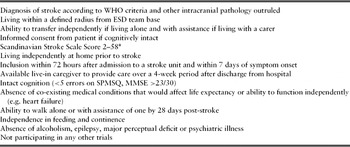
Not all stroke patients will qualify for ESD after stroke. A proportion of patients in all stroke units will have extensive deficits and high dependency levels or medical complications post-stroke that will require ongoing specialist in-patient care. Studies report a variety of inclusion/exclusion criteria, some in more detail than others (Table 1). All patients must have a diagnosis of stroke as per WHO criteria and are usually enrolled within days after symptom onset if willing to consent to early discharge. For ESD the patient must be deemed medically fit for discharge by their supervising consultant, have no co-existing conditions that would affect their ability to participate and be in need of no further inpatient care. Stroke patients are clearly a very heterogeneous group who often have a variety of clinical deficits. If there is a perceptual abnormality or incontinence, this could potentially make for a difficult case to support at home. Swallow dysfunction, which could put the patient at risk of aspiration or malnourishment, may also challenge suitability for early discharge. Most studies do not report all these deficits as exclusion criteria but instead are eager to support early discharge home once the patient has suitable home conditions, in a fixed abode in the area served by the ESD service, and has a care-giver willing and able to provide live-in care for the patient. If the patient lives alone then independence with transfers is necessary but if living with a carer the patient must be capable of transferring with assistance. However, cognitive impairment at a level that reduces safety, insight or communication would exclude a patient from participating.
Inclusion criteria for early supported discharge from a selection of studies

WHO, World Health Organisation; SPMSQ, Short Portable Mental Status Questionnaire; MMSE, Mini-Mental State Examination. *Stroke 1985; 16: 885–90.
Most studies comparing ESD with conventional stroke care included patients with a mean age ranging from 70 to 75 years.Reference Rudd, Wolfe, Tilling and Beech8, Reference von Koch, Holmqvist, Wottrich, Tham and de Pedro-Cuesta9, Reference Indredavik, Fjaertoft, Ekeberg, Løge and Mørch13, Reference Mayo, Wood-Dauphinee, Côté, Gayton, Carlton, Buttery and Tamblyn17, Reference Thorsén, Holmqvist, de Pedro-Cuesta and von Koch19, Reference Askim, Rohweder, Lydersen and Indredavik35, Reference Pessah-Rasmussen and Wendel36 One study looking at cost-effectiveness of the service reported a mean age as low as 64 yearsReference Saka, Serra, Samyshkin, McGuire and Wolfe34 and the Belfast Community Stroke Trial reported a mean age of 68 in their ESD group.Reference Donnelly, Power, Russell and Fullerton37 Older age was not defined as an exclusion criterion in these studies and it may be that people older than this had more extensive deficits post-stroke and for that reason were not suitable for early supported discharge.
Patients with moderate severity stroke (Barthel Index > 9/20) have been reported to gain most from ESD services, having the greatest reduction in the odds of death, dependency or institutional care.Reference Langhorne, Taylor, Murray, Dennis, Anderson, Bautz-Holter, Dey, Indredavik, Mayo, Power, Rodgers, Ronning, Rudd, Suwanwela, Widen-Holmqvist and Wolfe20 Patients with severe stroke, who have shown a more favourable economic benefit, and those with milder severity stroke, who may benefit from further focused rehabilitation, should however not be excluded on this basis alone. Each case should be considered individually for appropriate patient inclusion and ESD resource usage.
Limitations of ESD and opportunities for future developments
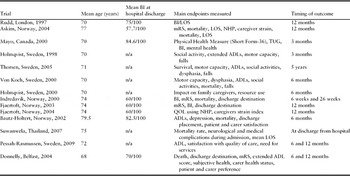
The characteristics of the ESD services described in the above trials vary, and the patients deemed suitable for inclusion into one study may not have been appropriate for another, based on criteria set out in individual regions. It can be difficult to make conclusions in such a heterogeneous group of trials (Table 2). It is clear, however, that some centres are more selective than others when allowing patients with stroke to discharge early for home-based rehabilitation. ESD teams vary in which patients they can support at home and this may depend on local staffing levels, frequency of patient visits and level of medical support. There are a number of possible limitations to ESD, which may not suit all patients after stroke. Although older age was not defined as an exclusion criterion in any study, most patients included were younger than 75 years old. It is possible that patients older than this were more functionally dependent after their stroke, which may have led to their exclusion, and they may not have had a suitable live-in carer at home. Furthermore, the likelihood of cognitive impairment, medical complications and falls is higher in older people, which may limit their ability to participate in an early discharge programme.
Endpoints measured in a selection of studies assessing functional outcome after ESD post-stroke

BI, Barthel Index; LOS, length of hospital stay following randomization into study; mRS, modified Rankin Scale; NHP, Nottingham Health Profile; TUG, timed up and go; ADL, activities of daily living; QOL, quality of life.
Deficits in perception and language after stroke can be very disabling and may impact on a person's ability, at any age, to function and participate in ESD and rehabilitation at home, even if functional mobility is satisfactory. Depression is common after stroke and psychiatric and neuropsychological support and involvement vary between ESD services, but their input is very important should this complication arise. ESD teams and carers must have a low index of suspicion for depression when reviewing patients during the early weeks post-stroke at home. Furthermore, home location can limit a patient's participation in ESD programmes as some patients are not considered on the basis that they live too far from their base hospital. As discussed above, ESD has not been sufficiently developed in rural areas to date and certainly has some possible drawbacks relating to accessibility and patient follow-up, and future studies are needed to assess its feasibility in more remote areas.
However, some of these limitations may be overcome with future service adaptations and developments, improved carer training and involvement prior to and post-discharge. It is uncertain which qualities contribute most to the effectiveness of ESD services but increased staffing levels on ESD teams and greater medical and psychiatric support in the community may allow greater numbers of patients to be included in ESD programmes.
Conclusion
After stroke ESD offers suitable patients the opportunity to discharge home earlier than conventional services allow, completing a programme of rehabilitation in the familiar surroundings of their own home. Since being first introduced over ten years ago, ESD has shown very promising results in many international studies. When part of a comprehensive stroke service, ESD can lead to increased independence and reduced institutionalization in the long term. This move from in-patient to out-patient rehabilitation reduces the overall length of hospital stay with resultant cost savings (from bed days saved) and is in keeping with overall changes in focus of health service delivery and shifts in resource use.
Best results in functional recovery are seen in those patients with mild to moderate stroke when under the care of well co-ordinated ESD teams who meet on a regular basis. However, the greatest cost savings are seen when patients with severe stroke are discharged early for rehabilitation at home. Currently the cost–benefit balance in the different patient groups is unclear and further studies are needed to explore this.
Conflicts of interest
The authors have no conflicts of interests to declare.