


1. Introduction
In China, subnational governments and officials have played vital roles in managing local economies. In the 1980s, this included fostering local township and village enterprises, and since the 1990s, it has included promoting local industrialization and urbanization (Oi Reference Oi1985; Whiting Reference Whiting2001). Researchers have tended to interpret the economic enthusiasm of local Chinese officials as the result of race-to-the-top or race-to-the-bottom competition among them for GDP growth, fiscal revenue collection, and investment attraction (Li and Zhou Reference Li and Zhou2005; Lü and Landry Reference Lü and Landry2014, Su and Tao Reference Su and Tao2017). Such efforts enable local officials to “cozy up” to supervisors, among others central leaders, who mainly care about economic performance and hence utilize a highly centralized governance structure to compel local officials to conduct mandates (Li and Zhou Reference Li and Zhou2005; Xu Reference Xu2011).
This research complements the abovementioned perspective by proposing that the economic activities of local officials also derive from provincial patrons using distributive politics to dispense benefits to lower-level bureaucrats in exchange for their cooperation. Theoretically, even in a highly institutionalized single-party system like the USSR and China, powerful politicians at various levels need cooperation and support from lower-level party cadres and bureaucrats to secure regime stability and shore up their own political careers (Shih Reference Shih2008). This establishes the basic motivation for allocating benefits to constituents. In a decentralized milieu in which different segments of bureaucrats have more or less discretionary power over resources, support from lower-level bureaucrats and cadres is particularly important given its critical role in either facilitating or inhibiting the goals of patrons at various levels, thereby providing the latter with additional resources to consolidate their power.
Moreover, the demand for support from lower-level bureaucrats—and therefore the need for support buying (vis-à-vis vote buying under democracy)—varies with the degree of power dispersion/concentration among patrons. Ceteris paribus, when only a few patrons have acquired more power and have greater discretion to allocate spoils, they face fewer challenges and uncertainties; therefore, there is less incentive to win over rank-and-file supporters at the cost of valuable resources. By contrast, when power is dispersed more evenly among patrons, they face fiercer competition, more uncertainty, and greater risk. Thus, support from lower-level officials becomes more valuable because it helps individual leaders consolidate their power base, cushions unexpected shocks to the power balance, and facilitates the smooth running of the system. Patrons are therefore incentivized to dispense benefits to their lower-level supporters in exchange for cooperation and support. Once it is decided to offer more benefits to lower-level officials, the power balance among leaders implies that leaders constrained by various veto-power checkpoints will likely perpetuate the spoils. In short, for patrons, the value of support from lower-level officials is a function of the degree of power concentration within the leadership. We hypothesize, therefore, that the less (greater) power is concentrated in their hands, the more (less) leaders are incentivized to buy support from lower-level bureaucrats.
To test this hypothesis, we examined how provincial leaders in China pursued support-buying strategies from 2003 to 2012 through the lens of land fiscalization. Land fiscalization is a combination of land-use policies through which local governments within provinces interfere with the land market to facilitate urbanization and industrialization. By manipulating the land market, including agricultural land requisitions and land supply for nonagricultural use, land fiscalization tilts the distribution of interest disproportionately toward local government officialsFootnote 1 vis-à-vis those outside the regime. It allows local officials to reap the benefits of urbanization and industrialization while shifting the resultant social and economic costs to disempowered groups, such as farmers, migrants, and even the urban middle class. Given the distributional effects, the extent to which a province is exposed to land fiscalization can be viewed as an outcome of the provincial leadership allowing local officials to choose land-use policies aligned with their self-interest, regardless of the associated social costs. According to our hypothesis, when provincial leaders have less power concentrated in their hands, provincial authorities will allow local governments to pursue land fiscalization to a greater extent in order to please local officials.
In this study's empirical analysis, we used sub-provincial land-market transaction data aggregated at the provincial level to measure the extent to which a local government within a province is involved in land fiscalization. We also compiled a comprehensive provincial party standing committee (PPSC) data set, which includes all PPSC members in 31 Chinese provinces, to measure the degree of power concentration among provincial leaders (i.e., provincial party secretary and provincial governor). The empirical evidence strongly supported the hypothesis, which held true under various regressions that allowed for different specifications and accounted for alternative explanations of local land fiscalization—specifically, provincial leaders’ political identities and personal networks, provincial leaders’ capacity to discipline lower-level bureaucrats, within- and between-province political tournaments among local officials (to appease provincial leaders), and fiscal imperatives. Further, to deal with potential endogeneity, we exploited the exogenous shock of the 2008 financial crisis, employed the instrumental variable method, and considered provincial border discontinuity. Finally, validity was tested using public-sector employment as an alternative to land fiscalization. This helped illustrate why it was land fiscalization—rather than other policy tools that may extend beyond provincial leaders’ control—that had become the mainstay of support-buying strategies since the 1990s.
By documenting a negative relationship between power concentration in provincial leadership and provincial land fiscalization in China, this study contributes to the literature on distributive politics under authoritarianism. Previous studies have tended to focus on how distributive strategies operate in favor of autocrats to help them gain electoral advantage (Magaloni Reference Magaloni2006; Pepinsky Reference Pepinsky2009; Hong and Park Reference Hong and Park2016). Recently, a growing body of literature has investigated how, in the absence of mass elections, autocrats offer preferential benefits to bureaucrats and inner-circle followers to secure loyalty and support. Most of those studies focus on how incumbent power holders allocate public expenditures and transfers to lower-level officials, based either on personal connections between patrons and clients (Lü and Liu Reference Lü and Liu2019; Jiang and Zhang Reference Jiang and Zhang2020) or on central-government policy priorities, which necessitate doling out benefits to local bureaucrats to implement the policy mandates (Belova and Lazarev Reference Belova and Lazarev2013; Ang Reference Ang2016). Our study calls attention to a new factor from a political-structure perspective—namely, how power distribution among subnational leaders motivates the leadership as a whole to offer policy compromises to local bureaucrats. This adds to our understanding of why, under authoritarian regimes, political elites have incentive to distribute benefits downward to lower-level officials in the form of developmentalism, especially in a single-party context such as China.
2. Land fiscalization under local developmentalism in China
Since the early 1990s, a common strategy among local governments in China has been to interfere with local land markets to promote industrialization and urbanization; this is known as land fiscalization (tudi caizheng). As many have noted (He et al. Reference He, Liu, Webster and Wu2009; Lin and Ho Reference Lin and Ho2005), because of the public ownership of land and strict regulations on land use, local governments have de facto control over land supply and land use. They can therefore wield monopolistic power over local land markets in two ways. First, a local government usually assigns lower-than-market prices for industrial use in its jurisdiction by strategically expanding the land supply for industrial use to reduce the price of the land for manufacturing firms. In addition, local governments offer tax breaks and make huge investments in infrastructure to reduce input costs for manufacturing firms (Su and Tao Reference Su and Tao2017).Footnote 2 Such maneuvers aim to attract industrial firms, among other manufacturing firms, to settle in their jurisdictions by offering lower-than-market land prices. This can have the spillover effect of fostering service industries (e.g., restaurants, shopping malls, banks), which in turn generate valuable revenues, such as business taxes, that end up in local governments’ pockets. Second, unlike manufacturing firms, which can move with relative ease across different regions, service industries are typically non-tradable businesses attached to the localities they operate in. This gives local governments an upper hand in bargaining, enabling them to strategically limit land supply for commercial and residential use, which pushes up land sale prices for commercial and residential use and land revenues as well (Zhang, Fan, and Mo Reference Zhang, Fan and Mo2017; Su and Tao Reference Su and Tao2017).
Local governments and officials are undoubtedly the biggest beneficiaries of land fiscalization. For one thing, land has become the most valuable asset and an important revenue source for local governments. On average, land-sale revenues alone account for more than 30 percent of the fiscal revenues of local governments; land is also used as collateral for about 37 percent of local government debt for financing local public goods (Zhang, Fan, and Mo Reference Zhang, Fan and Mo2017). Apart from giving local governments greater fiscal capacity to provide public goods, such as education and support for social stability (Shih and Zhang Reference Shih, Zhang, Shue and Wong2007; Lee and Zhang Reference Lee and Zhang2013), higher revenues also highlight local officials’ administrative performance and increase their chances of promotion (Lü and Landry Reference Lü and Landry2014).
In addition, local officials have accrued tremendous personal wealth through land fiscalization, legally or illegally. First, the intraprovincial fiscal systems in many provinces allow provincial governments to transfer a portion of year-to-year increased revenues to local officials’ personal pockets.Footnote 3 Against this fiscal backdrop, the greater the revenues generated by land fiscalization, the greater the rewards local governments and officials can claim. Second, state ownership of land and the discretion over land use given to local officials generate rent-seeking opportunities (Chen and Kung Reference Chen and Kung2016) in which local officials sell cheap land to real estate developers in return for bribes (Pei Reference Pei2016, chap. 3). Unsurprisingly, government land acquisitions and market transactions, including leasing or selling land to businesses, often go hand in hand with corruption (World Bank Reference Bank2005; Cai, Henderson, and Zhang Reference Cai, Henderson and Zhang2013).
These effects of land fiscalization would have disappeared or been abated without permission from governing provincial authorities. First, subject to approval from the State Council to convert farmland into construction land, provincial governments have the discretion to distribute annual approved land-use quotas among lower-level local (county and township) governments (Han and Lai Reference Han and Lai2012). These land-use quotas received by local governments determine the extent to which they can pursue land fiscalization.
In addition, to acquire low-cost land for industrial use, local governments and officials often use force, sometimes via local mafia and thugs, to expropriate land from rural farmers and urban residents, offering only low compensation in return. Further, local governments sometimes collude with businesses to lower labor and environmental standards to court manufacturing investment, exacerbating environmental problems and reducing labor protections (Gallagher Reference Gallagher2007). Such adverse effects have resulted in protests by villagers and urban residents who lost their property and by migrant workers who labor under dangerous conditions for meager wages. Despite such growing resistance, which threatens both social stability and regime legitimacy, provincial governments typically turn a blind eye to local governments’ abuses of power or even directly support their efforts to grab more land.
Provincial governments have even been able to protect land-fiscalization practices from central-government intervention. In 2006, for example, the central government launched a nationwide investigation into land-fiscalization problems, whose products are embodied by development zones, industrial parks, and other features that are already established as well as those under construction. After the audit, the central government decided to consolidate development zones, and it ordered shutdowns in many places. However, the development zones and industrial parks continued to operate because local governments simply changed their names to “urban industrial functional zones” or “urban industrial complexes.” Local officials would not be able to get away with such tactics were it not for the protective umbrella of provincial authorities.
Thus, land fiscalization in China is not a localized phenomenon driven merely by self-interested lower-level officials. It also results from provincial governments’ collusion with local governments, which gives license to land fiscalization by allowing local governments to extract rent from land and shift costs to marginalized social groups. In fact, provincial leaders have incentive to cater to the interests of lower-level bureaucrats. Apart from distributing patronage to local governments and officials based on social ties and personal connections (Persson and Zhuravskaya Reference Persson and Zhuravskaya2016; Jiang and Zhang Reference Jiang and Zhang2020), provincial leaders need support from lower-level officials to secure their own careers against political uncertainty and risk (Shih Reference Shih2008; Li and Liu Reference Li and Liu2016; Zhu and Zhang Reference Zhu and Zhang2017). Moreover, many studies have noted that even in a country with strong state capacity like China, policy mandates from above still largely depend on lower-level officials, who can significantly influence policy implementation and its consequences by selectively conducting some policies while blocking others (O'Brien and Li Reference O'Brien and Li1999, Tsai Reference Tsai2006, Li and Zhang Reference Li and Zhang2018). In other words, provincial authorities use land-fiscalization strategies to channel benefits downward to local governments and officials to boost local compliance and cooperation.
Although it is a widespread practice across China, land fiscalization displays considerable variation in geography and timing. As our data show (section 3.2), the degree of land-fiscalization practice differs significantly among different provinces. For example, land fiscalization originated as a development strategy in coastal provinces such as Shanghai, Jiangsu, and Zhejiang. It then spread to inland provinces, including relatively poor regions such as Qinghai and Gansu. The degree of land fiscalization can change over time, even within an individual province. Although a host of factors may influence land fiscalization in a province (e.g., local economic and social conditions, factor endowments; Zhang, Fan, and Mo Reference Zhang, Fan and Mo2017; Su and Tao Reference Su and Tao2017), this study emphasizes one factor that has received less attention: power concentration among provincial leaders. As already mentioned, the support-buying imperative of provincial governments varies with the degree of power concentration and competition among provincial leaders. When power is split among top-level provincial officials, including party secretaries and governors, and they face fierce intra-elite rivalry, it necessitates downward benefit distribution via land fiscalization to ensure compliance from local bureaucrats and build up local mobilization capacity, which can help secure their political careers (Lü and Liu Reference Lü and Liu2019). By contrast, when power is concentrated in the hands of a few top provincial leaders, and their authority is secure, offering patronage benefits is no longer an attractive stratagem for power consolidation.
Based on the above reasoning, we can formulate the following testable hypothesis:
The less power is concentrated among provincial leaders, the more a province will pursue land fiscalization.
3. Variables, data, and descriptive statistics
3.1 Dependent variable
As introduced in section 2, the key feature of land fiscalization is that local governments manipulate the land market to offer lower prices for industrial use and higher prices for commercial and residential use, driving a wedge between the two (Zhang, Fan, and Mo Reference Zhang, Fan and Mo2017; Su and Tao Reference Su and Tao2017). We therefore used the ratio of the unit land price (10,000 yuan per hectare) of commercial and residential land to that of industrial land (CRI) in a province as a proxy for the degree to which local governments in a province engage in land fiscalization. A greater CRI value indicates a greater gap between the two types of land prices and therefore a greater degree of land fiscalization practiced by local governments in a province.
3.2 Explanatory variable: Power dispersion/concentration in provincial leadership
To measure power dispersion/concentration in provincial leadership, we developed a novel index for provincial power dispersion (PPD) based on our data set of 31 PPSCs from 1992 to 2012. The PPD index is based on two widely accepted observations on Chinese formal and informal politics. First, the PPSC is the paramount power body of a province, typically consisting of seven to nine members annually. Among them, the provincial party secretary (PPS) and provincial governor (PG) are the two most important members. The PG is de jure the most powerful politician in a province and is primarily responsible for economic affairs, including land-related policies. PPSs are mainly responsible for party affairs, but many suggest that in practice they have agenda-setting power over personnel appointments in local and provincial bureaucracies and have a say in policy issues that matter for their political careers (Oi Reference Oi1999). Second, aside from the power derived from formal hierarchy, politicians gain informal power by forming factional networks or personal connections to consolidate their power base and sustain their careers (Nathan Reference Nathan1973). Recent literature on Chinese factional politics has found that officials have become increasingly specialized in different policy tasks, which may cause members of a faction to be more dominated by those from a certain bureaucracy (Nathan Reference Nathan2003; Shih Reference Shih2008). In light of the above, we used an approach similar to “the effective number of electoral parties in a legislature” (Laakso and Taagepera Reference Laakso and Rein1979)Footnote 4 to calculate the PPD index:
 $$PPD = \displaystyle{1 \over {{( {\% PP{S}^{\prime}s\;connection\;in\;PPSC} ) }^2 + {( {\% P{G}^{\prime}s\;connection\;in\;PPSC} ) }^2}}, \;$$
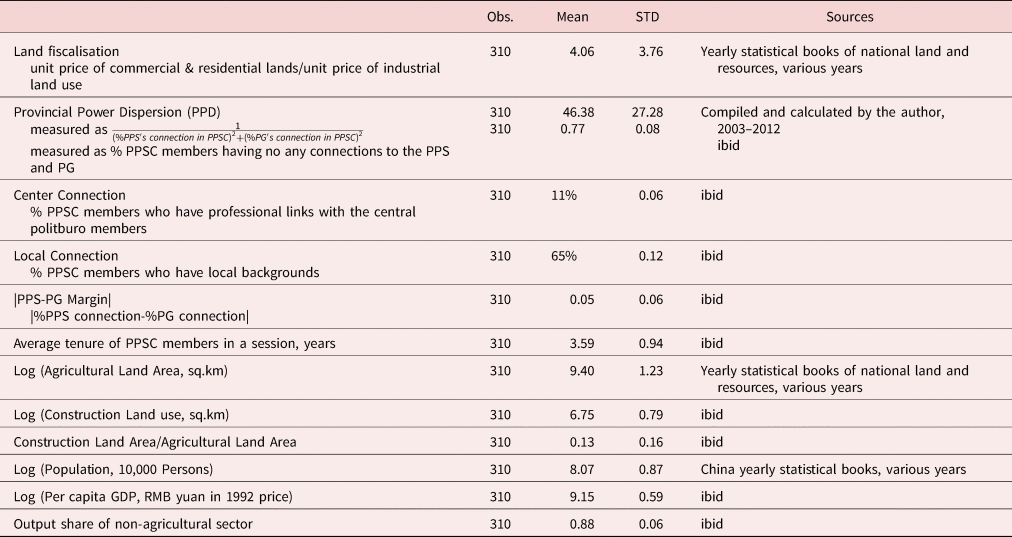
where the first and the second component of the denominator are the percentages of PPSC members in a province who share previous working experience (professional link) with the PPS and PG, respectively, in the same administrative or party unit for over one year, within two administrative steps of one another before they served in the PPSC (Shih, Shan, and Liu Reference Shih, Shan and Liu2010; Meyer, Shih, and Lee Reference Meyer, Shih and Lee2016). Thus, in equation (1), we view the number of PPSC members as the size of a legislature and the number of previous working connections with the PPS/PG as the number of seats the PPS/PG has in the legislature. In this way, PPD measures the extent to which factional connection resources in a PPSC are claimed by the two most powerful officials in the committee, and it therefore mirrors the degree of power concentration within the committee. A greater value of PPD means factional connections are less concentrated in the hands of the PPS and PG and more evenly distributed in the PPSC. It is worth noting that although a PPSC typically includes one or two military members, we did not count PPSC members with a military background in the calculation of PPD since the military is believed to be autonomous from civilian bureaucratic systems (apart from a few areas involving joint civic–military issues, such as militia, mobilization, and demobilization) (Bo Reference Bo, Finkelstein and Gunness2007, 96–124).Footnote 5 Table 1 presents the summary statistics of the main variables and data sources.
Descriptive Statistics

3.3 Estimation model and control variables
Equation (2) is the baseline estimation model we used to assess the effect of provincial power concentration on provincial land-fiscalization practice:
 $$CRI_{it} = \alpha \ast PPD_{it} + \beta \ast X + \rho _i + \mu _t + \varepsilon _{it}, \;$$
where subscripts i and t stand for province i and year t, respectively. Based on our hypothesis, we should expect α>0 (∂CRI/∂PPD >0). ρi is the province-fixed effect, and μt is the year-fixed effect common to all provinces. ɛit is a province time-varying error distributed independently of ρi and μt. X is a set of controls that not only control for a host of social and economic factors that might affect land markets but also allow for factors to evaluate alternative hypotheses (e.g., personal traits of provincial leaders, their networks, their capacity to control lower-level officials, regional fiscal competition). We introduce and discuss these controls in the next section.
4. Estimation results
4.1 Baseline results
A close examination of Table 1 suggests that there might be outliers in the data, which is confirmed by the results in columns (1) and (2) in Table A1 in the Appendix. In both columns, the estimated coefficients of PPD are not statistically significant at any conventional level. We therefore dropped observations of CRI and PPD that were beyond three standard errors of the mean values of the two variables, leading to mere 1.9 percent loss in observations (6 out of 310). We then used the robust OLS regression method to estimate equation (2).Footnote 6
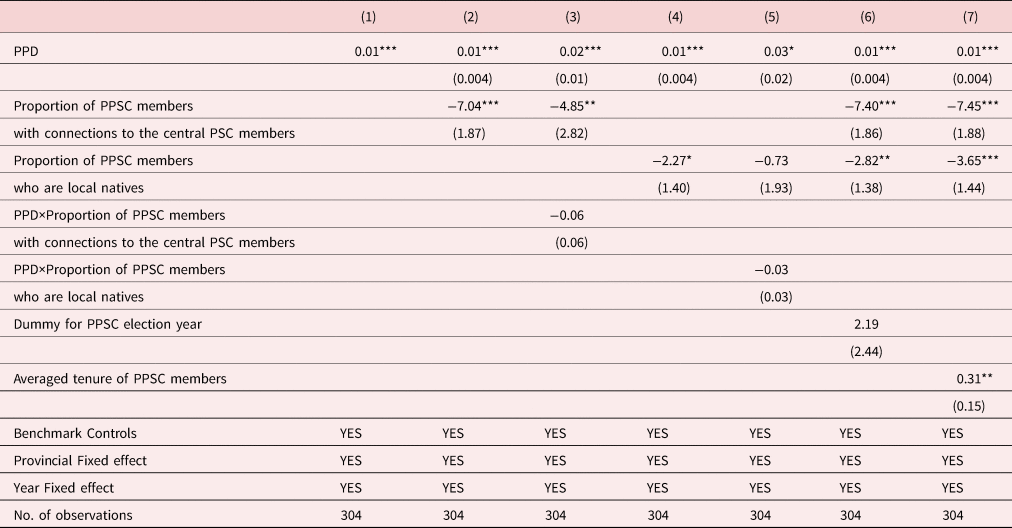
Table 2 shows the baseline estimation results for equation (2). In column (1), the estimated coefficients of PPD (provincial power dispersion) are positive and statistically significant. This is consistent with the hypothesis that a lower degree of provincial power concentration is associated with a greater degree of local land-fiscalization practice. According to the result, an increase in PPD from 5 percent below the mean to 5 percent above the mean leads to a 1.5 percent increase in CRI. Column (1) also includes a set of control variables to control for factors that may influence land-market supply and demand conditions, including the following: log (land area for agricultural use, LAA), log (land area for urban construction use, LAUC), and the ratio of LAUC to LAA. The first two variables measure the potential land supply and demand in the real estate market in a province in absolute terms. The third variable (LAUC/LAA) controls for the market conditions of the local real estate sector in terms of supply–demand balance. Other control variables include log (population), the total population size, which is also a demand factor in the housing market, and log (per capita GDP), a variable to control for the income level of a province. Compared with less developed provinces, the demand for housing in wealthier provinces is likely higher, but the cost of land fiscalization (e.g., compensation for appropriating land from farmers and urban residents) is also higher. Thus, the overall effect of per capita GDP on land fiscalization is ambiguous. The share of nonagricultural output in GDP, which measures the industrial structure of a province, is also included. A province with a higher agricultural output share may lack comparative advantages in attracting manufacturing sector investment via land fiscalization. Meanwhile, local governments in agricultural provinces might have more discretionary power over land because of loose restrictions on agricultural land protection. Therefore, they might have more room to maneuver land fiscalization relative to their counterparts whose economies rely more on the manufacturing and service sectors. Hence, similar to per capita GDP, we do not have an ex ante expectation of the overall effect of provincial industrial structure.
Control for more structural features of provincial party standing committees

Robust Standard errors in parentheses
*p < 0.1, ** p < 0.05, *** p < 0.01, one-tail test results
The results in column (1) of Table 2 indicate that agricultural land area and urban construction land area, and the ratio between them, have coefficients that are statistically significant and with the expected signs. This suggests that market conditions have indeed had significant effects on the price ratio between the two types of land via supply and demand channels. In addition, population size and nonagricultural output share both have positive and significant coefficients, whereas the income level of a province has no significant effect at all.Footnote 7
4.2 Additional features of provincial power structures
We further tested whether PPD's effect on land-fiscalization practice reflects provincial leaders’ motivation to elicit local politicians’ support by controlling for additional factors that likely arise from the same incentive. In columns (2) and (3) of Table 2, we include a new variable, Center Connection (i.e., the percentage of PPSC members with working or previous professional links to at least one standing member of the ruling party's Central Politburo), and its interaction with PPD, respectively. The rationale is that Center Connection reflects the extent to which the provincial leadership is embedded in the political network of the central patrons (Jia, Kudamatsu, and Seim Reference Jia, Kudamatsu and Seim2015), since under autocracy, the power of lower-level politicians is an extension of the power of upper-level patrons.Footnote 8 Thus, we expect that provincial leaders’ incentive to woo support from below will be weakened if they have a solid power foundation derived from above.
The results in column (2) show that, indeed, there is a significant negative relationship between Center Connection and land-fiscalization practice. In column (3), with the inclusion of Center Connection×PPD, we examine whether the marginal effect of PPD is conditional on Center Connection. Based on the estimation results in column (3), the marginal effects of PPD decline as the value of Center Connection increases, and eventually its significance disappears when the latter is above a certain point (0.2 by the 90 percent significance level, or the sixty-sixth percentile of the sample observations). These results are consistent with our expectation that the more support the provincial leaders get from above, the less they are willing to allow local officials to engage in land fiscalization.
Apart from personal connections with the center, we also need to consider provincial leaders’ personal relationships with lower-level politicians, as many suggest that, in China, provincial leaders who have risen from low to high positions within the same province tend to cater to lower-level officials in policy making and resource allocation (Persson and Zhuravskaya Reference Persson and Zhuravskaya2016). In columns (4) and (5) we control for a variable, Local Connections (i.e., the percentage of PPSC members whose careers rose from the lower administrative levels within a province), and its interaction with PPD, respectively. In both columns, the PPD variable still has a positive sign and is statistically significant. Local Connections, however, has no significant effect at all (column 4) and has a negative conditional effect on the effect of PPD (column 5). A likely explanation is that provincial leaders’ professional links to incumbent central leaders reflect a large part of their de facto power foundation, whereas their prior local working experience is too noisy to capture the extent to which their power base originates from local bureaucrats.
In column (6), we control for the dummy for the PPSC election year because it is possible that provincial leaders have a greater demand for buying support from lower-level officials in an election year. As shown, the coefficient of the election-year dummy is positive but insignificant. In column (7), we include the averaged tenure of PPSC members in each PPSC session. A shortsighted provincial leadership, captured by a smaller value for the variable, is unlikely to take care of the interests of lower-level officials (i.e., the coefficient of the variable should be positive). Meanwhile, provincial leaders with shorter tenures may sense more uncertainty and risk, so they have greater motivation to buy support from lower-level officials, suggesting the coefficient of the variable should be negative. As column (7) shows, the first effect outweighs the second, given that the coefficient of the averaged tenure is positive and significant.
4.3 Alternative explanations
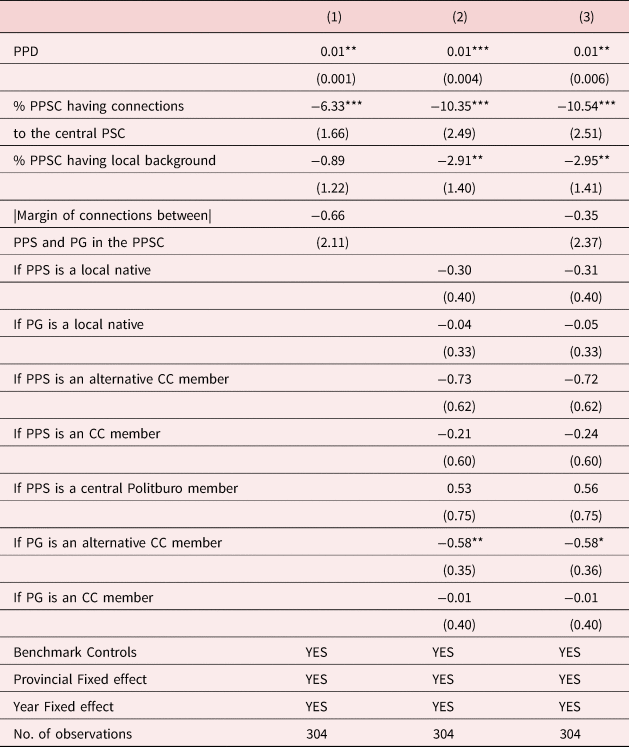
Provincial leaders’ personal political identities. Thus far, the PPD metric has measured how much PPSC power is concentrated in the hands of the PPS and PG. It is natural, then, to wonder if the effect of PPD results from the two top provincial politicians’ personal political features, rather than reflecting the collective motivations of provincial leaders regarding land fiscalization. For example, what does the scenario look like if the PPS and the PG are rivals in the provincial political arena? A competitive relationship may drive them both to green light local land fiscalization to win lower-level officials’ support. To proxy for the potential rivalry between the PPS and the PG in a province, we include a new variable (|PPS–PG Margin|) measured as the proportion of connections of the PPS against the proportion of connections of the PG and take its absolute value. If we assume there is a rivalry relationship between the two top provincial politicians, then a greater value of |PPS–PG Margin| stands for the superiority of the PPS/PG over the PG/PPS in the PPSC.
We also include the following variables to capture the personal political identities of the PPS and PG to proxy for politicians’ policy preferences and capacities, which may influence policy bargaining and resource allocation (Persson and Zhuravskaya Reference Persson and Zhuravskaya2016): a dummy variable of whether a PPS/PG has a local background (1 if a local native or rose from the local bureaucracy; 0 otherwise); a dummy for whether a PPS/PG is an alternate member of the party's Central Committee (CC); a dummy for whether a PPS/PG is a full member of the CC; and a dummy for whether a PPS is a member of the Central Politburo.Footnote 9
Table 3 presents the results. Columns (1) and (2) include the variable of |PPS–PG Margin| and the political identity variables, respectively, and column (3) includes all variables. Several findings are noteworthy. First, the margin between the PPS's connections and the PG's connections in the PPSC has no significant coefficients.Footnote 10 Second, the personal identities of PPSs have no significant effects in all regressions. Third, for a PG, being an alternate CC member tends to reduce land-fiscalization activities while being a CC member has no significant effect. A possible explanation is that a PG who is an alternate CC member has a greater likelihood of being promoted (Shih, Shan, and Liu Reference Shih, Shan and Liu2010) and is therefore more cautious about land fiscalization to avoid being implicated in such activities (e.g., by way of protests and environmental problems). Although further research is needed to fully interpret the results, they suggest that, compared with power concentration status in the PPSC, the personal political identities of the PPS and PG are of secondary importance in affecting local land-fiscalization practices.
Control for PPS-PG rivalry and personal political identities

Robust Standard errors in parentheses
*p < 0.1, ** p < 0.05, *** p < 0.01, one-tail test results
Within- and between-province local political competition. In the literature, it is suggested that higher-level governments in China can leverage their political control of nomenclature to create tournaments among local officials to align the latter's behavior with the former's policy priorities (Xu Reference Xu2011). Following this logic, local governments and officials do not engage in land fiscalization because they are pursuing their own interests (i.e., land fiscalization is not a bargaining chip in provincial distributive politics). Rather, they are mainly motivated to compete with each other, relying on land-related development strategies to accomplish the tasks assigned by upper-level authorities, including promoting economic growth and generating fiscal revenues (Lü and Landry Reference Lü and Landry2014).
Following Lü and Landry (Reference Lü and Landry2014), to measure interjurisdiction competition at the prefectural level, we use the average number of counties (No. of counties) within a prefecture in a province and the number of prefectures (No. of prefectures) within a province to proxy for the degree of within-province political competition.Footnote 11 We also consider another variable, Neighboring Land fiscalization, which is the averaged degree of land-fiscalization practice by neighboring provinces (excluding the concerned province), to capture peer effects on the concerned province from neighboring provinces via two potential mechanisms. One is the between-province competition mechanism, in which provincial leaders care about their relative zhengji (administrative performance) compared to their counterparts in other provinces. The other mechanism is the emulation mechanism, in which provincial leaders of the concerned province emulate their counterparts in neighboring provinces, not to polish their zhengji but to show that they do not lag behind in pleasing local officials compared with their neighboring counterparts. Although the first mechanism is more reflective of the political competition hypothesis while the second gives more credence to our provincial distributive politics hypothesis, both suggest that the greater the degree of Neighboring Land fiscalization, the more likely it is to pressure the concerned province to escalate its own degree of land fiscalization.Footnote 12
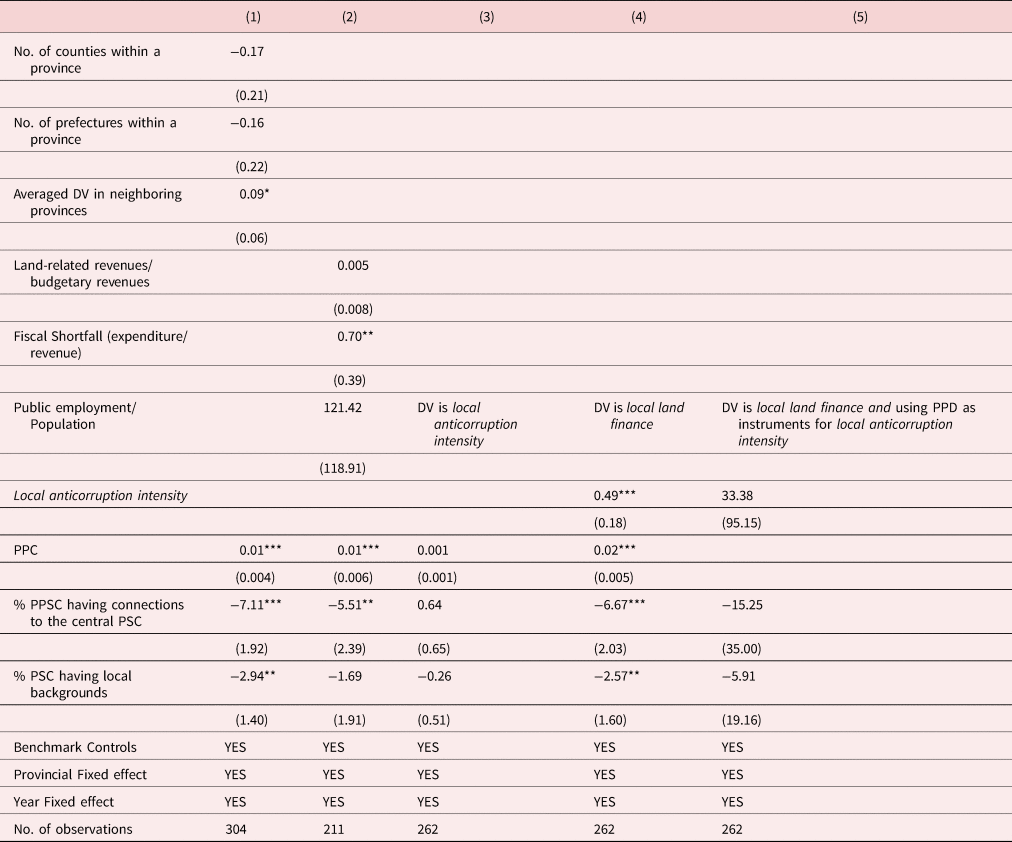
In Table 4, column (1) includes No. of counties, No. of prefectures, and Neighboring Land fiscalization. The coefficients of PPD remain positive and significant. The coefficients of No. of counties and No. of prefectures are not statistically significant, implying that local land fiscalization can hardly be attributed to within-province political competition. The positive and significant coefficients of Neighboring Land fiscalization, however, suggest that a peer effect exists, attributable to either the between-province competition mechanism or the emulation mechanism, or both.
Alternative hypotheses and mechanisms

Robust Standard errors in parentheses
* p < 0.1, ** p < 0.05, *** p < 0.01, one-tail results
Fiscal imperative. Another competing hypothesis is that land fiscalization is not so much a policy vehicle for local officials’ self-interest as local government's responsiveness to fiscal revenues. A large body of literature has interpreted China's local governments as embodiments of local developmental states obsessed with revenue generation (Oi Reference Oi1992; Whiting Reference Whiting2001). To control for local governments’ fiscal imperatives, we include three variables in column (2) of Table 4. The first is Local fiscal dependence on land fiscalization, measured as the averaged land-related fiscal revenues of a county as a ratio of the county's total budgetary revenues. If the fiscal imperative hypothesis is valid, then local governments more dependent on revenues from land will be more incentivized to engage in land-fiscalization practices. The second is fiscal pressure, measured as averaged county budgetary expenditure as a ratio of its budgetary revenue. A larger gap between the expenditure and revenue of a county is expected to positively relate to local land-fiscalization practice. Third, one may argue that both the first and second variables are a function of the size of the bureaucratic system, because a larger bureaucratic system requires more revenue to work properly (Shih and Zhang Reference Shih, Zhang, Shue and Wong2007; Ang Reference Ang2016). Hence, we include public employment size, measured as the averaged county–prefecture public employment as a ratio of population size. One consequence of introducing this variable is the loss of almost a third of our total observations (from 304 to 211) because data for public employment at the county–prefecture level after 2009 are not available. As column (2) shows, after controlling for the local fiscal condition, provincial power concentration (PPD) still has a positive and significant coefficient. In addition, among the three fiscal variables, Local fiscal dependence on land fiscalization is not statistically significant at all. This suggests that the fiscal contribution of land fiscalization is actually not a meaningful driving force for local land-fiscalization practice. Fiscal pressure has a positive and significant coefficient. This is strong evidence that, aside from distributive politics, whether local revenues can cover expenditures is another major factor affecting the local experience of land fiscalization, implying that both local and provincial governments are concerned about a stable bureaucratic system. Finally, the coefficient of public employment size is positive but insignificant. A possible explanation is that, although a bureaucratic system may be large, it does not necessarily mean the fiscal resources are overstretched.
Top-down provincial bureaucratic control (PBC). Given the above finding that a lesser degree of power concentration among provincial leaders is positively associated with local land-fiscalization practice, one may argue that less power concentration affects land fiscalization not via provincial leaders’ incentive to buy support, but because a less powerful provincial leadership is unable to discipline its subordinates, therefore losing control over local governments’ pursuit of land fiscalization, even if it involves corruption and provokes social unrest.
In columns (3)–(5) in Table 4, we examine whether the provincial bureaucratic control (PBC) mechanism holds. If provincial power concentration acts on land fiscalization through the PBC mechanism, and if we assume we can proxy for provincial government control over local bureaucrats by considering anticorruption campaigns in a province, then a plausible conjecture is that provincial power concentration should be conductive to the intensity of anticorruption campaigns targeting local officials, which then influence local land fiscalization.
Similar to Zhu and Zhang (Reference Zhu and Zhang2017), we gauge local anticorruption intensity by the number of officials at and above county levels investigated annually by provincial procuratorates as the ratio of the total number of cadres. We first examine the relationship between PPD and local anticorruption intensity (as the dependent variable) in column (3). As shown, although the coefficient of PPD is positive, it is not statistically significant. In column (4) we regress local land fiscalization (CRI) on both PPD and local anticorruption intensity. After controlling for local anticorruption intensity, PPD still has a positive and significant coefficient. Contrary to the expectation of the PBC mechanism, local anticorruption intensity has a significant but positive coefficient. As the PBC mechanism suggests, this may result from the coexistence of anticorruption and corruption, in which more corruption likely goes hand in hands with land-fiscalization practice, leading to greater anticorruption intensity. Thus, we use the instrumental variable (IV) method to examine whether PPD affects local land fiscalization through the PBC mechanism. Column (5) reports the IV results in which PPD is the exclusive instrument for local anticorruption intensity. As shown, the coefficient of local anticorruption intensity becomes larger but is still insignificant. Based on these results, we can rule out the possibility that provincial power concentration affects local land fiscalization through the PBC mechanism.
4.4 Potential endogeneity
Thus far, we have consistent and robust evidence in support of our argument. One might wonder if the results are subject to the endogeneity problem. Although we believe endogeneity is unlikely, we still used the following approaches to address the potential problem.
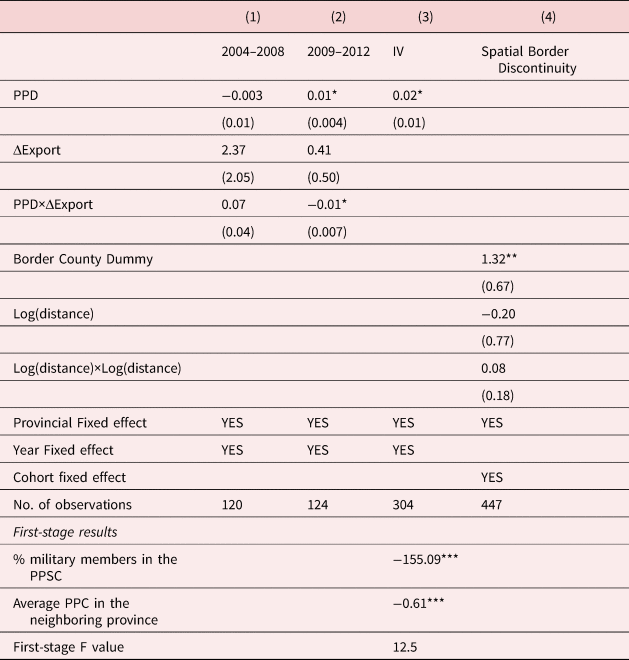
First, we take the 2008 financial crisis as an exogenous shock, which compelled the Chinese government to implement a stimulus package of four trillion RMB yuan (586 billion dollars) to mitigate the crisis. This event allows us to investigate how provincial leadership responded to the shock—that is, whether provincial authorities allowed for more land-fiscalization practices by local governments when the province was hit by the financial crisis, mainly through the export channel because of reduced foreign demand. To capture this export shock, in columns (1) and (2) in Table 5, we control for the interaction between PPD and Log (change of provincial export, ΔExport =  ${{export_t} \over {export_{t-1}}}$) for 2004–2008 and 2009–2012, respectively. As shown, only during 2009–2012 does the coefficient of the interaction PPD×ΔExport turn negative, suggesting that during this period, the marginal effect of PPD was larger when the negative shock of exports was more severe. Further, a decline in exports tends to receive more of a response from provinces with less power-concentrated provincial leaderships than from more power-concentrated provincial leaderships.
Addressing endogeneity

Robust Standard errors in parentheses. Column (1)-column(3) include all benchmark controls. Column (4) controls for county fiscal revenue per capita.
*p < 0.1, ** p < 0.05, *** p < 0.01, one-tail results.
Second, we use the IV method by adopting two exclusive instruments. The first is the percentage of military members in the PPSC. As mentioned, the military does not interfere with civilian affairs within the PPSC, but its presence in the PPSC directly affects provincial power concentration. The second instrument is the average PPD value of the neighboring provinces (excluding the concerned province), which should also reflect the outcome of center–province bargaining, whose influence likely extends across provincial borders.Footnote 13 Column (3) reports the IV estimation results. Both instruments are strong, and they pass the overidentification tests to be valid instruments. According to the first-stage results, more military members in the PPSC and greater power concentration in neighboring provinces tend to increase power concentration in the PPS and PG. The coefficients of PPD are still significant and have positive signs.
Finally, we also used the province-border discontinuity design (PBDD) to test whether counties with different PPDs differ significantly in land fiscalization. We did this by focusing on adjacent counties across provincial borders and assuming they are similar, except that they face different provincial authorities with different PPDs. This limits the analysis to 66 cohorts, each of which contains two or three adjacent counties on different sides of provincial borders (Table A2 in the Appendix). To implement PBDD, we construct a county dummy, Border, assigning value of 1 if the PPD value is greater than that of the adjacent counties. We also obtained all land-sale cases in the counties from 2007 to 2012 from the Ministry of Land and Resources. These were then aggregated at the county level to calculate CRI over the period. The PBDD specification is as follows:
CRI = α1*Border + α2*log(distance) + α3*log(distance)2 + μ + γ + ε,
where μ and γ are the fixed effects for province and cohort, respectively. Distance is the distance between the adjacent county seat to the provincial borders. Column (4) reports the results, which are consistent with our hypothesis that counties with a higher PPD experience a higher level of land fiscalization.
4.5 How the PPD effect operates
As mentioned, local governments’ land-fiscalization strategies include suppressing the price of industrial land and increasing the price of commercial and residential land. Given the findings thus far—namely, that a more dispersed power distribution in provincial leadership (PPD) will drive a higher commercial and residential land price/industrial land price ratio (CRI)—it is natural to ask whether the CRI–PPD association reflects the effect of PPD on the denominator component of CRI or the effect on the numerator component. To consider this, in column (1) of Table A3 in the Appendix, we regress the log of the unit price of industrial land use on PPD to see how provincial power concentration affects the denominator component of the land-fiscalization index. In column (2), we regress the log of the unit price of commercial and residential land on PPD to see how provincial power concentration affects the numerator component of the land-fiscalization index. These results, based on reduced-form regressions, suggest that less power concentration among provincial leaders encourages local governments to reduce the price of industrial land and increase the price of commercial and residential land, thus confirming existing studies regarding the ways local governments manipulate land supply and demand in land fiscalization (Zhang, Fan, and Mo Reference Zhang, Fan and Mo2017; Su and Tao Reference Su and Tao2017).
4.6 Public employment: An alternative tool of distributive politics
In the literature, offering public employment is widely viewed as a strategy for buying support in both democratic and autocratic systems (Robinson and Virder Reference Robinson and Verdier2013; Ang Reference Ang2016). In China, however, provincial leaders have little discretion in offering public positions to lower-level bureaucrats; this is because the central government, rather than provincial governments, have the final say on this issue. Thus, from the perspective of supply-side distributive politics, the importance of providing public positions should pale in comparison with land fiscalization, over which provincial leaders have more discretion in policy making. This conjecture was examined using the ratio of the number of personnel in the entire local bureaucracy in the total population as the dependent variable (column 3 in Table A3). The result confirms the expectation that provincial power concentration has no significant relationship with the scale of public employment.
5. Conclusions
We have proposed that in an institutionalized single-party regime, political elites have incentive to buy loyalty and support from lower-level officials, and the demand for support from below varies according to power concentration within the leadership. Using provincial-level data on power dispersion in PPSCs and land-fiscalization practice within provinces, we found robust evidence that less power concentration in a PPSC resulted in increased land-fiscalization practices in the province.
This research calls for a reexamination of the political logic underlying economic policy in China. Given China's rapid economic growth, the conventional wisdom tends to posit that Chinese political elites design and assign economic policies via a top-down style to promote economic growth and generate fiscal revenues, and lower-level officials participate in tournaments to accomplish the policy objectives and advance their political careers (Xu Reference Xu2011). Our research instead lays out the distributional effects of economic policies, by which powerful patrons allot more fruits of economic growth to their subordinates when power is more evenly dispersed among leadership and political competition is fierce. Thus, even in China, which has long been viewed as a centralized regime with a strong ability to compel lower-level officials to implement the policy agendas of the higher-ups, economic policies can be an outcome out of the higher-ups’ incentive to dispense benefits to their subordinates to win bureaucratic support from below.
This logic is not confined to China. Other Asian developmental states, which were also authoritarian in nature when their economies took off, have emphasized government interference in the market and have highly professional bureaucracies for execution (Grabowski Reference Grabowski1994; Huff, Dewit, and Oughton Reference Huff, Dewit and Oughton2001; Haggard Reference Haggard2018). Although these states have long been touted as paradigms of success in economic development (Johnson Reference Johnson and Woo-Cumings1999; Huff, Dewit, Oughton, Reference Huff, Dewit and Oughton2001; Vu Reference Vu2010), political elites in those countries likely have the same incentives as their Chinese counterparts to use economic policies to distribute goods and resources in exchange for support. Many studies have noted that in Asian developmental states such as South Korea, Taiwan, Malaysia, and Indonesia, fast economic growth, directed by competent bureaucrats, usually coexisted with a huge patronage system administered by the ruling party to secure loyalty from bureaucrats (Pepinsky Reference Pepinsky2009; Kim and Vogel Reference Kim and Vogel2011; You Reference You2015). Our research suggests that economic policies, including land-use policies, in developmental states should be highlighted not only for their effectiveness in promoting growth but also for their value for achieving political ends.
Acknowledgments
This work is supported by the National Natural Science Foundation of China (72173025, 71773019) and innovative research groups project of the National Natural Science Foundation of China (72121002). We thank Hui Wang, Chuanhao Tian, Ruixue Jia, Shuo Chen, Jiangnan Zhu, Ran Tao, Victor Shih, Lei Guang, and all the participants of the 2017 Fudan–UC Young Scholars Conference at UCSD for their comments and suggestions on this article. We especially thank Shuai Wang (Beijing Normal University) for her excellent help in dealing with the geographic data. All errors of this article are our own.