Introduction
Gastrointestinal nematodes (GIN) are the parasites most frequently observed in sheep (Waller, Reference Waller2003). Regional epidemiological studies describing parasitosis dynamics, including the parasite, host and environment, are critical to understanding the factors that influence disease severity within a population in a defined environment (Fiel, Reference Fiel, Nari and Fiel1999). Epidemiology determinants describe models in specific geographical zones, based on seasonal availability of larvae, variations in parasite load and sources of contamination (Sréter et al., Reference Sréter, Molnar and Kassai1994).
The magnitude of the infection depends on the biology of the host and the parasite, the number of species and individuals parasitized, age, and physical and nutritional condition (Valderrábano et al., Reference Valderrábano, Delfa and Uriarte2002) and the natural resistance of the host (Niezen et al., Reference Niezen, Waghorn and Charleston1998). For example, periparturient ewes can be an important source of GIN contamination in grazing animals (Kahn et al., Reference Kahn, Knox, Walkden-Brown and Lea2003).
Additionally, it has been shown that the Suffolk breed of sheep may be more susceptible to GIN infections in comparison with other sheep breeds, i.e. US sheep native to the Gulf coast, Santa Inés, Katahdin, Saint Croix and Dorper (Li et al., Reference Li, Miller and Franke2001; Matika et al., Reference Matika, Nyoni, Van Wyk, Erasmus and Baker2003; Amarante et al., Reference Amarante, Bricarello, Rocha and Gennari2004; Burke & Miller, 2002, Reference Burke and Miller2004). This paper compares a specific population on the farm used for the study, as is often the case in small research studies when two breeds are used.
Environmental factors such as temperature and relative humidity are fundamental for GIN egg and free-living larval development (Tembely et al., Reference Tembely, Lahlou-kassi, Rege, Sovani, Diedhiou and Baker1997); therefore, these factors limit the geographic distribution of some species. Thus, Haemonchus contortus, Trichostrongylus sp. and Strongyloides papillosus are more prevalent in tropical regions, while Teladorsagia and Nematodirus are more prevalent in temperate or cold regions (Soulsby, Reference Soulsby1965).
Carrying out effective control requires an understanding of the life cycles of parasites, the ecology of infective third-stage larvae (L3) and the management practices that prevent or limit contact between parasite and host. Grassland rotation is a complementary parasite control measure, as it reduces the quantities of larvae present on pastures (Niezen et al., Reference Niezen, Waghorn and Charleston1998).
Here, the aims were to determine egg-shedding frequency (percentage of egg-positive faecal samples) and faecal egg counts (FEC) over 13 months in two different breeds of ewes, both pregnant and non-pregnant. Additionally, the effect of ivermectin and albendazole treatments on FEC reduction was recorded. The study also relates temperature and rainfall to FEC. The GIN L3 genera recovered from both faeces and grassland pastures in a temperate region were also assessed
Materials and methods
Study site
Field research was carried out in the Centre for Teaching, Research and Expansion in Ovine Production of the School of Veterinary Medicine (CEIEPO), Huitzilac, state of Morelos, Mexico, located at 19°03′N, 99°14′W. The altitude was 2810 m, temperate (cb (w2)) with humidity and rainfall from June to October (García, 1988). Meteorological data (temperature and rainfall) were recorded at the CEIEPO meteorological station. The Centre has introduced Kikuyo (Pennisetum clandestinum) and native grass pastures.
Ewe samples and faecal analyses
A group of 25 Dorset ewes and another of 25 Suffolk ewes were employed in the study. The formula n= Z2pqn/(NE2 +Z2pq) was used to calculate the sample size (where n is the sample size; Z is the confidence level; p is positive variability; q is negative variability and E is the accuracy or error); also, more animals were included considering the low numbers and absences during the course of the study. Healthy ewes aged 3–7 years were used, with similar body condition, weighing 70–90 kg. Of these, 65% were pregnant, and births occurred between January and February 2005. The ewes were kept on daily rotational pasture in meadows from 08.00 to 16.00 hours and housed in floor pens at night. Both flocks grazed the same pastures and received a food supplement with 14% protein.
Every 28 days, from May 2004 to May 2005, sheep were subjected to coprological examination: faecal samples were collected from the rectum and analysed using the McMaster technique to identify positive samples (i.e. those recording the presence of eggs) and to determine the frequency of egg shedding ((positive samples/total samples) × 100) and the FEC (Hendrix, Reference Hendrix1999). The frequency of egg shedding and FEC in ewes were related to monthly temperatures and rainfall data. In June, ewes from both groups were treated with ivermectin (200 mg/kg); in September, ewes were treated with albendazole (10 mg/kg). The percentage reduction in FEC was determined using the following formula: ((average eggs per g faeces (epg) before treatment − average epg after treatment)/average epg before treatment) × 100 (Eckert et al., Reference Eckert, Schneiter and Wolf1984).
Coprocultures from each group of ewes were prepared with positive samples to obtain the percentage of each GIN genus present (Liébano, Reference Liébano, Campos and Bautista1989; van Wyk et al., Reference van Wyk, Cabaret and Michael2004). Positive samples from each breed were pooled, incubated for 14 days at 27°C and removed daily to allow aeration. Larvae were collected using the Baermann technique (Hendrix, 1999). The L3 recovered from each breed were used to determine the GIN genera percentages.
Collection of larvae from pasture
Every 28 days grass samples were taken between 13.00 and 15.00 hours from the active and resting pastures to determine quantity of larvae per kg and genera percentage by means of L3. Temperature and rainfall parameters were correlated with the previously described parameters. There was rotational grassland management, with ewes grazing in naturally contaminated meadows. Five equidistant transects were laid in pastures where the sheep had grazed for 4–5 days and another five transects were laid in pastures rested for 30–40 days. Grass (approximately 300 g) was collected from each transect. These samples were placed in gauze and submerged in buckets of water for 12 h. Larvae were concentrated utilizing the Baermann technique (Hendrix, Reference Hendrix1999). The larvae collected were classified and the percentages of genera were obtained (van Wyk et al., Reference van Wyk, Cabaret and Michael2004).
Statistical analyses
We performed Fisher's exact test to compare the frequency of egg shedding between breeds over 13 months. Logarithmic transformation (log helminthic reinfection +1) of the data was done to identify normality and homogeneity of variances; however, this failed, so tests were non-parametric. Analysis of the FEC numbers was by the Wilcoxon test to determine statistical differences between paired samples from adjacent months. The Mann–Whitney U test was used to show the difference in FEC between breeds and the months of study. The Spearman ρ was used to correlate FEC, the average monthly temperature and monthly rainfall. The Mann–Whitney U test was used to interpret the statistical differences in FEC during the peripartum period and to compare the quantity of L3 recovered from grasslands in use and at rest between months. The Spearman coefficient was used to relate L3 with temperature and rainfall quantity in the rainy and dry seasons.
The amount of L3 (number of larvae; NL) collected per pasture was transformed logarithmically (log NL +1) and multiple comparisons were made to verify statistical differences between the larval amount by months. There was no normality or homogeneity of variances, which were used with the Mann–Whitney U test to determine the statistical differences in the amount of L3 month by month, comparing the temperature and rainfall between grazing pastures and those at rest.
Results
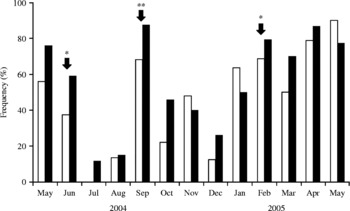
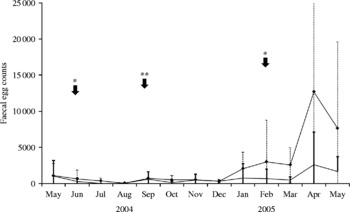
Over the year, the frequency of GIN egg-positive samples from Dorset ewes was 44.6%, with 0 to 2450 ± 1137 FEC detected. In Suffolk ewes, the annual frequency was 55%, with an FEC between 50 ± 0 and 12,684.6 ± 4064.2. Overall, there were no statistically significant differences in frequency between breeds (P>0.1); nevertheless, FEC were higher in Suffolk ewes during October, February, March and April (P< 0.05) (figs 1 and 2).
Frequency of gastrointestinal nematodes in Dorset (white bars) and Suffolk (black bars) ewes (May 2004 to May 2005). Arrows indicate anthelmintic treatment: * ivermectin, ** albendazole.

Faecal egg counts of gastrointestinal nematode in faeces of two breeds of ewe (May 2004 to May 2005). Statistical difference (P< 0.05) in October, February, March and April. Arrows indicate anthelmintic treatment: * ivermectin, ** albendazole. Faecal egg counts were higher in Suffolk (–♦–) ewes than in Dorset ewes (—). In the rainy season the faecal egg count decreased due to anthelmintic treatment; the highest faecal egg counts were recorded in the dry season due to peripartum.

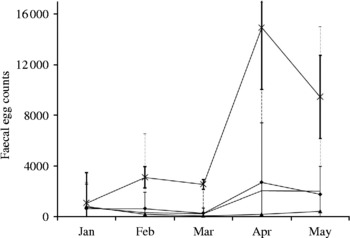
An increase in FEC among pregnant ewes and in peripartum was recorded. During February, March and April, there were significant differences in FEC between ewes with and without peripartum, particularly Suffolk ewes (P< 0.05). In periparturient ewes FEC were higher than in ewes without peripartum, but there was no significant difference in FEC in Dorset ewes (P>0.1); however, there were significant differences between Suffolk ewes with and without peripartum in February, March, April and May 2005. There were no statistical differences in FEC between Dorset and Suffolk ewes without peripartum (P>0.1), but there were between Dorset and Suffolk periparturient ewes in February, March, April and May 2005 (P< 0.1) (fig. 3).
Faecal egg counts of gastrointestinal nematode in faeces of ewes without peripartum and with peripartum. There was no significant difference in faecal egg count in Dorset ewes (P>0.1); however, there were differences between Suffolk ewes with and without peripartum in February, March, April and May 2005. There were no statistical differences in faecal egg count between Dorset (—) and Suffolk (–▲–) ewes without peripartum (P>0.1), but there were differences between Dorset (–♦–) and Suffolk ( ) periparturient ewes in February, March, April and May 2005 (P< 0.1).

The administration of anthelmintic treatment decreased the FEC. The effect of ivermectin administered in June on the percentage reduction was from 100% to 82% after 7 days, while that applied in February was from 27.7% to 11.6% after 21 days; the effect of albendazole administered in September was a reduction from 67.4% to 48% after 14 days.
Genera of gastrointestinal nematodes
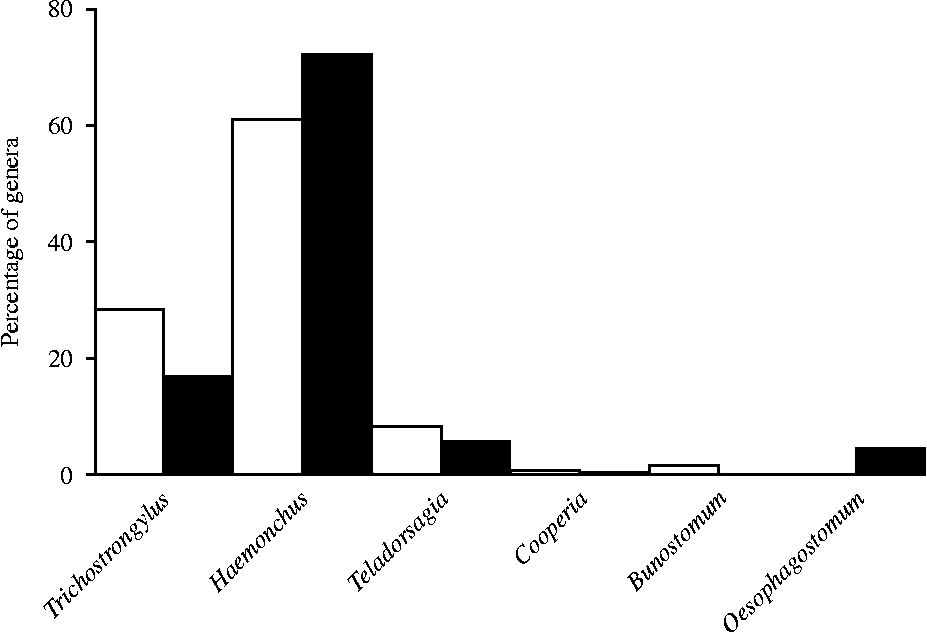
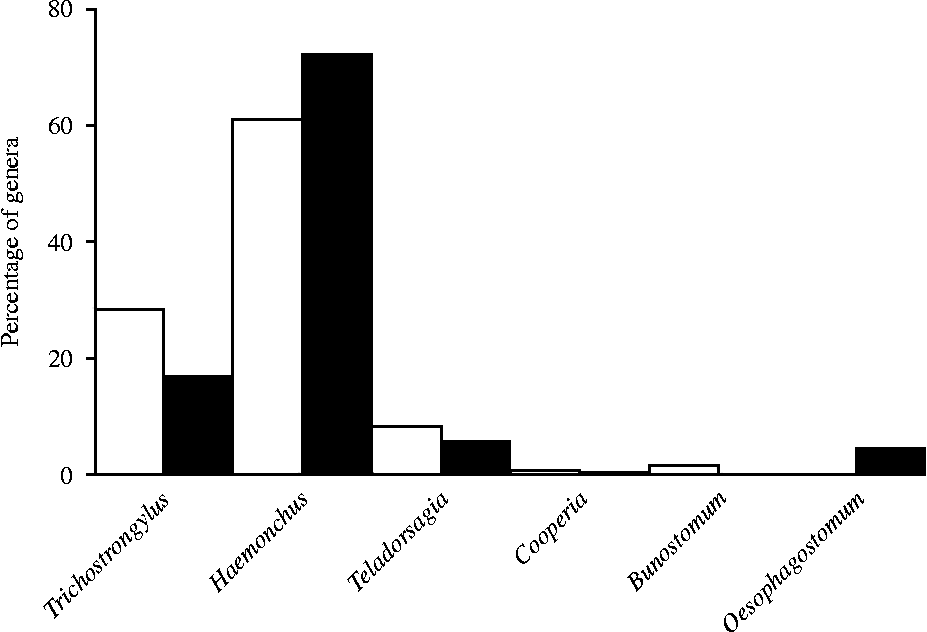
The identified genera in coprocultures were: Haemonchus (69.6%), Trichostrongylus (20%), Teladorsagia (6.4%) and Cooperia (0.4%). Additionally, in Dorset ewes, Bunostomum (0.4%) was recorded and Oesophagostomum (4.5%) was detected in Suffolk ewes. Figure 4 shows the genera in each breed. Table 1 shows the genera collected each month. Of the total larvae, 42% were collected in the rainy season while the remaining 58% were collected in the dry season.
Genera of gastrointestinal nematodes in coprocultures of Dorset (white bars) and Suffolk (black bars) ewes.
The proportion of genera of gastrointestinal nematodes from coprocultures of ewe faeces at the Centre for Teaching, Research and Expansion in Ovine Production of the School of Veterinary Medicine (CEIEPO), Morelos, Mexico.

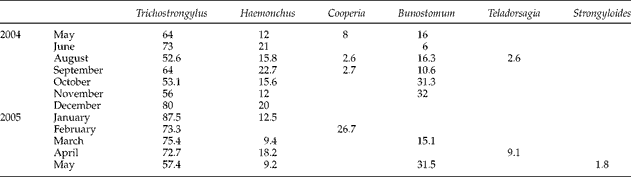
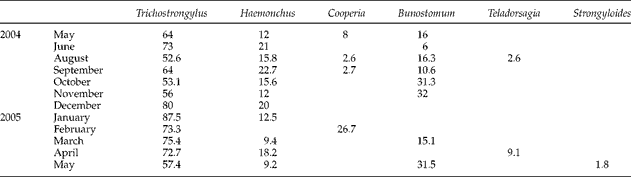
In grass samples collected from the pastures, the quantity varied from 5 to 75 L3/kg. Trichostrongylus (64.6%), Haemonchus (14.6%), Cooperia (2.4%), Bunostomum (17.7%) and Teladorsagia (0.5%) were collected during both seasons. Strongyloides (0.2%) was also recorded during the dry season. Trichostrongylus and Haemonchus were present in all periods. Table 2 shows the genera collected each month. Of the total larvae, 61% were collected in the rainy season and 39% in the dry season. Haemonchus genus larvae were higher in coprocultures. The opposite occurred in Trichostrongylus genus larvae, as the percentage of larvae in coprocultures was lower than in pastures.
The proportion of genera of gastrointestinal nematodes from ewes taken from grass at the Centre for Teaching, Research and Expansion in Ovine Production of the School of Veterinary Medicine (CEIEPO), Morelos, Mexico.
The average number of L3 collected from the grazing pastures was 13.4 L3/kg, and 7.5 L3/kg in resting grasslands. There was a significant difference between grasslands in use and grasslands at rest in May, September and October of 2004 and February of 2005 (P< 0.1).
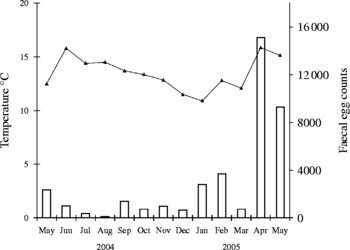
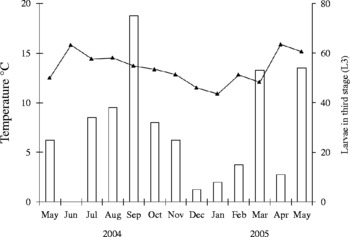
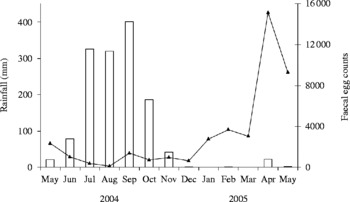
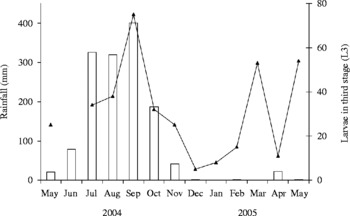
The monthly minimum mean temperature was 10.9°C and the maximum 15.9°C at CEIEPO, and 1310 mm of rain was recorded from May to September 2004. From May to November 2004 the correlation between temperature and L3 quantity was r 2= 0.81; for rainfall and L3, the correlation was r 2= 0.65. From December to May, the correlation between temperature and L3 quantity was r 2= 0.01, while the correlation between rainfall and L3 was r 2= 0.25 (figs 5–8). The highest FEC were recorded in the dry season; however, the highest L3 count was recorded in the rainy season.
Temperature (–▲–) and faecal egg counts (white bars) of gastrointestinal nematodes from ewe faeces.

Temperature (–▲–) and quantity of third-stage larvae (L3) (white bars) of gastrointestinal nematodes recorded at the Centre for Teaching, Research and Expansion in Ovine Production of the School of Veterinary Medicine (CEIEPO), Morelos, Mexico.

Rainfall (mm) (white bars) and faecal egg counts (–▲–) of gastrointestinal nematodes from ewe faeces. The highest faecal egg counts were recorded in the dry season.

Rainfall (mm) (white bars) and quantity of third-stage larvae (L3) –▲– of gastrointestinal nematodes recorded at the Centre for Teaching, Research and Expansion in Ovine Production of the School of Veterinary Medicine (CEIEPO), Morelos, Mexico. The highest L3 counts were recorded in the rainy season.

Discussion
GIN-positive animals were recorded throughout both the rainy and dry seasons during the study period. The frequency of animals shedding GIN eggs and the number of GIN eggs shed varied each month due to environmental influence, breed, physiological conditions and the administration of anthelmintic treatments. Although the frequency of GIN egg shedding was similar in both breeds at most time points, the average number of eggs eliminated was significantly greater in the Suffolk breed of sheep; these findings suggest that Suffolk ewes are less susceptible to GIN infection. This interpretation is consistent with other reports (Li et al., Reference Li, Miller and Franke2001; Matika et al., Reference Matika, Nyoni, Van Wyk, Erasmus and Baker2003; Amarante et al., Reference Amarante, Bricarello, Rocha and Gennari2004; Burke & Miller, 2002, Reference Burke and Miller2004).
Rainfall and FEC were only related from May to November 2004, and with a higher rainfall the FEC increased, so the results obtained here agreed with those recorded in Senegal, Greece, Cameroon, Canada and Ivory Coast (Vercruysse, Reference Vercruysse1983; Theodoropoulus et al., Reference Theodoropoulus, Koutsotolis, Nikolaou, Kalogiannis and Petrakos1998; Ngambia et al., Reference Ngambia, Pandey, Dorny and Killanga2000; Colwell et al., Reference Colwell, Goater and Jacobson2002; Achi et al., Reference Achi, Zisstag, Yeo and Dea2003).
On the other hand, the highest FEC were recorded from December 2004 to May 2005 (the dry season) due to peripartum, so these results were similar to those obtained by Martínez-González et al. (Reference Martínez-González, Díez-Baños and Rojo-Vázquez1998) and confirmed the increase as reported by Chroust (Reference Chroust1997), Romjali et al. (Reference Romjali, Dorny, Batubara, Pandey and Gatenby1997) and Chartier et al. (Reference Chartier, Hoste, Bouquet, Malpaux, Pors and Koch1998). GIN egg excretion varied greatly during the peripartum period, and epg shedding in pregnant ewes was greater when compared with that of ewes without lambs.
In coprocultures, Haemonchus was the most frequent; the Cooperia genus was only observed during the dry season. The Trichostrongylus genus was more frequent in grass samples. Haemonchus frequency is higher in faeces compared with the grass because, primarily, the techniques used were different. However, the females of this genus have high oviposition, and the larvae have low survival, contrary to the case in Trichostrongylus. In the Trichostrongylus genus, although the females lay few eggs, probably the frequency is higher in the grass because the larvae are more likely to survive compared with Haemonchus (Gordon, Reference Gordon1973).
The geographical distribution of species is determined principally by environmental factors; for example, H. contortus, Trichostrongylus sp. and S. papillosus are more prevalent in tropical regions, while Teladorsagia and Nematodirus are more prevalent in temperate or cold regions. This study was conducted in a region classified as temperate, and although it was possible to observe Teladorsagia and Nematodirus during the rainy season and at cooler temperatures, H. contortus and Trichostrongylus were the most common. This is probably because the extreme environmental conditions favour the survival of these species.
The quantity of L3 was related to environmental factors and there was seasonal variation. The highest numbers of L3 were recorded in the rainy season, in agreement with Theodoropoulus et al. (Reference Theodoropoulus, Koutsotolis, Nikolaou, Kalogiannis and Petrakos1998), Agyei (Reference Agyei1995) and Wanyangu et al. (Reference Wanyangu, Karimi, Gatongi, Mugambi and Bain1995). It was observed that the larvae got into the pasture when high temperatures were combined with rain, coinciding with findings reported by Eysker et al. (Reference Eysker, Bakker, Kooyman and Ploeger2005). It was thus interpreted that the larvae climbed up the grass when high temperatures coincided with high precipitation (Fritsche et al., Reference Fritsche, Kaufmann and Pfister1993; Ngambia et al., Reference Ngambia, Pandey, Dorny and Killanga2000). The rain and moisture therefore determined the development of free-living forms to reach the infective stage, so the number of L3 collected on the pastures was higher in the wet season. The quantity of L3 recovered from the pastures increased as egg elimination increased. Thomas & Boag (Reference Thomas and Boag1973) recorded similar findings except in the months that followed treatment administration.
The grasslands most contaminated with L3 were those being grazed at the time of sample collection, except in January, March and April: these results agree with those of Githigia et al. (Reference Githigia, Thamsborg and Larsen2001). In the pasture at rest, the parasite load was lower compared with that in the pastures being grazed. However, the rest period should be longer than 30 days, as infective L3 were still found past this time point. These findings agree with previously published reports (Fiel, Reference Fiel, Nari and Fiel1999).
We conclude that different aspects of GIN epidemiology were confirmed; for example, the effect of peripartum on FEC. Moreover, the influence of rainfall and resting pastures as an alternative method for controlling infective larvae mean that some changes are needed as regards time and space, according to weather conditions and animal management in a temperate region. Additionally, our results highlight the presence of Haemonchus and Trichostrongylus throughout the year. Thus, although these species occur mainly during the rainy season, their prevalence may be expanding throughout the year. These studies are essential as knowledge of the dynamics of nematodiasis and mixed infections are critical for the development of effective monitoring programmes that consider regional environmental factors.
Acknowledgements
Special thanks to the CEIEPO staff, specially to MVZ Martin Villalobos, Karina Hernández-Guzmán, Abel Zapata-Arenas, Fernando Lara-Rojas, Víctor García-Martínez, Roberto Sanginés-de Castro and Gustavo Peralta-Abarca. Perla Maria del Carmen Acevedo-Ramirez was funded by Consejo Nacional de Ciencia y Tecnología.