Introduction
Tobacco smoking is widespread and its use is a contributory factor in the death of 50% of its regular users and the morbidity of many more (malignancy, respiratory complications, coronary heart disease, etc.) (Mannino & Buist, Reference Mannino and Buist2007; World Health Organization, 2008). Despite these published facts, many smokers continue to smoke and one reason for this may be that they often attribute the reinforcing nature of smoking to its ability to help them to concentrate (Hughes & Hatsukami, Reference Hughes and Hatsukami1986) – implying a positive impact upon cognition. The research of tobacco smoking and its constituents, such as nicotine, has produced mixed effects on cognition and memory. For example, the administration of nicotine to non-smokers and deprived smokers has been found to improve recall on a range of cognitive tasks and memory tasks specifically. Such enhancements include improved performance on paired associate learning tasks (Mangan & Golding, Reference Mangan and Golding1995), verbal memory (Rusted etal. Reference Rusted, Graupner, Tennent and Warburton1998), working memory (Pineda etal. Reference Pineda, Herrera, Kang and Sandler1998), and has been associated with improvements in mood and memory in people suffering from a range of psychiatric conditions, including schizophrenia and depression (Bacher etal. Reference Bacher, Rabin, Woznica, Sacco and George2010). These increases in efficiency of cognition and memory associated with nicotine ingestion is consistent with the notion that nicotine acts to stimulate the cholinergic system that plays a functional role in maintaining a state that promotes efficient information processing. However, tobacco smoking includes not only nicotine ingestion, but also the inhalation of a toxic mixture of chemicals resulting from the ignition of the tobacco leaves. Therefore, smoking per se may be very different from the administration of nicotine alone. The cognitive deficits associated with prolonged tobacco smoking have been observed by a number of researchers, including smoking-related deficits in psychomotor speed (Whalley etal. Reference Whalley, Fox, Deary and Starr2005), general cognitive decline (Cervilla etal. Reference Cervilla, Prince and Mann2000), verbal memory (Richards etal. Reference Richards, Jarvis, Thompson and Wadsworth2003), as well as working memory (Hill etal. Reference Hill, Backman and Neely2000; Ernst etal. Reference Ernst, Heishman, Spurgeon and London2001; Jacobson etal. Reference Jacobson, Krystal, Mencl, Westervel, Frost and Pugh2005; Fried etal. Reference Fried, Watkinson and Gray2006), and executive function (Kalmijn etal. Reference Kalmijn, van Botel, Verschuren, Jolles and Launer2002; Jacobson etal. Reference Jacobson, Krystal, Mencl, Westervel, Frost and Pugh2005; Sabia etal. Reference Sabia, Marmot, Dufoil and Singh-Manoux2008). Taken together, this research suggests that persistent tobacco smoking per se is associated with impairments in cognition and memory. Given the adverse effects tobacco smoking has upon the health and cognition, it is important to gain a fuller understanding of what impact persistent tobacco smoking has on other domains, such as everyday cognition.
Prospective memory (PM) is the cognitive ability of remembering to carry out particular actions at some future point in time (Brandimonte etal. Reference Brandimonte, Einstein and McDaniel1996; McDaniel & Einstein, Reference McDaniel and Einstein2007) and provides an ideal context from which to study smoking-related everyday cognitive deficits. Lapses in PM can have consequences for everyday life, ranging from relatively minor ones (e.g. forgetting to meet with one's friends can cause embarrassment) to the fairly major ones (e.g. forgetting to take an important medication on time can have serious health repercussions). Studies involving the acute administration of nicotine, which acts to stimulate the cholinergic system, have found improvements in simple PM (i.e. when the PM task is carried out in isolation), but not when the PM task is accompanied by a secondary task (a more complex PM paradigm) (Rusted etal. Reference Rusted, Trawley, Heath, Kettle and Walker2005, 2009; Rusted & Trawley, Reference Rusted and Trawley2006). Recent work from this group has elucidated this by observing that nicotine enhancement of the cholinergic system produces stimulation in the parietal lobes of the brain (which may account for the boost in simple PM paradigms), with no such benefit to the prefrontal cortex of the brain (which could account for the failure to boost PM on more complex tasks – which would rely more heavily on prefrontal cortical activity) (Rusted etal. Reference Rusted, Ruest and Gray2011). However, since the aim of the current study is to observe whether tobacco smoking per se affects PM, it is necessary to consider the literature on tobacco smoking and PM in general. Only two published studies to date have considered the relationship between natural recreational smoking and PM. In the first of these (Heffernan etal. Reference Heffernan, Ling, Parrott, Buchanan, Scholey and Rodgers2005), smokers reported significantly more everyday PM lapses (using the Prospective Memory Questionnaire (PMQ) (Hannon etal. Reference Hannon, Adams, Harrington, Fries-Dias and Gibson1995) when compared with a never-smoked group. In the second study (Heffernan etal. Reference Heffernan, O'Neill and Moss2010), this was extended to observe that smokers recalled significantly fewer items on an objective laboratory-based PM task in the form of the Cambridge Prospective Memory Task (CAMPROMPT) (Wilson etal. Reference Wilson, Emslie, Foley, Shiel, Watson, Hawkins, Groot and Evans2005) when compared with a never-smoked comparison group. These findings were observed after controlling for a range of other variables, such as mood, other drug use, and IQ; supporting the notion that persistent tobacco smoking impairs PM.
Given that PM is critical to everyday functioning (McDaniel & Einstein, Reference McDaniel and Einstein2007) it is important to observe whether smoking-related PM deficits extend to more real-world paradigms; the current study attempts to achieve this by utilising the Prospective Remembering Video Procedure (PRVP) as an objective measure of PM alongside the PMQ. The PRVP involves remembering a series of pre-determined location–action combinations while viewing a short CD clip of a busy shopping high street and has been used previously to reveal selective PM deficits in both cannabis users (Bartholomew etal. Reference Bartholomew, Holroyd and Heffernan2010) and binge drinkers (Heffernan etal. Reference Heffernan, Clark, Bartholomew and Ling2010). Since other variables may impact upon PM independent of smoking, such as other substance use/dependence [e.g. cannabis (Bartholomew etal. Reference Bartholomew, Holroyd and Heffernan2010), excessive alcohol use (Heffernan etal. Reference Heffernan, Clark, Bartholomew and Ling2010), and ecstasy (Rodgers etal. Reference Rodgers, Buchanan, Scholey, Heffernan, Ling and Parrott2011), as well as anxiety and depression (Parrott etal. Reference Parrott, Morinan, Moss and Scholey2004)], anyone meeting one or more of these criteria were excluded from the study. The main aim of the study was to observe whether smoking-related PM deficits were observable on the PRVP when compared with a never-smoked comparison group. Self-reported PM lapses were also measured in order to determine the level of self-awareness of any putative PM deficits in smokers. If persistent smoking does impair PM then one would expect smokers recall fewer location–action combinations on the PRVP than a never-smoked comparison group.
Method
Sample
One-hundred and thirty young undergraduate students studying at a university in the North East of England were recruited via student notice boards and word of mouth. All of the participants were either in their first or second year of an undergraduate degree in the social sciences and were educated to A’ level status (having either an B, B, C profile or a B, B, B profile). All were between 18 and 25 years of age so as to control for age variations between the two groups, all reported that they were in good general health and were further screened on a number of criteria outlined below. Following screening, 52 were omitted on the basis that they met one or more of the following exclusion criteria. (1) They were using other illegal substances (e.g. ecstasy, cannabis). (2) They had used alcohol within the last 48 hours. (3) They were drinking in excess of UK Government guidelines for safe drinking – currently 21/14 units of alcohol per week for males/females, respectively (Cabinet Office Strategy Unit, 2004). (4) They were ‘binge-drinkers’ (Office for National Statistics, 2003). (5) They reported having suffered from/were suffering from a psychiatric condition (e.g. an anxiety disorder, clinical depression, substance dependence, clinical amnesia). The remaining 78 participants were educated to A’ level standard and studying on a university degree course. Thirty-nine of these (14 males) were existing smokers – someone who smoked a minimum of 10 cigarettes per day, had been smoking for a minimum of 18 months and reported not using any other tobacco product apart from cigarettes (e.g. cigars, pipe). Thirty-seven of these had smoked immediately before beginning the study (which avoided them being in a potential state of ‘smoking withdrawal’ just before carrying out the PRVP – which some authors have suggested can lead to decrements in cognitive performance (Sakurai & Kanazawa, Reference Sakurai and Kanazawa2002), and two others had smoked within the previous  $$-->$<>\tfrac{{\rm{1}}}{{\rm{2}}}$$$
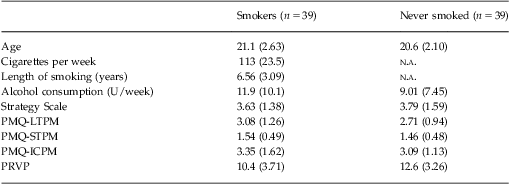
hour. The requirement to smoke immediately before participation (or very shortly before in the case of two participants) had the added advantage in that all the smoking participants would be at similar levels of nicotine ingestion, therefore reducing the possibility of them being in various states of ‘nicotine enhancement’ which can lead to cognitive enhancement (Rusted etal. Reference Rusted, Sawyer, Jones, Trawley and Marchant2009, 2011). The remaining 39 had never smoked any tobacco product throughout their lives (18 males). Mean ages, smoking characteristics (smokers only), and mean alcohol use data are contained in Table 2.
Substance use
Smoking and other drug use were assessed by a modified version of the University of East London Recreational Drug Use Questionnaire (Parrott etal. Reference Parrott, Milani, Parmar and Turner2001). This asked questions on smoking status and history, including the type of tobacco product used (only those who smoked cigarettes were included), how much they smoked per week, how long they had been using the drug (in years) and when it was last used (in hours). Similar details were also collected regarding the use of other drugs (e.g. alcohol, cannabis, and ecstasy). The respondent was also asked to provide brief details of any psychiatric condition which they had/were suffering from (such as a substance dependence disorder, clinical depression, or amnesia).
Self-reported PM
Self-reported PM was assessed using the standardised PMQ (Hannon etal. Reference Hannon, Adams, Harrington, Fries-Dias and Gibson1995) which measures long-term habitual PM (PMQ-LTPM; e.g. ‘I missed appointments I had scheduled’), short-term episodic PM (PMQ-STPM; e.g. ‘I forgot to button or zip some part of my clothing as I was dressing’), and internally cued PM (PMQ-ICPM; e.g. ‘I forgot what I wanted to say in the middle of a sentence’). Each item consisted of a statement, followed by a nine-point scale ranging from ‘never’ (1 point), through to a midpoint of ‘2 times/month’ (5 points) and finally through to ‘4 or more times/month’ (9 points), with the higher the score indicating the greater the number of lapses reported. A fourth scale comprised a strategy scale which measured the number of strategies used to aid remembering, from 1 (few techniques used) to 9 (a great deal of techniques used) with the greater the score the more strategies used to aid remembering.
Objective PM
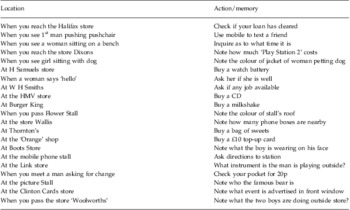
Objective PM was measured by the PRVP based on a methodology used by earlier researchers to study cannabis and binge-drinking (Bartholomew etal. Reference Bartholomew, Holroyd and Heffernan2010; Heffernan etal. Reference Heffernan, Clark, Bartholomew and Ling2010). The PRVP involved presenting a list of 21 specific locations (e.g. ‘When you reach the Halifax store’) accompanied by a list of associated actions (e.g. ‘Check if your loan has cleared’) that the respondent viewed for 1.5 minutes. The participant then watched a 10-minute CD clip of a busy shopping area depicting a range of shop fronts and passers-by that contained the previously presented to-be-recalled location–action combinations (see Table 1 for the full list of combinations) along with a series of distracter events. Examples of such distracters include the emergence of other (non-target, yet similar in type) shop locations, and passers-by that appear on the video clip (in addition to the main targets identified in Table 1), but that do not require a response. This therefore increases the complexity of the task and makes the task more akin to real-life PM functioning. Before watching the CD clip, the participant was instructed that he/she should only write down each location–action combination on a blank response sheet when the familiar location was reached on viewing the CD clip and not before. This was to ensure that the participant recalled each combination as part of the ongoing PM task presented on the CD clip. The participant was observed by the experimenter throughout the PRVP in order to ensure that he/she only wrote down the particular action when the specific location was reached. All of the participants followed this instruction clearly. One point was given for each location–action combination correctly recalled, ranging from 0 to 21, with the higher score indicating more proficient PM. The PRVP has been used in previous research and shows good reliability (α = 0.68) (Bartholomew etal. Reference Bartholomew, Holroyd and Heffernan2010; Heffernan etal. Reference Heffernan, Clark, Bartholomew and Ling2010).
Full list of the 21 location–action/memory combinations used in the PRVP

PRVP, Prospective Remembering Video Procedure.
Statistics
All data were entered in SPSS-16. Chi-square was applied to the data to compare the gender break down across the smokers and the never-smoked group. One-way analyses of variances (ANOVAs) compared the two groups on age, units of alcohol consumed per week, and number of strategies used to aid memory. Finally, a series of one-way analyses of co-variances (ANCOVAs; controlling for weekly alcohol use) were applied to the PM data to compare smokers and the never-smoked groups on the PMQ-LTPM, PMQ-STPM, and PMQ-ICPM and scores from the PRVP.
Results
Chi-square analysis revealed no significant gender difference between the smokers and the never-smoked group [χ 2(1) = 1.31, p = 0.25]. A series of one-way ANOVAs revealed no significant differences between the two groups in terms of age (F(1, 76) = 0.99, p = 0.32), units of alcohol consumed per week (F(1, 76) = 2.11, p = 0.15), or strategy use (F(1, 76) = 0.22, p = 0.63) – see Table 2 for descriptive data. Since the two groups did not differ on age or strategy use, neither were controlled for in the following analyses. However, given evidence that alcohol can impede PM (Heffernan etal. Reference Heffernan, Clark, Bartholomew and Ling2010) it was included as a covariate (to be ultra cautious) in the following analyses. Table 2 also contains the descriptive data for the number of lapses reported on the PMQ-LTPM, PMQ-STPM, and PMQ-ICPM; as well as the number of correct location–action combinations recalled from the PRVP. A series of one-way ANCOVAs (with weekly alcohol use as a covariate) were applied to the PM data comparing smokers with the never-smoked group. This revealed no significant between-group differences on PMQ-LTPM (F(1, 75) = 2.02, p = 0.15), PMQ-STPM (F(1, 75) = 0.17, p = 0.68), nor PMQ-ICPM (F(1, 75) = 0.54, p = 0.46), but smokers did recall significantly fewer location–action combinations on the PRVP than the never-smoked group (F(1, 75) = 7.64, p < .01).
Smokers and never-smoked group descriptive data
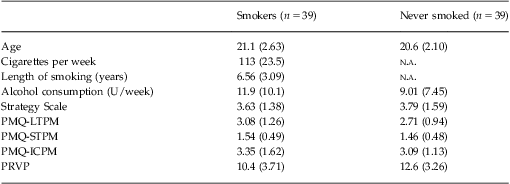
n.a., not applicable; PMQ-LTPM, Prospective Memory Questionnaire-Long Term Prospective Memory; PMQ-STPM, Prospective Memory Questionnaire-Short Term Prospective Memory; PMQ-ICPM, Prospective Memory Questionnaire-Internally Cued Prospective Memory; PRVP, Prospective Remembering Video Procedure.
Means and standard deviations (in parentheses) comparing both groups on age, cigarettes per week and length of smoking in years (smokers only), units of alcohol consumed per week, scores on the PMQ Strategy Scale, the PMQ-LTPM, PMQ-STPM and PMQ-ICPM; and scores from the PRVP.
Discussion
Smokers recalled significantly fewer location–action combinations on the PRVP when compared with a never-smoked group. This finding is consistent with the only previous published study in this area that has observed objective PM deficits in smokers using the CAMPROMPT (Heffernan etal. Reference Heffernan, Clark, Bartholomew and Ling2010) – but importantly the present study extends this to reveal such deficits on a more naturalistic PM task incorporating routines often followed in the real world. The lack of any observed differences between smokers and the never-smoked group on self-reported PM in the current study suggests that smokers lack self-awareness of their PM problems; a conclusion reached by other authors studying other drug using cohorts such as cannabis users (Bartholomew etal. Reference Bartholomew, Holroyd and Heffernan2010) and binge drinkers (Heffernan etal. Reference Heffernan, Clark, Bartholomew and Ling2010). The current findings cannot be attributed to the use of other illegal substances (cannabis, ecstasy), excessive or ‘binge’ drinking, anxiety, depression, or some other major clinical condition, since people reporting these were screened out before the main study. The fact that the smokers and the never-smoked group did not differ in terms of gender, age, ‘safe’ levels of alcohol use, and strategy use again means that these findings cannot be attributable to variations in these other factors.
The findings from the current study extend our understanding of smoking-related PM deficits and supports the notion that PM deficits should be added to the growing list of neuropsychological sequelae associated with persistent smoking (Cervilla etal. Reference Cervilla, Prince and Mann2000; Hill etal. Reference Hill, Backman and Neely2000; Ernst etal. Reference Ernst, Heishman, Spurgeon and London2001; Kalmijn etal. Reference Kalmijn, van Botel, Verschuren, Jolles and Launer2002; Richards etal. Reference Richards, Jarvis, Thompson and Wadsworth2003; Jacobson etal. Reference Jacobson, Krystal, Mencl, Westervel, Frost and Pugh2005; Whalley etal. Reference Whalley, Fox, Deary and Starr2005; Fried etal. Reference Fried, Watkinson and Gray2006; Sabia etal. Reference Sabia, Marmot, Dufoil and Singh-Manoux2008) – but extends the focus to a more naturalistic setting, i.e. recalling everyday actions to be recalled at different locations on a busy ‘high street’, while ignoring irrelevant distracter tasks, as well as incorporating important controls into the study. The move to more naturalistic PM paradigms is a move welcomed by current researchers in the field (McDaniel & Einstein, Reference McDaniel and Einstein2007) and should be pursued by future researchers using a variety of real world PM tasks.
The reduced PM functioning in current smokers may reflect some underlying physiological damage, although it should be noted that these mechanisms are not yet fully understood. However, given the links between PM functioning and prefrontal/frontal cortical activity in the brain (Simons etal. Reference Simons, Scholvinck, Gilbert, Frith and Burgess2006; Kliegel etal. Reference Kliegel, Jager, Altgassen and Shum2008), it is possible that reduced activity in these regions underpin the reduced PM functioning observed here and based upon recent evidence (Ghosh etal. Reference Ghosh, Mishra, Das, Kaushil and Basu2009) it is feasible that the dangerous carcinogens in tobacco smoking may be responsible for such deficits. Such conclusions are tentative and future research might wish to utilise functional brain-imaging techniques alongside PM tasks to elucidate the links between persistent smoking, reduced PM performance and potential cortical and sub-cortical damage.
These findings augment arguments about the harmful effects persistent smoking has upon everyday cognitive function, in this case everyday PM. Future research should extend the focus by including a battery of objective PM tests in order to provide converging evidence of objective PM deficits in the same cohort of smokers. For example, it has been recently suggested that virtual reality (VR) tasks could be useful ways of assessing PM functioning in clinical and non-clinical samples (Rose etal. Reference Rose, Brooks and Rizzo2005). VR technology could therefore be used to study smoking-related deficits in laboratory-controlled yet more ecologically valid testing paradigms. Although the PRVP has proven to be a useful tool for uncovering drug-related deficits both in the present study and elsewhere (Bartholomew etal. Reference Bartholomew, Holroyd and Heffernan2010; Heffernan etal. Reference Heffernan, Clark, Bartholomew and Ling2010) it is possible that the task has a strong associative learning component in the sense that the location–action combinations are dependent upon successful learning in the first place before the PM task is initiated. Therefore, it is possible that the deficits observed here might be due to differences in the extent to which the associations have been learnt rather than PM deficits. Current thinking in the area (Rose etal. Reference Rose, Brooks and Rizzo2005) envisages PM as containing two stages – an initial learning stage wherein the intentions (actions) are associated with the cues (locations) and a later recall stage wherein the cue appears in the environment (on the video clip) and triggers the recall of the intended action (i.e. the appearance of the Thornton's shop triggers the intention to buy a bag of sweets). Future work could tease apart whether such PM deficits associated with smoking are the result of the initial learning phase or final recall phase by presenting each participant with a post-PRVP task recognition stage in which all of the location–action combinations that appeared as target items are combined with ‘filler’ combinations that did not appear on the video clip. Therefore, if the two groups (smokers and non-smokers) recognised an equal number of the target combinations (from the array of target/filler combinations) then it can be assumed that the initial learning of these target combinations was equal across the groups. This procedure would therefore allow one to tease apart the initial learning from the later recall stages of the PRVP.
Since there is a paucity of research that has focused on smoking cessation and putative improvements in memory function (Brega etal. Reference Brega, Grigsby, Kooken, Hamman and Baxter2008) it would be informative to compare current smokers with previous smokers in order to assess putative improvements in PM function upon smoking cessation. If PM improvements were observed in those who had stopped smoking, then this information could be used to educate people about the everyday cognitive benefits of stopping smoking.
There are a number of limitations to this research. Biological drug-screening methods could be used to provide an objective measure of drug use; providing a more accurate drug profile rather than relying on self-reported drug use. Therefore, the deficits observed might be due to differences in the extent to which the associations have been learnt rather than PM deficits. A second limitation is that although the screening questions did ask about pre-existing psychiatric conditions, including anxiety and depression, it is feasible that the two groups tested did in fact vary on these measures. Future work should control for such variations by measuring anxiety and depression states using, for example, the Hospital Anxiety and Depression Scale and matching the smokers and never-smoked groups on these variables. A further limitation of the study is the possibility that the PRVP only provides a ‘snapshot’ of everyday PM. As noted elsewhere (Farrimond etal. Reference Farrimond, Knight and Titov2006), intentions are often carried out over prolonged delays (such as hours, days, or weeks) whereas the present task was short in duration; future research should therefore vary the task duration. Cigarette strength should also be controlled for in future research as the amount of nicotine and other chemicals may vary greatly.
It can be concluded that smokers experience greater problems in their everyday PM when compared with those who have never smoked; with other drug use, mood or variations in gender, age, or strategy use, being unable to account for this deficit. It is also apparent that smokers may lack a self-awareness of such deficits. These deficits should be added to the list of cognitive, and in particular memory, deficits associated with smoking. Further research is needed in order to elucidate the links between persistent smoking, PM deficits and putative underlying damage that might underpin such deficits.
Acknowledgements
The authors would like to thank everyone who participated in this study.
Conflict of interest
None.