1 Overview
Issues regarding non-local relations are a challenge to all theories of grammar. Of them, the phenomenon of raising, whereby a semantic argument of an embedded predicate surfaces as a syntactic argument of a higher one, has received much attention in the literature, and, consequently, is subject to many analyses in diverse frameworks. In fact, a comparison of analyses of raising reveals major distinctions between linguistic frameworks or theories (e.g., movement, traces, empty elements, agreement). One recent noteworthy line of research is taken up by Polinsky & Potsdam (e.g., Reference Polinsky and Potsdam2006, Reference Polinsky and Potsdam2012), who extend the inquiry to less investigated languages. Their findings raise questions regarding assumed cross-linguistic (or universal) generalizations and prompt more research, both typological and theoretical.
Raising in Modern Hebrew (MH) exhibits a property that, to the best of my knowledge, has not yet been addressed in the literature. The interaction between raising, inversion and agreement reveals that raising predicates in MH are ‘parasitic’ on properties of their non-finite verbal complements. More specifically, raising predicates can head three different types of constructions, which vary in their agreement and word order properties. The licensing of these constructions is solely determined by the embedded verb and its dependents.
This paper focuses on raising predicates in MH and the types of constructions in which they appear. Section 2 provides an initial glimpse of the data by comparing the syntactic behavior of two predicates in order to identify a raising predicate. It then proceeds to consider the interaction of raising predicates with subject–verb inversion phenomena in MH, thus revealing two additional raising patterns. Section 3 considers the phenomena from a typological perspective, on the basis of work by Polinsky and Potsdam. It compares the MH raising constructions with other attested patterns by applying different diagnostics, and concludes that when raising interacts with subject–verb inversion the agreement relation between the raising predicate and the inverted subject is long-distance. An analysis of the data cast in the framework of Head-driven Phrase Structure Grammar (HPSG; Pollard & Sag Reference Pollard and Sag1994) is proposed in Section 4. It begins by providing the necessary background regarding the framework and its treatment of raising and selectional locality, and continues with an outline of previous work on verb-initial constructions in MH (Melnik Reference Melnik2002, Reference Melnik2006). The pieces are finally put together at the end of the section, where an analysis of the three raising patterns is presented.
2 Raising predicates in Modern Hebrew
2.1 Raising versus control
In MH, as in English, raising and control predicates have a similar surface structure. However, since Rosenbaum’s (Reference Rosenbaum1967) early work on English complement constructions different diagnostics have been proposed in the literature in order to tease the two syntactic constructions apart.Footnote [2] In what follows I apply some of these diagnostics to the MH data in order to ascertain the raising status of one aspectual predicate omed ‘stands (about to)’, in contrast to a control predicate roce ‘wants’.
The first set of four diagnostics is based on the assumed contrast in thematic relations between the subject and predicate (i.e., the assignment of a thematic role to a subject by a control predicate, and the absence of a thematic relation in raising). The second set of diagnostics targets a syntactic property: the status of the embedded VP.
First, as thematic role assigners, control predicates impose selectional restrictions on their syntactic subjects. In contrast, raising predicates do not. Thus, for example, the control predicate roce ‘wants’ requires an animate subject, hence the semantic anomaly of (1b).Footnote [3]

Second, the absence of thematic role assignment on the raised subject allows there to be an expletive in this position. Subjects of control predicates, on the other hand, must receive a semantic role and thus cannot be expletives.Footnote [4]

Third, idioms can also be used to distinguish between the two constructions (Postal Reference Postal1974). Idiom chunks can be subjects of raising predicates and still maintain their idiomatic meaning, while only a literal interpretation is possible under control. This distinction applies in the following examples, where the raising sentence (3a) is ambiguous, having both literal and idiomatic interpretations, while with the control predicate roce ‘wants’ in (3b) only a literal interpretation is possible. This interpretation, however, is unavailable due to the selectional restrictions of roce ‘wants’.

Fourth, under raising, passivized embedded VPs retain the truth conditions of their active counterparts (4a); under control, they do not (4b) (Rosenbaum Reference Rosenbaum1967). This too, results from the lack of semantic relation between the predicate and its subject in raising, but not in control.

Jacobson (Reference Jacobson1990), working in the categorial grammar framework, presents an additional set of diagnostics which focus on the status of the embedded VP. She argues that in control structures the VP behaves like an argument of the predicate, and, as such, can be elided or extracted and fronted. This is not the case with VP complements of raising predicates. This distinction, too, is borne out by the MH data. As an example consider the following contrast regarding ellipsis.

To summarize, standard diagnostics which are used to tell apart raising from control clearly distinguish between the raising predicate omed ‘stands (about to)’ and the control predicate roce ‘wants’. Other predicates that exhibit similar behavior to omed include epistemic modals (e.g., asuy ‘likely’, alul ‘liable’, amur ‘should’, cafuy ‘expected’, atid ‘future’) and aspectuals (e.g., hitxil ‘begin’, hims̆ix ‘continue’, hifsik ‘stop’).Footnote [5] The class of control predicates is more varied semantically, with deontic modals (e.g., ras̆ai ‘allowed’, xayav ‘must’), as well as predicates such as me’unyan ‘interested’, nisa ‘try’, hixlit ‘decide’, hicliax ‘succeed’.
The data presented so far regarding the syntactic behavior of MH raising predicates mirror in many ways their English counterparts. Nevertheless, MH exhibits additional raising patterns which warrant further investigation. However, before that, a bit of background regarding MH syntax is in order.
2.2 Subject–verb inversion in Modern Hebrew
The basic word order in MH clauses is SVO. Finite verbs in MH exhibit person–number–gender agreement with their subjects. Two types of subject–verb inversion constructions exist: Triggered Inversion, in which a clause-initial element triggers inversion (similarly to V2 constructions), and Free Inversion, in which no trigger is involved (Shlonsky & Doron Reference Shlonsky, Doron and Bates1992).Footnote [6]
Triggered inversion is a productive construction. The trigger can be any constituent that can be moved to a clause-initial position and there are no lexical restrictions on the verb. It is, however, characteristic of formal written registers.

Free Inversion, or as it will be referred to in this paper ‘V1’, is a more restricted construction. In the literature it is characterized as involving unaccusative verbs or ‘presentational verbs’ (Shlonsky Reference Shlonsky1987). Indeed, V1 is found to be compatible with unaccusatives (7), and, in fact, obligatory with existentials (8).

However, Melnik (Reference Melnik2006) argues that the lexical characterization of the licensing conditions of V1 captures frequent correlations but not hard constraints. Counter-examples include cases where the verb is unergative (9a) or transitive (9b).

Consequently, Melnik (Reference Melnik2006) proposes that V1 is employed by MH as an information packaging device which encodes thetic (all new) judgments in distinction from ‘unmarked’ categorical judgments. Thus, by using V1 the speaker indicates that the proposition is not about the subject. Indeed, word order alternations (post-verbal versus pre-verbal subjects) are shown by Lambrecht (Reference Lambrecht2000) to be one of the strategies that languages employ to distinguish between thetic and categorical judgments (Sentence Focus and Predicate Focus, in Lambrecht’s terminology).Footnote [7] These strategies are motivated by the principle of paradigmatic contrast, which requires that thetic judgments be minimally distinct from the corresponding categorical judgments. The necessary contrast is achieved by the detopicalization of what is prototypically the topic and/or by subject–object neutralization (Lambrecht Reference Lambrecht2000).
2.3 Inversion and agreement
Although finite verbs in standard MH exhibit full person–number–gender agreement with their subjects, in unmonitored colloquial speech there are cases where the initial verb in a V1 construction is marked with impersonal (3sm) agreement, regardless of the agreement features of the subject. The impersonal V1 construction is especially frequent with the existential predicate haya (10b), yet is found, to a lesser extent, also with unaccusative verbs (11b).Footnote [8] Throughout the paper, non-standard colloquial example sentences are indicated by a tilde (˜), to set them apart from standard ones, on the one hand, and ungrammatical ones, on the other.


The co-occurrence of V1 and agreement suspension is not coincidental. Rather, the loss of agreement between the thematic subject and the predicate is another manifestation of subject–object neutralization, which characterizes thetic judgments. A similar well-known example is the suspension of agreement in colloquial there constructions in English (e.g., There’s many ways to have fun.). Both the English there construction and the Hebrew haya in (10) are existential constructions, which are typical of thematic judgments.
2.4 Raising, inversion and agreement
The interaction between the SV–VS alternation and raising reveals an additional raising construction. Alongside ‘standard’ (i.e., English-like) raising there exists an additional pattern where the embedded subject does not raise to a clause-initial position, but rather follows the embedded verb. The licensing of this inverted pattern is constrained by the same licensing conditions that apply to V1, namely the information packaging status of the embedded clause. Only when the finite counterpart of the embedded verb and its dependents can appear in a V1 construction can the subject occur in a post-verbal position. At this point, for ease of exposition, I will refer to this construction as ‘pseudo-raising’, and will defer discussion of its syntactic structure to Section 3.2.
When the embedded clause is an existential clause, which obligatorily appears in V1, both the raising predicate and the existential infinitive lihyot obligatorily precede the NP theme. The agreement patterns found in the raised construction also mirror the simple clause. In the standard construction (12a) the raising predicate omdot (‘about to’) exhibits full agreement with the NP, while in the colloquial alternative (12b) it exhibits default 3sm agreement. The infinitival form in MH does not exhibit agreement marking at all.

The two types of agreement patterns percolate higher up in a longer raising chain, where the raising predicate itself is embedded under the past tense haya ‘was’:

Moreover, the agreement pattern must be consistent throughout the chain. Thus, if, for example, the raising predicate exhibits agreement with the NP, the verb haya ‘was’ must too.

Alternating raising patterns are found when the embedded clause can alternate, as was shown to be the case with unaccusative verbs. Note the preference for definite pre-verbal and indefinite post-verbal subjects, in (15) and (16) respectively, an indication of information packaging constraints.

In all cases, the constraints that operate on simple clauses apply to the raised structure (cf. (9b) above).

With regards to agreement, as was previously mentioned, impersonal constructions with unaccusative verbs are much less frequent than those with the existentials. Nevertheless, there are some attested examples of impersonal raising constructions with unaccusatives. One example follows.

When the configuration of the embedded verb and its dependent(s) is not compatible with V1 (e.g., (6a), its subject cannot occur post-verbally (19a). Triggered inversion is possible, with the raising predicate omedet ‘stands’ inverting with the raised matrix subject Dina (19b).

The interaction between raising, inversion and agreement presented above reveals that raising predicates in MH appear to be ‘parasitic’ on properties of their complements, namely word order and agreement. Furthermore, the correlation between this syntactic characterization, on the one hand, and the semantic characterization of these predicates as modals and aspectuals, on the other hand, cannot be coincidental.Footnote [9]
The relationship between modals and aspectuals and the embedded verb has received some attention in the literature. For example, Rizzi (Reference Rizzi1982) proposes that in Italian the two components undergo restructuring which reanalyzes them as a single verbal complex. Zubizarreta (Reference Zubizarreta1982), on the other hand, argues that modals and aspectuals in languages such as Spanish and Italian can be analyzed as syntactic affixes which modify the verb to which they are bound. What these two analyses have in the common is the weak syntactic status of modals and aspectuals. This characterization is clearly reflected in the parasitic behavior of such predicates in MH.
With regard to a formal analysis, it is clear that a standard subject raising analysis does not suffice in order to account for all types of raising constructions in MH. The additional pseudo-raising construction raises issues regarding the non-local relation between an embedded subject and a raising predicate, on the one hand, and the agreement alternation, on the other. The following section begins with a review of the typology of raising, which provides the setting for an attempt to situate the MH phenomenon in a cross-linguistic context and to reveal its syntactic structure.
3 On raising
3.1 The typology of raising
Most research on subject-to-subject raising focuses on standard (i.e., English-like) constructions, where the thematic subject of an embedded clause surfaces as the syntactic subject of a higher predicate, yet is not in a thematic relation with it. More recently, Polinsky & Potsdam (Reference Polinsky and Potsdam2006) argued that linguistic theory would be better served by extending the investigation to other less explored languages which exhibit ‘unusual patterns’.
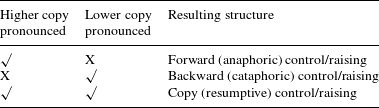
They discuss two raising patterns which differ from the standard ones and which, according to Polinsky and Potsdam, can be accounted for by mechanisms proposed and adopted by Chomsky’s (Reference Chomsky, Michaels, Martin, Uriagereka and Keyser2000) Minimalist Program. The main mechanism that they build on is compositional (or copy and delete) movement, whereby a chain is formed between two (or more) positions. A process of deletion can target one of these positions, replacing it with ‘silence’. In the standard case (aka ‘forward raising’), the higher copy of the chain is pronounced while the lower copy is deleted. There are, however, two other theoretical options, which, they claim, are found in natural language. In ‘backward raising’, the embedded subject raises covertly to the matrix clause, and the element that is pronounced is the lower copy. Conversely, in ‘copy raising’ the two elements are pronounced.
Consequently, they propose the typology given in Table 1.
Typology of control and raising.

3.1.1 Backward raising
Backward raising, Polinsky & Potsdam (Reference Polinsky and Potsdam2012) note, is remarkably rare. One language that they claim has sufficient evidence to suggest this type of construction is Adyghe, a Northwest Caucasian language with ergative case marking and relatively free word order.Footnote [10] Consider the following pair:

The verb ‘begin’ is a subject-raising verb in Adyghe. In forward raising (20a), ø-fjěz ’a-ʁe-x ‘began’ agrees with the absolutive case-marked matrix subject a-xe-r ‘they’. In backward raising (20b), the raising verb exhibits absolutive case marking, while the (embedded) subject is marked with ergative case. In this case, Polinsky and Potsdam argue, the raising verb agrees with the higher copy of the subject, which is ‘silent’ (or covert).
3.1.2 Copy raising
An analysis of copy raising is not in the scope of this paper. Nevertheless, a comparison of copy raising with ordinary raising reveals a different pattern of interaction between subjects, raising and agreement in MH. Consider the following examples.

Copy raising typically involves a perception verb (e.g., nir’e ‘looks’) which takes an NP subject and a finite complement clause, which contains a pronoun that is co-indexed with the matrix subject (21a). The raised element can play different syntactic roles in the complement clause; in (21a) it is the subject. An additional alternation is found in MH, where the matrix perception verb appears with no expressed matrix subject (21b) (Landau Reference Landau2011).
The predicate-initial construction in (21b) superficially resembles the pseudo-raising constructions described in Section 2.4. Nevertheless, the complement of the raising verb is a finite clause, while in pseudo-raising it is infinite. Moreover, the copy-raising predicate exhibits invariable impersonal agreement, regardless of the syntactic properties of its clausal complement. It is only when an element is copy-raised and surfaces as a matrix subject that the predicate exhibits full agreement with it, regardless of the role it assumes in the complement clause (cf. (21a)). Unlike ‘standard’ raising and pseudo-raising, the choice between the two alternations illustrated in (21) does not depend on properties of the embedded clause. Finally, the Hebrew verbs that participate in copy raising (nir’a ‘seem, look’, nis̆ma ‘sound’, hirgis̆ ‘feel’ and heriax ‘smell’) do not participate in ordinary raising, unlike their English counterparts (Landau Reference Landau2011).
3.2 The syntactic structure of pseudo-raising
The aforementioned typology raises the question of where the MH pseudo-raising construction fits in. Consequently, three hypotheses will be considered.Footnote [11]

3.2.1 Pseudo-raising as backward raising
On the surface, the pseudo-raising construction in MH clearly resembles that of Adyghe: the post-verbal subject appears to occupy an embedded position and the raising predicate exhibits agreement with it, while an overt matrix subject is missing. Nevertheless, Polinsky & Potsdam (Reference Polinsky and Potsdam2006) caution against confusing backward raising with cases of long-distance agreement to which they refer as ‘impostors’ (p. 183). The fact that the matrix verb exhibits agreement with the subject in the complement is not sufficient to qualify as backward raising. Backward raising requires there to be a covert copy of the subject in matrix position. Moreover, although covert, this copy needs to play a role in semantic scope relations and licensing of elements such as floating quantifiers.
One so-called impostor is the Greek raising construction illustrated in (22).

The raising predicate ‘stopped’ in Greek can appear in two different alternations. In the first, (22a), the thematic subject of the embedded verb ‘scold’, ‘the teachers’, appears as the matrix subject in a standard forward-raising construction. Conversely, in (22b) the subject appears inside the embedded clause headed by ‘scold’. Moreover, both the embedded verb and the raising verb exhibit agreement with it. Thus, the structure in (22b) suggests backward raising, on a par with the Adyghe example.
While it is indeed the case that although the thematic subject appears to be embedded its agreement properties are matched with the matrix verb, Polinsky & Potsdam (Reference Polinsky and Potsdam2012), as well as Alexiadou & Anagnostopoulou (Reference Alexiadou, Anagnostopoulou, Haugen, Bird, Carnie and Norquest1999) and Alexiadou et al. (Reference Alexiadou, Anagnostopoulou, Iordachioaia, Marchis, Müller, Alexiadou and Kiss2012), argue that the two constructions should receive distinct analyses. They propose that while the Adyghe construction is a true case of backward raising, the Greek construction is an instance of long-distance agreement, which is licensed by Agree (Chomsky Reference Chomsky, Michaels, Martin, Uriagereka and Keyser2000).
One diagnostic that they propose to distinguish between between the two constructions is the licensing of floating quantifiers, which depends on the matrix subject. In a true backward raising language, a floating quantifier is licensed either by an overt matrix subject (in a forward raising construction) or by a covert matrix subject (in a backward raising). In Greek, Alexiadou & Anagnostopoulou (Reference Alexiadou, Anagnostopoulou, Haugen, Bird, Carnie and Norquest1999) and Alexiadou et al. (Reference Alexiadou, Anagnostopoulou, Iordachioaia, Marchis, Müller, Alexiadou and Kiss2012) argue, a floating quantifier is licensed only when there is an overt matrix subject. This suggests that when the subject appears in the embedded clause there is no corresponding silent copy in the matrix position to license the quantifier, or in other words long-distance agreement holds between the matrix verb and the embedded subject.
Applying this diagnostic to the MH data reveals similar behavior. In simple clauses a floating quantifier is licensed by the matrix subject.

When the embedded subject surfaces as the matrix subject of a raising predicate, the quantifier is licensed in its floating positions (24b) and (24c).

Yet, when the subject appears post-verbally a floating quantifier renders the sentence ungrammatical (25b).

Thus, the ungrammaticality of (25b) suggests that there is no covert copy of the subject in the matrix subject position, which can license the floating quantifier, and therefore pseudo-raising in MH is not backward raising.
3.2.2 Pseudo-raising as forward (‘rightward’) raising
The failure of the post-verbal subject to license a floating quantifier does not only rule out the possibility that the subject raised covertly. It also constitutes evidence against an alternative analysis according to which the subject in pseudo-raising raises ‘rightwards’ and occupies a higher matrix clause position post-verbally.Footnote [12] There are additional arguments against such an analysis. First, adverbs that modify the embedded verb may follow the subject, thus indicating that the subject is indeed embedded (26).

In addition, in MH the embedded clause can be conjoined, with each clause containing its own subject.

Consequently, as the evidence suggests, the post-verbal subject in pseudo-raising occupies an embedded position, and therefore no raising occurs in MH pseudo-raising.
3.2.3 Pseudo-raising and long-distance agreement
The typology of raising patterns described by Polinsky & Potsdam (Reference Polinsky and Potsdam2006) reveals three different pattern options, under the assumption that copy-and-delete movement occurs. However, as they and Alexiadou et al. (Reference Alexiadou, Anagnostopoulou, Iordachioaia, Marchis, Müller, Alexiadou and Kiss2012) argue, there are reasons to believe that yet another pattern is found, one in which no movement occurs, and the agreement between the embedded subject and the matrix verb is a product of long-distance agreement. This construction, referred to here as ‘pseudo-raising’, was argued to characterize the Greek case, and was shown here to apply to MH.
However, the MH data revealed an additional twist on pseudo-raising: the occurrence of a canonical/impersonal alternation which bears on the agreement marking on raising predicates. Consequently, three distinct subject raising patterns in MH were identified:

In canonical pseudo-raising, similarly to Greek, the embedded subject remains in the embedded clause, yet triggers agreement on the raising predicate. In the impersonal pseudo-raising pattern, the position of the embedded NP is identical to that of the canonical construction, yet the raising predicate exhibits impersonal 3sm agreement. The distribution of the two variants of pseudo-raising is constrained by the same licensing conditions as apply to verb-initial constructions. Only when the finite counterpart of the embedded verb and its dependents can appear in a verb-initial construction can pseudo-raising occur. Moreover, the colloquial impersonal pseudo-raising construction is licensed only when agreement can be suppressed in the finite counterpart of the embedded clause. This analysis, formalized within the framework of HPSG, is proposed in Section 4.
3.3 The raising and pseudo-raising alternation
The alternation between raising and pseudo-raising is not universally possible. Pseudo-raising has been found to occur in MH, Greek, Romanian and Spanish (and possibly Hungarian, Italian and Brazilian Portuguese (Szabolcsi Reference Szabolcsi, Irwin and Maldonado2009)). Alexiadou et al. (Reference Alexiadou, Anagnostopoulou, Iordachioaia, Marchis, Müller, Alexiadou and Kiss2012) note that Greek, Romanian and Spanish have a number of shared properties which may potentially explain their ability to license long-distance agreement: (i) they are pro-drop languages, (ii) they have VSO orders with VP-internal subjects and (iii) they have clitic doubling. This generalization holds for MH, too, thus providing additional evidence for its validity.
An additional issue raised by the alternation is the question of what motivates it and whether there are any constraints regarding the use of each variant. The discussion in Polinsky & Potsdam (Reference Polinsky and Potsdam2006, Reference Polinsky and Potsdam2012), Alexiadou & Anagnostopoulou (Reference Alexiadou, Anagnostopoulou, Haugen, Bird, Carnie and Norquest1999) and Alexiadou et al. (Reference Alexiadou, Anagnostopoulou, Iordachioaia, Marchis, Müller, Alexiadou and Kiss2012) focuses, of course, on the fact that such alternates exist, yet it is not clear from the discussion whether they are freely interchangeable or whether there are distinct semantic or pragmatic properties associated with each one.
One explanation is mentioned by Polinsky (Reference Polinsky2013) in a review paper on raising and control. Polinsky notes that Cognitive Grammar attributes the choice between raising and non-raising to information structure. Thus, ‘If the focus of the utterance is on the event denoted by the entire sentence, a non-raised sentence is more likely, whereas if the subject of the embedded clause is informationally prominent then the raised version is chosen.’
The distinction that Cognitive Grammar makes between the two types of situations echoes the distinction between thetic and categorical judgments, which was previously argued to be the motivating factor for the SV–VS alternation in MH. Moreover, as was shown here, the choice between raising and non-raising is completely dependent on the embedded clause type. This was illustrated by (15) and (16) above, where an informationally prominent definite subject appeared in a standard raising construction (15b), while an indefinite ‘new’ subject remained in an embedded post-verbal position (16b). Thus, the MH data clearly support an information structure account of the two variants. It remains to be investigated whether similar constraints operate in raising/pseudo-raising alternations in other languages, as well as forward and backward raising in Adyghe.
4 Proposed analysis
4.1 Head-driven Phrase Structure Grammar: Some background
Head-driven Phrase Structure Grammar is a declarative, monostratal (non-derivational) theory of grammar. The fundamental linguistic object in the theory is called a sign and includes words and phrases (for instance, NPs, clauses and sentences). Signs in HPSG are ‘structured complexes of phonological, syntactic, semantic, discourse, and other phrase-structural information’ (Pollard & Sag Reference Pollard and Sag1994), modeled by feature structures (FSs). Feature structures are information-bearing objects that contain attributes (or features) and values notated by Attribute–Value Matrices (AVMs). The theory defines the types of FSs that are necessary in order to model the language, and, for each attribute/feature, the types of values that it can have. Additionally, a set of constraints further restricts the potential linguistic objects.
The basic mechanism by which linguistic objects are related to each other is structure-sharing. Structure-sharing occurs when two paths in a feature structure lead to the very same (token-identical) node. As a result, the information content associated with that node is the unification of the information provided by the various shared paths. That is, unification merges consistent information from different sources. A linguistic expression is said to be grammatical when the information contributed by components of the linguistic object is compatible and can accumulate to form a coherent description of the expression.
4.1.1 Raising in HPSG
Raising in the non-transformational framework of HPSG is not the product of movement. Rather, subject raising predicates are characterized as subcategorizing for unsaturated complements, which have not instantiated their subject requirement. This requirement is ‘adopted’ by the raising predicate.
A more concrete example is given below for the raising verb seems. The argument-structure (arg-st) feature represents the theta grid of the word. Its value contains a list of the verb’s dependents, listed in increasing order of obliqueness. The arg-st of seems reflects the fact that the verb selects for two dependents: a subject ( ) and a complement (
 ), which also appear in the subj and comps list in the val(ence) feature, respectively. The subject requirement is identical to the first element in arg-st, and the VP complement to the second.Footnote
[13]
The verb seems imposes constraints on its VP complement. It is required to be an infinitival VP whose comps requirements have been satisfied (hence the empty list), while it still has a subj requirement to fulfill. The subj requirement of the VP complement is simply identified with the subj requirement of seems (both tagged
 ). This is the essence of subject-to-subject raising. In addition, the semantic content of the VP complement (s1) is embedded in the semantic content of the raising predicate, under seems-rel. There is no semantic relation between seems and its subject.

An additional component of the HPSG analysis of subject raising in English builds on the analysis of the existential there-construction (Pollard & Sag Reference Pollard and Sag1994: 147).Footnote [14] The lexical entry of the existential be specifies that its subject be the expletive there and that the subject’s (abstract) number property be identical to that of the NP theme. This accounts for the agreement between the be verb and the theme.

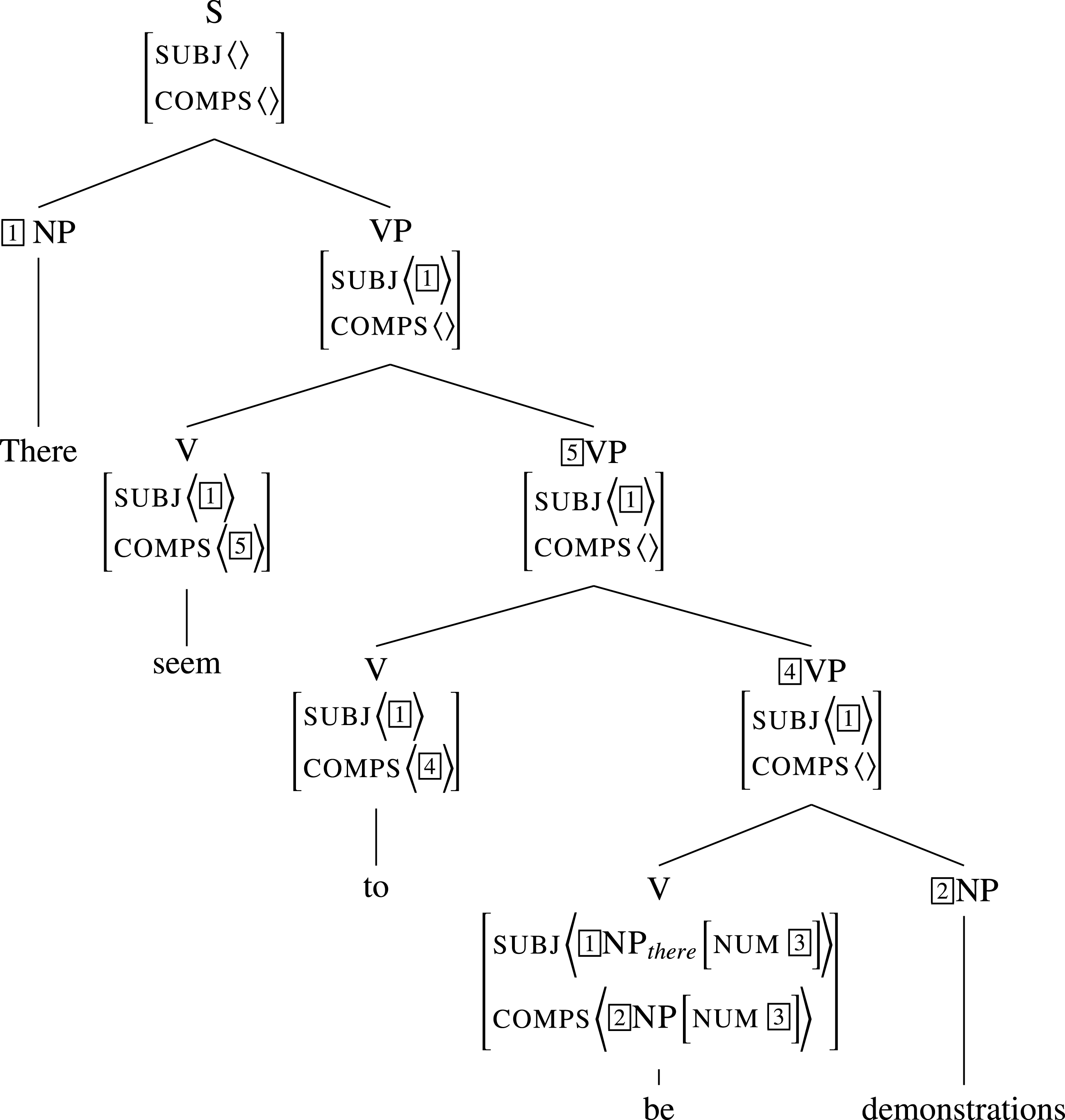
When embedded under a raising predicate, the subject requirement of be is raised to the infinitival to (itself a raising predicate), and from there to the raising predicate seem. Thus, the number property of there triggers agreement on the raising predicate, in a seemingly local relation, reminiscent of the MH pseudo-raising construction. This accounts for the contrast illustrated in (30).

A sketch of the tree structure, illustrating the percolation of the subject requirement from the lower be to the raising seem, is provided in Figure 1.
Long-distance raising and agreement.

From the presentation so far, it is clear that the HPSG analysis of raising can be straightforwardly applied to the standard raising construction in MH. Yet, while the expletive raising construction described above does resemble pseudo-raising, a key component is missing: in MH there is no there there to trigger local subject–verb agreement; this is, of course, unless one posits a phonologically empty expletive.
4.1.2 Locality of selection
As was previously argued, pseudo-raising in MH is an instance of long-distance agreement. Issues of non-local dependencies are persistent challenges to syntactic theories. In HPSG, locality is ensured by the built-in mechanism of removing elements from the valence lists as the verb combines with them. Thus, when a verb’s valence requirements are fully saturated the valence lists of the phrase it heads are empty. Consequently, a head does not have access to the internal structure of a phrase it selects for.
While this principle generally holds cross-linguistically, there are a number of empirical phenomena that defy the principle of locality and consequently prompt discussion.Footnote [15] Meurers (Reference Meurers1999) shows that Case inside of non-finite projections in German depends on the matrix verb and hence internal parts of VPs have to be accessible. Bender & Flickinger (Reference Bender, Flickinger, Webelhuth, Koenig and Kathol1999) discuss question tags in English and their agreement with matrix subjects. Bender (Reference Bender and Müller2008) considers NP parts in Wambaya and demonstrates how they can be assembled if one adopts a non-cancelation approach to valence. Finally, Müller (Reference Müller, Schroeder, Hentschel and Boeder2008) discusses depictive secondary predicates in German and English, which refer to elements inside phrasal projections. A number of challenges to locality are discussed by Sag in a series of papers (Sag Reference Sag and Müller2007, Reference Sag, Corbett and Kibort2010, Reference Sag, Boas and Sag2012). For the purpose of this paper, one example will suffice.
Copy raising, a phenomenon that was briefly mentioned in Section 3.1.2, requires referential identity between the raised subject and its pronominal copy, which, in English, functions as the subject of the embedded clause.

Under a strict view of locality of selection, it is not possible for the matrix verb looks to impose selectional constraints on the internal structure of the embedded clause. In the HPSG analysis the sign that corresponds to the embedded clause and with which the verb looks combines has no information about its subject, due to the valence cancelation mechanism.
Phenomena such as those mentioned above prompted researchers to propose a modification of the HPSG theory to incorporate a principled treatment of non-local phenomena. The solution suggested by Sag to copy raising as well as other non-local constructions involves the introduction of the feature external-argument (xarg), whose role is to project outside of the local domain expressions that need to be made visible.Footnote [16] The value of xarg is either sign or none.
Consider, as an example, an abbreviated description of the lexeme look (Sag Reference Sag, Boas and Sag2012: 151). The arg-st list of the lexeme consists of a subject, the particle like and an embedded clause (S). The constraint on the embedded clause requires it to have a pronominal external argument (i.e., subject), thus ruling out, for example, Kim as a subject in (31a). Moreover, an additional constraint identifies the index feature of that pronominal subject with the index of the matrix subject.

Consequently, the projection of information regarding the subject of the embedded clause up to the clausal level localizes in effect a non-local dependency.
A similar situation occurs in the case of pseudo-raising in MH. The raising predicate combines with a fully saturated clause, yet it has access to information regarding the status of its subject which determines whether it should agree with the subject (33a) or exhibit impersonal agreement (33b). In the standard case, the subject requirement of the VP has not been fulfilled yet, and does appear in its subj list.

I propose that an xarg solution could be applied to pseudo-raising in MH. However, before this is considered, an additional factor needs to be addressed, and that is the standard/colloquial agreement alternation in MH V1 constructions. In what follows I will first provide an overview of an analysis of the canonical/impersonal alternation of V1 in MH. Subsequently, I will propose an analysis of the three raising patterns described above.
4.2 Raising patterns in Modern Hebrew
4.2.1 V1 in Modern Hebrew
Subjecthood
The analysis of V1 constructions in MH is the topic of Melnik (Reference Melnik2002, Reference Melnik2006). The analysis proposed there builds on insights of Borsley (Reference Borsley1995), who distinguishes between VSO structures in Syrian Arabic and Welsh. The key factor in determining the syntactic structure of the two constructions is the degree of subjecthood the S arguments in the two languages exhibit.
A comparison of cliticization phenomena between the two languages leads Borsley (Reference Borsley1995) to assign them different analyses. While in Syrian Arabic it is the O arguments of VSO and SVO structures that trigger cliticization (i.e., cliticization occurs when the O argument is pronominal), in Welsh it is the S argument in VSO (i.e., the post-verbal argument) and the O argument in SVO. Thus, the two languages differ in their treatment of the S argument in VSO, and consequently receive distinct analyses.
In Borsley’s analysis, transitive verbs in Syrian Arabic subcategorize for subj and comps. The verbal head of a verb phrase simultaneously combines with its subject and complements to form a flat hd-subj-comp-ph phrase type.Footnote [17] In Welsh, as cliticization groups post-verbal S with post-verbal O, Borsley proposes that the two dependents be realized by means of the same valence feature – comps. Consequently, finite verbs in Welsh are syntactically subjectless and subcategorize only for complements.Footnote [18]
Borsley’s analysis illustrates the HPSG approach to subjecthood. Under this approach, valence subjects are not necessarily distinguished configurationally from complements, hence the flat structure of Syrian Arabic VSO. Furthermore, logical subjects (i.e., the least oblique arguments in arg-st) are not necessarily realized as valence subjects, hence Borsley’s subjectless analysis of Welsh VSO.
Returning to the MH data, Melnik (Reference Melnik2002) uses Keenan’s (Reference Keenan and Li1976) list of subject behavior properties to determine the status of post-verbal thematic subjects. The crucial cases are those in which the verb is an unaccusative verb, since it can then appear in three different clause types: SV, canonical VS and impersonal VS. It is with such verbs that we can examine whether position or agreement plays a role in determining the thematic subject’s syntactic role. Two examples of subject behavior tests follow.
First, the ability to antecede reflexives is assumed to be a property of subjects. Consider the following set of examples with an unaccusative verb.

From the first two examples in the set we can conclude that the position of the thematic subject does not affect its ability to antecede a reflexive. However, the existence of agreement between the verb and the thematic subject is found to be a determining factor. Once the verb exhibits impersonal agreement, this subject behavior property is lost, hence the ungrammatical (34c).
An additional subject behavior property is the ability to be missing from a second conjunct under coreference with the subject of the first conjunct. A simple example of this phenomenon is given in (35).

Example (35) shows that the subject of the second conjunct can be unexpressed and that this unexpressed subject can only refer to the subject of the first conjunct. Thus, this example establishes the subjecthood of Danny as the subject of met (only the subject can be the antecedent) and of the ‘hugger’ as the subject of ‘hug’ (it can be unexpressed).
Let us examine the behavior of the unaccusatives in coordinated structures.

As is evident from examples (36a) and (36b), the thematic subject, whether in a pre-verbal or post-verbal position, can be an antecedent to an unexpressed subject in the second conjunct.Footnote [19] The contrast between the (a) and (b) examples and that of (c) reveals that verbal agreement determines whether the NP dependent can assume this subject behavior property.
Consequently, building on the clear contrast between the agreeing and impersonal agreement cases, Melnik (Reference Melnik2002) proposes that in MH only agreement-triggering thematic subjects exhibit the properties necessary to be considered valence subjects.Footnote [20] Thus, canonical V1 constructions in MH are licensed by the hd-subj-comp-ph phrase type, on a par with Borsley’s (Reference Borsley1995) analysis of VSO in Syrian Arabic. Conversely, when the V in V1 exhibits impersonal agreement the NP is not considered a valence subject, and the V1 clause is licensed as a subjectless clause by the hd-comp-ph phrase type, similarly to Borsley’s analysis of Welsh. Information packaging properties associated with the two V1 constructions are defined as phrase-type constraints.
Subject–verb agreement in MH
In general, verbs in finite clauses in MH exhibit full agreement with their subjects. Nevertheless, subjectless constructions are not a rarity in MH. Berman (Reference Berman1980) describes a number of subjectless constructions, of which one is the impersonal passive, illustrated below. Similarly to the impersonal pseudo-raising construction, impersonal agreement is encoded as 3sm agreement. An account of subject–verb agreement in MH needs to address both types of agreement marking.

There are different HPSG approaches to subject–verb agreement. One approach (Pollard & Sag Reference Pollard and Sag1994) views subject–verb agreement as a selectional restriction of a predicate. Consequently, the selector specifies the agreement properties it requires from the phrase it selects. This approach can be seen in the lexical entry of the verb be given in (29), where the verb (the selector) specifies that the agreement properties of its subject be matched with the agreement properties of the comp.
An alternative approach, proposed by Kathol (Reference Kathol, Levine and Green1999), is to view agreement as a matching relation between the agreement properties of the selector and the selected. Thus, subject–verb agreement involves the matching of the agreement properties of the verb with those of its subject. Such an approach enables the grammar to be explicit about which properties are relevant for this relation. In MH, for example, finite verbs agree with their subjects in number, gender and person. Subject–verb agreement in English, on the other hand, is not sensitive to gender distinctions. Moreover, Kathol’s approach makes it possible to account for cases where the agreement marking on the verb is not derived from an overt source, such as a subject. In other words, the verb itself carries morphosyntactic agreement properties.
Following Kathol (Reference Kathol, Levine and Green1999) I assume that subject–verb agreement is a matching of the AGR features of the head with those of the subject. Moreover, similarly to Kathol’s account of subject–verb agreement in German, I distinguish between two types of agreement patterns. Personal agreement occurs between heads and NP subjects, and involves the matching of their respective features. When the subj requirement is either empty or not an NP the agreement marking on the head is impersonal (3sm).

This general constraint on head–subject agreement applies to the impersonal V1 construction described above, as well as to other constructions with non-NP subjects.
Sample analysis
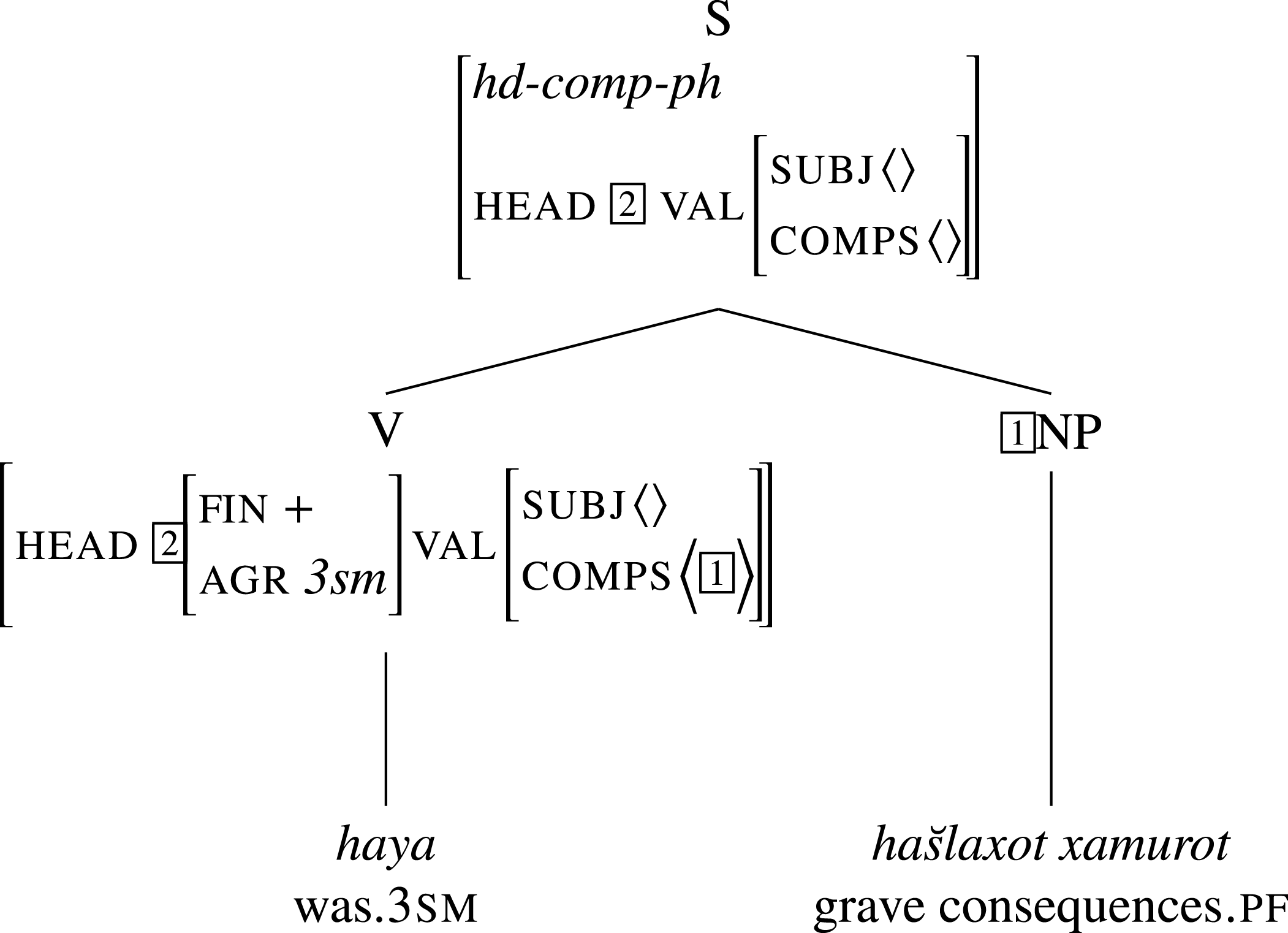
Consider, as an example, the analysis of the colloquial existential sentence in (10b) above, given in abbreviated form in Figure 2. The subjectless haya combines with its non-subject theme dependent in an hd-comp-ph phrase type, thus forming a V1 clause. Impersonal agreement is captured by the impersonal agreement principle. Note that in the description of the resulting clause both the subj and comps lists are empty.
An impersonal V1 construction.

4.2.2 Long-distance agreement and raising in MH
The generalization regarding long-distance agreement and raising in MH is as follows. When V1 clauses are embedded under raising predicates the subject remains post-verbally. The agreement marking on the raising predicate depends on the type of V1 clause, or, more specifically, on the relation between the embedded verb and its NP dependent. An embedded subject triggers agreement on the raising predicate, while an NP complement is associated with impersonal 3sm agreement.
As was noted earlier, the HPSG analysis of subject-to-subject raising, as well as that of long-distance raising illustrated in Figure 1 above, cannot straightforwardly account for pseudo-raising in MH. Nevertheless, a very slight modification is required in order to account for cases where the embedded verb is subjectless.
Müller (Reference Müller2009) discusses a similar situation in German, which has subjectless verbs and adjectives. He proposes a general treatment of raising according to which raising predicates are agnostic about the subject status of the embedded clause, and adopt the requirements of the embedded verb, whatever they are. Technically, this is implemented as a requirement that the raising predicate share the embedded subject’s subj list, and not the element in that list.
This approach is illustrated in the description of the raising predicate omed ‘stands (about to)’ below.

Note the identity of the subj list in the embedded verb and the raising verb (both tagged  ). Compare this with the standard description of a raising verb (e.g., (28) above), where the raised/shared requirement (also tagged
 ) is the element in the subj list, and not the list itself. When the content of the subj list of the embedded predicate is underspecified, both cases – NP subjects in the standard case and empty subjects in pseudo-raising – are subsumed under one lexical description.
Müller’s (Reference Müller2009) account of subject raising allows for pseudo-raising, yet an additional mechanism is required in order to account for the agreement properties of the raising predicate. When the subject is realized in the embedded clause it does not appear in the valence list of the embedded V1 clause, due to the principle of locality, and its agreement properties are inaccessible. In order to circumvent this obstacle, I propose that information regarding the NP theme is projected outside the embedded clause by means of the xarg feature, which is matched with the head’s subj requirement. In the case of canonical pseudo-raising, the NP is considered a valence subject of the VP. As such, the VP’s xarg feature is identical to that NP’s sign and the agreement marking on the raising predicate is matched against the agreement marking on xarg. Conversely, when the embedded clause is subjectless the xarg value of the VP is none, and impersonal agreement is licensed.
Only one general constraint on subject-to-subject raising predicates is required in order to account for the agreement marking in the case of canonical pseudo-raising.

This implicational constraint states that raising predicates that subcategorize for a VP complement with an NP in its xarg feature must agree with that NP. This is essential for long-distance agreement in the canonical case (without it the predicate will be marked with impersonal agreement), and is redundant for standard raising, where agreement matching is accounted for by a general subject–verb agreement principle. The constraint does not apply in the impersonal case, since there the value of xarg is none and is thus incompatible with the antecedent of the constraint. In such cases the raising predicate is marked with impersonal agreement.
Thus, an account of all three raising constructions found in MH requires the following.
-
∙ One single lexical type definition of subject-to-subject raising predicates (e.g., (39) above), which can appear in all three constructions.
-
∙ One implicational constraint (40), which accounts for long-distance agreement in the canonical case.
-
∙ Three standard phrase type schemata (subj-head-phrase, head-subj-comps-phrase, head-comps-phrase).
Canonical pseudo-raising.

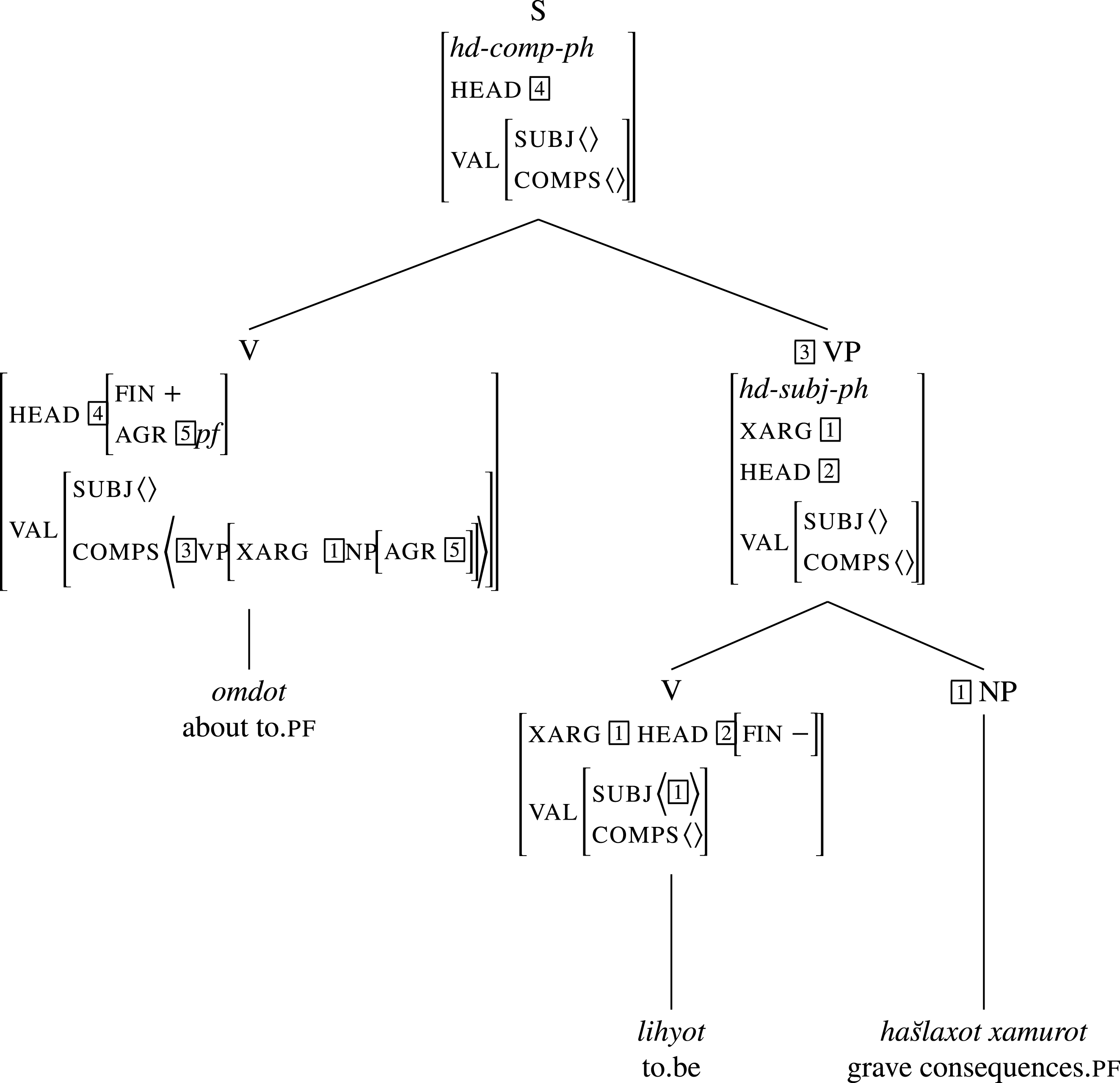
Impersonal pseudo-raising.

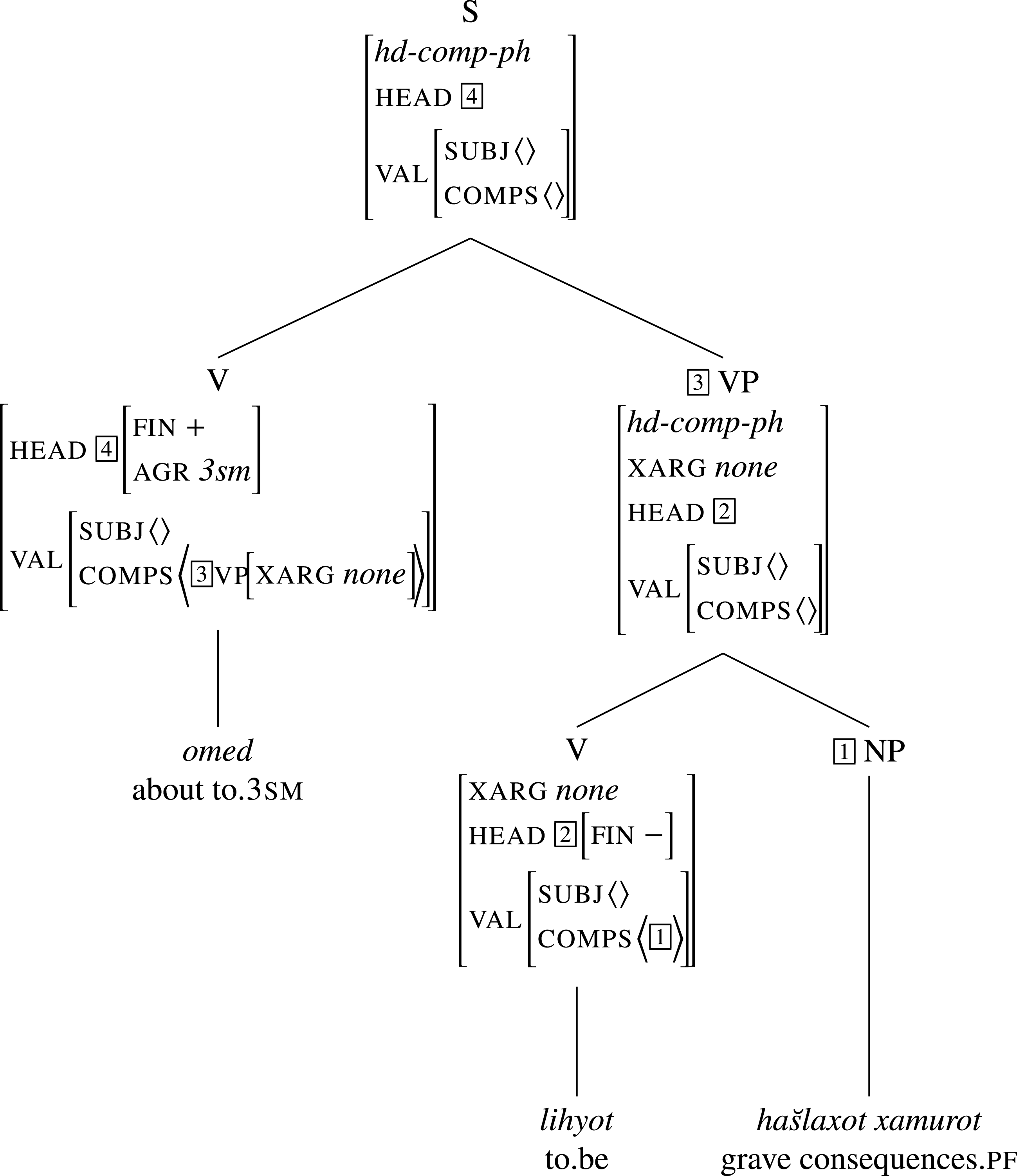
Figures 3 and 4 present abbreviated tree structures of the two pseudo-raising constructions in (33).Footnote [21] Note that the phonological strings of the embedded clauses in the two structures are identical (lihyot has̆laxot xamurot ‘to be grave consequences’). However, although the infinitival form in MH does not exhibit agreement and therefore cannot reveal it, the syntactic structures of the two variants are different. In Figure 3 the infinitival is a canonical verb which selects for an NP subject, while in Figure 4 it is a colloquial subjectless verb, whose NP dependent is realized as its complement. This distinction is reflected in their respective valence lists and in their xarg feature, which is identical to the subject in the canonical case and is empty in the subjectless case.
Indeed, the xarg property is what distinguishes between the two structures at the VP level. Although the valence lists of both VPs are empty, as their respective valence requirements have been fulfilled, the indication that one is canonical while the other is subjectless is represented by the xarg feature which is passed up to the VP level. Moreover, at the clausal level both structures are subjectless. Yet, the raising-specific constraint on subject-to-subject raising targets the xarg feature of the VP complement in the canonical case and matches the agreement properties of the raising predicate with the NP in xarg, thus resulting in the two distinct patterns.
The fact that all of the information regarding subjecthood and agreement stems from the embedded clause reflects the parasitic nature of the relationship between the raising predicate and the embedded verb. Moreover, this property is essential for accounting for the consistency of agreement patterns in longer raising chains (cf. (13) and (14)).
An important consequence of the proposed analysis is the fact that it extends beyond the initial data to other types of clauses that are embedded under a raising predicate. An example of the impersonal passive construction was given in (37) above. When this construction is embedded under the raising predicate omed ‘stands (about to)’, its subj requirement is empty and its xarg value is none. Consequently, the raising predicate exhibits the appropriate 3sm agreement marking (41).

An additional impersonal construction that exhibits similar behavior is the environmental construction.Footnote [22] The existential haya subcategorizes only for an AdjP complement (42a). When embedded under a raising predicate, the empty subj requirement and xarg value are passed up and consequently asuy ‘likely’ is marked with impersonal agreement (42b).

The impersonal active construction in MH is a slightly different case, yet it too can be accounted for by the current proposal. The impersonalization of agents in MH is often achieved not by use of the passive voice, but rather with plural third person masculine verbal forms and empty subjects (Berman Reference Berman1980). In (43a) below the agent of the active verb dofkim ‘knocking’ is not identified. When this clause is embedded under the raising predicate amur ‘supposed’, the plural–masculine agreement marking turns up on the raising predicate. In this case, similarly to that of canonical pseudo-raising, the agreement properties of the matrix predicate are matched against those of the xarg of the embedded clause.

4.2.3 Summary
The proposed analysis builds on existing HPSG machinery and requires very few construction-dependent stipulations.
-
∙ Subject raising, under this proposal, is based on the ‘standard’ HPSG analysis, and is augmented with Müller’s (Reference Müller2009) general treatment of the construction, which subsumes canonical embedded clauses, as well as subjectless ones.
-
∙ The account of canonical and impersonal agreement patterns adopts Kathol’s (Reference Kathol, Levine and Green1999) approach, according to which agreement is viewed as a matching relation between the agreement properties of the selector and the selected. This approach provides a way of accounting for the agreement marking on subjectless predicates.
-
∙ The non-local relationship between the raising predicate and the embedded subject in pseudo-raising is mediated by the xarg feature, which has been used in the HSPG literature to account for various phenomena that defy strict locality.
-
∙ The analysis of the MH VS–SV alternation as well as the canonical/impersonal alternation of VS constructions is adopted from Melnik (Reference Melnik2006) and is shown to extend to cases where such clauses are embedded under a raising predicate.
-
∙ One raising-specific constraint is needed in order to capture the agreement relation between the raising predicate and the xarg of its embedded clause.
5 Conclusion
Three distinct raising patterns were identified for MH:

The main finding was that the distribution of the three patterns does not depend on the raising predicate; all raising predicates can appear in each of the three. Rather, it was shown that the raising predicate fully adopts the clause structure of the embedded clause.
The basic word order of clauses in MH is SVO. When such clauses are embedded under a raising predicate the S argument raises to matrix subject position, similarly to ‘standard’ subject raising. The distribution of V1 clauses is more restricted. V1 clauses are typically associated with existentials and unaccusative verbs, yet they are found also with other types of verbs. Information packaging constraints license V1 in MH, as it is used to encode thetic (all new) judgments, in distinction from ‘unmarked’ categorical judgments. When such V1 clauses are embedded under raising predicates their subjects remain post-verbally. This is referred to here as ‘pseudo-raising’. In colloquial language, alongside canonical V1 clauses, there exists an alternative construction where the V exhibits impersonal agreement. In this case too, the raising predicate mirrors the clause structure of the embedded clause: the S argument remains post-verbally and the raising predicate is marked with impersonal 3sm agreement. Consequently, the canonical/impersonal alternation in V1 constructions and the way it is reflected in the agreement marking on raising predicates provide additional evidence for the parasitic nature of these predicates.
The occurrence of standard subject raising alongside pseudo-raising was found to characterize other languages such as Greek, Romanian and Spanish, all languages that have (i) pro-drop, (ii) VSO orders with VP-internal subjects and (iii) clitic doubling (Alexiadou et al. Reference Alexiadou, Anagnostopoulou, Iordachioaia, Marchis, Müller, Alexiadou and Kiss2012). Furthermore, although it was not explicitly mentioned, it appears that similarly to MH, raising predicates in these languages tend to be modals and aspectuals.
The similarity between MH and the aforementioned languages suggests that languages that share these properties may also share two more properties that were identified for MH and were not yet examined for the latter: the parasitic nature of the raising predicate and the information packaging motivation for choosing between raising and pseudo-raising. This prediction remains to be investigated.