In the week following the November 2006 midterm elections, which gave the Democratic Party control of Congress, both parties in the House held elections for various leadership offices. A total of six positions in both parties were contested, an unusually large number, but the campaign for one office—the Democratic majority leader—garnered the most attention. That race pitted two moderate Democrats against each other, threatened to split the party, and featured a remarkable intervention by the incoming speaker.
In this paper, I use statistical analysis, interviews, and other evidence to suggest answers to two questions stemming from that campaign. First, what factors increased the likelihood that a Democrat supported Representative Steny Hoyer (MD), the candidate who decisively defeated the challenger, John Murtha (PA)? Second, why did Speaker-elect Nancy Pelosi (CA) openly endorse and lobby on behalf of Murtha, even though he was widely expected to lose? Before addressing these questions, however, I first sketch the basic outline of the campaign for majority leader.
The Race for Majority Leader: Overview
The House majority leader has a number of important responsibilities, including legislative scheduling, coordinating the party's agenda, and serving as party spokesperson. In addition, the position is second only to the speaker of the House, and has, at least for Democrats, traditionally served as a stepping-stone to the speakership. Choosing its occupant thus can have major, and often long-term, consequences for congressional politics and the effectiveness of the House majority party.
Since 2003, Steny Hoyer had been the House minority whip, his party's second-in-command, and was considered the natural candidate for majority leader if the Democrats won a majority of House seats. Hoyer had many strengths as a candidate: besides his leadership experience, he had proven skill in winning leadership races, could distribute leadership resources in exchange for votes, and—if the Democrats won the House in 2006 (as they did)—could take some credit for that outcome.
Despite Hoyer's many strengths, in June 2006 John Murtha declared his intent to run for the position as well. A 16-term conservative Democrat and ranking member of an appropriations subcommittee, Murtha had never held a party leadership post and generally worked behind the scenes, making him an unlikely candidate for the job. But the Pennsylvanian had become more prominent when, seven months earlier, he openly called for the withdrawal of U.S. troops from Iraq, garnering him many press appearances and praise from liberals and anti-war activists. Murtha was considered a sufficiently viable candidate that his entry was criticized for potentially dividing Democrats before the midterm elections (Kornacki 2006). As a result, Murtha agreed to suspend his campaign until November, which might have given Hoyer extra time to win legislator commitments (Yachnin and Bresnahan 2006)—though, according to one Democratic House chief of staff, “Murtha was still talking to people” about his candidacy.1
This and other interviews were conducted anonymously with House Democratic congressional staff and a Democratic House member shortly after the leadership race.
Both candidates emphasized certain themes and issues in their campaigns. In an email sent shortly after midnight of Election Day to Democratic congressional offices (and distributed the next day in hard-copy), Hoyer referenced his prior experience as whip, his intent to regularly seek opinions of both chairmen and rank-and-file Democrats, and his support for “core Democratic principles” (Hoyer 2006). Murtha, by contrast, heavily emphasized his early opposition to the Iraq War, and argued that Hoyer had been more supportive of the war than he (e.g., Bresnahan and Yachnin 2006).
Both Hoyer and Murtha used a range of campaign tactics. Perhaps the most significant was the distribution of campaign contributions, from both personal campaign funds and leadership political action committees (LPACs), to House Democrats. Hoyer gave over $700,000 to 71 Democrats subsequently elected in 2006, while Murtha provided over $200,000 to 58 such Democrats. Interviews with Democratic House staffers suggest that the candidates also used more personal tactics, such as making phone calls to undeclared legislators and keeping tabs on the legislative requests of their colleagues.
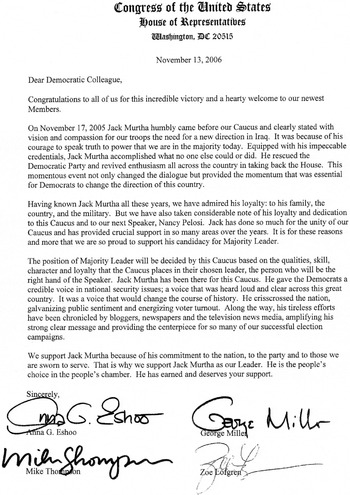
The candidates and their supporters also sent letters, faxes, and “dear colleague” missives to House Democrats—especially after Election Day, when, as one Democratic staffer put it, “we had letters walked into our office daily.” Pro-Hoyer letters came from many party members, including would-be committee chairmen, moderate legislators, and—perhaps to counter Murtha's position on Iraq—six liberal Democrats, in a letter sent to members of the left-leaning Progressive Caucus (Hearn 2006c). The letters most commonly cited Hoyer's extensive campaign and legislative experience, and claimed he had good working relations with other party leaders and could build consensus in a diverse party. Pro-Murtha letters, by contrast, almost uniformly cited the lawmaker's early opposition to the war in Iraq. An example of such a “dear colleague” letter, signed by four northern California Democrats, appears in Figure 1.
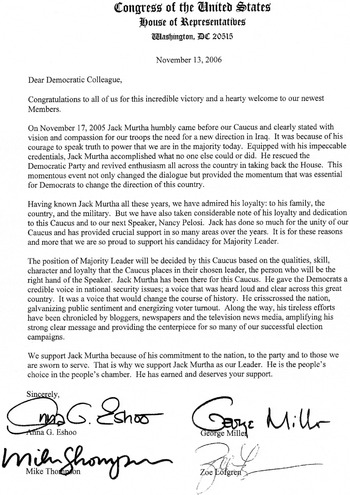
Sample Support Letter for John Murtha
The wildcard in the race was the minority leader and soon-to-be speaker, Nancy Pelosi. Murtha was a close ally of Pelosi's, having “managed” her first leadership campaign, for minority whip, in 2001 (Drew 2007). Furthermore, Pelosi and Hoyer had a long-running rivalry: Pelosi had beaten Hoyer for the whip position; they had supported opposing candidates in other leadership races; and the pair allegedly had a frosty personal relationship. Some even believed that Pelosi had encouraged Murtha's run for majority leader, perhaps to threaten or even oust Hoyer (Kornacki 2006).
Pelosi remained officially neutral in the race until the Sunday before the election, when she made a surprising endorsement of Murtha. In a letter that was addressed to Murtha but released to the public, she declared that “I salute your courageous leadership” on the Iraq War and “am pleased to support your candidacy” (Hotline 2006a). Within two days, she was also reportedly lobbying undecided Democrats and suggesting to incoming freshmen Democrats that their committee assignments would be contingent on support for Murtha (Weisman and Romano 2006).
Other close Pelosi allies heavily lobbied on behalf of Murtha. Two fellow Californians, George Miller and Anna Eshoo, were so aggressive that one Hoyer supporter complained they were “really beating up on people to back Jack or else” (quoted from Yachnin and Bresnahan 2006). Another such Democrat, Jim Moran of Virginia, went so far as to publicly declare that “We are entering an era where when the Speaker instructs you what to do, you do it” (Hearn 2006a), and that freshmen failing to vote for Murtha will “screw themselves for the rest of their lives” (Hearn 2006b). Whether these efforts helped or hurt Murtha, it meant that, according to one Democratic chief of staff, “people saw this as a Pelosi-Hoyer thing.”
Pelosi's move was greeted with skepticism, if not bewilderment, because it seemed at that point that a Hoyer win was a foregone conclusion. It was also followed by increased publicity about Murtha's questionable ethical background, including a widely-aired videotape showing Murtha debating whether to take a cash bribe from undercover federal agents. One group calling itself “YouDon'tKnowJack.org” even sent a series of emails to Democratic offices criticizing Murtha's ethics problems.2
Murtha's campaign claimed Hoyer was responsible for this last-minute media campaign (Bresnahan and Yachnin 2006), a suspicion also voiced by a pro-Pelosi House Democrat in an anonymous interview with the author.
Explaining Support for Hoyer or Murtha
The biggest question that usually follows a contested congressional leadership race is why one candidate won. Vote choice in such elections is usually explained as a consequence of non-measurable factors, such as personal relationships between candidates and legislators. Goal salience theory posits an alternative claim: that legislators vote for candidates that have fulfilled, or are expected to fulfill, one or more legislator goals, including reelection, enactment of desired public policy, and internal advancement (Fenno 1973; Green 2006; Green and Harris 2007).
Since balloting in leadership elections is secret, I test the goal salience hypothesis as an explanation of the majority leader race by using the public pledges of Democrats to vote for Murtha or Hoyer. Such pledges are an admittedly imperfect measure of actual vote choice (Green and Harris 2007).3
Regression analysis suggests that the only significant factor influencing the likelihood of announcing one's support for Murtha or Hoyer is age (older legislators being less likely to make a public commitment).
For example, some legislators show their ballots to candidates prior to casting them, and the presence of a limited number of ballot boxes, grouped alphabetically by legislators' last names, make it easier for candidates to identify how representatives vote (e.g., Jacobs 1995, 318). Murtha supporters, however, did later claim that many Democrats broke their pledges to Murtha (e.g., Yachnin and Bresnahan 2006).
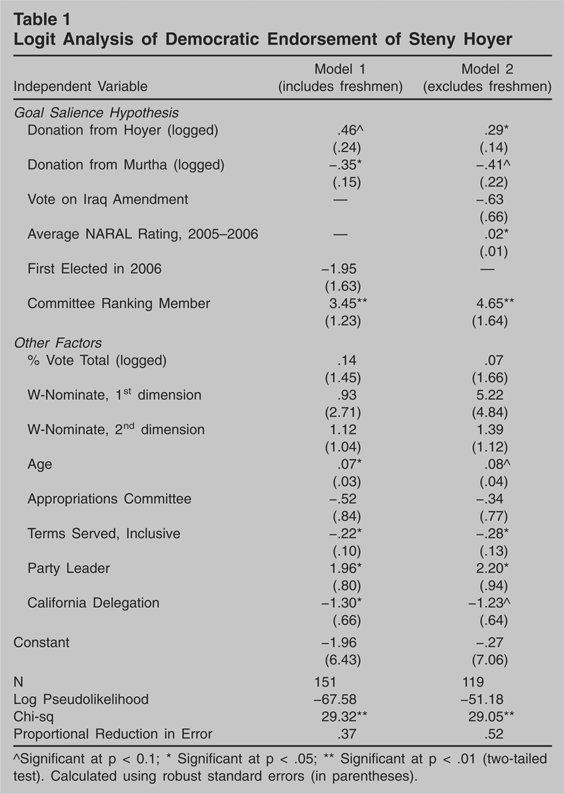
Both candidates published partial lists of supporters at the end of the race, while various media outlets also reported the voting preferences of local Democratic representatives (e.g., Hotline 2006b). Merging these lists and media accounts together, I was able to identify the likely votes of 151 representatives (plus two delegates), or just under two-thirds of the House Democratic caucus. (Hoyer was endorsed by 101 Democrats; Murtha by 52.) To predict support for each candidate, I conducted a logit analysis with the dependent variable equal to 1 if the Democrat publicly endorsed Hoyer.
The public statements, campaign-related texts, and characteristics of the candidates and their campaigns suggest that aspects of three basic legislator goals influenced vote choice. The first goal was reelection: even if Democrats were electorally optimistic after their party's 2006 sweep of the House, both candidates did help Democrats before that election by providing them with campaign funds. Whether the funds were a cause or a consequence of legislators' endorsements, one would expect a significant relationship between the two, as has been found to be the case in at least one other recent leadership race (Green and Harris 2007). To account for this possibility in the analysis, I use logged measures of total contributions made by both candidates to every Democrat elected to the 110th Congress.5
Data are from the Federal Election Commission (www.fec.org, accessed August 14, 2007).
The second goal, policy enactment, may have mattered in several ways. As a proxy measure of relative opposition to the Iraq War, a major theme of Murtha's campaign, I use each Democrat's vote on an early anti-Iraq proposal, a May 2005 amendment by Rep. Lynn Woolsey (D-CA), which urged the president to develop a troop withdrawal plan (and which received the votes of 123 Democrats). Also, while both candidates were ideologically moderate, they differed on some major party issues (or “core Democratic principles,” as Hoyer had put it). Perhaps most notably, Murtha opposed abortion rights, which may have hurt his support among liberals (Weisman 2006a). I therefore add a measure of each Democrat's average rating from the pro-choice group NARAL in the 109th Congress. Finally, select electoral cohorts can share particular policy goals, and membership in such cohorts has been shown to matter in leadership elections (Green 2006; Green and Harris 2007). I thus include a dichotomous variable coded 1 if the Democrat was first elected in 2006, a pivotal election year for Democrats.6
Membership in the same electoral cohort as a candidate could also yield support for that candidate. However, both Hoyer and Murtha first entered Congress in special elections, and few House Democrats had been first elected at a similar time.
The third goal, internal influence, may have been relevant as well. Hoyer claimed he would solicit the views of committee chairs, perhaps increasing their likelihood of supporting his candidacy. Meanwhile, non-chairs may have been discouraged from supporting Hoyer, fearing that opposing Murtha and Pelosi would endanger their future chances of being selected as a chair (though Pelosi's endorsement came after most ranking committee members had already endorsed Hoyer [Weisman and Romano 2006]). To account for this possibility, I add a measure of whether a Democrat was a ranking committee member in the 109th Congress, and thus more likely to support Hoyer.
I also use measures of other factors that are related to these goals, or have otherwise been found to predict vote choice for leadership candidates (e.g., Green 2006; Harris 2006; Green and Harris 2007). I include a variable capturing vote margin in the 2006 election (which may measure individual electoral vulnerability, though this was not an issue in the race), and ideological disposition (using the first two dimensions of W-NOMINATE scores, although both candidates were relatively conservative).7
W-NOMINATE scores for the 110th Congress were derived from all floor votes through August 2007. These data allow one to include freshmen, but may be problematic since they are calculated from only a subset of House votes cast after the leadership election. Substituting them with W-NOMINATE scores from the 109th Congress in Model 2 did not significantly change the results. W-NOMINATE scores were not calculated for the five House delegates, who have only limited floor voting rights.
All Pennsylvania and Maryland Democrats who made public commitments openly supported Murtha or Hoyer, respectively, and thus cannot be controlled for. Support from the California delegation may have been the result of Pelosi's endorsement, but it may have occurred independently, as the letter in Figure 1—which was not signed by Pelosi and did not mention her endorsement of Murtha—implicitly suggests.
The results of the logit analysis, shown in Table 1, suggest that some goals did matter to legislators in deciding whom to support, including those involving reelection (via campaign funds), policy (abortion rights), and influence (being a committee ranking member). The importance of campaign money is particularly intriguing, suggesting that receiving such funds from a candidate may indicate—if not bring about—support for that candidate.9
With all other variables in Model 2 at their means (or 0 if dichotomous), a $4,000 donation from Hoyer increased the probability of a Hoyer endorsement by 32%, while $4,000 from Murtha decreased it by 56%.
Similar results occurred when using membership in the “Out of Iraq” caucus (with 69 members, as of September 2006). Membership in groups such as the Progressive Caucus, New Democrats, and Blue Dogs also proved statistically insignificant.
Logit Analysis of Democratic Endorsement of Steny Hoyer
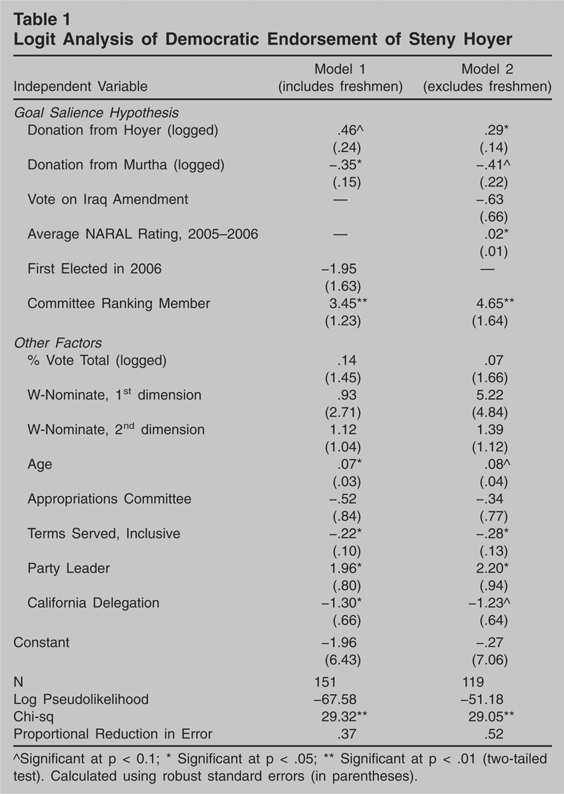
The statistical analysis used here does not rule out the possibility that one or more of the independent variables was a consequence, rather than a cause, of legislators' endorsements (e.g., campaign contributions); or that they influenced, rather than were driven by, the candidates' campaigns. It also cannot capture other potentially important factors, such as negative media coverage of Murtha or perceptions of each candidate's abilities. Nonetheless, it at least suggests what went wrong with Murtha's campaign: while Murtha did distribute campaign funds to other Democrats, and successfully drew support from more senior legislators and many Californians, his focus on Iraq failed to overcome greater concerns about his long-standing policy views, at least on abortion. Hoyer, meanwhile, successfully rounded up commitments from party leaders and committee chairs, and contributed more money to more Democrats than did Murtha.
Why Did Pelosi Endorse Murtha?
Perhaps the greatest mystery of the campaign was Pelosi's decision to endorse Murtha. When Murtha lost—as expected—many observers argued that Pelosi had foolishly let herself be publicly repudiated by a majority of her party (e.g., Tumulty and Bacon 2006). Why did Pelosi do this? Perhaps the most immediate explanation is that Pelosi was returning a favor: Murtha had been a key supporter of Pelosi's for years, and his outspoken opposition to the Iraq War had given “cover for other Democrats” to do so (Drew 2007). More broadly, however, evidence suggests that it derived from a key aspect of her leadership style: an emphasis on personal loyalty.11
Pelosi's focus on personal loyalty reflects the politics of one of her House predecessors, San Franciscan Phil Burton (Wallison 2006), as well as the urban politics of Baltimore, where she grew up (Tumulty and Bacon 2006).
Pelosi's emphasis on personal loyalty may have aided her in many ways. Doing so consistently, as evidence suggests has been true for Pelosi since first becoming a party leader, may have helped legislators understand the terms by which they received scarce resources from her.12
Alleged examples include: in 2002, her selection of Bob Matsui (CA) over William Jefferson (LA) to chair the Democratic Congressional Campaign Committee, even though Matsui did not seek the post (Firestone 2003); her 2003 appointment of former Rep. Max Sandlin (TX) to powerful committee and leadership positions (Wallison 2006); and her early disputes over committee jurisdiction with John Dingell (MI), who had opposed Pelosi's run for party whip in 2001 (Eilperin 2002).
However, a leader's emphasis on personal loyalty can put other objectives at risk. For example, decisions based on personal loyalty may be seen as unfair, vengeful, or even petty: one skeptical journalist portrayed Pelosi as having “nursed grudges with intensity” (Wallison 2006), while another argued that Pelosi may have been “acting on a grudge” in supporting Murtha because she “took [Hoyer's] challenge personally” when he ran against her for majority whip in 2001 (Drew 2007). In addition, legislators who are disfavored for being insufficiently loyal may harbor long-term resentments, jeopardizing party harmony.
When Murtha decided to challenge Hoyer, Pelosi faced a dilemma. On the one hand, according to a legislator interviewed for this study who worked closely with Pelosi, “there was always a feeling that he [Hoyer] was trying to undermine” Pelosi. One Pelosi aide also said that Pelosi “had to show her loyalty to Murtha, who has been steadfastly loyal to her” (Weisman 2006b). On the other hand, openly favoring Murtha could badly split her party and put her on the losing side of a major leadership election.
Pelosi's apparent solution to this dilemma was to temper the nature of support she gave Murtha. Though Pelosi and her allies did lobby undecided and freshmen Democrats on Murtha's behalf, the nature and timing of Pelosi's endorsement suggested she would only do so much for the Pennsylvanian. As one Democratic chief of staff later observed in an interview, her letter did not explicitly ask Democrats to vote for Murtha, and its formality was almost reminiscent of an impersonal letter sent to local constituents. The staffer also noted that when a member of Pelosi's staff hesitated to elaborate on the letter, “everybody knew what he meant by this: OK, you're [Pelosi's] not getting involved.” Pelosi's letter also came late in the process, leading another staffer working for a legislator supporting Murtha to remark that the letter seemed more of a “last-ditch effort” to help Murtha than a strategically timed maneuver. Finally, Pelosi's personal lobbying efforts, which were not apparent until two days before the election (Hearn 2006a), may have been used selectively, neglecting for example more senior members of the caucus (Bresnahan and Yachnin 2006).
Pelosi's actions in the last days of the campaign, then, may have been a rational strategy to maintain personal ties of loyalty with a key Democrat while minimizing the negative fallout from doing so.
Conclusion
The findings here illuminate some of the detail behind the Democratic majority leader race and, in particular, how a candidate for a leadership office can build support by meeting (or promising to meet) the goals of other party members. Put succinctly: Hoyer's experience, money, and views on fundamental party policy trumped Murtha's activism on the Iraq War and close ties to the new speaker.
The race apparently did not, contrary to initial fears, create long-lasting rifts in the party. The reasons for this are unclear, though it does suggest that the issues raised by the campaign were not poisonously divisive for Democrats, at least in the short-run. In addition, Murtha did gain an important, unofficial leadership role: advising the House Democratic caucus on legislative strategy regarding Iraq.
Perhaps more importantly, the campaign opened a window into Pelosi's leadership style—a style which could be a boon or a hazard for the new House majority party. Her emphasis on loyalty may have contributed to the relatively strong unity of her party to date; but it may also come into conflict with the achievement of other leadership objectives, forcing her to find creative ways to resolve those conflicts within a diverse congressional caucus.