-
a. Event Type: Flash Flood
-
b. Event Onset Date: March 25, 2019
-
c. Location of Event: Shiraz, Iran
-
d. Geographic Coordinates: 29.5926° N, 52.5836° E, 5,200′
-
e. Date of Observations Reported: March 25, 2019
-
f. Report Type: Disaster Risk Reduction
Introduction
Natural hazards are devastating and catastrophic events which may occur at every moment in the world with probable major casualties, property damages, and long-term and even irreversible consequences.Reference Patwardhan and Sharma1 No society can claim immunity from natural hazards, and human beings always suffer from their adverse mental and objective impacts.Reference Ghafory-Ashtiany2 Flood, as the most common natural hazard, is a hydrological or water-related threat occurring in both developing and developed countries. Yet, this threat is likely to increase since risks from natural hazards are estimated to increase in the future decades due to general population growth.Reference Peduzzi, Dao, Herold and Mouton3 The danger of a flash flood, being a sudden flood of water that can cause damages at anytime and anywhere without prior warning, is even worse.4
Statistics of flood in Iran have shown a growing incidence of this phenomenon over the recent decades. Apart from the fact that approximately 70% of the human casualties and financial losses caused by natural disasters in Iran are due to the floods,Reference Ardalan, Holakouei and Honarvar5,Reference Mehdinasab, Tavousi and Mirzaei6 this phenomenon has caused considerable psychological aftermaths in this country as well.Reference Seyedin, HabibiSaravi, Djenab and Hamedani7
Studies have shown that risk perception of Iranian community about disasters and their complications is at a low level, in a way that people who are exposed to disasters do not have enough understanding of the common hazards of the areas of their residence. These people are not adequately prepared to carry out preventive and effective response to disasters and, therefore, will suffer more damages and losses when faced with them.Reference Parsizadeh, Ibrion, Mokhtari, Lein and Nadim8
The Sendai Framework for Disaster Risk Reduction (SFDRR) 2015-2030, as an international guideline designed by United Nations, has focused its first priority on “Understanding Disaster Risk.”9 In the present case study, different aspects, roots, and lessons learned were explored from the Shiraz flash flood on March 25, 2019 based on the first priority of SFDRR 2015-2030.
Brief Incident Report
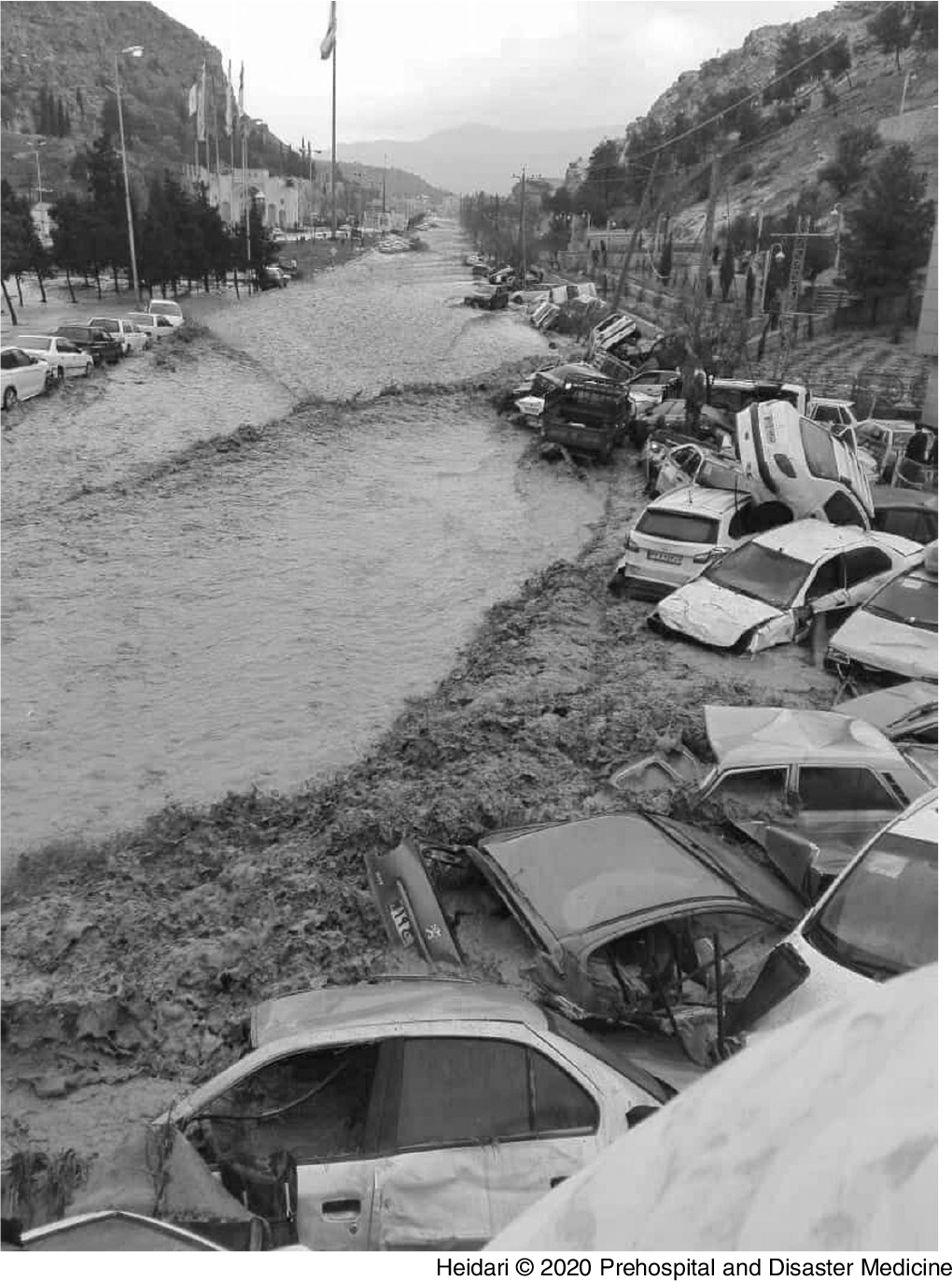
In the historical-cultural city of Shiraz, located in the southwest of Iran, a heavy rainfall started on Monday, March 25, 2019 from 11:33am to 11:48am. During these 15 minutes, between 17 and 26 millimeters (0.7 and 1.0 inches) of rain was recorded at different meteorological stations. This heavy rainfall, being 2000-times heavier compared to the annual average at the similar time, triggered a flash flood in the highlands of the city. The flood running from the entrance of the city (a historic place known as the Quran’s gate) caused 50-75 centimeter-high (20-30 inches) water inundation in the urban roads. This flood was so fast-moving that most of the entangled car drivers and passengers did not find time to leave their cars. According to the formal reports of local authorities, 21 people were killed, more than 120 people were injured, and more than 150 vehicles were damagedReference Beitollahi and Abedi10 (Figure 1).
Vehicles Damaged in the 2019 Shiraz, Iran Flash Flood.

According to the field experts, Shiraz Flood, caused by soil looseness, was a debris flow in essence, which finally led to a deep mudflow. High concentration of sediments increased the specific gravity of the floodwater, which in turn, augmented the floating power of the bodies to such an extent that heavy objects were easily displaced.Reference Wilford, Sakals, Innes, Sidle and Bergerud11
Human-Related Causes of the Disaster
In addition to the extreme and abnormal precipitation caused by climate changes, experts cited the following items as human-related causes for this incident.
Unsustainable Urban Developments
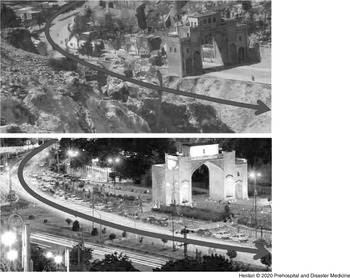
A number of man-made factors were responsible for the flood formation. One of the main causes of soil leaching was the previous destruction of forests and pastures of the region. These land cover changes usually affect the energy balance of the local area.Reference Mazidi and Narangifard12,Reference Seto and Christensen13 During the past years, local authorities in Shiraz have ruined the area vegetation for urban developments. Results of geological surveys also revealed that there was a flood path in this area which was blocked for the construction of a new bridge and the related road (Figure 2). Filling the former watercourse to build the new street increased the slope of the catchment area and transformed the then channel’s route to the local dried river. These measures increased the area’s vulnerability to flood-related hazardsReference Beitollahi and Abedi10 (Figure 2).
Past and Present Photographs of Quran’s Gate, Shiraz, Iran.

Furthermore, after the re-constructions, the opening of the new channel was much tighter than the standard one (ie, only one-fourth of the standard level). Besides, the garbage trap installed on the mentioned tight entrance of the channel was partially obstructed by wastes. Other factors aggravating the issue included failure to dredge the local river, as well as the presence of debris in the main and secondary routes leading to the site of the accident.Reference Beitollahi and Abedi10 All these man-made modifications caused the flood to flow from the road to the city entrance instead of running in its own previous intentionally-made route. Looking at the past and present photographs of the region (Figure 2) illustrates how the past river’s watercourse has been filled to expand the city’s entrance road.
Lack of Early Warning Services
An Early Warning System (EWS) is a key element of disaster risk reduction that prevents loss of life and reduces property damage. An effective EWS composes of four main elements, including risk awareness, monitoring and warning services, dissemination and communication, and response capability.14 A flood EWS is a complex system requiring several technologies and expertise such as sensor equipment; information and communication technology for data transmission sensor; filtering and analysis; modeling software; computational models and simulation; interactive visualization technologies; a decision support system assisting public authorities and citizens in choosing the right flood protection tactics; and finally, remote access to early warning and decision support systems.Reference Krzhizhanovskaya, Shirshov and Melnikova15 Evidence suggests that there is not an efficient EWS (including all four parts of the system) for floods in Iran. Experts believed that there was a 26-minute golden time in the flood incident of Shiraz from the beginning of the unusually heavy rainfall to the formation of the destructive flood which could have enabled the authorities to warn people and taken effective measures to prevent the harms. This golden time duration was wasted. However, it should be mentioned that from the week before the incident, prediction of severe rainfall was announced by the country’s Meteorological Organization (Islamic Republic of Iran Meteorological Organization; Tehran, Iran).16
Discussion
In order to gain a thorough outlook of the causes of the Shiraz 2019 flood, different aspects of the community’s disaster understanding are discussed below.
Disaster Risk Perception of the Public
The risk perception of flash flood by people is dependent on factors such as the extent of flood-encountering experience, sufficient exposure to climate change news, the amount of knowledge and preparedness against flood events, and how they respond to public warnings.Reference Knocke and Kolivras17 In the Shiraz flood incident, despite prior warnings of a possible flood from the country’s Meteorological Organization and the National Disaster Management Organization (NDMO; Ministry of Interior; Tehran, Iran), people at risk did not pay much attention to those warning messages, most probably because they had thought that they were safe inside the cars. The flood was, however, so robust that it easily moved most of the cars on its track. The people killed in the incident were most significantly those who were stuck in their automobiles.
It should be noted that almost one-half of the losses caused by flash flood usually occur in the vehicles. Contrary to people’s beliefs, approximately 30 centimeters (12 inches) of water can cause the vehicles to float, and, if in high speed, can even move the trucks.4 During Shiraz flash flood, people’s inadequate perception of a high-risk area caused them to overlook the value of high locations or the places away from the risk. Instead, they stopped on the flood route to watch the accident in their cars.
Disaster Risk Perception of the Local Authorities
Initial investigations after the incident showed that the city officials were aware of heavy rainfall, but failed to anticipate the occurrence of a flash flood from the city’s entrance road. For that reason, they were staggered by the incident as well. This ignorance caused the incident to have high rate of casualties and to be considered as one of the most disastrous natural disasters in the area (Fars Province), despite its limited scope. Low level of risk perception of officials led to lack of attention to all aspects of the incident, despite their awareness of the potential hazards. This augmented the vulnerability of the region.
Disaster Risk Perception of the Policy Makers
Despite significant advances in disaster management in Iran, experts in the field believe that policymakers generally follow a response-focused approach and do not sufficiently pay heed to prevention and preparedness. These experts believe that senior policymakers regard disaster management as a subsidiary issue. On the other hand, the legal structures designed to manage disasters do not let the disaster risk managers to take independent actions. In other words, Iranian NDMO is under the supervision of a ministry, but not the president. Therefore, they have not been granted sufficient authority to apply disaster mitigation policies, nor is there a specific disaster management commission in Iranian parliament. Challenges arising from the existing structure are rooted in the policies of Iranian relevant policymakers, such as the parliament, the government, and the Expediency Council.18 This fact demonstrates that lack of disaster risk perception is not specific to the people and managers. Senior legislators and policymakers are also engaged in this shortage. Not paying enough attention to the needs of the community resilience and the presence of predominantly reactive, instead of proactive, measures can bring about damages like those of the Shiraz flood incident.
Conclusion
Shiraz flood is a small sample of urbanization without justifiable development considerations in Iran. Low risk perception of policymakers has resulted in lack of regulations for preventing dangerous behaviors, chronic negligence toward disaster risk management, mere disaster-response approaches instead of considering priority for preparedness, and lack of risk mitigation approach. Poor risk perception in managers of various levels, particularly local authorities, can lead to granting permissions for immethodical constructions resulting in manipulation of natural topography of the lands and lack of EWS design and implementation. The community’s unfamiliarity with how to deal with the flood phenomenon and inattention to the warnings can be the consequences of reduced social thoughtfulness and insufficient public pertinent education.
Conflicts of interest
The authors report no conflicts of interest. The authors alone are responsible for the content and writing of the paper.