Introduction
In UK infants, the incidence of permanent childhood hearing impairment (PCHI) equal to or worse than 40dBHL in the better hearing ear is thought to be around 1:1000.Reference Fortnum, Summerfield, Marshall, Davis and Bamford1 One of the most important factors in treatment is early intervention to minimise the impact of hearing impairment on development.Reference Yoshinaga-Itano, Sedey, Coulter and Mehl2, Reference Moeller3 Hearing screening in the UK was previously undertaken between six and 12 months of age, using the health visitor distraction test; screening performed in this way was felt to have a sensitivity of around 40 per cent. With a median detection age of 26 months, health visitor distraction screening did not allow early intervention,Reference Fortnum and Davis4 and 20 per cent of children were never screened.
The concept of universal newborn hearing screening is based on the Rhode Island Hearing Assessment Project, which used transient evoked otoacoustic emissions (TEOAEs) to screen 1850 children. This screen identified 11 children with sensorineural hearing loss, of whom five would not have been identified by targeted screening.Reference Maxon, White, Vohr and Behrens5 (Targeted hearing screening has been used in many areas to screen those children at greater risk of hearing loss due to a variety of factors, e.g. prematurity, prolonged stay in a neonatal intensive care unit, severe jaundice, use of ototoxic antibiotics, family history, etc.)
A systematic review supported the introduction of universal newborn hearing screening in the UK; specifically, screening shortly after birth, using TEOAEs followed by automated auditory brainstem response (ABR) testing where appropriate.Reference Davis, Bamford, Wilson, Ramkalawan, Forshaw and Wright6 Avon, situated in the southwest of England and with a population of approximately 1 000 000 (as per 2001 census information), was established in April 2002 as a first-phase site for the introduction of screening in the UK. The region has approximately 10 000 births a year, and thus more than 44 000 births occurred between April 2002 and July 2006.
All children in the UK now undergo universal hearing screening following one of two protocols. Well babies receive a TEOAE screen, followed by automated ABR testing if no clear response is seen on TEOAE testing. Babies requiring care in neonatal intensive care units for more than 48 hours routinely receive both a TEOAE and an automated ABR screen (for full details see http://hearing.screening.nhs.uk/).
The aims of this study were threefold. Firstly, we aimed to audit the achievement of applicable targets, as set by the Newborn Hearing Screening Programme. Secondly, we aimed to review the children identified by the screening programme over the past four years, paying particular attention to: those who would not have been identified from targeted screening; those who had gone on to be assessed for cochlear implantation; and those who had been identified with possible auditory neuropathy or dys-synchrony. Thirdly, we aimed to obtain outcome measures for children identified as having hearing loss.
Methods
We reviewed the medical records of all children with bilateral Permanent childhood hearing impairment (PCHL) of 40 dBHL or worse identified from universal newborn hearing screening in Avon between April 2002 and July 2006, in order to identify risk factors for hearing loss and dates for completion of screening and initiation of intervention, and also to review serial audiological results (including OAEs and ABRs). In addition, we also examined information on those children put forward for cochlear implantation and those with auditory neuropathy or auditory dys-synchrony. Auditory neuropathy or dys-synchrony is demonstrated by the presence of OAEs and the absence or marked abnormality of ABRs.Reference Starr, Picton, Sininger, Hood and Berlin7 It can be difficult to differentiate this condition from delayed auditory maturation, and some authors feel that this diagnosis should not be made before the age of one year.
These results were compared with the following standards set by the national Newborn Hearing Screening Programme. (1) Follow up of referrals with initial audiological assessment (with exceptions for diagnostic reasons): all parents of babies referred from the screen, who wish to continue, should be offered an appointment that is within four weeks of screening completion. (2) Follow up of referrals with full audiological assessment (with exceptions for diagnostic reasons): 75 per cent of babies requiring further assessment should be seen by two months of age, and 100 per cent by three months of age. (4) Hearing aid fitting offered for confirmed cases of hearing loss where appropriate: all appropriate cases should be offered hearing aid fitting within four weeks of confirmation of hearing loss, unless delayed for management reasons.
Age-standardised data regarding speech and language development and social function, in the form of the Early Support Programme Common Monitoring Protocol, were obtained with the help of the local Teachers of the Deaf from the Bristol Sensory Support Children's Service. This protocol grades development in comparison with normal reference points for specific ages. It covers a number of domains including communication, attending, listening, vocalisation, social and emotional milestones, and play. A score is given for each category, which relates to age-appropriate ‘normal’ development, e.g. stage two relates to a developmental age of two to four months, stage three to four to six months, etc. This is completed by the child's parents in association with teachers of the deaf.
Results
By July 2006, the screening programme had identified 54 children with a persistent, bilateral hearing loss of 40 dBHL or worse in the better hearing ear, from a screened population of approximately 44 000 (given an annual live birth rate of approximately 10 000, with a 98 per cent screening uptake rate). Twenty-two of these children would not have been identified by targeted screening. Nine were assessed for cochlear implantation and seven had been implanted at the time of writing (two were not suitable for implantation). Thirteen of these children were diagnosed with possible auditory neuropathy or dys-synchrony or delayed neural maturation, with nine showing definite improvement in hearing thresholds over time.
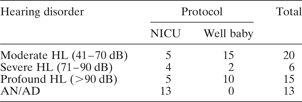
The severity of hearing loss in those children with persistent, bilateral loss of 40 dBHL or worse in the better hearing ear, as assessed by behavioural testing, is shown in Table I.
Child hearing disorders* confirmed by behavioural testing

Data represent patient numbers.
* Persistent, bilateral loss ≥40 dBHL. NICU = neonatal intensive care unit; HL = hearing loss; AN/AD = auditory neuropathy or auditory dys-synchrony
Compliance with Newborn Hearing Screening Programme standards
We assessed compliance with the above mentioned Newborn Hearing Screening Programme standards, considering only those babies who would not have been identified by targeted screening, as follows.
Compliance was assessed for standard one (i.e. follow up of referrals with initial audiological assessment: all parents of babies referred from the screen, who wish to continue, should be offered an appointment that is within four weeks of screening completion). Of the 22 confirmed cases of persistent hearing loss, all referred parents were offered an appointment within four weeks of screen completion.
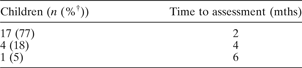
Compliance was assessed for standard two (i.e. follow up of referrals with full audiological assessment: 75 per cent of babies requiring further assessment should be seen by two months of age, and 100 per cent by three months of age). Seventy-seven per cent of children (i.e. 17 of the 22 identified by universal screening who would not have been identified by targeted screening) were seen by two months of age (Table II). Five children (of the 22) were not fully assessed by three months of age but all had been offered appointments by this age. Twenty-one of the 22 were seen by four months and 22 of 22 by six months of age.
Time to full audiological assessment*

* In children requiring further assessment. †Percentage of the 22 children identified by universal screening who would not have been identified by targeted screening. Mths = months
Finally, we assessed compliance with standard three (i.e. hearing aid fitting offered for confirmed cases of hearing loss where appropriate: all appropriate cases should be offered hearing aid fitting within four weeks of confirmation of hearing loss, unless delayed for management reasons). All children were offered hearing aid fitting within four weeks of diagnosis. Fitting was delayed in one case due to illness, in another case when the child temporarily left the area, and in four cases due to parental choice.
Cochlear implants
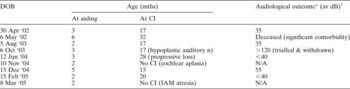
Nine children of the 15 confirmed to have profound (i.e. worse than 90 dBHL) hearing loss were assessed for cochlear implantation over the study period, at the rate of two to three children a year (two children in 2002, two in 2003, three in 2004 and two in 2005). At the time of writing, seven children had been implanted, with an average age of 21 months at implantation (actual ages at implantation were 17, 32, 17, 17, 28, 15 and 20 months; see Table III). Two children had been assessed as unsuitable for implantation due to anatomical anomalies. After implantation, two recipients had aided thresholds better than 35 dBHL (averaging 0.5, 1, 2 and 4 kHz), two had thresholds better than 40 dB and one had a threshold of 55 dBHL. One child had no response to audiological stimuli post-implantation, and one unfortunately died post-implantation due to other causes. Of the six remaining children in the confirmed profound hearing loss group, the parents of one declined implantation in favour of British Sign Language, two had other significant developmental and social problems and remain under review, and three unfortunately died (Tables III and IV).
Data for children assessed for cochlear implantation

* CI-aided thresholds. †Average dB over 0.5, 1, 2 and 4 KHz. DOB = date of birth; CI = cochlear implantation; n = nerve; N/A = not applicable; IAM = internal auditory meatus
Audiological data for children assessed for cochlear implantation

DOB = date of birth; HL = hearing loss; mgmt = management; ABR = auditory brainstem response audiometry; audio = audiological assessment; HT = hearing threshold; SN = sensorineural; prof = profound; CI = cochlear implantation; NR = No response; av = average; assess = assessed for CI suitability; N/A = not applicable
Auditory neuropathy and dys-synchrony
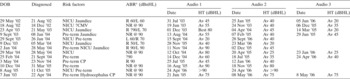
A total of 13 children were identified with possible auditory neuropathy (two in 2002, five in 2003, five in 2004 and one in 2005). Due to the nature of screening in the UK (with ABR being used as an initial screen only in babies requiring neonatal intensive care for more than 48 hours), all of these children had risk factors putting them in the targeted screening group. Nine of these children showed definite improvement in hearing thresholds over time, with an average age of improvement of 12.7 months (range, eight to 24 months). For further information see Table V.
Data for children with auditory neuropathy

* auditory brainstem response audiometry (ABR); right (R) and left (L) thresholds are shown where appropriate. DOB = date of birth; audio = audiological assessment; HT = hearing threshold; NICU = neonatal intensive care unit; CMV = cytomegalovirus; CP = cerebral palsy; NR = no response; av = average
Early Support Programme Common Monitoring Protocol results
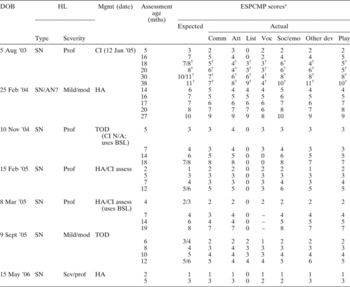
All available Early Support Programme Common Monitoring Protocol results were obtained. Nine children had not been formally assessed by this programme but were reported as having age-appropriate development (three with auditory neuropathy or dys-synchrony, one with profound loss post-implantation, and five with idiopathic hearing loss (one severe, three moderate and one mild)). Some children had moved from the area after diagnosis and did not have results available, and some had not been assessed due to multiple concurrent medical problems; in addition, a small number of children had not survived (results were not available for 12 children: two with auditory neuropathy or dys-synchrony and ten with idiopathic hearing loss (two profound, one severe, six moderate and one mild). In those children who had undergoing formal Early Support Programme Common Monitoring Protocol assessment, there were a wide range of results, as would be expected in a group with a range of hearing impairments, comorbidities and interventions (including monitoring, hearing aids, cochlear implantation and sign language). From the results obtained, it was clear that those children with mild or moderate loss and no other relevant background tended to have normal age-related scores. Children who had undergone cochlear implantation (with good thresholds post-implantation) had relatively delayed results, but at the time of writing these children were showing significant progression. For further information see Table VI.
Early support programme common monitoring protocol scores

* The Early Support Programme Common Monitoring Protocol (ESPCMP) consists of seven categories (communication (comm), attention (att), listening (list), vocalising (voc), social and emotional (soc/emo), other developmental (other dev) and play) scored against normal milestones; an age-appropriate score is given for each age range, from 1 (=age 0–2 months) to 11 (=age 30–36 months). †Results after cochlear implantation. DOB = date of birth; HL = hearing loss; mgmt = management; mths = months; SN = sensorineural; AN = auditory neuropathy; prof = profound; mod = moderate; sev = severe; CI = cochlear implantation; HA = hearing aid; TOD = teacher of the deaf; N/A = not application; BSL = British Sign Language; – = represents not recorded as using BSL
Discussion
Any screening programme has to be justified in terms of the incidence and impact of the disease being screened for, the potential interventions available, and the specificity and sensitivity of the screening test. Hearing impairment can be shown to impact on patients' long-term socioeconomic outcome and quality of life.Reference Wood, Wood, Griffiths, Howarth and Gregory8–Reference Mohr, Feldman, Dunbar, McConkey-Robbins, Niparko and Rittenhouse10 It has been suggested that early identification and intervention results in the best long-term outcome;Reference Yoshinaga-Itano, Sedey, Coulter and Mehl2, Reference Moeller3 screening of newborn children has been observed to be both cost-effective and efficient.Reference Davis, Bamford and Stevens11, Reference Stevens, Hall, Davis, Davies and Dixon12
The UK Newborn Hearing Screening Programme aims to screen all children within two weeks of birth, using an automated measure of OAEs, with further investigation and subsequent appropriate and timely intervention as needed. Otoacoustic emissions are sounds generated in the outer hair cells of the cochlear which can be recorded in the ear canal. They have been shown to indicate cochlear outer hair cell function (although this does not definitively confirm normal hearing) and are used as an initial screening tool in many countries. Similarly, the absence of OAEs will not confirm hearing loss, but such absence will identify the need for further screening using automated ABR testing, followed by referral for full audiological assessment when necessary. Subsequent bilateral, permanent hearing loss of 40 dBHL or worse will be confirmed in approximately one in 1000 screened children.13 In children requiring neonatal intensive care for more than 48 hours, a different screening protocol is used which tests both OAEs and automated ABRs; if clear responses are not obtained on the latter test, then a referral for further audiological investigation will be made. (Children with clear response on automated ABR testing and unilateral no clear response on OAE testing are discharged, whilst those with clear response on AABR and bilateral no clear response on OAE are seen for targeted follow-up at eight months' corrected age). Newborn Hearing Screening Programme Standards require all children referred from initial screening to be offered an appointment within four weeks of completion of screening; in our group of patients, this target was met.
Following identification of a child with hearing impairment, timely initiation of an appropriate strategy of assistance is needed. Children who are identified prior to six months of age and given appropriate support and early intervention have been found to have substantial language benefits at five years of age.Reference Yoshinaga-Itano, Sedey, Coulter and Mehl2, Reference Moeller3 Hearing aids will be an important part of the treatment package for most children.
The importance of engaging the family in the decision-making process is crucial. Positive involvement of the family is a known contributory factor to language outcome at five years.Reference Moeller3 Furthermore, many of these children will need regular and prolonged follow up, with many hospital and clinic visits, and this is often a factor in delayed diagnosis and subsequent attrition. Additionally, many of these patients will suffer with multiple medical and developmental problems which may delay initial screening and subsequent intervention.
Full audiological assessment should, where needed, be completed in 75 per cent of children by two months of age and in 100 per cent by three months of age. In this study, although all patients were contacted for formal audiological assessment and 77 per cent had been assessed by two months of age, the remaining 23 per cent (five children of 22) had still not been assessed by three months due to non-attendance. With regard to subsequent intervention, although appropriate appointments were offered, six children were delayed in aid fitting due to medical problems or parental choice. A number of children progressed from an initial moderate loss, and the decision to fit aids was only made when behavioural tests had been undertaken.
A screening programme can only be as strong as the weakest link in the follow-up chain. Although the sensitivity of the universal newborn hearing screening programme may be 80–90 per cent,Reference Davis, Yoshinaga-Itano and Hind14 this is of no benefit if rates of follow up and timely intervention are allowed to fall. We feel that this raises a number of issues regarding improved follow up of moderate hearing loss cases for further assessment, and improved management of ongoing care for patients who would benefit from aiding but are delayed due to parental choice. Although there is an argument for pushing these children towards hearing aids, we recognise the importance of keeping the parents ‘on board’ the treatment process and of allowing them to come to terms with the diagnoses made and the treatments offered.
It is worth giving consideration to two other groups of patients, namely those with profound hearing loss (and particularly the subset who have gone on to cochlear implantation, since these children stand to gain some of the greatest benefit) and those diagnosed with possible auditory neuropathy or dys-synchrony.
In the current study, fourteen children were confirmed with profound hearing loss, with nine of these assessed for cochlear implantation and seven implanted to date. There is good evidence for improved outcomes, in terms of speech perception and language, with earlier implantation in prelingually deaf children.Reference Nikolopoulos, O'Donoghue and Archbold15–Reference O'Donoghue, Nikolopoulos and Archbold17 More recent work has looked at the effect of implantation at younger and younger ages. Govaerts et al. found the best results, in terms of categories of auditory performance scores and mainstream school integration, in patients implanted before two years of age, with a significant decline in those implanted after four years.Reference Govaerts, De Beukelaer, Daemers, Ceulaer, Yperman and Somers18 Schauwers et al. found improved results, in terms of onset of age-appropriate categories of auditory performance scores and babbling, in children implanted as young as five months.Reference Schauwers, Gillis, Daemers, De Beukelaer and Govaerts19 During the period of the current study, the implant team took an active decision the age has been gradually decreased from the previous target of two years of age. Our cochlear implant patients were aged 17, 32, 17, 17, 28 and 15 months at implantation. Of the two children implanted over the age of 18 months, the child implanted at 28 months suffered a progressive hearing loss from moderate to profound in the better hearing ear, and the child implanted at 32 months had many other medical problems which delayed implantation.
One of the arguments against very early implantation is the possibility of auditory neuropathy. This condition is characterised by normal cochlear outer hair cell function, as judged by present OAEs or cochlear microphonic, but abnormal VIIIth nerve function, as assessed by ABR testing.Reference Starr, Picton, Sininger, Hood and Berlin7 Since this combination of findings covers a wide range of potential pathology not all of which involves neuropathy, it has been suggested that the more appropriate term ‘auditory neuropathy or auditory dys-synchrony’ be used. Since ABR testing assesses neural synchrony in response to external stimuli, loss of synchronous discharge (i.e. auditory dys-synchrony) results in an abnormal ABR recording or an absent ABR. The functional effect of this condition ranges from total deafness to normal hearing in a quiet environment but impaired hearing in background noise. However, the degree of hearing loss does not correspond to the ABR results, and behavioural testing will normally be required in infants to ascertain true hearing thresholds before definitive intervention can be undertaken. The true incidence of auditory neuropathy or dys-synchrony is unknown, but identified risk factors include: hyperbilirubinaemia; anoxia, hypoxia or prolonged assisted ventilation; prematurity of less than 28 weeks' gestation; the presence of other congenital abnormalities; demyelinating conditions and syndromes associated with other peripheral neuropathies.20–Reference Butinar, Zidar, Leonardis, Popovic, Kalaydjieva and Angelicheva22 The natural history of the condition is also variable: abnormal ABRs may regain normal morphology and become consistent with the behavioural threshold; perceptual ability may improve with persistence of abnormal ABRs; OAEs disappear not abnormal results resolve. One of the potential causes of this pattern on screening is delayed maturation of the auditory pathway secondary to prematurity with or without hyperbilirubinaemia. These children tend to recover completely by 12–18 months and should undergo regular reassessment. If recovery has not occurred by this time, other pathology should be suspected. With the recent push towards earlier intervention, including cochlear implantation, it is important to ensure that these children have had sufficient time to develop before significant interventions are undertaken.
One of the arguments against the use of OAE testing alone in universal screening is the resulting failure to identify those children suffering auditory neuropathy or dys-synchrony. It is not surprising, therefore, that all 13 of the children identified with possible auditory neuropathy in the current study had been cared for in a neonatal intensive care unit for more than 48 hours and therefore had received automated ABR screening. Nine of these children had shown definite improvement in hearing thresholds, with an age range for improvement of eight to 24 months. One of the children had OAEs with persistently abnormal ABRs at two-year follow up.
• The incidence of permanent childhood hearing impairment of ≥40 dBHL in the better hearing ear is thought to be around one in 1000 UK infants
• All children in the UK now undergo universal hearing screening
• Well babies receive an otoacoustic emissions screen, followed by auditory brainstem response testing if there is no clear response to emissions testing
• In this audit of neonatal screening in the Avon region of the UK, 54 children with a bilateral hearing impairment of >40 dBHL were identified from a screened population of approximately 44 000
In addition to the need for ongoing surveillance in patients identified as being of concern, it should be remembered that the incidence of persistent significant hearing loss increases with age. This is partly due to postnatal events e.g. meningitis and chemotherapy, partly due to delayed diagnosis of pre-existing conditions, but also due in part to the later onset of the effects of certain genetic mutations.Reference Fortnum, Summerfield, Marshall, Davis and Bamford1, Reference Pagarkar, Bitner-Glindzicz, Knight and Sirimanna23 A recent review of school entry screening reported that, for the 3.47 of every 1000 children who had permanent hearing impairment at school entry age, 1.89 of 1000 had been identified after newborn hearing screening.Reference Bamford, Fortnum, Bristow, Smith, Vamvakas and Davies24 These figures raise two points. The first concerns the identification of false negatives from OAE screening, and whether a screening programme using automated ABR testing would detect a proportion of these children at an earlier age. The argument against using automated ABR testing currently centres around the extra cost of the screening procedure; however, this issue may need revisiting as more information on false negatives from OAE screening becomes available, and as technological advances result in faster and cheaper automated ABR screening. The second point concerns the optimal method of identifying those children who develop hearing impairment after the initial screen; whether this is by a second universal screen or by closer surveillance of children identified as being at risk, through mechanisms such as genetic screening, remains to be seen.Reference Gardner, Oitmaa, Messner, Hoefsloot, Metspalu and Schrijver25
Conclusions
The number of children with hearing loss identified by the current study's screening programme was as expected. The Avon programme was found to be compliant with the Newborn Hearing Screening Programme Standards assessed, although it may be argued that more should be done to ensure timely follow up and intervention in those patients who prove to be poor attenders. Children referred from this screening programme represented two to three cochlear implantations per year, in a screened population of 10 000 births per year. Early detection of hearing loss and subsequent early intervention can be objectively demonstrated to be effective in some of the cases identified in this study.